A gateway at the edge

Photo by Martin Malina (Kalaloch Beach, WA, August 16, 2022)

Today, we stand with the women and disciples at the foot of the cross. We have arrived at the end of our Lenten pilgrimage. Or so we may feel.

We have come now to the base of the hilltop of Golgotha. We have come to the edge. We’ve made it.

We may have been carrying a heavy burden—our own cross. What do you bring? What have you carried? Maybe at this point you realize you can carry it no longer? Because the weight of it is just too much. Because, while at the start of this journey you thought perhaps you could carry it all, you now realize your own limits, your own complicity, your own misguided perceptions, your own sin.

“We come to the edge, when what we hold cannot be contained” (Mahany, 2023, p. 52), when we have to finally lay it down.

Golgotha stood at the edge of the city of Jerusalem. In order to leave the city, or enter it, you had to pass through the place crucifixion, of death. There is no bypass where truth is concerned. Pilate sought refuge in argument and exercising power — that was his bypass. “What is truth?” (John 18:38) he quipped, retreating into abstraction and perceived safety of his privilege and power.

“What is truth?” Jesus’ answer to Pilate? Watch me. Watch what I do. Watch the power of God’s love in the actions of Simon who will carry my cross (Luke 23:26), in the centurion’s cross-side confession (Matthew 27:54). Watch the power of God’s love in those who wait at the edge of the hilltop and witness the day turn to night (Mark 15:33), the curtain in the temple being torn in two (Luke 23:45). Watch the power of God’s love in the grace shown by Joseph to provide a tomb for my body (Luke 23:50-53). Watch what God does, then …

Jesus knew his path. Jesus’ path led through the challenge, the suffering, the cost – not around it. Dietrich Bonhoeffer, the famous Lutheran pastor who was executed by the Nazis 80 years ago this year for opposing Hitler, noted in one of his books, how Jesus fulfilled his call on earth.

But in this short reading, Bonhoeffer extended the example of Jesus into our own lives, as his followers, should we seek peace for our souls at edge of our journeys.

He writes, “Our hearts make sure that we only keep the company of friends, of the righteous and the respectable. But Jesus was to be found right in the midst of his enemies. That is precisely where he wanted to be. We should be there too. It is that which distinguishes us from all other … religions. In them, the pious want to be with one another. But Christ wants us to be in the midst of our enemies, as he was; it was in the midst of his enemies that he dies the death of God’s love and prayed: Father, forgive them for they know not what they do. Christ wants to win his victory among his enemies. Therefore, do not withdraw, do not seclude yourselves; rather seek to do good unto all. Make peace, as far as it depends on you, with all” (Bonhoeffer cited in Barnhill, 2005, p. 31).

This was Jesus’ path, to be in the middle of the tension, the conflict among his enemies. This had always been his way.

For example, Jesus could have avoided Samaria on his way to Galilee. Samarians were in tension and at odds with Jews. Jesus could have gone around. But instead, he travelled through the region, some 150 kilometres on foot. No wonder the Gospel writer reports Jesus as “weary” (John 4:6) when he stops at the well to talk with the Samarian woman. Many others would have gone around. But for Jesus, it is always important to go through even though it cost him. The path is hard.

We have a famous path in Canada. And it isn’t easy to follow. The Path of the Paddle is a series of portages between lakes and rivers from the western edge of Lake Superior into the bush of Northwestern Ontario. The path is part of the Trans Canada Trail. In one of its hardest sections, where in order to travel when the water is not frozen, the trail must be negotiated at the height of bug season, soon upon us. Portaging is not for the faint of heart: each portage means traveling twice – once to carry the canoe, and the other time to carry the gear from one lake’s edge to the next.

This path was first charted by Indigenous people as the Anishinaabe Trail, before it became a major route for Europeans interested in the fur trade. Today, this path is being restored in the hope of re-establishing the original route as it once was.

The 1200-kilometre journey was made by Carrie and John Nolan ten years ago. It involved 120 portages, and it took them 58 days. It was certainly a test of their fitness, endurance and physical and mental stamina (Coman, 2025, April 11).

When we come to the edge, when what we hold can no longer be contained, tears will often fall. Is it any wonder that God turned to water when making our tears? We can go to the water’s edge, when what we hold can no longer be contained. The water’s edge, like at the foot of the cross, is the place to let it all out, to lay it all down, to let it go. The baptismal waters, our place of identity forming in Christ, is sacred, this holy edge. Where we can be honest, vulnerable, and let the tears roll.

I walked only a small portion of the Camino de Santiago in Spain – some 800 kilometres long. It is one of the oldest trails on the planet, dating back over a thousand years to the 9th century. Last year, in 2024, the Camino attracted almost half a million pilgrims.

If you are walking, it could take months to cross the Iberian Peninsula in northern Spain towards the destination. The destination? Pilgrims will say, it is the city of Santiago de Compostella, in the shrine of Saint James.

But increasingly over the years, more and more pilgrims go through Santiago and travel an extra 100 kilometres to a town called Fisterra, whose name literally means, “the end of the world.” This town lies on the coast along the Atlantic Ocean which at one point in history was deemed to be situated literally at the edge of the known world.

Santiago becomes a way point on a journey to a more significant edge where the horizon is limitless and points our vision upward. This extended journey does not end at the Cross but continues beyond the original destination to a more expansive vision beyond the hardship of the trail.

The Cross is not really the end point. That is why Good Friday is good. Because the Cross, while necessary to go through, is merely a gateway to the edge of a new world coming.

References:

Barnhill, C. (Ed.). (2005). A year with Dietrich Bonhoeffer: Daily meditations from his letters, writings, and sermons. Harper One.

Coman, S. (2025, April 11). Streams of living justice [Blog]. Lutherans Connect. https://streamsoflivingjustice.blogspot.com/2025/04/day-33.html

Mahany, B. (2023). The book of nature: The astonishing beauty of God’s first sacred text. Broadleaf Books.

Stripping away

Photo by Martin Malina (Kalaloch Beach, WA, August 15, 2022)

At the end of the service tonight, we engage a ritual that has become a tradition in many churches on Maundy Thursday. We strip the altar.

We take away all the symbols, the candles, the silverware, the embroidery and fabric that are associated with our faith.

We do this in Holy Week – in the context of Jesus’ suffering and dying when everything he had was stripped away, not only his clothing, but his dignity as a human being. Maundy Thursday sets the stage in the grand narrative of Jesus’ Passion for Good Friday when he was nailed to the tree.

Theologian and American writer Brian McLaren writes about how one tree survives the hurricanes that seasonally batter his home state of Florida. “Many of our trees in Florida survive hurricanes by being flexible. They’re able to bend an amazing amount and spring back into shape. [But] One of my favourite trees,” he writes, “has a slightly different strategy.

“It’s called a ‘gumbo-limbo’ tree, and the way it survives a hurricane is that when the wind starts to blow, it just lets branches break off. It knows that if you can keep the trunk solid and stable, and you don’t get overturned by the wind, you can bounce back after the storm. And that’s what the gumbo-limbo tree does. It travels light through the storm. It lets go of everything that’s not essential to focus on for life” (McLaren, 2023).

If you keep the trunk solid and stable, you will find new life after the storm. What is that proverbial trunk in our lives? What was it, in Jesus’ life? What was that power that allowed him to let go of everything and be stripped of all his humanity?

The mandate to love sets the stage for this proverbial stripping. The mandate to love is the command of Jesus we hear on Maundy Thursday – the night he washed the feet of his disciples, shared the meal with them and led them to the garden to pray. This mandate to “love one another just as I have loved you” (John 13:34-35) is the fuel. It is the trunk of the tree: God’s eternal, unconditional, loving presence for all people. But it comes at a cost.

A quote I came across this past week has stuck, the wise saying of a desert mother from early Christianity. She said, “the hardest world you have leave behind is the one you carry right inside your heart” (Lane, 2024). What you carry inside your heart, it would seem to me, is precious. Whatever you hold in your heart is integral to what you perceive to be an important part of your identity. It defines who you are in the world.

This is important stuff. And it struck me that on Maundy Thursday as we strip away the paraments and silverware from the altar, we’re not talking about the knick-knacks, dusty boxes in basements and stuff we keep in storage rental units.

We’re talking about what we would consider the important, life-altering, life-defining stuff. But these are still the branches, not the trunk. You might say what the gumbo-limbo tree does in a hurricane is counter-intuitive, even unreasonable, impossible for us to do. Why would we let go of what we feel most attached to?

It’s significant that the Garden of Gethsemane was the last place to which Jesus led his disciples before he was arrested, before the dominos began to fall in the Passion narrative, a story that then escalates towards Jesus’ arrest, prosecution, persecution and execution.

Jesus led his disciples to the garden to pray. There is a form of prayer whose aim is finding inner peace and contentment in the storm.

Yet this peace cannot be experienced without a painful letting go. It’s a practice, you could say, of stripping away the non-essentials. Prayer is becoming aware of God’s grace and life of Christ with us and for us. And this prayer needs no words from us.

For the desert mothers and fathers, prayer was understood as practising a way of taming the ego’s desires for being front-row-and-centre in all things, including our conversation with God.

So, instead of doing all the talking in this relationship of prayer, we practice doing all the listening. Instead of trying to change God’s mind, prayer is about allowing God to transform the mind and heart of the one doing the praying. In this practice of letting go we allow God to change our mind about what is truly going on around us. We let God change our mind about the reality right in front of us, a reality which we usually dismiss, avoid or even distort.

In our prayer tonight and throughout these coming three holy days, may we practice letting go. In the way of Jesus, may we learn to be like the gumbo-limbo tree, especially during the storms of our lives. Because as long as the trunk remains stable and firmly planted in the ground, new life will surely find a way again.

“And now, faith, hope, and love remain … and the greatest of these is love” (1 Corinthians 13:13).

References:

Lane, B. (2024). “The Desert Tradition,” The Living School: Essentials of Engaged Contemplation. Center for Action and Contemplation. www.cac.org.

McLaren, B. (2024). 2024 Daily meditations: Radical resilience [Video]. Center for Action and Contemplation.  https://cac.org/daily-meditations/2024-daily-meditations-theme-radical-resilience/

Wagamese, R. (2021). Richard Wagamese selected: What comes from spirit.

Gifts & Growth: Receive

Over the past year and a half, I’ve only looked at my guitar sitting in the corner of my home office. It has sat there, lonely, untouched, collecting dust. I have not picked it up once during this time.

So, when I finally did a few days ago, and started plucking a few notes, I wondered – what’s the point? What purpose does it serve to spend valuable time messing around on a musical instrument?

I’m not being really productive playing around on it. Learning a new song won’t yield perfection (to be sure!) and only reminds me of how much my skills have deteriorated by not playing it. Even though, for Lent, I’ve committed to picking it up each day for at least a few minutes at a time, those thoughts plague me: For what purpose? Is it worth the time?

You may have heard of the so-called “Marshmallow Experiments” (Burkeman, 2024), the first of which was conducted at Stanford University by Doctor Walter Mischel in 1970.

In these experiments, Mischel and his colleagues presented children with a single marshmallow and offered them a choice: They could eat it. Or they could wait alone in the room with it for ten minutes. If they succeeded in waiting ten minutes without eating that one marshmallow, they got one more. And so on.

As these experiments unfolded over time, the scientists were able to make some evidence-based conclusions. For one thing, participants who were able to resist temptation went on to enjoy better academic performance and physical health in later childhood, and demonstrated other positive differences as adults (Burkeman, 2024).

The self-discipline not to grab the first marshmallow became an invaluable trait for what’s commonly thought of as a successful, productive life.

Self-denial is a common messaging that we impose on ourselves, often without being aware we are doing so. In other words, we remain perpetually a Lenten people because we never really enjoy the gifts we have received, have amassed, have saved over time. In this mindset, we never get to Easter because we either don’t know how to embrace and receive the treasures we have been given and/or we feel guilty for enjoying gifts from God when we do receive them.

A Canadian Benedictine, the late John Main, was known to say that the greatest sin was not succumbing over and over again to tantalizing temptations. No, the greatest sin was not fully enjoying the good gifts that we have received from God’s bounty and grace.

What gifts have you received? Are they material blessings? But gifts are more than having lots of stuff. There is the gift of music, the talent for precision and patience in woodworking and building things, the gift of listening to another, the care for animals, for growing plants, flowers and vegetables. Gifts are also the gifts of our personalities, our characters, our abilities, our passions, our interests, what we’re good at doing, what we love doing, what we enjoy in each other and in the world.

What today’s scriptures point to is the temptation to believe that we are the source of and engine behind all these gifts and good things we experience in life.

What resulted in Jesus overcoming temptation in the desert was acknowledging the true source of his power in God (Luke 4:1-13). In the accompanying text from Deuteronomy (26:1-11), the temptation is not hunger but prosperity.

When things go well and the harvest is plentiful, the Israelites will be tempted to think that they are self-made. They will be tempted to believe that they have earned their prosperity. They have worked hard for it.

To counter this temptation, God instituted the ritual of first fruits to remind the Israelites that thanksgiving always had priority over self-congratulation (Oldenburg, 2025 March 9).

On this First Sunday in Lent it is good therefore to begin with the gift of receiving. Maybe Lent can be a reminder to us that what we may be so proud to boast about is not our doing. God is the source. We are the vessels. When we recognize our primary role as receptors of God’s grace, we can then let that gift flow through us and to the world around us.

This year, the Gospel of Luke travels with us throughout Lent. And Luke’s emphasis is celebrating the persistence of God’s grace and mercy despite stubborn obstacles.

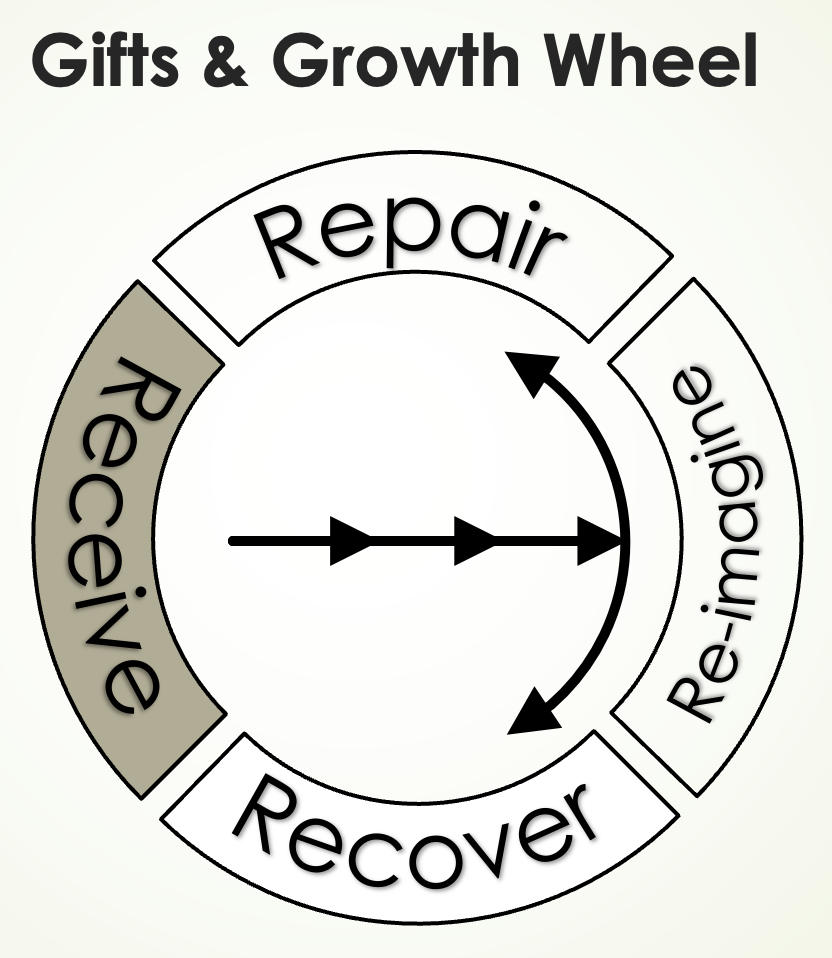
In the series of sermons this Lent, I’ll look at four ‘R’s’ of faithful practice and growth: Receiving, Re-imagining, Repairing and Recovering (Bailey, 2021). Each of these is a great and important gift for the community of faith. We need Receivers as much as we need Re-imaginers, Repairers and Recoverers.

copyright Martin Malina, 2025

Each of us, depending on our individual strengths and gifts, will start in a different quadrant. There are some who are best positioned, because of their God-given personality and character, to start at the receiving end. Others will naturally begin by re-imagining; others first will move into repairing and others still will be best suited to start in the recovering quadrant of this circle.

But for growth and wholeness, a journey of faith is necessary. We can’t remain stuck in just one of the four quadrants. For the gift to bear fruit we need the whole circle, the whole community.

So, what do the Receivers offer? The Receivers are naturally disposed to acknowledge reality as it is – the good and the bad. The receivers among us can more easily accept their lot and enjoy what they have and who they are – without judgement.

Receiving – being able to accept what is – is an incredible gift. To see God’s work in all things. To trust in God’s grace to keep us going into an unknown and uncertain future. To be, as we are.

This spiritual gift is useful in both tempering the productivity bias in our hustle culture. It is to consider that all our accomplishments are for naught, and even a temptation, if they are not placed in the broader perspective of the origin of all good things. It is God’s mercy and grace that are fundamentally operative in our lives. Our gifts bear fruit when we acknowledge the true Source of them in God and God’s mercy.

But, as I said, remaining in this quadrant without the input of the other ‘Rs’ can leave the Receivers – or “mystics”, as they are sometimes called (Ware, 1995)—stuck. They are tempted into distorted thinking that in order to experience God’s presence they need to escape or check-out from the reality of this world.

It’s ironic that the Receivers can, on the one hand, more naturally than all others receive reality as it is. But, on the other hand, the Receivers are also the ones most likely tempted to remove and displace themselves from it. To avoid all the confusion and chaos of the world, Receivers are tempted to retreat into the comforts of their self-created worlds, their private realms.

That two-sides-of-the-same-coin dynamic is characteristic of all the gifts in the circle. Indeed, our greatest gift can be our greatest blind spot.

We all start somewhere on the wheel of gifts and growth. But, for growth to happen, where do we go from there?

The next movement for the receivers is towards the opposite quadrant. For the receivers, it’s towards re-imagining. The Re-imaginers are those who start with the gift of the mind, the gift of clear and constructive thinking. This is what the Receivers need. We’ll talk about the Re-imaginers next week.

Why, you ask, do we first go to the opposite side, and not to either side of the starting point? If the Receivers would first look to the Repairers on one side, Receivers’ action might not be the best course of action in a given situation. It would be like the Receiver realizing they had to do something good in the world, but choose an activity that isn’t relevant, or particularly helpful. Likely, because the Receiver hasn’t done their homework.

On the other side, if the Receivers would first look to the Recoverers, their action might lead to boundary issues. They might over-function, burn out and feel like they needed to do everything to take on the weight of the world and care for everyone, which of course is impossible.

We first need the opposite gift to correct the distortions associated with our starting place on the circle, before moving to the last two quadrants.

This arrowed pattern in the middle of the circle looks like an anchor, intentionally. This pattern of gifts and growth keeps us anchored in our movement towards balance and healthy growth for everyone. The writer to the Hebrews affirmed: “We have this hope as an anchor for the soul, firm and secure” (Hebrews 6:19).

Today, at the start of our Lenten pilgrimage the Receivers among us will say: Thank God! Receive, enjoy and delight in the gifts of God’s doing and grace in your life. You can enjoy that marshmallow that someone gives you today. Don’t deny it. It’s Ok!

In the words of the late Indigenous author Richard Wagamese: “Sure there’s stuff that needs doing, stuff to wade through and stuff to fix but there’s also the joy of small things: a hug, a conversation, playing a song all ragged and rough on an instrument, walking on the land, listening to great music or enjoying silence and a cup of tea. Rejoice. Fill yourself again” (Wagamese, 2021).

Receive.

References:

Bailey, J. (2021). To my beloveds: Letters on faith, race, loss, and radical hope. Chalice Press.

Oldenburg, M. W. (2025, March 9). Crafting the sermon; First Sunday in Lent, Year C. Augsburg Fortress. https://members.sundaysandseasons.com

Wagamese, R. (2021). Richard Wagamese selected: What comes from spirit. Douglas & McIntyre.

Ware, C. (1995). Discover your spiritual type: A guide to individual and congregational growth. Alban Institute.

Changing lanes

photo by Martin Malina (Galetta, Ontario, 2020)

It’s all about change today. In the church year, the Transfiguration of Our Lord Sunday not only pivots us from the Christmas cycle of Advent, Christmas and Epiphany to the Resurrection cycle of Lent, Holy Week, and Easter. The Transfiguration is also an event in the life of Jesus wherein he claims his full divinity without denying his full humanity.

First, Jesus’ appearance changes on the mountaintop (Luke 9:28-43a). His face and clothes become dazzling white. And, the voice from the cloud declares Jesus God’s chosen son. Divine.

But the changes don’t stop there. The story doesn’t end with the disciples’ awe and silence atop the mountain in the cloud. There is a purpose for those mountaintop experiences. The purpose is to live on the earth.

Jesus must continue his ministry, his mission to the cross. Alongside his divinity Jesus has to continue to grapple with his humanity. He has to come down, descend to earth, so to speak, and deal with real people. And he is frustrated and angered when he encounters the people, calling them a “perverse generation”. Yes, this Gospel text about the Transfiguration of Our Lord reveals Jesus’ humanity as much as it does his divinity.

Yet, in both the divine and human Jesus, the glory, the presence and greatness of God is witnessed. “All were astounded at the greatness of the Lord,” concludes the Gospel (Luke 6:28-43a).

But the changes don’t stop there! There are others in this story that experience growth, deeper connection and maturity in faith – the healed boy to say the least, the crowds who witness the miracle, as well as the three disciples who were privileged to accompany Jesus to the mountaintop. They were all impacted in different ways. This event changed them.

This event is a key turning point in the disciples’ awareness and experience of their friend and their Lord. They are growing and changing in their faith. From simple fishermen to martyrs – many of them – there is a long narrative in between. And the transfiguration story is an important milestone in that journey towards growth and maturity.

Yes, today is all about change. The disciples in Jesus’ day represent the church today. We are the body of Christ, together. How does a community of people change, never mind individuals? In our hyper individualized society, we don’t pay enough attention to the changes we undergo as a community of faith.

After the Second World War, Sweden was the only country in continental Europe whose citizens drove on the left side of the road. This caused chaos at border crossings and many head-on collisions. So, on September 3, 1967, citizens in Sweden changed from driving on the left side of the road to the right. They called it, “turn around day”.

Because of opposition to this proposed change, a four-year education program was started four years before September 3, 1967, upon the advice of psychologists, so that at 4:50 a.m., “turn around day” began with all traffic halting for 10 minutes. After the 10 minutes were up, at 5:00 a.m. on September 3, 1967, then everyone changed lanes from driving on the left side to the right side of the roads (Watson & Watson, 2025).

To make their change, the Swedes had to first stop what they had been doing. Psychologists today call it “thought stopping” (Erford, 2020). On the road to recovery and healing, the idea is that one must begin by consciously arresting/stopping the unhelpful automatic thought before substituting an alternative thought, and behaviour.

But long before cognitive behavioural therapists started using this technique, Christian contemplatives were practising a version of thought-stopping in order to make room in their awareness of God. And what they noticed when they stopped everything, including their incessant thinking and activity trying to solve all their problems, what they discovered was that God was already working the desired change in their lives.

The practice was called Statio, the practice of stopping one thing before beginning another. I like to call it a “holy pause”. It is the acknowledgement that in the holy pause is a space of transition and threshold into a sacred dimension. And this holy pause is full of possibility. This place between is a place of stillness, where we let go of what came before and prepare ourselves to enter fully into whatever comes next (Paintner, 2018).

Statio calls us to a sense of reverence for the “fertile spaces” in between all our work and activity “where we can pause and center ourselves and listen” (Paintner, 2018, pp. 8-9). We open up a space within us to receive Christ’s invitation and Spirit to follow the way of Christ, inviting us on the path to healing.

Jesus taught the disciples the importance of a holy pause, on this path of life. The Transfiguration story began in prayer. “They went up a mountain to pray.” That is the way we travel this journey with Jesus. Prayer. In holy pausing, we begin to see God being revealed to us all the time, all around us.

The disciples, you will note, were both elated and terrified. Because those holy pauses aren’t always easy nor are they always immediately gratifying.

The turn-around-day in Sweden was not a popular move, at first. Allegedly some 80% of the population opposed the idea of changing lanes. Maybe because people knew the cost. Whole infrastructures had to be rebuilt and retooled – imagine the cost – signs, intersections, car lights – never mind getting used to driving on the other side of the road (Savage, 2018).

Was it worth it? Car accident insurance claims and more importantly fatal head-on collisions dropped sharply in the months and years following “turn around day”. So, the public effort and expense resulted in saving lives.

And that’s where this Gospel today leads us to and ends with: healing. The cross leads to the empty tomb. That’s the story of the Gospel. Transfiguration – and all those holy pause moments – eventually lead us, in the way of Christ, to resurrection and new life. That is our hope.

References:

Erford, B. T. (2020). 45 techniques every counsellor should know (3rd ed.). Pearson Merrill.

Savage, M. (2018, April 17). A thrilling mission to get the Swedish to change overnight. BBC [website]. https://www.bbc.com/worklife/article/20180417-a-thrilling-mission-to-get-the-swedish-to-change-overnight

Valters Paintner, C. (2018). The soul’s slow ripening. Sorin Books.

Watson, C., & Watson, G. (2025, January 21). Right day. Eternity for Today. Evangelical Lutheran Church in Canada. www.eft.elcic.ca

True power, true love

photo by Martin Malina, 2019

“Love your enemies” (Luke 6:27) is a teaching from Jesus that hits especially hard in today’s economic and political climate. Because loving your opposition is not how you win. Loving your enemies goes against the grain of our conditioning. 

Using a hockey analogy, we naturally want to go on the offensive when facing adversity. We want to fight back, tit-for-tat. Seeking revenge is a strong motivator, isn’t it? 

But good hockey minds know that focusing only on offense usually means losing the game. Avoiding sound defensive play is not a winning strategy. As they say, defence wins championships. 

Winning, in the end, is about nurturing love and care for the battle that goes on in your end of the ice. Loving your enemies is first loving and taking care of your neck of the woods, in your backyard, whenever challenges or personal adversity appear.

So, on the one hand, loving your enemy is NOT about being a doormat and taking abuse. On the other hand, if the aim of any relationship is to always and unquestionably have the upper hand, that is no relationship.

Indeed, the problem with a bulldog approach to the challenges we face is that it more often than not keeps you stuck, by avoiding the things in your own life which you are scared to confront. These are issues that lurk in the places you don’t want to go. Occasions of adversity are invitations and opportunities to first take stock and look in your own life for whatever needs attention there.

Imagine these issues as “gnawing rats” (Loomans cited in Burkeman, 2024). How do you deal with these rats in your life? Impulsively we may want to eradicate and stomp the bad parts out of us, eliminate them completely. With force of willpower we will confront those rats and attack them with brute force and hatred even, eh?

The problem is that this approach simply replaces one kind of hatred (“Stay away from me!”) with another (“I’m going to destroy you!”). And that’s only a recipe for more avoidance over the long term, “because who wants to spend their life fighting rats?” (Burkeman, 2024, p. 62).

“Love your enemies,” says Jesus. What about befriending the rats instead? What about turning towards them and allowing them to exist alongside? There are benefits to this approach. Following Jesus’ command isn’t merely about being mindlessly obedient and doing whatever Jesus says never mind us. Jesus truly had our wellbeing, our healing in mind when he gave us this command. Jesus wants the best for us, wants us to be healthy.

First, to befriend a rat is to defuse the anxiety we feel, because we change the kind of relationship we have with it. We turn that gnawing rat into an acceptable part of our reality. By doing this, we can begin to accept that the situation is real, no matter how fervently we might wish that it weren’t. 

But we need to do something that initially feels uncomfortable. What would it take to befriend the gnawing rats in your life? “Loving your enemy” becomes an act requiring real courage – more courage, perhaps, than the standard confrontational approach. “Loving your enemy” becomes like reconciling yourself to reality rather than getting into a bar fight with it.

This is not passivity nor, as I said, is it being a doormat. It’s a pragmatic way, Jesus teaches, to increase our capacity to do something positive while becoming ever more willing to acknowledge that things are as they are, whether we like it or not (Burkeman, 2024).

Last week walking through the thick snow in the uncharacteristically quiet Arnprior Grove, I caught sight of a quick movement at the base of a tree. But it was too quick for me to recognize what it was. Seeing the tiny creature reminded me of an Indigenous tale taught by the late Canadian writer Richard Wagamese, whose story about true power I paraphrase here:

A young man dreamed of being a great warrior. In his mind’s eye he envisioned himself displaying tremendous bravery and earning the love and admiration of his people. The young man knew that the greatest warriors were those who possessed the strongest spirit and wisdom. He longed to become the greatest defender of his people.

And so he approached the Elder of his village. He told the Old One of his dream, of the great love and respect he felt within himself for his people and of his desire to protect them.

He asked the Old One to grant him the power of the most respected animal in all of the animal kingdom. With this power, the young man would be able to become as widely respected as this animal.

The Old One smiled. Although he appreciated the young man’s earnest desire he recognized that this was the time for a great teaching. So he told the young man that he would gladly grant him this power if the youngster could accurately identify the animal who commanded the most respect from his animal brothers and sisters.

The young warrior smiled. It was obvious to him that the grizzly bear commanded the most respect in the animal world. He stated this to the Elder and sat back awaiting the granting of the bear’s power. 

The Old One smiled. He told the young man to guess again, for despite the immense courage and ferocity of the grizzly, there was one who commanded greater respect.

One by one, the young man named the animals he felt possessed the adequate amount of fierceness, courage, boldness, and fighting power to earn the awe of his four-legged brothers and sisters. He named the wolverine, the eagle, the cougar, the wolf and the bison, but each time the Old One simply smiled and told him to guess again.

Finally, in confusion the young man surrendered. The Elder told the young man he had guessed as wisely as he could. However, not many knew the most respected of animals because the most respected one is seldom seen and even more seldom mentioned. It is the tiny mole, the Old One said.

The tiny, sightless mole who lives within the earth. Because the mole is constantly in touch with Mother Earth, the mole is able to learn from her every day. Whenever some creature walked across the ground above, the mole could feel the vibration in the earth. In order for the mole to know whether or not it was in danger, the mole would always go to the surface to learn more about what created the vibration.

It is said by the Old People that the mole knows when the cougar is prowling above, just as it knows the approach of a human and the scurry of a rabbit. And that is why the tiny mole is the animal among all animals who commands the greatest amount of respect. Because though the mole might put himself at great danger, the mole always takes the time to investigate what it feels (Wagamese, 2021, pp. 47-49).

“Love your enemies,” Jesus says.

Adversity challenges us to activate the better part of ourselves. Because however you define your enemy within and without, the enemy is an opportunity to reset a relationship, to re-balance things, with ourselves, with others, with creation, and with God.

“Love your enemies,” Jesus teaches us, because in the end, it’s about relationships. We were God’s enemy because humanity killed Jesus. Because sin kept us separated from God. What God did was to break down that barrier of enmity by forgiving us, loving us. Jesus gives us a way to deepen and in the end strengthen relationships of love despite the reality, the imperfection of it all, and the adversity we will always face in this life.

“I used to pray for everything I thought I wanted,” prays Richard Wagamese, “big cars, big money, big … everything. Mostly, so I could feel [big]. That was always a struggle. These days I’ve learned to pray in gratitude for what’s already here: prosperity, health, well-being, moments of joy and to pray for the same things for others …. I’m learning to want nothing but to desire everything and to choose what appears. Life is easier that way, more graceful and I AM [big] – but from the inside out” (Wagamese, 2021).

References:

Burkeman, O. (2024). Meditations for mortals: Four weeks to embrace your limitations and make time for what counts. Penguin Random House.

Wagamese, R. (2021). Richard Wagamese selected: What comes from spirit. Douglas & McIntyre.

Freed to be, freed to act

(Photo by Martin Malina, Sandbanks Provincial Park Ontario, 2020)

After witnessing the miracle of Jesus providing the overabundance of fish Simon Peter says, “Go away from me Lord, for I am a sinful man” (Luke 5:1-11). In the presence of a great gift, Simon feels weak.

In the Epistle reading for today (1 Corinthians 15:1-11), Paul confesses, “I am the least of the apostles, unfit to be called an apostle …” In the presence of the divine, Paul realizes his weakness.

When Isaiah sees a vision of the glory of God, he beats his breast and cries, “Woe is me! I am lost, for I am a man of unclean lips, and I live among a people of unclean lips …” (Isaiah 6:1-8). Not only does he confess himself, but he also implicates his own people for failing and falling far short of the glory of God.

Simon Peter, Saint Paul and the prophet Isaiah, were all quick to announce their limits, faults, sins, and weaknesses in the presence of the divine. These are giants of faith and central biblical characters of God’s choosing to bear witness to the message and purpose of God.

When we experience God’s presence, when we experience a miracle, when we bear witness to something of God, we are faced first with our own failing, fault and weakness, which is not easy. It hurts. But we are not left with our broken selves alone. We are given a choice, to embrace who we are, and follow Jesus.

We are free to be, and freed to act.

We are freed to act because we accept what is truly most important. We are freed to act because we can live out of our true selves in Christ. This movement towards freedom from being ruled by our fears, however, is tough.

I remember as a kid freezing my hands outside on a cold winter’s day. They’d get so cold, not quite frostbitten. But when I came into the warm inside, they felt numb and got all red and puffy. My fingers stung for many minutes as the blood slowly returned to the tips of my fingers.

I remember complaining to my parents why they said it was good that my fingers hurt. For one thing, my fingers stinging was a sign that my blood was still flowing there and therefore were still alive! If I didn’t feel anything, that would be really bad.

This turn towards healing begins with honesty and vulnerability. The movement to our healing and transformation begins, like it did with Isaiah, Paul and Simon Peter, by entering on the ground floor with ourselves and others. And so, it begins by stinging.

Coming alive is scary. It hurts. When we realize we are seen in the glory of God’s all-pervasive light means we are changing. Jesus’ statement to Simon, “Do not be afraid” suggests that Simon was afraid bearing witness to the miracle. Because now, his life, should he choose to continue following and listening to Jesus, will change.

What is most important? To what are we making this shift? From what are turning away? What is the treasure we seek?

Fish were a valuable part of the economy in ancient Rome. But fishing was not an entrepreneurial, free enterprise. Fishing was controlled by Rome and profited only the elite. Since Caesar functionally owned Lake Galilee and all the creatures in it, the best of the catch belonged literally to him.

For fishers, like Simon Peter and his cohort, fishing was a subsistence work. Their work was not their own. After Rome got the biggest and best fish, that haul of fish would be heavily taxed in a system of tariffs, duties, and tributes. Those who caught the fish would see little from their sale, just enough to feed their families (Butler-Bass, 2025, February 9).

In that moment, it finally came to a head. In that moment, in the face of a miracle, Simon Peter is faced with the decision whether or not he will continue working for an oppressive regime, whether he will continue to follow Caesar and his unjust policies that benefited only the powerful and rich. Or, whether he will free himself from that.

Simon is not sure he can handle that shift of thinking, of understanding. Just a moment’s hesitation, perhaps. But he and his cohorts, in the end, “leave everything behind” and follow Jesus to treasure people not possessions. Because the treasure of God is not material wealth for the rich. The treasure of God is having compassion for all people.

“In the year 258 the Roman Empire, during one of its many persecutions of the church, ordered that the church turn over its treasure. The task fell to a young deacon named Lawrence who was given three days to complete it.

Immediately Lawrence sold all the liquid assets and gave that to the sick and the widows. He liquidated also all of the property and divided that up amongst the poor. On the third day, he appeared before the emperor who demanded to see the treasures of the church.

Lawrence just turned to behind him and there were the poor, the sick, the hungry, the naked, the stranger in the land, and the most vulnerable. And Lawrence said, ‘These are the treasurers of the church’.” (Eaton, 2025 February 3).

It hurts to let go. But, when it hurts, stay with it. The blood is flowing. God might just be revealing something important about who you are and who you are becoming in Christ, a beloved child of God freed to be, and freed to act.

References: 

Butler Bass, D. (2025, February 9). Sunday musings: Fishing trip … or something else? [blog]. The Cottage. https://dianabutlerbass.substack.com/p/sunday-musings-a12?utm_source=substack&utm_medium=email&utm_content=share

Eaton, E. (2025, February 3). The Evangelical Lutheran church in America. https://www.instagram.com/elca

Mirror mirror

Lake Kioshkokwi at Kiosk, Ontario (photo by Martin Malina, Sept 2022)

There’s always a reason not to act, not to do something. Even if that something is good, is right, is just and kind. Even if that something is God’s call on your life.

It can be dealing with something as ordinary as exercising or picking up the phone to call or text someone. Or it can be deciding on the big issues – relationships, jobs, opportunities – that can change the course of your life. There’s always a reason or reasons not to do those things.

At least we are in good company when we initially think and/or say, “no”, and justify our reasons for not acting on the nudge to pursue a good course of action. The prophet Jeremiah resisted the call of God because he believed himself not up to the task. He disqualified himself by not believing he had the abilities and the confidence to do what God asked him (1:4-10).

There’s always a reason not to do something. Fear is a powerful force. But fear is not evil per se. We have good cause to be afraid. But when our fearful avoidance and resistance overwhelms our pursuit of the good, “our overwhelming fears need to be overwhelmed by bigger and better things” (Bader-Saye, 2007, p. 60).

From where do these bigger and better things come? Contrary to what may first come to mind, these bigger and better things don’t stem from our achievements nor confidence in our abilities. These don’t qualify us in God’s eyes. Neither our resumé nor personality style justify our suitability for doing good. What does, is embracing, being and living out who we are created to be.

God saw who Jeremiah was in the goodness of his heart. God called Jeremiah back to himself, his true self. With all the conditioning of the world around him stripped bare, Jeremiah was called to embrace God’s love for and in himself.

“Mirror, Mirror, on the wall who is the fairest of them all?” The evil queen in the Snow-White fairytale is surprised not to see herself in the mirror. Instead, she sees Snow White. This revelation triggers a conflict between the queen and young Snow White and the Seven Dwarfs (Grimm & Grimm, 1812).

When we look for answers, what does the mirror reveal to us? In the face of conflict, it’s like a mirror is held up to expose the battle going on inside of us. Like the evil queen, we would rather see ourselves, have our opinions validated, have everyone else be like us, reflect who we are. The rage we direct at outsiders, others who are different, others who don’t reflect us, only reveals the conflict raging within ourselves. Being angry at the foreigner indicates a self-hatred more than anything.

Indeed, “We see in a mirror dimly,” writes Saint Paul in his treatise on love in 1 Corinthians 13. “But faith, hope and love remain. And the greatest is love.” Because we shall, one day, see face to face who we truly are in Christ. Beloved. Wipe that mirror clean! To see the goodness in others, the same goodness in you — the good we share.

When our mind’s eye clouds our vision, is it because we have forgotten who we truly are? How smudgy is our mirror? How distorted is our vision? Saint Paul says it is! So, then, look at Jesus.

When faced with the violence and acrimony of the crowd, notice Jesus neither disputes nor argues with them when they lead him to the edge of a cliff. Nor does he back down. He remembers who he is. He is solid in his identity.

And Jesus simply passes through them. He simply goes about his business of showing love to the outsider, just as Elijah was sent by God to care for the widow at Zarephath, and just as Naaman the Syrian was healed from his leprosy by the command of God (Luke 4:21-30).

Who are we? How do we keep from forgetting who we are as people of faith? Martin Luther understood Confession and Forgiveness as “a return and approach to baptism” (Luther, 2000, p. 466). Baptism is the sacrament sealing who we are – our identity in Christ. Every time we face the mirror and come true and honestly to ourselves, we recommit ourselves to baptism. In Confession and Forgiveness, we are being renewed by the love of God Paul described.

God’s love binds us together, not as isolated individuals, but into a whole community in Christ called to care for others and the world God created.

“Before I formed you in the womb I knew you, and before you were born, I consecrated you” (Jeremiah 1:5).

“I have been sustained by you ever since I was born; from my mother’s womb you have been my strength” (Psalm 71:6).

Though these words originated in the context of their lives, these two texts are not just for Jeremiah and the Psalmist. These two passages offer powerful words of hope for us as well: God knows us. God declares us, each of us, as sacred. We can lean on God. God protects us. These passages illustrate a lifelong conversation and a loving relationship between us and God.

Indeed, “today the scripture has been fulfilled in your hearing,” Jesus told the crowd in the synagogue (Luke 4:21), and Jesus tells us.

So, like to the prophets before us, God nudges us, whispering in our hearts the truth of who we are. And when we feel the tensions rise around and in us, we look for where God is in the world.

Maybe not in Nazareth. Maybe not in our own backyard, so to speak. Maybe God is active somewhere else, even in places and in people we least expect.

But that’s where God is, right now. And that’s where God is calling us to join in the Holy Spirit’s work there. Will we follow? Will we trust in the bigger and the better something that can overwhelm our fear?

Because there’s always a reason not to do something good. But what about the reasons to do something good? Remember who we are as followers of Jesus. Because divine love will never forget us.

References:

Bader-Saye, S. (2007). Following Jesus in a culture of fear. Brazos.

Grimm, J. & Grimm, W. (1812). Children’s and household tales. Germany.

Luther, M. (2000). Baptism, the large catechism. In R. Kolb & T. J. Wengert (Eds.), The book of concord (p. 466). Fortress.

Which pieces are missing?

(photo by Martin Malina)

It is finished! The 1000-piece nativity puzzle is now done. Thank you to all who contributed – whether you fitted only one piece or sat for hours in the narthex over the past month and a half, putting it all together. It is complete.

Or is it?

Upon closer observation of the photo above you might notice there are two pieces missing. Just two, out of a 1000. But two, nonetheless. Sucked up in the vacuum cleaner, stuck on the bottom of someone’s boots, or dropped inadvertently in someone’s pant pocket. Who knows? How does that make you feel?

You might think, like me, of parables in the bible where Jesus leaves the 99 sheep to go searching for the one lost sheep (Luke 15:1-7), or the parable in which a woman searches her whole house to find that one, lost coin (Luke 15:8-10).

Whatever you may want to say about Paul’s writing in his letter to the Corinthian church, it has a clear meaning: Every piece matters. Every part is important for the whole (1 Corinthians 12:12-31a) to function well. All the gifts perform vital roles for the overall health and wellbeing of the body.

Paul even goes as far to say, “those members of the body that we think less honorable we clothe with greater honor, and our less respectable members are treated with greater respect, whereas our more respectable members do not need this” (v. 23-24).

In her book Fierce Love, the Rev. Dr. Jacqui Lewis refers to the Zulu concept of ubuntu which means, “I am who I am because we are who we are.” This phrase resonates with Paul’s words in 1 Corinthians. We, the body of Christ, are deeply interrelated, united by one Spirit. Perhaps we could say, “I am Christ in the world because we are Christ in the world” (Lewis, 2021, p. 11).

If each of us is worthy because together we are, this leads us to ask a very relevant question for all our families, communities, teams, groups, neighbourhoods, and nations: What parts are missing? Whose voices are not being heard? What members of the body have been ignored, overlooked, even marginalized, treated as unimportant?

In preparation for the annual meeting later this winter, the council is now searching, as we normally do at the end of terms, for a couple new members to serve. In choosing leaders on council, we can ask the same question: Whose voices in the congregation are not yet represented, nor being heard? Who is not at the table?

I love the children’s book I’ve used for Communion instruction. It’s called, “A Place for You.” The theme is inclusion. That is why in the invitation to the Communion table I will often say, “You are invited without exception.” Because Jesus loves everyone and welcomes all to the table of God’s grace.

The missing pieces challenge us to support and lift up everyone.

In the Gospel for today (Luke 4:14-21) Jesus returns to his hometown Nazareth, the place he grew up, the place where everyone knew who he was as a child. The scroll is given to him – the scroll of the prophet Isaiah – to read publicly. He has no choice which scroll to use. But, from everything Isaiah has to say, Jesus chooses this one particular text.

He could have read anything. The prophet’s words fill a big book, some 66 chapters long. Yet, Jesus focuses on this part. He makes it a point to remind the good people of Nazareth whose marginalized voices God has heard, and whom now God’s people are called to lift up.

What captivates the crowd, as all the eyes of those in the synagogue were fixed on him, was that Jesus distinguished himself, his new role, his mission now as the voice of God to declare what people of faith were called to do with Jesus: to bring good news to the poor, to release the captive, to recover the sight of those who are blind and let the oppressed go free – the economically poor, the incarcerated, the disabled, and the migrant. They belong at the table, too.

This is now the job of the body of Christ to proclaim, in our words and actions. How do we proclaim the words of Jesus in our daily lives? How do we follow Jesus?

In the science fiction dystopian television series Silo (Yost, 2023), 10,000 people have lived for decades in an underground bunker in the shape of a cylinder over a hundred floors deep. They’ve lived in the silo because the air outside is poisoned. At least that’s what they’ve been told.

A mechanic, Juliette Nichols, uses a modified hazmat-type suit to leave the silo and survive outside. But all the people inside don’t know where she has gone or whether she’s still alive. People start to question the truth. A rebellion grows.

A group of mechanics living at the bottom of the silo claim those privileged living closer to the top have not been telling the truth about what is really going on outside the silo. The rebels rally around a spray-painted symbol “JL” and chant “Juliette Lives!” to galvanize their faith.

In Jesus’ day, we have to remember they didn’t have microphones. The Nazarenes would pack the synagogue to listen to the speaker. To make sure everyone got the gist of the speaker’s message especially those at the back of the room, those closest to the speaker would repeat in a loud voice together a phrase the speaker just said. This method of getting the word out is called “the people’s microphone,” the practice of amplifying voices without a sound system (Augsburg Fortress, 2025).

This method requires attentive ears—those nearest must hear and respond to the call of the speaker—and it requires the community’s unified work, lifting up the speaker’s voice together.

Yes, “JL” is our call, too. But for us it is “Jesus Lives!” “Jesus Lives!” is a sign of hope for the fulfillment of what is being called upon the living body of Christ today

But if bringing good news to the poor and releasing the captive was Jesus’ purpose and mission, all evidence today points to the contrary. Had Jesus failed? Has the church failed? Many today, I know, feel that it has on many levels. Because so many people still suffer. And will suffer.

Perhaps a vision of a perfect world free from all suffering is not what Jesus meant. Because if we follow in his steps: From that early synagogue worship service to the hills of Galilee, on the road to Jerusalem, and the way of the cross, we discover that suffering is not God’s will.

Rather, what is God’s will is life in the face of suffering. What is God’s will is courage in the face of fear. What is God’s will is faith in the face of doubt and love in the face of hatred and prejudice. God’s will is to call these things out of the hurt and brokenness that we are and that we find around us. “With Christ, the prophecy is fulfilled, in you and in me” (Evenson, 2025). Because “JL!” Jesus lives. Thanks be to God!

References:

Evenson, B. (2025, January 26). Comments from the cloud of witnesses; Third Sunday after Epiphany /lectionary 3, year C. Augsburg Fortress. https://members.sundaysandseasons.com

Lewis, J. (2021). Fierce love: A bold path to ferocious courage and rule-breaking kindness that can heal the world. Harmony Books.

Yost, G. (Creator). (2023-present). Silo [TV series]. Apple TV+.

Washed in the waters of love

The Jordan River
(photo by Jean Housen, CC BY-SA 3.0 https://creativecommons.org/licenses/by-sa/3.0, via Wikimedia Commons)

There is this sense of judgement in today’s Gospel (Luke 3:15-17, 21-22). Taken alongside the imagery of gathering the wheat and burning the chaff, the announcement of a baptism with Holy Spirit and fire leaves an impression of division, exclusion and judgement (Honig, 2025).

Last weekend my brother and his wife noticed that their outdoor Christmas lights, particularly the spotlight on their nativity scene set up in the flowerbed by the front of their house was mysteriously disconnected during the night.

Examining the scene the following morning they found the bulb lying on the snow a couple feet from the extension cord. Human footprints leading from the sidewalk were evident in the snow. They also noticed what looked like a dog’s footprints in the front yard.

Who did this? Why did they do this? My brother and I came up with a list of several reasons and scenarios that might lead someone to this act of aggression. And they weren’t positive reasons. Our imaginations swirled, as I’m sure you can understand, around worst-case motivations.

If it weren’t for a chance encounter in the local grocery store the next day, I wonder how long and how deep those judgements would burrow into and affect our hearts and minds.

Thankfully, in the grocery store my brother bumped into their next-door neighbour. And immediately the neighbour apologized for their dog’s erratic behaviour the previous night.

Out for their daily late evening walk, the dog had bolted and escaped its leash, and then leapt onto my brother’s yard. The dog began digging up the cords embedded in the snow and pulled apart the outdoor lights, resulting in the displacement of the nativity spotlight. The neighbour promised to replace any damaged cords or lights.

Truth be told.

The New Testament, taken as a whole, proclaims ours is not to judge (Romans 114). In this Gospel text, there is debate about who is the Messiah – John or Jesus (Luke 3: 15-17). The people wondered if it should be John. But even John makes an error in judgement when he expresses by his false humility – “I am unworthy to untie the thong of his sandals.”

Because recall that at the Last Supper, Jesus gets down on his hands and knees to untie the shoes and wash the feet of his disciples (John 13). In his confession, John’s idea of Messiahship was mixed up because being the Messiah was not about fright, might and right – the assumption of many at the time (and today).

Rather, to be the Messiah was to be servant of all, as Jesus modelled. It was God’s choice to make, not the crowds. It was God to judge who was to be the Messiah and who wasn’t. And at Jesus’ baptism (Luke 3:21-22) what was important was the voice of God making it clear on whom God’s mission would fall.

The beloved.

Baptism is a sign and promise of God to confer the blessing of love — to gather together, to end division, to bridge difference and to welcome all into a life that is beloved (Quivik, 2025).

The reason people make great mistakes in judgement and in their behaviour, I suspect, is because they never heard what Jesus heard on the day of his baptism (Rohr, 2021). They have never heard another human voice, much less a voice from heaven bless them by saying, “You are a beloved son. You are a beloved daughter. And in you I am well pleased.”

If we’ve never had anyone believe in us, take delight in us, affirm us, call us beloved, we don’t have anywhere to begin. There’s nothing exciting and wonderful to start with, so we spend our whole lives trying to say those words to ourselves: “I’m okay, I’m wonderful, I’m great.” Which can be helpful, to a point.

But we may not really believe it until that word also comes to us from someone else, someone we adore or at least respect — a partner, a friend, a parent. And when we do hear those words directed at us, we are changed. We are empowered.

Henri Nouwen wrote, “We are the Beloved. We are intimately loved long before our parents, teachers, spouses, children and friends loved or wounded us. That’s the truth of our lives. That’s the truth I want you to claim for yourself. That’s the truth spoken by the voice that says, ‘You are my Beloved’” (Nouwen, 1992, p. 30). This is our greatest need, to hear those words spoken to us. It is the greatest need of everyone.

The banner hanging right behind me is one of my favourites in our church: Christ’s light shines in us. In us. It’s not just that Christ’s light shines. But that it shines in us. And, therefore, like Jesus, because we shine in the light, we, too, are beloved.

That new year’s fright of finding the spotlight on Jesus torn from its extension cord in the front yard of my brother’s house and then finding out the truth of what actually happened, taught me something about how quick I am to judge others.

So, I invite you to consider with me a new year’s resolution that on paper may seem rather soft. But it is more difficult, I imagine, than any new year’s resolution you can make:

Rather than judging others or evaluating them for where they fit on our scales or standards, can we, near the start of the new year and in the way of Jesus, commit to compassionately understand every person we encounter, approaching everyone with humility, with empathy, no exceptions? Can we resolve to begin every encounter with everyone we meet, in our hearts and in our words, with grace and love?

Let us be renewed in the waters, in the river, of God’s never-ending love.

References:

Honig, C. (2025, January 12). Crafting the sermon; Baptism of our Lord /lectionary 1, year C. https://members.sundaysandseasons.com

Nouwen, H. J. M. (1992). Life of the beloved: Spiritual living in a secular world. Crossroad Publishing.

Rohr, R. (2021, October 28). Beginning as beloved; Original goodness. Daily Meditations. https://cac.org/daily-meditations/beginning-as-beloved-2021-10-28/

Quivik, M. A. (2025, January 12). Crafting the sermon; Baptism of our Lord /lectionary 1, year C. https://members.sundaysandseasons.com

On the road to Bethlehem

photo by Jessica Hawley Malina (July 16, 2024 / Hwy 4 between Ucluelet & Tofino BC)

It is a dark night. The cedars drape over the narrow, rocky path, blanketing out what dim starlight shines from the sky above.

A pregnant woman travels with her husband through dangerous territory in a tyrannical age, on the road to Ephrath – a small town on the outskirts of Jerusalem otherwise known as Bethlehem.

Who is this woman with her husband travelling at night?

This story is familiar in the bible. It is Rachel, going where the Lord God commanded. But the story doesn’t end well for Rachel. She dies in labour, on that road to Bethlehem, giving birth to Benjamin. And Rachel’s husband Jacob buries her by the road. He erects a grave in her honour and memory (Genesis 35:16-26).

Generations later, the lamenting prophet Jeremiah picks up the image of Rachel’s tomb on the road to Bethlehem, when the Babylonian captives are forced to march by it into exile (Jeremiah 31:15).

Tonight, Mary and Joseph follow the same path (Luke 2). After passing Rachel’s tomb on the way, Mary would no doubt have remembered the story of Rachel’s tragic end.

When she and Joseph make their anxious way on a dangerous road in the night to be registered in Joseph’s birthplace, what goes through Mary’s mind? Would she, like the faithful Rachel before her, also die on this road in labour? Would she, despite saying yes to God’s call, fail like the captives on their way to Babylon?

That dark night on the dangerous road to Bethlehem no doubt challenged her faith. Anyone who traveled on that rocky, darkened path to Bethlehem was reminded of the often-difficult realities facing God’s people throughout history.

You may be on an uncertain path, this Christmas. Thinking you are nonetheless on the right path, you still question your decision. Because there are reminders along the way from past experiences and memories, that cause you to doubt. And even though you believe you are on the right path, it is dark and hard to see the way. And you question God. Is God even there? Indeed, we travel a dangerous road tonight.

Like the prophet Isaiah, we complain God is nowhere in sight. We cry, O God, “You have hidden your face from us” (Isaiah 64:7).

When we find ourselves in the dark, what do we do?

Like Mary and Joseph making their way on the road to Bethlehem in the night, we can’t wait for sunny days. We keep moving forward in the dark, little by little. Like Mary and Joseph, we move, trusting that whatever challenges we face are already solved. The answer is out there, somewhere in the dark. We just haven’t come across it yet.

Let’s not forget, much of God’s created world relies on darkness as much as light. We need not fear the darkness. For plants and trees, seed germination takes place in the darkness of the soil below the ground. It is in darkness that the roots seek nutrients (Coman, 2024).

We require darkness for birth and growth in the human world as well, not just the seed in the ground, but the seed in the womb, the seed in our souls.

In the dark lie possibilities for intimacy, for rest, for healing. Although we may find journeying in the dark fearsome or confusing, it teaches us to rely on senses other than sight. In the process we learn that darkness bears the capacity for good, gives birth to the good.

What do we do when we find ourselves in the darkness of our own making or what the world has done?

Our work is to name the darkness for what it is and to find what it asks of us. What does the nighttime call us to do? Does the darkness ask a wrong to be made right, for justice to bring the dawn of hope to a night of terror? Does it ask for a candle to give warmth to the shadows, or for companions to hold us in our uncertainty and unknowing, or for a blanket to enfold us as we wait for the darkness to teach us what we need to know?

We need not fear the darkness of this Christmas Eve. It is a holy birth, after all, we celebrate this night.

At home this past Fall we installed LED sensor lights on the outside of the house. Our yard borders on a town pathway that leads into a back field. Sometimes people will take a short cut and walk down that path which has no lighting.

After being installed, two of the three sensor lights worked properly, coming on when sensing movement and shutting off after a minute or so. But the third one would not shut off. It remained on, even during the daytime. And no amount of fiddling with the settings could I get that light to turn off, apart from shutting down all three of them on the same breaker.

It was the light that would not turn off, the light that kept shining in the day when we didn’t notice it. The light was on, even when we didn’t see it.

“God came to us because God wanted to join us on the road, to listen to our story, and to help us realize that we are not walking in circles but moving towards the house of peace and joy.

“This is the great mystery of Christmas that continues to give us comfort and consolation: we are not alone on our journey [in the dark] … Christmas is the renewed invitation not to be afraid and let him – whose love is greater than our own hearts and minds can comprehend – be our companion” (Nouwen, 2004).

“In these … days of darkness and waiting, it may indeed seem that [at first] God’s face is hidden from our sight. But the sacred presence is there, breathing in the shadows” (Richardson, 1998, pp. 1-3).

It is a call to faith, darkness invites. A call to trust in the dawn and the sun that never stops shining. A call to trust in those who come alongside to travel with us to Bethlehem.

On that first Christmas Eve, indeed Mary was reminded of how not so well things turned out for the faithful people who went before her on that dangerous road to Bethlehem.

Yet, if anything, Mary was reminded of how God is there, in the darkness, once again, trying again. Trying again with people of faith to make a place in their lives for the coming of the Lord.

If anything, Mary was reminded that she was indeed on the right path in the dark, going in the direction God was making ready.

Mary Oliver, in her poem entitled “The Uses of Sorrow”, wrote:

Someone I loved once gave me
a box full of darkness
It took me years to understand that this, too, was a gift.

In the Christmas story, God’s face is revealed. The stars in the night sky over Bethlehem shine on a tiny baby’s face. In the midnight hours of that first Christmas, God came into the world in the face of a baby. The dark night gave birth to the greatest gift ever.

Thanks be to God! Merry Christmas!

References:

Coman, S. (2024, December 4). Seeds of hope. Lutherans Connect. https://lcseedsofhope.blogspot.com

Nouwen, H. (2004). Advent and Christmas wisdom from Henri J. Nouwen. Liguori Publications.

Richardson, J. (1998). Night visions: Searching the shadows of Advent and Christmas. United Church Press.