Freed to be, freed to act

(Photo by Martin Malina, Sandbanks Provincial Park Ontario, 2020)

After witnessing the miracle of Jesus providing the overabundance of fish Simon Peter says, “Go away from me Lord, for I am a sinful man” (Luke 5:1-11). In the presence of a great gift, Simon feels weak.

In the Epistle reading for today (1 Corinthians 15:1-11), Paul confesses, “I am the least of the apostles, unfit to be called an apostle …” In the presence of the divine, Paul realizes his weakness.

When Isaiah sees a vision of the glory of God, he beats his breast and cries, “Woe is me! I am lost, for I am a man of unclean lips, and I live among a people of unclean lips …” (Isaiah 6:1-8). Not only does he confess himself, but he also implicates his own people for failing and falling far short of the glory of God.

Simon Peter, Saint Paul and the prophet Isaiah, were all quick to announce their limits, faults, sins, and weaknesses in the presence of the divine. These are giants of faith and central biblical characters of God’s choosing to bear witness to the message and purpose of God.

When we experience God’s presence, when we experience a miracle, when we bear witness to something of God, we are faced first with our own failing, fault and weakness, which is not easy. It hurts. But we are not left with our broken selves alone. We are given a choice, to embrace who we are, and follow Jesus.

We are free to be, and freed to act.

We are freed to act because we accept what is truly most important. We are freed to act because we can live out of our true selves in Christ. This movement towards freedom from being ruled by our fears, however, is tough.

I remember as a kid freezing my hands outside on a cold winter’s day. They’d get so cold, not quite frostbitten. But when I came into the warm inside, they felt numb and got all red and puffy. My fingers stung for many minutes as the blood slowly returned to the tips of my fingers.

I remember complaining to my parents why they said it was good that my fingers hurt. For one thing, my fingers stinging was a sign that my blood was still flowing there and therefore were still alive! If I didn’t feel anything, that would be really bad.

This turn towards healing begins with honesty and vulnerability. The movement to our healing and transformation begins, like it did with Isaiah, Paul and Simon Peter, by entering on the ground floor with ourselves and others. And so, it begins by stinging.

Coming alive is scary. It hurts. When we realize we are seen in the glory of God’s all-pervasive light means we are changing. Jesus’ statement to Simon, “Do not be afraid” suggests that Simon was afraid bearing witness to the miracle. Because now, his life, should he choose to continue following and listening to Jesus, will change.

What is most important? To what are we making this shift? From what are turning away? What is the treasure we seek?

Fish were a valuable part of the economy in ancient Rome. But fishing was not an entrepreneurial, free enterprise. Fishing was controlled by Rome and profited only the elite. Since Caesar functionally owned Lake Galilee and all the creatures in it, the best of the catch belonged literally to him.

For fishers, like Simon Peter and his cohort, fishing was a subsistence work. Their work was not their own. After Rome got the biggest and best fish, that haul of fish would be heavily taxed in a system of tariffs, duties, and tributes. Those who caught the fish would see little from their sale, just enough to feed their families (Butler-Bass, 2025, February 9).

In that moment, it finally came to a head. In that moment, in the face of a miracle, Simon Peter is faced with the decision whether or not he will continue working for an oppressive regime, whether he will continue to follow Caesar and his unjust policies that benefited only the powerful and rich. Or, whether he will free himself from that.

Simon is not sure he can handle that shift of thinking, of understanding. Just a moment’s hesitation, perhaps. But he and his cohorts, in the end, “leave everything behind” and follow Jesus to treasure people not possessions. Because the treasure of God is not material wealth for the rich. The treasure of God is having compassion for all people.

“In the year 258 the Roman Empire, during one of its many persecutions of the church, ordered that the church turn over its treasure. The task fell to a young deacon named Lawrence who was given three days to complete it.

Immediately Lawrence sold all the liquid assets and gave that to the sick and the widows. He liquidated also all of the property and divided that up amongst the poor. On the third day, he appeared before the emperor who demanded to see the treasures of the church.

Lawrence just turned to behind him and there were the poor, the sick, the hungry, the naked, the stranger in the land, and the most vulnerable. And Lawrence said, ‘These are the treasurers of the church’.” (Eaton, 2025 February 3).

It hurts to let go. But, when it hurts, stay with it. The blood is flowing. God might just be revealing something important about who you are and who you are becoming in Christ, a beloved child of God freed to be, and freed to act.

References: 

Butler Bass, D. (2025, February 9). Sunday musings: Fishing trip … or something else? [blog]. The Cottage. https://dianabutlerbass.substack.com/p/sunday-musings-a12?utm_source=substack&utm_medium=email&utm_content=share

Eaton, E. (2025, February 3). The Evangelical Lutheran church in America. https://www.instagram.com/elca

Mirror mirror

Lake Kioshkokwi at Kiosk, Ontario (photo by Martin Malina, Sept 2022)

There’s always a reason not to act, not to do something. Even if that something is good, is right, is just and kind. Even if that something is God’s call on your life.

It can be dealing with something as ordinary as exercising or picking up the phone to call or text someone. Or it can be deciding on the big issues – relationships, jobs, opportunities – that can change the course of your life. There’s always a reason or reasons not to do those things.

At least we are in good company when we initially think and/or say, “no”, and justify our reasons for not acting on the nudge to pursue a good course of action. The prophet Jeremiah resisted the call of God because he believed himself not up to the task. He disqualified himself by not believing he had the abilities and the confidence to do what God asked him (1:4-10).

There’s always a reason not to do something. Fear is a powerful force. But fear is not evil per se. We have good cause to be afraid. But when our fearful avoidance and resistance overwhelms our pursuit of the good, “our overwhelming fears need to be overwhelmed by bigger and better things” (Bader-Saye, 2007, p. 60).

From where do these bigger and better things come? Contrary to what may first come to mind, these bigger and better things don’t stem from our achievements nor confidence in our abilities. These don’t qualify us in God’s eyes. Neither our resumé nor personality style justify our suitability for doing good. What does, is embracing, being and living out who we are created to be.

God saw who Jeremiah was in the goodness of his heart. God called Jeremiah back to himself, his true self. With all the conditioning of the world around him stripped bare, Jeremiah was called to embrace God’s love for and in himself.

“Mirror, Mirror, on the wall who is the fairest of them all?” The evil queen in the Snow-White fairytale is surprised not to see herself in the mirror. Instead, she sees Snow White. This revelation triggers a conflict between the queen and young Snow White and the Seven Dwarfs (Grimm & Grimm, 1812).

When we look for answers, what does the mirror reveal to us? In the face of conflict, it’s like a mirror is held up to expose the battle going on inside of us. Like the evil queen, we would rather see ourselves, have our opinions validated, have everyone else be like us, reflect who we are. The rage we direct at outsiders, others who are different, others who don’t reflect us, only reveals the conflict raging within ourselves. Being angry at the foreigner indicates a self-hatred more than anything.

Indeed, “We see in a mirror dimly,” writes Saint Paul in his treatise on love in 1 Corinthians 13. “But faith, hope and love remain. And the greatest is love.” Because we shall, one day, see face to face who we truly are in Christ. Beloved. Wipe that mirror clean! To see the goodness in others, the same goodness in you — the good we share.

When our mind’s eye clouds our vision, is it because we have forgotten who we truly are? How smudgy is our mirror? How distorted is our vision? Saint Paul says it is! So, then, look at Jesus.

When faced with the violence and acrimony of the crowd, notice Jesus neither disputes nor argues with them when they lead him to the edge of a cliff. Nor does he back down. He remembers who he is. He is solid in his identity.

And Jesus simply passes through them. He simply goes about his business of showing love to the outsider, just as Elijah was sent by God to care for the widow at Zarephath, and just as Naaman the Syrian was healed from his leprosy by the command of God (Luke 4:21-30).

Who are we? How do we keep from forgetting who we are as people of faith? Martin Luther understood Confession and Forgiveness as “a return and approach to baptism” (Luther, 2000, p. 466). Baptism is the sacrament sealing who we are – our identity in Christ. Every time we face the mirror and come true and honestly to ourselves, we recommit ourselves to baptism. In Confession and Forgiveness, we are being renewed by the love of God Paul described.

God’s love binds us together, not as isolated individuals, but into a whole community in Christ called to care for others and the world God created.

“Before I formed you in the womb I knew you, and before you were born, I consecrated you” (Jeremiah 1:5).

“I have been sustained by you ever since I was born; from my mother’s womb you have been my strength” (Psalm 71:6).

Though these words originated in the context of their lives, these two texts are not just for Jeremiah and the Psalmist. These two passages offer powerful words of hope for us as well: God knows us. God declares us, each of us, as sacred. We can lean on God. God protects us. These passages illustrate a lifelong conversation and a loving relationship between us and God.

Indeed, “today the scripture has been fulfilled in your hearing,” Jesus told the crowd in the synagogue (Luke 4:21), and Jesus tells us.

So, like to the prophets before us, God nudges us, whispering in our hearts the truth of who we are. And when we feel the tensions rise around and in us, we look for where God is in the world.

Maybe not in Nazareth. Maybe not in our own backyard, so to speak. Maybe God is active somewhere else, even in places and in people we least expect.

But that’s where God is, right now. And that’s where God is calling us to join in the Holy Spirit’s work there. Will we follow? Will we trust in the bigger and the better something that can overwhelm our fear?

Because there’s always a reason not to do something good. But what about the reasons to do something good? Remember who we are as followers of Jesus. Because divine love will never forget us.

References:

Bader-Saye, S. (2007). Following Jesus in a culture of fear. Brazos.

Grimm, J. & Grimm, W. (1812). Children’s and household tales. Germany.

Luther, M. (2000). Baptism, the large catechism. In R. Kolb & T. J. Wengert (Eds.), The book of concord (p. 466). Fortress.

Which pieces are missing?

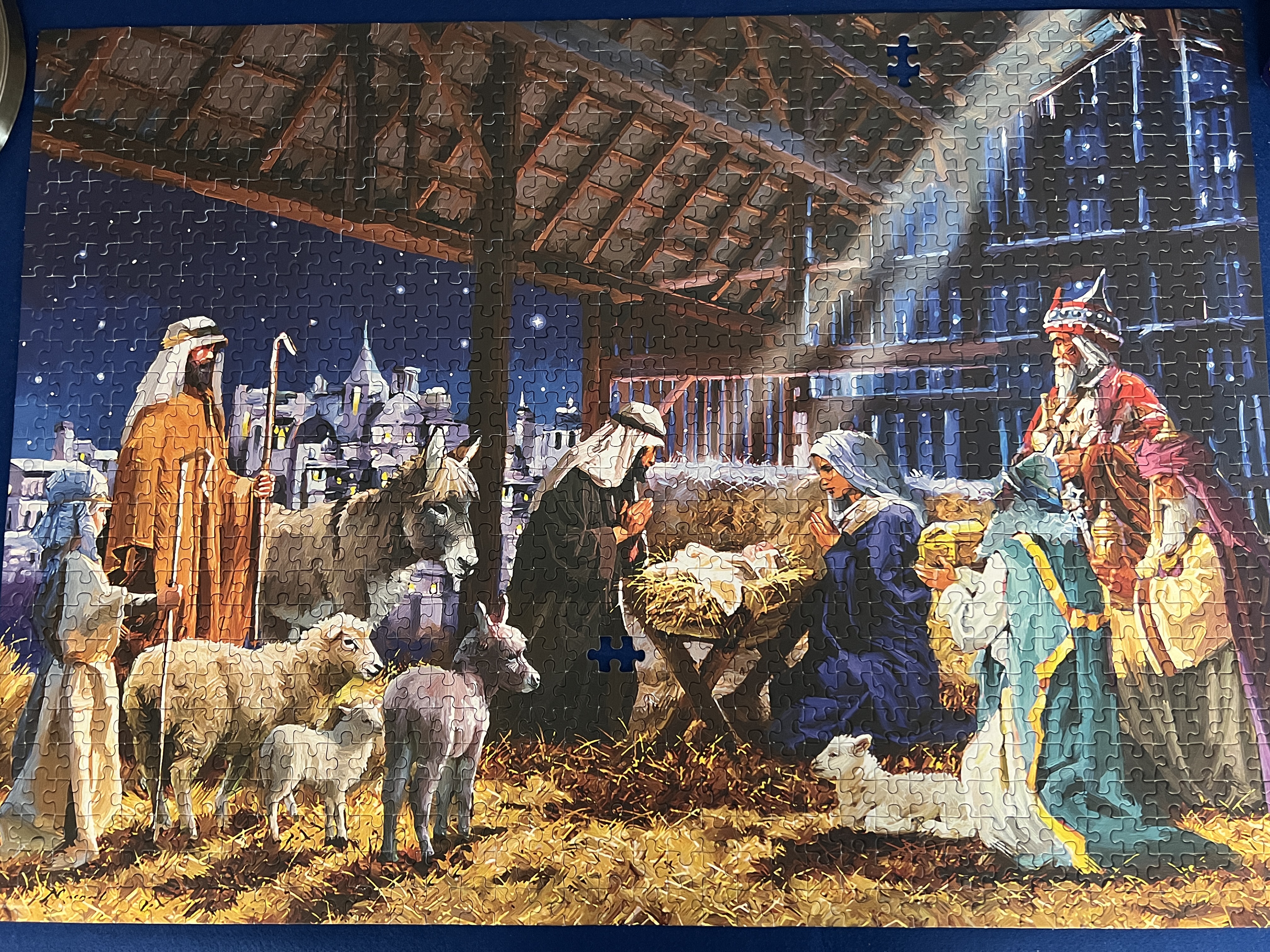
(photo by Martin Malina)

It is finished! The 1000-piece nativity puzzle is now done. Thank you to all who contributed – whether you fitted only one piece or sat for hours in the narthex over the past month and a half, putting it all together. It is complete.

Or is it?

Upon closer observation of the photo above you might notice there are two pieces missing. Just two, out of a 1000. But two, nonetheless. Sucked up in the vacuum cleaner, stuck on the bottom of someone’s boots, or dropped inadvertently in someone’s pant pocket. Who knows? How does that make you feel?

You might think, like me, of parables in the bible where Jesus leaves the 99 sheep to go searching for the one lost sheep (Luke 15:1-7), or the parable in which a woman searches her whole house to find that one, lost coin (Luke 15:8-10).

Whatever you may want to say about Paul’s writing in his letter to the Corinthian church, it has a clear meaning: Every piece matters. Every part is important for the whole (1 Corinthians 12:12-31a) to function well. All the gifts perform vital roles for the overall health and wellbeing of the body.

Paul even goes as far to say, “those members of the body that we think less honorable we clothe with greater honor, and our less respectable members are treated with greater respect, whereas our more respectable members do not need this” (v. 23-24).

In her book Fierce Love, the Rev. Dr. Jacqui Lewis refers to the Zulu concept of ubuntu which means, “I am who I am because we are who we are.” This phrase resonates with Paul’s words in 1 Corinthians. We, the body of Christ, are deeply interrelated, united by one Spirit. Perhaps we could say, “I am Christ in the world because we are Christ in the world” (Lewis, 2021, p. 11).

If each of us is worthy because together we are, this leads us to ask a very relevant question for all our families, communities, teams, groups, neighbourhoods, and nations: What parts are missing? Whose voices are not being heard? What members of the body have been ignored, overlooked, even marginalized, treated as unimportant?

In preparation for the annual meeting later this winter, the council is now searching, as we normally do at the end of terms, for a couple new members to serve. In choosing leaders on council, we can ask the same question: Whose voices in the congregation are not yet represented, nor being heard? Who is not at the table?

I love the children’s book I’ve used for Communion instruction. It’s called, “A Place for You.” The theme is inclusion. That is why in the invitation to the Communion table I will often say, “You are invited without exception.” Because Jesus loves everyone and welcomes all to the table of God’s grace.

The missing pieces challenge us to support and lift up everyone.

In the Gospel for today (Luke 4:14-21) Jesus returns to his hometown Nazareth, the place he grew up, the place where everyone knew who he was as a child. The scroll is given to him – the scroll of the prophet Isaiah – to read publicly. He has no choice which scroll to use. But, from everything Isaiah has to say, Jesus chooses this one particular text.

He could have read anything. The prophet’s words fill a big book, some 66 chapters long. Yet, Jesus focuses on this part. He makes it a point to remind the good people of Nazareth whose marginalized voices God has heard, and whom now God’s people are called to lift up.

What captivates the crowd, as all the eyes of those in the synagogue were fixed on him, was that Jesus distinguished himself, his new role, his mission now as the voice of God to declare what people of faith were called to do with Jesus: to bring good news to the poor, to release the captive, to recover the sight of those who are blind and let the oppressed go free – the economically poor, the incarcerated, the disabled, and the migrant. They belong at the table, too.

This is now the job of the body of Christ to proclaim, in our words and actions. How do we proclaim the words of Jesus in our daily lives? How do we follow Jesus?

In the science fiction dystopian television series Silo (Yost, 2023), 10,000 people have lived for decades in an underground bunker in the shape of a cylinder over a hundred floors deep. They’ve lived in the silo because the air outside is poisoned. At least that’s what they’ve been told.

A mechanic, Juliette Nichols, uses a modified hazmat-type suit to leave the silo and survive outside. But all the people inside don’t know where she has gone or whether she’s still alive. People start to question the truth. A rebellion grows.

A group of mechanics living at the bottom of the silo claim those privileged living closer to the top have not been telling the truth about what is really going on outside the silo. The rebels rally around a spray-painted symbol “JL” and chant “Juliette Lives!” to galvanize their faith.

In Jesus’ day, we have to remember they didn’t have microphones. The Nazarenes would pack the synagogue to listen to the speaker. To make sure everyone got the gist of the speaker’s message especially those at the back of the room, those closest to the speaker would repeat in a loud voice together a phrase the speaker just said. This method of getting the word out is called “the people’s microphone,” the practice of amplifying voices without a sound system (Augsburg Fortress, 2025).

This method requires attentive ears—those nearest must hear and respond to the call of the speaker—and it requires the community’s unified work, lifting up the speaker’s voice together.

Yes, “JL” is our call, too. But for us it is “Jesus Lives!” “Jesus Lives!” is a sign of hope for the fulfillment of what is being called upon the living body of Christ today

But if bringing good news to the poor and releasing the captive was Jesus’ purpose and mission, all evidence today points to the contrary. Had Jesus failed? Has the church failed? Many today, I know, feel that it has on many levels. Because so many people still suffer. And will suffer.

Perhaps a vision of a perfect world free from all suffering is not what Jesus meant. Because if we follow in his steps: From that early synagogue worship service to the hills of Galilee, on the road to Jerusalem, and the way of the cross, we discover that suffering is not God’s will.

Rather, what is God’s will is life in the face of suffering. What is God’s will is courage in the face of fear. What is God’s will is faith in the face of doubt and love in the face of hatred and prejudice. God’s will is to call these things out of the hurt and brokenness that we are and that we find around us. “With Christ, the prophecy is fulfilled, in you and in me” (Evenson, 2025). Because “JL!” Jesus lives. Thanks be to God!

References:

Evenson, B. (2025, January 26). Comments from the cloud of witnesses; Third Sunday after Epiphany /lectionary 3, year C. Augsburg Fortress. https://members.sundaysandseasons.com

Lewis, J. (2021). Fierce love: A bold path to ferocious courage and rule-breaking kindness that can heal the world. Harmony Books.

Yost, G. (Creator). (2023-present). Silo [TV series]. Apple TV+.

Present to Presence

photo by Martin Malina

About once a month I have lunch at Denny’s on Merivale with a dear friend of mine. His name is Jack Murta. He is a retired politician. He was a Member of Parliament from Manitoba in the late 1980s. A member of the Progressive Conservative Party, Jack served as the Minister of Tourism in the Brian Mulroney government.

Today, he sits on the Board of the Mission in downtown Ottawa and leads Christian Meditation groups there for people who are homeless. Jack and I spend a lot of our time talking about politicians and how they related with one another back in the day. Indeed, much of our conversation recalls the past.

In the Gospel reading for today (John 2:1-11), guests to a wedding party in Cana, Galilee, meet most likely in a garden setting, to celebrate a joyous occasion.

Certain clues in the story attract our attention. I’d like to point out, first, the empty jars normally filled with water used for the Jewish rite of purification. People engaging this rite did not drink the water. It stayed on the outside of their bodies when they immersed themselves in the bath.

The jars in this story direct peoples’ attention to their past, their Jewish tradition and ritual. The garden also was the usual setting where Jewish weddings took place, a reference to the Garden of Eden in the first book of the bible – Genesis (Shaia, 2021). The jars and garden are indicative of tradition, the past, the way things had always been done.

And not only does the Gospel look to the past, it points us to the future as well. “My hour has not yet come.” Jesus hints to Mary about his future path, when Jesus’ purpose will be fulfilled on the cross and by the empty tomb.

But it’s the present moment where the miracle—the sign—happens. It’s into the present moment that the Gospel ultimately draws us. “You have kept the good wine until now.” The steward recognizes Jesus’ act of bringing an unexpected gift for the guests.

And Jesus’ action in the present does more than merely get the bridegroom out of an embarrassing social faux pas. The unexpected gift is good wine, not normally offered late in the party. It’s in the present moment, even in an unpleasant situation, when people enjoy themselves.

Brain studies have examined where most of our time is spent thinking. They show that we spend most of our time thinking either about the past or the future; and, between these two, most of it is about the past. In other words, being fully present in the moment is not where we spend most of our time. And this is true even among young adults (Bellana et al., 2017).

Our thinking, entrenched in the past or fantasizing about the future, is also closely related to speech. Thoughts and words go hand in hand. Talking a lot is related to thinking a lot (about the past).

But in the Gospel, it’s more about what is not said that draws my attention. Mary does not tell Jesus what to do. She merely points to the problem. And leaves it up to her son.

The head steward didn’t know where the wine came from, but the servants knew because they drew the water for the jars as per Jesus’ instruction. How did they know it had turned to wine? Did they taste it, before and after? If it were left up to the dialogue alone, what was said out loud, we would be missing important pieces. There would be gaps in the story filled in only by observing behaviour.

As much as 80% of what is communicated takes place on the nonverbal level: our tone of voice, our body position and movement, our facial expressions, the direction of our eyes (Mehrabian, 1972).

What is more, if you want to be friendly, or hostile, your body language is over 12 times stronger in getting the message across than anything you might say (Argyle et al., 1971). What we do and how we do it speaks volumes. Words are important but have power only when anchored in the present reality. Simply pointing to the reality without judgement nor instruction, without any hint of direction nor evaluation, Mary said to Jesus: “They have no wine.” Fact.

Events and situations that bring us into the present reality are often not initially pleasant. We resist the present moment because we may be afraid of what we encounter there.

From the garden to the hospital. There aren’t other settings that bring us, force us, to the present moment more as in the hospital. When we are sick or visiting someone who is ill, or working in the hospital setting as a nurse, PSW, doctor – being there makes us grapple with the sometimes-harsh realities of the present moment.

And in that present moment, very few words are necessary when it comes down to it. The past, the future, these are all important and good. But when it comes down to it, presence is all we need in the present moment.

My friend, the retired Member of Parliament, Jack Murta, was also good friends with one of Speakers of the House of Commons at the time. And when you think about it – a politician Member of Parliament and a Speaker of the House – you can imagine the jokes about them entering a bar: There would be a lot of words spoken to say the least! Even the name – “Speaker” of the House – evokes images of a whole lot of verbiage. Words. Words. Words!

And yet, at the end of his long life, when this Speaker of House was dying in the hospital, he indicated he wanted to see Jack one last time. So, Jack drove to the hospital. And at this point the Speaker was no longer saying much of anything. But when Jack sat down beside him, the Speaker reached out and Jack took his hand in his own. And for many minutes they just sat there without saying a word. The touch of his hand was all the Speaker wanted and needed in that moment.

What mattered, what really mattered, was not the past on earth nor the future on earth. What mattered, what really mattered, was not saying a whole lot of words anymore. Because the joy of living even in that desperate moment, the true joy was found in the simple touch of another in the present moment.

I mentioned the water for the purification rite. It stayed on the outside of the human body. We don’t normally drink our bath water. Jesus performed a miracle of transformation: from water to wine.

When we celebrate Holy Communion, wine is offered. Jesus transformed an understanding of religion from external ritual to internal reality. We don’t wash our bodies with wine. We drink it. We bring it inside of us. We consume it. We digest it. It becomes part of us.

Holy Communion invites us to be present in the moment. To touch. To feel. To drink. To taste. To eat. Let this sacrament in which we participate weekly give us an occasion to practice being present to the holy Presence of God in Christ Jesus. So, with Christ’s presence in us now, we can be God’s loving presence in the world by what we say and what we do.

Behold, now is a very acceptable time; Behold, now is the day of salvation (2 Corinthians 6:2).

References:

Argyle, M., Akema, F., & Gilmour, R. (1971). The communication of friendly or hostile attitudes by verbal and nonverbal signals. European Journal of Social Psychology, 1, 385–402.

Bellana, B., Liu, Z. X., Diamond, N. B., Grady, C. L., & Moscovitch, M. (2017). Similarities and differences in the default mode network across rest, retrieval, and future imagining. Human Brain Mapping, 38, 1155-1171. https://doi.org/10.1002/hbm.23445

Mehrabian, A. (1972). Nonverbal communication. Aldine.

Shaia, A. J. (2021). Heart and mind: The four-gospel journey for radical transformation. Quadratos.

Washed in the waters of love

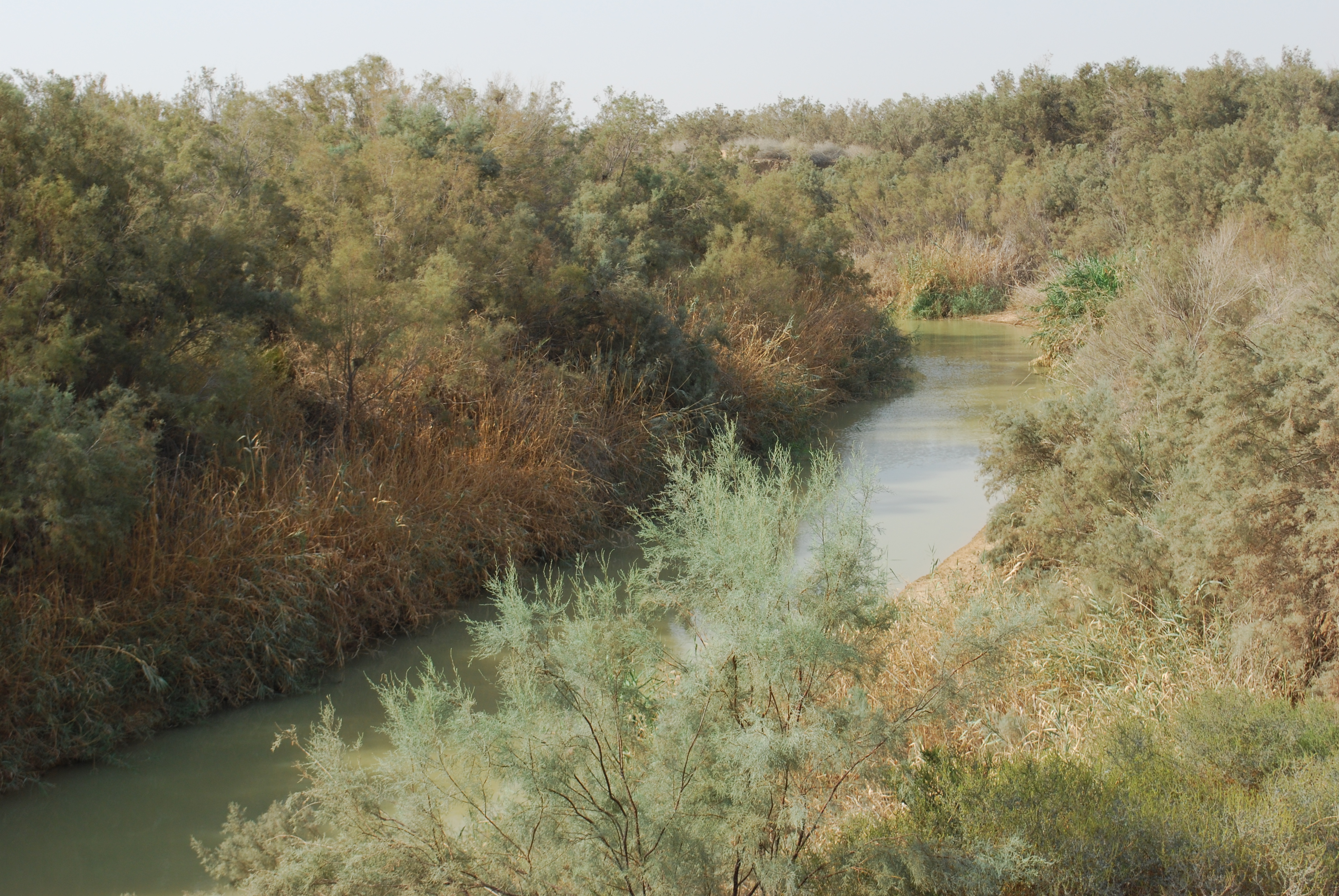
The Jordan River
(photo by Jean Housen, CC BY-SA 3.0 https://creativecommons.org/licenses/by-sa/3.0, via Wikimedia Commons)

There is this sense of judgement in today’s Gospel (Luke 3:15-17, 21-22). Taken alongside the imagery of gathering the wheat and burning the chaff, the announcement of a baptism with Holy Spirit and fire leaves an impression of division, exclusion and judgement (Honig, 2025).

Last weekend my brother and his wife noticed that their outdoor Christmas lights, particularly the spotlight on their nativity scene set up in the flowerbed by the front of their house was mysteriously disconnected during the night.

Examining the scene the following morning they found the bulb lying on the snow a couple feet from the extension cord. Human footprints leading from the sidewalk were evident in the snow. They also noticed what looked like a dog’s footprints in the front yard.

Who did this? Why did they do this? My brother and I came up with a list of several reasons and scenarios that might lead someone to this act of aggression. And they weren’t positive reasons. Our imaginations swirled, as I’m sure you can understand, around worst-case motivations.

If it weren’t for a chance encounter in the local grocery store the next day, I wonder how long and how deep those judgements would burrow into and affect our hearts and minds.

Thankfully, in the grocery store my brother bumped into their next-door neighbour. And immediately the neighbour apologized for their dog’s erratic behaviour the previous night.

Out for their daily late evening walk, the dog had bolted and escaped its leash, and then leapt onto my brother’s yard. The dog began digging up the cords embedded in the snow and pulled apart the outdoor lights, resulting in the displacement of the nativity spotlight. The neighbour promised to replace any damaged cords or lights.

Truth be told.

The New Testament, taken as a whole, proclaims ours is not to judge (Romans 114). In this Gospel text, there is debate about who is the Messiah – John or Jesus (Luke 3: 15-17). The people wondered if it should be John. But even John makes an error in judgement when he expresses by his false humility – “I am unworthy to untie the thong of his sandals.”

Because recall that at the Last Supper, Jesus gets down on his hands and knees to untie the shoes and wash the feet of his disciples (John 13). In his confession, John’s idea of Messiahship was mixed up because being the Messiah was not about fright, might and right – the assumption of many at the time (and today).

Rather, to be the Messiah was to be servant of all, as Jesus modelled. It was God’s choice to make, not the crowds. It was God to judge who was to be the Messiah and who wasn’t. And at Jesus’ baptism (Luke 3:21-22) what was important was the voice of God making it clear on whom God’s mission would fall.

The beloved.

Baptism is a sign and promise of God to confer the blessing of love — to gather together, to end division, to bridge difference and to welcome all into a life that is beloved (Quivik, 2025).

The reason people make great mistakes in judgement and in their behaviour, I suspect, is because they never heard what Jesus heard on the day of his baptism (Rohr, 2021). They have never heard another human voice, much less a voice from heaven bless them by saying, “You are a beloved son. You are a beloved daughter. And in you I am well pleased.”

If we’ve never had anyone believe in us, take delight in us, affirm us, call us beloved, we don’t have anywhere to begin. There’s nothing exciting and wonderful to start with, so we spend our whole lives trying to say those words to ourselves: “I’m okay, I’m wonderful, I’m great.” Which can be helpful, to a point.

But we may not really believe it until that word also comes to us from someone else, someone we adore or at least respect — a partner, a friend, a parent. And when we do hear those words directed at us, we are changed. We are empowered.

Henri Nouwen wrote, “We are the Beloved. We are intimately loved long before our parents, teachers, spouses, children and friends loved or wounded us. That’s the truth of our lives. That’s the truth I want you to claim for yourself. That’s the truth spoken by the voice that says, ‘You are my Beloved’” (Nouwen, 1992, p. 30). This is our greatest need, to hear those words spoken to us. It is the greatest need of everyone.

The banner hanging right behind me is one of my favourites in our church: Christ’s light shines in us. In us. It’s not just that Christ’s light shines. But that it shines in us. And, therefore, like Jesus, because we shine in the light, we, too, are beloved.

That new year’s fright of finding the spotlight on Jesus torn from its extension cord in the front yard of my brother’s house and then finding out the truth of what actually happened, taught me something about how quick I am to judge others.

So, I invite you to consider with me a new year’s resolution that on paper may seem rather soft. But it is more difficult, I imagine, than any new year’s resolution you can make:

Rather than judging others or evaluating them for where they fit on our scales or standards, can we, near the start of the new year and in the way of Jesus, commit to compassionately understand every person we encounter, approaching everyone with humility, with empathy, no exceptions? Can we resolve to begin every encounter with everyone we meet, in our hearts and in our words, with grace and love?

Let us be renewed in the waters, in the river, of God’s never-ending love.

References:

Honig, C. (2025, January 12). Crafting the sermon; Baptism of our Lord /lectionary 1, year C. https://members.sundaysandseasons.com

Nouwen, H. J. M. (1992). Life of the beloved: Spiritual living in a secular world. Crossroad Publishing.

Rohr, R. (2021, October 28). Beginning as beloved; Original goodness. Daily Meditations. https://cac.org/daily-meditations/beginning-as-beloved-2021-10-28/

Quivik, M. A. (2025, January 12). Crafting the sermon; Baptism of our Lord /lectionary 1, year C. https://members.sundaysandseasons.com

Stoppage time: the waiting game

“Prepare the way of the Lord!” shouts John the Baptist in the wilderness (Luke 3:1-6).

There was a child who was asked to read a part in a Christmas pageant at church. She had the part of John the Baptist. She was perfect for the role, a firecracker of a personality, a born leader. She had many friends who listened to her and followed her on the playground.

But she was worried that she would make a mistake or forget her lines. She told her parents that she didn’t want to go in front of so many people. It made her stomach upset and she felt scared.

Her parents told her stage fright was normal and that the best way to deal with her fear was to be prepared. Being prepared meant going over her lines 10,000 times in the weeks leading up to the play until she could fall asleep reciting her lines perfectly.

She protested. What if her mind would blank out when getting on stage? What if all that practice would mean nothing if she froze under the lights? Why should she even bother trying?

Preparation is the virtue we hail in Advent, when we are called to watch and wait – and prepare! – for the coming of the Lord at Christmas.

But what happens when we don’t have time to prepare everything just right? What happens when we are not prepared, when it comes down to it?

The notion that during Advent we are to wait, at first seems ludicrous. There is no time. How can we wait when there is so much to do (to prepare!)?

But what if the key to being prepared is learning and practising the art of waiting?

Because the truth is, no amount of preparation can prevent a tragedy from happening just as no amount of preparation can have you ready for the birth of a child when it happens. When it happens, at some profound level, we know we can never be fully prepared. When it happens, we know that we could never have anticipated and controlled for every contingency. So, what if being prepared means we know how to wait for it? Could it be, maybe we need first to learn how to wait?

From the Gospel, waiting first means we need to slow down. When shopping malls, parking lots and highways in December indicate everything but, slowing down is vital to receiving the Word of God this season. To practice, notice how you read scripture. So, in the Gospel reading today resist the temptation to skip through the first couple of verses (Luke 3:1-2) – it’s a list of names we have difficulty pronouncing.

Yet, there is purpose here. Luke, the Gospel writer, is intentional about naming all the political and religious rulers of the day and the time they presided. Luke firmly plants the message in a particular place and time in history. We can’t rush through this. Read those words intentionally as if they were a prerequisite for what comes after. And this takes practise. Read slowly.

Every valley shall be lifted and every mountain made low. Not just one valley. Not just one mountain. Not just the valleys associated with Friday night. Not just the mountains confronted Monday morning. Not just the valleys and mountains experienced during worship. In every valley of our lives. On every mountain encountered in daily living.

God’s message needs to land in time and place. We need to slow it down in order to notice it everywhere.

Luke is also quite clear, and intentional, about placing John the Baptist in the wilderness. Not in the crowded confines of a stuffy boardroom or lecture hall. Not in the opulent chancels and temple sanctuaries. Not in the public square in the middle of the city. Not even around the kitchen table or comfy living rooms of our private homes.

In the wilderness, there is lots of space, open areas yielding infinite horizons and unexplored terrain. There is this expansiveness associated with receiving God’s word. We rarely give thought to these conditions when the message is delivered. But there is always context. Waiting is preparing the ground, turning the proverbial soil of our hearts in order to receive the gift. God works from the inside out as much as God works from the outside in. Those expansive contexts of our lives, inner and outer, must be nurtured and practised.

Here is something you can do this Advent to illustrate this practice of slowing it down. For example, I know exchanging and mailing Christmas cards is not as popular today as it was a few decades ago. But maybe some of you can relate.

So, when you receive a hand-delivered Christmas card or in the mail after the postal strike is over, don’t open it right away. If you live with someone else, wait until you can sit down with them for a meal or coffee later that day to open it together, read it and give thanks for the person sending it. Or, if you live alone, wait until your next devotional time, or quiet time to open it, read it and give thanks for whomever sent it.

Advent is about slowing down, opening up time and space, and marking time.

Finally, waiting is becoming aware that the message is for you. Not for someone else. Not for the wayward children or grandchildren. Not for those who disagree with you. Not for those from other parts of the world. Not for those who behave differently from you. Not some part of the culture you do not participate in.

When John the Baptist spoke of a baptism of forgiveness, his opponents – the Pharisees – didn’t at first think this baptism referred to them. They, after all, had already participated in the mikvah, the Jewish ritual of immersing into the purity bath.

The rug was pulled from underneath the Pharisee’s feet when the message that John the Baptist brought was meant for them. And not just for the Gentiles, but for Jewish people as well – everyone who does not receive the message of repentance and forgiveness for themselves.

Waiting opens up regions of the soul to admit the call of repentance and promise of forgiveness into each and every one of us. Waiting allows us to contemplate what that changed life means for us. It’s very personal.

But what if we are like the little girl preparing for the Christmas pageant? What if we can’t or don’t prepare? What if we insist, “It’s not for me.”

When we are not ready for what happens in life, when there is no amount of work that can adequately prepare us for whatever comes our way, God still puts extra time on the clock. Just like at the end of a 90-minute soccer match, there’s always stoppage time to account for injuries that delayed the play of the game during the first 90 minutes. There’s extra time added. Always.

God’s patience is infinite. God waits for us. Even when we get injured, are delayed, or for whatever reason can’t seem to get our ducks in a row. God’s pacing and timing operate on a different level which we cannot fully understand, except that God makes time and space for us. And God’s message is to each one of us, personally. That message is conveyed in love and mercy.

“I am confident of this,” writes Saint Paul to the Philippians, “that the one who began a good work among you will bring it to completion by the day of Jesus Christ” (1:6).

The second candle we light today is called the Peace Candle. When we wait for the Lord by slowing down, creating space, and we receive the message for us personally, we prepare in a way that brings peace into our lives. Because of God’s grace and love, peace reigns.

Zechariah, the father of John the Baptist, sings God’s praise in the temple at the news of John’s birth:

78 In the tender compassion of our God
  the dawn from on high shall break upon us,
79 to shine on those who dwell in darkness and in the shadow of death,
  and to guide our feet into the way of peace. (Luke 1)

Having peace is about living daily with ourselves and others in the mercy, forgiveness and love modelled by the one for whom we wait, Jesus Christ the Lord.

Finding green shoots of hope – everywhere

Hope is the theme of the first Sunday of Advent. It is the hope candle, the first one, we light on the Advent wreath today.

But I must admit after reading the scripture assigned for the start of thie new year in the church calendar (Luke 21:25-36), the Gospel from Luke did not initially feel like an Advent-themed scripture. For one thing, Jesus points to fresh leaves on a fig tree, a sign of coming summer. Summer? When winter in the northern hemisphere is bearing down upon us?

After all, shouldn’t we be reading Christmas stories and singing Christmas carols already, like they are doing in the malls? We’re getting our shovels out and snow blowers primed, not looking at green leaves. Admittedly, many of us might rather skip over Advent, its call to spiritual discipline, slower pacing, prayer and perspective, and rush headlong into the frenzy of the season.

The word, Advent, from Latin, means “coming” and refers to the comings of the Lord: the coming of Jesus at the first Christmas two thousand years ago; the second coming of Christ at the end of all time; and the coming of Jesus into our lives every day and in moments we perceive as grace-filled.

When we work at it a bit and unpeel the layers of this Lukan scripture we nevertheless find clues that plant it firmly in this season of preparation, anticipation and longing called Advent. In short, hope undergirds this Gospel.

“Then he told them a parable: ‘Look at the fig tree and all the trees; as soon as they sprout leaves you can see for yourselves and know that summer is already near’” (v.29-30).

One quick Google search reveals that figs are mentioned in the bible 50 times (Bolen, n.d.), because they were so common in that time and place, being a part of their economy and a staple of their diet.

A recent fig excavation in Ireland found 2,000-year-old remains of a fig, preserved because it had been burned (RTE Media, 2024). Among other things, this archeological discovery points to a lifestyle adopted so far north and so far away from Rome. Considered an exotic fruit, figs were enjoyed not just in regions governed by the Roman empire nearer the equator, but in areas of Europe not controlled by Rome. Figs found in the least expected places: Ireland.

Jesus often used fig trees as symbols and metaphors in his teaching. He used common, relatable images of people’s lives to make a point about living in God’s kingdom. But God’s kingdom on earth, not in heaven. “Your will be done on earth,” the Lord’s Prayer points us to focus here, on the ground.

Annie Dillard said, “The Gospel is less about how to get into the Kingdom of Heaven after you die, and more about how to live in the Kingdom of Heaven before you die.” If it were the other way around, why would Jesus spend so much time talking about coins, treasures buried in the earth, fig leaves and trees, lost sheep, seeds and mustard trees? The point of the Gospel is to point us to this life and finding hope and ways of relating to each other and the world that reflect kingdom values.

Admittedly, this perspective on faith requires some hard work. And maybe that’s why we shy away from that ‘kingdom on earth’ perspective. To nurture hope as a Christian is not to remain passive in facing seemingly hopeless situations. It is to be active in faith.

Perhaps the most striking reason for observing an intentional Advent season prior to the festivities of Christmas is the reality common to us all, the reality of death and grief. Approaching Christmas can be the most difficult for those especially experiencing this season for the first time without their loved one, or for those preparing for their last one.

In no other circumstance of life can Advent be such a gift. To slow things down. To temper expectations. To practice contemplation, value simplicity, and give permission to those who suffer, give them space, room to just be and do whatever – without the stringent expectations of the hustle culture and anxious disposition to doing what is expected. Here is an opportunity to say, ‘stop’. Breathe. And reset.

In dealing with grief, it is important to do something to acknowledge the holidays (Morris, 2018). Because grief is unique to each one of us, for some it might mean doing the same thing you’ve always done, or it may mean doing things a little bit differently this year.

The key is to do something, however simple and small – even if at first you might not feel like it. Being hopeful is not a feeling. It is doing the right thing for you.

So, on the one hand, don’t do what is expected. Don’t do what the world thinks you should do. Don’t pretend to be all joyful and happy. Don’t join the consumer frenzy and hustle or put pressure on yourself to be a certain way.

Lower your expectations. Tell yourself it’s okay to do less this year. Give yourself permission to be sad and cry during the holidays. On the other hand, do something. Don’t do nothing. Don’t wait for feelings to be your signal to act.

Many faith communities will offer a Blue Christmas service. A very valuable ministry, to introduce sacred text, Advent hymns, comforting social support, and to hold contemplative, accepting space to an otherwise loud and intense season. Perhaps you’ve once attended a Blue Christmas service. If you would like to attend one put on by Ottawa churches this month, I can give you a couple options where I know they are happening.

What are personal things people who struggle with loss and grief can do in the weeks leading to Christmas?

Lighting a candle in honour and memory of a loved one. Making or buying a special tree ornament or stocking you can hang on the tree. Asking everyone at a family gathering to write down a fond memory they have of a loved one and place those written memories in a special vase or keepsake box that you can read together later in the season. Making a donation to a charity in a loved one’s memory. Volunteering in a hospital, food bank or serving food at an Out of the Cold program. These are all meaningful activities to engage.

The point is, Advent is such an important season to observe, before launching mindlessly into the Christmas festivities and frenzy which, let’s be honest, are by and large self-serving and self-indulging. Especially in a time that feels hopeless, there are things you can do to shift that focus – meaningful things – to discover hope again.

Find green shoots of hope wherever you can. Look for the proverbial fig leaf, even if in places you might never have expected. And do something. And if, this year, you cannot …

Some people and communities are doing great things. Celebrate them. Others are doing small but important things. Thank them. Others are doing courageous things. Appreciate them. Keep hope strong. Keep hope alive (Reich, 2024).

References:

Bolen, T. (n.d.). Fig Trees. Retrieved from https://www.bibleplaces.com/fig-trees/

Morris, S. (2018). Overcoming grief (2nd ed.). Robinson.

Reich, R. (2024, November 19). How to hope in a hope-less time [blog]. https://robertreich.substack.com/p/how-to-hope-in-a-near-hopeless-time?

RTE Media. (2024, November 14). On a roll: Fig from 2,000 years ago found at Dublin archaeological site [website]. https://www.rte.ie/news/dublin/2024/1113/1480725-fig-excavation-dublin/

Water, water, everywhere – a sermon for baptism

Photo by Ernie Dickey (British Columbia Photos, posted November 15, 2024) https://www.facebook.com/groups

Leyla is baptized today. The water in the font is not moving that much. But when we spilled it over her head, you could hear the splash and see the fall of water from her head back into the font. Water, even when it appears still, is still moving.

In baptism Water and Word come together. It is the word of promise, of hope, that amidst all the struggles and storms of life, God will never forsake Leyla. God will always, no matter what, travel with her on the life’s journey. God will always love her.

But you can’t have baptism without water. And if you think the Word part is difficult to understand, water, too, is a tricky thing, this primary conveyor of grace and meaning for us today.

On the one hand we dream and recite scripture about walking beside quiet and still waters (Psalm 23). We read about the river of life flowing through the new Jerusalem (Revelation). We consider the vital nourishment rainfall gives to the earth so desperate and dry. Water is a gift. It is necessary, required for life.

Yet, sometimes those waters can get rough. Indeed, being in the water can be dangerous business. In the Psalm today, the water mentioned is not some gentle, mountain stream or a placid pond. We’re not talking here about a dreamy Hallmark waterfall.

The pounding waves described in Psalm 93 are more akin to the weather bomb affecting the west coast of BC this past week. More like the deadly flood waters that devastated Spanish towns in a few terrifying hours, last month. The violent and deadly Noah’s flood from Genesis (chapter 7) describes this contrasting aspect of water images from the bible.

Getting into the water, we confront our fears. Getting into the water we become vulnerable. We know the dangers that lurk for humans who are not fish. We can even die, submerged under the water too long.

Waters, even baptismal waters, symbolize both peaceful religious experience as well as potential danger. Waters, even baptismal waters, take us out of our comfort zones as much as they bring comfort and joy.

Herein lies the paradox of faith, actually, between life and death. Two apparent extremes can co-exist on the same line at the same time. Both/And. Peaceful waters. Stormy waters. Same place.

The oceans on this planet represent the most mysterious and unknown region yet to be discovered. Its depths have not yet been fully plumbed. It’s a place of fear and danger, of mystery. As much as oceans determine our weather – la Nina or el Nino – and the amount of water we receive and need, they represent a vast unknowing.

What a beautiful metaphor for God. What a profound image for Jesus who invites us on the journey to follow him our whole life long. Baptism is the Christlike means to launch each of us on this journey of faith. Water and the Word combine to enrich our faith and give us hope.

Indeed, we sail over the tempestuous sea of life. Our world is in storm mode – it may be on a personal level but also on national, and definitely global levels. Danger threatens all about. No wonder we are afraid.

And yet, only when the water moves, and the more it moves, the more energy for life it gives. The powerful impact of waves gets us moving! The ocean, after all, is alive with energy: Roiling waves, crashing surf. According to CBC Radio’s The Current, scientists are now trying to harness the power behind those waves. And the impact could be staggering, providing electricity, experts believe, for up to a third of American homes (Galloway, 2024).

As we ride those turbulent seas, Christ is on the ship with us. We may be perplexed facing a great mystery. We may be afraid to move, to change. But Jesus is with us. Jesus is aware, he knows – even when from our perspective he seems to be asleep in the back of the boat (Mark 4: 35-40). With the Psalmist we can declare, “He who keeps watch will neither slumber nor sleep” (Psalm 121:3).

Today the church celebrates the reign of Christ. Christ is king. What does that mean? In the Gospel, Jesus tells Pilate that the kingdom of God is not of this world (John 18:33-37). Who and what Christ Jesus is about doesn’t look like the powers of this world.

The water images from the bible suggest the reign of Christ is not one-dimensional. Jesus is in it all – the rain that nourishes, the surf that pounds, the tsunami that terrifies, the floods that wash it all away, the waters that calm and refresh. The contrasts may befuddle and bewilder us. The journey of faith takes us right into the middle of the ambiguity. Yet, Jesus is right there, with us, giving us energy, giving us life – new life.

Jesus watches us and keeps us, no matter what storms we face, no matter how poor the prognosis is, no matter how uncertain the horizon looks, no matter how badly the waves threaten to wash us overboard. Jesus watches us because he loves us and sees us as we truly are. This is the baptismal promise.

Because even when we are submerged in water, the only way out is up. It is the first thing we do when coming out of the waters. To open our mouths and gasp for air we have no choice but to look upwards, to the hills, to the horizon, to the heavens, to the one who reaches out to us.

Christ will stay on board with us until there are no more seas to sail. Jesus will guide our days and travel with us on the journey until the storm clouds break, the sun’s rays shine through, and we can look up again.

Thanks be to God.

Reference:

Galloway, M. (Host). (2024, November 21). Harnessing the oceans waves [transcript]. In The Current. CBC Radio. https://www.cbc.ca/radio/thecurrent/thursday-november-21-2024-full-transcript-1.7390604

God waits, for us

Towards the sun, through the flame (photo by Martin Malina, October 2024)

Despite condemnation of these acts by public leaders (Alhmidi, 2024), temples, synagogues, mosques and churches in Canada are burning.

A House of Commons report published in September catalogued a chart of statistics showing, by a breakdown of provinces and territories, how between 2010 and 2022 the number of police-reported cases of arson causing significant damage to religious institutions steadily increased from 13 incidents annually to 74.

These stats reflect not only damage to material property but acts of violence against people on site (Government of Canada, 2024 September 16).

Religion has become a target for people’s pain. A church near Eganville (Ottawa Valley) covered their building with tin late last century to protect it in the wake of suspicious fires that destroyed the Lutheran and Catholic church buildings in town at the time. They call it “the tin church”.

Visions of burning churches capture our imaginations. These visions stir up fear and despair. And one of the first things we want to do is to circle the wagons. What is the world coming to?

The Gospel for today (Mark 13:1-8) was first heard in the Jewish-Roman war of 66-70 C.E. Ultimately, in this war the temple in Jerusalem was demolished never to be rebuilt. It didn’t look good for the people of faith in the day, as the outward signs of their religion were torn down and burned.

It feels like ‘the end’ whenever the beloved symbols, forms, and outward appearances of our lives at best change, at worst are destroyed, especially in dramatic fashion and/or through violent conflict.

We feel like we are in the midnight hours of a life when we suddenly lose what we have cherished and become attached to over time. It is a trauma from which many do not recover. Some people struggle under the weighty pain of regret regarding past behaviours. Many today face incredible and what can often feel like and may actually be insurmountable obstacles.

We shake our heads in disbelief. How can the goodness of God prevail in the midst of this harsh reality? Is faith just a pipe dream? Is the kingdom of God merely some illusion to distract ourselves in one of many ways we amuse ourselves to escape from this reality? We look to the Black Friday deals.

There is word, a phrase and an image of Jesus the writer to the Hebrews uses that caught my attention. In verse 12 (Hebrews 10), “When Christ had offered for all time a single sacrifice for sins, he sat down at the right hand of God, and since then he has been waiting …”

The writer of Hebrews bears witness to God’s great acts in Jesus of overcoming death and the grave and rising to new life. And then the writer of Hebrews pictures Jesus as sitting down and waiting. You can almost hear a pin drop. There is Jesus dusting off his hands with an attitude of mission-accomplished and slumping into an easy chair with a satisfied grin (Wallace, 2009).

Is this a picture of Christ the first hearers of scripture needed to hear as their temple burned? Isn’t Jesus supposed to rescue people in trouble? Swoop down and pull us out of the hellfire? Doesn’t he care? We get a rather passive image of Jesus sitting, waiting, and doing nothing. We don’t want this Jesus – a God who waits!

Facing the craziness of this world today, trying to cope with all our losses, we want a strong man who will make things right and make us great again!

Hebrews (chapter 10) cites a beloved passage from Jeremiah (31:33-34) where the prophet announces God’s vision of writing God’s covenant, God’s promise, on our hearts and minds (Hebrews 10:16).

What is implied is that the life of faith is not a matter of living under external measures. Our minds, our hearts – that’s where God goes. The life of faith is not validated by blind compliance to the outside demands of the law. The life of faith, rather, is Spirit-driven and a Spirit-given ability to live into the new covenant (Fahey, 2009). In other words, people of faith are called to live a new life, a changed life, from the inside out.

The early church had to hear again the gracious word of God. That is the purpose of this letter to the Hebrews. In facing their losses, they needed to hear again the Gospel promise that God will be faithful (Hebrews 5:12). God has faith in us. God believes in us, trusts us to do our part, to make our move. To be loving. To see in the hearts of everyone we meet the face of God, to be gracious and compassionate, and generous.

This is not a cockeyed optimism. It is not a life based on emotional reactions to outward circumstances. Rather, it is a life practised in hope and trust.

Jesus waits for us to take responsibility for our actions – past and present. Jesus waits for us to forgive ourselves, show compassion to ourselves, as God has already forgiven us and first loved us. We cannot have outward renewal unless and until we experience for ourselves inner renewal and change.

We may not see the victory of God in Christ with the naked eye. But we can hear it again with the naked ear (Long, 2009). The message here is that if you want to know the truth, pay attention not to the evil you see out there, but to the Gospel you hear and receive in here.

We do not rely on external circumstances or outward legalities or protocols to validate our faith nor to justify our actions. Instead, we find, in and through God’s grace, a pathway through devastation and suffering to freedom and salvation.

The time of loss and change signifies an ending to be sure. It is also a new beginning for people of deep faith. To have new life, all things must grow and change. It is no accident that the final words of today’s Gospel are: “This is but the beginning of the birth pangs” (Mark 13:8).

The midnight hour feels heavy buried deep in the shadows. The nighttime of our lives hides all things true from view. But dawn is just a few hours away. In the concluding words of Hebrews 10 (25): “Encourage one another, and all the more as you see the Day approaching.”

We need to make the move, towards the light. Because the sun will rise. The son is coming. And that is the surest promise of faith.

References:

Alhmidi, M. (2024, October 15). Video of Trudeau remarks edited to remove his condemnation of church fires. The Canadian Press. https://www.thecanadianpressnews.ca/fact_checking/video-of-trudeau-remarks-edited-to-remove-his-condemnation-of-church-fires/article_d82061e0-4cf5-55c7-83f0-f586a1016a1a.html

Fahey, J. E. (2009). Hebrews 10:11-14 (15-18), 19-25; Theological perspective. In D. Bartlett & B. Brown Taylor (Eds.), Preaching the revised common lectionary; Feasting on the word; Year B, volume 4 (pp. 302-307). WJK Press.

Government of Canada. (2024, September 16). Inquiry of ministry Q-2825. House of Commons. Retrieved on 14 November 2024 from https://smartcdn.gprod.postmedia.digital/nationalpost/wp-content/uploads/2024/11/Q-2825-Order.pdf

Long, T. G. (2009). Hebrews 10:11-14 (15-18), 19-25; Exegetical perspective. In D. Bartlett & B. Brown Taylor (Eds.), Preaching the revised common lectionary; Feasting on the word; Year B, volume 4 (pp. 302-307). WJK Press.

Wallace, P. M. (2009). Hebrews 10:11-14 (15-18), 19-25; Homiletical perspective. In D. Bartlett & B. Brown Taylor (Eds.), Preaching the revised common lectionary; Feasting on the word; Year B, volume 4 (pp. 302-307). WJK Press.

Love – the override button (a funeral sermon)

View over the Ottawa River at CFB Petawawa, August 2023 (photo by Martin Malina)

One thing Garfield loved to do was drive. When he still lived in Ottawa, he was determined to drive to bible study every Monday even in freezing rain. And as long as he was able, he drove.

In Petawawa, it was his precious cart that he scooted around in the neighbourhood off Laurentian Drive, sometimes pushing the limits of its speed. It’s as if he had a secret override button, that when he pressed it, it would give him just a bit more torque, a little more juice. I think he loved that.

We started the service today with a thanksgiving for baptism. Water.

At a wedding reception I attended last week, I sat beside someone who worked on cruise ships for almost twenty years. I asked him about what stood out in his memory, working on a boat sailing the world over.

He said what stuck out for him were those few times “Man overboard!” was called, those horrifying instances when it was believed someone had fallen into the water.

He told me about a time when a pop music group was celebrating New Years. Its lead singer was especially exuberant and tried to dance on the railing at the back of the ship. His body was never found.

The contrast struck my reflective cruise ship manager. On the one hand going on a cruise symbolizes vacation and fun and good times. Those “man overboard” occasions, on the other hand, were tragic events. How one extreme could exist so close alongside its opposite bewildered him. And me.

Indeed, being in the water can be dangerous business. On the one hand we dream and recite scripture about walking beside quiet and still waters (Psalm 23). Yet, sometimes those waters can get rough. Noah’s flood (Genesis) was not a dreamy Hallmark waterfall. More like the deadly flood waters that devastated Spanish towns in a few terrifying hours, a couple of weeks ago.

Getting into the water, we confront our fears. Getting into the water we become vulnerable. We know the dangers that lurk for humans who are not fish. We can even die, submerged under the water too long.

Waters, even baptismal waters, symbolize both peaceful religious experience as well as potential danger. Waters, even baptismal waters, take us out of our comfort zones as much as they bring comfort and joy.

We gave thanks for baptism at the beginning of this funeral service for Garfield. I want to tell you a baptism story from his life. For the longest time Garfield expressed his desire to renew and reaffirm his baptism. And when A put in the in ground pool at their home, Garfield spent a lot of time over the last couple of summers lounging in that pool.

And so, last July we all got into the pool. I could still see Garfield’s face. He wanted to do this, but I could see a bit of fear in his eyes. And before I could say anything, he had steeled his energy and dipped under. He had just pressed that secret override button.

This was a beautiful experience for me to witness. Garfield expressed his baptismal faith amidst the growing physical challenges he faced. Garfield’s baptismal faith was the marriage between water, will, and divine promise.

Later in the summer he went into the pool again. In those same waters he had an episode that triggered his recent hospitalization. Herein lies the paradox of faith, actually, between life and death. Two apparent extremes can co-exist on the same line at the same time. Both/And. Peaceful waters. Stormy waters. Same place.

In scripture we find many such paradoxes; In First John, between fear and love: “Love casts out fear” (1 John 4:18). When love casts out fear, it is not to eliminate it. It is to put it in its proper place. As long as we live on this earth, we will have fear. But love puts our fears in perspective, in the larger perspective. As Garfield did so often, we need to press the love-override button.

While I could already see some trepidation in Garfield’s eyes on the day he reaffirmed his baptism, what carried us through that experience was an overriding love.

He knew the love of God for him. He believed in the promise of God to be with him. Tears came to his eyes every time he spoke of God’s love for him. And, of course, by that I also mean the deep and committed love he felt from his so-called angels – P & A – who lived with him these last years and watched over his days.

When you enter their pool down steps into the water, you basically face the Ottawa River direction, and just over the trees in that direction are the Laurentian Hills. I like to think that even as Garfield descended into the waters, even as he faced both the joys of faith and the fears of being human, he was also literally facing the direction of the hills. No wonder one of his favourite verses from the bible is from Psalm 121: “I look to the hills from whence is my help to come?”

Love calls us to take the long view. I think that’s why Garfield often mentioned wanting to get in a helicopter to see Petawawa from above. Did he ever do that? (Well, he is doing it today!)

Because looking to the hills means lifting our gaze upward. It is the first thing we do when coming out of the waters. To open our mouths and gasp for air we have no choice but to look upwards, to the hills, to the horizon, to the heavens.

Indeed, we sail over the tempestuous sea of life. Our world is in storm mode – it may be on a personal level but also on national, and definitely global levels.

But Christ is on the ship with us. Jesus is in command – even when he seems to be asleep (Mark 4: 35-40). With the Psalmist we can declare, “He who keeps watch will neither slumber nor sleep” (Psalm 121:3).

Jesus watches us to protect us and keep us, no matter what storms we face, no matter how poor the prognosis is, no matter how uncertain the horizon looks, no matter how badly the waves threaten to wash us overboard. Jesus watches us because he loves us and sees us as we truly are. This is the baptismal promise.

Christ will stay on board with us until there are no more seas to sail. Jesus will guide our days and travel with us on the journey until we have climbed the mountain of our lives and reached its peak.

And then, the sky will be the limit. For Garfield, today, it is so.

Thanks be to God.