
Rooted in the earth, rising to the sun

Recently I have been reading about people’s experiences on the Camino de Santiago — the eight hundred kilometre walking pilgrimage through northern Spain. This walk has become more and more popular among Christians of all stripes over the past couple of decades. It seems Christians around the globe are finding the pilgrimage a good place to work through personal issues, find focus in life again and seek re-connection with God, the world and themselves.

This past week I met with one such pilgrim from Ottawa who goes at least once a year to walk some part of the Camino; in fact he is leaving today for Barcelona. I sought his experienced advice for some practical considerations for the trek. His first rule of thumb: Pack only ten percent of your body weight. For me, that would mean no more that 20 pounds in my back pack — of all that I would need for the thirty to forty day hike. Twenty pounds is not a lot!

His second rule of thumb: What you wear on your back, put only one in your pack. That’s all. For example, if you are wearing a t-shirt, pack only one other t-shirt in your back-pack. If you are wearing a pair of shorts, pack only one other pair of shorts. And so on.

He laughed when he told me that about four days in — some one hundred kilometres into the journey — you find bins and bins full of personal items people left behind. These pilgrims had realized, thankfully sooner than later, that they were simply carrying too much — stuff they didn’t really need (extra shirts, pants, sweaters, books, jackets, bed mats, blankets, etc.). A final rule of thumb from my friend: If you do take something extra, then you need to have a good reason for it besides, “I might need it.”

This discipline reflects the quality of being able to let go. It can be described as a total self-surrendering, a giving up. The term “Kenosis” has been used among Christians throughout the ages to connote this sense of releasing that which we normally feel we need to hold onto tightly.

Fourteenth century German theologian Meister Eckhart said, “God is not found in the soul by adding anything, but by a process of subtraction.” (1) In our consumer culture, religion and spirituality have very often become a matter of addition: earning points with God, attaining enlightenment, producing moral behaviour. In the ‘prosperity gospel’ so popular in North America, we often hear the message that Jesus approves of you when your material and financial wealth increases; the more you have, the more in favour you are in God’s eyes.

Yet authentic, Christian faith is not about getting, attaining, achieving, performing or succeeding. The solution is not just “work harder” or “get more” of something. Our culture and economy, indeed, is based on more and more. Whereas true faith suggests: less is more. Martin Luther’s theology of Justification by Grace through Faith suggests the very same: We cannot by our own efforts achieve anything worthy of God.

So, stop trying. In fact, start doing the opposite: Let go of your pretence to manage your life according to the creed: Bigger and More is Better. Let go of a paralyzing negative body image. Let go of the inner talk that is putting yourself down, that tells you you are no good. Let go of attitudes of hatred against people who are different from you. Let go of those material aspirations that tease you into a false sense of security. Let go of being paralyzed by fear.

Instead, focus on what is essential. Appreciate that you already have enough, all that you need. When Jesus gives instruction in the Gospel text for today (Luke 14:25-33) he is travelling out on a public road, on his pilgrimage to the Cross. Remember, ever since Luke 9:51, he is already on the way to Jerusalem, his final destination. When Jesus is walking towards his death and resurrection in Jerusalem, he offers what sounds rather harsh to our ears. What is called-for here is a ‘single-mindedness’ that is needed when you travel with Jesus.

Discipleship is about being single-minded about the purpose, the goal and the mission of Jesus in the world. It is about prioritizing what is important to life in the public realm where culture, consumerism and a whole host of other distractions can keep us from this focus.

This single-mindedness demands that we think ahead, and anticipate the cost of our journey. Setting out on the road to follow Jesus requires at least a little forethought and reflection. This journey is not a light matter. Sit down and think about it a bit. Reflect.

There is not only the blessing of the assets promised, but there are the liabilities, too. Discipleship is not just one more hobby or extra-curricular activity to add to a well-rounded, prosperous life. It is not merely “a matter of pure passion and abandon” (2).

Followers of Jesus should count the cost, but also realize this is not just about counting the cost of a church building renovation or a church fund-raising project. The cost of discipleship, as Dietrich Bonhoeffer first coined the term, is about prioritizing our whole lives, not just our “church” or “Sunday morning” lives.

If someone told me a year ago that I would spend four days cut off from civilization, in the bush without cell-phone service, hauling all my food and everything I need to survive in a canoe that I would have to navigate through rapids and rocky, snake-infested portage routes — I would say they were dreaming … or talking about someone else.

Well, that’s precisely what I did last week, along the French River Provincial Park between North Bay and Sudbury. Fortunately I was not alone; I journeyed with a more experienced wilderness survivalist. 
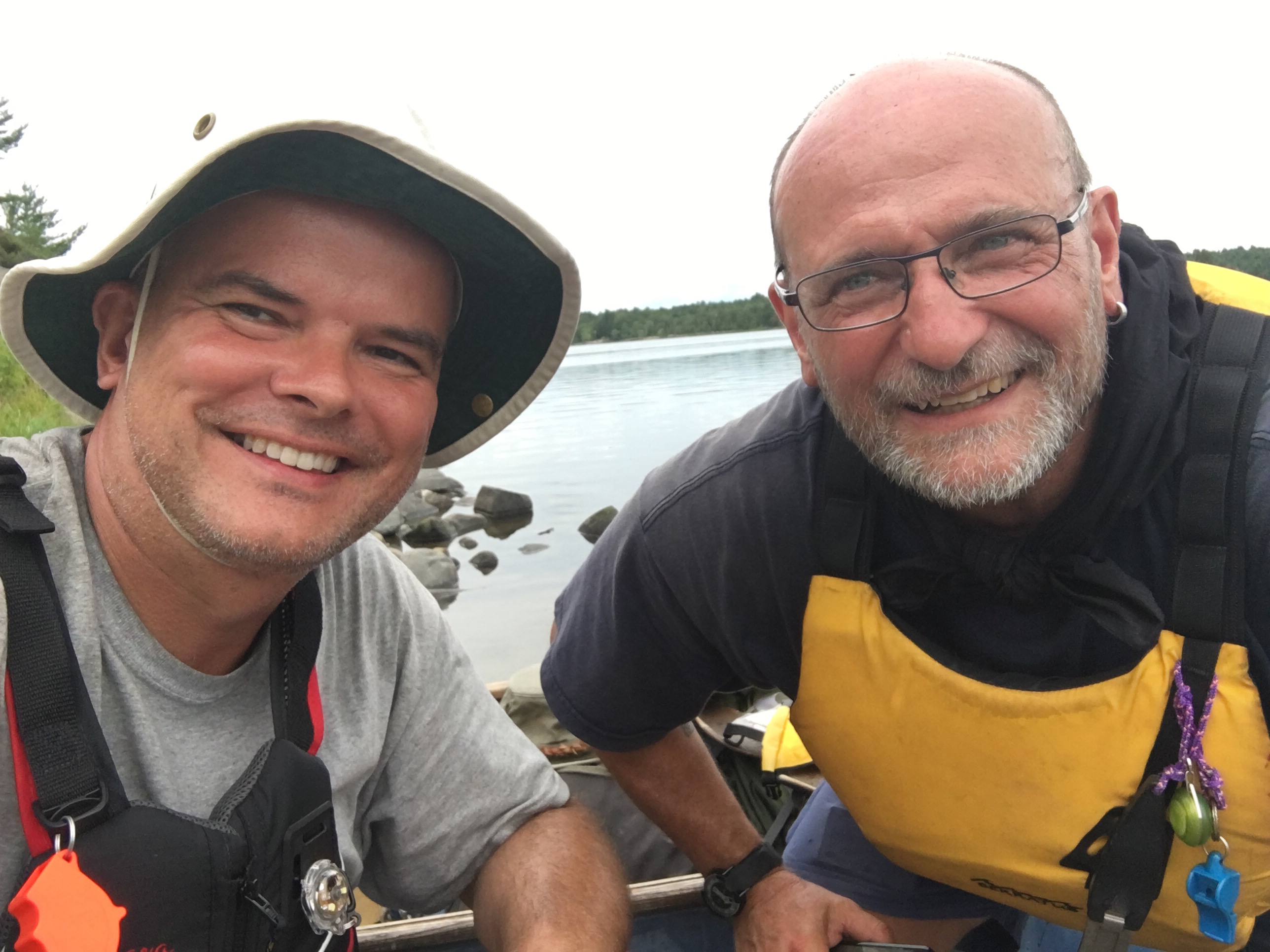
We ended up taking more than we needed. We could have packed less food, and less clothing. The exercise, nevertheless, was confident-building for me in realizing I really don’t need that much stuff.

Jesus says, “None of you can become my disciple if you do not give up all your possessions.”

To live life well, and faithfully, is to recognize one’s place in the world, and not to over-reach, over-extend, to be someone you are not — all on the basis of wanting more and more, bigger and better. To live faithfully, we are called to examine our dependencies, count the cost of it all, focus on what is important, and then make room in our lives for what is important by letting go.

A sojourn into the wilderness may indeed by the antidote to visions of self-aggrandizement embedded in the prosperity gospel message. Try doing without, for some time, what you may have taken for granted for too long. Try doing without what you always have believed you needed in order to live. Try Letting go. Releasing. Forgiving. 

This is not about doing away with personal boundaries. Letting go is not about condoning injustice or cruelty. Kenosis/letting go is not about being blind optimists, repressing or denying or not caring, or ‘giving up’ in frustration.

Forgiveness is a good example of letting go of the misery caused by holding on to the pain of resentment or holding a grudge. This kind of letting go brings a positivity that is based in honest struggle and prayer born out of compassion and love for self, the other, and God. The end result is a freedom and peace that cannot ever be realized through a program of simply working harder or getting more.

The German poet, Rainer Maria Rilke, wrote about the contrast between the law of gravity and the rising of the trees. He writes about the gift of letting go into a place of trust: Trusting that the gift in you is enough. So that you can rise up, rooted like trees: 

How surely gravity’s law,

strong as an ocean current,

takes hold of even the smallest thing

and pulls it toward the heart of the world.


Each thing —

each stone, blossom, child —

is held in place.

Only we, in our arrogance,

push out beyond what we each belong to

for some empty freedom.

If we surrendered

to earth’s intelligence

we could rise up rooted, like trees


Instead we entangle ourselves

in knots of our own making

and struggle, lonely and confused.

So, like children, we begin again

to learn from the things,

because they are in God’s heart;

they have never left God.

This is what the things can teach us:

to fall,

patiently to trust our heaviness.

Even a bird has to do that

before he can fly. (3)

In the poetry of scripture, the Psalmist describes beautifully the blessing we are, created in the image of God — so “wonderfully made” (Psalm 139:14). God would know intimately each part of our lives only if we were valuable to God and to the rest of creation. Otherwise, why would God care?

In other words, we are and have everything we need to enjoy and live to our fullest potential. We are beautiful. We don’t have to strive and strive to become someone we are not. We don’t have to ‘add’ anything to our lives to be well. In fact, when we have the courage to risk letting go, and “fall”, as Rilke poetically expresses, trusting in our “heaviness”, we will find a freedom and peace that will be the joy of all creation, and the glory of God.

We will live our lives at the same time rooted in the earth, and rising to the sun.

(1) Translated by J. Clark & J. Skinner, “Meister Eckhart: Selected Treatises & Sermons Translated from Latin and German with an Introduction and Notes”, Faber & Faber: 1958, p.194

(2) David Schnasa Jacobsen, Commentary on Luke 14:25-33 in “WorkingPreacher.org”, 2016

(3) Rainer Maria Rilke, “Rilke’s Book of Hours: Love Poems to God” translated by Anita Barrows and Joanna Macy, Riverhead Books: 1996, p.116-117; cited with permission in Richard Rohr’s Daily Meditation for August 28, 2016

Funeral sermon for an astronomer

Read Psalms 136:1-9 & 19:1-8

Rolf worked at many things. My impression is that he accomplished so much. Rolf was always on a project, whether clearing large rocks off his land, growing grapes, gardening, building structures, star-watching and -tracking.

His scientific mind, inductive reasoning and clarity of thought all translated into a degree of productivity not many of us will ever achieve. His gentle, methodical approach to his work reflects a state of mind that mirrors the great, spiritual giants of history.

Yes, spiritual.

Often science and religion have been pitted against each other in the philosophical and doctrinal wars of the contemporary age. And yet, in the lives of common people, we can begin to see that the two are not opposites in the seesaw battle for truth. Science and religion, in all truth, go hand in hand.

Some argue that besides the bible, no other book has likely influenced the course of western history more than the Rule of Benedict from the sixth century of the Common Era. Only some 13,000 words long, The Rule outlines instructions for the monastic tradition including prayer and work. In The Rule, Saint Benedict ordered the monks not only how to pray the Psalms, but how to work.

This work involved primarily manual, physical labour — fixing things, gardening, building. This work also evolved, happily, into artisan endeavours — wine-making, beer-producing, food preparing, and the such. Finally, the intellectual work of scribing and reading.

With singular attention focused on one task at a time, work becomes a contemplation. Even, you could say, a prayer. When it is done with joy and thanksgiving in each given moment. When we are present to our work, it is an offering of the natural rhythms of life, unfettered by distraction and self-consuming narcissism, which is often characterized by the demands and expectations of a hurried, anxious immediacy.

We remember and celebrate a precious life today. We recall moments that reveal a story of a person who reflects some of the best of what life and work is all about. Creation is indeed beautiful. God did good! And it will take eternity for us humans to begin to even scratch the surface of the brilliance and wonder of all that is.

The spirit of expansion, I would say, characterized Rolf’s life — a moving outward to include all, to embrace all, to reach to the farthest limits of all that we can know in God’s creation.

When Rolf was baptized at St James Anglican Church in Gatineau a few months after his birth, he was not only baptized into that particular faith community. His baptism signified his connection to the vast communion of saints. This community of faith spans the globe in all times and in all places. His baptism connected him to what Christians often call the ‘Body of Christ’ which has many members and includes all the baptized around the world: Starting here in the Ottawa region, and expanding outward.

In the funeral liturgy, one of the traditional prayers acknowledges the ‘mystical communion’ we all share in the Body of Christ. It speaks to the connectivity among all creatures.

Rolf’s passion for astronomy demonstrates this expansive spirit beautifully. The stars, of course, symbolize the mystery of heaven and God, and our human yearning for the unknown to become known. To connect to this great mystery, Rolf built his own observatory in the backyard of his house. 

And in 2005 he took a superb photo of Mars, his favourite planet. This image, which you see displayed here today, was possible because in 2005 Mars was in a close approach to earth at a high elevation — which means the angle at which viewing the red planet from the earth’s surface was exceptional.

Apparently Mars doesn’t behave like this every year. But in 2016, this year of Rolf’s death, Mars has again dipped close to the earth. Almost as if it was coming in to scoop Rolf up and connect his spirit once again to the vast universe, where now Rolf can see with his own eyes the expansive realm of God, whose love, mercy, and grace knows no limits.

Although we grieve a particular connection we have known with Rolf on earth these past six-plus decades, we touch today on the truth of the eternal connection we share with Rolf, all people, with all of creation and with God, forever.

Thanks be to God.

The other side

In a Brazilian folk tale called, “The Little Cow”, a master of Wisdom was walking through the countryside with his apprentice. They came to a small disheveled hovel on a meagre piece of farmland. “See this poor family,” said the Master. “Go see if they will share with us their food.”

“But we have plenty,” said the apprentice.

“Do as I say.”

The obedient apprentice went to the home. The good farmer and his wife, surrounded by their seven children, came to the door. Their clothes were dirty and in tatters.
“Fair greetings,” said the apprentice. “My Master and I are sojourners and want for food. I’ve come to see if you have any to share.”
The farmer said, “We have little, but what we have we will share.” He walked away, then returned with a small piece of cheese and a crust of bread. “I am sorry, but we don’t have much.”

The apprentice did not want to take their food but did as he had been instructed. “Thank you. Your sacrifice is great.”
“Life is difficult,” the farmer said, “but we get by. And in spite of our poverty, we do have one great blessing.”

“What blessing is that?” asked the apprentice.

“We have a little cow. She provides us milk and cheese, which we eat or sell in the marketplace. It is not much but she provides enough for us to live on.”

The apprentice went back to the Master with the meagre rations and reported what he had learned about the farmer’s plight. The Master of Wisdom said, “I am pleased to hear of their generosity, but I am greatly sorrowed by their circumstance. Before we leave this place, I have one more task for you.”
“Speak, Master.”

“Return to the hovel and bring back their cow.”

The apprentice did not know why, but he knew his Master to be merciful and wise and so he did as he was told. When he returned with the cow, he said to his Master, “I have done as you commanded. Now what is it that you would do with this cow?”
“See yonder cliffs? Take the cow to the highest crest and push her over.”
The apprentice was stunned. “But, Master …”

“Do as I say.”

The apprentice sorrowfully obeyed. When he had completed his task, the Master and his apprentice went on their way.

Over the next years, the apprentice grew in mercy and wisdom. But every time he thought back on the visit to the poor farmer’s family, he felt a pang of guilt. One day he decided to go back to the farmer and apologize for what he had done. But when he arrived at the farm, the small hovel was gone. Instead there was a large, fenced villa.

“Oh, no,” he cried. “The poor family who was here was driven out by my evil deed.” Determined to learn what had become of the family, he went to the villa and pounded on its great door. The door was answered by a servant. “I would like to speak to the master of the house,” he said.

“As you wish,” said the servant. A moment later the apprentice was greeted by a smiling, well-dressed man.
“How may I serve you?” the wealthy man asked.

“Pardon me, sir, but could you tell me what has become of the family who once lived on this land but is no more?”

“I do not know what you speak of,” the man replied. “My family has lived on this land for three generations.”

The apprentice looked at him quizzically. “Many years ago I walked through this valley, where I met a farmer and his seven children. But they were very poor and lived in a small hovel.”
“Oh,” the man said smiling, “that was my family. But my children have all grown now and have their own estates.”

The apprentice was astonished. “But you are no longer poor. What happened?”

“God works in mysterious ways,” the man said, smiling. “We had this little cow who provided us with the slimmest of necessities, enough to survive but little more. We suffered but expected no more from life. Then, one day, our little cow wandered off and fell over a cliff. We knew that we would be ruined without her, so we did everything we could to survive. Only then did we discover that we had greater power and abilities than we possibly imagined and never would have found as long as we relied on that cow. What a blessing from Heaven to have lost our little cow.” (1)

This story is not a prescription for how the church or society should treat economically disadvantaged, underprivileged people — by ignoring their plight and expecting them to pull themselves up by their own bootstraps. 

Instead, I offer this story as an allegory, a parable, of whatever it is in our lives that keeps us bound, that keeps us stuck. 

The cow, in the story, represents that which the farmer believed would help them survive in the big, bad world. And without it, they would be lost.

What is ‘the cow’ in your life? Whatever you believe you cannot live without. What keeps you bound, shackled in a sense? It may not appear or even be a bad thing. It can be the ‘best’ thing in your life, you will say! And that’s point of the fable.

The cow was the only thing, the best thing, the poor family had going. In our lives, it can be the relationship we have with our work. It can be a person. It can be some activity of our lives that we think we want and need. What is the ‘cow’ in your life — things to “let go ” of, either in church life or your personal lives, that would enable the freedom of God to operate?

Letting go of over-attachment to building? Property? Material riches? Some significant aspect of your financial portfolio?Clutching on to church programs and processes that have had their day, making room for something new?

It could even be your reputation, your status, or social position. Whatever it is …

If we should lose that, why would God want that for us? And when we do lose it, we may be angry at God for taking it away from us. We may shake our fists at God, walk away in disgust and anger, never to darken the door of a church again. We may be blind to the possibilities on the other side.

In the Gospel text today (Luke 8:26-39), Jesus travels to opposite side of Lake Galilee. He goes to what I will call ‘the other side’, where the people in the Gentile territory there respond to the miracle of exorcism with fear. The man they knew to be living on the outskirts of town, out of his mind, full of demons — now sat at the feet of Jesus “in his right mind” (v.35).             

Odd as it may sound, we often prefer the devil we know to the freedom we do not. We can take a false sense of security from the patterns of our lives we learned to cope with over the years. 

And we may fear what change — even change for health — may bring. Because that would mean losing that which we have grown accustomed, even cherished, for a long time. We keep ourselves from seeing the possibilities on the other side.

The truth of the Gospel of Jesus Christ reverses the fortunes of those in low estate. The “good news to the poor” which Jesus announces in his inaugural speech (4:18) becomes a reality in the healings and exorcisms that follow in Luke’s Gospel.

But this freedom and health does not come without major disruption in people’s lives. This is the part we like to dismiss in our “feel good”, “prosperity-gospel” driven culture of church in North America. 

Because to the people whose living depended on the pigs — those pigs who ran off the edge of a cliff to their deaths — their loss is catastrophic. The swineherds in the Gospel story are understandably afraid, too, even angry at Jesus. And despite the healing, they want Jesus to leave them (v.37).

The story demonstrates that the the Gospel brings upheaval and sets in motion powerful forces that will disrupt our lives. 

At first, the good news of Jesus will not seem good to everyone. At first, our economic and social lives are put on their heads. At first, we will experience pain and suffering. We will need to surrender that which has given us a sense of security in life. 

We cannot have Easter without “Good” Friday. The cross precedes the empty tomb. The way of salvation goes through suffering, not around it. We cannot avoid pain in our journey towards liberation, healing and salvation.

The good news is the promise that there is no darkness, no loss, no pit too deep that God will not go into, in order to carry us through to the other side.

(1) cited in Richard Paul Evans, “The Walk” Toronto: Simon & Schuster, 2010, p.285-288

Happy Birthday! (funeral sermon)

“Jesus said to her, ‘I am the resurrection and the life. Those who believe in me, even though they die, will live, and everyone who lives and believes in me will never die. Do you believe this?’” (John 11:25-26)

It may seem strange to say this, today: On a day we mourn at the death and loss of a loved one. A loved one, nonetheless who lived to a 103! A loved one whose 104th birthday is today! “Happy birthday Wilma!”

When we say a funeral service is a ‘celebration of life’ we affirm this with mixed feelings, to be sure.

Kind of like the other paradoxes in our lives: Because, for example, we know that we are better fulfilled in giving rather than receiving. Because, as people of faith, we know that it is in dying that we live — on many levels.

That is why a funeral service is like an Easter service when we celebrate the resurrection of Jesus. That is why, the day Jesus died on the cross is called “Good” Friday. Talk about paradox.

So, with confidence, we gather today to have a birthday party. Because Wilma, a person of deep faith in the living Lord, lives today in heavenly glory! 

Happy birthday Wilma!

At birthday parties we often tell stories about the person’s life, to date. There is one story from early on in Wilma’s life that I wish to highlight: When she was five years old, the windows of the Halifax house she and her family were living in blew inward, planting shards of glass deep in the layers of the skin on her head. She and her family survived the famous Halifax explosion.

Until Wilma was well into her 40s she was pulling little pieces of glass from her skin. For a large chunk of her life, especially in her formative years, she had to live with this reminder of her near death experience at such a young age. She was, in the first part of her life, regularly made aware of the fragility of her life and the reality of her mortality. That with each step we take in life, death walks along close by. Maybe that’s why she lived so long.

We try to avoid death. We deny it at every turn. We don’t want to see it. And yet, in avoiding death we also avoid living. Living to the upmost. The key to a rich life is to be aware that our death is only one breath away. 

It is common knowledge that the most effective, greatest and skilled soldiers in history were men and women who were willing to die in giving themselves to engage each combat situation. When you accept your own death at any given moment, then you can truly live.

An incredible paradox, isn’t it? How can we live in the ambiguity, uncertainty and mystery of this reality?

Wilma, as I said, was a woman of deep and enduring faith — through it all. It’s amazing when you think about the history she lived through: the rise of the automobile; the radical advance of technology from wires to the digital age; the many wars and two world wars of the last century, the Depression and economic ups and downs, the social revolutions. Through it all, she nurtured, and was nurtured in, a life of faith in the God who died in order to live.

Perhaps a deep knowing of this leads one to bless others. Indeed, this is how I got to know Wilma in these last four years of her life. Mostly through touch. In the tradition of the church, a blessing of healing and grace was given primarily by the ‘laying of hands’. It was a challenge to communicate with her, and yet, experts affirm that 70% of communication is non-verbal.

Wilma’s image of God was of a gracious, giving, loving God. She bristled at me early in our relating when I said the version of the Lord’s Prayer that has the line: “Lead us not to temptation …” She stopped me right in the tracks of that prayer, right there: “Stop,” she said. “God does not lead us to be tempted!” she objected. So, we changed the words. And that is why you read a slight variation in that sentence in the liturgy today.

God is a God of compassion and caring. God loves. Even when we can’t. Even when our love is imperfect and fraught with our own sin and misgivings. God comes to us first with a word of compassion, healing and mercy. This is the God Wilma believed in.

Her mission in life, in the last few years, was to bless others who cared for her. I learned this when she was at Fairfield Manor in Kanata, that she would routinely bless the nurses that attended to her. 

And after our many visits there, she would lean close to me and kiss me on my forehead. She said: “That’s the kiss of Jesus, saying that he loves you. And I do too.”

I responded: “I love you too, Wilma.”

Then, ever true to her belief, Wilma said: “That makes the Holy Trinity — three loves!”

Perhaps, then, Wilma leaves us with the legacy of faith that doesn’t pretend life is meant to be perfect. Because she wasn’t. But life is meant to be lived as long as we are given breath, in order to be a blessing of love to one another, as best we can.

Because God does.

Amen.

Bread for all

After the old doctor died, his sons emptied the house in order to sell it. In the living room on the shelf above the fireplace they found a box with a slice of bread in it.

It was dried up hard and obviously had sat in the box a long time.

“He really kept every thing!” said one of the sons amazed. The doctor’s assistant who worked for the doctor for many years stood beside the sons silently. And then said: “Let me tell you the story of the slice of bread:

“You know that after the war your dad became very ill. He was weak, and near death. A friend, who had visited him told him, ‘If you don’t eat enough to regain your strength, it looks very bad for you.’ But where was one to get enough to eat? Everyone was starving. Many simply cooked potato peels and considered it a rich soup.

“The friend returned after some hours and brought some bread. Where he found it, he didn’t say. Surely he must have paid a fortune for it.

“But your dad did not eat it,” continued the assistant. “Your dad told me to take it to the neighbour; their daughter had been ill for a long time too. ‘I am an old man already who does not need the bread as much!’ your Dad said. ‘Take it to the neighbours!’

“As it later turned out, the neighbours did not eat it either, but passed it on to a family of refugees with three little children that lived in a small shack in the backyard of the neighbours’ house. They were overjoyed for they had not seen bread for more than three months. 

“But as they were about to eat, they remembered that the doctor, who had helped their children at no charge when they had been struck by a dangerous fever, was ill and weak and really needed something that would make him stronger.

“So when the bread came back after a day,” said the assistant, “we recognized it at once. Your dad was in tears, as they found out about the wandering piece of bread and where it had been.

Your Dad had said, “as long as there is love between us – I am not afraid about anything, not even dying”. So he divided it evenly and sent me out again. His share he kept; he put it in this box to always remember what had happened.”

The three children took the old bread, broke in in three pieces and decided to keep it in order to remember the story, to tell it to the next generation, and to teach them about the power of love and the wonder of sharing.

Something like this can only happen when there is a communal consciousness — more than one person that participates in a community of love and trust. That all will have enough. That all will benefit. That the needs of the whole outweigh the needs of the one.

This is the Gospel call. The kingdom call. Not for individual enlightenment or edification. Not for our sake alone. Dear Confirmands, your baptism as a baby was not valid on account of your own individual strength or decision. It was the community — your parents, sponsors and everyone in the church long ago — whose faith surrounded you at your baptism. Even your confirmation is not done for your own sake — but for the sake of others around you.

And that’s why you participate in leading and assisting in your own confirmation service: To practice this truth, that affirming your baptism is a call to deeper commitment in the life of the church. You may doubt the strength of your faith. That’s ok. In fact, I would be worried if you didn’t. God can work with just a tiny bit.

I must admit when we planted that tiny four-inch tall spruce on church grounds last Fall, I didn’t have a lot of hope that it would survive the winter. This was our first tree planted in response to the Reformation challenge for our national church to plant 500,000 trees by the end of 2017 — the 500th anniversary of the Reformation. It was a small tree. A humble start. Could it live, and even bear fruit? I had my doubts.

For one thing it was exposed, and not easily visible, to the many pedestrians that use this property to cross through and the many children who play in this space. For another thing, since receiving the sapling, I had not seen signs of new life on it. So I wasn’t sure it there was anything new to come out of it.

I was in for a pleasant surprise. Throughout the coming months, our neighbours put a tall chicken-wire type fence around it and staked it. We watered it. People walked around it. God took care of it over the cold winter. And voila, look at the new shoots of life sprouting now! There is hope.


It does take a community committed to sharing, committed to kingdom values, and the Gospel of Jesus Christ. Today is just as much about celebrating the church of all times and places as it is about our part in the kingdom of God on earth. We are not loners on this path. We don’t walk by ourselves. It’s not all up to us, individually. 

It’s amazing to see the fans of “We the North” cheer on the Toronto Raptors as they advance through the NBA playoffs this post-season. They are true fans who gather in “Jurassic Park” outside the ACC in downtown Toronto, even during away-games in the pouring rain. You might say, they are ‘fan-atics’ of their team. 

Yes, fans can be fanatics — exuberant, dedicated, passionate, sometimes even over-the-top. Imagine the fans in heaven — the faithful gathered as the grand host of heaven, cheering you on this day. These may be your loved ones, long gone now, or recently died. These may be the saints throughout the ages. These may be other Christians not here today yet praying for you nonetheless. These are your fans of faith. Fans. Fanatics. Fantastic!

You are not alone, making this decision today. Pentecost, and Confirmation Sunday, is also about trusting in God’s initiative, God’s work, God’s love and mercy. Through the Holy Spirit God comes to us in so many ways we sometimes don’t even recognize. 

In a few minutes, God comes to us in bread. This bread, the body of Jesus, is broken bread. It is broken from the One, so that all may eat. There is always enough for all, for the sake of our broken lives in this broken world that God so loves.

The gift of the White-breasted Nuthatch

I walk quickly. In the first hour of walking I can manage 6 kilometres. Pretty impressive, eh? Well, I was zipping through the treed park near our house the other day when I heard birds rustling and chirping in the branches above me. 

I stopped when I noticed a small bird scampering down the trunk of the tree head-first. This tiny bird caught my attention. It had a disproportionately long beak, a black cap and a white breast. I memorized the details of what I saw, and scurried home to consult my three, different bird books.

It was a White-breasted Nuthatch. I was so thrilled to have made that identification. I love birds, and I enjoy the challenge. Most of the time.

I’m by no means an experienced, knowledgeable birder. Because most often I forget the names of the birds I identify or mis-identify. Because I don’t carry around with me my bird books and note pads wherever I go, I have to hone my skills of observation and memory. There are times even when my bird books don’t display sketches or photos of what I think I saw. That’s really frustrating!

When Paul and Silas were thrown into prison after being flogged for disrupting the peace, their future was uncertain at best, an absolute failure at worse (Acts 16:16-34). They were done, or so it seemed. The prospects of continuing their missionary journeys looked bleak no matter how you looked at it. What could they do?

I bet no one expected that earthquake to come when it did. A natural disaster always comes unexpectedly. The severity and life-changing magnitude of an earthquake, for example, cannot be predicted. It’s only after-the-fact when assessments and conclusions of what happened can be made. 

No one could see it coming the way it did: The fires in northern Alberta around Fort McMurray, despite the dry hot Spring, could not be predicted. Who could forsee precisely how it’s actually played out, and continues to play out? It just happens. And people have to react to the moment, when it does.

Despite the life-changing magnitude of events unfolding around Paul, he still seems to find stride in his faith, and yes, even joy. He shows resilience in faith. Despite all the losses, earthquakes, imprisonments, floggings, shipwrecks, rejections, threats on his life, thorn in his side — he still demonstrates an incredible passion for, dedication to, and joy in his life in Christ.

They are in the Roman colonial city of Philippi when Paul and Silas are arrested. Paul’s famous letter to the Philippians was written, later, when Paul sat in a Roman prison cell. And it is in this letter where we find some of the most joyous and aspirational words from Paul’s hand: 

“Rejoice in the Lord always; again I will say: Rejoice! Let your gentleness be known to everyone. The Lord is near. Do not worry about anything, but in everything by prayer and supplication let your requests be made known to God. And the peace of God, which surpasses all understanding, will guard your hearts and your minds in Christ Jesus.” (4:4-7)

Paul is instructing his good friends in Philippi, and followers of Christ in all times and places, to rejoice — not when everything is perfect, not when your problems have been resolved, not when certain conditions have been met, not when we are prepared for rejoicing, not even when the stars are aligned.

But, to rejoice, precisely when things are chaotic and messy. Rejoice, precisely when things are not going well, nor planned, nor pre-conceived, nor forseen. How is this even possible?

When installing our new dishwasher recently, I screwed clamps into the cabinetry on both sides. Tightly.

When I ran a cycle for the first time, water started streaming out the side of the door. It’s as if the door wasn’t even sealed! I discovered later that because I had fastened the clamps too tightly, the whole unit twisted and warped the door in an unnatural way and therefore could not seal properly and do its job. 

As soon as I loosened the screws a bit so that the dishwasher could rest naturally, evenly and squarely on the floor, everything worked fine.

Indeed, to be faithful is to know how to celebrate, even in difficult, unpredictable times. Trying too hard without a break can actually damage our commitment in faith. 

When things don’t go well, is it that we are trying too hard? Or believe the solution is simply to work harder? And then do we get all tense, anxious, impatient and frustrated when nothing in our power seems to work or when things don’t always go the way we planned? And we don’t ask for help. Or recognize or confess openly our limitations. Who do we think we are?

Especially during the long journey of a dark night of the soul, it is vital for our health to pause from time to time, loosen the screws, and lighten up a bit. Doing so will improve our endurance, open our hearts, deepen our trust in the good Lord who comes to us, who is alive and lives in us.

It is the freedom of God who comes to us, quite unexpectedly. Like the gift of the White-breasted Nuthatch. All I needed to do, was to stop my rushed march through the woods. Stop my over-thinking, incessant mental machinations. 

Just stop, and look up.

Easter: Jesus on the loose, now!

A mother was putting her young, eight-year-old girl to bed one night. The girl, accustomed to saying her prayers as part of her bedtime ritual, said to her Mom:

“I want to die so I can see Jesus.”

Taken aback, the mother realized in that moment that everything her daughter had heard to that point about Jesus was about eternal life — how Jesus came to earth to save us from our sins so that after we die we will go to heaven. 

No wonder the girl, who had faith, thought that the only way to see Jesus was to die first.

Quick thinking, the mother put her hand in her child’s, looked her in the eye and said, “Jesus is alive. Jesus lives in you and in me. If you want to see Jesus, look for him in the people you meet in the church, in your school and wherever we go. If you want to see Jesus, sweet child, just open your eyes. And live your life!”

Jesus is alive, today. Right now. That is the message of Easter. And the foundation of our faith as Christians.
A few weeks ago the Jewish Rabbi who met with our confirmation class answered a question about who he thought Jesus was. His answer made me think. He said, “Jesus was and is a very important and significant person for Christians.”

I wondered if someone asked me, “Who is Jesus?”, what would I say? I think my first response would be: “Jesus is alive.” Not dead. Not just a great teacher who walked the earth over two thousand years ago and died a criminal on a cross outside Jerusalem. Not just a healer of the sick and prophet who spoke God’s good news to the people of his time. All those things, yes. But more. So much more.

You notice the traditional Easter acclamation is NOT: “Alleluia! Christ was risen! He was risen indeed! Allelulia!” He IS risen!

When we come to worship God, we are not just praising a man from the past, studying an important historical figure, or reading a great story from history. We are not just about being a bunch of ‘talking heads’ who like to debate religion, theology and doctrine, but go on living as if nothing really needs to change in our lives in this world, today. 

We cannot turn this great story of Jesus’ death and resurrection into a platitude that just makes us feel good on a holiday long weekend in Spring. There’s too much at stake. The Easter proclamation means something for our lives today. Our job is no different from the first disciples who met the risen Jesus.

Jesus, outside the garden tomb, had to shift Mary’s focus away from the past to the future. After calling Mary’s name, Jesus rebuffs Mary’s attempt to ‘hold on’ to Jesus as if he were the same as before he died (John 20:17). In that encounter with Jesus, Mary learns from her Teacher that she is being caught up into a larger drama that includes not only Jesus’ death and resurrection, but also his ascension — and beyond!

In other words, Mary learns that this is not merely a story about the re-union of friends with tears and hugs all around, case solved. It is about ultimate destinies: (1) Jesus’ and Mary’s — and the disciples’ destinies too. The story has not concluded; it is still unfolding. She must relate that to the rest of the disciples. Her story, and Jesus’ story, his experience and hers, cannot be anchored in the past. The story of Jesus, then and now, must move on.

That’s where our sights are focused on Easter morning. Where are we going? Where are you going, in your faith? The promise of new life in Christ Jesus means something special for you, now. It means something very special for the church, today. To live out of the Easter message, we must look forward, to where the risen Jesus awaits our following.

It seems so many people these days are reading Rumi, the great 13th century Sufi poet. Sufi described an image of a mirror in the hands of God. It fell, and broke into billions of pieces of glass strewn all across the face of the earth. Everybody took a piece of it, and thought at first they had the Truth — the whole Truth, and nothing but the Truth.

Let’s imagine that each shard represents a unique reflection of God’s being, God’s will, God’s presence. Let’s imagine that each piece of glass represents one who has faith. Each piece of glass reflects the beauty and light of God’s creation, manifest in the individual person or congregation — however you want to look at it.

God is, over time, restoring all the pieces back into wholeness, into the original mirror. God also seeks our cooperation in mending what has been divided. 

We are like that little girl who wants to see the face of Jesus. And is learning that we don’t have to wait until we die, to experience a fullness of the Lord’s presence. Using the words of the Apostle Paul, We may see as in a mirror dimly while we live on earth (1 Cor 13:12), for sure. But slowly, surely, God is also already at work reflecting the love, the light and presence of the living Christ in each and everyone one of us. Who in gospels was not changed after encountering the Lord?

We are, as Paul also describes, the “Body of Christ” (1 Cor 12:27), on earth. The tradition of Christianity since the Resurrection of the Lord has claimed that the church together is the Body of the Living Jesus. We are the living representation of Jesus on earth. As Martin Luther stated, in our baptism we are “little Christs”. 

Jesus is on the loose! Jesus can show up as a cashier in the grocery store, the young man who changes the oil in our car, a coworker in the office, our doctor, a good friend or even our spouse, child or grandchild. You may even find him looking back at you in your bathroom mirror! (2)

Paul concludes, “All of us … are being transformed” (2 Cor 3:18). God is already at work, in the power of the resurrection, healing what has been broken, bringing together what has been divided, restoring to completion a glorious transformation of our very lives. This is our hope. This is our Easter joy.

Alleluia! Christ is risen! He is risen indeed! Alleluia!


(1) Gregory A. Robbins & Nancy Claire Pittman in David L. Bartlett & Barbara Brown Taylor, eds., “Preaching the Revised Common Lectionary: Feasting on the Word” WJK Press, Kentucky, 2009, p.377

(2) Sr Bernadette Gautreau, “Jesus is Loose!” in Holy Week Reflections 2016 published by On Eagle’s Wings, p.9

Stick-to-it-ness of love

Terrorist bombs going off in Brussels during Holy Week should get our attention. Not only and primarily because of the sudden horror and tragic, senseless loss of life.

But also because Christians this week, the world over, are reflecting and imagining the path Jesus took to his own senseless, horrific death hanging on a cross.

Death is on the mind and heart of many these days. How can we approach this reality common to us all? How can we accept the truth of our own mortality, which will be realized some day in some unique way?

In a popular book about near-death experiences, people reported on how they saw a review of their life — the cliched ‘life flashing before your eyes’.

The people who had momentarily died detailed every single encounter they had had with another human being throughout their life. They not only re-lived it, they were able to feel what the other person had felt. In that life-review they knew what others felt because of the near-dead person’s words or actions in that particular encounter. (1)

You may be able to imagine how surprised some felt to know how their behaviour and words actually affected other people. To know what impact our lives have on others. We may not think that a simple action like a smile, or a scowling face, a gracious word, or an angry outburst, could affect someone else’s day — let alone their life.

A friend recently suggested that this is what they thought Judgement Day would be for us — to understand and feel fully what influence our lives had on people around us. And how much our lives mean, in relationship.

I attended my brother-in-law’s retirement reception last week. He was retiring from the military after about twenty-five years. In his speech to the gathered friends, family and colleagues he concluded by saying something that stuck with me: “There’s lots that I’ve done over the years that I’m not proud of — as I stand here today. But, I’ve always and will always be proud of who I did it with.”

On Maundy Thursday, the main theme behind the actions of Jesus with his disciples is love. The commandment to love one another infuses the ritual of washing his disciples feet, of eating with them and instituting the Holy Supper, of instructing them and praying for them that ‘they may be one’.

The motif of loving one another is strangely underneath the surface of the high-tension, escalating conflict surrounding Jesus as he nears the cross — the ultimate place of his suffering and death. You wouldn’t think this is a love story, at first glance.

Yet, Jesus does not seek retribution for the injustice he endures. As Simon Peter did by taking a sword and cutting off the ear of one of the high priest’s servants who came to arrest Jesus (John 18:10). Instead, Jesus is about a restorative type of judgement — one that through love seeks to make right what has been divided or tarnished by sin. Judgement is ultimately always about restoring us, not avenging us for all our mis-deeds. To whom are we restored?

Our religion is not one of individual moral performance and accomplishment for our glory alone. The judgement we individually meet at the end is not considered in a vacuum. Our religion is constituted in a community. Our religion, more to the point, is practised and validated in the context of human relationship. Christianity is a social religion. You can’t do Christianity apart from others.

On Maundy Thursday, the focus is on the disciples meeting together for the last time with Jesus. And they do so around a Meal. This is the context, the meal and the companionship, however flawed and fragile. Sharing food, here, is not an individual indulgence as it is a communal sharing.

For many, in our culture today, to simply sit and eat and talk and to remain together until the end of the meal seems a quaint custom, perhaps incomprehensible, even an empty game: There’s always something else to do in my room — download something, fix something, watch something, communicate in some other media. The community of the table seems far less interesting once you have eaten your fill.

Yet eating with others is what prayer is all about. It is the time — like meditating with others or celebrating a ritual as we do this evening at the Sacrament of the Table — when we are fed and nourished by the One who is the food itself. We need to stay and wait and allow ourselves to be waited upon. (2)

And so, we need to practice doing things together. Practice. Not perfectly. Not always the right way. And not just when all is smiles and joy. Sometimes, in practising our faith together we end up hurting others, and being hurt ourselves. This is nevertheless the nature of practice. 

Like in any endeavour, physical exercise, any discipline, anything that is of value to us. It sometimes hurts. We need to challenge ourselves. We need what coach Dave Cameron of the Ottawa Senators said once in an interview explaining what his team needs in order to be successful in the NHL: ‘stick-to-it-ness’. 

‘Stick-to-it-ness’ is the quality of staying with the game plan, playing with the team; not, individual heroics as they and we are want to do. Stick-to-it-ness, even in the face of adversity or failure, or disappointment. Not running out the back door when things get tough or uneasy or uncomfortable. Not giving up on others or on yourself, even when they disappoint you. Staying with the game plan. Being persistent. Even when things are less-than-perfect or ideal in your life, and life with others.

‘Stick-to-it-ness’ is a quality sadly lacking in Christian culture today. We are so individually-minded that we delude ourselves into thinking we can go it alone. That we don’t need others. That we can live our Christian lives without being faithful to the community — the hassle or complication of others who will only disappoint and annoy — 

That we can leave a group of people and join another church. That religion is like a smorgasbord; and “I” am the centre of the universe, determining my destiny, choosing what I want and leaving behind what I don’t want. And being in total control.

In the acclaimed film, “The Way”, starring Martin Sheen and his son Emilio Estevez, father and son together experience a walking pilgrimage on the Camino de Santiago. They begin their journey in conflict, estranged from one another. The son tells the father a truth that he learns by the end of the movie: “You don’t choose a life, you live a life.”

Practising our faith is not something we do by ourselves. Practising our faith is not motivated by trying to earn favour from God by all our good deeds. Practising our faith is not creating for ourselves the life we want. 

Practising our faith is first and foremost something we do together, for the sake of the other, and for love of the other. Even in the face of death.

We follow Jesus, who walked the way of life and death as we know it. We worship Jesus, these holy days, who showed us the motivation and stick-to-it-ness of love, of grace, of leading with a heart of mercy. For the sake of the other.

I will offer to you a thanksgiving sacrifice and call upon the name of the Lord.

I will pay my vows to the Lord in the presence of all his people, in the courts of the house of the Lord,

in your midst, O Jerusalem. Praise the Lord!

(Psalm 116:17-19)
(1) Raymond A. Moody, “Life After Life”, HarperCollins, New York, 2000, p.55-65

(2) Laurence Freeman, “Sensing God”, Novalis Press, Toronto, 2015, p.110

Laetere!

“This is the day that the Lord has made. Let us rejoice and be glad in it!” (Psalm 118:24)

Lent is a journey through the desert. It is dry. And there’s little for comfort. Let alone luxury. It is a time of self-reflection, of letting go, of pacing ourselves through disciplines that humble us and peel back the layers of our habits and beliefs.

The famine provides a turning point in the parable of The Prodigal Son (Luke 15:11-32). His wasteful, dissolute, squandering of money — his lifestyle — is brought to an end by a famine, probably caused by drought.

Up to this point the Prodigal continued down the course of his delusion, believing he could be happy by pursuing this lifestyle, even when he runs out of money. His mistaken and self-indulgent strategy for fulfillment is derailed and heightened by the onset of famine.

After the famine grips the land and its people, he has to work among the pigs. He might have had to do this anyway. But because of the famine, nobody can even spare change to throw at his feet when he begs. This famine-ridden reality leads him to a place of brutal honesty. And he falls on his knees in confession.

This is not the only time a famine in the land affects the course of the history of the relationship between God and God’s people. The famine illustrates a pervasive motif in the bible: The famine acts as a significant motivator for people to move in their lives, physically and in their hearts as well (1).

Famine is the reason that Abraham and Sarah leave Ur for Canaan. Once they are there, famine is also the reason they leave again for Egypt (Genesis 12). Famine appears twenty times just in Genesis (eg, Genesis 26). The story of Joseph and Jacob revolve around the reality of the famine.

Famines represent those times in life when forces beyond our control dictate the course of our lives. Famines remind us that we are not the masters of our own destiny. Famines expose the truth of our own poverty. Famines make us honest for our own need. Famines cause us to reach out for help, and let go of our pretence of self-sufficiency and self-reliance.

Famines will lead us to confession – honesty about what we need, what we lack, what limits us. Famines will move us to depend on something/someone beyond our capabilities and industry. Famines will bring us to our knees at the throne of God’s grace (Hebrews 4:16).

Maybe that’s why famines happened a lot in scripture.

The famine, otherwise not usually considered an important part of the parable of the Prodigal Son, serves to underscore the central message of Scripture: It’s not about us, it’s about God. We can act irresponsibly like the Prodigal, or we can follow all the rules of life and be good citizens and good people like the resentful elder son — this has no bearing on the freedom of God to dispense grace as God will.

It almost doesn’t feel fair, what happens. We can sympathize with the elder son, I suspect. Yet, whenever we feel the pangs of ‘It’s not fair’ — how much of that objection, when we are honest, is based on the presumption of our own righteousness, our own ability, our own deserving, our own industry to earn our rightful place?

There’s this delightful short book by Francois Lelord, which was translated into English and adapted for the big screen starring Simon Pegg, called “Hector and the Search for Happiness.” Simon Pegg’s character, Hector, goes on a journey around the world to observe what makes people happy. As he travels to distant places and meets different people, he writes down in his little notebook a short list of what makes people happy.

His very first observation — the first lesson he learns about what makes people happy — is: “Making comparisons can spoil your happiness” (2). Is that not what the elder son does — compare his righteousness to the wayward squandering of his younger brother? He is justifying himself, based on the less-than-stellar behaviour of another.

“Making comparisons can spoil your happiness.” This is Gospel truth, in fact. Remember the other parable Jesus tells of the workers in the vineyard? The ones who work the shortest amount of time earn the same wage as the ones who worked from early morning (Matthew 20:1-16). The ones who worked all day grumble that they made the same wage as those who only worked a short time, even though the early workers had already agreed on the rate they would receive.

Another characteristic of people who are not grateful for what they have, and who continually make comparisons: Resentful people do not feel like a party. People who are continually comparing themselves to others who have more, keep themselves from enjoying life and having fun from time to time. People who are judging others and pointing fingers, will not easily relax and accept the good in them and others.

The Father begs the resentful elder son to join the party he has thrown for the Prodigal. What the Father reminds the elder son are words from God to us and the church today: “Son, you are always with me, and all that is mine is yours.” In other words, rather than incessantly compare our lot with others, focus on the gifts, the resources, the passions, the energy, the interests we have already been given to you. And we have been given much, indeed!

We have musical gifts in this congregation, and talented singers and instrumentalists. We have people passionate about social justice, and caring for the poor nearby. We are well-read, educated and earnest in our pursuit of truth. We are warm-hearted and dedicated to one another.

Moreover, we have an abundance of material resources. Yes, we do! A building assessment was done last year. And the replacement cost of this small building alone was valued at $1 million. With the property around the building, the value is much higher.

We have been given so much in this community alone. Imagine the potential human and material resource we have here for the purpose of God’s mission in the world today!

Accept with thanksgiving what we have been given. And, when it comes to what others have received, rejoice in God’s generosity and grace towards them. After all, God is free to do what God will.

And we are free, to do what we must do. Whether we make mistakes, or do good. Whether we are led astray for a time in our lives, or we keep the faith through thick and thin — God says, “You count! You are beloved! I am with you always. I will go the distance for you. I will wait for you — no matter what you have done, good or bad. You count!” So much so, it’s worth throwing a party — an extravagant party.

There is cause to celebrate. And be happy! For God is good, and God’s love endures forever.


(1) Lutherans Connect, Lenten devotional, Day 6 — found at lc2016lentdevotional.blogspot.ca
(2)Francois Lelord, “Hector and the Search for Happiness”, Penguin Books, Toronto, 2010, p.19