Over mangoes

IMG_7760

Mercy Lawluvi’s first days in Canada were met by the famous ice storm. Arriving from Ghana a young woman in 1997, Mercy had never seen first-hand, touched nor felt snow, let alone freezing rain that made moving about a danger and terror for slipping and falling.

Mercy was alone. And she felt lonely, surrounded by the four walls of her apartment. She couldn’t even see her backyard garden bushes and trees buried and drooping under the heavy, thick accretions of ice.

Nevertheless she decided to slip-and-slide over to the nearby Loblaws. Surviving this first test of Canadian living, she made her way to the fresh produce section. Mercy was delighted to find some mangoes, her favorite fruit.

And as she was standing there, turning over a small reminder of her homeland, a woman came up to her looking for mangoes herself. “Hello,” she smiled. “The mangoes look good. What’s your name?” she asked.

“Mercy,” she responded.

“Where are you from?” the woman asked. “Ghana, in Africa. And these are my favorite fruit. I am so happy they are here.” And so, the two stood there for a long time chatting and exchanging mango recipes. Finally, the other woman asked, “What is your occupation?”

“I am a teacher.”

“I know the administrator of an ESL (English as a second language) school in Ottawa. Let me get the name of my friend to you. Maybe you see where that goes?”

“Thank you so much!”

Twenty-one years later, Mercy stands before us during the “Welcoming the Newcomer” session hosted by the Ottawa Lutheran Refugee Sponsorship Committee[1]this past Thursday, to tell us this story of her first welcome to Ottawa.

Because of the kindness shown by that nameless woman in Loblaws twenty-one years ago, whom she has never since met again, Mercy was able to find the emotional strength and resources to settle well and grow in her new country.

She said how much that simple encounter by the mango display made all the difference in the world to her, not only on that first day during the ice storm to help her through the loneliness and fear. But how important that encounter was for her development, networking and success-finding in her new home in Canada. Someone—a stranger to her— acknowledged her. And was genuinely interested in her.

Twenty-one years later she stands before us as the executive director of “Immigrant Women Services Ottawa”.[2]

And it all started by a caring, open-hearted person asking, “What is your name?”

Indeed, what is our name?  We have a family name sign in front of our house. In my first parish twenty-one years ago in the heart of farmland in southwestern Ontario, every house along the long and straight rural concession roads had one of these kinds of signs hanging or posted in the front yard.

IMG_7762

Fast forward to today, I believe we are the only house in Arnprior, maybe even the whole of Ottawa, who has one. Obviously, it’s not a thing.

I understand Millennials prefer their private, cocooned lifestyles. I understand that, fueled by fear, we are hyper-sensitive about things like identity-fraud and being targeted by criminals. So, if there’s anything we can do NOT to be publicly identified or exposed, the better.

I wonder, though, how much we have, because of this attitude, dampened, even snuffed out, any collective heart-filled reaching out. Because before newcomers, or anyone for that matter, can get to know us and trust us, we need to be available, visible, transparent, accessible to them. In other words we cannot hide from others, and then say that we are welcoming.

I read this week that the first step to building an ethical culture in churches, in business and in society in general, is to let people be who they are. Without needing to persuade, sell something, impose our opinion or argue a point. Without believing they first need to conform before I/we will give them any time. Without needing to protect, defend and uphold my or ‘our’ way of thinking, fearful that any such approach means a loss of integrity or personal safety.

Letting people be who they are, first. Means an open heart. Means, listening first. Means, asking questions first. Means, listening for points of similarity – mangoes. And, then, when trust begins to build, going from there.

“I will pour out my thoughts to you; I will make my words known to you,” Wisdom says.[3]I have the image of a couple of friends getting together at the end of a long day over drinks. And each takes turn pouring out their hearts to the other. Arms waving. Voices rising and falling with each impassioned response. Laughter. Silence. A mutual-inpouring!

I heard recently that each human being requires these two things to survive and thrive: unconditional love, and complete understanding. Both are met in this image from the Wisdom writings of the Bible. An intimacy that affords love and understanding to the partners involved in relationship.

Intimacy. God promises a deep and lasting connection within us. Despite our foibles, our missteps, our compulsions. God promises a deep connection within us despite our mistakes and failures.

Transparency, on the surface, goes only so far to the truth of who we are. You may see the name sign outside my home. You may see my license plate on the highway or city streets. This may be a good first step, I believe, to an honest transparency and invitation for conversation. But, that only goes so far.

When Jesus asks his disciples who they say he is, the question reveals more about the disciples than it does about Jesus. “Who do you say that I am?”[4]Jesus ask them, not because Jesus doesn’t know the answer himself but because the disciples are on a journey of growth with Jesus. These wayward disciples don’t often get it right on this journey. They miss the point of Jesus time and time again.

Jesus’ rebuke of Peter is consistent with how the disciples are portrayed by the Gospel writer.[5]And while Peter might I.D. Jesus correctly, while Peter can give Jesus his proper title and name—the Messiah—he still doesn’t understand what that name actually means in Jesus:

That this Messiah will suffer and die; that this Messiah will be rejected by the powerful, scorned by the knowledgeable, that this Messiah will be arrested a criminal, tortured and die a brutal death by capital punishment. And that this Messiah will rise again three days later. The disciples, Peter among them, do not really understand Jesus.

Just because we may know God’s name, doesn’t necessarily mean we know what is called of us under that name. Just because we can name Jesus and say the right words of faith doesn’t mean we get the follow-through right all the time. In another Gospel, Jesus says, “Not everyone who says to me, ‘Lord, Lord,’ will enter the kingdom of heaven, but only the one who does the will of my Father in heaven.”[6]

Because, ultimately, our titles and our names only give us an entry point into who we are. Words, titles and names cannot capture the totality of who we are. As James so pointedly writes, the words we say by our tongue will get us into trouble; “though small, [the tongue] stains the whole body.”[7]

Getting it right verbally isn’t what faith is about. It’s rather about experiencing God in our own lives and in relationship with others. Wisdom pours out her thoughts into us, not at us. God writes God’s law upon our hearts, deep within, despite our mistakes.[8]This faithful following of Jesus is not just a function of our brains.

Intimate relationship with God and with others in Christ is a matter for the heart. We know God and we know truth not by the words we say or the names with which we identify, but by a deeper knowing marked by deeds and experiences of faith, hope, trust and love.

When the heart is in a good place, we start simply, in small ways, to see the other, reach out to them with a smile and a question: “What is your name?”

And God replies, “Mercy.”

[1]olrs@bell.net

[2]http://www.immigrantwomenservices.com

[3]Proverbs 1:23 NRSV

[4]Mark 8:29

[5]Mark 6:51-52; Mark 8:21; Mark 9:32; Mark 10:23-32,38; Mark 16:13

[6]Matthew 7:21 NRSV

[7]James 3:1-12 NRSV

[8]Jeremiah 31:33

Into the deep end

I’d like you to meet Harry Truman, at the end of his life.

This is not Harry Truman the 33rdpresident of the USA. This is Harry Truman, the eighty-three-year-old who, in March 1980, refused to budge from his home at the foot of Mount Saint Helens near Olympia, Washington State, where the volcano began to steam and rumble.

A former World War 1 pilot and Prohibition-era bootlegger, he’d owned his lodge on Spirit Lake for more than half a century. Five years earlier, he’d been widowed. So now it was just him and his sixteen cats on his fifty-four acres of property beneath the mountain.

Three years earlier, he’d fallen off the lodge roof shoveling snow and broken his leg. The doctor told him he was “a damn fool” to be working up there at his age.

“Damn it!” Truman shot back. “I’m eighty years old and at eighty, I have the right to make up my mind and do what I want to do.”

An eruption threatened, so the authorities told everyone living in the vicinity to clear out. But Truman wasn’t going anywhere. For more than two months, the volcano smoldered. Authorities extended the evacuation zone to ten miles around the mountain. Truman stubbornly remained.

He didn’t believe the scientists, with their uncertain and sometimes conflicting reports. He worried his lodge would be looted and vandalized, as another lodge on Spirit Lake was. And regardless, this home was his life.

“If this place is gonna go, I want to go with it,” he said. “’Cause if I lost it, it would kill me in a week anyway.” He attracted reporters with his straight-talking, curmudgeonly way, holding forth with a green John Deere cap on his head and a tall glass of bourbon and Coke in his hand. The local police thought about arresting him for his own good but decided not to, given his age and the bad publicity they’d have to endure. They offered to bring him out every chance they got.

He steadfastly refused. He told a friend, “If I die tomorrow, I’ve had a damn good life. I’ve done everything I could do, and I’ve done everything I ever wanted to do.”

The blast came at 8:40am on May 18, 1980, with the force of an atomic bomb. The entire lake disappeared under the massive lava flow, burying Truman and his cats and his home with it.

In the aftermath, he became an icon – the old man who had stayed in his house, taken his chances, and lived life on his own terms. The people of a nearby town constructed a memorial to him at the town’s entrance that still stands to this day, and there was a TV movie made based on the story.[1]

Opinions may be divided as to whether he did the right thing, by staying and dying so violently. Some herald his gritty resolve. Others shake their heads considering the effect of his decision on his loved ones, and the public resources expended on his behalf to inform and keep the community safe about the impending danger.

What would you have done?

4 Say to those who are of a fearful heart,
‘Be strong, do not fear!
Here is your God.
He will come with vengeance,
with terrible recompense.
He will come and save you.’

5 Then the eyes of the blind shall be opened,
and the ears of the deaf unstopped;
6 then the lame shall leap like a deer,
and the tongue of the speechless sing for joy.
For waters shall break forth in the wilderness,
and streams in the desert;
7 the burning sand shall become a pool,
and the thirsty ground springs of water;
the haunt of jackals shall become a swamp,
the grass shall become reeds and rushes.[2]

This poetry from the prophet reads, generally, in a comforting, encouraging and promising tone. However, the second half of verse 4 feels out of place. God “will come with vengeance, with terrible recompense” and then God “will come and save you.”

It sounds like salvation will come only after an horrible, terrifying experience. Perhaps, Harry Truman’s salvation came on the heels of being drowned in the burning lava flow.

This interpretation can lead, however, to dangerous conclusions. Such as the only way to something good is create and go through untold suffering: Such as the ends justify the means; That it is ok to do something hurtful, cruel, and violent if the result of that violence is pleasing; That salvation can only come through terrible suffering.

We know life happens. We don’t need to search out and fabricate all the pain that is a natural part of life. We don’t need to choose suffering. Great suffering comes in different forms quite apart from any conscious decision to bring it on.

The better question is not whether or not we must suffer, but how do we respond and live in the midst of our suffering. That is the question of faith.

No doubt, Harry Truman had experienced some significant losses in the years leading to the eruption of Mount Saint Helens. No doubt at age eighty-three, his physical capacities were failing. He had lost his spouse. He had broken his leg. He was coming up against his very sure limitations. And, likely, grieving in his own way the passing of his event-filled and active life.

One can only have compassion on him.

The words of Isaiah are spoken to “those who are of a fearful heart.”[3]Ultimately, the war of all that divides and challenges us is waged on the battlefield of our own hearts. Any external fight on our hands is really a fight happening in our own hearts. Do you fight against a circumstance beyond your control? Are you so terrified that you can’t even speak of it?

At the centre of that odd, out-of-place verse is a word I do not like much: “vengeance” (in Hebrew, naqam), because I struggle to link this promise with Gospel good-news.

And then I came across what Biblical scholar Hendrik Peels showed about this word, naqam, in the Bible. This word refers to a retribution by a legitimate authority. And especially in this text from Isaiah, the emphasis is a retribution that brings liberation to those who are oppressed, and freedom from a situation or need. Its meaning is closer to a restoration rather than to vengeance of any kind.[4]

We tend, naturally, first to react to our fears by targeting some outside source. We blame others, when all along we hold the source of our trouble in our own hearts by refusing to examine our attachments and address our own sense of loss and fear.

It’s not easy to learn how best to let go at the endings of our lives. Most of us, unfortunately, confront these deeper questions and challenges at the end of our lives when we face a critical crisis: our health fails and all that we have been attached to in life we lose, suddenly.

We can do ourselves a favour. But it takes exercise, and some pain during the course of our lives when we are not yet at this life-ending crisis time. Learning to die before we die is the point. When we meet with common challenges of life – a physical move, a changed relationship, a job loss, a surgery, a life-changing experience, daily challenges – we can practice how to die to what has been (in the past) and welcome the feeling of terror about the unknown future. We learn how to surrender to what cannot be controlled; or, find the courage to throw off the weight of internalized oppression. This is all serious heavy-lifting.[5]

Following Jesus provides a way through, so we don’t get stuck in despair or denial. The wisdom of the inspired Word of God has something to say about this journey of heavy-lifting:

It is to turn to our neighbor and help them on their journey. It is seeing with the mind’s eye and the heart’s passion that we share a common humanity with those who suffer, who are oppressed, who are vulnerable and needy. To look, and go, beyond ourselves. And not give up.

“Compassionate Justice” is therefore one of the four vision priorities of the Evangelical Lutheran Church in Canada (ELCIC).[6]Of course, making statements and standing up in the public sphere for the sake of the poor, the newcomer, the homeless, creation, the marginalized and weak can get us into trouble. Of course, we can spare ourselves a lot of trouble by shutting our eyes to the suffering.

But our closed eyes will also shut out God. The Word is spoken, indeed, to “those with fearful hearts”. To those who need to listen. And do something.

I’ve never met Harry Truman. I didn’t know him, personally. I didn’t know his family, his community, or his religious background.

But I wonder – what would have been in the last years of his life especially if someone he respected and trusted leant him an ear more than once-in-a-while.

What would it have been, if a friend offered to shovel the snow from the roof of his lodge.

What would it have been like, if family or friends showed him unconditional, loving attention despite his bravado and curmudgeonly behaviour.

I wonder if his ending could have somehow been less violent, less tragic.

Our hearts may be fearful. And yet hearts also race in expectation of something good. Something better. Hearts race in hope.

And hope never fails.

God of compassion and justice, bring justice to those who hunger for bread. And give a hunger for justice to those who have bread. Amen.


[1]Atul Gwande, “Being Mortal: Medicine and What Matters in the End” (Anchor Canada, 2017), p.66-67.

[2]Isaiah 35:4-7a, Revised Common Lectionary for Pentecost 16B

[3]Isaiah 35:4

[4]Hendrik G. L. Peels, The Meaning of the Root NQM and the Function of the NQM-Texts in the Context of Divine Revelation in the Old Testament (Leiden: Brill, 1995), 265-66.

[5]Brie Stoner, A Reflection: Into the Deep End in The Mendicant Volume 8 Number 3 (Center for Action and Contemplation, Summer 2018).

[6]http://www.elcic.ca

A spirituality of fierce landscapes

The Lord is king! Let the earth rejoice; let the many coastlands be glad! Clouds and thick darkness are all around him; righteousness and justice are the foundation of his throne. (Psalm 97:1-2)

Which is mountain? And which is cloud?

Sometimes it’s difficult to distinguish one from the other. When cooler air temperatures carried by strong wind collide with a warm land mass in wide open, exposed landscapes, what we see is not always clear. The lines between the two are not certain.

I am reminded of Moses meeting God in a could atop Mount Sinai in the wilderness. I imagine the dove dropping from the heavens and God’s voice booming at Jesus’ baptism. I sympathize with the disciples seeing Jesus change before their very eyes atop the Mount of Transfiguration. Biblical stories of God colliding and communicating with creation and humanity in a volatile mix of potent energies, some clashing and some joining in a mysterious dance of meaning and purpose.

And we’re not always sure what to make of it. Can we trust what we see? Is our perspective clouded? What is real?

Mountains convey a sense of certitude and stability, a rock and fortress we can count on and lean on. What are the rocks in our lives? Those things, beliefs and people that anchor us in the construct of our lives?

Clouds are ethereal. We cannot grasp the cloud. It is there and yet it isn’t. It is not solid. It is a vapour that we can see, yes, but that which we cannot contain. A cloud is free to form and reform, free to move, free to be and not to be. After all, it belongs in the sky. What are the clouds in our lives? Events, circumstances and situations that have arisen quite outside the realm of our control, good and bad?

Then, as we reflect on the journey of our lives, with all the twists, turns and unexpected happenings, which has more sway in the course of our lives? The mountain? Or, the cloud?

While the mountains of our lives give us a sense of security and well-being, comfort and confidence — all important in life — what role do the clouds play? The bible shows that God speaks through the cloud, even when our main characters find themselves on top of the mountains! Despite all the securities we afford in our lives, those things we strive for to make us feel in control, God clouds those places.

Not that God is against those things, per se. But that the only way God can get into our hearts and bring meaningful change is from the cloud. An anonymous fourteenth century spiritual writer called her work, “The Cloud of Unknowing”, to talk about a way of prayer in which God encounters us in the depths of our hearts.

It may feel, at times, like we don’t know much. It may feel, in these out-of-our-control experiences of life, that we don’t know anything. And we ask, “Why me?”, and “Why this?”

It is in the cloud of our unknowing, nevertheless, where our re-birth and renewal begins. It is here, in the cloud, where all we need to do is not turn around and go home. In the cloud of unknowing, we must not give up. It is called faith.

Faith, to know, that in the fiercest landscapes of our lives where everything seems uncertain, there is hope. We are held in a greater, larger purpose of which we cannot see the whole, big picture right now. We are held in a loving Mystery. And that’s ok.

Because the very reason we can ask the questions, struggle in the uncertainties and take the next, tentative, step on the path is because the sun gives the light for all this to be possible in the first place.

Fresh air

I am glad to be back to breathe the air in the Ottawa Valley. That is why I live here, truth be told. Even before the plane landed at Ottawa airport last evening, I could feel it in the air.

IMG_7127

There’s nothing in the world like catching the sweet breeze blowing down over James Bay, through the budding pine and spruce trees of the Laurentian’s and over the pristine waters of the Ottawa River.

Not only was the hotel room where my brother and I stayed sealed off to the outside, the air in Washington DC was heavy, stale and full of particle contaminants that caused us some coughing, wheezing and rubbing our itching eyes. You don’t have to be an environmentalist to know the Potomac River basin is ….well, not the Ottawa River and Valley.

Ottawa and Washington DC are both the capital cities of their respective nations. Each reflects by its monuments, memorials and geography the character of the nation it represents. One of the purposes of nationalism, like the rivers that surround the two capital cities, is to separate one from the other. Indeed, the work of creating divisions continues in earnest to this day.

In fact, walls are being built not only in the United States, but all over the world as the USA Today front page reported a couple of days ago.[1]Protectionism and isolationism fueled by fear are on the rise.

IMG_7120

So, the voices of a different vision need to be heard, once again.

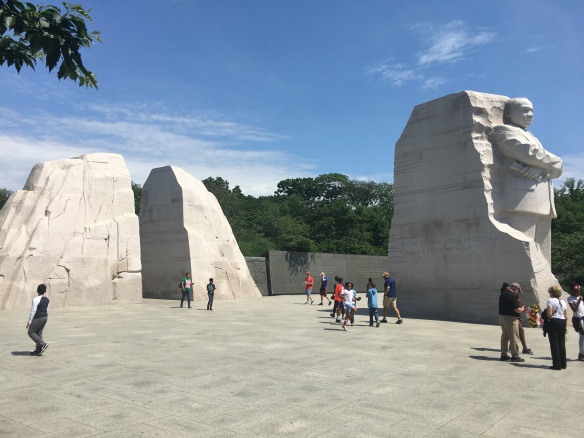
One of the most recently constructed memorials in Washington is on the shores of the Potomac River — the Martin Luther King Memorial.

IMG_6993

“No one is free,” said Martin Luther King, “until we are all free.” In other words:

What I want for myself can’t happen, until it can be so for everyone. If there is anyone who suffers in whatever way,

If there is anyone who is not free, in whatever way,

If there are people who are bound, captive to whatever vice, to whatever imprisonment of the soul or in prison because something they have done…

I am going to be healed of whatever ails me, only when I seek the healing of the other, the freeing of the other, the liberation of the other. The church holds up a different vision from that of the divisive, individualistic and exclusive nature of white nationalism in the world today.

You can see, I hope, why the consciousness of the church not only at Faith Lutheran, not only in Ottawa, or in the Eastern Synod or the Evangelical Lutheran Church in Canada, but in the United States of America and worldwide is moving to see not a division between things, not building walls between two perceived opposites, but building unity between them.

Not a division between politics and pastoral care,

Not a division between care for the soul and social justice,

Not a division between reaching out and reaching in,

Not a division between speaking out against injustice of whatever kind and speaking to the choir,

Not a division between contemplation and action.

Not an either-or, but a both-and.

Last week when Ken stood here and told you about the different ways we can support the financial health of the congregation, he introduced his well-delivered announcement by saying — “you’ve heard we in the church were never to talk about money, politics and sex (well, he didn’t actually say the last word, but I know you all were thinking it!).

And then a couple weeks before that, Mark stood here and told you about his upcoming trip to Ecuador to build homes in a community destroyed by an earthquake some years ago. And in his well-worded speech he said (I paraphrase): “In this mission trip the group he was going with was not doing mere charity, dollars sent to a far-off location, but directly helping them on the ground and making a real difference in the lives of those who suffer.” Check it out. He said it. I believe he has it all on a piece of paper.

I alone am not telling you all this. Your own members are. Your own church family is slowly but surely breaking down the walls that have divided, distanced and incubated our conversations in the church.

Limited our conversation. Limited our imagination. Limited the ways of God. NOT talking about these things, well, how has that worked out for the church in recent times?

NOT talking about the things that really matter in our daily life, NOT being open and honest, sharing the deepest secrets and burdens of our lives, NOT feeling safe in a community of faith to be who we humanly are, warts and all, imperfect, suffering, in need of God’s love. NOT being like that — how has that worked for the church? How has that worked for you?

It is not easy in the church (although everyone else in our real lives are talking about them!) to talk about money, politics and sex. It is not easy to talk about the real things that matter in this life. And so, the church for many decades has avoided having these conversations. Why? Because we were afraid? Because talking about sex, politics and money would put a mirror in front of us, exposing areas of our life that needed even a bit of God’s light shining upon it?

It’s not easy to talk about these things. I know. I feel it too. But I always thought that that’s what faith was supposed to be about — to confess, be honest, be real, and just do the work of God. How can we do the work of God when we can’t even be honest, and real, and confess ourselves to one another?

We can echo the prophet Isaiah’s complaint to the Lord: “Woe is me! I am lost, for I am a man of unclean lips …”[2]

But he doesn’t stop there. His confession is not just about himself. Faithfulness is not merely individualistic. We don’t come to church to make an individual contract with the Lord.

Isaiah continues in his confession: “Woe is me! I am lost, for I am a man of unclean lips, and I live among a people of unclean lips.”

Faithfulness drives towards the communal, the community, the well-being of the world. “No one is free, until we are all free.” Not just me, but we!

When we don’t include, welcome and affirm people who are different from us, we are a people of unclean lips.

When we refuse to include conversations about sexuality, money and political action, we are a people of unclean lips.

When we remain quiet in the face of injustice, we are a people of unclean lips.

In other words, this confession of Isaiah implies that he feels he should just ‘shut up and sit down.’ Not say anything. Because he is bad. And Israel is bad.

Maybe you feel this too. Not unlike Isaiah when confronted with a vision of God, you feel, deep down, the church is bad, and has nothing worthwhile to say in the public sphere. Millennials believe that. Just ask your children or your friend’s children. In the past, we church-going Canadians have conveniently said, “That sort of stuff is the government’s job.” We effectively, therefore, excuse ourselves from any social action in the name of Jesus. And continue the dividing.

Martin Luther King also said that in the church it’s alright to talk about the New Jerusalem (pointing to heaven, the afterlife), yes, but one day we also have to talk about the New York or the new Ottawa, the new community in the here and now.

What did Isaiah see in his vision?

Two details in this vision I want to focus on:

First, “the house was filled with smoke.”[3]

Here’s Isaiah who sees God in all God’s glory. How can I understand this vision by analyzing: Why the six wings folded over on various parts of the seraphim? What’s with that?

But the smoke fills the space. Usually, the image of smoke — like the cloud — in the bible is codeword for, “Can’t get this.” I can’t explain what’s going on in the presence of God. I can’t bring all the statistics, analysis, data and information the world can offer, to explain this rationally. But that’s ok. Because that’s not the point.

In 2018, in the wake of the internet revolution, did you know that more than 7 billion humans use the internet; and, that’s 7 and a half percent more, over 2016. Google now processes more than 40 thousand searches EVERY second. And remember, that’s only Google. Include all the other search engines out there, worldwide there are 5 billion searches EVERY day.[4]

We don’t need any more information! The church’s solutions are not found in accruing more data to solve our problems!

Because things happen in life that we can’t understand. The truth about God cannot be conveyed in data streams and pie charts and three point sermons.

Smoke in the house. Mystery. Might it be, that Isaiah and the bible is trying to say: We don’t need to understand everything. We don’t need to know how it makes sense for people of different races, colour, ethnic background, different social economic status, expressing a different sexuality, different ages, different abilities can form one, unified community. We don’t need to know how that can be.

Today is Trinity Sunday. I am not going to stand here and try to explain to you how three different persons can constitute one God. Because I don’t know. All I know is that those different persons are in a unified relationship. Relationship.

The third person, especially, confounds our Lutheran sensibilities. We’ve figured God the Creator. We’ve figured out God the Son, well, as much as we can. But the Holy Spirit throws a wrench into any rationalizations. A mystery, to be sure!

How does it all fit together? How can we analyze this even more? Shouldn’t we first have a detailed plan? Shouldn’t we try to draw a diagram?

We don’t need to know! All we have are the visions. The dreams. The imagination that describes in poetry and colourful words flashes and fragments of God’s kingdom and truth. We don’t need to know. We don’t need to reconcile all the contradictions. We don’t need to make sense of it. We don’t need to provide all the answers. We don’t need to put God in a box, nor explain God to anyone. God doesn’t need that from us.

Why?

Because even though Isaiah is a man of unclean lips (God doesn’t deny it!), even though God’s people have unclean lips, even though we are imperfect individuals in an imperfect church, that isn’t going to stop God. In Section Five of a recent Confession of Faith in a Time of Crisis called “Reclaiming Jesus” church leaders from across the United States wrote: “We support democracy, not because we believe in human perfection, but because we do not.”[5]

The realm of politics is imperfect. Who would think? Yet, our imperfection is the very reason politics happens. It is not something to avoid, it is something to embrace.

What does God do? Despite Isaiah’s complaints and resistance (just like all the rest of the people in the bible!) …

Despite us!

God reaches down from God’s throne and touches Isaiah’s lips with God’s holiness. God doesn’t steer uncomfortably away from the place of Isaiah’s greatest embarrassment, sin, weakness, brokenness, uncleanliness. God doesn’t avoid the uncomfortable places of our lives. God doesn’t even say anything to that uncleanliness.

God touches it. In the place of our greatest fear, shame, guilt, when we present ourselves in God’s almighty, mysterious presence, honestly and openly — not denying nor avoiding — we place ourselves in a position to be touched by God in the very place of our greatest weakness, to be healed, to be transformed, to be made new.

Even in the vision, the temple and the seraphim cannot contain the ‘bigness of God’. “The train of God’s robe filled the temple.”[6]The image is not meant to convey facts, figures, numbers, measurements, information.. Only our post-enlightenment, rational minds want to go there. But we can’t explain the vision of God. God’s kingdom doesn’t sit comfortably in our rationally justified common-sense policies.

God’s presence enfolds and goes to the edges and bunches up in the corner feeling like it needs to be stretched even beyond the walls of temple.

Whom shall I send? God asks.

Isaiah, transformed by God’s touch, can then say, “Here I am, send me.”[7]

Will we?

The Holy Spirit blows where it will. The wind does not stop at the border. The wind does not end at any walls we build to divide. The Holy Spirit brings fresh air into the stagnant, recycled, stuffy air of our temples. The Holy Spirit blows, fresh air at last, sending us into the world with God’s love, grace and power to change.

I don’t know how the fresh air of the Ottawa Valley is cleaner and sweeter than the air I breathed south of the border, really. But I don’t need to know how. I just know.

And give thanks.

[1]USA Today, May 24, 2018

[2]Isaiah 6:5

[3]Isaiah 6:4

[4]Bernard Marr, Forbes.com, May 21, 2018

[5]ReclaimingJesus.org

[6]Isaiah 6:1

[7]Isaiah 6:8

Dare we imagine

For my friend’s wedding over twenty years ago, I was asked to play Pachelbel’s Canon in D on my violin for the processional. We were to rehearse on the Friday evening. As I was running late, I drove over 120 km/hour on the Queensway from the west end all the way to Orleans. When I ran into the church, violin case in toe, the bride was waiting. I had made it just in time to set up and start the procession.

The notes lifted off the strings and the bridal party started down the aisle. But I was getting strange looks from them when all of a sudden the bride waved her hands and said: “Could we start over? Martin, did you tune your instrument?”

At that moment I actually heard the music I was playing – completely off key, sharp by at least three tones. “Ah, no,” I mumbled, even though the problem wasn’t that I hadn’t tuned my instrument. The problem was in my head.

You see, when I sat down to play, my mind was still travelling 120 km/h on the Queensway. My body may have been resting at that moment when I played the first note. But everything inside of me was still going. And going fast. No wonder I was playing sharp.

I learned from that experience, that before I play my guitar or violin, or sing any song, I must pause. I stop. And in my mind, before playing the first note, I hear what I want to play and how I want to play it. I need to imagine it first, before doing anything.

The truth is, you cannot even do something until you first have an image of it inside you. Albert Einstein, early 20th century inventor and scientist, once said, “I am enough of an artist to draw freely upon my imagination. Imagination is more important than knowledge …”[1]

Late 20thcentury author, surgeon, and inventor — Leonard Shlain – made the case that images come before our capacity to verbalize or name what we see.[2]We have to see it in our mind’s eye, first. Our imagination dictates our reality to a large extent.

Attending the Festival of Homiletics in Washington D.C. this week is a real treat, as I have had a little time in the busy schedule hopefully to visit the National Gallery of Art.

There, until mid-summer is an exhibition of paintings about Francis of Assisi. Francis of Assisi from the 13thcentury is an important figure in Christian history. He is, of course, known for his spirituality about nature and all of creation. Francis is also credited for putting Christmas on the annual Christian calendar. Christmas is the celebration of God’s incarnation into humanity.

I was impressed to learn that “Francis of Assisi has the longest, single entry in the bibliography in the Library of Congress, also in Washington D.C. He is the most written-about human being in history. Every day there is another biography, monograph, that they enter into their files, from another language, another culture, even other religions.

When the Pope some years ago wanted to gather leaders of all the world religions to have a respectful, inter-faith dialogue, the only city in the world that they could agree to meet in was Assisi, Italy. Because the memory of this man doesn’t carry much negative baggage at all. “[3]He was one of those rare human beings whose humility and stance towards others garnered respect and love. Truly, a saint.

In one popular painting of him, he is standing with arms open and the birds flocking around him. But instead of looking up – which you might expect – he is looking down at the earth.

In the season of Pentecost we are entering now, we read from Book of Acts that the Spirit of God “came from heaven” upon those gathered in Jerusalem.[4]The Spirit of God came down upon the earth. The Spirit of God descended to the place where humans were gathered.

Often we assume that to be spiritual, or to be holy, we have to gaze upwards towards heaven – somewhere away from the here and the now. We may therefore over emphasize our destination in the heavenly realms while paying little heed to the earthly journey.

In the optioned first reading for today[5], we encounter a dramatic vision of what happens in the valley of dry bones.[6]The prophet Ezekiel conveys to us a message using fantastic imagery, not unlike later apocalyptic visions from Daniel and the Book of Revelation in the Bible. I hope our imaginations are stirred by this reading, where skeletal human remains join together and begin to walk again.

Christians have traditionally understood this vision primarily to point to the resurrection of the dead, in light of Christ’s resurrection. This rising, then, would happen at the end of time, after our physical death.

Such an interpretation does not do full justice to the text, whose context is the community of exiles in Babylon, some six centuries before Christ. These exiles – the people of God – felt dead, like the dry bones. They had lost everything when Babylon conquered Jerusalem – their temple, their homes, their land.

The prophet Ezekiel with the exiles, conveys the word of God to the hopeless. The vision of new life in the dry bones is a promise of new life for the exiles. They are given hope, in a hopeless world.

Holy people in art are often depicted looking up to God. While this is certainly an appropriate stance to have in life, let us not miss the point of the Pentecost message, which is not fundamentally heavenward. The primary movement and message of Pentecost is downward. To the ground. God’s Holy Spirit blows upon the earth, in the earth, and in humanity.

God’s Spirit comes to us, wherever we are in life on earth. To whatever circumstance of our lives. Whether we are imprisoned in the exile of our own making or constrained by forces beyond our control. It is into the ordinary, the mundane even sordid realities of life to which God now comes.

Our lives on earth matter to God. How we live and what we do with what we have matters to God. How we live and what we don’t have matters to God. How we live with others matters to God.

While in the passing season of Easter our gaze may have looked upward to the glory of Jesus, our gaze and focus during Pentecost levels out upon the earth. We now watch for the presence of God among us. We go where the Spirit blows to do God’s will and mission.

We pause to imagine, like African American slaves did centuries ago on this continent, that ‘dem bones’ will rise again out of captivity. Dem bones will sing a new song. Dem bones will embrace freedom in the loving grace of God.

Dare we imagine.

[1]Cited in Leonard Shlain, “Art and Physics: Parallel Visions in Space, Time, and Light” (New York: HarperCollins, 2007)

[2]Richard Rohr, “Daily Meditation” 14 May 2018 (Center for Action and Contemplation), http://www.cac.org

[3]Richard Rohr, “The Art of Letting Go: Living the Wisdom of Saint Francis”, Session One/CD1 (Boulder Colorado: Sounds True, 2010)

[4]Acts 2:2 NRSV

[5]Day of Pentecost, Year B, Revised Common Lectionary

[6]Ezekiel 37:1-14

The musical performance

“You are witnesses of these things,” Jesus tells his followers.[1]

What does it mean, ‘to be a witness’ to all that happened around Jesus over two thousand years ago? How can we be a witness to these things with which we haven’t had a direct experience, when we haven’t seen with our own eyes and met with our own bodies the living, Lord Jesus?

The weather this weekend is a joke. There’s no other way of putting it, to my mind. It is the season of baseball not snowball! But sometimes when things don’t go our way, humour can be a good antidote. So, here is a music joke.

Last week I gave an example of a double bass player to illustrate how we need to go from the head to the heart. But we don’t always trust that movement from head to heart because it feels like we are losing control.

Imagine a picture of several double bass players standing at the back of an orchestra playing Beethoven’s Ninth Symphony. The bass players are swaying to the majestic sounds and rhythms; their bodies are into it. It is nearing the end of the epic masterpiece, and the caption at the bottom of the comic strip says:

“It’s the bottom of the ninth, and the bassists are loaded.” Hmmm. Maybe too much heart?

How do we live a life of faith that is heart-centred? At same time, how do we deal with our performance anxiety, worried about how people will perceive us when we do our thing, as Christians? We do put a lot of pressure on ourselves to perform to perfection and make a good impression. Unfortunately, this kind of self-talk keeps us from being the best we can be. That’s why, unfortunately, too many musicians have too much to drink prior to a performance.

We need not be too hard on ourselves. Easily 50% of the population make decisions based on fear.[2]The annual “Back to Church” movement creator, Michael Harvey, claims that there is only one socially-accepted sin in the church today: fear.[3]

Yet, none of the Gospel accounts of the risen Jesus condemn the fear. It is to be expected. Jesus meets the disciples, and meets us, where we are even in our uncertainty. Jesus’ initial purpose, after all, is to bring peace. “Peace be with you,” are Jesus’ first words to his disciples after the resurrection.[4]

But Jesus calls us, as he called his disciples, to move beyond our fear, move beyond the fearfully locked doors of our hearts.

The ultimate purpose of the Gospel is not just to allay the fears of Jesus’ followers. It is not to convince us of the miracle of God. In other words, ultimately, who and what we’re about leads us beyond ourselves. The point of the bodily resurrection of Jesus is not the miracle per se, but that it becomes the engine of the proclamation of Jesus Christ to all nations.

Brother Curtis Almquist of the Society of Saint John the Evangelist noted recently that, “Jesus’ resurrection was indeed a miracle; however, Jesus’ resurrection needs to be more than a miracle. It needs to be normal, everyday, how we live and breathe: with resurrection power.”[5]

God’s grace finds expression in flesh and blood – in our bodies. First, as we experience it coming through the Eucharist, the presence of God is made manifest in humanity. And today, in the power of the Holy Spirit, that means, in us and all our brokenness and despite our imperfections.

How can we say this? Because in Jesus’ resurrected body, his scars were still visible. His humanity was still intact – in some mysterious way, in an mysteriously enhanced body to be sure. But the fact that Jesus bodily resurrection is so defended and argued by Paul and Luke and other early Apostles suggests, does it not, the crucial importance of the earthly, human manifestation, and receptivity, of God’s grace and presence.[6]

This is the power of the resurrection. That in the midst of our fear, Jesus comes to stand among us. In the midst of all that is wrong, broken, suffering in our lives, Jesus comes into the locked doors of our hearts and bodies. And then, calls us out.

How do we ‘proclaim’ Christ to all the nations? Again, nothing spectacular, here. Through our ordinary, simple selves, reaching out.

Leonard Bernstein, 20thcentury musician and famous conductor of renowned orchestras around the world – the Berlin Philharmonic, Los Angeles Philharmonic – once said: “The only way I have of knowing I’ve done a really remarkable performance is when I lose my ego completely and become the composer. I have the feeling that I’m creating the piece, writing the piece on stage … making it up as I go, along with those hundred people [in the orchestra] who are also making it up with me.”[7]

Working together, like in an orchestra, we are playing the music of the Gospel of Jesus Christ to the world, and in the world. Even though the music was first created a long time ago, we are making it alive and real for us and for the world, today.

We do so, using the gifts and grace and resources given to us from the Composer of the whole experience. We do so, through our own bodies, minds and spirits. At the same time, we let go of our ego, because it is not about us; it is about something much bigger than all of us.

Order of Canada recipient for his work in fostering Christian unity and inter-religious dialogue, Father Laurence Freeman said: “…grace works on nature. The grace of God that enters into human existence doesn’t come from out of space; it comes through nature. That’s why it is very dubious to talk about supernatural things. We are always interested in the supernatural, but what’s much more real and interesting is the real meaning of the natural. It is through nature, through the natural, through our own nature, our own psychology, our own physiology, our mind and body – through our human nature – that grace touches, emerges and transforms us …”[8]

So, it is our ordinary selves through which the grace and purpose of God works. What does this mean? First, it means we have to believe in ourselves. We have to trust that God has given us what we need to do God’s work, to be God’s instruments and vehicles through which God accomplishes God’s purposes.

Then, we need to perform the music, so to speak. And, it doesn’t need to be perfect, complicated or anything spectacular. Just simple, ordinary. We have to start somewhere.

One of our members asked recently a neighbor to describe what happens on and around our property on an average day in the Spring, Summer and Fall. And the neighbor reported that between 2:30 and 3:30pm every week day, about 30 kids on average, children of all ages, walk across our property from the bus stops along Meadowlands to their homes in the City View neighborhood. Thirty.

With presence of mind, our member asked the neighbor: What do they do when they walk across? Is there anything in particular that stands out in their behavior?

The neighbor said many of them like our benches outside the front doors. They like to sit and visit. They like to rest for a few minutes before continuing on their walk home.

When the member and I reflected on this, we realized there aren’t many, if any at all, public places in the neighborhood where people can sit awhile. Not only do we fill a need providing a place to sit, we encourage community-building, relationship-building right outside the doors to the church. How appropriate!

And for so many young people who are turned off the church, or at least afraid to enter into a church building these days, providing benches for children and young people to sit and visit sends a positive if subtle message about our identity and purpose as a church. It also sends a subtle yet real message of welcome.

This example is simple, ordinary, unspectacular. Yet, it is a first step in the right direction. As a community. Not as individuals doing our own thing. But, together, as a church, an orchestra playing together.

And isn’t that what the walk of faith is all about? We can only do what we are able to do, together. And then, when we take the first step, we watch as the Spirit of God can surprise and delight in us. All because we began by simply using what God has given us. Giving from ourselves, for the sake of others, for something larger than all of us.

That is, being faithful witnesses to these things.

[1]Luke 24:48, NRSV.

[2]Richard Rohr & Andreas Ebert, “The Enneagram: A Christian Perspective” (Crossroad, 2001).

[3]Michael Harvey, “Unlocking the Growth: You’ll Be Amazed at your Church’s Potential” (Oxford: Monarch Books, 2012), p.52.

[4]Luke 24:36; John 20:19-21, NRSV.

[5]Brother Curtis Almquist, Society of Saint John the Evangelist, “Brother, Give us a Word” on April 10, 2018.

[6]Paul’s first letter to the Corinthian church is a testimony both to Jesus’ bodily resurrection, and to our bodies being the imperfect vessels for the transmission of God’s grace and wisdom.

[7]Cited in Barry Green with W. Timothy Gallwey, “The Inner Game of Music: The Classic Guide to Reaching a New Level of Musical Performance” (New York: Doubleday & Company Inc., 1986), p.95.

[8]Laurence Freeman, OSB, “Finding Oneself 2” transcript (Singapore: Medio Media, 2017), p.29.

Easter: what is life-giving

When Sherlock Holmes and John Watson go tent camping for the first time, the two detectives unexpectedly encounter a ‘mystery.’

They hike deep into the woods all day until they find the ideal place to pitch their tent. They start a roaring campfire, roast marshmallows, tell favorite stories, sing some tunes and as the last embers flicker in the fire pit they pack it in for the night.

In the wee hours before dawn, Watson wakes the snoring Sherlock. “Look, Holmes, look at the billions of stars in the sky! What a glorious sight! Praise to the Creator!” Watson’s eyes remain transfixed on the expanse above them. “What would you say about this wonder, my friend?”

“I would like to know,” Sherlock mumbles, looking around their campsite, “who stole our tent.”

Were Sherlock Holmes and Dr. Watson victims of a prank, an April Fool’s Day practical joke?

Nevertheless, consistent with their personalities, each chose to notice a different aspect of their reality: Watson immediately taken in by the glorious night sky – probably something both sleuths weren’t accustomed to seeing in their busy, urban lives.

Sherlock, on the other hand, ever the deducing genius, notices what is amiss, and automatically goes into ‘fix it’ mode, seeking solutions to the trickiest, mind-stumping riddles of life.

In their shared situation one beholds life, joy and beauty; the other, the problem, and its attendant logical, calculated explanation. One looks up, the other, down.

What do you notice? And dwell on? Are you looking up? Or, still down?

The joyous, life-giving message of Easter does not deny nor avoid the harsh realities of living. The Christian’s journey on the road of life does not float over the potholes, ignore the accidents, nor glibly get a free pass over the traffic jams.

Yet, Easter declares something greater than all the suffering, pain and death has happened, and continues to happen every moment we dare to notice.

Jesus is alive! Amidst the hardships. Despite the necessary suffering. Jesus is alive! Right in the middle of the mess. Even in our complicated, self-contradicting lives. Despite our mistakes and our failures. The life of God in Christ resides within and all around us. Martin Luther famously said, the sun shines even on all the manure piles in our lives. Sherlock Holmes AND John Watson. Both/And.

The question is, do we now, as Easter people, notice the Life? Do we see, as Watson does – the victim of obvious theft – the stars in the glorious sky? Do we pause amidst the hectic, hurly-burly of life to, actually, smell the roses and give thanks? Can we believe that the Light that has come into the world now shines in the darkness? A darkness that can never overcome the Light?(1)

Can we assert that our hurt has become home for our greatest hope?

The good news of resurrection hope is that we don’t see this alone. The life and light of Christ shines in the Body of the living Christ — the church today. We are here for each other and for the world in order to discover and celebrate the presence of God in and around us.

We are not alone in discovering the gift of Life in us. In truth, the life of Christ resides in each and every one of us, despite the imperfection of the church and this community. When one of us falls, the other lifts up. We don’t have to suffer alone in the misery of alienation, feeling useless, or being crushed by failure. As if we must carry this burden alone, and heroically solve all by ourselves.

Easter means that now, “Faith does not occur in isolation. Despite the rugged individualism of our culture, faith is not just something private between God and me. Rather, faith is, by its very definition, communal.”(2)

God gives life. That’s God’s job. Where is God’s in yours? In the world? Where do you see it? Because, it’s there!

A woman asked her local Lutheran pastor for advice. “Pastor”, she says, “I have a boy who is six months old. And I’m curious to know what he will be when he grows up.”

The Lutheran pastor says, “Place before him three things: A bottle of beer, a looney, and a Bible. If he picks the beer, he’ll be a bartender. If he picks the looney, a business man. And if he picks the Bible, a pastor.” So, the mother thanked him and went home.

The next week she returned. “Well,” said the pastor, “which one did he pick: the beer, the looney, or the Bible?”

She said, “He picked all three!”
“Ah,” said the pastor, “a Lutheran!”(3)

Of course, we can substitute any Christian, here, not just Lutherans. The point is, living in the resurrection of Jesus means our lives reflect, resonate and echo the life of the living God. We rejoice and sing Alleluias for the beauty in life, despite the difficulties, through our human desires, and amidst the realities of life.

Now, we can see the life in the world – its beauty and glory – without denying the real. Even though someone may very well have stolen our proverbial tent, this cannot stop or take away the Life that is in us and all around us. Forever.

May our lives reflect a sense of wonder, trust in one another and in ourselves, and hope for God’s glorious future. Good news, indeed!


1 — John 1:5

2 — Stephen R. Montgomery in David L. Bartlett & Barbara Brown Taylor, eds., “Feasting on the Word: Preaching the Revised Common Lectionary” Year B Volume 2 (Kentucky: WJK Press, 2008), p.166.

3 — Adapted from James Martin , SJ, “The Jesuit Guide To Almost Everything: A Spirituality for Real Life” (New York: HarperCollins, 2010), p.317.

The Passion of Christ – a Good Friday sermon

The heaviness of it all weighs on our souls. Good Friday is a sombre day. The tormented images of the torture and death of anyone, let alone Jesus Son of God, flash across our minds-eye in the hearing of the texts describing the Passion of Christ.

We hear the lament from Isaiah’s poetry known as the Suffering Servant poems. If we let it, Good Friday pierces our denial of suffering and death. And we face squarely the reality of the situation. The very word, “Passion”, is from the Latin, one meaning of which is suffering.

If you, like me, have watched some contemporary video portrayals of Jesus’ Passion, probably the foremost image is the bloodiness of it all. Not only do we see the violence of the Jewish rebellion heating up during the Passover in Jerusalem, but we are intimately involved in the trial and torture of Jesus – beginning with the bloody cutting off of the servant’s ear in the Garden, to the whipping, flaying, kicking, slapping and piercing in Jesus’ torture while being held in Roman custody.

If that is not enough, we shiver at the pounding of the nails into his hands and feet, see the blood and water gush out of his side when the sword strikes him. Watch as blood trickles over his bruised face from the crown of thorns. Blood all over.

Blood all over. The blood of Christ given for you.

Suffering, Passion, is a great letting go. And acceptance of Christ suffering, even for us, is a great letting go. We cannot possess the gift of life. We cannot own or control this gift for us.

“For three days, the child bled profusely from the nose. She was six years old, and doctors had no idea what was causing the bleeding. What’s more, they understood that if the bleeding didn’t stop, her life was in grave danger.

“The year was 1913. The doctors knew little about transfusion, but they understood the importance of somehow getting good new blood back into the little girl’s system, so they asked her father, a preacher, to give his daughter some of his. He did, one of the first blood transfusions in the state of Michigan.

“The yellowed newspaper story is titled ‘Minister Saves the Life of Daughter By Giving Blood’, and ends by explaining how the father ‘was considerably improved and was able to dress.’ Then it adds, ‘The child was also considerably better and hopes are entertained for her recovery.’

“Two weeks later she was dead. Little Agnes Gertrude … succumbed once the hemorrhaging returned. For a time her father’s blood had brightened her face and her possibilities, but his gift – as unusual and strange to the newspaper readers as it must have been to him – wasn’t enough to save her life.

“Doctors knew very little, back then, about blood-typing. Her father … was as good as choice as the doctors could have made, but what coursed in his veins was not a match. Agnes Gertrude … died two weeks after that strange new procedure the doctors called ‘a transfusion.’

“Her father, a man of God, lay face down on the rug of the living room for almost a week after Agnes’ death, unable to move. Who could blame him – for an entire afternoon, he lay there beside his little girl, his blood flowing into her veins. He was lost in profound grief, was lethargic, depressed, his whole countenance darkened by the death of his child.

“Nothing changed … until he accepted a call to another congregation, a small country church up north. He and his family rode in a horse-drawn wagon up to that country church, their possessions packed up behind them. And there being greeted by the entire congregation there on the lawn, all of them waiting for the new preacher and his family.”[1]

The blood of Christ shed for you. Still, a mystery. Source of life. Beyond comprehension. The blood of Christ shed for you.

We hear these words during the Eucharist, Holy Communion. The word, Eucharist, from Greek, means “Thanksgiving”. Martin Luther, the great reformer, insisted that this sacrament is centrally about the gift of God, in Christ Jesus. The Holy Communion is God’s gift in Christ to us.

This, in contrast, to his contemporaries many of whom insisted that the sacrament of the table was more about what we humans must do to make sacrifice in order to appease God. Instead of making Holy Communion about what we must do for God, Luther preached that the Eucharist was what God does for us. It is a gift.

And a gift we cannot control, manipulate, engineer, manage. Only receive in thanksgiving.

On Good Friday, significantly, we abstain from the Holy Communion. It is one of the only days in the church year that calls for us to withhold collectively this gift. It, in our tradition, is the climax of the Lenten fast, the discipline to ‘do without’ and ‘let go’ and ‘surrender’ our claim on the gift. After all, we do not control God. God is free. And God gives what God will. When God wills. We are not in the driver’s seat of life and death.

Part of our lament, and suffering prayer, is to recognize that we are finite human beings, that we cannot do it alone. And can’t ever get it right. On this heavy day, the low point you might say of the Lenten journey, we put our ultimate trust and hope in God’s promise. As Jesus trusted his Father to the bitter end, we follow in his way, trusting that death has not the last word.

The blood of Christ shed for you.

Christ bled in his suffering, death and burial for three days. But God has other plans. The other meaning of the word “Passion” of course is love. Great suffering and great love. The Passion of Christ is ultimately about God’s great love for Jesus and for us. That is why God gives the gift of life to us. Love.

We will once again feast on the gift of life in Christ’s blood coursing through our veins. We will be transfused again with the life-giving spirit of God. It will be a perfect match! And our lament can become a song of praise and hope, bringing us home at last, as to a lawn on a bright day full of smiling people who open their loving arms.


[1] James Schaap, in Greg Pennoyer & Gregory Wolfe, eds., “God For Us: Rediscovering the Meaning of Lent and Easter” (Massachusetts: Paraclete Press, 2015), p.119-121.

The human face of a vulnerable God

Jean-Paul Sartre once wrote a play entitled: ‘The Living Dead”. The climactic scene is set in the attic of a house in France during World War II, where a half dozen captured members of the Resistance are being kept. The prisoners anxiously await the morning, when they will be executed.

An unexpected thing happens, however. The attic door opens, and the Nazi soldiers throw in the leader of the Resistance. The Nazis don’t know who he is. As far as they are concerned, they simply caught a man out after curfew.

The prisoners’ anxiety turns to courage. They tell their leader, “Don’t worry. We will hold our tongues.” The leader responds, “I thank you, for myself, for the Resistance, for France. Your courage and your sacrifice will not be forgotten.”

Suddenly, one of the prisoners says, “Oh, shut up. Nothing you have to say could possible mean anything to us. I am not blaming you … the fact is that you are a living man and I am a dead woman after tomorrow morning. The living and the dead have nothing to say to each other …and that fact puts an impenetrable barrier between us.”[1]

The Leader of the Resistance is an example of who God is NOT. Until Jesus, there indeed stood an impenetrable barrier between the divine and the rest of us. This is precisely why God became human. If God couldn’t bridge that divine-human divide, how could we love God? How could God love us?

When we look at the world today, we may just the same want to get angry at our human leaders if they lack authenticity. Scenes of African poverty, the chaos of Middle Eastern refugee camps, the evil of human trafficking, the growing divide between rich and poor, the scandals and fake posturing in politics – these all make us angry.

Indeed, in life we sometimes feel like shouting at God: “Shut up!” And working through that anger is good, I believe, because we will realize that many of our gods are not God: The god of domination. The god of violence. The god of consumerism. The gods of competition and combat. The gods of politics and superiority. Which lead us in the opposite direction when it comes to the God of the cross, and God’s relationship with us and the world.

We arrive soon at the climax of Jesus’ earthly, very human story. And this man who reflects the face of God says something very different from the gods of this world.

German Reformed theologian, Juergen Moltmann, tweeted this week: “We discover his glory in his humbleness, his greatness in his poverty, his power in his self-surrender, from the wretched manger in Bethlehem to the desolate cross on Golgotha.”[2]

In today’s Gospel reading[3], Jesus says, “…My soul is troubled.” Jesus can say this. He is fully human and authentically relatable to us, as a human being. “Jesus had the full spectrum of emotion and experience. He was sad and had compassion for those who suffered. He wept with a broken heart including upon the death of his friend Lazarus. He got mad at injustice and hypocrisy (“you brood of vipers!”) and got frustrated at his disciples who were continually arguing and not getting his point. Jesus changed his way of thinking as with the surprising confrontation with a Syrophoenician woman. Jesus learned and developed. Jesus was human!”[4]

God does not bypass the humanity and death we too must endure. God is now capable, because God became fully human, of removing the inseparable barriers between God and the world. Our Leader is one of us!

“…My soul is troubled,” says Jesus. Thank God for these words! These are the kind of things Jesus said that reveals the truth of the Christian God. Jesus says this in response to the inquiry of Gentiles during the Passover Festival in Jerusalem, just days before Jesus dies on the cross. Everything has been accomplished in his ministry and mission, even now to all the nations represented by the seeking Greeks.

Nothing is left now for Jesus to do other than his final surrender to death. Jesus is now ready to succumb to the evil gods of the world which will condemn and crucify the upstart prophet from Galilee.

When Pilate, the regional governor of Palestine, later confronts Jesus during his trial, Jesus says that his kingdom is not of this world. If it were, his followers would be fighting to protect, defend and save Jesus.[5] Obviously, the method of God is not violence however justified. The way of God, is vulnerability and surrender. Not combat, not force-on-force, not physical strength, not invincibility nor violent justice.

Yes, we hear the human Jesus in that honest, vulnerable statement: “My soul is troubled.” In these words, Jesus crosses the divide between divine and human. He identifies with all our troubled souls however afflicted. He knows what is coming.

In Jesus, God was given a face and a heart. God became someone we could love. We don’t and we can’t fall in love with abstractions. So, God became a person “that we could hear, see with our eyes, look at, and touch with our hands”.[6] The brilliant Jewish philosopher Emmanuel Levinas (1905-1995) said the only thing that really converts people is “an encounter with the face of the other.”[7]

This is why to this day Christians have sought God among the faces of the poor, the destitute, the refugee, the homeless – and have tried to do their part in alleviating the plight of the disadvantaged and vulnerable. Because that is where God is discovered.

“Just giving people commandments on tablets of stone doesn’t change the heart. It may steel the will, but it doesn’t soften the heart like an I-Thou encounter can. We are mirrored into life, not by concepts, but by faces delighting in us, giving us the beloved self-image we can’t give to ourselves. Love is the gaze that does us in! How blessed are those who get it early and receive it deeply.”[8]

The prophet Jeremiah says it best: “I will put my law within them, and I will write it on their hearts; and I will be their God, and they shall be my people. No longer shall they teach one another, or say to each other, ‘Know the Lord’, for they shall all know me, from the least to the greatest, says the Lord; for I will forgive their iniquity, and remember their sin no more.”[9]

The good news is that the vulnerable God we worship and follow suffers with us. This vulnerable God in Christ Jesus lived in poverty and died in shame and torment. This God embraced our humanity. And has earned the right to ask us to hold on a little longer until morning comes … until resurrection.[10]

[1] Cited by Michael Battle in David Bartlett & Barbara Brown Taylor, eds., “Feasting on the Word: Preaching the Revised Common Lectionary Year B Volume 2 (Kentucky: WJK Press, 2008), p.141-142.

[2] @moltmannjuergen, March 15, 2018

[3] John 12:20-33, Lent 5B.

[4] Brother Luke Ditewig, “Brother Give us a Word”, daily meditations from the Society of Saint John the Evangelist (SSJE), 20 January 2018.

[5] John 18:36

[6] 1 John 1:1

[7] Cited in Richard Rohr, “Daily Meditations”, 15 January 2018.

[8] Ibid.

[9] Jeremiah 31:33-34

[10] Michael Battle, ibid., p.144.

Re-purpose the building: a sermon for Transfiguration

In the Gospel stories of the Transfiguration of Jesus, it is the disciples’ response to Jesus’ glory that captures my attention and imagination.

In response to seeing the incredible transformation of their friend and master before them, Peter says he wants to build three “dwelling places”, or “tents” from the Greek. The Gospel of Mark suggests that Peter wants to build these shelters because they are “terrified”.[1]

It is a natural reaction when we are afraid for us to go to that which gives us security. For Peter, that means building a house. Or two. Or three. He must have been really scared. Not just a tent for Jesus, but also for Moses and Elijah who have mystically and supernaturally appeared alongside Jesus.

This is a glorious moment. Jesus’ divinity bursts upon their vision. And, we humans naturally want to contain this mountaintop experience. Put God, literally, in the proverbial box. Saint Augustine said in the fourth century, “If you can comprehend it, it is not God.”

The Gospel of Matthew goes further when he writes that it was “while Peter was speaking”[2] this, that a voice from heaven spoke: “This [Jesus] is my beloved Son.” The narrative feels like God interrupted Peter, cut him off.

It’s as if God is saying: “Don’t.” Don’t try to own such divine moments of God’s self-revelation. Don’t try to manage your spirituality. Don’t try to control the experience of gift, of unconditional love. We may want to build something and thus put God in a box. But we can’t. Because, really, there is no box.

In our religiosity, we may instinctively try to capture any glorious, God moments we experience in life. By repeating the experience, invoking certain feelings and the mood. We build buildings and keep them the same.

As with the disciples of old, we would rather escape the humdrum, ordinary realities of living in the valley of our daily, imperfect lives, and just stay on the mountaintop, containing God while we are at it. We don’t want it to change. We don’t want to change. We, like the disciples of old, just want to remain in this state of euphoric ‘mountaintop’ feelings and stay put, there.

Today marks the one-year anniversary that we have worshipped in this transfigured space. A year ago, on Transfiguration Sunday, we returned from an extended absence during which we worshipped every Sunday for eighteen straight weeks with our neighbours at Julian of Norwich Anglican Church. Coming back to this renewed space was a joy and a blessing. We were back in our own tent, so to speak.

IMG_6546

I say, ‘tent’, intentionally. Because the contractors who modernized this building emphasized the strap-over accenting on the exterior – to make it look like when you put a large fly over your tent. In fact, those of us on the ‘liturgical arts’ committee who consulted with the contract designer heard him say on occasion early on in the project, that the idea behind the contrasting colour choices was to make it look like a tent.

Which was by design. And very appropriate for the church, as a symbol. Not only was the natural element emphasized in the tent-like strappings on the outside, the blue colour on our ceiling inside was meant to image the night sky – looking up, in faith.

Indeed, the structure of our church, and its recent ‘transformation’, is not new. It is to emphasize an original idea when it was first built over fifty years ago: as a temporary house worship space. The tent image for our structure underscores an enduring truth about the church: The church is a movement. It is always on the move. It doesn’t stay put in one place for long.

A church ever changing, a church adapting its form yet reflecting its original mission.

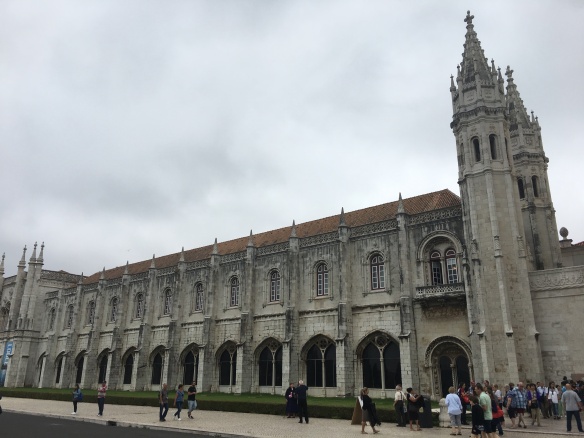
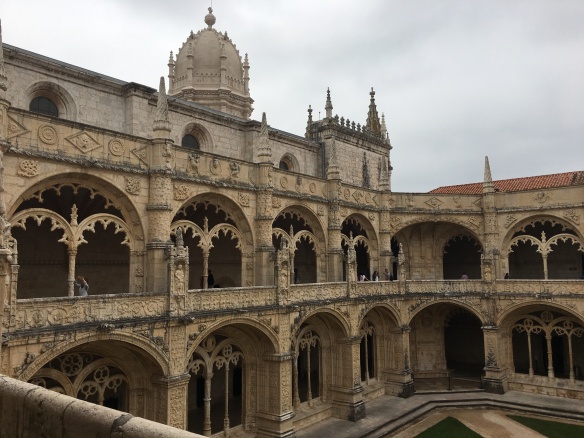
The Jeróminos Monastery in Lisbon, Portugal, is a UNESCO world heritage site. When my wife and I toured the massive complex last summer, including the impressive cloister and the ‘chapel’ – which views more like a colossal cathedral in typical European grandeur, I understood why. These photos don’t do it justice.

IMG_5608

In 1833, over three hundred years after the site and property was inaugurated as a religious Order of Saint Jerome, a state edict transferred the property and all its assets to Real Casa Pia de Lisboa, a philanthropic institution that took in, raised and educated orphan children.

IMG_5573

It was hard for me to imagine that a three-hundred-year-old religious institution of this magnitude would relinquish its assets. And doing this, located on prime waterfront in Portugal’s growing commercial city during the sea-faring Age of Discovery.

IMG_5588

IMG_5595

IMG_5605

IMG_5581

Without delving into the complex history and context of the Secularization Act of 1833, the fact remains: During a robust period of historical expansion, the church made a big change. I would argue, however, the church did not lose. Sure, it no longer could boast financial ownership of the property. But, by handing over its assets and combining them with the resources of the state, it bolstered its core purpose in mission – the care of vulnerable children. The space and property, as of 1833 moving forward, would now serve the needs of needy children.

Jesus says: “Unless you change and become like children …”[3] Without doubt, the religious of 1833 Lisbon were being true to the mission of Jesus.

In our lifetimes, we are witnessing here in North America – indeed in Ottawa – many growing examples of a church re-purposing its properties to build senior’s complexes and other social enterprise. We may believe this is a sign of the times – a negative, unfortunate, disappointing, mournful reality of the church. But, in truth, in many cases, such a re-purposing of a building is consistent with the Christian mission – to care for the weak, the vulnerable and needy in our society.

I can remember driving through rural country in south-western Ontario, and more in Saskatchewan, where you would see, stuck in the middle of a wheat field, a run-down, dilapidated old church building no longer in use, just left abandoned. It is sad to see this. It’s easy to jump to the negative conclusion that the church is dying by simply looking at its physical assets. When it’s not tied to a living purpose, the building will surely die.

But two hundred years after the so-called secularization of the Jeróminos Monastery’s assets, hundreds of thousands of visitors to the site every year continue to pour in and be inspired by the legacy of that bold, courageous move of those 19th century Christians in Lisbon. Good for them.

Re-purposing church property is not just a recent, contemporary phenomenon borne out of the institution’s modern demise. Re-purposing assets is not a sign of Christian defeat in a secular society. First of all, it has evidently been done throughout history when the need and opportunity arose.

Moreover, changing a physical structure doesn’t mean Christians are being decimated by an oppressively secular, contemporary, multi-cultural, diverse society in Canada. The physical transfiguration of Christian property may in truth be a positive sign of healthy, missional spirit, consistent with our Christian identity. A sign that the church and its original purpose in their properties will endure for centuries longer.

The disciples of Jesus accompany him to and from the mountaintop. Moses and Elijah appear with the transfigured Jesus, linking the present moment with the great tradition spanning all times and places. The community, the people, the saints on earth and the saints of heaven, accompany us on this journey.

The journey is a movement, not to remain stuck – even in moments of glory and victory. Rather, we are called to embrace the hardship as well, the challenges, the disappointments and opportunities of the daily grind of living, down in the valley of our lives. Ours is not a denial religion. Ours is not an escapist religion, one that ignores the plight of those who suffer, avoiding the normal difficulties of life, pretending that somehow we can with God only experience the highs without the lows. That is false religion.

Jesus interrupts our striving and tells us, “Don’t”. Don’t build those false expectations of a prosperity gospel. Don’t pretend you can stay on the mountaintop with Jesus forever while you live on earth. Because, Jesus, the divine Son of God, also embraced his humanity, and leads us down into the very human valley of life on earth.

Positive change and transfiguration in this light don’t come by way of escaping the world. The cathedrals of our hearts are meant to house people – all people, in their needs and for the sake of the other.

We are not alone, in this enterprise. As Jesus accompanied the first disciples up and down the mountain, God goes with us, up and down. Jesus leads the way. And, we walk shoulder to shoulder with our co-pilgrims who go with us.

[1] Mark 9:6, NRSV

[2] Matthew 17:5, NRSV

[3] Matthew 18:1-5