Prayers among the people – Pentecost +13B

13th Sunday after Pentecost; Year B

With reverence for the whole human family and all of creation, let us offer our prayers to God, saying “Let us pray,” and responding, “Have mercy, O God.”

For the family of God in the church, that you empower our inner lives and renew our minds, so that we may act boldly to invite others to church; and that we may trust the work of your Spirit in all that is good in our action. Let us pray … /R

For the family of God among nations’ leaders, that your Word gives life to those who are mal-treated and victimized by greed and self-serving leadership. We pray for those families affected by the gun-violence in the United States – in Chicago, New York and Colorado, recently. We pray also for justice, peace and restoration in Syria. Let us pray… /R

For the family of God in all of creation – the sparrows, swallows and birds of flight – that they may find home in safe and clean environments. We pray for the families affected by the oil refinery explosion in Venezuela yesterday. We pray also for those affected by the devastating earthquakes in Iran a few weeks ago, that lives and communities may be restored and needed help offered by those who have much. Let us pray … /R

For the family of God in our local congregation, especially parents and students travelling together to colleges and universities this week, that heartfelt farewell is expressed and new beginnings and empty-nesting be embraced. Let us pray … /R

For those in the family of God hurting, ill, distressed and despairing, that you deliver all in trouble, affliction, danger, or need; especially we pray for ….and those we name in the silence of our hearts or out loud……. May they be rooted and grounded in your love. Let us pray …/R

Receive our hopes and prayers, O God of mercy. Because we are a church that belongs to Christ Jesus our Lord, we all find a place in your home and at your table. Great is your faithfulness, in Christ Jesus our Lord. Amen. 

Cold sores and family

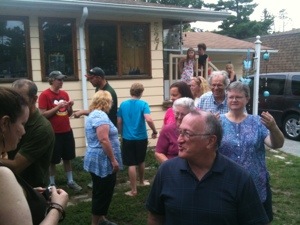
A highlight for me this summer was the family reunion at Wasaga Beach. We had been unable to attend this annual reunion the last few years, so it was a while since I had last connected with many people on my spouse’s side of the family. And as is consistent with my personality style, I was worried about making a good impression.

God has a funny way of challenging us where we need to be challenged. Because at about the time we decided to attend (which was a last minute thing on account of our recent move), I woke up with a big, festering cold sore on my lip.

Now, I had not had a cold sore for the last several years. It had also been a while since I knew what a cold sore was all about: irritating, itchy, never letting you forget it’s there (for a fleeting moment I wondered whether family reunions and cold sores had something in common!).

The cold sore has about a ten-day cycle, from initial growth to its drying, scabby end. I was to hit the high point of visible grossness the day of reunion. Everyone with whom I would have a conversation would have to be blind not to see the bulbess thing hanging from my lip. What would they say to me? (“Aahh, Martin, wipe your mouth man! Too much salsa for lunch?”) How would I respond? (“Awwh shucks, it’s nothing, really”) What would my extended in-law family think of the man their wonderful daughter had married?

As it turned out, God also has a funny way of reminding us of what is true, what is good, and what speaks of God’s love for us all. You see, my obsessive preoccupation with how I looked turned my conciousness away from others and the whole meaning of the event. Martin Luther defined sin as “being turned in on oneself”. I guess I was sinning: I was preoccupied with myself.

And yet, by the end of the day and contrary to my initial expectations, I felt accepted, loved and part of a family. No one drew attention to the cold sore; it was a non-issue. They were just happy to see me and my famly there! “It’s been too long!” That was the main thing: being together at the reunion. I felt like the Psalmist who expressed: “Even the sparrow finds a home, and the swallow a nest for herself where she may lay her young” (Psalm 84:3).

According to the Psalmist, it was the relatively insignificant, common, plain-looking, rather small sparrows who found a home among the rafters and ceiling crevaces in the tabernacle. It wasn’t the eagles, hawks, larger birds with colourful, attractive plumage.

What does this image suggest about who finds ‘home’ in God’s presence? The great? The mighty? The successful? The seemingly perfect? The beautiful?

By the end of the reunion day, I had almost forgotten about my cold sore because I was more focused on this collection of diverse people who found there way to Wasaga Beach on a sunny, August day: There were some fifteen youth and children under the age of twenty in addition to some twenty adults and seniors. And this collection of people spanned the whole socio-political spectrum and North American continent …. You get the picture.

Immersed in this blessed diversity I forgot about myself, because it wasn’t about me to begin with. This reunion was bigger than the sum of its individual parts. There was something more going on here.

The basis of our unity was not the visible aspects of our togetherness, otherwise we would all look the same! The basis of our unity was something we shared on the inside that was manifested on the outside. And what is true on the inside of our lives gets expressed on the outside by way of attitude, by way of our beliefs, by way of the nature of how we relate to one another.

“As it is on the inside, so shall it be on the outside,” as Michael Harvey explains (@Unlockingthegrowth). While mortals look on the outside, the Lord looks upon the heart (1 Samuel 16:7).

Thy will be done on earth as it is in heaven. This notion from the Lord’s Prayer suggests that heaven (the invisible, interior reality) leads to a corresponding visible reality on earth. Like in the Holy Eucharist, Baptism — any Sacrament — an inner truth reflected exteriorly, in water, bread, cup, meal.

Over the past month we have heard scriptures from the sixth chapter of the Gospel of John reflect on Jesus as the “bread of life”. We conclude today this teaching of Jesus from the synagogue in Capernaum. And the disciples, it is reported, had difficulty with it (John 6:56-69).

Admitedly, I think for us, too, it is much easier to deal with external, material reality: we can touch, taste, manage, something on the outside of us. It is easier to make judgement on a crooked picture frame hanging on your wall; but to reflect on why that particular picture is there in the first place and who painted it, for example, takes much more work that often, quite frankly, we’re not up for.

To approach the inner realm of our lives can be dumbfounding, intimidating, overwhelming a prospect. And so we avoid this work and get ourselves immersed in unreflected, unexamined action and busyness. Because that’s easier.

Yet Jesus emphasizes the truth of the inner life giving reason and substance to the outer life. In his words, “It is the spirit that gives life; [without the spirit] the flesh is useless.” (John 6:63). The beginning points of all meaningful and effective action are prayer, contemplation, reflection, engagement with our inner lives in relationship with God and others. The spirit gives life.

And this is how to understand that more famous text from Ephesians 6 about putting on the armour of God. We put on the belt of truth, the breastplate of righteousness, the shoes proclaiming the gospel of peace, the shield of faith and helmet of salvation and sword of the spirit, NOT in an aggressive, confrontational, external stance against enemies of the flesh. “For our struggle is not against enemies of blood and flesh, but … against the spiritual forces of evil in the heavenly places” (Ephesians 6:12). Again, the beginning point of faith is in the internal, invisible reality of our lives.

That is not to say that sometimes when we don’t feel inside any stirrings of the spirit, we ought not do anything. Sometimes the reverse is true: we need to engage in right action despite our feelings or what might or might not be going on interiorily; our external action, then, may affect positively what is going on inside us. After all, Jesus doesn’t exclude one or the other: “The words that I have spoken to you are spirit AND life” — internal AND external are both vital, to hold in balance. Not either/or, but both/and.

As I said, the exterior reality that reflects the inner truth is that of attitude, and the quality of our relationships. And, more to the point, this attitude is pointed to the quality of our relationships with those whom we invite to church and those to whom we are strangers and happen to cross the threshold of our church.

These people, too, are part of God’s creation, loved and cherished. Every person on the planet can claim the passage from the Psalms: “I am fearfully and wonderfully made” (Psalm 139:14). And therefore they are among us for a divine purpose.

More Christians are raising concern about equating the church with ‘family’ – presuming the analogy refers to a traditional father-mother-children unit. For being exclusively defined as such, I agree with their objections. Because the family of God is so much more.

It is not our job to judge their status in the family. It is our job to invite them. To be an invitational church. That family reunion at Wasaga Beach happened because an invitation to come went out. I am grateful for that invitation.

Because we are a church that belongs to Jesus Christ, there is a place for you and everyone else here. “You did not choose me,” Jesus says, “But I chose you …” (John 15:16).

Christ’s invitation is about joining in God’s mission. And this mission is not just the purvue of the rich, the famous, the successful, the educated, those who have unblemished bodies, those who have been a part of the church forever — but to all, including you and me. Because God made us, “wonderfully”, from the inside out.

20120825-115542.jpg

Failure = Success

When we think of David, we think: shepherd, poet, giant-killer, king, and ancestor of Jesus – in short, one of the greatest characters in the Bible.

But alongside that list stands another: betrayer, liar, adulterer, and murderer. The Bible makes no effort to hide David’s failures. The first text from the Scriptures today (2 Samuel 11) highlights one of David’s greatest sins: his adultery with Uriah’s wife, Bathsheba.

And this sin doesn’t stand alone in his life. In order to have Bathsheba, David not only breaks the sixth commandment, but the fifth one as well – he arranges for Uriah’s murder. One thing leads to the next.

Like David, we are sinners and we live in the web of sin. Our sins are not isolated, autonomous items, knick-knacks lined up on the shelf; and when we want, we can simply remove one without really having an effect on anything else. When we say we are sinful, we confess the pervasive depth and breadth of sin in our lives. The doctrine of original sin implies that brokenness and imperfection seep into and is woven into the very fabric of all creation. You can’t escape it.

Which may lead us to despair over our seeming palliative moral situation as human beings. We are bound to fail. What hope is there?

One of the outstanding effects of our cynicism and despair is our loss of resiliency. We give up all too easily. This trait becomes a hallmark of a people who are fearful and shameful of failure, of making mistakes. We may try something new, take a bit of risk, and if it doesn’t work the first time – we say, “That isn’t for me” and walk away.

Loss of resiliency comes from our fear of failure. The phrase “airbrushed out” is used to describe photos where a model’s imperfections have been removed, or where their attributes have been enhanced. But airbrushing, as Michael Harvey points out (Unlocking the Growth, p.118) also happens in church circles.

Doesn’t the church have a tendency today to airbrush out any imperfections? I doubt if church authorities today would commission the writing of David’s Psalms. There is too much honesty there: “Why have you forsaken me?” “Why have you let my enemies surround me?”

But what if we chose to look at our failures and imperfections as an aid to hearing God’s voice, to the transformation of not only ourselves but of the world around us?

Norman Vincent Peale used to say: “When God wants to send you a gift He wraps it up in a problem. The bigger the gift that God wants to send you, the bigger the problem He wraps it in.” Problems are a sign of life and activity. But we get concerned with the wrapping rather than the gift, don’t we?

The wise would say: There is no failure in falling down; the failure is only in not getting back up again. So don’t waste a good failure, because imperfect practice makes perfect, and failure precedes success. David, while he sinned greatly, he moved on from his mistakes: confessed his imperfections and accepted the suffering they brought.

Thomas Edison said, “If I find 10,000 ways something won’t work, I haven’t failed. I am not discouraged, because every wrong attempt discarded is another step forward.” Often one of the best ways to hear God’s voice is in the midst of failure, if only we stop berating ourselves to listen for it.

How do we do this?

First: Practice persistence. If I came home from a long trip late some stormy night to a fridge that was empty of the one thing I desperately wanted to eat, what would I do?

I could just go to bed and forget about it. Give up.

Or, I could put on my boots and raincoat and walk down to the corner store. But alas, they’re sold out of what I want; I could just go home and forget about it. Give up.

Or, I could drive farther across town to a late night drugstore. But alas, they don’t carry the thing I want; I could just go home and forget about it. Give up.

Or, I could drive to a specialty food store where I am sure they would carry my product. But alas, when I arrive there I discover they have closed for the day; I could just go home and forget about it. Give up.

Or, I could drive downtown to an all-night super-big grocery store where I finally find that one, precious item.

Persistence. Learning to unlock failure as a necessary way to grow is a bit like playing a video game. There is always another level, another lock to break down and then yet another level to reach. And if you don’t take down the locks one by one, well, you never reach the top.

Christ Jesus saw the rich young ruler walk away, saw many disciples turn back after a particularly hard teaching, saw Judas betray him, and the other eleven disciples temporarily desert him in the Garden of Gethsemane. Jesus himself had to face disappointment and ultimate failure – from a human perspective – in his defeat on the Cross.

Yet Jesus remained true to his divine call. Jesus stayed on the path set before him. No failure too deep nor cross too heavy would stop him. Praise be to our Lord, who showed us the way!

In the striving and persistence, there is yet another very important distinction to make: between doing the right thing, and the results. The results of our best-laid plans and intentions are in God’s hands. When we fret and fume and obsess about the results, we are often disappointed and we lose resiliency and give up, afraid to try anything, take any risk.

It was Saint Paul who wrote: “I planted the seed, Apollos watered it, but God gave the growth” (1 Corinthians 3:6). Our job is to do what we need to do – let God worry about the results.

Our gut response to failure is often: just follow/enforce the law. (As if doing that will make all things right again). The purpose of the law, in Lutheran theology, however, is to drive us to our knees at the throne of grace. The purpose of the law, which stands out in Martin Luther’s theology, is to make us realize that we cannot accomplish by our own strength and effort the perfection of the law. This confession and realization draws us to Christ and his work.

Failures are like leftovers. Leftovers are food that may even be discarded. Leftovers are food that was not initially desired nor needed by those for whom it was prepared. Leftovers have a second-rate, imperfect quality about them. In the Scriptures, sometimes leftovers are like the crumbs spilled on the floor for the dogs to eat (Matthew 15:27) In Matthew’s version of the feeding miracle, the ‘leftovers’ are identified as “broken pieces” (Matthew 14:20).

Whatever you take the miracle of the feeding of the multitudes to mean, one thing the text from John 6 makes explicit: Jesus causes everyone’s hunger to be satisfied and twelve baskets of leftovers are collected. Why emphasize these leftovers? A great miracle has just occurred, the only one told by all four Gospels – Matthew, Mark, Luke and John – and our attention is drawn to leftovers? Kind of odd, no?

Perhaps the Gospel writer indicates by this the character of the new community of believers where “leftovers” – both food and people – are neither insignificant nor abandoned. Who are the ‘leftover’ people in our society? Those at the margins? Anyone who is not afraid to show and be honest about their imperfections, their failures?

When we accept the “leftovers” in our own lives – whatever failures and imperfections – we are in the best position to accept Jesus.

During the storm on the sea when they notice Jesus walking on the water, the disciples take Jesus in – receive him – into the boat. The Gospeler John often uses the verb “to receive” (lambanein) in terms of believing that Jesus is the Son of God (see 1:12-13;3:27-36;5:43;7:39;12:48;13:20,etc.). For John, such trust and reception on the dark and wind-tossed seas of their failures is followed immediately by calm and joy. Jesus distributes the food to all; Jesus is the source of peace.

You see, the thing about David, is that he trusted and believed in God as one who would forgive him, who would satisfy the hunger of his heart, who was the source of all things good. I believe it is because of this trust that God referred to David as one “after his own heart” (Acts 13:22).

We know how leftovers can sometimes taste the best; our failures can be the key to our growth, to positive action. God speaks through our failure. Accepting this, confessing it, and then doing what we are able, in trust and openness of heart, receiving Jesus as the one who accomplishes the good deeds in us and through us – this is the character of faith.

How is God Faithful? – in Covenant

We are a Covenant people! — So announced the theme of the biennial Eastern Synod Assembly last week in Waterloo. What does it mean to be in a Covenant relationship with God? Certainly this word is not in common usage today. Perhaps ‘promise’ comes close.

Yet Covenant conveys more. First and foremost, to be in a Covenant relationship with God is to trust that God worries about the results. God brings it home. God’s action is the punctuation mark at the end of all our sentences. God finishes.

And we do not. That’s important.

Nevertheless, to assert God’s side of the bargain, what is presumed is our action as well. There’s no point in having punctuation marks at the end of sentences that aren’t written. And so to be in a Covenant relationship with God is to take the risk of faith, not knowing what the consequences may be. Without this element of faith we bring judgement upon ourselves in living and believing in “cheap grace.”

Indeed what we often need to start with — and that is why we being most acts of worship with confession — is seeking forgiveness for blocking God and locking ourselves in false ways of being church. How do we block God and lock ourselves in patterns of unfaithfulness? A worthy question worth exploring: How do we block God and lock ourselves in ways that keep us stuck?

Have you considered that being Christian is not just about going to church on Sunday? Have you considered that being Christian has just as much to do with what we do in our free time? — being Christian has just as much to do with Monday to Saturday as it does with Sunday? — being Christian has just as much to do with what we spend our money on? — being Christian has just as much to do with how we vote? — being Christian has just as much to do with how we relate with our spouse, our children, our extended family, our neighbours, our community? — being Christian has just as much to do with our behaviour as it does with the words we speak? “Preach the Gospel; use words, if necessary,” instructed Saint Francis.

Many of us, myself included, grew up in the church with the idea that faith was a private affair; and, therefore there were three topics good, pious Christians would never discuss openly, especially in the church. You know those three topics, right? — sex, religion, politics.

In looking recently over our annual Canada Revenue Agency charitable report that all churches are bound by law to complete and submit annually, I was surprised to find a question among a hundred other questions: The question was: “Did the charity carry on any political activities during the fiscal period?” The little note above the question clarified that churches indeed can be involved in politics, as long as that political activity is non-partisan and limited in extent.

I was also struck by the meaning of the Old Testament story optioned for this Sunday, from the book and prophet, Samuel. In this story, the Holy Ark of the Covenant — there’s that word again! — is brought triumphantly into Jerusalem. We read about that procession of King David dancing as the Ark is brought into Jerusalem and placed at the center of that great city. It is an image of uninhibited, unabashed glory, of joy and celebration (2 Samuel 6:1-5,12b-19).

Now, just for a moment, reflect with me on the meaning of this: The Ark of the Covenant in ancient Israel was at the time the most powerful and central image of Israel’s faith. And Jerusalem was (like Ottawa is for Canadians) the center of political power in the nation — the capital city.

And what does David do? He brings the two together: religion AND politics. And, perhaps more significantly, he does it not begrudgingly nor fearfully, but joyously!

At the Synod Assembly last week in Waterloo, we passed several motions that you could deem “political” in nature. Let me briefly review a few of these: a motion in support of non-violent solutions in pursuing justice in the world and in situations of conflict; a motion to call upon the government to re-instate full health care coverage to refugee claimants; motions to address affordable housing, poverty, racism and environmental action. These motions can be viewed on the Synod website; hard copies are also available from your delegates.

Faith is not exclusively ‘private’. It is ‘public’. It’s not just about me and Jesus; but about me and the world that God so loved. It’s more than just me. And as soon as we translate our faith into the public realm, it gets political. We have the biblical witness to this marriage between faith and politics:

When the seven perscuted churches in west Asia on the Aegian Sea coast (in present day Turkey) of the Book of Revelation are pressed to swear allegiance to Emperor Nero they are brought before the courts; and the encouragement of scripture is heard: Do not worry about what to say when called upon to testify to your faith in Christ as Lord. “For what you are to say will be given to you; for it is not you who speak, but the Spirit of your Father speaking through you” (Matthew 10:19).

The beheading of John the Baptist, from our Gospel text for today (Mark 6:14-29), provides a gruesome image of what sometimes may happen when religion and politics meet in the same room.

And perhaps the most poignant image from the New Testament — the Cross — was a political symbol and practical means of Roman capital punishment. It’s like the electric chair or lethal injection would be for us today. For several centuries after Christ early Christians shied away from using the cross as a central symbol; you can’t find images of crosses anywhere in the archeological record of those first centuries. In fact, the fish was the first central symbol of Christianity. Did the early church find the cross too brutal — too political — an image? I wonder.

I know I need to confess my own fear of bringing my faith to bear on the public world around us. I know I need to confess my own fear of blocking what God wants to do and locking myself because of my fear of rejection, my fear of failure, my fear of sticking out my neck.

One of the speakers at last week’s Synod (I’ll want to talk more about Michael Harvey in the near future) said that fear is the socially acceptable sin of the church today. It is a sin of omission. This is the sin we need to confess. I don’t think it’s coincidence that the biblical injunction: “Do not be afraid/Do not fear/Fear not!” appears some 365 times throughout the bible. We need to hear that; I need to hear that, each day of the year.

Because on the other side of fear is the vision, the abundant life. On the other side of fear is new life. The thing we fear is actually God’s call on our lives. We need to accept and confess our fear. We need to go there.

And when we do, God finishes. God is faithful. God remains true and steadfast to the Covenant relationship. Because God loves us and wants us to love God and those around us. God wants to be in relationship with us, even though we so often miss the mark.

Listen to Paul’s words we often recite: “Who will separate us from the love of Christ? Will hardship, or distress, or persecution, or famine, or nakedness, or peril, or sword? [notice the political words here]. No, in all these things we are conquerors through him who loved us. For I am convinced that neither death, nor life, nor angels, nor rulers, nor things present, nor things to come, nor powers, nor height, nor depth, nor anything else in all creation, will be able to separate us from the love of God in Christ Jesus our Lord” (Romans 8:35-39).

Jesus goes there. Jesus has crossed the boundary between private and public, religion and politics. Jesus enters all aspects of our life together. There is no place Jesus does not go. Even to those places we fear most. Jesus goes there — into our hurt, pain, suffering, persecution, illness. It is not our job to be successful; it is our job only to be faithful, and do it. We are called only to follow, to follow in the way. And then “Jesus will bring to completion the good work begun in you” (Philippians 1:6).

Thanks be to God! Amen.

Sunset and Sunrise of the Church

20120711-223116.jpg

Today I took this photo during sunset at Andrew Haydon Park, Ottawa.
I guess you can’t tell from the photo whether it’s a sunset or sunrise. Unless you know the spot personally.
A sunset and sunrise stand as good metaphors for the institutional church. For many reasons. The image is full of meaning.
I reflect on the need for the people of God to surrender and let go of the good old days; the need to open our hands and release all the sentiments associated with those glory, golden decades of the church during the 20th century. It is a dying of sorts because the new thing can’t happen until we lay all that was on altar.
That lament is what stirs in my soul as I watch yet another sunset.
But there is beauty and hope in the experience, too. Not only do I witness and surrender the passing of a wonderful day. As I walk to the parking lot in near darkness, my back to the darkening sky behind me and the ball of flaming red long gone, I know the sun will rise again in the dawning light in a few hours.
Sunset. Sunrise. The promise of the new awaits as I sneak a glance towards the eastern sky. A smile on my lips.
But first I will sleep, and let the Lord, God of heaven and earth work the miracle of new life, resurrection, while I rest in grace and in peace.

20120711-224845.jpg
I snapped this photo during a glorious sunrise over the Atlantic Ocean at Fort Lauderdale, Florida, in July 2011. The start of a new day, full of promise.
Behold, the light of the world has come, and darkness has not overcome it.

How is God faithful? – In the Margins

An elderly woman lived on a small farm in Manitoba, Canada – just yards away from the North Dakota border. Their land had been the subject of a minor dispute between the United States and Canada for years. The widowed woman lived on the farm with her son and three grandchildren.

One day, her son came into her room holding a letter. “I just got some news, Mom,” he said. “The government has come to an agreement with the people in North Dakota. They’ve decided that our land is really part of the United States. We have the right to approve or disapprove of the agreement. What do you think?”

“What do I think?” his mother said. “Sign it! Call them right now and tell them we accept! I don’t think I can stand another Canadian winter!”

Celebrating Canada Day is about celebrating who we are. And who we are is to a large extent defined by our borders. Indeed, boundaries are important. We need to be clear about the margins, the borders, of our country to understand the shape, size and very nature of our identity.

The margins are both bad and good places for us.

Often we think of the margins as places we don’t want to go to. Those are unknown, scary places full of tension. Margins are not desirable locales. They are places where danger lurks.

I visited this past week the Carlington neighborhood whose chaplaincy we support by our donations and, more significantly, our volunteer leaders. Here, in Ottawa, this area was established for “low income housing” where poor people live. People who call that neighborhood “home” live on the margins of society, so we say.

Jesus, of course, goes to those scary places – our Gospel text today (Mark 5:21-43) opens with a statement recognizing borders: “Jesus crossed in a boat to the other side.” For a rabbi to go to the margins, this is something extraordinary. Jesus is not afraid to go to those from whom we normally want to keep distant.

Jesus goes directly into the home of those whom he heals – Jairus’ daughter in this case. Jesus doesn’t heal from a distance; he goes right into the room and even touches the sick, the outcast and the marginalized. The Gospels are full of such examples. This is his practice – going to the margins. This defines his identity.

Jesus would make a good Canadian. It’s interesting we are living in a time of our history when Canadians are just starting to explore and establish our national presence in a largely unknown “margin” of our country – the Arctic in the Far North. We might find Jesus there. Or would we?

Because Christianity is not just about going to and debating geographic boundaries. Christianity is more than that. It is essentially about going to the social margins.

Notice the literary structure of the Gospel story. Interesting that scribes, translators and early redactors of the text maintained the “interrupted” nature of this text from scripture. They didn’t separate the two distinct healing stories into neat, successive stories. The healing of the woman with hemorrhaging interrupts the story of the healing of Jairus’ daughter. There is something important about preserving this interrupted structure of scripture.

Can going to the margins be good for us? Because, in truth, it describes our reality. Immigrants especially should understand this. Canada is full of immigrants. The nation state of Canada as we know it developed out of our immigrant identity. How can we describe our immigrant experience?

For one thing, immigrants are people betwixt and between two places; it is an interrupted reality, so to speak. As a first generation Canadian I have felt the residual effects of this reality, experienced more directly of course by my parents.

New immigrants often feel ‘marginalized’ in the dominant culture. They neither feel they belong fully to where they’ve come from; nor do they feel they belong fully to where they’ve landed. These are the margins as well; it is who we are, crossing both boundaries of national identities, and creating something new and unique.

Listen to the words of Mary Joy Philip who was one of the keynote speakers at the Luther Hostel last month inWaterloo. She said,

“What is home now? India? The United States? Most of my life has been spent in India; I was educated, married, had children, a career there. And now I have been in the U.S. for fifteen years. So, where is home now? Where do I belong? Having been away from India this long, do I belong there? And even though I have been in the U.S.for fifteen years, I definitely don’t have that feeling of belonging. I am an outsider and always will be. So, I don’t feel that I belong in India or in the U.S.; and yet, I belong in both … I belong in that in-between space, betwixt and between … you are neither there nor here but in both … [which] puts me in a unique position of being in beyond both, of being what you might call a hybrid.”

I would add that Canada is full of ‘hybrids’.

Yet what is truly remarkable about Jesus is that he doesn’t just go to the margins; he crosses the borders of social acceptability. He crosses the borders that we might deem fearful. He crosses the borders of any kind of stigma that separates people. He crosses the borders of theological correctness, doctrinal purity. He crosses the borders of ethnic segregation.

To be sure, the margins are places of tension, a tension between endings and beginnings. But it is precisely this tension that sustains life. Those margins, the borders, prove so necessary to our common life and growth together as a nation and people of God’s reign.

Let’s remember that, in a sense, Jesus was a hybrid: Fully human and fully divine. Both/And. Jesus, the God-man, lived at the margins, in theGalilee, where from, in the eyes of the others no good could come, but from whither and from whom the “good news” came. How can the margins NOT be the threshold to something new, something transformed, something good, in Christ Jesus.

Mary Joy Philip went on to assert that as an immigrant, she could draw out the uniqueness of both places she was and is now, and create a new space to be … which allowed her to have a distinct identity.”

Crossing over may not always be ideal nor perfect. But it is important to do, and good, too. As we venture into this new space we need only to hear Jesus’ words over and over again: “Do not fear, only believe.”

A small yet significant example from our Canadian history illustrates well this dynamic: Chiefswood is the name of the house of Canadian literary giant, Pauline Johnson. This stately house is situated on the Six Nations Reserve nearBrantford,Ontario. The house, literally, was built as a ‘cross-over’ for two distinct peoples sharing the land.

The house has identical entrances on opposite sides of the main floor, joined by a common foyer hall and staircase going up, in between. One entrance was designated for the Six Nations community to enter, and the other for the British side. The home served as the in-between space for both sides to co-exist. Their home provided a space where on equal footing – literally – interaction and dialogue could happen; and perhaps even transformation of BOTH sides in deep, meaningful ways. What a great image and model for Canada, moving forward!

I think we Canadians are well conditioned and poised by our history and our faith to be thankful and assert our unique identity in the world as a people whose social borders are crossed and mutually transformed into something more beautiful. That is to say: the ‘whole’ of what it means to be Canadian is larger than the sum of our individual parts.

Thank God for going to the margins of our lives!

Amen.

How is God Faithful? – Despite Us

How do you like your water? Do like it rough? Or do you like it calm?

In the Bible one of the most popular images of water is from Psalm 23: “He leads me beside still waters.” We say that still waters run deep; and indeed, it is true. In baptism, we sprinkle a few, tiny drops of water; or, we pour a small, shell-full of lukewarm water on the infant.

And so we sometimes and naturally receive these images and rituals as prescriptive of a rosy, comfortable, and easy existence with God and the Church.

Therefore, we may come to expect and even crave an easy life, saying it is the will of God. Conversely, when bad things happen or life challenges us to the core, is it because God has abandoned us, or is punishing us? Has our faith been lacking?

In reality our lives our often marked by a rushing torrent of roiling, turbulent, frothing white-water. Being faithful to the baptismal life in Christ is often descriptive more of being in a full-blown hurricane on the ocean.

I love the image of Jesus sleeping in the back of the boat while the disciples get anxious and fearful (Mark 4:35-41). To me, Jesus’ response suggests that in all the storms of our lives, Jesus does not diminish in any way the normalcy of the stormy life as part and parcel of faithful living.

The implication of this is counter-intuitive: It is precisely when life gets unnerving that faith makes any sense at all. Faith isn’t faith until it’s all you’re hanging on to, when the storms of life rage close by.

So when everything is calm, enjoy the moment because there will be more white water soon to come (if we are being faithful, that is). Because when we know God to be near, what we think is reliable and safe is shaken up. Whatever we presume is unchanging, constant, safe …. Beware! If Jesus comes close to that, you may be in for a ride! Because in Jesus’ presence we realize we really cannot control or fix those seemingly stable, controllable things on our own. And this is admitedly a scary prospect.

I’m not a white-water kayaker. But I do enjoy paddling in our canoe or kayak on relatively calm waters. Last weekend I got out on the river for the first time this season. And I was reminded again of the “Rules for White-water Rafting” described by Bishop Pryse at the last Synod Assembly in Toronto a couple of years ago.

He had eight rules for white-water. But I just want to highlight a couple. One rule, which is actually a combination of two of them, is: Never stop paddling, even when it seems hopeless, even when the boat doesn’t go where you want it to go. Never stop paddling.

This is so very important! One of the biggest challenges we face today is that of not giving in to cynicism which Martin Luther reminds us should be counted among, “doubt, despair and other shameful sins.” We need to keep paddling. We need to keep believing. We can never give up.

What did the disciples lack? If anything, they didn’t believe Jesus could do anything, that Jesus could actually provide a way through the storm.

But just as much as we need to keep paddling even when things aren’t going our way, at another level and in other circumstances we also need to be able to let go and stop trying too hard.

I’ve discovered that when docking or pulling away from the dock, all efforts to overcome wind and current by simply trying harder generally do not work. Far better than fighting wind and current is to position myself so that those natural forces will in their own natural way aid rather than frustrate my intent (p.229, Edwin Friedman A Failure of Nerve: Leadership in the Age of the Quick Fix, 2006).

I know this especially to be true when solo-canoeing. Even when heading out onto the river, if I don’t have my canoe aligned at the right angle vis-à-vis the direction of the wind, no amount of paddling on my part will achieve anything except frustration.

Alignment. Positioning. This has everything to do with the relationships in which we find ourselves. When we discover a need to realign ourselves vis-à-vis others, ourselves and God, the first step is to “take off the tires” that need re-alignment. For a complete re-alignment job, all tires have to be detached from the vehicle, rotated and then re-attached and balanced. In other words, letting go of our emotional grip on things is the first step.

Another one of Bishop Pryse’s rules for white-water paddling is: If you go under – which is a normal occurrence when white-water paddling – let go of everything; eventually you will come back up. An essential quality of faith is the willingness to let go of anything that we’re holding onto tightly. What are you holding onto so tightly? Resentment? Impatience? The need to be right? The need to be needed? The need to be in control?

Golfers, table-tennis, baseball and hockey players can attest to the one indicator that they are in a slump – what are they doing? They’re holding onto their club, racket, paddle, stick or bat too tightly.

If you want to get out of your slump, one thing to consider is “loosening up”. This is risky and scary. The stress of doing that can be sharp, but short-lived. Because once you have the courage to let go we discover an amazing truth, one that David I believe experienced on the battle field (1Samuel 17).

David could have gone home. David could have used the armor Saul was intent on giving him to fight Goliath, the giant Philistine. Yet, David did neither “safe” option. He was determined to trust in God by trusting in his own gifts of a sling and pebble – even when the facts appeared to suggest he was doomed.

We already have everything we need. We have enough; we don’t need to toil and strive to be something we are not. God has already given to us what we need. All we need to do is trust that God will not let go of us, and that ‘resurrection’, so to speak, will take care of itself.

For me it puts things in right perspective knowing that, regardless of what happens, we will most certainly come back up when we let go.

It’s interesting Jesus, after stilling the storm and bringing peace and calm to the situation asks his disciples, “Why are you afraid?” (Mark 4: 40-41) His question doesn’t refer to their fear during the storm, but after it was over: Verse 41, where the NRSV translates that the disciples were filled with “great awe”, is literally translated they were “fearful with a great fear” for what Jesus did. Why were the disciples as afraid – if not more afraid – of what Jesus accomplished to bring calm to the water than when the storm was at its peak?

Was it because they knew now there was no longer an excuse for not acting in bold, nervy, trusting, faithful ways DESPITE their fear? Truth be told, sometimes people want to remain stuck, holding on too tightly to that which they know is not good. Better the devil you know, right? The unfortunate result, however, is remaining stuck, cowering in despair and using fear as an excuse not to do the right thing.

But it’s not about us. While Jesus doesn’t diminish the reality of the storm, Jesus also demonstrates an everlasting, unshakable commitment to his disciples. Despite their unbelief and fear, Jesus is faithful. Jesus’ faithfulness is NOT conditional on the strength of our faith. This is good news. Jesus doesn’t abandon us in the storm. Jesus is not punishing us on account of the storm – whatever the storm you face. Jesus believes in us, even when we don’t have the courage to believe in ourselves.

One of the most honest, authentic prayers and confessions in Christianity is from the Gospel of Mark: “Lord, I believe; Help my unbelief” (9:24). And so our prayer today may echo the great prayer of the father whose son was healed by Jesus: “Lord, I believe. Help my unbelief!” For your homework this week, I invite you to read that 9th chapter of Mark leading up to that father’s statement. And read Martin Luther’s explanation of the Third Article of the Apostle’s Creed in Luther’s Small Catechism, where he writes: “I believe that by my own understanding or strength I cannot believe in Jesus Christ … or come to him ….. but by the Holy Spirit.”

Reflect on those words and examine your capacity to trust and wait for God’s Spirit. And examine your capacity to be decisive; to be decisive with honest awareness of your limitations and despite your fears. And in all that reflection, remember the most important thing – God is faithful!

Amen.

How is God Faithful? – Surprise!

I don’t like surprises. Never have. I am impressed when families can pull off those surprise anniversary celebrations or birthday parties. Perhaps I’m even more impressed by those who are the recipient of the proverbial “Surprise!” How do they keep their composure? Especially when all of a sudden their day and plans are turned upside down – how do they go with the flow?

But maybe I need to open myself up more to being surprised. Because I suspect being surprised is a basic quality of faith. And maybe that’s what I like about that hymn: Great is Thy Faithfulness. Since the first time I sung it, it always catches me and invites me to ponder – life is not about my faithfulness. I remember as a teenager believing mistakenly for a while that this hymn was about affirming the faithfulness of one another in the church. This hymn title suggested to me it was about my growth, my faith and the faith of those I admired in the church.

Anytime we encounter one of these parables about seeds and planting and growth (now that we’re in the season after Pentecost) the temptation is to dwell on and maybe even obsess about what we need to do, how we should respond in order to make things happen in our lives, in our church and in our world.

The Gospel text for today (Mark 4:26-34) nevertheless points to another reality we so easily miss in our striving and toiling, in our compulsions and in our hard work: God is faithful, despite all our efforts. My life is about God, and God’s ways. Not only that, it is the manner in which God is faithful that surprises me.

For fun I have been reading the trilogy of popular books about the Hunger Games by Suzanne Collins. During the first time the main character, Katniss Everdeen, competes in the deadly competition to survive she is saved by someone who no one expected to live long in the games, by someone no one really took notice of when the games began. In fact, no one even noticed her because she was the smallest, youngest girl, until….

One fateful night Katniss is trapped high in a tree while her enemies simply wait her out camping at the base of the tree. Before dawn she is wakened by some rustling of leaves and branches in a neighboring tree. Looking over she sees the little girl, Rue, who points to a large bee’s nest indicating a way out of her predicament. Acting on Rue’s cue, Katniss drops the entire nest on the unsuspecting group below, scattering them and giving Katniss opportunity to escape.

This seems to be God’s modus operandi: God chooses that which the world presumes unqualified, even undesirable, to accomplish God’s purposes. God will demonstrate God’s faithfulness by sticking by us, especially in our weakness and among those who are marginalized on account of their ‘unwanted’ qualities. When everyone else loses their faith in someone or something, watch out! It is precisely in those circumstances and with those people where God might be working to demonstrate God’s faithful, life-giving, gracious and powerful purposes. Echoes of Paul’s words in his letters to the Corinthian Church sound here: “My power is made perfect in weakness” (2 Cor 12:9).

I think we can see this operating in the choosing of the smallest, ruddiest shepherd boy David to be the next King of Israel (1 Samuel 16:1-13). The family doesn’t even have him around when all the boys of the family are lined up before the prophet Samuel who comes to appoint the heir to the throne. The older, taller, powerful brothers were exceptional candidates, right? That’s how little faith they had in David’s abilities and gifts. How can God choose such an inexperienced youth, after all? Someone we push around and give all the crappy farm-hand jobs to do?

And what about that tiny seed? A theme throughout the Gospel of Mark is ‘secrecy’ that is eventually unveiled. For example, often in Mark’s Gospel Jesus instructs those who witness a miracle not to tell anyone about it, for the truth about Jesus must be disclosed at the right time – at the cross and empty tomb.

The character of the kingdom of God emerges, comes out. And the kingdom of God matures and grows not because of our efforts but because that’s its job, like a seed. A seed is not forced to grow, or told to grow. It does what it has been created to do, naturally, and on its own timetable.

The nature and function of the kingdom of God on earth starts – covered, veiled, hidden, unsuspecting; but once it starts, you can’t stop it. Because a mustard plant is invasive, like a weed. Nobody wants a weed! Nobody would expect God’s truth, God’s power, God’s ways to come about from something like that, eh? Just like people in Jesus’ day never believed anyone or anything good would come from Nazareth, right?

Surprise! God’s ways are not our ways (Isaiah 55:8-9).

One way our toiling and striving can get in the way and get us stuck is our obsession with gathering more and more information. As if our salvation rests on more and more knowledge. We live in an age of data-obsession. For example, whenever we encounter a challenge or ambiguity or a question, what is the first thing we do? We collect data. We take surveys. We gather information so that we’ll have an answer to the question. The result, often: we get stuck –in the numbers, the facts.

Edwin Friedman in his book A Failure of Nerve: Leadership in the Age of the Quick Fix discusses Europe’s rather sudden conversion from being depressed (Nuremberg Chronicle, 1493) and having a lack of hope and vision, to flowering in religious, artistic and scientific revival. The turning point? The discovery of the New World. And what characterized those who discovered the New World was that they had the nerve, the courage and spirit of adventure to go beyond the boundaries of the accepted data of the day.

The sanctioned cartography of the day described the Atlantic Ocean as the only ocean on earth; there were no land masses south of the equator; and, California was an island. If Columbus and other sea-faring adventures remained ‘bound’ by the data they would never have made their discoveries; Europe would have remained ‘stuck’ and ‘depressed’.

I suspect as important as data-collection can be to any vision, this approach can also only serve to squeeze out of our consciousness the vision of adventure, of the beyond- ourselves, including some ambiguity, including God’s ways, God’s power.

The parable of the mustard seed asks us not to close our imagination. This parable asks us not to close our sense of a vision beyond what is immediately apparent and measurable. In short, this parable invites us on a journey of life and faith in which we are open to be surprised by God’s grace. How can we be surprised if we know everything – or pretend to know everthing?

Great is Thy Faithfulness, O God! How can we practice being surprised by God’s unsuspecting faithfulness to us? Well, let’s first narrow our scope from New World discovery to our experience of worship: Ask yourself, why do I come to worship? Where do I expect to encounter God in the worship service?

And let me suggest that you are open to experiencing and encountering God not just where you might expect – the usual suspects: in the sermon or in the music, for example. Let me suggest that God may bless you and move your heart in another place in the service where you didn’t expect it – perhaps in the lifting of the bread and cup at the Eucharist, perhaps in one of the petitionary prayers, or merely one word in the prayer of the day, or in sharing a cup of coffee with another person following the service, or in one line of a hymn, the sound of a musical instrument, the voice of the choir, the reading of scripture. And that can change from week to week!

God is faithful. God can come to us not only in any and all of these parts of the liturgy but in any part of our day from Monday to Saturday where we least expect it. And God comes to us faithfully in order to sustain us, empower us and inspire us with His Spirit. On our way rejoicing!

Thanks be to God. Amen.

A Holy Re-Orientation – Pentecost 2B

Mark 3:20-35

My experience at Luther Hostel last week reinforced some things that I think many of us who care about the church sense at some level – that something’s wrong with the church, and that something’s going to have to change to turn the ship around!

I don’t need to list all the evidence that is pointing to a diminished institution as we know it. What do we do to prepare ourselves for the changes – even transformation – to which we are heading whether we like or not?

Probably encouragement. Maybe even challenge. But I suspect some comfort as well.

I’m not going to articulate in this sermon what that specific mission will be because quite frankly I don’t know. In this congregation I’m the new kid on the block and I’m still in information-gathering mode. I’m learning about your history and just beginning to get a sense of what makes you tick, what inspires you, what your passions are in all things church-related. And this is where we’re going to have to start in determining what that mission will be.

But I do believe I know how some of that transformation might take place.

Two things happened on the first day of Luther Hostel to me that may illustrate how new life will come to our lives, our community, our church.

Because early on the first day we traveled on a school bus over an hour to the Six Nations reserve in Brantford I held off my first coffee before the trip. I didn’t want to suffer the bouncing need to use a washroom during the drive. Been there, done that. Not again.

But I also (falsely) assumed that upon arriving, there would be coffee somewhere. As it turned out I didn’t have my first coffee of the day until supper time.

The other disorienting experience was I realized I wasn’t going to be doing any driving, not only that day but for the whole week. As one who now averages about 500 kilometers a week behind the wheel, I didn’t know what to do with myself!

Being without those two, simple, routine comforts disoriented me.

But I soon realized that feelings of withdrawal were a precursor for something good, even better. What initially disoriented me prepared me for a holy re-orientation.

I had to let go of something for the sake of what was happening that was more important. The wider truth of my discomfort is to say that ‘life begins at the end of our comfort zone’ (thanks to @soulseedzforall for that pearl!). Life begins at the end of our comfort zones.

On the first day of Luther Hostel a bunch of us mostly white, ethnically northern Europeans visited Mohawk Institute — the first residential school in Canada. We heard about the painful stories of abuse suffered by the aboriginal, First Nations, children at the hand of church and government leaders there. In the sharing and storytelling I was nevertheless encouraged by our meeting with traditional native peoples. Because the circle of this story-telling was expanding.

There was something going on here that was much bigger than me. I couldn’t let my banal neediness sabotage the important things that we needed to learn that day, however difficult. My life was enriched by that learning — no coffee aside. At some point that morning I had to surrender myself to the experience. It was a giving it up — sort of like in Lent, a discipline. And I realized by the end of the day I didn’t really need that morning coffee.

Jesus often does this to get his point across. He ‘breaks things down’ before presenting the new thing. He disorients his listeners in order to REorient them. In so doing he is consistent with the biblical tradition:

The prophet Jeremiah often uses the language of “plucking up” and “breaking down” in his poetry; he refers to the Israelite need of giving up the securities of land and religion to prepare for God’s next great act in their lives: exile – not something, by the way, they at first welcomed.

In Jesus’ day loyalty to family was the backbone of society maybe even more so than today. But I think we can feel the offense in his statement implying that his own family is inferior. Could he even be universally denouncing the traditional, family unit? We could think so, when he asks rhetorically and maybe even facetiously, “Who are my mother and my brothers?”

But for Jesus to describe the new family his kingdom stands for — inclusive of all people including those at the margins — he first needs to shock us out of our assumptions of what family is. He needs to de-construct ‘family’ before rebuilding it.

Not that he is anti-family. But he holds out for what is better in the long run. What will be rebuilt is much better than what has been.

But first we need to let go. And that’s the hard part, to be sure: In our personal lives do we want things to change for the better? In our economy do we wish for better days? In our church do we want to include more young people? In all these and other areas, in our yearning for the new, the better — what first do we need to question, to let go of, to de-construct?

If the prospect of letting go of something or someone precious frightens us to the point of paralysis, take heart people of Faith!

At the point of Jesus’ deepest letting go, at the point of the ultimate ‘break-down’ of his life on the Cross, he demonstrates a profound love for his mother.

Jesus does love his family. From the cross he prays for his Momma, that she be taken care of (John 19:26-27). In his dying breath he prays for her. At the point of God’s very own death Jesus does not forget us. There is indeed nothing that can separate us from the love of God in Christ Jesus (Saint Paul, Romans 8:38-39).

But Jesus’ vision is greater than us. Jesus’ ‘breaking down’ is for all people. His kingdom includes those whom at first we might consider outsiders, lazy, second class.

The Cross, according to German theologian Jurgen Moltmann, represents a momentary ‘crack’ between the Father and the Son, revealed in Jesus’ cry, “My God, my God, why have you forsaken me?” (Matthew 27:46) There appeared a break in the Trinity, a crack in the divine relationship, in which Father and Son suffered mutually.

But this crack opened the possibility for the Holy Spirit to enter and bind the Godhead together. So, the triune God experienced a separation of sorts before unity was to be re-established. And God accomplished this reconciliation for the sake of Jesus, and resurrection — new life — for everyone!

At the end of that first day at Luther Hostel, I SO enjoyed my next cup of coffee. And I appreciated the privilege to drive my vehicle. I approached these simple routines with renewed gratitude.

And I look to God’s gracious leading us, in little and maybe big ways, to the end of our comfort zones. To see what happens where life begins anew.

Amen.

House of Pain

Image

20120605-115346.jpg

LutherHostel2012 visited the first residential school in Canada – Mohawk Institute – from 1831-1970 situated at Woodland Cultural Centre on Six Nations Reserve in Brantford Ontario. We continue to pray for truth and reconciliation, and courageous leadership among and with First Nations. We confess our sins, and we commit to telling the story for all to know what really happened.