
A new baptism

The violin can be one of the most difficult instruments to master. I know, because I try to play it, from time to time. And it isn’t easy to play well. So I appreciated this poem that reflects a baptismal understanding recognizing the touch of God on our lives:

“’Twas battered, scarred and the auctioneer thought is scarcely worth his while – to waste his time on the old violin, but held it up with a smile, ‘What am I bid, good people’ – he cried – ‘who will start the bidding for me? A dollar, a dollar, now two, only two – two dollars, and who will make it three – but no!’

“From the room far back a gray-haired woman came forward and picked up the bow. Then wiping the dust from the old violin, and tightening up the strings she played a melody pure and sweet as sweet as an angel sings.

“The music ceased and the auctioneer with a voice that was quiet and low, said: ‘What am I bid for the old violin?’ And held it up with the bow. ‘A thousand dollars, and who will make it two – two thousand and who will make it three? Three thousand one, three thousand twice and going and gone’, said he.

“The people cheered, but some of them said, ‘We don’t quite understand, what changed its worth?’ Swiftly came the reply: ‘The touch of the Master’s hand.’”

Our lives, sometimes, can be out of tune, and tattered and torn with sin. Our lives can therefore feel ‘cheap’ and useless – much like the old violin. But then the Master comes, alighting our lives with the loving touch of the Spirit of God. God touched us in our baptism and we can never be the same again. We are of priceless worth to God.

Our lives are transformed, changed for the better, when what we do and who we are resonates and harmonizes with the purposes of God. We are in our baptism called to be servants and co-workers with the living Jesus in the ministry of the church.

If there is any similarity between Jesus’ baptism and our baptism, it is in discovering and embracing the unique purpose of our life. What was Jesus’ purpose? His mission?

Because Jesus didn’t need baptism in the same way we practice the first sacrament today. Jesus’ baptism was meant for Jesus alone, in first century Palestine; after all, the heavens were opened “to him” (Matthew 3:16), Matthew records, presumably to him alone. Jesus had a singular and primary purpose to fulfill as the Son of God. It was to be his job alone to take away the sin of the world. Not anyone else’s.

Jesus’ ‘baptism’ was really an inauguration for Jesus to begin his earthly ministry in that time and place. If anything, we catch a glimpse of the intimate relationship between Jesus and his ‘abba’ – God the Father and the Holy Spirit. Jesus is baptized in order to fulfill the purpose of God to bring salvation to us. This is what is meant when Jesus says his baptism is meant to “fulfill all righteousness” (v.15). God was doing something here to accomplish the salvation of the world through Jesus.

And God would accomplish this through Jesus in at least a couple of ways: First, through Jesus, God makes all things new. Just as Jesus transformed the Passover Meal into the Holy Communion, the Lord’s Supper; just as he transformed and gave new meaning to the Hebrew Scriptures; so, he made baptism a new thing.

In response to Jesus’ command recorded in the last chapter of the Gospel of Matthew (28:19) – to go and make disciples of all nations, baptizing them in the name of the Father, the Son and the Holy Spirit – Christian baptism is primarily an act of the triune God. Baptism is done ‘in the name of’ God. In baptism, God acts. Baptism is God’s doing now, not our doing. God is the primary actor.

Through the sacraments God promises to be united to us in love, to bring us into the community of faith, and to nourish us on the journey. Through the sacraments, God promises to adopt us as God’s precious children whom God will never abandon. In my baptism, I believe God promised to love me, to forgive me, to nurture me and stay with me, “even unto the end of the age” (Matthew 28:20), no matter what I do.

We belong to God, we call ourselves Christian, not because we made it that way. But because God wanted us. We are God’s children, and we have God’s touch on us. Thereby, God also accomplishes through Jesus our salvation: by coming to us and being in us, and calling us to serve in the name of Jesus.

God identifies with us — with humanity — by becoming human and going through all the motions of being human. God identifies with us in order to transform out lives. That is what ‘salvation’ means — transformation. Not only is salvation about heaven, but also about being transformed in our lives on earth.

The Belmont Abbey and College in North Carolina was built on property that was once a large southern plantation. In a far back corner of the property, the monks found a huge, granite stone upon which men, women and children stood a couple centuries ago to be sold as slaves.

The monks took the stone and hollowed a little bowl in the top. Then they carried the rock into the abbey’s chapel where to this day it serves as a baptismal font. The engraving on the baptismal font reads: “Upon this rock, people were once sold into slavery. Now, upon this rock, through the waters of baptism, people become free children of God.”

That font is a wonderful symbol of the new life, new beginning, new start we always receive because of our baptism into Christ.

Our baptismal font is placed at the centre of our sanctuary. It is placed there so that every worshiper be confronted by it every Sunday morning. It is placed there so that those who come and go from the church be persistently and constantly reminded that they have been baptized, grafted as members of the Body of Christ, the church, marked and identified as a Christian disciple.

I would ask that each of us remember our own baptism – as Martin Luther did every morning washing his face with water – as an affirmation of our own calling, purpose and mission in Christ. What are we called to do for Christ? What is our unique mission? What have our lives together been formed — grafted — to accomplish in Christ’s name?

When we ‘live out’ our baptismal calling to be God’s hands and feet in this world, in this time and place, we can be confident God says to us: “you are my beloved daughter or son, with whom I am well pleased.”

Thanks be to God.

Thanks to Rev. Joanna Malina for providing me with some of the illustrations described here, from her own reservoir of experience.
When the gift seems strange

Because of the nature of my work, I cannot travel, like many Canadians do, to warmer climes during the holidays. I confess having fantasized celebrating Christmas Day or Easter morning in the tropics.

I imagine watching a sunrise over the liquid horizon, feeling the warm ocean breezes on my sun-bronzed skin and hearing the crackle of palm leaves above me. I squish my toes into the still-cool pristine sands beneath me and breathe in the salty air. I turn to those sharing the scene beside me, and say: “Merry Christmas”. And we burst into singing together, over the thunder of the crashing surf nearby, “Silent Night, Holy Night”.

I have to confess, I would like to experience this one day. I’m putting it on my bucket list. But I wonder: Will I then miss the typical experience of us northerners who are familiar with a winter setting for the celebration of these holy events? Will I feel I have missed something integral to the experience of a Christmas celebration without the frigid temperatures and snow-laden environs?

Those of you who have experienced a Christmas in a setting that is totally foreign to our typical Canadian winter climate, I’m interested in hearing from you. How did you feel? What did you think? Would you do it again?

As I reflect on our time-worn traditions, I confess how often I put so much emphasis on the ‘window dressing’ of the event, as if what makes the experience enjoyable for me depends on decisions I make or on how much I can control the circumstances. However, in all truth, achieving that ‘picture perfect’ Christmas depends in large part on forces beyond my control; for example, the weather. So, I am caught in-between pretending I can manage an ideal experience whose outcome is ultimately beyond my control.

The real question, therefore, is: How can I receive the gift of Christmas despite the circumstances of my life?

After the worship, we are holding our now annual ‘Epiphany potluck lunch’. Considering the origin of this church tradition, we are practising the spiritual discipline of receiving a gift, unexpectedly. Some of the first potluck meals in North America were held in 1843 at St Paul’s Church in Chicago, which served a large wave of German immigrants swelling Chicago. They held regular potlucks — communal meals where guests brought their own food (from a paper written by Daniel Sack on the social meaning of church socials).

But the original practice was in the spirit of spontaneity. The food was provided for an unexpected guest, but according to the ‘luck of the pot’. There was little or no control over what kinds of food people brought. Yet, attendees rejoiced in whatever they received, however mismatched or unbalanced the contents of meal ended up being. It was, after all, a gift.

In the Christmas story called “The Fussy Angel” which I read in worship on Christmas Eve, the angel assigned by God to look over the Christ child on the night of his birth was frustrated with the imperfect, out of control, events surrounding the Holy Birth.

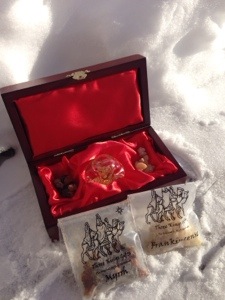
He chastised the Wise Men for their pricey and pretty yet wholly impractical and useless gifts. “If you were truly wise,” griped the angel, “you would have known that what we need is hot water and towels; goat’s milk and bread; twenty diapers and some soap to wash them with.” Not gold, frankincense and myrrh! (p.15-16, Mary Arnold, “The Fussy Angel”, Ignatius Press, 1995). Yet, the Christ child accepts these gifts, however impractical.

The gifts, of course, hold symbolic meaning: the gold – for a king; the spices – used in burial practices of the time.These gifts point to the identity and purpose of God made human in Jesus Christ, whose destination was the Cross and the empty tomb of Easter.

Admittedly, the whole story about astrologers bringing strange gifts to a child in a strange land sounds somewhat exotic, not real.  It is filled with strange incidents, strange gifts, and strangers encountering one another.

At the same time, there is meaning here. Should we but pause to consider the deeper, sometimes hidden, levels of our experience we may appreciate the gift anew, however strange.

The movie “The Best Exotic Marigold Hotel” (Fox Searchlight, 2012) tells of a group of seniors who head off to an inexpensive retirement home in exotic India. As unfamiliar and sometimes frustrating as the experience is, when one character asks why he likes it so much, he replies: “The lights, the colours, the vibrancy; the way people see life as a privilege, not as a right.”

Perhaps Epiphany can open our eyes as well to the holy revealed in what we may have previously thought of as strange, foreign, outside our experience.

Perhaps you have celebrated Christmas and New Year’s this year differently from ‘the norm’ — in a different setting, with different people, outside your comfort zone. Perhaps this Christmas was the first without a loved one. Or, perhaps your life circumstances are changing due to ill health. Admittedly, these are all situations to which, on the surface, we may react even reject outright if we had a choice.

But the Christ child teaches us something important: He didn’t reject those outlandish, impractical and useless gifts brought to him by, of all people, foreigners from the East. Instead, he welcomed them into their home with giggles, gurgles, and laughter.

And this grace, this gift of freedom, is infectious. It liberates us to receive and rejoice in the gifts of life, however small and strange they may at first appear.

20140103-110930.jpg

Spelling the Word

We are in the season of gift-giving. But during Christmas we must also be able to receive those gifts given to us. And receiving that gift, celebrating it, using it – can be just as challenging if not more so than giving.

The question throughout Advent – the four weeks of preparation before Christmas – challenged us to watch and wait, to let go and forgive, to shed those distractions of our lives, to give of ourselves for the sake of others. These were the disciplines of Advent.

But now the gift of Christ is given to us. The Gospel states that the light of the world has come; the light has shone in the darkness, a light no darkness can overcome. This is the gift of God, the life of Jesus, to the world (John 1:3-5)

How shall we receive this most precious gift? And how does this gift make a positive difference in our lives shrouded in darkness?

The answer may lie in how well you can spell. How’s your spelling? I learned how to spell by doing reps; I had to practice spelling a word. I also learned how to spell by getting beyond the disappointment of the mistakes, mistakes which were bound to happen no matter how good I was at spelling.

The famous artist, Rembrandt (1606-1669), painted the “Holy Family” in the 17th century. In the painting, he portrays the nativity as if it were an event taking place in 17th century Holland. The attire and furnishings are what one would find in a typical Dutch home from Rembrandt’s own day.

In addition to Joseph standing and an angel hovering in the background, Mary is seated at the centre of the painting with an opened, well-thumbed book, presumably the Bible, held open by her left hand. Her right hand, on the top of a rocking cradle, has pulled aside a covering to reveal a soundly sleeping Jesus. Mary’s head is turned from the book to gaze upon the infant.

Whether or not Rembrandt intended it, the painting represents different ways to encounter and understand the ‘word of God’:

On the one hand, there are the Scriptures, the book that Mary has been reading as Jesus sleeps and Joseph works in the background. The Word of God is to be found in the Bible. We read the words and find we are addressed by the Word of God. We read them again and again – like learning how to spell. That is why the book is well-thumbed. Rembrandt pictures Mary as one who knows well the word of God and who ponders it in her heart.

But she does not ponder the page alone. She also ponders the infant beside her, “the Word made flesh”, rather than the Word made paper and ink. The Word is a blood-warmed, breath-enlivened human sleeping beside his mother.

I have the impression looking at this painting that when Mary returns to her reading, she will understand what she reads at a greater depth because she has encountered the Word through the Word made flesh. At the same time, when she tends to the child, she will understand the child at a greater depth because she has encountered the Word through the words in the book. Back and forth between Word made flesh and Word through words is the pattern suggested by Rembrandt’s painting.

This is how we learn to ‘spell’ our baptism in Christ — learning not only the words in the Bible, but more importantly for us Christians living in the 21st century, learning to know the living Christ in our hearts and in others and in the world today. “The Word became flesh and lived among us” (John 1:14).

How do we live Christ in the world today? How do we tend to the Christ child in our midst?

Let the light be seen! Let the good gift of Christ within us shine forth anew, for the world to see! Those words are spoken at every baptism to the baptized: “Let your light so shine before others that they may see your good works and glorify your Father in heaven!” (Matthew 5:16). The light wasn’t meant to be hidden under a bushel, but put on a lampstand (Matthew 5:15)!

You hold the light of Christ in your heart. There is no justification to hide it. There is some good there that the world so desperately needs. And you have it!

A royal priesthood we are! A holy nation! God’s own people! In order that we might proclaim Christ (1Peter 2:9). Martin Luther argued for the ‘priesthood of believers’. In other words, we all receive the grace of God for ministry, not just the religious professionals. That is why the baptized receives a crown – we are all now princes and princesses in the kingdom of God.

How do we live out our priesthood?

Another artist, perhaps not as well known, lived during the same time as Rembrandt. George Herbert’s life (1593-1633) overlapped with Rembrandt’s. Although the poet and painter may never have met or even known of each other’s work, I find it interesting to consider Rembrandt’s “Holy Family” in light of some lines from Herbert’s poem that resonate with the first chapter of John’s Gospel: “We say amiss, this or that is; Thy word is all, if we could spell.”

How do we ‘spell’ the Word of God? Listen to a portion of a poem written by Thomas Troeger (in Feasting on the Word Year A Volume 1, WJK Press, Louisville, 2010, p.189-193):

“How do you spell the word? /Where do you search and look – /Amidst the chaos and cries you’ve heard /Or in a well-thumbed book? /Hold back the swift reply, /The pious, worn cliché … /Instead, let all you do /Embody truth and grace, /And you will spell the word anew /In every time and every place.”

I must admit I had to practice a few times spelling ‘Kirubakaran’ before getting it right. Every name has meaning – this is also something we learn from the Christmas story: starting with the name of the newborn Messiah, Jesus – Immanuel, God is with us – the salvation of the world (Matthew 1:18/Isaiah 7:14). I was pleased when you told me that the name Roselyn takes, in your native language, means literally – “Christ who gives mercy.”

Today, as Rose is baptized, she receives the great gift of Christ in her life. May she grow to know, and live out, this mercy, forgiveness and grace.

May we all spell the word anew in every time and every place.

Christmas camping

For any one who likes to camp in one of our provincial parks, and wants to secure that ‘perfect’ site for the summer time vacation, better boot up your computer soon! The rule is: you can make an online reservation up to five months in advance of the date you wish go camping.

So you can perhaps understand that along with enjoying the many blessings of this Christmas tide, my thoughts are also going the direction of outdoor summer camping.

And while I’ve never been very successful beating others online to that ‘perfect’ site, my family has enjoyed some beautiful camp sites over the years.

We define a good site as one that, above all, gives us some privacy; that is, there are as many trees, wild grass, shrubs, and distance between our site and the ones around us. Ideally, our site would back onto a green space, a pond, a beach, sand dunes, or a wild growing, dense thicket of bush.

Conversely, the least favourable site would be one from which we could watch the TV show blaring through the window of the RV next to us, or sing along to the lyrics sounding from the radio propped on the picnic table next site over, or play catch-the-ball with the neighbour’s pet whose leash extends across our campsite.

You get the picture. Instinctively, the last thing we want is someone next to us. Even though, as it turns out, those who pitch their tent next to us are more often than not good people.

At Christmas, we hear about and celebrate the truth that God came to us. And God didn’t come to us like a visitor would, and then leave. God entered human flesh by being born into this world. And this “incarnation” as Christians call it, was an event that changed the world forever.

In the Gospel of John we read: “The Word became flesh and lived among us” (1:14). “Lived among us” in the culture of first century Palestine more accurately rendered is: “Pitched a tent by us”. You can imagine the nomadic movement of people across the Judean wilderness. Putting up a tent beside another assumed a trusting relationship, where co-travelers in a harsh environment would seek solace, safety and security – in one another.

This notion of God ‘pitching a tent’ next to us is expressed elsewhere throughout sacred scripture. In the last book of the Bible, we read: “The home of God is among mortals. He will dwell with them as their God” (Revelation 21:3). In the Wisdom poetry we hear the voice of the Word that became flesh – Jesus Christ — say: “Then the Creator of all things gave me a command, and my Creator chose the place for my tent. He said, ‘Make your dwelling in Jacob, and in Israel’” (Ecclesiasticus 24:8). Of course, the very name given to Jesus as instructed by the angel to Joseph in a dream is Immanuel, which means: “God is with us” (Matthew 1:23 / Isaiah 7:14).

I must confess my human instinct sometimes goes against this Gospel pull towards involvement with other people, and their involvement with me – especially with people whom I don’t know. Like what happens initially at the camp site. The ones who pitch their tent, so to speak, beside me are at first suspect. Could I trust these strangers who come from outside my circle of family, friends and community at home, and intersect with, even intrude into, my life?

Perhaps the answer lies in the mystery of this incarnation, where the Holy Spirit found a home in Mary, the mother of Jesus. It is truly remarkable, when you think about it, how God was born from a human person.

But the popular, religious focus on Mary can be fruitful if that miracle is seen as extending to all of humanity, all of us – not just Mary. Obviously, the infant Jesus was born from Mary. But Mary was just a teenager, a country girl, representing really the common, sinful yet transformed human being in us all, as Christians.

A pre-Reformation era tradition in Germany has recently gained more popularity: It is a ritual that has been practiced mostly in small towns, villages, and rural areas. What happens before Christmas is that each family brings a small statue of Mary to a neighbouring family, where that statue remains in a central location in the household until Christmas day.

This ritual reminds each family that the gift of God comes to us, first of all, since you don’t get a statue for your own home; someone else gives it to you. And secondly, perhaps more importantly, the statue is a visual reminder that each of us is Mary, preparing a place in our own hearts for the presence of Jesus in the Holy Spirit.

You see, when Mary was pregnant with Jesus in that small place within her where the light of the world was gestating and growing – there was no sin. Yes, Mary was sinful as a human being. But within her, too, was a holy place where sin had no power, where she was pure and reflecting truly the image of God in her.

Is that not so, with us, too? Each one of us holds the capacity, within ourselves, to carry the presence of the living God in Jesus. What difference would that conviction make in, not only appreciating the place in our own lives where God’s Spirit indwells, but in others?

The statue of Mary in these households reminds families, that despite all the conflict, stress, misunderstandings and sin so obvious in families of all kinds, especially at this time of year, there is also a place of peace, stillness, and true joy amongst ourselves. We are, at Christmas, reminded by this holy birth and through those familiar characters like Mary, that we can see one another now with what Saint Paul calls the strength of our inner nature, or being (2 Corinthians 4:16-18, Ephesians 3:16-19). We can regard one another, though we are different and unique, with a knowledge and belief that each of us holds a space and a place within that is being renewed and transformed and united in God.

So rather than right away assume the worst, rather than initially write off those intruders on my camp-site, those strangers who ‘pitch a tent’ so close to mine, perhaps I need to appreciate anew the gift in them that appears. Perhaps God is coming to me again, in the guise of a stranger yet one who is truly a lover – one who comes because “God so loved the world” (John 3:16).

Indeed, love has come. Alleluia! Thanks be to God! Amen!

For more information about the tradition of ‘carrying Mary’ at Christmas, please read Anselm Gruen, “Weihnachten — Einen neuen Anfang” (Verlag Herder Freiburg, 1999), p.39-41

A ‘fussy’ Christmas?

I was stunned, as I am sure many were, to see photos last week of snow-covered Bethlehem. They say it was, for that Mediterranean region, the first such weather event in over a century.

And over the past century, biblical scholars have criticized Hallmark and other popular artists for depicting these snow covered fields around Bethlehem with sheep softly grazing; ‘they are not being historically or factually accurate’ we critically-minded people complained.

We were critical of such romanticized attempts to depict a ‘perfect’ Christmas from the Canadian perspective. Isn’t it true, though? In the weeks before Christmas, don’t we invest a great deal of time and energy trying to achieve that picture-perfect Christmas? How can you have Christmas without snow, after all?

We ramp up our expectations. Just like they do with movie trailers. Months before its theatre and weeks before its home release, we watch these 60 second teasers, which are designed to wet our appetite and raise our expectations to the awesomeness of the next super-hero, blockbuster flick.

Should we be surprised, then, when we are disappointed? Our expectations have been managed. Marketing gurus have effectively created an appetite, a need. The result: sadness. Many at Christmas feel an emptiness that their lives and families prevent them from having the sort of Christmas they believe they should have. If I don’t get that perfect gift, I’ll be depressed. Right?

Have we ever questioned why we have these expectations in the first place? From where have they come? Who is telling me, ‘It ought to be this way’?

If anything can capture and convey the true meaning of Christmas, a story will do just that. Listen, then, to the story of the ‘fussy angel’:

“When Jesus was born as a tiny baby, God wanted Him to have a special angel to guard Him. But it wasn’t St. Michael the great warrior archangel he chose; nor the mighty archangels Raphael and Gabriel.

No, it was the smallest angel in Heaven that caught God’s eye. ‘This one will do well,’ the Father said. Which proves that God works in strange and mysterious ways.

“But on that Christmas Eve when Christ was born, the little angel was not happy with what he found. ‘This will never do,’ he said, looking around the cold and drafty stable. ‘Get those smelly beasts away from my Master,’ he ordered, tugging on the donkey’s tail. ‘Who knows what diseases they carry and they’re breathing in his face!’ ‘Hush, little one,’ Joseph said. ‘Their breath is warm. They comfort him.’

“There was a cobweb on the manger. Mice peeped out from under the straw and, perched on a beam above where the baby lay, an old crow gazed downward. The little angel grabbed a straw broom and began some furious sweeping. ‘The King of Kings and they dump him in a barn full of animals,’ he muttered. ‘It’s terrible.’ He waved the broom at the crow but the bird ignored him.

“….At midnight the door of the stable burst open and a group of excited shepherds tumbled in. The shepherds fell on their knees, their leathery faces pointed in the direction of the manger. ‘Where’d you lot come from? You’re tracking snow inside. Keep the noise down. Can’t you see he’s sleeping?’ the angel warned.

“A young shepherd took a woolly lamb and laid it at the foot of the manger. ‘What good is a lamb? A sheepskin blanket would have been a better idea,’ said the angel. ‘Can you imagine how prickly it feels to sleep on a bed of hay?’ But Mary smiled at the shepherd boy and bent to pat the lamb.

“In the early hours of the morning they heard a camel snort and into the stable proceeded three wise men. They were richly dressed. Mary held the baby on her knee and as the kings approached, they laid at her feet gold, frankincense and myrrh.

“’That’s very pretty and quite useless,’ the angel observed. ‘If you were truly wise you would have known that what we need is hot water and towels; goat’s milk and bread; twenty diapers and some soap to wash them with.’ The kings turned their proud faces on the angel and were about to reply when the baby gurgled with delight and waved a royal fist in the air. Tempers cooled and everyone smiled … even the angel.

“Outside over the fields and houses of Bethlehem, angel choirs were singing in joyful chorus – ‘Silent night, holy night, all is calm, all is bright.’ The angel stepped outside. ‘The night’s not silent but it’s definitely bright,’ he said. ‘I’ve never seen so many stars. What was God thinking of? How can anyone sleep with all that light? We need curtains to shut it out.’

 “He found some sack cloth and pieces of straw and blocked the holes in the roof and walls of the stable. ‘Blow out your lanterns,’ he ordered the shepherds. ‘The baby needs some sleep.’ But even with holes blocked and lanterns dimmed, the stable was bathed in a golden glow. From the center of the manger a light shone that penetrated the darkness and it seemed this light would never be extinguished.

“By now the angel choirs were piling up ‘Glorias’ which shook the heavens with their strength and timbre. The angel strode outside again: ‘No, no, no! Brother [and sister] angels, have pity on him. He’s human now and needs to sleep. Turn the volume down!’

“But the heavenly choirs could not be silenced. Crescendo after crescendo rang out with such power and majesty that the people came out of their houses and gazed fearfully at the skies, wondering what was happening.

“Sure enough, inside the stable the baby had wakened and was back on his mother’s knee. The angel hung his head in shame. ‘It’s a mess,’ he groaned. ‘My poor master! What can I do?’

“Mary reached her hand toward the angel. ‘Come and see,’ she said. She drew back her veil and the angel looked at his tiny charge. And as he looked, his frustration melted. ‘Why everything is perfect,’ he thought. ‘It’s just the way He wants it to be. Smelly animals, prickly straw, silly gifts and loud music. The snow and the thin, sack blankets. It’s human and it pleases Him.’

“…. he was [then] struck by a surprising thought. This poor stable would one day be more famous than Buckingham Palace or the White House. In the hearts of the people everywhere the stable with its dirt floor and broken walls would be the most glorious palace of all ….” (Mary Arnold, The Fussy Angel, Ignatius Press, 1995).

Tonight, I welcome you to consider how you relate to the newborn Child of Bethlehem. Remember – God’s not looking for the perfect place to be nor the perfect person to do God’s will. God does not demand a perfect situation or people in order to fulfill God’s purpose and be present with God’s love.

Each of us is invited to come and kneel at the manger. I think Jesus and his ‘Abba’ Father in heaven would be happy – pleased – simply for us to come, to give what we are, and who we are, just as we are. What a gift – the greatest gift at Christmas, barring all expectations! – for Almighty God to receive us with such mercy, acceptance and grace. ‘Just the way we are’ is the best offering we can give to the tiny, newborn Jesus, who is our healing and our salvation. How can we resist such love?

Peace on earth, and in your heart, this Christmas.

.

Discerning God’s ways

How can we tell if it’s God’s voice we’re hearing? Joseph receives the call from God to remain in a committed relationship with Mary … in a dream, of all things (Matthew 1:18-25). And Joseph listens, and acts accordingly. His decision has huge ramifications – the salvation of the world!

No loudspeaker from the heavens, no dove descending, no John the Baptist screaming, no SMS messaging that beeps a notification on our smart phone. But a dream – which is internal, psychological and in the purview of what many of us rational types might deem a “wishy-washy” medium for trust-worthy communication.

But, if this is valid, then what would we make of it? How can we discern God’s way of talking to us?

The Gospel suggests at least a couple of clues. First, in Joseph’s dream the angel cites a scripture from Isaiah – that a virgin will bear a son and name him Immanuel (7:14). Joseph, being a righteous man (v.19), would have been familiar with these sacred and traditional texts from his faith.

So, no matter how strange and even other- or inner-worldly the news from God may come to us, the divine message appeals to, and is grounded in, some aspect of our faith tradition; in this case, the Scriptures.

The second clue lies in the nature of our expectations. The story of Jesus’ baby birth in a lowly barn dashed all popular, first-century Palestinian expectations of how the mighty Messiah was to come triumphantly. So, too, with us: When God communicates with us, it is not exactly what we expect.

If we’re the ones initiating and following through on what we think God wants us to do – will we not get what we expect, what we have planned? Perhaps, sometimes, if we’re in total control. But I suspect more often than not, God’s call to us will fly in the face of all our planning, all our expectations. Very likely, God’s call to us to do something will surprise us.

And like Joseph’s experience, what may at first seem a ridiculous, unpopular and lowly proposition will turn out to be the most amazing and life-changing journey, for the sake of the world that God so loved.

And at the end of that journey, we realize that there could not have been written a more appropriate and better script for our lives. For, our true needs and desires are met, albeit in unexpected ways, should we follow.

Like in The Tale of Three Trees (A Traditional Folktale, retold by Angela Elwell Hunt, Lion Publishing, Colorado Springs CO, text copyright 1989)

“Once upon a mountaintop, three little trees stood and dreamed of what they wanted to become when they grew up.

“The first little tree looked up at the stars twinkling like diamonds above him. ‘I want to hold treasure,’ he said. ‘I want to be covered with gold and filled with precious stones. I will be the most beautiful treasure chest in the world!’

“The second tree looked out at the small stream trickling to the ocean. ‘I want to be a strong sailing ship,’ he said. ‘I want to travel mighty waters and carry powerful kings. I will be the strongest ship in the world!’

“The third little tree looked down into the valley below where busy men and busy women worked in a busy town. ‘I don’t want to leave this mountaintop at all,’ she said. ‘I want to grow so tall that when people stop to look at me they will raise their eyes to heaven and think of God. I will be the tallest tree in the world!’

“Years passed. The rains came, the sun shone, and the little trees grew tall. One day three woodcutters climbed the mountain.

“The first woodcutter looked at the first tree and said, ‘This tree is beautiful. It is perfect for me.’ With a swoop of his shining axe, the first tree fell. ‘Now I shall be made into a beautiful chest,’ thought the first tree. ‘I shall hold wonderful treasure.’

“The second woodcutter looked at the second tree and said, ‘This tree is strong. It is perfect for me.’ With a swoop of his shining axe, the second tree fell. ‘Now I shall sail mighty waters,’ thought the second tree. ‘I shall be a strong ship fit for kings!’

“The third tree felt her heart sink when the last woodcutter looked her way. She stood straight and tall and pointed bravely to heaven. But the woodcutter never even looked up. ‘Any kind of tree will do for me,’ he muttered. With a swoop of his shining axe, the third tree fell.

“The first tree rejoiced when the woodcutter brought him to a carpenter’s shop, but the busy carpenter was not thinking about treasure chests. Instead his work-worn hands fashioned the tree into a feed box for animals. The once beautiful tree was not covered with gold or filled with treasure. He was coated with sawdust and filled with hay for hungry barn animals.

“The second tree smiled when the woodcutter took him to a shipyard, but no mighty sailing ships were being made that day. Instead the once-strong tree was hammered and sawed into a simple fishing boat. Two small and too weak to sail an ocean or even a river, he was taken to a little lake. Every day he brought in loads of dead, smelly fish.

“The third tree was confused when the woodcutter cut her into strong beams and left her in a lumberyard. ‘What happened?’ the once tall tree wondered. ‘All I ever wanted to do was stay on the mountaintop and point to God.’

“Many, many days and nights passed. The three trees nearly forgot their dreams. But one night golden starlight poured over the first tree as a young woman placed her newborn baby in the feed box. ‘I wish I could make a cradle for him,’ her husband whispered. The mother squeezed his hand and smiled as the starlight shone on the smooth and sturdy wood. ‘This manger is beautiful,’ she said. And suddenly the first tree knew he was holding the greatest treasure in the world.

“One evening a tired traveler and his friends crowded into the old fishing boat. The traveler fell asleep as the second tree quietly sailed out into the lake. Soon a thundering storm arose. The little tree shuddered. He knew he did not have the strength to carry so many passengers safely through the wind and rain. The tired man awakened. He stood up, stretched out his hand, and said, ‘Peace.’ The storm stopped as quickly as it had begun. And suddenly the second tree knew he was carrying the King of heaven and earth.

“One Friday morning, the third tree was startled when her beams were yanked from the forgotten woodpile. She flinched as she was carried through an angry, jeering crowd. She shuddered when soldiers nailed a man’s hands to her. She felt ugly and harsh and cruel.

“But on Sunday morning, when the sun rose and the earth trembled with joy beneath her, the third tree knew that God’s love had changed everything. It had made the first tree beautiful. It had made the second tree strong. And every time people thought of the third tree, they would think of God. That was better than being the tallest tree in the world.”

Adventing the New

Christians observe Advent as a season in which we begin again. We start over. We begin a new church year. We return to the starting line, again.

The four weeks of Advent, leading to Christmas, also occurs at a time when everyone is getting ready to turn the page to a new calendar year. It is a time of drafting New Year resolutions, of wiping the slate clean, of starting some new discipline, of beginning again. These seasons are carried on the backs of hope and promise for something good, something better, and something new for our lives.

Although we feel the initiative rests with us to get the ball rolling on these good things, it’s a new beginning that doesn’t start with us, paradoxically. Our action to pray, to seek justice, to exercise, etc. is a response.

Liturgy acts this way. “The Lord be with you,” says the worship leader. And our response: “And also with you.” The prayer of Advent begins when another speaks a word to us. These scriptures upon which we reflect and those we hear read during worship are not ones worship leaders and preachers choose willy-nilly – our favorite, pocket bible verses.

No, in churches that follow a lectionary, these are assigned readings for the season. They were given to us. Advent prayer is essentially a prayer of response to something already there, already given. Our starting over and our returning to the Lord, happen because God is speaking a word to us.

Some fifteen years ago at the beginning of my parish ministry I remember visiting Mrs. Rose – I’ll call her. Mrs. Rose was well into her 90s when I began monthly visits to her home – she lived alone. She didn’t say much, not one for chit-chat, talking about the weather, no. She knew I came with the Eucharist, the Holy Communion.

So, we got right down to business. I would start the prayers – of confession, absolution, and consecration. And without even looking into the book for the words, she would join right in. This happened each time I visited her.

There were times I brought a prayer in her native language, German. I would start reading the 23rd Psalm in German, start praying the Lord’s Prayer in German, or sing a hymn she learned, and memorized, at her confirmation some 80 years ago. And each time I started into those readings and songs, she needed me only to begin – then she was able to join in and complete the prayer.

She represented for me a life lived in response to the new thing God does every day in our lives.

I sat by her deathbed in hospital some years later. Mrs Rose didn’t say anything anymore. And what she did say didn’t make a whole lot of sense, whenever family came to chat. But she was awake, aware of other people’s presence, listening carefully. And whenever I began those prayers she had learned by heart, especially the German ones, she launched into a near perfect recitation.

What word is God speaking to you this season? And are you willing to trust that word from God, in order to take the first, risky step towards the new thing God is doing? And live your life in response to the good, unexpected thing God is doing and saying?

Like Joseph (Matthew 1:18-25), who was willing to go against convention, and maintain his relationship with Mary — all from a dream he had from God.

John the Baptist’s day of reckoning

They say that even the most confident, bold and courageous people have soft hearts. Those of us who may instinctively flinch at John the Baptist’s energetic – even vitriolic – outburst against the Pharisees, and loyal deference to Jesus Christ in his speech from last week’s Gospel (Matthew 3:1-12); those of us who would question his insensitive, uncaring, and offensive style – we might pause today in light of this Gospel story about John the Baptist (Matthew 11:2-11).

For what we see here is a more nuanced, man of faith no longer ranting out of a dogmatic cut-and-dry confidence. But a soft, vulnerable heart. He is much more than an in-your-face, sock-it-to-them extremist and extrovert. Here we get a peek at his vulnerability and the depth of his soul. Maybe it’s because he knew he was close to his death.

At Nelson Mandela’s memorial service in South Africa last week, U.S. President Obama said that Mandela’s strength was “sharing with us [that is, the world] his doubts and fears.”

In prison, John the Baptist expresses his doubts as to whether the man he had rooted for all these years was truly the Messiah. Was his entire life calling to herald the coming Christ all for naught? Like the doubting Thomas would later, John the Baptist seriously questioned whether this Jesus who ate and hung out with sinners, Romans, and tax collectors was the man whom they all expected would save them from those very sinners. John the Baptist’s insecurity is telling, especially when placed in contrast with the early depiction of him crying out brashly in the wilderness.

How does Jesus respond to John’s expressions of doubt? With not only encouragement and affirmation. But Jesus also lifts John’s ministry up. Jesus doesn’t scold John for doubting. Jesus calls him “the greatest” person alive.

I hope John heard that good news. It is a path of hardship John the Baptist undertook, without question. It was a hard path of rejection, ridicule and suffering John endured being a prophet and preparing the way of the Lord. And yet, it is also a path tempered with grace. Because the grace of God came to John in prison; when he really couldn’t do anything to change his unfortunate circumstances – that’s when he received a word of blessing from the One for whom he had prepared the way.

On the path of hardship tempered with grace

I suspect that some of you really like John the Baptist, while others would feel intimidated and back off from his forceful energy. Similar to the way two very different recruits into the Canadian Armed Forces reacted during the first days of regular duty.

A friend from Petawawa who is a sergeant and has put many years in the Forces told me last week how very differently some personalities react to his dissing of discipline. When boots aren’t polished, collars not ironed, and back-packs not kitted properly, he would lean in on the rookies and set them straight.

The one young recruit began to well up in tears when my friend started criticizing him for not being prepared. The other, being disciplined for the same problem, smiled, and was energized by the confrontation: “Wow, this is just like the movies, when the sergeant major yells at the recruits, spitting inches from the other’s face, turning the air blue!” Just loving it! The first recruit didn’t last long in the army. The other, was spurred on and challenged through his mistakes, to have a successful career.

John the Baptist is the ultimate reality check for Christianity. In the best of the prophetic tradition, he epitomizes the no-nonsense, truth-telling, going-for-the-jugular style not often associated with a more sanitized approach to religion.

C.S. Lewis wrote, “If you want religion to make you feel really comfortable, I certainly don’t recommend Christianity.” Is this how you feel about belonging to the church today? Many stand in the line of John the Baptist tradition. Stanley Hauerwas and William Willimon — influential theologians of the last century wrote: “There is not much wrong with the church that could not be cured by God calling about a hundred really insensitive, uncaring, and offensive people into ministry” (p.45 Feasting on the Word Year A Vol 1). What do you think about that? Would you like that?

John the Baptist’s hard words to the religious leaders of the day call them to repentance. Judgment underscores the tenor of this text assigned for Advent. And that’s why some of us would rather read scriptures and sing songs about sheep softly grazing in fields during these weeks leading to Christmas. Because you may know people in your life who have been hurt by the judgment of others — many of those doing the judging from the church. Even as we in the church have been warned NOT to judge others (Romans 14).

God calls ALL of us to fall on our knees, confess and repent — especially those of in the church.

The original Greek word for repentance, metanoia, literally means — “moving beyond the mind.” We need to have a change of mind as much as a change of our heart. “Do not be conformed to this world, but be transformed by the renewing of your minds,” argues Saint Paul (Romans 12:2). He goes on to say that this change of our mind would happen, “so that you may discern what is the will of God — what is good and acceptable …” Our changed minds, our renewed way of thinking about things, will then affect how we behave.

“Moving beyond the mind” means that we need, at first, to have our fundamental assumptions questioned. Fundamental assumptions about God and the ways of God in the world. Is it true that we don’t have to do anything more in the church because we were baptized and confirmed here and our grandparents and great-grandparents were Lutheran? Is it true that God hates us and is only out there to catch us breaking a rule in order to punish us?

John the Baptist might have a field day in the Christian church today. John the Baptist is here to remind and recall us to a faith that only makes sense when embraced in the desert, in the wilderness of our lives. John the Baptist is here to remind and recall us to a faith that makes sense only when we have learned to weep at our faults and let go. John the Baptist is here to remind and recall us to a faith that makes sense only when we are called out of our complacency, selfishness, and self-righteousness to a greater cause, a greater good.

Barbara Marshall wrote this prayer poem cited in an Advent devotional for the season (Lutherans Connect); in it she describes the times of her life when she was truly invigorated, motivated and inspired in faith:

“… It was never the turbulent waters that raged and tore through my life that left me floundering, helpless adrift in the surging tide. But rather the lulling beauty and lure of familiar shores that fashioned my days with indifferent thought and compelled me to stay where I was. So, Father, give me a yearning for the valleys shadowed and steep, for deserts that breathe their fire and dust, for waves that crash at my feet. And surely then I’ll accomplish much …when inspiration is fueled on the path of hardship tempered with grace.”

So you can see why I suggest that nostalgia may be a great enemy of Christianity. For it keeps us stuck in apathy and inaction. But, ironically, looking to the past is an essential ingredient in faithful living. John the Baptist himself quotes directly from Isaiah when preaching his sermon: “The voice of one crying out in the wilderness: Prepare the way of the Lord; make his paths straight …” (40:3). In writing about John the Baptist, the Gospel writer Matthew uses descriptive words right out of the Hebrew Scriptures originally describing the prophet Elijah who was “a hairy man with a leather belt around his waist” (2 Kings 1:8). John the Baptist may breathe fire into a soppy nostalgic faith — but he certainly doesn’t dismiss the past.

Remembering the past is important. But there’s a difference between nostalgia and remembering. Biblical commentator David Bartlett writes that “nostalgia is memory filtered through disproportionate emotion. Faith is memory filtered through appropriate gratitude” (p.48, Feasting on the Word, Year A Vol 1). In Advent we re-member, we reconnect. The word “religion” literally means to re-unite, re-align, ourselves out of isolation and into a holy union. In Advent when we remember, we embrace the good God has been and done for us in our past. In Advent we remember, together, as a family, as a church, as a community — what God has done for us in Jesus. We do this remembering at the Table — we remember that in the night in which he was betrayed …. We do this remembering singing out loud together our seasonal songs so precious to us.

We pray. We sing. We remember. Doing this, NOT to a disproportionate emotional longing for a time gone by. No. But rather, to embrace an occasion for re-affirming the good God has done for you in the history of your life, and to affirm our on-going hope and belief that God does care about us and our behavior this season, and beyond.

This Advent, know that we are cherished by God not only for who we are, but that we are responsible for what we do. This is good news, because if God does not care about what I do, I may begin to question whether God actually cares about me. If God loves me enough to welcome me into the family, then God loves me enough to expect something of me.

“One December afternoon … a group of parents stood in the lobby of a nursery school waiting to claim their children after the last pre-Christmas class session. As the youngsters ran from their lockers, each one carried in his hands the ‘surprise’, the brightly wrapped package on which he had been working diligently for weeks. One small boy, trying to run, put on his coat, and wave to his parents, all at the same time, slipped and fell. The ‘surprise’ flew from his grasp, landed on the floor and broke with an obvious ceramic crash. The child … began to cry inconsolably. His father, trying to minimize the incident and comfort the boy, patted his head and murmured, ‘Now, that’s all right, son. It doesn’t matter. It really doesn’t matter at all.’ But the child’s mother, somewhat wiser in such situations, swept the boy into her arms and said, ‘Oh, but it does matter. It matters a great deal.’ And she wept with her son.”

It does matter to God. God is that mother who embraces us when we weep after making a big mistake and mess up. God doesn’t punish us, but rather holds us, and cries with us.

Perhaps the church can give up on judgment, but we cannot give up on responsibility. We can continue remembering and being faithful to our calling in Christ, especially in the desert, because we know God does care for each of us.

So, let’s sing on and re-member!

Returning to the Lord your God

It was a joyous yet emotionally intense day that Mom and Dad finally decided to tell their rather rambunctious four-year-old son the good news of the coming birth of another child into their family. After all, little Joshua liked being the centre of attention, and was quite the social spark at school, church and family gatherings.

The birth of a baby girl came soon enough to the active family. Their lives changed forever. No longer were they three. Another human being was ushered into their home, and a nursery room already prepared at the end of the hallway.

Mom and Dad were a little concerned about how Joshua would react to having a baby sister — someone else in the family who would vie for parental attention. But the first few days after Mom and Daughter returned home from the hospital proved a relatively easy transition for Joshua, who welcomed his sister with endless requests to hold her and play with her.

“Be careful,” Mom’s mantra of advice to Joshua, “she’s just a few days old and we can’t be rough with her.” She repeated this instruction over and over again those first days.

Late one night Mom and Dad heard footsteps down the hallway and into the nursery. Dad was on duty, so he quickly got out of bed and followed Joshua into his sister’s room. When he poked his head to see what Joshua was up to, Dad was a little startled:

Joshua was practically inside the crib with little baby sister, his body hanging over the railing and his legs dangling over the top.

“Joshua! What are you doing?!” whispered Dad as loudly as a whisper can be. “Don’t wake up your sister!”

“Shhhh!” Joshua replied, “I am listening to what my baby sister remembers about God.”

The season of Advent gives us an opportunity to return to an awareness that God is coming to us, always. Jesus’ birth represents a truth about our lives: before we were born, we were united with God; when we were born we began a life journey that will eventually reunite us with God after our death. Honour the babies! For they have just come from seeing God face to face! They may just have something to tell us about God. This Advent may be a good time to practice simply listening in our prayer with God and to each other.