A New Way to Pray: Tracking the Trajectory of the Reformation

What follows are the lecture notes for Week Three in the course I am giving at the Ottawa School of Theology and Spirituality (www.osts.ca) this Fall. Reformation Sunday is on the last Sunday in October, October 28, 2018. It is a time for Lutherans and all Christians to reflect on the legacy of Reformation, commemorate its contributions, and to pray for unity among all who try to follow in the Way of Christ Jesus today.

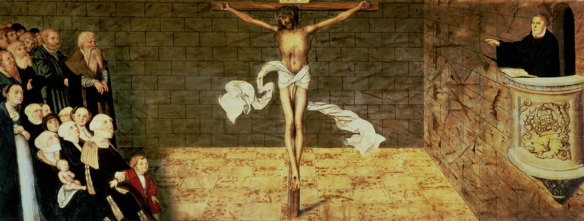
Lucas Cranach was a Renaissance painter and printmaker in woodcut and engraving. He was a friend of Martin Luther and his wife Katharine von Bora. In one of his paintings (1547) focusing on the Cross of Christ, Cranach depicts Martin Luther preaching to the congregation. I remember this particular painting vividly as it hung above the bookshelf in my house growing up.

image.png

It shows Martin Luther standing in a pulpit perched high on the wall of the chancel at the front of the medieval church. One of Martin Luther’s hands rests on the bible. And he points with his other hand to a cross with Jesus hanging bloodied bruised planted in the floor space between Luther and the crowd gathered in the church. Jesus hanging on the cross forms the center of this work of art.

Today this painting comprises one of the plates surrounding the altar in the Wittenberg church where Luther preached. As such, we often recognize and associate this painting with the ‘Reformation altar’.

Its prominence in Lutheran history suggests how poignantly this painting describes Luther’s theological bias: The Cross stands at the center. And Christ crucified informs everything in the church and even our reading of the bible.

Before we can embrace deeper understanding of Martin Luther’s theological claim that we find salvation by God’s grace—which finds us— through faith, we must first encounter the centrality of the Cross in Luther’s thinking and prayer.

In the seminary that I attended[1], we used the term, “Theology of the Cross”. Martin Luther first coined the phrase in his Heidelberg Disputation written in 1518. A theology of the cross is a way of understanding and imagining God. Fundamentally, in addressing God, we need to ask the questions: What is my image of God? Where is God primarily revealed? How is God best known?

Luther provided an answer: God was, and is, being revealed to us in all truth most clearly and unequivocally in suffering. In the vulnerability and pain of death on the cross, Jesus revealed—and continues to—the God who suffers alongside us wherever there is pain and suffering in the world. It is no wonder, then, that the longest sections in each of the four Gospels in the New Testament are dedicated to the various passion narratives[2]of Jesus.

Therefore, the Cross is theologically vital not just to Luther but to the Apostle Paul (the central figure of the Acts of the Apostles and some of the earliest Christian writings and Epistles) who central theme is: “God’s power is shown in human weakness.”[3]

The Theology of the Cross is contrasted to a Theology of Glory. Especially today among spiritually materialistic cultures in the West, what has been coined ‘a prosperity gospel’ has grown in popularity. This theology of glory presumes God validates faith, and is only validated by, success, measures of progress and triumphal conquering over any weakness or adversary.

A prosperity gospel fueled by unbridled optimism avoids places of defeat, failure, vulnerability and weakness as having anything to do with divine identity or purpose. A theology of glory undermines real people and a God who is known in the darkest times and places of life. It compromises and even derides a common humanity and the losses we all endure.

Prayer, as I have said, is the act of letting go. If prayer begins with God, and our address of God, we must presume before all else who this God is, and how this God is revealed—in scripture, in tradition and in our own experience.

One of the first creeds that circulated among the earliest Christians is from a hymn imbedded in Paul’s letter to the Philippians 2:5-11. The poetry first describes the descent of God. This is the primary movement of God, and of faith: downward. The Almighty chose to enter the lower and lowest regions of human birth, life and death. Only after this primary downward movement can the rising out of the depths happen.

Theologians over the centuries have used the term kenosis, from this text in Philippians, to capture the primary movement of faith. It starts with Christ’s self-emptying and letting go of God’s pure, divine nature. In God’s humility, Jesus compromised a perfect divinity in order to take on the fullness of a human existence.

Our God is a God who lets go, releases, self-empties what has become part of the God-self. This calls for a descent of the soul which in the words of St John of the Cross entails, indeed, a ‘dark night’ of the soul. Prayer is not easy, in so much as it may very well be simple.

Prayer, in the words of Laurence Freeman, “… always involves us in the paradoxes of growth, the cycle of losing so that we can find and then of having to let go of what we have found.”[4]

Prayer is a continual process of detaching and dislodging from places of comfort, stability and strength. Prayer is a deconstructive process. It is disruptive. In prayer we begin first to detach our self from all that we are attached to, all that has defined our identity and lives, all our constructs—mental and material—that constitute the construction and containment of our ego. All of this, in prayer, is placed on the precipice of loss.

All is not lost, however. Because in action and contemplation prayer’s aim and understanding is the prayer of God and for the sake of the God of the Cross. “Prayer calls the active person to a life of interiority and soul discovery … by detaching from all the fruits of action and doing everything purely for the love of God.”[5]In letting go, we discover our true self in God which includes and transcends all that we have been and are becoming.

By kenosis we resolve the Lutheran paradox. Some complain that the grace of God is cheap, such as Dietrich Bonhoeffer last century who sacrificed his life for a greater cause of justice in the Nazi regime. He wrote a book entitled, “The Cost of Discipleship”. Bonhoeffer argued that the theology of the cross ought not lead the Christian to rest on their laurels and not do anything. Just because we are saved by grace and since Christ lost everything for everyone once and for all doesn’t mean there isn’t a point doing anything. There is a cost of discipleship.

In prayer, we move into response because prayer is not for our sake. When we pray, it is not my prayer or our prayer. Praying is like walking along a path on the banks of a fast-flowing river and frequently stepping into the water. The current is strong. It is moving in one direction. We immerse ourselves into presence, the presence of Christ. We fall into the river of prayer that continues, the prayer of the living, resurrected Jesus, whose destination is union with God.

It is in Christ’s name we pray, and for the sake of our God who chose to be revealed in the humility and defeat of the Cross, in the most desperate human condition possible: death. We step maybe timidly yet faithfully into the water, fast flowing towards the great hope of new love and life in God. 

Questions for reflection and discussion:

  1. When you pray, after considering your image of God, what is God doing? What is God’s purpose—a purpose that is consistent with that image of God? Construct your prayer by strengthening the connection between image and function. If God is revealed in human suffering, where does that suffering lead? If God is compassionate, why? If God is patient, for what purpose? If God forgives and heals, to what end? Practice making this relationship between image and function as clear as possible before you make any petition to God. And write down some examples of the connection you make between image and function of God, to share with others next time (See copies of “Prayers of the Day” in Evangelical Lutheran Worship for good examples of how short prayers can be constructed).
  2. What is one non-negotiable spiritual practice and/or belief you would hold onto, if everything else had to be take away? (Ask yourself this, after visiting a place of worship other than your own)
  3. If time was short, what is most important to you in the end? Have you had this crucial conversation with those closest to you? If not, why not?

[1]Martin Luther University College (formerly, Waterloo Lutheran Seminary)

[2]The last several chapters of Matthew, Mark, Luke and John describe in detail the last days of Jesus leading to his arrest, torture and death on the cross. These passion narratives form nearly half the total lengths of the Gospels.

[3]1 Corinthians 1-2

[4]Laurence Freeman, Christian Meditation Newsletter, June 2005.

[5]Richard Rohr, Daily Meditation, 17 August 2018

The Meditation Journeys

This text represents a draft of a talk I gave at the Essential Teachings Weekend (ETW) for the Canadian Community for Christian Meditation (wccm-canada.ca) in Alexandria, Ontario (September 21-23, 2018). This was the third of three talks, entitled “Stages of the Journey” which complemented the first talk (“The Essential Teaching”), and the second talk (“History of the Tradition”).

STAGES OF THE JOURNEY

The notion of journey, or pilgrimage, originates in the very birth of Christianity. Christ-followers came to be known as “Christian” only after Christianity became the official religion of the empire in the fourth century C.E. But until then they were known as those who followed in the “Way”, implying a path, a road, a journey to be followed.[1]

The notion of motion is integral to those who try to follow Jesus to this day. In the last several decades the pilgrimage has become very popular, especially the Camino de Santiago which attracts hundreds of thousands of pilgrims every year. Many who walk the eight-hundred-kilometre journey across the Iberian Peninsula in northern Spain will attest that the journey is a metaphor for the passage of life or traversing some interior path.

Indeed, the exterior journey, such as the Camino, mirrors the internal journey where one explores the contours of the heart and the landscape of the soul. It is a journey that takes time and is fraught with danger. And, at some level, determination, dedication and faithfulness.

Speaking of Spain, it was perhaps the great Spanish mystics of the sixteenth century – Theresa of Avila and St John of the Cross – who first in their writings exemplified the interior and often difficult journeys of faith, such as in ‘The Dark Night of the Soul’. Recently, Richard Rohr describes it best when he asserts that it is through great suffering or great love by which we move along the path towards meaningful change and growth. Crises of faith and challenging circumstances of life are invitations to go deeper into the truth of self and the presence of God.

I want to describe these two journeys to you by using several metaphors—involving water, an hourglass, a wagon wheel and the Exodus story from the Bible describing the desert wanderings of a people. These symbols and images I hope will convey effectively the meaning of these journeys.

When we commit to meditation, we are undertaking what I would summarize as two journeys, operating on a couple of levels.

1.THE FIRST JOURNEY

The first is journey that happens during the time of the meditation.

The Ottawa river at Petawawa Point: the rough & the smooth

I used to live close to Petawawa Point in the Upper Ottawa Valley. Petawawa Point was a lovely spot on the Ottawa River which broadened out into a large lake dotted by several islands. And, I loved to kayak through and around these islands and waterways.

When I first put out onto the river at the beach I was immediately into the main channel lined by the green and red marker buoys, where all the motor boats would roar through. This was the turbulent section of my paddle. I often fought the waves created in the wake of speeding, noisy boats. This part demanded my determination, resolve, and good intention to get past the hurly-burly and through the narrow passage between a couple of islands.

Once through, the water opened up into an area of the river where the large, loud motor boats avoided – only the loons, hawks and sometimes eagles. Here was the more peaceful part of my paddling experience, one that I have treasured to this day.

Meditators have often mentioned to me—and I have experienced this too—that during the first fifteen to twenty minutes they are fighting themselves, their thoughts and distractions. And then something inexplicable happens, and they finally get into some kind of peaceful rhythm with their mantra in the last five minutes! Whether it takes you fifteen minutes, or only a couple of minutes into the meditation, it’s important to keep paddling even when things settle down in your brain.

You see, the temptation once I got through the busy channel into the peaceful expanse of the river was to stop paddling altogether and just float for a while. I would gaze at the birds flying, the clouds in the sky and the distant Laurentian Hills. It was beautiful!

In meditation, this is called the “pernicious peace”, where we just float in some kind of relaxed state our mind really doing nothing and it just feels good and we don’t want to do anything else. I soon realized however I wasn’t doing what I had set out to do. I came to the river to paddle, not to float. And as soon as I dipped my paddle again in the peaceful river, I found my stride, purpose and joy.

When we begin in our meditation, we usually immediately encounter the distractions of the mind. For example, I ruminate over what I am I having for supper, what groceries I need to pick up, what errands I need to run, how will I handle a problem at work or in my family, where am I going on my vacation, the main point of my upcoming sermon, etc.

How do we respond to these distractions? Do we simply float in some sleepy, dream-world, following the course of this stream-of-consciousness? Yes, sometimes we do fall asleep during meditation. It’s good to be relaxed. Yet, we also pay attention and are alert to the experience by remaining faithful to the paddle, so to speak, to the mantra. We focus the mind.

On the underwater rock: dealing with distractions

Another water image, from Thomas Keating, may help us.[2]It is the example of sitting on a large rock on the bottom of the river. Here, deep under the water you watch far above you the boats of various sizes and shapes float by and down the river. These boats represent all our thoughts and distractions. Often, the temptation of our mind is too great, and we push ourselves off the rock—it’s so easy! —and we swim to the surface.

Sometimes, we will even climb into the boats and sail on down the river in these thoughts. In other words, we will let our minds sink into thinking about it for some time in our meditation. Of course, when we do this, we are not saying our mantra, which is the discipline and faithfulness of sitting on that rock down below.

It’s important not to be harsh with yourself on this journey. Give permission for the boats to come by your mind in this river. Then, as you return to the word, you let these distractions keep floating on down the river. Let them go. Return to the place of deep silence, stillness, on the rock deep below.

Despite the incessant distractions of the mind that come to me during my meditation, I continue to ‘return to the Lord’ and my mantra. Someone once said that it is ok to ‘catch yourself’ in a distraction during meditation. In fact, the more often you catch yourself and gently return to the mantra, the better. Why? Because each time you return to the word, it’s one more time you are loving God. Each time I bring my concentration to the saying of the word, I am offering my love to Jesus. Each time I say the word, I am saying, “I love you” to Jesus.

The journey throughout the meditation period may appear simple. We sit quietly and in stillness for twenty minutes not doing anything except saying, interiorly, the mantra. But it is not easy. We confront in this journey the imprinting of our go-go culture and a hyper-active environment upon our egos. We encounter our very humanity in this journey —

A humanity which incessantly strives to accumulate more information and judge progress according to expectations. We already go into it expecting it gets easier over time. We expect benefits to accrue, like lower blood pressure and more patience. And when nothing like this happens after meditating for a few months or years, we give up. This is a spiritual capitalism.

We encounter our very humanity which also craves stimulation and distraction. Already in 1985, Neil Postman wrote a book indicting our culture with the provocative title: “Amusing ourselves to Death”. For most of our daily lives we choose to keep busy or entertain ourselves rather than sit still and face the truth of ourselves. No wonder we are bothered by distraction during meditation.

We encounter our very humanity which finds self-worth in active productivity. We do therefore we are – the mantra of our culture. The more we produce, the more we have to show for in our day, in our vocations, the better we are. So, it just doesn’t make sense from this perspective to be so unproductive by sitting still and doing nothing with ourselves, really. What’s to show for, after twenty minutes of idleness?

And so, we may also, at deeper levels, encounter anxiety, fear and/or anger – which represent our resistance to the journey of our meditation. These normal, human feelings, given now the freedom of space, time and a loosened ego, erupt to the point of a significant disruption.

When I first started on this journey in 2004, I was beset by anxiety, to the point where I felt that I might explode during the silence and the stillness, to the point where I felt I would run screaming from the meditation room. The waves in that channel from the wake of the speeding motor boats threatened to swamp and drown me! I remember how I resisted the letting go, by asking for example that I not sit in the circle but by the wall in a corner of the room. And then, by suggesting we should sit wherever we want to, not necessarily in a circle. Anything to assert my control, even over the meditation period.

Here, depending on the nature of the deep-seeded emotional pain, you may want to encourage those who find meditation times a time of suffering to seek help to deal with whatever is being uncovered—loosened—during meditation. Some have expressed concern that when we open up our inner lives in meditation, the devil/evil will come in. Laurence Freeman, to this question, said: “It is more likely the devil will come out! Negative feelings and the forces of the shadow will get released as repression is lifted. This is quite natural although it’s important to be prepared for the inner turbulence it can create at times.”[3]

This becomes a journey, then, of healing and transformation.

2. THE SECOND JOURNEY

This journey of healing, then, links us to the second journey operating at another yet concurrent level. The second journey we undertake when we meditate connects us with our whole life, indeed life’s journey.

Being a meditator is about slowly but surely learning how to meet life’s greatest moments with grace, acceptance, generosity, courage and faith. Meditating teaches us how to navigate a crisis of faith, a crisis in our relationships, in our work and in our health. It is about forming an attitude toward life in general. Meditating trains us to bea prayer rather than merely say prayers from time to time. This is contemplation: an inner attitude to all of life so that we are indeed praying always, or as Saint Paul puts it, to pray without ceasing.[4]

The dropping stone in water: deeper we go & letting it happen

James Finley talks about a dropping stone in the water, a journey characterized by a deeper simplicity, a deeper solitude and a deeper silence. He describes well this image of a descent.

“Imagine,” he writes, the stone is “falling … And the water in which the stone is falling is bottomless. So, it’s falling forever … And the water in which the stone is falling is falling along an underwater cliff. And there are little protrusions along this cliff and every so often, the stone lands on one of these protrusions; and pauses in its descent. And in the movements of the water, it rolls off and it continues on and on and on and on.

“Now imagine you are that stone; and imagine we’re all falling forever into God. And imagine you momentarily land on a little protrusion where you get to a place and where you say, ‘You know what? I think I’ll stop here and set up shop and get my bearings and settle in. After all, this is deep enough. That’s as far as I need and want to go. It’s comfortable here.’

“And then you fall in love, or your mother dies, or you have terminal cancer, or you’re utterly taken by the look in the eyes of one who suffers. And you are dislodged, by [a great love or great suffering], dislodged from the ability to live on your own terms and from the perception that the point you’ve come to is deep enough for you.

“And so, you continue on your descent, experiencing successive dislodging from anything less than the infinite union and infinite love which calls us deeper.”[5]

Meditating teaches us not to give up on this journey to a deeper contemplation. Some of the comments I have heard from parishioners who came only to one or two sessions of meditation. And then they declare as if for all time: “I don’t like it.” “It’s not for me.”

Meditation is emblematic of staying the course with what is important, of giving what is important a chance and committing to the path, the pilgrimage – even though we fall short time and time again. And as John Brierley mentions in his introduction to his popular guide for pilgrims, “We are not human beings on a spiritual journey, we are spiritual beings on a human journey.”[6]A very human journey. We will encounter and deal with all our inner and outer limitations on this journey. Sometimes we will need to stop because the human path challenges us in ways we must address. Sometimes the human path will keep us from embracing the fullness of the journey in what it offers.

The Exodus: a journey of transformation to liberation that never seems to end

The Exodus, from the bible, is a narrative of a desert wandering that takes a long time, much longer than you would think: If only the Israelites under Moses’ leadership walked a straight line from start to finish!

The journey, however, is much more than you think. After escaping the shackles, confines and suffering of slavery in Egypt, the Israelites are now a free people, or so you would think. Liberation as the goal is however a process that involves transformation. They are free to go to the Promised Land, yes. And yet, their journey in the desert, confronting the fierce landscape of their souls, is rife with resistance and conflict as they take a long and circuitous route towards their liberation.

They complain to Moses. They say they would rather return to the fleshpots of Egypt than eat the Manna from heaven given in the desert. They create distractions and build a golden calf. It’s not an easy journey for them, to get to the Promised Land. It’s not easy, to be free.

Yet, as what happens on the first journey (during a meditation period by returning to our mantra), we return to the Lord our God over and over on the journey of life. We learn over time to trust the journey and stay the course. By being committed to the journey of meditation, we cultivate the spiritual muscle of trust, despite the resistance and conflict we confront within us.

Trusting in God. Trusting in life. Trusting that the trajectory of our pilgrimage is heading in the right direction despite all the bumps in the road. As the small stone on the underwater ledge drops to a deeper level through every crisis and twist and turn of life, we learn to surrender and let go. Richard Rohr, I believe it was, said that all great spirituality is about letting go. Of course, trusting this process involves taking the risk as we ‘fall’ deeper into the mystery of life and God towards an unknown yet hopeful future.

Riverbank: dipping into something bigger

On this journey of life we remain faithful to the path, which winds its way on the banks of a great river. The river is moving. We stay connected to the river, regularly stepping into the waters to say our mantra. We step into the flow of the river. The current is strong. The River is the prayer that continues in our hearts that is Jesus’ prayer to Abba.[7]

When we so dip into the prayer of Christ, which is ongoing, we participate in the living consciousness of Jesus who continues to flow in the trinitarian dance of relationship with God. In meditation, we learn that life is not limited to myprayer or ourprayer. Dipping into the river is stepping into a larger field of consciousness. It is dipping into the very prayer of God in which we participate every time we meditate.

If this journey is not about us, we therefore look to relate to one another, especially those who suffer. We see in the other our common humanity and act in ways that are consistent with the grace that first holds us. In the end, meditation’s journeys lead us beyond ourselves, to others in love, and to God in love.

Meditation, therefore, is essentially a journey in community. It’s a pilgrimage we undertake with others and for others. It’s not a solitary journey. Thus, the importance, at least, of attending/being part of a weekly meditation group.

Contemplation, then, leads to action. The journey of life, like the journey through the time of meditation, embraces paradox. While on the surface seeming opposite and incompatible, contemplation and action are integrated into the whole. Both are essential on the Way.

In truth, following Jesus is embracing paradox. “In order to find your life you must lose it,” he says.[8]Later, Paul announces that strength is found in weakness and the weak have shamed the wise.[9]Of course, the major paradox of the faith centres on the Cross; God is defeated. And in that vulnerability and loss, Christ and Christ-followers discover new life and resurrection.[10]

To do well on the journey of contemplation, on the path of meditation and indeed life, is to accept the ambiguities, the ‘greys’ and the uncertainties of the Way. As any peregrino will tell you on the Camino de Santiago, there is no end to the daily surprises and challenges that meet the faithful pilgrim. If one’s mind is already made up about what to expect and how it should go, disappointment and premature abandonment of the journey is likely to follow.

To do well on the journey corresponds to the capacity you have to hold paradox in your heart. The solution finds itself more in the both/and of a challenge rather than an either/or. Perhaps the faithful pilgrim will have to compromise an initial expectation to walk every step of the way. And, in dealing with an unexpected injury, the pilgrim might need to take the train or bus for part of the journey. In other words, the dualistic mind is the enemy of the contemplative path.

On the spectrum between action and contemplation, where do you find yourself? If you want to become a better meditator and enrich your soul, then seek social justice. Become active in the cause of a better humanity and a better creation. Speaking to a group of social activists and community organizers, I would counsel the opposite: If you want to become a better justice-seeker and advocate, then dedicate more of your time to meditation. Both/And.

The hourglass: flow ever deeper

 The direction of the flow in an hourglass starts at the top in a basin that collects all, then moves downward into a narrowing, finally coming through into an expansive region flowing ever deeper and wider.

The top of the hourglass represents all that our mind grapples with – the squirrel brain. It represents all our efforts, desires and intentions – good and bad – of a furtive, compulsive ego to come to the expressed need for this practice. “I need some quiet in my life.” “I enjoy the silence shared with others.” “I need to slow down.” “I like being by myself.” Admittedly, many introverts are enticed by the prospect of meditation. Although these are the same people who realize, on the path, it is much more than stoking the flames of a rich imagination or escapist tendencies – all ego-driven.

On the path, then, meditation leads us deeper into the heart, at the narrows. This is the place of a pure heart, a singular, aligned heart-mind place—some have called it the still-point.

From this point, the journey then expands as we go deeper and farther into the broad, ever-expansive areas, towards the infinite depths involving others and participating actively with all creation.

The wagon wheel: towards the still point

Teachers of Christian Meditation, such as Laurence Freeman, have used the image of a wagon wheel to describe how different forms of prayer relate. These various ways of praying – body prayer, labyrinth walking, petitionary, sacramental, song, poetry, art – represent the spokes on the wheel. All of them attach to the centre.

At the centre of the wheel is the hub. And when the wheel is in motion, which it must be in order to fulfill its purpose and continue on the road, the one part of the wheel that remains still and sure is the hub. This is the place of meeting, convergence, the point, the centre: the Jesus consciousness. Always in motion yet always still. The still-point. Another paradox of prayer. Action and Contemplation.

If the hub is vibrating and not still while the wheel is in motion, then the wheel is out of balance and there is something wrong. The whole riggings may even fall apart if not attended to! For the wheel to function properly, the hub must remain still even as the wheel is rotating at high speeds.

It is here at the infinite center, time and time again, where our prayers lead. Like the labyrinth whose destination is the centre, it is on the path to this centre where we experience a taste and a foretaste of the feast to come, where we taste the freedom and joy of the Promised Land, a land flowing with milk and honey. Where we can be free.

Questions for reflection

  1. Which image presented here about the journey of meditation touches you immediately and speaks to you most effectively?
  2. On the spectrum between action and contemplation, in which direction do you naturally lean? What are some ways you can improve the balance in your life?


[1]Acts 18:25; 19:9; 19:23; 22:4; 24:22

[2]Cited by Cynthia Bourgeault, transcribed from the recording of a live retreat titled, An Introduction to Centering Prayer given in Auckland, New Zealand, in October 2009 (www.contemplative.org)

[3]Fr. Laurence Freeman, A Pearl of Great Price.

[4]1 Thessalonians 5:17

[5]  Adapted from James Finley, Intimacy: The Divine Ambush, disc 6 (Center for Action and Contemplation, 2013); cited in Richard Rohr, Daily Meditation, www.cac.org, April 27,2018

[6]John Brierley, A Pilgrim’s Guide to the Camino de Santiago(Camino Guides, 2017)

[7]In the Garden of Gethsemane on the night before his death, Jesus addressed God in prayer with this Aramaic word, meaning ‘Dad’.

[8]Matthew 10:39

[9]1 Corinthians 1-2

[10]All four Gospels – Matthew, Mark, Luke & John –  conclude with lengthy passion narratives.

Doers of positive change

If you’ve followed the Ottawa Senators’ Hockey Club over the last year you will have endured a roller coaster ride. From the high, you will have tasted the sweet drippings of a near-berth in the Stanley Cup Championship Series sixteenth months ago …

To the low, feeling the despairing collapse of the team, not just to being out of the playoffs but crashing all the way to second last place in the NHL standings by the end of this past season.

What happened?

In the last several months, the nightmare season was enflamed by revelations of all the off-ice drama that was happening:

  • Allegations of sexual abuse by then assistant manager Randy Lee;
  • The politicking of owner Eugene Melnick to shame/scare the fan base that he was either going to move the team away from Ottawa, and/or that the downtown arena project may not happen motivating concerned fans to initiate an #MelnykOut ad campaign across the city;
  • Star player Erik Karlsson’s wife applying for a peace bond (restraining order) against the girlfriend of another star player, Mike Hoffman, who allegedly used social media and other means to send discriminatory, abusive messages to the Karlssons even during the loss of their unborn son in March;
  • And the continuing speculation around and probable trade of Erik Karlsson in the final season of his current contract.

General Manager Pierre Dorion was right when he told the media last Spring that his locker room was “broken.” Inter-personal relationships, team chemistry – the essential ingredients in a winning team – were damaged maybe even beyond repair.

While ‘on paper’ the team had skilled players and was comprised of the same core from the year previous when they had that successful run to the Conference Final, something significant had changed for the worse. And this subtle yet very real aspect of failed team-work was at the root cause of the team’s on-ice collapse last season. It wasn’t that they weren’t good players; it was their unhealthy, damaging ways of relating with each other that was the problem.

Funny we are talking here in the church about a hockey team that many of us follow in Ottawa. And yet, we can, I think, attend in a similar way to most areas of our social, political, religious, family and personal lives. Are their areas in your work, your volunteer efforts in the church and in the community, in your personal health, in any aspect of your quality of life let’s say, that are lagging, that yearn for renewal, new life, positive change?

For some time, Ottawa Senator players have been saying that there needs to be a culture change in the locker room and among team relationships. Goaltender Craig Anderson said this week he is looking forward to the changed culture in the coming season but he is “too old for all the drama.”

Teammate and hometown defenseman Mark Borowiecki who is considered a leader in the group called out his goalie and others on the team by suggesting they need to do more than just say they need a culture change. Each player and the players themselves as a team, has to do the work of changing the culture. It wasn’t going to happen by itself. No divine intervention. No single-player trade, no matter how newsworthy, was going to change their culture. They, the players, had to take on the responsibility to work at it.

Be doers of the word. A theme in the scriptures assigned for this day. In the Book of James we get the message that while words are important, actions reveal the truth, authentic self and purpose of what we’re about (1:22) more than anything else. What we do with ourselves, with each other – our actions – are the best teacher and communicator of what is most important to our common life, our team, you could say – whether that team is the church, the family, a marriage, a community group, a political movement, or a sports team.

And this action is not only about our performance on the ice, so to speak. This work of doing is not merely about the mission, out there. It is not about whether we succeed or fail on the mission field in getting the job done – the work of ministry in the world. Perhaps our failure at getting that job done out there may at least in part relate to our failure to do anything on the inside of our personal and corporate lives. And lacking the awareness and the belief of positive change within.

It is no wonder Bishop Susan Johnson and the leadership of the Evangelical Lutheran Church in Canada (ELCIC) has identified being a “healthy church” as one of the four vision priorities, moving forward in community. Being a healthy church means, to “develop and promote a culture of mutual trust and accountability.”[1]

That is, we relate with one another and the world around us in ways that reflect genuine listening, respect, humility and patience. In short, we offer safe spaces for personal interaction and growth. We can’t achieve the other vision priorities of the church, such as compassionate justice, spirited discipleship or effective partnerships, unless we are first a healthy group of people relating to one another.

And no one will make this culture change in our relational lives unless we are doers of the word, unless we take action that promotes growth, faith and positive change in our common lives.

In the mid-point of Mark’s short Gospel, Jesus spends a lot of time around the Sea of Galilee. When I visited Israel during my seminary years, our bus ride was only a couple of hours from Jerusalem to the Sea of Galilee. In Jesus’ day, it meant walking at least six days. Word of Jesus had certainly spread, and his actions of healing and eating with sinners and picking grain on the Sabbath made the Pharisees – the keepers of the Law – extremely nervous. So much so, that the powers that be from Jerusalem invested the better part of a month checking up on Jesus’ ministry (7:1).

It is sometimes amazing the lengths people will go in order to keep things the way they have always been. A radio sports commentator mentioned after the Anderson and Borowiecki interviews that Mark Borowiecki was right: talk of culture change has been swirling around the same group of players for most of last season with little, actual change in their performance. It seems we haven’t really been taught how to work at bringing positive change, starting with us.

Change is frightening, to be sure. Institutions often seek to preserve the status quo. That was true in Jesus’ day. And it is true in congregations as much as in team locker rooms these days. Yet change, as we must surely know living in this time and place in history, is the norm, not an exception.

I was pleased to hear Pastor Mei Sum Lai, leading her last worship service at Resurrection Lutheran Church in Orleans[2]last Sunday, thank the congregation for allowing change to happen during her tenure there. I then reflected on all the changes that have happened here at Faith[3]in the last six years or so:

  • The bold decision to bring significant upgrades and modernization to the building and sanctuary;
  • The gutsy decision to worshipping for four months with our local Anglican parish while the sanctuary was off-limits in its renovation;
  • The move to weekly Communion;
  • The involvement of lay readers and worship assistants;
  • The completion of the work of the Evangelical Lutheran Women as a formal entity
  • The introduction of Christian Meditation as a weekly prayer group;
  • The evolution of bible study to a prayerful encounter with the Word;
  • The ongoing evolution of meals at the church in all its fits and starts – to name a few changes.

These changes, good or bad in your view, are nevertheless good practice for us. Making these changes are good exercise for us, for the positive changes that God is bringing about in our world and church. Because we won’t do it perfectly. We will make mistakes. We will even fail at times. But avoiding failure is not the point of Christian identity and mission. The point is, we are following Christ – or trying to – on a rocky and uncertain road in the post-modern world. Trying amidst the noise and chaos to discern and listen to Jesus’ voice.

What is at stake, is what we believe. What do we believe about change? I think this makes a huge difference in how that rocky road will go for us.

Despite the negative scrutiny and criticism heaped upon Jesus by the Pharisees, what does Jesus do in response? Does he cave into the pressure to play by the religious rules of the day? Does he try to please the authorities and adhere to the tradition for tradition’s sake? Does he shift into self-preservation mode and quietly step into the shadows as not to garner any more attention? What does he do?

Jesus keeps on healing. If you read on in chapter 7, he goes on from Lake Galilee southward on the road into the non-religious Gentile region first to heal the daughter of the Syrophoenician woman[4], and then he opens the ears of the deaf man in the Decapolis.[5]

In fact, I don’t know of anyone in the New Testament who doesn’t change after encountering Jesus, whether by a healing or in a shift of attitude and approach to life. The most dramatic example, probably, is Saul of Tarsus who on the road to Damascus encounters the living Lord and experiences a profound conversion.[6]

When you meet Jesus, your life changes for the better not because you don’t do anything about it. But because you’ve placed yourself, for better or worse, in a position to receive the grace, healing and change of God. Historian Diana Butler Bass writes, “For all the complexity of primitive Christianity, a startling idea runs through early records of faith: Christianity seems to have succeeded because it transformed the lives of people in a chaotic world.”[7]During this time, Christianity was primarily about how to live a better, more faithful life, here and now within the kingdom of God.

Team play is as much an inner game as it is an outer game. And the inner game takes work, not just words. This inner work is not easy to do.

Perhaps you might have a hard time believing positive change is possible in your own life. If so, is it because we refuse to see the positive changes happening in those around us – in the life of the church, in our own families and friendship groups? Because when we refuse to accept that others have changed, we strike the death knoll and close the doors of our own hearts to see the change there.

So perhaps a first step would be to regard others, especially those closest to us, as on a journey that is changing and growing them in ways beyond our control. And then wait for Jesus’ call on your own life to follow him, to encounter him, to meet him on the road of life. In most of the people who meet Jesus, they present their own need. They approach Jesus in their vulnerability. Where they are hurting.

Because whatever the case may be with your own heart, whether or not you believe change in your own life and in the life of others around you is possible, God waits for you. God is patient, ready and willing to heal. God believes in you.


[1]http://www.elcic.ca

[2]http://www.rlchurch.ca

[3]http://www.faithottawa.ca

[4]Mark 7:24-30

[5]Mark 7:31-37

[6]Acts 9:1-31

[7]Diana Butler Bass, “A People’s History of Christianity: The Other Side of the Story” (HarperOne, 2009), p.26.

Lent

IMG_6780

All we need to do during this season of Lent, is just slow down a bit.

Displaying a delightful play on words, this photo of Dorchester Ave in Ottawa suggests in the French language what drivers must do in the bilingual city of Ottawa when navigating narrow streets: “Slow down!”

A meaning of the word Lent, is slow. It is a season when we slow down to aerate the lawn of our lives, so to speak. In so doing, we create bigger and longer spaces amidst the hurly-burly of living. We take stock of our lives, reflect on the purpose of our living and contemplate our lives as part of a bigger picture.

During Lent, we (re) connect and correct. We connect with others in an organized fashion to focus on others in meeting their needs And, we connect with the Other that is the destination and goal of life — the living Christ.

In community and in relation to the other, we also experience a correction. We say the market makes occasional corrections to re-establish a sustainable pattern for growth in the value of stocks over the long term. So, our lives must experience regularly a season of correction, for the long term.

We make this Lenten pilgrimage both for connection and correction, in the hope that by the time Easter arrives we can experience renewed balance and a pattern for sustainable growth and joy in living.

But, it starts by slowing down the pace. Evening stopping, pausing, for a moment or two. Take a deep breath.

Lentement, s’il vous plait.

Langsam, bitte.

Slowly, please.

Exposing the agenda of hate

A recent song by American singer-songwriter Soufjan Stevens is entitled: “There’s no shade in the shadow of the cross.” Today, on Good Friday, we all stand in the shadow of the Cross of Jesus. But there’s no shade in this shadow.

If you want a comfortable religion that just makes you feel good, then you dare not approach the Cross of Christ, and you dare not pray.

Encountering Jesus on the Cross is not pablum for the soul nor is it expressing mere platitude for an easy life. The cross is not an exercise of remembering something that happened long ago (and therefore doesn’t really mean anything for me today). We are not merely going through the motions, on Good Friday.

The cross, in all its bloody, bear and stark reality, exposes the darkness within each one of us, today. The cross exposes the human problem of hatred. You will not find relief here today. No shade. No comfort. Only sin. Only hate. In the world. And, within you.

The longer we live in this world, we are forced to asked the question: What makes many people so mean? What creates mean-spirited people? “I want to hurt you!” What is behind hate?

Hate – I just called it ‘mean-spiritedness’. Maybe that is what we see more often than overt hatred. Mean-spiritedness is, unfortunately, here to stay.

Hate is, for some reason, helpful. Hate works. In a lot of immediate and seemingly good ways. It unites a group very quickly. Far quicker than love, you must know that. Hate immediately and easily resolves the inner struggle between the little devil on one shoulder persuading you to do something other than what the little angel on the other shoulder is saying. 

Mean-spiritedness is formed by contraction, ‘against-ness’. Love, on the other hand, is formed by expansion. Love doesn’t come easily, because you have to let down your boundaries. And no one wants to do that.

Contraction — whereby you can eliminate another person, write them off, exclude them, torture them, expel them, ‘vote them off the island’, immediately gives one a sense of boundaried definition, boundaried superiority, even.

Hatred — mean-spiritedness — gives a person identity even if it is a negative one (“I am not that, I am not like them, I am against so-and-so, etc.”). And we’d sooner have a negative identity than feel vulnerable, like nothing, empty. Just who we are, in God.

Hatred takes away all doubt, and free-floating anxiety. Even if in a false way. It feels superior. And feels in control. Hate settles the dust, and the ambiguity that none of us likes. Hate is much more common and — I’m sad to have to say this as a pastor — it is much more immediately effective than love. Immediately.

Hate makes the world go round. Just read the front pages of morning paper this week, scroll through the news feeds on your tablet or flip the channels at 6 o’clock every day. It’s largely about who is hating whom.

You could say that Jesus came to resolve the central problem of hate — this problem that has defined humanity since the beginning of history. There’s really no other way: To save us from ourselves. To save us from one another. And to, therefore, save us.

Until and unless we are saved from our need to hate. 

That’s why people even made religion into a cover for their need to be hateful. I’m hating for Allah, and so it’s ok. And yes, I’m hating for Jesus. Christian history, too, is not free from violence (the Crusades, the witch-hunts, Protestant-Catholic European wars, the residential schools — the list goes on). “I’m hating for Christianity — so my hatred is good hatred.” It happens every day. It’s almost the name of the game.

The ultimate disguise, whereby you can remain a hateful, mean-spirited person is to do it to protect the church, or to protect the country. All those good excuses. So, you are relieved of all anxiety: “I am still a holy person.” Even though, underneath, in the deeper stream, you are a hateful person. But you don’t have to see that. That’s what Scott Peck called, years ago, “People of the Lie”.

We have done so much utopian talk about Jesus and love. But Jesus had a very hard time getting to the issue of love. First, he had to expose and destroy the phenomenon of hate. Which I think is the meaning of the Cross.

Once he exposed the lie and the illusion of hatred, love could show itself clearly. But until then, you can’t. The pattern is still the same. As Jesus shockingly put it, “Satan is the real prince of this world” (John 12:31, 14:30, 16:11).

Hate, it seems, is the daily, ordinary agenda. Love is the totally enlightened, entirely non-sensical way out of the ordinary agenda. The Gospel presents the dilemma in a personal and cathartic Passion narrative that grounds the whole issue in history, and in one man’s enlightened response to that history. 

One man, Jesus — fully divine and fully human, accepts the religious and social judgement of hate. We have both church and state, both Caiaphas and Pilate. Both power systems declaring Jesus unworthy, declaring him a sinner, wrong, the problem. The very one that you and I call the most perfect man who ever lived is judged by power at the highest levels to in fact be the problem. 

Jesus bears the consequences of hatred, publicly. But in an utterly new way that transforms the pattern. And therefore for us, transforms the possibilities. For two thousand years, Jesus has remained the most striking icon of a possible new agenda. His death exposed the lie and the problem like never before.

His risen life told people that life could have a different story line. Jesus did not just give us textbook answers from a distance. But he personally walked through the process of being rejected and then said, ‘follow me’. And there’s something you only know having been in that position.

What is behind hate? I believe fear is almost always behind hate. It’s not easy to get to that deeper river of fear. It’s not easy to recognize the subtle fears: Afraid of not looking good. Afraid of not being in control. Afraid of not having the right word. All those are fears. But they are subtle.

And the only way to see them is to go right into your own poverty of spirit — blessed are they who do so, Jesus said (Matthew 5:3).

Sometimes it looks like it’s control that’s behind hatred. But even control freaks like myself are usually afraid of losing something. Just go deeper, and you’ll see. It is almost always fear that justifies our knee-jerk hateful response. 

Fear is hardly ever recognized as such. As Paul says in Second Corinthians — ‘the angel of darkness must always be disguised as an angel of light’ (2 Corinthians 11:14). The best and most convincing disguise, of course, is virtue itself, or godliness. Then, it never looks like fear. 

For fear to survive, it has to look like reason, or reasonableness, prudence, common sense, intelligence, the need for social order, responsible stewardship, morality, religion, obedience, or even justice and spirituality. It always works. Just give it the nice cover, and you don’t have to face underneath it, what is craven fear.

What better way to veil vengeance, and a vengeful spirit than to call it justice. You hear it on the news every night, “I just want justice.” One wonders whether the inner need to punish the other, to hurt the other, has ever been recognized. Let’s be honest: It’s in everyone of us in this room. When someone has made you afraid, you want to hurt them back. To be trapped in our need for vengeance, is to always be afraid. It’s necessarily to be afraid. No wonder fear is the name of the game in almost all of the world. 

And that demon is not exorcised easily. Until you name the demon and admit the demon is there, you have no power of exorcising the demon. It’s clear, in Jesus’ exorcisms. You must name the demon correctly. When you pretend the demon isn’t there, you’ll never do any good exorcism. That’s largely what we do. It’s called, denial.

Only people who are honest and vulnerable about their own fear, and confess their need to control all outcomes, only those practiced in letting go, can go beyond the agenda of hate. Jesus himself prayed hanging on the cross: “Father, into your hands I commend my spirit” (Psalm 31:5). This is about letting go of our opinions, our need for getting back, our need to exclude, circle the wagons, and point the finger.  

Jesus prayed, too, from the cross: “Father, forgive them — they don’t know what they are doing!” (Luke 23:34). Only people practised in letting go will be taking the first step in the new agenda of love and forgiveness. This agenda of love, Jesus made possible for us. “Perfect love casts out fear,” scripture promises us (1 John 4:18).

The Cross, today on Good Friday, calls us to trust Jesus. To not have anyone that you can trust is necessarily to be afraid, to be vengeful. Christianity at its best aims to free individuals from their small, fragile, sinful selves, and points to a larger identity in Christ Jesus — the only true self — “hidden in Christ with God” (Colossians 3:3) .

Jesus is the only trustworthy lover, the only trustworthy self. Healthy Christianity, like Jesus himself, tells you that there IS someone you can trust. You do not have to create all the good. You do not have to fix all of the bad. You do not have to explain all the failures. You know you are simply in the stream we call the mystery of death and resurrection, the paschal mystery. 

What else would be the beginnings of peace? As long as you think you have to fix everything, control everything, explain everything, and understanding everything, I can promise you, you will never be a peaceful, loving person.

In the shadow of the cross, there is no shade. Indeed. But let’s stay awhile, and open our hearts to Jesus whose love makes us worthy and who is with us, even in the darkness.

Adapted and transcribed from Richard Rohr, “The Central Problem of Hate” track 8 on CD ‘Action & Contemplation’, Meditatio Talk Series 2015

Slo-mo prayer

Everyone’s happy for the extra time off in March. For those in school, children and teachers can enjoy some leisure and vacation time. Then, at the end of the month, comes the extra long, four-day weekend at a time when Spring and warmer weather brightens our days.

Indeed, the holy days are upon us. But it’s not really just party time. It looks like that on the surface or at the start: The singing of hosannas, palm branches waving, praising the coming of the Messiah into Jerusalem riding a … wait. A pony? Is this a joke?

Palm Sunday starts the final leg, so to speak, on our Lenten journey. And what seems on the surface like the start of a holiday (that is, to relax and enjoy some well-earned leisure and play) is in truth an invitation to go deeper and reflect not only on the good life, but to go underneath and look at our suffering and pain. In Christian language, we call it the crosses we bear.

It is time now to look at the big picture of our life without ignoring the present sometimes difficult reality. How can we do that?

This Holy Week we are invited to slow down. And take a deep breath. And be honest, with ourselves and the truth of our lives. Not to grovel in a depressive, morbid mire of self-hate. But to lift to the light everything that has been hidden, kept secret, denied, overlooked, suppressed in the shadows and dark recesses of our hearts. In the end, it can be cause of a deeper joy and freedom; at first, though, it can be distressing and anxious-filled.

The path of Jesus shows us the way through it all. Where Jesus goes and how he does it offers us a way to forgiveness, release and true happiness. But first we must bear our cross. As we slow down, we pray.

Pray. As Jesus, on the night of his arrest, commanded his sleepy disciples in the Garden of Gethsemane not once but twice: “Get up and pray, that you may not come into the time of trail” (Luke 22:40,46). Jesus not only shows us what to pray, but also how to pray.

I follow the Ottawa Senators NHL team on Instagram. And before every game they post a short video montage, lasting no more than 15 seconds or so, of the players getting ready for the big game.

What’s attractive about the video to me, is to see how they splice together several brief clips of various moves the players make on and off the ice: back-slapping a team mate, practising a slap shot, the goalie making a glove save, skating towards the puck, a pre-game ritual.

But what keeps my attention is where the editors choose to speed up and slow down a few of the segments. Strategically done in an appealing way, the montage goes back and forth between periodic slow-motion action clips and real-time moves.

The whole presentation is enhanced because the real time rapid action shots are interspersed with slow motion shots. In fact, because they slow down some of the action, I can appreciate and enjoy a particular move even more — for all the skill and intention it entails.

In other words, it’s not boring. Slowing down, from time to time, actually gives energy. Slowing down, from time to time, gives clarity, focus and meaning to the activity and the whole picture. Slowing down, from time to time, allows me to get a good look at what is actually happening in all that I do.

And that’s what we do when we pray as Jesus did. Throughout his life of ministry, Jesus moved around a lot in the region of Galilee — healing people and teaching them about God. He covered great distances by foot. He didn’t even have a home base. 

But as was his custom, even before suffering betrayal, arrest and branded a criminal to die a horrific death on the cross, Jesus slowed things down. He went to quiet places on a hillside, by himself usually, to pray.

The feeling I have every Palm Sunday is like I’m seeing a video montage of Jesus’ life, ministry, and Passion. Just short segments highlighted with the larger flow of the story. Certain shots are in real time, sometimes even sped up because we also see the cross on Palm Sunday. But then there are the segments that slow right down.

Jesus was already practised in the art of slowing down to pray, so that from the cross came two prayers that can not be rushed, denied, suppressed, hidden: There’s a prayer for forgiveness (“Father, forgive them; for they do not know what they are doing” – Luke 23:34) and a prayer of relinquishment/release (“Father, into your hands I commend my spirit” – Luke 23:46). (1)

Whom was Jesus forgiving? The disciples who deserted him, the Roman soldiers who killed him, the ruling religious elite who condemned him to death, yes. Was he forgiving us all forever, for all our sins? This is the Gospel.

Did they “know what they were doing”? Only in part. None of us knows the full extent of our sinning or the full harm we do. God’s forgiveness covers all.

In his prayer of relinquishment, Jesus offers to his Father – Abba – what he has been offering all along: his life into the hands of God who is ever faithful. Jesus quotes Psalm 31, an evening prayer which may very well have been the bedtime prayer for Hebrew children and their parents. It is the prayer of “letting go”.

And Jesus asks his disciples to do the same. So, we can say, especially bearing our own crosses: “O God, take my sticky fingers off the controls, and place my life and life of my loved ones in better hands than mine. In your hands.”

It’s in our nature not to want to slow down. It’s in our nature to go-go-go. Slowing down, being silent and still, forgiving and letting go, is especially difficult in our day and age when we are so used to being stimulated by rapid-fire activity, lots of noise, and when we have total control.

The irony is that our lives of activity and go-go-go will have even more effect should we also intersperse that activity with regular times of slowing down to pray as Jesus did.

It has always been a tradition for Christians to pray silently, to just be, in the presence of God. We pray without having to do a whole lot. And this reminds us that God is already with us, Jesus already loves us and is already doing stuff in the world — even before we do anything. The practice of prayer has given Christians through the centuries great energy and peace for life, even more so had they not made the time for prayer.

If someone would do a video montage of your life to date — reviewing all the things you have done, places you’ve visited, people you’ve been with — would it also include shots of you being silent, still, praying by yourself and with others?

I think that would make a really cool video!

(1) – H. Stephen Shoemaker in David L. Bartlett & Barbara Brown Taylor, eds “Preaching the Revised Common Lectionary: Feasting on the Word” Year C, Volume 2, WJK Press, Kentucky, 2009, p.183

The life-giving gap

Does a spring pour forth from the same opening both fresh and brackish water?” (James 3:11)

The writer, James, makes a case for integrity and authenticity in the Christian life. For us moderns, living in a day and age where how we look, our reputations, our social standings and our bank accounts seem to speak louder than anything else about who we truly are and what we truly want. Is our joy at living based on these ‘worldly’ values, when we are honest about it? 

It becomes particularly challenging for us Christians, whose value system is acutely counter-cultural. It becomes a real war, actually, to embrace the true source of our lives in a world of celebrity politicians and glory-seeking suburbanites. And I think, for the most part, we live a bifurcated existence. We say one thing — I believe in the God who asks us to bear our cross and follow him (Mark 8:34) — but so easily slip into a lifestyle that is really narcissistic, self-centred and selfish. The easy way.

It’s a rhetorical question. “Does a spring pour forth both fresh and brackish water?” In James’ mind, of course not. A spring will either bring forth, on balance, mostly fresh or mostly dirty water. The meter will lean one way or the other. 

Which way do you lean? In your work? In the way you invest? In how you spend your money? In how you spend your free time? With whom? In what and how you communicate?

In the Gospel for today (Mark 8:27-38), Jesus says some difficult, counter-cultural things about what kind of way Jesus — the Lord of Lords, the King of Kings, God incarnate, Almighty and Everlasting God — will travel the journey of life. And it is this God who beckons us to follow: in order “to undergo great suffering” (Mark 8:31). Really? That doesn’t sound right for a person claiming godly power!

In an upwardly mobile culture we are suddenly and shockingly presented with a downwardly mobile God. Naturally and understandably, through the lens of worldly value, we shudder. Peter rebukes Jesus. And it is in response to Peter’s communication that Jesus accuses Peter of being Satan.

The first lesson from Isaiah, the third chapter in the Epistle James and the Gospel reading for today are a call to discipline our speech — how we talk, and for what purpose. I would broaden this to say: How we communicate. The words we use. The body language we employ. They say that 70% of communication is non-verbal. I believe this truth is what prompted Francis of Assisi to say: “Preach the Gospel; Use words only when necessary!” It’s a cliche, but it’s true: Our actions speak louder than words.

We are called to pay attention not only to the words we use — important though they are, but our actions, our tone, our presence with another. We are called to pay attention to these details in assessing the quality of our relationships. Not to do so, to ignore and dismiss our attention to these aspects of relating, is evil. Not to hold ourselves accountable to what we say and how we say it to another is a satanic time-bomb waiting to happen.

The eighth commandment reads: Do not bear false witness against your neighbour (Exodus 20, Deuteronomy 5). This means, what we say about them. Of course, first we have to look around and ask: Who is our neighbour? On Meadowlands Drive West, in Nepean, Ottawa, and in Canada. Who are our neighbours today? Do we know their names? Who are they? And then, what do we say about them, to them?

In his explanation of all the Ten Commandments, Martin Luther makes clear these are not simply about ‘not-doing’ — not gossiping, not slandering — but even more important what positive behaviour we do for the sake of the neighbour. He writes that it is imperative that Christians should do all they can to protect the good name and social standing of their neighbours — and he lifts up particularly the “sins of the tongue” in this context. (Martin Luther, “The Large Catechism,” in the Book of Concord, ed. Robert Kolb & Timothy Wengert, Minneapolis: Fortress Press, 2000, p.420)

I can’t help here to think of the millions of refugees fleeing the violence in Syria. I can’t help here but think of the many ways Muslims are disparaged in the media in the West not only in the press, but also in those malicious forwarded emails that circulate “like a hydra with multiple heads: so pernicious and so difficult to stop” (Kristin Johnston Largen, “Inter-religious Learning and Teaching” Fortress Press, 2014, p.57).

James concedes to our human predicament. In the end, no matter how hard we try to do right by this, “no one can tame the tongue” (3:8). It’s as if the narrative of Scripture accepts the impossible capability of us, on our own, to get it all right all of the time. Even though Peter is in one moment ‘Satanic’ he is, in the next, the rock upon which the church will be built against whom “the gates of Hades will not prevail” (Matthew 16:18). Martin Luther’s well-known paradox can help us frame this apparent contradiction: We are simultaneously saints AND sinners (simul justus et pecator). 

This ‘word’ today may make us feel uncomfortable. It does, me. And, probably for good reason. Yet, there is good news. God speaks into this confused darkness of our lives. God speaks the Word of creation into this murky existence (Genesis 1). A Word of forgiveness, mercy and compassion. 

And the Word that God speaks sets up the endless harmonic of sounds in the world. And as we speak, and try to speak truthfully, perhaps what we are doing is far less hanging labels around the necks of the things of the world. And instead we try to find those divine harmonics and speak and act ‘in tune’ with that Word first spoken into silence and darkness.

The image I like of creation is that God first makes a great cave. And then breathes into it. Speaks into it. A Word. And from the cave the echoes come back. Differently pitched. Differently aimed. A world of Word. And we find our place in that world listening to those harmonics, trying to speak and act in tune with them. Not to speak and act from our will or our passion for control. But to speak because we want to join in what an earlier generation would have called the ‘music of the spheres’. (Rowan Williams, “The Spirit in the Desert” Meditatio Talk Series 2015 B Apr-June CD).

Those of us preachers and public speakers, especially need to think more about this. Paul says that the Body of Christ is made up of all parts, each important in their own right (1 Corinthians 12:12-27) — you are a hand, you a leg, you the eyes, you the foot. This morning, I am the mouth! And, like James, Paul also says that greater scrutiny and possible judgement will be brought upon those who speak (2 Peter 2:3;Colossians 2:20;1 Timothy 1:2-4). A timely word, perhaps, in a season of political campaign, mindless rhetoric and questionable election promises.

How do we speak in such a way that is authentic and true? Only by looking for the harmonics that that Word of God sets up. By refusing the mass pressures of culture. By becoming in our speaking as in our living a kind of invitation into the gracious harmonics of God’s world, into the resonances and echoes that are set up by that primordial utterance of God into the cave of creation.

Simone Weil used the concept of ‘hesitation’ to describe how to communicate in a healthy way For her, part of the essence of spiritual maturity was leaving the ‘life-giving gap’ between you, the act, and the other person (quoted in Rowan Williams, ibid.). Learning not so much to project straight away our ego compulsions into the other person; learning not so much to move right away into solving a problem on our own terms. But drawing away momentarily to listen for the sake of the other. And for the sake of the truth.

At the end of the day, we are called to check the compulsion to speak. And move back into a momentary stillness into which God’s draws us, and out of which God calls us to speak and to act with integrity and authenticity.

We would make James proud.

Are you an honest sinner?

A Christian leader (Laurence Freeman) commented on the 25th anniversary edition of “Rolling Stones” magazine. It contained interviews with pop music icons over that time period, starting with John Lenin all the way to Madonna.

He was wondering why young people especially were drawn to these, their idols. Of course, many pop stars are not exemplary people. They are not saints.

But they are, what he calls, ‘honest sinners’. Which reminds me of what Martin Luther said about us: That we are at the same time: Saints AND Sinners.

In the church, I think we get the ‘Saint’ part. But how do we validate the ‘Sinner’ part of ourselves?

In the Gospel text for Ordinary Time on this last Sunday in September 2014, we continue to work through the parables given by Jesus, in the latter part of the Gospel of Matthew.

In the assigned pericope, the authority of Jesus is questioned by the Pharisees (Matthew 21:23-32). In response, Jesus tells a story of a Father who asks both his sons to work in his vineyard. The first son says he wont do it, but does. The second son says he will do it but doesn’t.

What do we make of the first son who does his Father’s bidding? He does not want to obey. And he is honest about it.

The verb in the original Greek in this text (v.29) for “changed”, as in, “he changed his mind” (or as many English translations have it — “he repented”), is not the common one usually associated with the idea of a total transformation of character (as is implied in, for example, Matthew 3:2 “Repent, for the kingdom of God is at hand”).

In fact, the only other place in the Gospel of Matthew where the exact same form appears is in Matthew 27:3, when Judas experiences a regretful change of purpose that ends in despair, remorse and his demise (see Ellicott’s Commentary for English Readers).

Perhaps a better translation would have it as “a caring change of heart”; or, “a change of heart burdened with care.”

This form suggests that a heart nurtured in the love of God leads to action that not only obeys the call of God, but does it willingly. Even though the first son’s mind and his words at first are contrary to the will of the Father, his follow-through redeems him in the end. An imperfect confession it is, to be sure. But, ultimately, words are not enough.

Although in the case of both sons words do not match the deeds, “the repentance of the former is preferable to the hypocrisy of the latter;” Kathryn Blanchard says it best: “True righteousness is in the doing, rather than in the confessing” (in “Feasting on the Word” Year A Volume 4, WJK 2011, p.118).

I see a possible link here with the alternate first testament text assigned for this Sunday, from Exodus 17:1-7 (We also encounter this text on the Third Sunday in Lent, Year A). The Israelites are on the journey to the promised land, and yet again (for the fourth time in the sequence of these texts from Exodus) they complain to Moses about their lack of food; and in this, case, water.

They are thirsty. They are without a basic need for human survival. We are not talking here about typical ‘first-world problems’ — complaining about the weather, or unable to sync online calendars among family members with different smart phones, or dealing with a dilemma of how to invest money in competing markets, or having to cancel a credit card that was stolen, etc. These are things we complain about, and may even pray about.

But the Israelites’ complaints to Moses are about a basic, human need that they lack. I cannot blame them for being upset! They will die without water. They are being ‘honest sinners’, aren’t they?

Scientists, medical professionals, and child care workers will agree today that love is such a basic human need. If a person, especially at a young age, lacks love in their life, this absence of love will even stunt their physical development. They will be underdeveloped, physically, because of love being absent. The giving and receiving of love is a fundamental, human need.

Jesus tells the Pharisees that the prostitutes and tax collectors will enter heaven before they will. Maybe because these ‘lowest rung’ folk in the religious hierarchy of the day certainly don’t present themselves in a religiously acceptable way. There is no pretence, performance, pious evasion. There is no making appearances, no self-denial nor self-repression. There is no saying-the-right-things, no artifice, no self-consciousness to their being and behaving. They are truly ‘honest sinners’.

Both of Moses and of Jesus, the people demanded ‘signs’ of God’s presence. The Exodus text ends with those ominous and faithless words: “Is God with us, or not?” Even after the visible and tangible sign of water was given to quench their thirst, the Israelites still doubted. Even though Jesus performed miracles; even though the resurrected, bodily form of Jesus appeared to the disciples in Galilee following Easter morning, they did not ‘believe’ (Matthew 28:17).

The ‘signs’ are not the point of the Gospel — God’s love IS. Acts of love demonstrate our Christianity more than dogmas and creeds.

And when we participate in loving, caring action …

We are truly free. Free to be ourselves. And free to do the right thing. Perhaps whatever good things honest sinners do, they do it then from the heart. Their giving of love, however unnoticeable and seemingly irrelevant acts of love, is authentic and real — something the Pharisees so stuck in their heads and dogmas could not grasp.

You might notice that the Father — who in this parable may represent the attitude of God — does not condemn the first son for saying the wrong thing. The Father does not ‘correct’ the son’s imperfect words. The Father accepts him just as he is. And in the freedom of God’s love, the son then experiences a change of heart.

God accepts you as you are. God has faith in you. Because of God’s steadfast love and unwavering faithfulness in you, what will you do?

Vespers reflection – Responding to God’s prayer

When I’m hungry, and even when I’m not, there’s nothing like the aroma – the scent – of food cooking to catch my attention. Think of some of your favourite foods; and imagine being able to catch the smell of that food. It would take great will-power not to be distracted from that pleasing sense. In fact, it is impossible.

Christians pray in order to be connected with God. And, in history and tradition of our faith, Christians have prayed at different times of the day. In the evening, especially at the end of the day to give God thanks for all that has happened in the day, and to place ourselves in God’s care during the night to come.

In some churches today, Christians practice the ancient ritual of burning incense during worship called ‘vespers’ – evening prayer. The priest or pastor would burn a strong scent of something in a crucible and the smoke would rise upward for all to see and smell. The priest would walk throughout the congregation wafting the incense for all to catch the scent.

In the prayer-book of the ancient Israelites, the Psalmist says: “Let my prayer rise to you as incense, like the lifting up of my hands as an evening sacrifice” (Psalm 141:2).

But the lifting of our hands in worship of God, the raising of our hearts as prayer to God, is more a response to God rather than ‘my’ prayer or ‘our’ prayer. Prayer is not about what we start, what we initiate, what we create. When our hands and arms are open to God, this is a gesture of acceptance or openness to God and God’s coming to us. Prayer, if anything, is God’s prayer.

The Psalmist, elsewhere, writes: “By day the Lord commands his steadfast love, and at night HIS song is with me, which is a prayer to the God of my life” (Psalm 42:8). Our prayer, if anything, is God’s song that resonates, that hums, and that wafts in our hearts and around us.

And we are the recipient of God’s word; we listen to God; we catch it; we receive the love, mercy, forgiveness and grace of God. Just like the scent of cooking food on the stove catches our attention: It’s hard to ignore it.

May our lives become a light that reflects the light of God, shining in the darkness of this night.

The desert journey begins

One of the first things we do even before setting out on the journey is to contemplate: “What should I bring along?” And so we need to imagine what it is we will be getting ourselves into, on this journey. Where will I go? What will I do? What will the weather be like? As such, we must initially deal with our expectations.

And as the weather goes, so the reality of what actually happens once we get on the road might not coincide at all with what we had anticipated. We all know those people who travel without high expectations or a highly controlled agenda; they just experience things and deal with situations when they arise. And if that’s how we are to travel on this spiritual journey, some of us may not want to go; we may get stuck even before we head out the door.

And yet, we know, no amount of planning can determine precisely how we experience the journey.

Jesus wandered the hillside, countryside and byways around Palestine. It seems every time we encounter Jesus in the Gospels he is on the move. He is either coming or going. And so it is consistent with the nature of the pilgrim God we worship: Immediately after Jesus’ baptism and before he even begins his ministry, the Spirit of God sends him into the wilderness for forty days and forty nights where he fasts and contemplates the journey ahead (Matthew 4:1).

“Do not worry,” Jesus later preached, “about your life, what you will eat or what you will drink … what you will wear” (Matthew 6:25,31). In the desert, admittedly, those luxuries become somewhat irrelevant, don’t they?

Jesus goes into the desert. We may not literally need to go into the desert – although you can understand why ancient Christian pilgrims made it a point to spend time in the desert as our Lord did because you cannot find a more austere location for a true ‘letting go’. An actual desert pilgrimage brought spiritual benefit for many followers of Christ. But the harsh climate in that setting – with the sand dunes, scorpions, snakes and burning hot air – can also stand as a metaphor for us.

Michael Pacher’s masterful, artistic depiction of the temptation of Jesus on an altar piece in the Sankt Wolfgang church in Austria shows Jesus and the devil not in the middle of a desert as we would imagine. But on a narrow street in a medieval town in front of a cathedral, of all places. And what is more, the devil is not holding a pitch fork and coloured red. He is wearing a monk’s habit and bent over like an elderly, wizened man.

Pacher’s interpretation is worthy of reflection, as he translates the desert into his own daily reality. Living in the 15th century, Pacher implies in his art that the journey of faith is not tied down, literally, to any particular geography but is lived out especially in one’s own place, wherever one is. What is more, our greatest temptations are more subtle. What can destroy us will more often than not come disguised in familiar, even culturally acceptable ways and people.

We often discover, do we not, that the greatest challenges and difficulties on the road arise from the least expected sources — you packed the wrong pair of shoes, or you can’t decide whether to grab a quick burger here or there or skip lunch altogether. The biggest temptations, or tests, come from the most familiar, most common and from those nearest to us — even from within ourselves!

And yet, we do not overcome the devil by avoiding this pilgrim journey. In truth, the only way we experience redemption, healing and restoration is by committing to the journey through the desert of our lives.

Go, we must, should we seek the Lord. Jesus went into the desert. And so, we will follow there. “Follow me” Jesus called to his disciples (e.g. Matthew 9:9). But how shall we be? What shall we do?

If we follow Jesus into the desert, we must also consider about what Jesus was tempted. And we know that Jesus, King of Kings and Lord of all, right up to the end when he hung on the cross “despised and rejected” was taunted again by the voice of the devil in the passersby: “If you are the Son of God, come down from the cross” (Matthew 27:39-40).

We know that, as from the beginning, Satan tempts his victims to go for power: To Eve he promised: “You can be like God” (Genesis 3:5). Perhaps this is why the first of the Ten Commandments establishes who is the God we are to worship and place undying trust in: “I am the Lord your God … you shall have no other gods before me” (Deuteronomy 5:6-7). The three temptations of Christ are really three variations on this same basic theme: the turning of the bread – about the miraculous; the falling from the temple – about the spectacle; and while the first two show semblance of persuasion, the third goes directly for sheer control (p.46, Douglas John Hall, Feasting on the Word Year A Volume 2, JN Press Kentucky, 2010): “I will give you all the kingdoms of the world” (Matthew 4:8-9).

The pilgrim ‘desert’ journey is the sure fire antidote to the danger of pretending we have ultimate power and control over life. It is the path of humility, letting go, and ultimate trust in God – that God will take care of us as He did Jesus.

But we have to move. On a journey, we move, physically. We put one foot forward at a time. What tangible, intentional discipline will you do during these forty days before us now? Whatever it is you decide to take up in Lent, envision each time you do it like taking one step forward on that journey.

In worship, we symbolize an intentional discipline by refraining from singing “Alleluia”, the Hymn of Praise after the Kyrie, and, generally, simplifying and toning down the style of worship. We also give opportunity for more prayer and worship on Wednesday evenings, during which we practice the ancient Christian rite of laying on of hands and anointing with oil. With tangible, earthy, disciplines that we do together, we keep our feet on the ground and moving forward. Our soup suppers before worship on Wednesdays are intentionally simple, to remind us that we have all that we need in trusting Jesus for our very lives.

And despite the temptations and set-backs we may occasionally experience on the road, Jesus goes with us. What Jesus shows us, above all, in his wilderness experience was an unyielding trust in God, the Father. After all, it was the Spirit of God that led Jesus into the wilderness in the first place. Jesus needed to trust God that God knew what He was doing in sending Jesus on this unappealing journey. Jesus had to trust God’s words in Scripture over-against the devil’s wiles. Jesus had to trust God that in the end, his needs would be met. And indeed, they were, as angels came to attend to his hunger and physical need (Matthew 4:11).

Whatever temptations come our way, they are essentially an invitation not to trust God. Temptations are those ways of thinking and behavior that place more and more power and control in our hands – as if we were God. Instead, we are invited each Lenten season, specifically, to welcome opportunities to be vulnerable, to open our hearts, to not be afraid to go on that journey into the desert and experience for some time what is feels like to let go, and trust God even more.