
Telling our story

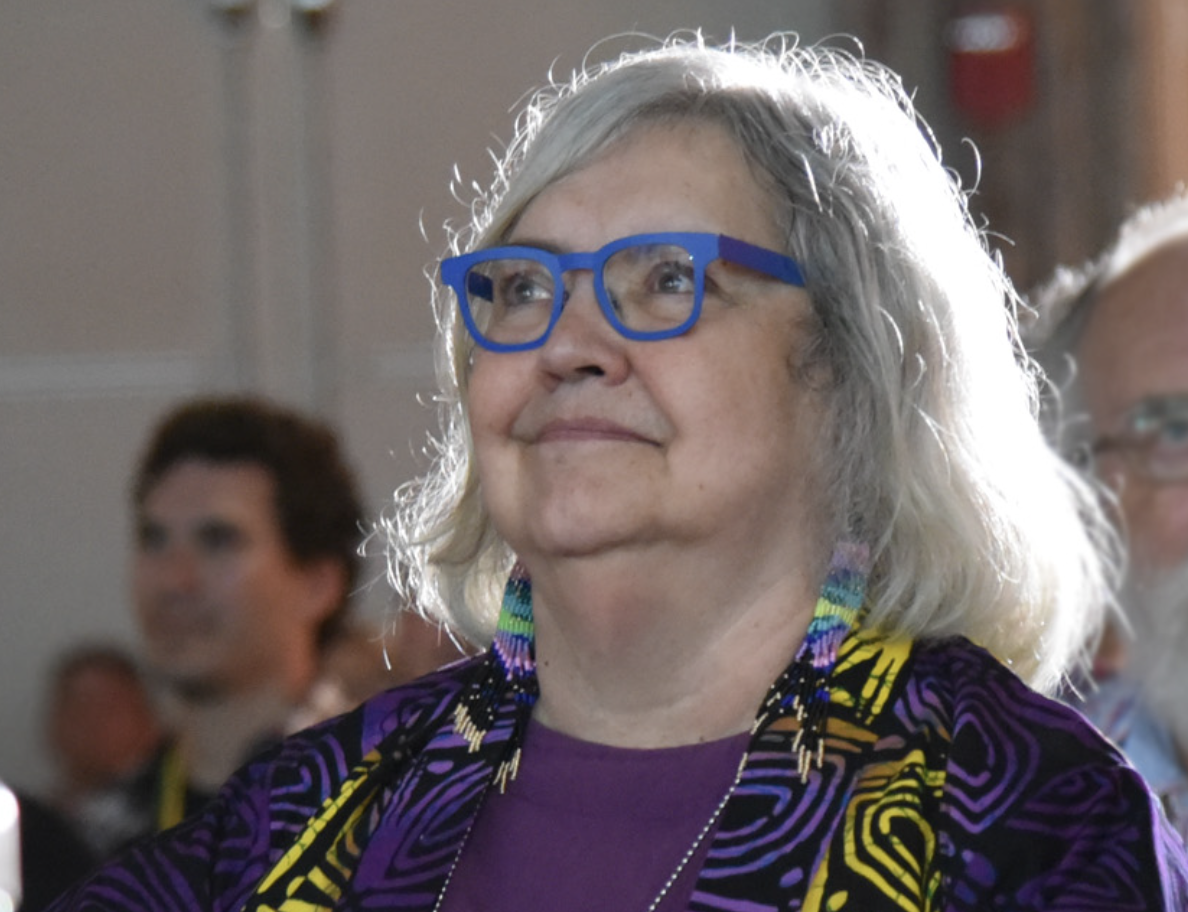
National Bishop Susan Johnson (ELCIC) listens to words of gratitude for her 18 years of service as national bishop (July 12, 2025, Winnipeg, http://www.elcic.ca)

The Mary-and-Martha Gospel story (Luke 10:38-42) reminds me of what sometimes happens when family and/or friends gather around a table on a holiday or to celebrate some special occasion. Over the meal, each person has a different take on the subject matter at hand. Everyone has their own opinion.

After years of regularly encountering this Gospel in the lectionary, and preaching countless sermons on it, I have concluded that there are at least three characters sitting around our table today. These three characters represent my own evolution of understanding this Gospel story. They are the Literalist, the Rebel, and the Peacemaker.

The Literalist is the first to speak. The Literalist reads this Gospel and concludes that Mary is the person that we all should model: the one who is quiet and listens to Jesus and doesn’t worry at all about the practical aspects of hosting Jesus and his entourage. While the mundane activities need to be done, we are called instead to aspire to the true, higher, spiritual gifts.

The Rebel, as you might guess, jumps right in. The Rebel resists the Literalist’s interpretation and declares their objection. They see it in the opposite way. Martha is the true hero, and Jesus is unfair in admonishing her. After all, the practical aspects of hosting a party are vital in healthy relationships and community building, not to mention how dominant cultures have tended to diminish and marginalize women who traditionally did these more active, practical things.

Finally, the Peacemaker quietly interjects. The Peacemaker will argue that both roles, or postures, are important to balance in any community or within any individual. Jesus isn’t taking sides in this debate. Rather, he directs his comments to the way Martha goes about her task, “worried and distracted by many things” (Luke 10:41). Whether we are active all the time and busy in our service to God, or praying in silence and resting in stillness and holy presence, distraction is the real culprit.

If you were invited to this table, and you came, where would you sit? And with whom? The Literalist? The Rebel? The Peacemaker? Or … is there yet another voice that needs to be heard?

In the farewell tribute and celebration of outgoing national bishop Susan Johnson at the national convention of the ELCIC last week, a speaker and close friend of Susan’s, Willard Metzger from the Mennonite Church and current director of the Citizens for Public Justice (CPJ) talked about the strengths in Bishop Johnson’s ministry (www.elcic.ca).

He spoke about how Bishop Susan knows who she is. She is strong in her personal identity. In other words, she has an abiding love of self despite all the challenges she had faced, both personally and professionally, in her 18 years as bishop.

Willard went on to say that our love for God is affirmed when we love ourselves. Why? Because God created each of us. Each individual is created out of the love of God. It is fundamentally crucial as Christians to continually work at loving ourselves because God created you, made you, fashioned you in God’s image. We would then compassionately correct any messages we might tell ourselves, or the world might tell us, to the contrary.

Here’s another voice, another way of interpreting the Gospel. What shall we call this character? The Lover? It’s not about whether it’s better to be active and serving, attending to others and being hospitable in practical ways. Neither is it better to be contemplative, and reflective and sitting at Jesus’ feet. It’s not either/or.

It was that Mary knew who she was, was strong in her own identity, and loved herself enough to know that she just needed to do the one thing she was about and be who she was, at that point in time. The “better part” that she had chosen was that she chose to be herself without trying to be someone and do something she was not. She didn’t need to please someone else or fulfill their expectation of her. Jesus said it: Who she was and what she was about could not, “will not be taken away from her” (Luke 10:42).

This year, the national church has embarked on a restructuring process. During the convention the facilitators of the restructuring process engaged convention delegates, visitors and staff in an activity which I would like to practice here today, with you.

To begin with, the activity had us pair off. So before doing anything, turn to one person sitting beside or close to you and introduce yourself to them. It’s best to break the ice before diving in to do this exercise. If you are watching online with another person, you can do this with them at home.

The aim is to tell a story, together. I’ll start you off by saying, “Once upon a time ….” Then one of you will start telling your story by saying just one word. Then the other person will respond, but with just one word. And back and forth you go, taking turns but with just one word at a time.

Before you begin we need a general theme that will govern all our stories. So, what country or place in the world would you like to visit? …. What activity would you like to do there? ….

Ok, the story you will create together with your partner will be in this place and revolve around this activity. But remember, you say just one word when it’s your turn. I’ll give you a couple of minutes to do this, ok? Ready? “Once upon a time …” Go!

Time’s up! What was one challenge you may have encountered in the exercise? You may have had an idea about where the story should go. But then your partner would say a word that totally threw you off. They, obviously, can’t read your mind. And they might very well rather take the story in a different direction.

For the exercise to be productive, both partners need to get past themselves, listen carefully, and join together in telling a story that emerges from both, without preconception. You are co-creating in the moment. And hopefully having some fun along the way.

The exercise taught me that there is a difference between my story, and a story. There’s a difference between my story, and our story. And it’s not that my story is bad, or lacking, or not good enough. Refer to my earlier point about loving ourselves.

Each of us is beloved and has value and worth and beauty. You and I need to know who we are as individuals. We need to rejoice and celebrate in our particular, unique gifts that each person brings.

At the same time, we need to share and engage each other in relationship, and work together, respecting each other’s gifts. We co-create a new story, an emerging story. This can be exciting, and scary at the same time.

However your close relationships are organized, however community happens for you, despite and maybe because of our differences, the family still gathers around the table, as we will at the Holy Meal shortly. We reach out to make meaningful connections.

And perhaps this is the grace. Even though the people sitting around the proverbial table may be very different in their outlooks and interpretations and politics, we still gather and hear each other out. We practice being in community. And God continues to love each one of us, and the church.

Let us rejoice and give thanks in the story that God tells through us.

Thanks be to God!

Annual Pastor’s Report 2017

Anniversary Year

2017 marked a significant year in the life of the Lutheran church, from the global expression of the church all the way to the local.

Some 74 million Lutherans associated with the Lutheran World Federation (LWF) commemorated the 500th anniversary of Reformation with the theme, and theological claim: “Liberated by God’s Grace: salvation, human beings, creation – not for sale!”

The Evangelical Lutheran Church in Canada (ELCIC) presented several Reformation goals based on the number 500. Congregations in the ELCIC were challenged to commit to 500 refugee sponsorships, fund 500 scholarships for students in the Evangelical Lutheran Church in the Jordan and the Holy Land, plant 500,000 trees, and raise $500,000 for the LWF endowment fund.

In the Ottawa Ministry Area, a five-week study in the Fall included lay and ordained members from both Lutheran and Roman Catholic congregations to reflect together on the theme and resource, “From Conflict to Communion”. The documents were developed by the ELCIC and the Canadian Conference of Catholic Bishops (CCCB) for local groups across the country to acknowledge the significant strides to greater visible unity between Lutherans and Catholics over the last fifty years.

Thus, the Reformation was not merely ‘celebrated’ as a competitive – even combative – victory over the other but rather ‘commemorated’ as a movement whose trajectory invites greater understanding of a complex history. In this mutual sharing and conversation, deeper ties and unity is realized.

In this spirit of growing ecumenism as an appropriate expression of Reformation, two significant worship experiences happened in the Fall of 2017. The first was held at St Peter’s Lutheran Church and Christ Church Cathedral in downtown Ottawa.

This service, on Reformation Sunday, October 29, welcomed over 600 Lutherans and visitors from Ottawa congregations who by closing their individual congregation’s doors that Sunday morning opened doors of greater unity and relationship-building. It was a festive worship led by Eastern Synod Bishop Michael Pryse and National ELCIC Bishop Susan Johnson. The service was organized by lay and ordained leaders of the Ottawa Lutherans organization, and by many of our members from Faith.

The second service occurred on the last liturgical weekend of the church calendar in 2017 – at Notre Dame Cathedral. Ottawa Roman Catholic Archbishop Terrence Prendergast and Lutheran Bishop Michael Pryse led a Service of the Word to an assembly of Lutherans, Catholics and visitors – again to enact a Reformation 500 principle of first focusing on all that unites us rather than emphasizing our differences.

At Faith, this Lutheran Anniversary year also capped an extensive modernization of our worship space and narthex. At the beginning of 2017 we were still worshipping at Julian of Norwich Anglican Church while renovations were being completed at 43 Meadowlands Drive.

During our absence from Faith building, we were able to continue worshipping at the same time on Sunday morning with our neighbouring Anglican sisters and brothers, seamlessly, because of the Full Communion relationship the ELCIC shares with the Anglican Church of Canada (ACC).

Finally, on a personal note, 2017 marked the 20th anniversary of my ordination to the Ministry of Word and Sacrament (June 6, 1997). And therefore, it was significant that in my 20th year of ordination, I took a three-month sabbatical leave for renewal and rest. My wife, Jessica, and I celebrated in 2017 our 20th wedding anniversary as well.

In conclusion, anniversaries are opportunities to not only look back, but look to the future with hope. In all the planning and events surrounding the 500th anniversary of Reformation, I heard often the sentiment that we do this for the sake of the next 500 years. I’ve quoted before the Eastern Synod motto for its 150th celebration in 2011: “Remembering for the future.” Indeed, life must be lived forward even as we look to the past.

“Hope does not disappoint us, because God’s love has been poured into our hearts through the Holy Spirit that has been given to us.” (Saint Paul, Romans 5:5)

Turning into the wind

We were just down the street from Pearson International Airport in Toronto. Late in the evening after the first day’s sessions at the Synod Assembly last week, I walked along Dixon Road which goes right to the airport. 

At one point on a bridge you can stand directly underneath the path and roar of landing planes. You look west in the direction of the landing, and you see the long runway lighted brilliantly for the descending jets touching down. You look in the opposite direction towards the east, and you can see a long line of planes taking their turn in the landing rotation, the dots of their lights extending in a straight line far into the distant sky.

It was a windy day, the gusts reaching over 50 km/h from the south. What impressed me was how each plane’s nose was turned slightly to the left, towards the south, as they made their final approach. The planes were coming in on a straight line, yes, but turned towards the wind in order to keep their landing true. At the last second before touching down, the jet would straighten out.

Wind, like currents in the water, is a significant if not main factor in affecting the flight or sail of the airborne or water craft. In order to land safely and soundly, the planes had to face the challenging issue head on. In the words of Paul in his letter to the Galatians, the problem must be “detected” (Galatians 6:1) and exposed. 

You will get nowhere in a plane or boat unless you ‘dance with the devil’ so to speak. Unless you look your problem square on, face it and name it, and change your position accordingly. If the landing planes insisted on keeping their plane aligned straight on their approach, they would not have made their landing on the runway, but somewhere to the north of it!

Our guest at the Synod Assembly, Bishop Munib Younan (president of the Lutheran World Federation) spoke of Lutheranism. He warned us, that in these Reformation Anniversary years, we do not celebrate ourselves. We do not pretend that God couldn’t have done anything good without us. We are not the perfect church, but always reforming.

Being Lutheran, he said, is a call to humility, not a spirit of triumphalism. We dare not make an idol out of Martin Luther or his legacy in us.

Paul strongly exhorts the Galatian church to proceed with one another in humility and gentleness, not lording it over others who are ‘sinners’. Because we ourselves are no better. We must learn to face our own demons. This is what is meant by his words: “All must test their own work … for all must carry their own loads (v.4-5).” We dare not point fingers without first acknowledging our own stuff.

This is then, how we bear one another’s burdens. Amidst the conflict wreaking havoc in the early church in Galatia, Paul encourages the people to persist in not losing heart, to have courage and not give up.

As the Gospel text for today describes (Luke 10:1-11), the work of the church doing God’s mission in the world will result in friction and struggle. You cannot follow Christ and not encounter conflict and adversity in your life. 

The famous Psalm 23 so often associated with bringing comfort and evoking peaceful, calming images includes this disturbing verse: “You prepare a table before me in the presence of mine enemies” (Psalm 23:5). It feels like this verse doesn’t belong beside still waters and green pastures along paths of righteousness. But it does belong! It means that God gives us the gift of grace in the presence of all that challenges us, all our demons internal and external, everything that we may not like in our lives — not apart from it.

Paul concludes his letter to the Galatians by focusing our attention on the cross of Christ (6:12,14) — the symbol of death and suffering of a God who goes the distance to love us. This is the only reality about which to “boast”. Why?

There is a treasure in the midst of the suffering. We may not see it right away. Yet, our struggle does yield something good, something meaningful, something liberating. Yes, we are liberated by God’s grace. 

Liberated however not by ‘nicey-nicey, goody-goody’ — a phrase our Bishop Michael Pryse used at Synod to describe an approach to church life that just keeps us stuck. Liberated not pretending to live a charmed life. Not by everything working out perfectly. But liberated through what may be a terrible suffering, a loss, the very pain that would otherwise destroy a person altogether. There is a treasure therein.

That is why we boast of the cross, and nothing else. How can God be found in the painful letting go that marks the various stages of life? How can we even sense or feel God’s presence in the midst of a grief too heavy to bear? How can we move on through the turbulence of change and transformation?

In his short book, “Rules for a Knight”, actor-writer Ethan Hawke recounts the last words of instruction by a renowned knight, Thomas, to his children:

“There is a memory that won’t let me go,” Thomas begins. “Last summer all you children were playing by the ocean. We were with your mother and her sister’s family, do you remember? The weather was sublime, streaks of sun and a deep blue sky. You four and all your cousins were building castles with the warm, muddy sand. Each of you kept your castle separate, announcing, ‘This one is mine!’ ‘That’s yours!’ ‘Stay away from mine!’

“When all the castles were finished, your cousin Wallace playfully stepped on Cven’s. Lemuel, you flew into a protective rage. You were only looking out for your sister, I know. Mary-Rose, you thought Lemuel was over-reacting, and you threw him to the ground. Next, everyone was fighting, throwing sand, howling with tears, and pushing one another. Young Wally had to be taken home, sobbing in your aunt’s arms.

“When he was gone, you all went back to playing with your castles for a little while but quickly moved on to swimming. It grew cloudy, and soon it was time for us to begin the journey home. No one cared at all about their castle anymore. Idamay, you stamped on yours. Cven, you toppled yours with both hands. We all went home. And the gentle rain washed all the castles back into the surf.

“Please be kind to one another,” Thomas concludes. (1)

What are the castles in your life? Things or issues that in five to ten years won’t really matter anymore? Things for which you might lay your life down now in heated, compulsive reaction, but really won’t endure — material possessions, opinions that merely shore up a vulnerable ego, beliefs that have outlasted their use? A spirit of judgement and condescension towards people who do not experience life like you do? A reputation to defend at all costs? etc. etc. What are your castles in the sand?

“My friends,” writes Saint Paul, “if anyone is detected in a transgression, you who have received the Spirit should restore such a one in a spirit of gentleness.” Around the same time Philo of Alexandria wrote: “Be kind: Everyone you meet is fighting a hard battle.”

Turning into the wind may be a basic operation for landing a plane. When I face the wind and continue paddling or cycling into it, tears will come to my uncovered eyes. There are tears that come in the face of God’s Spirit, a Spirt that will blow down castles built in the sand.

This wind also has the power, like the Spirit of God, to build endurance, strengthen my inner life and take me where I need to go. If I stay with it, often more rapidly than I would on my own!

May God’s wind blow surely and true in your life this summer. May you receive grace in turning to the wind.

(1) – Ethan Hawke, “Rules for a Knight”, Alfred A Knopf, New York, 2015, p.148-149

Read it again: We are the messengers

A message to children on the 2nd Sunday of Advent  —

Read Luke 3:1-2 out loud to the children:

“In the fifteenth year of the reign of Emperor Tiberius, when Pontius Pilate was governor of Judea, and Herod was ruler* of Galilee, and his brother Philip ruler* of the region of Ituraea and Trachonitis, and Lysanias ruler* of Abilene,2during the high-priesthood of Annas and Caiaphas, the word of God came to John son of Zechariah in the wilderness.”

What did that mean – all those names of people you know little if anything about?

Let me read these verses again, with some changes, and see if the meaning of the word might make better sense for us today:

“In the 2nd year of Prime Minister Stephen Harper’s majority government, when Dalton McGuinty was still premier of Ontario, and Jim Watson was mayor of Ottawa, and the Rev. Susan Johnson was the national bishop of our ELCIC, and the Rev. Michael Pryse was the bishop of the Eastern Synod, the word of God came to us – right here at Faith. And we will leave here and go into our schools, and homes, to our work and sports teams, over mountains and along highways to share the good news of Jesus Christ. As it is written in the Bible …”

What difference did that reading make? Maybe it brought the bible a little closer to home.

John the Baptist was called to be a messenger of God – to prepare the way of the Lord Jesus who was coming. Two thousand years ago, he was the first one.

Today, we are the messengers, along with our parents and friends and fellow believers. We can share the good news and invite others to celebrate with us.

How can we get ready for Jesus’ coming?

1gift4good.

One small deed/act/gift to another person …. Ideas?

–        Drop a loonie in a Salvation Army kettle in the mall

–        Parents – become an organ donor by signing the back of your drivers’ license

–        Pray for someone in particular

–        Light candles on the advent wreath

–        Learn a new song

–        Read the bible out loud for someone

–        Make a Christmas decoration to give to someone in the nursing home or to an elderly friend or relative

– Invite someone to church for Christmas

–        Parents – let someone else have that parking spot near the mall, or let someone in front of you in a long line up

Prayer: Dear Jesus, thank you for coming to us this Christmas. Prepare our hearts to receive you, by doing and giving, one small gift for good. Amen.