
Jesus said, “Come, and see!” (John 1:39)
The French Impressionist painter, Claude Monet, captured my attention when Jessica and I visited the National Art Gallery over the Christmas holidays. It was in the special exhibit about snow and winter. The winter exhibit runs until the end of March at the National Gallery.
I lingered a little bit longer before Monet’s “Floes at Bennecourt” which captures the remarkable scene after extreme weather in January 1893 caused the Seine River in France to freeze and then thaw, “producing dramatic ice floes” (National Gallery of Canada, 2025, p. 271).
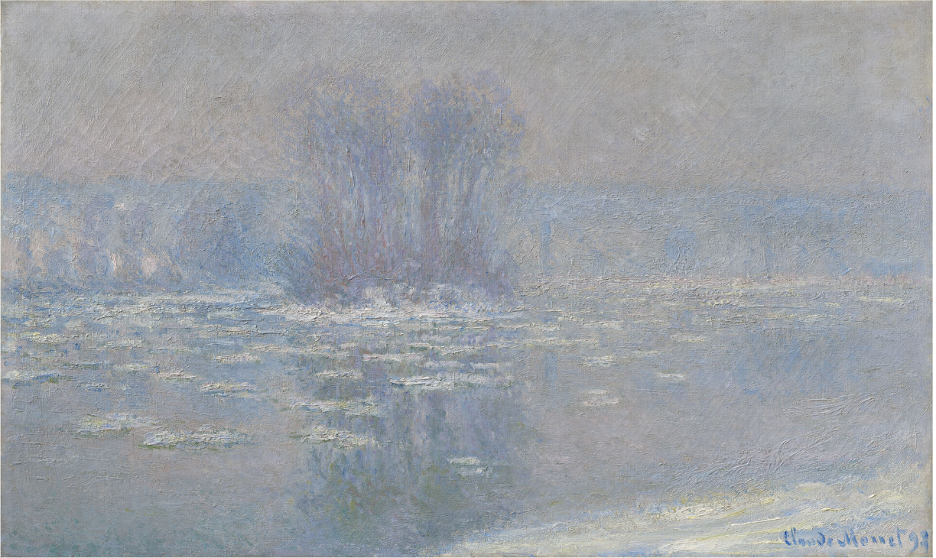
What struck me was the way in which Monet so brilliantly used muted purples and browns to paint such a clear picture of what was there despite the frosty haze clouding that vision. The cloudiness, so prevalent in his art, stands in between the observer and that otherwise clear, indisputably real scene behind it.
I’m right away reminded of Saint Paul’s famous words from 1st Corinthians 13:12 – “Now we see in a mirror dimly.”
Now, it’s January, but not 1893! We find ourselves in this season after Epiphany in 2026. The word, ‘epiphany’, means revelation, uncovering. We read biblical stories of Jesus being revealed to the first disciples as the Son of God.
Epiphany asks us to grapple with the question, “How do we know Jesus, God, is revealed to us, talking to us today?” Indeed, today we see in a mirror dimly. Today, when we might not know what to do given a particular challenge in our life, we seek answers. In a time when truth seems to be covered up, clouded, we want direction. When we are not sure about who we are, what our purpose is, we may easily be attracted to voices that shout the loudest telling us what to do. Ok.
But how do we know if that’s what God wants us to do? It seems to me we need to do some work to clear the frosty haze and uncover what’s really there behind the cloudy vision. We need to practice looking beyond what is immediately apparent.
Some of my favourite biblical characters are the Magi, the wise ones, the sages from the East, who visit the Christ child by following the star to Jesus’ place of birth (Matthew 2). I aspire to the courage and confidence they demonstrate by faithfully trusting in and following that star all the way to their destination.
But perhaps the most telling part of their story is what they do after meeting with Herod on their way to visit the holy family. After their visit, they decide it is too risky to go back by the same road which would expose them to Herod’s unpredictability and violence. They have a dream that convinces them of this decision. God speaks in their dreaming.
But that’s where the biblical narrative stops. After we read that they decide to go home by a different road, we hear nothing more of the Magi. We can only imagine:
It must have been hard, perhaps frightening, journeying under threat of Herod’s wiles. We may wonder who they met along the way, what they learned, and how they told the tale of meeting Herod and seeing the Christ child (Butler Bass, 2026). Whichever way they went, they no longer had that external guide – that star – to guide them. They only had their dream.
The biblical story is nevertheless unfinished. Perhaps intentionally so, to be worked out and continued in our own lives.
Claude Monet’s “Floes at Bennecourt” was hanging in the part of the exhibition that showcased how painters use light – daytime and nighttime – to create their art.
In Epiphany, the central image is light. In the New Testament, the expression “the light of the world” is used to describe Christ Jesus (John 8:12). But then Jesus applies the same phrase to us. In Matthew 5:14, he says to the disciples, “You are the light of the world.”
Light is less something we see directly, and more something by which we see all other things (Rohr, 2025, December 28). Looking at the light directly is tough, even impossible for us humans. Just try to look at the sun for more than a few seconds! It can damage our eyes. We can’t really, directly, and always be looking at the sun, the source of the light. That is not the point of faith. The purpose of the light being given is so that we can look at what that light source illuminates, on the earth.
It’s like God is telling us to wake up! And look! And see! Maybe, see again, with renewed vision what is before us!
We have faith in Christ so we can have the faith of Christ. Practising the faith of Christ is the goal of our lives. We look at Jesus only so far as we can look out at the world with the eyes of Jesus. You are the light of the world!
So, what are we to see? What does God see, so that we can see with the eyes of Jesus? Historian, writer and theologian Diana Butler Bass, whose book (Freeing Jesus) is the subject of the Ottawa Lutherans online book club tomorrow, comments in a recent blog on what God sees when God looks at the world, at our reality.
“Certainly”, she writes, reflecting on the creation story from Genesis, “God sees sin, sorrow, the shame, the pity, the terror, and the sheer horror of it all …
“God sees beyond, through, and past the covering of the fig leaves. God sees creation ‘without deceit.’ God beholds the world as it really is, a beloved community, a feast of abundance, sparkling in the light and glory of love.
She concludes: “And God invites us to see that goodness also – with our own eyes. To see differently, looking beyond, under, through, and past the shadows … But seeing isn’t only for visionaries. Every person called to follow is called, first and foremost, to come and see. The Light dwells with all of us, opening our eyes. The Light widens the circle of welcome … The Light beckons: Come and see” (Butler Bass, 2025, pp. 89-90).
How do we tell if God is speaking to us? By looking at the world with the faith – the eyes – of Christ and focusing on where that Light shines. Come, and see!
In my practicum, a client will sometimes come to therapy expecting the counsellor to be the expert. They show up assuming the therapist will have the answers to their confounding questions about what is going on in their life and find the perfect solution for them.
They expect the proverbial star to suddenly ‘poof’ appear through the counsellor’s expertise and show them the way to go. It seems a similar dynamic exists across many professions of care, whether we are talking about mental health care, medical care or spiritual care.
During the first “Conversations Across the Church” webinar on November 30, 2025, ELCIC national bishop, Larry Kochendorfer, noted at least a couple of shifts the church needs to make in a season of anxiety and uncertainty, when our vision is clouded. He stressed that Lutherans today need to shift away from envisioning ministry – service in Christ’s name, discipleship, mission work – as clergy-led and lay-supported, to ministry that is lay-led and clergy-supported.
“The priesthood of all believers” – Martin Luther’s term.
In psychotherapy, solutions are found not in the expertise of the counsellor, but in the resources and sometimes hidden strengths in the life of the person seeking help in therapy. The job of the counsellor is to help the client realize, accept and act out of their strengths and resources.
We call it client-centred psychotherapy. The counsellor does not have all the answers and cannot know more about the client’s problem and experience of life than the client themselves. They are the expert.
“You are the light of the world.”
The other shift Bishop Larry indicated for the church today was away from a mentality of “fixing” problems to the practice of “listening”.
Sharon Brous writes, “sometimes the holiest work is not to pray them into the light, but instead to join them in the dark” (Brous, 2024, p. 144).
If we want to follow Jesus and do his work, we don’t need to drag people we care for into the light and fix their problems. We just need to listen to them. And that is accomplished by sitting with them in the dark. And see what happens. “Come, and see!” (John 1:39).
Do you see the dysfunction, the problem, and do you expect the other to adopt your solution? Or, do you look for the good, maybe hidden deep inside the other? Trust, that in your faithfulness to listen, the path forward and the way home will be illuminated.
“The Light shines in the darkness.” See with the eyes of Jesus where that light shines. And go there. Amen.
References:
Brous, S. (2024). The amen effect: Ancient wisdom to mend our broken hearts and world. Avery Books.
Butler Bass, D. (2026, January 3). Sunday musings: Another way home. The Cottage [Blog]. https://dianabutlerbass.substack.com/p/sunday-musings-another-road-home
Butler Bass, D. (2025). A beautiful year: 52 meditations on faith, wisdom, and perseverance. St. Martin’s Essentials. Rohr, R. (2025, December 28). That by which we see. Daily Meditations. https://cac.org/daily-meditations/that-by-which-we-see
Rohr, R. (2025, December 28). That by which we see. Daily Meditations. https://cac.org/daily-meditations/that-by-which-we-see/






 Raspberryman