I am a pastor in the Evangelical Lutheran Church in Canada, serving a parish in Ottawa Ontario. I am a husband, father, and admirer of the Ottawa Valley. I enjoy beaches, sunsets and waterways. I like to write, reflect theologically and meditate in the Christian tradition.
Before Santa Claus became “Santa”, he was Saint Nicholas. Saint Nicholas was a real person, and a bishop a long time ago.[1] A bishop is like a pastor, but instead of relating only to one congregation as a pastor does, a bishop relates to many congregations—and many people covering a large area.
Saint Nicholas indeed cared for many people in the part of the world known today as the country of Turkey. As a Christian he was very active in his faith by helping people who were poor, giving gifts and money to those who needed food, and rescued people who were in prison. In short, he helped people who were in trouble. All his life Saint Nicholas showed people how to love God and care for each other.
You could say he was “God’s Agent”. Yes, many of the things he did to help people he did them in secret. He didn’t want to draw attention to himself, because it was the kindness that he showed that was the important thing.
But he wasn’t God’s agent in the sense of being like a spy from the movies. Spies will sometimes deceive and trick people on purpose. No, Saint Nicholas was God’s Agent in the sense of doing things out of faithfulness to God, being active to do God’s will and show God’s love to all people. Even if he had to take some risks.
And that’s what we are all called to do as well. Like Saint Nicholas, we too are God’s Agents of love for other people. This Christmas I pray we can all find little ways, and maybe some big ways, to be God’s Agents, and like Saint Nicholas show God’s love for all people.
There are many stories about Saint Nicholas. I would like to read you one of them about a special animal—the Pine Marten—who was Saint Nicholas’ good friend; and, who helped him on a very special mission as “God’s Agent” …
Invite the children to sit with you gathered around the Christmas Tree.
Read Terri Reinhart, illustrated by Patrick Reinhart, “The Fiercest Little Animal in The Forest” (Colorado: St Patrick’s Press, 2nd Printing, 2019).
Let us pray:
God of joy and cheer, we thank you for your servant, the good bishop Nicholas. In loving the poor, he showed us your kindness; in caring for your children, he revealed your love. Make us thoughtful without need of reward so that we, too, may be good followers of Jesus.[2]Amen.
At the end, hand out a Saint Nicholas treat to each child …
[1] traditionally 15 March 270 – 6 December 343 A.D.
[2] B. Batchelder, illustrated by Barbara Knutson, All Through the Day, All Through the Year: Family Prayers and Celebrations (Minneapolis: Augsburg Fortress, 2000).
In the Christmas Eve candlelight service we all light our individual candles to symbolize the light of Christ coming into the world.
In this ritual, there’s another symbol for these candles I’d like us to consider: These candles represent each one of us. The light of Christ shines in our very own lives.
I took a photo of one of the advent wreaths we constructed in our home this past month; you can see it below. To begin with we had four, good-sized pillar candles we set in a bed of stones. But the glass holder had a relatively small diameter. The only way they would all fit in the container was to place the four candles right beside each other so they were touching.
As the four candles burned down, pretty soon we realized our mistake. They were too close to each other. The flames from the candles conspired to melt the wax in an accelerated, agitated fashion. The melted wax pooled quickly and often snuffed out the drowning wicks. We managed the candles as best as we could. But by the end all that was left was one amorphous blob of wax at the bottom of the bowl.
The candles burn much better when there is more space between each of them.
One of my favourite rituals of Christmas is shining all manner of lights. There are various and different kinds of lights—LED, flashing electrical lights for outdoor use, fairy white lights on boughs of spruce and pine, candlelight, and the list goes on. Yet all of them still do one thing: they provide light. It’s all about the light. These candles we light tonight belong to the one light of God. All light comes from God.
At a deeper level, we are all united, and share, in the light of Christ. All of it belongs to the One. At a deeper level, God overcomes whatever separates and divides us. In our common humanity, like all the wax pooling together at the bottom of the bowl, therein we find the one light in us all.
At Christmas, we often discover and experience our failings, weaknesses, and limitations in our relations. Amidst the intensity of those relationships, may we be reminded again of the good news of Christmas: That our individual lives–where necessary space is important–we still belong to a larger, brighter and ever-burning light. This is the life and love of God coming into the world at Christmas, and whose life and love is for the whole world.
Irresistible Flow (photo by Martin Malina, December 2022, Ottawa River at Arnprior)audio for sermon “Love Action” by Martin Malina
Did Mary and Joseph love each other? I mean, we say that they both loved God. But did they love each other? And what was this love? What kind of love?
The Christmas story from Matthew doesn’t explicitly describe the dimension of love in their relationship.[1]
Eileen O’Hea relates an example from her life about what the New Testament describes as—from the Greek— “agape” love. And this love was expressed by her dying mother. O’Hea writes:
“An example of agape love happened to me as I sat beside my mother’s bed a day before she died. An ambulance siren rang through the city streets close to our home. It somehow penetrated the thick coma-like sleep that enveloped my mother. Her eyes opened and dreamily met mine for the first time in many hours. She then looked at me and asked, “Is daddy alright?” “Yes,” I replied, “he’s fine; he’s in the living room.” My mother, assured that the one she loved was safe from harm, slipped back into the sleep she would not awaken from again.”[2]
The kind of love that propels someone into a deeper, more fulfilling life with another is what I think the angel reminds Joseph of in the dream he has.
Notice the angel’s first words to Joseph. The angel says his name. Before anything else is said, saying someone’s name when you address them is already an act of love for the person. Saying their name calls them to pay attention in return, grounding them in the moment of grace and opening their hearts to listen to and receive the other. The angel’s words to Joseph communicate love.
Joseph had to be called back to his love for Mary. We say it was Joseph’s love of God that made him obedient. Let’s assume Mary told Joseph about the angel Gabriel’s news that she will bear the Son of God. So, when the angel then confirms this news in Joseph’s dream, Joseph is called to obey out of his love of God, the God who Mary now carries in her body. Joseph’s love for Mary, herself, is the way he chooses to love God in that moment of decision. For Joseph, love of God indeed means loving Mary.
This truth is echoed later in the New Testament, specifically the commandment to love one another. “The commandment we have from [God] is this: those who love God must love their brothers and sisters also.”[3] In other words, you cannot love God without loving someone on earth.
But there’s so much that blocks us from practising this true, “agape” love in life, isn’t there? What blocks this love?
Joseph’s plan to dismiss Mary was an act of fear. After saying his name, the angel’s very next words to Joseph are, “Do not be afraid” – the most repeated instruction in the whole bible. “Do not be afraid to take Mary as your wife.” The bible has something to say about being afraid, and how fear relates to love. In scripture, fear and love are at opposite ends of a spectrum:
There is no fear in love, but perfect love casts out fear; for fear has to do with punishment, and whoever fears has not reached perfection in love. We love because [God] first loved us.[4]
When talking about love, that’s where we need to begin. With God’s love for us. And how God loves us. And we are given a gift in the Holy Meal. The sacrament of the table is first and foremost God’s gift of grace, God’s gift of love for us and the world.
Holy Communion is a meal we share with others. This is an important realization. Because while the Communion is “given for you”, personally, it is also given for everyone else. Communion is not just ‘ours’, individually. It connects us to the whole of creation. As national bishop Susan Johnson writes:
“The bread and wine are symbols of all life joining in praise of God … The earth, the sea, and all their creatures join in this praise. The meal is universal … [and] includes all our relations … [The Communion] connects us to angels, and to the saints who have gone before us. The meal makes no distinction between people. God invites all to come and share in this mystery. All receive the same bread and wine. All are equals … before the grace of God.”[5]
Love opens our hearts. In Communion, each of us is called by name to receive the grace of God. In forgiveness we accept love despite our failures and weaknesses.
We cannot do it alone. We cannot love perfectly. Even though we are called to love others as God would love—infinitely, graciously, extravagantly—it’s not easy to do this especially when we are suffering, grieving, and hurting.
Joseph and Mary had each other. Their love for each other and God helped them take risks of faith together, trusting in God’s love always. We are not alone on this journey. Love is not a solitary act. We don’t love others on our own accord. It’s not our love to keep for ourselves alone or dispense by ourselves alone.
Rather, we love with God.[6] Loving with God means the love we give is an expression of the heart of God, who is Emmanuel—God with us. The love God gives is not based on the merit of the beloved, nor the correctness of the beloved’s beliefs. But rather the love we share is part of the flow of God’s ongoing love for us and all of creation.
We join God’s love and participate in God’s loving. Like stepping into a river which flows continually. We may start at the river’s edge, gingerly testing the waters. Our first move into the river may be tentative. We may only go in a little way, and quickly jump out. We may even feel at times that we are not making any progress at all going deeper.
But regardless of how we may feel, and in whatever hurting circumstance we may find ourselves, there is something else going on that is deeper, and bigger, than what we may first perceive—as Joseph and Mary both learned in their experience. The story wasn’t just about them.
The Greek philosopher Heraclitus once said that “you cannot step into the same river twice,” meaning every act, however small, however tentative, bears an essential newness. Divine love is not a river of stagnant water but a fountain fullness of overflowing love, love that is forever awakening to new life.[7] Whether we are aware of it or not each time we dip into the river, the love of God-with-us strengthens a deeper, more lasting flow and truth within us and the world around us.
In the shadows of our lives this Christmas, may our loving shine forth brightly, in Jesus’ name.
A Path Through It (photo by Martin Malina October 2022)sermon audio for “Gateways of Doubt” (by Martin Malina
You could tell it was his first time on the diving board. Even though the edge of the spring board was only about ten feet above the surface of the water, he was not sure.
The little boy paces back and forth along the full length of the board, his index finger lifting his chin, his eyes squinting in concentration. Then he crosses his arms across his chest. Back and forth. Back and forth. Will he jump?
All the while his instructor calls for him from the water below. Her arms are outstretched, ready to catch him. The boy’s friends encourage him with: “Come on!” “You can do it!” “It’s fun!” The splashing, the playing, the shouts of joy are all evidence of the promise of what is to come.
But for the longest time, the little boy is not sure. Then on one of his return paces back to the edge, and for inexplicable reason, he unexpectedly jumps. He holds his legs tucked underneath him so tightly.
After he emerges out of the water, his face is beaming with joy. He clambers out onto the pool deck and runs happily into the waiting arms of his parents.
Today is called Gaudete Sunday, meaning Rejoice! The liturgy wants to capture the joy of anticipating the birth of Jesus. Soon and very soon! We’re over halfway in the season of Advent.
We light the candle of joy today on this Third Sunday of Advent, although we may not feel particularly joyful these days. For so many reasons.
This Advent theme has its roots in the pregnancy narrative from the Gospels. It is the joy experienced by Mary after she receives the news that her life will birth the Savior. Mary then sings her famous Magnificat which we just read together.[1]
But the joy of the Gospel can be misunderstood.
When the angel Gabriel appears to Mary to tell her what’s in store for her, I notice Mary’s initial confusion: “But she was much perplexed”[2] by the angel’s words. Initially she wasn’t sure about what was asked of her.
I suspect we think that a holy encounter would initially inspire certitude and confidence in our faith. And therefore, this certainty would lead us to joyful praise and discipleship. I suspect we presume that faith is borne from understanding it fully and knowing everything and being sure about it, first. Then, be joyful.
But the joy of the Gospel does not come from being certain. The joy of the Gospel does not come from eliminating all doubt and ambiguity in life.
In this case with Mary, the words of the angel Gabriel don’t lead her out of doubt and into faith. It’s the other way around: Her encounter with the angel leads her out of whatever preconceived notions gave her a sense of security, and into a “holy bewilderment.”[3] God’s message disrupts her certainty and turned her world upside down. “She was much perplexed.” Or, as she says to Gabriel: “How can this be?” In faithful response, Mary moves out of familiar spiritual territory and into a lifetime of pondering, wondering, questioning, and wrestling.
Doubt is the gateway to joy.
The journey to expressing true, authentic joy cannot exclude the experiences of our lives that disrupt our certitudes. Being faithful moves us into realms of unhinging, unknowing, unlearning even what has kept us secure and comfortable in our beliefs our whole life long. And moving forward anyway. And doing it. Jumping off the diving board.
In the Gospel reading for today, John the Baptist is in prison, and he knows he is near the end of his life.[5] In the uncertainty and fear, it is natural for him to seek assurances from Jesus. “Are you the one who is to come, or are we to wait for another?” You could say, when he sends his disciples to ask Jesus if he is the One, the Messiah, John is expressing doubt.
Jesus’ response suggests at least a couple of cues for our own journeys of faith:
First, doubt is not the opposite of faith. In truth, doubt is very much an important, a vital, aspect of faith in God and Jesus. Jesus does not scold John for questioning Jesus’ identity as the Son of God. Jesus does not say, “Shame on you John, you should know better!” Rather, just the opposite.
Jesus lifts John up. Jesus praises John for being like no other in the reign of God. John may be at a difficult part of his journey. But it’s not over. There’s more, and better to come!
It’s important in the church, even among those who have been faithful for years, decades, that we give each other permission, even admiration, for expressing honesty in doubting our beliefs. It is part of, and belongs to, a life and journey of faith whose end is life in the “kingdom of heaven’’.
Even when we feel our own lives are nearing their end, it’s ok to question God. In truth, doing so is a mark of great faith. This authenticity provides a safe, truly loving place for having real conversations about suffering, death, life, and God.
One of the great proponents of doubt as a way to find deeper truth was René Descartes, seventeenth century philosopher, mathematician, scientist, and Christian. He expressed the value of doubt this way: “If you would be a real seeker after truth, it is necessary that at least once in your life you doubt, as far as possible, all things.”[6]
In Jesus’ response to John’s question, Jesus doesn’t come out and say: “I am the Messiah, the one for whom you have been waiting.” Jesus doesn’t give John a simple, clear-cut, plain-truth answer to John’s question. Jesus does not satisfy John’s clinging to certainty and long-held beliefs. Even nearing the end of his life, John is faced with bewilderment, in the sense that he still needs to be on that journey of wrestling, questioning and working through it himself.
In her faithful response, Mary consents to evolve. To wonder. To expand her vision. And continue jumping. Her gateway of doubt through which she moves turns into a path she must continue to follow and discern as she makes her way forward. She has to learn that faith and doubt are not opposites—that beyond all the easy platitudes and pieties of religion, we serve a God who dwells in mystery.
In Holy Communion, bread and wine become the body and blood of Christ. We speak of a mystery here. Shall we say the mystery of incarnation. As we will celebrate in the coming Christmas season, God is not hostile to creation, the stuff of earth. God becomes human, part of the stuff of earth. God enters our frail, human reality. And we celebrate this mystery every week at Communion when simple gifts of bread and wine are transformed.[7]
Along with wine and bread, we offer ourselves at the table, that we might be transformed. Martin Luther claimed that “Even as bread and wine become the body and blood of Christ, so the people are transformed into the body of Christ.”[8] For we are a community, a people, sent to care for others and the world, to encourage, support and serve them.
On one level, we perceive only bread and the wine. But from the heart we perceive what God does at the table and are reminded again that God’s work of transformation continues in us and in the world around us.
If we agree to embark on a journey with this God, if we jump as Mary did, we will face periods of bewilderment and true joy. Through gateways of doubt. If we agree to embark — jump! — on a journey with God, and receive the nourishment God provides on the journey, we will be transformed. And the world around us.
Because Christ has died. Christ has risen. And Christ will come again.
[7] Donald W. Johnson and Susan C. Johnson, “Holy Communion” in Praying the Catechism: Revised and Expanded Edition (Minneapolis: Augsburg Fortress Press, 2021), p.170.
[8] Martin Luther, tr. Jeremiah J. Schindel, rev. E. Theodore Bachman, “The Blessed Sacrament of the Holy and True Body of Christ and the Brotherhoods, 1519,” Luther’s Works (Philadelphia: Muhlenberg Press, 1960), 35:59-60.
“…may the righteous flourish; and let there be an abundance of peace” (Psalm 72:7)
audio for sermon ‘Wreath on fire” by Martin Malina
The season of Advent was always a big deal at our home when I was a child. I remember looking forward every year to Advent—the season of candles, wreaths, waiting and anticipating Christmas coming.
Fire transparent, Fire contained, Fire reflected (photo by Martin Malina, 2022)
On our wooden coffee table in the middle of the living room we would place a large wreath with real pine boughs intertwining four, tall candles. Of course, these candles were a lot shorter by the time the fourth week of Advent rolled around having lighted them every day. And the pine boughs had gotten quite dry. The needles were falling off.
It was during the last week of Advent one year when, after lighting all four candles, my mother, brother and I had to go into another room for a short time. When the fire alarm went off, at first I couldn’t think of what it could be. But then the awareness struck all of us and we dashed back into the living room.
The whole wreath was consumed in a gigantic plume of fire and smoke reaching up to the ceiling. Thank God for the water nearby that saved us.
John the Baptist warns the religious leaders of the day, in today’s Gospel reading, that the one who is coming will burn the chaff “with unquenchable fire”.[1] The advent wreath on fire appeared unquenchable, believe you me!
Today we light the candle of Peace on the wreath. The biblical word for peace is ‘shalom’. What does ‘shalom’—the peace of God—mean?
The advent wreath on fire wasn’t a calming vision of peace, one that we normally seek at this time of year. We may not expect and may not want to read a passage from the bible these days that paints disturbing images about the coming Christ.
I am drawn, rather, to focus on the “… intimate comforts of mangers, fireplaces and hot chocolates.”[2] I would rather my advent wreath not explode in a plume of unquenchable fire. I want to see the soft, flickering light, snuggled up with a blanket and a good book on the couch. I don’t think I’m alone in seeking a reality closer to Hallmark images of chestnuts roasting on an open fire.
Yet, a world already awash in the soft glow of Christmas, this Sunday’s gospel jarringly redirects our focus. The Gospel presents a dirty and smelly John the Baptist wearing camel’s hair, eating locusts and wild honey, and screaming threats at the religious leaders visiting him in the wilderness. Where is the good news in this?
Before we skip over John the Baptist in our rush to get all cushy with Christmas, let’s pause for a moment. And consider this: While only two of the four gospels talk about Jesus’ birth, all four tell about John the Baptist. So, there’s something here we need to pay attention to. We need to ponder why his story is vital to our Advent journey.
Ancient wisdom for people of faith warned against what was called a “pernicious peace.” One of self-indulgence, self-absorption and self-preoccupation with being comfortable. A peace that ultimately does not satisfy. In fact, too much of this spelled a dangerous escape from reality—a pernicious peace.
What do you notice first about John the Baptist? What detail about his persona first draws you in? I’m drawn to the wild honey image. I love honey. But I must confess I associate the pleasure and benefit of honey with an early childhood image that has stayed with me—Winnie the Pooh. But this childhood warm-fuzzy image must be revised. Because it doesn’t square with the reality of the honeybee and its grittier, larger truth.
In her Advent devotional, Gayle Boss describes how bees survive winter. They cluster together and shiver their wing muscles in a carefully arranged dance to keep the queen and the honey at the center of the hive warm.
Some bees are even born to know only this long, cold season of life: “They will know only the dark hive,” Gayle Boss writes, “the press of their sisters’ bodies …They give their lives to shivering together in the dark, the tiny repetitive gestures of each, added together, a music beyond our hearing, sustaining a future for the community.”[3]
There’s a constant movement, not easily perceptible to us humans in the formation of honey and the beehive. There’s movement, a community that endures difficulty and toil during the dark winter. Yet in the toil, there is hope for the future. And this is the ongoing work we give during Advent.
The pastor says: “The Peace of the Lord be with you all.” And the people respond: “And also with you.” Where is this said in the liturgy every week? Those words mark the beginning of the Communion part of the service. Those words and gestures launch us into Holy Communion.
We share the Peace. Sharing the Peace is an action towards and with one another. Then, in our tradition, we come forward. We move our bodies on the way to the altar to receive the gift.
Peace is not a state of being, but a movement. Like the bees shivering their wings to keep the queen and honey warm. Peace is a movement, ongoing. A path. A way of peace. This is the shalom of the bible.
The Hebrew concept of peace was described as peace between God, the people, and the environment. When we share the peace of Christ at the beginning of the Holy Communion, “we are calling for this shalom to be present in our lives, in the lives of others, and in the world. Shalom [therefore] means hospitality and welcoming the stranger in our midst.” And after the Eucharist—the Holy Communion— “we go forth as agents of reconciliation, carrying the peace of Christ with us.”[4] Even and especially when we find ourselves in the wilderness of our lives.
So, what is your “wilderness”? Is it a physical suffering? Is it dealing with mental illness, an emotional pain, an addiction, sadness, anxiety, fear, anger, shame? Is your wilderness the loneliness of the season, the feeling of abandonment, isolation? What is your wilderness?
We all likely have a few advent wreaths on fire, figuratively speaking, somewhere in our lives. And we may feel like all we are doing is trying to put out all those out-of-control fires. But John the Baptist warns the religious leaders, even suggesting that the “wrath to come” is not something from which to “flee”. Repentance is not escaping into a Hallmark world of denial and avoidance. True repentance happens when we face the wrath, the wilderness, the suffering in faith and hope.
God takes the lead. God comes to be with us in our wilderness wandering. Jesus is the Living Water[5]that saves us. Jesus chose to go to where John the Baptist was—into the wilderness of his life, to be baptized. God chooses to go there—into the wilderness of our lives—to bring healing and wholeness.
This is wonderful news! God doesn’t flee from the wilderness. It is the place where God’s presence is experienced. This is the path of peace. It’s a journey. May we find our nourishment and strength moving toward the goal on this winding path.
“Blue as the sky is blue”(Kioshkokwi Lake, 5 September 2022, photo by Martin Malina)audio for sermon “Why? Why not?” by Martin Malina
Why Why Why? More questions come out of the reading of the Gospel than anything. When the lectionary group met online earlier this week to reflect on the Gospel text for the First Sunday of Advent[1], most of the initial responses were questions: “What does this mean?” “What are we to do?” “How am I awake?” “When are we asleep?” Lots of questions.
When my children were young, they drove me crazy whenever they would drill down any line of reasoning with ‘why’.
“Why do I have to go to the dentist?” “Because your teeth need to be cleaned.” “Why do they have to be cleaned by a dentist?” “Because they have machines that can clean in a way you can’t” “Why don’t we just get those machines for ourselves?” “Because they are expensive and only dentists can get them.” And on and on and on. “Why?” It can be an annoying question.
But my sense these days is that we have to go there especially if we want to communicate our faith effectively. We have to address those more fundamental questions—but not first with established doctrines or beliefs. Rather, it is best to begin addressing questions of faith with our personal experience of faith, in an honest, genuine, heart-felt way.
Advent inaugurates a season of hope. As blue as the sky is blue, blue is the colour of hope. In the Gospel, we are called to keep watch, pay attention, and be vigilant. But in this era of pandemic economic and social depression, perhaps a more fundamental question is “Why?” Why should folks bother keeping awake when hope is scarce, when everything—as they say—is broken? What is the point of paying attention and keeping watch for the coming Messiah? Why bother, in the first place?
Hope in gospel faith is not just a vague feeling that things will work out, for it is evident that things will not just work out. Hope in gospel faith is also not some romantic or ideological notion of private preference detached from reality. Rather, hope is the conviction, against a great deal of data, that God is persistent in overcoming the deathliness of the world, that God intends joy and peace.[2]
Yet, this ‘perfect fullness’ is always to come, over the horizon. And we do not need to demand it now. Why? The virtue of hope keeps the field of life wide open. Hope in gospel faith is especially open to grace, and to a future created by God rather than us. God is always up to something.
And we’re always on the lookout for where and what is going on with God. This is exactly what it means to be “awake,” as the Gospel urges us! We can also use other a words for Advent: aware, alive, attentive, alert are all appropriate.[3]
It’s not all warm fuzzies. To pay attention to the grace of God and to a future created by God rather than us, costs us something. We have to work at it. Faith is a practice that needs exercise. So, what at the beginning of this new church year and at the advent of God’s future, what can we practice that will curate hope in our hearts?
To begin with, we can learn to be grateful for what we have. We can foster an attitude of gratitude. This may be a tall order, especially in a context of doom-and-gloom. These apocalyptic themes we touch on in our bible reading during Advent can easily generate in us fear, anxiety and catastrophic thinking. But we need to hold such a response in check. A person cannot exist in a place of fear and true gratitude at the same time.[4]
As they rebuild Jerusalem following their exile, as they return to a land and city once devastated by war and dislocation, why do the returning Israelites feel they can go up to Jerusalem with joy? Why are they glad to go to the house of the Lord?
Because they go, first and foremost, to give thanks. “Jerusalem—built as a city that is bound firmly together, to it the tribes go up, the tribes of the Lord … to give thanks to the name of the Lord.”[5]
Gratitude moves stagnant energy when we’re feeling stuck in life. Gratitude debunks and moves us out of the mistaken belief that everything is broken. The simple act of practicing gratitude disrupts negative thoughts and changes our mindset to see the world in a positive way. Not only are we more attractive to others when we live in gratitude, but the most ordinary things can become extraordinary, creating a fuller, more beautiful expression of our life.
You’ve probably heard the old saying, “Things don’t happen to us, they happen for us.” Gratitude is the foundation of that adage. It means that our mindset has to be that God is conspiring and working in everyone’s favour. Do we perceive how?
Frequently, when something that we perceive as “bad” happens to us, we let it affect us in a highly negative way. But if we interact with the world from a place of gratitude, when something happens that others may perceive as “bad,” we can be curious about why something happens the way it does. And in expressing that curiosity we’re actively seeking the part of the experience that we’re grateful for.
Holy Communion is also called ‘The Great Thanksgiving’ based on the Greek word “Eucharist”, which means ‘thanksgiving. Embracing the holy mystery surrounding Holy Communion doesn’t mean we fully understand what’s going on here. By being curious and asking why we celebrate the Eucharist, we don’t pretend we can always figure it out completely. We can’t. We’re not God.
Being thankful means, we trust that God will complete the sentence. And God will one day place the period at the end of the sentence when the last word on our lives and the world is said and done. So, what do we do in the Eucharist? In the meantime? In the Holy Communion we practice the presence of Christ. We practice presence. We practice being awake, paying attention, to what good God is doing now, however small, in this place and at this time, in our lives.
And when we perceive it, we give thanks. We practice being grateful.
As a child I probably was one of those kids who annoyingly asked “Why” a lot. I could remember when I was a little bit older my dad had the best response to my “Why”. When the questions got a little bit more complex and abstract, he responded to me with: “Why not?”
This may very well be the best question about faith, hope, God—in anxious and fearful times. Not to shut down conversation. But exactly the opposite—to widen the field of possibility. Why not? To faith, to hope, to a good God who loves us all – Why not?
[4] Doug Good Feather, Think Indigenous: Native American Spirituality for a Modern World, transcribed by Doug Red Hail Pineda (Carlsbad, CA: Hay House, 2021), 27, 30, 31.
Still growing (photo by Martin Malina 16 November 2022)
Jesus said, “Indeed, the water I give them will become in them a spring of water welling up to eternal life”[1]
Up until last month, Emilie provided fresh cut flowers from her garden to adorn the altar here at Faith every week. Not only did Emilie gift flowers, but she also gave trees. I want to mention three trees she gave.
The first tree, she gave to me. It was barely 10 inches tall. I think it is a green spruce. It was October around Thanksgiving when it showed up at the church in a flowerpot. So, late one evening when I came home, I got out the shovel and put it in the ground. I didn’t want to leave it too long before the frost would freeze the ground and snow would pile high.
I also learned that especially after transplanting anything alive, it was important to soak the tree with water. I must have dumped a dozen large pailfuls over the tree those first few days. The lawn around the tree was saturated. And I repeated this process for the weeks leading to the first snow, and also the following Spring. This tree had water.
And it responded positively. It grew quickly. A couple years later, and it’s now pushing four feet. Its lead is long—a robust, strait javelin pointing up to the sky.
The second tree Emilie gave to the church. When we took down a dead poplar at the street behind the church building, she replaced it by gifting another birch. If I recall correctly, it was late in the Springtime a few years ago—that year when there was hardly any rain. That was the year the grass was brown by the end of June.
I remember Andrew coming to church on a Sunday in June holding a bucket and saying we needed to water that thing—which we did when we could. But it didn’t get enough. And by the end of the season that year, it was dead.
The third tree Emilie gave to the church was during the 500th anniversary year for Lutherans, back in 2017. That year, the national church encouraged congregations to plant a tree commemorating Martin Luther nailing his 95 theses on the door of the Wittenberg Church in Germany, thus inaugurating the 16th century Reformation.
It’s also a green spruce, I think, and you can see it on the east side of the church above the community mailboxes. In 2017 the confirmation class planted that tree when it was also barely a foot high. Our neighbours generously placed a chicken-wire fencing around it for protection since pedestrians like to cut across the lawn there, coming to and from the bus stops along Meadowlands Drive.
I’m not sure how it has survived. It hasn’t taken off like the one I have at home. But it’s filling out and I have confidence it will survive. And maybe even some day, thrive, surrounded by its mature neighbouring trees.
Three trees. Three tales. The first received an almost constant nourishing and abundance of water. The second received not enough water. And the third benefitted from its surroundings for protection and just enough nourishment over time. I like to think that these three different tales reflect different aspects of Emilie’s life and character. And they point to ways in which we live ours.
The first tree.
It appears Emilie, despite humble beginnings, found life and even life abundant. She was uprooted in her youth and transplanted into a new world. Mobility and change were fundamental to the dynamic of her life. Maybe she was even energized and stimulated by what these changes brought to her and the possibilities before her. Metaphorically speaking, she found lots of water, saturated with the fullness of what life could be for her. Emilie employed all the resources at her disposal and took risks to make it happen. She lived life to its fullest always reaching for what was within her grasp.
The second tree.
But as we all do at times in life, Emilie also experienced seasons of drought. These were times when her world turned upside down. And sometimes for reasons beyond her control. Relationships ended or changed. A re-ordering of life happened, but not without first suffering the pain of enduring and then of losing. Of doing without.
Disappointment. Tragedy. Failure. Like something that used to be secure and stable is no longer. When we face the gaping chasm and fall into it. It feels like dying. Certainly, these last few months she lived under the threat of her growing illness and of this day that we gather to mourn her death.
Finally, the third tree. This tree is the most curious. A little bit mysterious in the sense that it somehow finds a way to live without our constant and full engagement all the time. There’s uncertainty about it.
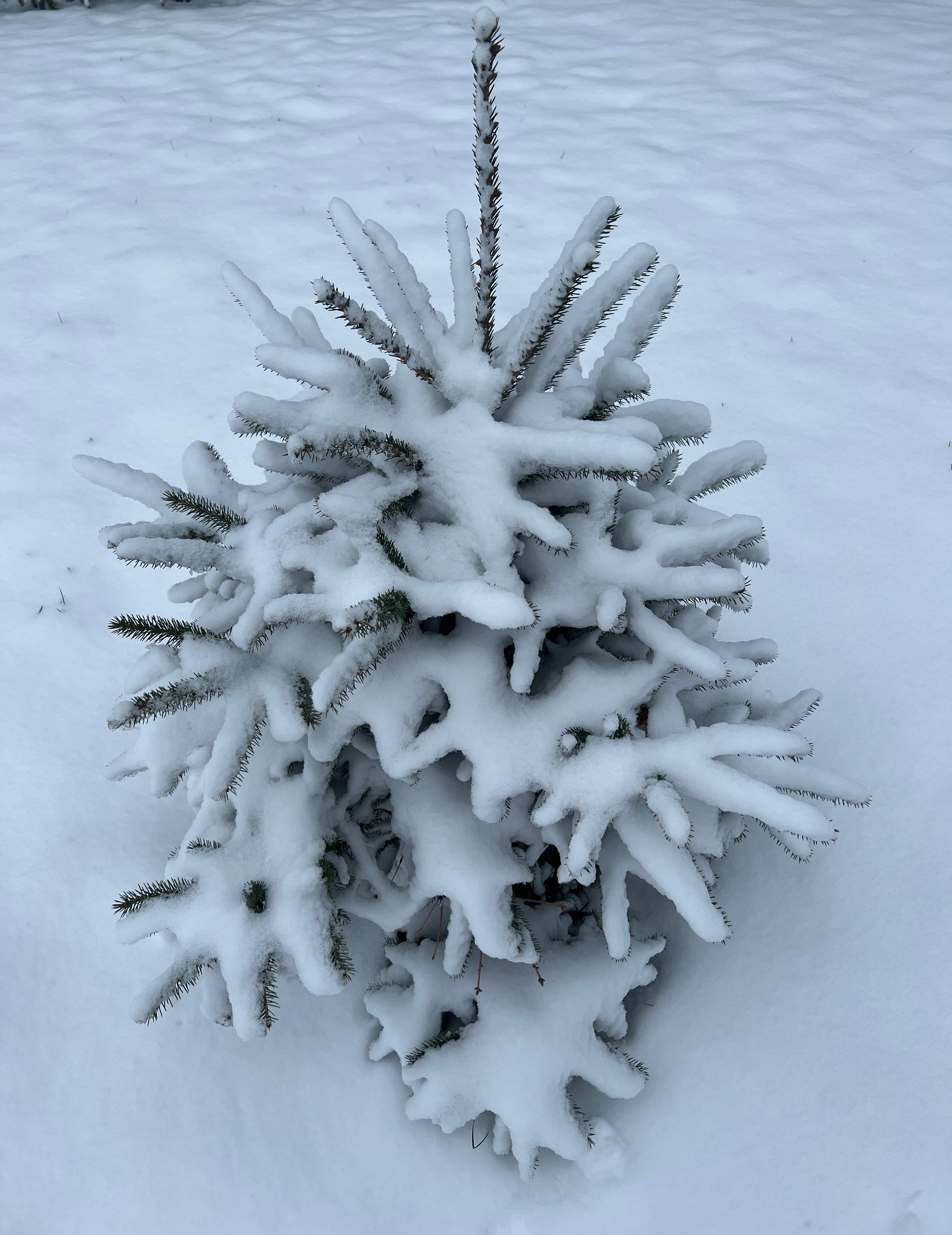
But, perhaps by the help of neighbouring humans and trees, it finds a way. Perhaps its environment protects it, to some degree. We don’t often see it but it’s there. We might not notice it; it doesn’t stand out. But beneath the snow and behind our conscious awareness of it, this little tree continues to live, and grow.
Emilie understood the mystery of growing things. She understood that we do our part. But flowers bloom and trees reach for the sky according to forces beyond our constant, active involvement and even awareness. I think this respect for growing things gave her such an amazing ‘green thumb’.
Though in winter and early Spring months the circumstances on the ground do not always show evidence of the final product, what motivated her to continue going and gardening year after year was the vision of what that flower or tree could eventually become. Regardless of the actual outcome. That’s the secret. That’s faith. It’s the hoped-for vision: Going for it, a vision of what can be—tall, solid and majestic trees; flowers exploding in brilliant colour under summer sun.
A vision of what can be, in our lives, is what motivates us and to which people of faith aspire and around which we order our days.
The vision from the book of Revelation, the last book in the Bible, contains the images of water and trees.[2] Here we find the divine promise that despite suffering, and during seasons of drought and despair, God will offer the river of life to nourish the tree of life. And what is more, the purpose of the tree of life is “for the healing”[3] of us all! Including you and me.
It’s about life, and even living beyond the days of our lives on earth. Deep within our lives, not always visible, perceptible nor noticeable, lives the Spirit of God in Christ. And this gift of grace will nourish us and grow us, forever.
September Sky/River (photo by Martin Malina, September 2022)
In the Shaun the Sheep Movie[1], a sleeping farmer accidentally rolls into a trailer and into the city. And it’s up to an adventurous lamb to bring him back, with help from the rest of the flock. It’s a humorous animation, a spin-off of the Wallace and Gromit franchise.
Much of the humor comes from role reversal: while the farmer, suffering from amnesia, mechanically operates clippers in a hair salon, the sheep wear clothes, shop, and try to escape being captured by animal control. In the end, both the farmer and the sheep learn that they need one another. They experience the joy of depending on one another in their role reversals.[2]
But they never would have come to this satisfying and fulfilling conclusion without having experienced this reversal. They would not have deepened their relationships without having suffered through the discomfort of having their original expectations uprooted. Reversals happen when our expectations are turned upside down. And who we thought and what we thought were true are turned on its head.
In the bible we find several images for God and Jesus. In the Gospels which tell the story of Jesus, the image of God we may long have believed is turned upside down. A radical reversal.
For example, the prophet Jeremiah from the Hebrew scriptures introduces both the images of the Messiah as shepherd and king. Here is one who will “deal wisely, and execute justice and righteousness in the land.”[3] These images are later attributed to Jesus, echoed again in the New Testament (i.e. the image of shepherd in John 10).[4]
However, most references to Jesus as king occur during the Passion story, such as in today’s Gospel from Luke. The main symbol of Christ’s “kingship” is not a crown but a cross. Which ought to alert us to what happens often in the Gospel when we imagine God and what Jesus is about—a role reversal.
Diana Butler Bass writes in her book, Freeing Jesus, about this reversal of understanding who God is in Jesus Christ. Butler Bass suggests we talk more about the kin-dom of God rather than the king-dom. She writes that Jesus “used ‘kingdom of God’ to evoke . . . an alternative ‘order of things’ over and against the political context of the Roman Empire and its Caesar, the actual kingdom and king at the time.”
Moreover, Butler Bass goes on to write that “kingdom” has become a corrupted metaphor, one misused by the church throughout history to make itself into the image of an earthly kingdom. Indeed, Christians have often failed to recognize that ‘kingdom’ was an inadequate and incomplete way of speaking of God’s governance. “Kingdom” is not a call to set up our own empire. In contrast, ‘kin-dom,’ is an image of la familia, the …family of God working together for love and justice.” ‘Kin-dom’ is a metaphor closer to what Jesus intended.
The “’Kin-dom’ metaphor echoes an older understanding, one found in [for example] … the work of … Julian of Norwich. Julian wrote of ‘our kinde Lord,’ a poetic title … summoning images of a gentle Jesus. But … the word ‘kinde’ in medieval English did not mean ‘nice’ or ‘pleasant.’ Instead … in Middle English the words ‘kind’ and ‘kin’ were the same—to say that Christ is ‘our kinde Lord’ is not to say that Christ is tender and gentle, although that may be implied, but to say that he is kin—our kind …
“Jesus the Lord is our kin. The kind Lord is kin to me, you, all of us—making us one.” He is for all of us our next-of-kin. “This is a [radical reversal] of the image of kingdom and kings. ‘The Lord is kin’ … [does away with] the pretensions and politics of earthly kingdoms. [Because] Jesus calls forth a kin-dom.”[5]
I must admit, it is often out of fear and anxiety that I want Jesus to be my magical savior. So it can be frustrating when we discover a very different Jesus. Instead of one who fixes everything in an instant, Jesus is the one who walks with us through the darkest valleys. He is our kin.
Jesus is the one who calls us to lives of service—and again and again as we care for the needs of others we discover the face of Jesus himself in the lost, the last, and the least.[6] He is our kin.
On the cross, God is one who is revealed in weakness and vulnerability. God is one who comes to us in our sufferings and imperfections. The Reign of Christ Sunday this year can be of great help, in encouraging us to reframe our expectations of what it means to be the Body of Christ, the church.
Who we are together, and anything we do together, are not validated in glory, majesty and spectacle. When we gather for worship, work together for the cause of helping others or even pray together—these activities are not validated because there are large numbers and it feels good. Rather, even where two or three are gathered, even when it doesn’t feel “like it used to”, even when the situation is anything but perfect—that is when and where God is revealed to us.
So let’s not give up on meeting together, even when numbers are small. Let’s not give up doing what little we can to fulfill the call of Christ in our lives. Let’s not give up dreaming and striving towards the future of God for us all. Because the Reign of Christ is upon us, soon and very soon. Christ Jesus comes to us in the humble moments of forgiveness, mercy, love and grace.
audio for sermon “For a collective narrative: The time is nigh”
“The time is near!”[1] The words from Jesus strike an ominous tone.
“It’s the end of the world as we know it.” The refrain from a song by American rock band R.E.M. first came out in 1987. But it’s the end of 2022. At the tail end of a worldwide pandemic which among other things has rocked this world, we may feel it really is the end of the world as we know it.
Do you remember the famous words of hockey star, Erik Karlsson—EK65—when the Ottawa Senators began rebuilding the team five years ago and it was rumoured that he was on the trading block? When Karlsson leaned into the microphone to speak, his first words were those ominous: “The time is nigh.” And then the trade was announced. What was feared. What was expected to happen. What was dreaded, and anticipated, finally came to pass.
During the pandemic many young people have suffered through significant mental health challenges. Many youths I know have also a keen and vibrant imagination. Listen to the following scenario born out of anxiety about end times. It’s pure fiction, yet still a scene similar to what has likely played out in the imaginations of many young people ….
The house had kept warm even though we were in the depths of a sub-zero winter. The electricity in our small town had been out for days. I’ve lost track counting. Each day has blurred into the other without much change. For some inexplicable reason, the gas fireplace still operated. And my family gathered around it for hours daily, warming our mittened hands. The natural gas linesunderground were still left undisturbed. But for how much longer?
It would likely give out soon, as suddenly as the lights did that first night when the howling first began. The virus had mutated. It actually happened. The zombie apocalypse.
We used our small solar panel to charge the camp lantern for light. But we used it sparingly not just because we wanted to save battery power. We also didn’t want to attract unwanted attention. We lived in a small town, so there weren’t too many people. We didn’t know what our neighbours were doing, where they were. No one ventured onto the street. We had all locked our doors, barred our windows, retreated into defensive postures.
That night when we sat huddled around the fireplace there was a thump on the door. Peeking through the covered drapes, I saw the shadows at the front of the house. But they weren’t swaying or twitching. Four shadows, standing still, unmoving. That was a good sign.
Slowly I opened the door, feeling the rush of icy wind around my ankles. And what a relief it was to see the faces of our neighbours from across the street, folks we hadn’t spent much time getting to know before the apocalypse. “Our supplies have run out. And the pilot light on our gas stove can’t restart. We’re cold.”
“Come on in.” We all gathered around the fireplace. I felt better knowing we weren’t alone. There were more of us now, facing the coming battle ahead together.
Young adults have the biggest market in the book-selling industry[2] – and of this segment the ‘Zombie Apocalypse’ continues to be a prominent theme. When the word ‘apocalypse’ is spoken today it’s usually said in the same breath as zombies.
In the Gospel today, Jesus gives a speech about the end times. We find this apocalyptic genre in scripture in the Book of Revelation, the last book in the bible, and in other spots throughout—such as in the book of Daniel and the Gospels. Often these texts contain vivid, supernatural, and extraordinary images of destruction, upheaval and end-of-the-world stuff. The purpose of this type of reading, for one thing, is to remind us that all things, even good things—like the beautiful stones of the temple in Jerusalem—come to an end.
The COVID pandemic at the beginning of this 21st century brought the reality of impermanence to our minds. Nothing lasts forever. Doing without. Not satisfying every compulsion that our culture would otherwise tell us to pursue. Putting at bay indulging ourselves all the time. We are conditioned to believe that we should get whatever we want, whenever we want it, and as much as we want. To be in a position otherwise would be less than ideal, undesirable and indicative even of a disadvantaged life.
Just look at how we struggled against the limitations and restrictions to contain the pandemic. We’ve had a hard time understanding our mask-wearing, for example, not primarily for our own sake, but as something we do for the sake of the other, out of love for those who are vulnerable in our midst.
Remembrance Day this past Friday was an opportunity to mark a time of remembering another very difficult, violent time in history.
And in the last couple of years on Remembrance Day, I have asked myself: Why do I wear a poppy? I wear it not only to remember the lost, the wounded, the killed, not only to remember and pray for all our veterans for the service they gave.
I wear it also to remember the sacrifice that they made for a cause greater than their private, individual needs. They believed in the higher good in making their sacrifice: For God, for the sake of their nation, their world, others.
It is part of our collective identity, that there are times in history when individuals like you and me are called to a higher purpose, to serve a wider interest, to give of ourselves for the common good. Remembrance Day is for me about upholding and affirming a collective narrative. That sometimes, our individual interests must be subjected in order to serve a greater good. That’s why I wear a poppy.
These times are scary indeed. Talking about ‘end times’ is frightening. Yet our faith is in God who comes into our lives during these scary times. And Christ knocks on the doors of our troubled hearts. Shall we open the doors, take the risk of letting the neighbour in and travelling the rocky road ahead together?
“It’s the end of the world as we know it,” are not the last words in the refrain for that popular R.E.M. song. If you know it, you can’t sing this refrain without finishing with the words, “And I feel fine.”
It’s a statement of faith. And all shall be well, expressed Julian of Norwich in the 14th century during the bubonic plague. “And all shall be well”, “And I feel fine” are not to mean that life doesn’t bring you tragedy. It means you will be well in spite of the pain and suffering.
You’ll find your way through when you reach out to others in love and trust. And God will continue to be with us through it all. That is the hope and the promise of Jesus in the Gospel.
audio for “The Communion of Saints” by Martin MalinaRising for the Saints in Light (photo by Martin Malina, 30 October 2022)
Part of what we do today is giving thanks for the saints who have gone before us. But this celebration is not without some heaviness on our hearts as we confront our loss.
We grieve because the loss underscores the separation from our loved one that we feel in death. And yet, the separation is just the tip of an iceberg that reveals a larger, more enduring truth.
The late Vietnamese monk and author Thich Nhat Hanh wrote of experiencing a tender connection with his mother in a dream: “The day my mother died,” he wrote, “A serious misfortune of my life arrived. I suffered for more than one year after the passing away of my mother.
“But one night, in the highlands of Vietnam, I was sleeping in the hut of my hermitage. I dreamed of my mother. I saw myself sitting with her, and we were having a wonderful talk. She looked young and beautiful, her hair flowing down. It was so pleasant to sit there and talk to her as if she had never died.
“When I woke up it was about two in the morning, and I felt very strongly that I had never lost my mother. The impression that my mother was still with me was very clear. I understood then that the idea of having lost my mother was just an idea. It was obvious in that moment that my mother is always alive in me.
“I opened the door and went outside … Each time my feet touched the earth I knew my mother was there with me. I knew this body was not mine alone but a living continuation of my mother and my father and my grandparents and great-grandparents. Of all my ancestors. These feet that I saw as “my” feet were actually “our” feet. Together my mother and I were leaving footprints in the damp soil.”[1]
The weight of grief becomes heavier when we believe it’s ours alone to bear. We are conditioned by our culture to be by ourselves with both the pain of grief and the stress of responsibility. For example, when anyone would suggest we are saints, we might therefore resist the notion. Martin Luther claimed we are both saint and sinner. We have no problem accepting the sinner part. But how could I, by myself, aspire to and achieve sainthood?
Sinner and Saint, Grief and Responsibility.
We’ve internalized the hyper-individualistic view of faith and salvation, buying into the idea that “my spirituality is private, that my spiritual growth has absolutely nothing to do with my community, my ancestors—the cloud of witnesses, those I knew directly and indirectly—as well as the countless number of people who have influenced me or even those I myself have influenced.”[2]
And that is why the other part of what we do today is celebrate the newly baptized saints—the infants we welcomed into the Body of Christ earlier this year. Infant baptism reminds us that we go on the journey of faith, not alone, but with others.
So, today we build a bridge—liturgically speaking—between those who have gone before us, and those who are coming after us. We do this to emphasize that “…we are saved not by being privately perfect, but by being part of the body, humble links in the great chain of history.
“This view echoes the biblical concept of a covenant love that was granted to the people of God as a whole and never just to one individual like Abraham, Noah, or David.”[3]
We would not be complete if faith was only about achieving the prize at the end as individuals. For hockey fans, you might recognize the following names: Phil Housley, Marcel Dionne, Jarome Iginla, Adam Oates, Mats Sundin, Dale Hawerchuk, Mike Gartner, Roberto Luongo, Peter Stastny, Pierre Turgeon, Daniel Alfredsson. What do all these great NHLers have in common besides their outstanding individual achievement in the game?
Not one in that list ever won the Stanley Cup. Which is the prize, isn’t it? The whole point of playing and the goal of professional sports is to eventually win the championship. And you can only do that on a team. With others, pulling together, sharing your gifts, drawing on resources and trusting each other to do what you are good at doing.
Today we do our part to build this bridge. And this bridge is a bridge of love and trust. In our lives of faith, we build bridges of love and trust, especially for the next generation coming afterwards. The important thing to acknowledge and celebrate today, for all of us, is that we be bonded somewhere. Because if you have never loved, and cannot trust anyone, there is no bridge.[4]
Neither the grief nor the responsibility is ours alone to bear, as individuals. When the confirmation class debriefed our act of grace in giving pies to homeless street people last week, we confessed that to do so by ourselves would be very difficult. Even impossible.
But if we all held hands on the edge of the cliff of faith, and jumped together, taking the risk of faith together, we could do it and do it well.
What is more we may be surprised to find that after jumping we did not fall to our demise on the rocks in the ravine far below. Rather we would find ourselves standing firmly on a bridge—the bridge built by love and trust—connecting us with God and the vast host of earth and heaven. We are, after all, part of the body, the communion of saints of all times and places.
[1] Thich Nhat Hanh, No Death, No Fear: Comforting Wisdom for Life (New York: Riverhead Books, 2002), p.5–6.
[2] Kat Armas, Abuelita Faith: What Women on the Margins Teach Us about Wisdom, Persistence, and Strength (Grand Rapids, MI: Brazos Press, 2021), p.33–37.
[3] Richard Rohr, Part of One Body: Keeping Faith With Our Ancestors (Daily Meditations, www.cac.org, 1 November 2022)
[4] Rohr, The Continuum of Life, ibid. (30 October 2022).