A wedding sermon: To expand and include

In a moment, we will share candlelight in this circle of friends and family. Sharing the light is a symbol of the meaning of marriage. Just as one candle shines its light in the darkness and with other candles expands the field of vision, so the nature of the rose bud is to open and expand into the world. Each of you receives a rose from the bridal couple.

Like the rose bud, the human soul defines itself in the same way. The soul’s nature and purpose is to expand and include, by offering a courageous ‘yes’ to life.[1]The soul, in all human goodness, always says ‘yes’. Wherever and whenever ‘no’ must be said, it will follow the initial ‘yes’. ‘No’ never leads in a life of faith, and love. ‘No’ will find clarity and effectiveness only after the gracious lead of ‘yes’ – to any and all of life’s circumstances and situations, marriage included.

The primary words in a wedding service, traditionally and effectively, are spoken by the bride to the groom, and the groom to the bride: “I do.” In other words, “Yes! I will.” You cannot come to a wedding service without the energy of the “yes” defining this very moment. Thanks be to God!

In the time I have journeyed with the bridal couple in preparation for this day, I have witnessed in them a celebration of who they are as a couple. I have witnessed an emerging and resilient joy at their union. And the gift within them.

Each of us has a gift inherent and living within us. I invite you to participate now in a brief guided meditation to experience and touch that gift within your life. You may close your eyes or focus on the rose in front of you:

‘Imagine, for a moment, a rose bud. At first, the rosebud is closed and enveloped by its green sepals. Now, imagine that the sepals start to open, turn back, and reveal the petals inside – tender, delicate, still closed.

‘Now, the petals themselves slowly begin to open. [Such is the process of growth in us.] As you imagine the petals slowly begin to open, perhaps you can become aware of a blossoming also occurring in the depths of your being. You may feel that something in you is opening and coming to light.

‘As you keep visualizing the rose, you feel that its rhythm is your rhythm, its opening is your opening. You keep watching the rose as it opens up to the light and the air, as it reveals itself in all its beauty. You smell its perfume and absorb it into your being.

‘Now gaze into the very center of the rose, where its life is most intense. Let an image emerge from there. This image will represent what is most beautiful, most meaningful, most creative that wants to come to light in your life right now. It can be an image of absolutely anything. Just let it emerge spontaneously, without forcing or thinking.

‘Now stay with this image form some time and absorb its quality. The image may have a message for you – a verbal or a non-verbal message. Be receptive to it.’[2]This is the gift of the rose for you today, on this joyous occasion of the your union.

There is something beautiful emerging out of this expanding and inclusive circle. From the union of two, comes the growth of an emerging new family, including more and more people, an expansion born out of the ‘yes’ of love, life, and light.

In your opening notes about the service, dear couple, you quoted from the bible a verse from Proverbs (17:17). “A friend loves at all times.” The verse goes on to say that these relationships bear together not just the good times but the challenges of life, too. Despite the dissonance inherent in all relationships, someone stands by you. This, too, is an important image for the journey of marriage.

When I bought the same Sony receiver that you have in your home, I connected them to some old Sony tower speakers that I’ve used for years. You’d think that the same brand would create a perfect compatibility. But, I neglected to consider what connected these two parts. To connect the speakers to the receiver, I used the same, old speaker wires whose ends were frayed to put it mildly.

As a result, whenever the receiver is plugged into the electricity, I can hear this faint but persistent humming sound. For some reason, the wires inhibit a perfect compatibility between speaker and receiver. For a perfectionist such as myself, it drives me crazy. Needless to say, I’m on the hunt for some new wire that will, hopefully, more adequately convey and balance the connective energy between speaker and receiver.

In other words, the connection will not always be perfect. In truth, conflict is part of healthy life. “A life without conflicts is by necessity only half a life,” I read recently. “A certain degree of stress is good and necessary; and shows you inside of the true Mystery”[3]of all relationships, even good ones.

The healthiest of relationships will carry some subtle dissonances. But, when the marriage focuses intentionally on its fundamental purpose and nature to ‘make music’ – staying with the analogy – then the grace of God is experienced in all beauty and wonder and goodness. Because when I crank that receiver, the whole neighbourhood can hear what I’m playing! And it’s a sweet, clear sound.

When light does what it is meant to be – despite the darkness all around …

When the rose bud does what it is designed to do – expand and include …

When the human soul, before anything else, says, “Yes!” to love and life …

When, in the midst of the hard realities of life, the music of love and gentleness and compassion sound to all the world around …

Then, we know that we do and are, what we were meant for.  Then, your marriage communicates to yourselves and to those around all that is good in this life we are given.

[1]Richard Rohr, “Dancing Standing Still: Healing the World from a Place of Prayer” (New Jersey: Paulist Press, 2014), p.23-24.

[2]Jacqueline Syrup Bergan and Marie Schwan, CSJ, “Love, A Guide for Prayer” (Maryland: The Word Among Us Press, 2004), p.78-79.

[3]Richard Rohr, ibid., p.19.

Canada is a neighbour

Happy Canada Day!

On this July 1stit is good to reflect on what makes Canada great. Let’s be positive! What is it about our society that stands out in a positive way – amid all that is not so good?

I would like to say that we are a country that aspires to a healthy neighbourliness. Being a good neighbour – whether striving for better relations with Indigenous people, whether relating to newcomers to Canada today, whether reaching out in kind to those who are different from me who live across the street – is our national identity.

Asserting this quality for Canadians, I believe, is not new. Being a good neighbour is not a recent trend in progressive society. Hearing preachers spout the virtues of neighbourliness reflects a deep seeded consciousness influenced by popular culture already in the last century.

It was in the 1950s when children fell in love with the Friendly Giant on TV in Canada. Some of you might recall watching actor Bob Homme on CBC TV from 1958 until 1985 being friendly to his puppet animal friends.

Then there was Mister Rogers’ Neighbourhood which first aired in 1968. Although an American show, did you know that Fred Rogers spent several years in Toronto in the early 1960s working with Ernie Coombs – Mr. Dressup – airing a prototype show called the same Misterogers?

Over his career, Fred Rogers was intentional about being more and more inclusive. He brought, for example, an African American person onto the show yet didn’t draw undue attention to it. This was a subtle yet poignant statement about neighbourliness when American white culture was anything but, towards people of colour.

To assert that these cultural icons were birthed in Canada would not be an overstatement. To be Canadian is to be a good neighbour. It is in our DNA. It is our calling, our witness to a world that wants to be anything but, especially these days.

Yet, it seems every generation of Canadians needs to learn anew how to be a good neighbour. We need to be continually reminded and encouraged to practice being a good neighbour because we tend to be a fearful lot. And fear keeps us from this holy calling.

Having faith doesn’t mean the absence of fear. Having faith means stepping into the fearful place. Having faith means action. It means “leaning into” the situation as we are.[1]

Our lay delegate from Faith Lutheran Church to the Eastern Synod Assembly in Toronto last week, admits being fearful taking the train for the first time. Julia is a seasoned, experienced OC-Transpo bus rider here in Ottawa. Despite the similarities in travel experience between the train and bus, she confesses taking the train across the province for the first time was an anxious affair.

What is more, we missed each other on the train ride to Toronto. Even though we were on the same train, we boarded at different locations – Julia, downtown; and me, at Fallowfield Station in Barrhaven. In fact, as it turns out, we were on the same car – but I never once caught sight of her.

Until on the last leg of the journey, when we were on the Union-Pearson Express train. My phone dinged. Julia texted me to confirm whether I knew where to catch the hotel shuttle to the convention centre where the Assembly was to take place.

Despite her fear of riding the train for the first time, and alone, Julia reached out to me. She was being a good neighbour by making sure I was ok. Her reaching out to me was helpful since, truth be told, I was not sure about where to catch the airport shuttle bus.

“Who is my neighbour?” Jesus asks before telling the story of the Good Samaritan.[2]“Liberated by God’s Grace … to be neighbour” was the theme of the Eastern Synod Assembly. Through thoughtful, provocative and compelling bible studies, song, and interactions with various peoples, the Assembly reflected and re-committed to become even better neighbours, as a church.

Interesting, in keeping all this in mind, that we encounter the nameless woman in the Gospel reading for today.[3]She approaches Jesus in the crowd, hidden, secretly. No wonder. She is powerless and outlawed in public spaces on account of her bleeding.

The main point of the story is not that she is miraculously healed. She could have remained hidden, quietly disappearing into the crowed after she is healed. That is the way she would have wanted it, likely.

The point is that Jesus calls her into a deeper relationship. She must come out of her private suffering. She must confront her fear, and make a deeper connection with herself, with others, and with Jesus.

“Who touched my clothes?” Jesus says out loud even though he knows the woman has already been healed when he felt the power drain out of him.[4]He, too, could have enabled the woman’s secretive behaviour, letting her go and moving on. He could have protected her in her fearful existence after she is cured.

Instead, Jesus calls for her to step up and be known. Demonstrating incredible courage, the woman responds to Jesus’ call and approaches him “in fear and trembling, fell down before him and told him the whole truth.”[5]

Jesus seeks out a relationship with her. It is of God to do this. God continues to call us into ever deeper relationship – with ourselves, with others and with God. The point of the Gospel is that we affirm our connectedness with others in healthy and compassionate co-existence. This is the path to truth.

Jesus’ ‘touch’ can heal us and the world. The touch of God’s grace can give us peace. We are shaped and made human in relationship with others. All our relationships – in church, in friendships, in marriage – are not just something extra added on to life for distraction and entertainment as if we would be complete human beings in individual isolation.[6]Relationships are not some added feature to our lives in order to get something, a means to some autonomous end.

Relationships are the fabric of life. Relationship – touch, if you will – makes us human and whole. Being neighbourly can heal us, make us better people. “Perfect love casts out fear,”[7]our scriptures say. Love can only be expressed in relationship.

The reason Julia was not afraid of riding the bus in Ottawa, was because she was practiced at it. She had done it many times. Even though the train is not that much different, she had never before taken the train. The difference is, some intentional, risk-taking exercise.

Later this week, members of Faith council will be volunteering for a couple of hours at the Mission downtown for homeless, impoverished men. We will get a tour of the facility and help give out some ice cream to those who are there. Practice, to move beyond fear to faithfulness, isolation into community, to where our neighbours are.

We need to practice being a good neighbour – to those who are vulnerable, to those who are powerless, to those who are stigmatized, to the homeless, the LGBTQIA+ community, to refugees and migrants. We have to lean in to the places of fear in our lives and to take some risks vis-à-vis people who are different from us. In doing so, we realize we are not alone, and we have meaning and purpose in our lives for the common good.

Canadians and Christians share something in common, to be sure. We are called to reach out. And be a good neighbour to the world. We are not left alone stuck in our fear. Because God continues to call us into the deeper waters of grace and love. God will never abandon us, despite our fear.

Let us approach boldly the seat of grace in Christ Jesus our Lord. Amen.

[1]Brother Luke Ditewig, “Brother, Give Us A Word” for June 28, 2018 (Society of Saint John the Evangelist) friends@ssje.org

[2]Luke 10:25-37

[3]Mark 5:21-43

[4]v.30

[5]v.33

[6]Michael L. Lindvall in David L. Bartlett and Barbara Brown Taylor, eds., “Feasting on the Word: Preaching the Revised Common Lectionary” Year B Volume 3 (Kentucky: WJK Press, 2009), p.192.

[7]1 John 4:18

There’s a hole, PART 1: Meant to be

The Lord God took the man and put him in the garden of Eden to till it and keep it. And the Lord God commanded the man, “You may freely eat of every tree of the garden; but of the tree of the knowledge of good and evil you shall not eat, for in the day that you eat of it you shall die” Genesis 2:15-17).

“There is a hole inside you. It’s been there a long time. Longer than you even knew. But chances are great these days this hole reappears on almost a daily basis, reminding you that something is missing in your life.”

It shouldn’t come as a surprise, really, to say that there is lots that’s wrong with the world. We don’t have to look far and wide to notice the brokenness in our lives, the violence in creation and in relationships of all kinds.

Christians have pointed to the creation stories in Genesis — in the Bible — to locate the beginnings of all that has gone wrong in this world. “The Fall” we have called it.

But all the doctrine-making explanations do not take away the problem.

All that’s not right, all this reminds each of us that something is missing in our lives. Like a hole right at the bottom of your heart.

One of the first camp songs I learned was one that’s called: “There’s a hole in the bottom of the sea.” Right off the bat, that image suggests permanence, because a hole at the bottom of the sea has likely been there a very long time.

But the song goes on in repetitive fashion: “There’s a log in the hole … there’s a log … there’s a bump … there’s a frog … there’s a wart … there’s a fly … there’s a flea — all in the hole in the bottom of the sea.”

So even though that hole is an integral and permanent part of the landscape, it’s fun to imagine that hole filled! From a young age we learn that having a hole is not good. It’s better to have it filled, somehow. What is the hole in the bottom of your heart? What is missing in your life?

“It may involve a relationship. It may involve a yearning for intimacy in the relationships you have. Maybe it’s an issue related to health, a problem that has become chronic. Maybe it’s a loved one who died and left a huge hole in your heart.

“Maybe the thing that’s missing has to do with being fulfilled in your life’s work, or vocation, or job. Or, maybe the hole has to do with a dream that has been just out of reach.

“If we had time and courage, we would turn to each other and share what is the hole in our lives. And we would have to listen, because all the holes are different; they’re not quite the same.

“The only thing that is the same, is that everybody is missing something.

“As Christians, we would pray about it. So we claim such verses as: ‘Ask and you will receive, seek and you will find, knock and the door will be open unto you’ (Matthew 7:7, Luke 11:9). Over the years, there has been plenty asking, seeking and knocking … and still this thing that is missing persists.

“Oh, we learn eventually to cope with it. Our favourite coping mechanism is to rush back to work and get busy enough to not have to think about it. Others prefer to distract themselves through entertainment. Some of us come to church precisely in search of spiritual distraction from the hole that remains in our hearts.

“But at the end of the day, when you are too tired to remain distracted, when you are trying to get to sleep, the pain of this hole returns. Maybe the pain is so great you well up with tears, and you can’t sleep. You think about all the choices you’ve made in your life and you wish you could do it all over again.

“There is nothing that will keep us up at night like fear. We try to talk ourselves out of anxiety with rational reasons why we shouldn’t be afraid. But as soon as we figure out why what we fear wont happen, we find three more ways it will happen. If only I had ….

“Some will say that God does not desire this for us. That God doesn’t desire us to live with any holes in our lives at all. That God wants us to be complete, whole.

“I’m not sure about that, actually.

“The opening of the bible is very important for us. It gives a short glimpse into what God had in mind for us. It’s only two pages in my bible. That’s all we get, in terms of what God had in mind from the very beginning. The entire rest of the bible is … the recovery plan.

“We cherish these first two pages. They’re critical to us. In these brief glimpses into what God had in mind for us we’re told we were created by God — which means we are creatures, not the creator — we were placed into a garden. And we were told that we could freely eat of almost every fruit of this garden. (Genesis 1-3)

“Because it was given to us by God. Even in taking the fruit we are partaking in doxology — we are saying, “Thank you” to God because it was given to us. We didn’t create the fruit, God created the fruit. We receive it. We receive all of this out of the bounty of God’s goodness to us. So, it’s not just thanksgiving for the knowledge of God, it is thanksgiving for being in this spectacular garden, to being able to work in it, be stewards of it and receive its fruit.

Almost all the fruit. But there was one tree whose fruit was forbidden. Fruit that was not given to us by God. And to desire this fruit is to desire it for its own end. Not as a means for saying thanks to God because God chose not to give us this fruit.

“Do you remember where that tree was planted in the garden? Right slap dab in the middle. The exact same place it is planted in your life. Right in the middle of your life. This meant, as the narrative goes, every day Adam and Eve had to walk past this thing that they did not have. A reminder that something was missing in the garden of their lives. Just as there is in ours. That it wasn’t all for the taking. And, that they were not supposed to have it.

“Keep in mind, this is God’s idea of paradise. This is not a result of the ‘Fall’. This is the garden God created for you and called “good”. God said, “It’s all for you except for this one thing right in the middle that you’re never going to have.” Now, this drives us nuts. Just like it did Adam and Eve. We think about this thing we don’t have every day. This hole that just keeps returning. We obsess over it. We want it. Other people have. Why can’t I?

“There can be 999 spectacular trees in our garden. But where do we pitch our tent? Right underneath this one thing we don’t have. We obsess over it. We yearn for it. We think about it constantly. Let the rest of the garden go to weed, but what am I going to do about this one thing I don’t have?

“As the narrative goes, it is in reaching further than we were meant to reach that we then lose the garden. On the way out, we discover that it actually was a pretty good garden. Only now it is paradise lost.

“There is nothing and no one that can do as much damage to your life as you can yourself. When we reach for more than we were created to have.”

The real miracle, however, is that despite all the pain and suffering and confusion, there is good in the world.

Now, hear this: there is good in our lives. There is good within us. There is good within you. And good that can come out of you in word and deed.

But that good only happens, that good is there only when we trust God. When we put our trust in that which is beyond us — in the power, grace and strength that is God and God’s alone. God created everything.

When we put our trust in God …

Not in our abilities to do the good because there is always something missing in our lives.

We put our trust in God. For we can also claim these verses from the bible, the words of Jesus who said, “Pick up your cross, and follow me” (Mark 8:34-35). Jesus, the God we follow, never promised to plug up that hole in our hearts.

We do have a choice. We can choose gratitude over despair. We can be thankful despite all that is wrong in the world. Despite all that is wrong in our lives. We may have pitched our tent underneath that one tree. But we can also build an altar there, an altar of thanksgiving right beside that hole in the bottom of our heart.

“Because the garden, you know, it’s pretty good. It’s not perfect. Something is missing. But we can choose gratitude, because it’s pretty good.”

Thank you, to Craig Barnes whose sermon is given, in quotations, from the Festival of Homiletics in Denver Colorado (Minneapolis: Luther Seminary Peach Media CD, 2015)

God in Acts

In Mark Burnett’s recent visual adaptation of the entire Bible, some scenes from Jesus’ passion still stand out for me. Weeks have passed since the dramatic events of Holy Week and Easter. So, I ask you, to rewind the tape for just a minute. And recall with me when news of the upstart prophet from Galilee first came to ears of the high priest in Jerusalem:

The scene in the temple is dark, illuminated only by the flickering flame of candlelight sending fleeting shadows throughout the cavernous room. The religious leaders draped in their flowing robes shuffle about.

An anxious member of the religious elite makes his way to the high priest, catching his attention: “There are reports of a man performing miracles, and some five thousand followed him to Galilee.” At first, news about Jesus does not worry the high priest. He turns away without saying a word. But the messenger persists, pulling at the high priest’s shoulder. “He calls himself the Son of God!”

The high priest’s mouth stretches in a cold smile, “They all do.”

Then, the night before Jesus’ death, Pilate consoles his wife who is disturbed by news of Jesus’ arrest and trial. Pilate’s wife tries to convince Pilate to have nothing to do with Jesus and let him go.

But Pilate, feeling caught between a stone and a hard place, is playing a delicate political game in order to keep control. He says to his wife, trying to justify his own actions to have Jesus condemned to death: “Don’t worry, in a week this man will be forgotten.”

Both the high priest and Pilate, struggling for political control, convince themselves Jesus is a no one, or at best, a pretender. And will be forgotten, like all the rest of them.

We fast forward now, to life in Jerusalem after Jesus’ death and resurrection. Now, in the Book of Acts, the focus shifts to the disciples. A man who is disabled, sitting by the gate near the temple in Jerusalem, finds healing. Peter and John meet him on their way into the temple. “In the name of Jesus Christ”, Peter touches the man, and he is able to walk again.[1]

“By what power or by what name did you do this?” the religious leaders in Jerusalem ask Peter and John when they are arrested. The Sadducees, who were a powerful religious group in Jerusalem, did not believe in the resurrection of the dead.

Strike one, against Peter and John who did not stop preaching the resurrection of Jesus and all who believe.

It is said that five thousand people converted to Christianity after hearing and seeing what miracles and words Peter and John performed.[2]

Strike two, against them. Five thousand people is a huge threat to the religious establishment. And to social stability. Rome held Jerusalem’s religious leaders responsible for keeping the pax romana – Caesar’s idea of political control over each region in the vast Mediterranean empire. There was no way the Sanhedrin were going to allow Peter and John to continue their disruptive work.

So, they were arrested and brought before the religious council called the Sanhedrin. Did Peter and John know that a few weeks prior, Jesus stood in the same place before the religious leaders?

Strange, I find, that something obviously positive – the healing of a person – turns into something negative so easily where human nature is concerned. Questions of resurrection, the mercy of God and healing turn into a question of power: “By what power or by what name did you do this?”

It is also clear, as the author of Acts present, that the religious leaders were “jealously protective”[3]of their franchise on religion. They wanted the masses to be prayerful and faithful. But they wanted people to do so under the exclusive banner of the temple.

Yet, from the beginning, the Christian movement was an outbreak of the Holy Spirit, spreading like wildfire. It cannot be contained in any one, exclusive denomination, group or church claiming to be the only, right way. That is not the nature of the Christian movement, from day one to the present. Exclusivity is not the preferred style of Christian life.

“By what power or by what name did you do this?” Peter and John have an answer: There is no other name by which we all are healed. Jesus Christ stands for all.[4]For God shows no partiality, for there are people in every nation who are acceptable to God.[5]

There is no other name. Other gods will give up on you:

The god of war and violence will give up on you when you turn the other cheek.

The god of consumerism will give up on you when you give what you have to those in need.

The god of power and control will give up on you when you let go of any pretence of being in control of others, forcing them to be like you.

The god of competition and hatred will give up on you when you welcome, affirm and show mercy to those who are different from you and your kind.

All these false gods of the world will forget you. They will be forgotten. The high priest of Jerusalem and Pilate were right because there were so many claiming to be the Messiah who were just that: fakes. These are the false gods who will be forgotten.

But not Jesus. Even after his resurrection and ascension, Jesus will not be forgotten.

Peter and John may have had a couple of strikes against them standing as prisoners before the religious leaders in the temple’s portico. But they, and the Christian movement, would never strike out. God was about to blast a grand slam out of the park of history.

The God of resurrection and new life will continue to inspire, to push us forward, to pinch our consciences, even challenge us to move forward. There is no hiding from this God who will not give up on you and on us.

The God who created you, who loved you,

Who, even in your sin forgives you and shows you mercy,

The God who gives you a second chance, always,

The God who is your loving shepherd, compassionate friend,

This God will never, ever give up on you, nor forget you. Nor any lost, hurting person or creature in all of creation.

Whether it is Peter or John, or the voice of God speaking this through the church and in the world today …

There is no other name under heaven by whose power all can be saved.

Amen.

[1]Acts 3:1-10

[2]Acts 4:4

[3]Thomas C. Long cited in David L Bartlett & Barbara Brown Taylor, “Feasting on the Word: Preaching the Revised Common Lectionary” Year B Volume 2 (Kentucky: WJK Press, 2008) p.432

[4]Acts 4:10-12

[5]Acts 10:34

The musical performance

“You are witnesses of these things,” Jesus tells his followers.[1]

What does it mean, ‘to be a witness’ to all that happened around Jesus over two thousand years ago? How can we be a witness to these things with which we haven’t had a direct experience, when we haven’t seen with our own eyes and met with our own bodies the living, Lord Jesus?

The weather this weekend is a joke. There’s no other way of putting it, to my mind. It is the season of baseball not snowball! But sometimes when things don’t go our way, humour can be a good antidote. So, here is a music joke.

Last week I gave an example of a double bass player to illustrate how we need to go from the head to the heart. But we don’t always trust that movement from head to heart because it feels like we are losing control.

Imagine a picture of several double bass players standing at the back of an orchestra playing Beethoven’s Ninth Symphony. The bass players are swaying to the majestic sounds and rhythms; their bodies are into it. It is nearing the end of the epic masterpiece, and the caption at the bottom of the comic strip says:

“It’s the bottom of the ninth, and the bassists are loaded.” Hmmm. Maybe too much heart?

How do we live a life of faith that is heart-centred? At same time, how do we deal with our performance anxiety, worried about how people will perceive us when we do our thing, as Christians? We do put a lot of pressure on ourselves to perform to perfection and make a good impression. Unfortunately, this kind of self-talk keeps us from being the best we can be. That’s why, unfortunately, too many musicians have too much to drink prior to a performance.

We need not be too hard on ourselves. Easily 50% of the population make decisions based on fear.[2]The annual “Back to Church” movement creator, Michael Harvey, claims that there is only one socially-accepted sin in the church today: fear.[3]

Yet, none of the Gospel accounts of the risen Jesus condemn the fear. It is to be expected. Jesus meets the disciples, and meets us, where we are even in our uncertainty. Jesus’ initial purpose, after all, is to bring peace. “Peace be with you,” are Jesus’ first words to his disciples after the resurrection.[4]

But Jesus calls us, as he called his disciples, to move beyond our fear, move beyond the fearfully locked doors of our hearts.

The ultimate purpose of the Gospel is not just to allay the fears of Jesus’ followers. It is not to convince us of the miracle of God. In other words, ultimately, who and what we’re about leads us beyond ourselves. The point of the bodily resurrection of Jesus is not the miracle per se, but that it becomes the engine of the proclamation of Jesus Christ to all nations.

Brother Curtis Almquist of the Society of Saint John the Evangelist noted recently that, “Jesus’ resurrection was indeed a miracle; however, Jesus’ resurrection needs to be more than a miracle. It needs to be normal, everyday, how we live and breathe: with resurrection power.”[5]

God’s grace finds expression in flesh and blood – in our bodies. First, as we experience it coming through the Eucharist, the presence of God is made manifest in humanity. And today, in the power of the Holy Spirit, that means, in us and all our brokenness and despite our imperfections.

How can we say this? Because in Jesus’ resurrected body, his scars were still visible. His humanity was still intact – in some mysterious way, in an mysteriously enhanced body to be sure. But the fact that Jesus bodily resurrection is so defended and argued by Paul and Luke and other early Apostles suggests, does it not, the crucial importance of the earthly, human manifestation, and receptivity, of God’s grace and presence.[6]

This is the power of the resurrection. That in the midst of our fear, Jesus comes to stand among us. In the midst of all that is wrong, broken, suffering in our lives, Jesus comes into the locked doors of our hearts and bodies. And then, calls us out.

How do we ‘proclaim’ Christ to all the nations? Again, nothing spectacular, here. Through our ordinary, simple selves, reaching out.

Leonard Bernstein, 20thcentury musician and famous conductor of renowned orchestras around the world – the Berlin Philharmonic, Los Angeles Philharmonic – once said: “The only way I have of knowing I’ve done a really remarkable performance is when I lose my ego completely and become the composer. I have the feeling that I’m creating the piece, writing the piece on stage … making it up as I go, along with those hundred people [in the orchestra] who are also making it up with me.”[7]

Working together, like in an orchestra, we are playing the music of the Gospel of Jesus Christ to the world, and in the world. Even though the music was first created a long time ago, we are making it alive and real for us and for the world, today.

We do so, using the gifts and grace and resources given to us from the Composer of the whole experience. We do so, through our own bodies, minds and spirits. At the same time, we let go of our ego, because it is not about us; it is about something much bigger than all of us.

Order of Canada recipient for his work in fostering Christian unity and inter-religious dialogue, Father Laurence Freeman said: “…grace works on nature. The grace of God that enters into human existence doesn’t come from out of space; it comes through nature. That’s why it is very dubious to talk about supernatural things. We are always interested in the supernatural, but what’s much more real and interesting is the real meaning of the natural. It is through nature, through the natural, through our own nature, our own psychology, our own physiology, our mind and body – through our human nature – that grace touches, emerges and transforms us …”[8]

So, it is our ordinary selves through which the grace and purpose of God works. What does this mean? First, it means we have to believe in ourselves. We have to trust that God has given us what we need to do God’s work, to be God’s instruments and vehicles through which God accomplishes God’s purposes.

Then, we need to perform the music, so to speak. And, it doesn’t need to be perfect, complicated or anything spectacular. Just simple, ordinary. We have to start somewhere.

One of our members asked recently a neighbor to describe what happens on and around our property on an average day in the Spring, Summer and Fall. And the neighbor reported that between 2:30 and 3:30pm every week day, about 30 kids on average, children of all ages, walk across our property from the bus stops along Meadowlands to their homes in the City View neighborhood. Thirty.

With presence of mind, our member asked the neighbor: What do they do when they walk across? Is there anything in particular that stands out in their behavior?

The neighbor said many of them like our benches outside the front doors. They like to sit and visit. They like to rest for a few minutes before continuing on their walk home.

When the member and I reflected on this, we realized there aren’t many, if any at all, public places in the neighborhood where people can sit awhile. Not only do we fill a need providing a place to sit, we encourage community-building, relationship-building right outside the doors to the church. How appropriate!

And for so many young people who are turned off the church, or at least afraid to enter into a church building these days, providing benches for children and young people to sit and visit sends a positive if subtle message about our identity and purpose as a church. It also sends a subtle yet real message of welcome.

This example is simple, ordinary, unspectacular. Yet, it is a first step in the right direction. As a community. Not as individuals doing our own thing. But, together, as a church, an orchestra playing together.

And isn’t that what the walk of faith is all about? We can only do what we are able to do, together. And then, when we take the first step, we watch as the Spirit of God can surprise and delight in us. All because we began by simply using what God has given us. Giving from ourselves, for the sake of others, for something larger than all of us.

That is, being faithful witnesses to these things.

[1]Luke 24:48, NRSV.

[2]Richard Rohr & Andreas Ebert, “The Enneagram: A Christian Perspective” (Crossroad, 2001).

[3]Michael Harvey, “Unlocking the Growth: You’ll Be Amazed at your Church’s Potential” (Oxford: Monarch Books, 2012), p.52.

[4]Luke 24:36; John 20:19-21, NRSV.

[5]Brother Curtis Almquist, Society of Saint John the Evangelist, “Brother, Give us a Word” on April 10, 2018.

[6]Paul’s first letter to the Corinthian church is a testimony both to Jesus’ bodily resurrection, and to our bodies being the imperfect vessels for the transmission of God’s grace and wisdom.

[7]Cited in Barry Green with W. Timothy Gallwey, “The Inner Game of Music: The Classic Guide to Reaching a New Level of Musical Performance” (New York: Doubleday & Company Inc., 1986), p.95.

[8]Laurence Freeman, OSB, “Finding Oneself 2” transcript (Singapore: Medio Media, 2017), p.29.

Blessed, to trust

Jesus’ words to Thomas are meant for us. Yes, they were first said to Thomas over two thousand years ago in the upper room in Jerusalem days after Jesus’ resurrection. Yes, they were intended to increase his faith in light of his doubting and fear. Yes, the early church and disciples heard these words for them, too.

When Thomas confesses his faith in the risen Lord, Jesus says: “Blessed are those who have not seen yet have come to believe.”[1]They are for us.

Let’s slow down and savour these words. Let’s look at three sections of this short sentence.

First, “Blessed are those who have not seen yet have come to believe.”

When do we not see? What are the times in life when God is unrecognizable?

In the face of great suffering or great love,

in the presence of death and dying,

and facing the difficult questions of living such as: Why do children suffer disease, poverty, persecution? Why do people who don’t deserve it, suffer? When the usual, easy answers don’t fit.

When we stand in the presence of a great mystery.

When everything points to everything except what is good.

When all words and ideologies fail.

Then, “Blessed are those who have not seen yet have come to believe.”

What are the qualities of these people who have ‘not seen’? These are people …

Who sometimes doubt.

Who are not certain.

Who don’t have all the facts.

Who can’t provide an easy explanation.

Who don’t have proof.

Who have done without.

Who have to trust someone else, and ask for help.

Who have to trust …

“Blessed are those who have not seen yet have come to believe.”

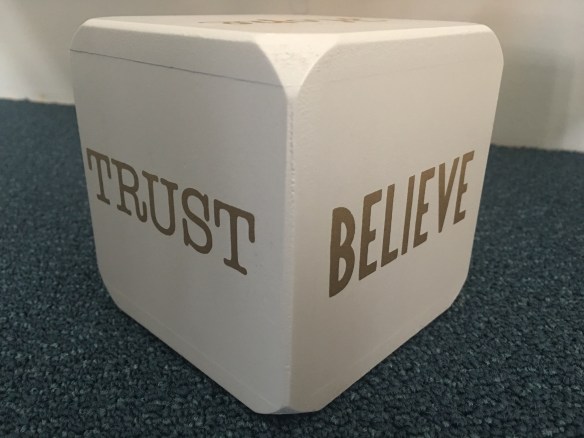
Finally, what does it mean to believe? To believe and to trust, are very similar. The two words appear on the faith cube. You might wonder why the authors of this toy decided to keep the two words separate even though they might, to our minds, mean essentially the same thing.

IMG_6887

And yet, it is worthy to ponder the subtle distinction between the two. Martin Luther understood faith as meaning the addition of the two concepts: Belief + Trust, not as opposing realities but complementing in distinct ways.

Belief is a function mainly of the mind. When we discuss doctrines, creeds. When we debate interpretations of scriptures and statements of faith. To believe is to access the cognitive capacity of our brains. It is, in the lingo of psycho-babble, the left brain analytical side that relishes in rational thought. To believe, in short, is to think through it.

Trust, on the other hand (or, on the other side of the brain), is more intuitive. Trust does not require a full explanation. Trust does not need all the facts and arguments in favor or against. Trust is a function mainly of the heart. Trust lowers the center of intelligence down from the brain to the heart.

Trust is relational. Trust understands our need for the other, to be open to the other, to take risks for and with the other. Trust calls us out of ourselves, to get out of the isolation of all our mental activity – to reach out to the other.

“Blessed are those who have not seen yet have come to believe.”

Jesus affirms for Thomas and the disciples that to follow in the Way of Christ, especially to generations and people like us thousands of years after the fact, that we need to trust others, and trust ourselves. To believe in Jesus, is to believe the witness of generations of Christians before us, to trust their witness, and to walk in the way precisely when easy explanations and scientific proof fall short.

We don’t ‘trust blindly’. That is often the criticism of trust, when it feels like we would be making an irrational decision not based in fact or evidence.

But we are trusting the most capable and the truest part of ourselves when we let go of our cognitive compulsions and let go into the love that sustains the heart.

The opposite of love is not hate. It is fear. “Perfect love casts out fear,” we read from the author of the second reading today[2]. We need to confess that it is fear that keeps us stuck in our heads, and keeps us stuck on the ground. Major decisions in our lives, decisions that changed the course of our lives, decisions that were important to us – were they born out of fear or love? Were they more a movement of the heart or head? Or some combination of both?

A music analogy …

I have been learning a new musical instrument these last couple of years. Classical guitar. Which is different, a little bit, from the acoustic guitar that you often see in churches today, and listen to in popular music.

In comparison, the classical guitar uses nylon strings, which tend to produce a softer, delicate, more harp-like sound. The fingerboard is wider on the classical guitar, and the body – the bell – of the instrument is smaller. When you hold the classical guitar, the curve of the body, which is more pronounced, sits on your left knee (if you are right-handed). And rather than strum chords, you pluck separate notes on the classical guitar. It’s a beautiful-sounding instrument.

But as with learning to play any instrument, and staying with it, there is a progression that needs to happen from the head to the heart. Listen to what Barry Green, renowned double bass player, writes about when teaching another musician how to play vibrato on their instrument. Vibrato is rolling your finger back and forth over your string when playing a note.

“On my Pacific tour,” he writes, “I coached Edith, a bass player from the New Zealand Symphony. She had tried to use her vibrato in a number of different places in a slow, expressive sonata by Vivaldi and couldn’t decide where it ‘worked’ best. None of her experiments quite had the right feel to them.

“I wanted Edith to discover the best places for vibrato by herself, so I asked her to play the piece without making any effort to put in a vibrato. I asked her to imagine that her fingers, not her brain, would tell her what to do, and suggested that she only use vibrato when her fingers ‘screamed at her’ to do so.  Since she would not have decided in advance which notes needed the vibrato, I was confident that her hands would be free to supply it unconsciously.

“Her performance improved immediately: Both her sound and her vibrato were smoother and richer.”[3]

Obviously to gain this level of playing, Edith had to practice and practice and practice. She had to become technically proficient in playing the bass. But to begin to enjoy playing and hearing the sounds you are creating on your instrument, to discover the resiliency of performing and the joy of making music, the usual questions provided by the mind must be eclipsed by the heart.

In other words, the mind will give instructions, constantly critique, and fan the flames of fear and self-consciousness – all of which undermine the making of a beautiful sound. We need the mind’s work, to an extent. But we also need to be able to let go of what the mental activity can get rather compulsive about. We need to grow up, as people of faith.

Albert Einstein, the most eminent scientist of the twentieth century, you would think would defend the prominence of the mind over the heart, the rational over the intuitive. So, this quote from him might surprise you; he said: “The intuitive mind is a sacred gift, and the rational mind is a faithful servant. We have created a society that honours the servant and has forgotten the gift.” Take his phrase, ‘intuitive mind’ to mean the ‘intelligence of the heart’.

Intuition relies on the capacity of trusting: Trusting the love, this capacity and capability within you, trusting the other who is willing to help, assuming the good intentions of others rather than immediately judging them – these are the attributes of one who has maturing faith. Especially, faith in God.

“Blessed are they who have not seen, yet have come to believe.”


[1]John 20:29

[2]1 John 4:18

[3]Barry Green with W. Timothy Gallwey, “The Inner Game of Music: The classical guide to reaching a new level of musical performance,” (New York: Doubleday & Company /Pan Books, 1986), p.113.

Easter: what is life-giving

When Sherlock Holmes and John Watson go tent camping for the first time, the two detectives unexpectedly encounter a ‘mystery.’

They hike deep into the woods all day until they find the ideal place to pitch their tent. They start a roaring campfire, roast marshmallows, tell favorite stories, sing some tunes and as the last embers flicker in the fire pit they pack it in for the night.

In the wee hours before dawn, Watson wakes the snoring Sherlock. “Look, Holmes, look at the billions of stars in the sky! What a glorious sight! Praise to the Creator!” Watson’s eyes remain transfixed on the expanse above them. “What would you say about this wonder, my friend?”

“I would like to know,” Sherlock mumbles, looking around their campsite, “who stole our tent.”

Were Sherlock Holmes and Dr. Watson victims of a prank, an April Fool’s Day practical joke?

Nevertheless, consistent with their personalities, each chose to notice a different aspect of their reality: Watson immediately taken in by the glorious night sky – probably something both sleuths weren’t accustomed to seeing in their busy, urban lives.

Sherlock, on the other hand, ever the deducing genius, notices what is amiss, and automatically goes into ‘fix it’ mode, seeking solutions to the trickiest, mind-stumping riddles of life.

In their shared situation one beholds life, joy and beauty; the other, the problem, and its attendant logical, calculated explanation. One looks up, the other, down.

What do you notice? And dwell on? Are you looking up? Or, still down?

The joyous, life-giving message of Easter does not deny nor avoid the harsh realities of living. The Christian’s journey on the road of life does not float over the potholes, ignore the accidents, nor glibly get a free pass over the traffic jams.

Yet, Easter declares something greater than all the suffering, pain and death has happened, and continues to happen every moment we dare to notice.

Jesus is alive! Amidst the hardships. Despite the necessary suffering. Jesus is alive! Right in the middle of the mess. Even in our complicated, self-contradicting lives. Despite our mistakes and our failures. The life of God in Christ resides within and all around us. Martin Luther famously said, the sun shines even on all the manure piles in our lives. Sherlock Holmes AND John Watson. Both/And.

The question is, do we now, as Easter people, notice the Life? Do we see, as Watson does – the victim of obvious theft – the stars in the glorious sky? Do we pause amidst the hectic, hurly-burly of life to, actually, smell the roses and give thanks? Can we believe that the Light that has come into the world now shines in the darkness? A darkness that can never overcome the Light?(1)

Can we assert that our hurt has become home for our greatest hope?

The good news of resurrection hope is that we don’t see this alone. The life and light of Christ shines in the Body of the living Christ — the church today. We are here for each other and for the world in order to discover and celebrate the presence of God in and around us.

We are not alone in discovering the gift of Life in us. In truth, the life of Christ resides in each and every one of us, despite the imperfection of the church and this community. When one of us falls, the other lifts up. We don’t have to suffer alone in the misery of alienation, feeling useless, or being crushed by failure. As if we must carry this burden alone, and heroically solve all by ourselves.

Easter means that now, “Faith does not occur in isolation. Despite the rugged individualism of our culture, faith is not just something private between God and me. Rather, faith is, by its very definition, communal.”(2)

God gives life. That’s God’s job. Where is God’s in yours? In the world? Where do you see it? Because, it’s there!

A woman asked her local Lutheran pastor for advice. “Pastor”, she says, “I have a boy who is six months old. And I’m curious to know what he will be when he grows up.”

The Lutheran pastor says, “Place before him three things: A bottle of beer, a looney, and a Bible. If he picks the beer, he’ll be a bartender. If he picks the looney, a business man. And if he picks the Bible, a pastor.” So, the mother thanked him and went home.

The next week she returned. “Well,” said the pastor, “which one did he pick: the beer, the looney, or the Bible?”

She said, “He picked all three!”
“Ah,” said the pastor, “a Lutheran!”(3)

Of course, we can substitute any Christian, here, not just Lutherans. The point is, living in the resurrection of Jesus means our lives reflect, resonate and echo the life of the living God. We rejoice and sing Alleluias for the beauty in life, despite the difficulties, through our human desires, and amidst the realities of life.

Now, we can see the life in the world – its beauty and glory – without denying the real. Even though someone may very well have stolen our proverbial tent, this cannot stop or take away the Life that is in us and all around us. Forever.

May our lives reflect a sense of wonder, trust in one another and in ourselves, and hope for God’s glorious future. Good news, indeed!


1 — John 1:5

2 — Stephen R. Montgomery in David L. Bartlett & Barbara Brown Taylor, eds., “Feasting on the Word: Preaching the Revised Common Lectionary” Year B Volume 2 (Kentucky: WJK Press, 2008), p.166.

3 — Adapted from James Martin , SJ, “The Jesuit Guide To Almost Everything: A Spirituality for Real Life” (New York: HarperCollins, 2010), p.317.

The will of God – creation,incarnation,passion – March 25

In both Mel Gibson’s ‘The Passion of the Christ’ and, more recently, Mark Burnett’s ‘The Bible’, the devil stands by watching Jesus’ moments of agony.

Contemporary Jesuit writer, James Martin, SJ, describes three temptations facing Jesus during his Passion: The temptation of accommodation; the temptation of annihilation, and the temptation of abandonment.[1]

Jesus could have accommodated his opposition by not offending his listeners and telling them what they wanted to hear thereby avoiding his fate. When the Pharisees tested him time after time, Jesus could have appeased them.[2] But he didn’t.

Jesus could also have simply wiped out/annihilated his opponents by rallying the rebellious Jews against the Roman oppressors. Moreover, he could have called on divine power to protect him through force and violence.[3] But he didn’t.

Finally, Jesus could have left his ministry behind and the life God chose for him – abandoned it – in favor of a more conventional life. He could have settled down in the quiet sea-side town of Capernaum and taken on his earthly father’s carpentry business. But he didn’t.

Instead of doing all these things, he chose the path of surrendering to what came before him. He remained true to himself and his path.

Jesus chose the path of love and obedience. Jesus understood that the only way for God to fully embrace the human life and therefore the only way for God to love us, was the path of suffering and death. How did he come to align his will with God’s will? In the garden of Gethsemane, he prayed, “Not my will, but thy will be done.”[4] He prayed this as an affirmation that his deepest desires aligned with God’s purposes. “With you, all things are possible,” he prayed in his hour of anguish.

Indeed, what is God’s will? How do we discern God’s will for our lives? And when we are faced with the right path to follow, are we not also tempted to accommodate, to annihilate or to abandon? Early Christians, even before they were identified as such, were called, “Followers of the Way”, or “People of the Way”.[5] Jesus said, “I am the Way, the truth and the life…”[6]

This is the path of Jesus that we follow – a path that does not accommodate, annihilate nor avoid the reality of situation on the way to new life and resurrection. Life and death, light and dark, suffering and healing – the opposites are not excluded nor denied in the life of discipleship. It’s more both/and, than either/or.

March 25th is a significant date in Christian tradition, did you know? What we realize on the Sunday of the Passion / Palm Sunday is a liturgical convergence, an integration of meaning in the events of Holy Week, rather than a dissection and deconstruction into separate parts.

Some Christian denominations on March 25 celebrate the Annunciation – the day the angel Gabriel announced to Mary that she was pregnant with the Holy Spirit – nine months before Christmas Day. It is also the day ancient Christian believed Jesus was crucified. Finally, while now the calendar puts it on March 21, this time was associated with the creation of the world, on the Spring Equinox, the day when the day is divided equally between light and dark.

Creation, Incarnation (Christmas) and Passion (Crucifixion) – all collapse and converge on this day in Christian tradition.[7] The larger purpose of God come together to offer significant meaning on this one day: We recall the separation of day and night in Genesis during creation; the entering of God into the world in the person of Jesus; and, finally, the passion of Jesus brings to concrete and vivid reality the cross as the way to resurrection.

We live as we worship, and worship as we live.

Amidst the collisions of light and dark, hope and despair, love and suffering in our own lives, how do we discern God’s will for our lives? What are we supposed to do? Often when we ask these questions we assume that we have to figure it out. As if God’s will exists somewhere out there, detached or opposed to us, like clues we have to solve and decipher – a problem or mystery.

And yet, Christians have for centuries believed that God’s will was discerned within their  very own lives. Our own desires help reveal God’s desires for us. We look for signs of those desires in our own lives.[8] From ancient days, the Psalmist prayed: “May God grant you your heart’s desire and fulfill your plans.”[9]

Here are some pointers:

  1. Sometimes an obligation is an obligation, and you need to do it in order to be a good and moral person. But be careful your life is not simply one in which you only respond to shoulds or pushes that may not be coming from God. “When you feel pushed to do something – I should do this, I should do that – out of a sense of crushing and lifeless obligation or a desire to please everyone, it may not be coming from God.”[10] God’s ‘pulls’ are gentle invitations that beckon in love – that do not accommodate, annihilate nor abandon the reality you face.
  2. The desires of our heart are not the surface pushes and pulls of wishes and wants, neither are they tied to our compulsive, impulsive selves. The desires of our hearts are discovered deep within us. When getting water from the lake or river into a jar, we need to let all the sediment – twigs, leaves, sand – settle to the bottom. We can’t examine or use it right away. Even just waiting for a few minutes is really not good enough. We have to wait a good day, leaving it alone, still. Then, the water is at its best. Truly, it is the best of ourselves that will reveal our truest and deepest desires.
  3. Finally, the desires of our hearts as the way to discerning God’s will for us, are realized in the most ordinary tasks of the day. What God wills for us is presented in the problems, situations, people and events of our daily lives. God’s will for us is not found in any abstract principle disconnected from the reality of our simple, ordinary lives. If you want to find God’s will and God’s path for your life, start with the realities of your day-to-day, and discover the path of love and attention within the specifics of every moment you face.

Pray for what you desire, as the way of discovering God’s will for your life. Your will and God’s will may very well be closer than you imagined. When we follow in the Way of Christ, we discover that God is Immanuel – God is with us.


[1] James Martin, SJ, “The Jesuit Guide to Almost Everything; A Spirituality for Real Life” (New York: HarperCollins, 2010) p.299.

[2] Matthew 22:15-22; John 2:13-22

[3] John 18:36; Luke 23:39

[4] Mark 14:36

[5] Acts 24:14.

[6] John 14:6

[7] Beth Bevis in Greg Pennoyer & Gregory Wolfe, eds., “God For Us: Rediscovering the Meaning of Lent and Easter” (Massachusetts: Paraclete Press, 2015), p.155-157.

[8] James Martin, SJ, ibid., p.279-283.

[9] Psalms 20:4

[10] James Martin SJ, ibid., p.329.

The Passion of Christ – a Good Friday sermon

The heaviness of it all weighs on our souls. Good Friday is a sombre day. The tormented images of the torture and death of anyone, let alone Jesus Son of God, flash across our minds-eye in the hearing of the texts describing the Passion of Christ.

We hear the lament from Isaiah’s poetry known as the Suffering Servant poems. If we let it, Good Friday pierces our denial of suffering and death. And we face squarely the reality of the situation. The very word, “Passion”, is from the Latin, one meaning of which is suffering.

If you, like me, have watched some contemporary video portrayals of Jesus’ Passion, probably the foremost image is the bloodiness of it all. Not only do we see the violence of the Jewish rebellion heating up during the Passover in Jerusalem, but we are intimately involved in the trial and torture of Jesus – beginning with the bloody cutting off of the servant’s ear in the Garden, to the whipping, flaying, kicking, slapping and piercing in Jesus’ torture while being held in Roman custody.

If that is not enough, we shiver at the pounding of the nails into his hands and feet, see the blood and water gush out of his side when the sword strikes him. Watch as blood trickles over his bruised face from the crown of thorns. Blood all over.

Blood all over. The blood of Christ given for you.

Suffering, Passion, is a great letting go. And acceptance of Christ suffering, even for us, is a great letting go. We cannot possess the gift of life. We cannot own or control this gift for us.

“For three days, the child bled profusely from the nose. She was six years old, and doctors had no idea what was causing the bleeding. What’s more, they understood that if the bleeding didn’t stop, her life was in grave danger.

“The year was 1913. The doctors knew little about transfusion, but they understood the importance of somehow getting good new blood back into the little girl’s system, so they asked her father, a preacher, to give his daughter some of his. He did, one of the first blood transfusions in the state of Michigan.

“The yellowed newspaper story is titled ‘Minister Saves the Life of Daughter By Giving Blood’, and ends by explaining how the father ‘was considerably improved and was able to dress.’ Then it adds, ‘The child was also considerably better and hopes are entertained for her recovery.’

“Two weeks later she was dead. Little Agnes Gertrude … succumbed once the hemorrhaging returned. For a time her father’s blood had brightened her face and her possibilities, but his gift – as unusual and strange to the newspaper readers as it must have been to him – wasn’t enough to save her life.

“Doctors knew very little, back then, about blood-typing. Her father … was as good as choice as the doctors could have made, but what coursed in his veins was not a match. Agnes Gertrude … died two weeks after that strange new procedure the doctors called ‘a transfusion.’

“Her father, a man of God, lay face down on the rug of the living room for almost a week after Agnes’ death, unable to move. Who could blame him – for an entire afternoon, he lay there beside his little girl, his blood flowing into her veins. He was lost in profound grief, was lethargic, depressed, his whole countenance darkened by the death of his child.

“Nothing changed … until he accepted a call to another congregation, a small country church up north. He and his family rode in a horse-drawn wagon up to that country church, their possessions packed up behind them. And there being greeted by the entire congregation there on the lawn, all of them waiting for the new preacher and his family.”[1]

The blood of Christ shed for you. Still, a mystery. Source of life. Beyond comprehension. The blood of Christ shed for you.

We hear these words during the Eucharist, Holy Communion. The word, Eucharist, from Greek, means “Thanksgiving”. Martin Luther, the great reformer, insisted that this sacrament is centrally about the gift of God, in Christ Jesus. The Holy Communion is God’s gift in Christ to us.

This, in contrast, to his contemporaries many of whom insisted that the sacrament of the table was more about what we humans must do to make sacrifice in order to appease God. Instead of making Holy Communion about what we must do for God, Luther preached that the Eucharist was what God does for us. It is a gift.

And a gift we cannot control, manipulate, engineer, manage. Only receive in thanksgiving.

On Good Friday, significantly, we abstain from the Holy Communion. It is one of the only days in the church year that calls for us to withhold collectively this gift. It, in our tradition, is the climax of the Lenten fast, the discipline to ‘do without’ and ‘let go’ and ‘surrender’ our claim on the gift. After all, we do not control God. God is free. And God gives what God will. When God wills. We are not in the driver’s seat of life and death.

Part of our lament, and suffering prayer, is to recognize that we are finite human beings, that we cannot do it alone. And can’t ever get it right. On this heavy day, the low point you might say of the Lenten journey, we put our ultimate trust and hope in God’s promise. As Jesus trusted his Father to the bitter end, we follow in his way, trusting that death has not the last word.

The blood of Christ shed for you.

Christ bled in his suffering, death and burial for three days. But God has other plans. The other meaning of the word “Passion” of course is love. Great suffering and great love. The Passion of Christ is ultimately about God’s great love for Jesus and for us. That is why God gives the gift of life to us. Love.

We will once again feast on the gift of life in Christ’s blood coursing through our veins. We will be transfused again with the life-giving spirit of God. It will be a perfect match! And our lament can become a song of praise and hope, bringing us home at last, as to a lawn on a bright day full of smiling people who open their loving arms.


[1] James Schaap, in Greg Pennoyer & Gregory Wolfe, eds., “God For Us: Rediscovering the Meaning of Lent and Easter” (Massachusetts: Paraclete Press, 2015), p.119-121.

The human face of a vulnerable God

Jean-Paul Sartre once wrote a play entitled: ‘The Living Dead”. The climactic scene is set in the attic of a house in France during World War II, where a half dozen captured members of the Resistance are being kept. The prisoners anxiously await the morning, when they will be executed.

An unexpected thing happens, however. The attic door opens, and the Nazi soldiers throw in the leader of the Resistance. The Nazis don’t know who he is. As far as they are concerned, they simply caught a man out after curfew.

The prisoners’ anxiety turns to courage. They tell their leader, “Don’t worry. We will hold our tongues.” The leader responds, “I thank you, for myself, for the Resistance, for France. Your courage and your sacrifice will not be forgotten.”

Suddenly, one of the prisoners says, “Oh, shut up. Nothing you have to say could possible mean anything to us. I am not blaming you … the fact is that you are a living man and I am a dead woman after tomorrow morning. The living and the dead have nothing to say to each other …and that fact puts an impenetrable barrier between us.”[1]

The Leader of the Resistance is an example of who God is NOT. Until Jesus, there indeed stood an impenetrable barrier between the divine and the rest of us. This is precisely why God became human. If God couldn’t bridge that divine-human divide, how could we love God? How could God love us?

When we look at the world today, we may just the same want to get angry at our human leaders if they lack authenticity. Scenes of African poverty, the chaos of Middle Eastern refugee camps, the evil of human trafficking, the growing divide between rich and poor, the scandals and fake posturing in politics – these all make us angry.

Indeed, in life we sometimes feel like shouting at God: “Shut up!” And working through that anger is good, I believe, because we will realize that many of our gods are not God: The god of domination. The god of violence. The god of consumerism. The gods of competition and combat. The gods of politics and superiority. Which lead us in the opposite direction when it comes to the God of the cross, and God’s relationship with us and the world.

We arrive soon at the climax of Jesus’ earthly, very human story. And this man who reflects the face of God says something very different from the gods of this world.

German Reformed theologian, Juergen Moltmann, tweeted this week: “We discover his glory in his humbleness, his greatness in his poverty, his power in his self-surrender, from the wretched manger in Bethlehem to the desolate cross on Golgotha.”[2]

In today’s Gospel reading[3], Jesus says, “…My soul is troubled.” Jesus can say this. He is fully human and authentically relatable to us, as a human being. “Jesus had the full spectrum of emotion and experience. He was sad and had compassion for those who suffered. He wept with a broken heart including upon the death of his friend Lazarus. He got mad at injustice and hypocrisy (“you brood of vipers!”) and got frustrated at his disciples who were continually arguing and not getting his point. Jesus changed his way of thinking as with the surprising confrontation with a Syrophoenician woman. Jesus learned and developed. Jesus was human!”[4]

God does not bypass the humanity and death we too must endure. God is now capable, because God became fully human, of removing the inseparable barriers between God and the world. Our Leader is one of us!

“…My soul is troubled,” says Jesus. Thank God for these words! These are the kind of things Jesus said that reveals the truth of the Christian God. Jesus says this in response to the inquiry of Gentiles during the Passover Festival in Jerusalem, just days before Jesus dies on the cross. Everything has been accomplished in his ministry and mission, even now to all the nations represented by the seeking Greeks.

Nothing is left now for Jesus to do other than his final surrender to death. Jesus is now ready to succumb to the evil gods of the world which will condemn and crucify the upstart prophet from Galilee.

When Pilate, the regional governor of Palestine, later confronts Jesus during his trial, Jesus says that his kingdom is not of this world. If it were, his followers would be fighting to protect, defend and save Jesus.[5] Obviously, the method of God is not violence however justified. The way of God, is vulnerability and surrender. Not combat, not force-on-force, not physical strength, not invincibility nor violent justice.

Yes, we hear the human Jesus in that honest, vulnerable statement: “My soul is troubled.” In these words, Jesus crosses the divide between divine and human. He identifies with all our troubled souls however afflicted. He knows what is coming.

In Jesus, God was given a face and a heart. God became someone we could love. We don’t and we can’t fall in love with abstractions. So, God became a person “that we could hear, see with our eyes, look at, and touch with our hands”.[6] The brilliant Jewish philosopher Emmanuel Levinas (1905-1995) said the only thing that really converts people is “an encounter with the face of the other.”[7]

This is why to this day Christians have sought God among the faces of the poor, the destitute, the refugee, the homeless – and have tried to do their part in alleviating the plight of the disadvantaged and vulnerable. Because that is where God is discovered.

“Just giving people commandments on tablets of stone doesn’t change the heart. It may steel the will, but it doesn’t soften the heart like an I-Thou encounter can. We are mirrored into life, not by concepts, but by faces delighting in us, giving us the beloved self-image we can’t give to ourselves. Love is the gaze that does us in! How blessed are those who get it early and receive it deeply.”[8]

The prophet Jeremiah says it best: “I will put my law within them, and I will write it on their hearts; and I will be their God, and they shall be my people. No longer shall they teach one another, or say to each other, ‘Know the Lord’, for they shall all know me, from the least to the greatest, says the Lord; for I will forgive their iniquity, and remember their sin no more.”[9]

The good news is that the vulnerable God we worship and follow suffers with us. This vulnerable God in Christ Jesus lived in poverty and died in shame and torment. This God embraced our humanity. And has earned the right to ask us to hold on a little longer until morning comes … until resurrection.[10]

[1] Cited by Michael Battle in David Bartlett & Barbara Brown Taylor, eds., “Feasting on the Word: Preaching the Revised Common Lectionary Year B Volume 2 (Kentucky: WJK Press, 2008), p.141-142.

[2] @moltmannjuergen, March 15, 2018

[3] John 12:20-33, Lent 5B.

[4] Brother Luke Ditewig, “Brother Give us a Word”, daily meditations from the Society of Saint John the Evangelist (SSJE), 20 January 2018.

[5] John 18:36

[6] 1 John 1:1

[7] Cited in Richard Rohr, “Daily Meditations”, 15 January 2018.

[8] Ibid.

[9] Jeremiah 31:33-34

[10] Michael Battle, ibid., p.144.