On whom have I given up?

“First of all, I urge that thanksgivings should be made for everyone (I Timothy 2:1)

Let’s face it. Even the most mature, enlightened and experienced of us need to confess: There are those we have given up on.

Mitt Romney may have given up on half the population in the United States. Unwise to admit, politically.

And yet haven’t we all, personally? That is, given up on those who annoy us to no end. On those who are different from us. On those whom we know we can’t change for the better. On those who appear to threaten our sense of security and stability. On those who are very near and dear to us who have fallen away from the faith. On those we pretend to have some measure of control or influence over, but who have rebelled against our wishes and desires. On the infirm, the elderly locked away in their homes or on the ward. Those in prison, incarcerated for committing some crime. On our political leaders. Have we given up on them?

Have you given up on that dream, a hope for your life? Have we given up on ourselves, tragically, when all options seem closed to us?

There’s a kind of resignation that comes with giving up. After having argued, reasoned, persuaded and tried oh so long and hard. After having endured tension and animosity for a long time. After trying so hard and so long.

Finally, enough is enough. We find ourselves at the end of our rope. I give up on them! I don’t want anything to do with them anymore. I don’t want to dream anymore!

Talking about politicians, I think it was Bill Clinton who said, “You become old when memories of the past outweigh your dreams for the future.” Have you given up?

And we turn to the scriptures to justify our resignation, where Jesus counseled his disciples in a specific situation to “shake the dust off your feet” (Mark 6:11); Jesus, who gave us words we use to rationalize not caring for the poor (Mark 14:7). We turn to Paul, who in another situation encouraged his followers not to associate with the ‘immoral’ (1 Corinthians 5:11).

Our anger, fear and anxiety lead us to insulate ourselves from others — creating fortresses and cocooning in places and routines that preserve our sense of self. As our world gets narrower and we dig ourselves deeper in the rut of isolation, our hearts harden and we fight harder to exclude others from our vision.

And then, surprise! We encounter the Gospel which states in no uncertain terms that in “God’s world there is no them and us. There is no them. Only us.” (@JamesMartinSJ)

In Paul’s first letter to Timothy Paul encourages Timothy to pray for all people, for God desires ALL people to be saved (1 Timothy 2:1,4). Not just our friends. Not just those who agree with us. Not just those with whom we get along and are just like us.

But those very people who annoy us. Those who are different from us. Those with whom we have little in common. Those who do not listen nor agree with us. Those who intimidate us. ALL people.

Maybe I need to keep praying for these folks, and not give up on them. Because God Almighty Maker of heaven and earth surely hasn’t. God has not given up on them.

Maybe what I need to give up, if anything, is the presumption that somehow it is I who is going to save them, change them and make them into the person I want them to be. Maybe what I need to give up is the belief that it is I who will manufacture the life I want to live.

Maybe my job is to keep hoping, keep praying, keep being the person God made me to be. Maybe my job is to persist in a gracious disposition to those I encounter in my day. Maybe my job is to take the risk to reach out in love — and leave the rest up to God. Maybe my job is to let the Christ in me see the Christ in you.

Yes, that’s my job. But it is not my job to ever, ever, give up on anyone — including myself. My dreams. And God. And the person who I can’t stand.

How can I do this, and maintain this sense of compassion for all?

Listen to this story entitled, “The Old Man and the Gulls”, written by Paul Aurandt (in ‘Paul Harvey’s The Rest of the Story’, quoted in ‘Heaven Bound Living’ Standard Publishing, 1989, p.79-80):

It is gratitude that prompted an old man to visit an old broken pier on the eastern seacoast of Florida. Every Friday night he would return, walking slowly and slightly stooped with a large bucket of shrimp. The sea gulls would flock to this old man, and he would feed them from his bucket.

Many years ago, in 1942, Captain Eddie Rickenbacker was on a mission in a B-17 to deliver an important message to General Douglas MacArthur in New Guinea. But there was an unexpected detour which would hurl Captain Eddie into the most harrowing adventure of his life.

Somewhere over the South Pacific their plane became lost beyond the reach of radio. Fuel ran dangerously low, so the men ditched the plane in the ocean…For nearly a month Captain Eddie and his companions would fight the water, and the weather, and the scorching sun. They spent many sleepless nights recoiling as giant sharks rammed their rafts. The largest raft was nine by five. The biggest shark…ten feet long.

But of all their enemies at sea, one proved most formidable: starvation. Eight days out, their rations were long gone or destroyed by the salt water. It would take a miracle to sustain them. And a miracle occurred. In Captain Eddie’s own words, “Cherry,” that was the B- 17 pilot, Captain William Cherry, “read the service that afternoon, and we finished with a prayer for deliverance and a hymn of praise. There was some talk, but it tapered off in the oppressive heat. With my hat pulled down over my eyes to keep out some of the glare, I dozed off.”

Now this is still Captain Rickenbacker talking…”Something landed on my head. I knew that it was a sea gull. I don’t know how I knew, I just knew. Everyone else knew too. No one said a word, but peering out from under my hat brim without moving my head, I could see the expression on their faces. They were staring at that gull. The gull meant food…if I could catch it.”

And the rest, as they say, is history. Captain Eddie caught the gull. Its flesh was eaten. Its intestines were used for bait to catch fish. The survivors were sustained and their hopes renewed because a lone sea gull, uncharacteristically hundreds of miles from land, offered itself as a sacrifice. You know that Captain Eddie made it.

And now you also know…that he never forgot. Because every Friday evening, about sunset…on a lonely stretch along the eastern Florida seacoast…you could see an old man walking…white-haired, bushy-eyebrowed, slightly bent. His bucket filled with shrimp was to feed the gulls…to thank and remember that one which, on a day long past, gave itself without a struggle…like manna in the wilderness.

This story is about ‘not giving up’ — on several levels. Not giving up on life — even in the midst of desperate circumstances. Not giving up on God — for before the sea gull was caught, the surviving men praised God, said their prayers and sung a hymn. Not giving up on hope, even when all seemed hopeless.

And, finally, not giving up on giving thanks. The persistence that trumps a ‘giving up on’ kind of attitude is giving thanks over the long term. Not-giving-up is born from an attitude of gratitude. Thanksgiving is grown in the heart, over the long haul. Captain Eddie Rickenbacker didn’t start living gratitude after his miraculous survival story; it was already being cultivated before it. It is about learning to see whatever good there is, even in the direst of situations — and giving thanks for any glimmer of grace therein.

I like the way Mary Jo Leddy in her book, “Radical Gratitude”, wrote about the gratitude expressed by the birds at the start of a new day; she writes:

“There is a moment each day when it is morning before it is morning. Darkness still hovers over the deep. Those who wait for the dawn can hear it even before they see it. At first there are only the slight sounds of attunement as a chorus of birds assembles: twits and trills, chirps and peeps, and even the occasional squawk. Slowly they gather into one great concerted song of supplication: Let it begin! Let us begin! May it begin again! They are of one accord. They do not take the dawn for granted. When it bursts upon them, once again, as on the first day of creation, they give thanks once again for this once only day, to begin. The birds know, as we sometimes do, that the light does not dawn because of our singing. We sing because the dawn appears as grace.”

Is there someone you’ve given up on? Is there a dream, a hope, for your life you are on the verge of ditching. Make a list. And then, sometimes this Thanksgiving weekend, go down that list slowly and give God thanks for each of the people you’ve named there. Give thanks for each of those dreams and hopes you have listed there.

And then pray that their hearts, as yours, will be opened to receive the grace, love and light of God. And God will give you your heart’s desire (Psalms 20:4 & 37:4).

Amen.
Prayer is a subversive public act

When I compare popular notions of prayer today with the original purpose and description of prayer in the Christian tradition, I see a great divide. Popular understandings of prayer suggest it is private, that it is done as a means to cure a disease, and that its public face is often divisive.

Let me clarify some of the basic biblical understandings of prayer. I base my commentary on the letter of James (5:13-16) in the Bible, since it is one of the texts which will be read in many mainline churches this Sunday.

I find that the biblical witness debunks prayer as a private act, prayer for the sole purpose of curing medical diseases, and prayer as a divisive tool in a multiple-voice culture. Practiced as fundamentally a public act whose unifying purpose is wholeness and restored relationships, prayer as such counters popular notions and is therefore a subversive practice.

First, prayer is fundamentally public. Time in prayer is not “my time”. Prayer is not exercised in some other-worldly state that separates one from social reality and relationships. Prayer is not, according to some spiritual mythology, done in some sequestered, secluded and isolationist context. Prayer is not withdrawal from reality in order to satisfy some escapist, narcissistic compulsions so evident in the pathology of our contemporary culture.

In James’ commentary, vivid images of prayer involving the “laying on of hands” and the “anointing of oil” makes  prayer a visceral act that invades the space of individuals, one to another. Prayer is inherently relational. It gets down and dirty in the bodily reality of our lives, one with another. It is about touch. Prayer is “our time”, and for the sake of the “other”.

Another scripture that will be read alongside James this Sunday is from the Gospel of Mark (9:38-39). Powerful, effective deeds are done “in the name of Jesus”. When we call on the name of the Lord, we are entering a power and reality that is beyond us. Everything we do as Christians is for and about the “other”. Prayer leads us beyond exclusive concern about our own individual lives; it draws us out of ourselves and into the needs and realities facing other people.

We can pray by ourselves, to be sure. But the power of prayer, which is clearly evident in the casting out of demons from the Gospel, is seen most clearly when it is communally, not privately, done, when it is done in the name of Another besides ourselves, when it is done together.

Which leads to the second aspect of prayer, addressing our understanding of healing. And here we have to be honest about our modern approach to illness and its cure. I don’t, for a moment, doubt God’s ability to cure our diseases, especially when offered in a prayer of faith. God is able in God’s freedom to cure anyone. And we’ve all heard, I suspect, of such miraculous healings. Certainly, the Scriptures reveal such astounding events.

And yet, the biblical witness shies away from making this God’s central way of healing. For one thing, after many of such cures that Jesus performs he often instructs those whom he cures to be silent and not tell anyone. And, while affirming that the “weary will be restored” (James 5:15), the kind of healing God is about does not emerge from a modern, Western, understanding of illness and healing. The kind of healing James is talking about is substantially more than merely prescribing antibiotics or applying scientific medical knowledge to a ‘problem’.

The restoration of which James speaks assumes a relationship between sin and sickness. It is a redemption that only God can accomplish incorporating all that we are. This holistic approach to healing involves our social illnesses as much as our internal chemical imbalances; it has as much to do with our spiritual and psychological health as it has our physiological and corporeal brokenness.

In the Mediterranean culture out of which Jesus and the biblical witness came, healing of broken and ailing bodies is not so much about fighting invading microbes, but of restoring community and social relationships so that people could live the good life intended by God. (John Pilch, “Healing in the New Testament”, Fortress Press, 2000).

This means that should one seek healing today, especially within the church, the way of healing must include awareness of and action toward restoring broken relationships — the relationship between the individual and her/himself, the relationship between the individual and others, the relationship between the individual and the earth, and the relationship between the individual and God — to name but a few of some basic relationships.

When appreciated in the context of the whole web of life on earth, prayer is a powerful and effective force in realizing the healing of our lives, diverse as we are. Prayer is mindful action toward bringing together that which has been divided.

Therefore, prayer functions as a unifying force. Often in our society prayer is used as a weapon to take a stand over against other Christians, a secular culture, or another religion. The fights over public school prayers, for example, give prayer a bad name. For one thing, it betrays a misunderstanding of the diverse yet unifying truth about our connection with God and others.

Prayer is not divisive, though it is diverse in form. There are various, legitimate forms of prayer: We offer verbal petitions in our devotions, in liturgical orders of worship, the Eucharist — these are some traditional forms. But meditation, walking prayers, art, music and even social action can also be a prayer. Any activity, for that matter, entered mindful of God’s abiding presence (i.e. done “in the name of Jesus”) are also forms of prayer often overlooked and undervalued.

The Book of James begins with an address to those who are “dispersed” (1:1). James continues his letter to address the divisive consequences of an “unbridled tongue” (3:6ff) and considers the reasons for the “conflicts and disputes” among the people (4). James’ letter is about divisiveness, disconnection and the splintering of our lives.

It is very suiting, and I believe not without purpose and inspired intention, that James ends his letter in chapter 5 with an appeal to prayer. And not only because prayer is the one activity among diverse Christians that we share. But in recognizing the diversity of form prayer takes, we can affirm the unity we share in Christ Jesus, in our prayerful living.

Thus, a book that begins with division ends with blessings promised those who restore another “wandering” sinner within the community of faith (5:20). Some remark that this is a rather abrupt ending to the letter. But with good purpose.

Because the abrupt ending can remind us that though the world today is still full of sin and death and those who wander, Christians, through prayer, continue “to engage the world in hope for a time when what has splintered can be reunited.” (p.114, “Feasting on the Word” Year B Volume 4)

Listen to your children praying

Some of you have heard my incessant grumbling over the last couple of weeks that, “I need to get my hair cut.” You have given me good advice about the various places in town where I could receive a decent haircut. Even though three weeks ago I could have had it done, I’ve put it off. And off. And off.

And I wonder how commonly and naturally this condition plagues us, in general, on many levels: A project at home we know is good and important but we’re distracted and too busy with our regular routines to get it done; When we put off reaching out to so-and-so but never get around to it; When we put off sending that “thank you” card or making that phone call; When we put off engaging a new and healthy discipline — prayer, exercise, a regular visit to volunteer at the local shelter or food bank; etc. Whatever it is, procrastinating seems to be a universal problem.

What is the result? Well, I’ve found one of my initial emotional reactions is guilt. I beat myself up over the delay. And should I recommit myself to the task, often fear is the motivation. Because I remind myself of the consequences — and I don’t want to go there.

Just consider for a moment the weighty topic of the end times or the final judgment. There’s nothing like striking fear in our hearts to push us to try harder, right? Indeed, this is the final characteristic of the cycle: First guilt, with underlying fear, motivating us to try even harder.

But where does that leave us? Back at the beginning, because do we ever get done all that we want to get done? Do we ever achieve the goals of the perfect kind of world we are trying so hard to create for ourselves and for others? Someone once admonished me for my over-zealousness: “Remember, Martin, your inbox will still be full on the day you die.” Is just “try harder” the solution?

What to do, then, when we find ourselves mired in the mud, stuck in the rut, of despair and disillusionment?

I heard the story this week of an Anglican priest’s young child who declared that he didn’t want anymore to be a sheep in the church’s Christmas pageant. Even though the Sunday School teacher had slotted him to be a sheep, he protested.

“Why don’t you want to be a sheep, little darling?” the teacher asked. “The shepherd will take care of the sheep, and we are all like sheep.”

“I want to be a shepherd,” declared the young boy. Adamant.

“Why is that?”

“Because the shepherds were the only ones who heard the angels sing.”

What that child exposed was truth and wisdom that I hope the Sunday School teacher heard. The shepherds were indeed the only ones who heard the angels sing. And they were the first evangelists in Christianity — those lowly shepherds. They got it right.

Do we hear the angels sing? Do we listen to our children? Do we pay attention to the lowly in our society? Maybe we should. They often get it right.

In ancient times — out of which the bible was written, and famous passages of Jesus welcoming the children into his arms were told — adults considered children no more than chattel. They were economic units, bred and raised and tolerated only so they could become useful when they grew up.

Stoic philosophers, who influenced the thinking of many in Jesus’ day, taught that in children under seven years of age, reason was not active. So, you could treat them like young animals to be trained, rather than like human beings to be guided in a learning process.

Consequently, adults would not listen to or learn from children. Animal trainers do not look for significant insights from those they train. They give commands, observe behaviour, and hand out rewards or punishment (see pages 21ff in Catherine Stonehouse & Scottie May, “Listening to Children on the Spiritual Journey”, Baker Academic, Michigan, 2010).

Notice in the Gospel reading today how even from the original Greek ‘the child’ is translated into an inhumane “it”, not once but twice in verse 36 (Mark 9): “Then he took a little child and put it among them; and taking it in his arms…” In the ancient world you gained social capital as you got older. Kids weren’t even cute; they were a drain on the family budget.

Jesus begins his ministry by declaring that the Reign of Christ has come (Mark 1:15; Matthew 4:17). And then he astonishes everyone when he says that to enter God’s kingdom we need to become as children.

Talk about turning the tables on society and cultural norms! Suddenly the poor and weak and the vulnerable have something to say. And the rich and powerful need to listen to the poor! To the children! Because children are not marginal members of the kingdom of God, just tagging along with their parents, waiting to grow up and become real members. No, children are models in the kingdom of God, showing adults how to enter.

In a famous hymn we sing, “Lord, listen to your children praying.” Perhaps the Lord will listen when we — the privileged and mighty, by the world’s standards — start listening to the children ourselves.

I also heard this week about the plight of child labourers. We pride ourselves, you know, in saying that our modern society has advanced and evolved to the point where we don’t treat our children like animals anymore. Look again.

You know all those balls we buy in our stores — footballs, soccer balls? Well the majority of those balls today are still stitched by young children in developing countries. They get paid only 33 cents a day in Pakistan, for example, and work twelve hours a day there. They are forced into this labour by parents who so desperately need the money.

But as a result, they don’t go to school to learn how to read and write. And because their bodies are developing so rapidly at that young age, many of their hands become crippled from the repetative stitching by the time they are in their late teens. Consequently they are unable to secure gainful employment when they are older on account of their mal-formed hands and lack of education. So, they resort to prostitution, drugs and social violence.

Is there work to be done here? Darn right! When we talk about the evils of this world — what about the children and their plight caused by powerful global, economic and social systems that enable this injustice? What are we going to do about that?

And yet, after we express our moral indignation, is this another ‘good deed’ we’ll put on the shelf of good intention? About which we end up procrastinating, feeling guilty, and finding refuge in getting ourselves busy because we are scared about judgment?

Not that doing little things won’t help. Not that becoming socially active for some worthy cause won’t do some good. It will.

But do the children have anything to teach us? How do we prepare for the work that will bear fruit, in the end?

I began this sermon by describing a negative cycle with which we are familiar, even and perhaps especially, in North American Christianity. We read passages from the Bible like we sung today — Psalm 1 — and instinctively we zero in on the images of destruction of the unrighteous. With fear and trepidation we secretly hope we are not one of “those” people (you can fill in the blanks from the news this past week); and then we berate ourselves with guilt into “trying harder”.

And often we spin our wheels in anxious activity, ending in disillusionment and despair.

There is another way — a biblical way, by the way.

In the lectionary study this past week we talked about the image of the tree planted by streams of water bearing fruit in its season. But the tree didn’t choose to be by the river. The tree didn’t pick itself up, carry itself to where a river was flowing and plant its roots by it.

This image is not prescriptive, it’s descriptive. It describes the life of those who are, before they do anything, aware of where their true life is sourced, despite their circumstance. And, moreover, aware of the seasonal aspect of their activity. It’s not always, round the clock, 24-7, about doing good and being busy. There are some seasons of life during which dormancy, quiet, stillness, are not only a good idea and desirable. But necessary.

My mother told me a theological and living truth this week when we were discussing judgment day and the end times: For those who live in Christ, judgment day will be a wonderful experience. Judgment day will not be scary and frightening for those who are in Christ. She cited that well-known saying from Martin Luther: “If I knew judgment day was coming tomorrow, I’d go out today to plant an apple tree.”

Listen to the words of the biblical writer, Paul: “There is therefore now no condemnation for those who are in Christ Jesus. For the law of the Spirit of life in Christ Jesus has set you free from the law of sin and of death” (Romans 8:1-2).

We don’t need to try hard to become like children. Because what’s one characteristic of children? — They don’t try to be anything or anyone other then themselves.

Our good deeds and good intentions will bear fruit in due season when we approach the end with joy not driven compulsion, with ease not by trying harder, with hope not guilt, with trust not fear, with gratitude not demands.

Amber (age eleven) explained: “God is my special person because I can talk to him anywhere. I can just speak to him in my mind … in the middle of class … on a race … sitting right here, just thinking, ’cause he can read my mind … So I don’t actually have to say a prayer out loud … sit down, close my eyes, and fold my hands. I can pray right now as I’m talking, and that’s one way he’s my special person.”

Although in her school public prayer was not allowed, Amber discovered that no one could deprive her of talking to her special person.

Lord, listen to your children praying. Lord let us listen to your children praying.

Amen.

The Value of Loss

The story is told of a highly competitive and much scrutinized race for the position of arch-bishop over a prosperous diocese. Several bishops were vetted and interviewed by senior officials and religious leaders.

Everyone knew the stakes. This position was both a great responsibility and a great honour. People would look up to the new arch-bishop and follow his lead. Many privileges would come by the successful candidate. People would listen to what he said.

It all boiled down to the last interview. Two finalists met individually with the senior official who would make the final recommendation and appointment. The first candidate responded to a question by saying that the very best part of himself aspired to this position and therefore he would do a great job.

Later, the second candidate responded to the same question by saying that the best part of himself didn’t want the esteemed position; rather, the worst part of himself coveted it.

Guess who got the job?

In the logic of the world, success is defined by having more — that the only way to find security and happiness is through possessions and power. In the logic of the world it is only by satisfying all our wants that we can be content. It is an energy of acquirement based on the notion of absolute scarcity.

Therefore, we live according the winner-takes-all idea where we compete not only for goods, material things and political power, but also for meaning and love and relationship. Winning and losing takes on a whole new dimension when we figure into it our religious values.

What does it mean to follow Jesus, take up your cross, and lose your life for the sake of God and God’s mission? If we are going to take the words of Jesus seriously, well, what’s your life going to look like?

Should you pursue a job promotion, or be content with where you are? What about expensive theatre or ice-level tickets at Scotiabank Place or the Air Canada Centre? If you buy a pair of those, is that gross self-indulgence? Or, if your house is full of all sorts of material possessions, what will happen to your soul the next time you pass over a person in need?

We can worry about gas prices and argue over who holds the TV remote control. We can get all fussy over keeping neighbourhood kids and their skateboards off the church parking lot, even if we don’t give a whip about the inner or outer states of their lives. But for the life of us, we struggle to keep focus during even the briefest of prayers.

What does it mean to follow Jesus in your life?

When we boil it down to making good choices, are we not still operating in the logic of this world, which suggests that “it’s all up to us” and “what you make of it”? Are we still not acting on the presumption of acquirement (of good, righteous living)? Are we still not presuming that by our own strength we can make it right? Do our ego compulsions make any room at all for God?

We can sympathize with Peter’s objections when he confronts Jesus against the notion of a Messiah who must suffer and die (Mark 8:27-38). We can understand Peter’s confusion and rebuke — because like most of us he, too, must confess his entrapment to the popular notions of power, possession and security in the world.

Have you heard the joke of two people who died around the same time — a Lutheran pastor and a New York City taxi driver? Both approached the gates of heaven and were met by Saint Peter. Immediately the angelic hosts — singing a joyous chorus — surrounded the taxi driver, embraced him and ushered him with pomp through the gates and into the glories of heaven.

The pastor was left at the gates while Saint Peter had to check the heavenly files. It was some hours before the pastor finally asked, “Why did the taxi driver get to go through so quickly and I — a servant of the Lord — must wait in line so long to enter?”

“Well, you see,” replied Saint Peter, “When you preached the people in the church fell asleep; when the taxi driver drove, the people in his car prayed earnestly!”

Anne Lammott just published a book entitled: “Help. Thanks. Wow: The Three Essential Prayers.” That title suggests that real, authentic, heart-centred prayer is simple. Martin Luther said about prayer that fewer words make a better prayer. In the Psalm for today (116) we encounter a phrase often mentioned in scripture: “I call on the name of the Lord”.

We can take that meaning plainly to say, simply the name of the Lord: Jesus. In ancient tradition this was the Prayer of the Heart: “Lord Jesus Christ, Son of God, have mercy on me a sinner” — and this was the simple prayer repeated over and over again during a short period of silence and stillness in the midst of any circumstance of life.

So, what does prayer have to do with “losing our life”? For one thing, prayer forces us to experience the living Christ, not just talk about Jesus.

I don’t know about you, but I have found in my own life that sometimes I am more comfortable talking about Jesus. But caring about Jesus with the insight of my mind or through the books on my shelf is not the same as giving over the full allegiance of my life and simply being in Christ.

It’s a little bit like the difference between talking about a loved one and actually picking up the phone or looking them straight in the eye and telling a person you really love them.

When Jesus asked his disciples that day, “Who do people say that I am?” they had no trouble answering that question. As many prominent names as they could pull out of their Bible or from their community, they offered up. It was a nice objective question to which they could give nice objective answers.

When Jesus changed one word, however, it became a bit more difficult: “Who do YOU say that I am?” Suddenly their confidence and investment in him, and all that he was, was being tested. This was a much more difficult question to answer, because they had to answer it with their lives and not just with their brains.

The minute we hear this question posed to us, we do have a choice. We can either hold back and talk about this Christ figure whose sayings and deeds are written down in a precious ancient book. Or, we can decide to open up to the fullness of our lives by using the language of love.

Have we at times noticed, for example, that when we give a gift to another we recognize how much we receive in return? (recent studies indicate that the only way money truly makes us happy is when we give it away) Or, have you discovered on occasion that only by loving another do you feel yourself to be loved? Have you ever gone without, in order that someone could have more — and then felt intensely richer as a result? Or, that there’s no better way to find a friend than first to be a friend, and that unexpected rewards come through sacrifice?

C.S. Lewis wrote, “Give up yourself and you will find your real self. Lose life and it will be saved. Submit to death – the death of ambitions and secret wishes. Keep nothing back. Nothing in us that has not died will ever be raised from the dead. Look for Christ and you will find him.”

In the world’s logic, we don’t want to lose because losing leaves us alone, forsaken, abandoned. In the recent ‘Dr. Seuss and the Lorax’ movie, the main character, the Once-ler, achieves great success selling his Thneebs by cutting down all the trees. But his greed and ambition to acquire more without recognizing any limits — leads to failure. And in the movie you see how when his kingdom comes crumbling down, everyone abandons him: His forest friends and the Lorax — because they no longer have a place to live without the trees, his family because he disappointed them. Losing meant abandonment.

But in the losing we experience the grace of God. It is in the loss where and when we find Christ. Jesus experienced the ultimate loss and then exposed the false logic of the world on the Cross and out of the empty tomb.

Therefore we are not alone when we lose. Because Someone who loves us will find us. And give us another chance, a new beginning, and a new life.

Healing (Mark 7-8)

What do the Gospel texts from Mark 7 & 8 teach about healing?

Comparing the texts reveals similarities and significant differences:

Both texts involve healing of men. In both, Jesus employs touching their ears/tongue/eyes with his hands covered with his saliva. In Jesus’ action, he definitely gets his hands dirty. And, both texts conclude with Jesus’ ordering the healed not to tell anyone about what happened.

The most significant difference is, whereas the healing in Mark 7 is immediate the healing in Mark 8 occurs in stages. After the first stage of touching, Jesus asks, “How’s it going?” And the man replies that although he can see, his sight is still blurry — the people look like trees walking around. And so Jesus does it again … finally getting it right? Good question.

Was Jesus not firing on all cylinders in this healing? Did Jesus need to attempt it the second time to get it right? I don’t think so.

I think Jesus was demonstrating a truth about healing: it’s more often than not a process that takes time and is not just about once and for all eliminating the problem.

What is healing? It’s more an approach to living with the problem rather than denying it or fighting against it.

Healing is not about Jesus coming to us in order to rid our lives on earth from any suffering whatsoever. Otherwise he wouldn’t be ordering everyone he healed to be quiet about it. Otherwise he would have cured everyone’s diseases while on earth.

Jesus was more about opening the way for all people to be made whole through the Cross and the empty tomb. Jesus still carried his wounds in his side, hands and feet — even in his resurrected body! This is important!

We are made whole when our wounds no longer define us, defeat us and cause us to harm ourselves and another. We experience healing when our wounds help us to stay humble, patient, honest and more open to trust. “Ephathah” — the beautiful word spoken by Jesus means: “Be opened!” Healing is an openness of heart, regardless of our circumstance of suffering.

And finally, our wounds — when undergoing healing in Christ — develop in us a compassion toward the weaknesses, woundedness and sufferings of others.

Hosting in action – into the public eye

I make visits to nursing homes. I go with a purpose: to serve the elders in our community. And because I am ordained, I am given the responsibility and privilege to administer a sacramental service, in addition to offering mutual comfort, words of encouragement — and, most importantly — all done in the context of prayer.

I also go with expectation and joy, because I know encounters with my elders almost always are received with appreciation, acceptance and mercy.

Today I make my monthly visit to a dear member of our congregation, ‘Lil. She lives at the end of a long hallway in a private room adorned with flowers and pictures hanging on the wall. When I knock gently and enter, softly calling her name, ‘Lil welcomes me in. I sit by her bed as we exchange pleasantries and begin to settle into the visit. She is kind and beaming with joy at my arrival.

I assure ‘Lil that her congregation continues to pray for her, and she tells me of the occasional visit from her god-daughter who brings honey dip donuts to share with her every Wednesday evening. She particularly looks forward to that. A big smile creases across her freckled face.

I pause before inviting her to share in Holy Communion with me. I do so because ‘Lil also particularly looks forward to this sacramental connection not only with her Lord but with the whole Body of Christ on earth.

Then, the tables turn, so to speak.

She invites me to join in this special meal outside her room where there are a couple of chairs at the end of the hallway. She says she considers that place her own living room where she like to host her guests — at the end of the hallway under some picture windows looking out onto the treed yard.

I accept ‘Lil’s invitation, suddenly realizing the truth. I was the guest. And what was to be a Communion in her room would be displayed outside for all to see. What was to be a ‘private’ service would become, at least, a public witness to anyone else in the hallway.

And what is more, the transformation from a private, spiritual event to a public expression of faith came not at the initiative of a ‘religious professional’ in myself, but at the gentle behest of a 90-year-old woman of deep faith.

Our witness together came about because she was the host. Not me. The presumed host — the expert provider of a professional service — became the humble recipient of a grace: to be led by the hand of a beloved senior of the church — out of the realm of private religious observances, and into the public eye.

Hosting a family reunion

It may come as a bit of a surprise for you to hear that one of the most important reasons you are here today is to be a good host.

Almost every Christian I encounter — when the conversation goes deeper — touches on concerns about the demise and downsizing of the institutional church. And everyone, it seems, has an opinion about why it is so.

Most of those opinions are rather negative; that is, pointing to something that is deemed “wrong” with the way things are going in the church today. And if only the church did things the way it used to half a century ago, or like the “other guys and gals” down the street do it — well, then, everything would be hunky-Dorry and the church will grow again.

These negative reasons usually presume what needs to change is anything and anyone besides the person giving the “negative” opinion. We may have presumed that the reason I or you are here today is to ‘get something out of’ the experience of worship; so, we are here predominantly to be spectators in the entertainment business.

“But take care and watch yourselves closely,” directs the Deuteronomist from our first lesson for today (Deuteronomy 4:9). Maturity and spiritual growth begin from a healthy self-awareness, not the blame-game to which we more naturally and easily revert.

So for me to stand here and suggest that you are not here to be entertained; and my job is not to do the entertaining, but to encourage you to be good hosts to others, may come at you sideways!

Let me give you some recent examples:

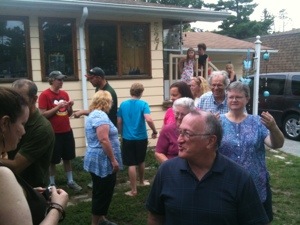
I am grateful for my aunt and uncle for giving the whole lot of us a place and space within which to meet, in Wasaga Beach last month for our family reunion. What stands out for me was their quiet, non-intrusive, relaxed manner of their hosting.

Fundamentally they were gracious, accepting. And this affected the way I felt about myself, regardless of my self-conscious preoccupations. They simply allowed the family reunion to happen. They allowed everyone who came to make of the experience what they brought to it themselves.

The hosts didn’t impose their own agenda; the structure of the day was simple and accepted by all: we gather at noon for the meal; then for those who want, can go to the beach — and several of the younger generation usually go to spend the afternoon there together; and by the late afternoon before anyone is allowed to leave Wasaga Beach we get the family photos done.

The order of service, so to speak, allows for give and take, and everyone engages it together. My aunt and uncle, whose house upon which we descend, make sure the basic things are available for the meal; but everyone brings something and they simply stay in the background helping everyone with their needs. There’s a feeling of mutuality that pervades the experience; it’s not just about the hosts and what they can do for everyone else.

Then, a week later, when Jessica and I enjoyed a couple of days at Chateau Montebello (a parting gift from Zion Pembroke), I witnessed again something good from good hosts. Even though the Chateau was brimming with families and couples and all manner of people — there was even a wedding on site during the weekend — I watched the staff, from cooks to servers, to room cleaners, to receptionists, waiters, tour guides — there were many.

In fact, that’s the first thing I noticed about my hosts — there were many workers there; almost every time I turned around, another staff member was there … to answer my question, to guide me where I wanted to go, to attend to my need. They didn’t tell me what to do; they were there to help me — and make me feel welcome, accepted. They were there to give the space for me to be who I was and wanted to do in leisure and play.

And I wonder: What if the church behaved like this to newcomers, visitors, others who may be crossing the threshold of our church for the first time? What if we, each and everyone of us, allowed our guests to find their own stride with God, to express the mission of God from the giftedness that each of us bear, in Christ Jesus?

We are hosts, all of us. And in the end, it’s not about us. It’s about God’s mission, God’s love, God’s desire for all people.

And this outward stance to others begins inside of us. As I stressed last week, what goes on on the inside of us ends up on the outside. What we believe on the inside gets expressed, eventually, in our behavior, our attitudes, our decisions and way we are with others.

Let’s for a moment consider why it is we may have a hard time conceiving ourselves as good hosts. Perhaps a better question would be, simply: what do you believe? When we are honest about what we really believe, when we confess the truth about us, then we can grow into our identity as hosts.

Michael Harvey in @UnlockingtheGrowth makes the point that Christians are supposed to “see what we believe”. This is the basis for faithful living; we are ready to receive the power of God’s presence and purpose in our lives when faith is already active.

But normally, it’s the other way around, isn’t it? We will  rather believe what we see — we say, “I’ll believe it when I see it”. But, let’s be honest — that’s not belief; that’s not faith. Belief and faith are interior qualities that precede action, attitude and behavior.

The reading from James today (James 1:17-27) points to the discrepancy between our actions and what comes out of our mouths: “If any think they are religious” but then say and act in ways that are not — then what does that reveal about what they really believe deep down? Not to mention bring condemnation upon themselves. Our faith and what precedes does not depend on our circumstances. We see and therefore act from what is beyond the apparent, the visible, the material reality in which we find ourselves.

In the Gospel for today (Mark 7:1-8,14-15,21-23), Jesus’ teaching validates this relationship between what goes on in the heart and what comes out in our behavior, words and actions: “For it is from within, from the human heart, that evil intentions come.”

Not only what is evil, but what is good as well; because — back to the Deuteronomist (4:6) — our obedience to God will also show “your wisdom and discernment to the peoples”. And from the Psalm: “My heart is stirring with a noble song” (45:1).

If we believe that we’re not good enough, that we have nothing valuable to share with others, that church is about me and what I want out of it — well, then, you can imagine: We wouldn’t be good hosts, would we?

But if on the inside we believe that God loves everyone, even those who are not familiar with church life; if we believe we are precious in God’s sight, that we have remarkable gifts to share with the world, that we have something valuable in faith and that each person who walks in this door is “fearfully and wonderfully made” (Psalm 139) — then we WILL see what we believe, won’t we? We will be very good hosts.

God creates this new family in the kingdom of God to which we belong, in which we find our homes. And God invites us all, not because of what we look like on the outside, but because of what God sees on the inside of us. God sees a beauty beyond words.

And upon this gracious conviction, we will see growth and transformation in our lives, and in the life of the church. We will see so much value in what we are all about here that we will learn to invite others to share in the experience of God.

Prayers among the people – Pentecost +13B

13th Sunday after Pentecost; Year B

With reverence for the whole human family and all of creation, let us offer our prayers to God, saying “Let us pray,” and responding, “Have mercy, O God.”

For the family of God in the church, that you empower our inner lives and renew our minds, so that we may act boldly to invite others to church; and that we may trust the work of your Spirit in all that is good in our action. Let us pray … /R

For the family of God among nations’ leaders, that your Word gives life to those who are mal-treated and victimized by greed and self-serving leadership. We pray for those families affected by the gun-violence in the United States – in Chicago, New York and Colorado, recently. We pray also for justice, peace and restoration in Syria. Let us pray… /R

For the family of God in all of creation – the sparrows, swallows and birds of flight – that they may find home in safe and clean environments. We pray for the families affected by the oil refinery explosion in Venezuela yesterday. We pray also for those affected by the devastating earthquakes in Iran a few weeks ago, that lives and communities may be restored and needed help offered by those who have much. Let us pray … /R

For the family of God in our local congregation, especially parents and students travelling together to colleges and universities this week, that heartfelt farewell is expressed and new beginnings and empty-nesting be embraced. Let us pray … /R

For those in the family of God hurting, ill, distressed and despairing, that you deliver all in trouble, affliction, danger, or need; especially we pray for ….and those we name in the silence of our hearts or out loud……. May they be rooted and grounded in your love. Let us pray …/R

Receive our hopes and prayers, O God of mercy. Because we are a church that belongs to Christ Jesus our Lord, we all find a place in your home and at your table. Great is your faithfulness, in Christ Jesus our Lord. Amen. 

Cold sores and family

A highlight for me this summer was the family reunion at Wasaga Beach. We had been unable to attend this annual reunion the last few years, so it was a while since I had last connected with many people on my spouse’s side of the family. And as is consistent with my personality style, I was worried about making a good impression.

God has a funny way of challenging us where we need to be challenged. Because at about the time we decided to attend (which was a last minute thing on account of our recent move), I woke up with a big, festering cold sore on my lip.

Now, I had not had a cold sore for the last several years. It had also been a while since I knew what a cold sore was all about: irritating, itchy, never letting you forget it’s there (for a fleeting moment I wondered whether family reunions and cold sores had something in common!).

The cold sore has about a ten-day cycle, from initial growth to its drying, scabby end. I was to hit the high point of visible grossness the day of reunion. Everyone with whom I would have a conversation would have to be blind not to see the bulbess thing hanging from my lip. What would they say to me? (“Aahh, Martin, wipe your mouth man! Too much salsa for lunch?”) How would I respond? (“Awwh shucks, it’s nothing, really”) What would my extended in-law family think of the man their wonderful daughter had married?

As it turned out, God also has a funny way of reminding us of what is true, what is good, and what speaks of God’s love for us all. You see, my obsessive preoccupation with how I looked turned my conciousness away from others and the whole meaning of the event. Martin Luther defined sin as “being turned in on oneself”. I guess I was sinning: I was preoccupied with myself.

And yet, by the end of the day and contrary to my initial expectations, I felt accepted, loved and part of a family. No one drew attention to the cold sore; it was a non-issue. They were just happy to see me and my famly there! “It’s been too long!” That was the main thing: being together at the reunion. I felt like the Psalmist who expressed: “Even the sparrow finds a home, and the swallow a nest for herself where she may lay her young” (Psalm 84:3).

According to the Psalmist, it was the relatively insignificant, common, plain-looking, rather small sparrows who found a home among the rafters and ceiling crevaces in the tabernacle. It wasn’t the eagles, hawks, larger birds with colourful, attractive plumage.

What does this image suggest about who finds ‘home’ in God’s presence? The great? The mighty? The successful? The seemingly perfect? The beautiful?

By the end of the reunion day, I had almost forgotten about my cold sore because I was more focused on this collection of diverse people who found there way to Wasaga Beach on a sunny, August day: There were some fifteen youth and children under the age of twenty in addition to some twenty adults and seniors. And this collection of people spanned the whole socio-political spectrum and North American continent …. You get the picture.

Immersed in this blessed diversity I forgot about myself, because it wasn’t about me to begin with. This reunion was bigger than the sum of its individual parts. There was something more going on here.

The basis of our unity was not the visible aspects of our togetherness, otherwise we would all look the same! The basis of our unity was something we shared on the inside that was manifested on the outside. And what is true on the inside of our lives gets expressed on the outside by way of attitude, by way of our beliefs, by way of the nature of how we relate to one another.

“As it is on the inside, so shall it be on the outside,” as Michael Harvey explains (@Unlockingthegrowth). While mortals look on the outside, the Lord looks upon the heart (1 Samuel 16:7).

Thy will be done on earth as it is in heaven. This notion from the Lord’s Prayer suggests that heaven (the invisible, interior reality) leads to a corresponding visible reality on earth. Like in the Holy Eucharist, Baptism — any Sacrament — an inner truth reflected exteriorly, in water, bread, cup, meal.

Over the past month we have heard scriptures from the sixth chapter of the Gospel of John reflect on Jesus as the “bread of life”. We conclude today this teaching of Jesus from the synagogue in Capernaum. And the disciples, it is reported, had difficulty with it (John 6:56-69).

Admitedly, I think for us, too, it is much easier to deal with external, material reality: we can touch, taste, manage, something on the outside of us. It is easier to make judgement on a crooked picture frame hanging on your wall; but to reflect on why that particular picture is there in the first place and who painted it, for example, takes much more work that often, quite frankly, we’re not up for.

To approach the inner realm of our lives can be dumbfounding, intimidating, overwhelming a prospect. And so we avoid this work and get ourselves immersed in unreflected, unexamined action and busyness. Because that’s easier.

Yet Jesus emphasizes the truth of the inner life giving reason and substance to the outer life. In his words, “It is the spirit that gives life; [without the spirit] the flesh is useless.” (John 6:63). The beginning points of all meaningful and effective action are prayer, contemplation, reflection, engagement with our inner lives in relationship with God and others. The spirit gives life.

And this is how to understand that more famous text from Ephesians 6 about putting on the armour of God. We put on the belt of truth, the breastplate of righteousness, the shoes proclaiming the gospel of peace, the shield of faith and helmet of salvation and sword of the spirit, NOT in an aggressive, confrontational, external stance against enemies of the flesh. “For our struggle is not against enemies of blood and flesh, but … against the spiritual forces of evil in the heavenly places” (Ephesians 6:12). Again, the beginning point of faith is in the internal, invisible reality of our lives.

That is not to say that sometimes when we don’t feel inside any stirrings of the spirit, we ought not do anything. Sometimes the reverse is true: we need to engage in right action despite our feelings or what might or might not be going on interiorily; our external action, then, may affect positively what is going on inside us. After all, Jesus doesn’t exclude one or the other: “The words that I have spoken to you are spirit AND life” — internal AND external are both vital, to hold in balance. Not either/or, but both/and.

As I said, the exterior reality that reflects the inner truth is that of attitude, and the quality of our relationships. And, more to the point, this attitude is pointed to the quality of our relationships with those whom we invite to church and those to whom we are strangers and happen to cross the threshold of our church.

These people, too, are part of God’s creation, loved and cherished. Every person on the planet can claim the passage from the Psalms: “I am fearfully and wonderfully made” (Psalm 139:14). And therefore they are among us for a divine purpose.

More Christians are raising concern about equating the church with ‘family’ – presuming the analogy refers to a traditional father-mother-children unit. For being exclusively defined as such, I agree with their objections. Because the family of God is so much more.

It is not our job to judge their status in the family. It is our job to invite them. To be an invitational church. That family reunion at Wasaga Beach happened because an invitation to come went out. I am grateful for that invitation.

Because we are a church that belongs to Jesus Christ, there is a place for you and everyone else here. “You did not choose me,” Jesus says, “But I chose you …” (John 15:16).

Christ’s invitation is about joining in God’s mission. And this mission is not just the purvue of the rich, the famous, the successful, the educated, those who have unblemished bodies, those who have been a part of the church forever — but to all, including you and me. Because God made us, “wonderfully”, from the inside out.

20120825-115542.jpg

Life under re-construction

20120802-092835.jpg

The re-construction of Victoria Street began in late June. This average-looking, common-place road in the heart of a small town in Ontario was undergoing a radical change for the better.

Something new was going to be constructed that would mean a better, safer and more reliable roadway, both for what is above and below the surface of the asphalt. In short, something good was going to come out of all the disruption, detours, noise and dirt in my neighborhood.

Perhaps your life reflects times of re-construction. These often disruptive experiences can shake us to the core and may initially feel unwanted, uncomfortable. They can also offer opportunities for growth, maturity and — at the end of it all — realizing a better place in your life.

But how do we get from the rough place to a better one? How can we see the work of re-construction not as a negative but as a positive?

Well, the first thing I observe about what’s happening on Victoria Street is that all the planning and organizing is done with the long view in mind. In other words, re-construction takes time. Though the shovel broke the earth in mid-June, it will likely be late Fall by the time the work of re-construction is completed.

To realize this vision of completion (the biblical definition of “perfection”), the workers need to implement intermediary measures. For example, for several weeks they need to ensure portable generators are in place to pump drainage water through long, large rubber hoses laid along the length of the street. Before any new permanent structures can be installed, time is needed to remove the old and ship in the new.

Life re-construction, if it is to be effective and enduring, requires the long view. It is seasonal, and experiences ups and downs, occasional setbacks, like taking two steps forward and one step backward. It may take some interesting twists and turns before you are done.

In Paul’s letter to the church in Ephesus, he exhorts the people that in order to “speak the truth in love” they must “grow up” (Ephesians 4:15). The phrase “grow up” is often directed at misbehaving children. But this is an directive to adults as well. Growing up in Christ is a lifelong process.

When the prophet Nathan called King David out to confess his sins of adultery and murder, King David found himself at a milestone on his life’s journey (2 Samuel 11:26–12:13a). A significant indication of David’s desire to grow in faith and maturity in his relationship with God and others around him was his honesty; he did not deny his sin but confessed it immediately to Nathan. And it would take a lifetime for David to live out the consequences of his sin. His confession was but a step on this journey of healing and growth.

It is natural to be discouraged by setbacks on life’s journey. But stay on the path. Pray for the gifts of persistence, endurance and patience. Take the long view; transformation is a process not a one-time event.

Another aspect I notice in the re-construction of Victoria Street is the very reason the work had to be done in the first place. Yes, the surface of the road was getting full of pot-holes. But it was more the stuff deep below the roadway that needed a complete overhaul.

You see, Victoria Street runs along the bottom of a ravine. And the road is located in town; therefore this street is connected to all the municipal services, including water and sewer. After torrential downpours anyone living along that street would get sewer back-up and flooding in their basements. Why? Because the culverts and buried pipes constructed half a century ago are not adequate enough to deal with any overflows and demands of the present day.

Huge concrete casings, like giant cement vaults, need to be buried underneath that particular roadway to connect and drain sewer and storm runoff — to solve the problem.

No good talking about the piping and drains under streets up on top of the ravine. No use blaming the rain fall! The problems are on Victoria Street! It’s about the infrastructure underneath Victoria that is the source of the problem, and what needs to be exposed to the hard work. No where else.

In life, reconstruction is about YOUR stuff! No one else’s! In the famous Psalm of Confession (51) where David prays fervently to God for forgiveness and healing, he also confesses something I think we sometimes forget in all our confessing: David acknowledges the “truth deep within me” (v.6), a truth that reveals good things too: wisdom, for one. Confession is not just about opening up to the bad within, but acknowledging the good that is there too.

And we can experience the good when we take ownership of our own stuff. Positive change doesn’t happen until you accept the truth about yourself. As soon as you catch yourself blaming someone or something else for your problems, you are likely missing the opportunity for growth, renewal and transformation in your life.

And that is why it is so important to undertake the journey of reconstruction with others. Reconstruction involves a community. Paul follows his exhortation to “grow up” by offering that famous image of the body of Christ. Growing involves the whole body, “joined and knit together by every ligament with which it is equipped …” (verse 16).

I believe what motivates the workers on Victoria Street over the long haul is that they can envision what it’s all going to look like one day. They can see in their minds eye the final result of all their labour. Therefore, hundreds of people are working on Victoria Street — traffic guides, contractors, town officials, engineers, workers — like busy bees all working together, interdependently.

Whether you see it or not, others can see in you a vision of the new thing God is doing in your life.

Life under reconstruction is not a solitary enterprise, even though our instinct may draw us to seclusion and isolation when bad things happen. Privacy and confidentiality are important to respect; nevertheless beware if these modern ideas provide instead an excuse to hide from others under the pretense of invulnerability. Be open and honest, like David was to Nathan for knowing his darkest secrets. Try trusting others. Find a confidant. Open yourself up to God.

God’s grace persists and perseveres. It may take a long time. Digging deep may even hurt. But the grace and the faithfulness of a loving God mediated through co-travelers will, in the end, bring us to that place of wholeness and healing.

It is also in the poetry of the Old Testament where we read over and over words that communicate what stands out in David’s life: God’s anger lasts but a moment; God’s steadfast love endures forever. The same is true for us.

Thanks be to God!

Amen.