Game of Thrones and the Throne of Grace

As I watched, thrones were set in place, and an Ancient One took his throne .. (Daniel 7:9)

There appears to be something different about the throne of the Ancient One. Among all the thrones, when the Ancient One sits down we are to take notice. What is it about God’s throne that stands out?

At this time of the year, we still ought to be saying: “Winter is coming.” Although it is obvious now that we can, with all “Game of Thrones” fans, be asserting those ominous words that indeed, “Winter has arrived”!

Fans of the epic TV series “Game of Thrones” need still to wait until the final season airs next year. In the symbolic centre of this miasma of twisting plot lines and characters constantly fighting for supremacy sits the imposing throne at the front of the grand hall of the capital city in George RR Martin’s fantasy world of ‘Westeros’.

Who will finally succeed in claiming the throne? Who IS the rightful heir? And how will each of the so-called ‘pretenders’ manage to usurp ultimate power in the Seven Kingdoms? These are the questions swirling around this throne, highlighted by spiked swords and jagged edges—a dark, cold symbol reflecting the heart, it seems, of what it takes to succeed in this place.

… and an Ancient One took his throne …

When Jesus stands before Pilate hours before Jesus dies a criminal of the state on a bloodied cross, he tells Pilate that his kingdom is not of this world.[1]The cross stands as a counterpoint to the world’s thrones. The cross stands as a symbol, not of cold-hearted power-plays and world domination where the end justifies any, bloodied means. No, the cross is a sign of the God who failed according to the world’s rules, who found defeat at the hands of the worldly mighty.

The throne that Jesus sits on is indeed very different from all the others. When Jesus said ‘my kingdom is not of this world’ he meant its values are at odds with how power is exercised among humans, in all its brutish ways. We may be alarmed, and despair; yet, we accept that the ‘Game of Thrones’ world is quite similar to our reality on earth, more so than the kingdom of God.

I find at least two ways we fail to see and realize God’s ways on earth:

First, I suspect, for Christians, the temptation is to go the other way: to deny God’s kingdom on earth. The problem is that, without even consciously, we may delegate God’s values to some fantasy world. To practice genuine humility, forgiveness, grace, mercy and unconditional love not just to family and friends but to people we don’t know—well, we say, that’s reserved for ‘heaven’ someday; it has no place in the ‘real world’, we way.

But God’s throne is not in a different world than ours. God’s throne is not ‘up there’ or ‘over there’ or in some fantasy world far removed from our own.

The truth, and our hope, is that God’s way can be realized on earth. Not only has Jesus enabled people of all time and place to face the truth about ourselves, our relationships, our faith, and the world in which we live, Jesus is saying that his kingdom is also present — in part — upon the earth, in all our relationships.[2] Wherever grace is given and received, wherever forgiveness is practiced, wherever mercy and love are shown. There, is God.

I’m finishing up this week teaching a course on Martin Luther, prayer and the legacy of the Reformation (at the Ottawa School of Theology and Spirituality). In teaching this course, the students and I have returned time and time again to the notion of movement. Semper Reformanda–the Latin phrase popularized by Karl Barth in the last century: Always reforming. The legacy of the Reformation is that we are a church that is continually changing, and moving, and becoming. And, in what ways?

Here, I want to bring in the Rev. Riitta Hepomaki, assistant to Bishop Pryse (Eastern Synod–Evangelical Lutheran Church in Canada). She said at the workshop the council attended last weekend that what we lack, today, as a church of the Reformation is this sense of movement. Our western church, and especially our generation, has adopted a “we have arrived” mindset.

This is the second way in which we fail to realize God’s ways, God’s reign on earth.

If we have arrived, we don’t need to move. If we don’t move, we are stuck. The feeling of being stuck often leads to hopelessness. And, we are not talking here about physical movement from one street address to another, per se. We can make little moves: from the church hall to the streets, from our own kitchen or garden to a community kitchen or garden—wherever God is sending you.

Giving up the ‘we have arrived’ mindset means also that we are willing to move from my little world to other people’s worlds. It is challenging. But we can do it because we have faith, even faith the size of a miniscule mustard seed. And we have each other. We have fellowship. We have a new way of life. And because we are confident that our God will guide and provide.

So, let’s try to change our mindset from ‘having arrived’ to ‘being sent’, and ‘being in movement’. After all, if we don’t move, we cannot follow. Aren’t we called “followers of Jesus?”[3]And, today, we proclaim, that Jesus is the Lord of our lives. And that we are followers not of the ways of the world, but of the Reign of Christ.

In another vision of God, this time from a major prophet[4]in the Hebrew scriptures, God sits on his throne, yet the primary image is of the hem of God’s robe filling the temple. God’s presence permeates and fills all.

The world will indeed separate and set a boundary between the most powerful ‘at the front on the throne’, and the rest of us on the floor down below. Not so with God. In Christ, that boundary has been severed. Moments after Jesus died on that symbol of death and defeat—the cross—the curtain in the temple was torn.[5]The dividing line between where God is and where the rest of us are was opened.

No longer are we divided, violent, fighting, them-and-us. No longer need we compare, compete and kill. These are the actions and behavior of those who bow to the world’s thrones.

Rather, we are all enfolded in the robes of God’s grace forever. There are no boundaries, no limits, to the love of God in Christ Jesus our Lord. And, as the writer to the Hebrews expresses, we can therefore approach the “throne of grace” will confidence.[6]No longer afraid that God will rebuke, punish and condemn us. No longer condemned by our faults, sins and weaknesses.

We can approach this throne with boldness, assured that God will embrace us in mercy, forgiveness, and love.


[1]John 18:33-37, Gospel for the Reign of Christ Sunday, Year B, Revised Common Lectionary (RCL).

[2]Robert A. Bryant in David L. Bartlett & Barbara Brown Taylor, eds., Feasting on the Word, Year C Vol.4 (Kentucky: WJK Press, 2009), p.337.

[3]Riitta Hepomaki, The Eastern Synod Lutheran Volume 44, Sept 25, 2015 (Kitchener: Eastern Synod of the Evangelical Lutheran Church in Canada), p.1

[4]Isaiah 6:1-8

[5]Matthew 27:51; Mark 15:38; Luke 23:45

[6]Hebrews 4:16

We the Saints

Death will be no more … for the first things have passed away… ‘See, I am making all things new.’ (Revelation 21:1-6a)

Who are the saints? And, who cares?

I recall an image of running the Boston marathon described by a church leader in the context of social justice. She said that congregations and persons of faith are like marathon runners. When tens of thousands of runners line up at the start of the race, only the best runners are at the front of the pack. And when the starter’s pistol signals to begin running, it takes hours by the time everyone crosses the starting line.

The implication, I believe, is that some persons or congregations are better at this job of being the church. They belong at the front. The implication, I believe, is that there is a small group of super-stars that must lead the pack and give witness to the rest of the runners ‘how it’s done’, spurring the rest of us to be better than we are. The implication, is that not everyone is as valuable as those at the front, leading the way. The implication is that there are, to be sure, the saints; and, then, there are the SAINTS. A hierarchy.

I wondered about this. And, on one level, she is correct: The kingdom of the world needs, or wants, superstars. To survive according to the world’s rules, we want to find motivation to be better. The NBA wants the Stephen Currys and Lebron James’. The NHL wants the Conner McDavids’, Austin Matthews’ and Sidney Crosbys’. Business wants the Elon Musks, Oprah Winfreys and Bill Gates’ of the world—for better or for worse. Politics wants the Doug Fords, the Kathleen Wynnes, the Andrew Scheers and the Justin Trudeaus—for better of for worse. They set the bar—high or low, depending on your perspective.

The kingdom of the world wants superstars. The world wants to compete, to compare and to conflict. Even kill. Because, some are better. And some are worse. Some are more valuable, and some … not so much. Some set the bar while others don’t quite measure up. Yes, we like to say on All Saints Sunday that we are all saints. But, there are the saints; and then, there are the SAINTS.

We identify and glorify the heroes of faith, while overlooking the value in the sainthood of the less noticed, the less attractive, the less ‘gifted.’ The kingdom of the world—its culture of comparison and competition—has indeed infected our idea and practice of the Reign of God on earth.

We are all the children of God. We are a community. Some will say, a family, whose purpose and meaning we discover in our lives on earth. “Thy kingdom come on earthas it is in heaven,” we pray. On earth. First, we do need to accept that the church on earth is where it’s at for us. The vision of heaven on earth, of the new Jerusalem descends upon the earth. We don’t find who we are as followers of Christ—as Saints—apart from our community. To be a follower of Christ is to be discovered in community.

Not by ourselves. Not alone on the mountaintops, nor alone in the valleys. Not enlightened in the ivory towers of private illumination. Not sequestered in solitude in the libraries of ancient wisdom. Not by winning individual races. Not in individualistic endeavours that don’t need anyone else, or to which everyone else needs to conform by our powers of persuasion, force or pressures.

We don’t find who we are and what we are to do as followers of Christ—as the Saints on earth—apart from community. Even in the traditional format, the saints and conferred their title by the community. The process is, no doubt, elaborate and needs the validation of the Pope and subjected to all manner of procedure.

In Protestant theology, generally, our sainthood is conferred upon all the baptized. In baptism, we are united and joined into Christ’s death and resurrection. We are enjoined with the church on earth and the saints of heaven on a journey towards full and complete union with God when we will one day see face to face. In baptism and at the communion table, we are all placed on a level playing field.

As such, relationships matter. How we behave with one another on that journey, matters. What we say to one another, matters. How we communicate with one another, matters. The words we say, and the words we don’t say, to each other, matters. How we do church, today—not yesterday, not fifty years ago, not in the last century but today—matters. ‘Thy kingdom come on earth.’ Today.

The vision of God is meant for us to grow, to transform, to change into the likeness of Christ Jesus. The community on earth strives to reflect the divine, eternal vision. The community on earth, the church, grows into what we are meant to be, on earth. The community on earth includes and embraces all of creation, excluding no one and doing violence in word and deed to no one.

It is vital that when violence is done against any group, we stand up for the downtrodden. We stand beside those who are victimized because of their religion. As Lutherans, especially today, a week after the gun-shooting and murder of Jewish people while they prayed in their house of worship in Pittsburgh, we stand up against such hatred. As Lutherans, especially today, we must repudiate again Martin Luther’s anti-Semitic writings. Just because we are Lutheran doesn’t mean we regard Luther as infallible, without sin, as anything more than the term he used to describe us all: simul justus et peccator—we are simultaneously saints and sinners. So was he.

The Dean of the Ottawa Ministry Area of our Lutheran Church underscored the nature of this church on earth of which we are members. She said in her sermon on Reformation Sunday last week: “In Ottawa we are really one church but worship in different locations.” Ottawa Lutherans are one church. This is a change of thinking. We are becoming the new thing God is calling us to.

Together, as one, standing beside all the saints and sinners. Together, as one, standing alongside the downtrodden. Together, as one, standing with the victims of group-identity based violence. Standing against all forms and means of hatred towards ‘others’ who are different from us. The vision of John of Patmos is an inclusive one. The new earth and the new Jerusalem does not exclude anyone. The new community includes all.

Even you.

The one who just got some bad news. Even you.

The one whose marriage is on the rocks. Even you.

The one who lost their job. Even you.

The one whose health continues to fail. Even you.

The one whose anxiety and worry crushes any hope for the future. Even you.

The one whose sexual identity invites judgement from others. Even you.

The one who is new to Canada. Even you.

The one who failed the math test. Even you.

The one who was bullied at school. Even you.

The one who broke the law. Even you.


Together we will find our way. Better together.

Thanks be to God! Welcome home, saint and sinner. Welcome home. Amen!

A spirituality of fierce landscapes

The Lord is king! Let the earth rejoice; let the many coastlands be glad! Clouds and thick darkness are all around him; righteousness and justice are the foundation of his throne. (Psalm 97:1-2)

Which is mountain? And which is cloud?

Sometimes it’s difficult to distinguish one from the other. When cooler air temperatures carried by strong wind collide with a warm land mass in wide open, exposed landscapes, what we see is not always clear. The lines between the two are not certain.

I am reminded of Moses meeting God in a could atop Mount Sinai in the wilderness. I imagine the dove dropping from the heavens and God’s voice booming at Jesus’ baptism. I sympathize with the disciples seeing Jesus change before their very eyes atop the Mount of Transfiguration. Biblical stories of God colliding and communicating with creation and humanity in a volatile mix of potent energies, some clashing and some joining in a mysterious dance of meaning and purpose.

And we’re not always sure what to make of it. Can we trust what we see? Is our perspective clouded? What is real?

Mountains convey a sense of certitude and stability, a rock and fortress we can count on and lean on. What are the rocks in our lives? Those things, beliefs and people that anchor us in the construct of our lives?

Clouds are ethereal. We cannot grasp the cloud. It is there and yet it isn’t. It is not solid. It is a vapour that we can see, yes, but that which we cannot contain. A cloud is free to form and reform, free to move, free to be and not to be. After all, it belongs in the sky. What are the clouds in our lives? Events, circumstances and situations that have arisen quite outside the realm of our control, good and bad?

Then, as we reflect on the journey of our lives, with all the twists, turns and unexpected happenings, which has more sway in the course of our lives? The mountain? Or, the cloud?

While the mountains of our lives give us a sense of security and well-being, comfort and confidence — all important in life — what role do the clouds play? The bible shows that God speaks through the cloud, even when our main characters find themselves on top of the mountains! Despite all the securities we afford in our lives, those things we strive for to make us feel in control, God clouds those places.

Not that God is against those things, per se. But that the only way God can get into our hearts and bring meaningful change is from the cloud. An anonymous fourteenth century spiritual writer called her work, “The Cloud of Unknowing”, to talk about a way of prayer in which God encounters us in the depths of our hearts.

It may feel, at times, like we don’t know much. It may feel, in these out-of-our-control experiences of life, that we don’t know anything. And we ask, “Why me?”, and “Why this?”

It is in the cloud of our unknowing, nevertheless, where our re-birth and renewal begins. It is here, in the cloud, where all we need to do is not turn around and go home. In the cloud of unknowing, we must not give up. It is called faith.

Faith, to know, that in the fiercest landscapes of our lives where everything seems uncertain, there is hope. We are held in a greater, larger purpose of which we cannot see the whole, big picture right now. We are held in a loving Mystery. And that’s ok.

Because the very reason we can ask the questions, struggle in the uncertainties and take the next, tentative, step on the path is because the sun gives the light for all this to be possible in the first place.

Geometric power: The circle church

The architecture of church buildings, despite Christianity’s institutional decline in the Western world today, continues to draw our attention. For the most part, these are beautiful buildings, appealing to the eye whose symbols etched in paint, glass and images conveyed through colour and the play of light and shadow serve as magnets to the curious and searching among us all.

In one reading assigned for this Sunday from the prophet Amos, God’s judgement on Israel is measured by a plumb line.[1]Construction workers measured the stone blocks to make sure they were squared so the walls of the temple could be built straight up. It was used to make sure the construction of buildings was done properly. The plumb line image conveys the proverbial ‘standard’ to determine how righteous God’s people are. Needless to say, Israel fails miserably, time and time again.

It seems, for folks in the bible, there is always good and bad in the mix. God’s people will never, no matter how hard they try, be pure and perfect in their doing and being. From ancient days to this day, people of faith always miss the mark. Just read Paul.[2]Our vision is often clouded, and we cannot help but make mistakes on the journey.

The stories from the bible assigned for this day reveal characters mired in the shackles of their humanity, good and bad. David rejoices in bringing the ark of the covenant into the holy place of the temple in Jerusalem while others look on with hatred, despising him.[3]Of course, King David was no angel himself, committing murder and adultery while he was king.[4]

Herod Antipas, in the Gospel reading, respected the rogue John the Baptist and liked to hear him speak yet condemned him to a gruesome death in order to protect his own reputation.[5]Wherever you read in the bible, you cannot avoid the sinfulness of even the so-called heroes of the faith.

What we build to the glory of God, the fruits of our labours and expressions of our faith, will also reflect this good/bad reality. The Dean of the now re-named Martin Luther University College [formerly Waterloo Lutheran Seminary], Rev. Dr. Mark Harris, once told me, when he visited me at my former parish at Zion Lutheran Church in Pembroke, that no matter all the changes that happen in the church today — good and bad — architecture always wins out.

What does the architecture of a place of prayer, therefore, communicate? What truths do they reveal about what we value, what is important to the church? How does the architecture ‘win out’?

Recently, I’ve visited other congregations that are housed in beautiful, old church buildings. The first is Merrickville United Church where last month I did a pulpit exchange, you might remember. The second was two months ago when I visited Luther Place Memorial Church in Washington D.C., which hosted some seminars at the Festival of Homiletics.

What is similar about the floors in these churches, keeping in mind [hint!] our discussion of the plumb line? What would Amos say about their construction using his plumb line?

Why did the original construction include a sloped floor? Perhaps its architects wanted to create an easier sight-line for the person in the pew to see clearly the primary furniture of worship located in the chancel — the font, altar and pulpit. The font, where the first sacrament of baptism — of entering the family of God; the altar, where the sacrament of the meal invites us regularly for nourishment on the journey of faith; the pulpit from where we hear God’s word in scripture and voice.

That’s the good from the construction, that we are drawn and can see clearly what is central to our faith: Word and Sacrament. That we can come easily; we don’t have to work hard to earn our way to God. I don’t know how many times in worships services and lectures during my time in and visits to these spaces, we had to stop whatever was going on to wait for a rolling water bottle to make its easy yet loud, clattering roll down to the front.

So, the good: We can pool down into the arms of God’s grace. We are drawn to the love of God’s welcome and forgiveness. And we really don’t need to work hard to be there. We just need to ride the current flowing to God. It is gift. It is grace. It is free. Neither ought we place any barriers to God’s grace being accessible to all, to come forward. To let all, including ourselves, come to God. Amen? All are welcome!

You may have noticed, however, that King David brings the ark of the covenant “up” into the city. Indeed, this is the geography and architecture of the city of David built upon a hill.[6]And the holy of holies is not down below in the valley, but up high by the altar.

The people have to exert some physical energy to get to the place of God’s presence. Even David, in all his rejoicing in bringing the ark to Jerusalem, “danced before the Lord with all his might.”[7]He was working hard! He was putting his all – heart, soul and body – into the effort.

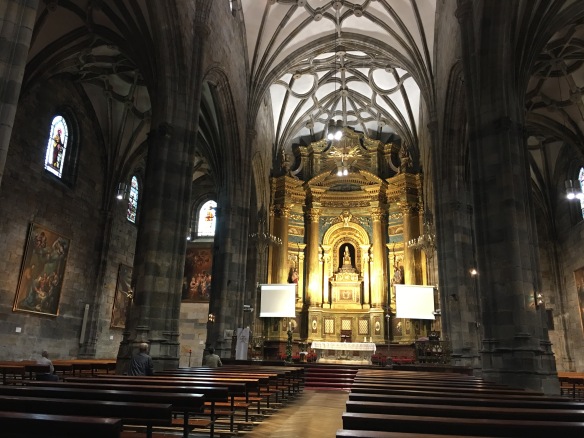
At the unplanned end to my Camino de Santiago pilgrimage last year, I sat in the large nave of the cathedral in Bilbao, Spain, reflecting on the disappointing turn of events. It is a spectacular fifteenth century build.

IMG_5352.jpg

As I looked around me in the silent, cavernous space, for a split second I experienced vertigo, not unlike you would in the old slanted room in the Ottawa Science Centre. Something was off.

Then I realized, I’d never before been in a church building whose floor was not sloped downward toward the altar, but upward!

IMG_5355.jpg

And what goes up must come down. The floor was slanting outward and downward toward the front doors and down into the city!

The story of David’s extravagant, energy-filled entrance up into the holy city didn’t finish at the holy of holies. Going up was completed by turning around at the apex to come back down. The story ends by David distributing food and gifts to not only his family and friends in the city, but “the whole multitude of Israel.”[8]Everyone is fed!

Worship and centering in God is followed by a necessary, gracious giving and going out into the world. I quote again the prophet Amos, where we started: “Let justice roll down like waters, and righteousness like an ever-flowing stream.”[9]

We don’t have slanted floors here. It’s more or less flat. Amos with his plumb line might be satisfied with the level of the floors. But what else could the architecture of our place of worship tell us about ourselves, our identity and God’s call for us?

IMG_6546

Could it be, sitting in room that is basically round that the obvious measure and geometric symbol is not the straight line, but the circle? And now, with larger windows surrounding us, windows which let more light in, also improve our imagination and connection with the world out there? Could it be, given the architecture of our faith here at Faith, we are now called not only to be drawn into the centre, the hub, of the circle who is Christ, but also be sent out in the centrifugal force of God’s Spirit?

In the last pages of the bible, the Book of Revelation, we read a vision of God’s magnificent future:

God’s future comes as an experience of God’s love, “flowing like a river from God’s throne, nourishing trees with leaves for the healing of the nations.”[10]This vision “pictures a world made whole, with people living in a beloved community, where no one is despised or forgotten, peace reigns, and the goodness of God’s creation is treasured and protected as a gift. Our faith is not a privatized expression of belief which keeps faith in Jesus contained in an individualized bubble and protects us from the world.

“Rather, we are on a spiritual journey in which we remain connected to the centre of the presence of God but whose love yearns to save and transform the world. We are called to be ‘in Christ’, which means we share – always imperfectly, and always in community with others – the call to be the embodiment of God’s love in the world.”[11]

In loving others by including them in the circle, we discover how much we are loved by God. We are the circle church. A porous, ever-expanding circle.


[1]Amos 7:7-9

[2]Romans 3:23; Romans 7:15-21

[3]2 Samuel 6:16

[4]2 Samuel 11

[5]Mark 6:14-29

[6]2 Samuel 6:12b

[7]2 Samuel 6:14

[8]2 Samuel 6:18-19

[9]Amos 5:24

[10]Revelation 22:1-2

[11]Richard Rohr’s Daily Meditation, Friday, July 13, 2018 (www.cac.org)

Fresh air

I am glad to be back to breathe the air in the Ottawa Valley. That is why I live here, truth be told. Even before the plane landed at Ottawa airport last evening, I could feel it in the air.

IMG_7127

There’s nothing in the world like catching the sweet breeze blowing down over James Bay, through the budding pine and spruce trees of the Laurentian’s and over the pristine waters of the Ottawa River.

Not only was the hotel room where my brother and I stayed sealed off to the outside, the air in Washington DC was heavy, stale and full of particle contaminants that caused us some coughing, wheezing and rubbing our itching eyes. You don’t have to be an environmentalist to know the Potomac River basin is ….well, not the Ottawa River and Valley.

Ottawa and Washington DC are both the capital cities of their respective nations. Each reflects by its monuments, memorials and geography the character of the nation it represents. One of the purposes of nationalism, like the rivers that surround the two capital cities, is to separate one from the other. Indeed, the work of creating divisions continues in earnest to this day.

In fact, walls are being built not only in the United States, but all over the world as the USA Today front page reported a couple of days ago.[1]Protectionism and isolationism fueled by fear are on the rise.

IMG_7120

So, the voices of a different vision need to be heard, once again.

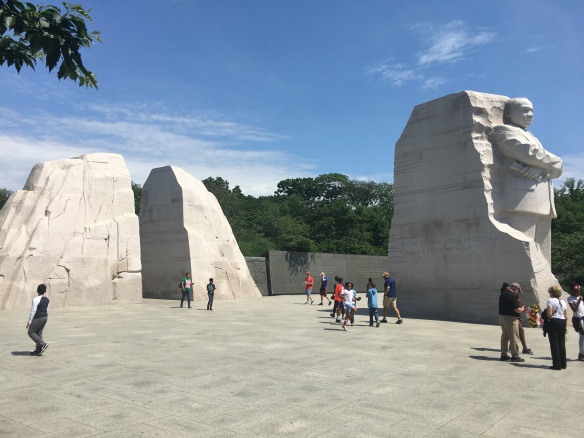
One of the most recently constructed memorials in Washington is on the shores of the Potomac River — the Martin Luther King Memorial.

IMG_6993

“No one is free,” said Martin Luther King, “until we are all free.” In other words:

What I want for myself can’t happen, until it can be so for everyone. If there is anyone who suffers in whatever way,

If there is anyone who is not free, in whatever way,

If there are people who are bound, captive to whatever vice, to whatever imprisonment of the soul or in prison because something they have done…

I am going to be healed of whatever ails me, only when I seek the healing of the other, the freeing of the other, the liberation of the other. The church holds up a different vision from that of the divisive, individualistic and exclusive nature of white nationalism in the world today.

You can see, I hope, why the consciousness of the church not only at Faith Lutheran, not only in Ottawa, or in the Eastern Synod or the Evangelical Lutheran Church in Canada, but in the United States of America and worldwide is moving to see not a division between things, not building walls between two perceived opposites, but building unity between them.

Not a division between politics and pastoral care,

Not a division between care for the soul and social justice,

Not a division between reaching out and reaching in,

Not a division between speaking out against injustice of whatever kind and speaking to the choir,

Not a division between contemplation and action.

Not an either-or, but a both-and.

Last week when Ken stood here and told you about the different ways we can support the financial health of the congregation, he introduced his well-delivered announcement by saying — “you’ve heard we in the church were never to talk about money, politics and sex (well, he didn’t actually say the last word, but I know you all were thinking it!).

And then a couple weeks before that, Mark stood here and told you about his upcoming trip to Ecuador to build homes in a community destroyed by an earthquake some years ago. And in his well-worded speech he said (I paraphrase): “In this mission trip the group he was going with was not doing mere charity, dollars sent to a far-off location, but directly helping them on the ground and making a real difference in the lives of those who suffer.” Check it out. He said it. I believe he has it all on a piece of paper.

I alone am not telling you all this. Your own members are. Your own church family is slowly but surely breaking down the walls that have divided, distanced and incubated our conversations in the church.

Limited our conversation. Limited our imagination. Limited the ways of God. NOT talking about these things, well, how has that worked out for the church in recent times?

NOT talking about the things that really matter in our daily life, NOT being open and honest, sharing the deepest secrets and burdens of our lives, NOT feeling safe in a community of faith to be who we humanly are, warts and all, imperfect, suffering, in need of God’s love. NOT being like that — how has that worked for the church? How has that worked for you?

It is not easy in the church (although everyone else in our real lives are talking about them!) to talk about money, politics and sex. It is not easy to talk about the real things that matter in this life. And so, the church for many decades has avoided having these conversations. Why? Because we were afraid? Because talking about sex, politics and money would put a mirror in front of us, exposing areas of our life that needed even a bit of God’s light shining upon it?

It’s not easy to talk about these things. I know. I feel it too. But I always thought that that’s what faith was supposed to be about — to confess, be honest, be real, and just do the work of God. How can we do the work of God when we can’t even be honest, and real, and confess ourselves to one another?

We can echo the prophet Isaiah’s complaint to the Lord: “Woe is me! I am lost, for I am a man of unclean lips …”[2]

But he doesn’t stop there. His confession is not just about himself. Faithfulness is not merely individualistic. We don’t come to church to make an individual contract with the Lord.

Isaiah continues in his confession: “Woe is me! I am lost, for I am a man of unclean lips, and I live among a people of unclean lips.”

Faithfulness drives towards the communal, the community, the well-being of the world. “No one is free, until we are all free.” Not just me, but we!

When we don’t include, welcome and affirm people who are different from us, we are a people of unclean lips.

When we refuse to include conversations about sexuality, money and political action, we are a people of unclean lips.

When we remain quiet in the face of injustice, we are a people of unclean lips.

In other words, this confession of Isaiah implies that he feels he should just ‘shut up and sit down.’ Not say anything. Because he is bad. And Israel is bad.

Maybe you feel this too. Not unlike Isaiah when confronted with a vision of God, you feel, deep down, the church is bad, and has nothing worthwhile to say in the public sphere. Millennials believe that. Just ask your children or your friend’s children. In the past, we church-going Canadians have conveniently said, “That sort of stuff is the government’s job.” We effectively, therefore, excuse ourselves from any social action in the name of Jesus. And continue the dividing.

Martin Luther King also said that in the church it’s alright to talk about the New Jerusalem (pointing to heaven, the afterlife), yes, but one day we also have to talk about the New York or the new Ottawa, the new community in the here and now.

What did Isaiah see in his vision?

Two details in this vision I want to focus on:

First, “the house was filled with smoke.”[3]

Here’s Isaiah who sees God in all God’s glory. How can I understand this vision by analyzing: Why the six wings folded over on various parts of the seraphim? What’s with that?

But the smoke fills the space. Usually, the image of smoke — like the cloud — in the bible is codeword for, “Can’t get this.” I can’t explain what’s going on in the presence of God. I can’t bring all the statistics, analysis, data and information the world can offer, to explain this rationally. But that’s ok. Because that’s not the point.

In 2018, in the wake of the internet revolution, did you know that more than 7 billion humans use the internet; and, that’s 7 and a half percent more, over 2016. Google now processes more than 40 thousand searches EVERY second. And remember, that’s only Google. Include all the other search engines out there, worldwide there are 5 billion searches EVERY day.[4]

We don’t need any more information! The church’s solutions are not found in accruing more data to solve our problems!

Because things happen in life that we can’t understand. The truth about God cannot be conveyed in data streams and pie charts and three point sermons.

Smoke in the house. Mystery. Might it be, that Isaiah and the bible is trying to say: We don’t need to understand everything. We don’t need to know how it makes sense for people of different races, colour, ethnic background, different social economic status, expressing a different sexuality, different ages, different abilities can form one, unified community. We don’t need to know how that can be.

Today is Trinity Sunday. I am not going to stand here and try to explain to you how three different persons can constitute one God. Because I don’t know. All I know is that those different persons are in a unified relationship. Relationship.

The third person, especially, confounds our Lutheran sensibilities. We’ve figured God the Creator. We’ve figured out God the Son, well, as much as we can. But the Holy Spirit throws a wrench into any rationalizations. A mystery, to be sure!

How does it all fit together? How can we analyze this even more? Shouldn’t we first have a detailed plan? Shouldn’t we try to draw a diagram?

We don’t need to know! All we have are the visions. The dreams. The imagination that describes in poetry and colourful words flashes and fragments of God’s kingdom and truth. We don’t need to know. We don’t need to reconcile all the contradictions. We don’t need to make sense of it. We don’t need to provide all the answers. We don’t need to put God in a box, nor explain God to anyone. God doesn’t need that from us.

Why?

Because even though Isaiah is a man of unclean lips (God doesn’t deny it!), even though God’s people have unclean lips, even though we are imperfect individuals in an imperfect church, that isn’t going to stop God. In Section Five of a recent Confession of Faith in a Time of Crisis called “Reclaiming Jesus” church leaders from across the United States wrote: “We support democracy, not because we believe in human perfection, but because we do not.”[5]

The realm of politics is imperfect. Who would think? Yet, our imperfection is the very reason politics happens. It is not something to avoid, it is something to embrace.

What does God do? Despite Isaiah’s complaints and resistance (just like all the rest of the people in the bible!) …

Despite us!

God reaches down from God’s throne and touches Isaiah’s lips with God’s holiness. God doesn’t steer uncomfortably away from the place of Isaiah’s greatest embarrassment, sin, weakness, brokenness, uncleanliness. God doesn’t avoid the uncomfortable places of our lives. God doesn’t even say anything to that uncleanliness.

God touches it. In the place of our greatest fear, shame, guilt, when we present ourselves in God’s almighty, mysterious presence, honestly and openly — not denying nor avoiding — we place ourselves in a position to be touched by God in the very place of our greatest weakness, to be healed, to be transformed, to be made new.

Even in the vision, the temple and the seraphim cannot contain the ‘bigness of God’. “The train of God’s robe filled the temple.”[6]The image is not meant to convey facts, figures, numbers, measurements, information.. Only our post-enlightenment, rational minds want to go there. But we can’t explain the vision of God. God’s kingdom doesn’t sit comfortably in our rationally justified common-sense policies.

God’s presence enfolds and goes to the edges and bunches up in the corner feeling like it needs to be stretched even beyond the walls of temple.

Whom shall I send? God asks.

Isaiah, transformed by God’s touch, can then say, “Here I am, send me.”[7]

Will we?

The Holy Spirit blows where it will. The wind does not stop at the border. The wind does not end at any walls we build to divide. The Holy Spirit brings fresh air into the stagnant, recycled, stuffy air of our temples. The Holy Spirit blows, fresh air at last, sending us into the world with God’s love, grace and power to change.

I don’t know how the fresh air of the Ottawa Valley is cleaner and sweeter than the air I breathed south of the border, really. But I don’t need to know how. I just know.

And give thanks.

[1]USA Today, May 24, 2018

[2]Isaiah 6:5

[3]Isaiah 6:4

[4]Bernard Marr, Forbes.com, May 21, 2018

[5]ReclaimingJesus.org

[6]Isaiah 6:1

[7]Isaiah 6:8

The unknown journal of Ebenezer Scrooge

After attending the National Arts Centre (Ottawa) theatre performance of Charles Dickens’ classic tale “A Christmas Carol” last week, I wondered: What if Scrooge kept a daily journal? So, in my journal this week, I wrote this imaginative piece entitled, The Unknown Journal of Ebenezer Scrooge:

“It started out as a good idea. Keeping a daily journal was easy for a man who kept meticulous financial records. His ledgers were perfectly lined, his pen craft impeccable.

“Ebenezer Scrooge was on a mission to clean up all of life’s messiness. He wanted to resolve all his problems. He wanted to tie up all the loose ends and complete any unfinished business:

“The brackets on his library shelves downstairs needed reinforcing. The kitchen silverware needed polishing. The large knocker on his apartment door needed sanding and some fresh paint.

The door’s deteriorating condition had recently created spectral images on his imagination in the fading light of day. Like on this Christmas Eve when coming home from work, he saw the face of his long-deceased partner, Mr. Morley, embedded in the decorative door knocker.

“Then, there was the unresolved issue of his assistant Bob Cratchit’s pay in the New Year. Scrooge waffled between giving him a decrease, or keeping it at the same level. The money was tight. And, Scrooge was still beset by disturbing dreams about Tiny Tim – Cratchit’s youngest boy. He wanted to understand what to do with the feelings of despair swirling about these nocturnal predations of the mind.

“All these he would diligently record. These matters, after all, needed his scrupulous and perfectionist ministrations once he would have the time, or by unsuspecting fortune he was granted insight and resource to solve.

“Scrooge lifted his journal onto his lap, feeling the rough leather-bound book. He was surprised by how heavy it felt. Curious about the turn of his thoughts, he flipped to previous days in the month. Then quickly he turned to the first half of his nearly-finished tome, recording events in the last year. Finally, he opened to the first few pages when he started the journal several years ago now.

“Back then, the door knob still needed fixing, the shelf brackets still needed reinforcing. The silverware was never polished enough. And worry about money figured into most of his notations throughout. Nothing changed.

“What is more, a persistent, dark pessimism shrouded his lists of unfinished, unresolved, ‘problems.’ His writing reflected a clear, negative tendency. Something was always missing, incomplete, imperfect. There was never enough. Scarcity, he realized with startling awareness, was a constant undercurrent in his approach to life. And had been, for a long, long time.

“Scrooge pulled on his night shirt and climbed onto his giant canopy bed. As he pulled the covers tight around his chin, he wondered if he should bother keeping a journal at all. The lights dimmed. And he thought he heard the rattle of chains ….”

Charles Dicken’s epic story survives the ages and continues to inspire people at Christmastime because there is something in all of us that can relate to it. The light of Christ coming into the world exposes the darker contours of our souls. In the weeks, and now days, leading to the Christmas celebration, we may feel and struggle with the tensions in our own hearts: Between generosity and self-preservation, between a joyous liberation of spirit and the confining constriction of fear.

Into these tensions, the Lord’s message is clear. The Gospel pushes us into the realm of light – under the spotlight of God’s vision. All is revealed.  We have nothing to hide, and nothing for which we have to strive and toil and protect. “The true light, which enlightens everyone, was coming into the world.”[1]

During Advent, we hear again the story of Elizabeth’s meeting with her cousin Mary. Both are pregnant, expecting the birth of babies. Even the babies feel the excitement of their mothers, “leaping with joy” in the womb.[2] The Magnificat, which we read responsively this morning, is Mary’s song of joy in response to the message of the Lord’s promise to her. Joy is a central theme both in the four weeks of preparation leading to Christmas, and also an important characteristic of faith.

It is God’s will for us to enjoy the good things in life. Without denying nor avoiding the hard, challenging and often disappointing events of life, we are called to see the good, and rest in the joy of living. Jesus came, after all, that we might have life “abundantly”.[3] The dominant disposition of faith is joy.

Paul writes in our second lesson some of the earliest script in the New Testament.[4] Written around 50 C.E. the Christians in Thessalonica are merely a generation removed from Jesus life, death, resurrection and ascension. They are waiting for the immanent return of Jesus. And this letter is written to a people with a growing anxiety. The proverbial elephant in the room is growing larger with each passing year: Why hasn’t Jesus yet returned in glory?

So, in essence, Paul is addressing a relevant question of faith – even to us some two thousand years later: What do we do in the tension of living between the promise of Jesus’ coming again, and the harsh reality of ‘not yet’?

Paul’s answer revolves around the inner attitudes of thanksgiving and joy. “Give thanks in all circumstances,” he admonishes the faithful.[5] Even when things don’t seem just right. Even when there doesn’t seem to be enough. Even when there are still things to be done, problems to solve, imperfections to address.

The true message of Christmas does a frontal attack on our inherent pessimism. This wake-up call can be disarming. The inaugural Prayer of the Day for Advent calls us to be pure and blameless at the coming of the Lord.[6] Even our liturgies can make us feel worse. For, how can we give thanks in all circumstances when we are hurting so much, are so fearful or angry?

By the end of the story, Ebenezer Scrooge has a conversion of heart. He becomes generous, joyful, free, helping others. How does it happen? A man steeped in his own negativity makes an almost incredible U-turn by the end because of the intervention of the ghosts of Christmas past, present and future. An intervention of divine proportions breaks into and breaks apart the shroud of pessimism encasing his heart.

Even when we find ourselves stuck in the mire of circumstance, we can begin by appreciating that all of life, especially the good things, are a pure gift of God. Even amidst the direst of circumstances, are there not pinpricks of light, nuggets of grace, whispers of love that pierce our field of vision?

We can, in this appreciation, learn to let go, and release our claim on our lives which are not our own. They are gift. With open hearts, we learn to walk lightly in faith, trusting that God will indeed complete the good work begun in each of our hearts “by the day of Jesus Christ.”[7] All our days are God’s. Our very breath is a gift of life from the Creator.

And what is more, Paul’s earliest message to the Christian church, a message that will endure until the day of Jesus Christ, is one of grace. “The one who calls you is faithful,” Paul tells us, “and God will do this.”[8] On our own strength, and by our own will, we may very well not be able to engineer our own perfection, or the perfection of our lives.

By ourselves, we cannot make the world a better place. By ourselves, we cannot solve all the world’s problems.

But together, God can through us. God did; God does; And God will.

[1] John 1:9

[2] Luke 1:41

[3] John 10:10

[4] 1 Thessalonians 5:16-24

[5] 1 Thessalonians 5:18

[6] First Sunday of Advent, Year B in “Evangelical Lutheran Worship” (Augsburg Fortress, 2006), p.18

[7] Philippians 1:6

[8] 1 Thessalonians 5:24

No easy way up those stairs


Perhaps you know someone like Sue.

Sue had Multiple Sclerosis (MS). As the disease progressed in her relatively young life, she nevertheless wanted to stay at home as long as possible. Her house, unfortunately, was not outfitted appropriately for someone in her debilitating condition.

And yet, she battled. For example, it took her twenty minutes to crawl upstairs to her bedroom. Sue called the stairs “Mount Sinai”. Because it was by struggling on those stairs, moving limb for limb through each laboured breath through gritted teeth; it was through determination for each step gained, that she learned so much (1).

The prophet Isaiah does this to us again — gives us an ideal vision of a world where no one suffers any longer, a utopia where everyone is joyful. What is perhaps even more astounding is that this vision of hope and promise is proclaimed in the midst of everything that was not:

These verses speak to Babylonian exiles (2). They are the captives of war, and as such have been wounded maimed, even intentionally blinded as was King Zedekiah (2 Kings 25:7). It is to this failed community now subjugated and marginalized in an oppressive regime far away from Jerusalem that Isaiah paints this picture of a highway leading back home through the desert (Isaiah 35:1-10).

The cynic in us alights, as it must have in many of the exiles in the sixth century B.C.E. For, when do we see the eyes of the blind opened, the ears of the deaf unstopped, the disabled leaping like a deer, the tongues of the speechless sing for joy? (vs.5-6). Words that Jesus later repeats almost verbatim (Matthew 11:5; Luke 4:18) surprise because he seems to validate the promise of a vision, hundreds of years after Isaiah, that has yet to be fulfilled.

The vision, the promise, operates like a bouncing ball through history. Indeed, our world to this day — two thousand years later — is still rife with human brokenness, both visible and hidden from sight. Many have given up on God precisely because they can’t see how a God of love can be represented in a world of suffering, disease, violence and disability.

What if this promise is given, is meant, for us today? Can we believe it? Yet, perhaps human beings will always struggle with the God who came, and is coming again and again, in Jesus. We have to be careful with Isaiah’s vision, for it can pander to our perfectionism, which denies the reality of a life lived in the graces of God: That what is of God is exclusively the purview of the rich and famous, successful, beautiful and handsome — only for the perfect ones.

Perfectionism pretends that we have to achieve that vision of wholeness and restoration by our own herculean efforts and responsibilities. A denial of the suffering in life leads us to attempt a path around all that is difficult, challenging and transformative.

“A highway shall be there, and it shall be called the Holy Way, and the unclean shall not pass it by, but it shall be for them.” (Isaiah 35:8)

When John the Baptist shouts that the coming Jesus will make a way through the aridity and desolation of the desert (Matthew 3:3), it bears reason to pause and reflect on the place of John’s prophetic work. Not in the public square in downtown Jerusalem nor on the steps of the Temple.

He stands on the banks of the Jordan River — which separated two worlds. On the one side, the desert which represents the long journey, the pilgrimage, that the people of God made from slavery in Egypt. On the other side of the Jordan lies the Promised Land, the place of arrival, destination, highlighted by the holy city of Jerusalem.

John the Baptist stands preaching words of challenge and hope in the in-between place — the River Jordan. Baptismal in its imagery, this in-between space is the place where something happens. A change occurs in our lives. The space in-between is often a place of disruption as the mental furniture of long-held beliefs, assumptions and values are re-arranged. In this in-between place of discomfort and turbulence we experience, nevertheless, a transformation to be people ‘on the way’ to our destination with God.

We must be willing to go there. And not deny this path through the wilderness. A holy highway does not circumvent the desert places of our lives. What ails us, what disturbs us, what challenges us — these are often valuable clues, yes even invitations, to a deeper engagement with our lives and with God. The disruption is actually God calling us into a transformative experience of life.

Do we accept this? Advent is a time to be honest. Advent is a time of reckoning. Will we stay the same, stuck in our inhibitions and motivated by fear? Or, are we willing to take the risk and go through this in-between place that does not deny our suffering and discomfort, but which actually holds redemptive power?

It is no accident that God chose to be revealed in a broken body. A bloody and pierced body hanging on a Cross. God showed us the way, in Jesus’ death and resurrection. God opened to us the way of salvation.

We know God saves. The names of Isaiah, and Joshua — important in the Hebrew Scriptures — echo the same meaning of Jesus’ name: God saves. No dispute there. But what is the way, the how, of God’s saving? How does God save?

The path through the desert. Before there is a re-ordering of our lives, there must first be a dis-order or sorts. There is no direct-flight from ‘order to re-order’ as much as we might wish there were. In God’s realm, according to the way of Jesus, we must go from ‘order to dis-order before arriving at re-order’ (3).

Julian of Norwich wrote: “First the fall, and then the recovery from the fall. And both are the mercy of God” (4).

We can’t have Easter without Good Friday. Both are held in tandem. Even today in popular Christianity, people avoid worshiping on Good Friday; most experience the ‘hosananas’ of Palm Sunday only to return the following Easter Sunday to sing ‘halleluia’. No wonder we get seduced by culture’s ‘glory’ theology that pretends we can somehow deny suffering in order to validate our faith.

But without somehow acknowledging the Passion and suffering of Holy Week culminating in death on the Cross of Good Friday, we miss the point of Easter. We miss the point of Christianity:

The body of Christ is broken in love for us. God loves us not despite our brokenness as human beings but precisely because we are broken.

Lutherans talk a lot about grace, and unconditional love of God for us ‘while we were yet sinners’ (Romans 5:6-8). This is good talk. But — being a diehard, lifelong Lutheran myself and so I can say this — it is not easy living, behaving and inter-relating according to that unconditional-love-‘way’ with others. It may be a simple concept for the mind to turn over and accept, but it certainly is not easy for our egos to put into practice.

Climbing the steps of “Mount Sinai” as Sue was want to do was a feat of incredible endurance. Whether it took her twenty minutes or two hours is not the point, really. It’s the journey: Learning to love, forgive and accept our lives not because everything is ‘just right’ but precisely because God is there in the ‘not alright’ — is a discipline that may indeed take a lifetime to learn.

Enduring whatever suffering comes your way. Grieving whatever loss or mourning a loved one. Carrying on in the midst of the in-between places of our lives. Being present to all the feelings and thoughts and sensations of life — good and bad. Accepting our own imperfection and disability — and still enjoying moments of grace with one another on the way.

So as we learn on the way, may our journeys be inspired by moments when we do experience the presence of a God who understands and walks with us, when the vision appears no longer a mirage on the horizon of reality. But is truth incarnate. An inexplicable gift of joyous wonder.

When, “everlasting joy shall be upon their heads; they shall obtain joy and gladness, and sorrow and sighing shall flee away” (Isaiah 35:10).


(1) Charles Foster, “The Sacred Journey” (Thomas Nelson, Nashville, 2010), p. xxiii
(2) Bruce C. Birch in David L. Bartlett & Barbara Brown Taylor, eds. “Preaching the Revised Common Lectionary; Feasting on the Word, Year A, Volume 1” (WJK Press, Kentucky, 2010), p.51-55
(3) Richard Rohr, “Daily Meditation”, Tuesday, December 6, 2016 (Center for Action and Contemplation), http://www.cac.org
(4) Julian of Norwich, “Revelations of Divine Love”, 61, ed. Grace Warrack, R.Rohr paraphrase (London: Methuen & Company, 1901), p.153

Funeral sermon – Thanksgiving

Isaiah 25:6-10 —

On this mountain the Lord of hosts will make for all peoples a feast of rich food, a feast of well-matured wines, of rich food filled with marrow, of well-matured wines strained clear. 

And he will destroy on this mountain the shroud that is cast over all peoples, the sheet that is spread over all nations; he will swallow up death for ever.

Then the Lord God will wipe away the tears from all 

faces, and the disgrace of his people he will take away from all the earth, 

for the Lord has spoken. It will be said on that day,

   Lo, this is our God; we have waited for him, so that he might save us.

   This is the Lord for whom we have waited; let us be glad and rejoice in his salvation. For the hand of the Lord will rest on this mountain. 

It is not insignificant, I believe, that Peter died on Thanksgiving. It’s a paradox of the utmost to grapple with this most grievous reality — on a day when we are supposed to be thankful for all good things, someone beloved is taken away from us. The pain of loss digs sharply into our hearts to have to face death when this loss occurs on Thanksgiving weekend, of all times.

How can we be thankful in such circumstances? Is this possible?

We say that a funeral service is about a “celebration of life”. When we name it such, we choose to focus on life. Then, perhaps we can begin to approach the notion of giving thanks even amidst the turmoil of grief.

Because “death does not end our relationship with those who have died. Relationships at their deepest level are not of the body, but of the spirit. And in that sense, they are never over. The crux of a relationship lies not in its form, but in its content.” (1) Living into heaven, but starting on earth.

It is our work on earth, especially now that Peter has died, to tap the gift of faith in us and deepen our understanding of the eternal nature of relationships, and the eternal nature of love. This understanding, I believe, can bring peace to even a tormented heart.

We need to use our imaginations, and examine our beliefs honestly. The gift of faith grants those who wish to exercise it a rich imagination that is filled with God’s good promises, and the blessing of love lived out.

The image the prophet Isaiah paints is rich indeed! A feast on the mountain where there is more than enough good food and wine for all people! What a beautiful image of heaven, a promise to those who can imagine such a thing. And to all people, not just to those whose faith seems impressive on the outside, not just to those who appear spiritual. But to all.

Since Peter, I hear, was quite a cook, he would appreciate the attention to detail required to put on such a scrumptious and generous gift of food for all. I can imagine him today, one of the cooks in God’s kitchen!

Thanksgiving, as I’ve said before, is not a feeling that presumes all is well all of the time. In truth, thanksgiving is an action that stems from a belief in the never-ending power and unconditional nature of God’s love, forgiveness and presence — especially in the darkest and most trying of times.

“Faith, hope and love remain. And the greatest of these is love,” writes Saint Paul to the Corinthian Church. “Your anger, O God, lasts for but a moment; your love and mercy endureth forever,” sings the Psalmist. Again, Saint Paul to the Romans: “Nothing can separate us from the love of God, through Jesus Christ our Lord — not even death, nor principalities, nor things to come.”

These promises of God’s enduring love can be an anchor for you in a tumultuous, stormy sea of life. Such visions of God’s generosity are like salve to the troubled soul.

As you grieve the death of a dear husband, son, brother, brother-in-law and friend, I pray your thanksgiving for his life leaves a legacy of God’s love amongst yourselves, and in the world, for the days ahead.

Peace be with you,

Amen.

(1) Marianne Williamson, “Tears to Triumph; The Spiritual Journey from Suffering to Enlightenment” (HarperOne, New York, 2016), p.123-127

Blueberries where the forest was

A congregational treasurer once asked God how long a million years was to Him. God replied, “A million years to me is just like a single second in your time.”  

Then the treasurer asked God what a million dollars was to Him. God replied, “A million dollars to me is just like a single penny to you.” Congregational finances being what they were, the treasurer got her courage up and asked: “God, could I have one of your pennies?”  

God smiled and replied, “Certainly, just a second.”

I think it’s more often the case in our spiritual journeys that we do not simply get what we ask for, or want. The faith life just doesn’t work like that. Even though in popular religion we often joke about it.

When people banter with me about having a special connection to God when we want better weather, I like to remind them that I’m in sales, not management. Indeed, in the popular mindset we live with this idea that somehow we ought to manage what really is the purview, the domain, of God.

And in tough times we struggle with it. Why doesn’t God do what WE think is the solution to our problem: Cure our illness, give us money to make ends meet, solve our problems, etc.? Of course we hear stories that are exceptions to this. But even then, the answers to the prayer request don’t come in precisely the way we expected they would.

It reminds me of a Valentine’s day card that I’ve seen. On the outside of the card is the catchy phrase “You’re the answer to all of my prayers.” On the inside of the card are the words “You’re not what I prayed for, but you’re the answer to all of my prayers. You’re what I got!” 

It is true: everything we have in life is ‘what we got’ whether we like it, want it, or not. We run into spiritual and emotional trouble whenever we feel like we must control the outcome of all that we do and are. How much do we miss what’s there because we are expecting to see what’s not there? What we don’t have? What we’ve lost? What isn’t any longer?

At the ‘generous giving’ practicum I attended this past week in Orillia with other clergy from the Eastern Synod, several speakers spoke to us about the nature of giving. The general secretary of the Anglican Church of Canada, the Ven. Dr. Michael Thompson, told of the time when he and his wife hiked a challenging trail in Lake Superior National Park last summer.

Coming over a rise they descended into a valley devastated by a forest fire a couple years back. The contrast from the lush pine and spruce forest they had just left was stark. Now, they walked gingerly among the burnt out stumps in a moonscape land. The birdsong had disappeared into an eerie silence. The rustle of underbrush caused by scampering chipmunks yielded to wind gusts sweeping across the vast, exposed earth.

Where were the tall trees? Would they ever return? How long would it take? Michael and his wife began to despair as they hurried to leave the depressing scene and return into the cover of mature forest once again.

Then by their feet a blueberry caught their eye. As they lifted their vision, they saw not just one blueberry but a bush, and not just one blueberry bush but actually the whole place was teeming with blueberry bushes surrounding the base of the tree stumps and fallen timber.

They stopped to consider the gift of abundance that lay at their feet in the blueberries: the sweet taste, the healthy nutrition, the food for many creatures of land and air. And then the possibilities of scrumptious blueberry pies and jams. All of a sudden their mood shifted, and they began to see and talk not about what was missing anymore. But the new thing that was appearing out of the ruins of fire and loss.

Indeed, especially on Thanksgiving weekend, it can be hard to feel thankful, especially when we focus either in the direction of deficit and scarcity, or in the delusion that we are the reason of all that we have. When we lean either way we may have trouble understanding what it means to live by Paul’s words in his letter to the Philippians: “Rejoice always, again I will say rejoice!” (4:4). 

How can we rejoice always, when we focus on scarcity on the one hand, or pretend it’s all up to us on the other? Either way, we remain depressed or stressed to the hilt and cannot, in the words of the Deuteronomist, “celebrate with all the bounty that the Lord your God has given to you and to your house” (26:11).

The Lord instructs the people, when they enter the Promised Land, to bring their basket of offerings to the priest at the altar. The giving doesn’t stop there, however. They need to be reminded again and again that it was God who listened to their prayer and brought them out of slavery in Egypt to freedom in the Promised Land (Deuteronomy 26:1-11). In the Gospel for Thanksgiving Day, we read Jesus’ words reminding his listeners again, that it is his “Father in heaven” who is the source of the bread we need (John 6:33).

Perhaps the secret to thanksgiving is in seeing what is actually there, what God has actually given, and not fixate on what is “missing” all the time? Perhaps Thanksgiving is not only about giving, but also about receiving. What if the secret to thanksgiving is noticing the blueberries where a forest should of /could of/ would of been, if not for the fire?

It is our nature to give and to receive with joy. As Christians we have a choice. It is a matter of belief, and intention. We can submit to our ego cravings to keep ‘what we got’ for ourselves, pretending we are the source of all the good in our lives. Or, we can give ‘what we got’ for the benefit of the world which God so loved (John 3:16). And rejoice!

Thanksgiving is not a feeling. It is an action. It is intention, and practice, and discipline. Why do people give, today? There are some cultural changes we need to recognize. If you are of a certain age, born before the latter part of the last century, you likely give because of duty, responsibility and commitment. That’s not the case in recent decades, if you haven’t already noticed, among younger people. Only 29% of Canadian donors in 2013 reported donating to fulfill religious obligations. (1)

The reality, today, is that younger generations will give of their time, talent and treasures when they feel compassion in the community and hope towards their giving. They need to be inspired, not guilted. In other words, people today give when they believe in the mission of whatever group or activity — including the church’s work and programs — if they are inspired and compelled by a belief that their engagement with the church will make a positive difference in the world.

Statistics Canada reports that the vast majority of Canadian donors today (91%) said that the reason they donate is that they feel compassion towards people in need (2013 General Social Survey released in Dec 2015); other reasons for donating often cited include the idea of a helping cause in which they personally believe (88%) and wanting to make a contribution to their community (82%).

There is much for us to be thankful. Giving levels in Canada between 1984 and 2010 have steadily grown, contrary to what you might think; charitable giving peaked in 2010 (the last year this was tracked) with a gross amount of $15 billion. In other words, over the last couple decades people are giving more, not less. And what is good news for us in the church, is that 60% of this $15 billion was faith-based.

This community of faith has given generously to the refugee sponsorship, to Lutherlyn Camp and Conference Centre, to our youth initiatives. This community of faith has given of its time, talents and treasures for the last quarter century to the Carlington Community Chaplaincy. This community of faith has always been generous, giving at least 10 percent to the work of the wider church in benevolence offerings. And, I’ve just scratched the surface.

You people are very generous in your giving. And this culture of generosity, of compassion and commitment, is the heart of what we are all about as Christians, as followers of Jesus who gave his all, for us.

And so, on this Thanksgiving Sunday in Canada, on behalf of all the people in Ottawa, in Canada and in the world who have benefited in small and big ways over the years from your generous giving — I want to say a heartfelt “Thank you!”

Let’s pray together “The Prayer of Thanksgiving” written by Walter Rauschhenbusch:

For the wide sky and the blessed sun,

For the salt sea and the running water,

For the everlasting hills

And never-resting winds,

For trees and the common grass underfoot.

We thank you for our senses

By which we hear the songs of birds,

And see the splendor of the summer fields,

And taste of the autumn fruits,

And rejoice in the feel of the snow,

And smell the breath of the spring.

Grant us a heart wide open

To all this beauty;

And save our souls from being so blind

That we pass unseeing

When even the common thornbush

Is aflame with your glory,

O God our creator,

For ever and ever.

Amen.
(1) Kerilyn Voigt, “Generosity – What Moves Us to Give?” Canada Lutheran Vol 31 No 5 July/August 2015, p.10-14; also, from the Eastern Synod ‘Generous Giving Practicum’ October 2016

Today

In Andy Weir’s book and movie entitled, “The Martian”, the character played by actor Matt Damon – Mark Watney – is stranded on Mars. And he decides to survive using whatever scientific means possible and using whatever resources are at his disposal until a rescue mission is mounted. 

The book and movie differ in some ways — although the deviations in the movie aren’t as pronounced as in other script to screen adaptations. The most significant difference is, perhaps, the last scene. In the movie, the rescued and now teacher, Mark Watney, gives advice to a classroom full of students in astronaut school.

He counsels that in the face of almost certain death, the way forward is to focus all your energy on solving the next problem, and then the next, and then the next. After all, he survived almost two years alone on the red planet on account of his determination, and despite the odds to remain focused on the immediate task at hand. And not get lost in imagining future outcomes, or wallow in past mistakes.

His advice points to the importance of being present to the current moment of existence, paying attention to what is (not what might be or what was), and acting in confidence for all his efforts.

In the Gospel story, Jesus uses the words of the prophet Isaiah to announce his mission, his purpose (Luke 4:14-21). Jesus will bind up the brokenhearted, proclaim liberty to the captives, release to the prisoners and good news to the oppressed. In summary, he declares his mission to bring compassion and healing to people. And significantly, he closes his public reading in the Nazarene synagogue in 28 C.E. by announcing that “today” this scripture has been fulfilled.

For all who wonder about who this Jesus is, this season after Epiphany ought to give us some clues. Epiphany means ‘revelation’, as Jesus is revealed to us. And, in this text his purpose is made clear. In fact, the writer Luke throughout his book de-emphasizes moral correctness, and rather underscores acts of compassion (1). The underlying question in Luke is not so much: “What does God demand?”; Rather, “Who needs attention and compassion?” This line of questioning can re-focus the purpose of any follower of Jesus.

If someone asked you today, “What is your purpose in life?”, what would you say? Could you describe your mission, specifically and in concrete terms? And, how does your life today reflect the values of your mission statement?

These questions cannot be directed solely at individuals, but the church as well. In the reading today from 1 Corinthians 12, our ministry and purpose finds purchase in the context of the collective. Saint Paul describes the church as a body with many members. The church is the Body of Christ, today. Do you know what your faith community’s mission is, to which you belong?

In coming to terms with his own ministry, Jesus had to make some decisions. He omits a phrase from the Isaiah scroll handed to him. While Jesus cites Isaiah 61:1-3 word for word, he excludes the second part of verse 2 — “… and the day of vengeance of our God.” In order to be true to his purpose, Jesus also needs to be clear about what he will not do. He needs to leave something out of his life altogether in order to remain on the path of healing and compassion. How can he reconcile divisions and heal the brokenhearted by bringing punishment and vengeance upon the people? Impossible.

In pursuing your mission, what do you need to omit? What do you need to stop doing? What are things you need to let go of, in order to make room for the new life which is calling you to grow in the Body?

And we can’t put it off or rationalize it away. There is a sense of urgency in the life of faith. Almost a dozen times in his Gospel, we find the word “today.” The writer Luke emphasizes the importance of the present time. Jesus says, “Today” the scriptures have been fulfilled (Luke 4:21). To Zacchaeus, Jesus announces that “today” salvation has come to his household (Luke 19:9). Hanging on the cross moments before he dies, Jesus turns to the criminal hanging beside him and says, “Today, you will be with me in paradise” (Luke 23:43).

Today, not yesterday. Not when I was young. Not in the heyday of church planting and growth. Not in some glorious vision of the past to which we hang on, pretending it was perfect, wishing to turn the clock back.

Today, not tomorrow. Not at some future date when things will be better. When we will have enough money. When I will have more time. When the kids are old enough. When I retire. When I die. When the church will be full again. When I/we find healing or deliverance from whatever hinders me/us from pursing my/our mission.

God gives us no other day than today to do what we must, what we need to do.

What in my life is it too soon for, too late for, just the right time for? (2)

The Holy Spirit gives us something to do for God. And God doesn’t leave us bereft of resources. The solution may very well be under our eyes, very near to us. Everyone seems to want to know these days: “How are we doing as a church?” and “How are you doing as an individual?” Perhaps the questions need to change. The real questions may be: “As a church, what are we doing for God?” and “What are you doing for God, today?”
This is the day that the Lord has made! Let us rejoice and be glad in it! – Psalm 118:24


(1) Carol Lakey Hess in Barbara Brown Taylor & David L Bartlett, eds. “Feasting on the Word” Year C Vol 1, WJK Press Kentucky, 2009, p.286

(2) Dawna Markova, “I Will Not Die an Unlived Life” in Joyce Rupp, “Open Door: Journey to the True Self”, Kindle version, 2008, p.18 of 36 in Week 1