Reception and release

“Increase our faith!” the disciples ask Jesus (Luke 17:5). Perhaps they in so doing expose their underlying belief that they are not good enough at practising their faith. “Increase our faith!” is their prayer.

And perhaps yours, too.

What does it mean, to have more faith? What does that look like?

When my beef tomato plant yielded hundreds of blooms early in the summer my hopes soared. But as the blooms turned into tiny green golf-balls, then turned yellow and grew finally into the large, red ripened tomatoes, the vast majority of them had a problem.
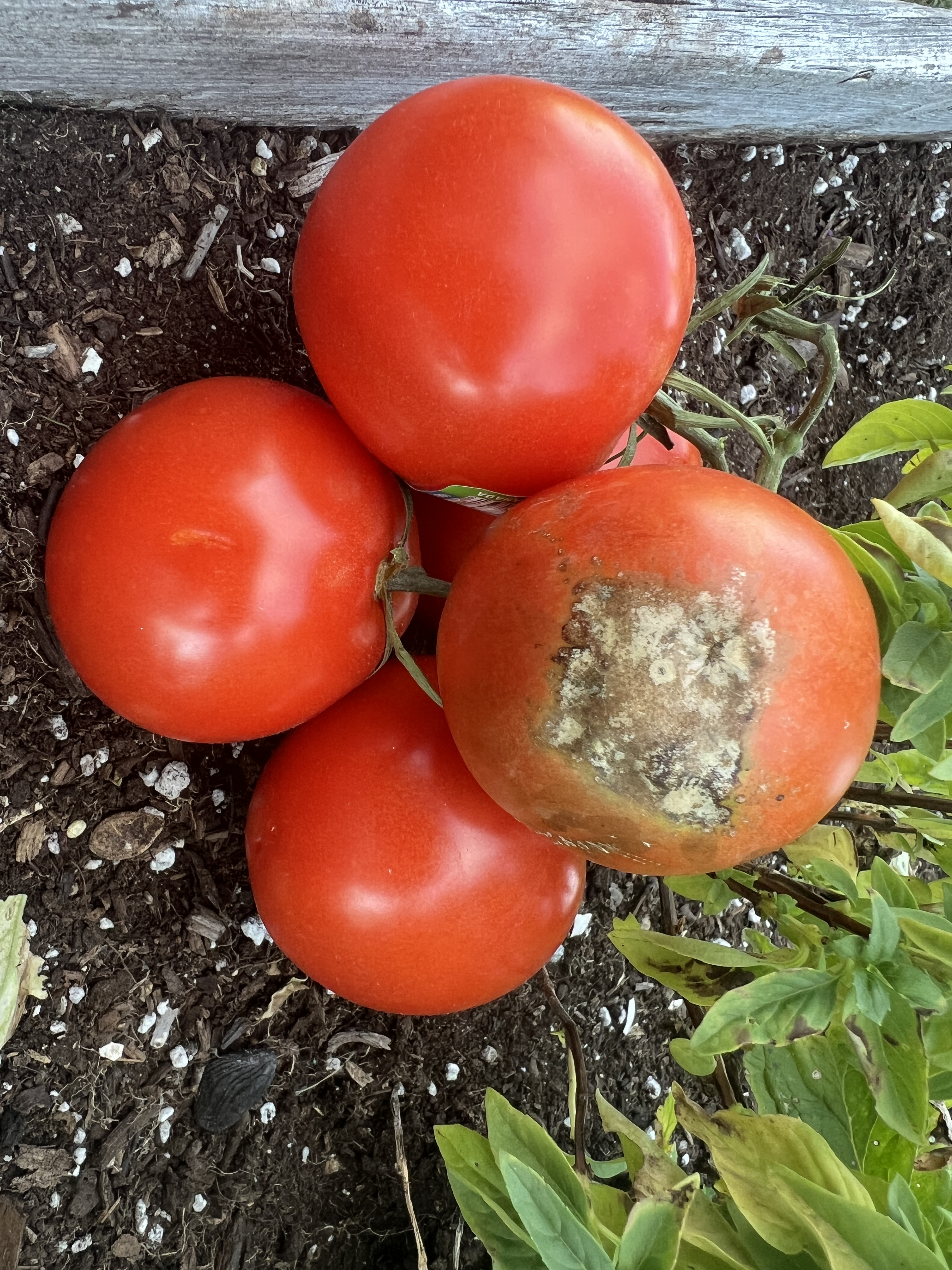
Even in the premature, un-ripened stage all of them with very few exceptions showed signs of rot, starting from the bottom up. Many of these rotten tomatoes didn’t even have a bottom. It looked like someone had sliced off the bottom half which was flat and blackened.

At a critical stage early in the plant’s development, the tomato plant did not get what it needed. When I looked up this problem, the experts suggested this plant did not receive the requisite amount of calcium. The soil, in other words, did not provide this plant with the needed nutrients mediated by regular watering.

But it was not just about what was missing, but when. As soon as I noticed the first tiny green tomato with the rot back in July, and did my research, I started watering the plant, even soaking the ground, every evening. But it was too late. I’d missed that critical stage in its development. Early on in its growth, that is when the watering and soil treatment should have happened.

“Increase our faith!” The disciples asked Jesus to strengthen what they probably perceived to be their weak faith. They had just heard Jesus’ difficult teaching on the need to forgive others who have hurt them (Luke 17:1-4). They likely felt unable to do this and concluded that they didn’t have enough faith. They may even have gotten down on themselves. Not having enough faith translated into being a bad person.

Jesus responds with a parable to temper their expectations. To sum it up, I can hear Jesus ask them a rhetorical question: “Who do you think you are, God?”

As far as gardening goes, I felt like a failure.

A couple of things I need to remember regarding my disappointing tomato plant experience: First, we did get a few, really good, juicy-sweet tomatoes from it. It wasn’t a total loss.

Second, I might do well to recall my part in its growth. And this ties in with the act of blessing, which we have engaged in this morning. Because when we give a blessing, how are the blessing’s gifts realized? After all, the blessing’s benefits must be received in order for the blessing to be fulfilled. It’s not just the giving but the receiving as well.

The action of blessing our pets is a good exercise of faith for us today, because, of course, we have little way of verifying scientifically that our blessing confers anything of value on our pet. They can’t even say, “Thank you, I feel better already.” But we still do it, faithfully if imperfectly. And that is the important piece.

Is it not the same relating with human beings? In our stuffed-up pride, we may like to believe that our caring and our words and our blessing actions must have a positive effect on those whom we bless when we can see and verify it by their changed behaviour, or whatever. The value of our prayers, our service, our words become contingent on a verifiable result. And when we don’t have that result immediately, we may lose faith in ourselves and in God.

My gardening failure, taken as a metaphor to failing at all my righteous attempts to do good, doesn’t mean I’m weak in my faith or not praying hard enough. When you experience failure, it doesn’t mean your faith is deficient.

The paradox is that for anything great to happen, for any wondrous change to occur for the better, we first must accept ourselves as we are, with all our limits and weaknesses. Whenever we avoid, mask, pretend and think more and expect more from us than what is, we often run into trouble and bring about the opposite of what we seek.

After the first week of training and orientation at my practicum site last month, I felt I had a tentative and yet untested grip on all the policies, procedures and digital charting protocols. I was just beginning to understand how things operated in the office, receiving referrals from the doctors and using the proper charting process, never mind the actual practice of counselling clients.

There are, including me, four psychotherapists in our department. On one day in the second week, it so happened that the other three were not in the office. For the whole day, I was it, the only therapist on site.

I wondered, at first, why I had been left all by myself. There were still things I wasn’t sure about. But I managed through all the hiccups and logistics that challenged me that day. I figured out solutions, if only temporary. As the day wore on, I found more confidence in myself and found an unexpected pride in occupying that space and role for the day.

Later I reflected how important that experience was for me not to lean on the crutch of more experienced professionals at my beck and call to help me. I appreciated the faith my colleagues had in me to leave me alone in their office and on their computers. It was, in truth, an important part of my learning.

They had faith in me! God has faith in me, and God has faith in you!

The prayer to God, “Increase our faith” is learning to trust the faith that God already has in us especially when things are stressful, tense and not going our way – when we’re not on our game, when we are suffering, grieving, losing.

Let me repeat: Increasing our faith looks more like the practice of receiving and trusting in the faith of God in us, when we are not at our best.

This Gospel is about God validating the faith already in us, never mind how strong or weak it is. The real question is – Do we trust the incredible faithfulness God has in us? Do we trust God’s faithfulness in us,

enough faith to let us make our own mistakes,

enough faith to let us make our own decisions with the resources we already have,

enough faith to let us meet those tough days without giving up,

enough faith to let us use what we already have for good,

enough faith to meet our seemingly insurmountable challenges with courage,

enough faith to trust we are never out of the reach of God’s love, mercy, grace and forgiveness.

Our new national bishop of the Evangelical Lutheran Church in Canada (ELCIC), the Rev. Bishop Larry Kochendorfer, said recently: “We do not fully know the future, but we have what we need. We have bread and wine, we have the scriptures, we have each other … Jesus comes alongside. Love is at our side.”

The blessing we receive from God is God’s faith in us. The blessing is the gift of accepting that God believes in us because God loves us. And this is the blessing we give to others.

When we bless others, we have faith in them, in their abilities to meet their own challenges with the resources, and the God-given capacities they have, to grow and flourish.

“Increase our faith, Lord. Help us lean on the faith you have in your creation. Help us trust you have given us enough of what we need to live by your grace and love.”

Amen.
Wildfires and the journey of faith

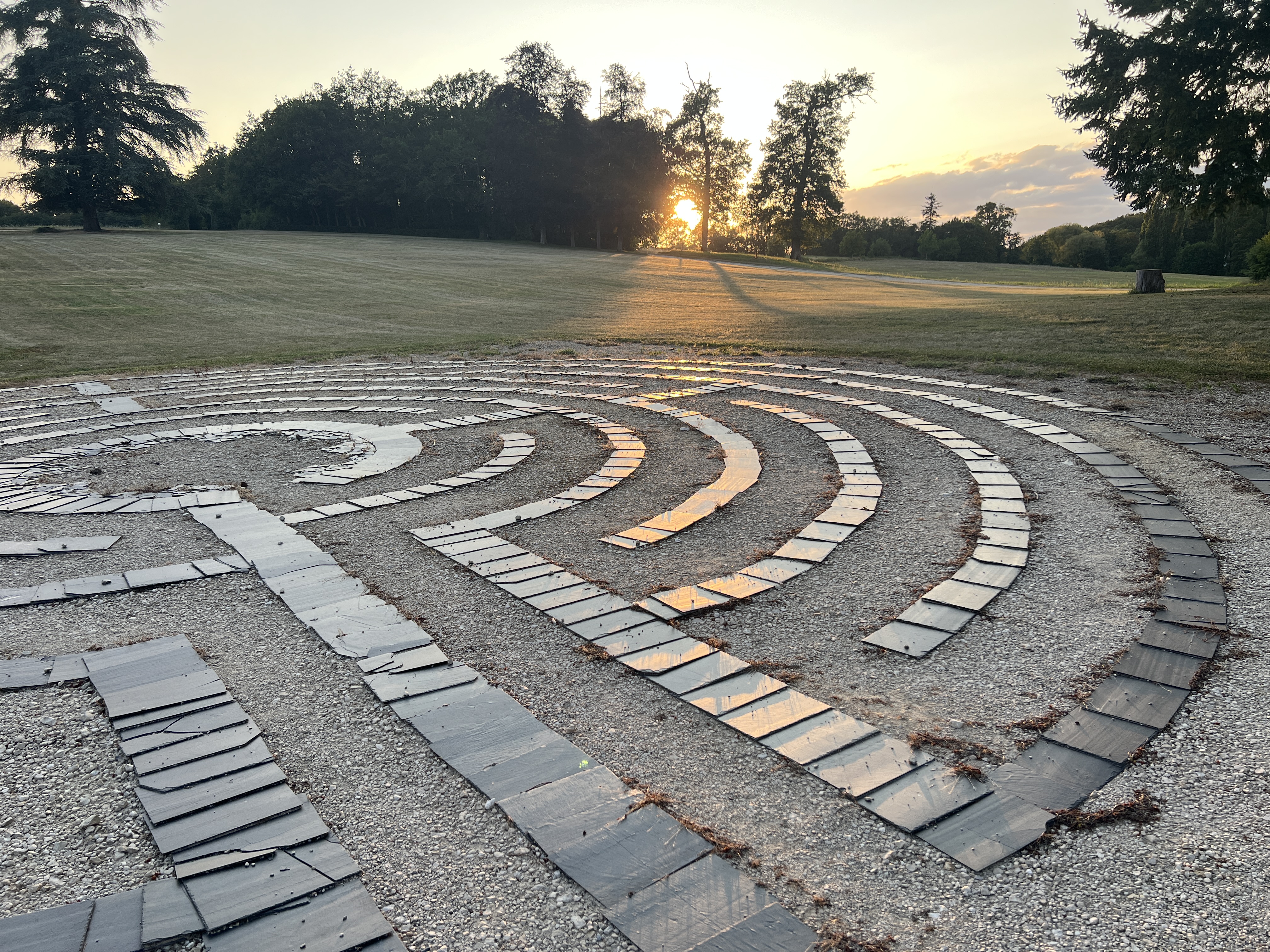
Labyrinth at Bonnevaux Centre for Peace (photo by Martin Malina, 21 July 2023, Marçay, France)

How could such a beginning
Ringed in water
Come to such an end
Fixed in fire?

(King, 2019)

When I recently read this poetic lament written by Canadian Indigenous historian and poet, Thomas King, I couldn’t help but immediately think about all the wildfires this summer.

Others are calling on us Canadians to get used to the “new reality” (Reed, 2025, August 11) regarding summertime wildfires. 2025 has been the second worst year for wildfires after the record-setting year in 2023.

The average number of hectares that burn over a 5-year period in Canada is around 4 million. This year alone, seven-and-a-half million hectares of land have burned due to wildfires, about 78% more than the 5-year average.

The warmer it gets the more fires we see. It is a stark manifestation of the climate crisis, with temperatures this past spring already two-and-a-half degrees Celsius above average. The hotter the climate the more the atmosphere sucks moisture out of the dead vegetation and the forest floor, creating ideal conditions for fires to start. The warmer temperatures increase the frequency of lightning that sparks the fires. Lightning is a leading cause of wildfires in remote regions of Canada’s north.

Indeed,

How could such a beginning
Ringed in water
Come to such an end
Fixed in fire?

(King, 2019)

How do you interpret this poem? Likely, we can go in many different directions with it. We could, like I initially did, take his poem literally and refer it to creation and the climate crisis.

We could also read it as a metaphor for faith, describing the journey of faith beginning in the waters of baptism and ending in the fiery passion of living in the Spirit?

Whichever way you go, poetic words are meant to call out from each of us – our own hearts and minds – a unique response. Scripture is meant that way, to elicit and evoke something from us.

Like last week’s Gospel, Jesus’ words in the opening verse of today’s reading from Luke leans into this approach: “I came to cast fire to the earth and how I wish it were already ablaze!” (Luke 12:49). Poetic. But is Jesus angry? Is he vengeful?

Recall, Jesus recently rebuked James and John for wanting retribution, wanting to bring down fire from heaven on unwelcoming Samaritans (Luke 9:54-55). Jesus means a different kind of fire. This is not the fire that incinerates. It’s not the fire of judgement raining down from heaven upon the heads of God’s (read, ‘our’) enemies. Let’s be careful about taking these poetic words literally.

Some bible scholars suggest Jesus is talking about the fire he takes upon himself. This is the “baptism by fire” (Lull, 2010, p. 361) that entails his own suffering, his own passion. God’s work on earth is Jesus’ own self-giving, his own sacrifice on the cross. “How I wish it were already ablaze,” Jesus says. How he wishes his purpose on earth was already accomplished. He was passionate.

So, where does that leave us? Jesus does not let his disciples, nor we, off the hook. In this season after Pentecost we continue to be reminded of the Holy Spirit’s work in our lives, in the church on earth. The fire the Spirit of God brings burns in the hearts and minds of followers of Jesus. “Were not our hearts burning within us?” confessed the disciples after seeing the resurrected Jesus (Luke 24:32). A spiritual awakening, a growth, a movement enflamed by the Spirit’s power continues to burn in the hearts of Jesus’ followers ever since.

So, if the fire in this Gospel refers to the passion of Jesus leading through the suffering of the cross and the empty tomb, the death and resurrection of Jesus introduce us to the paradox of faith. In other words, we cannot bypass the pain on the path to new life. Death before resurrection. Whatever good for which we pray, strive and seek only comes by way of hard, personal work. The good results from the struggle.

At the orientation meeting when I started the Master of Arts in Counselling Psychology over a year and a half ago, the Dean of the program told all of us newbies that, “to learn is to churn.” To churn, like hurricane Erin now does in the eastern Caribbean.

To learn is to churn. I didn’t want to believe him at first. But I can honestly now say that this learning journey, while rewarding and affirming in many ways, has also been a churning, so to speak.

Learning is something we say we are always doing. But the growth and positive change don’t come without the pain of loss. The ‘little deaths’, as Martin Luther liked to put it. This challenge can apply to everything from family relations to politics to community engagement and church work, from caring for ourselves and others to meeting our daily challenges. Solutions don’t come without some churning along the way.

To learn is to churn. On the one hand, churning is about movement. When we confront the ambiguity and nuance and complexity of life, we don’t just give up and stay stuck in this challenging awareness. Churning is about movement. We do something. Our behaviour changes.

At the same time, churning is about a movement that is not rushed nor hastily reactive. Churning turns things over, mixing it all, going deep. We don’t rush the turns of life. We spend time in, embrace, the change as hard as it is. Teilhard de Chardin said, “Above all, trust in the slow work of God” (DotMagis, 2025). Churning.

One highlight of the summer for me happened on the first day of summer, when members of three congregations in this community went for a walk from garden to garden to garden. We ended by walking the labyrinth on the floor in the parish hall at Julian of Norwich Anglican Church.

The labyrinth has a history in the Christian tradition. During the Middle Ages, when Christian pilgrimages to Jerusalem were disrupted by conflict, particularly during the Crusades, Christians developed labyrinths as a substitute for the physical journey to the Holy Land. 

These labyrinths, often called “Chemins de Jerusalem” (Paths of Jerusalem), provided a way for Christians to symbolically journey to Jerusalem through prayer and meditation, particularly on the Passion of Christ. The most famous of these labyrinths is in the Chartres Cathedral near Paris, France.

When I walked on the labyrinth at Julian of Norwich, praying and reflecting on the journey of life and faith, these words pierced my heart with renewed appreciation: “There is no wrong turn”. On the labyrinth, there is no wrong turn.

The labyrinth, after all, is not a maze. In a maze you may be tricked or mistaken in taking a wrong turn which leads to a dead end, right? But not so in a labyrinth. There is only the one path, leading to the centre. You just need to follow it.

And be mindful of the turns. Those turns take you around 360 degrees. If you are sprinting, you might overshoot and miss the turn. But by remaining faithful to the slow work, by staying on the path, that is all. You just need to take your time at each turn. On the labyrinth, there is no wrong turn. In a life of faith, there is no wrong turn.

These turns, changes of direction, in life, are not easy. But these turns provide the best learning opportunities in your life. And yes, to learn is to churn.

As I focus on my practicum over the next eight months, I will have an excellent opportunity to learn. It will also be an excellent opportunity for you, the congregation, to learn. To learn together in a new way.

Trust the path. On the way, there is no wrong turn. No decision you make is outside the purview of God’s grace, mercy and love. Because the path you are on, even with all the turns, takes you to the center of Jesus’ heart, into the fullness of Christ’s presence and love. This is the eternal journey that begins now, and in eternity never ends.

The promised glory at the end of the road requires us to take that road, and fully embrace ourselves on the path ahead, one step at a time.

Trust in the slow work of God. And be amazed.

References:

DotMagis (Ed.). (2025). Prayer of Teilhard de Chardin: Patient trust [Website]. Loyola Press. https://www.ignatianspirituality.com/prayer-of-theilhard-de-chardin/

King, T. (2019). 77 fragments of a familiar ruin: Poems. Harper Collins.

Lull, P. J. (2010). Luke 12:49-56: Pastoral perspective. In D. L. Bartlett & B. B. Taylor (Eds.), Feasting on the word: Preaching the revised common lectionary, year c volume 3 (pp. 359-362). Westminster John Knox Press.

Reed, B. (2025, August 11). Canada wildfire season already second worst on record as experts warn of ‘new reality’ [website]. The Guardian. https://www.theguardian.com/world/2025/aug/11/canada-wildfire-season

Ordinary Time

We understandably seek an extraordinary experience of the divine. The stories we like to tell each other over coffee, for example, are those strange, inexplicable even miraculous moments of life. It’s as if we can know God only through these extreme, irregular events: How by some fluke we avoided an accident waiting to happen, or how we were so fortunate to win a prize, or how we happened to be in the right place at the right time to witness something incredible. 

These expectations of experiencing something spectacular of the divine translate into our religious observance. We will come to church at Christmas and Easter – when all the stops are pulled to put on a good show – in order to fulfill our longing for God, for something better than the norm, something more entertaining and stimulating. Aren’t epiphanies supposed to catch our attention after all?

It is so tempting to set religion apart from the ordinary, making of it a sort of “fairyland amusement park.” This leads to an ancient heresy of the church – the split between God and human, the ordinary and the holy, the sacred and profane.[1]And when this split entrenches in our minds, how is it, we wonder, that we would deserve such a God? A God who is made known only to an elite few who will have these extraordinary, divine epiphanies more than we ever can.

But today we find ourselves in ‘ordinary’ time of the church year. According to the church calendar, these times are marked by the colour green. The largest chunk of ordinary time follows the numerous Sundays after Pentecost, running through the whole summer and into late Fall.

But, ordinary time also has a place early in the year, a shorter chunk of time between Christmas and Easter. Combined with the season after Pentecost, ‘ordinary’ time makes up mostof our time – thirty-three or thirty-four weeks of every year.[2]It is not, therefore, the time during which the church is engaged in preparations for, or celebrations of, the birth, death and resurrection of Jesus.

It is the time during which we are called, like Simon and Andrew in the Gospel for today, to follow Jesus. Not because of the star that announced his birth. Neither because of the excitement conjured by the promise of a trip to Jerusalem. But simply because Jesus said, “Follow me.”[3]

It’s ironic that in church history and doctrine we have minimized Jesus’ life and ministry in comparison to his birth and death. Some of the ancient creeds jump directly from Jesus’ birth to his death. But the reason for which Jesus lived on earth cannot be minimized. “Though it is not untrue to say that Jesus came to earth to die, it is more true to the Gospels to say that he came first to live.”[4]

In fact, Jesus’ death is truly significant only in connection with that which he lived for and proclaimed – God’s kingdom. We pray every week, “Thy kingdom come, thy will be done on earth as it is in heaven.” On earth. While we go about living, here.

In these weeks between Christmas and Easter we are reminded that, for all their wonders, neither of these great celebrations is sufficient to sustain us in the hard work of following Jesus in our ordinary lives. How can we do that?

In addressing this question let’s be aware again not to be always so taken by the WOW factor —the exceptional even unbelievable nature of the disciples’ response:

“Immediately they left their nets and followed him.”[5]

Again, we may tend to focus only on the extraordinary act of obedience on the part of the disciples. All we see and read here is this immediate response by Simon and Andrew to follow Jesus. They don’t think about it, they don’t talk to anyone before agreeing. They just drop everything and go. Wow!

But what has been going on leading up to this moment, this encounter between Jesus and the disciples he calls? You get the feeling that there has been something brewing beneath the surface, even of their consciousness, which then presents in this radical behaviour. What has been going on in their lives preceding this moment? And, over the long haul of their ordinary living?

Saint Augustine from the fourth century opens the first book of his Confessionswith the prayer and statement that “our hearts are restless until they rest in thee.”[6]It might very well be that even those four fishers had restless hearts – so restless that when they heard Jesus’ call to them, they could do nothing else but leave everything behind and follow. 

Perhaps they were simply responding to what had already been imprinted on their souls from birth—the knowledge of the voice of God—so that when they heard the voice, all they could do was obey. Their hearts were already prepared over time, to respond to that moment of invitation.

Our hearts have been prepared through every experience of our lives, prepared to hear God’s voice when it happens. Our lives, every ordinary moment, is holy ground in which God is working in us to be prepared for when that moment of realization comes.

We may be our greatest enemy in recognizing the work of God in our ordinary routines, as we go about our lives—washing dishes, or walking to the office, or talking on the phone. We can give up the search for extraordinary experiences to validate our relationship with God and service in Jesus’ name. It is obvious. It is right here. In our ordinary lives. Salvation happens in everyday, ordinary experience.[7]

An old man was making rope. Someone came to him and asked him, “What is it necessary to be saved?” Without looking up from his work, he replied, “You are looking at it.”[8]

An episode on one of the nature documentary channels was about the elephant seals of Argentina. The show focused on a mother and her seal pup, who had just been born. Soon after birthing her baby, the mother, now famished, abandoned the pup on the shore so she could go feed in the rich waters off the coast. 

After feeding, she returned to a different part of the beach and began to call for her baby. Other mothers had done the same, and all had returned at a similar time. It was hard to believe they would find each other. 

The camera then followed the mother as she called to her pup and listened for the response. Following each other’s voices and scents, soon the mother and her pup were reunited. The host of the show explained that, from the moment of birth, the sound and scent of the pup are imprinted in the mother’s memory; and, the sound and scent of the mother are imprinted in the pup’s memory.[9]

That’s how it is between God and each of us. We are imprinted with a memory, a longing for God. And God is imprinted with a memory, a longing for us. And even if it takes a lifetime, we will find each other.

No bright stars. No earthquakes. Just a voice that strikes our ear amid the ordinariness of our lives and announces that God has found us and God is among us.


[1]Gregory Mayers, Listen to the Desert; Secrets of Spiritual Maturity from the Desert Fathers and Mothers (Chicago: ACTA Publications, 1996), p.105

[2]David Toole in David L. Bartlett and Barbara Brown Taylor, eds. Feasting on the Word; Preaching the Revised Common Lectionary Year A Volume 1 (Kentucky: WJK Press, 2010) p.284-286

[3]Matthew 4:19

[4]Troy A. Miller in David L. Bartlett and Barbara Brown Taylor, eds., ibid., p.287

[5]Matthew 4:20

[6]Cited in Rodger Y. Nishioka, Feasting on the Word, ibid., p.286

[7]Gregory Mayers, ibid., p.105

[8]Ibid., p.97

[9]Rodger Y. Nishioka, Feasting on the Word, ibid., p.284-286

When the lights go out: an Epiphany funeral sermon

It’s sounds strange talking about Marcella in the past tense. All of this happened so quickly. It was such a sudden loss. So unexpected. One moment she is participating and enjoying the holiday with family. And the next, she is gone. 

It’s like when there’s a power outage and the lights go out. We may have some heads up – like at this time of year when the weather network puts up freezing rain, wind or snow warnings. These storms will threaten the hydro lines, and we know we could lose power at any given time. 

But usually when the lights go out, no matter the condition, it still catches us by surprise. We are caught in the shock of it. 

And we are left in the dark. When we are without power even for a relatively short amount of time, that’s usually when we realize all the things we take for granted. These creature comforts we call them, things we appreciate, like – running water if we are on a well, the stove, the fridge, the furnace. Generally, when the lights go out, we think of all those things that normally give us a sense of security and help us survive, especially in the harsh winter time. And how life is now without them.

It’s scary. We find ourselves in unchartered territory. The first thing we will likely do is reach instinctively for any light. Like a candle. Or a flashlight. And appreciate its simple brilliance more. Also, if we share a living space with others, likely the situation will bring us physically closer together as we huddle around the light. And, usually, although it may not initially feel like it, we eventually get through the harrowing ordeal – through the dark night – in one piece and okay.

The sudden death of Marcella feels like the lights going out. And we’re not talking about a house or a subdivision, but a whole city or half the country! Marcella was a bright light in our lives. Her energy, her spunk, her drive. Her light going out affects a universe. It feels like now something huge in our lives is gone. We feel truly in the dark without Marcella. Will it ever be bright again in our lives?

Marcella and David travelled a lot. So, you know that when flying from Ottawa to London or Frankfurt, the journey begins late in the evening. Almost immediately upon departure it is already night time. It is dark. And while most of the six-hour journey transpires in the dark of night, the flight over the Atlantic is heading eastward.

And that means that this journey we are on, dark as it stays for most of it, goes with the expectation—the promise—that we are heading into a new day. After five hours of complete darkness, a thin pinprick of light first lines the horizon ahead. It isn’t too long afterward that the journey is completed in the bright daylight.

You begin a journey these days. And it starts in the darkness of grief. This journey may take some time. It may feel like a very long time. This journey must acknowledge and embrace the darkness in which we walk and the time it takes. Because we can’t get to where we are going without moving through the night. We can’t avoid it. 

But you travel not alone. You are together, as family and friends, somewhere on the flight path. You may use the time you have to be reconciled to your losses and the suffering you bear.

Even though you carry the burden of grief and loss, you are nevertheless heading towards a new day. On this long journey in the dark you wait, as it were, for the sun to shine again. You look for the pale dawn’s light to begin brightening the day again. It may start small – a tiny candle flame, a moment of grace, a pinprick of starlight shining brightly in the dark sky.

May these moments give you hope and faith that Marcella’s light still shines. It still shines in the warmth, the light, the life and the love of God. Yes, we speak of her today in the past tense. But we can still use the present tense. Her light still shines. And your light will, one day, shine brightly again.

A sentimental Christmas?

We say that ‘Christmas is for the children’. Especially, parents and grandparents will focus much of their energies to make sure the children are happy: 

That the presents they receive will excite them, 

That the rituals around the Christmas tree and fireplace will fuel their anticipation and wonder, 

That the events in church and community the family attends will reinforce their understanding of the meaning of it all. 

And that all these efforts will bring delight to those who watch and attend them. And make it all worth the effort.

The accounts of Jesus’ birth – the Christ child born in Bethlehem – in the first chapters of Matthew and Luke especially reinforce our emphasis on children: The story of the Word made flesh in Jesus begins with Jesus the babe. The story of Jesus that ends at the cross of Golgotha and the empty tomb begins in a baby’s cries from a feeding trough in a stable for animals. 

Yes, Christmas is by the children and for the children. It is no wonder many of the annual Christmas pageants today are performed by children.

And yet, the story of faith compiled over decades and centuries into what we have in the bible challenges us. What the early Christians give us disrupts our sentimental bias in how we celebrate the Christmas season.

Let’s go back in time a week ago. First, December 21, the shortest day in the northern hemisphere, was traditionally the feast day observed for Saint Thomas, the doubting one, who was martyred in India in the mid first century. Then, December 26 is the feast day for Saint Stephen, whose violent murder at the hands of Jerusalem’s religious we read about in the book of Acts.[1]

And, finally, today, the first Sunday of Christmas, the church commemorates the ‘Holy Innocents’ – the children of Bethlehem – who were murdered at the hands of Herod trying to get at Jesus and eliminate any potential threat to his despotic hold on power.[2]

Not exactly a Christmas observance that brings the warm fuzzies. Why has the tradition included these rather violent and distressing facts about Christian faith so close to Christmas? Wouldn’t we rather put off such disturbing elements until long after the holidays when the kids are back to school and we return to the mundane realities of our lives (when we can ignore the truth of the faith)? Wouldn’t we rather preserve the genteel, Hallmark images cradled in soft-white light where all the children are squealing with delight?

The church, in its wisdom, pierces through our illusions and disrupts our escapism. In compiling the stories of the birth of Jesus, Matthew, the Gospel writer, chose to express a profound care for the children – especially those who suffered under the violent injustices of corrupt and despotic rulers. Matthew will not ignore what happened around Jesus’ birth, but will bring voice to it. Expose it for what it is.

This Christmas story is a very human, and a very real, story of life and death, sin and grace. None of it can be ignored nor dismissed, and certainly not simply in order to cradle our cocktail-numbed minds. The Gospel pours cold water on us and calls us to ‘wake up’ in the face of our reality:

That following Christ will sometimes be a rocky road, to put it mildly – as the ancient martyrs of the faith exemplified by their faithfulness and service. That following Christ will sometimes shock us onto our knees in lamenting the evil in the world – when children elsewhere and in our own communities suffer incredible injustice and violence.

That following Christ will sometimes call us into risky and urgent action that doesn’t give time for proper goodbyes. That following Christ will sometimes call for unconditional grace and acceptance of the stranger – as Egypt welcomed the fleeing holy family refugees from neighboring Judea. 

We don’t care for the children if we turn a blind eye to injustice, especially at Christmas. We don’t care for the children when we insist on avoiding the chaos and upheaval that our faith implies. Christmas isn’t just about sentimentality. It is more about taking responsibility and learning from the witness of the Gospel message.

One element of the storytelling from the Gospel today catches my eye: It is the rapid plot movement. This story reflects anything but a sedate, static tableau:

One moment, the holy family is in Bethlehem being visited upon by the magi; the next moment they are fleeing to Egypt. Then, Herod reacts, is infuriated by the magi’s deception, and sends his murdering squads to Bethlehem. Even though it would have been some time passing until Herod’s death, the story-telling doesn’t permit but a breath before another angel of the Lord comes to Joseph in a dream to ‘get up’ and return his family to the land of Israel. But not to Bethlehem where potential threat still exists, but to Nazareth. And all of this in ten short verses.

The pace of the story-telling itself evokes responsibility, not sentiment – not even a lingering, inert contemplation. Joseph doesn’t even have time to think, just react. And trust himself and especially trust God. The truth of the story is expressed in behavior and action.

The witness of the story-tellers of old have something to say to us, who very much like to sit-back and put-up-our-feet during the Christmas season. Perhaps this word to us is a reminder not to forget to take up the mantle of faith, to do our part in meaningful action and behavior. And be responsible, as the body of Christ, to be Jesus’ hands and feet in the world today.

“For if the babe does not again take flesh in us today, the Bethlehem star is but an optical illusion leading to nothing. 

“If we are not empowered to offer a gift to the one in need, then there are no wise men searching. 

“If there is no praise or joy within our hearts, then there are no angels singing; no shepherds watching.”[3]

May these days of Christmas bring to us a deepened awareness of the care we have and express for this dark, broken world. And in so doing fulfill our responsibility as bearers of the Christ child.

This responsibility is also a gift God gives us at Christmas. It is a gift that is activated in us by the witness of all the saints of old.


[1]Acts 6:8—7:60

[2]Matthew 2:16-18

[3]Bishop Michael Pryse, Christmas Message from Bishop Pryse (www.easternsynod.org, December 24, 2019)

The house built by fear

Reading from the bible can be scary. Sometimes a faithful reading of the bible will not bring calm and assurance. Just the opposite!

Today’s scripture can evoke fear.[1]When Jesus talks about Herod’s glorious temple crumbling to the ground and being betrayed by family members, our eyes widen in apprehension and we shift uncomfortably in our seats. Fearful of the future. What will it bring? Is God’s future good or something to fear. We do know, the way there won’t be easy.

From the Gospel, Jesus exposes two false ways in which people of faith try to deal with our fear. By that, I mean, strategies that we have employed for thousands of years in order to combat our fear. While these methods may be effective in allaying our fear, they also serve to block the way we connect with God.

The first such strategy Jesus exposes is our attachment to, and almost exclusive dependence on, what we build. Even, as we say, to the glory of God. These buildings. Glorious, adorned with carvings, intricate stained glass, spires making confident bids to the sky, and arches perfectly rounded and balanced. Architectural master pieces. To say the least.

IMG_9192

IMG_9201

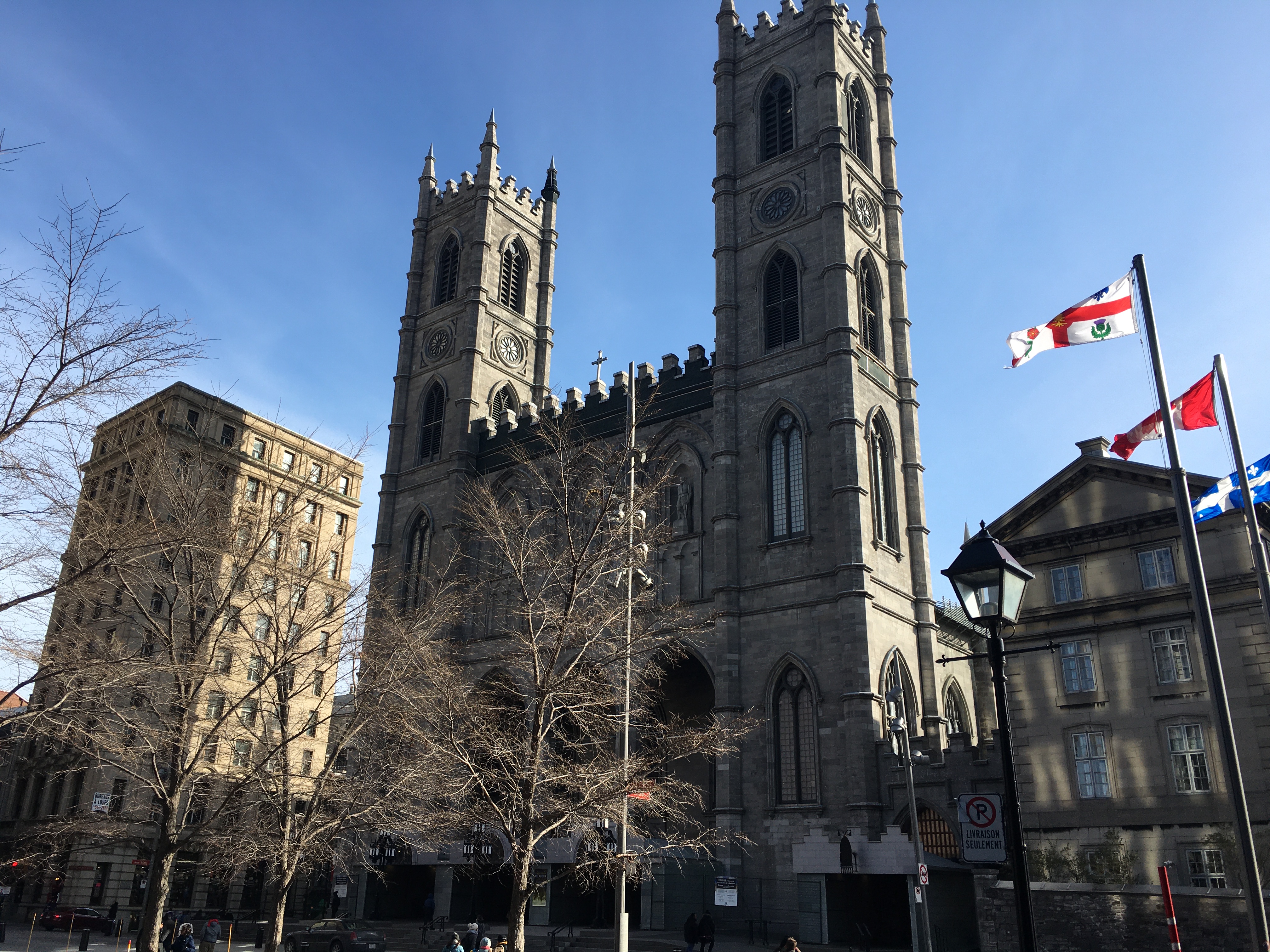
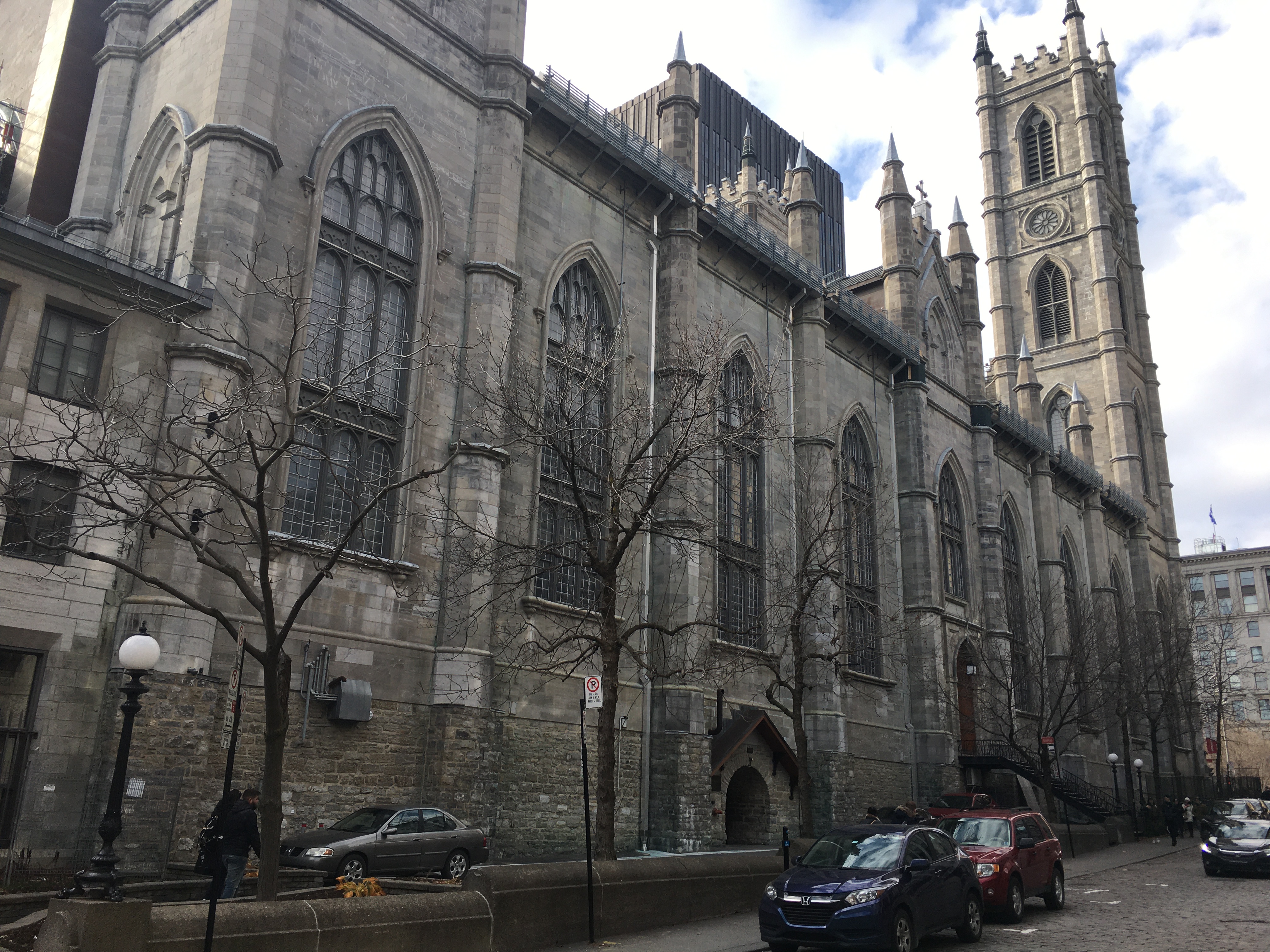
The pulpit alone, in Montreal’s Notre-Dame Basilica, is a wonder to behold. It is a sermon in itself – its spiraling, narrow staircase winding itself up into a small yet regally appointed platform high above the nave.

King Herod, for Christians reading the bible, was a paranoid despot. He killed innocent children was ruthless in defending and protecting his hold on power. Because he was afraid, afraid of losing it.

For historians and archeologists, however, he was a builder par excellence.

King Herod started building his temple in Jerusalem two decades before Jesus was born. During the time of the build he more than doubled the size of the temple mount. The temple proper was completed in eighteen months. But work on the outer courts and decorations continued throughout Jesus’ lifetime and still some thirty years after his death and resurrection. During this impressive season of building the temple, people gathered under the large colonnades and porches to hear speeches and witness healings.[2]

It was a gathering place, a central focal point for people’s identity in faith and source of authority and guidance for life. It was where you went to listen to and engage religious debate. It was where you went to deliberate truth. It was where you made animals sacrifices. Here, you found the rules and regulations and laws for a good life.

Less than a decade after everything was completed on the Herodian temple, it was pretty much destroyed by the Romans in the late first century. Jesus’ words in the Gospel text for today, calling for a day “when not one stone will be left upon another; all will be thrown down”, speak to events that were happening in the lives of Jesus’ followers during this time of the destruction of Jerusalem and its glorious, magnificent temple.

In reading this text carefully, however, I realized this is not just about buildings. Jesus isn’t just criticizing those who put all their religious stock in bricks and mortar. Jesus is exposing yet another related strategy for dealing with our fear. Not just in the glory of the buildings, but in the way we speak to one another and relate to one another. Not just in glory. But also in power.

It was, after all, the authorities who made the rules, sold the animals for sacrifice and mediated the people’s connection with God.

At root, the religious authorities persuaded the people that their relationship with God could only be mediated by the authority’s permission. If you didn’t follow the rules and authorities, you were not justified or in right relationship with God. The whole culture, the spiritual climate, surrounding the temple served to choke out freedom of a personal and direct intimacy with God.[4]

The Russian novelist Dostoevsky wrote the dismaying story with the title, “The Grand Inquisitor” in The Brothers Karamazov. The old cardinal of the church hears that the real Jesus has come suddenly to his town. The cardinal is alarmed that Jesus healed a blind man who had been coming to his church. Then, he hears that the real Jesus who has come to his town raised a young girl from the dead.

When the cardinal confronts Jesus he asks him: “Why, then, have you come to interfere with us?” He wants to rid the town of Jesus, because in his mind what Jesus did long ago is done far better by the church today. In other words, the cardinal has to admit to himself, the church does not need Jesus.[3]The cardinal really couldn’t give up the power he had. Not give it up for anyone. Even Jesus. The cardinal was afraid of losing his job — what it would mean for him and the church …

Seeking glory and defending power seem to be effective ways of dealing with our fear.  We attach ourselves to symbols and expressions of glory in our culture – the tallest buildings, the fastest cars, celebrities, newsworthy leaders and victories on the battle fields of life. This brings comfort, though momentary and fleeting. Because we can never be satisfied operating in this consumer and acquisition-fueled culture. There’s never enough, or it’s not good enough. Ever.

Jesus suggests we must learn a new language. A new way of being, with God and with one another. A way, marked not by successes in the eyes of the world—there were lots of tourists in those houses of worship we visited in Montreal. The world approves. But will we walk a different way – a way marked by love, faithfulness in suffering, and generous giving in the face of poverty, suffering and our fear?

Throughout the Gospels, the religious authorities asked Jesus for a sign of his authority. And, he never satisfied them with his answer. His answers usually appear to disturb their sense of right and wrong.

The truth, when it comes, seems to turn upside down our initial ways of thinking and doing. Here, Jesus says, “For I will give you words and a wisdom that none of your opponents will be able to withstand or contradict.”[5]

These opponents were neither stupid nor un-educated. In fact they were the most articulate and brilliant of the age. So, there is something altogether different going on here. A different way of being with God. A way not encumbered by discursive thought and debate. A way not intimidated by rules and regulations and conditional statements of belonging. A way not defined by glory-seeking persuasion nor forceful coercion.

The confirmation class the other night reflected on the meaning of the Trinity—God the Father who creates all, God the Son who is with us, God the Spirit who gives us strength. On this poster they cut out images from magazines to place in one of three designated areas on the poster. These images evoked for them the meaning and feeling of what God is up to in the world today, through the various persons of the Trinity.

IMG_9244

In reflecting on the experience of doing this exercise afterwards, we pastors admitted this was rather an abstract exercise. We weren’t just memorizing definitions of the Trinity from the Catechism, difficult enough as that is! But in engaging the confirmands on another level, we began to see more than we thought possible.

We discover that we don’t find God by building glory or defending power — ways we use to avoid confronting our fears of the future. Rather, the good news is that God has already found us. In this world. In our lives. And in a multitude of ways.

Making this link, this connection, is much simpler than all the methods we have devised to combat our fear. We don’t need the tallest and most beautiful buildings to assert God in this world. We don’t need to merit, or qualify for, our relationship with God by building skyscrapers or getting straight A’s in school.  We don’t need degrees and a long pedigree to justify ourselves in faith. We don’t need to arm ourselves with book knowledge in order to defend against some opponent whether a family member or stranger.

All we need is an open heart and a desire to love and trust. Following Jesus is about going directly to intimacy with God in our deepest selves. And God is there, right there, all along.

We can respond, then, not out of fear. But out of the love of Christ for all and in all. Forever.


[1]Luke 21:5-19

[2]Acts 3:11; 5:12

[3]Cited in Eberhard Busch, in David L. Bartlett & Barbara Brown Taylor, eds. Feasting on the Word: Preaching the Revised Common Lectionary Year C Volume 4 (Kentucky: WJK Press, 2010) p.310-312

[4]Ray Leonardini, Finding God Within (New York: Lantern Books, 2018), p.93-96

[5]Luke 21:15

Give God a chance

A year ago last summer we bought a potted Hibiscus plant already in full, glorious bloom. The local nursery encouraged us to plant it right away and let it take root in our garden. When winter came, we snipped the stem down to a few inches above the ground.

Last Spring, the sprig showed no signs of life. At all. And it was late June already when I was tempted to pull up the seemingly lifeless root ball from the garden to make room for something else. Visiting the same nursery at the time I complained to them about the Hibiscus plant they sold to us, that obviously did not winter-well. To say the least.

“Don’t pull it up, yet!” they entreated me. “Wait a little longer, for it has been a late Spring. Give it a chance.”

At first, I didn’t believe them. But I left the dead thing alone trying not to think about my disappointment too much. Was I in for a surprise! In early July a tiny, green shoot pushed up the earth around the base. But then, not just one, but two, three and four shoots of new life erupted out of the ground. Seven weeks later, we were enjoying a multitude of magnificent blooms. The plant had more than doubled its growth from last year!

How critical it was for me to heed the gardener at the nursery when she told me “Don’t pull it up!” and “Wait a little longer” and “Give it a chance!”

“Then Jesus told them a parable about their need to pray always and not to lose heart”[1]

In Jesus’ story, the theme is ‘not giving up.’ Not giving up is what it looks like to pray always. Elsewhere in the bible, Paul, the writer to the early church, instructed the faithful “pray without ceasing”[2]. It’s about being persistent in waiting, in not reacting, in staying the course when it starts feeling like it’s no use any longer to keep going.

“If it seems to tarry, wait for it; it will surely come, it will not delay.”[3]

The prophet was waiting for a vision from God, a word that would give new life to those who were discouraged, defeated and ready to give up on God, on themselves and on the world.

For what do you wait? After what justice do you persist? What is it you seek after that seems elusive, just beyond your grasp? Whatever that is, the scriptures describe an inner quality of the heart that will not give up, that will wait for it, that is patient and true in enduring and persisting.

That sees the present moment as holding value in and of itself.

The goal, the destination, the vision – this may seem to tarry. Perhaps in those impatient moments it’s important again to look around at what is happening. Infant baptism, for one thing, is a visible sign of this challenge and truth.

For an infant does not express knowledge of God in the way we adults do. An infant cannot give us a rational accounting of their faith. They cannot, surely, deserve blessing by pointing to a long list of their good deeds and giving an impassioned testimony.

It confounds us sophisticated grown-ups crazy, as we are influenced so much by a success-mindset culture of instant gratification. The world we live in has little patience for this kind of long-view approach. We’d sooner just give up on someone or something for which we hope. When it seems we are in futility grasping at something not yet.

Here, we are asked to commit to quite the opposite. Infant baptism invites us all to dedicate ourselves to long journey. We are challenged to persist in our waiting for it, not to give up, to have faith and stay the course.

And, in the meantime, walk with the baptized as he grows over time into the person God has created him to be. The flowering will happen, yet quite beyond our claim to control it. The green shoots poking out of the ground are occasion to rejoice. Here is evidence enough for now, for this moment. Those tiny shoots hold the fullness of the gift of faith and life in him.

Dear family and friends of the baptized, and Faith community, I hope you stick with it. This journey of faith, together. Trust in the vision, the promise. And celebrate the wondrous gift of this moment.

IMG_3355


[1]Luke 18:1-8

[2]1 Thessalonians 5:17

[3]Habakkuk 2:3, the first reading from a couple of weeks ago, Pentecost 17C (RCL)

Thanks-doing

I knew—we all knew—we had to do it. We had to go, single-file, through the turn-style and meet, individually, with the control officer. The ticket attendant would then scan the barcode on our paper copy or our smartphone before letting us in.

It started out a large crowd—a mass of people walking together across the cordoned-off streets, parking lots and plazas like a tsunami racing towards the stadium. But then it eventually, ultimately, bottle-necked to one person at a time through the gate.

IMG_8943

It was my first time at Mosaic Stadium in Regina, Saskatchewan. At game time it is probably the largest gathering of Canadians I will ever see together in one place—some thirty-thousand mostly screaming Rough Rider fans cheering their beloved football team. In all, watching that game in the stands was for me an exercise in social conformity, or fighting against it.

However, each football fan, regardless of our stripe, had to pass one-at-a-time through the entrance gate. In places where lots of people normally gather, whether it be the security line at the airport or the gate into a sporting event, each of us has to make a reckoning, an accounting.

And it can cause some anxiety, some fear. It does for me. Even though this fear is largely irrational. After all, I have my ticket. I purchased it. I have every right to be there.

And yet, that moment of passing through the gate has a kind of self-consciousness attributed to it. The spotlight now falls on me, not us as a whole. I have to put myself on the line. I can’t be anonymous any longer, melting into the perceived security of the crowd. I have to stand out, be vulnerable, if but for a moment.

Thanksgiving is about doing. It’s already a word constructed for doing something. It is ‘giving’ something, an action word: Thanks-giving. That is why we practice today. We bring food to the altar—our gifts—that will then be given to a world in need.

But doing something in our practice of faith is risky. We put ourselves on the line. We have to make a move. Declare ourselves. Make an account for ourselves. Thanksgiving has to mean something personal to each of us, individually and perhaps differently.

My mother tells the story of her home church in Poland when she was a child. Every Sunday morning during the gathering of the gifts, everyone would line up and go single-file to the altar to deposit their offering. In front of everyone to see!

For fifteen chapters in Deuteronomy (11-26), Moses gives the Lord’s instruction to the people of Israel upon arriving in the Promised Land. In the Hebrew text assigned for Thanksgiving this year, we read the first section of the concluding, last chapter (26:1-11), in this long oration.

In looking at the translated words into English we can’t see the distinction between singular and plural. In other words we can’t tell whether Moses calls the people into faithful commitment together or individually. But in the Hebrew language you would notice the distinction. So, while the early chapters in Moses’ speech are predominantly addressed to the community—as the verbs are in the plural—in chapter 26 the writer has noticeably shifted to singular verbs and personal pronouns.

In our pilgrimage of faith, there are times we have to walk by ourselves. When we can’t hide behind options any longer. When we can’t melt into the crowd. And simply observe. When we can’t be an anonymous fan any longer. When we can’t find excuses nor justifications for not doing anything about something we know needs some doing. When we can’t just be spectators any longer.

We have to go through the gate ourselves. Individually. We have to participate, and get into the arena of life and make some moves, some waves.

It’s scary to do so. To take a risk. We may not have done this kind of thing before. Because we know that in doing something for our faith, anything, we will likely make a mistake or two. It may not be pretty. In fact it may be downright messy for a while. We may at times fail, as in trying different things, things we’ve never done before—Christians have never done before—in mission with others.

The ticket we hold in our hands represents our efforts, our attempts at giving something of what we have—to show the attendant at the gate. At Thanksgiving, not every one of us may feel thankful, especially if you are going through some grief. So then, let your tears be the ‘ticket’ you bring. The ticket an also represent your financial gift, or your volunteer hours, or your gift of expertise knowledge or skills that you offer. Wherever you are at, whatever you have, you bring to the altar and lay it down.

Maybe the irrational fear we have (all fear is irrational) suggests that the ticket is not good enough, that somehow it will not register, that we will be turned away and denied the experience of what we have come to celebrate.

The ticket we bring may be for the cheapest seats high up in the nosebleeds. However we may have acquired our ticket, or whatever its value, we may suffer the anxiety of thinking it is all up to us. That our entrance fee is based on “I deserve it,” or, “I earned it”, or “I accomplished this.”

The risk of doing something brings both the pinch of vulnerability and the fulfilment of the promise. The pinch of vulnerability because in exposing our hearts we realize it’s not all perfect with us. In truth, we must acknowledge we do not do it on our own. We are limited. We are also weak. And, for a moment, this awareness—this confession—hurts.

But the ticket was already purchased. Weeks ago. Months ago. The moment we cross by the gate is after-the-fact. Our participation in the party is already guaranteed. And nothing can change that. The justification for our being there had been already long ago determined. The moment we must make an accounting of ourselves, the moment of fear and uncertainty, is also the moment we celebrate something already accomplished.

By Another. For us.

Thanks be to God!

Happy Thanksgiving!

IMG_8946

Faith alone not our faith alone

“Increase our faith,” we pray.

Isn’t that what we want? More faith to get us through the tough times. More faith to make us better people. More faith to tolerate things in life that set us off course. More faith to believe in things that are not easy to believe in. More. If only we had more.

In the BBC television series called “Broken” actor Sean Bean plays the role of Michael, a parish priest in a small, industrial town. In one of the episodes he answers a question from someone in the youth group curious as to why he chose the priesthood.

He tells the story of when he was eighteen years old he went one day with a crowd of people to visit a falconer on the side of a hill. To see such a large bird with a with a vast wingspan take flight was a treat for the villagers, many of whom had never before seen a falcon. The falconer took time describing the bird to the villagers and even had some of them feed it.

Then they all watched captivated by the sight of the majestic bird lifting off from the falconer’s outstretched arm. Michael saw the bird circle once overhead before heading out into the vast sky overlooking the valley below. The falcon became smaller and smaller—a small dot over the horizon—until it finally disappeared from view.

The afternoon wore on. People looked at the falconer and each other, wondering what to do. But the falconer did not move from his place on the side of the hill. The hours turned and the sun was setting in the western sky. What had started as a large crowd dissipated until there was only the falconer and Michael standing alone there. Michael wondered why the people had left.

He sympathized, for sure. Perhaps, as he was feeling, there was no point in hanging around anymore. The falcon was gone. How would it know to return to this very spot after ranging across a sky which was so vast and covered the whole world? Why would the falcon even care to return? It was now free to roam wherever it wanted to go. What more could it want?

To Michael’s surprise, but not it seemed to the falconer’s, as the darkness descended on the hillside he heard a flutter and rush of wings. The falcon had returned and now sat perched contentedly on the falconer’s arm. Michael could see the white of the falconer’s teeth showing from behind a smile that stretched from cheek to cheek. Michael laughed with delight.

Here was faith. And it was the falconer’s witness of faith that inspired Michael on his life journey. That the falconer had waited on that hillside for what seemed like forever. To stay there, when everyone else had gone home, even if it meant waiting alone. To have no guarantee that the falcon would return. To not have control over how long and when. And if. But only do what he was called to do: Let the falcon go. Let that bird with whom he had a relationship, to be sure, go.

“Increase our faith.”

Maybe it’s not our faith that is at stake here. These texts assigned for today can easily lead us into yet another guilt trip or glory trip—as if that’s what faith is all about! We are either not worthy enough, not good enough. Or, look – I’ve moved mountains! If only we had more, even more, faith!

“Increase our faith.”

The faith talked about in these passages are Christian, but perhaps not in the sense of the faith of the Christians. Because dwelling exclusively on our faith alone often gets us spiraling into dark holes of depression and feelings of unworthiness, defeat and failure. We hit walls of misunderstanding when we separate our faith from the faith of Christ, the One we trust. Here the central understanding is not our faith but faith in Christ, a faith that mirrors the faith of Christ.

It is like eighteen-year-old Michael watching the faith of the falconer.  What Michael ends up doing with his life is secondary. What is at stake, what is the most important thing in Michael’s experience on the side of that mountain one long afternoon, is not his own faith but someone else’s.

Timothy is charged to ‘rekindle’ the mustard seed of faith that is within him. The mustard seed is tiny, almost undetectable to the naked eye. We don’t often recognize the gift that is already there.[1]

Perhaps we too need to wait on the side of that hill, and not just give up and go home.

Timothy is encouraged that there is something good within him working long before he even became aware of it. He has to be reminded that “grace was given to us in Christ Jesus before the ages began”. And that we are called to good things, “not according to our works but according to [Christ’s] own purpose and grace.”[2]

In prayer, in our relationships and interactions, the search-light of consciousness turns off ourselves and onto the living Christ. When the attention turns away from our stuff—good and bad—and onto Jesus, I believe we may feel a needed lift. Our heart alights. The pressure for performance relaxes. The guilt dissipates. And we can start by simply being in awe about the One whose purposes and faithfulness and love reach far beyond our own self-preoccupations, weaknesses and accomplishments.

What transformed eighteen-year-old Michael was not an argument about faith, not a debate which he won or lost and convinced him either way what to do with his life. What transformed Michael was an encounter with someone who showed him the way, who practiced faith. Our call is not to win all the arguments but to forgive as we have been forgiven and to love as we have been loved.

We are called to get in touch with the Giver of the gift of faith. We are called to give thanks for the One who beckons for us to stay on the journey, calling us not worthless, but friends along the way.

Let our prayer of praise therefore shout from the rooftops: “Great is Thy Faithfulness!”[3]Amen.


[1]Luke 17:5-10

[2]2 Timothy 1:1-14

[3]Hymn 733, Evangelical Lutheran Worship (Augsburg Fortress, 2006).

With us, snowed-in

I wasn’t able to remove the Christmas manger scene from our front yard in time, before the snowstorms left everything buried. As we’ve approached Lent, the joke in our household is that Jesus, like us, is snowed-in.

IMG_8042

It likely won’t be until late April now when I will be able to remove the tableau from the frozen earth and its snowy cover. When will Jesus be set free from the tomblike confines of winter’s grip?

When exactly, no one knows. Meteorologists are calling for a cooler-than-normal late April /early May. It might be a while.

The Jesus story, for us, begins in winter around the winter solstice on Christmas Day. We begin again our Lenten pilgrimage in the throes of winter, when snow and ice cover everything. When will the sky brighten and warmer temperatures heat the ground again? When does the journey end?

The poet, Mary Oliver, who died in January of this year, wrote primarily about winter. In several pieces she twins snow with wisdom, the capacity to live with questions in silence, surrendering to its beauty. “I love this world,” she wrote, “but not for its answers.”[1]

I’ve considered Christianity to be a winter faith. We, as people of faith, live with many questions that are largely unanswerable. Why do we still live in a world beset by injustice, intolerance, hatred—despite all good effort in the name of Jesus to the contrary? Why death and disease? When will we find the answers to our deepest questions? Why? Why? Why? Winter is a time for questions.

And so, we continue to search, wander, and wonder with Jesus snowed-in, by our side.

But, is Jesus in over his head?

The temptation of Jesus—as this story is famously called—happens near the beginning of his divine calling and ministry.[2]He goes into the wilderness, the desert, for forty days. He goes into a place of harsh simplicity, stripped of all creaturely comforts, to serve a holy purpose.

We wonder, will he survive the challenge?

Given his life purpose on earth, he meets with what could be his greatest vulnerability—the seduction of power and its forceful implications. The man who is the Son of God, King of Kings, Lord of Lords, Almighty and Everlasting, the man whom people would look to for guidance and leadership, the man who many would lift onto a pedestal—would Jesus succumb to everyone’s expectation?

Would Jesus yield to the temptation that he, the Messiah, will now lead the revolt to free the suppressed and oppressed Judeans out from Roman occupation? Would he be the political rallying point around which the crowds would mobilize and generate an effective, political movement?

And, in fact, the evil one touches on this potential weakness. Notice in different ways each of the three temptations seduce Jesus to grab hold of power that would make him this kind of King: One who satisfies his every appetite and hunger using whatever means at his disposal; one who creates God in one’s own image by forcing God’s hands, one who offers blind obedience to those still ‘above’ them while climbing the ladder of ‘success’.

But that’s not what Jesus was going to be about. We know that. In order to embrace his true identity, what happens?

Jesus is first led by the Spirit into this vulnerable place, not away from it. He was to first meet this human, shadow side.

The point of Lenten discipline, whatever it may be for you, is to be led into that shadow place in our own lives that we, on our own, don’t want and even can’t go. The Spirit leads us to face that which we normally distract ourselves from, where we normally deny, avoid. What is that vulnerability for you?

What does the light and Spirit reveal in the dark corners of your life? Is it a fear? Is it a conversation you know needs to happen? Is it confronting a situation you have been trying to avoid? Is it coming to terms with what is really going on deep down in your heart?

How does Jesus respond to his temptation? How does he return to his identity in God?

The scriptural quotations he cites are signs of his true identity—his ‘touchstone’, if you will. The scriptures point to his true self. By citing the scripture, he reminds himself, he aligns himself, he allies himself, with what grounds him in who he is. By citing scripture he relies not on his own humanity and resources of his own making, but rather on God.

This text provides rich support for our own journeys of Lent. As we wander into the wilderness of our lives and continue to trudge through the snow wary of still slipping on the ice, as we wonder with our questions, we meet our own shadow sides. And are called to stay rooted in who and whose we are.

And what is your touchstone for remembering your identity in Christ? Is it scripture? Is it the bread and cup of the sacrament? Is it a song? Is it an act of repeated service for another? Is it a prayer?

In her poems about winter Madeleine L’Engle writes a word of hope for the journey:

“Snow does not obscure the shape of things. It outlines them, like an icy highlighter, revealing the deep structure of the world. We walk through the woods, seeing differently, and, when we glimpse the hidden structure, we ask questions even as we experience its stark beauty.”[3]

Writer-theologian, Diana Butler Bass takes it further: “Strangely I have found in my own life that it is only through a wintery spirituality that I am able to affirm summer and sunshine. A friend wrote me recently, ‘Winter reveals structure’. Only as the structure is firmly there are we able to dress it with the lovely trappings of spring, budding leaves, rosy blossoms. Winter is the quiet, fallow time when earth prepares for the rebirth of spring.”

The word, Lent, means ‘springtime’. While the Lenten journey begins in the frozen winter, we can say in faith that the purpose of the journey is to bring us to Spring. Because by the end of the Lenten season, the snow will be gone revealing the soft, verdant earth underneath where new life is just budding to sprout.

In the end, the disciplines of Lent, the questions we now pose and with which we struggle on the journey, these are gifts from God. They point us to God’s presence in our lives and in our world. In the end, that is what faithful observance of Lent is—“a grace-filled return to the Lord our God.”[4]

Who begins with us, snowed-in and under.


[1]Cited in Diana Butler Bass, The Cottage: A Winter Faith (January 18, 2019)

[2]Luke 4:1-13

[3]Madeleine L’Engle cited in Diana Butler Bass, ibid.

[4]Kimberly M. Van Driel, in David L. Bartlett & Barbara Brown Taylor, eds. Feasting on the Word: Preaching the Revised Common Lectionary Year C, Vol 2 (Kentucky: WJK Press, 2009), p.25.