Talking about toast

“I want butter on my toast, but not too much.””You’ve spread it on too thinly. I want a whole wad of it.”

“You’re being wasteful. You’ll use up the tub in a couple of days.”

“If you didn’t burn the toast to a crisp all the time …”

“I don’t like my toast slightly warm.”

” … the butter would melt into the bread.”

“Toast is toast. A slice of bread is a slice of bread. There’s a difference.”

“Lighten up. Just slather it on.”

Of course, the words alone in this dialogue do not tell the whole story. There are other ways that we communicate, that animate the message. They say seventy percent of communication is non-verbal. What does the tone of our voice communicate? What are our eyes looking at when we speak? And, most significantly, what are our bodies doing? What is our body language?

I was attuned more to this truth in Italy during our family vacation. Every culture presents uniquely in the manner of body language during a conversation, to the point of caricature and over-generalization. Of course, not every English person speaks with a stiff upper lip; not every Italian gestures wildly with their hands; not every Canadian looks downward and apologizes. The exercise, nevertheless, of paying attention to a cultural tendency is helpful in bringing awareness to the way we communicate.

We played a little humorous game, somewhat irreverent, whenever we drove by or saw in a distance a couple of Italians speaking to each other — their bodies close, hands waving on either side of their partner’s ears as if guiding a plane on the tarmac to its docking at the gate, eyes piercing the other with intensity, even spittle flying from their mouths. We couldn’t hear what they were talking about. But we made up a dialogue about something the opposite in nature to their serious, even combative, style. We would try to convince ourselves that they were talking about toast.

Communication is essential to any relationship. And it’s not just the words we speak. It’s our behaviour. What we do. How we act. What our bodies are telling ourselves, and the other who is in our presence.

In other words, communication is real. It is not just reserved to the realm of ideas and theory and abstraction. Communication involves our whole lives, our whole selves. We are not by ourselves in the ideas we express and the words we use. 

When we speak about God, and our relationship with God, we dare not relegate our relationship with God to the realm of words alone — whether those words are printed on a page, or spoken during worship in a detached manner as if those words hold power on their own without context or embodiment.

Our God is real. Our God wants relationship with us. And, in the Isaiah text today, we read that invitation: “Come, let us argue it out!” says the Lord (1:18). God is having an argument with the people of Judah and Jerusalem during the reigns of kings Uzziah, Jotham, Ahaz and Hezekiah.

It is not a dialogue that is calm and reserved. It is not a cool, collected, disassociated manual of instruction. It is not a legal text. It is throwing down the gauntlet! Come on! You are messing up! But I make an offer. Let’s have it out! says the Lord! You have something to say? Then say it! The Lord can take it. Let’s negotiate. Let’s hear each other out. Let’s be real.

I wonder about our image of God when we shy away from such boldness. Is it because we imagine a God who is passive? Who only does our bidding, or should? Or a God whose job it is only to direct us, judge us and basically order us around?

But what about a God who is more vulnerable than that? There is no more direct and clear message of this vulnerable God than Jesus hanging crucified and dying on the Cross. So, what about a God who seeks our attention by being vulnerable? Who wants us to engage with God in an honest, self-disclosing way? Because the message of Scripture suggests time and time again: 

Not only is God’s company available and deeply important to us, but our company might very well be important to God. Could it be that God seeks our companionship? Could it be that God desires to have us as friends, and that the God who so patiently works with us in every moment rejoices upon occasion to have our undivided attention — even when our attentions are directed to the many particular concerns of our lives? (1) 

God is, indeed, the “great companion” (2). God is present with us, interested in us, and trustworthy. God’s love is receptive and responsive. In other words, we do not pray to an impassive, unmoved mover.

God is in relationship with us. God invites us, when we have a bone to pick about life, about whatever is happening in the world, to “Come, let us argue it out.”

It’s not that God always wants a fight. I will define a “fight” in this context as a bold yet non-combative, mutually-respecting exchange of unique perspectives. What this kind of arguing or fighting reveals is passion, real feelings, and the truth about ourselves. 

And this is a sign of any healthy relationship whether we talk about relationships in marriage, or work, church, community or play. Honesty. Truth. And in the exchange of honest discourse, we bring all that we are, not just our words. Our hearts. Our minds. Our bodies. 

We may not change God’s mind about whatever. But that is not the point. God wants to hear what we have to say. God wants to feel our passion, hear our cries, sense the beating of our strained hearts. God wants to understand us. This is what Jesus was all about. 

God sent Jesus in our flesh so that God could begin to truly understand what it means to be human. And in that humanity, in seeking us, God can bring an outpouring of love, grace and mercy — time and time again.

So, any subject is on the table. Thanks be to God! Anything is on the table, in all honesty. Including talking about toast.
Amen.

1 – Nancy Campbell & Marti Steussy, “Process Theology and Contemplative Prayer: Seeking the Presence of God”, p.87

2 – Clark Williamson, “Learning How to Pray,” in Adventures of the Spirit: A Guide to Worship from the Perspective of Process Theology with Ronald Allen (Lanham: University Press of America, 1997), p.162

Gospel, Italian style

On the Sunday before I left for a family vacation to Italy, you encouraged me to — “know your history”. I think that message came to me mostly during the children’s chat when we talked about the Canadian flag on my backpack, and why Canadians had been so well appreciated and admired in western Europe, especially, over the past several decades.

The conversations then, as well as following the service over coffee, reinforced to me the value you place upon ‘history’ in general. 

Well, Italy is not exactly the hotbed of Reformation, Protestant Christian history as such. At the same time, the buildings there stand clearly as testimony to the dedication of Christians in certain times and places in history.

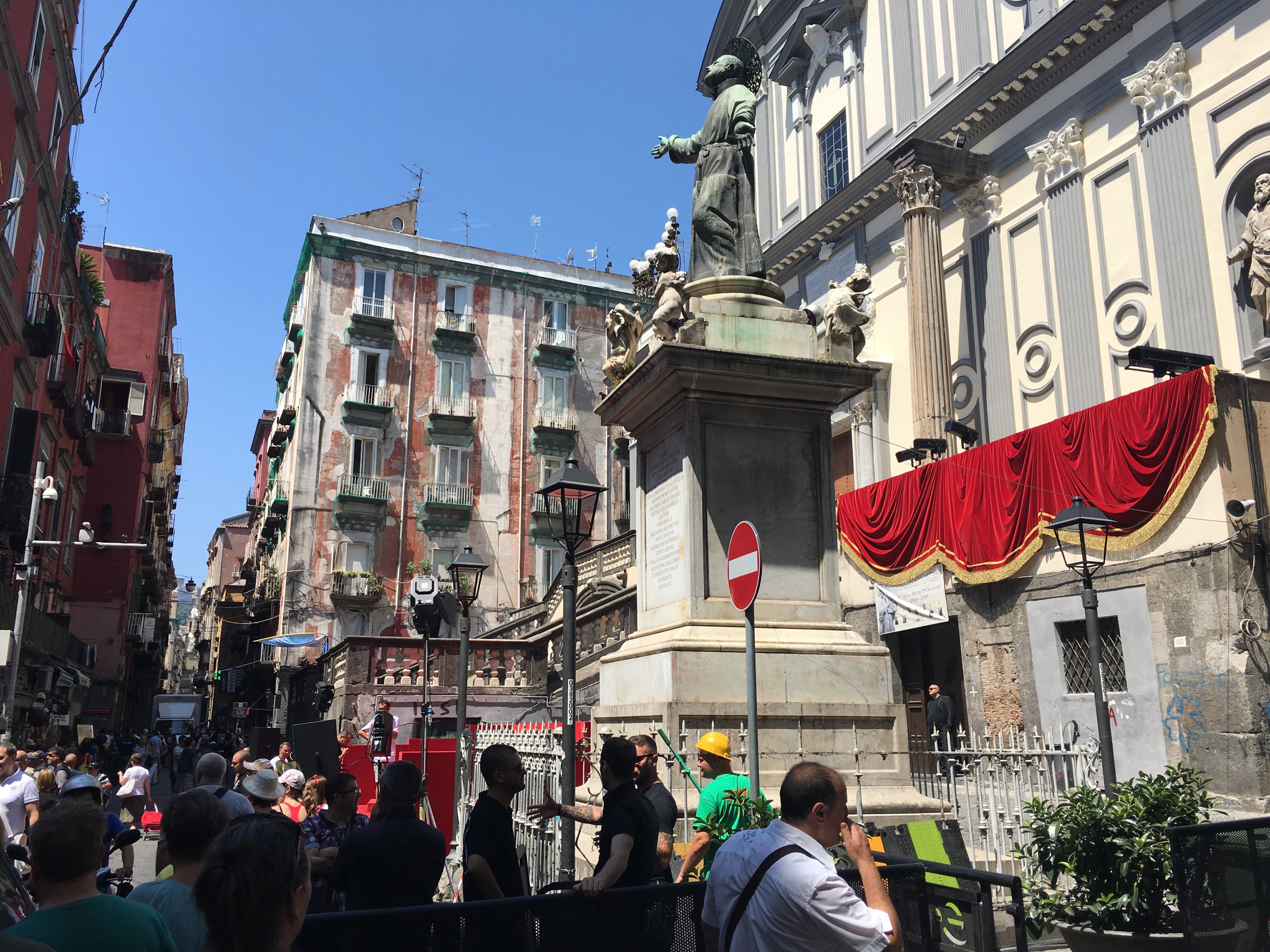
It was the first day we walked in the older section of Naples — a sprawling metropolis at the base of Mount Vesuvius on the Mediterranean coast — when I began to feel this history pressing in the air all around me.

I say sprawling because Naples is today the most densely populated urban centre in all of Europe; some 8,500 people inhabiting one square kilometre in a metropolis of nearly four million people — making it the third largest city in Italy, and the ninth most populous urban area in the entire European Union.


The noise was overwhelming: the hustle and bustle of pedestrians, car horns beeping, motorcycles and mopeds buzzing, shouting street vendors, impassioned conversations, two-toned emergency sirens, barking street dogs, screeching tires.

In conrast, the neo-Gothic styled ‘duomo’ in Naples offered a welcome break to this outside clamour. 

The expansive interior spaces of this main cathedral embraced silence and only hushed speech. You could occasionally hear the squeak of rubber-soled shoes and someone dropping a book on the stone and marbled flooring as people sat and wandered solemnly throughout the holy spaces.

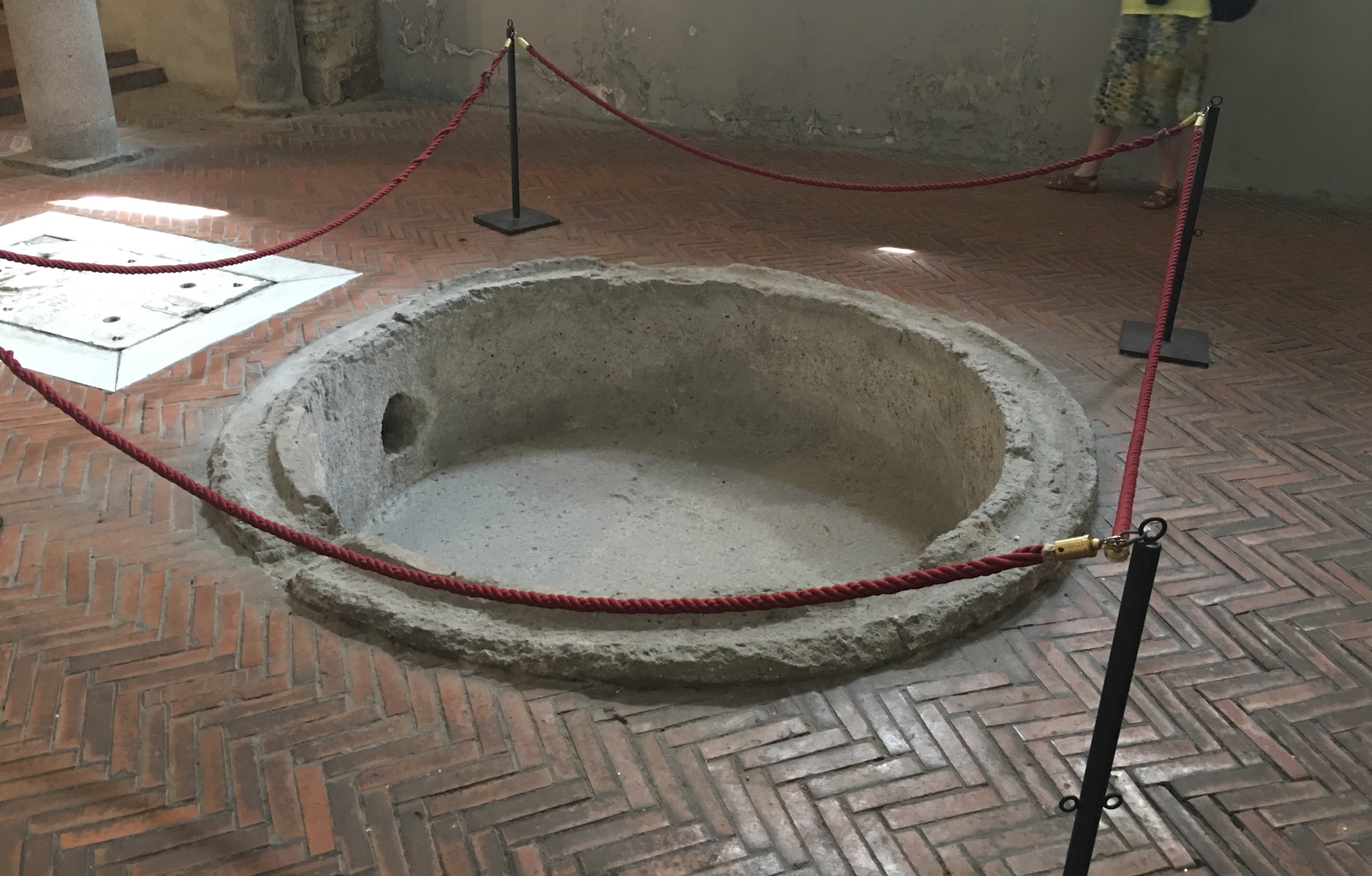
Perhaps the most significant feature of this cathedral is the baptistery, which is the oldest baptistery in the world, built in the fifth century, C.E. It is remarkable to connect with such an ancient symbol in a material form. 

When the baptized emerged from the water, looking upward at the ceiling, they would be encouraged in their faith; the first images they saw after being baptized were scenes from the Gospel expressed in Byzantine, mosaic art: Jesus saving Peter from drowning, the women at the empty tomb, the miracles of the multiplied fish, an image of Saint Paul, the Apostle, etc.

Seeing with my own eyes and touching with my own hands this font that was built by human hands only a few hundred years after Jesus, affirmed my conviction in the longevity and validity of the sacrament which has endured as profoundly meaningful for Christians throughout the millennia. 

I felt that faith is not just about the good old days when I was young, but the good old days when the Christian faith was younger. We are part of something much larger than our immediate reality. And, when we connect with that broader history, we realize it wasn’t always peaches ‘n cream and rose-coloured a history.

If you are movie watcher, you might recognize another cathedral we visited — the Duomo in the Umbrian, medieval town of Orvieto. 


This cathedral was featured in the opening scenes of Under the Tuscan Sun. This cathedral’s highlight is the Chapel of San Brizio, featuring Luca Signorelli’s brilliantly lit frescoes of the Day of Judgment and Life after Death. 

Although the frescoes refer to themes of resurrection and salvation, they do so through images not from the bible (that is, stories from the Gospels or Old Testament) but from the turbulent political and religious atmosphere of Italy in the late 1400s. Signorelli told the story of faith through his contemporary human events, rather than the traditional symbols (such as Jesus, God, the Trinity, the Apostles, disciples and other biblical characters) that we see in most other places.

Those frescos in the Orvieto cathedral chapel were snapshots of an historical era particular to a specific time and geo-political reality (i.e. 15th century Italy). And the impression of faith put ‘on it.’ Historical to us. Yet current to those who built that Cathedral in the Midlle Ages.

Faith is more than merely appealing to our past. Coming to worship today is not just about being reminded of something or someone from a long time ago. What we do here today is not just an exercise in recalling historical facts. As if decisions we make today are really not about faith. When we talk about our building renovations, worship practice and art, musical choices, communion, budgets, outreach initiatives  — these issues are very mcuh about the Christian faith ‘in the real world’, so to speak. All of these real things do reveal what we believe in, our values, what is important to us, who we are. How do these ‘mundane’ decisions reflect the Christian Gospel, faith, kindgom values in this time and place?

Lutherans make a similar mistake, I believe, when we define ‘Lutheranism’ as a belief/doctrinal system that is limited to the words and conceptual formulations of sixteenth century Germans. When we say that to be Lutheran is merely to ‘turn the clock back’ to 1537 when the Book of Concord was finally assembled including Luther’s Small and Large Catechisms, the Augsburg Confession, and the Apology to the Augsburg Confession.

I prefer a view that is reflected in the Evangelische Kirche Deutschland’s (EKD) logo for 2017, “Celebrating 500 years of Reformation”. Five hundred years of Reformation. In other words, Reformation started happening — in our tradition — with Martin Luther, yes. 

But, Reformation continued through the 500 years following, and continues to this day and beyond. We are always reforming the forms and means by which we express our evangelical, Gospel-centred faith. Always finding new and creative ways to tell the story of God.

What can we say, then, about Christian history? If we can apply a macro view over the ages, we can say that the history of the Christian faith is about a God who loves us. Christian history is about a God whose compassion never fails, who “will not come in wrath” (Hosea 11:9) — even though the people of God continue to keep “sacrificing to the Baals and offering incense to idols” (v.2).

The history of the Christian faith is about our lives being “hidden with Christ in God”, being “revealed with Christ in glory” (Colossians 3:3-4), dying daily to ways of sin and being renewed daily in Christ who “is all and in all!” — even though we are imperfect and sin as long as we hold breath. Christ is all and in all — despite us!

The history of the Christian faith is about how each moment of history — including this one right now — reflected Jesus’ love in the fifth century, the fourteenth century, the 21st century in Palestine, Egypt, Italy, Canada, etc. God for all times and places!

We validate the Christian faith by our lives today, now. This is where the rubber hits the road. This in-the-moment approach fuelled the generosity of medieval Catholicism represented in the magnificent building projects for worship as much as it did the passion and commitment of European Christians during the Reformation era.

We do not leave the practice of faith for some distant, utopic and dreamy future. Neither do we rest on the laurels of the tremendous sacrifices made by our forebears in Canada. 

Now is the time. Now is the time to live out of the conviction of God’s grace and love, despite the many and various ways Christians have messed up in history, and continue to do so today. Now is the time to live out of the faith that is full of hope, that despite our waywardness and unfaithfulness, God is faithful. Now is the time to claim God loves us, not because we are good, but because God is good. God is so good!

You know Jesus’ familiar exhortation, most often translated as “be perfect as your heavenly Father is perfect” (Matthew 5:48). Christians have often interpreted this word ‘perfection’ as being made whole. 

A much better translation might be: “be merciful.” Because this verse comes right at the end of a passage calling Christians to “love your enemies” (v. 43-48). Only God is perfect. But we can participate in God’s perfect mercy, God’s all-inclusive and impartial love.

Echoing Saint Paul’s words from the Epistle today (Colossians 3:11 — “Christ is all and in all”) St. Bonaventure later said, “Christ is the one whose centre is everywhere and whose circumference is nowhere.” [1] 

Christ’s mercy is everywhere evident in history. This is the Wholeness, the forgiveness, the grace, that holds you forever and everywhere. You can’t figure this Wholeness out rationally, nor can you control it. All you can do is fall into this Wholeness that holds you when you stop excluding, even the dark parts of yourself. [2] And that, my friends, is the Gospel — good news — for all times and places.

Thanks be to God!

1- Alan of Lille, ‘Regulae Theologicae’, Reg. 7 as quoted by Bonaventure, translated by Ewert Cousins, “The Soul’s Journey into God”, Classics of Western Spirituality (Paulist Press: 1978), p.100

2- Richard Rohr, “Daily Meditation on the Spirituality of Imperfection” Week 2 – Perfection of Wholeness, Thursday, July 28, 2016

Funeral sermon for an astronomer

Read Psalms 136:1-9 & 19:1-8

Rolf worked at many things. My impression is that he accomplished so much. Rolf was always on a project, whether clearing large rocks off his land, growing grapes, gardening, building structures, star-watching and -tracking.

His scientific mind, inductive reasoning and clarity of thought all translated into a degree of productivity not many of us will ever achieve. His gentle, methodical approach to his work reflects a state of mind that mirrors the great, spiritual giants of history.

Yes, spiritual.

Often science and religion have been pitted against each other in the philosophical and doctrinal wars of the contemporary age. And yet, in the lives of common people, we can begin to see that the two are not opposites in the seesaw battle for truth. Science and religion, in all truth, go hand in hand.

Some argue that besides the bible, no other book has likely influenced the course of western history more than the Rule of Benedict from the sixth century of the Common Era. Only some 13,000 words long, The Rule outlines instructions for the monastic tradition including prayer and work. In The Rule, Saint Benedict ordered the monks not only how to pray the Psalms, but how to work.

This work involved primarily manual, physical labour — fixing things, gardening, building. This work also evolved, happily, into artisan endeavours — wine-making, beer-producing, food preparing, and the such. Finally, the intellectual work of scribing and reading.

With singular attention focused on one task at a time, work becomes a contemplation. Even, you could say, a prayer. When it is done with joy and thanksgiving in each given moment. When we are present to our work, it is an offering of the natural rhythms of life, unfettered by distraction and self-consuming narcissism, which is often characterized by the demands and expectations of a hurried, anxious immediacy.

We remember and celebrate a precious life today. We recall moments that reveal a story of a person who reflects some of the best of what life and work is all about. Creation is indeed beautiful. God did good! And it will take eternity for us humans to begin to even scratch the surface of the brilliance and wonder of all that is.

The spirit of expansion, I would say, characterized Rolf’s life — a moving outward to include all, to embrace all, to reach to the farthest limits of all that we can know in God’s creation.

When Rolf was baptized at St James Anglican Church in Gatineau a few months after his birth, he was not only baptized into that particular faith community. His baptism signified his connection to the vast communion of saints. This community of faith spans the globe in all times and in all places. His baptism connected him to what Christians often call the ‘Body of Christ’ which has many members and includes all the baptized around the world: Starting here in the Ottawa region, and expanding outward.

In the funeral liturgy, one of the traditional prayers acknowledges the ‘mystical communion’ we all share in the Body of Christ. It speaks to the connectivity among all creatures.

Rolf’s passion for astronomy demonstrates this expansive spirit beautifully. The stars, of course, symbolize the mystery of heaven and God, and our human yearning for the unknown to become known. To connect to this great mystery, Rolf built his own observatory in the backyard of his house. 

And in 2005 he took a superb photo of Mars, his favourite planet. This image, which you see displayed here today, was possible because in 2005 Mars was in a close approach to earth at a high elevation — which means the angle at which viewing the red planet from the earth’s surface was exceptional.

Apparently Mars doesn’t behave like this every year. But in 2016, this year of Rolf’s death, Mars has again dipped close to the earth. Almost as if it was coming in to scoop Rolf up and connect his spirit once again to the vast universe, where now Rolf can see with his own eyes the expansive realm of God, whose love, mercy, and grace knows no limits.

Although we grieve a particular connection we have known with Rolf on earth these past six-plus decades, we touch today on the truth of the eternal connection we share with Rolf, all people, with all of creation and with God, forever.

Thanks be to God.

Turning into the wind

We were just down the street from Pearson International Airport in Toronto. Late in the evening after the first day’s sessions at the Synod Assembly last week, I walked along Dixon Road which goes right to the airport. 

At one point on a bridge you can stand directly underneath the path and roar of landing planes. You look west in the direction of the landing, and you see the long runway lighted brilliantly for the descending jets touching down. You look in the opposite direction towards the east, and you can see a long line of planes taking their turn in the landing rotation, the dots of their lights extending in a straight line far into the distant sky.

It was a windy day, the gusts reaching over 50 km/h from the south. What impressed me was how each plane’s nose was turned slightly to the left, towards the south, as they made their final approach. The planes were coming in on a straight line, yes, but turned towards the wind in order to keep their landing true. At the last second before touching down, the jet would straighten out.

Wind, like currents in the water, is a significant if not main factor in affecting the flight or sail of the airborne or water craft. In order to land safely and soundly, the planes had to face the challenging issue head on. In the words of Paul in his letter to the Galatians, the problem must be “detected” (Galatians 6:1) and exposed. 

You will get nowhere in a plane or boat unless you ‘dance with the devil’ so to speak. Unless you look your problem square on, face it and name it, and change your position accordingly. If the landing planes insisted on keeping their plane aligned straight on their approach, they would not have made their landing on the runway, but somewhere to the north of it!

Our guest at the Synod Assembly, Bishop Munib Younan (president of the Lutheran World Federation) spoke of Lutheranism. He warned us, that in these Reformation Anniversary years, we do not celebrate ourselves. We do not pretend that God couldn’t have done anything good without us. We are not the perfect church, but always reforming.

Being Lutheran, he said, is a call to humility, not a spirit of triumphalism. We dare not make an idol out of Martin Luther or his legacy in us.

Paul strongly exhorts the Galatian church to proceed with one another in humility and gentleness, not lording it over others who are ‘sinners’. Because we ourselves are no better. We must learn to face our own demons. This is what is meant by his words: “All must test their own work … for all must carry their own loads (v.4-5).” We dare not point fingers without first acknowledging our own stuff.

This is then, how we bear one another’s burdens. Amidst the conflict wreaking havoc in the early church in Galatia, Paul encourages the people to persist in not losing heart, to have courage and not give up.

As the Gospel text for today describes (Luke 10:1-11), the work of the church doing God’s mission in the world will result in friction and struggle. You cannot follow Christ and not encounter conflict and adversity in your life. 

The famous Psalm 23 so often associated with bringing comfort and evoking peaceful, calming images includes this disturbing verse: “You prepare a table before me in the presence of mine enemies” (Psalm 23:5). It feels like this verse doesn’t belong beside still waters and green pastures along paths of righteousness. But it does belong! It means that God gives us the gift of grace in the presence of all that challenges us, all our demons internal and external, everything that we may not like in our lives — not apart from it.

Paul concludes his letter to the Galatians by focusing our attention on the cross of Christ (6:12,14) — the symbol of death and suffering of a God who goes the distance to love us. This is the only reality about which to “boast”. Why?

There is a treasure in the midst of the suffering. We may not see it right away. Yet, our struggle does yield something good, something meaningful, something liberating. Yes, we are liberated by God’s grace. 

Liberated however not by ‘nicey-nicey, goody-goody’ — a phrase our Bishop Michael Pryse used at Synod to describe an approach to church life that just keeps us stuck. Liberated not pretending to live a charmed life. Not by everything working out perfectly. But liberated through what may be a terrible suffering, a loss, the very pain that would otherwise destroy a person altogether. There is a treasure therein.

That is why we boast of the cross, and nothing else. How can God be found in the painful letting go that marks the various stages of life? How can we even sense or feel God’s presence in the midst of a grief too heavy to bear? How can we move on through the turbulence of change and transformation?

In his short book, “Rules for a Knight”, actor-writer Ethan Hawke recounts the last words of instruction by a renowned knight, Thomas, to his children:

“There is a memory that won’t let me go,” Thomas begins. “Last summer all you children were playing by the ocean. We were with your mother and her sister’s family, do you remember? The weather was sublime, streaks of sun and a deep blue sky. You four and all your cousins were building castles with the warm, muddy sand. Each of you kept your castle separate, announcing, ‘This one is mine!’ ‘That’s yours!’ ‘Stay away from mine!’

“When all the castles were finished, your cousin Wallace playfully stepped on Cven’s. Lemuel, you flew into a protective rage. You were only looking out for your sister, I know. Mary-Rose, you thought Lemuel was over-reacting, and you threw him to the ground. Next, everyone was fighting, throwing sand, howling with tears, and pushing one another. Young Wally had to be taken home, sobbing in your aunt’s arms.

“When he was gone, you all went back to playing with your castles for a little while but quickly moved on to swimming. It grew cloudy, and soon it was time for us to begin the journey home. No one cared at all about their castle anymore. Idamay, you stamped on yours. Cven, you toppled yours with both hands. We all went home. And the gentle rain washed all the castles back into the surf.

“Please be kind to one another,” Thomas concludes. (1)

What are the castles in your life? Things or issues that in five to ten years won’t really matter anymore? Things for which you might lay your life down now in heated, compulsive reaction, but really won’t endure — material possessions, opinions that merely shore up a vulnerable ego, beliefs that have outlasted their use? A spirit of judgement and condescension towards people who do not experience life like you do? A reputation to defend at all costs? etc. etc. What are your castles in the sand?

“My friends,” writes Saint Paul, “if anyone is detected in a transgression, you who have received the Spirit should restore such a one in a spirit of gentleness.” Around the same time Philo of Alexandria wrote: “Be kind: Everyone you meet is fighting a hard battle.”

Turning into the wind may be a basic operation for landing a plane. When I face the wind and continue paddling or cycling into it, tears will come to my uncovered eyes. There are tears that come in the face of God’s Spirit, a Spirt that will blow down castles built in the sand.

This wind also has the power, like the Spirit of God, to build endurance, strengthen my inner life and take me where I need to go. If I stay with it, often more rapidly than I would on my own!

May God’s wind blow surely and true in your life this summer. May you receive grace in turning to the wind.

(1) – Ethan Hawke, “Rules for a Knight”, Alfred A Knopf, New York, 2015, p.148-149

The other side

In a Brazilian folk tale called, “The Little Cow”, a master of Wisdom was walking through the countryside with his apprentice. They came to a small disheveled hovel on a meagre piece of farmland. “See this poor family,” said the Master. “Go see if they will share with us their food.”

“But we have plenty,” said the apprentice.

“Do as I say.”

The obedient apprentice went to the home. The good farmer and his wife, surrounded by their seven children, came to the door. Their clothes were dirty and in tatters.
“Fair greetings,” said the apprentice. “My Master and I are sojourners and want for food. I’ve come to see if you have any to share.”
The farmer said, “We have little, but what we have we will share.” He walked away, then returned with a small piece of cheese and a crust of bread. “I am sorry, but we don’t have much.”

The apprentice did not want to take their food but did as he had been instructed. “Thank you. Your sacrifice is great.”
“Life is difficult,” the farmer said, “but we get by. And in spite of our poverty, we do have one great blessing.”

“What blessing is that?” asked the apprentice.

“We have a little cow. She provides us milk and cheese, which we eat or sell in the marketplace. It is not much but she provides enough for us to live on.”

The apprentice went back to the Master with the meagre rations and reported what he had learned about the farmer’s plight. The Master of Wisdom said, “I am pleased to hear of their generosity, but I am greatly sorrowed by their circumstance. Before we leave this place, I have one more task for you.”
“Speak, Master.”

“Return to the hovel and bring back their cow.”

The apprentice did not know why, but he knew his Master to be merciful and wise and so he did as he was told. When he returned with the cow, he said to his Master, “I have done as you commanded. Now what is it that you would do with this cow?”
“See yonder cliffs? Take the cow to the highest crest and push her over.”
The apprentice was stunned. “But, Master …”

“Do as I say.”

The apprentice sorrowfully obeyed. When he had completed his task, the Master and his apprentice went on their way.

Over the next years, the apprentice grew in mercy and wisdom. But every time he thought back on the visit to the poor farmer’s family, he felt a pang of guilt. One day he decided to go back to the farmer and apologize for what he had done. But when he arrived at the farm, the small hovel was gone. Instead there was a large, fenced villa.

“Oh, no,” he cried. “The poor family who was here was driven out by my evil deed.” Determined to learn what had become of the family, he went to the villa and pounded on its great door. The door was answered by a servant. “I would like to speak to the master of the house,” he said.

“As you wish,” said the servant. A moment later the apprentice was greeted by a smiling, well-dressed man.
“How may I serve you?” the wealthy man asked.

“Pardon me, sir, but could you tell me what has become of the family who once lived on this land but is no more?”

“I do not know what you speak of,” the man replied. “My family has lived on this land for three generations.”

The apprentice looked at him quizzically. “Many years ago I walked through this valley, where I met a farmer and his seven children. But they were very poor and lived in a small hovel.”
“Oh,” the man said smiling, “that was my family. But my children have all grown now and have their own estates.”

The apprentice was astonished. “But you are no longer poor. What happened?”

“God works in mysterious ways,” the man said, smiling. “We had this little cow who provided us with the slimmest of necessities, enough to survive but little more. We suffered but expected no more from life. Then, one day, our little cow wandered off and fell over a cliff. We knew that we would be ruined without her, so we did everything we could to survive. Only then did we discover that we had greater power and abilities than we possibly imagined and never would have found as long as we relied on that cow. What a blessing from Heaven to have lost our little cow.” (1)

This story is not a prescription for how the church or society should treat economically disadvantaged, underprivileged people — by ignoring their plight and expecting them to pull themselves up by their own bootstraps. 

Instead, I offer this story as an allegory, a parable, of whatever it is in our lives that keeps us bound, that keeps us stuck. 

The cow, in the story, represents that which the farmer believed would help them survive in the big, bad world. And without it, they would be lost.

What is ‘the cow’ in your life? Whatever you believe you cannot live without. What keeps you bound, shackled in a sense? It may not appear or even be a bad thing. It can be the ‘best’ thing in your life, you will say! And that’s point of the fable.

The cow was the only thing, the best thing, the poor family had going. In our lives, it can be the relationship we have with our work. It can be a person. It can be some activity of our lives that we think we want and need. What is the ‘cow’ in your life — things to “let go ” of, either in church life or your personal lives, that would enable the freedom of God to operate?

Letting go of over-attachment to building? Property? Material riches? Some significant aspect of your financial portfolio?Clutching on to church programs and processes that have had their day, making room for something new?

It could even be your reputation, your status, or social position. Whatever it is …

If we should lose that, why would God want that for us? And when we do lose it, we may be angry at God for taking it away from us. We may shake our fists at God, walk away in disgust and anger, never to darken the door of a church again. We may be blind to the possibilities on the other side.

In the Gospel text today (Luke 8:26-39), Jesus travels to opposite side of Lake Galilee. He goes to what I will call ‘the other side’, where the people in the Gentile territory there respond to the miracle of exorcism with fear. The man they knew to be living on the outskirts of town, out of his mind, full of demons — now sat at the feet of Jesus “in his right mind” (v.35).             

Odd as it may sound, we often prefer the devil we know to the freedom we do not. We can take a false sense of security from the patterns of our lives we learned to cope with over the years. 

And we may fear what change — even change for health — may bring. Because that would mean losing that which we have grown accustomed, even cherished, for a long time. We keep ourselves from seeing the possibilities on the other side.

The truth of the Gospel of Jesus Christ reverses the fortunes of those in low estate. The “good news to the poor” which Jesus announces in his inaugural speech (4:18) becomes a reality in the healings and exorcisms that follow in Luke’s Gospel.

But this freedom and health does not come without major disruption in people’s lives. This is the part we like to dismiss in our “feel good”, “prosperity-gospel” driven culture of church in North America. 

Because to the people whose living depended on the pigs — those pigs who ran off the edge of a cliff to their deaths — their loss is catastrophic. The swineherds in the Gospel story are understandably afraid, too, even angry at Jesus. And despite the healing, they want Jesus to leave them (v.37).

The story demonstrates that the the Gospel brings upheaval and sets in motion powerful forces that will disrupt our lives. 

At first, the good news of Jesus will not seem good to everyone. At first, our economic and social lives are put on their heads. At first, we will experience pain and suffering. We will need to surrender that which has given us a sense of security in life. 

We cannot have Easter without “Good” Friday. The cross precedes the empty tomb. The way of salvation goes through suffering, not around it. We cannot avoid pain in our journey towards liberation, healing and salvation.

The good news is the promise that there is no darkness, no loss, no pit too deep that God will not go into, in order to carry us through to the other side.

(1) cited in Richard Paul Evans, “The Walk” Toronto: Simon & Schuster, 2010, p.285-288

Happy Birthday! (funeral sermon)

“Jesus said to her, ‘I am the resurrection and the life. Those who believe in me, even though they die, will live, and everyone who lives and believes in me will never die. Do you believe this?’” (John 11:25-26)

It may seem strange to say this, today: On a day we mourn at the death and loss of a loved one. A loved one, nonetheless who lived to a 103! A loved one whose 104th birthday is today! “Happy birthday Wilma!”

When we say a funeral service is a ‘celebration of life’ we affirm this with mixed feelings, to be sure.

Kind of like the other paradoxes in our lives: Because, for example, we know that we are better fulfilled in giving rather than receiving. Because, as people of faith, we know that it is in dying that we live — on many levels.

That is why a funeral service is like an Easter service when we celebrate the resurrection of Jesus. That is why, the day Jesus died on the cross is called “Good” Friday. Talk about paradox.

So, with confidence, we gather today to have a birthday party. Because Wilma, a person of deep faith in the living Lord, lives today in heavenly glory! 

Happy birthday Wilma!

At birthday parties we often tell stories about the person’s life, to date. There is one story from early on in Wilma’s life that I wish to highlight: When she was five years old, the windows of the Halifax house she and her family were living in blew inward, planting shards of glass deep in the layers of the skin on her head. She and her family survived the famous Halifax explosion.

Until Wilma was well into her 40s she was pulling little pieces of glass from her skin. For a large chunk of her life, especially in her formative years, she had to live with this reminder of her near death experience at such a young age. She was, in the first part of her life, regularly made aware of the fragility of her life and the reality of her mortality. That with each step we take in life, death walks along close by. Maybe that’s why she lived so long.

We try to avoid death. We deny it at every turn. We don’t want to see it. And yet, in avoiding death we also avoid living. Living to the upmost. The key to a rich life is to be aware that our death is only one breath away. 

It is common knowledge that the most effective, greatest and skilled soldiers in history were men and women who were willing to die in giving themselves to engage each combat situation. When you accept your own death at any given moment, then you can truly live.

An incredible paradox, isn’t it? How can we live in the ambiguity, uncertainty and mystery of this reality?

Wilma, as I said, was a woman of deep and enduring faith — through it all. It’s amazing when you think about the history she lived through: the rise of the automobile; the radical advance of technology from wires to the digital age; the many wars and two world wars of the last century, the Depression and economic ups and downs, the social revolutions. Through it all, she nurtured, and was nurtured in, a life of faith in the God who died in order to live.

Perhaps a deep knowing of this leads one to bless others. Indeed, this is how I got to know Wilma in these last four years of her life. Mostly through touch. In the tradition of the church, a blessing of healing and grace was given primarily by the ‘laying of hands’. It was a challenge to communicate with her, and yet, experts affirm that 70% of communication is non-verbal.

Wilma’s image of God was of a gracious, giving, loving God. She bristled at me early in our relating when I said the version of the Lord’s Prayer that has the line: “Lead us not to temptation …” She stopped me right in the tracks of that prayer, right there: “Stop,” she said. “God does not lead us to be tempted!” she objected. So, we changed the words. And that is why you read a slight variation in that sentence in the liturgy today.

God is a God of compassion and caring. God loves. Even when we can’t. Even when our love is imperfect and fraught with our own sin and misgivings. God comes to us first with a word of compassion, healing and mercy. This is the God Wilma believed in.

Her mission in life, in the last few years, was to bless others who cared for her. I learned this when she was at Fairfield Manor in Kanata, that she would routinely bless the nurses that attended to her. 

And after our many visits there, she would lean close to me and kiss me on my forehead. She said: “That’s the kiss of Jesus, saying that he loves you. And I do too.”

I responded: “I love you too, Wilma.”

Then, ever true to her belief, Wilma said: “That makes the Holy Trinity — three loves!”

Perhaps, then, Wilma leaves us with the legacy of faith that doesn’t pretend life is meant to be perfect. Because she wasn’t. But life is meant to be lived as long as we are given breath, in order to be a blessing of love to one another, as best we can.

Because God does.

Amen.

Grace precedes

Everyone was excited, but not sure what it was all about. In the centre of the room was a big box of balloons that had not been blown up yet.

The team leader asked each person to pick a balloon, blow it up and write their name on it. About 30 team members were able to get their name on a balloon without it popping. Those 30 were asked to leave their balloons and exit the room. They were told they had qualified for the second round.

Five minutes later the leader brought the team back into the room and announced that their next challenge was to find the balloon they had left behind with their name on it, among the hundreds of other balloons scattered in the large cafeteria. She warned them however to be very careful and not to pop any of the balloons. If they did, they would be disqualified.

While being very careful, but also trying to go as quickly as they could, each team member looked for the balloon with their name. After 15 minutes not one single person was able to find their balloon. 

They were not able to do it, because they were stuck looking only after their own interests as individuals. They couldn’t think collectively. They presumed they needed to do it all on their own, according to their interpretation of the rules of ‘the game’.

To me, the first two rounds of this game can be seen as a snap shot of the values of our culture and society. After all, there are ‘rules’ in our society. There are accepted ways of behaviour. There are the social norms and laws that bring at least a sense of order to our lives. One such norm, is the belief that we have to make it all on our own in this world.

We tell ourselves that competition and individualism are healthy and good, especially in the youth of our lives.

I grew up competing with my twin brother, David. Throughout our lives whether we were playing games, musical instruments and sports, doing our homework, achieving success at school, writing exams, making life choices — underlying our relationship was this competition. Always comparing and contrasting. While motivating and stimulating, ultimately it has become not always helpful, even a burden — as a foundation for our relationship.

When considering the doctrine of grace, based in the biblical witness of Paul’s letter to the Galatians, we often skim over and even neglect the original social context of Paul’s writing. We get excited debating the doctrine of Justification by Grace posited here — especially as Lutherans. Yet to do so without first examining what was going on in the early Christian community, we can miss its original meaning:

At the time of writing Galatians (2:15-21), Paul and Peter were in a bit of a conflict. They represented two, competing views of how the mission of Jesus should be carried out.

For Peter, the disciple chosen by Jesus to be “the rock” upon which the church would be built (Matthew 16:18), he was influenced by some Jewish-Christians in Jerusalem who insisted that true converts to Christianity should first follow all the rules of the Jewish tradition — since the first disciples and Jesus himself were Jews.

When Paul and Peter met in a town called Antioch in those early decades of the first century, they confronted each other on this point. Because, for Paul, the Gospel of Jesus Christ was on the line. He argued that Gentiles, who weren’t Jews, didn’t have first to be Jewish before becoming a follower of Jesus. If Christianity followed Peter’s bent, Gentiles could barely attain the status of second class citizens.

Later, Paul won the argument. Paul was a multi-culturalist far ahead of his time. Paul saw Jesus as the fulfillment of the long arc of God’s love and God’s inclusion, an arc bent toward making Gentiles full members of the family without preconditions. (1) Inclusion. Unconditional love. These words are signposts for the theology of grace, in Paul’s view, reflecting the way Jesus related to others.

If we begin with faith and grace, we can inhabit our traditions and rules more lightly. But it starts with God’s grace, for all people.

When I was in Clinical Pastoral Training at the Ottawa Hospital as part of my preparation for ordained ministry back in my seminary days, I was reminded of the truth of Christ’s presence and grace, which precedes mine.

I was advised, before entering the room of a patient, to stop for a moment. And bring to mind and heart this truth: Jesus is already in the room before I enter it. Jesus is already there, waiting for me. I do not bring Jesus with my charisma, eloquent words, magnetic personality, comforting presence. All these things may help, and may be true to some extent! 

But I don’t create Jesus. Jesus creates me. The patient I visit, along with me, are already in the presence of Christ. “It is no longer I who live, but Christ who lives in me,” Paul writes in his letter (2:20). Grace precedes everything I am and do.

When Jesus accepts the woman’s extravagant and outrageous offering of foot-washing with the gifts she has been given (her hair, her love, her touch, her tears), he is being inclusive and loving unconditionally. 

Jesus is not making the woman first follow a bunch of religious rules or follow accepted social norms before letting her come near and even touch him. (Luke 7:36 -8:3) Jesus is not requiring her to provide a government-issued I.D., proof of baptism certificate or a list of all the good deeds she accomplished and the churches she has attended.

The only requirement Jesus seems to accept is that she is honest, vulnerable and open about her sinfulness. Because only honest sinners can appreciate the gift of grace, it seems. The one who is forgiven the greater debt, shows the greater love (Luke 7:47).

What will we do when we see a homeless person, notice the addict, rub shoulders against a divorced person, or sense the struggling and pain in another? Will we ignore the other, suggesting “it’s none of my business”? (that statment reflects a major social norm in today’s society, you know!). 

Or, will we approach the person, confident that Jesus is already there? Will we approach the person, take a risk, and ask a question motivated by love and trust in God? Will we approach the person, aware and honest of our own sinfulness? Aware of the forgiveness we have been given?

We are not alone. We all stand on the same, level playing field in God’s kingdom. That is why we have the church. That is why we gather each week to feed at the Lord’s Table of grace and Divine Presence. We are not alone. We have each other, in the Body of Christ.

After the team who couldn’t find their balloons in the cafeteria was told that the second round of the game was over, they moved on to the third and final round:

In this last round the leader told the team members to find any balloon in the room with a name on it and give it to the person whose name was on it. Within a couple of minutes every member of the team had their balloon with their own name on it.

The team leader made the following point: “We are much more effective when we are willing to share with each other. And we are better problem solvers when we work together, helping each other.” We are able to do what we are called to do in Christ, when we work together for the sake of each other, in God’s mission on earth.

Because Jesus’ love, grace and presence await us in the room, at the table, in the world, beckoning us to come.
Amen.

(1) – Gregory H. Ledbetter, in David L. Bartlett & Barbara Brown Taylor, eds., “Feasting on the Word, Year C, Volume 3”, WJK Press, Kentucky, 2010, p.137

No life insurance

It’s like the spirited game parents play with their young children.

I remember years ago when the kids were still in diapers tossing our little ones up into the air, and then catching them on their way down. What makes this game so delightful is to watch the expression on the face of the child. If you slow-motioned the activity and zoomed in on the facial reactions of the child at each stage of the ‘throw and catch’ game, you would see a contrast of emotions:

From the catch to the upward toss, a smile and squeal of joy; from the falling motion to moment of catch, a growing sense of alarm as the eyes widen in concern and fear begins to creep into the picture. But, then, again the catch. And the grin returns. And the game resumes.

Can you imagine being the widow in the Gospel story (Luke 7:11-17) who has just lost her only son? Having lost her husband is one thing. You think it cannot get any worse. Yet, as is often the case in life, it does. Now her son. She feels the sharp edge of grief once again. Perhaps more deeply for the child she gave birth to, and raised with all her mother’s love.

Not only a personal grief, but the prospect of living in extreme need. Being a widow in 1st century Palestine was usually a ticket to poverty and low social status. A woman’s economic worth was almost always tied up in the men of her household — her husband or eldest son. This was much more than personal, emotional grief. This was a complete life-style change, from top to bottom, in a heart beat.

After meeting Jesus, however, things change so rapidly. From a season of mourning and grief, to the astonishment and wonder of joy: Her son is no longer dead, but alive! No longer is she alone, vulnerable, a burden on society, worthless in the economy and social structures of the day. Now, she has her son back. She has family. And that means the world to her!

Although something has changed. This new thing is also scary. All who witnessed the miracle were filled with fear (v.16). What does this second chance at life mean? Things will be different now. No longer like the good old days.

The rapid and extreme change of emotions could make her feel like a yo-yo. Maybe life sometimes feels like that for you. From moments of exquisite satisfaction, pleasure and joy, to the dark caverns of grief, depression, loss, suffering, fear and pain. Life. Death. Life. Death. Life. Death. Life. 

In my first parish, which was in rural southern Ontario, burials were conducted (except during winter months) immediately following the funeral service in the cemetery right beside the church building. The recessional with casket proceeded to the grave side where the words of committal, prayers and scripture readings were offered. 

But then, the family stood by as the grave-diggers and funeral attendants lowered the casket, suspended up until that point on winches and ropes, down into the hole. In some cases, I had to assist by moving the casket into place as it slowly lowered. Once resting on the ground inside the hole, a family member used a spade to throw the first shovel-full of earth onto the casket — a symbol of the family participating in burying their loved one.

Today, especially in urban centres where funeral services are highly managed by market-driven professionals, most often the family leaves the grave-side before the casket is lowered and actually buried. I wonder about how the smallest of acts reflects our attitudes towards death and loss. 

Perhaps we can’t ‘go there’ emotionally so soon after losing a loved one and have to insulate ourselves in order to cope. The funeral rite therefore serves more as an anesthetic against the harsh reality of death and loss. I wonder: Does the experience and ritual of funerals only end up buffering the hard, emotional impact of loss?

Perhaps we are not used to ‘losing’, letting go, failing, surrendering, being powerless, vulnerable, at ground zero. We have little in life to practice this letting go before the final experience of losing a loved one. And perhaps healthy religion, as Richard Rohr claims, is about showing us what to do with our pain.

Is this too difficult an expectation of our faith? Because in making religion only about ‘feel good’ ‘warm fuzzies’ we might maintain our denial of life’s realities and only distract ourselves from truth. And that’s not what Christian faith is about — distracting us and keeping us from the rhythms of life, death, life, death, life.

Because in avoiding death, we also ironically, avoid life. And Jesus is about life. When we say this Gospel story is first and foremost about a miracle, we may be missing the point. It’s understandable that we do, because it is sensational. It captivates our imagination.

Focusing only on the miracle may just play into our fear and avoidance of death. As if to say Jesus performing this miracle was done for the boy’s sake. The enemy, death, was conquered! Therefore we can go on denying death. As if the boy will never eventually die an earthly death. As if to say Jesus performed this miracle solely to convince us to ‘believe’ in him — because no one else could do so (even though there were magicians/soothsayers and other miracle workers who performed incredible acts in Jesus’ day).

But the miracle, per se, is not the point of the story. Jesus raised the son from death not merely to show his divine power but to express his love and concern for the widow. He had compassion on her (v.13). And he couldn’t stand the thought that she would have to go it alone in a culture that marginalized the widow. Jesus brought the son back to restore a relationship, for living in the world.

God tosses us into the air. God throws us into the thick of life with all its challenges, disappointments, failures, weaknesses, joys, hurts, loves, pleasures and pain, satisfactions and accomplishments. God throws us into the air to experience fully this life we have been given. Life, death, life, death, life, death …

Then, to our happy amazement, God catches us again at just the right moment. God cares about what happens to us in our lives. God is interested in every minute detail and event in our lives — even those things we would rather cover up and hide in the darkest recesses of our hearts. God’s light exposes those secrets, even. We may feel vulnerable, challenged, unsettled for a time. And we may even wonder if we won’t just crash and burn on our way down.

Have faith in the One who’s tossing you. Because it’s part of life, for one thing. But most importantly, because God loves you and will quite unexpectedly be the One to catch you, at just the right moment.

Better together

The story is told of a wide-eyed enthusiast who visited Mother Theresa in Calcutta. Over the last century, Mother Theresa has been admired by Christians worldwide for her dedicated, self-giving work for the poorest of the poor in India.

The young man approached Mother Theresa and said, “You couldn’t pay me a million dollars to do what you do.”

Mother Theresa, not missing a beat, replied, “You couldn’t pay me a million dollars to do what I do either. I do this because I was made to do it.”

When we speak about the Holy Spirit in this season after Pentecost, we speak about the breath of God breathing in us. The Greek word for “spirit” is pneuma, which means “breath.” 

Breathing is one of those automatic, biological responses that we don’t even have to think about. It is natural and does not really take any effort at all. We are seldom aware of our breathing. And yet, it is vital to our health. Breathing is critical to our very life and purpose.

You could say, we are made to breath.

And yet, though breathing is integral to our life we may forget the gift that is in us: The gift of the Holy Spirit. We forget that living in the Spirit is as natural as breathing.

The Spirit of God is like our breath. “God’s spirit is more intimate to us that we are to ourselves,” writes Henri Nouwen. “We might not often be aware of it, but without it we cannot live a spiritual life. It is the Holy Spirit of God who prays in us, who offers us the gifts of love, forgiveness, kindness, goodness, gentleness, peace, and joy.” (1) 

Breathing is so essential for life that we only think about it when something is wrong with it. When disease, shock or accident leaves us without breath. When breathing becomes laboured. When oxygen levels are critically low in our bodies. When something we have taken for granted for so long no longer works, then what?

The way to arrive and remain in the Holy Spirit of God is both very simple and very hard: We have to remain in love. Breathing the Spirit of God’s love nips negativity, hatred and violence in the bud. It begins by retraining our initial thoughts.

We can’t risk walking around with a negative, or resentful, or gossipy, or critical mind. Because if we let the mind operate in a paranoid, angry, and resentful way, we aren’t going to breathe the Spirit of God. We won’t be breathing. We can’t be God’s usable instrument. 

That’s why Jesus commanded us to to love. It’s that crucial for life. Like breathing. That love can begin in the mind. As Eleanor Roosevelt apparently said: “Watch your thoughts; they become words. Watch your words; they become actions. Watch your habits; they become character. Watch your character; it becomes your destiny.” (2)     

In Jewish tradition only the consonants for Yahweh were printed in the Hebrew text – YHWH. As such, this most holy name for God was unspeakable. Interestingly, even the Hebrew consonants used in YHWH do not allow you to close your lips when you try to speak them.

We cannot confine God in one place as much as we cannot contain breath. We cannot point to one specific place and say, “God is there!”, turn around, point in the opposite direction and say, “And God isn’t there!” We can’t dare try to close our lips over breathing and pretend we have God all figured out! Identifying with God since ancient times was simply the intake and exhalation of breath. The great “I AM” was the breath itself.

It is the great mystery we enter into when we follow Jesus. Someone said, “life is a mystery to embrace, not a problem to be solved.” God is always beyond us but totally around us, within us and outside of us. And we all share in that same air and that same breath. It is the first thing we did coming out of our mother’s womb, and there will come that moment when we will do it for the last time.

But in between, we continue to take in the breath of God and exhale the breath of God – the totally accessible One, the totally given One, who like breath just waits to be received. Waits to be engaged. In bold acts fuelled by love for the other.

The late Swedish Lutheran bishop, New Testament scholar, and pioneer in Lutheran-Jewish relations, Krister Stendahl, gave helpful advice in this regard. How is it we can love others who are so different from us, so unlike us? Because it is easy to ignore, write off, dismiss and be critical of them.

To Christians living in a diverse and multi-religious environment, Stendahl encourages us to cultivate an attitude of ‘holy envy’ (3) towards the other. That is, we first recognize the gifts, the positives, that the other offers by their life. Rather than thinking first we need to persuade them that ‘they are wrong’, we first seek understanding based on admiring a gift they have. What does the other offer that I/We do not have? Because others have gifts I/We do not have. So, what is it the other has, that is good?

In such a way we begin to see the image of God reflected in creation — in others who are different. We begin to practice seeing Christ in the other. We begin to see the unity we share in the purpose of God, the mission of God. It takes us working together, each with their gifts, to make it happen.

This mysterious God we worship chooses to self-reveal as the Trinity — three persons in one. In other words, this one God we worship is a holy relationship. God the Father, God the Son, and God the Holy Spirit must function together by nature.

So, too, we must learn, practice, be intentional, about being in relationship with one another: working together, breathing in together and breathing out together the love and purpose of God on earth.

Once there was a Washer-man (a man who washes others’ clothes for hire) who was raising two donkeys. One he called Donkey-A and the other Donkey-B.

Donkey-A felt he was more energetic and could do better than the other donkey. He always tried to get the Washer-man’s attention by taking more of the load and walking as fast as he could in front of him.

Donkey-B was just a normal donkey. He tried as hard as he could, but he couldn’t carry as much as Donkey-A or impress the Washer-man by walking in front of him.

One day Donkey-B was crying and asking Donkey-A to help. He said, “Dear friend, it is only the two of us. Why do we compete against each other? If we worked together we could carry an equal load at a normal speed.”

Donkey-A became even more competitive after that. The next day he boasted to the Washer-man that he could carry more and run faster than Donkey-B, and he did.

Under the pressure Donkey-B collapsed in great fatigue and quietly passed away. As a result of the collapse, Donkey-A felt like he was on top of the world, having proved his superior skills and abilities. 

But now he also had to carry Donkey-B’s load.

For a short time Donkey-A was able to carry both loads, but he eventually became fatigued and weak. Finally the day came when the Washer-man was tired of this fatigued and no good donkey. He put him to pasture, and went searching for some other pack donkeys to get his work done.

The moral of this story is, you can’t do it alone. If we are made to breathe the Spirit of the triune God, we are by nature ‘relational’. It is important to learn how to work well together.

Worrying more about individual performance, taking all the credit and trying to do more than you are capable of doing eventually comes back and bites us one way or another. Christians, at their best, are team players.

Donkey B may not have been the strongest nor the fastest, but he was consistent. Everyone brings something valuable to the table. And so do you. Just because you may be different from others, doesn’t qualify you or them to be in competition nor be shunned.

Stronger together. Better together. This is what we were made for.


(1) Henri Nouwen, “Bread for the Journey; A Daybook of Wisdom and Faith”, HarperSanFrancisco, 1997, May 18

(2) cited in “Richard Rohr’s Daily Meditation” Centre for Action and Contemplation, May 19

(3) cited in Kristin Johnston Largen, “Interreligious Learning and Teaching: A Christian Rationale for a Transformative Praxis” Fortress Press, 2014,page 4

The gift of the White-breasted Nuthatch

I walk quickly. In the first hour of walking I can manage 6 kilometres. Pretty impressive, eh? Well, I was zipping through the treed park near our house the other day when I heard birds rustling and chirping in the branches above me. 

I stopped when I noticed a small bird scampering down the trunk of the tree head-first. This tiny bird caught my attention. It had a disproportionately long beak, a black cap and a white breast. I memorized the details of what I saw, and scurried home to consult my three, different bird books.

It was a White-breasted Nuthatch. I was so thrilled to have made that identification. I love birds, and I enjoy the challenge. Most of the time.

I’m by no means an experienced, knowledgeable birder. Because most often I forget the names of the birds I identify or mis-identify. Because I don’t carry around with me my bird books and note pads wherever I go, I have to hone my skills of observation and memory. There are times even when my bird books don’t display sketches or photos of what I think I saw. That’s really frustrating!

When Paul and Silas were thrown into prison after being flogged for disrupting the peace, their future was uncertain at best, an absolute failure at worse (Acts 16:16-34). They were done, or so it seemed. The prospects of continuing their missionary journeys looked bleak no matter how you looked at it. What could they do?

I bet no one expected that earthquake to come when it did. A natural disaster always comes unexpectedly. The severity and life-changing magnitude of an earthquake, for example, cannot be predicted. It’s only after-the-fact when assessments and conclusions of what happened can be made. 

No one could see it coming the way it did: The fires in northern Alberta around Fort McMurray, despite the dry hot Spring, could not be predicted. Who could forsee precisely how it’s actually played out, and continues to play out? It just happens. And people have to react to the moment, when it does.

Despite the life-changing magnitude of events unfolding around Paul, he still seems to find stride in his faith, and yes, even joy. He shows resilience in faith. Despite all the losses, earthquakes, imprisonments, floggings, shipwrecks, rejections, threats on his life, thorn in his side — he still demonstrates an incredible passion for, dedication to, and joy in his life in Christ.

They are in the Roman colonial city of Philippi when Paul and Silas are arrested. Paul’s famous letter to the Philippians was written, later, when Paul sat in a Roman prison cell. And it is in this letter where we find some of the most joyous and aspirational words from Paul’s hand: 

“Rejoice in the Lord always; again I will say: Rejoice! Let your gentleness be known to everyone. The Lord is near. Do not worry about anything, but in everything by prayer and supplication let your requests be made known to God. And the peace of God, which surpasses all understanding, will guard your hearts and your minds in Christ Jesus.” (4:4-7)

Paul is instructing his good friends in Philippi, and followers of Christ in all times and places, to rejoice — not when everything is perfect, not when your problems have been resolved, not when certain conditions have been met, not when we are prepared for rejoicing, not even when the stars are aligned.

But, to rejoice, precisely when things are chaotic and messy. Rejoice, precisely when things are not going well, nor planned, nor pre-conceived, nor forseen. How is this even possible?

When installing our new dishwasher recently, I screwed clamps into the cabinetry on both sides. Tightly.

When I ran a cycle for the first time, water started streaming out the side of the door. It’s as if the door wasn’t even sealed! I discovered later that because I had fastened the clamps too tightly, the whole unit twisted and warped the door in an unnatural way and therefore could not seal properly and do its job. 

As soon as I loosened the screws a bit so that the dishwasher could rest naturally, evenly and squarely on the floor, everything worked fine.

Indeed, to be faithful is to know how to celebrate, even in difficult, unpredictable times. Trying too hard without a break can actually damage our commitment in faith. 

When things don’t go well, is it that we are trying too hard? Or believe the solution is simply to work harder? And then do we get all tense, anxious, impatient and frustrated when nothing in our power seems to work or when things don’t always go the way we planned? And we don’t ask for help. Or recognize or confess openly our limitations. Who do we think we are?

Especially during the long journey of a dark night of the soul, it is vital for our health to pause from time to time, loosen the screws, and lighten up a bit. Doing so will improve our endurance, open our hearts, deepen our trust in the good Lord who comes to us, who is alive and lives in us.

It is the freedom of God who comes to us, quite unexpectedly. Like the gift of the White-breasted Nuthatch. All I needed to do, was to stop my rushed march through the woods. Stop my over-thinking, incessant mental machinations. 

Just stop, and look up.