Buen Camino!

When in Sunday School decades ago we played the roles of well-known bible characters, I remember the only thing worse than being a “Judas” was to be a “doubting Thomas”.

We wanted to be Abraham, Moses, Kind David, Samson, Queen Esther, Rachel, Ruth, The Magi, Peter, Paul, John. We wanted to be Joseph or Mary, or even Jesus himself!

But Judas the Betrayer, or Thomas the Doubter? No. Indeed Thomas has been treated quite negatively in much of Christian preaching and teaching. He is often held up as a negative role model.

Let’s take a closer look at the text about Jesus’s resurrection appearance to his disciples (John 20: 19-31). Because there is no condemnation of Thomas. Recall the disciples are hiding behind locked doors in Jerusalem fearful of the authorities. Unless Jesus’ words to Thomas are inflected in an accusing way, they do not need to be read as a condemnation: “Have you believed because you have seen me? Blessed are those who have not seen and yet have come to believe” (John 20:29). They simply affirm that those who believe without first-hand experience of the risen Jesus are also blessed. (1)

But can we blame Thomas? Thomas only desires his own firsthand experience of the risen Jesus. He is unwilling to accept the secondhand testimony of others. And, his desire is granted: Jesus appears to him. Prayer answered!

I wonder if Thomas today doesn’t really represent so many of us who deeply yearn and seek for a first-hand experience of God, and are simply and naturally unsatisfied with hearing it ‘second-hand’. Hearing someone else’s first-hand experience of God is inspiring and instructional to be sure. We learn about someone else’s experience of God’s presence, healing, grace and wonder — whether that person is from the bible or our grandparents or the person sitting next to us in worship. But someone else’s experience of God can never be a substitute for our own.

What we may be looking for, is to be more like Thomas: Honest in our desire for a first-hand experience of the living God. Yearning to taste and feel more of the goodness of God in our own lives and in the world. Striving ourselves to make the world a better place for everyone. We may be unsatisfied with basing our commitment to a life of faith on someone else’s testimony. We may, like many people today, be seeking our own experience of God and suffer from what I would call the ‘second-hand syndrome’. Perhaps Thomas needs to be our role-model more than anyone else in the bible today!

Of course, the benefit of the Reformation was to teach us an important distinction in all our striving: Our motivation is important to be aware of, because if we strive to do good all in order to make ourselves right before God we will most certainly miss the mark. “We confess that we are captive to sin and cannot free ourselves,” we say in our Confession. God initiates the saving relationship. God moves; we only second the motion.

And yet, our striving, our trying, our good work as response to God can help create the space and the climate in which God’s grace is made clear to us, is given to us, and in which we are most ready, then, to receive God’s forgiveness, love and mercy. Being pro-active, doing things with one another in the church, yearning and striving for God — these are antidotes to the ‘second-hand syndrome’ and a prescription for a healthy life of faith.

Last week on the first Sunday of Easter, I emphasized the words from Matthew’s account of the Resurrection of Jesus outside the empty tomb that first morning. Jesus instructs the women: “Do not be afraid; go and tell my brothers to go to Galilee; there they will see me” (Matthew 28:9-10).

When resurrection happens today, as it always has beginning with that first day, there is movement forward. Not backward. As I said last week, there is no turning back once resurrection happens. The disciples are not instructed to meet Jesus in the empty tomb where the miracle happened. No. The instruction is quite clear: Get moving! Get out of here! Go to Galilee. Go to where I wait for you. In other words, don’t stay where you are! Do something!

In 2017 the Lutheran Church worldwide celebrates the 500th anniversary of the Reformation. We call it Reformation 500. ‘Five hundred’ is an important number in all the dialogue surrounding this momentous occasion. The national church has even set up the Reformation Challenges for the church across Canada to meet. And each of those goals are pegged at some variant of 500:

Five hundred refugee sponsorships (which already has been exceeded), five hundred scholarships for school children in the Holy Land, five hundred thousand trees planted in Canada, and five hundred thousand dollars raised for the Lutheran World Federation endowment. You can visit elcic.ca for the most recent update on where we are at in meeting all those goals. And please consider making a personal contribution towards any one of those worthwhile causes.

I’d like to up the ante. Let me call it the ‘Reformation 800 Challenge’. Eight hundred is the new Five hundred. Not only are we celebrating 500 years of Reformation this year; we turn to the future and pray not just for 500 more years but … 800. Why not?

Let that number, eight hundred, symbolize a confidence and hope-filled trust that God has more good than we can ever imagine in store for us in the church far into the future. And this is what I propose in this year’s Reformation 800 Challenge:

Next month, I begin walking the 800 kilometres from Irun, Spain to Santiago de Compostela in Galicia. The route I follow skirts the northern coast of Spain from East to West. This is my Reformation 800 Challenge.

I walk a pilgrimage route, one of the most ancient on the planet. This Camino (which means the “way”) has been an important spiritual discipline for almost a thousand years for millions of Christians.

A pilgrimage means that what happens on the outside of us in our physical reality mirrors the change and challenge that happens on the inside of us. In other words, outer and inner realities find some kind of resonance on a pilgrimage experience. It’s on a pilgrimage where many discover or re-discover their ‘walk’ with God in life, are renewed on their ‘path’ and/or are ‘re-directed’ to new ways of living.

I would like you to do this with me. Yes. I invite you to consider doing a Reformation 800 Challenge with me, in your own way, with your own resources and plan.

For example: In order to reach the goal of 800 kilometres in under two months I plan to walk at least 20 kilometres a day. So, while I’m gone would you consider a physical discipline whereby you, for 20 minutes a day, do something intentional for your own health and well-being: walking, cycling, lifting a small weight, stretching, doing yoga, etc.? It doesn’t have to be ‘extreme’; something simple even if you are confined to a chair or bed — for 20 minutes a day, do something that involves your body in ways you have not normally been accustomed. Be creative.

A piece of wisdom for pilgrims that has guided my preparation and planning is: Walk Your Way. Walk your own Camino. This is nobody else’s walk but yours. Do what you want and need to do, in your own way, according to your own pace.

You can interpret this challenge in many ways. For example, if you are very active and move about a lot in your daily life already, perhaps sitting still and quietly for twenty minutes a day in silent meditation and prayer is your way. Or, take twenty steps a day. Do twenty reps of a particular exercise or stretch. But whatever you do, the important thing is that you are challenged to attempt and remain faithful to a daily, body-involving discipline. Do it your own way.

Keep a journal or write your notes on a piece of paper that you stick to the fridge door. Write the date, and the accomplished task, so that over time, you can track your progress.

Your goal: 800 of something before the end of this year — whether eight hundred minutes, steps, kilometres. And here’s the good news. You already have a head start on me. I don’t begin until mid-May. You can start this afternoon, on your Reformation 800 Challenge! And, you have until the end of the year; I need to be finished my walk by early July.

After I return from my sabbatical, I would very much be interested in having a conversation with you about our experiences on our pilgrimage. They say that for pilgrims close to reaching their destination in Santiago, many confess that by the end it was no longer them walking the Camino, but the Camino was walking them. In other words, the experience of doing it created deeper trust in the way of God, of faith and peace within them. The physical reality converged with their inner life in positive ways.

As you contemplate what your discipline will be, as you think about what you will do, as you plan your own ‘pilgrimage’ — here are some questions for your own reflection and which can provide a basis for our own conversation when I return. Ask yourself:

In Preparation

What will you do to reach ‘800’ by the end of the year? In time? Kilometres? Steps? Reps? And how will you do it on a daily basis? (for example, 20 minutes/kms/reps/steps, etc. per day)

What are your intentions for this experience? What do you hope for by the end? The first recorded words of Jesus to his disciples in John’s Gospel are: “What are you looking for?” (John 1:38). How do you know you will find it if you don’t know what you are looking for in the first place?

What do you think you will discover about yourself? Saint Augustine once said that knowing yourself is a stepping stone to knowing God.

How will you record your journey?

On the Journey

Where did God find you? What experiences along the way brought you close to God?

What was the best part of the experience so far? What has been the greatest challenge?

Who did you meet along the way? Or, describe your relationships with others during the experience.

What were you grateful for?

Nearing the end / Getting close to the goal

What does it mean ‘to arrive’?

How does it feel to be reaching a destination after great effort and clear motivation for the journey?

What sacrifices did you make in order to get this far on the journey?

How will you celebrate and honour the ending of the journey?

After the Journey

What was the most memorable part of the whole experience?

How did you deal with disappointments and/or failure during the journey?

How do you now view God?

How will you keep what you learned alive in your regular life now that the journey is over?

Has anything shifted within you as a result of the experience? If so, how would you describe this change within yourself?

How will you share your journey and what you have learned with the important people in your life?

As we soon begin our pilgrimages, may God bless us on the way. And to all we meet along the path, may we wish them, “Buen Camino!”
1 — Marcus Borg & John Crossan, “The Last Week: What the Gospels Really Teach About Jesus’ Final Days in Jerusalem” (New York: Harper One, 2006), p.202-204.

Martin Luther & Julian of Norwich

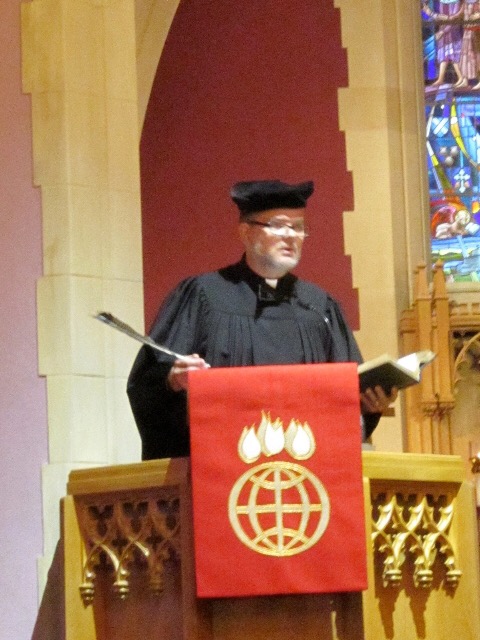
An imaginary meeting between Martin Luther (16th century reformer) and Julian of Norwich (14th century mystic) in celebration of the four-month time of worshipping together in the same space with Faith Lutheran Church Ottawa and Julian of Norwich Anglican Church Ottawa, a time which now comes to an end. Thank you to the Rev. Mary Ellen Berry, Anglican Diocese of Ottawa and incumbent of Julian of Norwich, for co-writing and presenting this dialogue with me, on our last Sunday together February 19, 2017


NARRATOR: I came early this morning to set up, and no one was here. I was tired so I sat down on the chancel steps, and fell asleep. And I had the strangest dream: Julian of Norwich had a conversation with Martin Luther …..

ANGEL: (singing, from the balcony) “I want Jesus to walk with me, I want Jesus to walk with me, all along my pilgrim journey, Lord I want Jesus to walk with me.” (ELW #325)

LUTHER: (appearing from behind the pulpit, holding a large Bible, opened, in one hand, his feather ink pen in the other) “Be perfect, therefore, as your heavenly Father is perfect!” (Matthew 5:48, Gospel for Epiphany 7A) What does this mean?

JULIAN: (appearing in her cell, sitting on a stool, leaning upon the reading desk) What does this mean to you?

LUTHER: Who are you?

JULIAN: Julian of Norwich.

LUTHER: Are you one of those uber-enthusiasts, I call Schwaermer in my native German tongue? Julian of Norwich, that’s hardly the way to relate to the Lord.

ANGEL: (singing) “I want Jesus to walk with me; I want Jesus to walk with me; all along my pilgrim journey, Lord, I want Jesus to walk with me.”

JULIAN: How did you learn that you couldn’t be perfect as God is perfect, by your efforts alone? What did you do?

LUTHER: At first, I rubbed the tips of my fingers raw washing the floors in the Augustinian monastery in Erfurt. That didn’t help my conscience. So, in 1510 I decided to go off to Rome. I crawled devoutly up the stairs of the Scala Santa, as millions of other pilgrims did.

JULIAN: Life, itself, Martin offers its own penance: disappointments, failures, sickness, betrayals. Life, if we but allow it, purges us of all the things for which our habits and affections grasp. Why on earth did you do all those things?

LUTHER: I laboured and sacrificed so much in order to purge myself of sin. It was up to me, I believed, to make myself right before God. It all depended on how hard I worked and the more penitential I became. I tried to impress God. I once believed my good works were the gateway to my salvation; only then, could I be perfect as my heavenly Father is perfect.

JULIAN: What happened to change your understanding?

LUTHER: It was on the Scala Santa in Rome as I made my wearisome, guilt-ridden way up those holy stairs, I heard God’s voice saying to me: ‘The just shall live by faith, not by doing penance.’ It was like scales fell from my eyes. I stood up, walked back down, and stalked out to ignite the Reformation!

JULIAN: You heard God’s voice speak to you! How do you know that it was God who spoke? Was it the only time you heard the voice of God speak to you? It seems quite an experience, no? Did you not criticize the ‘Schwaermer’ — as you call them — those ‘fanatics’ who relied on experience alone to express their Spirit-filled faith?

LUTHER: Well, yes .. and no, not just experience alone. I was suffering severe cramps in my room one evening, reading through Paul’s letter to the Romans, when I came across the verse from chapter 3: “Since all have sinned and fall short of the glory of God, we are now justified by God’s grace as a gift, through Jesus Christ” (v.23-24). This word of God is external, and comes to us quite apart from any experience we might have.

JULIAN: But you are not denying that God comes to us and speaks to us through our experiences?

LUTHER: Only when mediated through the Word.

JULIAN: I see, “Only when mediated by the Word.” And what, for you Martin, is the “Word’?

LUTHER: The spoken word, preached and proclaimed. The words in the bible. And, most importantly, the living Word made flesh, Jesus Christ.

ANGEL: (singing) “I want Jesus to walk with me; I want Jesus to walk with me; all along my pilgrim journey, Lord, I want Jesus to walk with me.”

JULIAN: But the spoken word and the living word touch our souls, not just the ears and mind, do they not? Is not the word something that needs to come into us, personally, experientially?

LUTHER: You are good at asking questions, fair Julian of Norwich. Perhaps you can tell me why it is you sit in your cell, asking questions of the faithful and listening to their stories?

JULIAN: It is in this way that I do my small part in the work of our Lord Jesus. I care for their souls, I tend to their hearts, so the real teacher, our Lord Jesus, can enter. My fondest hope, Martin, is “that when I am no longer in this world my dear ones will soon forget me so that I shall not hinder them, and they will behold Jesus who is teacher of all.”

LUTHER: In German, this pastoral care ministry is the work of the Seelsorger. But you also have written so much — the first book written by a woman in the English language. I wonder what greater impact your writing would have had, if you had Gutenberg’s printing press at your disposal, like I did.

JULIAN: You, too, my dear Martin, have written so much — more than me I should say! You translated the Latin bible into your beloved German.

LUTHER: Your Divine Revelations speak boldly of God’s love and trust.

JULIAN: You once wrote: “Sin boldly”. Do you regret anything you’ve written?

LUTHER: Well, yes. I did write unlovingly about the Jewish people. I have contributed, by my words, unfortunately, to the cause of anti-semitism. I am grateful that the Canadian Lutheran Church in the last century, among others worldwide, have rescinded this hateful language from my legacy. What advice do you have?

JULIAN: All wrath – all that is contrary to peace and love – is in us, not in God, Martin. So, yes you have sinned and fallen short of the glory of God. But you are forgiven, Martin. Grace alone. Is that not what you preached?

ANGEL: (singing) “I want Jesus to walk with me; I want Jesus to walk with me; all along my pilgrim journey, Lord, I want Jesus to walk with me.”

LUTHER: Your written work is impressive. Do you, Julian regret anything you’ve written?

JULIAN: Well, Martin, I don’t know that ‘regret’ is quite the proper word, but it will do until I can think of a better one. “All shall be well, and all shall be well, and all manner of things shall be well” are words that were given to me by our Lord, Jesus that I wrote in my Divine Revelations. They are beautiful words and they are most surely true, Martin. I do not regret hearing and writing these words; but I do regret – hmmm, still not the right word – how they are often taken.

LUTHER: What do you mean by “how they are often taken”?

JULIAN: What I mean, Martin, is that I fear these words have been misconstrued. When our Lord Jesus spoke them to me, I, too, was at first appalled and answered, “Good Lord, how can all be well when great harm has come to your creatures through sin.” – don’t forget, Martin, that I lived during times of war, plague, poverty, and famine. Through the grace of God, I came to understand our Lord Jesus’ words more fully.

LUTHER: Really, how so, Julian? Because being perfect, then, is not about a life free from all that ails us, and continues to do so all our lives long, no?

JULIAN: Yes. “All shall be well” is not a promise that God will relieve us of our sin and pain in this life. It is an invitation to trust God, to cultivate new habits of trust in God, and to at least be open to God’s healing love. “Just as by God’s courtesy he forgets our sin from the time we repent, just so does he wish us to forget our sins and all our depression and all our doubtful fears.”Does this speak to you, Martin? Or does it sound like the rantings of a 14th century mystic – a fourteenth century Schwaermer?

LUTHER: Well, you are two hundred years older than I am!

ANGEL: (singing) “I want Jesus to walk with me; I want Jesus to walk with me; all along my pilgrim journey, Lord, I want Jesus to walk with me.”

JULIAN: ‘Perfection’ then is experienced when we bask in the light of God’s love in, through, for and with us. Loving yourself, and loving others, loving all of creation, despite our suffering. This is the beginning and end of all prayer. How do you pray?

LUTHER: I spend nearly half the day in prayer, each and every day.

JULIAN: Being in the presence of God, whether you use words or not, unites us in Jesus.

LUTHER: I’ve always said: the fewer the words, the better the prayer!

JULIAN: The presence of Jesus, God’s love as a mother’s love, is all gift.

LUTHER: Despite our differences, then, prayer unites us all in this grace of God.

JULIAN & LUTHER: Thanks be to God! (Julian and Luther walk to the centre and embrace, then each walk separately out one of the side doors beside the altar)

ANGEL: (singing) “I want Jesus to walk with me; I want Jesus to walk with me; all along my pilgrim journey, Lord, I want Jesus to walk with me.”

NARRATOR: (wakes up, shakes his head, stands up and faces the congregation) The words of the Prayers of Intercession are posted on the screen. The Lutherans will with one voice say together their parts; and alternate with the Anglicans who will say their parts. Let us pray in the unity of Christ!

Martin Luther visit


Guten Tag. Allo. Ich heiss Martin. My name is Martin. Liebe Gott! I can speak English! Something incredible happened to me on my way to this time and place. And I cannot explain it! So, “Here I stand.” With you. In this place. Today.
You know, truth be told, I don’t know what to make of this “Lutheran Church”.

Yes, it’s been a long time — 500 years — since I hung the 95 Theses on the door of the Wittenberg Church. So much in the world has changed. Travel, electricity, automation, information systems. And yes, I did write a lot with my hand. I suppose I would do things differently today, as well. Who knows?

But I noticed that some of my words have taken on an iconic status in your discourse through the centuries. And so, I’ll start there and tell you what I observe about your “Lutheran” church today — I feel awkward even saying that word: “Lutheran”! Who the hell do you think I am? “It’s true, we are all beggars!” Even me!

So, let me set the record straight. First off, I never intended there to be a separate church, divided from the Catholic church. Oh yes, a toilet-flushing theology underpinned some religious practices at the time, beliefs that needed reformation. I was excommunicated. And that meant death. But the Lord had a purpose for me still to fulfill, and I was spared. Thanks to Frederick, who let me live in his Wartburg castle for a time being.

Obviously, I still have a purpose or else I wouldn’t be standing here today. I am amazed to see how many different churches exist — and some even taking on my name! In a letter I once sent to my colleague Philip Melanchthon, you know, I encouraged him to “sin boldly, but believe and rejoice in Christ even more boldly.” He must have taken my words seriously — the “sin boldly” part, anyway — since he pushed my reforms to brink of dividing the “one, holy, catholic church.” Dumbkopf!

Which, it seems, has happened here in Ottawa as well. I take it that Lutherans from my Heimat, Germany, arrived quite late in Ottawa — later than in other parts of Turtle Island — is that not what the first nations of this land call it, this Canada?

I have secret to tell you — the Germans have long since stopped getting off the boats and settling this land in large waves of immigration. You are all settlers! And, the first Lutheran Church was St Paul’s Lutheran Church near the University of Ottawa, established in 1874. For the most part of your history since then there have been some 15 Lutheran congregations, no?, divided basically into three different Synods — the Evangelical Lutheran Church in Canada, the Lutheran Church Canada-Missouri Synod, and the Wisconsin Evangelical Lutheran Synod.

“What does this mean?”. You who have endured Confirmation classes decades ago, yes I’m speaking to you now: When you memorized parts of my Small Catechism, you will remember I sectioned parts of the Creed, the Lord’s Prayer, and the Ten Commandments, for example, I offered my interpretation of those sections preceded by the question: “What does this mean?”

I did that on purpose. Don’t you know that asking the question itself reflects an important stance towards learning? “What does this mean” is a question that first seeks to understand. It doesn’t presume you already have the answer.

I certainly didn’t at first. I struggled mightily with my own stuff, and spent a whole lot of time on that blessed toilet seat! I had doubt and prayed: “Lord, I believe, help my unbelief!” (Mark 9:24).

The purpose of your Lutheran Council, for example, which functioned between 1968 and 1992 (I learned in your history books), was “to foster greater understanding between Lutherans in Ottawa” (1) — this amid conflicts over biblical interpretation, Communion practice and ordination of women to suggest a few enduring divisions. Good for the Lutheran Council! They were onto something, there, you know!

Learn from the first nations of this land. Among the diversity of Indigenous Peoples of Canada comes the wise advice: Seek first to understand, then to be understood. First, however, to understand the other. Not to persuade, to defend, to self-justify, to impose one’s opinion. Which appears to be the dominant characteristic of relationships in the church and the public today. You believe you first have to defend yourselves.

“What does this mean?” can be a call sign for you “Lutherans” today, indeed for all of mature faith, on how to learn, how to grow, how to move forward to embrace God’s future. You do so first by seeking to understand the other. Ask questions. Try to feel into from where the other is coming in their approach. Listen for smidgens of truth, of potential points of agreement, of overlap between what you hear and where your own heart resonates.

There’s another phrase some have said I wrote. But I didn’t. One of your modern theologians, Karl Barth, actually wrote it, based on something Saint Augustine of blessed memory wrote: “Semper Reformanda” — Always reforming. It’s still good and wise counsel! The Evangelical Lutheran Church in Germany (Evangelische Kirche Deutschland) has as the theme logo for the 500th Anniversary of the Reformation: “500 Years of Reformation”, suggesting that these past 500 years represent a continually reforming church. I like that. Sehr gut!

I know you like “A Mighty Fortress is our God”, ok? But I wrote that hymn in order to bring the popular music of my day into the church. I confess I spent much time in bars during my travels across Germany enjoying the local ales. And I sung along to the bar tunes, and wondered: “Wouldn’t this sound great in church!” And so, I took some of those tunes and transformed them into hymnody.

Why are you still singing “A Mighty Fortress” to celebrate the Reformation? The very idea of 21st century “Lutherans” celebrating the Reformation by clinging to the events of the 16th century doesn’t make sense, if you believe you are truly Semper Reformanda. I travelled all this way through space and time; I want to hear some of your new songs! 

We should be singing this century’s music rather than smugly resting on the laurels of the past, you would say. You should be plotting where the reformation goes from here. Perhaps in this the 21st century, when so many of your traditions have seen the institution fall into the malaise of irrelevancy, you need to echo the cry: “Semper Reformanda” — “Always Reforming”. Indeed, the church in every age stands in need of reformation (2).

In my Disputation in Heidelberg, a year before I hung those famous Theses on the doors of the Wittenberg Church, I stated that, “The Law says ‘do this’ and it’s never done; Grace says, ‘believe in this’ and everything is already done.”

The quality and practice of faith today is on trial. What do you believe about God, and your life with God, others and this world? Reformation starts with those questions.

I’m glad to see you still say, at least, that we are justified by grace through faith.

And when I read the Jeremiah (31:31-34) text for today, I must confess we are often our own worst enemy. When we try so hard and work so hard but underneath all that work is a niggling belief that it’s all up to us. We are most ready to hear those words of grace, forgiveness and mercy, I will confess, when our own efforts are exhausted. When we are weary of our inner turmoil we are ready to hear the Gospel of Jesus Christ. And believe. And trust.

Because by my own understanding or strength I cannot believe in Jesus Christ, in God, or anything good!

Do the work of God, yes. But allow God, in the end, to reap God’s own harvest. Believe in that which cannot be seen, towards that which can be seen (Hebrews 11:1). It won’t be our accomplishment when it finally happens. Because all is grace. All is love.

“This is most certainly true.”

I’ll tell you what else is true. There are some new words circulating among Lutherans in Ottawa these days. I’ve heard them. Who are you? You are “many communities and one church”. And you are “better together.” The fragmentation of the church which has been the unfortunate legacy of the Reformation needs reformation.

How can you see it? This is a matter of faith and belief? Do you believe that though you are many communities you are still one church? Do you believe you are better together?

This is not a figment of someone’s imagination that has mere mythic, allegorical status, invisible and irrelevant.

After all, when in the last year you gathered together at a Peace pole and prayer garden; when you gathered together to recall the history of the relationship between Indigenous and setter peoples in the blanket exercise; when you gathered together on Ash Wednesday and during Advent to worship; when you support a city-wide youth group by gathering together to have fun at summer fest; and when you serve together to do refugee sponsorship — it is real. It is tangible. It is visible.

And it is happening in a Lutheran community near you!

This is most certainly true!

(1) Barton Beglo & Jo Nordley Beglo, eds., “By Faith; Lutherans in Ottawa and the Valleys” (Ottawa: St Peter’s Press, 1995), p.66

(2) Dawn Hutchings, pastordawn.com “Enough with ‘A Might Fortress’ Already! Sing a New Song”

Martin Luther quotes

Please review these famous Martin Luther quotes before reading the posted sermon (“Martin Luther visit”)

1. I cannot nor will not retract anything since it is neither safe nor right to go against conscience. Here I stand, may God help me. Amen.

– with these words spoken to authorities at the Diet of Worms (April 15, 1521), Luther drew a line in the sand and started an age of Reformation for Christian church

2. It is true; we are all beggars

– Martin Luther’s last written words before he died (February 16, 1546)

3. Be a sinner and sin boldly; believe and rejoice in Christ even more boldly

– in a letter to Philip Melanchthon (August 1, 1521)

4. What does this mean?

– repeatedly, prior to each explanation, in Luther’s ‘Small Catechism

5. Semper Reformanda

– the cry of the reformers in the 16th century, whose idea originated in the writings of Saint Augustine, and whose words are attributed to Karl Barth in 1947

6. The Law says, “do this”, and it is never done; Grace says, “believe in this”, and it is already done

– in Luther’s Heidelberg Disputation (1518)

7. By my own understanding or strength I cannot believe in Jesus Christ

– explanation of the 3rd Article of the Creed, in Luther’s ‘Small Catechism’ (1529)

8. This is most certainly true

– repeatedly following each explanation, in Luther’s ‘Small Catechism’ (1529)
(Most of these quotes are from “The Lutheran Handbook”, Augsburg Fortress, 2005, p.55-57)

The case of the missing pulpit

As we worship this morning, the sanctuary at Faith Lutheran Church building is gutted — empty, a shell. Not only is the cork on the walls now removed and the old carpet disposed. The light fixtures, most of the furniture, liturgical items and holy hardware is stowed away for the time being to be recovered, restored and positioned again in their proper place once the renovations are completed.

I know some of you who have been at the site in the last day or so helping to get it ready for the workers, have been asking the question: “Where is the pulpit?” I can see the title of the next best-selling mystery novel: “The Case of the Missing Pulpit.” Where is it?

What a mystery! Well, this is what happened …

Last Sunday afternoon as I was helping members of our altar care committee removing certain items, we ran into a little problem. Our pulpit is mobile; it sits on wheels. So, depending on the needs of the day, we move it around. 

Well, we moved it alright — all the way to the door of the sacristy where we were hoping to store it. Without doing serious alterations (and damage!) to the door frame, there was no way that pulpit would get through. And the cloakroom, where we normally store the pulpit at Christmas, was going to be filled with stacks of chairs. Where on an already compact floor space would we store a rather heavy and cumbersome piece of teak-wood furniture?

It was the spur of the moment when I offered to put the pulpit in my car. I had the back seats down anyway at the time, and the rear hatch opened just wide enough to allow the pulpit to slide in fairly easily. And I drove away with church’s pulpit in the back seat of my car! Truth be told!

During the 45 minute drive home to Arnprior, my mind raced: What would I say to someone who would behold this mystery! I was also wondering where on earth I would put it. I had no clue. There was room in our garage, but most of that space was already tagged for bikes, tires, canoes and garden implements for the winter season.

My wife and I sat in the living room that evening scratching our chins and trying to come up with solutions. But to no avail. I guess I would drive around with a pulpit in the back seat of my car for three months! A mobile preacher who comes with his own pulpit! What a deal!

Barbecuing on the back deck that evening, I looked above the tree line and my eyes rested on the steeple of a church, just around the corner from our place. After making a phone call, and depending on the good will of their pastor and the muscle of a couple of their men from that community — and our pulpit now has a resting place. 

So, if anyone asks: Our pulpit is in the safe-keeping in the building of the good people of St John Lutheran Church in Arnprior. Let it be heard! “The case of the missing pulpit” … mystery solved!

I’m usually the kind of person who wants to have a plan, to know how things ought to go and what the end result should be, before doing anything. This is also usually a good thing. Driving away with the pulpit without any clue as to where it should go, was a little unnerving for me. It was, nevertheless, a good exercise for letting go and trusting that a solution would present itself. And it did, in a most gracious, natural and expedient way.

Some of you know that I am planning to go on a sabbatical next year. The theme of my sabbatical is ‘pilgrimage’. And part of the experience is to walk an ancient path, some eight hundred kilometres long, on the north coast of Spain on the famous Camino de Santiago de Compostela. I’ve read that a majority of people who start the pilgrimage — hundreds of thousands every year — don’t finish it. Many pilgrims give up, some even just 25 kilometres into it. 

What many successful pilgrims learn is that all that is required is to remain committed to the journey itself. What is needed, is to unlearn deep-seeded attitudes about what justifies us, as human beings. To persevere in that un-learning process over six-weeks, even against all the challenges of the trail. To learn that all that is required is simply to put the next foot forward. To not give up, to not lose heart. And to pray always.

To dial it down to accepting that it’s all about taking the next step faithfully — nothing more, nothing less. Although simple, it is not easy for most of us to comprehend let alone do: Just walk. Eight hundred kilometres. Because it’s not about our ability and resourcefulness in the end. It’s not about rushing to the next distraction, checking off the next thing on our list in a busy, hectic lifestyle. It’s about something much bigger than us and our ‘stuff.’ A pilgrimage can teach us that.

That was the message from last week’s Gospel from Luke 18:1-8, to pray always. The most important thing is to remain focused on staying the course, to do the prayer. The solution — the answer, the benefit — will present itself as long as we remain committed to the journey, the adventure. 

Last week, we learned to persevere in prayer. This week in the story that follows we learn how to pray. And I want to reflect David Lose’s perspective here (1), to watch for the trap that Luke sets for us readers. Remember, the Gospel of Luke is full of reversals — the song of Mary, the beatitudes in the sermon on the mount, Jesus’ conversation with the thief hanging beside him on a cross, etc. Luke, it seems, delights in setting up his readers with presumed expectations, and then pulling the rug from under our feet.

It’s too easy merely to paint the bad guy as the Pharisee. Because don’t forget, the Pharisee is law abiding, has fulfilled all the demands of his religion, lives a pure and righteous life. Isn’t this what faithful living looks like? After all, we shall know others by their fruits, no? The Pharisee does a lot of things right. Except for one thing:

The Pharisee, while living the right life, has forgotten the source of his life and all the good in it. Otherwise, he would not despise another whom God loves. He falsely believes it’s all about him and his efforts alone. He falsely believes others who are not like him, need to be, in order for them to be good people.

And, it’s too easy to side with the ‘humble’ tax collector. Let’s not let him off the hook too easily. The tax collector only recognizes that all he is about is depending on the mercy and forgiveness of God. That’s in good contrast to the Pharisee, yes. And that’s the challenging starting place, to be sure.

But nowhere do we see a sign of his repenting. Does he desire to have his life turned around? He may very well be as self-engrossed as the Pharisee. Just the other side of the same coin. The tax collector strikes me as one who might remain stuck in cycles of self-pity, negative self-talk and depression. 

He might be one who goes back every Sunday to remind himself how bad he really is. A false humility, we may call it, where it feels good, actually, to put yourself down before others. “I’m not good enough.” “I don’t have a strong faith.” “I can’t do this or that.” 
Will he not hear that God’s forgiveness can lift him out of what may appear a chronic negativity? Will he not hear that he is not all of the time all worms and dirt and badness within? Will he not hear that God has given him a great gift within himself, in himself?

No matter with whom we relate, or cheer for, in this text — the Pharisee or the tax collector — we run into a wall with both of them. And I believe this wall is meant to test to what degree we focus too much on ourselves in the practice of our faith and in our prayer, and not on God.

The trap is to call us out whenever what we do or what we decide as communities of faith is more about our own stuff, than about the bigger picture, the holy and wonderful mystery that is God.

At least one item from our worship practice is not in storage, but stands in this place alongside yours — the Paschal Candle. It is called, ‘paschal’, because it describes the ‘mystery’ of Jesus life, death, resurrection and ascension. We call it, ‘the Paschal Mystery’. 

We are not talking here about a mystery like ‘the case of the missing pulpit’, where it is simply a question of information about something that is already known, just not to everyone. “Mystery isn’t something that you cannot understand”; A mystery, in the holy sense, is as Richard Rohr puts it: something you can “endlessly understand” (2). We never ‘arrive’ at a complete knowing, this side of eternity, of what God is all about. We never completely ‘get it’. We are always growing, changing, discovering, adventuring.

It is natural to seek signs. The Pharisees and disciples demanded Jesus: Give us a sign! And the only ‘sign’ that Jesus was willing to give them, was the “sign of Jonah” (Luke 11:29). Many of us know that story from the Old Testament, where Jonah fights against God’s will, refuses to follow where God calls, doesn’t want to do it! 

Only by spending time in the belly of a whale for a few days, where he can do nothing, does Jonah become aware and accept that it’s not about him, or his mission, but about God’s purpose, God’s call, God’s mission. Doing God’s mission will call us beyond our own agendas, preferences, and even personalities. Not that those things are bad. But this is about something a lot bigger than our resumes, list of accomplishments, or even our baggage and painful histories.

We are on a journey moving forward, a pilgrimage, to discover what God is about in this holy space and in the world around us, now. We already received signs of God grace — your authentic and heartfelt welcome and accommodating us, for starters. This beautiful space and hospitality we can share. This is God’s good work among us and through you. Thank you!

We might not know what this will look like at the end of the journey together as Faith Lutheran Church worships alongside Julian of Norwich Anglican Church over the next few months. “I’ve got this pulpit in the back seat of my car, and I have no idea where it’s going!”
We might not know where this adventure leads.

But we don’t go alone. We travel this uncertain road together, side by side. We may suffer through some moments together as we figure things out, as we feel our way into this journey, as we learn and perhaps go through some growing pains together on these first few steps.

But let us be encouraged by the Paschal Mystery, which points to the way of Christ, the self-emptying and giving that leads to a marvellous and wonderful resurrection from all that is passing away, transforming us into the new thing that God is doing. The light of Christ shines ever and ever, even in the darkness and through our most challenging journeys. 

Thanks be to God! Amen.


(1) David Lose, “The Pharisee, the Tax Collector, and the Reformation”; Monday, October 21, 2013; http://www.workingpreacher.org 

(2) Richard Rohr, “The Divine Dance: The Trinity and Your Transformation” (Whitaker House Publishing, Pennsylvania, 2016)

Gospel, Italian style

On the Sunday before I left for a family vacation to Italy, you encouraged me to — “know your history”. I think that message came to me mostly during the children’s chat when we talked about the Canadian flag on my backpack, and why Canadians had been so well appreciated and admired in western Europe, especially, over the past several decades.

The conversations then, as well as following the service over coffee, reinforced to me the value you place upon ‘history’ in general. 

Well, Italy is not exactly the hotbed of Reformation, Protestant Christian history as such. At the same time, the buildings there stand clearly as testimony to the dedication of Christians in certain times and places in history.

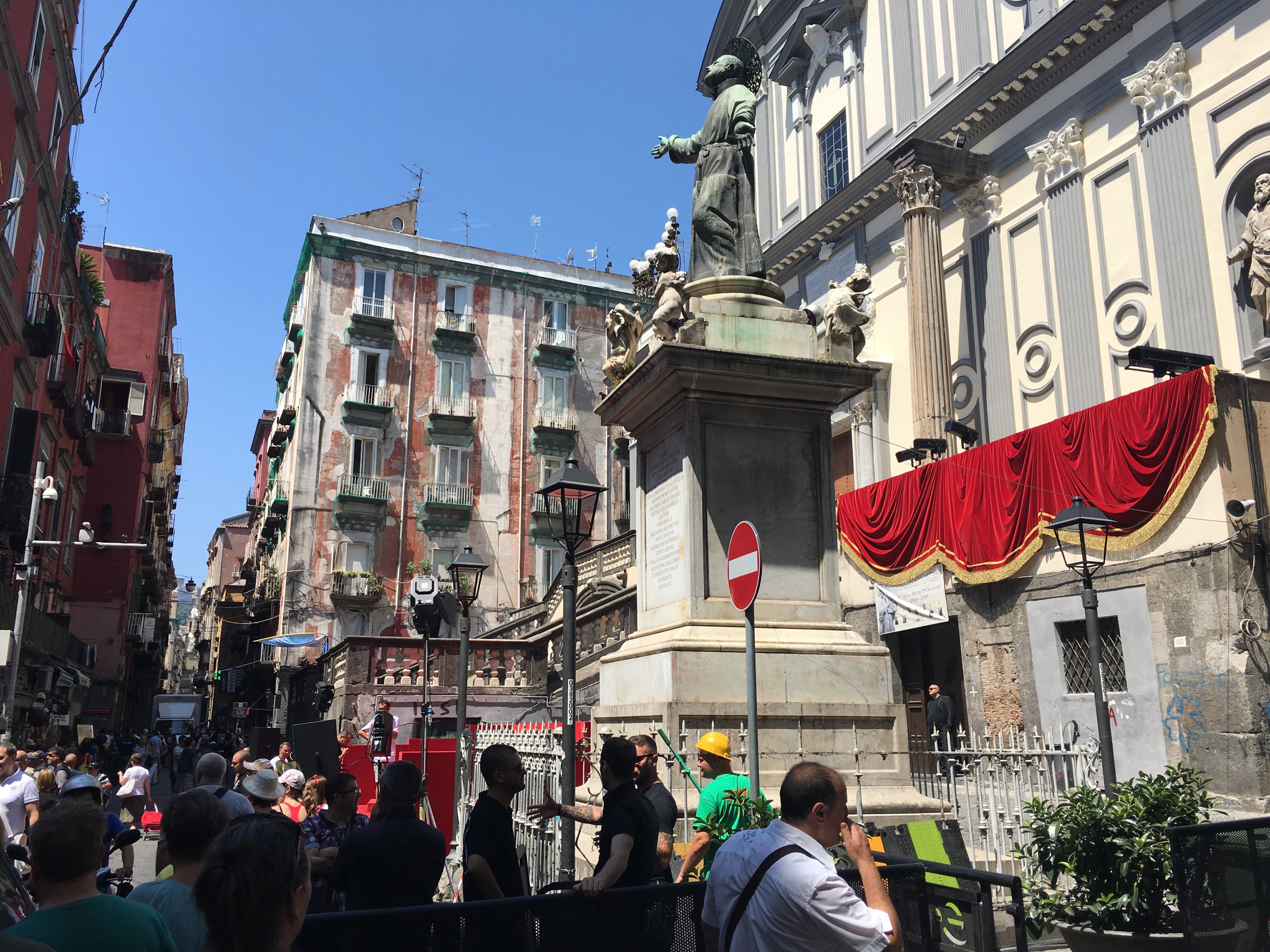
It was the first day we walked in the older section of Naples — a sprawling metropolis at the base of Mount Vesuvius on the Mediterranean coast — when I began to feel this history pressing in the air all around me.

I say sprawling because Naples is today the most densely populated urban centre in all of Europe; some 8,500 people inhabiting one square kilometre in a metropolis of nearly four million people — making it the third largest city in Italy, and the ninth most populous urban area in the entire European Union.


The noise was overwhelming: the hustle and bustle of pedestrians, car horns beeping, motorcycles and mopeds buzzing, shouting street vendors, impassioned conversations, two-toned emergency sirens, barking street dogs, screeching tires.

In conrast, the neo-Gothic styled ‘duomo’ in Naples offered a welcome break to this outside clamour. 

The expansive interior spaces of this main cathedral embraced silence and only hushed speech. You could occasionally hear the squeak of rubber-soled shoes and someone dropping a book on the stone and marbled flooring as people sat and wandered solemnly throughout the holy spaces.

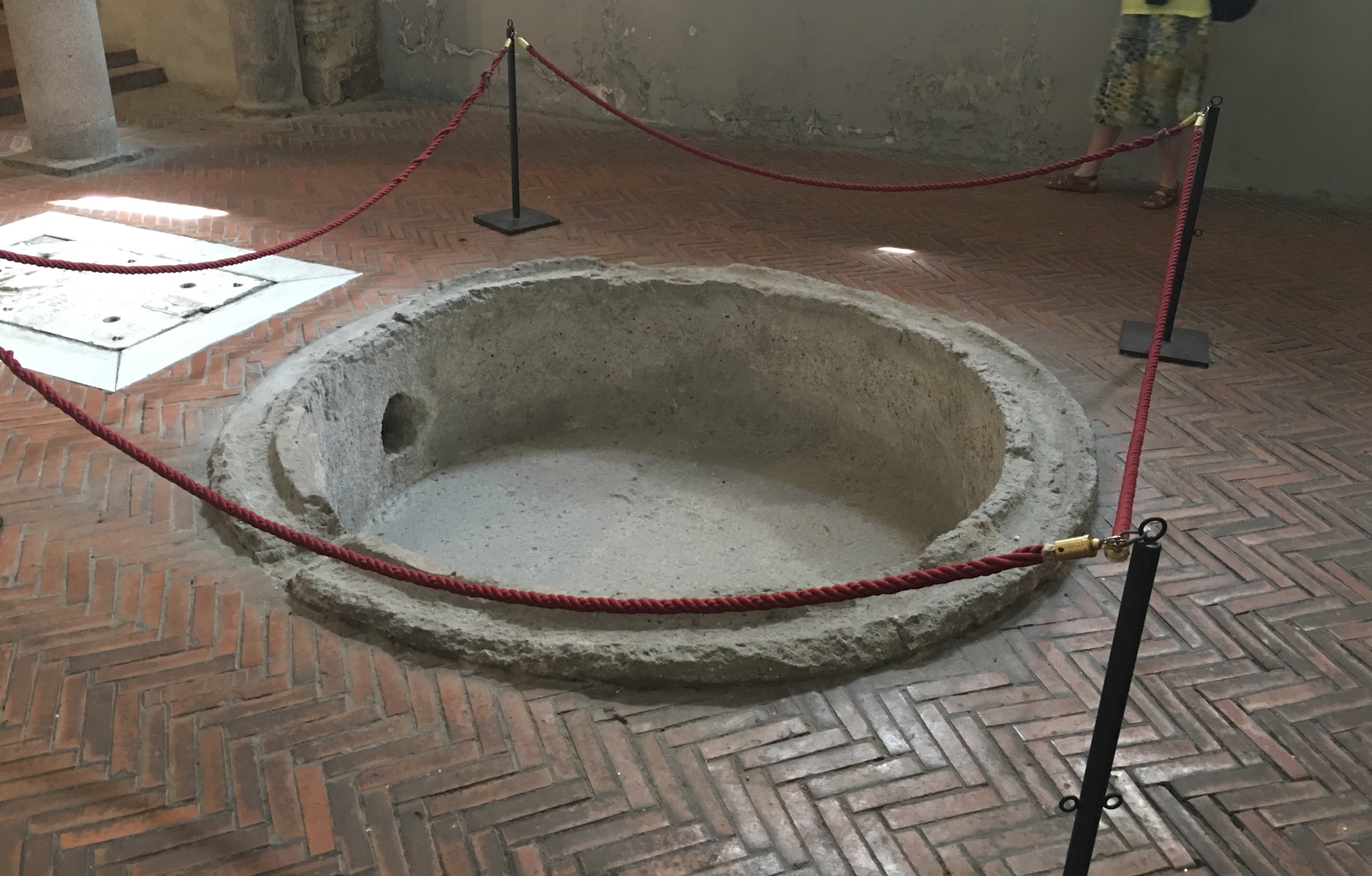
Perhaps the most significant feature of this cathedral is the baptistery, which is the oldest baptistery in the world, built in the fifth century, C.E. It is remarkable to connect with such an ancient symbol in a material form. 

When the baptized emerged from the water, looking upward at the ceiling, they would be encouraged in their faith; the first images they saw after being baptized were scenes from the Gospel expressed in Byzantine, mosaic art: Jesus saving Peter from drowning, the women at the empty tomb, the miracles of the multiplied fish, an image of Saint Paul, the Apostle, etc.

Seeing with my own eyes and touching with my own hands this font that was built by human hands only a few hundred years after Jesus, affirmed my conviction in the longevity and validity of the sacrament which has endured as profoundly meaningful for Christians throughout the millennia. 

I felt that faith is not just about the good old days when I was young, but the good old days when the Christian faith was younger. We are part of something much larger than our immediate reality. And, when we connect with that broader history, we realize it wasn’t always peaches ‘n cream and rose-coloured a history.

If you are movie watcher, you might recognize another cathedral we visited — the Duomo in the Umbrian, medieval town of Orvieto. 


This cathedral was featured in the opening scenes of Under the Tuscan Sun. This cathedral’s highlight is the Chapel of San Brizio, featuring Luca Signorelli’s brilliantly lit frescoes of the Day of Judgment and Life after Death. 

Although the frescoes refer to themes of resurrection and salvation, they do so through images not from the bible (that is, stories from the Gospels or Old Testament) but from the turbulent political and religious atmosphere of Italy in the late 1400s. Signorelli told the story of faith through his contemporary human events, rather than the traditional symbols (such as Jesus, God, the Trinity, the Apostles, disciples and other biblical characters) that we see in most other places.

Those frescos in the Orvieto cathedral chapel were snapshots of an historical era particular to a specific time and geo-political reality (i.e. 15th century Italy). And the impression of faith put ‘on it.’ Historical to us. Yet current to those who built that Cathedral in the Midlle Ages.

Faith is more than merely appealing to our past. Coming to worship today is not just about being reminded of something or someone from a long time ago. What we do here today is not just an exercise in recalling historical facts. As if decisions we make today are really not about faith. When we talk about our building renovations, worship practice and art, musical choices, communion, budgets, outreach initiatives  — these issues are very mcuh about the Christian faith ‘in the real world’, so to speak. All of these real things do reveal what we believe in, our values, what is important to us, who we are. How do these ‘mundane’ decisions reflect the Christian Gospel, faith, kindgom values in this time and place?

Lutherans make a similar mistake, I believe, when we define ‘Lutheranism’ as a belief/doctrinal system that is limited to the words and conceptual formulations of sixteenth century Germans. When we say that to be Lutheran is merely to ‘turn the clock back’ to 1537 when the Book of Concord was finally assembled including Luther’s Small and Large Catechisms, the Augsburg Confession, and the Apology to the Augsburg Confession.

I prefer a view that is reflected in the Evangelische Kirche Deutschland’s (EKD) logo for 2017, “Celebrating 500 years of Reformation”. Five hundred years of Reformation. In other words, Reformation started happening — in our tradition — with Martin Luther, yes. 

But, Reformation continued through the 500 years following, and continues to this day and beyond. We are always reforming the forms and means by which we express our evangelical, Gospel-centred faith. Always finding new and creative ways to tell the story of God.

What can we say, then, about Christian history? If we can apply a macro view over the ages, we can say that the history of the Christian faith is about a God who loves us. Christian history is about a God whose compassion never fails, who “will not come in wrath” (Hosea 11:9) — even though the people of God continue to keep “sacrificing to the Baals and offering incense to idols” (v.2).

The history of the Christian faith is about our lives being “hidden with Christ in God”, being “revealed with Christ in glory” (Colossians 3:3-4), dying daily to ways of sin and being renewed daily in Christ who “is all and in all!” — even though we are imperfect and sin as long as we hold breath. Christ is all and in all — despite us!

The history of the Christian faith is about how each moment of history — including this one right now — reflected Jesus’ love in the fifth century, the fourteenth century, the 21st century in Palestine, Egypt, Italy, Canada, etc. God for all times and places!

We validate the Christian faith by our lives today, now. This is where the rubber hits the road. This in-the-moment approach fuelled the generosity of medieval Catholicism represented in the magnificent building projects for worship as much as it did the passion and commitment of European Christians during the Reformation era.

We do not leave the practice of faith for some distant, utopic and dreamy future. Neither do we rest on the laurels of the tremendous sacrifices made by our forebears in Canada. 

Now is the time. Now is the time to live out of the conviction of God’s grace and love, despite the many and various ways Christians have messed up in history, and continue to do so today. Now is the time to live out of the faith that is full of hope, that despite our waywardness and unfaithfulness, God is faithful. Now is the time to claim God loves us, not because we are good, but because God is good. God is so good!

You know Jesus’ familiar exhortation, most often translated as “be perfect as your heavenly Father is perfect” (Matthew 5:48). Christians have often interpreted this word ‘perfection’ as being made whole. 

A much better translation might be: “be merciful.” Because this verse comes right at the end of a passage calling Christians to “love your enemies” (v. 43-48). Only God is perfect. But we can participate in God’s perfect mercy, God’s all-inclusive and impartial love.

Echoing Saint Paul’s words from the Epistle today (Colossians 3:11 — “Christ is all and in all”) St. Bonaventure later said, “Christ is the one whose centre is everywhere and whose circumference is nowhere.” [1] 

Christ’s mercy is everywhere evident in history. This is the Wholeness, the forgiveness, the grace, that holds you forever and everywhere. You can’t figure this Wholeness out rationally, nor can you control it. All you can do is fall into this Wholeness that holds you when you stop excluding, even the dark parts of yourself. [2] And that, my friends, is the Gospel — good news — for all times and places.

Thanks be to God!

1- Alan of Lille, ‘Regulae Theologicae’, Reg. 7 as quoted by Bonaventure, translated by Ewert Cousins, “The Soul’s Journey into God”, Classics of Western Spirituality (Paulist Press: 1978), p.100

2- Richard Rohr, “Daily Meditation on the Spirituality of Imperfection” Week 2 – Perfection of Wholeness, Thursday, July 28, 2016

Bread for all

After the old doctor died, his sons emptied the house in order to sell it. In the living room on the shelf above the fireplace they found a box with a slice of bread in it.

It was dried up hard and obviously had sat in the box a long time.

“He really kept every thing!” said one of the sons amazed. The doctor’s assistant who worked for the doctor for many years stood beside the sons silently. And then said: “Let me tell you the story of the slice of bread:

“You know that after the war your dad became very ill. He was weak, and near death. A friend, who had visited him told him, ‘If you don’t eat enough to regain your strength, it looks very bad for you.’ But where was one to get enough to eat? Everyone was starving. Many simply cooked potato peels and considered it a rich soup.

“The friend returned after some hours and brought some bread. Where he found it, he didn’t say. Surely he must have paid a fortune for it.

“But your dad did not eat it,” continued the assistant. “Your dad told me to take it to the neighbour; their daughter had been ill for a long time too. ‘I am an old man already who does not need the bread as much!’ your Dad said. ‘Take it to the neighbours!’

“As it later turned out, the neighbours did not eat it either, but passed it on to a family of refugees with three little children that lived in a small shack in the backyard of the neighbours’ house. They were overjoyed for they had not seen bread for more than three months. 

“But as they were about to eat, they remembered that the doctor, who had helped their children at no charge when they had been struck by a dangerous fever, was ill and weak and really needed something that would make him stronger.

“So when the bread came back after a day,” said the assistant, “we recognized it at once. Your dad was in tears, as they found out about the wandering piece of bread and where it had been.

Your Dad had said, “as long as there is love between us – I am not afraid about anything, not even dying”. So he divided it evenly and sent me out again. His share he kept; he put it in this box to always remember what had happened.”

The three children took the old bread, broke in in three pieces and decided to keep it in order to remember the story, to tell it to the next generation, and to teach them about the power of love and the wonder of sharing.

Something like this can only happen when there is a communal consciousness — more than one person that participates in a community of love and trust. That all will have enough. That all will benefit. That the needs of the whole outweigh the needs of the one.

This is the Gospel call. The kingdom call. Not for individual enlightenment or edification. Not for our sake alone. Dear Confirmands, your baptism as a baby was not valid on account of your own individual strength or decision. It was the community — your parents, sponsors and everyone in the church long ago — whose faith surrounded you at your baptism. Even your confirmation is not done for your own sake — but for the sake of others around you.

And that’s why you participate in leading and assisting in your own confirmation service: To practice this truth, that affirming your baptism is a call to deeper commitment in the life of the church. You may doubt the strength of your faith. That’s ok. In fact, I would be worried if you didn’t. God can work with just a tiny bit.

I must admit when we planted that tiny four-inch tall spruce on church grounds last Fall, I didn’t have a lot of hope that it would survive the winter. This was our first tree planted in response to the Reformation challenge for our national church to plant 500,000 trees by the end of 2017 — the 500th anniversary of the Reformation. It was a small tree. A humble start. Could it live, and even bear fruit? I had my doubts.

For one thing it was exposed, and not easily visible, to the many pedestrians that use this property to cross through and the many children who play in this space. For another thing, since receiving the sapling, I had not seen signs of new life on it. So I wasn’t sure it there was anything new to come out of it.

I was in for a pleasant surprise. Throughout the coming months, our neighbours put a tall chicken-wire type fence around it and staked it. We watered it. People walked around it. God took care of it over the cold winter. And voila, look at the new shoots of life sprouting now! There is hope.


It does take a community committed to sharing, committed to kingdom values, and the Gospel of Jesus Christ. Today is just as much about celebrating the church of all times and places as it is about our part in the kingdom of God on earth. We are not loners on this path. We don’t walk by ourselves. It’s not all up to us, individually. 

It’s amazing to see the fans of “We the North” cheer on the Toronto Raptors as they advance through the NBA playoffs this post-season. They are true fans who gather in “Jurassic Park” outside the ACC in downtown Toronto, even during away-games in the pouring rain. You might say, they are ‘fan-atics’ of their team. 

Yes, fans can be fanatics — exuberant, dedicated, passionate, sometimes even over-the-top. Imagine the fans in heaven — the faithful gathered as the grand host of heaven, cheering you on this day. These may be your loved ones, long gone now, or recently died. These may be the saints throughout the ages. These may be other Christians not here today yet praying for you nonetheless. These are your fans of faith. Fans. Fanatics. Fantastic!

You are not alone, making this decision today. Pentecost, and Confirmation Sunday, is also about trusting in God’s initiative, God’s work, God’s love and mercy. Through the Holy Spirit God comes to us in so many ways we sometimes don’t even recognize. 

In a few minutes, God comes to us in bread. This bread, the body of Jesus, is broken bread. It is broken from the One, so that all may eat. There is always enough for all, for the sake of our broken lives in this broken world that God so loves.

Prayer for Reformation Sunday

We give you thanks, loving God, for  your unconditional love and grace to us and all people. Help us be moved to your heart, Christ Jesus, as our motivation, our desire, our passion for the decisions we make in our congregations. By your Holy Spirit, keep us steadfast in your Word, and continue to bless us in mission for and with others, so all may have dignity and all may live in hope. Amen

(Hoping for) A happy ending: Why not?

“God will come and save you.” (Isaiah 35:4)

When the prophet Isaiah promises salvation to the people, people who are “weak, feeble and fearful” (Is 35:3-4) what does he mean? What does he mean when he says: “God will save you”? Does he mean, the promise of heaven? Does he mean, remission of sins?

In the news this week we have seen images of desperate people risking their lives to escape the dire situation in Syria. Refugees are literally dying for the sake of finding a better life for themselves and their loved ones.

The prophet Isaiah spoke to a people dispersed from their homes. He spoke to a people who were displaced for political reasons. Emerging empires, such as Assyria, Babylon and then the Greeks, swept through the region in the centuries before Christ leaving those without power or privilege to fend for themselves in foreign lands. Sound familiar?

The Bible gives us Christians a broader perspective on ‘Salvation’. Because when we look carefully at texts such as Isaiah 35, salvation is not about heaven and remission of sins. The people who are exiled, lost and experiencing the worst circumstances of life, will be saved from those circumstances. In real time, earth-bound, flesh and blood realities.

From the perspective of Jesus Christ, of course, we can express, in all truth, the promise of heaven and remission of sins. For sure. And yet we cannot, if we engage the bible honestly, limit the concept of salvation to these albeit abstract notions of faith. Salvation in Christ has just as much to do with our lives on earth, and the lives of others, “in the flesh”.

We may despair, watching the news. What can anyone do to make the situation right for the millions of refugees now flooding Europe? How can there be a happy ending, in this mess? We can be paralyzed in our fear, and look away, despondent.

And yet we have this fantastic story of restoration. We know how the story ends for the remnant of Judah in Babylonian exile. We know that their earthly suffering ends happily. On earth. They eventually return to Jerusalem and restore their fortunes. We can get giddy with faith at this happy ending. Surely, this is the promised outcome for all who suffer in any way!

Listen to how Professor of Old Testament, Patricia Tull, writing in workingpreacher.org, expresses the puzzling truth of this story:

“Events as deeply woven into our history as Jerusalem’s restoration take on for us an air of inevitability. Yet they cannot be taken for granted. Other nations destroyed by great empires — including Aram, Moab, and the Northern Kingdom of Israel — failed to reestablish when their crises passed. We have Judah’s story only because it transcended destruction. Every time our scriptural reading brings us to Jerusalem’s phoenix-like restoration 2500 years ago is a moment to stop for gratitude and wonder. As Isaiah 34 and 35 vividly show, reversal of fortune isn’t guaranteed. But it is possible. Judah’s success story sets a precedent for hope, showing that happy endings have occurred and can occur.”

The first prime-minister of the modern state of Israel, David Ben-Gurion, said, “Anyone who does not believe in miracles is not a realist.” To be hopeless, however grave the circumstance, is unrealistic. It works both ways: To believe that there is a happily-ever-after for each and every person in every situation imaginable is unrealistic; we know that’s not the way life works. At the same time, to dismiss altogether the possibility of happy endings and miraculous turn of events is unrealistic as well. For God, all things are possible.

Franklin D. Roosevelt once said, “Some people see things as they are and ask, ‘Why?’ Others see things as they could be and ask, ‘Why not?’

As Christians, as people of faith, aren’t we a people of a ‘Why not?’ -capability?

Why not be grateful at the start and end of each day — grateful for all things that have gone well in life?

Why not focus on the blessings and abundance rather than the scarcity?

Why not celebrate the victories of God that you see in the world in the lives of others even if those victories don’t benefit you personally?

Why not rejoice with those who rejoice and weep with those who weep?

Why not sing a song of gladness when the underdog takes it all?

Why not see the face of Jesus in the stranger, the immigrant, the Muslim neighbour, the un-churched youth and mid-lifers?

Why not envision a future for your life and the life of the church that is better than what it is now? Why not? Why not? And then, see where that leads …

We are not in the business of faith for what we make of it or get out of it. We are in the business of faith for what God has done, and continues to do all around us, and even despite us.

We can be strong and do not need to fear because God keeps promises. God keeps God’s word. As Isaiah foretold, “the eyes of the blind shall be opened, and the ears of the deaf unstopped … the lame shall leap like a deer, and the tongue of the speechless sing for joy.” (Isaiah 35:5-6). 

In the Gospel today we read about Jesus doing precisely this: Jesus brings miraculous healing to the lives of those distraught and torn apart by illness and disease (Mark 7:24-37). Jesus is the glory of God shining through the brokenness of our lives. Jesus is the majesty of God embracing the sweat and tears of our lives. Jesus is the active presence of God working in us and through our poverty and pain, amidst the blood and grit and earthy, daily activity of our lives.

The story of the Quilt Holes inspired me recently at a funeral I attended. The preacher told the story of one who faced God at the last judgement, as spoken through the first person: “I knelt before God, as did everyone else. Our lives lay before us like the squares of a quilt in many piles. An angel sat in front of each of us sewing our quilt squares together into a tapestry that is our life.

“But as my angel took each piece of cloth off the pile, I noticed how ragged and empty each of my squares was: They were filled with giant holes. Each square was labeled with a part of my life that had been difficult, the challenges and temptations I had faced in every day life. I saw hardships that I endured, which were the largest holes of all.

“I glanced around me. Nobody else had such squares. They just had a tiny hole here and there. Their tapestries were filled with rich colour and the bright hues of worldly fortune. I gazed upon my own life and was disheartened.

“Finally the time came when each life was to be displayed, held up to the light, the scrutiny of truth. My gaze dropped to the ground in shame. There had been many trials of illness. I had to start over many times. I often struggled with the temptation to give up. I spent many nights in tears and on my knees in desperate prayer, asking for help and guidance that took a long time coming.

And now, I had to face the truth: My life was what it was, and I had to accept it for what it was. I rose and slowly lifted the combined squares of my life to the light.

An awe-filled gasp filled the air. I gazed around at the others who stared at me with wide eyes. Then, I looked upon the tapestry before me: Light flooded the many holes, creating an image, the face of Christ. Then Jesus stood before me, with warmth and love in his eyes. He said, “Each point of my light shone through the holes, the rips and ragged, empty squares of your life. When you were down and out, and honest and still trusting, my light continued shining through you.”

At the end of it all, we may be threadbare and worn. It may look like a failure, a sad ending. And yet, Christ in us is the end of the story, not us.

Why not, then, just be the Body of Christ in the world today? Why not be, together, the hands and feet of Jesus? Holes and all? What do we have to lose? Why not be the answer we are waiting and hoping for — for others who have no hope, for the refugees of the world? 

I recently read the story of a woman who had walked seven hundred miles as a refugee to escape a violent war. She was finally able to cross a national boundary out of the war zone. She walked all that way and brought with her an eight-year-old girl, who walked beside her. For seven hundred miles, the child held her hand tightly. When they reached safety, the girl loosened her grip, and the woman looked at her hand: It was raw and bloody with an open wound, because the little girl had held tightly in her fearfulness. This is no casual hand-holding. This is a life-or-death grip that does not let go. (Walter Brueggemann, “Sabbath as Resistance: Saying No to the Culture of Now”, WJK Kentucky, 2014, p.88-89)

God’s hands do not let go of us, even though we may fear, even though we may be scared to take the risk and do the right things. This is the promise that God will never break.

The Evangelical Lutheran Church in Canada (ELCIC) was onto something when in convention this past summer we adopted the Reformation challenges — one of which is to sponsor, by 2017 (the 500th anniversary of Martin Luther posting the 95 theses, or arguments, on the doors of the Wittenberg Church in Germany thereby launching the Reformation), 500 refugees coming to Canada.

We are the people we are waiting and hoping for. We have a responsibility, in faith, to be grace, forgiveness, mercy and compassion to those who are unloveable, undesirable, the outcasts, the downtrodden, the refugee, the marginalized. Can you imagine what a show of grace might do in the lives of those to whom the unexpected is given?

Why not?

‘One little word’

“Long ago your ancestors — Terah and his sons Abraham and Nahor — lived beyond the Euphrates and served other gods …. Now … choose this day whom you will serve, whether the gods your ancestors served in the region beyond the River or the gods of the Amorites in whose land you are living; but as for me and my household, we will serve the Lord.” (Joshua 24:2,15)

“Finally, be strong in the Lord and in the strength of his power. Put on the whole armour of God, so that you may be able to stand against the wiles of the devil. For our struggle is not against enemies of blood and flesh, but against the rulers, against the authorities, against the cosmic powers of this present darkness, against the spiritual forces of evil in the heavenly places … ” (Ephesians 6:10-12)

My mother told me the story of a dramatic stand made by Christians against Hitler on Easter Sunday 1942 in Norway: The Nazis had insisted that every Lutheran congregation praise God for Hitler’s rule over the Norwegians. The Lutheran Church considered this blasphemy, and refused. Every Norwegian Church closed that Easter Sunday morning. And instead they agreed to worship in the afternoon.

Later that day in one of the villages the people assembled in the market place. And because they were scared, they began singing what Lutherans have sung for over 400 years when they were afraid: “A Mighty Fortress is our God, a bulwark never failing …”

And they slowly began to walk to the steps of the village church — only to find the doors locked and guarded by a company of SS soldiers with submachine guns trained at them. When the Christians arrived at the front steps, having finished the first verse of Martin Luther’s famous hymn, an SS officer grabbed a woman holding a baby in her arms and said: “One more verse and she gets it first”, pointing the weapon at her head.

In the tense silence, the people, not knowing what to do, looked down at their feet.

And then, a single, soft, quivering voice began … 

“Though hordes of devils fill the land, all threatening to devour us, we tremble not, unmoved we stand, they cannot overpower us. Let this world’s tyrant rage … his might is doomed to fail. God’s judgement must prevail. One little word subdues him.”

It was the voice of the woman holding the baby. “One little word subdues him.” The soldiers were the ones in a moment of indecision who looked down at their boots. And then quietly they shuffled out of sight to let the worshippers enter the church.

One little word subdues him. Not a loud trumpet call. Not an explosion of spectacular proportions. Not an air strike obliterating the enemy. Not a bravado that denies human frailty and vulnerability. Not eloquent oration. Not a motivational speech rallying the crowd into a frenzy. One little word subdues him.

The themes of ‘standing up against evil’ and ‘taking a stand’ pervade the scriptures assigned for this Sunday. We must choose our god. We must stand up. Especially in the context of a multi-faith community. But how do we do this when all we want to do is stare down at our feet, immobilized with fear?

Because we are surrounded by diverse peoples. And that isn’t going to change. At least we can relate to the Ephesians. The Christians in Ephesus were probably taken to worship the emperor at the newly constructed temple of Domitian; Ephesus in the first century was also a thriving commercial city and the cultic centre of goddess Artemis. (Haruko Nawata  Ward, Feasting on the Word Year B Vol 3 Fortress Press, 2009, p.376). Christians were challenged to be confident in their faith amidst challenging times. Change some of the names, and it feels a bit like Canada in the 21st century!

And as simple as we sometimes may want to reduce the question of evil, the scriptures present a more subtle and systemic view of evil. In other words, evil is not just a little red man with a pitch fork sitting on your shoulder tempting you to do something bad. Evil is also, and more significantly, about forces beyond the immediately ‘individual’, into the realms of politics, world history, economics. 

More than against “flesh and blood” evil is also about certain patterns of thinking. Our attitudes and underlying beliefs and assumptions about people of other faiths and values.

Standing up against evil and taking a stand is just is as much to do with changing the way we think about ‘them’. Standing up against evil is about repudiating ways of thinking and unspoken assumptions that have only served to hurt and damage other people. Sometimes the way we think — the common sense assumptions of our culture — are downright evil and wrong. Let me give you an example:

This past summer at the national convention of the Evangelical Lutheran Church in Canada (ELCIC), the church voted to repudiate the “doctrine of discovery”. This doctrine is different from our normal understanding of a statement of faith. But it was a belief that resulted in untold damage to the aboriginal populations of North America. It was the reason aboriginal children were taken from their homes, families and communities to suffer — many of them — in the so-called Indian Residential Schools in the last century.

The doctrine of discovery was the underpinning belief that resulted in the first explorers labelling Aboriginal people as “beasts of the field and forest”, and prompted governments to justify “killing the Indian in the child.” The doctrine of discovery made the residential schools places where native children were not permitted to speak their own language, practice their own religion, nor attend with their own siblings or have any contact with their parents while they were at school. How evil is that!?

So what is this doctrine of discovery that the ELCIC repudiated? Basically, it was a system of belief based in the discovery of North America, as if nothing of inherent value existed here before ‘we’ arrived. When the explorers landed on the shores of Iceland and then Turtle Island (i.e. North America), the land appeared to be unoccupied in the ways of western Europe. The explorers therefore believed it was theirs to acquire and own. When the explorers encountered native bands, there was this immediate disconnected with their values and culture and relationship with the land, understandably. Still, the settlers felt superior in their relationship to the native culture, believing — “What we have is better for you.” And moving from that doctrine into practices and policies of assimilation and subjugation like the residential schools.

I can anticipate your objection: But what to make of the Great Commission in Matthew 28:19 — when Jesus instructs his disciples to “Go therefore and make disciples of all nations”? Isn’t this what we have been supposed to do? – make others, force others to be like us? Aren’t we supposed to impose our values on the world, using any means at our disposal? Another English translation of the word, disciples, changes the tone significantly. When we read, “Go therefore and make learners of all nations”, we can see our task as learning. Disciples are essentially ‘learners’. Learning involves challenging current patterns of thinking, and going out into the world to share our faith. (Kristin Johnston Largen, Interreligious Learning &  Teaching, Fortress Press, Minneapolis 2014, p.109)

When I visited Jerusalem years ago, I was surrounded by at least three different world religions day in and day out. Muslim minarets blared out regular calls to prayer; orthodox Jews bowed at the wailing wall. And I, with a small group of Christians found a little apartment in the old city to gather around bible, cup and bread, to pray  and sing together. Few other times in my life have I ever felt as confident and grateful for my Christian faith than in a context  where other faiths and cultures came and tried to live together, even clashed.

Sharing our faith is not about one-up-man-ship. Sharing our faith is not a competition. It is simply being confident to talk to others when appropriate about what is most important to you. And, giving the other the freedom to do likewise. I think we still need to work on that in the church because I think we still believe it’s about a competition. That we have to fight, even, if necessary, to defend God — or our ideas of God. Be the winner, not the loser, in a winner-takes-all kind of world. It was in Jerusalem when I first realized that if there was any evil in the world, it started in me and my selfish, materialistic, self-acquiring vision for life.

Paul’s armour-of-God metaphor, like all metaphors, has limits and can even be problematic. Such a text has been interpreted throughout two thousand years of church and world history often as justification for violence against others. It is challenging maybe even impossible for us today to engage this text without the lens of history and the development of society and human culture through the ages — particularly with respect to warfare.

And that is why, as Lutherans especially are taught to do, I would not want to interpret this text without placing it beside another text from Paul’s letters, in this case, to ‘let scripture interpret scripture’. Listen now to another clothing analogy, where Paul speaks of what we ‘put on’ in Christ:

“As God’s chosen ones, holy and beloved, clothe yourselves with compassion, kindness, humility, meekness, and patience. Bear with one another and, if anyone has a complaint against another, forgive each other; just as the Lord has forgiven you, so you also must forgive. Above all, clothe yourselves with love, which binds everything together in perfect harmony. And let the peace of Christ rule in your hearts to which indeed you were called in one body. And be thankful …. And whatever you do, in word and deed, do everything in the name of the Lord Jesus, giving thanks to God the Father through him.” (Colossians 3:12-15,17)

Indeed, in this light, the belt of truth is the Gospel. The helmut of salvation is God’s eternal promise of love for us. The breast-plate of righteousness is a heart of compassion. The boots are actions that bring peace and goodwill to the world. The shield of faith is trusting in God’s grace. The sword of the Spirit is proclaiming the word of forgiveness, mercy and love.

One little word subdues him. An act of humility, not military aggression nor forceful imposition.

One little word subdues him. A word of forgiveness rather than condemnation, racism and judgement.

One little word subdues him. Something unexpected, surprising and even looked down upon by the world’s winners — that changes history. One little word — not born of competition, comparison and control, but born of surrender, release and trust. One little word, “I love you”, changes everything.

One little word is Jesus. God becomes human. A baby. A prophet. A teacher. A lamb taken to slaughter. One little word is greater than anything the world lives by. One little word whispered in a storm. One little word sung softly into the barrel of a machine gun. One little word nudging gently our hearts, saying to you: I love you. I forgive you. You are free. You will forever more be a child of God.

Now, tell the nations of the world the same. And act like you believe it. Because it’s true. Thanks be to God.