Conversations – Children’s Ministry

In recent years and with increasing awareness, it’s evident that a fresh, creative approach to children’s ministry is needed. We stand, really, at a crossroads with how we do this work. An opportunity stands before us. And an important question is: Will we embrace it?

What is this opportunity, you ask?

As part of the process of growing our ministry at Faith, the leadership of the church — comprising of members of the council as well as members at large of the congregation — we felt one important step in discernment was to bring the questions to the whole assembly on a Sunday morning.

There isn’t likely a better way introducing this conversation to the congregation than by having a baptism.

First, scheduling this baptism had been a bit of journey itself. Originally we were aiming for a July date. But in the last ten days, the opportunity in the family’s lives to be together this weekend came up. And so, here we are, on the Sunday we had planned for the better part of a month to bring the children’s ministry issue up for conversation. It’s a wonderful convergence that happened beyond anyone’s planning.

Then, there is the meaning of the baptism itself. What does this occasion mean to you — as parents, sponsors, cousins and church community of Elise? It can mean belonging. It can mean togetherness in faith. It can mean life. New life. New beginnings. It can mean the start of a life-long journey of continual growth, learning and expanding the soul in God’s love.

I hope you can with me begin to see some connecting points with the question I asked at the top — about the opportunity we have at this moment in the history of Faith to embrace something new, something fresh in our growth as a community of faith. Let me further prime the pump!

In the relatively short Gospel of Mark, the phrase, “Kingdom of God’, is mentioned at least fourteen times. Clearly, Jesus’ message and ministry on earth is about communicating in word and deed what this reign of God means — to the original listeners in their world, and to us in our day and age.

We come up against some challenges in reading the Gospel for today (Mark 4:26-34). That is, challenges to our way of thinking. Jesus, quite clearly in the story of the growing seed, makes it a point to emphasize the farmer has very little to do with making the seed grow. He “would sleep … and the seed would sprout and grow … [and] he does not know how. The earth produces of itself …” (v.27-28). This is how the kingdom of God operates.

As products of the Enlightenment and Scientific Eras where we demand proof, evidence and rational methods prior to justifying any kind of belief and action — this imagery and story-telling which by the way is how Jesus communicated probably drives us nuts.

But a baby cannot speak for herself what she believes. A baby cannot stand up and confess by memory the Apostles’ Creed (I’m not sure most of us who have likely said a few times in the course of our lives can!). A baby cannot make rational choices nor communicate them effectively. We can’t prove that she can demonstrate in a any clear, indisputable way that she has faith. That she deserves the gift.

A baby is dependent, vulnerable, and relies on others to make this baptism happen. It is truly a community event, not an individualistic enterprise. It does ‘take a village’ in the kingdom of God.

Could that be a sign that the kingdom of God is here? When those values and qualities described in the above couple of paragraphs characterize a situation or a decision? (Yes!) (And Yes!)

A friend who lives in Cantley near the Gatineau Park north of Ottawa told me that his municipality recently replaced aged and diseased trees along the roadway in front of his house. After cutting down several trees, the municipality gave him a few oak tree seedlings to plant in their place.

What surprised him the most after receiving these tiny seedlings, was the actual size of the whole tree that he held in his hand. The part above the ground that would remain visible was only a mere few inches. But the part that would be buried under the ground, the part that wasn’t seen, was the root system. Especially the tap root — the main one — was at least double the length of what was seen above ground.

Now we are also getting at the nature and definition of faith, “for we walk by faith, not by sight” writes Saint Paul (2 Corinthians 5:7). Often, the truth of the matter lies beyond what is visible, what we can calculate, measure and determine rationally.

That doesn’t mean we don’t have a job to do. We will water and nurture growth. We will make the space available, and put whatever resources we have to helping the growth along.

The stories Jesus told ask us not to close our imagination and creative juices, ever. Because there is a dynamic, vital power at work beyond our comprehension and grasp, always. Indeed, our imagination must be stirred by these stories as we seek to connect our individual and historical stories within the larger story of God’s movement in our lives and in the life of the world. (See Nibs Stroupe in David L. Bartlett & Barbara Brown Taylor, eds. “Feasting on the Word: Preaching the Revised Common Lectionary” Year B Vol 3, Kentucky: WJK Press, 2009, p.143)

This moment in the life of Faith Lutheran Church is ours to embrace and be bold in the creative process. It’s our job to do this. It’s not outlined in a neat and tidy manual. The answers are not clear-cut. And that’s ok.

Remember, “Jesus and the Gospel writers were not lacking in verbal skills. Had they wished to define the Kingdom of God in specific terms, they were capable of doing so. They chose not to. What the Kingdom of God is to be, has been left to us. It has been left to us to envision, to dream, to imagine and to build.” (Br. Mark Brown, Society of Saint John the Evangelist, “Brother Give us a Word” 12 June 2018).

Children’s Ministry by, with and for the church — as with infant baptism — is about small things. At least, about the beginning of a journey that starts out small. Yet, these stories of Jesus describing the kingdom of God are about small things, like seeds, that eventually yield great outcomes.

Out of the most insignificant beginnings, “God creates a mighty wind that will blow throughout the entire world. In these stories, Jesus invites seekers in every age and every place to consider joining in this kind of life-long journey” whose ending is anything but small. (Nibs Stroupe, ibid. p.145). Let it be so! Amen.

Children’s Ministry Review – Faith Lutheran Church

The Church Council has considered the reality that dedicating resources to maintain the current Sunday School program is no longer feasible nor sustainable.

Over the last several years there has been a noticeable trend in decreasing Sunday morning attendance that does not justify nor attract volunteers to lead a ministry for children in that traditional model.

Here follow some observations about the learning process for younger generation Christians today, that learning is more:

1. Intergenerational – it happens when young and older Christians mix to share their faith and work together in service-projects and initiatives in the community

2. In-the-home – it happens effectively in the church only when there is, however small, some faith-based discipline, activity or conversation in the household/home of that child/youth

3. Spanning-a-whole-life – it happens effectively in the church when a whole-life approach is adopted for Christian learning. Milestones such as Confirmation are markers along journey of faith that continues into adulthood and beyond

4. Worship-integration – Each worship service, rich in ritual, liturgy, symbol, art and sacrament are valuable occasions and opportunities for ongoing Christian learning

5. Inter-denominational – Because of the growing reality of multi-faith marriages, families are more open to seeking children’s ministries from other churches and faith groups, not just their own parish where they hold membership

These observations reflect the changing realities, socially, and for the church as we respond in ministry. Our response needs to respect and adjust to these changing realities.

These challenges may be summarized by the following questions for the church to consider:

1. At this time, does Faith Lutheran consider itself a children’s Christian education center, as a reflection of our unique character and mission? If not, what about the couples and families who do come with their children to worship? To which congregations can we refer them /partner with for a viable children’s learning ministry?

2. If we do, what is the focus, scope and intent of the program?

3. Who is the intended ‘audience’? Only those who have been baptized here in the last few years (e.g., cradle roll)? Or, is there a more public ‘interface’, providing a service to the wider community?

4. What resources (skills, passionate volunteer leaders, property space, budget lines) do we have already, and are we willing to make available for this purpose?

5. In what specific way(s) can you support a children’s ministry led by Faith Lutheran Church at this time in your life? Please check all that apply:

_____ organize and lead a traditional cradle-roll for all that have recently been baptized at Faith;

_____ organize and lead children’s programming on a Sunday morning;

_____ organize and lead children’s programming on a weekday afternoon/evening;

_____ pray regularly for the children and youth who attend Faith;

_____ increase your financial donations to the church in order to support a viable program; ministry starting in the Fall.

Please make time this week to reflect on these questions. Submit any written notes you provide, into the offering plate on Sunday, June 17, 2018, email your comments about Children’s Ministry to pastormartin@faithottawa.ca, or submit to the church office by June 29.

We will make time in the service on the 17th to honour and celebrate the Sunday School ministry in our history at Faith, recall favourite memories together about Sunday School at Faith, and address some of the questions above. Thank you for your time and input.

There’s a hole, PART 1: Meant to be

The Lord God took the man and put him in the garden of Eden to till it and keep it. And the Lord God commanded the man, “You may freely eat of every tree of the garden; but of the tree of the knowledge of good and evil you shall not eat, for in the day that you eat of it you shall die” Genesis 2:15-17).

“There is a hole inside you. It’s been there a long time. Longer than you even knew. But chances are great these days this hole reappears on almost a daily basis, reminding you that something is missing in your life.”

It shouldn’t come as a surprise, really, to say that there is lots that’s wrong with the world. We don’t have to look far and wide to notice the brokenness in our lives, the violence in creation and in relationships of all kinds.

Christians have pointed to the creation stories in Genesis — in the Bible — to locate the beginnings of all that has gone wrong in this world. “The Fall” we have called it.

But all the doctrine-making explanations do not take away the problem.

All that’s not right, all this reminds each of us that something is missing in our lives. Like a hole right at the bottom of your heart.

One of the first camp songs I learned was one that’s called: “There’s a hole in the bottom of the sea.” Right off the bat, that image suggests permanence, because a hole at the bottom of the sea has likely been there a very long time.

But the song goes on in repetitive fashion: “There’s a log in the hole … there’s a log … there’s a bump … there’s a frog … there’s a wart … there’s a fly … there’s a flea — all in the hole in the bottom of the sea.”

So even though that hole is an integral and permanent part of the landscape, it’s fun to imagine that hole filled! From a young age we learn that having a hole is not good. It’s better to have it filled, somehow. What is the hole in the bottom of your heart? What is missing in your life?

“It may involve a relationship. It may involve a yearning for intimacy in the relationships you have. Maybe it’s an issue related to health, a problem that has become chronic. Maybe it’s a loved one who died and left a huge hole in your heart.

“Maybe the thing that’s missing has to do with being fulfilled in your life’s work, or vocation, or job. Or, maybe the hole has to do with a dream that has been just out of reach.

“If we had time and courage, we would turn to each other and share what is the hole in our lives. And we would have to listen, because all the holes are different; they’re not quite the same.

“The only thing that is the same, is that everybody is missing something.

“As Christians, we would pray about it. So we claim such verses as: ‘Ask and you will receive, seek and you will find, knock and the door will be open unto you’ (Matthew 7:7, Luke 11:9). Over the years, there has been plenty asking, seeking and knocking … and still this thing that is missing persists.

“Oh, we learn eventually to cope with it. Our favourite coping mechanism is to rush back to work and get busy enough to not have to think about it. Others prefer to distract themselves through entertainment. Some of us come to church precisely in search of spiritual distraction from the hole that remains in our hearts.

“But at the end of the day, when you are too tired to remain distracted, when you are trying to get to sleep, the pain of this hole returns. Maybe the pain is so great you well up with tears, and you can’t sleep. You think about all the choices you’ve made in your life and you wish you could do it all over again.

“There is nothing that will keep us up at night like fear. We try to talk ourselves out of anxiety with rational reasons why we shouldn’t be afraid. But as soon as we figure out why what we fear wont happen, we find three more ways it will happen. If only I had ….

“Some will say that God does not desire this for us. That God doesn’t desire us to live with any holes in our lives at all. That God wants us to be complete, whole.

“I’m not sure about that, actually.

“The opening of the bible is very important for us. It gives a short glimpse into what God had in mind for us. It’s only two pages in my bible. That’s all we get, in terms of what God had in mind from the very beginning. The entire rest of the bible is … the recovery plan.

“We cherish these first two pages. They’re critical to us. In these brief glimpses into what God had in mind for us we’re told we were created by God — which means we are creatures, not the creator — we were placed into a garden. And we were told that we could freely eat of almost every fruit of this garden. (Genesis 1-3)

“Because it was given to us by God. Even in taking the fruit we are partaking in doxology — we are saying, “Thank you” to God because it was given to us. We didn’t create the fruit, God created the fruit. We receive it. We receive all of this out of the bounty of God’s goodness to us. So, it’s not just thanksgiving for the knowledge of God, it is thanksgiving for being in this spectacular garden, to being able to work in it, be stewards of it and receive its fruit.

Almost all the fruit. But there was one tree whose fruit was forbidden. Fruit that was not given to us by God. And to desire this fruit is to desire it for its own end. Not as a means for saying thanks to God because God chose not to give us this fruit.

“Do you remember where that tree was planted in the garden? Right slap dab in the middle. The exact same place it is planted in your life. Right in the middle of your life. This meant, as the narrative goes, every day Adam and Eve had to walk past this thing that they did not have. A reminder that something was missing in the garden of their lives. Just as there is in ours. That it wasn’t all for the taking. And, that they were not supposed to have it.

“Keep in mind, this is God’s idea of paradise. This is not a result of the ‘Fall’. This is the garden God created for you and called “good”. God said, “It’s all for you except for this one thing right in the middle that you’re never going to have.” Now, this drives us nuts. Just like it did Adam and Eve. We think about this thing we don’t have every day. This hole that just keeps returning. We obsess over it. We want it. Other people have. Why can’t I?

“There can be 999 spectacular trees in our garden. But where do we pitch our tent? Right underneath this one thing we don’t have. We obsess over it. We yearn for it. We think about it constantly. Let the rest of the garden go to weed, but what am I going to do about this one thing I don’t have?

“As the narrative goes, it is in reaching further than we were meant to reach that we then lose the garden. On the way out, we discover that it actually was a pretty good garden. Only now it is paradise lost.

“There is nothing and no one that can do as much damage to your life as you can yourself. When we reach for more than we were created to have.”

The real miracle, however, is that despite all the pain and suffering and confusion, there is good in the world.

Now, hear this: there is good in our lives. There is good within us. There is good within you. And good that can come out of you in word and deed.

But that good only happens, that good is there only when we trust God. When we put our trust in that which is beyond us — in the power, grace and strength that is God and God’s alone. God created everything.

When we put our trust in God …

Not in our abilities to do the good because there is always something missing in our lives.

We put our trust in God. For we can also claim these verses from the bible, the words of Jesus who said, “Pick up your cross, and follow me” (Mark 8:34-35). Jesus, the God we follow, never promised to plug up that hole in our hearts.

We do have a choice. We can choose gratitude over despair. We can be thankful despite all that is wrong in the world. Despite all that is wrong in our lives. We may have pitched our tent underneath that one tree. But we can also build an altar there, an altar of thanksgiving right beside that hole in the bottom of our heart.

“Because the garden, you know, it’s pretty good. It’s not perfect. Something is missing. But we can choose gratitude, because it’s pretty good.”

Thank you, to Craig Barnes whose sermon is given, in quotations, from the Festival of Homiletics in Denver Colorado (Minneapolis: Luther Seminary Peach Media CD, 2015)

Fresh air

I am glad to be back to breathe the air in the Ottawa Valley. That is why I live here, truth be told. Even before the plane landed at Ottawa airport last evening, I could feel it in the air.

IMG_7127

There’s nothing in the world like catching the sweet breeze blowing down over James Bay, through the budding pine and spruce trees of the Laurentian’s and over the pristine waters of the Ottawa River.

Not only was the hotel room where my brother and I stayed sealed off to the outside, the air in Washington DC was heavy, stale and full of particle contaminants that caused us some coughing, wheezing and rubbing our itching eyes. You don’t have to be an environmentalist to know the Potomac River basin is ….well, not the Ottawa River and Valley.

Ottawa and Washington DC are both the capital cities of their respective nations. Each reflects by its monuments, memorials and geography the character of the nation it represents. One of the purposes of nationalism, like the rivers that surround the two capital cities, is to separate one from the other. Indeed, the work of creating divisions continues in earnest to this day.

In fact, walls are being built not only in the United States, but all over the world as the USA Today front page reported a couple of days ago.[1]Protectionism and isolationism fueled by fear are on the rise.

IMG_7120

So, the voices of a different vision need to be heard, once again.

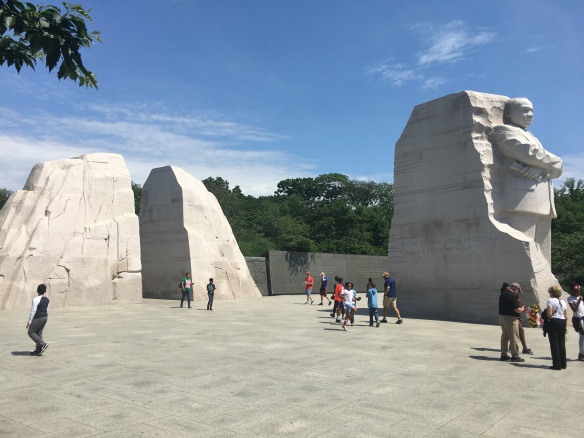
One of the most recently constructed memorials in Washington is on the shores of the Potomac River — the Martin Luther King Memorial.

IMG_6993

“No one is free,” said Martin Luther King, “until we are all free.” In other words:

What I want for myself can’t happen, until it can be so for everyone. If there is anyone who suffers in whatever way,

If there is anyone who is not free, in whatever way,

If there are people who are bound, captive to whatever vice, to whatever imprisonment of the soul or in prison because something they have done…

I am going to be healed of whatever ails me, only when I seek the healing of the other, the freeing of the other, the liberation of the other. The church holds up a different vision from that of the divisive, individualistic and exclusive nature of white nationalism in the world today.

You can see, I hope, why the consciousness of the church not only at Faith Lutheran, not only in Ottawa, or in the Eastern Synod or the Evangelical Lutheran Church in Canada, but in the United States of America and worldwide is moving to see not a division between things, not building walls between two perceived opposites, but building unity between them.

Not a division between politics and pastoral care,

Not a division between care for the soul and social justice,

Not a division between reaching out and reaching in,

Not a division between speaking out against injustice of whatever kind and speaking to the choir,

Not a division between contemplation and action.

Not an either-or, but a both-and.

Last week when Ken stood here and told you about the different ways we can support the financial health of the congregation, he introduced his well-delivered announcement by saying — “you’ve heard we in the church were never to talk about money, politics and sex (well, he didn’t actually say the last word, but I know you all were thinking it!).

And then a couple weeks before that, Mark stood here and told you about his upcoming trip to Ecuador to build homes in a community destroyed by an earthquake some years ago. And in his well-worded speech he said (I paraphrase): “In this mission trip the group he was going with was not doing mere charity, dollars sent to a far-off location, but directly helping them on the ground and making a real difference in the lives of those who suffer.” Check it out. He said it. I believe he has it all on a piece of paper.

I alone am not telling you all this. Your own members are. Your own church family is slowly but surely breaking down the walls that have divided, distanced and incubated our conversations in the church.

Limited our conversation. Limited our imagination. Limited the ways of God. NOT talking about these things, well, how has that worked out for the church in recent times?

NOT talking about the things that really matter in our daily life, NOT being open and honest, sharing the deepest secrets and burdens of our lives, NOT feeling safe in a community of faith to be who we humanly are, warts and all, imperfect, suffering, in need of God’s love. NOT being like that — how has that worked for the church? How has that worked for you?

It is not easy in the church (although everyone else in our real lives are talking about them!) to talk about money, politics and sex. It is not easy to talk about the real things that matter in this life. And so, the church for many decades has avoided having these conversations. Why? Because we were afraid? Because talking about sex, politics and money would put a mirror in front of us, exposing areas of our life that needed even a bit of God’s light shining upon it?

It’s not easy to talk about these things. I know. I feel it too. But I always thought that that’s what faith was supposed to be about — to confess, be honest, be real, and just do the work of God. How can we do the work of God when we can’t even be honest, and real, and confess ourselves to one another?

We can echo the prophet Isaiah’s complaint to the Lord: “Woe is me! I am lost, for I am a man of unclean lips …”[2]

But he doesn’t stop there. His confession is not just about himself. Faithfulness is not merely individualistic. We don’t come to church to make an individual contract with the Lord.

Isaiah continues in his confession: “Woe is me! I am lost, for I am a man of unclean lips, and I live among a people of unclean lips.”

Faithfulness drives towards the communal, the community, the well-being of the world. “No one is free, until we are all free.” Not just me, but we!

When we don’t include, welcome and affirm people who are different from us, we are a people of unclean lips.

When we refuse to include conversations about sexuality, money and political action, we are a people of unclean lips.

When we remain quiet in the face of injustice, we are a people of unclean lips.

In other words, this confession of Isaiah implies that he feels he should just ‘shut up and sit down.’ Not say anything. Because he is bad. And Israel is bad.

Maybe you feel this too. Not unlike Isaiah when confronted with a vision of God, you feel, deep down, the church is bad, and has nothing worthwhile to say in the public sphere. Millennials believe that. Just ask your children or your friend’s children. In the past, we church-going Canadians have conveniently said, “That sort of stuff is the government’s job.” We effectively, therefore, excuse ourselves from any social action in the name of Jesus. And continue the dividing.

Martin Luther King also said that in the church it’s alright to talk about the New Jerusalem (pointing to heaven, the afterlife), yes, but one day we also have to talk about the New York or the new Ottawa, the new community in the here and now.

What did Isaiah see in his vision?

Two details in this vision I want to focus on:

First, “the house was filled with smoke.”[3]

Here’s Isaiah who sees God in all God’s glory. How can I understand this vision by analyzing: Why the six wings folded over on various parts of the seraphim? What’s with that?

But the smoke fills the space. Usually, the image of smoke — like the cloud — in the bible is codeword for, “Can’t get this.” I can’t explain what’s going on in the presence of God. I can’t bring all the statistics, analysis, data and information the world can offer, to explain this rationally. But that’s ok. Because that’s not the point.

In 2018, in the wake of the internet revolution, did you know that more than 7 billion humans use the internet; and, that’s 7 and a half percent more, over 2016. Google now processes more than 40 thousand searches EVERY second. And remember, that’s only Google. Include all the other search engines out there, worldwide there are 5 billion searches EVERY day.[4]

We don’t need any more information! The church’s solutions are not found in accruing more data to solve our problems!

Because things happen in life that we can’t understand. The truth about God cannot be conveyed in data streams and pie charts and three point sermons.

Smoke in the house. Mystery. Might it be, that Isaiah and the bible is trying to say: We don’t need to understand everything. We don’t need to know how it makes sense for people of different races, colour, ethnic background, different social economic status, expressing a different sexuality, different ages, different abilities can form one, unified community. We don’t need to know how that can be.

Today is Trinity Sunday. I am not going to stand here and try to explain to you how three different persons can constitute one God. Because I don’t know. All I know is that those different persons are in a unified relationship. Relationship.

The third person, especially, confounds our Lutheran sensibilities. We’ve figured God the Creator. We’ve figured out God the Son, well, as much as we can. But the Holy Spirit throws a wrench into any rationalizations. A mystery, to be sure!

How does it all fit together? How can we analyze this even more? Shouldn’t we first have a detailed plan? Shouldn’t we try to draw a diagram?

We don’t need to know! All we have are the visions. The dreams. The imagination that describes in poetry and colourful words flashes and fragments of God’s kingdom and truth. We don’t need to know. We don’t need to reconcile all the contradictions. We don’t need to make sense of it. We don’t need to provide all the answers. We don’t need to put God in a box, nor explain God to anyone. God doesn’t need that from us.

Why?

Because even though Isaiah is a man of unclean lips (God doesn’t deny it!), even though God’s people have unclean lips, even though we are imperfect individuals in an imperfect church, that isn’t going to stop God. In Section Five of a recent Confession of Faith in a Time of Crisis called “Reclaiming Jesus” church leaders from across the United States wrote: “We support democracy, not because we believe in human perfection, but because we do not.”[5]

The realm of politics is imperfect. Who would think? Yet, our imperfection is the very reason politics happens. It is not something to avoid, it is something to embrace.

What does God do? Despite Isaiah’s complaints and resistance (just like all the rest of the people in the bible!) …

Despite us!

God reaches down from God’s throne and touches Isaiah’s lips with God’s holiness. God doesn’t steer uncomfortably away from the place of Isaiah’s greatest embarrassment, sin, weakness, brokenness, uncleanliness. God doesn’t avoid the uncomfortable places of our lives. God doesn’t even say anything to that uncleanliness.

God touches it. In the place of our greatest fear, shame, guilt, when we present ourselves in God’s almighty, mysterious presence, honestly and openly — not denying nor avoiding — we place ourselves in a position to be touched by God in the very place of our greatest weakness, to be healed, to be transformed, to be made new.

Even in the vision, the temple and the seraphim cannot contain the ‘bigness of God’. “The train of God’s robe filled the temple.”[6]The image is not meant to convey facts, figures, numbers, measurements, information.. Only our post-enlightenment, rational minds want to go there. But we can’t explain the vision of God. God’s kingdom doesn’t sit comfortably in our rationally justified common-sense policies.

God’s presence enfolds and goes to the edges and bunches up in the corner feeling like it needs to be stretched even beyond the walls of temple.

Whom shall I send? God asks.

Isaiah, transformed by God’s touch, can then say, “Here I am, send me.”[7]

Will we?

The Holy Spirit blows where it will. The wind does not stop at the border. The wind does not end at any walls we build to divide. The Holy Spirit brings fresh air into the stagnant, recycled, stuffy air of our temples. The Holy Spirit blows, fresh air at last, sending us into the world with God’s love, grace and power to change.

I don’t know how the fresh air of the Ottawa Valley is cleaner and sweeter than the air I breathed south of the border, really. But I don’t need to know how. I just know.

And give thanks.

[1]USA Today, May 24, 2018

[2]Isaiah 6:5

[3]Isaiah 6:4

[4]Bernard Marr, Forbes.com, May 21, 2018

[5]ReclaimingJesus.org

[6]Isaiah 6:1

[7]Isaiah 6:8

Dare we imagine

For my friend’s wedding over twenty years ago, I was asked to play Pachelbel’s Canon in D on my violin for the processional. We were to rehearse on the Friday evening. As I was running late, I drove over 120 km/hour on the Queensway from the west end all the way to Orleans. When I ran into the church, violin case in toe, the bride was waiting. I had made it just in time to set up and start the procession.

The notes lifted off the strings and the bridal party started down the aisle. But I was getting strange looks from them when all of a sudden the bride waved her hands and said: “Could we start over? Martin, did you tune your instrument?”

At that moment I actually heard the music I was playing – completely off key, sharp by at least three tones. “Ah, no,” I mumbled, even though the problem wasn’t that I hadn’t tuned my instrument. The problem was in my head.

You see, when I sat down to play, my mind was still travelling 120 km/h on the Queensway. My body may have been resting at that moment when I played the first note. But everything inside of me was still going. And going fast. No wonder I was playing sharp.

I learned from that experience, that before I play my guitar or violin, or sing any song, I must pause. I stop. And in my mind, before playing the first note, I hear what I want to play and how I want to play it. I need to imagine it first, before doing anything.

The truth is, you cannot even do something until you first have an image of it inside you. Albert Einstein, early 20th century inventor and scientist, once said, “I am enough of an artist to draw freely upon my imagination. Imagination is more important than knowledge …”[1]

Late 20thcentury author, surgeon, and inventor — Leonard Shlain – made the case that images come before our capacity to verbalize or name what we see.[2]We have to see it in our mind’s eye, first. Our imagination dictates our reality to a large extent.

Attending the Festival of Homiletics in Washington D.C. this week is a real treat, as I have had a little time in the busy schedule hopefully to visit the National Gallery of Art.

There, until mid-summer is an exhibition of paintings about Francis of Assisi. Francis of Assisi from the 13thcentury is an important figure in Christian history. He is, of course, known for his spirituality about nature and all of creation. Francis is also credited for putting Christmas on the annual Christian calendar. Christmas is the celebration of God’s incarnation into humanity.

I was impressed to learn that “Francis of Assisi has the longest, single entry in the bibliography in the Library of Congress, also in Washington D.C. He is the most written-about human being in history. Every day there is another biography, monograph, that they enter into their files, from another language, another culture, even other religions.

When the Pope some years ago wanted to gather leaders of all the world religions to have a respectful, inter-faith dialogue, the only city in the world that they could agree to meet in was Assisi, Italy. Because the memory of this man doesn’t carry much negative baggage at all. “[3]He was one of those rare human beings whose humility and stance towards others garnered respect and love. Truly, a saint.

In one popular painting of him, he is standing with arms open and the birds flocking around him. But instead of looking up – which you might expect – he is looking down at the earth.

In the season of Pentecost we are entering now, we read from Book of Acts that the Spirit of God “came from heaven” upon those gathered in Jerusalem.[4]The Spirit of God came down upon the earth. The Spirit of God descended to the place where humans were gathered.

Often we assume that to be spiritual, or to be holy, we have to gaze upwards towards heaven – somewhere away from the here and the now. We may therefore over emphasize our destination in the heavenly realms while paying little heed to the earthly journey.

In the optioned first reading for today[5], we encounter a dramatic vision of what happens in the valley of dry bones.[6]The prophet Ezekiel conveys to us a message using fantastic imagery, not unlike later apocalyptic visions from Daniel and the Book of Revelation in the Bible. I hope our imaginations are stirred by this reading, where skeletal human remains join together and begin to walk again.

Christians have traditionally understood this vision primarily to point to the resurrection of the dead, in light of Christ’s resurrection. This rising, then, would happen at the end of time, after our physical death.

Such an interpretation does not do full justice to the text, whose context is the community of exiles in Babylon, some six centuries before Christ. These exiles – the people of God – felt dead, like the dry bones. They had lost everything when Babylon conquered Jerusalem – their temple, their homes, their land.

The prophet Ezekiel with the exiles, conveys the word of God to the hopeless. The vision of new life in the dry bones is a promise of new life for the exiles. They are given hope, in a hopeless world.

Holy people in art are often depicted looking up to God. While this is certainly an appropriate stance to have in life, let us not miss the point of the Pentecost message, which is not fundamentally heavenward. The primary movement and message of Pentecost is downward. To the ground. God’s Holy Spirit blows upon the earth, in the earth, and in humanity.

God’s Spirit comes to us, wherever we are in life on earth. To whatever circumstance of our lives. Whether we are imprisoned in the exile of our own making or constrained by forces beyond our control. It is into the ordinary, the mundane even sordid realities of life to which God now comes.

Our lives on earth matter to God. How we live and what we do with what we have matters to God. How we live and what we don’t have matters to God. How we live with others matters to God.

While in the passing season of Easter our gaze may have looked upward to the glory of Jesus, our gaze and focus during Pentecost levels out upon the earth. We now watch for the presence of God among us. We go where the Spirit blows to do God’s will and mission.

We pause to imagine, like African American slaves did centuries ago on this continent, that ‘dem bones’ will rise again out of captivity. Dem bones will sing a new song. Dem bones will embrace freedom in the loving grace of God.

Dare we imagine.

[1]Cited in Leonard Shlain, “Art and Physics: Parallel Visions in Space, Time, and Light” (New York: HarperCollins, 2007)

[2]Richard Rohr, “Daily Meditation” 14 May 2018 (Center for Action and Contemplation), http://www.cac.org

[3]Richard Rohr, “The Art of Letting Go: Living the Wisdom of Saint Francis”, Session One/CD1 (Boulder Colorado: Sounds True, 2010)

[4]Acts 2:2 NRSV

[5]Day of Pentecost, Year B, Revised Common Lectionary

[6]Ezekiel 37:1-14

Ascension action

As you saw last Sunday, I had my canoe strapped atop my car. I was eager to put paddle in water and explore the waterways around Papineau Lake near the northern border of Algonquin Park, just south of Mattawa.

From Highway 17 at Mattawa, we turned south on a dirt road. The land there still thawing from winter’s grip, the snow-melting runoff left deep potholes and troughs across the narrow roadway. For about fifteen kilometres we traversed the rough and bumpy access road, thankful for the four-wheel drive.

Finally arriving at the end of the road at the shores of Papineau Lake, we still had to portage our gear about half a kilometer through the thick bush to the cabin. I thought to put the canoe in at the water in order to paddle my gear along the shore line and save the heavy climb carrying everything on my back along the trail.

But when I looked out over the lake, this is what I saw all over its surface: Ice.

IMG_6939

Despite the 20-degree Celsius air temperature by midweek, the persistent ice continued to lock out any hope of paddling into the lake. Until the fourth day of our camp-out, the ice prevented us from going to the deepest parts of the lake to fish for the coveted Lake Trout for dinner. We were limited to shoreline casts where a narrow band of water teased us into never-ending hope for a catch.

IMG_6935IMG_6931

After a windy and rainy day late into our stay, we awoke at long last to this glorious sight:

The ice was completely gone. Night and day. Needless to say, I was out on the water in my canoe, crisscrossing the lake and exploring new shorelines. The loons were back. The lake had awakened once more.

In these last few days, the church has recognized the Ascension of our Lord. Some forty days after Easter each year the church recalls when Jesus, after appearing to his disciples following his resurrection, ascends to heaven.[1]

Jesus, here, leaves them for good, so to speak. It is no wonder why the scripture texts in these last few weeks have gone back to parts of the farewell discourses from John’s Gospel, also appointed for reading before Christ’s death.[2]There’s a point to it.

Jesus prepares his disciples for his leave-taking, never easy – a second time, now. Both before his death, and now before his Ascension, Jesus needs to remind and console them – and us – that we are not left alone.

Despite his going away, Christ will come to them no longer in physical form but in the Holy Spirit. God is present now to us in each other– the community, through the power of the Holy Spirit.

Why did Jesus leave them? You might wonder: Why should Jesus have ascended to heaven and leave it all in his disciples’ hands? We don’t need to go far into Christian history to see the imperfection (to put it mildly) of Christians throughout the ages.

Jesus was alive and among them. Why couldn’t he just have stuck around – forever? Things would certainly have turned out better, no? Could you imagine how encouraging it would be for his disciples then and now to have Jesus appear from time to time albeit in his resurrected form to guide us, talk to us, lead us, comfort us, in physical form?

All the while the ice remained in the lake, we were confined to the shoreline. We could still fish, to be sure. But the real good catches were waiting for us out in the middle of the lake. For us to do so, we had to get out on the lake ourselves. The ice had to go, first.

If the Ascension didn’t happen, would the disciples ever really believe Jesus’ promise – or have to believe Jesus’ promise – that God lives in them through the Holy Spirit? Would the disciples ever do what Christ commanded them – to go “to the ends of the earth” to be Christ’s witnesses?[3]

If Jesus remained with them, wouldn’t they be tempted to look only to Jesus standing out in the middle of lake – even if there was ice covering it –  and not trust themselves enough to get ‘out there’ to do the job? Wouldn’t they become overly dependent on Jesus for everything and not embrace the gift within them?

“You are my witnesses, even to the ends of the earth,” Jesus says. We need to hear that first word in the sentence: You. Jesus speaks to each one of us here. Each one of us are Christ’s witnesses, now that Jesus is no longer present to us in bodily form.

And, that means, we have to follow through not only with words, but with deeds. When the ice melts, we are called to get ourselves out there into the middle of the lake and start fishing, with the gifts we have.

Over forty years ago, my father flew low over Algonquin Park in a single-prop plane. I was just a baby, and my mother was worried. You see, my father, the pastor of a church in Maynooth, was the passenger squeezed tightly into the small cabin of this plane. It was the pilot’s first solo flight.

The pilot was a member of his parish. Bill, we will call him. For years leading up to this event, my dad counselled Bill who struggled with many personal problems to say the least. Nothing was going right for this guy. At one point in their conversations, my dad asked Bill: “If there was anything you wanted to do, what is it you dream of doing?” Good, pastoral question, no?

Without much hesitation, Bill said he had always wanted to fly a plane. So, my dad encouraged him to get his pilot’s license. Which he did in short order. Again, good pastoral guidance. You’d think my dad’s job was done. Pastor School 101, check.

But when it came time for Bill to fly solo, he naturally asked his own wife to go with him the first time. She flatly refused, which worried my dad a bit. What was it about Bill that she couldn’t trust going into a plane with her husband flying it?

So, Bill came to my father. “Pastor,” he said, “you have been with me through it all. You said words that helped me in my despair. You listened to me when things weren’t going well. You helped me discover my passion. You encouraged me to get my pilot’s license. Now, I’d like you to go with me into the air, for my first solo flight. Would you please come?”

You could imagine why my mother was so worried. With two little baby boys to care for, she feared Bill would crash the plane and she would be left to parent us alone.

But dad went. He might have been justified in finding some excuse not to go with Bill. I think in his wisdom my dad knew, though, that his words had to be followed by actions.

I think in his wisdom, my dad knew that to be a witness to the gospel, it wasn’t merely about believing the right things and saying the right things. It had to be followed up by walking the talk. And this action involved some risk, to be sure, and a whole lot of trust.

May this Ascension Sunday remind us all that the God gives us the gifts we need to take the risk to get out there onto the lake and do the job that is ours, together in and through one another, blessed by God, and empowered by the Holy Spirit.

[1]Luke 24: 44-53

[2]John 17:6-19 (Easter 7B), John 15:9-17 (Easter 6B), John 15:1-8 (Easter 5B) – These texts, part of the ‘farewell discourse’ of Jesus in John’s Gospel, are intended to prepare, encourage and empower his disciples prior to Jesus’ departure. The context of the farewell discourse is Holy Week, especially during the Passover Meal on the night of his betrayal and arrest.

[3]Acts 1:8

One part per billion

I’m going into the Algonquin Park region this coming week. As you can see outside the church, I’ve already strapped my canoe atop the car. I’m looking forward!

And when I’m paddling, I like to follow the river or lake banks. Of course, where I’m going, there are lots of little lakes and rivers, and therefore many riverbanks and rocky shorelines I will skirt (probably still breaking the ice!).

We live in a world where borders and boundaries are important. Whether these are borders between nations, continents, cities, regions, communities, families or individuals, they mark the line between separate and distinct realities. Without honouring certain boundaries, we can fail to distinguish who we are and lose a sense of our identity and purpose.

Last summer when I travelled through Spain and Portugal, I learned that he Portuguese-Spanish border is the oldest, unchanged national border on continental Europe. This surprised me because that border did not appear natural. Not unlike the border between Canada and the United States in North America, the Spanish-Portuguese border draws a counterintuitive line across the more natural flow of the continent’s geography.

For example, to see it from space, the North American continent flows more north-south: The mountains run north-south on the western half of the continent, the prairie and plains in the centre of the continent, and the Great Lakes basin spilling into both the Mississippi and St Lawrence River valleys in the eastern portion of the continent. The geography suggests more natural north-south lines.

Spain and Portugal share what looks like a giant square mass of land peaking in the northwest on what is called the Iberian Peninsula. The Atlantic Ocean hugs the northern and western edges of this square. And the Mediterranean laps up against the eastern edge and into the southern Straits of Gibraltar separating Africa from Europe.

Despite what looks like it should be a unified whole, this large land mass is divided between two nations with Portugal carving its small section on the south-western shoreline.

When the kids were toddlers — and sometimes even to this day — they often lingered on the thresholds of doorways separating outdoors from indoors. Standing or sitting on the threshold meant that the door remained open. Of course, we parents were concerned about them jamming their thumbs and fingers and toes. So, we would yell at them: “In our out! Make up your mind!”

Borderlands, as we know from German history (the Berlin Wall) and between North and South Korea, can be dangerous places. We call the space in the border “no man’s land.” At best, these thresholds are ambivalent to us; at worst, they leave us uncomfortable, unsettled, fearful. We feel we can’t rest in these places.

I learned recently about what is called the ‘riparian zone’ which is the border between land and water. The riparian zone can be the lake or riverbank that is a marsh, or a rocky or sandy, thin strip of land, a hardwood forest or stand of pine on the edge of the river.

This ‘in-between’ place of the riparian zone fulfills three, vital, ecological functions: First, the riparian zone functions as a natural filter, cleaning ground water as it flows into the larger watershed. It also protects the surrounding soil from accelerated erosion by slowing down wash effect of the river. In the process, riparian zones actually create new soil and provides for new habitats.

A NASA scientist called the river and its marshy edges the ‘sine qua non’ of life; that is, where water and land touch, these edges are necessary for life on earth.[1]

So, we agree that boundaries are important. Borders, whether political, relational or ecological are vital.

But we also say that the grace of God knows no boundaries. We say that God’s love crosses and surpasses all boundaries. Jesus says, “Abide in my love.”[2]Paul wrote that “nothing can separate us from the love of God.”[3]God’s love expands and grows and overcomes all obstacles.

How does this happen? How can we, on the one hand, honour the boundaries in our lives and, on the other hand, live into the boundary-busting, wall-breaking, division-crossing, far-reaching, limitless, boundless reality of God’s love? How can God’s love abide in us when we are separated from God and each other by sin?

We are human, after all.

Imagine you are at the ocean, and you’re standing in the ocean ankle-deep. It’s true, you are only ankle deep. But it’s also true you are in the ocean. It’s also true that if you keep going, it will get plenty deep soon enough. If not in the ocean you are standing in, certainly at the deepest point on earth — the Marianas Trench — because all oceans on earth are connected anyway.

What if the infinite depth of the ocean gives the totality of its depths to your ankle-deep degree of realization of it?[4]

During the Easter season, and because of the resurrection of Jesus, the church says God is everywhere. But then, we also say God is really in your soul. And God is really, really in the church. You have to go in the church to save your soul. And, in the church, God is really, really, really in the Holy Communion. And, then, God is really, really, really, really in heaven. And, here at Faith Lutheran in Ottawa, it’s like one part per billion!

But, Jesus is alive. Therefore, God is really, really, really, really, really, everywhere.

The truth is, when you’re connected to a little bit of it, you’re connected to the whole of it, the fullness of it.

Speaking of the Holy Communion, when we receive one grain, it belongs to the one bread; one grape, one cup. Many parts, one body. When you receive only one small part of the Communion, you receive the whole of Christ.

“Every piece of bread and sip of wine is precisely the same one: there is one bread, and that is Christ. We receive all of Christ in communion, not just a piece of him. If we break the loaf into a thousand pieces, there’s still only one Christ – and each of us receives all of him.”[5]

This logic extends on several levels. Our lives, for one, belong to God’s story. “We need to sense that all aspects of our history, of our experience, are part of the same story, even the bits that don’t make any sense or the meaningless parts …”[6]There is no part of us that does not, somehow, belong to the great story of God and God’s people. Every part of us — our history, our experiences — is valuable to God and to us, and to each other.

We are who we are. No part of us is wasted space, wasted DNA. No part of us is lost, no memory is gone. All parts of us and each one of us belong.


[1]Diana Butler Bass, “Grounded: Finding God in the World; A Spiritual Revolution” (New York: Harper One, 2015), p.68.

[2]John 15:9-17 speaks of the mutuality of divine love’s presence: We abide in Christ as he abides in us.

[3]Romans 8:38

[4]James Finley, Centre for Action and Contemplation, 28 April 2018 (audio, http://www.cac.org).

[5]Br. Mark Brown, Society of Saint John the Evangelist (SSJE), Brother, Give us a Word, 28 April 2018

[6]Laurence Freeman, Daily Wisdom (Word Community for Christian Meditation, Meditatio), 1 May 2018.

Value-added, Christians in the world

Love is not a gooey, “Come, kiss my boo-boo because I hurt myself.”

Love is not a warm-fuzzy blanket to wrap yourself when you’re feeling blue.

Love is not Valentine’s Day chocolates wrapped up in a big red bow.

That is, not love according to the Gospel of Jesus Christ.

Love can be many things. In our world, love has masqueraded in many forms. Do we even have the energy to reflect, talk and most importantly act in the love-sense of the Gospel?

The text from 1stJohn begins with an address to the “beloved”.[1]This is a better English translation than others that start with “Dear friends.” The word in the original Greek is agape. As the first readers and listeners to this word were, so we are addressed, the “beloved.”

This word appears several times in this text. Can you count them all?

And none of them mean what the world, and our compulsive, fearful selves might first imagine.

Agapeis a self-giving love. It is a love that reaches out for the good of the other, despite what the giver wants to do. “Not my will but thy will be done,” Jesus prays to his Father in heaven moments before he is arrested.[2]

I continue to be perplexed by Mother Theresa’s confession on her way to India as a young girl. From the start, when God’s call to go there was beginning to grow within her, I wonder if she really wanted to go.[3]If it were up to what she wanted alone, I don’t believe she would have sacrificed her whole life to the cause of the poor. And yet, we know of her incredible contribution to help the vulnerable and homeless on the streets of Calcutta over the decades that she lived there, served there, loved there.

And what a paradox it was. She discovered, in the giving, that she was being most fulfilled. It wasn’t a sacrifice in the sense of self-denial, self-hatred even, or repression. She was one of the most human of souls on this earth, say those who met her. She discovered that her greatest needs were met, in her self-giving.

In the Star Wars spin off TV series, “The Clone Wars”, a story is told of how Jedi younglings are trained in the Force in a ritual called “The Gathering”. In order to become full Jedi, they must build their own light sabers. Their light sabers are unique to the individual. Each one is built around a crystal which they have to retrieve on an inhospitable, cold planet.

A group of younglings is dispatched into an ice cave to harvest their crystal. In order to succeed, they must meet and overcome their deepest individual fear and greatest weakness: Fear of heights. Fear of monsters. Impatience. Being left behind. Their crystal becomes available to them once they endure this personal challenge, each to their own.

What is more, the clock is ticking. They must find their crystal and exit the cave in a few short hours before the entrance to it freezes over. Otherwise, they would have to wait a couple of weeks trapped inside without help until the next rotation of the sun would allow the ice entrance to melt open again.

It begins as an individual challenge. But it can only succeed as a group effort. Before sending the younglings into the cave, Jedi master Yoda gives them their final instructions: “Trust yourself and trust each other you must.”

For some, this is the biggest problem. Most of the younglings run into the cave and work together in smaller groups, at least in pairs. One helps the other, and vice versa.

But for Pedro, the young upstart, know-it-all youngling boy, he rushes in at breakneck speed and abandons the group immediately. He forges ahead giving the others the impression, again, that he doesn’t need anyone’s help.

Before you know it, he finds his crystal. Or so he thinks. He is the first one back outside the cave. But when Yoda inspects the crystal, it melts in his hand. It wasn’t a crystal he found on the tip of the cave’s stalactite, just some frozen water.

Pedro needs to go back in and do it all over again. But now, time is against him.
While he runs back through the main entrance of the cave, others are returning from their search. He is worried and anxious now that he won’t have enough time.

Feverishly sprinting down tunnels and turning corners Pedro doesn’t know what to do. Until he comes across one of his class mates, Ketuni, trapped behind a glass-like ice wall.

Ketuni had been rushing herself to get to the entrance after finding her crystal. She had followed what she thought was a short-cut from one of the larger caverns. Just as she was coming up the narrow passage leading to the main tunnel near the exit, she realized she was trapped. There was no way she had enough physical strength herself to break the translucent, ice wall. Neither did she have enough time to find another way around.

Ketuni is just about to give up, getting used to the idea of spending days alone in the cave when she notices Pedro rush by. Ketuni calls, “Help! Get me out! Help!”. Pedro faces her through the glass wall. “But I haven’t yet found my crystal. I can’t help you. I have to get going.” And so, preoccupied with his own agenda and needs, he darts off.

But seconds later, perhaps with a change of heart remembering Yoda’s initial instructions to work together, Pedro comes back to the trapped Ketuni. Still without a crystal himself, Pedro takes a sharp rock and breaks a hole through the glass wall big enough to let her out. “Thank you! I’ll help you find yours, now quick!” Ketuni says.

“No, No, you go. There isn’t enough time. Please, get yourself out!” Pedro cries. Reluctantly, yet realizing the truth of what he says, Ketuni runs to the exit. At that moment Pedro notices a crystal glimmering in the broken ice from the hole he made to help Ketuni escape. In his willing sacrifice for her sake, he finds what he is looking for himself. By the end of the story, of course, Pedro makes it out just in the nick of time.

One of the lessons learned from the story is the mutual blessing that comes from paying attention to the needs of the other as the way of discovering your own gift. Our little friend needed to learn the value of trust in working together.

Love, no matter how you define it, is relational. A healthy encounter is usually mutual. A basic definition of mutuality is: “What I want from you, I will first give to you.” If I want respect, I first need to give it. If I want your trust, I need to trust you. If I want you to listen to me, I first need to listen to you.

Mutuality is thus a rendition of the Golden Rule: Do unto others as you would have them do to you.[4]That is, love the other because that is what you seek from them. A primary and fundamental question in any loving relationship is: “How can I best love you?” This brings an interesting implication of living out our faith, in the world: Our deeper needs will be met when we meet the needs of others.

Giving and receiving. Like a vine that is connected to the source. Any part of that vine (the stem, the leaf, the sprig, the sprout) is at any given time both the receiver of nutrients and the giver. It is a conduit. There is constant motion. Stasis does not compute in this picture, this dynamic. Any part of that vine must know what it is like to be both receiver and giver, giver and receiver.

If you can’t trust another to give you help when you need it,

If you can’t receive the love of another, no strings attached,

Then, how can you give it?

Both receiving and giving. Mutuality is thus a hallmark of the agapelove strewn throughout the stories in the Bible.

And flowing in the life of the church today.

We are the beloved. And we are a conduit of that love to the world. Christians are called the world over to ‘add value’ to society. And that value and worth resides in each human being. William Sloan Coffin, in his reflection of love some decades ago, wrote, “God’s love does not seek out value, it creates value. It is not because we have value that we are loved. Because we are loved, we have value.”[5]

God does not love us after we prove somehow that we deserve it. God does not love us after we already prove our worth or value. God’s love in the world creates value in each of us and in those we meet whenever we share God’s love.

Whenever we receive love and give love, love is truly the energy that keeps the world going ‘round.


[1]1 John 4:7-21, NRSV

[2]Luke 22:42

[3]Greg Pennoyer, ed., “God For Us: Rediscovering the Meaning of Lent and Easter” (Massachusetts: Chalice Press, 2015), p.114-115.

[4]Matthew 7:12; Luke 6:31

[5]William Sloan Coffin, “The Courage of Love,” (New York: Harper & Row, 1982), p.11

God in Acts

In Mark Burnett’s recent visual adaptation of the entire Bible, some scenes from Jesus’ passion still stand out for me. Weeks have passed since the dramatic events of Holy Week and Easter. So, I ask you, to rewind the tape for just a minute. And recall with me when news of the upstart prophet from Galilee first came to ears of the high priest in Jerusalem:

The scene in the temple is dark, illuminated only by the flickering flame of candlelight sending fleeting shadows throughout the cavernous room. The religious leaders draped in their flowing robes shuffle about.

An anxious member of the religious elite makes his way to the high priest, catching his attention: “There are reports of a man performing miracles, and some five thousand followed him to Galilee.” At first, news about Jesus does not worry the high priest. He turns away without saying a word. But the messenger persists, pulling at the high priest’s shoulder. “He calls himself the Son of God!”

The high priest’s mouth stretches in a cold smile, “They all do.”

Then, the night before Jesus’ death, Pilate consoles his wife who is disturbed by news of Jesus’ arrest and trial. Pilate’s wife tries to convince Pilate to have nothing to do with Jesus and let him go.

But Pilate, feeling caught between a stone and a hard place, is playing a delicate political game in order to keep control. He says to his wife, trying to justify his own actions to have Jesus condemned to death: “Don’t worry, in a week this man will be forgotten.”

Both the high priest and Pilate, struggling for political control, convince themselves Jesus is a no one, or at best, a pretender. And will be forgotten, like all the rest of them.

We fast forward now, to life in Jerusalem after Jesus’ death and resurrection. Now, in the Book of Acts, the focus shifts to the disciples. A man who is disabled, sitting by the gate near the temple in Jerusalem, finds healing. Peter and John meet him on their way into the temple. “In the name of Jesus Christ”, Peter touches the man, and he is able to walk again.[1]

“By what power or by what name did you do this?” the religious leaders in Jerusalem ask Peter and John when they are arrested. The Sadducees, who were a powerful religious group in Jerusalem, did not believe in the resurrection of the dead.

Strike one, against Peter and John who did not stop preaching the resurrection of Jesus and all who believe.

It is said that five thousand people converted to Christianity after hearing and seeing what miracles and words Peter and John performed.[2]

Strike two, against them. Five thousand people is a huge threat to the religious establishment. And to social stability. Rome held Jerusalem’s religious leaders responsible for keeping the pax romana – Caesar’s idea of political control over each region in the vast Mediterranean empire. There was no way the Sanhedrin were going to allow Peter and John to continue their disruptive work.

So, they were arrested and brought before the religious council called the Sanhedrin. Did Peter and John know that a few weeks prior, Jesus stood in the same place before the religious leaders?

Strange, I find, that something obviously positive – the healing of a person – turns into something negative so easily where human nature is concerned. Questions of resurrection, the mercy of God and healing turn into a question of power: “By what power or by what name did you do this?”

It is also clear, as the author of Acts present, that the religious leaders were “jealously protective”[3]of their franchise on religion. They wanted the masses to be prayerful and faithful. But they wanted people to do so under the exclusive banner of the temple.

Yet, from the beginning, the Christian movement was an outbreak of the Holy Spirit, spreading like wildfire. It cannot be contained in any one, exclusive denomination, group or church claiming to be the only, right way. That is not the nature of the Christian movement, from day one to the present. Exclusivity is not the preferred style of Christian life.

“By what power or by what name did you do this?” Peter and John have an answer: There is no other name by which we all are healed. Jesus Christ stands for all.[4]For God shows no partiality, for there are people in every nation who are acceptable to God.[5]

There is no other name. Other gods will give up on you:

The god of war and violence will give up on you when you turn the other cheek.

The god of consumerism will give up on you when you give what you have to those in need.

The god of power and control will give up on you when you let go of any pretence of being in control of others, forcing them to be like you.

The god of competition and hatred will give up on you when you welcome, affirm and show mercy to those who are different from you and your kind.

All these false gods of the world will forget you. They will be forgotten. The high priest of Jerusalem and Pilate were right because there were so many claiming to be the Messiah who were just that: fakes. These are the false gods who will be forgotten.

But not Jesus. Even after his resurrection and ascension, Jesus will not be forgotten.

Peter and John may have had a couple of strikes against them standing as prisoners before the religious leaders in the temple’s portico. But they, and the Christian movement, would never strike out. God was about to blast a grand slam out of the park of history.

The God of resurrection and new life will continue to inspire, to push us forward, to pinch our consciences, even challenge us to move forward. There is no hiding from this God who will not give up on you and on us.

The God who created you, who loved you,

Who, even in your sin forgives you and shows you mercy,

The God who gives you a second chance, always,

The God who is your loving shepherd, compassionate friend,

This God will never, ever give up on you, nor forget you. Nor any lost, hurting person or creature in all of creation.

Whether it is Peter or John, or the voice of God speaking this through the church and in the world today …

There is no other name under heaven by whose power all can be saved.

Amen.

[1]Acts 3:1-10

[2]Acts 4:4

[3]Thomas C. Long cited in David L Bartlett & Barbara Brown Taylor, “Feasting on the Word: Preaching the Revised Common Lectionary” Year B Volume 2 (Kentucky: WJK Press, 2008) p.432

[4]Acts 4:10-12

[5]Acts 10:34

The musical performance

“You are witnesses of these things,” Jesus tells his followers.[1]

What does it mean, ‘to be a witness’ to all that happened around Jesus over two thousand years ago? How can we be a witness to these things with which we haven’t had a direct experience, when we haven’t seen with our own eyes and met with our own bodies the living, Lord Jesus?

The weather this weekend is a joke. There’s no other way of putting it, to my mind. It is the season of baseball not snowball! But sometimes when things don’t go our way, humour can be a good antidote. So, here is a music joke.

Last week I gave an example of a double bass player to illustrate how we need to go from the head to the heart. But we don’t always trust that movement from head to heart because it feels like we are losing control.

Imagine a picture of several double bass players standing at the back of an orchestra playing Beethoven’s Ninth Symphony. The bass players are swaying to the majestic sounds and rhythms; their bodies are into it. It is nearing the end of the epic masterpiece, and the caption at the bottom of the comic strip says:

“It’s the bottom of the ninth, and the bassists are loaded.” Hmmm. Maybe too much heart?

How do we live a life of faith that is heart-centred? At same time, how do we deal with our performance anxiety, worried about how people will perceive us when we do our thing, as Christians? We do put a lot of pressure on ourselves to perform to perfection and make a good impression. Unfortunately, this kind of self-talk keeps us from being the best we can be. That’s why, unfortunately, too many musicians have too much to drink prior to a performance.

We need not be too hard on ourselves. Easily 50% of the population make decisions based on fear.[2]The annual “Back to Church” movement creator, Michael Harvey, claims that there is only one socially-accepted sin in the church today: fear.[3]

Yet, none of the Gospel accounts of the risen Jesus condemn the fear. It is to be expected. Jesus meets the disciples, and meets us, where we are even in our uncertainty. Jesus’ initial purpose, after all, is to bring peace. “Peace be with you,” are Jesus’ first words to his disciples after the resurrection.[4]

But Jesus calls us, as he called his disciples, to move beyond our fear, move beyond the fearfully locked doors of our hearts.

The ultimate purpose of the Gospel is not just to allay the fears of Jesus’ followers. It is not to convince us of the miracle of God. In other words, ultimately, who and what we’re about leads us beyond ourselves. The point of the bodily resurrection of Jesus is not the miracle per se, but that it becomes the engine of the proclamation of Jesus Christ to all nations.

Brother Curtis Almquist of the Society of Saint John the Evangelist noted recently that, “Jesus’ resurrection was indeed a miracle; however, Jesus’ resurrection needs to be more than a miracle. It needs to be normal, everyday, how we live and breathe: with resurrection power.”[5]

God’s grace finds expression in flesh and blood – in our bodies. First, as we experience it coming through the Eucharist, the presence of God is made manifest in humanity. And today, in the power of the Holy Spirit, that means, in us and all our brokenness and despite our imperfections.

How can we say this? Because in Jesus’ resurrected body, his scars were still visible. His humanity was still intact – in some mysterious way, in an mysteriously enhanced body to be sure. But the fact that Jesus bodily resurrection is so defended and argued by Paul and Luke and other early Apostles suggests, does it not, the crucial importance of the earthly, human manifestation, and receptivity, of God’s grace and presence.[6]

This is the power of the resurrection. That in the midst of our fear, Jesus comes to stand among us. In the midst of all that is wrong, broken, suffering in our lives, Jesus comes into the locked doors of our hearts and bodies. And then, calls us out.

How do we ‘proclaim’ Christ to all the nations? Again, nothing spectacular, here. Through our ordinary, simple selves, reaching out.

Leonard Bernstein, 20thcentury musician and famous conductor of renowned orchestras around the world – the Berlin Philharmonic, Los Angeles Philharmonic – once said: “The only way I have of knowing I’ve done a really remarkable performance is when I lose my ego completely and become the composer. I have the feeling that I’m creating the piece, writing the piece on stage … making it up as I go, along with those hundred people [in the orchestra] who are also making it up with me.”[7]

Working together, like in an orchestra, we are playing the music of the Gospel of Jesus Christ to the world, and in the world. Even though the music was first created a long time ago, we are making it alive and real for us and for the world, today.

We do so, using the gifts and grace and resources given to us from the Composer of the whole experience. We do so, through our own bodies, minds and spirits. At the same time, we let go of our ego, because it is not about us; it is about something much bigger than all of us.

Order of Canada recipient for his work in fostering Christian unity and inter-religious dialogue, Father Laurence Freeman said: “…grace works on nature. The grace of God that enters into human existence doesn’t come from out of space; it comes through nature. That’s why it is very dubious to talk about supernatural things. We are always interested in the supernatural, but what’s much more real and interesting is the real meaning of the natural. It is through nature, through the natural, through our own nature, our own psychology, our own physiology, our mind and body – through our human nature – that grace touches, emerges and transforms us …”[8]

So, it is our ordinary selves through which the grace and purpose of God works. What does this mean? First, it means we have to believe in ourselves. We have to trust that God has given us what we need to do God’s work, to be God’s instruments and vehicles through which God accomplishes God’s purposes.

Then, we need to perform the music, so to speak. And, it doesn’t need to be perfect, complicated or anything spectacular. Just simple, ordinary. We have to start somewhere.

One of our members asked recently a neighbor to describe what happens on and around our property on an average day in the Spring, Summer and Fall. And the neighbor reported that between 2:30 and 3:30pm every week day, about 30 kids on average, children of all ages, walk across our property from the bus stops along Meadowlands to their homes in the City View neighborhood. Thirty.

With presence of mind, our member asked the neighbor: What do they do when they walk across? Is there anything in particular that stands out in their behavior?

The neighbor said many of them like our benches outside the front doors. They like to sit and visit. They like to rest for a few minutes before continuing on their walk home.

When the member and I reflected on this, we realized there aren’t many, if any at all, public places in the neighborhood where people can sit awhile. Not only do we fill a need providing a place to sit, we encourage community-building, relationship-building right outside the doors to the church. How appropriate!

And for so many young people who are turned off the church, or at least afraid to enter into a church building these days, providing benches for children and young people to sit and visit sends a positive if subtle message about our identity and purpose as a church. It also sends a subtle yet real message of welcome.

This example is simple, ordinary, unspectacular. Yet, it is a first step in the right direction. As a community. Not as individuals doing our own thing. But, together, as a church, an orchestra playing together.

And isn’t that what the walk of faith is all about? We can only do what we are able to do, together. And then, when we take the first step, we watch as the Spirit of God can surprise and delight in us. All because we began by simply using what God has given us. Giving from ourselves, for the sake of others, for something larger than all of us.

That is, being faithful witnesses to these things.

[1]Luke 24:48, NRSV.

[2]Richard Rohr & Andreas Ebert, “The Enneagram: A Christian Perspective” (Crossroad, 2001).

[3]Michael Harvey, “Unlocking the Growth: You’ll Be Amazed at your Church’s Potential” (Oxford: Monarch Books, 2012), p.52.

[4]Luke 24:36; John 20:19-21, NRSV.

[5]Brother Curtis Almquist, Society of Saint John the Evangelist, “Brother, Give us a Word” on April 10, 2018.

[6]Paul’s first letter to the Corinthian church is a testimony both to Jesus’ bodily resurrection, and to our bodies being the imperfect vessels for the transmission of God’s grace and wisdom.

[7]Cited in Barry Green with W. Timothy Gallwey, “The Inner Game of Music: The Classic Guide to Reaching a New Level of Musical Performance” (New York: Doubleday & Company Inc., 1986), p.95.

[8]Laurence Freeman, OSB, “Finding Oneself 2” transcript (Singapore: Medio Media, 2017), p.29.

Blessed, to trust

Jesus’ words to Thomas are meant for us. Yes, they were first said to Thomas over two thousand years ago in the upper room in Jerusalem days after Jesus’ resurrection. Yes, they were intended to increase his faith in light of his doubting and fear. Yes, the early church and disciples heard these words for them, too.

When Thomas confesses his faith in the risen Lord, Jesus says: “Blessed are those who have not seen yet have come to believe.”[1]They are for us.

Let’s slow down and savour these words. Let’s look at three sections of this short sentence.

First, “Blessed are those who have not seen yet have come to believe.”

When do we not see? What are the times in life when God is unrecognizable?

In the face of great suffering or great love,

in the presence of death and dying,

and facing the difficult questions of living such as: Why do children suffer disease, poverty, persecution? Why do people who don’t deserve it, suffer? When the usual, easy answers don’t fit.

When we stand in the presence of a great mystery.

When everything points to everything except what is good.

When all words and ideologies fail.

Then, “Blessed are those who have not seen yet have come to believe.”

What are the qualities of these people who have ‘not seen’? These are people …

Who sometimes doubt.

Who are not certain.

Who don’t have all the facts.

Who can’t provide an easy explanation.

Who don’t have proof.

Who have done without.

Who have to trust someone else, and ask for help.

Who have to trust …

“Blessed are those who have not seen yet have come to believe.”

Finally, what does it mean to believe? To believe and to trust, are very similar. The two words appear on the faith cube. You might wonder why the authors of this toy decided to keep the two words separate even though they might, to our minds, mean essentially the same thing.

IMG_6887

And yet, it is worthy to ponder the subtle distinction between the two. Martin Luther understood faith as meaning the addition of the two concepts: Belief + Trust, not as opposing realities but complementing in distinct ways.

Belief is a function mainly of the mind. When we discuss doctrines, creeds. When we debate interpretations of scriptures and statements of faith. To believe is to access the cognitive capacity of our brains. It is, in the lingo of psycho-babble, the left brain analytical side that relishes in rational thought. To believe, in short, is to think through it.

Trust, on the other hand (or, on the other side of the brain), is more intuitive. Trust does not require a full explanation. Trust does not need all the facts and arguments in favor or against. Trust is a function mainly of the heart. Trust lowers the center of intelligence down from the brain to the heart.

Trust is relational. Trust understands our need for the other, to be open to the other, to take risks for and with the other. Trust calls us out of ourselves, to get out of the isolation of all our mental activity – to reach out to the other.

“Blessed are those who have not seen yet have come to believe.”

Jesus affirms for Thomas and the disciples that to follow in the Way of Christ, especially to generations and people like us thousands of years after the fact, that we need to trust others, and trust ourselves. To believe in Jesus, is to believe the witness of generations of Christians before us, to trust their witness, and to walk in the way precisely when easy explanations and scientific proof fall short.

We don’t ‘trust blindly’. That is often the criticism of trust, when it feels like we would be making an irrational decision not based in fact or evidence.

But we are trusting the most capable and the truest part of ourselves when we let go of our cognitive compulsions and let go into the love that sustains the heart.

The opposite of love is not hate. It is fear. “Perfect love casts out fear,” we read from the author of the second reading today[2]. We need to confess that it is fear that keeps us stuck in our heads, and keeps us stuck on the ground. Major decisions in our lives, decisions that changed the course of our lives, decisions that were important to us – were they born out of fear or love? Were they more a movement of the heart or head? Or some combination of both?

A music analogy …

I have been learning a new musical instrument these last couple of years. Classical guitar. Which is different, a little bit, from the acoustic guitar that you often see in churches today, and listen to in popular music.

In comparison, the classical guitar uses nylon strings, which tend to produce a softer, delicate, more harp-like sound. The fingerboard is wider on the classical guitar, and the body – the bell – of the instrument is smaller. When you hold the classical guitar, the curve of the body, which is more pronounced, sits on your left knee (if you are right-handed). And rather than strum chords, you pluck separate notes on the classical guitar. It’s a beautiful-sounding instrument.

But as with learning to play any instrument, and staying with it, there is a progression that needs to happen from the head to the heart. Listen to what Barry Green, renowned double bass player, writes about when teaching another musician how to play vibrato on their instrument. Vibrato is rolling your finger back and forth over your string when playing a note.

“On my Pacific tour,” he writes, “I coached Edith, a bass player from the New Zealand Symphony. She had tried to use her vibrato in a number of different places in a slow, expressive sonata by Vivaldi and couldn’t decide where it ‘worked’ best. None of her experiments quite had the right feel to them.

“I wanted Edith to discover the best places for vibrato by herself, so I asked her to play the piece without making any effort to put in a vibrato. I asked her to imagine that her fingers, not her brain, would tell her what to do, and suggested that she only use vibrato when her fingers ‘screamed at her’ to do so.  Since she would not have decided in advance which notes needed the vibrato, I was confident that her hands would be free to supply it unconsciously.

“Her performance improved immediately: Both her sound and her vibrato were smoother and richer.”[3]

Obviously to gain this level of playing, Edith had to practice and practice and practice. She had to become technically proficient in playing the bass. But to begin to enjoy playing and hearing the sounds you are creating on your instrument, to discover the resiliency of performing and the joy of making music, the usual questions provided by the mind must be eclipsed by the heart.

In other words, the mind will give instructions, constantly critique, and fan the flames of fear and self-consciousness – all of which undermine the making of a beautiful sound. We need the mind’s work, to an extent. But we also need to be able to let go of what the mental activity can get rather compulsive about. We need to grow up, as people of faith.

Albert Einstein, the most eminent scientist of the twentieth century, you would think would defend the prominence of the mind over the heart, the rational over the intuitive. So, this quote from him might surprise you; he said: “The intuitive mind is a sacred gift, and the rational mind is a faithful servant. We have created a society that honours the servant and has forgotten the gift.” Take his phrase, ‘intuitive mind’ to mean the ‘intelligence of the heart’.

Intuition relies on the capacity of trusting: Trusting the love, this capacity and capability within you, trusting the other who is willing to help, assuming the good intentions of others rather than immediately judging them – these are the attributes of one who has maturing faith. Especially, faith in God.

“Blessed are they who have not seen, yet have come to believe.”


[1]John 20:29

[2]1 John 4:18

[3]Barry Green with W. Timothy Gallwey, “The Inner Game of Music: The classical guide to reaching a new level of musical performance,” (New York: Doubleday & Company /Pan Books, 1986), p.113.