Remembrance Day Centennial

One of the reasons I wear my poppy year after year leading up to Remembrance Day, is to remind myself that freedom has a cost.

And that cost is not just ‘a drop in the bucket,’ spare change for which I reach into my deep pockets that doesn’t really make any difference in my life to do without. So, I throw them at some otherwise good cause. And feel smug.

In the Greek language in which the Gospel text from Mark[1]is originally written, we read that what the widow cast in the temple treasury was her bios. Her bios — meaning, literally, her very life. This text “invites us to imagine not two copper coins going into the treasury, but the very body and soul of the widow; her bios falling into the treasury.”[2]Freedom is not cheap. Freedom demands a whole lot of giving. Whatever good we see at the end of it all calls forth our very life.

Then, the punch to the gut. If we read on into the next chapter of Mark, Jesus says that this temple in Jerusalem—to and for which all those people were making donations—will soon be destroyed.[3]Throughout the Gospels, we know the temple and its culture was corrupt. Jesus had criticized, even became angry against, what was going on inside. In a fit of rage he had upturned the money changers’ tables in the temple. “Stop making my Father’s house a marketplace!” He cried, outraged.[4] Such behaviour from Jesus incited a condemning response from temple authorities, precipitating plans to have him silenced. The conflict between Jesus and the temple was well documented. And soon, Jesus would have the last word, promising that this building will be “thrown down.”

And Jesus is not just talking spiritually, here, referring merely to his body. His word was actually fulfilled: During the Siege of Jerusalem in 70 C.E. Roman armies destroyed the temple.

The juxtaposition of these texts is not without purpose, its meaning dare not be ignored. The structure of the narrative strongly suggests that the widow gives all she has to an institution that is going to be utterly destroyed.

According to Jesus, the widow gave more of her life than the rich people because she gave “out of her poverty”.[5]I think this is the key to understanding what Jesus is really getting at by drawing our attention to the widow’s gift.

She gave out of her poverty. I suspect we associate the freedom won on the battlefields with freedom to seek after material prosperity and amass financial wealth. In other words, we attribute freedom with permission in this land to become rich if we can.

The freedom of which the bible speaks, however, is not a freedom to invest, but to divest; where power and privilege divests itself in weakness which the world considers “foolish”. Remember Paul’s words from Corinthians: God made foolish the wisdom of the world.[6]

The widow gives her all, her bios, not for the temple treasury, not for the sake of the institution, not to build and maintain the stones, the bricks, the mortar, the properties, the buildings, the skyscrapers and the material wealth of church and society. Not for building an empire under the guise of ‘freedom.’ The giving of the faithful is not for these things.

Rather, the widow gives her all, her bios, for her neighbour. For the sake of relationship—relationship with the poverty within her own soul, relationship with the poverty in her neighbours, and relationship with the poverty of God: Christ crucified.

The placement of these stories in the Gospel narrative is significant, because even this story—often interpreted solely about stewardship and ironically giving money to upkeep an institution that is dying or will die—ultimately points to Jesus Christ, on the cross.

The widow, like Jesus, gives her life for that which is going down. The widow, like Jesus, gives her life for that which is imperfect and corrupt. The widow, like Jesus, gives her life for what we might regard as foolish, unproductive and a waste, to that which is undeserving.

She gives her life for us, trusting in a resurrection that will rise out of the ashes of her divestment, out of her poverty.

The cost for freedom does not happen when we go to church. We don’t do good by coming to church. The service women and men who risked it all, and as such modelled for us a self-giving that is truly remarkable, didn’t do it in church. But, rather, on the battlefield of life. We do good by going out from the doors of the church into the world, for the sake of the Gospel. And for the love of the God, in Christ, who gave all, for us—corrupted, broken, sinful, weak, sometimes useless people. Can we do in like for others, out there?

This year, 2018, is significant for the Canadian Armed Forces for several reasons, including the 100th anniversary of the end of the First World War. And, as such, the 100th anniversary of Remembrance Day on November 11th observed every year since.

According to Veterans’ Affairs Canada, since Confederation in 1867, approximately 2.3 million Canadians have served in uniform, and more than 118,000 have given their lives.

As people of faith, not only do we this day thank our brave men and women who have served Canada at home and abroad, we also express our thanks to and support efforts to walk with and help our veterans after they complete their service.

We may not be aware of the plight of many veterans, trying to live, trying to survive, in this very city of Ottawa. In the attached video link, see and hear what Multifaith Housing Initiative Ottawa is doing to provide affordable and safe housing for dozens of homeless veterans. The new project, planned for the grounds on the old Rockcliffe Airforce Base, is called, “Veteran’s House.” The desire, here, is to serve those who have served us.

The task is ours to practise the gift first given to us in Christ, the gift of grace and mercy that is the way of freedom.

https://m.youtube.com/watch?v=H4DFg9_hhig&feature=share


[1]Mark 12:38-44

[2]Professor Allen Jorgenson, Martin Luther University College in Waterloo, writes in his bible study on this text given at the 2018 Eastern Synod Assembly, Mississauga.

[3]Mark 13:1-2

[4]John 2:16

[5]Mark 12:44

[6]1 Corinthians 1:18-31

We the Saints

Death will be no more … for the first things have passed away… ‘See, I am making all things new.’ (Revelation 21:1-6a)

Who are the saints? And, who cares?

I recall an image of running the Boston marathon described by a church leader in the context of social justice. She said that congregations and persons of faith are like marathon runners. When tens of thousands of runners line up at the start of the race, only the best runners are at the front of the pack. And when the starter’s pistol signals to begin running, it takes hours by the time everyone crosses the starting line.

The implication, I believe, is that some persons or congregations are better at this job of being the church. They belong at the front. The implication, I believe, is that there is a small group of super-stars that must lead the pack and give witness to the rest of the runners ‘how it’s done’, spurring the rest of us to be better than we are. The implication, is that not everyone is as valuable as those at the front, leading the way. The implication is that there are, to be sure, the saints; and, then, there are the SAINTS. A hierarchy.

I wondered about this. And, on one level, she is correct: The kingdom of the world needs, or wants, superstars. To survive according to the world’s rules, we want to find motivation to be better. The NBA wants the Stephen Currys and Lebron James’. The NHL wants the Conner McDavids’, Austin Matthews’ and Sidney Crosbys’. Business wants the Elon Musks, Oprah Winfreys and Bill Gates’ of the world—for better or for worse. Politics wants the Doug Fords, the Kathleen Wynnes, the Andrew Scheers and the Justin Trudeaus—for better of for worse. They set the bar—high or low, depending on your perspective.

The kingdom of the world wants superstars. The world wants to compete, to compare and to conflict. Even kill. Because, some are better. And some are worse. Some are more valuable, and some … not so much. Some set the bar while others don’t quite measure up. Yes, we like to say on All Saints Sunday that we are all saints. But, there are the saints; and then, there are the SAINTS.

We identify and glorify the heroes of faith, while overlooking the value in the sainthood of the less noticed, the less attractive, the less ‘gifted.’ The kingdom of the world—its culture of comparison and competition—has indeed infected our idea and practice of the Reign of God on earth.

We are all the children of God. We are a community. Some will say, a family, whose purpose and meaning we discover in our lives on earth. “Thy kingdom come on earthas it is in heaven,” we pray. On earth. First, we do need to accept that the church on earth is where it’s at for us. The vision of heaven on earth, of the new Jerusalem descends upon the earth. We don’t find who we are as followers of Christ—as Saints—apart from our community. To be a follower of Christ is to be discovered in community.

Not by ourselves. Not alone on the mountaintops, nor alone in the valleys. Not enlightened in the ivory towers of private illumination. Not sequestered in solitude in the libraries of ancient wisdom. Not by winning individual races. Not in individualistic endeavours that don’t need anyone else, or to which everyone else needs to conform by our powers of persuasion, force or pressures.

We don’t find who we are and what we are to do as followers of Christ—as the Saints on earth—apart from community. Even in the traditional format, the saints and conferred their title by the community. The process is, no doubt, elaborate and needs the validation of the Pope and subjected to all manner of procedure.

In Protestant theology, generally, our sainthood is conferred upon all the baptized. In baptism, we are united and joined into Christ’s death and resurrection. We are enjoined with the church on earth and the saints of heaven on a journey towards full and complete union with God when we will one day see face to face. In baptism and at the communion table, we are all placed on a level playing field.

As such, relationships matter. How we behave with one another on that journey, matters. What we say to one another, matters. How we communicate with one another, matters. The words we say, and the words we don’t say, to each other, matters. How we do church, today—not yesterday, not fifty years ago, not in the last century but today—matters. ‘Thy kingdom come on earth.’ Today.

The vision of God is meant for us to grow, to transform, to change into the likeness of Christ Jesus. The community on earth strives to reflect the divine, eternal vision. The community on earth, the church, grows into what we are meant to be, on earth. The community on earth includes and embraces all of creation, excluding no one and doing violence in word and deed to no one.

It is vital that when violence is done against any group, we stand up for the downtrodden. We stand beside those who are victimized because of their religion. As Lutherans, especially today, a week after the gun-shooting and murder of Jewish people while they prayed in their house of worship in Pittsburgh, we stand up against such hatred. As Lutherans, especially today, we must repudiate again Martin Luther’s anti-Semitic writings. Just because we are Lutheran doesn’t mean we regard Luther as infallible, without sin, as anything more than the term he used to describe us all: simul justus et peccator—we are simultaneously saints and sinners. So was he.

The Dean of the Ottawa Ministry Area of our Lutheran Church underscored the nature of this church on earth of which we are members. She said in her sermon on Reformation Sunday last week: “In Ottawa we are really one church but worship in different locations.” Ottawa Lutherans are one church. This is a change of thinking. We are becoming the new thing God is calling us to.

Together, as one, standing beside all the saints and sinners. Together, as one, standing alongside the downtrodden. Together, as one, standing with the victims of group-identity based violence. Standing against all forms and means of hatred towards ‘others’ who are different from us. The vision of John of Patmos is an inclusive one. The new earth and the new Jerusalem does not exclude anyone. The new community includes all.

Even you.

The one who just got some bad news. Even you.

The one whose marriage is on the rocks. Even you.

The one who lost their job. Even you.

The one whose health continues to fail. Even you.

The one whose anxiety and worry crushes any hope for the future. Even you.

The one whose sexual identity invites judgement from others. Even you.

The one who is new to Canada. Even you.

The one who failed the math test. Even you.

The one who was bullied at school. Even you.

The one who broke the law. Even you.


Together we will find our way. Better together.

Thanks be to God! Welcome home, saint and sinner. Welcome home. Amen!

Surrender, to be free indeed: a sermon for Reformation Sunday

I am grateful that by some coincidence the choir sang today a piece whose title was, “I surrender to Jesus”. And, indeed, the thread that runs through the whole song is the act of of surrendering. This theme might, on the surface, appear incongruent and disconnected with Reformation Sunday.

As a child, I remember Reformation Sundays in the Lutheran Church were indeed ‘celebrations.’ As if we were remembering and celebrating a victory on the battlefield of religious truth. Against our opponents in the religious marketplace.

When we retold the stories of Martin Luther who five hundred years ago stood up to communicate his theological emphasis — that we are saved by grace alone through faith alone in Christ alone according to scripture alone — the upshot was that those who didn’t believe this were lost, even despised. Worthy of our judgement. Illumination translated into pressure to conform, need to compete and become embroiled in violent conflict.

Indeed the history of the Reformation in the decades and centuries following Martin Luther’s assertions reflects violence. Wars, based more on political and economical divisions, were fought in the name of Protestant or Catholic truth. Blood was shed. Common folk lost their livelihoods even their lives in the upheavals of the so-called religious wars across Europe. Marching into battle to defend truth became the vision and basis for ‘celebrating’ the Reformation.

Martin Luther’s unfortunate anti-semitism whose words the Evangelical Lutheran Church in Canada repudiated became grounds for hatred against Jewish people to this day, such as in Pittsburgh yesterday. Indeed hatred and violence are as much a legacy of the Reformation as anything else.

Surrendering is indeed counterpoint to the flavour of victory. The cross always stands in contrast to the wiles of glory-seeking fanatics. It is not an easy path: Waving a white flag in the wind may feel like we are ‘giving up’ on who we are, or not caring anymore, or losing our identity. And, here, it doesn’t matter whether we surrender spiritually to Jesus or surrender to anyone on earth. It is the act of surrender that offends our sense of being. And scares us.

That is why, perhaps, we react to this notion that surrender is a good thing. And so, we keep fighting, defending, being all self-righteous. And violent against others, in word and deed. When all along, the truth of it and the real problem is: We find it difficult to admit that in some things we were, and are, wrong.

Martin Luther didn’t want to create a new church. If he knew today that his actions resulted not only in the proliferation of some 30,000 Christian denominations and a plethora of Protestant churches across the globe, but that there was even a church named after him—he would be rolling around in his grave. And yet we trust that despite Luther’s good intentions to merely reform the Roman Catholic Church of which he wanted to remain a member, what has happened is part of something much larger than Luther himself.

The truth is, when we take the risk to do what we are called to do, we fall into a larger reality, a larger good, that is beyond our control. Do we do good, or even pray, in order to control the outcome? Do we do good, and pray, so that what we want to happen will turn out? And if it doesn’t, there’s something wrong with the prayer, or God? Is the religious life about an escape plan from this world into heaven? Because following Jesus is not management-by-objective. We don’t pray and do good to get an insurance policy for heaven.

Rather, we do what we must do because we are stepping into the flow of a greater good in which we participate. We move into active response to God’s love and grace because whatever we do is not for our sake alone. When we do good and pray, for example, it is not my prayer or our prayer. Following Jesus is like walking along a path on the banks of a fast-flowing river and frequently stepping into the water.

The current is strong. It is moving in one direction. We immerse ourselves into presence, the presence of Christ. It enlivens us with refreshment and purpose. We fall into the river of prayer that continues, the prayer of the living, resurrected Jesus, whose destination is the ocean of complete, loving union with God.

We can also learn from the example of Jesus. In the Gospel text for Reformation Day (John 8:31-36) , those who oppose Jesus try to draw him into an argument. Jesus suggests they are not free. They are slaves to sin. His opponents reply by saying they are descendants of Abraham and therefore have never been slaves to anyone.

They are blind to their own inner captivity. They can’t see how enslaved they actually are. Indeed they are not free to grow, in Christ. Because they are right. And everyone else is wrong. They are their own worst enemy.

When Jesus hangs on the cross, and prays to God, “Into your hands I commend my spirit,” (Luke 23:46) he expresses a profound and deep surrender, a letting go, into the immeasurable vastness that is God. From his moment of ‘forsakenness’ (Mark 15:34) that we all must one day experience we learn that faith is not about belief at all. It is about trust and love.

This is a surrendering that does not compromise in any way who we are. Letting go is not ‘giving up’, as if we don’t care anymore about whatever it is we’ve been so inclined to manage and control.

Surrendering to God is releasing our managerial faculties. It is like forgiveness, when we let go of the resentment that keeps us trapped in wanting revenge and retribution. Surrendering to God is an expression of complete trust in that which is wonderfully greater than anything we can imagine let alone accomplish on our own.

Over twenty years ago, Carl Sagan’s book, Contact, was made into a movie. This is basically a story of aliens who send the makings of an interstellar vehicle to earth. Engineers and scientists figure out how to complete this egg-shaped pod that would transport one person through gateways and wormholes to other worlds in the universe.

It is during the inaugural flight that the character played by Jodie Foster discovers a solution to a serious problem. She discovers that what humans think is a sensible, reasonable thing to do actually is the problem.

You see, in this orb that would be Jodie Foster’s mode of travel, there was at first no chair, or anything to keep her in place. And how could someone travel at untold speeds to unimaginable, unknown places without some way to secure her body? Otherwise she could seriously hurt herself tumbling about inside.

So the engineers and scientists construct an elaborate chair which they fasten to the inside of the capsule.

As expected, during the initial flight, Jodie Foster’s character experiences an excruciating degree of turbulence and vibration, to the point where she might expire from the stress of it.

At the height of the extreme shaking, a pendant that had been around her neck comes loose. And floats in front of her eyes. Surprisingly it isn’t subjected to the violent turbulence. It isn’t moving at all. Just floating, suspended in space. It is still. Peaceful.

An idea comes to her in a flash. Without hesitating she unbuckles her chest strap, and releases her body from the chair. From that moment on, her body is finally free from being confined to the chair. She could then fully appreciate, enjoy and embrace the wonder of her interstellar experience.

She understands now that the aliens knew what they were doing in sending a chair-less vessel to earth. They had indeed done their homework before coming to make contact with humans. In unbinding herself, she discovers she can trust them, the experience, and the greater good of what was happening to her.

Had she fixated on remaining bound in the chair, she would not have been able to discover the wonders of the universe to its fullest. Worse, she could have died.

She had to let go. She had to surrender any notion of security to survive. She had to take the risk to unbind herself. She had to trust, and have faith, that in the letting go, she would find peace. And be free.

We don’t have to be right. Only faithful. That when we surrender to Jesus we express in our praying and in our work a trust that we, and the whole universe, are held in the loving embrace of God.

From the scrap heap of metal, we find two pieces. These pieces are ready to be disposed of. The bare bones. The raw material. Broken pieces. These pieces represent our broken, common humanity.

We can do something with these pieces, to be sure. These scraps of metal can be used to brace structures of our own doing—reinforce supporting walls, strengthen sides in a piece of furniture, cover holes and be painted over in appealing colours.

But when these scraps are left alone, God makes something out of nothing. From the ‘scrap’ consciousness. You see, it is no good when these pieces are already made into something by our own hands. But in our dissembled lives, when either the world only sees just scraps and/or we only see the broken dissembled pieces of our lives.

It is only when we let go and let be ‘just as we are’ that God does something with us through the cross. We then become part of the greater flow of love running forever towards God.

Pilgrims rising

Don was a husband and father who one day was commuting home after work in a bad thunder storm, when the car he was driving was struck by lightning. Don was okay, and he managed to get home. Sitting down with his teenaged children, he relayed to them his harrowing experience.

Expecting at least a small degree of sympathy from them, Don was perplexed when his eldest interrupted: “Quick, let’s go buy a lottery ticket because they say the chances of being struck by lightning are like the chances of winning the lottery.”

The disconnect we feel in how Jesus’ disciples often responded to him is not dissimilar. He tells them he must die a horrible death. And they respond by demanding seats of power, authority and glory beside Jesus. His disciples continually seem out of sync with their leader’s meaning.

The Gospel for today[1]must be read in the larger context of Mark’s writing here. In Mark, we see that this is the third time Jesus announces his death, the third time the disciples respond in perplexing ways, and the third time Jesus responds to them by giving them a commentary on true discipleship.[2]

By looking at the what comes immediately before this text, we also discover that the disciples who followed Jesus were afraid.[3]It’s fair to presume, then, their desire and request to secure positions of glory once Jesus took his rightful throne on earth and/or in heaven was born out of fear.

The connection between fear and striving for security is common in all of us, to this day.

We are afraid. We fear the changing realities which make new demands on our time, energy and resources in the church. We fear the outcome of our health concerns. We fear the effects of an uncertain future, in our nation, our world and in our personal lives. In the fear of the unknown, it is a natural knee-jerk to secure anything down. Do something, anything, to give yourself the illusion of control. An insurance policy.

Let’s give the disciples the benefit of the doubt, to suggest perhaps they were aware that Jesus’ path was going to lead to his arrest, torture and death. And they knew that likely they, too, would be caught in the crossfire. They were probably aware that Jesus was causing an uncomfortable stir among the powers that be, religiously and politically, in Jerusalem. They saw the writing-on-the-wall.

And in the midst of this fear, the Sons of Zebedee tried to insure some benefit for all the sacrifices they were already making and would likely continue to make. Perhaps if they didn’t understand something, it was they couldn’t yet grasp the depths of the sacrifices they would make as a community of faith.

What Jesus stands for is a different way altogether from the way of the world. The disciples are caught up in the power plays of the world. They have in mind a hierarchy, a pecking order, of who’s on top. There is this Machiavellian feel to the debate amongst themselves, as if relationships of power must only be a win/lose scenario, a zero-sum game where in order to get ahead some people have to be left behind.

The way of Jesus, in contrast, is the way of the Cross. Jesus exposes the false way of the world by surrendering to it and dying by it. The way of the cross exposes our folly and calls us to a deeper more inclusive way.

Martin Luther first coined the phrase in his Heidelberg Disputation written in 1518. He called it, “A theology of the cross.” It is a way of understanding and imagining God. That is, God was, and is, being revealed to us in all truth most clearly and unequivocally in suffering. In the vulnerability and pain of death on the cross, Jesus revealed—and continues to reveal—the God who suffers alongside us wherever there is pain and suffering in the world.

Luther thus criticized a “theology of glory” which presumes God validates faith, and is only validated by, success, measures of progress and triumphal conquering over any weakness or adversary. This theology dominates not only in our society, but sadly also in the church.

A theology of glory reflects an unbridled, Pollyanna optimism that avoids and resists places of defeat, failure, vulnerability and weakness as having anything to do with divine identity or purpose. A theology of glory undermines real people and a God who is known in the darkest times and places of life. It despises our common humanity and the losses we all endure.

The way of Jesus is for all people, not just for those who make it to the top. The way of Jesus is for all people, because we all have our crosses to bear. We can share in our common suffering. And grow together. It is therefore in community, the Body of Christ, the body ‘broken for all’ we say in the Communion, where Christ is revealed and where our true purpose is born.

#OttawaRising is the hashtag used, announced and displayed on Ottawa Senators Hockey club promotional material. The vision is of the team rising out of the ashes of disappointment from last season. That was the season from hell, when they finished second-to-last place in the league standings, suffered through a broken, conflicted locker room and as a result had to trade away star players.

But it is only standing in the ashes that you can claim the vision of ‘rising’ again. The Stanley Cup champion Washington Capitals wouldn’t declare resurrection as their identity, this season. It only makes sense to proclaim the resurrection in the midst of the defeat of the cross.

The Gospel abounds with a promise. The disciples may not hear it as such. But Jesus has great compassion on them. He does not rebuke them for being out of sync with him. He affirms that they will indeed drink the cup that he must drink and be baptized with the baptism that he must endure.

Jesus will continue to offer this promise and hope to us, that we will not always need to act and respond out of our fear. That what we do as a community does not need to be knee-jerk platitudes that only keep us stuck in cycles of fear, self-preservation and defensiveness. Jesus will continue to call us into deeper expressions of serving others and of paying attention to the needs of others not just our own.

If there was anything the disciples should have known with any amount of certainty, is that Jesus’ promise is secure and very sure. Because by being in last place, and losing it all, those first disciples would one day rise.

And so will we.

[1]Mark 10:35-45

[2]C. Clifton Black in David L. Bartlett & Barbara Brown Taylor, eds., Feasting on the Word: Preaching the Revised Common LectionaryYear B Volume 4 (Louisville Kentucky: WJK Press, 2009), p.189.

[3]Mark 10:32

The great un-doing

This past week I heard from someone how they overcame their addiction to smoking. A middle-aged man, he said he had been a smoker for many years until he started feeling the ill-effects of the habit. He had tried many gimmicks and treatments to quit, to no avail.

It wasn’t until he let go of his need to control the outcome of his efforts, that he succeeded. In other words, when he was able to tell himself: “I can’t do this on my own,” he finally found the capacity within himself to quit. He was able to stop smoking only when he accepted his own limitations, when he released the false notion that he was the master of his own destiny. Even to do something healthy, good.

He didn’t need to accomplish this on his own. What he wanted (to quit smoking), he needed to let go of. What he sought, he needed to release control over.

Whatever you want, you first need to let go of. Counter-intuitive, isn’t it? Usually when you want something, you go for it. And you don’t let up until you have it, eh?

So, what’s going on here?

What did the rich young man in the Gospel story want (Mark 10:17-31)? He wanted to prove that he was a righteous, good man. He wanted to show Jesus and others that he had fulfilled all the rules of his religion and therefore he was worth his religious beans. And who could compare?

The rich man approached Jesus thinking he had it in the bag. His question—”What must I do to inherit eternal life?” (Mark 10:17)—sounds disingenuous, inauthentic. In a manipulative, self-congratulatory way, he thus approached Jesus, even kneeling before him.

He had self-righteously fooled himself into believing he already knew the answer. The gospel writer doesn’t even assign the rich man a name, underscoring the fake, artificial nature of the man’s attitude.

But Jesus cuts through the crap, skims the fat off the top, and goes to the jugular! Indeed, “the word of God is living and active, sharper than any two-edged sword” (Hebrews 4:12). Jesus sees through the rich man’s pretense, and uncovers the real, authentic person beneath the surface. There he finds an enslaved heart, and brings to light the truth:

In order for the man to be liberated and set free, he has to surrender what owns him, what captivates and grips his soul: For him — it’s material possessions. For someone else, it might be different. But he has to learn, if he wants to grow, to let go and not hold on to those things that keep him stuck in false beliefs about himself, God, and the world around him.

What he wasn’t expecting, was an answer from Jesus that undid him. The one thing that he wanted to get—an unscrupulous, beyond reproach reputation as a religious superman—he would now have to let go of. He would have to let go of everything that made him, that put him in a position of power and wealth in his community and that gave him the grounds to boast.

He would now have to sell his reputation, literally, and become poor. And what do the poor have to show for their religious prowess? Wasn’t (and isn’t) being impoverished a sign of God’s dis-favour?[1]

All the texts assigned for today reflect the nature of relationship with God. Relationship with God is at the root of our spirituality, our church lives, our purpose in life and the meaning of our lives. Relationship. Relationship. Relationship.

And what the lectionary offerings are inviting us to consider today, is the nature of our relationship with God. They ask us to be honest, first, about who this God is we are supposed to relate to.

Let’s say, we want God. Well, detach from what we want. That is the key. Let go of our false conceptions about God. For example, an underlying assumption we will make about God is a transactional, mechanized God. Such assumptions were criticized by reformers like Martin Luther in the 16thcentury but also those before him like Meister Eckhart in the 14thcentury. This image they condemned, was God the “reward machine”.[2]It goes something like this:

God is the great rewarder-in-the-sky. And, if you put enough quarters in the slot, God will send down the candy-bar. In Martin Luther’s world, the criticism focused on the sale of indulgences—the more money you paid to the church, the more spiritual benefits you accrued.

These false beliefs about God then generated attitudes and actions that placed the onus all on us and our capacities and resources as individuals. That it was up to us to garner favour with God and so we would earn, and deserve, our salvation and even prosperity on earth.

I believe this is what is behind the rich, young man’s presumption and approach to Jesus. Certainly, he of all people deserves God’s favour.

And Jesus’ response is, essentially: If that’s what you want, you need to let go of it. And, it’s going to hurt before it gets better again.

Whether it’s a bad habit or false understanding of God or anything else that puts you in the driver’s seat of your life, God is looking you in the eye and challenges you to let go of that pretense. Whatever it is you want, first let go of it, and feel the pain of it. Detach yourself from your attachments if you truly want to be healed. It ain’t easy.

And the image is apt: Putting a camel through the eye of a needle is meant to communicate impossibility. And we say that in our own way every day. “Bah, I can’t change; people can’t change.” “We don’t change.” “People stay the same.” And so, we continue to get mired in unhealthy and self-destructive life-journeys. Transformation is inconceivable, we believe.

Maybe, before anything, our image of God needs transformation. If God is not a reward machine high in the sky, who and what is God all about?

It’s hard to believe with all the rain we’ve had in the past month that earlier this summer the lawns were brown, and the ground was bone dry. We’ve seen a lot of rain, lately. I’ve noticed local creeks are flowing again, and the grass on our yard is thicker and a dark, rich green.

I was reminded this week when I read that waterdrops in the atmosphere are created when water vapour condenses. That part I knew. But what popped out at me was the following sentence: water vapour condenses on tiny particles of dust. At the very centre of every raindrop is a particle.[3]

Our relationship with God is not between entities, to begin with. We don’t relate to being, a God among various God-beings out there in a religious marketplace.

We relate to God as the ground of our very being. Our connection to God already exists. Before we do, say, or think anything. Whether we know it or not. God is already connected to us, in our innermost being.

Saint Paul writes: “Do you not know that you are a temple of God and that the Spirit of God dwells in you?” (1 Cor 3:16); and, “I pray that, according to the riches of his glory, he may grant that you may be strengthened in your inner being with power through his Spirit, and that Christ may dwell in your hearts through faith, as you are being rooted and grounded in love (Eph 3:16-17).

We don’t add God to our lives, like filling a shopping cart in the grocery store. We don’t need to relate to a transactional God-the-rewarder-in-the-sky with our consumer mindset. The Reformation should have put that mechanistic view of our relationship with the Lord to rest. We still need the Reformation!

We don’t add God to our lives. We add our lives to God. Who is already there, at the very centre of our lives.

Imagine rain, falling. The raindrops have a way to go before reaching the ground. It may feel like a free-fall. Unnerving, dis-orienting, it is to let go of our deepest attachments. We experience like Jesus did a painful, momentary ‘forsaken-ness’ (Psalm 22:1). I wonder if the rich, young man had the courage to sell all he had to give it to the poor.

I would love to meet him, especially if had gone through with it. I have many questions to ask him. I suspect, however, that if he did it, if he did what Jesus called him to do — that in the letting go he opened his heart, confronted his greatest fear and experienced a free fall … right into the love of God at the very centre of his life. What a joyous surprise, to find the presence that will always be there, and has always been there!

It may seem impossible to do—this letting go—but in Christ all things are possible. And we discover in the journey: there really isn’t anything to lose that is of any enduring, lasting value.

[1]Today’s so-called ‘prosperity gospel’ implies that when you have it right with God, you will be blessed with material riches; the converse is true, too: according to the prosperity gospel, when you sin, God will withdraw blessing and you will be impoverished.

[2]Bernard McGinn, Praying with the Masters Today, Volume 2 (Meditatio Talks Series CD B, Track 5), 2018.

[3]Richard Rohr, “The God Particle” Daily Meditation 10 Oct 2018 (cac.org /Center for Action and Contemplation)

Impossible Questions: a sermon for Thanksgiving and Confirmation

In observing Jesus’ teaching style in this text (Matthew 6:24-34), indeed throughout the gospels, notice all the questions he asks.

Normally, you would think the student is the only one who asks questions of the teacher, not the other way around. Jesus, the Rabbi, or Teacher, asks questions to reinforce his point. In fact, Jesus is employing a technique he learned from the sages of Israel who came before him.

There are at least two kinds of questions employed by the wisdom writers of the Hebrew scriptures: The first, is the rhetorical type, the one with the obvious answer. The obvious answer is leading to either ‘yes’ or ‘no.’

For example, “Can one walk on hot coals without scorching one’s feet?” (Proverbs 6:28); “Does not wisdom call, and does not understanding raise her voice?” (Proverbs 8:1)? To answer these questions, you don’t need to study the night before.

Now, Jesus’ teachings include some rhetorical questions, such as: “Is there anyone among you who, if your child asks for bread, will give a stone?” (Matthew 7:9); “Is there anyone among you, who, if your child asks for a fish, will give a snake?” (Luke 11:11; Matthew 7:10); “Are grapes gathered from thorns, or figs from thistles?” (Matthew 7:16; Luke 6:44). No brainer, right? Either yes or no.

We have a large three-panelled window at the front of our house. Recently we placed my reading chair beside it so I can enjoy the natural lighting and look outside. Periodically a bird would hit one of the side panels with a loud ‘thump’ and we would jump each time a bird slammed into it, offering a prayer for the poor bird’s well-being.

One day we noticed a good-sized crack making its way from the top corner of the centre panel. And we called in the window-guy. As he was removing the large centre panel window, he asked for my help. It wasn’t easy getting it out of the frame. Even with the vinyl strips removed we needed to do a lot of jimmying to get that frame out.

“This panel was installed too tightly,” he mused. “That may be the cause of the problem. Windows need to have some give, some space to move. Otherwise when something hits it, it’ll break.”

Rhetorical questions are like that window that have no give. Today, rhetorical questions don’t get much traction in meaningful conversation let alone as an effective teaching method. Like the window too tightly installed, there’s no wiggle room. Laced with presumption, rhetorical questions are often used as cheap shots in a fight: “Do you think I was going to say anything in response to that stupid thing you did?” “Duh! Isn’t it obvious you should not have done that?”

Rhetorical questions are also not very helpful in dealing with crises. When someone struggles, asking them rhetorical questions presumes ‘they should know better.’ I remember sitting in a church assembly years ago when the bishop forbade the use of rhetorical questions in the debate we were having.

Given the trouble associated with this style of asking questions, you can breathe a sigh of relief because–maybe you’ve already noticed– rhetorical questioning isn’t the type of question used in today’s text. But, don’t breathe too easily just yet. Because Jesus’ distinctive voice comes through more clearly in his “impossible questions.”[1]

His impossible questions made him a subversive teacher who often undercut the comfortable assumptions of his audience. His teaching and use of questions were more in the style of Ecclesiastes and Job, rather than the sunnier outlook of Proverbs. Some examples of impossible questions we see in Ecclesiastes and Job:

“How can the wise die just like the fools?” (Eccl 2:16); “What do mortals get from all the toil and strain with which they toil under the sun?” (Eccl 2:22); “Where is the way of the dwelling of light, and where is the place of darkness?” (Job 38:19-20). Not so easy, these questions are, to answer. Even impossible, in light of reality for many people. Nothing neat and tidy about answers to these kinds of questions.

Impossible questions annoy and even anger people. Why? Because they make us scramble for answers and doubt our most basic assumptions. Who likes to do that? It’s easier to be fixed and unyielding with clear-cut proofs and rules. It’s easier to repel the questions with sure-fire answers. If we don’t yield or bend, however, we will crack under the pressure of our own doing and the challenges of life that come to us all.

  • “Can any of you by worrying add a single hour to your span of life?” (Matthew 6:27; Luke 9:25).
  • “What will it profit them to gain the whole world and forfeit their life?” (Matthew 16:26; Mark 8:36; Luke 9:25).
  • “Salt is good, but if salt has lost its taste, how can its saltiness be restored?” (Matthew 5:13; Mark 9:50; Luke 14:34).
  • “If you love those who love you what reward do you have?” (Matthew 5:46; Luke 6:32)

Indeed, Jesus uses sayings that conform to traditional wisdom like the beatitudes and proverbs. But he uses them not to resolve conflicts of life but to heighten them. He uses them not to preserve the status quo, but to push the hearer to questions one’s own values and assumptions.

Not a very popular technique. No wonder the authorities got nervous and eventually did away with Jesus.

Questions are indeed indicators that learning can happen. Of course, just because we ask questions, or questions are asked of us, doesn’t mean we will respond positively to them. Just because we ask questions to which are provided answers, rhetorical or otherwise, doesn’t mean we will take the next step forward, ourselves, with our growth, healing and transformation.

We will likely stumble out of the gate. And continue to stumble on the path of life. And sometimes get stuck in the mud. But just because we can’t fathom how to emerge from the shackles of our own humanity, our own failings, our own weaknesses, doesn’t mean all is lost. Doesn’t mean the journey is not worth taking.

Jesus stirs the pot. And continues to do so. But because he believes in us. Because Jesus believes in our growth, in our transformation. Because Jesus is anchored in his divine self, Jesus is free “to dive into a fully incarnate and diverse world—as it is. He can love this ordinary and broken world … and critique all false absolutes and idolatries at the same time.”[2]

Jesus nudges us and beckons us forward on the journey, refusing to abandon us when we get stuck. He goes ahead on the muddy path. In shine and shower, wind storm and in the calm stretches. And, on the way, can we learn to let go of the false absolutes and idolatries in our lives? Can we release our preoccupation with worry, for example, to hang on too tightly to the emotional securities of material wealth, which seems to be the message of the passage today? But I would extend this to worries about what awaits after  we let go of anything that we have held on too tightly in our lives?

Every time we worship and every time we say the Creed together, we are being confirmed in faith. We have a confirmation every Sunday! And the one being confirmed is YOU!

Yet, as I’ve tried to make clear to the confirmation classes year after year, just because you are saying ‘yes’ today, just because you are saying the words of affirmation of baptism printed on the sheet in your hands, just because you are standing up at the front of the church doesn’t mean:

  • You’ve got it all figured out
  • You have all the answers to all the questions of faith
  • You are finished on this journey of learning
  • You have nothing more to learn
  • You will now never again make any mistakes nor experience any hardship

You keep on keeping on, as they say, not because the church is perfect. Listen, if you haven’t figured that out yet let me emphasize again: the church is not perfect. The church will continue to be full of people who are far from perfect. You stay on the journey NOT because the church or its leaders are perfect and never make mistakes. Your faith and your participation in a life and journey of faith is not validated by the church to which you belong, but by the God who loves you and us despite all our failings.

If anything, what you are doing today is bearing witness to the need to keep on the journey. You are standing with the rest of us, calling for us to stay the course alongside you. By your witness today you are calling the rest of us not to stop asking questions. Not to stop doubting from time to time. Not to stop saying once in while, “Hey, wait a minute. I’m not sure I believe that. What’s that all about?” Not to stop looking up and asking for help from time to time. Not to give up, on the journey.

Your window of faith will last intact a lot longer when there continues to be ‘give’ around the frame of your beliefs.

Jesus suggests to us that knowing all the answers and not making mistakes is not the point of the faithful life. Rather, it is the imperfect yet faithful following on the journey that makes all the difference.

Despite all that is wrong, God is still there.

We stay on the path not because it is easy. But for those moments of grace. We do this for those moments of joy where we notice the pinpricks of light across the dark canvas of our world.

Where forgiveness melts cold hearts.

Where mercy triumphs over condemnation.

Where love embraces the weary traveller.

Thank you, God.


[1]Alyce Mckenzie, No Easy Answers: Reflections on Matthew 6:24-34 (patheos.com, February 21, 2011)

[2]Richard Rohr, Daily Meditation,3 October 2018 (www.cac.org/Meditations@cac.org)

Over mangoes

IMG_7760

Mercy Lawluvi’s first days in Canada were met by the famous ice storm. Arriving from Ghana a young woman in 1997, Mercy had never seen first-hand, touched nor felt snow, let alone freezing rain that made moving about a danger and terror for slipping and falling.

Mercy was alone. And she felt lonely, surrounded by the four walls of her apartment. She couldn’t even see her backyard garden bushes and trees buried and drooping under the heavy, thick accretions of ice.

Nevertheless she decided to slip-and-slide over to the nearby Loblaws. Surviving this first test of Canadian living, she made her way to the fresh produce section. Mercy was delighted to find some mangoes, her favorite fruit.

And as she was standing there, turning over a small reminder of her homeland, a woman came up to her looking for mangoes herself. “Hello,” she smiled. “The mangoes look good. What’s your name?” she asked.

“Mercy,” she responded.

“Where are you from?” the woman asked. “Ghana, in Africa. And these are my favorite fruit. I am so happy they are here.” And so, the two stood there for a long time chatting and exchanging mango recipes. Finally, the other woman asked, “What is your occupation?”

“I am a teacher.”

“I know the administrator of an ESL (English as a second language) school in Ottawa. Let me get the name of my friend to you. Maybe you see where that goes?”

“Thank you so much!”

Twenty-one years later, Mercy stands before us during the “Welcoming the Newcomer” session hosted by the Ottawa Lutheran Refugee Sponsorship Committee[1]this past Thursday, to tell us this story of her first welcome to Ottawa.

Because of the kindness shown by that nameless woman in Loblaws twenty-one years ago, whom she has never since met again, Mercy was able to find the emotional strength and resources to settle well and grow in her new country.

She said how much that simple encounter by the mango display made all the difference in the world to her, not only on that first day during the ice storm to help her through the loneliness and fear. But how important that encounter was for her development, networking and success-finding in her new home in Canada. Someone—a stranger to her— acknowledged her. And was genuinely interested in her.

Twenty-one years later she stands before us as the executive director of “Immigrant Women Services Ottawa”.[2]

And it all started by a caring, open-hearted person asking, “What is your name?”

Indeed, what is our name?  We have a family name sign in front of our house. In my first parish twenty-one years ago in the heart of farmland in southwestern Ontario, every house along the long and straight rural concession roads had one of these kinds of signs hanging or posted in the front yard.

IMG_7762

Fast forward to today, I believe we are the only house in Arnprior, maybe even the whole of Ottawa, who has one. Obviously, it’s not a thing.

I understand Millennials prefer their private, cocooned lifestyles. I understand that, fueled by fear, we are hyper-sensitive about things like identity-fraud and being targeted by criminals. So, if there’s anything we can do NOT to be publicly identified or exposed, the better.

I wonder, though, how much we have, because of this attitude, dampened, even snuffed out, any collective heart-filled reaching out. Because before newcomers, or anyone for that matter, can get to know us and trust us, we need to be available, visible, transparent, accessible to them. In other words we cannot hide from others, and then say that we are welcoming.

I read this week that the first step to building an ethical culture in churches, in business and in society in general, is to let people be who they are. Without needing to persuade, sell something, impose our opinion or argue a point. Without believing they first need to conform before I/we will give them any time. Without needing to protect, defend and uphold my or ‘our’ way of thinking, fearful that any such approach means a loss of integrity or personal safety.

Letting people be who they are, first. Means an open heart. Means, listening first. Means, asking questions first. Means, listening for points of similarity – mangoes. And, then, when trust begins to build, going from there.

“I will pour out my thoughts to you; I will make my words known to you,” Wisdom says.[3]I have the image of a couple of friends getting together at the end of a long day over drinks. And each takes turn pouring out their hearts to the other. Arms waving. Voices rising and falling with each impassioned response. Laughter. Silence. A mutual-inpouring!

I heard recently that each human being requires these two things to survive and thrive: unconditional love, and complete understanding. Both are met in this image from the Wisdom writings of the Bible. An intimacy that affords love and understanding to the partners involved in relationship.

Intimacy. God promises a deep and lasting connection within us. Despite our foibles, our missteps, our compulsions. God promises a deep connection within us despite our mistakes and failures.

Transparency, on the surface, goes only so far to the truth of who we are. You may see the name sign outside my home. You may see my license plate on the highway or city streets. This may be a good first step, I believe, to an honest transparency and invitation for conversation. But, that only goes so far.

When Jesus asks his disciples who they say he is, the question reveals more about the disciples than it does about Jesus. “Who do you say that I am?”[4]Jesus ask them, not because Jesus doesn’t know the answer himself but because the disciples are on a journey of growth with Jesus. These wayward disciples don’t often get it right on this journey. They miss the point of Jesus time and time again.

Jesus’ rebuke of Peter is consistent with how the disciples are portrayed by the Gospel writer.[5]And while Peter might I.D. Jesus correctly, while Peter can give Jesus his proper title and name—the Messiah—he still doesn’t understand what that name actually means in Jesus:

That this Messiah will suffer and die; that this Messiah will be rejected by the powerful, scorned by the knowledgeable, that this Messiah will be arrested a criminal, tortured and die a brutal death by capital punishment. And that this Messiah will rise again three days later. The disciples, Peter among them, do not really understand Jesus.

Just because we may know God’s name, doesn’t necessarily mean we know what is called of us under that name. Just because we can name Jesus and say the right words of faith doesn’t mean we get the follow-through right all the time. In another Gospel, Jesus says, “Not everyone who says to me, ‘Lord, Lord,’ will enter the kingdom of heaven, but only the one who does the will of my Father in heaven.”[6]

Because, ultimately, our titles and our names only give us an entry point into who we are. Words, titles and names cannot capture the totality of who we are. As James so pointedly writes, the words we say by our tongue will get us into trouble; “though small, [the tongue] stains the whole body.”[7]

Getting it right verbally isn’t what faith is about. It’s rather about experiencing God in our own lives and in relationship with others. Wisdom pours out her thoughts into us, not at us. God writes God’s law upon our hearts, deep within, despite our mistakes.[8]This faithful following of Jesus is not just a function of our brains.

Intimate relationship with God and with others in Christ is a matter for the heart. We know God and we know truth not by the words we say or the names with which we identify, but by a deeper knowing marked by deeds and experiences of faith, hope, trust and love.

When the heart is in a good place, we start simply, in small ways, to see the other, reach out to them with a smile and a question: “What is your name?”

And God replies, “Mercy.”

[1]olrs@bell.net

[2]http://www.immigrantwomenservices.com

[3]Proverbs 1:23 NRSV

[4]Mark 8:29

[5]Mark 6:51-52; Mark 8:21; Mark 9:32; Mark 10:23-32,38; Mark 16:13

[6]Matthew 7:21 NRSV

[7]James 3:1-12 NRSV

[8]Jeremiah 31:33

Into the deep end

I’d like you to meet Harry Truman, at the end of his life.

This is not Harry Truman the 33rdpresident of the USA. This is Harry Truman, the eighty-three-year-old who, in March 1980, refused to budge from his home at the foot of Mount Saint Helens near Olympia, Washington State, where the volcano began to steam and rumble.

A former World War 1 pilot and Prohibition-era bootlegger, he’d owned his lodge on Spirit Lake for more than half a century. Five years earlier, he’d been widowed. So now it was just him and his sixteen cats on his fifty-four acres of property beneath the mountain.

Three years earlier, he’d fallen off the lodge roof shoveling snow and broken his leg. The doctor told him he was “a damn fool” to be working up there at his age.

“Damn it!” Truman shot back. “I’m eighty years old and at eighty, I have the right to make up my mind and do what I want to do.”

An eruption threatened, so the authorities told everyone living in the vicinity to clear out. But Truman wasn’t going anywhere. For more than two months, the volcano smoldered. Authorities extended the evacuation zone to ten miles around the mountain. Truman stubbornly remained.

He didn’t believe the scientists, with their uncertain and sometimes conflicting reports. He worried his lodge would be looted and vandalized, as another lodge on Spirit Lake was. And regardless, this home was his life.

“If this place is gonna go, I want to go with it,” he said. “’Cause if I lost it, it would kill me in a week anyway.” He attracted reporters with his straight-talking, curmudgeonly way, holding forth with a green John Deere cap on his head and a tall glass of bourbon and Coke in his hand. The local police thought about arresting him for his own good but decided not to, given his age and the bad publicity they’d have to endure. They offered to bring him out every chance they got.

He steadfastly refused. He told a friend, “If I die tomorrow, I’ve had a damn good life. I’ve done everything I could do, and I’ve done everything I ever wanted to do.”

The blast came at 8:40am on May 18, 1980, with the force of an atomic bomb. The entire lake disappeared under the massive lava flow, burying Truman and his cats and his home with it.

In the aftermath, he became an icon – the old man who had stayed in his house, taken his chances, and lived life on his own terms. The people of a nearby town constructed a memorial to him at the town’s entrance that still stands to this day, and there was a TV movie made based on the story.[1]

Opinions may be divided as to whether he did the right thing, by staying and dying so violently. Some herald his gritty resolve. Others shake their heads considering the effect of his decision on his loved ones, and the public resources expended on his behalf to inform and keep the community safe about the impending danger.

What would you have done?

4 Say to those who are of a fearful heart,
‘Be strong, do not fear!
Here is your God.
He will come with vengeance,
with terrible recompense.
He will come and save you.’

5 Then the eyes of the blind shall be opened,
and the ears of the deaf unstopped;
6 then the lame shall leap like a deer,
and the tongue of the speechless sing for joy.
For waters shall break forth in the wilderness,
and streams in the desert;
7 the burning sand shall become a pool,
and the thirsty ground springs of water;
the haunt of jackals shall become a swamp,
the grass shall become reeds and rushes.[2]

This poetry from the prophet reads, generally, in a comforting, encouraging and promising tone. However, the second half of verse 4 feels out of place. God “will come with vengeance, with terrible recompense” and then God “will come and save you.”

It sounds like salvation will come only after an horrible, terrifying experience. Perhaps, Harry Truman’s salvation came on the heels of being drowned in the burning lava flow.

This interpretation can lead, however, to dangerous conclusions. Such as the only way to something good is create and go through untold suffering: Such as the ends justify the means; That it is ok to do something hurtful, cruel, and violent if the result of that violence is pleasing; That salvation can only come through terrible suffering.

We know life happens. We don’t need to search out and fabricate all the pain that is a natural part of life. We don’t need to choose suffering. Great suffering comes in different forms quite apart from any conscious decision to bring it on.

The better question is not whether or not we must suffer, but how do we respond and live in the midst of our suffering. That is the question of faith.

No doubt, Harry Truman had experienced some significant losses in the years leading to the eruption of Mount Saint Helens. No doubt at age eighty-three, his physical capacities were failing. He had lost his spouse. He had broken his leg. He was coming up against his very sure limitations. And, likely, grieving in his own way the passing of his event-filled and active life.

One can only have compassion on him.

The words of Isaiah are spoken to “those who are of a fearful heart.”[3]Ultimately, the war of all that divides and challenges us is waged on the battlefield of our own hearts. Any external fight on our hands is really a fight happening in our own hearts. Do you fight against a circumstance beyond your control? Are you so terrified that you can’t even speak of it?

At the centre of that odd, out-of-place verse is a word I do not like much: “vengeance” (in Hebrew, naqam), because I struggle to link this promise with Gospel good-news.

And then I came across what Biblical scholar Hendrik Peels showed about this word, naqam, in the Bible. This word refers to a retribution by a legitimate authority. And especially in this text from Isaiah, the emphasis is a retribution that brings liberation to those who are oppressed, and freedom from a situation or need. Its meaning is closer to a restoration rather than to vengeance of any kind.[4]

We tend, naturally, first to react to our fears by targeting some outside source. We blame others, when all along we hold the source of our trouble in our own hearts by refusing to examine our attachments and address our own sense of loss and fear.

It’s not easy to learn how best to let go at the endings of our lives. Most of us, unfortunately, confront these deeper questions and challenges at the end of our lives when we face a critical crisis: our health fails and all that we have been attached to in life we lose, suddenly.

We can do ourselves a favour. But it takes exercise, and some pain during the course of our lives when we are not yet at this life-ending crisis time. Learning to die before we die is the point. When we meet with common challenges of life – a physical move, a changed relationship, a job loss, a surgery, a life-changing experience, daily challenges – we can practice how to die to what has been (in the past) and welcome the feeling of terror about the unknown future. We learn how to surrender to what cannot be controlled; or, find the courage to throw off the weight of internalized oppression. This is all serious heavy-lifting.[5]

Following Jesus provides a way through, so we don’t get stuck in despair or denial. The wisdom of the inspired Word of God has something to say about this journey of heavy-lifting:

It is to turn to our neighbor and help them on their journey. It is seeing with the mind’s eye and the heart’s passion that we share a common humanity with those who suffer, who are oppressed, who are vulnerable and needy. To look, and go, beyond ourselves. And not give up.

“Compassionate Justice” is therefore one of the four vision priorities of the Evangelical Lutheran Church in Canada (ELCIC).[6]Of course, making statements and standing up in the public sphere for the sake of the poor, the newcomer, the homeless, creation, the marginalized and weak can get us into trouble. Of course, we can spare ourselves a lot of trouble by shutting our eyes to the suffering.

But our closed eyes will also shut out God. The Word is spoken, indeed, to “those with fearful hearts”. To those who need to listen. And do something.

I’ve never met Harry Truman. I didn’t know him, personally. I didn’t know his family, his community, or his religious background.

But I wonder – what would have been in the last years of his life especially if someone he respected and trusted leant him an ear more than once-in-a-while.

What would it have been, if a friend offered to shovel the snow from the roof of his lodge.

What would it have been like, if family or friends showed him unconditional, loving attention despite his bravado and curmudgeonly behaviour.

I wonder if his ending could have somehow been less violent, less tragic.

Our hearts may be fearful. And yet hearts also race in expectation of something good. Something better. Hearts race in hope.

And hope never fails.

God of compassion and justice, bring justice to those who hunger for bread. And give a hunger for justice to those who have bread. Amen.


[1]Atul Gwande, “Being Mortal: Medicine and What Matters in the End” (Anchor Canada, 2017), p.66-67.

[2]Isaiah 35:4-7a, Revised Common Lectionary for Pentecost 16B

[3]Isaiah 35:4

[4]Hendrik G. L. Peels, The Meaning of the Root NQM and the Function of the NQM-Texts in the Context of Divine Revelation in the Old Testament (Leiden: Brill, 1995), 265-66.

[5]Brie Stoner, A Reflection: Into the Deep End in The Mendicant Volume 8 Number 3 (Center for Action and Contemplation, Summer 2018).

[6]http://www.elcic.ca

There’s a hole, PART 2: For a purpose

I am a hole in a flute / that the Christ’s breath moves through – / listen to this /music.            -Hafiz

If you comprehend it, it is not God. -St. Augustine

Unlike the pounding of the surf a stone’s toss away, the ponding on the nearby creek made the surface of its water look pristine. A narrow creek made its lazy, winding way down the escarpment from Highway 21 and aimed to run into Lake Huron after finally crossing the stretch of sand on the beach at Point Clarke.

One of our favourite pastimes on those lazy summer days was to play around the area where the creek and lake met. As children, my brother and I would build castles, dig trenches and re-direct the flow of the creek’s water.

For a real challenge, we would try to dam up the creek’s flow, which took some planning, and extra material like drift wood and larger stones to block any outflow attempts. Once we contained it, the creek turned slowly into a large pond, comfortably remaining – for the time being – behind its fortress sand walls.

I’ve already talked about how in God’s creation, it is meant to be that each of us has a hole in our heart (see “There’s a hole, PART 1: Meant to be”). Moreover, it is God’s good intention that this hole is there for a purpose.

Paul writes in his second letter to the Corinthian church a confession that in all his accomplishments for the expansion of the Gospel across the Mediterranean, he was given a thorn in his side.[1]The proverbial ‘hole’. It is not important, although many have tried, to figure out what this thorn actually was.

We don’t know. Maybe that’s the point. It’s not important that we know, only that this thorn was given him in order to keep him humble. The text says that the thorn was given Paul to keep him from being ‘elated’ – to keep his ego in check, perhaps because he tended toward being too full of himself, over confident in his own ability.

How does the ego get the better of yourself? What is your compulsion? What drives you to achieve some illusion of perfection in your life? So, you don’t need to trust what is beyond your life, what is ineffable, what cannot be fully understood that is the Great Mystery (a.k.a. God)?

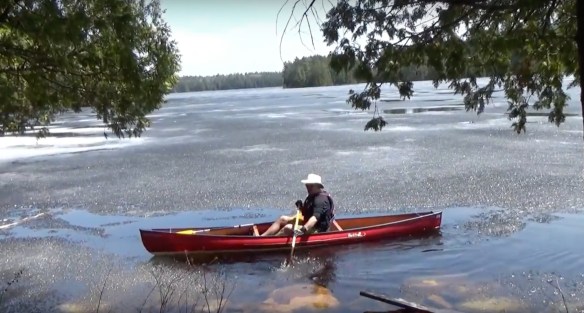
Let me show you an example of compulsion to achieve that which is beyond our capacity: On my fishing trip with colleagues last May to Algonquin Park, we tried everything to beat the ice on the lake. Despite the predominance of the ice-covered lake, we tried desperately to fight the odds against us catching some fish even to the point of risking our safety to break up the ice ourselves in our canoes.

Screen Shot 2018-07-07 at 2.29.00 PM

Yup, that’s me. And, yup, you guessed it: We caught no fish. The irony is that on the last day of our camp out, the wind and the sun did its job. When we woke that last day, we looked over a lake completely free of the ice.

IMG_6940.JPG

Was God sending us a message? Weren’t we the butt end of some divine humour?

The hole in our heart has a divine purpose: To keep us from being too sure of ourselves, over-confident in our ability and our capacity to have it all figured out. If we didn’t have this hole, might we put all our trust in our own autonomy, our independence, to lead our life without any need at all to trust anyone else let alone God.

Beyond Paul in the New Testament, the stories in the bible are about God lessening, even stopping, the compulsive drive of main characters, so the wind of God’s Spirit could draw them more gently and more effectively (Gideon and Moses in the Hebrew Scriptures are good examples).[2]

In the Gospel reading for today, Jesus instructs his disciples in going into the world to do God’s mission, “to take nothing for their journey … no bread, no bag, no money in their belts; but to wear sandals and not to put on two tunics.”[3]

God’s consolation is simple yet profound: “My grace is sufficient for you, for power is made perfect in weakness,” God tells Paul.[4]The making perfect here is not about getting rid of that vulnerability. Rather, whatever weakness we bear stays with us in order for us to complete our purpose as human beings. We are made complete in God’s love because of our hole, thorn, weakness – not without it.

In one of Martin Luther’s famous works entitled, “The Bondage of the Will”, he emphatically declared that we, as humans, can never work out our own salvation for ourselves. We will continually fail, even when, or especially when, we believe we are doing good in the world.

While some might find this realization depressing – and it would be helpful to know why that is, for yourself – perhaps the “bondage of the will” can be freeing. Because we don’t need to be driven to inaction because we are afraid of making a mistake. We don’t need to get stuck in the mud under the fear of imperfection. As Christians, we can be free to do good work in the world, imperfectly, knowing that what we do is for the benefit of others and not for ourselves.[5]

Author Brian McLaren in his recent book: “The Great Spiritual Migration”, describes this time in history as a transition in the church from “organized religion” to “organizing religion.”[6]

A Church in the flow of God’s Spirit pertains not only to wind and water over the earth, but also to spiritual movement. To purpose and mission. To going where we need to go as a people. To re-focus again on loving God, self and others as the primal energy of the church. To bring to life once again the old verse: “They will know we are Christians by our love …” … and not by our buildings, property, and concern for security, certainty and self-preservation.

Can we let go of these things for the sake of God’s mission, for the sake of the Gospel of life and love in Christ? As the prophet Amos so well put it, using the water imagery: “Let justice role down like waters, and righteousness like an ever-flowing stream … “[7]

By the time we had finally engineered the dam on the tiny creek aiming towards Lake Huron, the sun was setting and we had to go home. Inevitably, the next morning one of three things would have happened in our absence:

Either the creek would have found the weak spot in the sandy fortress wall we built, and escape through a tiny crack; or, increasing wind conditions over Lake Huron overnight would have created larger waves whose surf reached and destroyed the walls of our dam; or, someone would have been walking along the beach and, for the fun of it, just poked a tiny hole to watch as a slow trickle quickly turned into a strong, flowing stream.

In each case, a small hole was required in order for the creek to fulfill its mission and reach its destination – despite all the efforts of playful human beings to keep it contained.

After all, nothing was going to stop the flow. God’s Spirit and purpose will flow on because and through the holes in our lives.

[1]2 Corinthians 12:7-10

[2]Richard Rohr, “Dancing Standing Still; Healing the World from a Place of Prayer” (New Jersey: Paulist Press, 2014), p.18.

[3]Mark 6:8-9

[4]2 Corinthians 12:9

[5]Ross Murray, Senior Director, GLAAD Media Institute, LinkedIn July 2018.

[6]Brian McLaren, “The Great Spiritual Migration: How the World’s largest Religion is Seeking a Better Way to be Christian” (Massachusetts: Convergent Books, 2017)

[7]Amos 5:24

Canada is a neighbour

Happy Canada Day!

On this July 1stit is good to reflect on what makes Canada great. Let’s be positive! What is it about our society that stands out in a positive way – amid all that is not so good?

I would like to say that we are a country that aspires to a healthy neighbourliness. Being a good neighbour – whether striving for better relations with Indigenous people, whether relating to newcomers to Canada today, whether reaching out in kind to those who are different from me who live across the street – is our national identity.

Asserting this quality for Canadians, I believe, is not new. Being a good neighbour is not a recent trend in progressive society. Hearing preachers spout the virtues of neighbourliness reflects a deep seeded consciousness influenced by popular culture already in the last century.

It was in the 1950s when children fell in love with the Friendly Giant on TV in Canada. Some of you might recall watching actor Bob Homme on CBC TV from 1958 until 1985 being friendly to his puppet animal friends.

Then there was Mister Rogers’ Neighbourhood which first aired in 1968. Although an American show, did you know that Fred Rogers spent several years in Toronto in the early 1960s working with Ernie Coombs – Mr. Dressup – airing a prototype show called the same Misterogers?

Over his career, Fred Rogers was intentional about being more and more inclusive. He brought, for example, an African American person onto the show yet didn’t draw undue attention to it. This was a subtle yet poignant statement about neighbourliness when American white culture was anything but, towards people of colour.

To assert that these cultural icons were birthed in Canada would not be an overstatement. To be Canadian is to be a good neighbour. It is in our DNA. It is our calling, our witness to a world that wants to be anything but, especially these days.

Yet, it seems every generation of Canadians needs to learn anew how to be a good neighbour. We need to be continually reminded and encouraged to practice being a good neighbour because we tend to be a fearful lot. And fear keeps us from this holy calling.

Having faith doesn’t mean the absence of fear. Having faith means stepping into the fearful place. Having faith means action. It means “leaning into” the situation as we are.[1]

Our lay delegate from Faith Lutheran Church to the Eastern Synod Assembly in Toronto last week, admits being fearful taking the train for the first time. Julia is a seasoned, experienced OC-Transpo bus rider here in Ottawa. Despite the similarities in travel experience between the train and bus, she confesses taking the train across the province for the first time was an anxious affair.

What is more, we missed each other on the train ride to Toronto. Even though we were on the same train, we boarded at different locations – Julia, downtown; and me, at Fallowfield Station in Barrhaven. In fact, as it turns out, we were on the same car – but I never once caught sight of her.

Until on the last leg of the journey, when we were on the Union-Pearson Express train. My phone dinged. Julia texted me to confirm whether I knew where to catch the hotel shuttle to the convention centre where the Assembly was to take place.

Despite her fear of riding the train for the first time, and alone, Julia reached out to me. She was being a good neighbour by making sure I was ok. Her reaching out to me was helpful since, truth be told, I was not sure about where to catch the airport shuttle bus.

“Who is my neighbour?” Jesus asks before telling the story of the Good Samaritan.[2]“Liberated by God’s Grace … to be neighbour” was the theme of the Eastern Synod Assembly. Through thoughtful, provocative and compelling bible studies, song, and interactions with various peoples, the Assembly reflected and re-committed to become even better neighbours, as a church.

Interesting, in keeping all this in mind, that we encounter the nameless woman in the Gospel reading for today.[3]She approaches Jesus in the crowd, hidden, secretly. No wonder. She is powerless and outlawed in public spaces on account of her bleeding.

The main point of the story is not that she is miraculously healed. She could have remained hidden, quietly disappearing into the crowed after she is healed. That is the way she would have wanted it, likely.

The point is that Jesus calls her into a deeper relationship. She must come out of her private suffering. She must confront her fear, and make a deeper connection with herself, with others, and with Jesus.

“Who touched my clothes?” Jesus says out loud even though he knows the woman has already been healed when he felt the power drain out of him.[4]He, too, could have enabled the woman’s secretive behaviour, letting her go and moving on. He could have protected her in her fearful existence after she is cured.

Instead, Jesus calls for her to step up and be known. Demonstrating incredible courage, the woman responds to Jesus’ call and approaches him “in fear and trembling, fell down before him and told him the whole truth.”[5]

Jesus seeks out a relationship with her. It is of God to do this. God continues to call us into ever deeper relationship – with ourselves, with others and with God. The point of the Gospel is that we affirm our connectedness with others in healthy and compassionate co-existence. This is the path to truth.

Jesus’ ‘touch’ can heal us and the world. The touch of God’s grace can give us peace. We are shaped and made human in relationship with others. All our relationships – in church, in friendships, in marriage – are not just something extra added on to life for distraction and entertainment as if we would be complete human beings in individual isolation.[6]Relationships are not some added feature to our lives in order to get something, a means to some autonomous end.

Relationships are the fabric of life. Relationship – touch, if you will – makes us human and whole. Being neighbourly can heal us, make us better people. “Perfect love casts out fear,”[7]our scriptures say. Love can only be expressed in relationship.

The reason Julia was not afraid of riding the bus in Ottawa, was because she was practiced at it. She had done it many times. Even though the train is not that much different, she had never before taken the train. The difference is, some intentional, risk-taking exercise.

Later this week, members of Faith council will be volunteering for a couple of hours at the Mission downtown for homeless, impoverished men. We will get a tour of the facility and help give out some ice cream to those who are there. Practice, to move beyond fear to faithfulness, isolation into community, to where our neighbours are.

We need to practice being a good neighbour – to those who are vulnerable, to those who are powerless, to those who are stigmatized, to the homeless, the LGBTQIA+ community, to refugees and migrants. We have to lean in to the places of fear in our lives and to take some risks vis-à-vis people who are different from us. In doing so, we realize we are not alone, and we have meaning and purpose in our lives for the common good.

Canadians and Christians share something in common, to be sure. We are called to reach out. And be a good neighbour to the world. We are not left alone stuck in our fear. Because God continues to call us into the deeper waters of grace and love. God will never abandon us, despite our fear.

Let us approach boldly the seat of grace in Christ Jesus our Lord. Amen.

[1]Brother Luke Ditewig, “Brother, Give Us A Word” for June 28, 2018 (Society of Saint John the Evangelist) friends@ssje.org

[2]Luke 10:25-37

[3]Mark 5:21-43

[4]v.30

[5]v.33

[6]Michael L. Lindvall in David L. Bartlett and Barbara Brown Taylor, eds., “Feasting on the Word: Preaching the Revised Common Lectionary” Year B Volume 3 (Kentucky: WJK Press, 2009), p.192.

[7]1 John 4:18