In the Other

When we moved into our new house last Spring, there were no trees in our backyard. And so I went to a local nursery and bought a beautiful looking Norway Spruce tree, about four feet high, which I planted at the fence line. And I remember choosing this particular tree because it looked healthy; its deep and thick, verdant green branches were bursting with fresh, full buds, all over.

I watered it all summer long and fed it with fertilizer. In the winter I covered it with a folding board to protect it from the harsh winds and biting temperatures — which we had! I was going to make sure this tree would prosper!

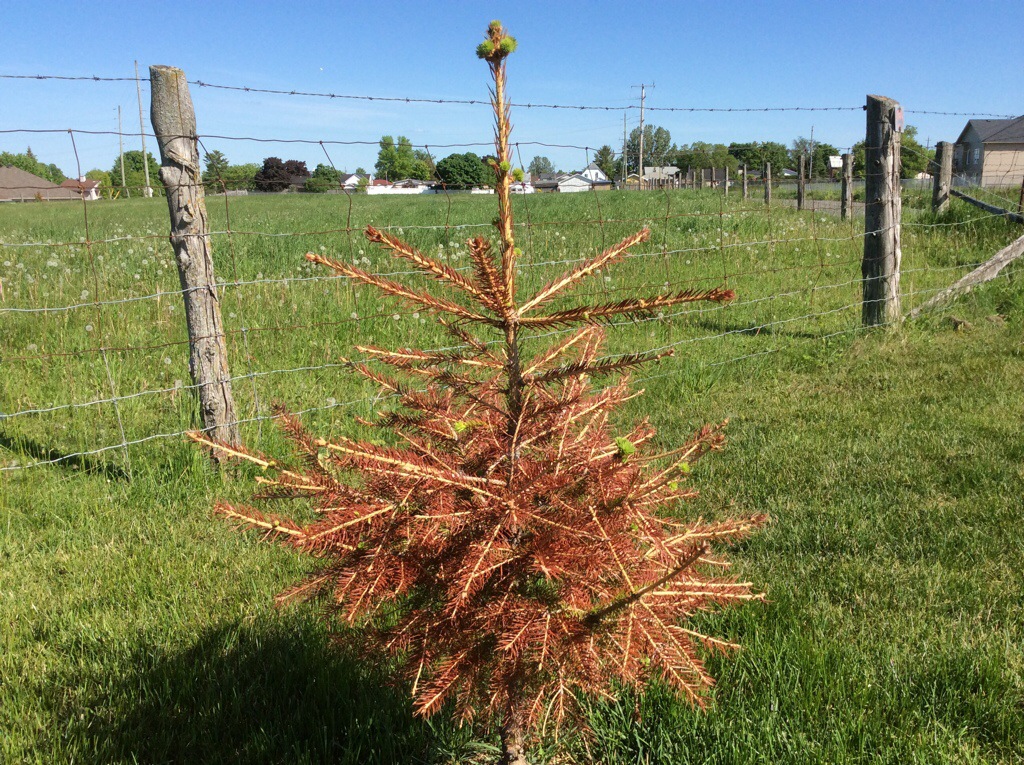
So, tell me what you would do if you saw what I saw this Spring once all the snow melted: What would you do? (scroll down to see photo).

I must confess that my first instinct was to rip it out and start over. Find another tree. I thought, at first, that this tree was surely dead. There was no life in it anymore. Hopeless cause. Forget it.

But, for some reason or other I just let it be. I left it alone for awhile. And about a month ago, I noticed something remarkable. Do you see it? There are indeed signs of life showing: the green buds atop, and amidst the what looks otherwise like dead wood.

And I thought of my tree when reading the Gospel text for today (Matthew 10:24-39). Jesus seems intent on reminding his disciples of their worth, their value (“You are of more value than many sparrows” v.31) — despite everything that seems to the contrary. Remember, these disciples are not getting it; they misunderstand Jesus left, right and centre! They are imperfect, some would say — hopeless causes! Why would God even bother with those stupid disciples from Galilee? Riff-raff. Blue collar. Uneducated … the list goes on!

There is the story of a certain monastery — a monastic community which had fallen upon hard times. Only five monks remained in the motherhouse and all of them over the age of 70. Clearly, it was a dying order.

In the woods surrounding the monastery was a little hut, where a wise bishop lived. One day, the abbot thought it would be a good idea to visit this bishop, and ask him for any advice he might be able to offer, in order to save the monastery.

And so the abbot went and explained the problem to the bishop. The bishop commiserated with him: “I know how it is,” he said. “The spirit has gone out of the people. No one knows the joy and love of God anymore.” And so the old bishop and the abbot wept together. They read parts of the Bible, and quietly spoke of deep things together.

The time came for the abbot to leave. They embraced each other, and as they parted the abbot said, “It’s been wonderful that we should meet after all these years. But I must ask: Is there nothing you can tell me, no piece of advice you can give me that would help me to save my dying order?”

The bishop looked straight into the eyes of the abbot and said, “The only thing I can tell you is this: One of you at the monastery is the Messiah.”

When the abbot returned to the monastery, he told his monks: “The bishop couldn’t really help me. We only read some Scripture and wept together. But he said some cryptic thing as I was leaving — he said that one of us is the Messiah. I really don’t know what he meant by that.”

In the weeks and months that followed, the old monks pondered the bishop’s statement, and wondered among themselves if there could possibly be anything of significance to the bishop’s words. The Messiah? One of us? But which one? The conversations went something like this:

“Do you suppose he means the abbot? Surely if he means anyone, it is Father Abbot. He has been our leader for more than a generation.

“On the other hand, he might have meant Brother Thomas. Without a doubt, Brother Thomas is a holy man.

“But certainly he could not have meant Brother Eldred! Eldred can get really crotchety at times. But you know, come to think of it, even though he can be a thorn in people’s sides … when you look back on it, Eldred is virtually always right about anything. Often very right. Maybe the bishop means Brother Eldred.

“But surely not Brother Philip. Philip is so passive, a real nobody. But then, he has got a real gift of somehow always being there when you really need him. He just, like magic, appears by your side. Maybe Philip is the one ……”

And so, as they contemplated this matter together, the old monks began to pay greater attention to one another. They regarded each other with fresh eyes. They began to treat one another with respect, love and extra care. They related to one another keeping in the back of their minds always, that just maybe one of them might be the Messiah. Or, perhaps that each monk himself might be the one.

A beautiful forest surrounded the monastery, and people still occasionally came to visit the monastery — to picnic on its lawn, to wander along some of its paths, and even now and then to go into its dilapidated yet charming chapel, to pray.

And as they did so, without even being conscious of it, they sensed this aura of respect and grace that now began to surround the five old monks …

And radiate out from them.

There was something strangely attractive and compelling about the atmosphere about the community. Hardly knowing why, these visitors began to return to the monastery to picnic, to play, and to pray. They began to bring their friends to show them this special place. And their friends brought their friends.

Then it happened that some of these visitors started to talk more and more with the old monks, and ask them questions: “Why are you here?” “What are you all about?” “Who are you?” etc. etc.

After awhile, one asked if he could join them. Then another. And yet another. And within a few years, the monastery had once again become a thriving order focused not on its own self nor plight — but in others with whom they came into contact in their daily routines about the community.

This story touches on the practice of being church. Community in Christ is not about navel-gazing and conformity. It’s not about seeking a gathering of the “like-minded”. Belonging in the family of God is not about being the same, or tying to be the same, with everyone else in the community.

Being in a church is about meeting others who are not like me. Being part of the church is about discovering God in difference, in others who are different from me and my ilk. Often that comes about by first noticing what you might not choose to be like, yet seeking to understand from where the other is coming, and appreciating their gifts.

And perhaps this story might give us a clue as how to appreciate the disruptive words of Jesus in our Gospel text — about loving God before loving our family. The Gospel of Jesus Christ is not about forming exclusive communities or clubs of like-minded people.

Rather, the Gospel is continually calling us to go out into the world in order to discover what God is already up to in other people who are not ‘part of our family’. Our worth and our value has a purpose — “to proclaim [the Gospel of Jesus] from the housetops” (v.27). As we have heard from many church leaders in recent years — “the church exists primarily — it’s primary focus — for those who are not members of it.”

This challenges each one of us, first to see the Christ in one another, and also see Christ in the stranger. And remembering that if God doesn’t give up on us who are far from perfect — if God sees the value and worth in us even when we might only see the blemishes — so God asks us to value an outsider as potentially being visited upon by Jesus himself.

20140620-110751-40071026.jpg

Changing seasons

20140317-150852.jpg

Apparently this has been the coldest winter in Ontario in some twenty years. Three days before Spring officially arrives, it is one of the coldest St Patrick’s Day EVER in Ottawa.

On the other side of the province, I stand today on the westernmost point of Lake Ontario looking east. The long grass and wet, packed sand whispers promises of summer, beach fun. The boulder size blocks of ice at the shoreline recall the harsh reality of the winter that is slowly passing. The shadows of light reflecting against a thinly veiled high-cloud announce the warmth that will soon embrace us, once again.

Doing God Thanks

The birds can teach us a thing or two about life. Especially those ground feeders. Have you noticed chickadees and sparrows feed? As soon as they peck downward to capture the seeds with their beaks, they immediately throw their necks upward.

Quite possibly to aid in consumption, the birds’ movement during feeding suggests to me, symbolically at least, an attitude of gratitude while receiving what is good, what is needed, for life. The bird looks to heaven in between each peck to thank the Creator for the gift of food.

It is born into the fabric of our nature to give thanks. On the one hand, we work and take responsibility to delve deeply into our lives and the world around us for what we and others need. At the same time we pay attention, mindful of the gift of life and what we receive out of the grace of God.

Not to do both would be unnatural, even unhealthy, for the creature. And this is the initial problem for the rich man in the Gospel text for today (Luke 12:13-21). His total lack of concern for any other person mirrors his total disregard for the source of his life and abundant material possessions.

He is pecking at his food, alright. And, making the most of that! But he is not at the same time looking upward. He is not mindfully paying attention, alert, for what is real, what is true, in that moment of living.

But what if we feel we don’t have enough or anything at all for which to look heavenward in thanksgiving?

A fear of scarcity may very well be what motivates the rich man to build bigger barns and plan for increasing profits in the first place. Planning for a rainy day is what it’s all about, isn’t it? And when that rainy day comes, you don’t want to be found wanting.

Whether it’s fear of having nothing, or destitution in the present circumstances of your life — these attitudes may keep us from looking upward in faith, in thanksgiving. Our hearts are cold stone towards others and God, and/or we believe it’s all up to us to make something happen. God has nothing to do with our material concerns, one way or another.

Have you heard the joke — “If you want to make God laugh, tell God your plans.” The rich man in the Gospel makes plans. But they don’t turn out exactly the way he had planned, did they? Earthly death is God’s final say. At some point on our journeys of life, we need to acknowledge that at the end of our days it’s not about us, but about God whose promises stand forever.

I don’t think God actually laughs at us when we tell God our best-laid plans. But perhaps we are called upon by this Gospel to turn our hearts and minds outward, and upward, with some humility.

20130801-133644.jpg

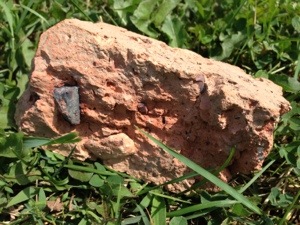
This is what is left of my mother’s inheritance: One, crumbling brick. When my mother grew up in pre-Second-World-War Poland, she belonged to a large and very wealthy German family in the south-west. She lived in an estate-sized home whose family owned large tracts of land and had servants waiting on them 24-hours a day.

Then, as the Soviet army pushed westward across Europe in the mid-1940s, the Soviets expropriated any properties owned by Germans. My mother’s father was taken to far eastern Ukraine where he later died, and her mother and siblings were put out on the street. For days they lived in corn fields trying to evade marauding soldiers on the hunt. Finally they were able to find shelter with a relative where they were able to live in safety until the end of the War.

Literally, in a matter of days, from riches to rags. The American Dream, in reverse.

Decades later after the iron-curtain (the physical and symbolic wall that divided East and West) fell, my mother traveled to her home town with her brother and sisters. They visited their old property where nothing besides piles of rubble from the old homestead remain.

For my mother, this brick symbolizes why not to place eternal value in material possessions. It points to the need to view life as much more than a selfish grab of as much stuff as possible.

Moreover, it represents the basis for a life of gratitude. For, if it weren’t for the experience of doing without, she may have never come to the realization of and the attention towards a life lived for the sake of others and of God.

You might recall a Hebrew story from Scripture sounding a similar theme to our Gospel for today, when Joseph in a dream is instructed to tell Pharaoh to save food in barns for seven years of plenty in order to prepare for a subsequent seven years of famine (Genesis 41:32-36). This is a wonderful scriptural precedent for gathering in a bountiful harvest and saving it for the future.

The critical difference, of course, is that in the case of Joseph, the purpose of doing so is for the benefit of many people — indeed an entire nation.

Echoes of previous stories from the Gospel of Luke resonate. In the case of Mary and Martha — where Mary has chosen the better way — the point is not that preparing food and being busy is bad. It’s just that Martha was distracted from remaining centered on the whole point of being busy: serving with prayerful attention to the divine guest.

In the same way, there is nothing wrong with acquiring material wealth. It’s more a question of what purpose it serves and to whose benefit. The answer to that question will determine the value of the entire activity.

What is the purpose of this building in which we worship today? What will its purpose be in not only seven years from now, but twenty-five and fifty?

There’s nothing wrong with food. There’s nothing wrong with money. There’s nothing wrong with buildings and properties and abundance of material wealth. It’s being very clear and motivated by the mission, the vision, the purpose that’s at stake. Form follows function, not the other way around.

Someone in the bible study group on this text summarized the message of this text for us today, as being: “Allowing what we have now to be used for God’s purposes.” It may not be much, from our perspective. But it’s what God has given us in this time and place. How are we using it for God’s purposes? And where may the Holy Spirit be leading us?

I entitled this sermon “Doing God Thanks”. I think viewing our mission in light of God’s purposes requires of us discipline around our attitude of gratitude. And it’s not just in the feeling of thankfulness, it’s in responding, in doing, in putting muscle to the task at hand. We look up, and we look out, and actually move our bodies in that direction — and then see what God has in store.

But we start with what we know we have, for which we can offer hearts of thanksgiving.

Listen to what Richard Rohr writes about on the topic of “Day-to-Day-Gratitude” (p.285, “On the Threshold of Transformation”):

Things go right more often than they go wrong. Our legs carry us where we are going, our eyes let us see the road ahead, and our ears let us hear the world around us. Our bodies, and our lives, work pretty much as they should, which is why we become so unsettled when we confront any failure or injustice. This is not so true for people born into intense poverty or social injustice, of course. And we had best never forget that.

Nevertheless, we must stop a moment and look clearly and honestly at our life thus far. For most of us, life has been pretty good.

We shouldn’t be naive about evil, but perhaps the most appropriate attitude on a day-to-day basis should be simple and overwhelming gratitude for what has been given. From that overflowing abundance will come the energy to work for those who have a life of scarcity and sadness.

From what are you grateful, in the midst of your full and complex life?

God is the source of life and all things good. God will give us what we need to work towards God’s ends, God’s kingdom on earth. May we dig deep and never forget to look up — to see how rich God is toward us.

Thanks be to God!

Almost there. God finishes.

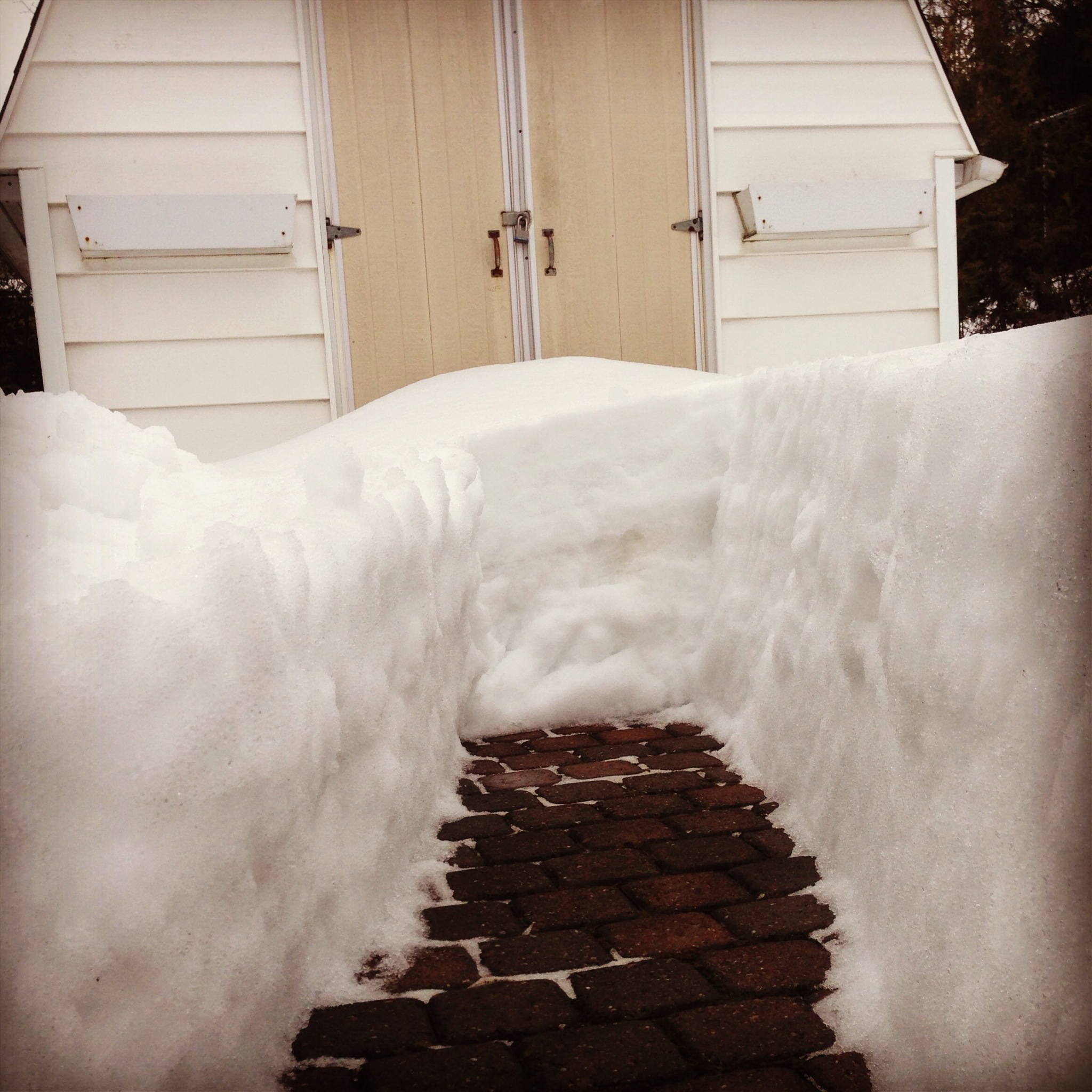
20130328-082702.jpg

Spring is coming. The snow is melting. But not fast enough. There’s so much!

I shovel and shovel breaking my back. Getting close to the goal. Can I keep up?

What happens in life when I keep on the path but am so close to giving up ….

God opens those doors and comes to me. God finishes the job, clearing the way. God makes it possible, every new day.

Out of the depths

Image

20121221-112447.jpg

The longest night. The fiercest storm. The threat to comfort. And down with the flu.

I am pulled out out of the routine distractions and busy-ness of living and left silent, still, listening to the howling wind outside and creaking timbers in the house….

And then emerges a new kind of vision, a clarifying purpose for what is truly important in life — community, mutual support, friendship, family, faith. The corner is turned.

Out of the depths comes new found hope. Joy. A way forward. Renewed.