Christmas – God comes anyway

Do you remember ‘grumpy old uncle Stan’?

Eleven-year-old Nadia couldn’t believe that her recluse uncle fell asleep under the Christmas tree during the family gift exchange. He snored louder than any squeals of joy from other family opening presents.

Nadia complained to her Mom that she didn’t want to sit beside him at the Christmas dinner table any more. His burps and other inappropriate sounds coming from him embarrassed her to no end.

“I just don’t get it,” Nadia said. “Even though we make his favourite mash potatoes every year and wrap up all sorts of yarn for his knitting projects – he still acts all weird-like.”

“We only see him once a year, dear,” said her Mom. “We need to be patient.”

Nadia took a bite from left-over ginger bread. “Yeah. I don’t remember a Christmas without him.”

“You’re right,” Mom said. “He comes every year. He has a present for each of us. He listens to us more than he talks. I think he is just happy to be invited.”

“And sometimes he will ask me questions that make me really think.” Nadia continued eating her cookie. “I missed my cousins this year.”

“Yeah,” Mom sighed. “Other family members will sometimes find reasons for not coming. Uncle Stan comes anyway. Regardless of the weather. Regardless of who does or doesn’t have colds. Even when it would be better not to come. He comes anyway.”

“Christmas wouldn’t be Christmas without Grumpy Uncle Stan.”

Christmas teaches us how God is present to us. I believe that everything that Jesus says, everything that Jesus does, and everything that happens to Jesus reveals to us how God is present in our life. And the way Jesus responds to the situations and people in his life reveals to us how we are to respond to God’s presence in our life.

It is in that spirit then, that I read and hear again this holy night the Gospel story of Jesus birth: When Mary and Joseph arrived in Bethlehem the time came for Mary to give birth. And probably because of all the people in Bethlehem because of the census, there was no room in the inn. And so, they had to go to a small stable where Jesus was born. Mary wrapped him in swaddling clothes and put him in a manger. And he was born there out in the dark in the stable with the animals.

What does this story teach us about how God is present in our life? To me, it seems that a lesson is that there was no room in the inn, but God came anyway. The fact there was no room in the inn did not stop God from being born into this world, and that’s the lesson because that’s always true:

That sometimes in today’s world, whether it be through mass media or just the things that are going on internationally, and the way we as human beings treat each other, or sometimes just in our daily life, the hectic pace that we have to keep to just stay ahead of the day’s demands, along with the complexities of it all, it seems that there’s no room in the inn. That there is no hiatus from it all.

It’s true sometimes, not just in the world but in our own families, or sometimes just what we’re going through ourselves and all the ragged unfinished business of things. It seems that there’s no room in the inn. That it’s just all like closed up or too filled up with too much complexity and maybe things that shouldn’t even be there in the first place.

And as true as that might be we can take reassurance that God comes anyway. That God is being inexplicably born in our hearts moment by moment, breath by breath, as the interior richness of every little thing that happens to us and everyone around us.

As much as we may think it is all up to us – the good work we do, the important, business of our lives, striving after all that we believe is important – then come times and circumstances in our lives that confound and disrupt our self-inflated, self-constructed, neatly-tidied world –

A sudden death, a broken relationship, health problems, some failure, job loss, bad news, an unsolvable problem – and our neatly-packaged lives unravel.

And so, the Christmas message is really for those who seek more comfort than joy at this time of year. Some mercy. Some grace.

The Christmas message is for you who have tried oh-so hard to make things right but do not reap nor see the benefits of your toil; to you who by no fault of your own find yourselves in the middle of heart-ache; to you who continue to flounder in fields of despair when it seems there is no end in sight, no light at the end of the tunnel; to you who carry on, lifting head high despite the significant impairments of your lives. The Christmas message is for you. So, hear this: God comes anyway.

Christmas is not an escape from those hard realities, an escape we must engineer somehow by all the numbing stimulations of holiday ‘cheer’. But that God comes right into the midst of the darkness of our lives.

But here’s the thing: In order to discover the presence of God, we have to leave the hurly-burly of the inn, the superficiality and the chatter of it all, and find our way in the dark, back to the stable. That is, we have to enter into the humility and the simplicity and the patience and the delicate nature of what’s unfolding in our heart to discover where God is being born in our life.

And in this kind of prayerful attentiveness we are then asked to bring that delicate simplicity back out into the hurly-burly of the world. “It would be so much easier if we were asked to live a simple life in a simple world. But we’re asked to live a simple life in a complicated world.”[1] And I think this is how God is born in our hearts: In simplicity of heart we do our best to live with integrity in a complicated world.

James Finley relates one of his earliest memories of Christmas: His mother would take him to mass on Sunday and they always sat right up in the first couple of rows, off to the side altar. He was maybe three years old. He knew it was Christmas time because there were Christmas trees up in the sanctuary and there was a nativity scene.

He remembers the church was very crowded and a little baby started to cry near the back. And he remembers whispering in his mother’s ear: “Is that the baby Jesus crying?” His Mom leaned down and whispered in his ear, “Yes, it is.” And little James believed her. And today at 74 years old he still believes her. Not in the naïve way that a small child would believe it. But knowing that in Christ it is revealed to us that every child is worth all that God is worth.

And the truth is, for all the complexities and things of which that simplicity has been buried under, these so many things, there is in our heart this childlike purity, this childlike God-given Godly nature of who we simply are because God loves us.

And so, for us Christmas is us being awakened to this birthing of God in the simplicity of our hearts, in the depths of our life; and, into the awareness that despite the complexities of whatever each day might bring, we can take reassurance that God comes anyway.[2]

[1] Katagiri Roshi, Contemporary Zen master.

[2] I’ve adapted his words to my preaching context and am ever grateful to James Finley, “An Advent Meditation” (New Mexico: Center for Action and Contemplation, 2017), for sharing and emphasizing the Christmas Gospel message, that God comes anyway.
Forgiveness: from transaction to wholeness

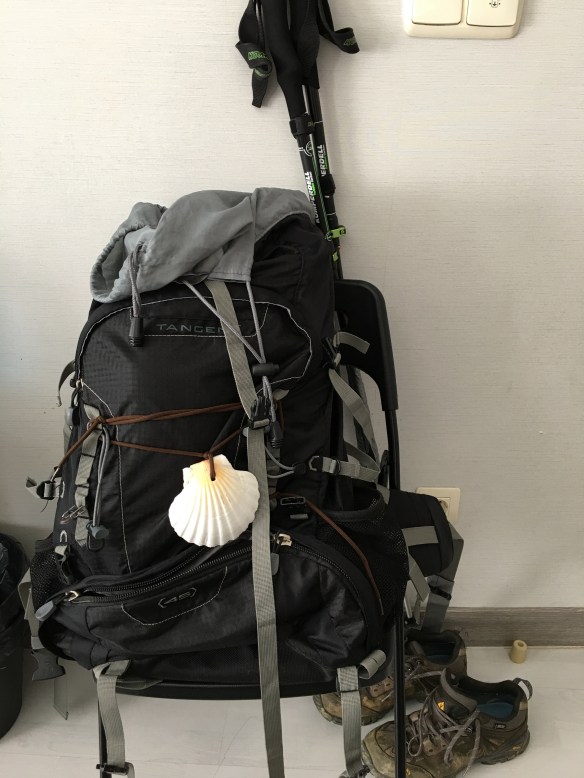
We ran all-out with back packs and walking poles to catch the bus. Yes, we were on a walking pilgrimage. But a few of us didn’t feel up to walking through one of northern Spain’s downtown city streets. After hiking a couple days already through the beautiful, peaceful hills along pristine trails with spectacular ocean views, the thought of breathing gas fumes and hitting the hard top sidewalks in an urban jungle just didn’t appeal. It was only three or four kilometres, and a city bus conveniently would take us to the other side where we could pick up the pilgrimage trail out in the open again.

As I clambered onto the bus behind my Dutch walking partners with all my gear, mindful of not clobbering someone with the swing of my bulky pack, I realized I did not have the correct change for the single fare ticket. Without any hesitation, my pilgrim friends dropped enough euros to cover my ticket. I expressed a deep-felt thanks to them, making a mental note to treat my friends later on. “I owe you coffee,” I said as the bus wove through San Sebastian’s downtown core.

IMG_5341

There’s a culture on the trail among pilgrims that doesn’t operate according to the normal etiquette of life back home. You see, early the next morning, my friends wanted to get going right away. I, on the other hand, wanted to stay at the hostel of my name’s sake (San Martin) a little longer to enjoy the view and the home made breakfast offered by the hosts. Off they went, and I never saw them again. I didn’t have a chance to ‘repay’ their good deed done unto me.

At the same time, there were other pilgrims to whom I’d catch up a few nights later at another hostel. Everyone walks at a different pace. Paths would cross, un-cross, and cross again. Sometimes I’d meet someone on the trail and never see them again. Other times I’d bump into the same group every other day, or so, somewhere along the way. Because of the nature of the pilgrimage community, I looked for opportunities, therefore, to treat another fellow pilgrim at a roadside café whenever the opportunity arose.

The economy of quid pro quo – paying back another individual and keeping the economic scales even on an individual basis – just couldn’t operate neatly on the Camino. It didn’t matter to whom you were being gracious. Only that you were gracious – that you offered help when help was needed, to whomever, regardless of whether or not they had earned your favour in some way earlier on.

The challenge was to receive the gift when it was offered, and give a gift when it was needed. Period. It was as if, on pilgrimage, we were all in the same boat. Which, of course, we know before God we are. It’s just in our daily lives we are not often able to appreciate that reality clearly.

Forgiveness is the theme in the Gospel text for today[1]. I’ve wondered why the servant who was forgiven his debt didn’t do likewise when given a chance. A more general question, is:  Why do we find it so difficult to forgive one who ‘owes you’ an apology for some wrong committed against you. I think it’s important to understand first some elements of the Gospel story. Because this story first tells us something very important about God and God’s ways.

To begin with, the servant owes the master ten thousand talents. ‘Ten thousand’ here signifies an absurd amount of money.[2] In that day and age, even if the servant lived three life-spans working full-time, there was no way he could ever repay that amount. The master has pity on him because the servant pretends that he can somehow work hard enough, in his plea for mercy, to repay the debt. The absurdity of the extra-ordinary amount should tip us off to something vital in our understanding of God forgiving us:

There is nothing we can do to make our lives right before God. And what is more, God has already forgiven us, and reminds us over and over again that we are forgiven before we do anything. Yes, we can say we ‘owe’ God. But no matter how hard we try, no matter all the things we can do to make it right, this effort will never, ever be able to erase what is stacked up against us – all our moral failing, our mistakes, our brokenness.

We puff ourselves us up in embarrassing, false piety when we pretend we can. As if forgiveness was simply a matter of paying our dues. But it isn’t. Like true love, forgiveness is a function of grace. And, oh, the Lord has compassion on us, even in all our futile toiling and striving.

I suspect one reason why the forgiven servant does not ‘pay it forward’ to his own slave, is because what the slave owes the forgiven servant was not as large an amount. In other words, the slave could technically repay his debt.

It’s so easy not to apply God’s economy of extraordinary grace to our ordinary lives. It’s so easy to slip into the transactional ways of our world, and apply the values of the culture to our life of faith. Meaning, we don’t really forgive others when they have to ‘earn’ our attention, our love, and our friendship. We will not really forgive others when they don’t behave in a way that meets our approval.

We live in a transactional economy – even in our spirituality – where people have to pay for their sins. We are to a large extent products of our culture. Our view of justice, therefore, is naturally retributive. Whereas God’s economy is about transformative justice. To move from one to another calls for a monumental shift in our thinking.

God’s grace, indeed, “surpasses all our understanding” (Philippians 4:7). God’s economy of grace does not make sense in our quid pro quo culture of transaction and merit. God’s love crosses all these boundaries and systems of our making. The gift is simply given. Will we receive it, freely? Will we pass it forward, freely, without any expectations nor strings attached?

In God’s economy of grace, we move from transaction to wholeness. Love and forgiveness – these functions of grace – expand outward. There are no losers in this economy. Only winners.

A transactional economy goes something like this: If I have twelve, gold coins and you take six, I will only have six left. I’ve lost. You’ve won. And so it goes with everything we do with others in life. Someone described our culture this way, sadly: We love things and we use people.

In an economy of grace, in contrast, we love people and use things. It’s as if I had planted twelve lily bulbs. I can divide my bulbs and give you twelve and I will still have twelve left. Then you can plant your bulbs and eventually you can give away twelve more. Grace multiplies. Everyone gets more. Grace is infinite, in truth. The win-lose economy changes into a win-win economy.[3]

Moreover, forgiveness is not just about evening the score between just two individuals. It’s not entirely a private act. Forgiveness is communal.[4] When, in the Gospel text, the others saw how unjustly the servant treated his own slave who owed him money, they didn’t simply wipe their hands in denial and avoidance of the injustice before them. They went back to the master and told him. The proverbial whistle-blowers, they were involved in the process of forgiveness.

This is necessary, because sometimes individuals are guilted into forgiving someone who is left unchallenged, unaffected, and unaccounted for their misdeed. Sometimes victims are not able to easily forgive the one who has hurt them. It took Joseph all the way to the last chapter in Genesis to finally forgive his brothers for throwing him into a well and selling him to slave-traders.[5] As they say, it takes a village. And sometimes time. Lots of it.

Forgiveness is validated in community. Because sin is something we all participate in. If we are human and live on this earth, we will sin. No matter the colour of our skin, no matter our creed, our ethnic background, no matter where we were born or what our political stripe. We will make mistakes. We will all contribute to the problems we face. As Paul wrote, “since all have sinned and fall short of the glory of God”.[6] No one is immune to the complicity and consequence of sin. It is woven into the fabric of our common existence.

And so is forgiveness. When forgiveness is offered and received, it becomes part of a wider field of responsibility and accountability. We are not alone. We need the community of faith. We need to be real. Forgiveness does not mean enabling sinful behavior to continue by excusing it, or letting it happen over and over again. Forgiveness means people of faith seek the justice of the matter. Forgiveness can only happen when people see their own lives as part of the human condition, just like everyone else.

People will not be changed in their hearts for God unless they are loved unconditionally, freely. Martin Luther believed that we would be so overcome by God’s unearned, unconditional love that we would be so moved to spontaneously and unconditionally love others in the same way.[7]

May our hearts be moved to forgiveness and justice for all.

Our Father in heaven …. forgive us our sins, as we forgive those who sin against us.

Amen.


[1] Matthew 18:21-35

[2] David L. Bartlett and Barbara Brown Taylor, eds., “Feasting on the Word: Preaching the Revised Common Lectionary”, Year A Volume 4 (Louisville Kentucky: WJK Press, 2011), p.71

[3] Janet Hagberg uses the gold coin versus lily bulb analogy to describe transitions in power, in “Real Power: Stages of Personal Power in Organizations”, 3rd Edition, Salem Wisconsin: Sheffield Publishing, 2003, p.77

[4] Susan E. Hylen, “Forgiveness and Life in Community,” Interpretation, Volume 54, Number 2 (April 2000), p.146-57.

[5] Genesis 50:15-26

[6] Romans 3:23

[7] cited in Bartlett & Brown Taylor, eds., ibid., p. 70

The long journey – Lent 1A

We don’t often see the humour in the creation stories around Adam and Eve (Genesis 2-3). Perhaps because so many centuries of debate and dogma and doctrine-making put such a heavy burden on the sacred text.

But, if we can just lighten our approach a bit, a fresh perspective emerges. There are some funny aspects in the story of the Garden of Eden where the crafty serpent tempts Adam and Eve to eat the forbidden fruit, they disobey God, resulting in their rather undignified exit from Paradise.

Here’s a joke someone sent me this very week on the subject: Did you know the oldest computer can be traced back to Adam and Eve?
Surprise, surprise.
It was an Apple.
But with extremely limited memory.
Just one byte.
Then everything crashed.

That joke isn’t biblical in case you were wondering. But these story-lines are rather comedic: We have a talking snake (a la Harry Potter). If anyone is a parent or works with children, you will know that the surest way to get a child to do something, is to tell them not to do it (e.g. “You can eat anything you want from the fridge, but you dare not touch a cookie from that jar on top of the table”). It’s almost as if Adam and Eve were set up to fail. And then God warns them they will ‘die’ if they even touch the tree. They do touch the tree, but they don’t die.

Well, not for another several hundred years.

The scripture records Adam having lived a very long life (Genesis 5:5 suggests 930 years). The threat of death was therefore not a literal one tied to that one, particular transgression. In other words, there must have been a divine purpose in Adam living so long after their expulsion from the Garden of Eden.

We can assume, therefore, that when Adam and Eve left the Garden, they began a life of maturing and labouring under the weight of their broken humanity. The development and growth of any human being, we know, is bought by the price of pain and suffering. The wisdom writer from Ecclesiastes (1:18) expresses this truth: “For in much wisdom is vexation, and those who increase knowledge increase sorrow.” Suffering, then, must be part of God’s good, created order. Canadian theologian Douglas John Hall writes, “Life depends in some mysterious way on the struggle to be.” (1)

That God did not destroy them both immediately after their unfortunate decision, is an act of grace, of forgiveness. The writer of Genesis is emphasizing an important characteristic of God, here. Whether or not Adam lived, actually, 930 years is not the point; the point is it was a very, very long time. Perhaps the author is, at very least, emphatic in expressing the extent of God’s mercy: Adam and Eve have all the time in the world to practice making better decisions, and of experiencing more and more of God’s grace.

God is forgiving, even more so than we can be to ourselves. God is merciful, even more than we can be merciful to each other. God is gracious, even more than we can imagine being gracious to ourselves.

We begin today a journey of some forty days, which mirrors Jesus’ forty days in the wilderness (Matthew 4:1-11). In pursuit of various disciplines we observe the season of Lent, year after year, as we slowly and intentionally approach the most holy of Christian days — Easter, the resurrection of our Lord.

The only way to the Empty Tomb of resurrection is through the Cross of suffering. The symbolic destination of the Lenten journey is the Cross, on Good Friday. And so, right off the start, we know this can’t be an easy journey, when we have to face and bear our own cross. But this is what life is about, is it not?

Whenever hardship comes our way in whatever form it does — illness, loss, tragedy, disappointment, conflict and confrontation, failure, guilt, pain. We don’t have to seek it out; Suffering comes to us all. This is a reality we are called to accept.

When Adam and Eve failed God in the Garden, God gave them a chance to confess. As much as disobedience was the problem, so too was their impulse to try to ‘cover up’ their faults by blaming someone else; Adam blames Eve and then Eve blames the serpent (Genesis 3:12-13). 

Are we willing to embark on the sometimes harrowing yet intentional path of some kind self-discipline or challenge to change things for the better? Are we willing to take a long, hard look at our own lives? If so, Jesus’ vulnerability in the wilderness points to the authentic quality and honesty in all our relationships.

We are called to be honest about our brokenness. Being vulnerable is not a weakness, it is a strength. We do not need to pretend our weaknesses away. Our suffering can be a great teacher, an opportunity for growth and wholeness.

Suffering, in the words of Douglas John Hall, “is necessary to evoke the human potential for nobility, for love, for wisdom, and for depth of authenticity of being. A pain-free life would be a life-less life.” (2)

Lent is not a path to ultimate self-annihilation. Ultimately, Lent is not a downer. Because suffering can point to a new beginning. Followers of Jesus are not a people who suffer the pains of life without faith and hope.

This hope ought to give us endurance for the journey ahead. There will be temptations. There will be setbacks. There will be disappointments on the journey of becoming more authentic, more vulnerable, more open, more honest.

But God will not give up on us. Every moment we have is pregnant with the grace of God, even should we like Adam and Eve not always make the best decisions and then have to live with the consequences. But there is always hope. Always another chance. Always a new beginning coming up over the horizon of our lives.

We have every moment given to us — maybe not 930 years. But our faith can assure us that God will never, ever, give up on granting us mercy and forgiveness, no matter the many bad decisions we make over the course of our lives.

Our desert, Lenten journey, may seem long and arduous. But longer, still, is the span of time it takes for God to keep faith in us.


1 – cited in Terence E. Fretheim, “Is Genesis 3 a Fall Story?” in Word & World (Volume 14, Number 2, Luther Seminary, St Paul Minnesota, 1994), p.147
2 – Douglas John Hall, “God and Human Suffering: An exercise in the Theology of the Cross” (Minneapolis: Augsburg Publishing House, 1986), p.62-63

Relationships over Resources

A member of this congregation sent me an email including a list of short phrases called paraprosdokians.

A paraprosdokian, according to my online dictionary, is a derivative of a Greek word which means, ‘beyond expectation’. It is a wordplay, a figure of speech in which the latter part of a sentence is unexpected. Here’s a smattering:

 · A neighbour knocked on my door and asked for a small donation towards the local swimming pool, so I gave him a glass of water.

 · Take my advice — I’m not using it.

 · Ever stop to think, and forget to start again?

 · He who laughs last, thinks slowest.

 · I was going to give him a nasty look, but he already had one.

 · Change is inevitable, except from a vending machine.

 · I was going to wear my camouflage shirt today, but I couldn’t find it.

 · If at first you don’t succeed, skydiving is not for you.

 · No matter how much you push the envelope, it’ll still be stationery.

 · Money is the root of all … wealth.

Indeed, the Gospel today (Luke 16:1-13) has at least one major, unexpected twist. And unlike most of these paraprosdokians, this twist is not humorous. 

A manager has been wasteful of his boss’ riches, and consequently will lose his job. So, the manager figures on a scheme to look out for his own interests in his impending unemployment. The ‘dishonest manager’ — as some bibles entitle this parable — puts himself first at the seeming expense of his boss: he will go to his boss’ debtors and demand only half of what they owe. He shrewdly seeks to curry favour with them, and anticipates to be in their good books, once he is unemployed.

Smart move, you might say, eh? But what will Jesus say? Especially keeping in mind that this passage comes to us on the heels of the ‘golden’ chapter of the bible, Luke 15. Therein we read the familiar and heart-warming stories of the lost being found, of celebration and belonging, of unimaginable grace and mercy shown to the poor, the wayward, those who are not easily counted in the economy of the day. 

In Luke 15, we get the strong impression that the values of God’s kingdom — mercy, inclusion of others, unconditional love — stand in sharp contrast to the values of the world — competition, self-centredness, individualism. And, now, in Luke 16, the set up leads me to anticipate Jesus will come down hard on the ‘dishonest’ manager. I expect Jesus to say how unjust, unethical, and selfish the manager was. Don’t be as self-centred as he is!

In verse eight, the rug is pulled out from underneath me: “And his master commended the dishonest manager because he had acted shrewdly.” What ?!! Commended?

And yet, I should expect that the bible does that to us from time to time. The bible does not present a tightly knit, unequivocally clear and coherent storyline. You can justify anything from the bible, if you want — even murder. But that is not what we are about, when we approach the bible. 

After all, there is an important reason why the New Testament includes four, different, renditions of the life and times of Jesus. If uniformity was the goal in the inspiration behind putting together the bible, then we would have only had one Gospel, not four. Matthew, Mark, Luke and John — the first four books of the New Testament — basically follow a similar plot line about Jesus’ birth, baptism, calling, choosing disciples, healing, teaching, passion, death and resurrection stories.

And yet, each presents variations, slightly different orders, and yes, sometimes even these unexpected twists and turns in what needs to be emphasized. There are, after all, different people listening in — the religious leaders of the day, his disciples — people like you and me who live different lives and face different challenges. Each of us needs to hear something unique to what our needs are, apart from our neighbour. And each faith community needs to hear a unique word spoken to them.

So, while the story of the dishonest manager twists and puts our expectations on their head, perhaps there is something here worth paying attention to. “You cannot serve God and wealth” concludes the passage. And yet, the manager was looking out for his own material well-being in his shrewd and commendable actions.

Well, what is the wealth that is talked about here? For what treasure do we Christians — called the “children of the light” in this text (v.8) — search? What is the golden nugget that we seek, above all else? Again, perhaps the broader context can help us, again.

As I said, the previous stories of the lost sheep, lost coin and lost sons suggest that what is valuable in the economy of God, stands in sharp contrast to what is valuable in the economy of the world. These are treasures that are worth uprooting what is hidden, putting in the light what is shrouded in darkness, lifting up what is normally considered not worth the effort, forgiving what is unforgivable.

What does the shrewd manager value, even more than making money? He values relationships. He values keeping connected with others even though he loses what the world values — jobs, financial security and material wealth:

He reduces the amount of debt owed by the amount of his commission — as some biblical commentators suggest. He reduces the amount of interest owed, according to the Torah Law in Deuteronomy 23:19-20 — as other commentators suggest. Regardless of how we interpret the manager’s actions, we can see how much the manager values being in relationship, above all else.

The wealth described here is the treasure of being inter-related in a season of loss and disruptive change. Relationships over Resources, you could say (1).

And this truth hits us unexpectedly in the telling of the Gospel. Another classic reversal. I started this sermon with a Greek word to describe a form of speech that ends unexpectedly. Of course, the New Testament was written in Greek and influenced by Greek culture.

Greek culture often reflects this image of having a feast in the midst of famine. Another contrast of expectations, when during a famine you would not expect people to throw a large feast, and celebrate. Remember, after finding the lost sheep, the lost coin and when the Prodigal returns home, there is much rejoicing. And a feast is prepared for the whole community.

This does not make sense. To have a feast in the midst of famine. And yet, this is what we are called to do. To be children of the light, in the midst of darkness. Not to be a slave to our circumstances and meagre resources, as we may see them to be. But to release them, distribute them, relinquish our seeming control over them, all for the purpose of maintaining and strengthening our relationships.

Celebrating the gift of each other and those we meet. Relationships first, then resources. The horse before the cart, not the other way around.

We may by lying in the gutter of our lives, but we keep our gazed fixed upon the stars. We may be wallowing in an ocean of despair, regret, fear or pain — but we begin with a spoonful of water. In other words, there is always hope. There is always room to grow, to change, to something — anything — in order to make things better. This is the quality of faith.

We are never lost, abandoned and left for dead in the economy of God’s grace. After all, the rich man gives his irresponsible manager a second chance. Normally when charges are brought against an employee, charges that incriminate and prove wrong-doing to the degree of ‘squandering’ the owner’s property, the person in question is fired immediately, without question.

But something odd happens here: The rich man allows his soon-to-be-fired worker to continue doing his job for a while. The rich man gives his delinquent employee some ground, some space, to do something — anything — in order to make things better. The rich man demonstrates some grace in a relationship that has gone awry. 

Not only are the relationships in life our priority over everything else including our material resources, the quality of those relationships — according to the New Testament — are defined by grace, compassion, and love. 

An unexpected twist of the stories of our lives in the world, perhaps. Yet, these are the hallmarks of the children of light following Christ in the world.

Thanks be to God!

(1) David L. Bartlett & Barbara Brown Taylor, eds., Preaching the Revised Common Lectionary; Feasting on the Word, Year C Vol 4, WJK Press; Louisville Kentucky, 2010, p.92-97

Burn, fire, burn


I bought this t-shirt in Italy last month — featuring Andy Warhol’s artistic depiction of an erupting Mount Vesuvius.

There really isn’t anywhere you can go in and around Naples, Italy, without being in eyeshot of Mount Vesuvius. Whether you are boating off the Mediterranean coast around the islands of Ischia and Procida, landing or taking off from the international airport there, or driving one of the many autostradas intertwining a metropolis of almost four million people, the unique double-mound character of this famous mountain is never out of sight, from any direction.

Of course it is still considered one of the most, if not the most, active volcano in Europe. Since the catastrophic, violent eruption that levelled Pompeii in the first century, it has erupted about three dozen times, significantly once in the 17th century and most recently in 1944.

Geologists and volcano experts today expect another eruption from Vesuvius, and believe they will have about a 4-week warning period before the first signs lead to the eruption.

So, you can imagine the horror we felt when we saw smoke pouring from the peak of Mount Vesuvius. Just a couple days after climbing the famed Mount and learning all this history, we were driving into Naples from the north. After holding a sudden, collective breath, we exclaimed together: “It’s going to blow!”

Some of us with phones quickly called our friends. Of course I kept driving, but in Naples it seemed everyone smoked, talked on the phone and held their child in their lap while driving at 130 kms/h. You will be happy to know I kept both my hands on the wheel while my passengers did some quick research to find out that a grass fire on the south side of Mount Vesuvius was sending smoke over the top which made it look, from our point of view, like the warning signs of an immanent eruption.

Indeed we are terrified of fire when it is out of our control. I’m not talking here about the pristine and contained burn of a campfire at the end of a day of leisure play on a lake or in the backyard. People who have seen and witnessed the raging inferno of a forest fire — earlier this year in Fort McMurray, for example — can speak of the palpable terror of a consuming fire.

In the text from Hebrews for today (12:18-29), the writer describes God as a “consuming fire.” Indeed, the writer describes the religious awe from Exodus in the Old Testament as a terrifying experience: “Indeed, so terrifying was the sight that Moses said, ‘I tremble with fear.'”

What does fire mean, in the context of faith? When we experience and confront hellfire in our lives — describe it however you will, reflecting on the greatest challenges in your life now — what does the consuming fire mean? 

In the DC Comics recent film, “Suicide Squad”, our super heroes each have a special gift they use for the cause of good. One of them has the gift of fire. El Diablo is his name, and he describes his ability as the “gift of the devil.” Indeed, we make a direct association, through culture, between fire and sin, fire and evil. In Dante’s epic 14th century poem, Inferno, there are references to fire to be sure. But considering all the degrees of hell described therein, fire is not the singularly predominant symbol of hell.

In the last century, Scots preacher George MacDonald in one of his sermons poses a more nuanced reflection on the purpose of fire: “Can it be any comfort to us to be told that God loves us so that God will burn us clean?” How many of us want to be tortured? MacDonald goes on, “We do not want to be clean and we cannot bear to be tortured.” So, the natural, human tendency kicks in — better the devil we know than the devil we do not know. And we take the easy road: we remain stuck in our unhealthy life styles and viewpoints that are far from the honest truth of it all.

Part of the problem, I believe, is that for many of us, fire means punishment.

Either we want it to mean punishment, or we imagine other people do. So, we avoid the all-consuming fire of God’s presence in our lives. We don’t believe we can stand it. In the words of a famous movie line delivered in “A Few Good Men” by Jack Nicholson: “We can’t handle the truth!” And so, in our hearts at least, we run away from God.

But the bible (in Hebrews, Revelation, Exodus, and the Gospels at least) reveals that fire is not God’s punishment; fire is not meant to be torture. 

Fire is purification.

Fire is used to refine metals. The smelter melts and pours off the gold or silver, then skims off the dross until she can see her own face reflected in the molten metal — not a bad metaphor for God’s judgement. The question is, what gets purified? And the answer has to go further than merely ‘sin’. Because sin is so embedded in our lives, and will always be as long as we walk this earth. We have to go deeper. The purification of God goes to that place deep in our hearts that causes sin, that generates those unhealthy behaviours and thoughts:

Our false selves. All the excuses, the lies, the fictions, all the rationalizations, self-justifications, all the official versions and self-diagnoses we attempt to sell to others, all the self-adaptations and defensiveness to escape criticism, all the motivations that are fuelled more by selfish ambition and fear than an honest concern for the other. All these will be consumed in the fire of God’s love.

Ironically, what I often call ‘religiosity’ is also a target for God’s fire. When we are honest about our true motivations for coming to church: Is it to look good, to make a good impression, to merely reflect the group’s ideals taking on manners of speech, dress, belief, common sense, even political opinions that make us fit and feel good about ourselves? The mournful fragmentation of the Christian Church into a plethora of denominations today is an unfortunate testimony to this truth, I believe. Yet, God’s fiery love will clean us from that sort of religiousness as well.

And when all that happens, this is the joyous promise: When God’s presence breaks into our awareness, when we feel ourselves being utterly known, embraced, and accepted as we are. The embraced and accepted self is not the false self that reflects only our perfected self image; it is the real self that God created. In that moment, the false self becomes ashes. In the end, I believe that the harshest judgement of God’s consuming fire (read: mercy, love and grace) is friendlier than our own most lavish self-praise.

But do we want to go there? Do we want to change? Or, are we afraid of what we will find when we take off the masks of our false selves?

Perhaps we cannot do this. Perhaps we are too weak to confront the consuming fire on our own willpower. Perhaps our fear is too great, and we are trapped in cycles of self-delusion. Like the point of view in our sighting of smoke on Mount Vesuvius: It looked like an immanent eruption but in truth it wasn’t. Better the devil you know than the devil you don’t know. In that case, it was better the devil you knew! We choose how we want to look at things. What is our response?

I see a connection with the parable of the Wedding Banquet (Matthew 22:2-14) where you might recall the king threw out a guest who wore no wedding robe even though the guest had clearly not anticipated attending a wedding when leaving home that day. However, a little know fact: it was up to the host to supply suitable robes to invited guests in that time and culture. The truth of the matter was that this man refused the offer, likely insisting he was OK as he was. Invited, yes. Fit to be present, not yet.

The invitation to the marriage feast is given to us. The joy and freedom is promised. Perhaps the consuming fire of God is an unavoidable mercy. And the only thing we can count on, is that this mercy will be offered to us over and over again throughout our lives regardless of how we respond to the events, people and circumstances of our lives. And so, all we can do is take the next step on the pilgrimage with our God, the all-consuming fire.

For that alone, then, thanks be to God.

Much of this sermon is adapted from Gray Temple’s fine piece in David L. Bartlett & Barbara Brown Taylor, eds, “Feasting on the Word; Preaching the Revised Common Lectionary” Year C Volume 3 (Louisville Kentucky: Westminster John Knox Press, 2010), p.376-380

Gospel, Italian style

On the Sunday before I left for a family vacation to Italy, you encouraged me to — “know your history”. I think that message came to me mostly during the children’s chat when we talked about the Canadian flag on my backpack, and why Canadians had been so well appreciated and admired in western Europe, especially, over the past several decades.

The conversations then, as well as following the service over coffee, reinforced to me the value you place upon ‘history’ in general. 

Well, Italy is not exactly the hotbed of Reformation, Protestant Christian history as such. At the same time, the buildings there stand clearly as testimony to the dedication of Christians in certain times and places in history.

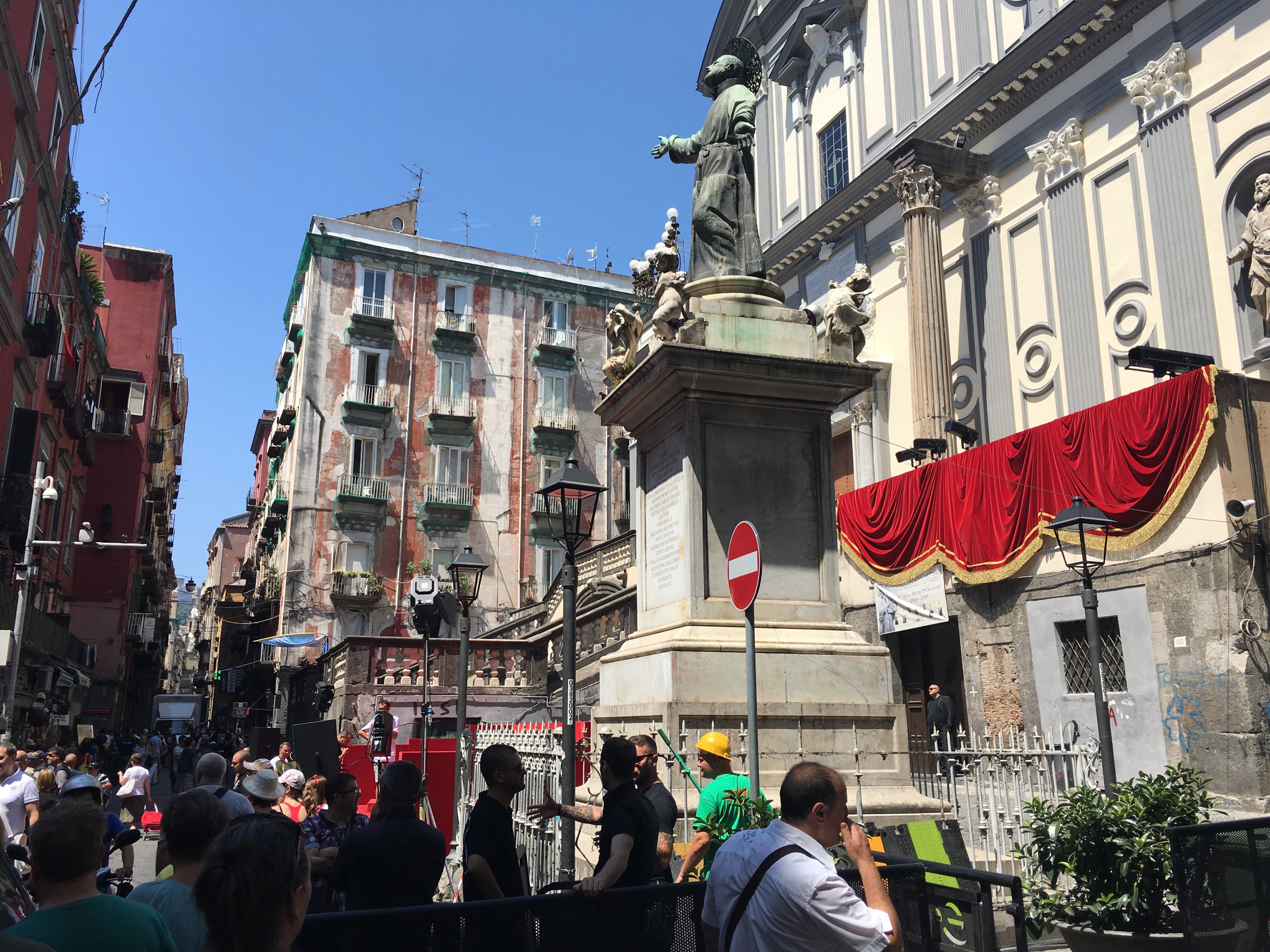
It was the first day we walked in the older section of Naples — a sprawling metropolis at the base of Mount Vesuvius on the Mediterranean coast — when I began to feel this history pressing in the air all around me.

I say sprawling because Naples is today the most densely populated urban centre in all of Europe; some 8,500 people inhabiting one square kilometre in a metropolis of nearly four million people — making it the third largest city in Italy, and the ninth most populous urban area in the entire European Union.


The noise was overwhelming: the hustle and bustle of pedestrians, car horns beeping, motorcycles and mopeds buzzing, shouting street vendors, impassioned conversations, two-toned emergency sirens, barking street dogs, screeching tires.

In conrast, the neo-Gothic styled ‘duomo’ in Naples offered a welcome break to this outside clamour. 

The expansive interior spaces of this main cathedral embraced silence and only hushed speech. You could occasionally hear the squeak of rubber-soled shoes and someone dropping a book on the stone and marbled flooring as people sat and wandered solemnly throughout the holy spaces.

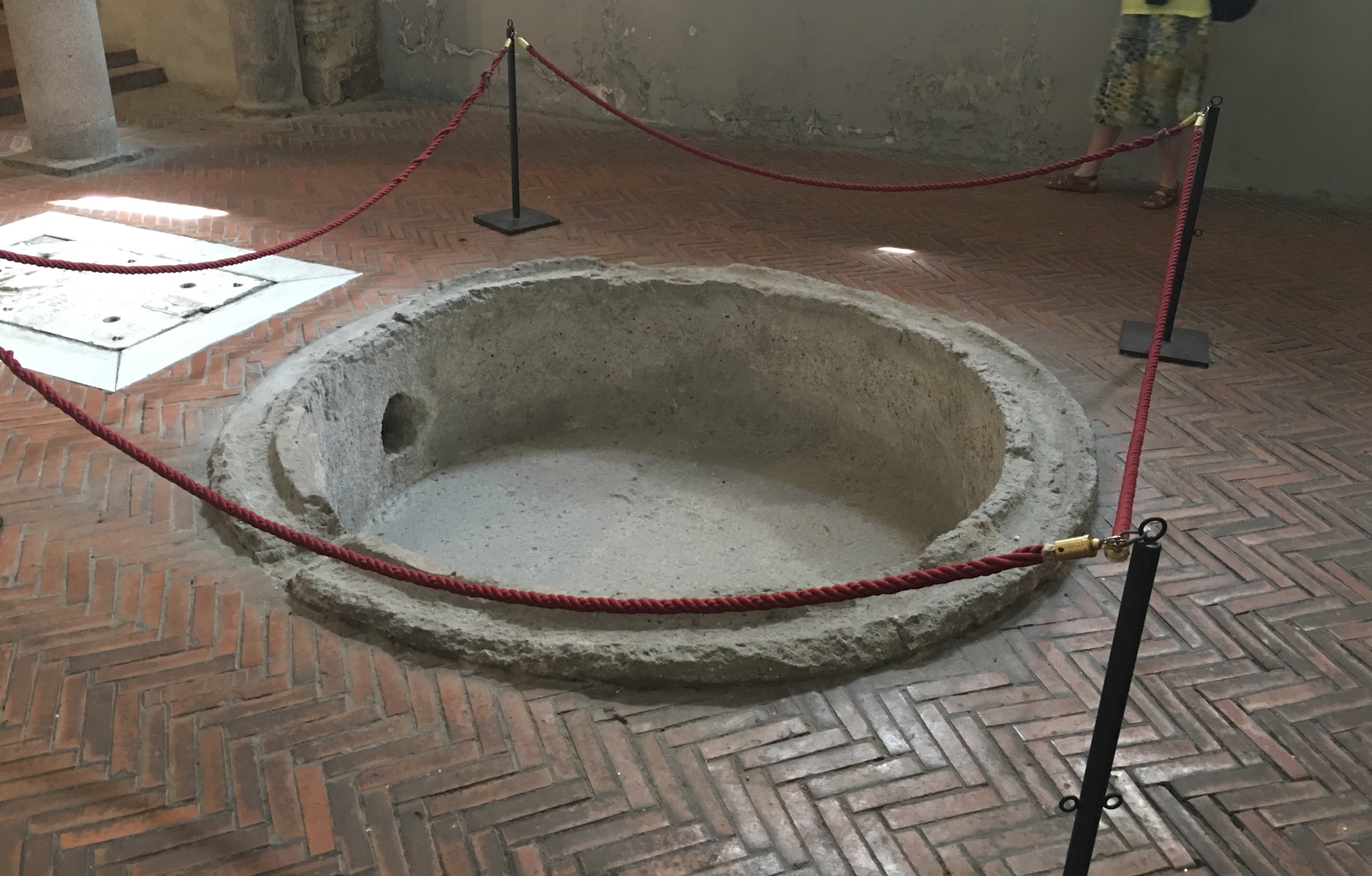
Perhaps the most significant feature of this cathedral is the baptistery, which is the oldest baptistery in the world, built in the fifth century, C.E. It is remarkable to connect with such an ancient symbol in a material form. 

When the baptized emerged from the water, looking upward at the ceiling, they would be encouraged in their faith; the first images they saw after being baptized were scenes from the Gospel expressed in Byzantine, mosaic art: Jesus saving Peter from drowning, the women at the empty tomb, the miracles of the multiplied fish, an image of Saint Paul, the Apostle, etc.

Seeing with my own eyes and touching with my own hands this font that was built by human hands only a few hundred years after Jesus, affirmed my conviction in the longevity and validity of the sacrament which has endured as profoundly meaningful for Christians throughout the millennia. 

I felt that faith is not just about the good old days when I was young, but the good old days when the Christian faith was younger. We are part of something much larger than our immediate reality. And, when we connect with that broader history, we realize it wasn’t always peaches ‘n cream and rose-coloured a history.

If you are movie watcher, you might recognize another cathedral we visited — the Duomo in the Umbrian, medieval town of Orvieto. 


This cathedral was featured in the opening scenes of Under the Tuscan Sun. This cathedral’s highlight is the Chapel of San Brizio, featuring Luca Signorelli’s brilliantly lit frescoes of the Day of Judgment and Life after Death. 

Although the frescoes refer to themes of resurrection and salvation, they do so through images not from the bible (that is, stories from the Gospels or Old Testament) but from the turbulent political and religious atmosphere of Italy in the late 1400s. Signorelli told the story of faith through his contemporary human events, rather than the traditional symbols (such as Jesus, God, the Trinity, the Apostles, disciples and other biblical characters) that we see in most other places.

Those frescos in the Orvieto cathedral chapel were snapshots of an historical era particular to a specific time and geo-political reality (i.e. 15th century Italy). And the impression of faith put ‘on it.’ Historical to us. Yet current to those who built that Cathedral in the Midlle Ages.

Faith is more than merely appealing to our past. Coming to worship today is not just about being reminded of something or someone from a long time ago. What we do here today is not just an exercise in recalling historical facts. As if decisions we make today are really not about faith. When we talk about our building renovations, worship practice and art, musical choices, communion, budgets, outreach initiatives  — these issues are very mcuh about the Christian faith ‘in the real world’, so to speak. All of these real things do reveal what we believe in, our values, what is important to us, who we are. How do these ‘mundane’ decisions reflect the Christian Gospel, faith, kindgom values in this time and place?

Lutherans make a similar mistake, I believe, when we define ‘Lutheranism’ as a belief/doctrinal system that is limited to the words and conceptual formulations of sixteenth century Germans. When we say that to be Lutheran is merely to ‘turn the clock back’ to 1537 when the Book of Concord was finally assembled including Luther’s Small and Large Catechisms, the Augsburg Confession, and the Apology to the Augsburg Confession.

I prefer a view that is reflected in the Evangelische Kirche Deutschland’s (EKD) logo for 2017, “Celebrating 500 years of Reformation”. Five hundred years of Reformation. In other words, Reformation started happening — in our tradition — with Martin Luther, yes. 

But, Reformation continued through the 500 years following, and continues to this day and beyond. We are always reforming the forms and means by which we express our evangelical, Gospel-centred faith. Always finding new and creative ways to tell the story of God.

What can we say, then, about Christian history? If we can apply a macro view over the ages, we can say that the history of the Christian faith is about a God who loves us. Christian history is about a God whose compassion never fails, who “will not come in wrath” (Hosea 11:9) — even though the people of God continue to keep “sacrificing to the Baals and offering incense to idols” (v.2).

The history of the Christian faith is about our lives being “hidden with Christ in God”, being “revealed with Christ in glory” (Colossians 3:3-4), dying daily to ways of sin and being renewed daily in Christ who “is all and in all!” — even though we are imperfect and sin as long as we hold breath. Christ is all and in all — despite us!

The history of the Christian faith is about how each moment of history — including this one right now — reflected Jesus’ love in the fifth century, the fourteenth century, the 21st century in Palestine, Egypt, Italy, Canada, etc. God for all times and places!

We validate the Christian faith by our lives today, now. This is where the rubber hits the road. This in-the-moment approach fuelled the generosity of medieval Catholicism represented in the magnificent building projects for worship as much as it did the passion and commitment of European Christians during the Reformation era.

We do not leave the practice of faith for some distant, utopic and dreamy future. Neither do we rest on the laurels of the tremendous sacrifices made by our forebears in Canada. 

Now is the time. Now is the time to live out of the conviction of God’s grace and love, despite the many and various ways Christians have messed up in history, and continue to do so today. Now is the time to live out of the faith that is full of hope, that despite our waywardness and unfaithfulness, God is faithful. Now is the time to claim God loves us, not because we are good, but because God is good. God is so good!

You know Jesus’ familiar exhortation, most often translated as “be perfect as your heavenly Father is perfect” (Matthew 5:48). Christians have often interpreted this word ‘perfection’ as being made whole. 

A much better translation might be: “be merciful.” Because this verse comes right at the end of a passage calling Christians to “love your enemies” (v. 43-48). Only God is perfect. But we can participate in God’s perfect mercy, God’s all-inclusive and impartial love.

Echoing Saint Paul’s words from the Epistle today (Colossians 3:11 — “Christ is all and in all”) St. Bonaventure later said, “Christ is the one whose centre is everywhere and whose circumference is nowhere.” [1] 

Christ’s mercy is everywhere evident in history. This is the Wholeness, the forgiveness, the grace, that holds you forever and everywhere. You can’t figure this Wholeness out rationally, nor can you control it. All you can do is fall into this Wholeness that holds you when you stop excluding, even the dark parts of yourself. [2] And that, my friends, is the Gospel — good news — for all times and places.

Thanks be to God!

1- Alan of Lille, ‘Regulae Theologicae’, Reg. 7 as quoted by Bonaventure, translated by Ewert Cousins, “The Soul’s Journey into God”, Classics of Western Spirituality (Paulist Press: 1978), p.100

2- Richard Rohr, “Daily Meditation on the Spirituality of Imperfection” Week 2 – Perfection of Wholeness, Thursday, July 28, 2016

There’s no place on earth

People of faith, since the beginning, have been on the move. Even when they settled down for a while, they created ways of practising the journey — of moving from Point A to Point B.

Rome, central to the story and expansion of early Christianity, is full of famous steps. The most famous of these are the 135 Spanish steps which visitors traverse daily en masse.

Millions of Christians have walked the Camino el Santiago which spans almost 800 kms from the foothills of the Pyrenees in France all the way to Galicia on the northwest coast of Spain.

The trails to the castle at Lindisfarne in the United Kingdom attract Christians worldwide every Holy Week to walk nearly 200 kilometres.

People of faith have valued movement as integral to their spiritual growth. Because we are not the same at the end of a journey than we were when we started. This innate desire to be better, to change, to grow and mature — is part and parcel of the life of faith.

The culture of Journeying, so important to the Lenten season we now begin, has its roots in the original pilgrimages to Holy Lands. For centuries, Christians sought a deeper connection with Jesus who walked and lived and died in and around Jerusalem and the Judean wilderness. 

When the Crusades prevented pilgrims from traveling to the Holy Lands, Christians ‘back home’ developed prayer walks in Labyrinths — the most famous and oldest in the Chartres Cathedral in France — which symbolized the long journey to meet Jesus.

Indeed, settlers to this country moved here, many of them to exercise and practice their faith in freedom. Mobility, migration, pilgrimage — this is our story, as people of faith.

How we journey is the question. The journey is not only physical, it also describes our understanding of the way things work.

Over the last month, the Ottawa Senators (NHL hockey team) were looking to score more goals. They had lost more games than won. Their star players were not producing. 

One of their younger players, Curtis Lazar, decided to give $50 to a homeless person after dining out one evening. The next night, he scored two goals in a routing of the Toronto Maple Leafs — the Senators won that game 6-1. The following game, the Senators won again, 5-1, against the Tampa Bay Lightning.

In an interview afterwards, Lazar confessed that perhaps there was “karma” working here. Meaning, because he had done a good deed, there was a ‘return’ on his righteous investment and he was rewarded with those goals and wins.

I like Lazar and I appreciate his hockey skills and character. At the same time, he reflects a dominant way of thinking. It is really what some have a called a mechanical type of spirituality, with inputs (from us) and outputs (from God). The sequence goes something like:

1. We sin

2. We are punished

3. We confess our sins

4. We change our lives, and do something good

5. Then, we receive forgiveness and grace

Such is the description of a journey towards goodness that hinges entirely on us, and our doing, our initiative. This spiritual journey then cycles back to the beginning and round and round it goes. Essentially, we force God’s hand. Karma is not a belief alien even to Christians, it seems!

The problem with karma is that because it ultimately relies on our good works, we will never achieve the goal. After winning two lop-sided games, the Senators have now lost three in a row. Where does that leave Lazar? Does he have to give $100 next time to poor people he meets?

In recalling the great acts of God in bringing the Israelites to the Promised Land, Moses confesses it is God’s mighty arm that started the ball rolling towards freedom; verses 8-9 of Deuteronomy 26:

8The Lord brought us out of Egypt with a mighty hand and an outstretched arm, with a terrifying display of power, and with signs and wonders; 9and he brought us into this place and gave us this land, a land flowing with milk and honey.

Like the Israelites wandering in the desert for 40 years, Jesus walks with us in a completely opposite direction from karma. His is not the spirituality of addition, but of subtraction. He goes into the desert.

Try to imagine Jesus’ first moments, entering into the wilderness he would occupy for forty days: The sound of any footsteps is absorbed by sand and rock, lost in the wind or in silence. It is in this barren place that Jesus chooses to retreat, far from what he knows.

Christ chose to retrace the path of his ancestors — in the desert: Abraham. Moses. Ruth. Some of them were responding to God’s call. Some were fleeing persecution. Some were simply looking for a place to call home.

There may very well be value, to our growth as Christians, in embarking on spiritual journeys and earth-bound pilgrimages with some expectations at the destination in mind.

At the same time, we can be assured that Jesus not only waits for us at the ‘end of the line’. Jesus is right there with us, each step of the way. His journey into the desert of testing and suffering shows that there is no place of suffering, pain and loss on earth, to which Jesus is unaccustomed. No place of want that Jesus doesn’t know, intimately. This is more the point.

I like one of the sayings, attributed to Albert Camus, on a Valentine’s Day card I saw: It’s a message of love from one to another: “Don’t walk in front of me, I may not follow; don’t walk behind me, I may not lead. Just walk beside me, and be my friend.”

The message of Christianity is that God is not out there, or back there. God is ‘in our skin’, with us. And goes where we go in our journeys of faith and life, through the good and the bad. Jesus is not only the God of our eternal salvation, Jesus is our friend for life, and no matter what.

Jesus resides in the deepest places of our heart and activates our truest most authentic selves no matter where we are at.

Long before Jesus came, the Psalmist knew this gracious truth in his heart: There is no place on earth where God’s presence of grace, love and mercy cannot reach. In Psalm 139 —

7 Where can I go from your spirit? Or where can I flee from your presence? 
8 If I ascend to heaven, you are there; if I make my bed in Sheol, you are there. 
9 If I take the wings of the morning and settle at the farthest limits of the sea, 10 even there your hand shall lead me, and your right hand shall hold me fast. 

Contrary to karma, this journey of faith begins with God’s grace and forgiveness, as it always does. It is in the desert of our lives where we experience this grace because life happens regardless of how hard we try. And because we are already forgiven, already blessed, we can live confident, transformed lives, even in the desert of our lives. As we live out of our freedom in Christ, we can then confess, “Jesus is Lord!”

As God is with us in our deepest darkness and light, we look to those on the move today. Refugees. Migrants. More than the places of the journey, it is the people we must engage. 

While the desert wilderness was a time of solitary retreat for Jesus, migrants and refugees live in communities: their solace is in the comfort of companionship and common history and identity with those whom they live alongside. In the Lenten days to come, in our own solitary places, let us pray for those for whom solitude is a luxury. And welcome them into our hearts and minds. (1)

(1) Lutherans Connect, “Welcoming the Stranger” blogpost Lenten devotions, Day 1 (lc2016lentdevotional.blogspot.ca)

The life-giving gap

Does a spring pour forth from the same opening both fresh and brackish water?” (James 3:11)

The writer, James, makes a case for integrity and authenticity in the Christian life. For us moderns, living in a day and age where how we look, our reputations, our social standings and our bank accounts seem to speak louder than anything else about who we truly are and what we truly want. Is our joy at living based on these ‘worldly’ values, when we are honest about it? 

It becomes particularly challenging for us Christians, whose value system is acutely counter-cultural. It becomes a real war, actually, to embrace the true source of our lives in a world of celebrity politicians and glory-seeking suburbanites. And I think, for the most part, we live a bifurcated existence. We say one thing — I believe in the God who asks us to bear our cross and follow him (Mark 8:34) — but so easily slip into a lifestyle that is really narcissistic, self-centred and selfish. The easy way.

It’s a rhetorical question. “Does a spring pour forth both fresh and brackish water?” In James’ mind, of course not. A spring will either bring forth, on balance, mostly fresh or mostly dirty water. The meter will lean one way or the other. 

Which way do you lean? In your work? In the way you invest? In how you spend your money? In how you spend your free time? With whom? In what and how you communicate?

In the Gospel for today (Mark 8:27-38), Jesus says some difficult, counter-cultural things about what kind of way Jesus — the Lord of Lords, the King of Kings, God incarnate, Almighty and Everlasting God — will travel the journey of life. And it is this God who beckons us to follow: in order “to undergo great suffering” (Mark 8:31). Really? That doesn’t sound right for a person claiming godly power!

In an upwardly mobile culture we are suddenly and shockingly presented with a downwardly mobile God. Naturally and understandably, through the lens of worldly value, we shudder. Peter rebukes Jesus. And it is in response to Peter’s communication that Jesus accuses Peter of being Satan.

The first lesson from Isaiah, the third chapter in the Epistle James and the Gospel reading for today are a call to discipline our speech — how we talk, and for what purpose. I would broaden this to say: How we communicate. The words we use. The body language we employ. They say that 70% of communication is non-verbal. I believe this truth is what prompted Francis of Assisi to say: “Preach the Gospel; Use words only when necessary!” It’s a cliche, but it’s true: Our actions speak louder than words.

We are called to pay attention not only to the words we use — important though they are, but our actions, our tone, our presence with another. We are called to pay attention to these details in assessing the quality of our relationships. Not to do so, to ignore and dismiss our attention to these aspects of relating, is evil. Not to hold ourselves accountable to what we say and how we say it to another is a satanic time-bomb waiting to happen.

The eighth commandment reads: Do not bear false witness against your neighbour (Exodus 20, Deuteronomy 5). This means, what we say about them. Of course, first we have to look around and ask: Who is our neighbour? On Meadowlands Drive West, in Nepean, Ottawa, and in Canada. Who are our neighbours today? Do we know their names? Who are they? And then, what do we say about them, to them?

In his explanation of all the Ten Commandments, Martin Luther makes clear these are not simply about ‘not-doing’ — not gossiping, not slandering — but even more important what positive behaviour we do for the sake of the neighbour. He writes that it is imperative that Christians should do all they can to protect the good name and social standing of their neighbours — and he lifts up particularly the “sins of the tongue” in this context. (Martin Luther, “The Large Catechism,” in the Book of Concord, ed. Robert Kolb & Timothy Wengert, Minneapolis: Fortress Press, 2000, p.420)

I can’t help here to think of the millions of refugees fleeing the violence in Syria. I can’t help here but think of the many ways Muslims are disparaged in the media in the West not only in the press, but also in those malicious forwarded emails that circulate “like a hydra with multiple heads: so pernicious and so difficult to stop” (Kristin Johnston Largen, “Inter-religious Learning and Teaching” Fortress Press, 2014, p.57).

James concedes to our human predicament. In the end, no matter how hard we try to do right by this, “no one can tame the tongue” (3:8). It’s as if the narrative of Scripture accepts the impossible capability of us, on our own, to get it all right all of the time. Even though Peter is in one moment ‘Satanic’ he is, in the next, the rock upon which the church will be built against whom “the gates of Hades will not prevail” (Matthew 16:18). Martin Luther’s well-known paradox can help us frame this apparent contradiction: We are simultaneously saints AND sinners (simul justus et pecator). 

This ‘word’ today may make us feel uncomfortable. It does, me. And, probably for good reason. Yet, there is good news. God speaks into this confused darkness of our lives. God speaks the Word of creation into this murky existence (Genesis 1). A Word of forgiveness, mercy and compassion. 

And the Word that God speaks sets up the endless harmonic of sounds in the world. And as we speak, and try to speak truthfully, perhaps what we are doing is far less hanging labels around the necks of the things of the world. And instead we try to find those divine harmonics and speak and act ‘in tune’ with that Word first spoken into silence and darkness.

The image I like of creation is that God first makes a great cave. And then breathes into it. Speaks into it. A Word. And from the cave the echoes come back. Differently pitched. Differently aimed. A world of Word. And we find our place in that world listening to those harmonics, trying to speak and act in tune with them. Not to speak and act from our will or our passion for control. But to speak because we want to join in what an earlier generation would have called the ‘music of the spheres’. (Rowan Williams, “The Spirit in the Desert” Meditatio Talk Series 2015 B Apr-June CD).

Those of us preachers and public speakers, especially need to think more about this. Paul says that the Body of Christ is made up of all parts, each important in their own right (1 Corinthians 12:12-27) — you are a hand, you a leg, you the eyes, you the foot. This morning, I am the mouth! And, like James, Paul also says that greater scrutiny and possible judgement will be brought upon those who speak (2 Peter 2:3;Colossians 2:20;1 Timothy 1:2-4). A timely word, perhaps, in a season of political campaign, mindless rhetoric and questionable election promises.

How do we speak in such a way that is authentic and true? Only by looking for the harmonics that that Word of God sets up. By refusing the mass pressures of culture. By becoming in our speaking as in our living a kind of invitation into the gracious harmonics of God’s world, into the resonances and echoes that are set up by that primordial utterance of God into the cave of creation.

Simone Weil used the concept of ‘hesitation’ to describe how to communicate in a healthy way For her, part of the essence of spiritual maturity was leaving the ‘life-giving gap’ between you, the act, and the other person (quoted in Rowan Williams, ibid.). Learning not so much to project straight away our ego compulsions into the other person; learning not so much to move right away into solving a problem on our own terms. But drawing away momentarily to listen for the sake of the other. And for the sake of the truth.

At the end of the day, we are called to check the compulsion to speak. And move back into a momentary stillness into which God’s draws us, and out of which God calls us to speak and to act with integrity and authenticity.

We would make James proud.

‘One little word’

“Long ago your ancestors — Terah and his sons Abraham and Nahor — lived beyond the Euphrates and served other gods …. Now … choose this day whom you will serve, whether the gods your ancestors served in the region beyond the River or the gods of the Amorites in whose land you are living; but as for me and my household, we will serve the Lord.” (Joshua 24:2,15)

“Finally, be strong in the Lord and in the strength of his power. Put on the whole armour of God, so that you may be able to stand against the wiles of the devil. For our struggle is not against enemies of blood and flesh, but against the rulers, against the authorities, against the cosmic powers of this present darkness, against the spiritual forces of evil in the heavenly places … ” (Ephesians 6:10-12)

My mother told me the story of a dramatic stand made by Christians against Hitler on Easter Sunday 1942 in Norway: The Nazis had insisted that every Lutheran congregation praise God for Hitler’s rule over the Norwegians. The Lutheran Church considered this blasphemy, and refused. Every Norwegian Church closed that Easter Sunday morning. And instead they agreed to worship in the afternoon.

Later that day in one of the villages the people assembled in the market place. And because they were scared, they began singing what Lutherans have sung for over 400 years when they were afraid: “A Mighty Fortress is our God, a bulwark never failing …”

And they slowly began to walk to the steps of the village church — only to find the doors locked and guarded by a company of SS soldiers with submachine guns trained at them. When the Christians arrived at the front steps, having finished the first verse of Martin Luther’s famous hymn, an SS officer grabbed a woman holding a baby in her arms and said: “One more verse and she gets it first”, pointing the weapon at her head.

In the tense silence, the people, not knowing what to do, looked down at their feet.

And then, a single, soft, quivering voice began … 

“Though hordes of devils fill the land, all threatening to devour us, we tremble not, unmoved we stand, they cannot overpower us. Let this world’s tyrant rage … his might is doomed to fail. God’s judgement must prevail. One little word subdues him.”

It was the voice of the woman holding the baby. “One little word subdues him.” The soldiers were the ones in a moment of indecision who looked down at their boots. And then quietly they shuffled out of sight to let the worshippers enter the church.

One little word subdues him. Not a loud trumpet call. Not an explosion of spectacular proportions. Not an air strike obliterating the enemy. Not a bravado that denies human frailty and vulnerability. Not eloquent oration. Not a motivational speech rallying the crowd into a frenzy. One little word subdues him.

The themes of ‘standing up against evil’ and ‘taking a stand’ pervade the scriptures assigned for this Sunday. We must choose our god. We must stand up. Especially in the context of a multi-faith community. But how do we do this when all we want to do is stare down at our feet, immobilized with fear?

Because we are surrounded by diverse peoples. And that isn’t going to change. At least we can relate to the Ephesians. The Christians in Ephesus were probably taken to worship the emperor at the newly constructed temple of Domitian; Ephesus in the first century was also a thriving commercial city and the cultic centre of goddess Artemis. (Haruko Nawata  Ward, Feasting on the Word Year B Vol 3 Fortress Press, 2009, p.376). Christians were challenged to be confident in their faith amidst challenging times. Change some of the names, and it feels a bit like Canada in the 21st century!

And as simple as we sometimes may want to reduce the question of evil, the scriptures present a more subtle and systemic view of evil. In other words, evil is not just a little red man with a pitch fork sitting on your shoulder tempting you to do something bad. Evil is also, and more significantly, about forces beyond the immediately ‘individual’, into the realms of politics, world history, economics. 

More than against “flesh and blood” evil is also about certain patterns of thinking. Our attitudes and underlying beliefs and assumptions about people of other faiths and values.

Standing up against evil and taking a stand is just is as much to do with changing the way we think about ‘them’. Standing up against evil is about repudiating ways of thinking and unspoken assumptions that have only served to hurt and damage other people. Sometimes the way we think — the common sense assumptions of our culture — are downright evil and wrong. Let me give you an example:

This past summer at the national convention of the Evangelical Lutheran Church in Canada (ELCIC), the church voted to repudiate the “doctrine of discovery”. This doctrine is different from our normal understanding of a statement of faith. But it was a belief that resulted in untold damage to the aboriginal populations of North America. It was the reason aboriginal children were taken from their homes, families and communities to suffer — many of them — in the so-called Indian Residential Schools in the last century.

The doctrine of discovery was the underpinning belief that resulted in the first explorers labelling Aboriginal people as “beasts of the field and forest”, and prompted governments to justify “killing the Indian in the child.” The doctrine of discovery made the residential schools places where native children were not permitted to speak their own language, practice their own religion, nor attend with their own siblings or have any contact with their parents while they were at school. How evil is that!?

So what is this doctrine of discovery that the ELCIC repudiated? Basically, it was a system of belief based in the discovery of North America, as if nothing of inherent value existed here before ‘we’ arrived. When the explorers landed on the shores of Iceland and then Turtle Island (i.e. North America), the land appeared to be unoccupied in the ways of western Europe. The explorers therefore believed it was theirs to acquire and own. When the explorers encountered native bands, there was this immediate disconnected with their values and culture and relationship with the land, understandably. Still, the settlers felt superior in their relationship to the native culture, believing — “What we have is better for you.” And moving from that doctrine into practices and policies of assimilation and subjugation like the residential schools.

I can anticipate your objection: But what to make of the Great Commission in Matthew 28:19 — when Jesus instructs his disciples to “Go therefore and make disciples of all nations”? Isn’t this what we have been supposed to do? – make others, force others to be like us? Aren’t we supposed to impose our values on the world, using any means at our disposal? Another English translation of the word, disciples, changes the tone significantly. When we read, “Go therefore and make learners of all nations”, we can see our task as learning. Disciples are essentially ‘learners’. Learning involves challenging current patterns of thinking, and going out into the world to share our faith. (Kristin Johnston Largen, Interreligious Learning &  Teaching, Fortress Press, Minneapolis 2014, p.109)

When I visited Jerusalem years ago, I was surrounded by at least three different world religions day in and day out. Muslim minarets blared out regular calls to prayer; orthodox Jews bowed at the wailing wall. And I, with a small group of Christians found a little apartment in the old city to gather around bible, cup and bread, to pray  and sing together. Few other times in my life have I ever felt as confident and grateful for my Christian faith than in a context  where other faiths and cultures came and tried to live together, even clashed.

Sharing our faith is not about one-up-man-ship. Sharing our faith is not a competition. It is simply being confident to talk to others when appropriate about what is most important to you. And, giving the other the freedom to do likewise. I think we still need to work on that in the church because I think we still believe it’s about a competition. That we have to fight, even, if necessary, to defend God — or our ideas of God. Be the winner, not the loser, in a winner-takes-all kind of world. It was in Jerusalem when I first realized that if there was any evil in the world, it started in me and my selfish, materialistic, self-acquiring vision for life.

Paul’s armour-of-God metaphor, like all metaphors, has limits and can even be problematic. Such a text has been interpreted throughout two thousand years of church and world history often as justification for violence against others. It is challenging maybe even impossible for us today to engage this text without the lens of history and the development of society and human culture through the ages — particularly with respect to warfare.

And that is why, as Lutherans especially are taught to do, I would not want to interpret this text without placing it beside another text from Paul’s letters, in this case, to ‘let scripture interpret scripture’. Listen now to another clothing analogy, where Paul speaks of what we ‘put on’ in Christ:

“As God’s chosen ones, holy and beloved, clothe yourselves with compassion, kindness, humility, meekness, and patience. Bear with one another and, if anyone has a complaint against another, forgive each other; just as the Lord has forgiven you, so you also must forgive. Above all, clothe yourselves with love, which binds everything together in perfect harmony. And let the peace of Christ rule in your hearts to which indeed you were called in one body. And be thankful …. And whatever you do, in word and deed, do everything in the name of the Lord Jesus, giving thanks to God the Father through him.” (Colossians 3:12-15,17)

Indeed, in this light, the belt of truth is the Gospel. The helmut of salvation is God’s eternal promise of love for us. The breast-plate of righteousness is a heart of compassion. The boots are actions that bring peace and goodwill to the world. The shield of faith is trusting in God’s grace. The sword of the Spirit is proclaiming the word of forgiveness, mercy and love.

One little word subdues him. An act of humility, not military aggression nor forceful imposition.

One little word subdues him. A word of forgiveness rather than condemnation, racism and judgement.

One little word subdues him. Something unexpected, surprising and even looked down upon by the world’s winners — that changes history. One little word — not born of competition, comparison and control, but born of surrender, release and trust. One little word, “I love you”, changes everything.

One little word is Jesus. God becomes human. A baby. A prophet. A teacher. A lamb taken to slaughter. One little word is greater than anything the world lives by. One little word whispered in a storm. One little word sung softly into the barrel of a machine gun. One little word nudging gently our hearts, saying to you: I love you. I forgive you. You are free. You will forever more be a child of God.

Now, tell the nations of the world the same. And act like you believe it. Because it’s true. Thanks be to God.

Jonah and the Call

When the waves started crashing over the deck of the ferry, I knew something was wrong. I remembered reading somewhere that the Baltic Sea can get unpredictably dangerous in the Fall of the year. So true.

When my grandmother — we called her “Oma” — and I sailed from the protected harbour, the waters looked calm. But once we hit the open water, the winds picked up, and I had to hang on for dear life!

I’m not sure the story of Jonah came to mind at the time, but the similarities are striking, when I reflected on that turbulent time in my life. I had just arrived in Germany for a year-long exchange student program during my seminary education. This was what I felt “called” in my preparation to be a good, Lutheran pastor — spend a year in a Lutheran university, in the very place Martin Luther argued with other reformers about Holy Communion.

But it was the first time I would spend significant amounts of time in a foreign land trying to function in a foreign language, by myself, without family and friends. And within the first couple of weeks after I arrived at the university in Marburg, Germany, I knew this was not going to be easy.

If fact, I remember coming soon to the conclusion that all I wanted, was to escape Marburg — the lonely dormitory room, the solitary walks to the lecture halls, the silent dinner times in the corner of the cafeteria. I’m an introvert, so this was really bad! Because I felt completely disconnected from everything and everyone.

Oma lived in northern Germany. And I think she wanted to help me, so within two weeks of my arrival she invited me to hop on the train and visit her for a couple of days. She wanted to take me on a ferry boat ride from just across the border in Denmark back to the seaside city in which she lived. Part of the deal was to enjoy a schnitzel meal before the boat left that placid harbour. In retrospect, that wasn’t a good idea!

But she tried to make me feel more ‘at home’. Just before we boarded the ferry she had handed me an envelope containing a thousand dollars. “Use this to help you this year in Germany,” she said, looking at me with her sparkling eyes, “in whatever way you see fit.”

I did. The answer was not Marburg. It was Vancouver! Yes! The timing couldn’t have been better. I was less than an hour’s train-ride to Frankfurt — and the paid-for plane ride outa here! Besides, I had a close friend studying in Vancouver at the time — nothing like a girlfriend to distract and motivate a young man desperate for a change in scenery.

I mentioned Jonah, because during my three-week hiatus in Vancouver I read Eugene Peterson’s book, “Under the Unpredictable Plant” (Eerdmans, Grand Rapids, 1992) — which is basically a reflection on the Jonah story:

God calls Jonah to go to Nineveh; but Jonah hesitates and would rather go to Tarshish. On the boat ride to Tarshish he encounters a gale storm threatening the lives of all aboard. He realizes the impending calamity is probably his fault, and sacrifices himself by jumping into the sea, where he spends three days in the belly of a whale. We pick up the story in the first reading today (Jonah 3:1-5,10) after the whale spits Jonah out; God calls him a “second time” to go to Nineveh — and he finally relents, and goes to do God’s will.

When I was in Vancouver I seriously toyed with giving up on my pastoral vocation; I remember thinking that I did not want to return to Marburg, and that I would use this opportunity in Vancouver to inquire about the School of Architecture and City Planning, programs which had intrigued me at the time. The dark, depressive notion of returning to Marburg (a.k.a Nineveh) was the farthest thing from my mind. I would start all over, in Vancouver (a.k.a Tarshish).

There’s something important about Jonah’s experience — Jesus likens his three days in the tomb to Jonah’s three days in the belly of the whale (Matthew 12:40). It’s that time of incubation, of waiting, of not being in charge. It’s the grass under the snow and ice, the seeds of the daffodils hibernating in the frozen ground, waiting until the right time that comes from outside of one’s individual initiative and control.

Those three weeks in Vancouver, the long walks on the beach — by myself, I might add — this was my time in the belly of the whale to discern and reflect on the truth of what I was called to do and be. I thank God for that time ‘in the belly’, where I could ruminate and come into myself as I truly was, and am.

It was during that time when I realized what I needed to do: I was called to return to Marburg, and I felt convinced in my heart that all I was asked to do was finish the year abroad. That’s all I had to do, and not worry about ‘what after?’. That’s where, despite my fear and anxiety about returning to a place where I would have to confront my demons, I knew was my next step.

You may notice how immediately Simon and Andrew leave everything behind and follow Jesus’ call (Mark 1:18). In last week’s Gospel, Philip and Nathanael so quickly respond to the invitation to “come and see” Jesus (John 1:43-47). Abraham went immediately, “as the Lord had told him” (Genesis 12:4). There is a prevalent understanding to lift up an idealistic, immediate and righteous response of Christians to the call of God. I can see why.

But then there is also Jonah, who resists. There is the great prophet Jeremiah who when God first appears to him and appoints him a prophet, he rejects the call by throwing up excuses: “I do not know how to speak; I am only a boy” (1:6). And it takes two whole chapters in the book of Exodus for God to finally convince Moses to do God’s bidding to confront Pharaoh and free God’s people from slavery in Egypt.

Moses’ excuses run like a litany: “Who am I?” (3:11); then, “What should I say?” (3:13); then, “But suppose they don’t believe me?” (4:1); and, “I am not eloquent; I am slow of speech” (4:10); and finally, “Please send someone else!” (4:13). To each of these successive excuses, God shows incredible patience to nurture Moses into fulfilling his task. This is the same God who is patient with Jeremiah and Jonah.

If I take the bible witness as a whole, it appears some followers of God respond immediately, without question or hesitation, dropping everything and going. And then there are some who resist, who complain, who self-doubt, hesitate and try to deflect the call of God.

In the world of mathematics, integers and fractions, these numbers would cancel themselves out. In other words, what is most important to focus on here, is not our human response to God. Because our responses will vary as many as there are people on this planet Earth. The starting point, is not how we should respond. But the way God is.

God is merciful. If God changes in anything, it is only in the direction of judgement to mercy. God is slow to anger and abounding in steadfast love (Numbers 14:18; Psalm 86:15, 103:8, 145:8).

God is persistent with us. God is the hound of heaven. God has a plan — one we can never know completely, because we are not God. For whatever reason, God is acting to fulfill something that is beyond all of us. All we are called to do is to participate somehow in God’s mission on earth. God won’t give up trying to get that message across to us.

God is faithful to us. As God was faithful to all the prophets and disciples in the bible, God will not give up, abandon and discard the “work of His hands” (Psalm 138:8). God is with us, regardless of whether we need a little more convincing over time or not.

With wobbly knees I disembarked from the ferry when we finally landed safely in the German port following our harrowing ride on the angry Baltic Sea. I walked quietly beside Oma back to the car, stomach churning yet grateful to be alive. Even though my heart, at the time, was set on Vancouver, I already knew that God had given me a second chance at life. And deep in my heart, I knew that God would continue, no matter what I did, to be merciful to me, to be patient with me, and never give up on me.