Advent 4 Eucharistic Prayer

We praise you gracious God

That since the beginning your Word created all.

You spoke to your people through the prophets.
You prepared us for your coming in the One

Jesus, who came to feed the hungry, 

who promised to come to us in your Spirit, 

and who promised at the end of time to come again.

We praise you, loving God, that you come to us now

In the Spirit of your Son

In the bread and the wine.
For, in the night before your death
You ate with your friends;

You took bread, gave thanks, broke it,

And gave it to them, saying,

“Take and eat. This is my body given for you.

Do this in remembrance of me.”
Again, after supper, he took the cup,

Gave thanks, and gave it for all to drink, saying,

“This cup is the new covenant in my blood,

Shed for you and for all people,

For the forgiveness of sins.

Do this for the remembrance of me.”
We praise you that you fill our lives with Peace

In the giving and the receiving

In the inviting and the responding

In the offering and the accepting
You come, Lord Jesus, as you did to Mary

into our minds, hearts and bodies

You come, Lord Jesus, as you did to Bethlehem 

into this dark world
You come, Lord Jesus, to shine your light 

Upon the joy and the sadness

Upon the love and the hate

Upon the courage and the fear

Upon the peace and the anger

You come, Lord Jesus, into our lives whether we are prepared or not

You come, Lord Jesus, whether we are ready or not

You come, Lord Jesus, into our imperfect, broken, wounded lives
You come, Lord Jesus, 

to restore what is broken, 

to reconcile the divided, 

to heal what is wounded,
To fulfill your Word, and

to give all people Peace.

Lift, and open the gates!

I reacted with sadness and sympathy looking at the photo of my friend’s dog whose entire face, chest and front legs were pierced with dozens — maybe even hundreds — of the sharp quills of a porcupine.
The photo was taken of the dog in the back of the car on the way to the vet, and she seemed stable enough — like the look of someone who knows they’ve been stung and know they just need to hold it together for a bit longer.

I felt sorry for that dog because it was simply being true to its nature — maybe motivated by a natural impulse to be friendly and play with another creature. Unfortunately, good intentions don’t always yield the desired results in relationships. Often, expressions of love and care are misunderstood. And the response can sting — just like this poor dog! I wonder if this dog will ever approach another porcupine again with such exuberance. 

On All Saints Sunday, Christians remember not only those who have gone before us who now taste and see the glory of God in eternity. We also reflect on the “communion of saints” on earth. And, like we did last Sunday during the celebration of the Reformation, we ask the good question: Who are we? Who are the saints? What qualifies a Christian for sainthood, beginning in this life?

Psalm 24 may suggest that no one living can belong to this glorious, virtuous group of people. Only those with clean hands and pure hearts who do not swear deceitfully (v.4) can qualify. A sharp tone of exclusivity rings throughout our tradition. Since I am not good enough, and will never be good enough, I have nothing good to offer. And so I will grovel in the dirt, turned in on myself and my sins.

Such negativity dominates our way of life. We don’t see abundance, we see scarcity. We don’t see forgiveness of sins as much as we love to talk about and dwell on our sinfulness. We don’t see the good, we see the bad. It’s a dangerous world out there, after all, and so we need to build closed, protective fortresses around us. And therefore, we get stuck in a self-centred, self-inhibiting style of life. Who am I to be able to offer anything of value? Let alone be counted among the saints?!

The bible’s poetry, today from the Psalms, offers insight into this problem. The Scriptures reveal a way of emphasizing what is important. Really important. We see this method most in the Hebrew scriptures — the Old Testament Psalms and prophets: Repetition.

Repetition of words and phrases underscores a sense of urgency or jubilation. In the Psalm for today — 24 — certain phrases are repeated. The context is a massive procession coming up the road to Jerusalem; God is returning to the temple being restored in the city of God. 

And as the people ascend to the walls, the cry goes out not once (v.7-10), but several times: “Lift up your heads, O gates! and be lifted up, O ancient doors! that the King of glory may come in.” (x2) The general image of ‘lifting up’, in fact appears almost half a dozen times in this short Psalm. What emphasis is being sought by the Psalmist, here?

The insistence of lifting up the gates mounts beyond the request to raise the gate just high enough, or the doors just wide enough, for the King of glory to enter and then to be slammed shut in the face of the others in the procession. Rather, the intent is for the gates to be raised so high above the walls that they will never need to be shut again. The intent is for the doors to be flung off their hinges, in order that the seekers and followers of the Lamb may follow him, redeemed and welcomed, into the courts of God. (1)

“The barriers to paradise, like the stone rolled away from the empty tomb in the garden, have been pushed aside to give us unfettered access to behold the smiling face of a gracious and accepting God, whose mercy, rather than our own merits, enables us to pass through the open door.”

We need to remember and appreciate who our King of glory is: A man, named Jesus, who encountered in his short life on earth all that we must endure and suffer. Our God is a God who became one of us in order to fully appreciate our own station in life. God understands our human weaknesses, suffers and endures with us on the road up to Jerusalem, and longs to welcome us into the divine presence. 

Ours is a God who bears the scars and wounds of crucifixion, even in his resurrected form. God is one who identifies with us seekers and wanderers who bear the scars of life, the woundedness of sin — and yet who long for something more: a deeper communion with God and the saintly procession going to Jerusalem together.

If we want to know God, we must know and accept ourselves; if we want to accept ourselves, we must know and accept God. Who are we? Well, perhaps we first need to ask: Who is God? Clean hands, a pure heart, a humble spirit, integrity and honesty — these are infinitely more difficult and subtle a list of characteristics suggested by this Psalm than the mandates against theft and adultery and the taking of another life (as in the Ten Commandments).

The qualifiers for sainthood are not a cut and dry check list easily accomplished like completing a shopping list. Rather, the qualifiers for sainthood are worked out in a life-long journey and sometimes seesaw struggle with the One who despite bearing the scars of suffering is the only One with clean hands and a pure heart.

Who are we? Well, then, Who is God? In Jesus, God is the One who welcomes us all into the holy city, whose cry goes out to lift up those gates — I mean, really lift up those gates — forever — in order to let in that whole procession of rag-tag, diverse, wounded, broken followers!

Knowing who we are, appreciating fully the grace and acceptance of us by a God who knows us, what do we have to lose? We can offer what little and what much we have to help others. We can use the gifts we have been given for the sake of the other, and with others, on this journey. We don’t have to be afraid. We can take the risk to reach out — not worried about the results but only convinced of the value of what we do.

Whether we have been stung by the quills of disappointment; whether we have been hurt by the failures of our lives; whether we have been weighted down by the pressures of performance in work and play; whether we endure the pain of physical, mental, emotional illness; whether we grieve through the losses of life — we are still on the way! And will always be!

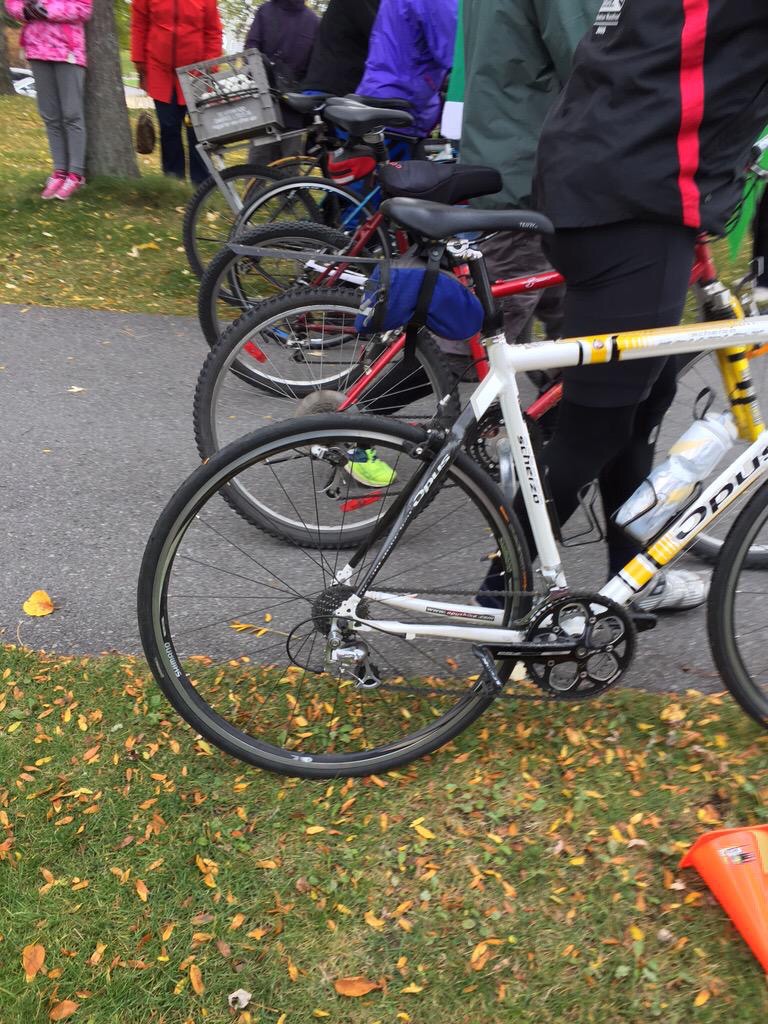
The highlight for me during the clerics cycling challenge (clericchallenge.com) was the finish line, when we all crossed together. This experience symbolized for me what the culture of Christian community ought to feel like and be like.

   
 We are part of a holy procession led by the King of Glory whose destination is sure. We have nothing to lose. If God’s grace is extended even to the generation of seekers (v.6), then we have nothing to lose. If what we are about is not a competition, then we have nothing to lose. If we don’t need to find fault in the other to prove our own self-worth, then we have nothing to lose. If it’s not about one-up-man-ship, then we can go for broke and not worry about it. If we don’t need to question who our Saviour is — who already accomplished for us our salvation — we don’t need to doubt our final destination. Then, why not share now what we have with others on this road?

All the saints on earth, despite the scars of life we bear, have gifts to share with other seekers on that journey. What gifts and blessings of God reflect in your life? In discerning this, remember: It’s not up to you alone! We don’t need to be perfect. We gain the gates not by our own merit or even hard work. Ours is the victory only because of the One for whose reason the gates are lifted in the first place.

Thanks be to God!
(1) — Michael Morgan in David L. Bartlett & Barbara Brown Taylor, eds. of “Feasting on the Word Year B, Volume 4” Fortress Press, 2009, p.228

It’s ok to fall (3): Jesus leads us there

The beginning of a story introduces the characters, but it also sets things up for what readers can expect later in the book. The writer of a good story will craft, early on, a good ‘set up’ for the plot development. Here’s an example, and you tell me what you think will happen later in the story:

At the beginning of this story, we read about a couple of children walking home from school, as they always do, along a familiar path. However, their route goes by the town’s cemetery, a place they have never visited. It remains a mystery to them. The cemetery is guarded by spiked, iron-wrought gates and surrounded by tall, thick cedar hedges.

The children are coming of age when their curiosity is piquing, and they ask their parents if they can venture into the cemetery. But they are warned repeatedly from all quarters: “Don’t ever, ever, EVER play in the cemetery! Especially, after dark!”

Now, what do you think will happen as a result of this ‘set up’ in the story line? They’ll likely go there! — into the cemetery, at night, perhaps under scary or tension-filled circumstances. And, we want to read on to find out how, as our own imaginations grow! It’s true, when we are ordered not to do something in some unequivocal, unyielding, non-explanatory way, it’s something we will usually end up doing! The story is a snap-shot of life.

Social history bears witness to this human dynamic: In 1920, law-makers south of the border enacted the 18th Amendment which attempted to curb the evils of liquor. Laws were passed against the sale and trade of alcohol. The result? After Prohibition was finally lifted, historians showed that the consumption of alcohol by the general population actually increased during those ‘prohibitive’ years. (Strayer & Gatzke, “The Mainstream of Civilization since 1500”, Harcourt, Toronto, 1984, p.730)

“Brick-wall” parenting, as some call it, often fails. Because children don’t grow in an environment where the evils of the world can be talked about, reasoned through and struggled with in loving, patient and understanding ways. They just outright rebel.

Perhaps it was employing some reverse-psychology that spurred Martin Luther to say those infamous words: “Sin boldly … !” But I like to emphasize the latter part of that quote: “Sin boldly … and trust the Lord even more.” Luther doesn’t deny or hide away from sin. He just trumps it, with the Lord!

When I assert repeatedly the theme of this sermon series for Lent: “It’s okay to fall”, I am NOT encouraging you to sin. Because you don’t need to purposely go out and find sin and suffering. You don’t need to seek out suffering, as if it’s a choice we can make (eg. “I think I’ll go out and sin today”; or, “I don’t think I’ll sin today!”)

Sin is something that we must learn to live with. It’s a part of our lives. Sin is not something we can ‘will’ away by the force of our self-righteous toil to purge ourselves somehow. If you think yourself a good Christian, you may be good at hiding your sin. But honest, faithful, authentic Christians will struggle monumentally with their sin, and not need to put on masks of perfection when they come to church.

Life happens. Life is ‘done unto us’. Mistakes are made. I can’t explain why God created a world where suffering is so much a part of the journey of life. The better, more meaningful question, I believe, is to consider what the suffering and the sin has to teach us about ourselves in relationship to God, in the journey to redemption.

In other words, it’s okay to fall, because that is where Jesus leads us. In the Gospel text for the first Sunday in Lent, after Jesus is baptized, “The Spirit of God immediately drove him into the wilderness” (Mark 1:12) where he spent forty days, tempted by Satan. This part of Jesus’ life is for me the image I hold whenever I pray the traditional English translation of the Lord’s Prayer: “Lead us not into temptation”.

Because, while Jesus does not cause my sinning, Jesus leads me into the wilderness of my life where I must confront all those temptations, the brokenness, weaknesses, despair, anger, fear, guilt — that cause my sinning. Jesus takes me there, into the barren land of my soul. He leads the way. I must follow.

The formal ‘Invitation to the Lenten discipline’ in most liturgies begins with a call to self-examination — even before repenting, praying, fasting and works of love strengthened by the gifts of word and sacrament (Evangelical Lutheran Worship, Leader’s Desk Edition, Augsburg Fortress, p.617). Self-examination is an act of profound humility and honesty. And it could very well be the most difficult task in the Lenten journey.

Here is some good news: Jesus is not afraid. Because he has already gone to the darkest place of all — the Cross, and then even descended into hell as we affirm in the Creeds. I can persevere through any turmoil life may offer, because Jesus is there, right beside me, helping me get through it.

What makes the consequences of our sin worse, I suspect, is the kind of thinking that suggests Jesus cannot be present if or whenever we go into those dark places of our lives. Our prejudice may be that Jesus cannot be there in the shameful, anger-ridden, fear-devastated places of our suffering. We thus delude ourselves into believing “I am alone” in my suffering. The Gospel, however, teaches us otherwise.

I was so inspired by the record number of folks we had out on Shrove Tuesday for our pancake party — including almost a dozen folks from the neighbourhood who had never been with us before! We danced, we sang, we ate, we enjoyed music together.

When we are in the desert of our lives confronting our sin and suffering, it is so important to know, again, who your friends are, your family, your community, your church — and simply experience their presence. And by their presence, their loving support — even in the darkest time of our lives. Just being there together, can make a huge difference.

Therefore, I can be encouraged that as Jesus was waited upon by the angels who gave him the things he needed to get through his wilderness suffering, so then Jesus will not abandon me in my desert. He’ll be right there beside me, and give me what I need (and maybe not always what I want).

It’s okay to fall, because Jesus leads me into that place that I would rather avoid. And even that place where I might be tempted to go. Because I don’t go alone. Thanks be to God.

Back to the Future: Borderland spirituality

2015 is the year of “Back to the Future”, did you know? When Marty McFly, played by Michael J. Fox, travelled ‘Back to the Future’ in the 1980’s pop culture film, the year they went to, in the future, was 2015.

As a kid I enjoyed the movie, partly because the year 2015, at the time, seemed some unrealistic, arbitrary and irrelevant point in the future; the number only represented some distant benchmark unconnected to my present reality.

Today, 2015 no longer means some far-off, futuristic fantasy. It is reality, now. And if I watch ‘Back to the Future’ today, the movie represents more of an historical curiosity — I’m only looking ‘back’.

In faith, it’s like we simultaneously look back, forward, and both from the grounding of the present moment. Balancing all three is good theology. For its sesquicentennial anniversary, the Eastern Synod (ELCIC) employed the motto: “Remembering for the Future”. Celebrating an important event in the present day by integrating past with the future is important. And a good way to interpret the Bible.

But it an also cause dismay if we only insist on a certain, chronological ordering of events in an absolute kind of way. For example, at Jesus’ baptism in the Gospel for today (Mark 1:4-11) there is the matter of the Holy Spirit, which descends in the form of a dove upon Jesus (v. 8, 10). John the Baptist preaches that Jesus will baptize with the Holy Spirit.

But Jesus never performs one baptism in his ministry that we know of. And, according to the time-line of the Gospels, the Holy Spirit doesn’t descend on the church until after Jesus’ resurrection (John 20:19-23) and at the Day of Pentecost (Acts 2) — these Holy Spirit events do not occur during Jesus’ ministry of healing, teaching and praying on earth. Curious, since many understand Jesus’ baptism as his ordination or commissioning to his call as the beloved Son of God. How do we make sense of this?

To understand many of the stories we read, like the Gospel for today, we would do well, I believe, to employ a ‘Back to the Future’ hermeneutic. This way of interpreting does not deny the truth of all of the events outlined above. For one, it reveals something about how the bible was put together:

The actual writing of the New Testament was done decades after these events took place. Therefore, we say, that we, today, are ‘post-resurrection’ Christians. We can best understand what happens at Jesus baptism from the perspective of the future. Because when these stories were written down for the first time, and from today’s perspective — the Holy Spirit has already come. Jesus is alive. Even as we recall, as a matter of history, what happened in the moments of Jesus’ life on earth some two thousand years ago.

And it’s not just a pointing forward that we need to keep in mind. It is a reverence and respect for the past.

If you look at the geography of the Baptism of our Lord, we can conclude at least a couple of things: First, it takes place in the wilderness, the desert. That is through which the river Jordan runs, basically north to south separating lands that are for the most part destitute, rugged, dangerous even.

Second, that river forms a boundary between two worlds — on the east and south, the world of the ancient Israelites tracking through the desert for decades on their way to the Promised Land flowing with milk and honey, which is on the other side.

John the Baptist comes to this border land, which is significant in the history of the prophets. In fact, John the Baptist stands in line with the prophets of old. His speeches are associated with Isaiah (Mark 1:1-8); he is also mistaken for Elijah because of what he wears (2 Kings 1:8) and because he foretells of the coming Messiah (John 1:21). John’s presence and ministry at the Jordan River in the wilderness brings the past (an identification with history and the prophets) together with the future (Jesus Christ, and the coming Holy Spirit) together into the present moment.

How can we keep ourselves from getting lost and totally confused in the plot line of “Back to the Future?” We remain grounded in the present moment. We look to our immediate surroundings. Like the beasts of the field, we scuff the earth with our heal, and snort and spit, before we look up.

And this is the beauty and wisdom of these Scriptures: their insistent if not peculiar emphasis on details. Yes, God acts in creation. Yes, God redeems sinners. Yes, God has a plan for salvation.

But this ‘spiritual’ talk is always, in the Gospel, tied to material — real water, real bread, real time, inexpensive wine, locusts, honey, sand, camel’s hair, wind, birds and the clouds being rent asunder. This is the nitty-gritty of life, and it can never be separated from matters of the Spirit.

Keeping grounded in the present awareness of life, ‘as is’, helps us track the sometimes confusing plot-line of ‘Back to the Future’. Because it is there that Jesus stands — on the borderland, at the edge of the Kingdom of God. Jesus stands there, and invites us to live into the now-and-not-yet reality of it (Ted Smith, “Feasting on the Word” WJK Press, Kentucky, 2008, p.239).

The Gospel of John identifies Jesus as a ‘lamb’. T.S. Elliot describes Jesus as a ‘tiger’. In C.S. Lewis’ ‘Narnia’ books, Jesus is personified in Aslan, the ‘lion’. Nancy Rockwell, in her post, “Tracks” (blog: The Bite in the Apple) suggests the ‘camel’, for Jesus who identified with lepers and prostitutes, difficult people, estranged members of right society, people who are spat upon. All these images for Jesus throughout history reveal unique elements about his truth.

But, standing in the desert beside John the Baptist, Jesus identifies with the lowly who are on a journey of transformation. Jesus invites the lowly in us to go on a journey that does not reject the past, and tradition, and history but doesn’t allow us to remain stuck there. Because this journey through borderland brings us eventually into a land flowing with milk and honey — a land of healing, restoration and justice for all who seek these gifts of the Holy Spirit.

This means that we cannot use our tainted and troubled past as an excuse for not doing the right thing, now. At the same time, we cannot wait until an ideal future when circumstances are perfect to do the right thing, now.

Back to the Future brings the present moment into sharp focus. A good theology will always ask, “What is going on right now in my life and world?” “Who do I meet today?” And act, now, accordingly. A spirituality of the borderland will always draw my attention to the divine importance of the present moment which is supported by history, and hope-filled for the future.

Holy Innocents

There is a rather obscure and tragic story from the bible not widely told. But it is part of the Christmas story (Matthew 2:16-18).

Herod was infuriated that the Magi had tricked him. Their agreement was that after paying homage to the newborn Messiah, the Magi would come back to Jerusalem and report to Herod where this new King was. Instead, they had gone home by a different route.

Enraged, the evil and paranoid dictator massacred all boys under 2 years of age in the Bethlehem area — just to be sure he would not have any competition from any Messiah, for years to come. Machiavellian in spirit, such brutality is reserved for the annals of history when humankind was barbaric and unenlightened, right? Surely, we have evolved to higher levels of sophistication. Or?

Last week alone, 132 schoolchildren and nine staff were massacred in a vicious attack by the Taliban in Peshawar, Pakistan. Then, in a Nigerian marketplace, some children were murdered by suicide bombers. All this tragedy, just in the past week.

The world today, never-mind first century Palestine, watches the anguish of grieving parents burying their children. And, in the words of Primate Fred Hiltz (Anglican Church of Canada), “we are left wondering how such evil intent to kill innocent children continues to stock the earth.”

The world, it would seem, has never been an easy place to bear and raise children. The dangers have threatened throughout the ages. Not only two thousand years ago, but to this day, we shake our heads and wonder: Why would anyone want to bring a child into the world today?

I think we could, then, sympathize with Mary’s initial response, after the angel Gabriel visits her with the astounding news that she will bear the Christ child. The Gospel text for today simply indicates that Mary was “perplexed” (Luke 1:29) by this encounter.

I think we can relate. What the angel proposes is both irrational and incredible. One would have to suspend belief — in at least two ways:

The angel’s message basically boils down to two instructions: First, “Do not be afraid!”
and then, “You will bear Christ!” Why? How so? “How can this be?”

“Do not be afraid!” “Fear not” — This message is actually repeated in the bible some 365 times (one for each day of the year). But this time is a dark time, and a dark place. How can we not be afraid!

At the same time, the Word instructs us to “fear the Lord”. Fear, in this sense, is humility before the Divine. Fear is respect before that which is indescribable, uncontainable, Mystery. “Fearing the Lord” is the beginning of wisdom (Proverbs 9:10). Those who fear the Lord, as Mary then sings, upon them mercy endures forever (Luke 1:50). In the end, fearing the Lord is about trusting in God above all else.

What kind of God do we worship? Look at Jesus: Our Lord is known for having taken children in his arms, blessing them and upholding their awe and wonder in the love and trust of those who care for them (Mark 10).

Sometimes I think we get things mixed up about God — that somehow God is like a dictator who keeps a checklist of who’s following the rules and who isn’t — and then punishing those who are deviant. God, in this view, is like some cosmic police-officer.

But if Jesus shows us who the Father is, then the picture is entirely different. “Jesus did not come to change God’s mind about humanity. Jesus came to change the mind of humanity about God” (twitter: @RichardRohrOFM). Jesus shows us that the God we worship is nothing like what we had come to expect in the likes of ruthless, dictators personified in power-obsessed Herod.

We don’t have to be afraid — afraid of God — because of who God is: “slow to anger, and abounding in steadfast love” (Psalm 103:8).

The second message may be even more perplexing: “You shall conceive in your womb a child … by the Holy Spirit … and he shall be Son of the Most High”! (Luke 1:31-35)

Scholars have long puzzled over the past tense on the lips of this soon-to-be pregnant woman. Mary, who before giving birth speaks of her offspring’s approaching mission as already accomplished — finished and done (i.e. “the Lord has scattered the proud; has brought down the powerful; has lifted up the lowly, has filled the hungry with good things”, etc.) She announces how the wrongs of her dark history have already been made right. (Luke 1:51-54).

The use of the past tense to announce a consummated future, is a statement of profound and deep faith. This grammatical curiosity from the Word of God suggests life-changing ramifications. Our challenge, I believe, is in the spirit of Mary’s faith, to cultivate the ability to see God’s promises as already having come to pass.

When we can express our faith from a trusting-in-God heart, how wonderfully this can change our whole outlook on life! Because we have to wait for it — something that, beyond our agency, will surely come to pass!

We are almost there. The liturgy in Advent forces us to wait for singing the joy of Christmas, unlike our culture that is already getting tired of Christmas when it hasn’t even happened yet. In church during Advent, we haven’t sung the Christmas carols for a reason.

Not only because Christmas doesn’t start until the 25th. But also because, as I’ve heard it said, Mary’s song must be the first Christmas song. Because it sets the right tone. It sets the tone of faithful praise and adoration. It brings truth and grace into sharp relief. It announces that the promises of God will come to pass:

For the lowly, the humble, those who respect the Lord. God will make things right for those who trust in God and God’s word.

How would you sing, this Christmas? How can you, now in your life, bring forth words, as well as a heart of thanksgiving, affirmation and hope? How has God been merciful in your life? Make a list, and check it more that twice!

My hunch is that even though life may indeed be difficult for you — whether burdened by grief, by sorrow, by depression, by financial ruin, by ill-health or a pending diagnosis, whatever — there are moments, even now, even barely perceptible, where you can point to a glimmer of grace, a memory of joy, and a hope that surpasses all understanding.

This is the song to carry you through the season. Because sleeping below our awareness of reality is the truth that God has already fulfilled his promises. And now, it’s simply a question of accessing the power of that truth, releasing it from your heart, for your life and for the benefit of a world shrouded in darkness.

Thanks be to God!

Santa is not God – the true gift

During Advent, the church has fasted. Not from food! Rather, we have refrained — tried to, at least, in our liturgies — from singing Christmas Carols. This was part of our preparation as we made room in our hearts by waiting and watching for the coming of Jesus.

But now, the wait is over! Christmas is a time for singing, a time for the carols. It is well to gorge on them now while they are plentiful, because it will be another year before we will sing them again.

Martin Luther, who loved Christmas, claimed that “music is a fair and glorious gift of God.” Music, he said, “makes people kinder, gentler, more staid and reasonable. The devil flees before the sound of music as much as before the Word of God” (from the foreword to the “Wittenburg Gesangbuch” (1524), Martin Luther’s hymnbook).

So, I would like you to ponder with me what is this ‘gift’ of Christmas so well expressed in the music of the season. I invite you to listen to lyrics from a couple of different popular, contemporary Christmas songs — that are normally not sung in church. But each of these songs have something to say to us about the gift of God at Christmas — the Gospel message about the Word made flesh in Jesus Christ.

Let’s see if you can identify them. Listen first to the words that we’ve probably heard in shopping malls since shortly after Halloween. It’s pretty easy to guess this one …

“You better watch out, you better not cry
You better not pout, I’m telling you why
Santa Claus is coming to town

He’s making a list, he’s checking it twice
Gonna find out who’s naughty or nice
Santa Claus is coming to town

He sees you when you’re sleeping
He knows when you’re awake
He knows if you’ve been bad or good
So be good for goodness sake

Oh, you better watch out, you better not cry
You better not pout, I’m telling you why
Santa Claus is coming to town, yeah
Santa Claus is coming
Santa Claus is coming to town!”

(Answer: Santa Claus is Coming to Town)

How does this popular song reflect (or not) the nature of God’s gift and grace at Christmas? And I’ll give you a hint: God is NOT Santa Claus. Yes, both Santa and Jesus are coming at Christmas to a town near you. But that’s where the similarity stops. Why?

Does God make a list? Does God check it twice? Does God try to figure out who’s naughty and nice, in order to determine who get’s the gift of Jesus’ love and presence?

If you look at all the characters in the New Testament, characters that meet Jesus, starting with Mary and Joseph, the shepherds, the tax collectors, those fishermen disciples, women, lepers, outcasts …. do they deserve the gift? If Santa was making a list of who’s been naughty or nice, we’d probably have to exclude everyone in the bible!

“They were people who were considered taboo, contagious, disabled, dangerous or excluded for all kinds of reasons” (Richard Rohr, “Preparing for Christmas” Franciscan Media, Cincinnati, 2008, p.56). They were poor, ordinary folk, whose sin, whose imperfection was visible, apparent. According to the message of Santa Claus is Coming to Town, they would have received a piece of coal in their stocking!

Santa is not God. The greatness of God’s gift is precisely because it is not conditional on our hard work to be ‘nice’. The greatest gift at Christmas is not something for which we must toil or earn by our hard work. But something that is given, that is already there, inside us!

Okay, time for the second song. Hear if you can recognize it by the lyrics; it tells a beautiful story …

“A poor orphan girl named Maria
Was walking to market one day
She stopped for a rest by the roadside
Where a bird with a broken wing lay
A few moments passed till she saw it
For it’s feathers were covered with sand
But soon clean and wrapped it was travelling
In the warmth of Maria’s small hand
She happily gave her last peso
On a cage made of rushes and twine
She fed it loose corn from the market
And watched it grow stronger with time
Now the Christmas Eve service was coming
And the church shone with tinsel and light
And all of the town folks brought presents
To lay by the manger that night
There were diamonds and incense
And perfumes
In packages fit for a king
But for one ragged bird in a small cage
Maria had nothing to bring
She waited till just before midnight
So no one would see her go in
And crying she knelt by the manger
For her gift was unworthy of Him
Then a voice spoke to her through the darkness
Maria, what brings you to me
If the bird in the cage is your offering
Open the door and let me see
Though she trembled, she did as He asked her
And out of the cage the bird flew
Soaring up into the rafters
On a wing that had healed good as new
Just then the midnight bells rang out
And the little bird started to sing
A song that no words could recapture
Whose beauty was fit for a king
Now Maria felt blessed just to listen
To that cascade of notes sweet and long
As her offerings was lifted to heaven
By the very first nightingale’s song.”

(Answer: Garth Brooks, “The Gift”)

The gift is an experience of grace, of something wonderful happening to us and in us and around us that is beyond our own efforts. All we need to do, is bring it forward, and offer what we have that is true to who we are — including our weaknesses, our limitations, our lowliness.

And God makes something beautiful out of our simple offering — the gift of our hearts, our minds, our hands. Like the healing of the bird, and its free song, it is a gift of pure love, a love that is shines unrelenting in the darkness and brokenness of our lives.

Last week at our children’s school concert, as is usual fair at these events, each class and grade goes on stage and presents a seasonal skit or song.

Near the end of the program, the audience was delighted to receive Ottawa singer-songwriter Craig Cardiff on stage with his guitar, surrounded by the grade 2-3 class. They danced and sang a simplified version of Craig’s popular song: “Love is Louder Than All the Noise”.

In the second verse, he writes:
“Was your messy heart chosen
or was it overlooked?
Are you the crazy in the corner,
writing it in your book?
A cynic with a cynic’s hook
waiting for the sky to fall?
Were you to be taken from me
by word by craft or by bomb
I would rage into an army
and bring you back with songs…
We said love is louder
than all this, all this noise.
Love is louder than all this noise.”

In the singing that we enjoy in this festive season, may our hearts, our minds and our hands sing loudest of the love of God. This greatest gift doesn’t come from our belief and ability to impress, nor from the resourcefulness of our own doing, nor from all the glitter and glamour.

The greatest gift of Christmas comes from a simple desire to love, and the openness of heart to be loved.

An Advent-Christmas funeral sermon

In some churches, the manger scenes during the Advent season are left intentionally incomplete: For example, as in our creche, the manger is empty; during the four weeks leading up to Christmas, the figurine of baby Jesus is not there. Until December 25th.

In one congregation that worships in a large, cathedral-type building, the magi start their journey at the beginning of Advent somewhere in the narthex (the entrance). Each successive Sunday in Advent, the magi move closer to the manger scene which is set up at the front near the altar.

And, each Sunday, the children of the congregation are charged with a treasure-hunt search for where the figurines of the magi have been placed that week — whether on a decorated window sill, or beside a poinsettia plant, or on the steps to the chancel, etc.

Not only do these traditions emphasize the important Advent themes of waiting and watching with expectation for the coming Christmas joy, we are reminded at this time of year that we are, all of us, indeed, on a journey towards the manger, towards a new encounter with Jesus.

I believe Grant’s love of hiking revealed his ability to see the Big Picture. You see, when you go on a hike, following a trail that spans hundreds of kilometres as Grant has done on occasion, you are not just meandering aimlessly. Oh, yes, the trail can take many twists, turns, ups and downs.

But part of the joy of long-distance hiking is understanding in your imagination where you are headed, where you began, and the relationship between the two. No matter where you are along that journey, you can see the Big Picture.

One of my favourite visual effects of modern cinema does this well: From the perspective of the TV/movie camera, a scene of someone or something that happens on the ground in one moment of time is suddenly zoomed out; we move backwards up into the sky — still focused on the ground, but quickly disappears through the clouds and then into outer space. And we can see the planet earth and the solar system. And we can understand how that particular event or person on earth relates to the cosmos!

To have this Big Picture vision is to see our present reality, on the ground, from the perspective of not only history (where you’ve been) but also from the perspective of the future (where you’re going). Grant was a Big Picture kind of guy. He enjoyed the long-distance hike.

The ancient caravan routes through the Holy Land, Judean desert I think informed the prophetic writings, many of which we read in the Bible. These caravan routes were the life-line of the economy, and framed the boundaries of social order.

When you followed a caravan route you were walking a path trodden by generations of people who came before you, and a path that was followed by many once you were gone. This is the experience of people who journey, in every time and place.

I like our Bishop’s repeated advice to pastors whenever we gather for clergy and leadership retreats: “Remember, we are one and all merely ‘interim’ pastors”. Even pastors who are tenured and may remain years, even decades, in one parish are still, only, ‘interim’. They are interim because there were pastors who preceded them in the congregations’s history, and hopefully there will be more pastors coming once they are gone.

The point is not a focus on the pastor so much as seeing that pastor in the context of the larger history and journey of a congregation. It’s to regard an individual from the perspective of the Big Picture.

I can see why Richard Rohr uses the term, Big Picture, to understand the Kingdom of God. Because even though we are in constant transition on the caravan route, both the memory of the past and the promise of the future impinge on the present moment. In the Big Picture, the twin pulls of historical and future vision reveal a “vibrant now” in which God’s kingdom is complete and dwelling among us (Gail Ricciuti, “Feasting on the Word; Advent Companion”, WJK Press, Kentucky, 2014, p.94).

Being in the present moment, while informed by the past and motivated by the future promise, requires that you keep both feet on the ground. Hiking is an activity that requires the hiker not merely to keep moving, but to keep focused on the ground, one step at a time. It’s a cliche, but it’s a good one: a journey of a thousand miles begins with the first step.

As such, the journey of faith is grounded in the moment. It is earthy, real. Your boots, feet and legs get dirty, scratched, bitten, sunburned. The Big Picture ultimately, for it to be effective, is anchored in the present, gritty, sometimes ugly circumstance of life.

Even when we experience death, loss, suffering and pain; this is part of the route when we have to go through the wilderness, the desert, and navigate the ‘dark night of the soul’ (St John of the Cross).

When I hiked part of the Bruce Trail near Tobermory on the Bruce Peninsula years ago, I remember first following the trail from the parking lot to a cliff- edge standing over a hundred feet above the crashing surf of Georgian Bay. It was a beautiful vista overlooking the bay, the sky, the water birds. The memory is vibrant: breathing in the marine smells, feeling the warm, morning sun. I relished the moment, standing still, taking it all in.

I didn’t want to turn my back on it, and continue on the hike. I wanted the moment to last forever. I felt that should I continue on the trail, I would never experience such a blissful moment again. It wasn’t easy to rip myself away. However, in the course of the day, there were many more such views I enjoyed along the trail.

The poet T.S. Elliott wrote: “The end is where we start from … or say that the end precedes the beginning” (ibid.). Grant met his ‘end’, we say, in dying. But that ending was just the start of something new. Our faith in God, the promise of salvation, Jesus’ resurrection, and by the guidance of the Holy Spirit — we are, each and everyone of us, including Grant — well equipped for the journey of life and death.

Because even though we might need to keep putting one foot forward and turn our back on the old, there is in each turn only something new waiting for us — a new perspective, something beautiful, something beyond our wildest dreams.

When we finish our walk on earth, the journey to Jesus merely takes on a whole new dimension. This Christmas, like the Magi who finally arrive at their destination to encounter the Christ child, Grant arrives home — his home with the Creator God and his Saviour Jesus. Now, he can experience life and union with God in a whole new, and deeper way.

One thing remains. The caravan is a journey undertaken with others, together. No one would even consider travelling the caravan routes through the desert alone. Jesus travelled with Grant throughout his life on earth, just as Jesus embraces Grant this day, with all the hosts of heaven.

Psalm 139:7-10
Where can I go from your spirit?
Or where can I flee from your presence?
If I ascend to heaven, you are there;
if I make my bed in Sheol, you are there.
If I take the wings of the morning
and settle at the farthest limits of the sea,
even there your hand shall lead me,
and your right hand shall hold me fast.

Are you an honest sinner?

A Christian leader (Laurence Freeman) commented on the 25th anniversary edition of “Rolling Stones” magazine. It contained interviews with pop music icons over that time period, starting with John Lenin all the way to Madonna.

He was wondering why young people especially were drawn to these, their idols. Of course, many pop stars are not exemplary people. They are not saints.

But they are, what he calls, ‘honest sinners’. Which reminds me of what Martin Luther said about us: That we are at the same time: Saints AND Sinners.

In the church, I think we get the ‘Saint’ part. But how do we validate the ‘Sinner’ part of ourselves?

In the Gospel text for Ordinary Time on this last Sunday in September 2014, we continue to work through the parables given by Jesus, in the latter part of the Gospel of Matthew.

In the assigned pericope, the authority of Jesus is questioned by the Pharisees (Matthew 21:23-32). In response, Jesus tells a story of a Father who asks both his sons to work in his vineyard. The first son says he wont do it, but does. The second son says he will do it but doesn’t.

What do we make of the first son who does his Father’s bidding? He does not want to obey. And he is honest about it.

The verb in the original Greek in this text (v.29) for “changed”, as in, “he changed his mind” (or as many English translations have it — “he repented”), is not the common one usually associated with the idea of a total transformation of character (as is implied in, for example, Matthew 3:2 “Repent, for the kingdom of God is at hand”).

In fact, the only other place in the Gospel of Matthew where the exact same form appears is in Matthew 27:3, when Judas experiences a regretful change of purpose that ends in despair, remorse and his demise (see Ellicott’s Commentary for English Readers).

Perhaps a better translation would have it as “a caring change of heart”; or, “a change of heart burdened with care.”

This form suggests that a heart nurtured in the love of God leads to action that not only obeys the call of God, but does it willingly. Even though the first son’s mind and his words at first are contrary to the will of the Father, his follow-through redeems him in the end. An imperfect confession it is, to be sure. But, ultimately, words are not enough.

Although in the case of both sons words do not match the deeds, “the repentance of the former is preferable to the hypocrisy of the latter;” Kathryn Blanchard says it best: “True righteousness is in the doing, rather than in the confessing” (in “Feasting on the Word” Year A Volume 4, WJK 2011, p.118).

I see a possible link here with the alternate first testament text assigned for this Sunday, from Exodus 17:1-7 (We also encounter this text on the Third Sunday in Lent, Year A). The Israelites are on the journey to the promised land, and yet again (for the fourth time in the sequence of these texts from Exodus) they complain to Moses about their lack of food; and in this, case, water.

They are thirsty. They are without a basic need for human survival. We are not talking here about typical ‘first-world problems’ — complaining about the weather, or unable to sync online calendars among family members with different smart phones, or dealing with a dilemma of how to invest money in competing markets, or having to cancel a credit card that was stolen, etc. These are things we complain about, and may even pray about.

But the Israelites’ complaints to Moses are about a basic, human need that they lack. I cannot blame them for being upset! They will die without water. They are being ‘honest sinners’, aren’t they?

Scientists, medical professionals, and child care workers will agree today that love is such a basic human need. If a person, especially at a young age, lacks love in their life, this absence of love will even stunt their physical development. They will be underdeveloped, physically, because of love being absent. The giving and receiving of love is a fundamental, human need.

Jesus tells the Pharisees that the prostitutes and tax collectors will enter heaven before they will. Maybe because these ‘lowest rung’ folk in the religious hierarchy of the day certainly don’t present themselves in a religiously acceptable way. There is no pretence, performance, pious evasion. There is no making appearances, no self-denial nor self-repression. There is no saying-the-right-things, no artifice, no self-consciousness to their being and behaving. They are truly ‘honest sinners’.

Both of Moses and of Jesus, the people demanded ‘signs’ of God’s presence. The Exodus text ends with those ominous and faithless words: “Is God with us, or not?” Even after the visible and tangible sign of water was given to quench their thirst, the Israelites still doubted. Even though Jesus performed miracles; even though the resurrected, bodily form of Jesus appeared to the disciples in Galilee following Easter morning, they did not ‘believe’ (Matthew 28:17).

The ‘signs’ are not the point of the Gospel — God’s love IS. Acts of love demonstrate our Christianity more than dogmas and creeds.

And when we participate in loving, caring action …

We are truly free. Free to be ourselves. And free to do the right thing. Perhaps whatever good things honest sinners do, they do it then from the heart. Their giving of love, however unnoticeable and seemingly irrelevant acts of love, is authentic and real — something the Pharisees so stuck in their heads and dogmas could not grasp.

You might notice that the Father — who in this parable may represent the attitude of God — does not condemn the first son for saying the wrong thing. The Father does not ‘correct’ the son’s imperfect words. The Father accepts him just as he is. And in the freedom of God’s love, the son then experiences a change of heart.

God accepts you as you are. God has faith in you. Because of God’s steadfast love and unwavering faithfulness in you, what will you do?

Dedication of new church doors

New front doors were installed over the main threshold of the building at Faith Lutheran Church in Ottawa on August 29, 2014. Here follows the brief dedication service offered in worship on site, on Sunday, August 31, 2014:

Let the door(s) be opened!

Jesus said to them, “Very truly, I tell you, I am the gate for the sheep … Whoever enters by me will be saved, and will come in and go out and find pasture.” (John 10:7-9)

The door(s) is opened. Pastor Martin marks the threshold of the doors with the sign of the cross, and says:

Our help is in the Name of the Lord;
The maker of heaven and earth.
Let us pray.
Everliving God the Father, God the Son and God the Holy Spirit, watchful and caring, our source and our end: All that we are and all that we have is yours. Accept us now, as we dedicate these doors through which we enter to praise your Name, to ask your forgiveness, to know your healing power, to hear your Word, and to be nourished by the Body and Blood of your Son. Be present always to guide, to illuminate and to bless your people as we gather in this place.
Help us also as we exit over this threshold — once nourished and strengthened by your Word and your Presence — to go out, confident in the work of your Mission in the world which you love.
We confess our fear associated with this threshold:
For those who come fearful for the first time through these doors into an unknown place, help them cross this threshold trusting that they will be met by the gracious and unconditional welcome of your people; and,
Whether we go out into the world fearful for the work set before us, help us trust always in the forgiveness and courage you give us through the power of your Holy Spirit in our hearts. Amen.

Peace be to this house, and to all who enter and exit here: † In the Name of the Father, and of the Son, and of the Holy Spirit.
Amen.

Easter: Reset on Life

Much of this reflection is adapted from the Rev. Pam Driesell’s excellent sermon, “Beyond Bunnies and Jelly Beans” (Easter A, April 24, 2011) found at day1.org. Thank you!

Easter is fun. And like Christmas, we say that these holidays are for the children.

Anticipation brightens our mood. Lilies and new clothes and family visits and Easter dinner preparations consume our attention.

But there’s a reason for the fun. So, I sympathize with the Mother who tried with very little success to convey to her four-year old daughter the meaning of Easter. It went something like this:

“Mommy, will the Easter bunny bring me purple jelly beans?”

“I am sure he will bring you jelly beans, love. But, remember, Easter isn’t about the bunny. It’s about Jesus.”

“But will they be purple?”

“Yes, honey, I am sure there will be some purple ones in there. Honey, the important thing about Easter isn’t the bunny. Easter is about how much Jesus loves you and me and the whole world.”

“Mommy, HOW MANY purple jelly beans will the Easter Bunny bring me?”

“Sweat heart, I think he will probably bring plenty of purple jellybeans. Do you know how much Jesus loves you?”

“Mommy ….”

“Yes, dear?”

“Will he bring me tootsie rolls, too?”

For a four-year old, Easter bunnies and purple jelly beans and tootsie rolls are just way more interesting than JESUS, and they are enough to make Easter fun. And fun is, for a four-year old, enough!

But my guess is that, unless you are four, you are also looking for something beyond candy-coated cliches added to the assortment of jellybeans we consume, purple or otherwise. We want to know something of what poor Mommy was trying to convey to her daughter.

Because Mom knows that her daughter won’t always be four, and sooner-AND-later all of us will encounter those changes in life that challenge us and often bring us to our knees. Life happens: In addition to all the joys and satisfaction and blessings of life, we encounter the dark night of heart-wrenching grief, devastating disappointment or smothering guilt. And when we do, we will need MORE than bunnies and jelly beans.

The story from the bible we read every year during Easter is the single most important reason we ever get together. It is the heartbeat of the Christian community. It is the hope to which we cling and the promise upon which we stand. It is the very essence of the Christian faith. It is much more than cliche.

Easter is about life. And what is more, Easter is about putting meaning in our lives once again. The message of the resurrection of Jesus is about new life, and starting over. Easter is about being given the permission to press the reset button on life. And this is a great and valuable gift.

How valuable?

Scientists have studied the mineral and chemical composition of the human body. The chemical and mineral composition of the human body breaks down as follows: 65% oxygen, 18% carbon, 10% hydrogen, 3% nitrogen, 1.5% calcium, 1% phosphorous, and less than 1% of potassium, sulphur, sodium, chlorine, magnesium, iron and iodine; oh, and there are trace quantities of fluorine, silicon, manganese, zinc, copper, aluminum and arsenic.

If we took all those parts and sold them on the common market, it would be worth about a dollar (Canadian). Now, our skin, I read, is our most valuable physical asset; it’s worth about $4. So, added all up, we’re worth just over $5!

But take a moment now to place your hand on your wrist or on your lower neck on either side of your windpipe; go ahead. Let’s all be quiet and still together for a moment.

What do you feel? You feel your pulse. You feel the mystery of biological life beating through your $5 worth of chemicals and minerals. And that mystery is worth much, much more.

Easter is about the power and meaning of life — the power and meaning and purpose that makes $5 worth of elements, priceless. The gift of life, and its meaning for each of us, individually, is priceless.

The Brazilian writer, Paulo Coelho, used the image of a sword to describe the gift given to him as a mark of graduation. After all, he was graduating from a magical order and the sword would befit such an accomplishment.

At the last moment, alas!, it was snatched from him, and he was ordered to go on the road. “Somewhere on this journey,” he conceded, “I will find my sword.” Because he felt strongly that he deserved such as prize, he was determined. However, all along the sometimes tiresome, sometimes dangerous and ever-adventurous journey, the sword proved elusive. He couldn’t find it.

He arrived at his destination disappointed and dejected. He thought himself a failure. And then, in a moment of inspiration, the doors were flung open and the purpose of his pilgrimage came to light: The very reason he was called upon this journey was to make him ask the question: “What am I going to us my sword for?” He realized in this moment of epiphany that a sword is pointless unless you have asked, and answered, that question.

That point of destination was no ending, but only a new beginning. He knew he had to return home to discover the meaning and purpose of his prize — to know how he would use this very special gift. (Charles Foster, The Sacred Journey, p.188)

As followers of Christ, we have been given the gift of resurrection. Jesus is alive, today. That is what we celebrate: Not only the joy of that first Easter morning over two thousand years ago. But to reflect and get ready for a re-start in our lives today, wherever we are.

Easter addresses that human longing to start over, but this time with renewed vigour for life. Saint Augustine called the restart a longing for God, the restlessness that only finds rest in God. Paul Tillich called it the ground or the power of being itself. Kierkegaard called it the leap of faith that quells anxiety. Easter is the Christian answer to the desire to live life ever abundantly, as Jesus willed for us (John 10:10).

This is not an easy accomplishment.

Mary came to the tomb thinking that death was the end for Jesus. She goes in the dark, presumably to prepare Jesus’ $5 worth of minerals and chemicals for burial. She is resigned to the finality of the journey — death. She is grieving. At first she does not even recognize new life when it is in front of her. But when the Risen Christ speaks her name (John 20:16) she knows.

The Lenten journey is symbolic of our journey of life: It isn’t always easy to trod the path that Jesus made to the Cross — the Cross of personal self-reflection, the Cross of confessing our sins and our ultimate dependence on God, the Cross which symbolizes a profound letting go of all that inhibits life in us and in the world. It isn’t always easy to look at the suffering and dying Jesus in our midst.

Maybe you can relate to Mary? (Or the disciples who when they first hear the news from Mary, “they don’t believe” — Luke 24:11). Maybe on this Easter 2014 you are resigned to the futility of life and the awful pain of death, the finality of death: perhaps the death of a beloved friend or family member, perhaps the death that pervades our culture, tragic deaths that come as a result of war, terrorism, violence, natural disasters the world over; perhaps the death of a business, friendship, even the church.

Maybe even one or more of these things has convinced you that not much makes sense in this life and although you are breathing, your heart is beating, but it is also breaking. There’s been so much sorrow and loss in your life that you showed up here today not looking for life but expecting to find more of the same … Easter bunnies and jelly beans … some candy-coated cliches that do not touch the real questions of your life or bring comfort to your deep grief.

As Jesus called Mary’s name, so the Risen Christ calls each one of us by our name. We are called by name to stand up and receive the gift of his new life. We are called by name to stand up, and press the reset button on our lives. We are called, each of us by name, to stand up and embrace the deep meaning of what this gift of new life means to us: to live abundantly in Christ whose life breathes and lives in us, now. And, then, we are called to share that new life in the world.

The living Jesus is always one step ahead of us, beckoning us to the future. The angel in the tomb instructs Mary to go ahead to Galilee where they will see Jesus (Matthew 28:7). And when Jesus suddenly appears to his disciples behind locked doors, he instructs them to share the news that Jesus will meet with all the disciples in Galilee (Matthew 28:10). New life in Christ is forward-looking; Jesus awaits us in God’s good future. There is hope in the possibilities of God’s future for us.

And that, my friends, is better news than bunnies and jellybeans. It is the reason for all our alleluias!

So, let us in this Eastertide, press the re-set button on life. The life of Jesus is our precious gift. A journey may come to an end, in a sense. The journey of Lent is behind us; it is done, for now. The darkness has cleared.

But it is the dawn of the day. A new journey begins.

It is time to begin, again.

Hallelujah! Christ is risen! Christ is risen indeed!