
Peregrenatio

(photo by Martin Malina)

After receiving God’s blessing and vision at his baptism, Jesus is led into the desert. He is led into the wilderness by the Spirit of God where he spends the better part of a month and a half (Matthew 4:1). That’s a long time.

Who would go there? And for what purpose? Why would anybody, especially right after receiving a holy calling and divine blessing, wander into wastelands full of danger and unpredictability?

You would think Jesus would immediately go to launch his mission of healing and proclamation. You would think Jesus would go directly from the Jordan river where he was baptized to the highways and byways, the street corners and the seats of power around Jerusalem. Which, he eventually does.

But instead, the first thing he does is go alone into the desert. For a long time.

The season of Lent is upon us. The long weeks leading to Easter have been described as a pilgrimage, a journey (Pope Francis, 2025). Martin Luther opposed the concept of pilgrimage in the medieval sense because he deemed going on pilgrimage as “works righteousness”. But Luther kept Lent. He saw the season of Lent as an opportunity to reflect on the Passion and suffering of Christ.

Today Lutherans will frame the 40 days of Lent as a “journey to the cross” or a “spiritual journey,” a concept that aligns with Luther’s theology of the cross.

It is on the cross where God is revealed most clearly in Jesus’ suffering. The heart of the Gospel is the mercy and grace for humanity that God experienced in Christ crucified. The intention of Lent is to focus on the path Jesus took through the cross to the empty tomb. Lent acknowledges that the only way to a good, new beginning is by embracing and working through the losses in our lives. This journey through the desert – the cross – is not easy. It’s work, moving forward.

Another way of describing it is that it’s always three steps forward and two steps back, between the cross and the empty tomb, never a straight line. But it’s the backward that creates the knowledge and the energy for the forward. We have to allow it. The desert is necessary for our growth.

We have an aversion to the cost of this journey. And that’s why we avoid it. We distract ourselves with efforts to win and achieve glory. We are inclined to skip Good Friday and go straight from singing the hosannas of Palm Sunday to the alleluias of Easter Sunday. We would rather avoid the desert experience.

What’s this business of God dying on the cross, anyway, suffering defeat at the hand of Jesus’ enemies? Who would go into the desert, anyway? Who wants to associate with losers?

Jesus does. And many did and still do, follow him there. Who were these first desert mystics and contemplatives, as we’ve called them?

I think we have this notion that the early desert mothers and fathers were some sort of super saints or perfected hermits. We falsely presume these desert Christians were pious followers of strict religious rules who had purged themselves of all fleshly desire and pleasure. That is incorrect (Colón Delay, 2026).

In the year 313 of the Common Era and the Edict of Milan, Christianity became the official religion of the empire. While the edict granted religious freedom and presumably ended the persecution of Christians, many Christians at the time were concerned with how becoming yoked with political power would affect the message and meaning of Jesus Christ. Beginning in the 4th century, many Christians who wanted to genuinely live out the promises of Christ and deepen their walk with God left the empire, so to speak.

And so, they went out into the deserts of Egypt, Palestine, Syria and Arabia. These were women and men, rich and poor. Some of them had been working in royal courts, and some had been murderers. Some were people of high esteem in society while others were viewed by society as scoundrels, persons of ill repute, outsiders, misfits (Acevedo Butcher, 2026, February 15).

By shedding their securities, and courageously moving into the unknown and potentially dangerous desert they knew they would be transformed by the experience of trusting in the ever-presence of God alone. On the journey itself, without necessarily knowing the destination, they knew they would be changed for the better.

From the desert into the open sea.

Some of the first monastic missionaries, from the Celtic tradition, would put themselves out in a boat – without oars. These boats were built to be sturdy enough to sustain a long voyage, but they were still small and could not be called ships.

Trusting the currents and the winds, the voyagers would simply drift until they landed where God had called them to be. For them, trusting God required a complete surrender to God’s will in the present moment. While a ’pilgrimage’ has a clear end in sight, a ‘peregrenatio’ does not. It is a wandering or drifting without a known destination (Valters Paintner, 2018).

Who would go into the desert or out onto the open sea? A people following Jesus. A people wanting and preparing for meeting the risen Christ who travelled there himself, who had experienced the challenges and temptations of going on this kind of journey.

I’ve been on a journey during my practicum. But this journey really started when I began the master’s degree program in counselling / psychology over two years ago.

Early on it felt to me like a pilgrimage with all the attending ups and down and unexpected twists and turns along the way. Early on it felt like as long as I stayed on the path I would eventually arrive at the destination – which was the end of the course work and this practicum. And then, it would be back to being the same it was before I started the program.

As the journey continued, however, the experience caused a shift from that of pilgrimage to peregrenatio. I knew and trusted it was God’s leading because every step of the way was validated, and I was finding traction in moving forward.

But I was growing more and more unsure about exactly where this was leading me. I was asking more questions about the purpose of the journey.

At the same time I was beginning to sense how I was growing through the experience itself. The end wasn’t as important as the becoming.

The congregation, too, has been on a journey these past several months. You didn’t know what this experience would be like when we started on this journey last Fall. What have you learned about your relationship to this congregation? With God? What events, developments and experiences during this time stand out in your memory? And which of these events or experiences align closest to what you value?

The journey itself changes us – our minds, our perceptions, our awareness of who we are becoming. We are like the monk in the boat on the peregrenatio, drifting out on the sea, surrendering to the will of God, not knowing exactly the destination but hanging on, nonetheless. How different are you by the end of this journey than you were at the beginning?

So much on this journey calls us to pay attention to the present moment, not ruminating about the past nor worrying about the future. When you don’t have control over the outcome, you will need to learn to let go and surrender to the present moment and what it invites us to notice. The desert and the open sea call us to ‘stay awake’.

The monk in the boat, not knowing what tomorrow might bring, would be fully alive in the present moment. The monk would be scanning the horizon, paying attention to conditions, aware of what his body needed in the moment, ready to respond without judgement just acceptance to whatever came his way.

Although Martin Luther frowned upon the medieval pilgrimage, he was all about being in the present moment. He is known to have said that if he knew the world would end tomorrow, he would still go out today to plant an apple tree in the ground.

So, too, when we stand at the threshold of an unknown future, we may not know the outcome nor the precise destination of our travels.

But will we notice, as we continue doing what we do, the sprig of new life budding in the ground upon which we stand? Will we see and appreciate the signs of hope and life around us? And they are there! From this hope we are nourished and strengthened for the journey ahead.

Who goes into the desert? Who would go there anyway?

Jesus does, to enrich his own life, to embolden him in his mission and purpose. And we go to follow, this Lent, to prepare ourselves for meeting the new life springing up all around us (Isaiah 43).

Then the devil left him, and suddenly angels came and waited on him.

References:

Acevedo Butcher, C. in Richard Rohr (2026, February 15). Wisdom from the outside: Desert and transformation. Daily Meditations. Center for Action and Contemplation. www.cac.org/daily-meditations/wisdom-from-the-outside.

Colón Delay, L. (2026). The way of the desert elders: How the wisdom of ancient Christians sustains us today. Broadleaf Books.

Valters Paintner, C. (2018). The soul’s slow ripening: 12 Celtic practices for seeking the sacred. Sorin Books.

Vatican News. (2025). Pope Francis: Lent calls us to journey together in hope [Website]. https://www.vaticannews.va/en/pope/news/2025-02/pope-francis-lent-calls-us-to-journey-together-in-hope.html#:~:text=This%20journey%20is%20not%20merely,are%20pilgrims%20in%20this%20life.%E2%80%9D
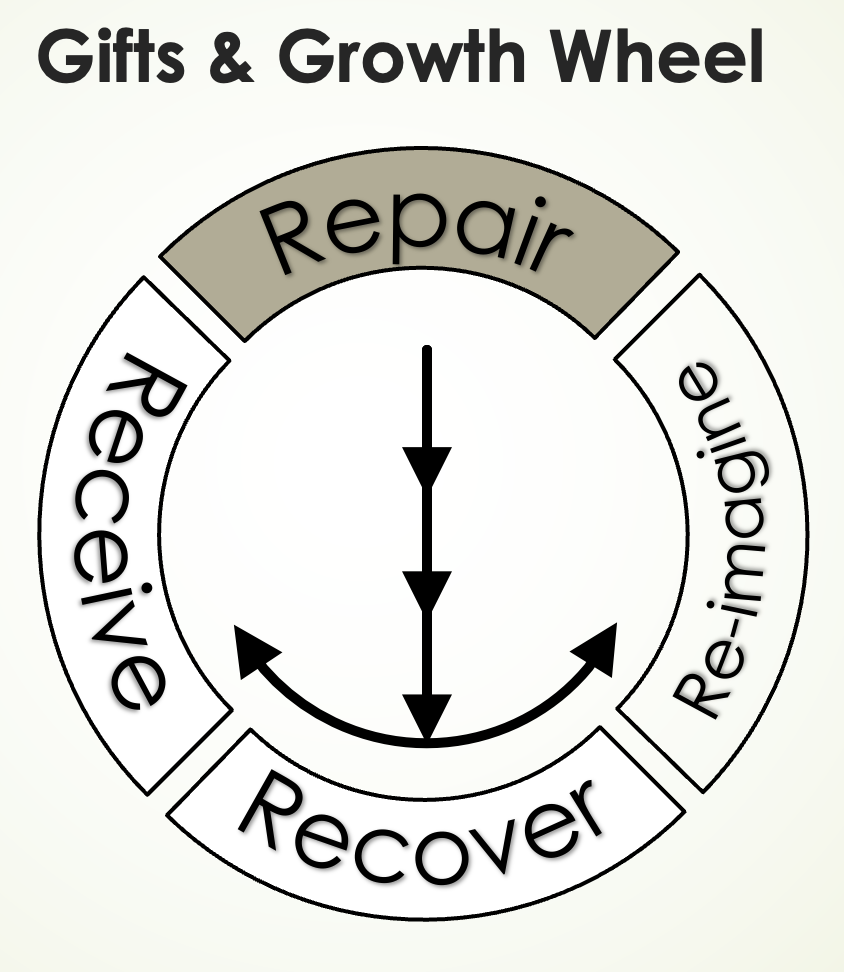
Gifts & Growth: Repair

A verse from Saint Paul captured my attention this week. He writes to the Romans: Do not be conformed to this age, but be transformed by the renewing of the mind, so that you may discern what is the will of God—what is good and acceptable and perfect (12:2).

Life in Christ, being a Christian, being faithful means renewing your mind. During this season of Lent, we are called in the liturgy to repent and return to the Lord.

Repentance means “an action or process” (Miriam-Webster Dictionary) of changing something. It is a changed action as much as a change of mind, toward what is good and right.

What stops you from living out the best version of yourself? Because God has entrusted you with gifts. I know many of you share your gifts with others and the church. There are many! And there are different kinds of gifts. But sometimes we hold back. Sometimes we feel we don’t have what it takes. So, what keeps you from celebrating those gifts and offering them in the community?

Thankfully, the Gospel of Luke emphasizes the persistence of God’s mercy and grace despite the stubborn obstacles that keep us from experiencing the joy of life in Christ. In today’s story from Luke 15 – the famous story of the Prodigal Son – it is God’s grace in the wake of estrangement, sin, and jealousy.

The focal point in the story is, of course, the youngest son who leaves home. The reader is invited to follow his story, his perspective. We are drawn to his journey. This is the person of interest.

It’s not that God doesn’t identify with the Father’s actions. It’s not that God doesn’t care for the older son, or any other character in the story. But God is particularly interested in the Prodigal Son.

Why? Is it because this person changes? The youngest son follows through on a different course of action when he realizes that things are not working out very well for him. So, when he hits rock bottom, he changes direction. That’s the gift, the grace upon which this story hinges.

It’s not to say, “Go and make mistakes!” It’s not to say, “Go, intentionally hit rock bottom in your life!” No. Rather, it is to say, “Don’t let your mistakes keep you from continuing to act, reaching out, trying to do good.” It is to say, “Don’t let fear keep you from taking risks, changing your tack, and trying something better.”

But beware! For those who value action—doing something—and want to do better to repair the problems in the world, we may be tempted to cheat and take a short cut.

copyright Martin Malina, 2025

Because to go to the thinker/Re-imaginers closest to you on the Wheel first, this might keep you trapped in justifying inaction, ironically. There’s always a reason, a rationale, not to do something, even good. We may over-think it.

Or, if you first go to the Receivers closest to you on the other side, you may trip into despair and isolation. In other words, you may just give up. It’s easy to get discouraged when your action, your work, your decisions take a downward turn.

No, for the action-oriented person to grow, they must first cross the floor and visit the Recover quadrant on the opposite side of the Wheel. To recover the heart, the feelings, the source of one’s identity. To recover the story of one’s life. To recover a sense of belonging to oneself, to others, to creation and to God. The heart-centred gifts of others will complement your own. You need them as much as they need you.

A concrete way to do this is to recover the lost traditions, rituals of one’s own faith and history. To find the anchor, again. And like a rubber band, to pull back in order to fly ahead with integrity and effectiveness.

But this means changing directions, changing one’s response to the world. What are some examples of right action?

Ask for help when you need it, seek forgiveness, embrace with open arms someone who has chosen a different path, embrace with open arms and accept the person who holds different values than you, take the initiative to reach out to others, to be with them and do good things together with them, care for creation with concrete acts of generosity and grace, vote in elections, commit to a spiritual discipline and practice of daily prayer, act and make different lifestyle choices, for the better. Etc. Etc.

In recent history, who are people you know who have experienced changes in their lives because of their faith? Who might first come to mind? In our church history it may be the likes of Martin Luther from the 16th century, and even Dietrich Bonhoeffer in the 20th century. But what about Martin Niemöller, who was a contemporary of Bonhoeffer’s? Have you heard of Martin Niemöller?

Martin Niemöller was a German Lutheran pastor. Most North Americans associate his name with the famous words inscribed on the wall of the United States Holocaust Memorial Museum in Washington:

First they came for the Communists
And I did not speak out
Because I was not a Communist
Then they came for the Socialists
And I did not speak out
Because I was not a Socialist
Then they came for the trade unionists
And I did not speak out
Because I was not a trade unionist
Then they came for the Jews
And I did not speak out
Because I was not a Jew
Then they came for me
And there was no one left
To speak out for me.

“Pastor Niemöller wasn’t just being poetic. That’s his life story. He was a German nationalist who, in the 1920s and early 1930s, supported Hitler and the Nazis. He hated Communism and socialism and workers — he believed that they had betrayed Germany in the aftermath of WWI. He worked against the Weimar Republic, thinking it to be politically weak and corrupt. Indeed, Niemöller voted for the Nazis, even in the 1933 elections which handed Germany over to Hitler.

“In short, Martin Niemöller not only did not speak out. He actively worked for a political movement to go after Communists, socialists, workers, and Jews … anyone whom he believed undermined the honor of the German nation.

“But Niemöller began to change his mind when Hitler interfered with church policies and applied racial tests to both clergy and laity, even insisting that German churches refrain from teaching or reading from the Old Testament.

“Niemöller’s resistance started when the Nazis applied their brutal and racist agenda to the church — Niemöller’s church, the community he most cared about, was vowed to serve, and led.” His changed action came about because he recovered the heart of his faith, his identity in the church, and the practices that made him Christian. And acted on it.

“Then, [Niemöller] realized that they were coming for him, too. It took him a while. It was a process. But he spoke out. He preached against Hitler and Nazism. He was one of the founders of the Confessing Church. He was detained several times between 1934 and 1937. Then, in 1937, he was arrested for treason and spent the next seven years in various prisons and concentration camps, including Dachau” (Butler Bass, 2025).

After recovering their authenticity, their true identity, action-oriented people can become Repairers. Being a Repairer as a spiritual gift is a greatly needed gift today. It is doing the right thing at the right time which will have positive effects even when those effects might not be immediately apparent. The church needs more Repairers today especially.

The last few weeks we have visited three of the four quadrants on the Gifts and Growth Wheel. Are you a Receiver – someone who reminds the rest of us of the faithfulness, the grace and the prevalence of God’s mercy? Or, are you a Re-imaginer – who thinks and reimagines a vision of God’s meaning and purpose in today’s world? Finally, are you a Repairer who will act righteously and guide others into active service in Christ’s name?

We have one more quadrant to visit next week. And no matter where you begin on this Wheel, we need everyone’s gifts to balance the wheel and help empower the church to faithfulness as we seek – like the Prodigal Son – to return to our home and be embraced by the Father at the end of all our toiling. Thanks be to God!

References:

Butler Bass, D. (2025, February 19). Forget Bonhoeffer. This is the Niemöller moment [Blog]. The Cottage/Substack. https://dianabutlerbass.substack.com/p/forget-bonhoeffer-this-is-the-niemoller?utm_campaign=email-half-post&r=66hlp&utm_source=substack&utm_medium=email

Miriam-Webster Dictionary. (2025). https://www.merriam-webster.com/dictionary/repentance

Super-hero busted

With Marvel and DC the biggest box office attractions in recent years, the popular culture exposes our desires and fantasies. These super-heroes are really just projections of our own wants and longings. We put ourselves in these roles, vicariously living out the super-hero life.

What from the super-hero culture inform and influence our real lives, you ask? What does it mean to be a hero, living day-to-day?

Last week, we concluded our Lent book study about our medical culture. When the stakes are high and decisions have to be made about treatment of serious illness, what do we want? How do we respond? In the book aptly entitled, “Being Mortal”, author Atul Gawande writes:

“The pressure remains all in one direction, toward doing more, because the only mistake clinicians seem to fear is doing too little. Most have no appreciation that equally terrible mistakes are possible in the other direction—that doing too much could be no less devastating to a person’s life.”[1]

Being heroic means doing more, not less. More power. More strength. Super-human capacity. Fighting evil means counter punch for punch—just harder, faster. Solving problems means finding more resources, generating more capacity to meet the demands. Doing things better. This is the culture of heroism in our day. We want to be heroes.

Peter, one of Jesus’ disciples, is our biblical hero. We like him. We get him. He always wanted to be Jesus’ hero, protecting him from the suffering of which he spoke, jumping into the water not once but twice to be the first of the disciples to get to Jesus.[2]Jesus, at one point, even had to say to Peter: “Get behind me Satan” when Peter said he would not allow the suffering and death of Jesus.[3]

Even in the Passion narrative Peter is still delusional, believing he will follow Jesus, heroically, to the end. “Lord, I am ready to go with you to prison and to death!”[4]Peter is the consummate hero.

The part from the Passion narrative where he then ‘denies the Lord three times when the rooster crows’ is a turning point for him.[5]And for us.

In the Passion of our Lord, the Cross is the central image and destination. And against the Cross our truth is exposed, and we are caught in the headlights. Our true motivations are squared against the values of the kingdom of God to which Jesus bore witness in his last days and trial.

Normally, I have understood Peter’s denial of Jesus merely as self-preservation. He doesn’t want to expose his vulnerability in that situation. He doesn’t want to be considered a threat, and be arrested himself. He wants to conserve and protect himself. And so he is caught off-guard, and quickly denies his involvement with Jesus.

But what if we saw Peter’s words of denial more as a confession rather than self-seeking, self-preservation? Peter confesses, at the end of the road, that he does not ‘know’ the kingdom of which Jesus speaks. Peter confesses that he is not a true disciple of Jesus.

Even at this end, nevertheless, Jesus knows Peter better than he knows himself. “Today, you will deny me”. Hours later, Peter stares into the flames of the firepit in the courtyard of the high priest’s house, and warms his hands by the fire. Finally, Peter comes to himself in all honesty and vulnerability. “No, I don’t know him. No, I don’t know this Jesus. No, I don’t know what you’re talking about.”

He is finally telling the truth, in his ‘denial’. Facing this truth is hard, and that is why he goes out and weeps bitterly at the end. Peter’s ideal image of himself—a heroic disciple of the Lord, a super-hero Jesus freak—has come crashing down. He is not the hero he thought he was. He does not have the courage to follow in the way of Jesus to the cross.

When, in the solitude of our confession, we confront ourselves in all honesty—we find ourselves at ground zero, that turning point, that event-horizon towards transformation and healing. Because further down that path of hero worship we cannot go. And, we wonder, seriously question whether we have what it takes to let go, and follow Jesus to the cross of our lives.

It is unknown territory, on the bottom. We do not know it well, if at all. We shy away from it, understandably. We are uncomfortable, here. “In solitude, we encounter our own poverty, incompleteness and brokenness. We see how petty we can be; how possessive and judgmental; how angry, resentful, and mean-spirited; how self-centered in our thoughts and actions. No wonder we are tempted to flee solitude and to lose ourselves in busyness and distractions. It takes courage to plumb the depths of our soul.”[6]

Peter in the high priest’s courtyard finds his bottom in honest confession, not unlike the Prodigal Son wallowing in the mud of the pig pen when he has his moment of reckoning.

It takes courage to come close to Jesus near the Cross. It takes courage to let go of our heroism and our compulsion to do more, to do better. It takes courage to let go being incessantly active and working harder as a way of avoiding ‘plumbing the depths of our soul’.

Are you willing to give up being a hero for Jesus? Are you still a disciple when Jesus leads you this close to the cross?[7]

Perhaps another story from the Passion narratives of the Gospels usually assigned for Holy Week can be helpful. It’s the Gospel text from last week, actually, when Mary lavishly anoints Jesus’ feet.

How does Mary respond to the reality of human limitation and vulnerability? How does she respond to the ‘ground zero’ reality surrounding her and Jesus? Remember, Mary knows what is going on with Jesus. Anointing was reserved for coronations and burials. Jesus qualifies for both. And his end was nigh. How does she deal with that?

In Luke’s version of the anointing story, Jesus tells Mary: “Your sins are forgiven.”[8]Why were her sins forgiven after anointing Jesus’ feet with costly perfume?

Not only because of her great sorrow, nor because she remembered all her sins, nor even because of any contrition she might have felt for her human weakness. Why then?

Because she loved, and loved much.[9]So, instead of sorrowing over her sinfulness, she gave abundantly and without reservation of her affection and love for Jesus.

Confronting our truth, as scary as that is, is not license to wallow in passive, self-preoccupation. Rather, this degree of self-honesty and confession leads to extravagant acts of mercy and love towards another. At ground zero, we realize that our lives are not ours, but God’s. At ground zero, we realize that we live for something and someone much greater than our individual problems and shortcomings.

The description of what God does, relating to the suffering servant in Isaiah 50:4-9 is important:

The Lord God has given me the tongue of a teacher, that I may know how to sustain the weary with a word …

The Lord God has opened my ear …

The Lord God helps me …

The Lord God helps me.[10]

When truth-telling can lead to acts of profound love for the sake of ‘the weary’, the Lord God helps us.

When our actions, tarnished even by our humanity, focus on love for the vulnerable and weak, the Lord God helps us.

When our limitations are offered to God in acts of love for others, the Lord God helps us.

And we are still the Lord’s disciples. Even Peter, beyond his moment not of denial, but acceptance. Jesus pronounced him ‘the rock’ upon which God builds the church.

And, we know what lies beyond this momentary tribulation. We have Jesus to thank for that. This is the promise of our journeys, rough though they may be.

And, through it all, we are still the Lord’s disciples.


[1]Atul Gawande, Being Mortal: Medicine and What Matters at the End(Toronto: Penguin, 2017), p.220

[2]Matthew 14:28-31; John 21:7-19

[3]Matthew 16:23; Mark 8:33

[4]Luke 22:33

[5]Luke 22:24-34,54-62; John 18:15-27

[6]Br. David Vryhof
Society of Saint John the Evangelist, “Brother, Give us a Word” 8 April 2019


[7]M. Craig Barnes, The Pastor As Minor Poet: Texts and Subtexts in the Ministerial Life  (Michigan: Eerdmans, 2009),  p.79.

[8]Luke 7:44-48

[9]The Cloud of Unknowing, ed. Ira Progoff (Delta Books: 1957), 100-102.

[10]Isaiah 50:4-9 NRSV, reading assigned by the Revised Common Lectionary (RCL) for Passion Sunday.

Still snowed in – Lent 5

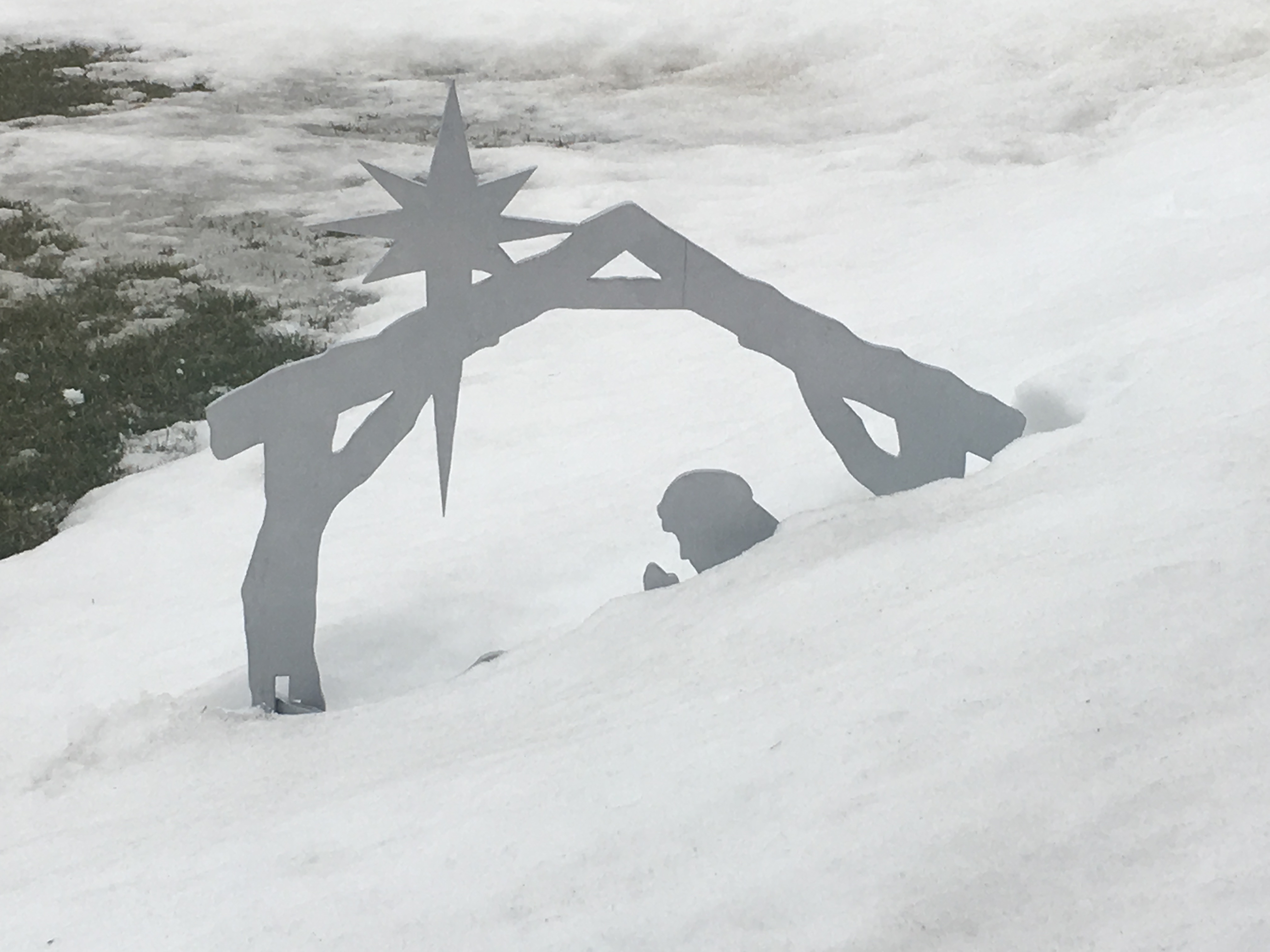
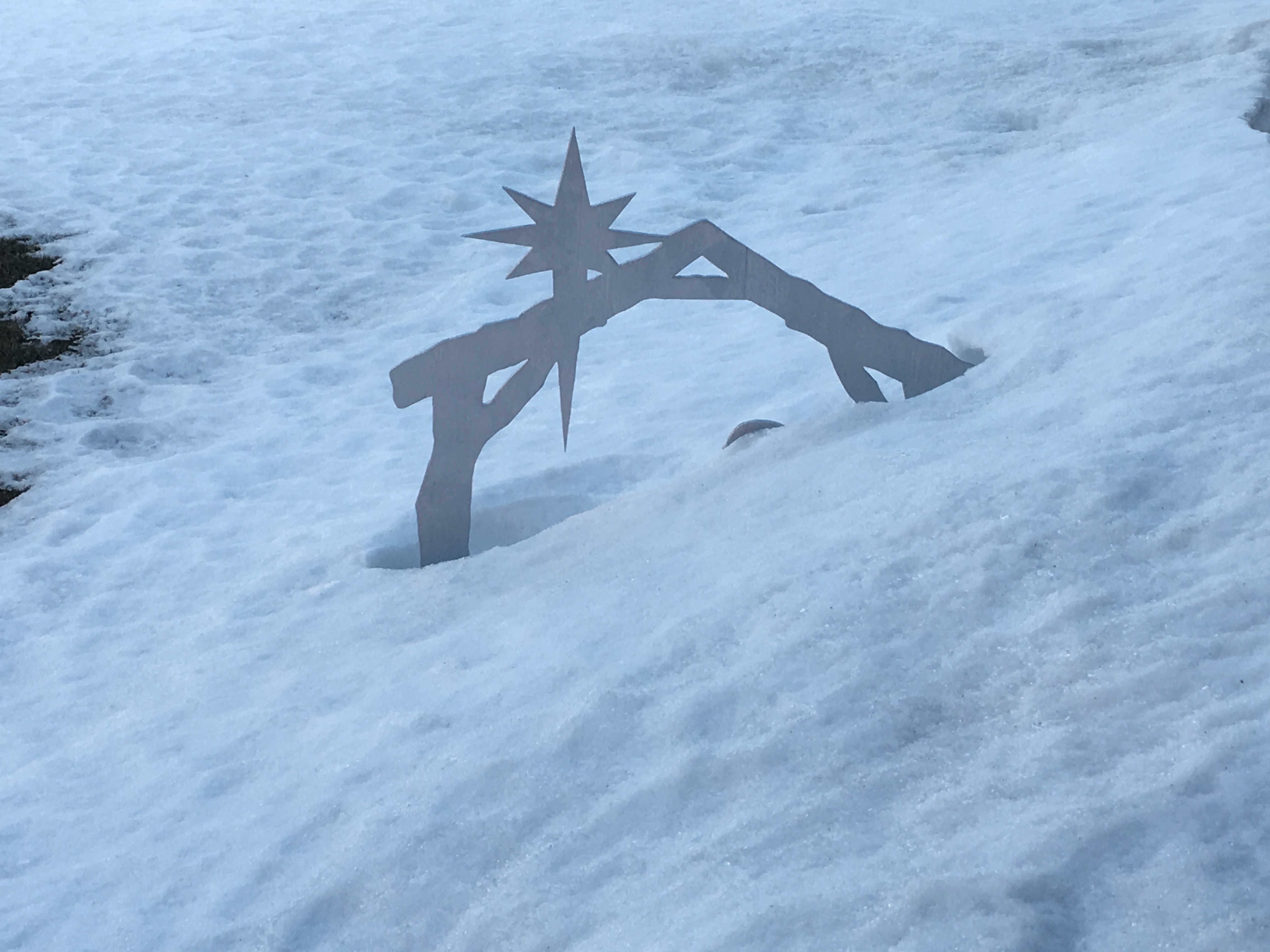
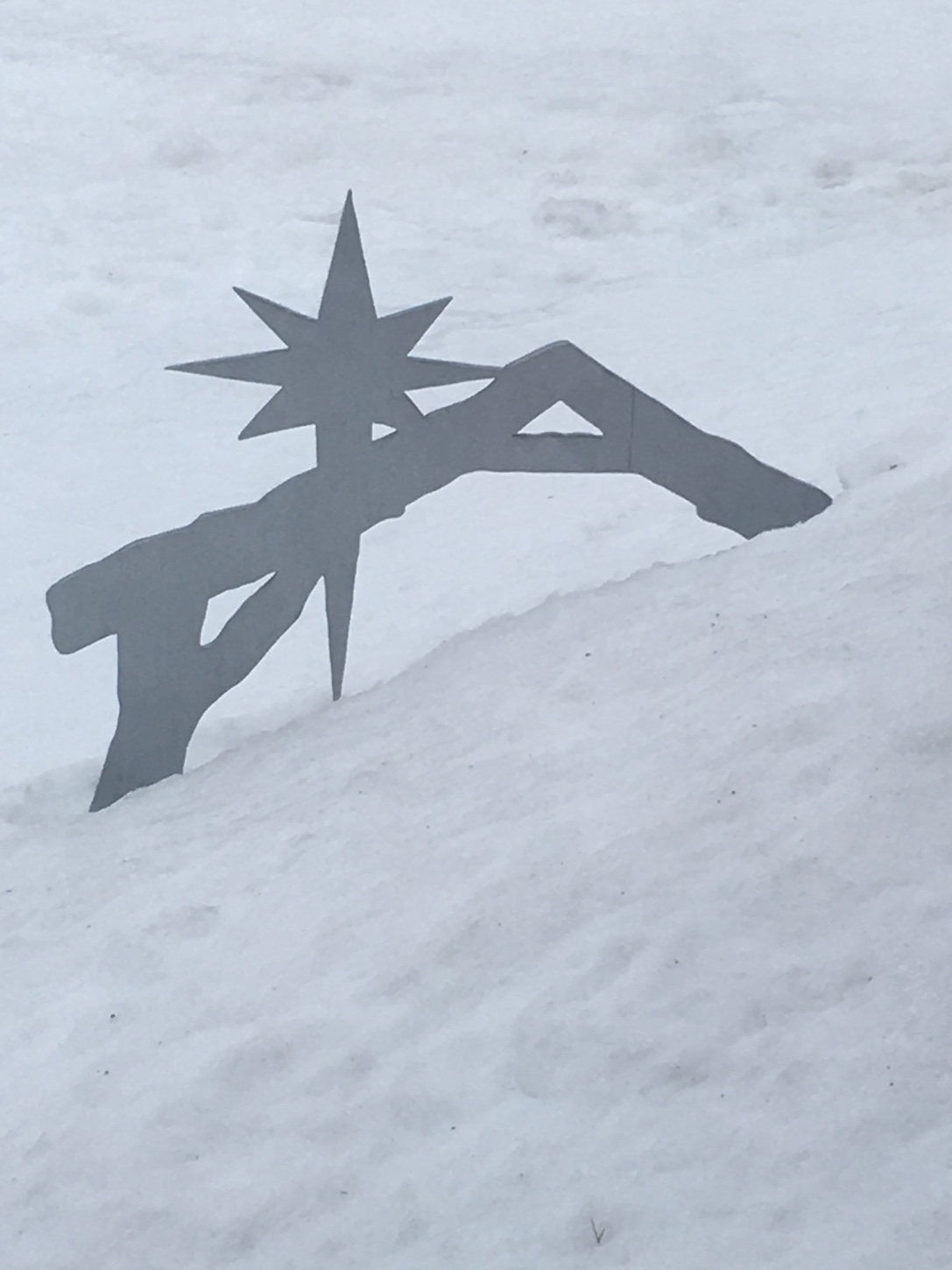
Even though it’s now less than two weeks till Easter Sunday, our Christmas tableau is still snowed into our front yard.

At least now — surprise! — we can see what’s there, what has been hidden deep under the snow for over three months.

The journey of Lent continues. More and more snow is melting. Much too slowly. The holy family and Christ child are now revealed, bit by bit.

Still not able to free Jesus from the frozen earth, I can recognize the gift hidden deep within a heart frozen in grief, in loss, in suffering.

And what a joy to discover that all along, Christ is there with me, even through the travail of a long winter’s journey in my life.

Invasion of abundant grace

The Toronto Maple Leafs are a playoff team. They have been for a while now. In fact, they’ve occupied the third seed in the Atlantic Division for months. And, lately, regardless of how many games they’d lose or win, it wouldn’t change their place in the standings for the playoffs, which begin this coming week.

The Leafs’ success has a lot to do with the stellar play of their number one goaltender, Frederik Andersen. At least how he played early in the season when he was sporting an impressive .923 goals against average (that’s very good). He was, some argue, the main reason the Leafs were able to climb in the standings and secure their playoff destiny. That is, until recently.

As some of you may know, he’s been kind of faltering a bit in the last month — letting in just a little too many goals, and losing just a bit too many games. As of last week, the Leafs had lost five of their last seven games—two of them here in Ottawa against the Sens. His lackluster performance has been enough to cause some to wonder whether Freddy will be able to hold up during the playoffs, especially against their arch rivals in the first round: the Boston Bruins.

An article in the Toronto Star recently caught my eye about this funk Andersen is in, and what he’s doing about it.[1]

Anderson speaks of dealing with all the downward-spiraling statistics — an embarrasing .890 goals against average (that’s bad) — all the anxiety-producing pressures to perform and succeed and chalk up more wins than losses — all the negative, worrisome scenarios that might play out for his whole team if he doesn’t stop more shots on net. Dashed playoff hopes. Disappointed fans. Negative publicity in the media. Downward career trajectories. Worry. Worry. Worry.

Indeed having success doesn’t mean being in a good head space. True, when the stakes are high, when it’s all on the line, when the vice grips of life’s important events tighten—it’s very difficult, maybe feels like it’s impossible, to keep calm, walk lightly, and breathe deeply through it all.

That’s the measure, that’s the key. Not when there’s nothing on the line. When you have little or no investment in the outcome. When it doesn’t matter and you don’t really care.

Rather, when what you are passionate about, what you care about, what you believe in, your most sacred values—when those things are on the line, when the stakes are high, how do you respond?

In the Lent book study, “Being Mortal” by Atul Gawande[2], we have been exploring many questions about the last chapter of one’s life. We’ve been talking about how to navigate the medical culture and what we want when time is short. You could say, the end of life conversations and thoughts are the ultimate ‘high stakes’ decisions:

How do you want the last ten years of your life to look like? What do you want for yourself? What trade-offs are you willing to make in order to achieve your final wishes? Whom do you need to include in conveying those decisions? Are those closest to you aware of your thoughts? Why or why not?

Most of us avoid having these conversations. We dread not only those situations but those conversations. We don’t want to think too far ahead. We don’t want to think about next year. ‘It’s too depressing’ we say. ‘I just want to think about next week, or just tomorrow, or just today.’

As Atul Gawande writes in his book, “It’s the route people the world over take, and that is understandable. But,” he continues, “it tends to backfire. Eventually, the crisis [you] dreaded arrives.”[3]And then what?

When the stakes are high, what does Mary do? Oh, and if you think the stakes aren’t high, let’s take another look: Why does Mary spill on Jesus’ feet a year’s worth of wages in perfume made from pure nard?[4]There are two uses in ancient Israel for pouring expensive oil on someone: First, in a coronation of a king; and, second, for the burial of that person.[5]

This was a costly oil with a sweet smell, imported from northern India. Scholars estimate that the “pound” referred to was nearly 12 ounces, or 324 grams. Many typical flasks of anointing oil would contain only a single ounce. So, Mary has a lot of this stuff, and pours it all out on Jesus’ feet!

“Money going down the drain!” eh?

Yet, Mary was anoints Jesus, the true King, and Jesus who will soon die. This extravagant act of love and adoration conveys Jesus’ purpose, publicly for all to see and read for all time to come. While everyone else around Jesus does not want to talk about it even though they might feel it, Mary does everything but avoid, deny and shove under the carpet what is obvious. What needed to be done.

It’s not a measly drop, offered in secret. It’s a whole flask, and the aroma fills the entire house!

Jesus and to an extent Mary know what is going to soon happen. The writing is on the wall, certainly since Jesus recently raised Mary’s brother Lazarus from the dead. From that point on, the religious leaders began plotting Jesus’ death.[6]The way to the cross is becoming clearer and clearer. There is no turning back. There is no avoiding this outcome if Jesus chooses to continue in his mission and divine purpose.

It is worth it, even though the stakes are high.

How do we find the courage to rise above our tendency to avoid and deny reality when the stakes are high? Can it have something to do with our purpose and mission? When you know what it is you are all about in life? Maybe, then, good things can happen.

In his book, Gawande mentions an experiment which compared two nursing homes. After the study, in one the number of prescriptions required per resident fell to half, psychotropic drugs for agitation decreased, total drug costs fells to just 38% of the comparison facility; and deaths fell by 15 %.[7]

What made the difference? In the test facility, residents began to “wake up and come to life” when animals and birds were brought into their environment. Not just one or two creatures. But a whole bunch of them. They experienced a “glorious chaos” at the beginning of the experiment.

Because no one knew what they were doing, everyone—staff and residents included—had to drop their guard and pitch in, to help. Residents forgot themselves and were immersed in an environment that gave them purpose and meaning. In the process they started having a little bit of fun. There was lots of laughter and frivolity reported in response to the invasion of all the animals and birds.[8]

This is just one small example of how connecting to a meaning and purpose in life, however trivial, and at whatever stage of life—can do miracles.

For goalie Frederik Andersen, it means no longer obsessing about the data and numbers, good and bad. He has to trust his teammates and play as part of a team rather than an individual obsessed with personal stats. He has to free himself from micro-managing his technique because he realizes his primary challenge is not his ability or capacity to do great things in the net, but the mental, emotional and yes, spiritual, part of his game.

In short, he simply needs to find joy in playing again. That’s spiritual!

As the playoffs begin, Fredrik Andersen is on a journey to reconnect with the purpose of what he was about on the ice. He is looking to discover ‘fun’ in his game, and enjoy every minute he has the privilege of playing it at that level.

We, too, are on a journey in Lent. Mary’s action in the Gospel reminds us that on this journey, there are times God calls us simply to be extravagant in our giving born of devotion and thanksgiving to God. Mary’s action reminds us that sometimes God calls us to breathe deeply and savor life’s good things.

As we ourselves work on the important question of the church’s mission and ministry, and how that again can take expression in the here and now, let’s remember in the midst of all that, to take the time, to give ourselves the permission, to lavish upon God our love, our attention, to rest in God’s presence.

And, in that holy act of devotion and love, be renewed for life and joy.


[1]
https://www.thestar.com/sports/leafs/opinion/2019/03/28/the-joy-of-hockey-could-save-andersen-and-the-leafs-season.html

[2]Atul Gawande, Being Mortal: Medicine and what matters in the End (Anchor Canada: Penguin Books, 2014/2017).

[3]Ibid., p.57

[4]John 12:1-8, Gospel text for the Fifth Sunday in Lent according to the Revised Common Lectionary, RCL, Year C

[5]Lindsey Trozzo comments on the Gospel reading (John 12:1-8) at http://www.workingpreacher.org

[6]John 11:45-53

[7]Gawande, ibid., p.123.

[8]Ibid., p.120-121.

Snowed in: Lent 4

IMG_8077

The snow still covers most of the story from our awareness. Buried deep within our hearts the fullness of all that makes us who we are is waiting to emerge. On the slow and steady movement on the Lenten journey to the springtime release and new life, we must embrace what is revealed, good and bad.

The first figure that I recognize is Joseph, praying. Joseph, the father of Jesus. Joseph, the father. What in my soul does ‘father’ mean to me? My father, Jan, died this winter. His memory resonates in my heart and I still feel the pang of grief. What is his legacy– as father, pastor, male– in my life? Faithfulness. Vulnerability. Physical strength. Passion. Feeling. Human-ness …

What does the revelation of the springtime structures within your heart tell you about you? About God? About your relationship with others, this earth, and Jesus still waiting to be released from what binds him on earth? Jesus, still waiting to be expressed and resurrected in your heart anew?

On the journey, even though the snow still covers so much (in Eastern Ontario anyway!), let us be buoyed by true signs, indeed, that the snow is surely melting away.

Here we (and God) go again

The horrible evil unleashed in Christchurch, New Zealand, this past weekend exposes so much that is wrong in our world. And in our relationship with those who are different from us. And in our relationship with God. When worshippers are gunned down in their house of prayer, to do anything now but grieve alongside and stand in solidarity with the sufferers exposes in us a serious God-image problem.

Our God-image problem, as Christians, starts with our understanding of God’s holy word. And specifically, our over-simplistic judgement of Jesus’ opponents. Typically, in the New Testament, these are the Pharisees. And we succumb to what I call the ‘black helmet syndrome’.

The ‘black helmet syndrome’ comes from how the bad guys are usually portrayed in popular culture—in old tv shows and movies like Star Wars. For example, the bad guys all wear the same uniform, usually the same colour, and we normally don’t see their faces because they are hidden behind some helmet or mask. They march to the same tune and move the same, predictable ways. They behave, essentially, like robots.

We know nothing of their unique personalities (unless a story evolves and develops, like Star Wars eventually does) and never gain insight into their unique personalities. They are trapped in their badness because individuals yield to the pressure to conform.

When we read the bible like that, it’s easy to lump all the Pharisees together under one over-arching label: bad guy. But that’s not the case, if we read the narrative more closely and contemplatively.

Portrayed in several Gospel stories as the antagonists, the Pharisees do scrutinize and criticize Jesus. Yes. But there are layers to that antagonism, even to the point of sympathy for Jesus. That is what first caught my attention in the Gospel text assigned for today, the Second Sunday in Lent.[1]

It was the Pharisees who warned Jesus he should get out of town because Herod wanted to kill him.[2]Jesus, after all, has become a useful target and a convenient scapegoat for the powerful elite. Let the restless crowds project their anxiety, their anger and fear onto the troublemaker Jesus rather than those holding tentatively to power.

Do you sense the growing tension? Jesus’ enemies have throughout his ministry flocked to him, hung on his every word and literally breathed down his neck. There is a power struggle strangling Jerusalem, and everyone, especially Herod Antipas, is looking over their shoulders.

The fact that Jesus had sympathizers and supporters  in the halls of power shouldn’t come to us as a surprise. After all, Joseph of Arimathea, on whose land Jesus was buried, exercised power in Jerusalem and had Pilate’s ear.[3]Joseph of Arimathea, we sense, was partial to Jesus and what he was all about. Nicodemus, who often questioned Jesus[4], in the end helped the Arimathean bury Jesus with respect and according to tradition. Who Jesus is and what he says somehow touches the hearts of those like Nicodemus.

These sympathizers, however, are caught between two worlds, two kingdoms. They have benefited from their privileged status, to be sure. They wouldn’t easily give that up, nor would they necessarily want to. And yet, this preacher from Nazareth who gives hope and the promise of God’s love to the downtrodden stirs something irresistible deep within them.

“Tell that fox, Herod …,” Jesus snipes.[5]“Tell him what’s really going to happen sooner than later. Tell him the truth about God and God’s intention.” Jesus gives a warning, and gives it to these ‘sitters-on-the-fence’ Pharisees to convey his cutting words.

At the first, we witness Jesus throwing his allies the proverbial ticking time bomb. For when they bring Jesus’ message to Herod, they would be bringing upon themselves unwelcome attention and even scrutiny. A shadow would pass over them, the seed of suspicion planted. “What were they doing so close to Jesus in the first place?” “Whose side are they really on?” And the political machine might start turning against them. The balance shifts ever so subtly, and the irreversible track to their eventual demise begins.

Indeed, Jesus’ words for these sympathizers lead them to a place of discomfort, to say the least. And Jesus knows what he is doing. These ‘good’ Pharisees must now face their own demons and answer to themselves. They must choose.

It’s as if Jesus is forcing their hands to come clean: Whose kingdom will you serve, now? Will you follow the values of Herod and the political self-serving machine of Jerusalem? Or, will you follow in the realm of God? Whose kingdom will you seek? The kingdom of hate? Or, the kingdom of love? And, are you prepared to let go of your privileged status, for my sake? And the sake of the Gospel?

We also live between two worlds. Being a follower of Christ creates tension before release and peace.

What about you? Where are you feeling the pinch in your life today? Where is your journey taking you? Where in your life is Jesus pushing you to decide in your heart whom you will follow—the voice of ambition and accumulation, the voice of privilege and protecting it at all costs, the voice of acquisition and preservation?

Or, will you follow the values represented by Jesus and the kingdom of God—the voice of compassion and forgiveness, the voice of reason and discernment, the voice of restorative justice and peace, of personal responsibility and collective wisdom?

We’ve seen this narrative repeat throughout the bible. Jesus even implies the repetitive nature of this story when in his lament, Jesus says, “How many times / How often have I desired  you….”[6]

Not only was this one of several, actual visits Jesus made to Jerusalem in Luke’s writing, the cycle has been going on since ancient times. God’s relationship with Israel reflects a similar pattern: At one point, they are not God’s people; at the next, they are God’s people, again.

The prophets preached God’s word to the people like a broken record: Judgement; Forgiveness. Destruction; Restitution. Rejection; Restoration. “How often have we been down this road before,” it’s as if Jesus were lamenting. Here we go again.

And yet, herein lies the grace, the Gospel, the good news: In confessing that we have an image problem with Jesus’ enemies—that we far too often succumb to the ‘black helmet syndrome’— we also must confess our image problem with God.

Because God is not some cosmic police officer ready to pounce on us should we be caught speeding. God is not some old man sitting on a throne pointing a finger of judgement and accusation. God is not about retributive, punitive justice. A tit-for-tat God who stokes the fire of revenge and escalating violence. God is not an exclusive God for only the rich, the famous, the perfect.

We learn three things that I can tell about God’s love from this passage. First, God’s love is true. God loves us, not to control us, but to free us. God’s love gives us the freedom to choose our way. God’s love allows us to figure it out for ourselves. God’s love lets us own it for ourselves, so our action is authentic and true. And then God’s grace follows.

We are not robots, mindlessly marching to some pre-determined rhythm of God’s master plan. We are not mindless creatures who can’t make own decisions. We are not co-dependent in some unhealthy, enmeshed relationship with a controlling God. As God’s love increases, so does our freedom. Union is not a breakdown of personal initiative and unique expression. Rather, God’s love is about ‘letting go’. This is true sacrifice.

Second, and consequently, God lets us fail if fail we will. If there is anything we learn about God’s love from Jesus lamenting over Jerusalem is that  Jesus’ sadness is the sadness of God. God grieves with us when we live the unfortunate consequences of our poor decisions. God understands and is ever near, especially when we fall to the bottom of our lives. That’s what they say about tears—they bear witness to how deep one’s love is for the other.

Finally, God never gives up on us. God is faithful. God will keep giving us second chances to grow and deepen our relationship with God, with one another, with ourselves and with this world we inhabit. God will always be there to give us those opportunities to make it better, to choose better. God will never abandon us on this journey.

As we follow Jesus on his path with ours this Lenten season, may we hold on, if anything, to this wonderful promise of God’s never-ending love for all people.


[1]Luke 13:31-35; the Gospel reading according to the Revised Common Lectionary (RCL).

[2]Luke 13:31

[3]John 19:38-42

[4]John 3 & 7

[5]Luke 13:32

[6]Luke 13:34

With us, snowed-in

I wasn’t able to remove the Christmas manger scene from our front yard in time, before the snowstorms left everything buried. As we’ve approached Lent, the joke in our household is that Jesus, like us, is snowed-in.

IMG_8042

It likely won’t be until late April now when I will be able to remove the tableau from the frozen earth and its snowy cover. When will Jesus be set free from the tomblike confines of winter’s grip?

When exactly, no one knows. Meteorologists are calling for a cooler-than-normal late April /early May. It might be a while.

The Jesus story, for us, begins in winter around the winter solstice on Christmas Day. We begin again our Lenten pilgrimage in the throes of winter, when snow and ice cover everything. When will the sky brighten and warmer temperatures heat the ground again? When does the journey end?

The poet, Mary Oliver, who died in January of this year, wrote primarily about winter. In several pieces she twins snow with wisdom, the capacity to live with questions in silence, surrendering to its beauty. “I love this world,” she wrote, “but not for its answers.”[1]

I’ve considered Christianity to be a winter faith. We, as people of faith, live with many questions that are largely unanswerable. Why do we still live in a world beset by injustice, intolerance, hatred—despite all good effort in the name of Jesus to the contrary? Why death and disease? When will we find the answers to our deepest questions? Why? Why? Why? Winter is a time for questions.

And so, we continue to search, wander, and wonder with Jesus snowed-in, by our side.

But, is Jesus in over his head?

The temptation of Jesus—as this story is famously called—happens near the beginning of his divine calling and ministry.[2]He goes into the wilderness, the desert, for forty days. He goes into a place of harsh simplicity, stripped of all creaturely comforts, to serve a holy purpose.

We wonder, will he survive the challenge?

Given his life purpose on earth, he meets with what could be his greatest vulnerability—the seduction of power and its forceful implications. The man who is the Son of God, King of Kings, Lord of Lords, Almighty and Everlasting, the man whom people would look to for guidance and leadership, the man who many would lift onto a pedestal—would Jesus succumb to everyone’s expectation?

Would Jesus yield to the temptation that he, the Messiah, will now lead the revolt to free the suppressed and oppressed Judeans out from Roman occupation? Would he be the political rallying point around which the crowds would mobilize and generate an effective, political movement?

And, in fact, the evil one touches on this potential weakness. Notice in different ways each of the three temptations seduce Jesus to grab hold of power that would make him this kind of King: One who satisfies his every appetite and hunger using whatever means at his disposal; one who creates God in one’s own image by forcing God’s hands, one who offers blind obedience to those still ‘above’ them while climbing the ladder of ‘success’.

But that’s not what Jesus was going to be about. We know that. In order to embrace his true identity, what happens?

Jesus is first led by the Spirit into this vulnerable place, not away from it. He was to first meet this human, shadow side.

The point of Lenten discipline, whatever it may be for you, is to be led into that shadow place in our own lives that we, on our own, don’t want and even can’t go. The Spirit leads us to face that which we normally distract ourselves from, where we normally deny, avoid. What is that vulnerability for you?

What does the light and Spirit reveal in the dark corners of your life? Is it a fear? Is it a conversation you know needs to happen? Is it confronting a situation you have been trying to avoid? Is it coming to terms with what is really going on deep down in your heart?

How does Jesus respond to his temptation? How does he return to his identity in God?

The scriptural quotations he cites are signs of his true identity—his ‘touchstone’, if you will. The scriptures point to his true self. By citing the scripture, he reminds himself, he aligns himself, he allies himself, with what grounds him in who he is. By citing scripture he relies not on his own humanity and resources of his own making, but rather on God.

This text provides rich support for our own journeys of Lent. As we wander into the wilderness of our lives and continue to trudge through the snow wary of still slipping on the ice, as we wonder with our questions, we meet our own shadow sides. And are called to stay rooted in who and whose we are.

And what is your touchstone for remembering your identity in Christ? Is it scripture? Is it the bread and cup of the sacrament? Is it a song? Is it an act of repeated service for another? Is it a prayer?

In her poems about winter Madeleine L’Engle writes a word of hope for the journey:

“Snow does not obscure the shape of things. It outlines them, like an icy highlighter, revealing the deep structure of the world. We walk through the woods, seeing differently, and, when we glimpse the hidden structure, we ask questions even as we experience its stark beauty.”[3]

Writer-theologian, Diana Butler Bass takes it further: “Strangely I have found in my own life that it is only through a wintery spirituality that I am able to affirm summer and sunshine. A friend wrote me recently, ‘Winter reveals structure’. Only as the structure is firmly there are we able to dress it with the lovely trappings of spring, budding leaves, rosy blossoms. Winter is the quiet, fallow time when earth prepares for the rebirth of spring.”

The word, Lent, means ‘springtime’. While the Lenten journey begins in the frozen winter, we can say in faith that the purpose of the journey is to bring us to Spring. Because by the end of the Lenten season, the snow will be gone revealing the soft, verdant earth underneath where new life is just budding to sprout.

In the end, the disciplines of Lent, the questions we now pose and with which we struggle on the journey, these are gifts from God. They point us to God’s presence in our lives and in our world. In the end, that is what faithful observance of Lent is—“a grace-filled return to the Lord our God.”[4]

Who begins with us, snowed-in and under.


[1]Cited in Diana Butler Bass, The Cottage: A Winter Faith (January 18, 2019)

[2]Luke 4:1-13

[3]Madeleine L’Engle cited in Diana Butler Bass, ibid.

[4]Kimberly M. Van Driel, in David L. Bartlett & Barbara Brown Taylor, eds. Feasting on the Word: Preaching the Revised Common Lectionary Year C, Vol 2 (Kentucky: WJK Press, 2009), p.25.