The change within

When seventeen-year-old Hannah said she was drug free, her parents were skeptical. Having participated in a rehab program and given all the support she could expect from friends and family, Hannah was able to declare that she was finding success in weaning herself off a destructive opioid dependence.

But her father was not convinced. When pressed, he simply confessed, “I don’t believe people can change. Once a drug addict, always a drug addict.”

Though fictional, Hannah and her parents’ situation poses a common predicament for many today. Not just of the real struggle with addiction. But also the struggle with belief: Do we change? And if so, how? And maybe more to the point: Do we recognize the change that happens in our lives? Do we want to?

There’s the story of the Zen Monk who was visiting Time’s Square in New York. And he wanted to buy a hotdog. The vendor asked him, “What would you like on your hotdog?”

The monk replied with a smile, “Make me one with everything.” So the vendor made the hotdog with ketchup, onions and lettuce and mustard and all these other nice things. And he gave it to the monk, and the monk gave the vendor a twenty-dollar bill.

And the vendor didn’t give him anything back. So the monk said, “What about my change?” And the vendor said, “The change is all within.”[1]

An underlying belief in Christianity is that people do change. The resurrection of Christ presents the ultimate pattern for life. We die. We live. We grow. We evolve. We are given new beginnings, to live again. Death. Resurrection. Life is dynamic, not static.

On this Transfiguration of our Lord Sunday, we encounter people who change. First and foremost, Jesus. He is bathed in uncreated light and to the onlookers his face radiates a changed appearance. His countenance is transformed before their very eyes. Here the gospel writers want to emphasize Jesus’ divine nature, his unique revelation as God’s own. The witnesses to this holy and amazing encounter receive the most wonderful gift of experiencing God’s greatness in Christ.[2]

At the same time, the transfigured Lord encounters us. In the scriptures for this Sunday we witness change in the characters of the bible, specifically Moses, Elijah and Paul.[3]They, and others in the bible, are not static beings, one-dimensional characters. We witness in them, rather, incredible change over the course of their lives and throughout history.

In other words, Jesus is not the only one who shows a divine-like appearance. Throughout scripture, there are others who experience within themselves a transfiguration.

Jesus is the first and foremost. But God’s divinity, though fully expressed in Jesus, is not confined to Jesus. God’s true presence is not limited to Jesus for Jesus’ sake alone. God’s fullness in all of creation is not locked in one specific time of history, two thousand years ago.

Martin Luther called it, the great, wonderful, holy “exchange”[4]. On the cross God experienced the fullness of our human sin in all its humiliating nakedness and vulnerability in order that all for whom Christ loved and died may eventually experience and grow into the fullness of divine life and union with God. This divine-human holy exchange is exemplified and mediated through Jesus.

We may balk at the notion that in our very lives, in each one of us, God is present in the living consciousness of Jesus. How can we be that good, eh? We are so used to imagining a separation there—that God is ‘out there’ reserved exclusively to doctrinal debate alone or in some other person upon whom we project all our hopes and dreams. But within me? In my heart? So that I can live differently, better, a changed person?

St. Paul, elsewhere in his first century writings expresses this truth from the start: In his letter to the Galatians, he says, “God revealed his Son in me”[5]. On the road to Damascus the living, post-resurrected Christ encountered Paul. Over one hundred times in all of his New Testament writings he writes this phrase: en Christo meaning ‘in Christ’. And to the Colossians, he confesses: “There is only Christ. He is everything and he is in everything.”[6]

The vendor’s response to the monk carries metaphoric weight. The change is within. A holy encounter with Jesus first changes us within. The change for the better can happen because God is in us. God works on our hearts. God is relentless. Sometimes it hurts. God is the refiner’s fire, creating and re-creating us from the inside-out.

So that, eventually, the light of Christ’s love may shine forth from our lives, and our union with God will be complete, in this world and the next.

Thanks be to God!

[1]Laurence Freeman, “Change is part of the Journey, like it or not”; talk 1 in Mount Oliveto Retreat, Maggiore Siena, Italy, June 18-25, 2016: Change (wccm.org, audio resources, album)

[2]Luke 9:28-43

[3]Exodus 34:29-35; 2 Corinthians 3:12—4:2

[4]“That is the mystery which is rich in divine grace to sinners: wherein by a wonderful exchange our sins are no longer ours but Christ’s and the righteousness of Christ not Christ’s but ours. He has emptied Himself of His righteousness that He might clothe us with it, and fill us with it.

And He has taken our evils upon Himself that He might deliver us from them… in the same manner as He grieved and suffered in our sins, and was confounded, in the same manner we rejoice and glory in His righteousness.”

–Martin Luther, Werke (Weimar, 1883), 5: 608.

[5]Chapter one, verse sixteen, as translated by the NIV and JB.

[6]Chapter three, verse 11. In the NRSV, the Greek is translated, “He is all and in all.”

Even among the lost

I hear Simon’s despair, tainted with frustration and even anger, when he reacts to Jesus’ instruction to put the nets in deep water to catch the fish in Lake Galilee.[1]

“Master, we have worked all night long but have caught nothing.” He’s trying to make a point that there is no use to doing what Jesus asks of them. After all, they did all they could do. They employed all their resources, knowledge and effort into catching fish that night. But to no avail. Understandably frustrated, Simon scoffs at the futility of doing what Jesus asks. As if he knows better. There is not point to it all.

This is not the first time we hear Jesus say or do something that mystifies us. Earlier in this season after Epiphany, we witnessed Jesus being baptized. Jesus being baptized in the Jordan River often confounds our sensibility. Why does Jesus need to be baptized? Aren’t we the ones that need to be baptized? Not God!

So often we find salvation in what we do, and the meaning we attribute to what we do. In the church, we often do exactly what the crowds at the Jordan did: We come to worship, pray the printed confessions of sin, receive Communion and hope that these liturgical acts will wash away our sins. And make life right.

Then, we also have other programs for self-improvement, such as trying a new diet, cutting down on drinking and smoking, or finding someone who will love us just right. But these things are all futile for making real change in our lives, for making our lives right.

But Jesus walks into our lives just as he waded into the Jordan to be baptized by John. If Jesus was to walk into our lives today, he could just as well arrive at our job interviews, wedding receptions, or retirement parties. He could just as well stand in the long lines with us at the Tim Horton’s or sports venues. Jesus could just as well join us in all our driving around town to this and that – and the next futile thing we are trying to do in order to make life right.

Yes, I could feel the futility behind Simon’s statement—but we fished all night and caught nothing. Would Jesus step even into that despair?

When work seems futile. When other people frustrate us. When life seems pointless. When what we do appears to have little purpose, meaning or utility. When we fail. When despair sinks in.

Or, not far removed in the face of uncertainty, we clamber and clamor for the next shiny, new thing. We distract ourselves. We fall into mindless routine or stimulating addiction, to occupy our minds or numb them. And escape reality. Even just below the surface of seeming industry, there broils a fearsome anxiety.

Yes, I hear Simon’s despair. But I also see Jesus, right there.

What is Jesus up to here? Getting baptized. Going fishing with his friends. Going to weddings. Hanging out in the streets. What is Jesus up to here, living the life we all live?

For some reason, Jesus is taking on our lost condition. Jesus participates in our lives, doing what we do, engaging our routines, our work, our lifestyles. And, as we become more aware of Jesus closeness to us in our successes and our failures, we discover the Gospel truth: that salvation comes not because of our activity, our brains, our efforts. Salvation comes through a loving Savior who finds us and takes on our lost condition.

So maybe our job is not to explain the mystery, but simply to obey the seemingly pointless, futile instruction from Jesus. And act on it, as Simon did. “Yet, if you say so, I will let down the nets.”[2]

Visit the sick. Befriend the poor, the outcast, the refugee. Accompany the vulnerable, the weak, the dying.

After selling their large house where they called home for decades, Jack and Betty moved to a smaller two-bedroom apartment in town. Once settled in, they invited Craig, a church friend, to dinner in their new home. Craig was happy to oblige.

After all, on Sunday mornings they would sit together in worship. They didn’t say a lot. Betty might say something odd, but her countenance was so bright. Jack seemed always bothered by something, like he was scowling. But the couple was always together. And they liked each other.

Craig tells the story of his experience visiting Jack and Betty. He writes,

“Once I arrived at their apartment on the appointed evening, it didn’t take me long to realize that Betty had Alzheimer’s disease. It now seemed so obvious that I felt foolish for missing it earlier. Jack never let her out of his sight. It was then that I realized that he hadn’t been scowling for the last couple of years. He was just worried.

“Before I even had my coat off, Betty took me by the hand and led me to the painting above the sofa that depicted their stately old home. She became a bit more lucid as the stories of the old place tumbled out of her soul. I felt her squeeze my hand as she talked … [as if she were trying to say], ‘There is more to me than you see now.’ … Jack stood behind us and allowed his worry to ease a bit with a tender smile.

“Dinner was interesting. Betty couldn’t be allowed near the stove, and Jack wasn’t about to learn to cook. So he had asked their housekeeper to make them an extra-large omelet before she left that afternoon. When we were ready to eat, Jack put the egg dish in the microwave, then cut it into thirds and served it on Betty’s best china. For desert he brought out Klondike bars that we ate using the good silverware, which wasn’t easy. Several times during the meal, Betty got up and wandered around the apartment a bit. I was impressed by Jack’s ability to maintain our conversation, which was always of secondary importance to him, while always watching his wife.

“Throughout the evening I kept thinking that I needed to say something useful. After all … [isn’t that what we’re supposed to do with others?] But how profound could I be with Betty, whose mind was too clouded for conversation? What would I even say to Jack…? I could try, ‘Keep up the good work’ or ‘This must be really hard,’ but that would be so inane.

“After dinner, we left the old dining-room table and made our way back to the living room sofa, where I sat next to Betty. Jack took the chair across from us. I began to talk, trying to speak of …[relevant] things, but I wasn’t doing well. [As a Christian friend, from church] I knew that I was called there to be a blessing to them and … to witness to Christ’s presence among them. But how? I felt like a pilot circling above the clouds, looking for an opening to land. Soon Betty got up and wandered off again.

“When she returned, she stood behind the chair where Jack was seated and put her trembling hand on his shoulder. And as only old lovers know how to do, he reached up to take her hand as if it were the first and millionth time he had done it. I stopped talking as they both smiled at me.

“Well, there it was – the blessed presence of Christ. Then I knew that I wasn’t there to say a thing. My calling was to behold and be amazed. It was as if their mutual smile said, ‘Don’t you dare pity us. We are blessed.’ Beneath the gentle act of holding a trembling hand lies the mystery of … [love].

“In the end, this is as good as the calling to love can be. …There is just the holding of hands …”[3]

There is neither brow-wrinkled explanation nor fear-induced despair.

There is just the smile of God in the face of another.


[1]Luke 5:4-5

[2]Luke 5:5

[3]M. Craig Barnes, The Pastor As Minor Poet: Texts and Subtexts in the Ministerial Life (Grand Rapids: Eerdmans, 2009) p.97,103-105

Christmas Day – funeral sermon

Jesus said, ‘The kingdom of heaven is like treasure hidden in a field, which someone found and hid; then in his joy he goes and sells all that he has and buys that field. ‘Again, the kingdom of heaven is like a merchant in search of fine pearls; on finding one pearl of great value, he went and sold all that he had and bought it … For where your treasure is, there your heart will be also.’ (Matthew 13:44-46; 6:21)

“Your mother is always with you … She is Christmas morning.”

Though your mother veered away from the Italian version of her first name, “Santa”, because of its obvious English connotation to ‘Santa Claus’, there is too much about your mother’s journey to avoid mention of Christmas Day, the day she died.

Of course, “Santa”, in Italian means “Saint.” There is indeed something godly about your mother’s journey that can leave for us a legacy of love and hope. She was, after all, a saint. But a human, as well. As Martin Luther said about all of us—we are simultaneously saints and sinners.

The scriptures her brothers sent for inclusion in this service point, also, to an important part of how your mother was with you. Normally when we hear the words of Jesus: “the kingdom of heaven is like …” such and such when someone does so and so, we think of the job we must do to enter that kingdom.

That’s part of it. Your mother certainly demonstrated determination and tenacity. She showed a singularity of mind and spirit about the things she liked to do, and the way she did them: a religious person, attending to ritual and prayer her whole life long; a gardener and craftsperson, committed and caring to her family. Never forgetting birthdays and special anniversaries.

Stubbornness may be the other side of that coin of having a clear, focused intention to what she was all about. She strikes me as a person you would never need to wonder about what she really wanted or what she believed. Indeed, the kingdom of heaven is like when someone knows what they want, and with joys seeks it out leaving all else behind.

At the same time, the words of Jesus point to what God is all about. I also consider those scriptures about the kingdom of heaven as describing the character of God: A God who treasures your Mother as much as God treasures each one of us. And will stop at nothing to find us. And give up God’s very life on the cross—give up everything—in order to be with us and love us. Where God’s treasure is—in us—there God’s heart is also.

Again, this is the message of Christmas, the day your Mother died. A message of One who comes into our life even in the messiness and despair of being human. Born a vulnerable baby to poor, teenage parents in a backwater town of Bethlehem. The message of Christmas is about a God who ‘sells it all’ in order to be with us. In order to know us, really know us. To grieve with us. To enjoy with us. To walk with us this often difficult journey that your Mother knew all too well.

And, to give us a wonderful promise of one day being united with all whom we loved on earth, at the end of the road.

Thanks be to God.

Amen.

Meeting the unexpected

On New Year’s Eve, the roadway was completely covered in snow. All I could see in the waning light of day was the general shape of the roadbed curving slightly to the right in front of me.

I couldn’t see the customary yellow and white lines on the pavement to guide me. There were no tracks left in the snow of cars gone down this way recently. The snowfall was fresh and the road was not well-travelled.

I could control my speed, of course, but I didn’t have a lot to go on. Would I get home in one piece? First, I had to slow down. And even be prepared to stop.

The Magi were on a journey to arrive at the home of the young Christ child. Christmas cards and the popular mindset show the Magi at the baby Jesus’ side on the night he was born. But that is likely not the case.

The Gospel of Matthew indicates the Magi visited the holy family’s “house” in Bethlehem, hardly a description of a cave or stable for animals.[1]The Gospel of Luke, from which we read the birth narrative on Christmas Eve, does not mention the Magi.

The Magi were on a journey that took months if not years to accomplish. Their journey took time. Their coming to Jesus, so to speak, was not an immediate, instant, snap-of-the-fingers conversion. Their experience was slow, plodding and winding course across the deserts of the Middle East. On their journey to find Jesus, they had to have the long-view in mind. A whole lot of determination. And a commitment to the journey with all its fits and starts.

I also get the impression, reading through these verses from Matthew, that the Magi who were nearing the end of their long journey had to make in-the-moment changes to their plans. They had to check their assumptions and change their minds about initial expectations.

For example, at least half the Gospel text for today focuses on Herod. Initially, the Magi came to him in good faith, believing the Roman governor would sincerely help them. But an angel of the Lord had to steer them away, literally by a different road, and from Herod’s manipulating, plotting, fear-ridden treachery. The Magi had to trust ‘new information’ and make changes to their flight plan in mid-stream.

Then, the gifts. Three gifts: Gold, Frankincense and Myrrh. In biblical times, these gifts were usually given to a king or a person with highest status. Gold was such a gift. From the Hebrew scriptures, when The Queen of Sheba visited King Solomon she gave him precious gifts: “Arriving at Jerusalem with a very great caravan – with camels carrying spices, large quantities of gold, and precious stones” (1 Kings 10:2). The spices that she brought with her might very well have been frankincense and myrrh.

The gifts themselves are a powerful sign of what these visitors originally intended. The Magi were coming a long way to worship who they considered the true King. Not Herod. Not Rome. But the divine Son of God.

And, still, not what they expected.

The meaning of these gifts needs to be examined in light of Jesus’ life, death and resurrection. For us, what is ‘kingship’ in light of Christ—certainly not what we might first assume: glory, power, military strength and victory. Jesus’ journey took him through the defeat and humiliation of the cross. That’s the kind of kingship Jesus is about.

Myrrh represented healing. Healing in the light of Christ was not so much about an instant cure to earthly disease. But rather, healing is a transformation of the inner life of our attitudes and finding wholeness and grace in every moment of life, especially in the midst of suffering and pain. The king whom the Magi came to worship was a king who, in truth, represented values and meaning that countered—were at odds with—the values of the world.

And that is why this story starts the season of Epiphany in the church. Epiphany means, Revelation. The baby Jesus is revealed as the Son of God who shows us the way of God—God’s path of transformation and salvation. The season of Epiphany invites us to participatein this way. Participating in this journey asks us, like the first Magi, to be prepared to change course and examine our standing assumptions about God and the world.

It’s the manner in which the truth is revealed that ought to catch our attention in the biblical story. And this way is both apparent by what these three gifts mean, and by the expectations we first bring to this story.

For example: We assume and even say ‘it’s biblical’ that there were three men and they were three kings. But that’s not what the bible says. For all we know, there could have been a whole caravan of them. And what if some were women?

Although we sing, “We Three Kings of Orient Are,”, these visitors from the East were also not kings. The term Magi is a plural form of a word in Greek which means, literally, Zoroastrian priests.[2]And, maybe they earned the title ‘wise’ because of their skills in interpreting dreams and understanding astrology.

It’s as if the proverbial rug first needs to be pulled from underneath us before the truth is revealed. We don’t come to it straight on. Our expectations first need to be checked, and likely over time, over turned.

Once on New Year’s Eve when driving down a country road covered in snow in the middle of a blinding snow storm I thought I was driving in the middle of the road. I figured I best check that assumption. Thank God I did.

In a moment no other vehicle was passing, I stopped and opened the driver’s side door. With my boot, I scraped away the fluffy blanket of snow believing I would find the dark asphalt of the road and maybe even a lane marker painted on the hard top.

To my horror, I turned over stones and gravel, indicating I was already on the shoulder of the road. Had I not stopped at that moment, my vehicle was heading in the direction of the deep ditch on the side of the road.

Thank God, I had it in my mind to stop when I did, and scratch the surface of my belief. Then, I was able to change course.

The star finally stopped over Bethlehem, showing the Wise Ones where the destination of their journey lay. At this sign, “they were overwhelmed with joy.”[3]Arriving home in one piece from driving in less-than-ideal road conditions gave me a sense of joy. The joy comes because of the journey, maybe because the journey was difficult. Maybe because the journey called forth the best from you, to meet the challenges and make headway despite the journey’s challenges, pain and suffering.

The amazing thing is that God somehow brought the Magi–the Wise Ones–to the exact location of their hopes and dreams. Perhaps not what they expected at first. But this gift they surely recognized.

Here are some questions for reflection as we enter this new season after the Epiphany: What was the most important gift you received this holiday season? Did you expect it? Why is it important? How did you receive it?

God has given us the greatest gift in Jesus. Where we find him will be shown to us, on the journey. This grace continues throughout our lives.

May our trust grow in a God who has this uncanny ability to trust and have faith in us to get home. Let us pray: God, you led the Wise Ones by a star to find the Christ child. Lead us as we strive to follow you in living our faith. No matter how long it takes. No matter how winding the journey. Help us trust your promise to bring us home. Amen.


[1]Matthew 2:11

[2]Niveen Sarras, “Commentary on Matthew 2:1-12”, http://www.workingpreacher.org

[3]Matthew 2:10

Christmas, now

Just a couple of years before he died, Martin Luther preached one of his last Christmas sermons. In it, he challenged his 16thcentury German congregation to bring the nativity into the present moment – the present reality.

Martin Luther described the squalor and desperation swirling around Mary and Joseph arriving late in Bethlehem and not finding room in the inn, leaving them to give birth to Jesus in a small barn out back. Then, he said:

 There are many of you in this congregation who think to yourselves: “If only I had been there! How quick I would have been to help the baby! I would have washed his linen!” … [Well] Why don’t you do it now? You have Christ in your neighbour. You ought to serve them, for what you do to your neighbour in need you do to the Lord Christ himself.[1] That was preached in 1543.

At Christmas 2018, we are not just called to hear the story again, but to be in it, part of it.[2]

Essentially, Martin Luther was getting at the meaning of Christmas for his contemporaries. And for us, today. How can we be inspired by the children, the music, the gifts we bring at Christmas to step out of the nativity ‘play’, and into the real story unfolding around us today?

We share in the communion tonight. In the chaos, noise and crowd, celebrating the sacrament might not fit our idea of a neat-and-tidy, perfect Christmas service. It’s hard to sentimentalize the Eucharist.

But it’s important to offer it tonight. Because the sacrament brings us to the present moment. The meal tells the story of Jesus being in our hearts—not decades ago when things were golden and sweet in our memories, not two thousand years ago, not in the Martin Luther’s day, not lost in words of scripture alone—but right here, right now, in the present day, in our own experience of life in this world.

Receiving the bread and cup doesn’t mean your life is perfect, doesn’t mean you are now ready for Christmas, doesn’t mean y our life is in order and worthy of God.

When you receive the Communion, you are affirming that God is somewhere in the mess and chaos of your life. Our life. Emmanuel–God with us.

Celebrating Christ’s birth does not bring us outof history, it involves us with it—in the present time.[3]The Christmas story gets lived out by our attention and care for the dark shadows in our own hearts, as well as reaching out to vulnerable people in our world.

I heard with dismay on the local radio station last week that the City of Ottawa is putting up 230 families in cheap hotels this Christmas, where they have to live for over a year before social housing spots open up. Talk about conditions of squalor entire families, all of them poor, need to live in at Christmas. And we’re not talking about a handful. Two Hundred and Thirty families, in Ottawa alone.

Have we considered that when we pray for and help in whatever way we can these people, we are serving Christ himself? After all, our Lord was a refugee himself right after his birth, fleeing to Egypt with his parents to get away from Herod’s violent and murderous intent.[4]

Popular TSN Hockey Insider Bob McKenzie just came out with a book this Fall entitled: “Everyday Hockey Heroes: Inspiring Stories on and off the Ice”[5]

In one chapter about an inspiring Ottawa story, Bob McKenzie relays the words of Karina Potvin, a minor hockey coach. She writes: “So much about Canada is welcoming. Well, except maybe our winters, but they’re a small price to pay in order to play hockey …”

As Karina watched on the news refugees being greeted at the airport, she writes: “I knew I wanted to help these new Canadians feel at home. I just wasn’t sure how.

“A few months later I was at practice when I saw one of my fellow coaches … coming towards the bench … [he had a] new idea for Reach Out. Reach Out is a program in our hockey association that helps low income families pay for equipment and registration fees so that their kids can join our league …

“‘You know how my wife and I have been working with some of the Syrian families who have settled here in Ottawa?’ He went on, ‘We took a family to …[a] game last week, and their sons absolutely loved it. They had never heard of hockey before, but they want to play.’

Karina ended up coaching three boys—Mohammed, Ahmad and Ismael—who quickly got the hang of skating. “They’re all over the ice!”

“The three boys breathed hockey all day, every day. As did their parents. By midseason, the parents were typical Canadian hockey moms and dads.

“One Arabic word I learned was hebbak which means “I love you.” Sometimes when we were on the bench, I would turn to Mohammed and say it. He always gave me a strange look.

“’Yeah, I just told you that I love you. Because you’re playing really well tonight and listening to us coaches.’

“He shook his head, ‘Coach Karina, you’re weird.’

“’If you ever make the NHL and they ask you who was your first and favourite coach, you have to say Coach Karina.’

“’Yes, of course.’ He laughed.

“’And if you ever play for the Senators, you have to get me tickets.’ Every time I said this, he would smile and reply, ‘Yes. Yes. Yes.’”

Just imagine: The year before, these kids had been in a refugee camp in Lebanon. Now, they were playing hockey just like so many other kids in Canada.[6]

May the first Christmas story become alive and real for you, as the Christ child is born anew in your hearts thisday.

Here are the words of American writer Madeleine L’Engle in a poem entitled “First Coming”:

He did not wait till the world was ready,
till men and nations were at peace.
He came when the Heavens were unsteady,
and prisoners cried out for release.

He did not wait for the perfect time.
He came when the need was deep and great.
He dined with sinners in all their grime,
turned water into wine.

He did not wait till hearts were pure.
In joy he came to a tarnished world of sin and doubt.
To a world like ours, of anguished shame
he came, and his Light would not go out.

He came to a world which did not mesh,
to heal its tangles, shield its scorn.
In the mystery of the Word made Flesh
the Maker of the stars was born.

We cannot wait till the world is sane
to raise our songs with joyful voice,
for to share our grief, to touch our pain,
He came with Love: Rejoice! Rejoice!

Merry Christmas!

[1]Martin Luther, Christmas Sermon, 1543; Matthew 25:45

[2]Lcfaithinthenight.blogspot.com, 19 Dec 2018, (Lutherans Connect, @LuTConnect).

[3]Gustavo Gutierrez, cited in LutheransConnect, ibid.

[4]Matthew 2:13-15

[5]With Jim Lang (Toronto: Simon & Schuster, 2018)

[6]The full story in ibid., p.45-56

Remembrance Day Centennial

One of the reasons I wear my poppy year after year leading up to Remembrance Day, is to remind myself that freedom has a cost.

And that cost is not just ‘a drop in the bucket,’ spare change for which I reach into my deep pockets that doesn’t really make any difference in my life to do without. So, I throw them at some otherwise good cause. And feel smug.

In the Greek language in which the Gospel text from Mark[1]is originally written, we read that what the widow cast in the temple treasury was her bios. Her bios — meaning, literally, her very life. This text “invites us to imagine not two copper coins going into the treasury, but the very body and soul of the widow; her bios falling into the treasury.”[2]Freedom is not cheap. Freedom demands a whole lot of giving. Whatever good we see at the end of it all calls forth our very life.

Then, the punch to the gut. If we read on into the next chapter of Mark, Jesus says that this temple in Jerusalem—to and for which all those people were making donations—will soon be destroyed.[3]Throughout the Gospels, we know the temple and its culture was corrupt. Jesus had criticized, even became angry against, what was going on inside. In a fit of rage he had upturned the money changers’ tables in the temple. “Stop making my Father’s house a marketplace!” He cried, outraged.[4] Such behaviour from Jesus incited a condemning response from temple authorities, precipitating plans to have him silenced. The conflict between Jesus and the temple was well documented. And soon, Jesus would have the last word, promising that this building will be “thrown down.”

And Jesus is not just talking spiritually, here, referring merely to his body. His word was actually fulfilled: During the Siege of Jerusalem in 70 C.E. Roman armies destroyed the temple.

The juxtaposition of these texts is not without purpose, its meaning dare not be ignored. The structure of the narrative strongly suggests that the widow gives all she has to an institution that is going to be utterly destroyed.

According to Jesus, the widow gave more of her life than the rich people because she gave “out of her poverty”.[5]I think this is the key to understanding what Jesus is really getting at by drawing our attention to the widow’s gift.

She gave out of her poverty. I suspect we associate the freedom won on the battlefields with freedom to seek after material prosperity and amass financial wealth. In other words, we attribute freedom with permission in this land to become rich if we can.

The freedom of which the bible speaks, however, is not a freedom to invest, but to divest; where power and privilege divests itself in weakness which the world considers “foolish”. Remember Paul’s words from Corinthians: God made foolish the wisdom of the world.[6]

The widow gives her all, her bios, not for the temple treasury, not for the sake of the institution, not to build and maintain the stones, the bricks, the mortar, the properties, the buildings, the skyscrapers and the material wealth of church and society. Not for building an empire under the guise of ‘freedom.’ The giving of the faithful is not for these things.

Rather, the widow gives her all, her bios, for her neighbour. For the sake of relationship—relationship with the poverty within her own soul, relationship with the poverty in her neighbours, and relationship with the poverty of God: Christ crucified.

The placement of these stories in the Gospel narrative is significant, because even this story—often interpreted solely about stewardship and ironically giving money to upkeep an institution that is dying or will die—ultimately points to Jesus Christ, on the cross.

The widow, like Jesus, gives her life for that which is going down. The widow, like Jesus, gives her life for that which is imperfect and corrupt. The widow, like Jesus, gives her life for what we might regard as foolish, unproductive and a waste, to that which is undeserving.

She gives her life for us, trusting in a resurrection that will rise out of the ashes of her divestment, out of her poverty.

The cost for freedom does not happen when we go to church. We don’t do good by coming to church. The service women and men who risked it all, and as such modelled for us a self-giving that is truly remarkable, didn’t do it in church. But, rather, on the battlefield of life. We do good by going out from the doors of the church into the world, for the sake of the Gospel. And for the love of the God, in Christ, who gave all, for us—corrupted, broken, sinful, weak, sometimes useless people. Can we do in like for others, out there?

This year, 2018, is significant for the Canadian Armed Forces for several reasons, including the 100th anniversary of the end of the First World War. And, as such, the 100th anniversary of Remembrance Day on November 11th observed every year since.

According to Veterans’ Affairs Canada, since Confederation in 1867, approximately 2.3 million Canadians have served in uniform, and more than 118,000 have given their lives.

As people of faith, not only do we this day thank our brave men and women who have served Canada at home and abroad, we also express our thanks to and support efforts to walk with and help our veterans after they complete their service.

We may not be aware of the plight of many veterans, trying to live, trying to survive, in this very city of Ottawa. In the attached video link, see and hear what Multifaith Housing Initiative Ottawa is doing to provide affordable and safe housing for dozens of homeless veterans. The new project, planned for the grounds on the old Rockcliffe Airforce Base, is called, “Veteran’s House.” The desire, here, is to serve those who have served us.

The task is ours to practise the gift first given to us in Christ, the gift of grace and mercy that is the way of freedom.

https://m.youtube.com/watch?v=H4DFg9_hhig&feature=share


[1]Mark 12:38-44

[2]Professor Allen Jorgenson, Martin Luther University College in Waterloo, writes in his bible study on this text given at the 2018 Eastern Synod Assembly, Mississauga.

[3]Mark 13:1-2

[4]John 2:16

[5]Mark 12:44

[6]1 Corinthians 1:18-31

A New Way to Pray: Tracking the Trajectory of the Reformation

What follows are the lecture notes for Week Three in the course I am giving at the Ottawa School of Theology and Spirituality (www.osts.ca) this Fall. Reformation Sunday is on the last Sunday in October, October 28, 2018. It is a time for Lutherans and all Christians to reflect on the legacy of Reformation, commemorate its contributions, and to pray for unity among all who try to follow in the Way of Christ Jesus today.

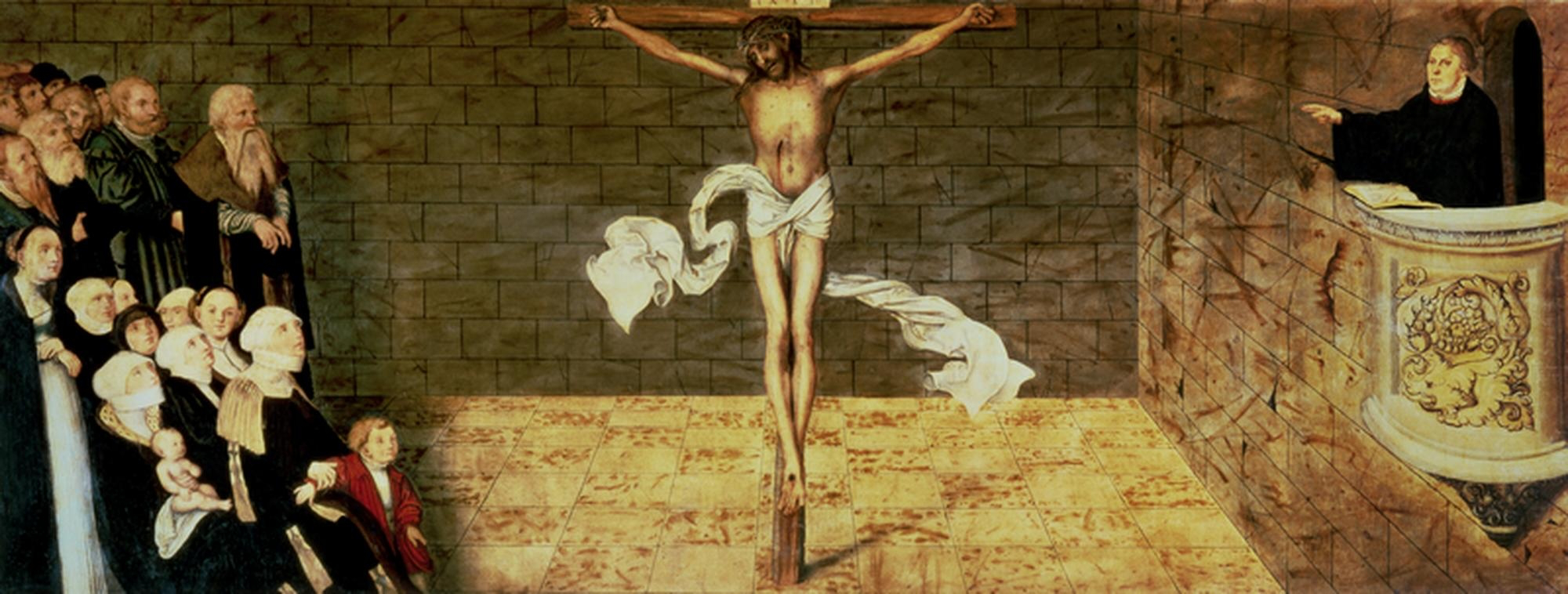
Lucas Cranach was a Renaissance painter and printmaker in woodcut and engraving. He was a friend of Martin Luther and his wife Katharine von Bora. In one of his paintings (1547) focusing on the Cross of Christ, Cranach depicts Martin Luther preaching to the congregation. I remember this particular painting vividly as it hung above the bookshelf in my house growing up.

image.png

It shows Martin Luther standing in a pulpit perched high on the wall of the chancel at the front of the medieval church. One of Martin Luther’s hands rests on the bible. And he points with his other hand to a cross with Jesus hanging bloodied bruised planted in the floor space between Luther and the crowd gathered in the church. Jesus hanging on the cross forms the center of this work of art.

Today this painting comprises one of the plates surrounding the altar in the Wittenberg church where Luther preached. As such, we often recognize and associate this painting with the ‘Reformation altar’.

Its prominence in Lutheran history suggests how poignantly this painting describes Luther’s theological bias: The Cross stands at the center. And Christ crucified informs everything in the church and even our reading of the bible.

Before we can embrace deeper understanding of Martin Luther’s theological claim that we find salvation by God’s grace—which finds us— through faith, we must first encounter the centrality of the Cross in Luther’s thinking and prayer.

In the seminary that I attended[1], we used the term, “Theology of the Cross”. Martin Luther first coined the phrase in his Heidelberg Disputation written in 1518. A theology of the cross is a way of understanding and imagining God. Fundamentally, in addressing God, we need to ask the questions: What is my image of God? Where is God primarily revealed? How is God best known?

Luther provided an answer: God was, and is, being revealed to us in all truth most clearly and unequivocally in suffering. In the vulnerability and pain of death on the cross, Jesus revealed—and continues to—the God who suffers alongside us wherever there is pain and suffering in the world. It is no wonder, then, that the longest sections in each of the four Gospels in the New Testament are dedicated to the various passion narratives[2]of Jesus.

Therefore, the Cross is theologically vital not just to Luther but to the Apostle Paul (the central figure of the Acts of the Apostles and some of the earliest Christian writings and Epistles) who central theme is: “God’s power is shown in human weakness.”[3]

The Theology of the Cross is contrasted to a Theology of Glory. Especially today among spiritually materialistic cultures in the West, what has been coined ‘a prosperity gospel’ has grown in popularity. This theology of glory presumes God validates faith, and is only validated by, success, measures of progress and triumphal conquering over any weakness or adversary.

A prosperity gospel fueled by unbridled optimism avoids places of defeat, failure, vulnerability and weakness as having anything to do with divine identity or purpose. A theology of glory undermines real people and a God who is known in the darkest times and places of life. It compromises and even derides a common humanity and the losses we all endure.

Prayer, as I have said, is the act of letting go. If prayer begins with God, and our address of God, we must presume before all else who this God is, and how this God is revealed—in scripture, in tradition and in our own experience.

One of the first creeds that circulated among the earliest Christians is from a hymn imbedded in Paul’s letter to the Philippians 2:5-11. The poetry first describes the descent of God. This is the primary movement of God, and of faith: downward. The Almighty chose to enter the lower and lowest regions of human birth, life and death. Only after this primary downward movement can the rising out of the depths happen.

Theologians over the centuries have used the term kenosis, from this text in Philippians, to capture the primary movement of faith. It starts with Christ’s self-emptying and letting go of God’s pure, divine nature. In God’s humility, Jesus compromised a perfect divinity in order to take on the fullness of a human existence.

Our God is a God who lets go, releases, self-empties what has become part of the God-self. This calls for a descent of the soul which in the words of St John of the Cross entails, indeed, a ‘dark night’ of the soul. Prayer is not easy, in so much as it may very well be simple.

Prayer, in the words of Laurence Freeman, “… always involves us in the paradoxes of growth, the cycle of losing so that we can find and then of having to let go of what we have found.”[4]

Prayer is a continual process of detaching and dislodging from places of comfort, stability and strength. Prayer is a deconstructive process. It is disruptive. In prayer we begin first to detach our self from all that we are attached to, all that has defined our identity and lives, all our constructs—mental and material—that constitute the construction and containment of our ego. All of this, in prayer, is placed on the precipice of loss.

All is not lost, however. Because in action and contemplation prayer’s aim and understanding is the prayer of God and for the sake of the God of the Cross. “Prayer calls the active person to a life of interiority and soul discovery … by detaching from all the fruits of action and doing everything purely for the love of God.”[5]In letting go, we discover our true self in God which includes and transcends all that we have been and are becoming.

By kenosis we resolve the Lutheran paradox. Some complain that the grace of God is cheap, such as Dietrich Bonhoeffer last century who sacrificed his life for a greater cause of justice in the Nazi regime. He wrote a book entitled, “The Cost of Discipleship”. Bonhoeffer argued that the theology of the cross ought not lead the Christian to rest on their laurels and not do anything. Just because we are saved by grace and since Christ lost everything for everyone once and for all doesn’t mean there isn’t a point doing anything. There is a cost of discipleship.

In prayer, we move into response because prayer is not for our sake. When we pray, it is not my prayer or our prayer. Praying is like walking along a path on the banks of a fast-flowing river and frequently stepping into the water. The current is strong. It is moving in one direction. We immerse ourselves into presence, the presence of Christ. We fall into the river of prayer that continues, the prayer of the living, resurrected Jesus, whose destination is union with God.

It is in Christ’s name we pray, and for the sake of our God who chose to be revealed in the humility and defeat of the Cross, in the most desperate human condition possible: death. We step maybe timidly yet faithfully into the water, fast flowing towards the great hope of new love and life in God. 

Questions for reflection and discussion:

  1. When you pray, after considering your image of God, what is God doing? What is God’s purpose—a purpose that is consistent with that image of God? Construct your prayer by strengthening the connection between image and function. If God is revealed in human suffering, where does that suffering lead? If God is compassionate, why? If God is patient, for what purpose? If God forgives and heals, to what end? Practice making this relationship between image and function as clear as possible before you make any petition to God. And write down some examples of the connection you make between image and function of God, to share with others next time (See copies of “Prayers of the Day” in Evangelical Lutheran Worship for good examples of how short prayers can be constructed).
  2. What is one non-negotiable spiritual practice and/or belief you would hold onto, if everything else had to be take away? (Ask yourself this, after visiting a place of worship other than your own)
  3. If time was short, what is most important to you in the end? Have you had this crucial conversation with those closest to you? If not, why not?

[1]Martin Luther University College (formerly, Waterloo Lutheran Seminary)

[2]The last several chapters of Matthew, Mark, Luke and John describe in detail the last days of Jesus leading to his arrest, torture and death on the cross. These passion narratives form nearly half the total lengths of the Gospels.

[3]1 Corinthians 1-2

[4]Laurence Freeman, Christian Meditation Newsletter, June 2005.

[5]Richard Rohr, Daily Meditation, 17 August 2018

The Meditation Journeys

This text represents a draft of a talk I gave at the Essential Teachings Weekend (ETW) for the Canadian Community for Christian Meditation (wccm-canada.ca) in Alexandria, Ontario (September 21-23, 2018). This was the third of three talks, entitled “Stages of the Journey” which complemented the first talk (“The Essential Teaching”), and the second talk (“History of the Tradition”).

STAGES OF THE JOURNEY

The notion of journey, or pilgrimage, originates in the very birth of Christianity. Christ-followers came to be known as “Christian” only after Christianity became the official religion of the empire in the fourth century C.E. But until then they were known as those who followed in the “Way”, implying a path, a road, a journey to be followed.[1]

The notion of motion is integral to those who try to follow Jesus to this day. In the last several decades the pilgrimage has become very popular, especially the Camino de Santiago which attracts hundreds of thousands of pilgrims every year. Many who walk the eight-hundred-kilometre journey across the Iberian Peninsula in northern Spain will attest that the journey is a metaphor for the passage of life or traversing some interior path.

Indeed, the exterior journey, such as the Camino, mirrors the internal journey where one explores the contours of the heart and the landscape of the soul. It is a journey that takes time and is fraught with danger. And, at some level, determination, dedication and faithfulness.

Speaking of Spain, it was perhaps the great Spanish mystics of the sixteenth century – Theresa of Avila and St John of the Cross – who first in their writings exemplified the interior and often difficult journeys of faith, such as in ‘The Dark Night of the Soul’. Recently, Richard Rohr describes it best when he asserts that it is through great suffering or great love by which we move along the path towards meaningful change and growth. Crises of faith and challenging circumstances of life are invitations to go deeper into the truth of self and the presence of God.

I want to describe these two journeys to you by using several metaphors—involving water, an hourglass, a wagon wheel and the Exodus story from the Bible describing the desert wanderings of a people. These symbols and images I hope will convey effectively the meaning of these journeys.

When we commit to meditation, we are undertaking what I would summarize as two journeys, operating on a couple of levels.

1.THE FIRST JOURNEY

The first is journey that happens during the time of the meditation.

The Ottawa river at Petawawa Point: the rough & the smooth

I used to live close to Petawawa Point in the Upper Ottawa Valley. Petawawa Point was a lovely spot on the Ottawa River which broadened out into a large lake dotted by several islands. And, I loved to kayak through and around these islands and waterways.

When I first put out onto the river at the beach I was immediately into the main channel lined by the green and red marker buoys, where all the motor boats would roar through. This was the turbulent section of my paddle. I often fought the waves created in the wake of speeding, noisy boats. This part demanded my determination, resolve, and good intention to get past the hurly-burly and through the narrow passage between a couple of islands.

Once through, the water opened up into an area of the river where the large, loud motor boats avoided – only the loons, hawks and sometimes eagles. Here was the more peaceful part of my paddling experience, one that I have treasured to this day.

Meditators have often mentioned to me—and I have experienced this too—that during the first fifteen to twenty minutes they are fighting themselves, their thoughts and distractions. And then something inexplicable happens, and they finally get into some kind of peaceful rhythm with their mantra in the last five minutes! Whether it takes you fifteen minutes, or only a couple of minutes into the meditation, it’s important to keep paddling even when things settle down in your brain.

You see, the temptation once I got through the busy channel into the peaceful expanse of the river was to stop paddling altogether and just float for a while. I would gaze at the birds flying, the clouds in the sky and the distant Laurentian Hills. It was beautiful!

In meditation, this is called the “pernicious peace”, where we just float in some kind of relaxed state our mind really doing nothing and it just feels good and we don’t want to do anything else. I soon realized however I wasn’t doing what I had set out to do. I came to the river to paddle, not to float. And as soon as I dipped my paddle again in the peaceful river, I found my stride, purpose and joy.

When we begin in our meditation, we usually immediately encounter the distractions of the mind. For example, I ruminate over what I am I having for supper, what groceries I need to pick up, what errands I need to run, how will I handle a problem at work or in my family, where am I going on my vacation, the main point of my upcoming sermon, etc.

How do we respond to these distractions? Do we simply float in some sleepy, dream-world, following the course of this stream-of-consciousness? Yes, sometimes we do fall asleep during meditation. It’s good to be relaxed. Yet, we also pay attention and are alert to the experience by remaining faithful to the paddle, so to speak, to the mantra. We focus the mind.

On the underwater rock: dealing with distractions

Another water image, from Thomas Keating, may help us.[2]It is the example of sitting on a large rock on the bottom of the river. Here, deep under the water you watch far above you the boats of various sizes and shapes float by and down the river. These boats represent all our thoughts and distractions. Often, the temptation of our mind is too great, and we push ourselves off the rock—it’s so easy! —and we swim to the surface.

Sometimes, we will even climb into the boats and sail on down the river in these thoughts. In other words, we will let our minds sink into thinking about it for some time in our meditation. Of course, when we do this, we are not saying our mantra, which is the discipline and faithfulness of sitting on that rock down below.

It’s important not to be harsh with yourself on this journey. Give permission for the boats to come by your mind in this river. Then, as you return to the word, you let these distractions keep floating on down the river. Let them go. Return to the place of deep silence, stillness, on the rock deep below.

Despite the incessant distractions of the mind that come to me during my meditation, I continue to ‘return to the Lord’ and my mantra. Someone once said that it is ok to ‘catch yourself’ in a distraction during meditation. In fact, the more often you catch yourself and gently return to the mantra, the better. Why? Because each time you return to the word, it’s one more time you are loving God. Each time I bring my concentration to the saying of the word, I am offering my love to Jesus. Each time I say the word, I am saying, “I love you” to Jesus.

The journey throughout the meditation period may appear simple. We sit quietly and in stillness for twenty minutes not doing anything except saying, interiorly, the mantra. But it is not easy. We confront in this journey the imprinting of our go-go culture and a hyper-active environment upon our egos. We encounter our very humanity in this journey —

A humanity which incessantly strives to accumulate more information and judge progress according to expectations. We already go into it expecting it gets easier over time. We expect benefits to accrue, like lower blood pressure and more patience. And when nothing like this happens after meditating for a few months or years, we give up. This is a spiritual capitalism.

We encounter our very humanity which also craves stimulation and distraction. Already in 1985, Neil Postman wrote a book indicting our culture with the provocative title: “Amusing ourselves to Death”. For most of our daily lives we choose to keep busy or entertain ourselves rather than sit still and face the truth of ourselves. No wonder we are bothered by distraction during meditation.

We encounter our very humanity which finds self-worth in active productivity. We do therefore we are – the mantra of our culture. The more we produce, the more we have to show for in our day, in our vocations, the better we are. So, it just doesn’t make sense from this perspective to be so unproductive by sitting still and doing nothing with ourselves, really. What’s to show for, after twenty minutes of idleness?

And so, we may also, at deeper levels, encounter anxiety, fear and/or anger – which represent our resistance to the journey of our meditation. These normal, human feelings, given now the freedom of space, time and a loosened ego, erupt to the point of a significant disruption.

When I first started on this journey in 2004, I was beset by anxiety, to the point where I felt that I might explode during the silence and the stillness, to the point where I felt I would run screaming from the meditation room. The waves in that channel from the wake of the speeding motor boats threatened to swamp and drown me! I remember how I resisted the letting go, by asking for example that I not sit in the circle but by the wall in a corner of the room. And then, by suggesting we should sit wherever we want to, not necessarily in a circle. Anything to assert my control, even over the meditation period.

Here, depending on the nature of the deep-seeded emotional pain, you may want to encourage those who find meditation times a time of suffering to seek help to deal with whatever is being uncovered—loosened—during meditation. Some have expressed concern that when we open up our inner lives in meditation, the devil/evil will come in. Laurence Freeman, to this question, said: “It is more likely the devil will come out! Negative feelings and the forces of the shadow will get released as repression is lifted. This is quite natural although it’s important to be prepared for the inner turbulence it can create at times.”[3]

This becomes a journey, then, of healing and transformation.

2. THE SECOND JOURNEY

This journey of healing, then, links us to the second journey operating at another yet concurrent level. The second journey we undertake when we meditate connects us with our whole life, indeed life’s journey.

Being a meditator is about slowly but surely learning how to meet life’s greatest moments with grace, acceptance, generosity, courage and faith. Meditating teaches us how to navigate a crisis of faith, a crisis in our relationships, in our work and in our health. It is about forming an attitude toward life in general. Meditating trains us to bea prayer rather than merely say prayers from time to time. This is contemplation: an inner attitude to all of life so that we are indeed praying always, or as Saint Paul puts it, to pray without ceasing.[4]

The dropping stone in water: deeper we go & letting it happen

James Finley talks about a dropping stone in the water, a journey characterized by a deeper simplicity, a deeper solitude and a deeper silence. He describes well this image of a descent.

“Imagine,” he writes, the stone is “falling … And the water in which the stone is falling is bottomless. So, it’s falling forever … And the water in which the stone is falling is falling along an underwater cliff. And there are little protrusions along this cliff and every so often, the stone lands on one of these protrusions; and pauses in its descent. And in the movements of the water, it rolls off and it continues on and on and on and on.

“Now imagine you are that stone; and imagine we’re all falling forever into God. And imagine you momentarily land on a little protrusion where you get to a place and where you say, ‘You know what? I think I’ll stop here and set up shop and get my bearings and settle in. After all, this is deep enough. That’s as far as I need and want to go. It’s comfortable here.’

“And then you fall in love, or your mother dies, or you have terminal cancer, or you’re utterly taken by the look in the eyes of one who suffers. And you are dislodged, by [a great love or great suffering], dislodged from the ability to live on your own terms and from the perception that the point you’ve come to is deep enough for you.

“And so, you continue on your descent, experiencing successive dislodging from anything less than the infinite union and infinite love which calls us deeper.”[5]

Meditating teaches us not to give up on this journey to a deeper contemplation. Some of the comments I have heard from parishioners who came only to one or two sessions of meditation. And then they declare as if for all time: “I don’t like it.” “It’s not for me.”

Meditation is emblematic of staying the course with what is important, of giving what is important a chance and committing to the path, the pilgrimage – even though we fall short time and time again. And as John Brierley mentions in his introduction to his popular guide for pilgrims, “We are not human beings on a spiritual journey, we are spiritual beings on a human journey.”[6]A very human journey. We will encounter and deal with all our inner and outer limitations on this journey. Sometimes we will need to stop because the human path challenges us in ways we must address. Sometimes the human path will keep us from embracing the fullness of the journey in what it offers.

The Exodus: a journey of transformation to liberation that never seems to end

The Exodus, from the bible, is a narrative of a desert wandering that takes a long time, much longer than you would think: If only the Israelites under Moses’ leadership walked a straight line from start to finish!

The journey, however, is much more than you think. After escaping the shackles, confines and suffering of slavery in Egypt, the Israelites are now a free people, or so you would think. Liberation as the goal is however a process that involves transformation. They are free to go to the Promised Land, yes. And yet, their journey in the desert, confronting the fierce landscape of their souls, is rife with resistance and conflict as they take a long and circuitous route towards their liberation.

They complain to Moses. They say they would rather return to the fleshpots of Egypt than eat the Manna from heaven given in the desert. They create distractions and build a golden calf. It’s not an easy journey for them, to get to the Promised Land. It’s not easy, to be free.

Yet, as what happens on the first journey (during a meditation period by returning to our mantra), we return to the Lord our God over and over on the journey of life. We learn over time to trust the journey and stay the course. By being committed to the journey of meditation, we cultivate the spiritual muscle of trust, despite the resistance and conflict we confront within us.

Trusting in God. Trusting in life. Trusting that the trajectory of our pilgrimage is heading in the right direction despite all the bumps in the road. As the small stone on the underwater ledge drops to a deeper level through every crisis and twist and turn of life, we learn to surrender and let go. Richard Rohr, I believe it was, said that all great spirituality is about letting go. Of course, trusting this process involves taking the risk as we ‘fall’ deeper into the mystery of life and God towards an unknown yet hopeful future.

Riverbank: dipping into something bigger

On this journey of life we remain faithful to the path, which winds its way on the banks of a great river. The river is moving. We stay connected to the river, regularly stepping into the waters to say our mantra. We step into the flow of the river. The current is strong. The River is the prayer that continues in our hearts that is Jesus’ prayer to Abba.[7]

When we so dip into the prayer of Christ, which is ongoing, we participate in the living consciousness of Jesus who continues to flow in the trinitarian dance of relationship with God. In meditation, we learn that life is not limited to myprayer or ourprayer. Dipping into the river is stepping into a larger field of consciousness. It is dipping into the very prayer of God in which we participate every time we meditate.

If this journey is not about us, we therefore look to relate to one another, especially those who suffer. We see in the other our common humanity and act in ways that are consistent with the grace that first holds us. In the end, meditation’s journeys lead us beyond ourselves, to others in love, and to God in love.

Meditation, therefore, is essentially a journey in community. It’s a pilgrimage we undertake with others and for others. It’s not a solitary journey. Thus, the importance, at least, of attending/being part of a weekly meditation group.

Contemplation, then, leads to action. The journey of life, like the journey through the time of meditation, embraces paradox. While on the surface seeming opposite and incompatible, contemplation and action are integrated into the whole. Both are essential on the Way.

In truth, following Jesus is embracing paradox. “In order to find your life you must lose it,” he says.[8]Later, Paul announces that strength is found in weakness and the weak have shamed the wise.[9]Of course, the major paradox of the faith centres on the Cross; God is defeated. And in that vulnerability and loss, Christ and Christ-followers discover new life and resurrection.[10]

To do well on the journey of contemplation, on the path of meditation and indeed life, is to accept the ambiguities, the ‘greys’ and the uncertainties of the Way. As any peregrino will tell you on the Camino de Santiago, there is no end to the daily surprises and challenges that meet the faithful pilgrim. If one’s mind is already made up about what to expect and how it should go, disappointment and premature abandonment of the journey is likely to follow.

To do well on the journey corresponds to the capacity you have to hold paradox in your heart. The solution finds itself more in the both/and of a challenge rather than an either/or. Perhaps the faithful pilgrim will have to compromise an initial expectation to walk every step of the way. And, in dealing with an unexpected injury, the pilgrim might need to take the train or bus for part of the journey. In other words, the dualistic mind is the enemy of the contemplative path.

On the spectrum between action and contemplation, where do you find yourself? If you want to become a better meditator and enrich your soul, then seek social justice. Become active in the cause of a better humanity and a better creation. Speaking to a group of social activists and community organizers, I would counsel the opposite: If you want to become a better justice-seeker and advocate, then dedicate more of your time to meditation. Both/And.

The hourglass: flow ever deeper

 The direction of the flow in an hourglass starts at the top in a basin that collects all, then moves downward into a narrowing, finally coming through into an expansive region flowing ever deeper and wider.

The top of the hourglass represents all that our mind grapples with – the squirrel brain. It represents all our efforts, desires and intentions – good and bad – of a furtive, compulsive ego to come to the expressed need for this practice. “I need some quiet in my life.” “I enjoy the silence shared with others.” “I need to slow down.” “I like being by myself.” Admittedly, many introverts are enticed by the prospect of meditation. Although these are the same people who realize, on the path, it is much more than stoking the flames of a rich imagination or escapist tendencies – all ego-driven.

On the path, then, meditation leads us deeper into the heart, at the narrows. This is the place of a pure heart, a singular, aligned heart-mind place—some have called it the still-point.

From this point, the journey then expands as we go deeper and farther into the broad, ever-expansive areas, towards the infinite depths involving others and participating actively with all creation.

The wagon wheel: towards the still point

Teachers of Christian Meditation, such as Laurence Freeman, have used the image of a wagon wheel to describe how different forms of prayer relate. These various ways of praying – body prayer, labyrinth walking, petitionary, sacramental, song, poetry, art – represent the spokes on the wheel. All of them attach to the centre.

At the centre of the wheel is the hub. And when the wheel is in motion, which it must be in order to fulfill its purpose and continue on the road, the one part of the wheel that remains still and sure is the hub. This is the place of meeting, convergence, the point, the centre: the Jesus consciousness. Always in motion yet always still. The still-point. Another paradox of prayer. Action and Contemplation.

If the hub is vibrating and not still while the wheel is in motion, then the wheel is out of balance and there is something wrong. The whole riggings may even fall apart if not attended to! For the wheel to function properly, the hub must remain still even as the wheel is rotating at high speeds.

It is here at the infinite center, time and time again, where our prayers lead. Like the labyrinth whose destination is the centre, it is on the path to this centre where we experience a taste and a foretaste of the feast to come, where we taste the freedom and joy of the Promised Land, a land flowing with milk and honey. Where we can be free.

Questions for reflection

  1. Which image presented here about the journey of meditation touches you immediately and speaks to you most effectively?
  2. On the spectrum between action and contemplation, in which direction do you naturally lean? What are some ways you can improve the balance in your life?


[1]Acts 18:25; 19:9; 19:23; 22:4; 24:22

[2]Cited by Cynthia Bourgeault, transcribed from the recording of a live retreat titled, An Introduction to Centering Prayer given in Auckland, New Zealand, in October 2009 (www.contemplative.org)

[3]Fr. Laurence Freeman, A Pearl of Great Price.

[4]1 Thessalonians 5:17

[5]  Adapted from James Finley, Intimacy: The Divine Ambush, disc 6 (Center for Action and Contemplation, 2013); cited in Richard Rohr, Daily Meditation, www.cac.org, April 27,2018

[6]John Brierley, A Pilgrim’s Guide to the Camino de Santiago(Camino Guides, 2017)

[7]In the Garden of Gethsemane on the night before his death, Jesus addressed God in prayer with this Aramaic word, meaning ‘Dad’.

[8]Matthew 10:39

[9]1 Corinthians 1-2

[10]All four Gospels – Matthew, Mark, Luke & John –  conclude with lengthy passion narratives.
Over mangoes

IMG_7760

Mercy Lawluvi’s first days in Canada were met by the famous ice storm. Arriving from Ghana a young woman in 1997, Mercy had never seen first-hand, touched nor felt snow, let alone freezing rain that made moving about a danger and terror for slipping and falling.

Mercy was alone. And she felt lonely, surrounded by the four walls of her apartment. She couldn’t even see her backyard garden bushes and trees buried and drooping under the heavy, thick accretions of ice.

Nevertheless she decided to slip-and-slide over to the nearby Loblaws. Surviving this first test of Canadian living, she made her way to the fresh produce section. Mercy was delighted to find some mangoes, her favorite fruit.

And as she was standing there, turning over a small reminder of her homeland, a woman came up to her looking for mangoes herself. “Hello,” she smiled. “The mangoes look good. What’s your name?” she asked.

“Mercy,” she responded.

“Where are you from?” the woman asked. “Ghana, in Africa. And these are my favorite fruit. I am so happy they are here.” And so, the two stood there for a long time chatting and exchanging mango recipes. Finally, the other woman asked, “What is your occupation?”

“I am a teacher.”

“I know the administrator of an ESL (English as a second language) school in Ottawa. Let me get the name of my friend to you. Maybe you see where that goes?”

“Thank you so much!”

Twenty-one years later, Mercy stands before us during the “Welcoming the Newcomer” session hosted by the Ottawa Lutheran Refugee Sponsorship Committee[1]this past Thursday, to tell us this story of her first welcome to Ottawa.

Because of the kindness shown by that nameless woman in Loblaws twenty-one years ago, whom she has never since met again, Mercy was able to find the emotional strength and resources to settle well and grow in her new country.

She said how much that simple encounter by the mango display made all the difference in the world to her, not only on that first day during the ice storm to help her through the loneliness and fear. But how important that encounter was for her development, networking and success-finding in her new home in Canada. Someone—a stranger to her— acknowledged her. And was genuinely interested in her.

Twenty-one years later she stands before us as the executive director of “Immigrant Women Services Ottawa”.[2]

And it all started by a caring, open-hearted person asking, “What is your name?”

Indeed, what is our name?  We have a family name sign in front of our house. In my first parish twenty-one years ago in the heart of farmland in southwestern Ontario, every house along the long and straight rural concession roads had one of these kinds of signs hanging or posted in the front yard.

IMG_7762

Fast forward to today, I believe we are the only house in Arnprior, maybe even the whole of Ottawa, who has one. Obviously, it’s not a thing.

I understand Millennials prefer their private, cocooned lifestyles. I understand that, fueled by fear, we are hyper-sensitive about things like identity-fraud and being targeted by criminals. So, if there’s anything we can do NOT to be publicly identified or exposed, the better.

I wonder, though, how much we have, because of this attitude, dampened, even snuffed out, any collective heart-filled reaching out. Because before newcomers, or anyone for that matter, can get to know us and trust us, we need to be available, visible, transparent, accessible to them. In other words we cannot hide from others, and then say that we are welcoming.

I read this week that the first step to building an ethical culture in churches, in business and in society in general, is to let people be who they are. Without needing to persuade, sell something, impose our opinion or argue a point. Without believing they first need to conform before I/we will give them any time. Without needing to protect, defend and uphold my or ‘our’ way of thinking, fearful that any such approach means a loss of integrity or personal safety.

Letting people be who they are, first. Means an open heart. Means, listening first. Means, asking questions first. Means, listening for points of similarity – mangoes. And, then, when trust begins to build, going from there.

“I will pour out my thoughts to you; I will make my words known to you,” Wisdom says.[3]I have the image of a couple of friends getting together at the end of a long day over drinks. And each takes turn pouring out their hearts to the other. Arms waving. Voices rising and falling with each impassioned response. Laughter. Silence. A mutual-inpouring!

I heard recently that each human being requires these two things to survive and thrive: unconditional love, and complete understanding. Both are met in this image from the Wisdom writings of the Bible. An intimacy that affords love and understanding to the partners involved in relationship.

Intimacy. God promises a deep and lasting connection within us. Despite our foibles, our missteps, our compulsions. God promises a deep connection within us despite our mistakes and failures.

Transparency, on the surface, goes only so far to the truth of who we are. You may see the name sign outside my home. You may see my license plate on the highway or city streets. This may be a good first step, I believe, to an honest transparency and invitation for conversation. But, that only goes so far.

When Jesus asks his disciples who they say he is, the question reveals more about the disciples than it does about Jesus. “Who do you say that I am?”[4]Jesus ask them, not because Jesus doesn’t know the answer himself but because the disciples are on a journey of growth with Jesus. These wayward disciples don’t often get it right on this journey. They miss the point of Jesus time and time again.

Jesus’ rebuke of Peter is consistent with how the disciples are portrayed by the Gospel writer.[5]And while Peter might I.D. Jesus correctly, while Peter can give Jesus his proper title and name—the Messiah—he still doesn’t understand what that name actually means in Jesus:

That this Messiah will suffer and die; that this Messiah will be rejected by the powerful, scorned by the knowledgeable, that this Messiah will be arrested a criminal, tortured and die a brutal death by capital punishment. And that this Messiah will rise again three days later. The disciples, Peter among them, do not really understand Jesus.

Just because we may know God’s name, doesn’t necessarily mean we know what is called of us under that name. Just because we can name Jesus and say the right words of faith doesn’t mean we get the follow-through right all the time. In another Gospel, Jesus says, “Not everyone who says to me, ‘Lord, Lord,’ will enter the kingdom of heaven, but only the one who does the will of my Father in heaven.”[6]

Because, ultimately, our titles and our names only give us an entry point into who we are. Words, titles and names cannot capture the totality of who we are. As James so pointedly writes, the words we say by our tongue will get us into trouble; “though small, [the tongue] stains the whole body.”[7]

Getting it right verbally isn’t what faith is about. It’s rather about experiencing God in our own lives and in relationship with others. Wisdom pours out her thoughts into us, not at us. God writes God’s law upon our hearts, deep within, despite our mistakes.[8]This faithful following of Jesus is not just a function of our brains.

Intimate relationship with God and with others in Christ is a matter for the heart. We know God and we know truth not by the words we say or the names with which we identify, but by a deeper knowing marked by deeds and experiences of faith, hope, trust and love.

When the heart is in a good place, we start simply, in small ways, to see the other, reach out to them with a smile and a question: “What is your name?”

And God replies, “Mercy.”

[1]olrs@bell.net

[2]http://www.immigrantwomenservices.com

[3]Proverbs 1:23 NRSV

[4]Mark 8:29

[5]Mark 6:51-52; Mark 8:21; Mark 9:32; Mark 10:23-32,38; Mark 16:13

[6]Matthew 7:21 NRSV

[7]James 3:1-12 NRSV

[8]Jeremiah 31:33

Canada is a neighbour

Happy Canada Day!

On this July 1stit is good to reflect on what makes Canada great. Let’s be positive! What is it about our society that stands out in a positive way – amid all that is not so good?

I would like to say that we are a country that aspires to a healthy neighbourliness. Being a good neighbour – whether striving for better relations with Indigenous people, whether relating to newcomers to Canada today, whether reaching out in kind to those who are different from me who live across the street – is our national identity.

Asserting this quality for Canadians, I believe, is not new. Being a good neighbour is not a recent trend in progressive society. Hearing preachers spout the virtues of neighbourliness reflects a deep seeded consciousness influenced by popular culture already in the last century.

It was in the 1950s when children fell in love with the Friendly Giant on TV in Canada. Some of you might recall watching actor Bob Homme on CBC TV from 1958 until 1985 being friendly to his puppet animal friends.

Then there was Mister Rogers’ Neighbourhood which first aired in 1968. Although an American show, did you know that Fred Rogers spent several years in Toronto in the early 1960s working with Ernie Coombs – Mr. Dressup – airing a prototype show called the same Misterogers?

Over his career, Fred Rogers was intentional about being more and more inclusive. He brought, for example, an African American person onto the show yet didn’t draw undue attention to it. This was a subtle yet poignant statement about neighbourliness when American white culture was anything but, towards people of colour.

To assert that these cultural icons were birthed in Canada would not be an overstatement. To be Canadian is to be a good neighbour. It is in our DNA. It is our calling, our witness to a world that wants to be anything but, especially these days.

Yet, it seems every generation of Canadians needs to learn anew how to be a good neighbour. We need to be continually reminded and encouraged to practice being a good neighbour because we tend to be a fearful lot. And fear keeps us from this holy calling.

Having faith doesn’t mean the absence of fear. Having faith means stepping into the fearful place. Having faith means action. It means “leaning into” the situation as we are.[1]

Our lay delegate from Faith Lutheran Church to the Eastern Synod Assembly in Toronto last week, admits being fearful taking the train for the first time. Julia is a seasoned, experienced OC-Transpo bus rider here in Ottawa. Despite the similarities in travel experience between the train and bus, she confesses taking the train across the province for the first time was an anxious affair.

What is more, we missed each other on the train ride to Toronto. Even though we were on the same train, we boarded at different locations – Julia, downtown; and me, at Fallowfield Station in Barrhaven. In fact, as it turns out, we were on the same car – but I never once caught sight of her.

Until on the last leg of the journey, when we were on the Union-Pearson Express train. My phone dinged. Julia texted me to confirm whether I knew where to catch the hotel shuttle to the convention centre where the Assembly was to take place.

Despite her fear of riding the train for the first time, and alone, Julia reached out to me. She was being a good neighbour by making sure I was ok. Her reaching out to me was helpful since, truth be told, I was not sure about where to catch the airport shuttle bus.

“Who is my neighbour?” Jesus asks before telling the story of the Good Samaritan.[2]“Liberated by God’s Grace … to be neighbour” was the theme of the Eastern Synod Assembly. Through thoughtful, provocative and compelling bible studies, song, and interactions with various peoples, the Assembly reflected and re-committed to become even better neighbours, as a church.

Interesting, in keeping all this in mind, that we encounter the nameless woman in the Gospel reading for today.[3]She approaches Jesus in the crowd, hidden, secretly. No wonder. She is powerless and outlawed in public spaces on account of her bleeding.

The main point of the story is not that she is miraculously healed. She could have remained hidden, quietly disappearing into the crowed after she is healed. That is the way she would have wanted it, likely.

The point is that Jesus calls her into a deeper relationship. She must come out of her private suffering. She must confront her fear, and make a deeper connection with herself, with others, and with Jesus.

“Who touched my clothes?” Jesus says out loud even though he knows the woman has already been healed when he felt the power drain out of him.[4]He, too, could have enabled the woman’s secretive behaviour, letting her go and moving on. He could have protected her in her fearful existence after she is cured.

Instead, Jesus calls for her to step up and be known. Demonstrating incredible courage, the woman responds to Jesus’ call and approaches him “in fear and trembling, fell down before him and told him the whole truth.”[5]

Jesus seeks out a relationship with her. It is of God to do this. God continues to call us into ever deeper relationship – with ourselves, with others and with God. The point of the Gospel is that we affirm our connectedness with others in healthy and compassionate co-existence. This is the path to truth.

Jesus’ ‘touch’ can heal us and the world. The touch of God’s grace can give us peace. We are shaped and made human in relationship with others. All our relationships – in church, in friendships, in marriage – are not just something extra added on to life for distraction and entertainment as if we would be complete human beings in individual isolation.[6]Relationships are not some added feature to our lives in order to get something, a means to some autonomous end.

Relationships are the fabric of life. Relationship – touch, if you will – makes us human and whole. Being neighbourly can heal us, make us better people. “Perfect love casts out fear,”[7]our scriptures say. Love can only be expressed in relationship.

The reason Julia was not afraid of riding the bus in Ottawa, was because she was practiced at it. She had done it many times. Even though the train is not that much different, she had never before taken the train. The difference is, some intentional, risk-taking exercise.

Later this week, members of Faith council will be volunteering for a couple of hours at the Mission downtown for homeless, impoverished men. We will get a tour of the facility and help give out some ice cream to those who are there. Practice, to move beyond fear to faithfulness, isolation into community, to where our neighbours are.

We need to practice being a good neighbour – to those who are vulnerable, to those who are powerless, to those who are stigmatized, to the homeless, the LGBTQIA+ community, to refugees and migrants. We have to lean in to the places of fear in our lives and to take some risks vis-à-vis people who are different from us. In doing so, we realize we are not alone, and we have meaning and purpose in our lives for the common good.

Canadians and Christians share something in common, to be sure. We are called to reach out. And be a good neighbour to the world. We are not left alone stuck in our fear. Because God continues to call us into the deeper waters of grace and love. God will never abandon us, despite our fear.

Let us approach boldly the seat of grace in Christ Jesus our Lord. Amen.

[1]Brother Luke Ditewig, “Brother, Give Us A Word” for June 28, 2018 (Society of Saint John the Evangelist) friends@ssje.org

[2]Luke 10:25-37

[3]Mark 5:21-43

[4]v.30

[5]v.33

[6]Michael L. Lindvall in David L. Bartlett and Barbara Brown Taylor, eds., “Feasting on the Word: Preaching the Revised Common Lectionary” Year B Volume 3 (Kentucky: WJK Press, 2009), p.192.

[7]1 John 4:18