

Present to Presence

photo by Martin Malina

About once a month I have lunch at Denny’s on Merivale with a dear friend of mine. His name is Jack Murta. He is a retired politician. He was a Member of Parliament from Manitoba in the late 1980s. A member of the Progressive Conservative Party, Jack served as the Minister of Tourism in the Brian Mulroney government.

Today, he sits on the Board of the Mission in downtown Ottawa and leads Christian Meditation groups there for people who are homeless. Jack and I spend a lot of our time talking about politicians and how they related with one another back in the day. Indeed, much of our conversation recalls the past.

In the Gospel reading for today (John 2:1-11), guests to a wedding party in Cana, Galilee, meet most likely in a garden setting, to celebrate a joyous occasion.

Certain clues in the story attract our attention. I’d like to point out, first, the empty jars normally filled with water used for the Jewish rite of purification. People engaging this rite did not drink the water. It stayed on the outside of their bodies when they immersed themselves in the bath.

The jars in this story direct peoples’ attention to their past, their Jewish tradition and ritual. The garden also was the usual setting where Jewish weddings took place, a reference to the Garden of Eden in the first book of the bible – Genesis (Shaia, 2021). The jars and garden are indicative of tradition, the past, the way things had always been done.

And not only does the Gospel look to the past, it points us to the future as well. “My hour has not yet come.” Jesus hints to Mary about his future path, when Jesus’ purpose will be fulfilled on the cross and by the empty tomb.

But it’s the present moment where the miracle—the sign—happens. It’s into the present moment that the Gospel ultimately draws us. “You have kept the good wine until now.” The steward recognizes Jesus’ act of bringing an unexpected gift for the guests.

And Jesus’ action in the present does more than merely get the bridegroom out of an embarrassing social faux pas. The unexpected gift is good wine, not normally offered late in the party. It’s in the present moment, even in an unpleasant situation, when people enjoy themselves.

Brain studies have examined where most of our time is spent thinking. They show that we spend most of our time thinking either about the past or the future; and, between these two, most of it is about the past. In other words, being fully present in the moment is not where we spend most of our time. And this is true even among young adults (Bellana et al., 2017).

Our thinking, entrenched in the past or fantasizing about the future, is also closely related to speech. Thoughts and words go hand in hand. Talking a lot is related to thinking a lot (about the past).

But in the Gospel, it’s more about what is not said that draws my attention. Mary does not tell Jesus what to do. She merely points to the problem. And leaves it up to her son.

The head steward didn’t know where the wine came from, but the servants knew because they drew the water for the jars as per Jesus’ instruction. How did they know it had turned to wine? Did they taste it, before and after? If it were left up to the dialogue alone, what was said out loud, we would be missing important pieces. There would be gaps in the story filled in only by observing behaviour.

As much as 80% of what is communicated takes place on the nonverbal level: our tone of voice, our body position and movement, our facial expressions, the direction of our eyes (Mehrabian, 1972).

What is more, if you want to be friendly, or hostile, your body language is over 12 times stronger in getting the message across than anything you might say (Argyle et al., 1971). What we do and how we do it speaks volumes. Words are important but have power only when anchored in the present reality. Simply pointing to the reality without judgement nor instruction, without any hint of direction nor evaluation, Mary said to Jesus: “They have no wine.” Fact.

Events and situations that bring us into the present reality are often not initially pleasant. We resist the present moment because we may be afraid of what we encounter there.

From the garden to the hospital. There aren’t other settings that bring us, force us, to the present moment more as in the hospital. When we are sick or visiting someone who is ill, or working in the hospital setting as a nurse, PSW, doctor – being there makes us grapple with the sometimes-harsh realities of the present moment.

And in that present moment, very few words are necessary when it comes down to it. The past, the future, these are all important and good. But when it comes down to it, presence is all we need in the present moment.

My friend, the retired Member of Parliament, Jack Murta, was also good friends with one of Speakers of the House of Commons at the time. And when you think about it – a politician Member of Parliament and a Speaker of the House – you can imagine the jokes about them entering a bar: There would be a lot of words spoken to say the least! Even the name – “Speaker” of the House – evokes images of a whole lot of verbiage. Words. Words. Words!

And yet, at the end of his long life, when this Speaker of House was dying in the hospital, he indicated he wanted to see Jack one last time. So, Jack drove to the hospital. And at this point the Speaker was no longer saying much of anything. But when Jack sat down beside him, the Speaker reached out and Jack took his hand in his own. And for many minutes they just sat there without saying a word. The touch of his hand was all the Speaker wanted and needed in that moment.

What mattered, what really mattered, was not the past on earth nor the future on earth. What mattered, what really mattered, was not saying a whole lot of words anymore. Because the joy of living even in that desperate moment, the true joy was found in the simple touch of another in the present moment.

I mentioned the water for the purification rite. It stayed on the outside of the human body. We don’t normally drink our bath water. Jesus performed a miracle of transformation: from water to wine.

When we celebrate Holy Communion, wine is offered. Jesus transformed an understanding of religion from external ritual to internal reality. We don’t wash our bodies with wine. We drink it. We bring it inside of us. We consume it. We digest it. It becomes part of us.

Holy Communion invites us to be present in the moment. To touch. To feel. To drink. To taste. To eat. Let this sacrament in which we participate weekly give us an occasion to practice being present to the holy Presence of God in Christ Jesus. So, with Christ’s presence in us now, we can be God’s loving presence in the world by what we say and what we do.

Behold, now is a very acceptable time; Behold, now is the day of salvation (2 Corinthians 6:2).

References:

Argyle, M., Akema, F., & Gilmour, R. (1971). The communication of friendly or hostile attitudes by verbal and nonverbal signals. European Journal of Social Psychology, 1, 385–402.

Bellana, B., Liu, Z. X., Diamond, N. B., Grady, C. L., & Moscovitch, M. (2017). Similarities and differences in the default mode network across rest, retrieval, and future imagining. Human Brain Mapping, 38, 1155-1171. https://doi.org/10.1002/hbm.23445

Mehrabian, A. (1972). Nonverbal communication. Aldine.

Shaia, A. J. (2021). Heart and mind: The four-gospel journey for radical transformation. Quadratos.

God waits, for us

Towards the sun, through the flame (photo by Martin Malina, October 2024)

Despite condemnation of these acts by public leaders (Alhmidi, 2024), temples, synagogues, mosques and churches in Canada are burning.

A House of Commons report published in September catalogued a chart of statistics showing, by a breakdown of provinces and territories, how between 2010 and 2022 the number of police-reported cases of arson causing significant damage to religious institutions steadily increased from 13 incidents annually to 74.

These stats reflect not only damage to material property but acts of violence against people on site (Government of Canada, 2024 September 16).

Religion has become a target for people’s pain. A church near Eganville (Ottawa Valley) covered their building with tin late last century to protect it in the wake of suspicious fires that destroyed the Lutheran and Catholic church buildings in town at the time. They call it “the tin church”.

Visions of burning churches capture our imaginations. These visions stir up fear and despair. And one of the first things we want to do is to circle the wagons. What is the world coming to?

The Gospel for today (Mark 13:1-8) was first heard in the Jewish-Roman war of 66-70 C.E. Ultimately, in this war the temple in Jerusalem was demolished never to be rebuilt. It didn’t look good for the people of faith in the day, as the outward signs of their religion were torn down and burned.

It feels like ‘the end’ whenever the beloved symbols, forms, and outward appearances of our lives at best change, at worst are destroyed, especially in dramatic fashion and/or through violent conflict.

We feel like we are in the midnight hours of a life when we suddenly lose what we have cherished and become attached to over time. It is a trauma from which many do not recover. Some people struggle under the weighty pain of regret regarding past behaviours. Many today face incredible and what can often feel like and may actually be insurmountable obstacles.

We shake our heads in disbelief. How can the goodness of God prevail in the midst of this harsh reality? Is faith just a pipe dream? Is the kingdom of God merely some illusion to distract ourselves in one of many ways we amuse ourselves to escape from this reality? We look to the Black Friday deals.

There is word, a phrase and an image of Jesus the writer to the Hebrews uses that caught my attention. In verse 12 (Hebrews 10), “When Christ had offered for all time a single sacrifice for sins, he sat down at the right hand of God, and since then he has been waiting …”

The writer of Hebrews bears witness to God’s great acts in Jesus of overcoming death and the grave and rising to new life. And then the writer of Hebrews pictures Jesus as sitting down and waiting. You can almost hear a pin drop. There is Jesus dusting off his hands with an attitude of mission-accomplished and slumping into an easy chair with a satisfied grin (Wallace, 2009).

Is this a picture of Christ the first hearers of scripture needed to hear as their temple burned? Isn’t Jesus supposed to rescue people in trouble? Swoop down and pull us out of the hellfire? Doesn’t he care? We get a rather passive image of Jesus sitting, waiting, and doing nothing. We don’t want this Jesus – a God who waits!

Facing the craziness of this world today, trying to cope with all our losses, we want a strong man who will make things right and make us great again!

Hebrews (chapter 10) cites a beloved passage from Jeremiah (31:33-34) where the prophet announces God’s vision of writing God’s covenant, God’s promise, on our hearts and minds (Hebrews 10:16).

What is implied is that the life of faith is not a matter of living under external measures. Our minds, our hearts – that’s where God goes. The life of faith is not validated by blind compliance to the outside demands of the law. The life of faith, rather, is Spirit-driven and a Spirit-given ability to live into the new covenant (Fahey, 2009). In other words, people of faith are called to live a new life, a changed life, from the inside out.

The early church had to hear again the gracious word of God. That is the purpose of this letter to the Hebrews. In facing their losses, they needed to hear again the Gospel promise that God will be faithful (Hebrews 5:12). God has faith in us. God believes in us, trusts us to do our part, to make our move. To be loving. To see in the hearts of everyone we meet the face of God, to be gracious and compassionate, and generous.

This is not a cockeyed optimism. It is not a life based on emotional reactions to outward circumstances. Rather, it is a life practised in hope and trust.

Jesus waits for us to take responsibility for our actions – past and present. Jesus waits for us to forgive ourselves, show compassion to ourselves, as God has already forgiven us and first loved us. We cannot have outward renewal unless and until we experience for ourselves inner renewal and change.

We may not see the victory of God in Christ with the naked eye. But we can hear it again with the naked ear (Long, 2009). The message here is that if you want to know the truth, pay attention not to the evil you see out there, but to the Gospel you hear and receive in here.

We do not rely on external circumstances or outward legalities or protocols to validate our faith nor to justify our actions. Instead, we find, in and through God’s grace, a pathway through devastation and suffering to freedom and salvation.

The time of loss and change signifies an ending to be sure. It is also a new beginning for people of deep faith. To have new life, all things must grow and change. It is no accident that the final words of today’s Gospel are: “This is but the beginning of the birth pangs” (Mark 13:8).

The midnight hour feels heavy buried deep in the shadows. The nighttime of our lives hides all things true from view. But dawn is just a few hours away. In the concluding words of Hebrews 10 (25): “Encourage one another, and all the more as you see the Day approaching.”

We need to make the move, towards the light. Because the sun will rise. The son is coming. And that is the surest promise of faith.

References:

Alhmidi, M. (2024, October 15). Video of Trudeau remarks edited to remove his condemnation of church fires. The Canadian Press. https://www.thecanadianpressnews.ca/fact_checking/video-of-trudeau-remarks-edited-to-remove-his-condemnation-of-church-fires/article_d82061e0-4cf5-55c7-83f0-f586a1016a1a.html

Fahey, J. E. (2009). Hebrews 10:11-14 (15-18), 19-25; Theological perspective. In D. Bartlett & B. Brown Taylor (Eds.), Preaching the revised common lectionary; Feasting on the word; Year B, volume 4 (pp. 302-307). WJK Press.

Government of Canada. (2024, September 16). Inquiry of ministry Q-2825. House of Commons. Retrieved on 14 November 2024 from https://smartcdn.gprod.postmedia.digital/nationalpost/wp-content/uploads/2024/11/Q-2825-Order.pdf

Long, T. G. (2009). Hebrews 10:11-14 (15-18), 19-25; Exegetical perspective. In D. Bartlett & B. Brown Taylor (Eds.), Preaching the revised common lectionary; Feasting on the word; Year B, volume 4 (pp. 302-307). WJK Press.

Wallace, P. M. (2009). Hebrews 10:11-14 (15-18), 19-25; Homiletical perspective. In D. Bartlett & B. Brown Taylor (Eds.), Preaching the revised common lectionary; Feasting on the word; Year B, volume 4 (pp. 302-307). WJK Press.

Healing

In the Gospel last week Jesus healed someone with an unclean Spirit.[1] This week, Jesus heals again, not only Simon’s mother-in-law but many others with all kinds of different problems.[2] What does it mean that Jesus heals us?

The language has changed in two thousand years. What healing was to people in the first century was expressed in language that has evolved over time. Today, the language we use to describe health, wholeness and healing assumes medical advances and understandings of how our bodies and brains work—something the authors of the letters, books, poetry and sermons of the bible didn’t yet know about.

It’s not to say there is no truth in the words of scriptures. It is to confess, however, that the means of conveying that truth—the language—has changed. Because our perspective has deepened. We have learned more, over time.

Listen to these predictions made almost a century ago, about computers. In 1949, a Popular Mechanics writer predicted, “Computers in the future may weigh more than one and a half tons.” And an IBM executive in 1943 observed, “I think there is a world market for maybe five computers.”[3] Despite their erroneous predictions, computers have since the 1940s changed in size, weight, speed, memory capacity, and market value. And they are an integral part of how we must effectively engage with others and the world today.

Technology is like language. Language is a tool. And while fulfilling an important purpose, tools change with changing needs.

Today, it’s Artificial Intelligence (AI). Maybe one thing we can learn from the mistakes the IBM executive and Popular Mechanics magazine made in the 40s is not to be too certain about our predictions about AI. You never know.

There are, nevertheless, some insightful comments made by those who work closely with AI development. They point to how the technology affects people and what we value. The development of AI presents a desperate need for compassionate, loving human interaction in this world, called “soft skills”.

Although technical skills will always help someone develop an expertise, the research suggests that in the age of AI, ethics skills are more valuable than ever.[4] People who develop and work with AI need to become ethicists to preserve authenticity and trust. Interpersonal communication is another in-demand skill in this field; that is, the ability to build real relationships.

So, what does this have to do with healing? Let’s look again at the Gospel. Jesus heals. That’s what Jesus does: he seeks the healing of all people. The emphasis in this text is on healing for the sake of a good and better life-on-earth, for us and for all people. Jesus came so that we might have “life abundantly”[5] because “God so loved the world.”[6]

God so loved the world, at the time when those words were first written two thousand years ago. But God so loved the world, in the 1940s. And, God so loved the world, today, in 2024.

Jesus’ healing today has to do with reconciling people within community, overcoming barriers and whatever separates people. Healing has to do with strengthening relationship and building community.

And, to this end, God has given us the tools we need. Much of our medicine today derives from plant-life, in other words, from God’s good creation. Our healing from God is found in the gifts God has already given to us in our natural environment.

Listen to this definition of medicine from an Indigenous writer: “Medicine is in every tree, plant, rock, animal, and person. It is in the light, the soil, the water, and the wind. Medicine is something that happened ten years ago that still makes you smile when you think about it. Medicine is that old friend who calls you up out of the blue because he or she was thinking about you. There is medicine in watching a small child play. Medicine is the reassuring smile of an elder. There is medicine in every event, memory, place, person and movement. There is even medicine in empty space if you know how to use it. And there can be powerful medicine in painful or hurtful experiences as well.”[7]

Let’s remember Jesus’ healing didn’t prevent people from dying eventually from something. Healing is not some magical cure for your problems. Healing is not the total eradication of disease from life on earth.

When Jesus healed he showed us, gave us a picture, of love-in-action, healing that happened in community, not in private. Notice the healing was always in the presence of another. That’s how we know these healings happened! There was always somebody around – if not in the crowded synagogue, in a crowded house and in the streets and byways.

Healing is what happens when there is loving connection with oneself, between oneself and others, between oneself and the natural world, between oneself and the Divine. There is balance in all those parts that make us who we are.

And God loves it all. God wants us to know and feel that love. Jesus couldn’t wait to get on to the next town and village to share the message of and demonstrate God’s love-in-action!

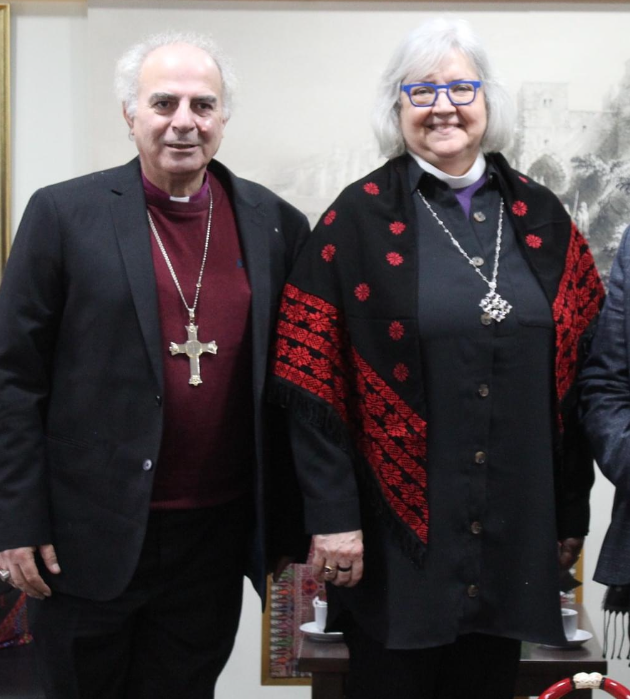
Today is Global Mission Sunday in the ELCIC. In Bishop Johnson’s sermon for today,[8] she reflects on our relationship with the Evangelical Lutheran Church in Jordan and the Holy Land (ELCJHL). In the midst of all their troubles, especially war, they continue to live in hope and faith.

Bishop Susan was actually in the Holy Lands last month, and talked with Bishop Ibrahim Azar about the very toned-down Christmas they had just experienced. She asked him how it had gone and he said to her how hard it was. “But,” Bishop Azar said, “Christ was born again in our hearts.” Christ was born again in our hearts.

If the ELCJHL can be faithful and continue ministry in their extremely difficult circumstances— keeping congregations and schools open and serving those in need, what about us?

Here’s a prediction that cannot be denied: We can certainly continue with faith and hope in the midst of the challenges we face!

Thanks be to the God, who continues to heal in Christ’s name, we pray. Amen.


[1] Mark 1:21-28

[2] Mark 1:29-39

[3] Ed Bowen. (2024, January 18). Hold Fast to the Truth. Eternity for Today.

[4] Peter Cardon. (2024, January 23). The Future of Work: New study finds AI makes employers value soft skills more. Fast Company. https://www.fastcompany.com/91012874/new-study-finds-ai-makes-employers-value-soft-skills-more

[5] John 10:10

[6] John 3:16

[7] Garrett, M. T., Garrett, J. T., & Brotherton, D. (2001). Inner circle/outer circle: A group technique based on Native American healing circles. Journal for Specialists in Group Work, 26(1), 17-30.

[8] Click here for Global Mission Sunday  resources (ELCIC, February 4, 2024).

To value the bruised reed

Not many today can echo the confidence of the Psalmist (29). Because confidence in God’s message does not come easily to those who struggle — struggle in faith, struggle against some great opponent within and outside themselves. And the Psalmist comes across as confident.

The Psalmist repeats the phrase, ‘the voice of the Lord’ seven times, introducing seven of the eleven verses in Psalm 29. Indeed, so the Psalmist claims, the voice of the Lord has accomplished so much, is everywhere and can do anything. The voice of the Lord can shake our world, break strong things and shock us with incredible visions!

And, therefore, his enthusiasm can either inspire some, and intimidate others. After all, how can we not notice? How can we miss what God is doing? God’s voice is loud, impressive and spectacular! You’d think there’s something terribly wrong with us if we can’t see the power and presence of God all around us. How can the Psalmist be so forthright and confident? His haughty display of faith can leave us feeling inferior or not good enough.

The church finds itself now in the season of Epiphany. The word means to ‘show’, or ‘reveal’. The season’s theme is all about our vision, being able to recognize the Christ. If only it were that easy!

The Baptism of Jesus marked the beginning of his ministry. And is slotted as the first Sunday after the Day of Epiphany.[1]In the experience of his baptism, Jesus alone saw the heavens opened and the dove descend. And it was only Jesus, in the moment of his baptism, who heard the voice of God.[2]This profound experience was meant for him.

We, too, whether at our baptism, or at the start of a new year, find ourselves at a new beginning. And we, too, may be looking for guidance and for a sign of God’s presence and power in our lives. As we seek our way, do we not yearn for the confidence that Jesus and the Psalmist in their own unique situations express in hearing and seeing the ‘voice of the Lord’—whether from the heavens or in the glory of creation itself? Especially at significant turning points in our lives? What do we see that is meant for us, personally?

At this ending of the Christmas season recall with me how some of the main characters received divine guidance and revelations. And I notice a recurring theme:

Specific guidance came to Mary and Joseph, to the wise men, to the shepherds, to Elizabeth and Mary and Zechariah – each and every one of them through dreams, visions, and stars.[3]Not exactly ways in which we normally expect to receive God’s guidance. The Christmas story teaches us how God will communicate with us. God’s revelation to you may very well come from beyond the normal sense of our day-to-day lives.

Writer-poet Kahlil Gibran wrote: “When you reach the end of what you should know, you will be at the beginning of what you should sense.”[4]In other words, when we come to the end of what we know in our heads, then we will be at the beginning of what we should experience and see in our hearts. So, maybe, those who struggle in any way — those who have come to the end of all they know — have something to show us.

We begin the new year by seeking the value in ‘bruised’ things – in us, and in the world. The prophet Isaiah writes in poetic fashion about God’s servant who will not break a bruised reed nor quench a dimly burning wick.[6]In bringing about God’s justice, the servant will honor even that which is weak, broken and imperfect within us and in the world.

In the second reading for today we must again review the story of Christ. Peter, the orator, tells the gathering at Cornelius’ house the message about the Cross and the empty tomb. And, that the character of the faithful life is forgiveness and mercy.[7] Not triumph and victory.

We begin the new year by seeking the value in bruised things – in us, and in the world. The glory of God comes only by way of the the broken things, the weak. Because only in those places and at those times do we touch the heart of forgiveness, mercy and love.

Last Spring, my wife Jessica’s special needs class travelled to Toronto to participate in the Special Olympics Invitational Youth Games. All the students in her class, each with a varying degree of developmental disability, played together on a soccer team. The team from Arnprior District Highschool played several games over the weekend against teams from all over North America. They lost every one of them.

But that wasn’t the point. Maybe the point was revealed in an incident that happened and how it was resolved:

One of the students from Jessica’s class was playing forward and was threatening to score a goal against their opponent, a special needs class from Arizona. One of their players was being inappropriately aggressive on the field with the student. It got to a point where there was a kerfuffle between the two of them.

The play was called and both teams retreated to the sidelines. Jessica’s student had held it together and did not overly react even though the other player had been provoking him the entire game by his aggressive behaviour. And the student’s maintaining composure alone was a huge accomplishment for the young lad.

But weren’t they surprised when the whole team from Arizona was soon standing in a semi-circle at centre field beckoning all our students to join them. When the circle was complete, the boy who had been aggressing took a step forward toward Jessica’s student, looked him in the eye, and said, “I’m sorry.”

Without hesitating, the student also took a step forward toward the Arizona boy and quickly added, “That’s ok, I’m ok.” The act of confession and forgiveness between the two of them was supported by their respective teammates. In a way, it was a collective effort; both sides encouraging the boys to do what was right and good. And after a big group hug at centre field, the teams resumed their play.

God is showing us all the time where truth and goodness lie. The problem is not that God isn’t doing anything. The problem is not our lack of ability to perform. 

Maybe the problem is more that we are not seeing where God is and what God is doing for the good of all in the world today. May God clear our vision to value the ‘bruised reed’ within us and in the world today. May God encourage our steps forward together.


[1]On the 6thday of January, and the 12thday of Christmas, every year.

[2]Matthew 3:13-17

[3]Luke 1-2; Matthew 1-3

[4]Kahlil Gibran, Sand and Foam

[5]Br. Curtis Almquist, “Revelation” inBrother, Give Us a Word (Society of Saint John the Evangelist, www.ssje.org, , 8 January 2020)

[6]Isaiah 42:3

[7]Acts 10:43

The mystic magi journey: discovering a new way of seeing

The word, ‘mystery’, Paul mentions four times in the text assigned for the Day of Epiphany.[1]He calls receiving God’s grace “the mystery of Christ.”

A mystery is not something that ought to scare us. Like how we feel when reading a whodunit and murder-mystery novels so popular. We have lived in a culture that sees mystery as something bad, something to avoid, something that is opposed to a life of faith. If something is mysterious, it can’t be of God.

That, what appears on the surface, at first sight, is division, discord, disharmony, a profound and inherent disconnection in our lives and in the world.

A negative view of mystery also implies that to know God means there is nothing more to know. To claim some cerebral notions of God—we call this doctrine—and to conform our knowing with others means there is no longer anything to learn. Change, growth, diverse thinking—the consequence of something that is difficult to understand—these have been an undesired mystery.

The journey of the magi suggests we need to take another look at “the mystery of Christ.” The prophet Isaiah, from another text assigned for the Day of Epiphany,[2]encourages us all to “lift up your eyes and look around … then you shall see and be radiant; your heart shall thrill and rejoice.” There is apparently a great benefit in seeing anew.

Isaiah speaks as if this ‘seeing’ is more than a mere observation of what is immediately in front of you. This spiritual seeing is about perceiving a deeper reality. Some would say it is seeing with the eye of the heart, or the mind’s eye. Sight, here, is not just a biological function of the eyes, but involves deeper more subtle capacities within us.

From the perspective of faith, mystery means, “endless knowability.”[3]Mystery is not something we cannot ever know; or, conversely, some riddle that we must solve once-and-for-all. Rather, mystery is a journey of learning more, growing, a continual expansion of our awareness, knowledge and perception.

The reason Matthew includes the story of the magi in his rendition of the birth of Jesus is to describe what is true for anyone on the journey of life and faith. 

For one thing, we never arrive at the fullness of truth on this journey we are on. That was the credo of the old science, that somehow once we figure something out, it never needs to be revisited or rethought. This approach affected the way of the church; that is, once you are confirmed or become adult or affirm your faith or join the membership … well, you’ve arrived. You are saved. And you don’t need to do anything more. Or change, or grow in faith, or explore different dimensions of the faithful life.

To say, “I don’t know”, in response to a question meant there is something wrong with you and your faith or your understanding. To confess “I don’t know” according to the credo of the old science was an admission of weakness, that something was not just right, or complete, with your faith. And this was shameful.

And yet, Paul challenges such arrogance (ironically since he was an arrogant guy himself) by focusing our attention on the “boundlessriches in Christ” whose intent is “to make everyonesee … the mystery hidden for ages in God who created all things.” [emphasis mine]

The magi of old studied the stars to gain understanding of God’s creation which included the boundless reaches of the universe. They sought the incarnation of God’s grace in Christ, and so followed the star. But when they arrived at the site of the nativity in Bethlehem—the apparent destination—was their journey over? Truly?

Far from it. Not only did they have to deal with Herod and his wiles, they continued by a different road. On earth, what is the destination of your faith? The destination of our yearning, searching, and endless knowing doesn’t mean the journey is over and done. And we have nowhere else to go. We continue on, seeking new expressions of God’s grace and God’s presence in Christ.

In a TV series called “See”, starring Aquaman superhero Jason Momoa, a post-apocalyptic humanity is blind. No one can see. Everyone is completely visually impaired (with few exceptions). The producers and actors do an excellent job of conveying to the viewer how individuals and communities arrange their lives to move and live without sight.

In a powerful scene, a ragtag group led by Jason Momoa is forging down a forest path, his sword cutting the air in front of them. It all seems to be a tranquil setting when suddenly he shoots out his arm to stop them from moving one step farther.

“What wrong?” another asks.

He shakes his head lifting his unseeing eyes ahead. “It doesn’t feel right. It is not safe.” Being physically blind has developed other, intuitive, senses – smell, the feel of the air, sound—to paint a picture of the truth in front of him.

As it turns out, they were walking into a narrow canyon ideal for an ambush. The ambushers, of course, were also blind. But as soon as they heard the subtle sounds of someone walking far below them—the scrape of a foot on stone, the crunch of dried leaves or the snapping of twig, they would aim their cross bows in the direction of the sound and shoot with deadly accuracy. Jason Momoa’s group was saved by a knowing that was deeper and richer than mere physical sight.

God has given us capacities beyond what we have known. There are unfathomable depths to our being in this universe and an immeasurable limit to our understanding. In describing a life of faith, Paul writes that we have confidence walking our journey of faith, “not by sight.”[4]There is more to it than a visual, observable certainty.

When someone asks you a question about your faith, and you find yourself saying, “I don’t know”, you need not say it as an admission of weakness. You can say, “I don’t know” with confidence because you are still on a journey of learning and discovery. Scientists today who study the stars will suggest with confidence that the universe is always expanding. New stars and solar systems are being discovered. We are endlessly knowing. The journey isn’t over. It never is.

And, what is more, scientists today will readily admit that there is indeed something at work in the universe that goes beyond the mere, yet important, crunching of numbers. Something they cannot put their analytical fingers on, yet something people of faith have been claiming since the beginning of time:

That our lives have purpose and meaning beyond the collision and interaction of molecules. That everything that happens in our lives is somehow intertwined, that there exists an almost imperceptible connection between ourselves, our past and our future, a connection that is leading somewhere, a connection that brings healing and wholeness to our lives.

A connection leading us somewhere eternally good.


[1]Ephesians 3:1-12

[2]Isaiah 60:1-6

[3]Richard Rohr, “Mystery is Endless Knowability” Paradox(Daily Meditations, www.cac.org, Tuesday, August 23, 2016)

[4]2 Corinthians 5:7

A sentimental Christmas?

We say that ‘Christmas is for the children’. Especially, parents and grandparents will focus much of their energies to make sure the children are happy: 

That the presents they receive will excite them, 

That the rituals around the Christmas tree and fireplace will fuel their anticipation and wonder, 

That the events in church and community the family attends will reinforce their understanding of the meaning of it all. 

And that all these efforts will bring delight to those who watch and attend them. And make it all worth the effort.

The accounts of Jesus’ birth – the Christ child born in Bethlehem – in the first chapters of Matthew and Luke especially reinforce our emphasis on children: The story of the Word made flesh in Jesus begins with Jesus the babe. The story of Jesus that ends at the cross of Golgotha and the empty tomb begins in a baby’s cries from a feeding trough in a stable for animals. 

Yes, Christmas is by the children and for the children. It is no wonder many of the annual Christmas pageants today are performed by children.

And yet, the story of faith compiled over decades and centuries into what we have in the bible challenges us. What the early Christians give us disrupts our sentimental bias in how we celebrate the Christmas season.

Let’s go back in time a week ago. First, December 21, the shortest day in the northern hemisphere, was traditionally the feast day observed for Saint Thomas, the doubting one, who was martyred in India in the mid first century. Then, December 26 is the feast day for Saint Stephen, whose violent murder at the hands of Jerusalem’s religious we read about in the book of Acts.[1]

And, finally, today, the first Sunday of Christmas, the church commemorates the ‘Holy Innocents’ – the children of Bethlehem – who were murdered at the hands of Herod trying to get at Jesus and eliminate any potential threat to his despotic hold on power.[2]

Not exactly a Christmas observance that brings the warm fuzzies. Why has the tradition included these rather violent and distressing facts about Christian faith so close to Christmas? Wouldn’t we rather put off such disturbing elements until long after the holidays when the kids are back to school and we return to the mundane realities of our lives (when we can ignore the truth of the faith)? Wouldn’t we rather preserve the genteel, Hallmark images cradled in soft-white light where all the children are squealing with delight?

The church, in its wisdom, pierces through our illusions and disrupts our escapism. In compiling the stories of the birth of Jesus, Matthew, the Gospel writer, chose to express a profound care for the children – especially those who suffered under the violent injustices of corrupt and despotic rulers. Matthew will not ignore what happened around Jesus’ birth, but will bring voice to it. Expose it for what it is.

This Christmas story is a very human, and a very real, story of life and death, sin and grace. None of it can be ignored nor dismissed, and certainly not simply in order to cradle our cocktail-numbed minds. The Gospel pours cold water on us and calls us to ‘wake up’ in the face of our reality:

That following Christ will sometimes be a rocky road, to put it mildly – as the ancient martyrs of the faith exemplified by their faithfulness and service. That following Christ will sometimes shock us onto our knees in lamenting the evil in the world – when children elsewhere and in our own communities suffer incredible injustice and violence.

That following Christ will sometimes call us into risky and urgent action that doesn’t give time for proper goodbyes. That following Christ will sometimes call for unconditional grace and acceptance of the stranger – as Egypt welcomed the fleeing holy family refugees from neighboring Judea. 

We don’t care for the children if we turn a blind eye to injustice, especially at Christmas. We don’t care for the children when we insist on avoiding the chaos and upheaval that our faith implies. Christmas isn’t just about sentimentality. It is more about taking responsibility and learning from the witness of the Gospel message.

One element of the storytelling from the Gospel today catches my eye: It is the rapid plot movement. This story reflects anything but a sedate, static tableau:

One moment, the holy family is in Bethlehem being visited upon by the magi; the next moment they are fleeing to Egypt. Then, Herod reacts, is infuriated by the magi’s deception, and sends his murdering squads to Bethlehem. Even though it would have been some time passing until Herod’s death, the story-telling doesn’t permit but a breath before another angel of the Lord comes to Joseph in a dream to ‘get up’ and return his family to the land of Israel. But not to Bethlehem where potential threat still exists, but to Nazareth. And all of this in ten short verses.

The pace of the story-telling itself evokes responsibility, not sentiment – not even a lingering, inert contemplation. Joseph doesn’t even have time to think, just react. And trust himself and especially trust God. The truth of the story is expressed in behavior and action.

The witness of the story-tellers of old have something to say to us, who very much like to sit-back and put-up-our-feet during the Christmas season. Perhaps this word to us is a reminder not to forget to take up the mantle of faith, to do our part in meaningful action and behavior. And be responsible, as the body of Christ, to be Jesus’ hands and feet in the world today.

“For if the babe does not again take flesh in us today, the Bethlehem star is but an optical illusion leading to nothing. 

“If we are not empowered to offer a gift to the one in need, then there are no wise men searching. 

“If there is no praise or joy within our hearts, then there are no angels singing; no shepherds watching.”[3]

May these days of Christmas bring to us a deepened awareness of the care we have and express for this dark, broken world. And in so doing fulfill our responsibility as bearers of the Christ child.

This responsibility is also a gift God gives us at Christmas. It is a gift that is activated in us by the witness of all the saints of old.


[1]Acts 6:8—7:60

[2]Matthew 2:16-18

[3]Bishop Michael Pryse, Christmas Message from Bishop Pryse (www.easternsynod.org, December 24, 2019)

The angel

I know an angel.

She’s the deli counter server who smiles when taking my order.

He’s the fourteen-year-old who dreams of winning $10 million to give to Parkinson’s research because his grandpa suffers from the disease.

They’re in the bus shelter laughing and giving hi-fives and kisses to friends who do not share the same skin colour, age, language and physical ability.

She’s the one who comes in the nursing home room to encourage with a soft and happy voice.

She challenges world leaders to pay attention to and do something about the climate crisis.

I know an angel.

Today, and every year on September 29, the church recognizes the annual festival, “Michael and all Angels”. In the bible, we acknowledge the popular ones: Gabriel, who brought news to Mary of God’s intention to give her Jesus. And, Michael the great protector whom we read about in Daniel and Revelation.

Herein lies one of those very grey areas for Lutherans who have, in our recent history, become increasingly nervous about the angels. Why is that?

In the Confirmation class which started this past week, we closed our time together by praying Martin Luther’s evening blessing: “I give thanks to you, heavenly Father, through Jesus Christ your dear Son, that you have graciously protected me today. I ask you to forgive me all my sins, where I have done wrong, and graciously to protect me tonight. Into your hands I commend myself: my body, my soul, and all that is mine. Let your holy angel be with me, so that the wicked foe may have no power over me. Amen.”[1][emphasis mine]

By the way he prayed, we can tell Martin Luther believed in angels. On the other hand, Luther didn’t care too much for those parts of the bible that suggested allegory—those so-called apocalyptic descriptions that described futuristic, other-worldly, colourful, image-rich portrayals of angels, arch-angels, cherubim and seraphim, of sword-wielding horseman, dragons and giant wheels in the sky. Luther consequently relegated these scriptures to a lower priority for the biblically literate.

“Angels cannot be our intermediaries between us and God,” we reformers insist. “There is only one mediator and that is Christ,” we claim. Christ alone, we’ve made things simple. Concrete. More about this in a minute …

And yet, at the same time, we cannot deny the reality and the truth, that just beyond the thin curtain of our awareness and perception there lies a dimension of reality in which we, too, participate—for good and for evil. Our highly trained, rational minds—thanks to the Reformation and Enlightenment eras of the last few centuries—have made us suspicious and skeptical of making such risky forays into those ambiguous, beyond-rational notions. We just don’t know what to do with that part. We just don’t know …

The Buddhist monk Thich Nhat Hanh tells a beautiful story about an experience he had following his mother’s death: “The day my mother died I wrote in my journal, ‘A serious misfortune in my life has arrived.’ I suffered for more than one year after the passing away of my mother.

‘But one night in the highlands of Vietnam, I was sleeping in the hut of my hermitage. I dreamed of my mother. I saw myself sitting with her, and we were having a wonderful talk. She looked young and beautiful, her hair flowing down. It was so pleasant to sit there and talk with her as if she had never died.

‘When I woke up it was about two in the morning, and I felt very strongly that I had never lost my mother. The impression that my mother was still with me was very clear. I understood then that the idea of having lost my mother was just an idea. It was obvious in that moment that my mother is always alive in me.”[2]

Perhaps you, too, can point to these subtle yet profound moments—especially following a loss or some great suffering or deepest love—when the cloud breaks, the sun streams through, a bird calls, an image flashes across your vision, a dream’s effect captivates you, a momentary feeling of peace and well-being engulfs you, a stranger impresses you in some unexpected, surprising way.

This is real. People talk to me about these experiences all the time. We can’t put our finger on it. We can’t rationalize our way through it. Well, we try, by talking about neural impulses and undigested fats in our bellies. But here we go again, dealing with our discomfort by reaching for yet another rational explanation. But can we explain away these experiences? Should we?

It’s easy to place religion into the esoteric realms of doctrinal outer-space. That’s our head space whose thoughts, theories and machinations serve to disconnect us from what is, right in front of us. And, sadly this state has almost exclusively defined the Reformation since the days of Martin Luther.

What about our bodies? What about our feelings? What about the natural occurrences in our daily lives? Are these not the purview of God as well?

Martin Luther insisted on the real, the tangible, as a valid and powerful expression of the divine. A faith that is characterized by the incarnation—Word becoming flesh—is a faith that cannot deny what we see, hear, taste and feel. When God became human in Jesus. When the Holy Spirit indwells in our hearts, our bodies. When we eat the body of Christ in the sacrament. God makes our reality God’s domain. Angels among us. The spiritual becomes tangible. Matter is, and has always been, the hiding place for God.

One of the clever jingles of the TSN1200 radio station in Ottawa is their oft-repeated phrase introducing whatever sport they broadcast: “The Sens play here” (NHL hockey); “The NFL plays here (football)”; “The RedBlacks play here”(CFL football); “The Fury play here” (soccer); “The 67s play here” (junior hockey).

That needs to be the church’s motto: “God plays here.” In real, tangible, visible, ways. “God plays here” among mortals, among real people in real situations. “God plays here” along with the angels and archangels.

We may not be able to figure it out completely. We may not know the mind and ways of God fully. We may not know this spiritual realm that interplays with our own. We may not even be able to rationalize it in the usual ways. And yet, we trust.

In the last line of the Evening Blessing from the Small Catechism, Martin Luther, after praying for the holy angel to be with him, he gives the following instruction:

“Then you are to go to sleep quickly and cheerfully.” And falling asleep quickly and cheerfully can only happen when, despite our inability to have all the solutions and figure out all our problems, we can feel that it will be well with my soul.

God will make God’s ways and purposes knowable to us, in the regular grind, routines and ordinary circumstances of our lives.

May you know some angels, too.

Trust.


[1]Martin Luther, “Small Catechism” in Evangelical Lutheran Worship (Augsburg Fortress, 2006), p.1162.

[2]Thich Nhat Hanh, No Death, No Fear: Comforting Wisdom for Life (Riverhead Books: 2002), p.5.

Pray, in Christ

In 1970, Russian cellist Mstislav Rostropovich expressed his support for artistic freedom and human rights in a letter to Pravda, the state-run newspaper of the Soviet Union. In response, the Soviets sharply curtailed his ability to travel. After Rostropovich and his wife decided not to return to the Soviet Union when travelling abroad in 1975, the Soviets stripped him and his wife of citizenship.

The political conflict in which the Rostropovich’s were embroiled reflected the larger geo-political strife of the Cold War from the last century.

When Rostropovich later played a Dvorak cello concerto in Chicago, the audience was treated to a brilliant performance. As the last note faded, the audience sat mesmerized. Rostropovich then did an extraordinary thing: he stood up and kissed his cello. The audience erupted. Then he hugged and kissed the surprised conductor. Then he hugged and kissed the entire cello section before moving on to the violins. He hugged and kissed most of the orchestra.[1]

With deeply felt gratitude, especially when circumstances are not ideal. When a home country—betrays, rejects. When suffering the consequences of some internal battle. When divided, separated from our home on earth and true home within. And still feeling grateful and expressing a profound thanksgiving. Does this not describe the experience of prayer?

I must admit upon reading the scripture from 1 Timothy I did not at first catch that this text is fundamentally about prayer. This text from Paul’s letter to Timothy announces the theme of prayer in the first verse: “First of all, then,” writes Paul, “I urge that supplications, prayers, intercessions and thanksgivings be made for everyone …”[2]

What follows in seven verses reads like a creedal statement of belief. This is what initially distracted me. But without the basic context of prayer undergirding that confession we can easily miss the deeper meaning by getting derailed by arguments about universalism and atonement theories.[3]

Starting with prayer gives us a practical, experiential basis for engaging questions of faith. Because it is in our personal communion with God that sets those questions in better, more productive, perspective.

Basically, religion is about realigning, reconnecting with God—that’s the meaning of the word, religion. Prayer is the means, the way, by which we connect with God. Our journeys of faith begin in the practice of prayer. And that is what we do every week in worship on Sunday. Everything that happens in the liturgy—in the order of worship—is prayer and flows from prayer.

At the Regina convention of the Evangelical Lutheran Church in Canada (ELCIC) this past summer, national bishop, Susan Johnson articulated a four-year vision for “Living our Faith”. She writes that “God is calling us into a deeper relationship …” and invites the church to focus, each of those four years, on one aspect of our spiritual journey. The first is prayer.[4]

Everything else (scripture, worship, love) flows from the beginning point of prayer. Why? Living our faith starts with communion in God, relationship with Jesus, personal connection with the living Lord.

While in worship we find many forms of prayer—different ways to pray (confession, petition, song, silence, sacrament, community, etc.)—there is only one prayer. And it is the prayer of Jesus. At its core, prayer for Christians is, as Paul often describes it, ‘in Christ Jesus.’ Paul uses the phrase, ‘in Christ’ dozens of times in his letters to the early Church. In Ephesians alone Paul uses ‘in Christ’ some twenty-seven times.

Christians believe in the living Lord. Jesus is not dead. Yes, he died on the cross over two thousand years ago. But since then, Christ is alive. And still is! We assert this every Easter season: Christ is risen! And Jesus’ communion with his ‘Abba’ (Father) through the Holy Spirit continues to this day, to this very moment.

When we pray we join in Christ’s ongoing prayer, in our hearts, like deciding to step into a river that continually flows towards the ocean. That river flows through our hearts. That is where the consciousness of Jesus resides through the Holy Spirit. In prayer, we incorporate with, enfold in, the prayer of Jesus with the Creator.

In our verbal prayers we will often conclude our words with, ‘in Jesus’ name.’ We pray ‘in the name of Jesus’. We pray, ‘in Christ’. This is the fundamental understanding of Christ as intercessor, as ‘mediator’ for us and for all people – as Paul writes here to Timothy. “Prayer is not an act resulting from our own autonomous will,”[5]but an act resulting from the good will of Jesus—a prayer that is ongoing regardless of what we do.

That is also why, prayer is not about us. Prayer doesn’t turn us back onto ourselves. Christian prayer may start by consciously locating our attention within our minds, our words and hearts and bodies. But ultimately, prayer leads us beyond ourselves. To others.

When Paul writes to Timothy that prayers “should be made for everyone” because God “desires everyone to be saved and come to the knowledge of the truth”, the emphasis is so made because of the real conflicts in the lives of those early Christians. The Christian community of Timothy’s time was persecuted for proclaiming Christ; they were not an accepted part of the social fabric in Gentile or Jewish community.[6]

I opened with a real story of conflict in the context of the Cold War. We can only understand our lives of faith in the context of our real lives which daily encounter some conflict—whether within ourselves, with our spouse, our children, our grandchildren, our neighbours, our hockey coaches, our teachers, our community leaders, our politicians, and whomever we label ‘our enemies’.

It is in the context of conflict and yes even strife where the instruction to pray bears down upon people of faith. “Love your enemies,” Jesus instructed more than once I am sure.[7] “Pray for those who persecute you,” he said.

We follow a God who is not immune from controversy and confrontation. Remember his earthly destination was death by a state-sponsored, capital punishment on the cross. This God we follow stretches us beyond our comfort zones and calls us to love in surprising situations. This God calls conservative evangelicals to pray for their liberal sisters and brothers, and vice versa. Trudeau Liberals are called to pray for Scheer Conservatives, and vice versa!

Maintaining healthy boundaries are important. And, some hurts go so deep that so much work and time are required in the process of healing. Without minimizing nor denying the harsh consequences of divisions …

“When you’re able to open your heart to your ‘enemy,’ allow God’s love to flow through you to them. Picture their face and send them warmth and tenderness. If this is a struggle, begin by focusing on someone that is easy for you to love, for whom you feel natural affection. Then broaden that circle of compassion to friends, acquaintances, and strangers.  [Because] no one is outside the embrace of God’s loving presence!”[8]


[1]William P. “Matt” Matthews in David L. Bartlett & Barbara Brown Taylor, eds. Feasting on the Word: Preaching the Revised Common Lectionary Year C Volume 4(Kentucky: WJK Press, 2010) p.89; www.britannica.com

[2]1 Timothy 2:1

[3]For example, God ‘desires everyone to be saved’ (verse 4); and, ‘Christ Jesus … gave himself a ransom’ (verse 6).

[4]www.elcic.ca

[5]Stephane Mar Smith in Feasting on the Word, ibid., p.88.

[6]Jane Anne Ferguson in Feasting on the Word, ibid., p.86.

[7]Matthew 5:44; Luke 6:27

[8]Richard Rohr, “Following Jesus” in Daily Meditations (www.cac.org, January 26, 2019).

God loves us uniquely, not exclusively

Some things Jesus says offend our most sacred held values.

In today’s Gospel Jesus basically turns against family. As one who drove 6000 kilometers this summer in a car with my family and then spent four intense but good days with extended family in Poland, I recoil at these words of Jesus. If we take Jesus’ demand literally, he is telling us outright to ‘hate’ our father, mother, wife and children and give up all our possessions.[1]How’s that for ‘family values’?

We cannot ignore this statement of Jesus, as much as we may want to. When we see the other places Jesus comments on family we begin to notice a theme emerge. Jesus redefines ‘family’ who shares not bloodlines but a common awareness of following Jesus and God’s mission.[2]

How do we pick up our cross and be faithful in following Jesus? How do we deal with this word ‘hate’ which brings up un-gospel-like connotations of division, conflict, anger and even violence?

In a historical fiction by Ken Follet entitled A Column of Fire he describes the early, raw conflict between Protestants and Catholics. Set in 1558, just some forty years after Martin Luther inaugurated the Reformation, Follet portrays through his characters the mindset of religious combatants in England and France.

In small towns where this religious war was waged in families and churches, to be caught with prohibited books from the ‘other side’ meant certain and immediate death. Underground Protestants were indiscriminately persecuted with the full force of the law when outed in Catholic regions. And vice versa. I had forgotten to appreciate the depth of the hatred that existed between coreligionists in the decades following the spread of Protestantism in Europe.

Early in the book we are introduced to Rollo. Rollo hates Protestants who are inflicting his English town. He bemoans the subversive, rule-breaking Protestants who are trying to alter Christian doctrines that had been taught in the old town cathedral unchanged for centuries. “The truth was for eternity,”[3]he pronounces. This truth is like the huge foundation stones of cathedral building which cannot be moved.

Of course, from today’s vantage point five hundred years later, we lay aside these trifling objections. Over the last fifty years especially culminating in the Joint Declaration on the Doctrine of Justificationin 1999, Catholics and Protestants together testify to the salvation that is bestowed only in Christ and by grace alone. In that almost incredible agreement, the objections and cause of divisions of the sixteenth century between the Roman Catholic church and reformers were officially removed.

Rollo’s problem was that he equated his interpretation of the truth with the truth itself. He believed his ‘take’ on the truth was the only take to make. And everyone else who didn’t conform to his take was excluded. In other words, his worldview was exclusive. Love of God, grace of God—these were exclusive gifts of God to a select few who conformed.

And damned be the rest.

Today, while the historical differences between Catholics and Protestants melt in the context of a changing cultural reality in the Western world, these troubling tendencies towards conformity, like-mindedness and exclusiveness nevertheless still persist in both Catholic and Lutheran circles worldwide and denominationally.

Think of the eye-glasses we wear. Some, to shield against the sun. Some glasses for short-sightedness, some for far-sightedness. Some glasses are bi-focal. Others are progressive lens. Important questions to ask in any study of scripture or tradition are: What lens do you use—your lens of experience, upbringing, learning, personality, opinion, background—what lens of interpretation do you bring to a reading of holy scripture?

What do you normally see in scripture? What do you first notice? The law? The gospel? Do you regard the bible as a legal book, or a historical book primarily? Or, do you look for promise, hope, forgiveness? Do you presume a punishing God who looks for mistakes and the follies of humanity? Or, do you see a loving God? Why? What are you afraid of? What are you looking for?

These are not easy questions to pose to oneself. But following Jesus is not blind. Obedience in the vision of Jesus is not like flotsam, driftwood, floating hither and yon.

Discipleship is a call to a commitment with focus and intention. Following Jesus calls each of us to a thought-probing, deliberative process in which we grow our ability and confidence to ask of ourselves the tough questions about life and living not only about God but especially of ourselves.

These types of questions are important to get some handle on before you can claim any part of the truth. In short, an honest self-awareness is necessary for healthy relating—whether relating to scripture or to someone else.

In families, relationships and organizations that are healthy, vital and growing, what do you see? I see people who are respected for their unique contribution to the whole. I see people who may be very different from each other and still value their own contribution because they know they are valued by others. Not because they conform. Not because they wear identical eye-glasses of interpretation. Not because someone else tells them what to do. Not because they ‘tow the party line.’ Not because they are like-minded in all things religious.

I know it’s not time to think of snow, yet. But I came across this past week an image of the snowflake. Of all the billions of people on this planet, no two are exactly alike. Even, as I am, an identical twin—I am not exactly like my brother. Of all the snowflakes that fall from the sky, no two are exactly alike.  Not one is a duplicate. Each is unique.

I don’t take the word ‘hate’ in the Gospel reading to mean we have license from God now to say and do violence to those we love most. That would constitute a false interpretation of scripture.

I do take this to mean we cannot, dare not, make any claim on another’s life. We do not own another person. We do not claim ownership and control them emotionally, psychologically, even spiritually. We are not responsible for another person.

Our growth with those we love means we release our claim over their lives, if we’ve ever had one or thought we had. I believe that is what Jesus is getting at here. Parents, even, are advised to remember that their role in raising children is to prepare those children for the world, and then release them to the world. In any relationship, blood-lined or missional—we do not control, own, or claim anything over another person.

And this is not easy with regards to letting go of our emotional attachments. But not claiming anything over another doesn’t mean we cut ourselves off from them, cutting all ties and never seeing them again. Releasing our emotional grip on another doesn’t mean we do not love them anymore. Letting go our claim over their lives doesn’t mean we do not care for them anymore. It just means we are not ultimately in charge of their lives. God is.

This can be a freeing prospect.

In reflecting on the cost of discipleship, Dietrich Bonhoeffer wrote, “The call to discipleship is a gift of grace.”[4]It’s a call to freedom and transformation which is what Jesus nurtures in us: to grow, to move, to change for the better as persons created in the image of God.

And, what is more, when all those unique snowflakes fall to the ground what accumulates is a blanket of snow—that has its recuperative and restorative purpose upon the earth. Unique, yet each contributes to the whole.

God doesn’t love us exclusively. As if we ought to be better than ‘them’. God loves uniquely. Being faithful is not about comparison, competition, being better than someone else. God loves us uniquely not exclusively. That means, our take on the truth is partial. Someone else’s take on the truth is also partial. Each of us in God’s family brings something unique to the whole of the truth.

To follow Jesus is to practice the letting go of the ego’s compulsions, and embrace God’s unconditional love and grace for you. So, following Jesus is not about being perfect, or copying someone else’s ‘saintliness’. It is, quite simply, being authentically you and affirming the stranger, in God’s love for all.


[1]Luke 14:25-33

[2]See Luke 12:51-53, 14:12, 18:29-30

[3]Ken Follet, A Column of Fire (New York: Viking Books/Penguin Random House, 2017) p.76.

[4]Cited by Emilie M. Townes in David L. Bartlett & Barbara Brown Taylor, eds. Feasting on the Word: Preaching the Revised Common Lectionary Year C Volume 4 (Kentucky: WJK Press, 2010), p.48.

Here we (and God) go again

The horrible evil unleashed in Christchurch, New Zealand, this past weekend exposes so much that is wrong in our world. And in our relationship with those who are different from us. And in our relationship with God. When worshippers are gunned down in their house of prayer, to do anything now but grieve alongside and stand in solidarity with the sufferers exposes in us a serious God-image problem.

Our God-image problem, as Christians, starts with our understanding of God’s holy word. And specifically, our over-simplistic judgement of Jesus’ opponents. Typically, in the New Testament, these are the Pharisees. And we succumb to what I call the ‘black helmet syndrome’.

The ‘black helmet syndrome’ comes from how the bad guys are usually portrayed in popular culture—in old tv shows and movies like Star Wars. For example, the bad guys all wear the same uniform, usually the same colour, and we normally don’t see their faces because they are hidden behind some helmet or mask. They march to the same tune and move the same, predictable ways. They behave, essentially, like robots.

We know nothing of their unique personalities (unless a story evolves and develops, like Star Wars eventually does) and never gain insight into their unique personalities. They are trapped in their badness because individuals yield to the pressure to conform.

When we read the bible like that, it’s easy to lump all the Pharisees together under one over-arching label: bad guy. But that’s not the case, if we read the narrative more closely and contemplatively.

Portrayed in several Gospel stories as the antagonists, the Pharisees do scrutinize and criticize Jesus. Yes. But there are layers to that antagonism, even to the point of sympathy for Jesus. That is what first caught my attention in the Gospel text assigned for today, the Second Sunday in Lent.[1]

It was the Pharisees who warned Jesus he should get out of town because Herod wanted to kill him.[2]Jesus, after all, has become a useful target and a convenient scapegoat for the powerful elite. Let the restless crowds project their anxiety, their anger and fear onto the troublemaker Jesus rather than those holding tentatively to power.

Do you sense the growing tension? Jesus’ enemies have throughout his ministry flocked to him, hung on his every word and literally breathed down his neck. There is a power struggle strangling Jerusalem, and everyone, especially Herod Antipas, is looking over their shoulders.

The fact that Jesus had sympathizers and supporters  in the halls of power shouldn’t come to us as a surprise. After all, Joseph of Arimathea, on whose land Jesus was buried, exercised power in Jerusalem and had Pilate’s ear.[3]Joseph of Arimathea, we sense, was partial to Jesus and what he was all about. Nicodemus, who often questioned Jesus[4], in the end helped the Arimathean bury Jesus with respect and according to tradition. Who Jesus is and what he says somehow touches the hearts of those like Nicodemus.

These sympathizers, however, are caught between two worlds, two kingdoms. They have benefited from their privileged status, to be sure. They wouldn’t easily give that up, nor would they necessarily want to. And yet, this preacher from Nazareth who gives hope and the promise of God’s love to the downtrodden stirs something irresistible deep within them.

“Tell that fox, Herod …,” Jesus snipes.[5]“Tell him what’s really going to happen sooner than later. Tell him the truth about God and God’s intention.” Jesus gives a warning, and gives it to these ‘sitters-on-the-fence’ Pharisees to convey his cutting words.

At the first, we witness Jesus throwing his allies the proverbial ticking time bomb. For when they bring Jesus’ message to Herod, they would be bringing upon themselves unwelcome attention and even scrutiny. A shadow would pass over them, the seed of suspicion planted. “What were they doing so close to Jesus in the first place?” “Whose side are they really on?” And the political machine might start turning against them. The balance shifts ever so subtly, and the irreversible track to their eventual demise begins.

Indeed, Jesus’ words for these sympathizers lead them to a place of discomfort, to say the least. And Jesus knows what he is doing. These ‘good’ Pharisees must now face their own demons and answer to themselves. They must choose.

It’s as if Jesus is forcing their hands to come clean: Whose kingdom will you serve, now? Will you follow the values of Herod and the political self-serving machine of Jerusalem? Or, will you follow in the realm of God? Whose kingdom will you seek? The kingdom of hate? Or, the kingdom of love? And, are you prepared to let go of your privileged status, for my sake? And the sake of the Gospel?

We also live between two worlds. Being a follower of Christ creates tension before release and peace.

What about you? Where are you feeling the pinch in your life today? Where is your journey taking you? Where in your life is Jesus pushing you to decide in your heart whom you will follow—the voice of ambition and accumulation, the voice of privilege and protecting it at all costs, the voice of acquisition and preservation?

Or, will you follow the values represented by Jesus and the kingdom of God—the voice of compassion and forgiveness, the voice of reason and discernment, the voice of restorative justice and peace, of personal responsibility and collective wisdom?

We’ve seen this narrative repeat throughout the bible. Jesus even implies the repetitive nature of this story when in his lament, Jesus says, “How many times / How often have I desired  you….”[6]

Not only was this one of several, actual visits Jesus made to Jerusalem in Luke’s writing, the cycle has been going on since ancient times. God’s relationship with Israel reflects a similar pattern: At one point, they are not God’s people; at the next, they are God’s people, again.

The prophets preached God’s word to the people like a broken record: Judgement; Forgiveness. Destruction; Restitution. Rejection; Restoration. “How often have we been down this road before,” it’s as if Jesus were lamenting. Here we go again.

And yet, herein lies the grace, the Gospel, the good news: In confessing that we have an image problem with Jesus’ enemies—that we far too often succumb to the ‘black helmet syndrome’— we also must confess our image problem with God.

Because God is not some cosmic police officer ready to pounce on us should we be caught speeding. God is not some old man sitting on a throne pointing a finger of judgement and accusation. God is not about retributive, punitive justice. A tit-for-tat God who stokes the fire of revenge and escalating violence. God is not an exclusive God for only the rich, the famous, the perfect.

We learn three things that I can tell about God’s love from this passage. First, God’s love is true. God loves us, not to control us, but to free us. God’s love gives us the freedom to choose our way. God’s love allows us to figure it out for ourselves. God’s love lets us own it for ourselves, so our action is authentic and true. And then God’s grace follows.

We are not robots, mindlessly marching to some pre-determined rhythm of God’s master plan. We are not mindless creatures who can’t make own decisions. We are not co-dependent in some unhealthy, enmeshed relationship with a controlling God. As God’s love increases, so does our freedom. Union is not a breakdown of personal initiative and unique expression. Rather, God’s love is about ‘letting go’. This is true sacrifice.

Second, and consequently, God lets us fail if fail we will. If there is anything we learn about God’s love from Jesus lamenting over Jerusalem is that  Jesus’ sadness is the sadness of God. God grieves with us when we live the unfortunate consequences of our poor decisions. God understands and is ever near, especially when we fall to the bottom of our lives. That’s what they say about tears—they bear witness to how deep one’s love is for the other.

Finally, God never gives up on us. God is faithful. God will keep giving us second chances to grow and deepen our relationship with God, with one another, with ourselves and with this world we inhabit. God will always be there to give us those opportunities to make it better, to choose better. God will never abandon us on this journey.

As we follow Jesus on his path with ours this Lenten season, may we hold on, if anything, to this wonderful promise of God’s never-ending love for all people.


[1]Luke 13:31-35; the Gospel reading according to the Revised Common Lectionary (RCL).

[2]Luke 13:31

[3]John 19:38-42

[4]John 3 & 7

[5]Luke 13:32

[6]Luke 13:34