
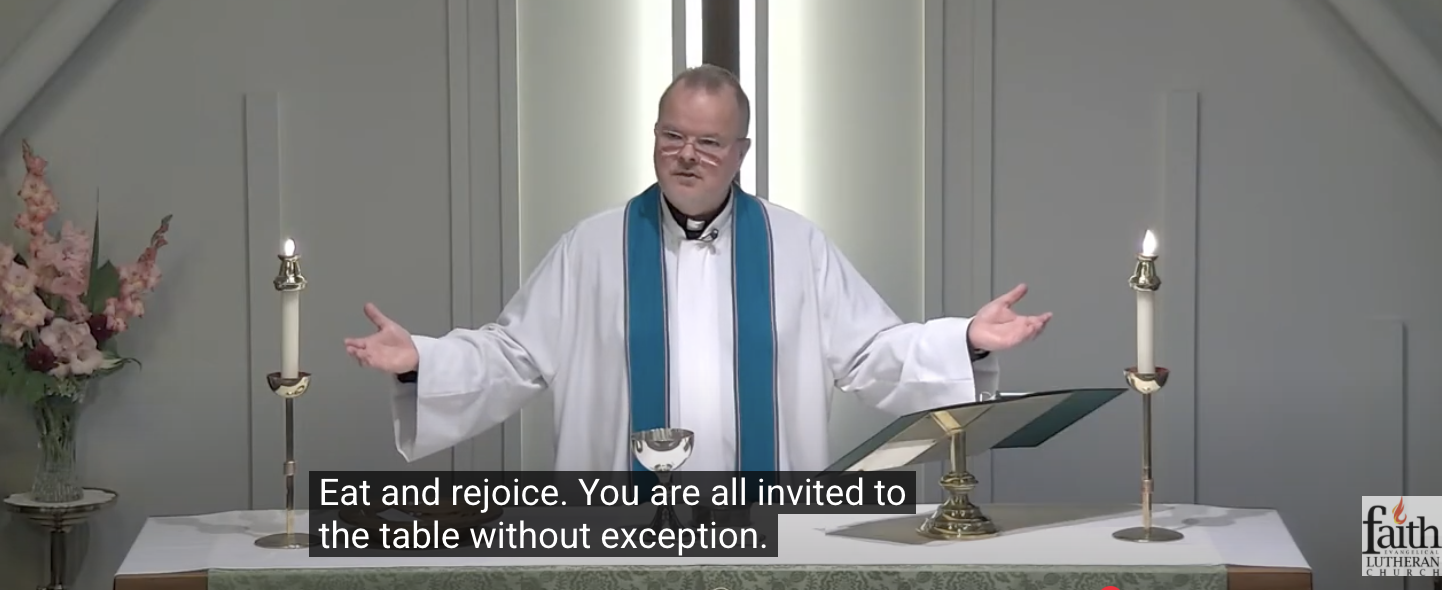
You have a place at the table

Online Services at Faith Lutheran Church, Ottawa (www.faithottawa.ca)

In my last sermon before the start of my practicum, I want to focus on and underscore the central action of the church to be welcoming and affirming of all people, without exception. I want to thank the congregational council for giving their blessing and support for the adventure on which we now embark over the next 8 months, which will see me take a significant step back from working in the church as I complete the practical part of my Master of Arts in Counselling Psychology program. I also want to thank the congregation, in advance, for giving Pastor Rosalie an ideal and excellent opportunity to practise her skills and development as a Lutheran pastor in the Canadian context. You are giving her this opportunity to exercise leadership as you pursue together God’s mission in this world, to invite all people to partake of God’s grace and love, without exception. Thanks be to God. ~ Pastor Martin

Do you have a place at the table? Do you feel there’s room for you around the table of the Lord? Is there a place for you, here, in the church?

On the last day of school at the end of June, every year like clockwork, we look forward to receiving an invitation to attend the annual Ida Street BBQ in Arnprior.

For years, neighbours at the end of our street host a gathering around food and drink. The street is barricaded off to vehicle traffic. And we are given the opportunity to meet each other, mix and mingle at the start of the summer holidays.

A diverse group of people from all walks of life, identities, backgrounds and life experiences gather around food.

In the Gospel of Luke, Jesus is especially preoccupied by eating (Saddler Jr., 2010). There are, in Luke, more references to eating, banquets, tables, and reclining at tables than in any of the other Gospels (Karris, 1985).

It is sitting or reclining around the table where Jesus teaches (22:24-30; 11:37-41) and encounters those who are marginalized (7:39). The table is the focal point in some of his parables (16:21; 14:15-24), as in today’s banquet feast parable (14:7-14).

That the table is the centre piece in Jesus’ teaching and fellowship should not escape our notice. There’s something important about eating together that sets the stage for healing and for restoring broken relationships. Jesus will not only meet us when we come together over food and fellowship but has something to teach us at the table of the Lord.

One of my earliest memories about church was Communion Sundays. I remember picking up on the holiness of the moment happening at the front.

But it wasn’t holy because of the kind of bread, or wafer offered or the wine. It was something about just the simple experience of going to the front with others. I would kneel or stand shoulder to shoulder on the same level as everyone else around the altar.

We were, all of us around the communion rail, in this holy action together in all our diversity. Part of God’s family.

And it wasn’t just an individual thing. There was no table of honour, for some. It wasn’t the privileged people who got to go first to receive communion, or anything like that. It was table after table of the mix of people who ever happened to be in line at the time our table was called.

That was the good memory. What I also remember that slightly annoyed me, quite frankly, were all the words. My Dad, the pastor, would read the longest Eucharistic prayer in the book! And while I appreciated the beautiful language and theological import of the words spoken before Communion, I grew astonishingly restless. “Just get on with it! Let’s go to the front!” was what my heart cried out.

Church is about doing, as much as it is about thinking and feeling.

My recent studies about what brings psychological healing made me appreciate what we do in faith, week after week, coming to the table of the Lord. What we do brings spiritual and psychological healing.

‘Talk therapy’ is popular these days. Many of the cognitive treatments rely on a whole of verbiage, to the extent that we’ve come to believe resolution only comes by coherently and accurately telling yourself and another what you think and what you feel. Religion isn’t the only place we encounter a whole lot of words. But words alone don’t save us.

We may be saved ‘by the Word’ – meaning the “Word became flesh” (John 1:14) in Jesus. But we are not saved by words alone – arguments, disputations, constitutions, belief statements. When Jesus says, “we are not saved by bread alone” (Matthew 4:4) he means we are not saved by material possessions or even spiritual materialism.

Dietrich Bonhoeffer was convinced himself, and wrote, that “the church is constituted not by religious formulae, by dogma, but by the practical doing of what is commanded [by Jesus]” (Barnhill, 2005, p. 253).

What brings healing is more than just books, talk therapy or words alone. Because, to Jesus, socially constructed, mentally devised distinctions that divide people do not define a person’s value, a person’s worth.

What defines a person’s value, dignity and worth is God’s invitation. God’s invitation, in Christ Jesus, to sit at the same table as everyone else. Gone are the ‘places of honour’. Gone is a ranking system, a pecking order, based on meritocracy and those who ‘deserve it’, reserved only and exclusively for those who have achieved ‘great things’. God’s invitation is not only for those who have it all, those who are perfect.

You don’t have to prove yourself worthy. Communion isn’t only for those whose lives are just right. You don’t receive Communion only when you are somehow rid of all your impurities and can show the best of yourself.

Because the truth of the Gospel, the good news in Christ Jesus, is that even if you lose everything (or I should say when you lose everything because eventually, we all will) – financial security, wealth, prestige, physical strength, your reputation, your social standing, those you love – when you lose it all, you still have a place at the table.

That’s why Holy Communion is offered to those in hospital beds and care homes, to the dying, to the poor, the marginalized, the suffering.

No matter what station of life, whether you are climbing the ladder and amassing your portfolio and finding the better jobs with higher income scales, you have a place at the table. In the prime of life in great health and are living the dream, you have a place at the table.

And, when things are failing, when you are descending the ladder, you have a place at the table. Even if you are staring into the abyss, unknowing and uncertain about a scary future. Even if your health is failing, resources are dwindling, and you are alone in your struggles. You have a place at the table.

There is always a place at the Lord’s table for you. God invites you, more than once a year. How about every time the church gathers to worship? You are all welcome, without exception!

References:

Barnhill, C. (Ed.). (2005). A year with Dietrich Bonhoeffer: Daily meditations from his letters, writings, and sermons. Harper One.

Karris, R. J. (1985). Luke: Artist and theologian: Luke’s passion account as literature. Paulist Press.

Saddler Jr., R. S. (2010). Luke 14:1, 7-14: Exegetical perspective. In D. L. Bartlett & B. B. Taylor (Eds.), Feasting on the word: Preaching the revised common lectionary, year c volume 4 (pp. 21-25). Westminster John Knox Press.


Present to Presence

photo by Martin Malina

About once a month I have lunch at Denny’s on Merivale with a dear friend of mine. His name is Jack Murta. He is a retired politician. He was a Member of Parliament from Manitoba in the late 1980s. A member of the Progressive Conservative Party, Jack served as the Minister of Tourism in the Brian Mulroney government.

Today, he sits on the Board of the Mission in downtown Ottawa and leads Christian Meditation groups there for people who are homeless. Jack and I spend a lot of our time talking about politicians and how they related with one another back in the day. Indeed, much of our conversation recalls the past.

In the Gospel reading for today (John 2:1-11), guests to a wedding party in Cana, Galilee, meet most likely in a garden setting, to celebrate a joyous occasion.

Certain clues in the story attract our attention. I’d like to point out, first, the empty jars normally filled with water used for the Jewish rite of purification. People engaging this rite did not drink the water. It stayed on the outside of their bodies when they immersed themselves in the bath.

The jars in this story direct peoples’ attention to their past, their Jewish tradition and ritual. The garden also was the usual setting where Jewish weddings took place, a reference to the Garden of Eden in the first book of the bible – Genesis (Shaia, 2021). The jars and garden are indicative of tradition, the past, the way things had always been done.

And not only does the Gospel look to the past, it points us to the future as well. “My hour has not yet come.” Jesus hints to Mary about his future path, when Jesus’ purpose will be fulfilled on the cross and by the empty tomb.

But it’s the present moment where the miracle—the sign—happens. It’s into the present moment that the Gospel ultimately draws us. “You have kept the good wine until now.” The steward recognizes Jesus’ act of bringing an unexpected gift for the guests.

And Jesus’ action in the present does more than merely get the bridegroom out of an embarrassing social faux pas. The unexpected gift is good wine, not normally offered late in the party. It’s in the present moment, even in an unpleasant situation, when people enjoy themselves.

Brain studies have examined where most of our time is spent thinking. They show that we spend most of our time thinking either about the past or the future; and, between these two, most of it is about the past. In other words, being fully present in the moment is not where we spend most of our time. And this is true even among young adults (Bellana et al., 2017).

Our thinking, entrenched in the past or fantasizing about the future, is also closely related to speech. Thoughts and words go hand in hand. Talking a lot is related to thinking a lot (about the past).

But in the Gospel, it’s more about what is not said that draws my attention. Mary does not tell Jesus what to do. She merely points to the problem. And leaves it up to her son.

The head steward didn’t know where the wine came from, but the servants knew because they drew the water for the jars as per Jesus’ instruction. How did they know it had turned to wine? Did they taste it, before and after? If it were left up to the dialogue alone, what was said out loud, we would be missing important pieces. There would be gaps in the story filled in only by observing behaviour.

As much as 80% of what is communicated takes place on the nonverbal level: our tone of voice, our body position and movement, our facial expressions, the direction of our eyes (Mehrabian, 1972).

What is more, if you want to be friendly, or hostile, your body language is over 12 times stronger in getting the message across than anything you might say (Argyle et al., 1971). What we do and how we do it speaks volumes. Words are important but have power only when anchored in the present reality. Simply pointing to the reality without judgement nor instruction, without any hint of direction nor evaluation, Mary said to Jesus: “They have no wine.” Fact.

Events and situations that bring us into the present reality are often not initially pleasant. We resist the present moment because we may be afraid of what we encounter there.

From the garden to the hospital. There aren’t other settings that bring us, force us, to the present moment more as in the hospital. When we are sick or visiting someone who is ill, or working in the hospital setting as a nurse, PSW, doctor – being there makes us grapple with the sometimes-harsh realities of the present moment.

And in that present moment, very few words are necessary when it comes down to it. The past, the future, these are all important and good. But when it comes down to it, presence is all we need in the present moment.

My friend, the retired Member of Parliament, Jack Murta, was also good friends with one of Speakers of the House of Commons at the time. And when you think about it – a politician Member of Parliament and a Speaker of the House – you can imagine the jokes about them entering a bar: There would be a lot of words spoken to say the least! Even the name – “Speaker” of the House – evokes images of a whole lot of verbiage. Words. Words. Words!

And yet, at the end of his long life, when this Speaker of House was dying in the hospital, he indicated he wanted to see Jack one last time. So, Jack drove to the hospital. And at this point the Speaker was no longer saying much of anything. But when Jack sat down beside him, the Speaker reached out and Jack took his hand in his own. And for many minutes they just sat there without saying a word. The touch of his hand was all the Speaker wanted and needed in that moment.

What mattered, what really mattered, was not the past on earth nor the future on earth. What mattered, what really mattered, was not saying a whole lot of words anymore. Because the joy of living even in that desperate moment, the true joy was found in the simple touch of another in the present moment.

I mentioned the water for the purification rite. It stayed on the outside of the human body. We don’t normally drink our bath water. Jesus performed a miracle of transformation: from water to wine.

When we celebrate Holy Communion, wine is offered. Jesus transformed an understanding of religion from external ritual to internal reality. We don’t wash our bodies with wine. We drink it. We bring it inside of us. We consume it. We digest it. It becomes part of us.

Holy Communion invites us to be present in the moment. To touch. To feel. To drink. To taste. To eat. Let this sacrament in which we participate weekly give us an occasion to practice being present to the holy Presence of God in Christ Jesus. So, with Christ’s presence in us now, we can be God’s loving presence in the world by what we say and what we do.

Behold, now is a very acceptable time; Behold, now is the day of salvation (2 Corinthians 6:2).

References:

Argyle, M., Akema, F., & Gilmour, R. (1971). The communication of friendly or hostile attitudes by verbal and nonverbal signals. European Journal of Social Psychology, 1, 385–402.

Bellana, B., Liu, Z. X., Diamond, N. B., Grady, C. L., & Moscovitch, M. (2017). Similarities and differences in the default mode network across rest, retrieval, and future imagining. Human Brain Mapping, 38, 1155-1171. https://doi.org/10.1002/hbm.23445

Mehrabian, A. (1972). Nonverbal communication. Aldine.

Shaia, A. J. (2021). Heart and mind: The four-gospel journey for radical transformation. Quadratos.

Resurrection in community

In the artwork of first centuries, for example, we see a striking difference between western and eastern portrayals of the resurrection of Christ. From western art we see pictures focusing almost exclusively on the risen Christ. Jesus emerges from the tomb alone as if to say, “Look at me! I made it!” Light glows from behind him. Whatever else there is in the painting, it is background material. Resurrection is primarily and exclusively about Jesus. And we declare “Jesus rose from the dead” as an individual.[3]

A good example is The Resurrection by Italian artist Andrea di Bonaiuto found in the Spanish Chapel, Florence, Italy.

Contrast this western artwork with the East. From eastern Christians, we see greater emphasis on the resurrection community. Resurrection is depicted more as a corporate event in the overcoming of death, evil and sin. Without denying the work of Christ in all of this, the implications are emphasized. So, it’s not so much about Jesus-the-individual conquering the grave as it is about all of creation rising from death to new life.

A good example is the painting outside the Church of St George in Romania.

The Eastern interpretation makes sense of challenging scriptures as one from the Gospel of Matthew; at the time of Jesus’ death and resurrection: The tombs also were opened, and many bodies of the saints who had fallen asleep were raised. After Jesus’ resurrection they came out of the tombs and entered the holy city and appeared to many.[4]  The life, death and resurrection of Jesus has implications for the whole people of God. Including us.

Both our tradition and the bible challenge our western bias. Instead of focusing only on the individual, we can learn how to be, and embrace being, in community.

Being and remaining in community is not easy. Relationships are messy. We would rather avoid having a crucial conversation.[2]We would rather not commit to a community because it’s easier to just leave when it gets tough. Especially when we can fall back to our individual, autonomous, private lives and independence. We would rather escape the boiling cauldron of community life.

We need to come clean with our natural bias towards individuality. That we value it. Really value it.

Let’s look briefly at today’s scripture. The story we read from Acts, chapter eleven, is actually a repeat of the same story in the previous chapter ten in Acts. The story line remains consistent: Peter has a vision from God and then meets three emissaries from Cornelius. And the message in both is the same:

Peter is called by God to expand his vision and mission of the Gospel to include Gentiles. Peter is challenged to overcome his stereotypes and distinctions between the Jews and Gentiles, and see God’s mission in more universal terms. No issue was more important to the early church than whether their newfound faith was intended only for Jews, or whether it was to include Gentiles while allowing them to remain Gentiles.[5]

The same story, told twice, in successive chapters. In fact, some of the words in chapter eleven are taken verbatim from chapter ten. Why did the author repeat the same story? Obviously this story was very important to the early church that it was re-told. Maybe a way to understand why, is to note what is different between the two. What’s the difference?

What changes in chapter eleven is the confrontation with ‘the apostles and the believers’ in Jerusalem.[6]Peter has been called before them, has heard their criticism, and now responds to it by telling them the story first conveyed in chapter ten. The difference is the context; and that context is Peter being called to task for his eating profane foods with those uncircumcised Gentiles.

We learn from the early church that believers were not reluctant to voice their differences. Peter did not escape. He didn’t go hide in the anonymity of a large shopping mall, airport or Caribbean vacation. He didn’t jump in his fishing boat and disappear on Lake Galilee.

Peter entered Jerusalem and squarely faced his critics. Too often, we try to be ‘nice’ at church. We try not to be confrontational. We try to sidestep controversy. We closet our differences. We paint smiles on our Sunday-morning faces. Even as we know deep down there may be an elephant in our collective room, and even as we suspect in our hearts irreconcilable issues. And, if we can’t handle this posturing, we leave. Get out of dodge. Back to being individuals in our private lives.

This text reminds us that controversy and difference needs to be voiced, not avoided. Conflict needs to be transformed, not ignored and swept under the rug. Living in Christ does not mean putting our heads in the sand. It means looking each other in the eye. It means accepting the other is unique, different from you.

What does this mean for us? First, when we say that we participate in the resurrection of Christ, we begin to see with fresh eyes the whole world not as risk or threat but as gift, invitation and trust. There’s what we call a ‘mutuality’ that informs our relationships—the way we relate with one another and especially those whom we may dislike or are fearful of.

In other words, mutuality can be described this way: what I see in you I see in me; what I see in me I see in you; seeing myself both in those I love and those I dislike.

Jean Vanier, the creator of the L’Arche Communities around the world, died a couple of weeks ago. He was the founder of homes for the disabled after he realized that all people, especially those with severe disabilities, have something important to offer to the world. In his writing entitled, “Ten Rules for life to become more human”, he said:

“The big thing about being human is to meet people. We need to meet people who are different and discover that the other person is beautiful.”[7]

To make this discovery for ourselves, especially in people we dislike, we need to practice paying attention for the gift in others.

The disciples are commanded by Jesus to love one another.[8]The life, death, resurrection and ascension of Jesus means the focus will shift to the community. The spotlight of faith is now not on some heavenly, other-worldly reality. It is on the Body of Christ. The focus now is not so much the individual, historic Jesus. Jesus now lives in the Body of Christ—the church, the community, wherever the Spirit of the living God blows in all creation, in every time and every place. This is the expansive vision of being a follower of Christ today, in real time.

When we share the Peace of God—a tradition in our preparation for receiving Communion—we can practice paying attention to the diverse ways in which we communicate that Peace of Christ and participate in vastness of Christ’s presence. We practice how it is to love. An analogy, you might say. Because we are all different.

And just because some may wish not to share the Peace in the same way as you do—shaking hands, or giving/receiving a hug—doesn’t mean they don’t want to participate.

Our intention comes from the heart. The desire to participate emerges from inside of us. I suggest the first thing we pay attention to is eye contact. When we turn to the person beside us look them in the eye. These eyes of ours are windows into the soul. They reveal this good intention in our heart to communicate the love and peace of Christ. This is when you can say, “the Peace of Christ be with you.”

The second thing is, pay attention to what you do with your hands. When you open them outward and upward you are giving a cue that you are open for a hug. Mind what the other is doing with their hands after making eye contact. Are they also opening their arms? If not, they are giving you a cue not to hug. What else can you do?

Your hands can come palms together in a prayerful pose—the namaste. While keeping eye contact and bringing your hands together over your heart, you may bow slightly, saying, “Peace be with you.” You can also give a fist-pump/shoulder-pump if you do not wish to shake hands. Obviously if both of you are reaching to each other in a motion to shake hands, your cues are mutual.

Two assumptions to review: First, please do not assume everyone will do it the same way as you. That’s Community 101 and it applies to lots of things. Pay attention to body language. There’s more to this liturgical act than saying the words. Second, just because you receive different cues from the other doesn’t mean they don’t wish to participate in conveying the love and peace of  Christ to you. We just have to work harder at discovering and respecting their way.

There are various ways we can communicate to another that we participate in the life-giving activity of God in the world that God so loved. And continues to love, through us.


[2]Patterson, Grenny, McMillan, Switzler, Crucial Conversations: Tools for Talking When the Stakes are High (Toronto: McGraw Hill, 2012), p.11-14

[3]Richard Rohr, Jesus’ Resurrection (Daily Meditations, www.cac.org), 21 April 2019.

[4]Matthew 27:52-53

[5]Stephen D. Jones in David L. Bartlett & Barbara Brown Taylor, eds. Feasting on the Word; Preaching the Revised Common Lectionary Year C Volume 2 (Louisville: WJK Press, 2009)  p.451-455.

[6]Acts 11:1-3

[7]Jean Vanier cited in Canada Lutheran Vol 34 No3 (April-May 2019), p.8

[8]John 13:31-35, the Gospel reading for Easter 5C, Revised Common Lectionary.

We the Saints

Death will be no more … for the first things have passed away… ‘See, I am making all things new.’ (Revelation 21:1-6a)

Who are the saints? And, who cares?

I recall an image of running the Boston marathon described by a church leader in the context of social justice. She said that congregations and persons of faith are like marathon runners. When tens of thousands of runners line up at the start of the race, only the best runners are at the front of the pack. And when the starter’s pistol signals to begin running, it takes hours by the time everyone crosses the starting line.

The implication, I believe, is that some persons or congregations are better at this job of being the church. They belong at the front. The implication, I believe, is that there is a small group of super-stars that must lead the pack and give witness to the rest of the runners ‘how it’s done’, spurring the rest of us to be better than we are. The implication, is that not everyone is as valuable as those at the front, leading the way. The implication is that there are, to be sure, the saints; and, then, there are the SAINTS. A hierarchy.

I wondered about this. And, on one level, she is correct: The kingdom of the world needs, or wants, superstars. To survive according to the world’s rules, we want to find motivation to be better. The NBA wants the Stephen Currys and Lebron James’. The NHL wants the Conner McDavids’, Austin Matthews’ and Sidney Crosbys’. Business wants the Elon Musks, Oprah Winfreys and Bill Gates’ of the world—for better or for worse. Politics wants the Doug Fords, the Kathleen Wynnes, the Andrew Scheers and the Justin Trudeaus—for better of for worse. They set the bar—high or low, depending on your perspective.

The kingdom of the world wants superstars. The world wants to compete, to compare and to conflict. Even kill. Because, some are better. And some are worse. Some are more valuable, and some … not so much. Some set the bar while others don’t quite measure up. Yes, we like to say on All Saints Sunday that we are all saints. But, there are the saints; and then, there are the SAINTS.

We identify and glorify the heroes of faith, while overlooking the value in the sainthood of the less noticed, the less attractive, the less ‘gifted.’ The kingdom of the world—its culture of comparison and competition—has indeed infected our idea and practice of the Reign of God on earth.

We are all the children of God. We are a community. Some will say, a family, whose purpose and meaning we discover in our lives on earth. “Thy kingdom come on earthas it is in heaven,” we pray. On earth. First, we do need to accept that the church on earth is where it’s at for us. The vision of heaven on earth, of the new Jerusalem descends upon the earth. We don’t find who we are as followers of Christ—as Saints—apart from our community. To be a follower of Christ is to be discovered in community.

Not by ourselves. Not alone on the mountaintops, nor alone in the valleys. Not enlightened in the ivory towers of private illumination. Not sequestered in solitude in the libraries of ancient wisdom. Not by winning individual races. Not in individualistic endeavours that don’t need anyone else, or to which everyone else needs to conform by our powers of persuasion, force or pressures.

We don’t find who we are and what we are to do as followers of Christ—as the Saints on earth—apart from community. Even in the traditional format, the saints and conferred their title by the community. The process is, no doubt, elaborate and needs the validation of the Pope and subjected to all manner of procedure.

In Protestant theology, generally, our sainthood is conferred upon all the baptized. In baptism, we are united and joined into Christ’s death and resurrection. We are enjoined with the church on earth and the saints of heaven on a journey towards full and complete union with God when we will one day see face to face. In baptism and at the communion table, we are all placed on a level playing field.

As such, relationships matter. How we behave with one another on that journey, matters. What we say to one another, matters. How we communicate with one another, matters. The words we say, and the words we don’t say, to each other, matters. How we do church, today—not yesterday, not fifty years ago, not in the last century but today—matters. ‘Thy kingdom come on earth.’ Today.

The vision of God is meant for us to grow, to transform, to change into the likeness of Christ Jesus. The community on earth strives to reflect the divine, eternal vision. The community on earth, the church, grows into what we are meant to be, on earth. The community on earth includes and embraces all of creation, excluding no one and doing violence in word and deed to no one.

It is vital that when violence is done against any group, we stand up for the downtrodden. We stand beside those who are victimized because of their religion. As Lutherans, especially today, a week after the gun-shooting and murder of Jewish people while they prayed in their house of worship in Pittsburgh, we stand up against such hatred. As Lutherans, especially today, we must repudiate again Martin Luther’s anti-Semitic writings. Just because we are Lutheran doesn’t mean we regard Luther as infallible, without sin, as anything more than the term he used to describe us all: simul justus et peccator—we are simultaneously saints and sinners. So was he.

The Dean of the Ottawa Ministry Area of our Lutheran Church underscored the nature of this church on earth of which we are members. She said in her sermon on Reformation Sunday last week: “In Ottawa we are really one church but worship in different locations.” Ottawa Lutherans are one church. This is a change of thinking. We are becoming the new thing God is calling us to.

Together, as one, standing beside all the saints and sinners. Together, as one, standing alongside the downtrodden. Together, as one, standing with the victims of group-identity based violence. Standing against all forms and means of hatred towards ‘others’ who are different from us. The vision of John of Patmos is an inclusive one. The new earth and the new Jerusalem does not exclude anyone. The new community includes all.

Even you.

The one who just got some bad news. Even you.

The one whose marriage is on the rocks. Even you.

The one who lost their job. Even you.

The one whose health continues to fail. Even you.

The one whose anxiety and worry crushes any hope for the future. Even you.

The one whose sexual identity invites judgement from others. Even you.

The one who is new to Canada. Even you.

The one who failed the math test. Even you.

The one who was bullied at school. Even you.

The one who broke the law. Even you.


Together we will find our way. Better together.

Thanks be to God! Welcome home, saint and sinner. Welcome home. Amen!

Pilgrims rising

Don was a husband and father who one day was commuting home after work in a bad thunder storm, when the car he was driving was struck by lightning. Don was okay, and he managed to get home. Sitting down with his teenaged children, he relayed to them his harrowing experience.

Expecting at least a small degree of sympathy from them, Don was perplexed when his eldest interrupted: “Quick, let’s go buy a lottery ticket because they say the chances of being struck by lightning are like the chances of winning the lottery.”

The disconnect we feel in how Jesus’ disciples often responded to him is not dissimilar. He tells them he must die a horrible death. And they respond by demanding seats of power, authority and glory beside Jesus. His disciples continually seem out of sync with their leader’s meaning.

The Gospel for today[1]must be read in the larger context of Mark’s writing here. In Mark, we see that this is the third time Jesus announces his death, the third time the disciples respond in perplexing ways, and the third time Jesus responds to them by giving them a commentary on true discipleship.[2]

By looking at the what comes immediately before this text, we also discover that the disciples who followed Jesus were afraid.[3]It’s fair to presume, then, their desire and request to secure positions of glory once Jesus took his rightful throne on earth and/or in heaven was born out of fear.

The connection between fear and striving for security is common in all of us, to this day.

We are afraid. We fear the changing realities which make new demands on our time, energy and resources in the church. We fear the outcome of our health concerns. We fear the effects of an uncertain future, in our nation, our world and in our personal lives. In the fear of the unknown, it is a natural knee-jerk to secure anything down. Do something, anything, to give yourself the illusion of control. An insurance policy.

Let’s give the disciples the benefit of the doubt, to suggest perhaps they were aware that Jesus’ path was going to lead to his arrest, torture and death. And they knew that likely they, too, would be caught in the crossfire. They were probably aware that Jesus was causing an uncomfortable stir among the powers that be, religiously and politically, in Jerusalem. They saw the writing-on-the-wall.

And in the midst of this fear, the Sons of Zebedee tried to insure some benefit for all the sacrifices they were already making and would likely continue to make. Perhaps if they didn’t understand something, it was they couldn’t yet grasp the depths of the sacrifices they would make as a community of faith.

What Jesus stands for is a different way altogether from the way of the world. The disciples are caught up in the power plays of the world. They have in mind a hierarchy, a pecking order, of who’s on top. There is this Machiavellian feel to the debate amongst themselves, as if relationships of power must only be a win/lose scenario, a zero-sum game where in order to get ahead some people have to be left behind.

The way of Jesus, in contrast, is the way of the Cross. Jesus exposes the false way of the world by surrendering to it and dying by it. The way of the cross exposes our folly and calls us to a deeper more inclusive way.

Martin Luther first coined the phrase in his Heidelberg Disputation written in 1518. He called it, “A theology of the cross.” It is a way of understanding and imagining God. That is, God was, and is, being revealed to us in all truth most clearly and unequivocally in suffering. In the vulnerability and pain of death on the cross, Jesus revealed—and continues to reveal—the God who suffers alongside us wherever there is pain and suffering in the world.

Luther thus criticized a “theology of glory” which presumes God validates faith, and is only validated by, success, measures of progress and triumphal conquering over any weakness or adversary. This theology dominates not only in our society, but sadly also in the church.

A theology of glory reflects an unbridled, Pollyanna optimism that avoids and resists places of defeat, failure, vulnerability and weakness as having anything to do with divine identity or purpose. A theology of glory undermines real people and a God who is known in the darkest times and places of life. It despises our common humanity and the losses we all endure.

The way of Jesus is for all people, not just for those who make it to the top. The way of Jesus is for all people, because we all have our crosses to bear. We can share in our common suffering. And grow together. It is therefore in community, the Body of Christ, the body ‘broken for all’ we say in the Communion, where Christ is revealed and where our true purpose is born.

#OttawaRising is the hashtag used, announced and displayed on Ottawa Senators Hockey club promotional material. The vision is of the team rising out of the ashes of disappointment from last season. That was the season from hell, when they finished second-to-last place in the league standings, suffered through a broken, conflicted locker room and as a result had to trade away star players.

But it is only standing in the ashes that you can claim the vision of ‘rising’ again. The Stanley Cup champion Washington Capitals wouldn’t declare resurrection as their identity, this season. It only makes sense to proclaim the resurrection in the midst of the defeat of the cross.

The Gospel abounds with a promise. The disciples may not hear it as such. But Jesus has great compassion on them. He does not rebuke them for being out of sync with him. He affirms that they will indeed drink the cup that he must drink and be baptized with the baptism that he must endure.

Jesus will continue to offer this promise and hope to us, that we will not always need to act and respond out of our fear. That what we do as a community does not need to be knee-jerk platitudes that only keep us stuck in cycles of fear, self-preservation and defensiveness. Jesus will continue to call us into deeper expressions of serving others and of paying attention to the needs of others not just our own.

If there was anything the disciples should have known with any amount of certainty, is that Jesus’ promise is secure and very sure. Because by being in last place, and losing it all, those first disciples would one day rise.

And so will we.

[1]Mark 10:35-45

[2]C. Clifton Black in David L. Bartlett & Barbara Brown Taylor, eds., Feasting on the Word: Preaching the Revised Common LectionaryYear B Volume 4 (Louisville Kentucky: WJK Press, 2009), p.189.

[3]Mark 10:32

Funeral sermon for an African-Canadian: Room for all

‘Do not let your hearts be troubled. Believe in God, believe also in me. In my Father’s house there are many dwelling-places. If it were not so, would I have told you that I go to prepare a place for you? And if I go and prepare a place for you, I will come again and will take you to myself, so that where I am, there you may be also. Peace I leave with you; my peace I give to you. I do not give to you as the world gives. Do not let your hearts be troubled, and do not let them be afraid. (John 14:1-3,27 NRSV)

The more I reflect on the gospel text you chose for reading this day, I have to conclude that Jesus has always been preparing room for your beloved, throughout his life.

The first room was in Ghana, his birthplace. Shortly after he was baptized in a Presbyterian church, and later attended the Missouri Synod Lutheran church there. You were married in 1971. Over the next several years you had four children and started to build your family life. A room you called home.

A political coup in Ghana in the 1980s created conflict between the nation’s lawyers and the self-acclaimed government. Lawyers defended the rule of law which threatened the legitimacy of the coup d’état. God was preparing another room for him and the family.

Fearing for his safety he fled to Nigeria where he stayed for five years while the rest of the family stayed in Ghana. You came to Canada in 1988 for six months, as participant of an exchange program between Carleton University and Ghana Institute of Management and Public Administration where you were a lecturer. Your husband visited you in Ottawa and decided to put in an application as a refugee in order to unite the family. It took five years, but in 1993, after 10 years of separation the family was finally together in Canada.

You received help from this congregation as they settled into their new life in Canada. People in this congregation, and other friends, gave you furniture and other means for getting used to living through cold, Canadian winters. Here was yet another room, on earth, that the Lord had prepared.

I recall some of this family history to underscore, broadly put, the importance of community in a Christian’s life. The story of immigration and supporting refugees escaping untold threat and terrors in their homelands is not unique to Theo and his family.

Standing on the side of refugees and migrants and immigrants—this is a central part of our identity not only as Canadians but as Christians and Lutherans. Our values are thus defined because we are a nation of immigrants, to be sure. And in God’s love for all humanity, we continue to this day to do what we can to support those newly arriving in Canada.

God sets the bar and calls us to follow—there’s room for everyone!

Through the turmoil and disruption of those decades late last century, your beloved had to believe, and nurture his faith. He had to trust that good would eventually prevail. He had to lean on God to get him through those lonely days separated by a vast geography from his loved ones. He had to depend on others—his own resources, the gifts and good-will of friends, and upon the grace and presence of God in his heart.

In the last six years that I have personally known him, especially as his cognitive and physical abilities declined, there was one thing that did not change each time I visited him: His face brightened, and his eyes looked like they were going to pop when I opened the bible and prayer book. He was fully attentive as I read familiar prayers and scriptures.

And for all that cannot be known and cannot be said about the mystery of the sacrament, he craved the sharing of the bread and cup in the Holy Communion. With few words spoken, he grasped for and received a tangible sign of the true presence of the living Lord Jesus.

Enough cannot be said about his expression of faith, especially the last years of his life. As he declined, he had to stop attending all the activities in which he loved to participate.

Except bible study. To the end, he would faithfully attend the regular bible study at the nursing home. If when I dropped by he was not in his room and I would ask a PSW or nurse where he might be, the answer was unanimous and consistent every time: In the chapel. Everyone knew that about him. And, more often than not he was there with his bible and prayer books open on his tray.

Even in this latter time of his life, his faith was expressed in community. It was room shared by all. And it was and is in a faith community where God prepares the soul for our final home in union with God. Just like when others supported him get to and settle in Canada as a refugee, decades ago—his faith was again validated by the loving presence of care-workers, church volunteers and staff in the nursing home. In faith, we are not an island unto ourselves. His life and faith demonstrated this in so many ways.

Jesus has indeed prepared an eternal dwelling place for your loved one. Today, he rejoices in the full presence of God where he now sees face-to-face. I believe his death on Thanksgiving is significant. It is a heavenly signal to us about what we need to do during times of loss and grief. At a time in Canada when we pause to give thanks for all the good in our lives, we therefore give God thanks and celebrate the gift of your beloved—a dear husband, father, brother and friend.

Thank you, God, for giving him to us and to the world, to know and to love. Amen.

One part per billion

I’m going into the Algonquin Park region this coming week. As you can see outside the church, I’ve already strapped my canoe atop the car. I’m looking forward!

And when I’m paddling, I like to follow the river or lake banks. Of course, where I’m going, there are lots of little lakes and rivers, and therefore many riverbanks and rocky shorelines I will skirt (probably still breaking the ice!).

We live in a world where borders and boundaries are important. Whether these are borders between nations, continents, cities, regions, communities, families or individuals, they mark the line between separate and distinct realities. Without honouring certain boundaries, we can fail to distinguish who we are and lose a sense of our identity and purpose.

Last summer when I travelled through Spain and Portugal, I learned that he Portuguese-Spanish border is the oldest, unchanged national border on continental Europe. This surprised me because that border did not appear natural. Not unlike the border between Canada and the United States in North America, the Spanish-Portuguese border draws a counterintuitive line across the more natural flow of the continent’s geography.

For example, to see it from space, the North American continent flows more north-south: The mountains run north-south on the western half of the continent, the prairie and plains in the centre of the continent, and the Great Lakes basin spilling into both the Mississippi and St Lawrence River valleys in the eastern portion of the continent. The geography suggests more natural north-south lines.

Spain and Portugal share what looks like a giant square mass of land peaking in the northwest on what is called the Iberian Peninsula. The Atlantic Ocean hugs the northern and western edges of this square. And the Mediterranean laps up against the eastern edge and into the southern Straits of Gibraltar separating Africa from Europe.

Despite what looks like it should be a unified whole, this large land mass is divided between two nations with Portugal carving its small section on the south-western shoreline.

When the kids were toddlers — and sometimes even to this day — they often lingered on the thresholds of doorways separating outdoors from indoors. Standing or sitting on the threshold meant that the door remained open. Of course, we parents were concerned about them jamming their thumbs and fingers and toes. So, we would yell at them: “In our out! Make up your mind!”

Borderlands, as we know from German history (the Berlin Wall) and between North and South Korea, can be dangerous places. We call the space in the border “no man’s land.” At best, these thresholds are ambivalent to us; at worst, they leave us uncomfortable, unsettled, fearful. We feel we can’t rest in these places.

I learned recently about what is called the ‘riparian zone’ which is the border between land and water. The riparian zone can be the lake or riverbank that is a marsh, or a rocky or sandy, thin strip of land, a hardwood forest or stand of pine on the edge of the river.

This ‘in-between’ place of the riparian zone fulfills three, vital, ecological functions: First, the riparian zone functions as a natural filter, cleaning ground water as it flows into the larger watershed. It also protects the surrounding soil from accelerated erosion by slowing down wash effect of the river. In the process, riparian zones actually create new soil and provides for new habitats.

A NASA scientist called the river and its marshy edges the ‘sine qua non’ of life; that is, where water and land touch, these edges are necessary for life on earth.[1]

So, we agree that boundaries are important. Borders, whether political, relational or ecological are vital.

But we also say that the grace of God knows no boundaries. We say that God’s love crosses and surpasses all boundaries. Jesus says, “Abide in my love.”[2]Paul wrote that “nothing can separate us from the love of God.”[3]God’s love expands and grows and overcomes all obstacles.

How does this happen? How can we, on the one hand, honour the boundaries in our lives and, on the other hand, live into the boundary-busting, wall-breaking, division-crossing, far-reaching, limitless, boundless reality of God’s love? How can God’s love abide in us when we are separated from God and each other by sin?

We are human, after all.

Imagine you are at the ocean, and you’re standing in the ocean ankle-deep. It’s true, you are only ankle deep. But it’s also true you are in the ocean. It’s also true that if you keep going, it will get plenty deep soon enough. If not in the ocean you are standing in, certainly at the deepest point on earth — the Marianas Trench — because all oceans on earth are connected anyway.

What if the infinite depth of the ocean gives the totality of its depths to your ankle-deep degree of realization of it?[4]

During the Easter season, and because of the resurrection of Jesus, the church says God is everywhere. But then, we also say God is really in your soul. And God is really, really in the church. You have to go in the church to save your soul. And, in the church, God is really, really, really in the Holy Communion. And, then, God is really, really, really, really in heaven. And, here at Faith Lutheran in Ottawa, it’s like one part per billion!

But, Jesus is alive. Therefore, God is really, really, really, really, really, everywhere.

The truth is, when you’re connected to a little bit of it, you’re connected to the whole of it, the fullness of it.

Speaking of the Holy Communion, when we receive one grain, it belongs to the one bread; one grape, one cup. Many parts, one body. When you receive only one small part of the Communion, you receive the whole of Christ.

“Every piece of bread and sip of wine is precisely the same one: there is one bread, and that is Christ. We receive all of Christ in communion, not just a piece of him. If we break the loaf into a thousand pieces, there’s still only one Christ – and each of us receives all of him.”[5]

This logic extends on several levels. Our lives, for one, belong to God’s story. “We need to sense that all aspects of our history, of our experience, are part of the same story, even the bits that don’t make any sense or the meaningless parts …”[6]There is no part of us that does not, somehow, belong to the great story of God and God’s people. Every part of us — our history, our experiences — is valuable to God and to us, and to each other.

We are who we are. No part of us is wasted space, wasted DNA. No part of us is lost, no memory is gone. All parts of us and each one of us belong.


[1]Diana Butler Bass, “Grounded: Finding God in the World; A Spiritual Revolution” (New York: Harper One, 2015), p.68.

[2]John 15:9-17 speaks of the mutuality of divine love’s presence: We abide in Christ as he abides in us.

[3]Romans 8:38

[4]James Finley, Centre for Action and Contemplation, 28 April 2018 (audio, http://www.cac.org).

[5]Br. Mark Brown, Society of Saint John the Evangelist (SSJE), Brother, Give us a Word, 28 April 2018

[6]Laurence Freeman, Daily Wisdom (Word Community for Christian Meditation, Meditatio), 1 May 2018.

The Passion of Christ – a Good Friday sermon

The heaviness of it all weighs on our souls. Good Friday is a sombre day. The tormented images of the torture and death of anyone, let alone Jesus Son of God, flash across our minds-eye in the hearing of the texts describing the Passion of Christ.

We hear the lament from Isaiah’s poetry known as the Suffering Servant poems. If we let it, Good Friday pierces our denial of suffering and death. And we face squarely the reality of the situation. The very word, “Passion”, is from the Latin, one meaning of which is suffering.

If you, like me, have watched some contemporary video portrayals of Jesus’ Passion, probably the foremost image is the bloodiness of it all. Not only do we see the violence of the Jewish rebellion heating up during the Passover in Jerusalem, but we are intimately involved in the trial and torture of Jesus – beginning with the bloody cutting off of the servant’s ear in the Garden, to the whipping, flaying, kicking, slapping and piercing in Jesus’ torture while being held in Roman custody.

If that is not enough, we shiver at the pounding of the nails into his hands and feet, see the blood and water gush out of his side when the sword strikes him. Watch as blood trickles over his bruised face from the crown of thorns. Blood all over.

Blood all over. The blood of Christ given for you.

Suffering, Passion, is a great letting go. And acceptance of Christ suffering, even for us, is a great letting go. We cannot possess the gift of life. We cannot own or control this gift for us.

“For three days, the child bled profusely from the nose. She was six years old, and doctors had no idea what was causing the bleeding. What’s more, they understood that if the bleeding didn’t stop, her life was in grave danger.

“The year was 1913. The doctors knew little about transfusion, but they understood the importance of somehow getting good new blood back into the little girl’s system, so they asked her father, a preacher, to give his daughter some of his. He did, one of the first blood transfusions in the state of Michigan.

“The yellowed newspaper story is titled ‘Minister Saves the Life of Daughter By Giving Blood’, and ends by explaining how the father ‘was considerably improved and was able to dress.’ Then it adds, ‘The child was also considerably better and hopes are entertained for her recovery.’

“Two weeks later she was dead. Little Agnes Gertrude … succumbed once the hemorrhaging returned. For a time her father’s blood had brightened her face and her possibilities, but his gift – as unusual and strange to the newspaper readers as it must have been to him – wasn’t enough to save her life.

“Doctors knew very little, back then, about blood-typing. Her father … was as good as choice as the doctors could have made, but what coursed in his veins was not a match. Agnes Gertrude … died two weeks after that strange new procedure the doctors called ‘a transfusion.’

“Her father, a man of God, lay face down on the rug of the living room for almost a week after Agnes’ death, unable to move. Who could blame him – for an entire afternoon, he lay there beside his little girl, his blood flowing into her veins. He was lost in profound grief, was lethargic, depressed, his whole countenance darkened by the death of his child.

“Nothing changed … until he accepted a call to another congregation, a small country church up north. He and his family rode in a horse-drawn wagon up to that country church, their possessions packed up behind them. And there being greeted by the entire congregation there on the lawn, all of them waiting for the new preacher and his family.”[1]

The blood of Christ shed for you. Still, a mystery. Source of life. Beyond comprehension. The blood of Christ shed for you.

We hear these words during the Eucharist, Holy Communion. The word, Eucharist, from Greek, means “Thanksgiving”. Martin Luther, the great reformer, insisted that this sacrament is centrally about the gift of God, in Christ Jesus. The Holy Communion is God’s gift in Christ to us.

This, in contrast, to his contemporaries many of whom insisted that the sacrament of the table was more about what we humans must do to make sacrifice in order to appease God. Instead of making Holy Communion about what we must do for God, Luther preached that the Eucharist was what God does for us. It is a gift.

And a gift we cannot control, manipulate, engineer, manage. Only receive in thanksgiving.

On Good Friday, significantly, we abstain from the Holy Communion. It is one of the only days in the church year that calls for us to withhold collectively this gift. It, in our tradition, is the climax of the Lenten fast, the discipline to ‘do without’ and ‘let go’ and ‘surrender’ our claim on the gift. After all, we do not control God. God is free. And God gives what God will. When God wills. We are not in the driver’s seat of life and death.

Part of our lament, and suffering prayer, is to recognize that we are finite human beings, that we cannot do it alone. And can’t ever get it right. On this heavy day, the low point you might say of the Lenten journey, we put our ultimate trust and hope in God’s promise. As Jesus trusted his Father to the bitter end, we follow in his way, trusting that death has not the last word.

The blood of Christ shed for you.

Christ bled in his suffering, death and burial for three days. But God has other plans. The other meaning of the word “Passion” of course is love. Great suffering and great love. The Passion of Christ is ultimately about God’s great love for Jesus and for us. That is why God gives the gift of life to us. Love.

We will once again feast on the gift of life in Christ’s blood coursing through our veins. We will be transfused again with the life-giving spirit of God. It will be a perfect match! And our lament can become a song of praise and hope, bringing us home at last, as to a lawn on a bright day full of smiling people who open their loving arms.


[1] James Schaap, in Greg Pennoyer & Gregory Wolfe, eds., “God For Us: Rediscovering the Meaning of Lent and Easter” (Massachusetts: Paraclete Press, 2015), p.119-121.

Thanksgiving builds commUNItY

Sometimes what I see in nature represents how I feel. For example: “The dark, thunder clouds looked angry,” we say. Or, “The deer leapt with joy across the meadow.”

Nature has a way of evoking feelings within us. When I stopped in this cove on Cape Disappointment, I couldn’t help but feel praise for the creator God, and thankful for the beauty of life.

IMG_6215.JPG

This particular photo conveys to me first a state of peace. After all, not far from this lone pine the swirling waters, changing tides and ravaging winds off the Cape constantly threaten to uproot the tree. And yet, the tree lives on looking very peaceful.

But more than that, thankful. The tree shoots to the sky, to the life-giving sun. It’s not just hugging the rock in defensive self-protection. It offers its praise to the Creator by aiming and growing upward, giving a faithful witness to all that will see this tree.

For me, a life lived grounded and united in peace, praise and thanksgiving to God, is indeed a life lived in the gracious community of God.

During this month when we reflect on the legacy of the 16th century Reformation and celebrate together the 500th year of Reformation, we cannot avoid nor deny the sad reality of conflict and division. It seems you cannot fully appreciate the nature of things, including the church, unless you acknowledge the role of conflict among people of all times and places.

This is why it is noteworthy that Luke in the Gospel text assigned for Thanksgiving Day tells this story, which is not found anywhere else in the New Testament.[1] What is unique about this healing story is the response of thanksgiving by a Samaritan. Jesus sets this “foreigner” apart from the others who were also healed.[2]

The Samaritan was the only one who “turned back” to give thanks to Jesus.[3] So, there is much more going on here than a physical, medical cure of a disease.

Since ancient times, a political and religious rift was growing between Israel and Samaria. Samaria became “foreign” after breaking off from the Davidic monarchy and the establishment of Samaria as the capital of the northern kingdom.[4] Then, after the Babylonian exile, tensions mounted between the people of Samaria and the Jews who returned to rebuild Jerusalem.[5]

Luke includes this story in his Gospel to emphasize the importance of looking to the positive witness of the outsider. In other words, the normal divisions separating us in our religious and cultural identities matter little in the larger scheme of things. Especially when it comes to the expression of faith.

Those who are different are often the very people we need to look to for a positive example of faithful living.

This summer a friend of mine visited the German town of Dinkelsbühl in Bavaria. During the Reformation Era in the 16th and 17th centuries, this town was the first of only a small number at the time who identified as bi-confessional; that is, roughly equal numbers of Roman Catholic and Protestant citizens were allowed to live and practice their faith, with equal rights for both sides.

After the Peace of Augsburg in 1555, a few years after Martin Luther’s death, land in Germany was divided into Protestant or Catholic regions. The religious adherence of a population in any region was determined by the religion of the ruling prince in that area.

Except for Dinkelsbühl. The Peace of Westphalia a century later enshrined the bi-confessional identity of this town by establishing a joint Catholic-Protestant government and administrative system, and ensured a precise and equal distribution between Catholic and Protestant civic officials.

When you consider the animosity, violence and warfare characteristic of those centuries between Catholics and Protestants, never-mind the twentieth century history in Ireland and the unfortunately enduring oppositional attitudes between Protestants and Catholics today – this is truly remarkable.

Bucking the dominant culture of dualistic either/or, right/wrong, in/out, black/white thinking, the leaders and citizens of Dinkelsbühl chose to follow a different path. We don’t need to point to present day efforts of ecumenism and unity building. Right in the middle of the conflict of the 16th, 17th and 18th centuries there were already efforts then to see a different way:

To see the good in the other. To search out and focus on common understandings first. To seek mutual understanding. Amidst everything around conspiring against such counter-cultural vision.

The point of decision for the Samaritan leper came when he realized he was healed, on the path as they went.[6] It’s important to picture this in your mind. Jesus didn’t snap his fingers and, voila! Yes, the lepers brought their belief in Jesus to the encounter, asking him for healing. Jesus then told them to go to the priest for certification of their healing.

It was on the way – after they had committed to doing something, even before any proof of their healing was given, amidst their still debilitating illness – they went. In doing something, on the way, they were healed. Healing is a process.

It was on this journey when the healed Samaritan had to make a decision.  He could have followed the other nine who were clearly pursuing their self-interest. Against the conforming pressures of the majority, he turned back to follow his heart, full of thanksgiving. We may wonder whether he was also motivated by avoiding potential ridicule and discrimination as a Samaritan appearing before Jewish authority in Jerusalem.

Nevertheless, the Samaritan made thanksgiving a priority. It is to him that Jesus ascribes the affirmation: “Your faith has made you well”; or, as other translations have it: “Your faith has saved you.”[7]

Faith without gratitude is no faith at all. There is something life-giving about thanksgiving. Grateful people are more hopeful. Indeed, there is evidence now of a correlation between gratitude and the immune system. People who are grateful have a health edge. For example, an attitude of gratitude, reduces stress. So, your mother was right when she made you call your grandmother and thank her for the birthday card.[8]

A true expression of faith is complete when it includes thanksgiving. Coming to worship on Sundays is not validated because “you get something out of it.” Attending worship is not about the self-centered search for “what is in it for me?” Worship is not “me-first” exercise. Let’s be clear.

Rather, coming to worship is about offering thanksgiving, first and foremost. Sunday worship is an opportunity to give thanks to the God who gives all, for all. It is no wonder that the Holy Communion is traditionally called “The Holy Eucharist”, translated from the Greek as “The Great Thanksgiving”. We come to the table to offer our gifts of thanksgiving to God. Every week.

Thanksgiving changes the character of a community and its work. Stewardship is transformed from fundraising to the glad gratitude of joyful givers. The mission of the church changes from ethical duty to the work of grateful hands and hearts. Prayer includes not only our intercessions and supplications, but also our thanksgiving and praise of God’s good gifts to us at the Table.[9]  Thanksgiving builds bridges among people who are different.

We come to Communion to offer thanks to God not because we are good, but because God is good. And we see God reflected in all of creation, in all people, in the good they are.

We pray the legacy of the next 500 years of Reformation reflects the growth of unity among a people that are grateful for the good gifts God brings to us all.

Amen.


[1] Oliver Larry Yarbrough in David L. Bartlett & Barbara Brown Taylor, eds., “Feasting on the Word: Preaching the Revised Common Lectionary” Year C, Volume 4 (Kentucky: WJK Press, 2010), p.169

[2] Luke 17:17-19

[3] Luke 17:15

[4] 1 Kings 12, 16

[5] Nehemiah 4, Yarbrough ibid., p.167

[6] Luke 17:14-15

[7] Luke 17:19, Yarbrough, ibid., p.169

[8] John M. Buchanan, ibid., p.169

[9] Kimberley Bracken Long, ibid., p.168

Bread for all

After the old doctor died, his sons emptied the house in order to sell it. In the living room on the shelf above the fireplace they found a box with a slice of bread in it.

It was dried up hard and obviously had sat in the box a long time.

“He really kept every thing!” said one of the sons amazed. The doctor’s assistant who worked for the doctor for many years stood beside the sons silently. And then said: “Let me tell you the story of the slice of bread:

“You know that after the war your dad became very ill. He was weak, and near death. A friend, who had visited him told him, ‘If you don’t eat enough to regain your strength, it looks very bad for you.’ But where was one to get enough to eat? Everyone was starving. Many simply cooked potato peels and considered it a rich soup.

“The friend returned after some hours and brought some bread. Where he found it, he didn’t say. Surely he must have paid a fortune for it.

“But your dad did not eat it,” continued the assistant. “Your dad told me to take it to the neighbour; their daughter had been ill for a long time too. ‘I am an old man already who does not need the bread as much!’ your Dad said. ‘Take it to the neighbours!’

“As it later turned out, the neighbours did not eat it either, but passed it on to a family of refugees with three little children that lived in a small shack in the backyard of the neighbours’ house. They were overjoyed for they had not seen bread for more than three months. 

“But as they were about to eat, they remembered that the doctor, who had helped their children at no charge when they had been struck by a dangerous fever, was ill and weak and really needed something that would make him stronger.

“So when the bread came back after a day,” said the assistant, “we recognized it at once. Your dad was in tears, as they found out about the wandering piece of bread and where it had been.

Your Dad had said, “as long as there is love between us – I am not afraid about anything, not even dying”. So he divided it evenly and sent me out again. His share he kept; he put it in this box to always remember what had happened.”

The three children took the old bread, broke in in three pieces and decided to keep it in order to remember the story, to tell it to the next generation, and to teach them about the power of love and the wonder of sharing.

Something like this can only happen when there is a communal consciousness — more than one person that participates in a community of love and trust. That all will have enough. That all will benefit. That the needs of the whole outweigh the needs of the one.

This is the Gospel call. The kingdom call. Not for individual enlightenment or edification. Not for our sake alone. Dear Confirmands, your baptism as a baby was not valid on account of your own individual strength or decision. It was the community — your parents, sponsors and everyone in the church long ago — whose faith surrounded you at your baptism. Even your confirmation is not done for your own sake — but for the sake of others around you.

And that’s why you participate in leading and assisting in your own confirmation service: To practice this truth, that affirming your baptism is a call to deeper commitment in the life of the church. You may doubt the strength of your faith. That’s ok. In fact, I would be worried if you didn’t. God can work with just a tiny bit.

I must admit when we planted that tiny four-inch tall spruce on church grounds last Fall, I didn’t have a lot of hope that it would survive the winter. This was our first tree planted in response to the Reformation challenge for our national church to plant 500,000 trees by the end of 2017 — the 500th anniversary of the Reformation. It was a small tree. A humble start. Could it live, and even bear fruit? I had my doubts.

For one thing it was exposed, and not easily visible, to the many pedestrians that use this property to cross through and the many children who play in this space. For another thing, since receiving the sapling, I had not seen signs of new life on it. So I wasn’t sure it there was anything new to come out of it.

I was in for a pleasant surprise. Throughout the coming months, our neighbours put a tall chicken-wire type fence around it and staked it. We watered it. People walked around it. God took care of it over the cold winter. And voila, look at the new shoots of life sprouting now! There is hope.


It does take a community committed to sharing, committed to kingdom values, and the Gospel of Jesus Christ. Today is just as much about celebrating the church of all times and places as it is about our part in the kingdom of God on earth. We are not loners on this path. We don’t walk by ourselves. It’s not all up to us, individually. 

It’s amazing to see the fans of “We the North” cheer on the Toronto Raptors as they advance through the NBA playoffs this post-season. They are true fans who gather in “Jurassic Park” outside the ACC in downtown Toronto, even during away-games in the pouring rain. You might say, they are ‘fan-atics’ of their team. 

Yes, fans can be fanatics — exuberant, dedicated, passionate, sometimes even over-the-top. Imagine the fans in heaven — the faithful gathered as the grand host of heaven, cheering you on this day. These may be your loved ones, long gone now, or recently died. These may be the saints throughout the ages. These may be other Christians not here today yet praying for you nonetheless. These are your fans of faith. Fans. Fanatics. Fantastic!

You are not alone, making this decision today. Pentecost, and Confirmation Sunday, is also about trusting in God’s initiative, God’s work, God’s love and mercy. Through the Holy Spirit God comes to us in so many ways we sometimes don’t even recognize. 

In a few minutes, God comes to us in bread. This bread, the body of Jesus, is broken bread. It is broken from the One, so that all may eat. There is always enough for all, for the sake of our broken lives in this broken world that God so loves.