

A little bit of root goes a long way

Photo by Martin Malina, on the Mattawa River at Samuel De Champlain Provincial Park, Ontario, May 3, 2025

This past week the in-person grief group concluded our weekly meetings by planting a spruce tree in the church yard. It is a memorial tree, in memory of baby Leyla who died last December. We also dedicated it to the losses shared by all group members, in the hope of continued connection and love over time.

When I was digging the hole for the tree earlier in the day, I was about a foot down in the earth when, thunk! my shovel hit something hard. And it wasn’t a stone. It was long and cylindrical, and at first I feared I was boring into some underground pipe or cable. Upon further inspection I realized it was a gigantic tree root.

I looked up and around and then noticed that some thirty feet away in the corner of the yard close to our neighbour’s hedge line was a towering spruce tree reaching over eighty feet into the sky. From its base, facing me, one large root dove into the ground heading my way.

Well, here at the bottom of the hole, lined in the same direction was the same root upon which we would be planting a baby spruce tree.

I also realized that, before I knew what I was digging into I had damaged the root by cutting it and chipping away surface layers during my initial inspection. The giant spruce thirty feet away must have felt the pain of this violent, threatening incursion upon its body and territory.

How would this old tree heal its fresh wounds?

In the Gospel today, we witness a dramatic healing story (Luke 8:26-39). A man is besieged by demons who have possessed him and left him isolated from his community for years.

In today’s language, we might say he was mentally compromised. Nobody wanted him around. He was deranged and unpredictable in his shocking behaviour and appearance. Consequently, the man was shackled and left alone in some cave distant from the city.

After the drama with the drowning of the pigs, we suddenly see the man calmly sitting at Jesus’ feet, “in his right mind” (v. 35). He has been healed.

Naturally, he wants to stick with Jesus, travel with him. He even begs to go with Jesus. Who could blame him? His own community had shunned him when he was sick. What does he owe them? And Jesus is this man who made him well, who finally showed him some mercy and compassion.

But Jesus refuses his plea. “Return to your home (v. 39),” Jesus instructs him. Now that you are healed, share with others in your community the meaning of your healing, that this is what God wants for everyone: Restoration of relationships that have been divided, that have been hurt and damaged.

Today, we typically think of illness and disability as biological, with Western medicine set up “to find and cure disease directly” (Kenny, 2022, p. 5). People in Jesus’ day, however, thought about healing in a much broader sense. They talked about healing as integrating someone back into their social and religious life. The Greek word often used in scripture for healing means “to make whole” or “to save” (Kenny, 2022, pp. 8-9). It’s the same word used to talk about salvation.

Modern medicine still recognizes the difference between curing and healing. Curing is a physical process. Healing focuses on restoring interpersonal, social, and spiritual dimensions of our lives (Kenny, 2022).

Jesus’ healing is not just a cure. It’s not purely about a physical, biological, alteration but about reestablishing right relationship between humanity and God, and hopefully, between individuals and their community (Kenny, 2022). Jesus was sending the man back to his community, to restore his relationship with them.

And maybe that’s why the crowds who witnessed this healing were so afraid – “seized with great fear” (v. 35-37) in fact – so much so they asked Jesus to leave them. They may have understood the implications of Jesus’ healing action. They would have been much more comfortable to remain in their self-created world of perceived purity which drew dividing lines between ‘them’ and ‘us’, between those who were acceptable and those who were not. They were afraid because now they would have to change their ways.

Are we willing to change our ways so that we can be healed, so that others can be healed? Because, how else can we?

So, how was the tree root I dug into going to heal its wounds?

Well, I believe the addition of another spruce tree into its environment, its community of trees beside the church, will contribute to its healing. It will help that the new sapling was planted right over top of the wounded root. The new tree’s roots are practically touching it.

Not only will the old spruce continue to live, but it will be healed for a purpose of supporting the new member in the community. How will it do that?

Tree roots are interconnected by fungal networks, thereby creating a system of mutual support and protection. These fungi form symbiotic relationships with tree roots, creating an extensive underground network, where two or three are gathered. This network functions like a living internet, facilitating the exchange of nutrients, water, and even warnings about potential dangers between trees (Wall Kimmerer, 2015).

Not only will the damaged root heal and survive, but the new spruce will also integrate into a healthier ecosystem and contribute to the overall well-being and resilience of the entire tree community in this area.

Following in Jesus’ way, healing happens when relationships can experience mercy and compassion, grace and love. And this process of healing takes time. Just think about the time it takes for new plants to establish themselves, and trees to become integrated in a new fungal network underneath the ground.

Healing is not a switch we or God just turn on and it happens. For that healed man, it wasn’t going to be easy for him to get used to life in the city. Neither was it going to be easy for the city folks to get used to him being around.

The healing, the restoration, is a lifelong process. So, for now, just a little bit of grace and love. A little bit of grace, love and compassion can help us reach out to welcome and support others who at first may seem far away from where we are. Those roots can go a long way underground over time. A little bit of grace and love can serve to bring us all just a bit closer together.

Because, in the end, we are not divided, isolated and cut-off. Saint Paul, in that beautiful text from his letter to the Galatians, emphasizes the inclusive nature of the community in faith, “For all of you are one in Christ Jesus” (Galatians 3:28). Above the ground, we may be distracted by focusing on the space between us. From what is visible, those trees are not side-by-side. There’s lots of grassy area in between. Just ask Norm how long it takes to cut the grass here!

But underneath the surface, the truth comes out. Without denying or glossing over our differences, we are connected. We are in a relationship. We are one.

For our healing, just a little bit of God goes a long way.

References:

Kenny, A. (2022). My body is not a prayer request: Disability justice in the church. Brazos Press.

Wall Kimmerer, R. (2015). Braiding sweetgrass: Indigenous wisdom, scientific knowledge, and the teaching of plants. Milkweed Editions.
Healing for everyone

Each and every one of them in the crowd wanted to be healed (John 5:1-9). That’s why they were there, surrounding the pool. Jesus asks the man a rhetorical question, “Do you want to be made well?” Because based on how the man responds, what Jesus may really have been asking was, “If so, why haven’t you already been into the pool?”

Everyone seeks healing, and that’s why they are there. The question really gets at the barriers to our healing, everyone’s healing.

The story ends well, for the man. In this Gospel, Jesus leads the man to new life. How does he get there? The text reads like all Jesus did was snap his fingers and the story is over. But let’s break it down.

To set him on the path to new life, Jesus provides the necessary support that man needed but never got from anyone else, for 38 long years.

Recall, for context, many more people than usual were in Jerusalem for the festival and passed by the pool on their way to the temple to offer a sacrifice.

This is how Sue Monk Kidd describes the scene at a healing pool in her creative telling of the Gospel. This scene is told from the perspective of someone close to Jesus:

“We crossed the valley with the little lamb on Jesus’ shoulders and entered Jerusalem through the Fountain Gate near the Pool […]. We planned to cleanse ourselves there before entering the Temple, but we found the pool glutted with people. A score of cripples lay on the terraces waiting for some sympathetic soul to lower them into the water.

“’We can purify ourselves at one of the mikvahs near the Temple,’ I said, feeling repulsed by all the infirmities and foul bodies.

“Ignoring me, Jesus thrust the lamb into my arms. He lifted a paralytic boy from his litter; his legs were twisted like tree roots.

“’What are you doing?’ I said, trailing after him.

“’Only what I’d want if I were the boy,’ he replied, carrying him down into the water. I clutched the squirming lamb and watched as Jesus kept the child afloat while he splashed and bathed.

Naturally, his deed set off shouts and pleas from the other cripples, and I knew we would be here a while. [Jesus] bore every one of them into the pool” (Kidd, 2020, pp. 169-170). This is Jesus. This is the beloved character of Jesus.

During the Easter season, we celebrate the resurrection of Jesus. And we see how it is in Jesus’ nature and purpose, exampled by this Gospel text, to lead us to life, beginning in this life. The one you have now, however imperfect, broken, hurting, sinful. Jesus beckons us to new life.

But the path to new life isn’t a solo journey. We understand that everyone is not the same. But that means everyone has different needs. And so, everyone needs everyone else to do their part to help. Interdependence. As the body of Christ in the world today, the church is about following together in Jesus’ way by helping each other.

Jesus models how it’s done in a simple yet vivid way: He acts to remove the barriers that keep others from their path to growth, healing, and new life. Jesus levels the playing field, so everyone at least has an opportunity, like everyone else, to grow and be renewed.

Doing this is not easy and it means taking a risk. Jesus healed the man on the Sabbath. He broke convention and the rules for the sake of the wellbeing of another. Jesus got in trouble with the law for his acts of compassion and healing.

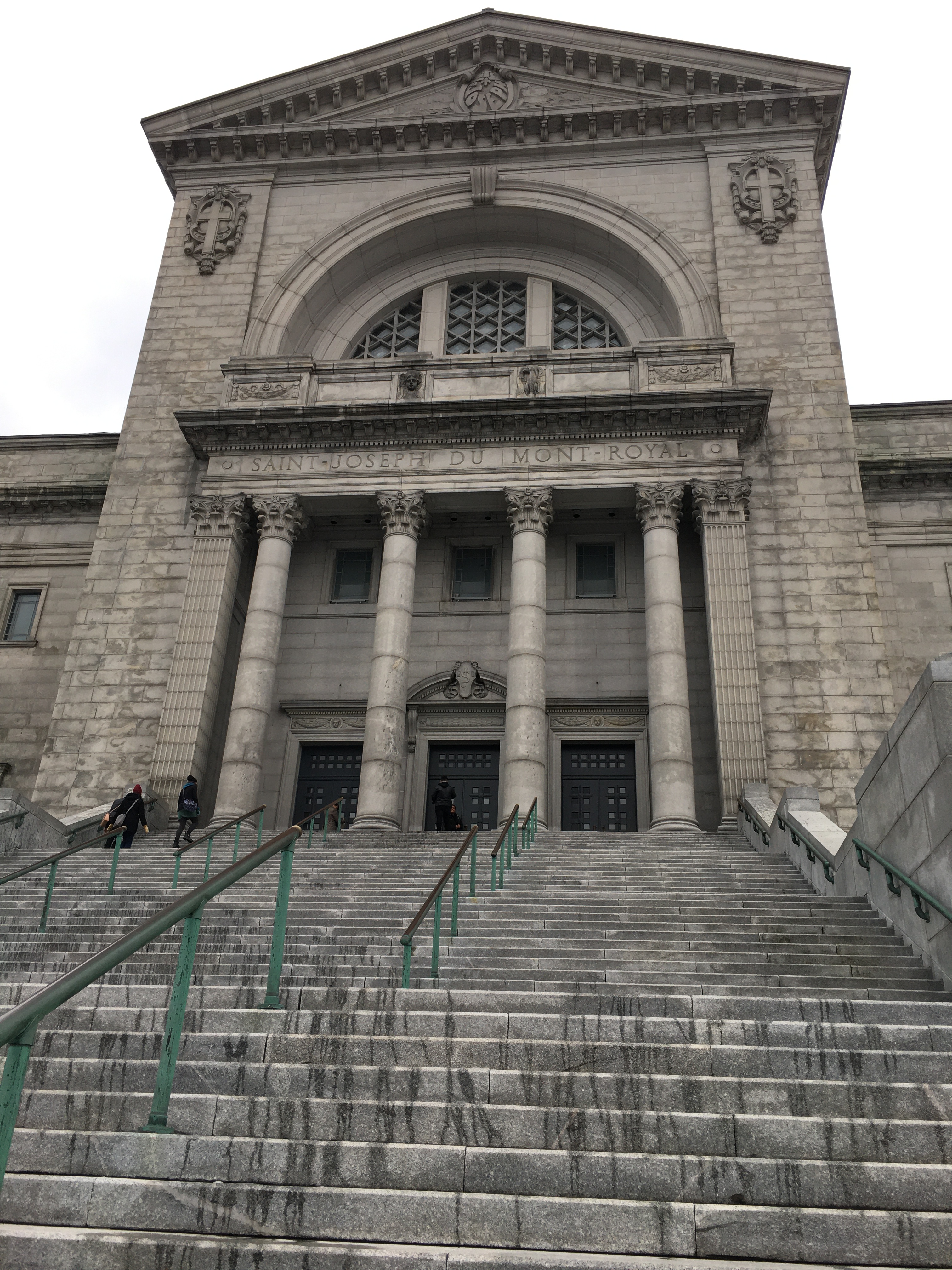
There’s a meme that’s gone around my social media page. It’s an animated picture of the front of a church during a snowstorm. There’s a crowd of people waiting to climb the steps to get into the building. But they are waiting for the lone caretaker to shovel off the pile of snow making entrance impassable for anyone. Amid the crowd is one person in a wheelchair.

The caretaker, before attacking the snow blocking the stairs, begins his work by shovelling the long, switchback ramp leading up to the main doors.

The crowd complains – “Hey, do the stairs first. There’s more of us!”

The caretaker responds – “If I shovel the ramp first, then all of us can enter right away.”

Jesus leads us into new life by removing the barriers. It’s a new life given to us all, not just those in the majority.

Climbing the stairs at St Joseph’s Oratory in Montreal (Nov 2019, photo by Martin Malina)

Dietrich Bonhoeffer said we don’t find truth and freedom by focusing exclusively on our own needs and wants. We find God’s truth and freedom by focusing our attention on another’s needs and wants. In doing that, we free ourselves from whatever blocks us on the journey to new life.

He says it best. Bonhoeffer writes in one of his sermons: “God’s truth alone allows me to see others. It directs my attention, bent in on myself, to what is beyond and shows me the other person. And, as it does this, I experience the love and grace of God … God’s truth is God’s love, and God’s love frees us from ourselves to be free for others” (Barnhill, 2005, p. 151).

There’s a beautiful Taizé song we are chanting before meditation these Easter weeks. It announces and celebrates the living Lord who leads us all into life.

Bless the Lord my soul, and bless God’s holy name. Bless the Lord my soul, who leads me into life. (Berthier, 1981).

What are the barriers you face? What are the barriers others face? And how does God invite you to help level the playing field so that all may come to know new life?

References:

Barnhill, C. (Ed.). (2005). A year with Dietrich Bonhoeffer: Daily meditations from his letters, writings, and sermons. Harper One.

Berthier, J. (1981). Bless the Lord, my soul [Taizé Community]. Les Presses de Taizé, France.

Kidd, S. M. (2020). The book of longings. Penguin.

Healing

In the Gospel last week Jesus healed someone with an unclean Spirit.[1] This week, Jesus heals again, not only Simon’s mother-in-law but many others with all kinds of different problems.[2] What does it mean that Jesus heals us?

The language has changed in two thousand years. What healing was to people in the first century was expressed in language that has evolved over time. Today, the language we use to describe health, wholeness and healing assumes medical advances and understandings of how our bodies and brains work—something the authors of the letters, books, poetry and sermons of the bible didn’t yet know about.

It’s not to say there is no truth in the words of scriptures. It is to confess, however, that the means of conveying that truth—the language—has changed. Because our perspective has deepened. We have learned more, over time.

Listen to these predictions made almost a century ago, about computers. In 1949, a Popular Mechanics writer predicted, “Computers in the future may weigh more than one and a half tons.” And an IBM executive in 1943 observed, “I think there is a world market for maybe five computers.”[3] Despite their erroneous predictions, computers have since the 1940s changed in size, weight, speed, memory capacity, and market value. And they are an integral part of how we must effectively engage with others and the world today.

Technology is like language. Language is a tool. And while fulfilling an important purpose, tools change with changing needs.

Today, it’s Artificial Intelligence (AI). Maybe one thing we can learn from the mistakes the IBM executive and Popular Mechanics magazine made in the 40s is not to be too certain about our predictions about AI. You never know.

There are, nevertheless, some insightful comments made by those who work closely with AI development. They point to how the technology affects people and what we value. The development of AI presents a desperate need for compassionate, loving human interaction in this world, called “soft skills”.

Although technical skills will always help someone develop an expertise, the research suggests that in the age of AI, ethics skills are more valuable than ever.[4] People who develop and work with AI need to become ethicists to preserve authenticity and trust. Interpersonal communication is another in-demand skill in this field; that is, the ability to build real relationships.

So, what does this have to do with healing? Let’s look again at the Gospel. Jesus heals. That’s what Jesus does: he seeks the healing of all people. The emphasis in this text is on healing for the sake of a good and better life-on-earth, for us and for all people. Jesus came so that we might have “life abundantly”[5] because “God so loved the world.”[6]

God so loved the world, at the time when those words were first written two thousand years ago. But God so loved the world, in the 1940s. And, God so loved the world, today, in 2024.

Jesus’ healing today has to do with reconciling people within community, overcoming barriers and whatever separates people. Healing has to do with strengthening relationship and building community.

And, to this end, God has given us the tools we need. Much of our medicine today derives from plant-life, in other words, from God’s good creation. Our healing from God is found in the gifts God has already given to us in our natural environment.

Listen to this definition of medicine from an Indigenous writer: “Medicine is in every tree, plant, rock, animal, and person. It is in the light, the soil, the water, and the wind. Medicine is something that happened ten years ago that still makes you smile when you think about it. Medicine is that old friend who calls you up out of the blue because he or she was thinking about you. There is medicine in watching a small child play. Medicine is the reassuring smile of an elder. There is medicine in every event, memory, place, person and movement. There is even medicine in empty space if you know how to use it. And there can be powerful medicine in painful or hurtful experiences as well.”[7]

Let’s remember Jesus’ healing didn’t prevent people from dying eventually from something. Healing is not some magical cure for your problems. Healing is not the total eradication of disease from life on earth.

When Jesus healed he showed us, gave us a picture, of love-in-action, healing that happened in community, not in private. Notice the healing was always in the presence of another. That’s how we know these healings happened! There was always somebody around – if not in the crowded synagogue, in a crowded house and in the streets and byways.

Healing is what happens when there is loving connection with oneself, between oneself and others, between oneself and the natural world, between oneself and the Divine. There is balance in all those parts that make us who we are.

And God loves it all. God wants us to know and feel that love. Jesus couldn’t wait to get on to the next town and village to share the message of and demonstrate God’s love-in-action!

Today is Global Mission Sunday in the ELCIC. In Bishop Johnson’s sermon for today,[8] she reflects on our relationship with the Evangelical Lutheran Church in Jordan and the Holy Land (ELCJHL). In the midst of all their troubles, especially war, they continue to live in hope and faith.

Bishop Susan was actually in the Holy Lands last month, and talked with Bishop Ibrahim Azar about the very toned-down Christmas they had just experienced. She asked him how it had gone and he said to her how hard it was. “But,” Bishop Azar said, “Christ was born again in our hearts.” Christ was born again in our hearts.

If the ELCJHL can be faithful and continue ministry in their extremely difficult circumstances— keeping congregations and schools open and serving those in need, what about us?

Here’s a prediction that cannot be denied: We can certainly continue with faith and hope in the midst of the challenges we face!

Thanks be to the God, who continues to heal in Christ’s name, we pray. Amen.


[1] Mark 1:21-28

[2] Mark 1:29-39

[3] Ed Bowen. (2024, January 18). Hold Fast to the Truth. Eternity for Today.

[4] Peter Cardon. (2024, January 23). The Future of Work: New study finds AI makes employers value soft skills more. Fast Company. https://www.fastcompany.com/91012874/new-study-finds-ai-makes-employers-value-soft-skills-more

[5] John 10:10

[6] John 3:16

[7] Garrett, M. T., Garrett, J. T., & Brotherton, D. (2001). Inner circle/outer circle: A group technique based on Native American healing circles. Journal for Specialists in Group Work, 26(1), 17-30.

[8] Click here for Global Mission Sunday  resources (ELCIC, February 4, 2024).

Pray, in Christ

In 1970, Russian cellist Mstislav Rostropovich expressed his support for artistic freedom and human rights in a letter to Pravda, the state-run newspaper of the Soviet Union. In response, the Soviets sharply curtailed his ability to travel. After Rostropovich and his wife decided not to return to the Soviet Union when travelling abroad in 1975, the Soviets stripped him and his wife of citizenship.

The political conflict in which the Rostropovich’s were embroiled reflected the larger geo-political strife of the Cold War from the last century.

When Rostropovich later played a Dvorak cello concerto in Chicago, the audience was treated to a brilliant performance. As the last note faded, the audience sat mesmerized. Rostropovich then did an extraordinary thing: he stood up and kissed his cello. The audience erupted. Then he hugged and kissed the surprised conductor. Then he hugged and kissed the entire cello section before moving on to the violins. He hugged and kissed most of the orchestra.[1]

With deeply felt gratitude, especially when circumstances are not ideal. When a home country—betrays, rejects. When suffering the consequences of some internal battle. When divided, separated from our home on earth and true home within. And still feeling grateful and expressing a profound thanksgiving. Does this not describe the experience of prayer?

I must admit upon reading the scripture from 1 Timothy I did not at first catch that this text is fundamentally about prayer. This text from Paul’s letter to Timothy announces the theme of prayer in the first verse: “First of all, then,” writes Paul, “I urge that supplications, prayers, intercessions and thanksgivings be made for everyone …”[2]

What follows in seven verses reads like a creedal statement of belief. This is what initially distracted me. But without the basic context of prayer undergirding that confession we can easily miss the deeper meaning by getting derailed by arguments about universalism and atonement theories.[3]

Starting with prayer gives us a practical, experiential basis for engaging questions of faith. Because it is in our personal communion with God that sets those questions in better, more productive, perspective.

Basically, religion is about realigning, reconnecting with God—that’s the meaning of the word, religion. Prayer is the means, the way, by which we connect with God. Our journeys of faith begin in the practice of prayer. And that is what we do every week in worship on Sunday. Everything that happens in the liturgy—in the order of worship—is prayer and flows from prayer.

At the Regina convention of the Evangelical Lutheran Church in Canada (ELCIC) this past summer, national bishop, Susan Johnson articulated a four-year vision for “Living our Faith”. She writes that “God is calling us into a deeper relationship …” and invites the church to focus, each of those four years, on one aspect of our spiritual journey. The first is prayer.[4]

Everything else (scripture, worship, love) flows from the beginning point of prayer. Why? Living our faith starts with communion in God, relationship with Jesus, personal connection with the living Lord.

While in worship we find many forms of prayer—different ways to pray (confession, petition, song, silence, sacrament, community, etc.)—there is only one prayer. And it is the prayer of Jesus. At its core, prayer for Christians is, as Paul often describes it, ‘in Christ Jesus.’ Paul uses the phrase, ‘in Christ’ dozens of times in his letters to the early Church. In Ephesians alone Paul uses ‘in Christ’ some twenty-seven times.

Christians believe in the living Lord. Jesus is not dead. Yes, he died on the cross over two thousand years ago. But since then, Christ is alive. And still is! We assert this every Easter season: Christ is risen! And Jesus’ communion with his ‘Abba’ (Father) through the Holy Spirit continues to this day, to this very moment.

When we pray we join in Christ’s ongoing prayer, in our hearts, like deciding to step into a river that continually flows towards the ocean. That river flows through our hearts. That is where the consciousness of Jesus resides through the Holy Spirit. In prayer, we incorporate with, enfold in, the prayer of Jesus with the Creator.

In our verbal prayers we will often conclude our words with, ‘in Jesus’ name.’ We pray ‘in the name of Jesus’. We pray, ‘in Christ’. This is the fundamental understanding of Christ as intercessor, as ‘mediator’ for us and for all people – as Paul writes here to Timothy. “Prayer is not an act resulting from our own autonomous will,”[5]but an act resulting from the good will of Jesus—a prayer that is ongoing regardless of what we do.

That is also why, prayer is not about us. Prayer doesn’t turn us back onto ourselves. Christian prayer may start by consciously locating our attention within our minds, our words and hearts and bodies. But ultimately, prayer leads us beyond ourselves. To others.

When Paul writes to Timothy that prayers “should be made for everyone” because God “desires everyone to be saved and come to the knowledge of the truth”, the emphasis is so made because of the real conflicts in the lives of those early Christians. The Christian community of Timothy’s time was persecuted for proclaiming Christ; they were not an accepted part of the social fabric in Gentile or Jewish community.[6]

I opened with a real story of conflict in the context of the Cold War. We can only understand our lives of faith in the context of our real lives which daily encounter some conflict—whether within ourselves, with our spouse, our children, our grandchildren, our neighbours, our hockey coaches, our teachers, our community leaders, our politicians, and whomever we label ‘our enemies’.

It is in the context of conflict and yes even strife where the instruction to pray bears down upon people of faith. “Love your enemies,” Jesus instructed more than once I am sure.[7] “Pray for those who persecute you,” he said.

We follow a God who is not immune from controversy and confrontation. Remember his earthly destination was death by a state-sponsored, capital punishment on the cross. This God we follow stretches us beyond our comfort zones and calls us to love in surprising situations. This God calls conservative evangelicals to pray for their liberal sisters and brothers, and vice versa. Trudeau Liberals are called to pray for Scheer Conservatives, and vice versa!

Maintaining healthy boundaries are important. And, some hurts go so deep that so much work and time are required in the process of healing. Without minimizing nor denying the harsh consequences of divisions …

“When you’re able to open your heart to your ‘enemy,’ allow God’s love to flow through you to them. Picture their face and send them warmth and tenderness. If this is a struggle, begin by focusing on someone that is easy for you to love, for whom you feel natural affection. Then broaden that circle of compassion to friends, acquaintances, and strangers.  [Because] no one is outside the embrace of God’s loving presence!”[8]


[1]William P. “Matt” Matthews in David L. Bartlett & Barbara Brown Taylor, eds. Feasting on the Word: Preaching the Revised Common Lectionary Year C Volume 4(Kentucky: WJK Press, 2010) p.89; www.britannica.com

[2]1 Timothy 2:1

[3]For example, God ‘desires everyone to be saved’ (verse 4); and, ‘Christ Jesus … gave himself a ransom’ (verse 6).

[4]www.elcic.ca

[5]Stephane Mar Smith in Feasting on the Word, ibid., p.88.

[6]Jane Anne Ferguson in Feasting on the Word, ibid., p.86.

[7]Matthew 5:44; Luke 6:27

[8]Richard Rohr, “Following Jesus” in Daily Meditations (www.cac.org, January 26, 2019).

The way the story is told

Look at the man whose community has judged as possessing a legion of demons. He has been pigeon-holed. Ostracized. Bullied. Looked down upon. Pitied. The man whom they looked upon, and said to themselves, ‘Thank God it’s not so bad with me.’ This is the kind of person who, it has been argued, we need. If only to make the rest of us feel better about ourselves.

Schadenfreude is the term we use to depict and distinguish those ‘less fortunate’ than us to justify our complaints and our more privileged status. So, we need ‘them’. And we need ‘us’. We need the distinction. To envision the opposite, to imagine some kind of union, to unearth the unholy distinctions between ‘them’ and ‘us’—well, that may be far too threatening to our fragile egos.

The way the story is told is not to focus on the man’s illness. Though, that’s what we like to talk about: the frothing at the mouth, the rattling of the chains which bound him, the pigs rushing dramatically to their watery deaths. The way the story is told, however, is not to fixate on whatever ails him, his sin, his problem. We say this is a healing story. But who else besides the man is invited to be healed?

Important though it is not to overlook the man’s problem, the way this story is told leads us to the climax of the telling—the last few sentences that describe the reaction of the man’s community, there across the Lake in Gentile territory.

When, at first, he is healed, and is shown to the people, how do they respond? You would think they would rejoice. You would think they would praise God. You would think they would marvel at the goodness, the promise, the hope, the delight of God in bringing transformation and healing to this man who once was lost in sickness and despair but now is saved. In Greek, the word for salvation is the same word for healing. This man we look upon, alongside the Gerasene community, is now restored, healed and given a new beginning in life. A second chance.

You would think those who witness this would rejoice in the promise and anticipation that this healing and transformation be offered to each of them also. Amen?!

The way the story is told, however, emphasizes the point not once at the end of the story, but twice: They were afraid, seized with a great fear.[1]They didn’t like what Jesus was doing. They had become too comfortable in their opinions, their prejudices, their categories, their pigeon-holing this man. And they didn’t like what Jesus was doing to upturn and completely reverse their world-view. They even had the gall to tell Jesus to leave. No more of this. Do you blame the healed man for wanting to get out of there, too, with Jesus?

This story shines an uncomfortable light not on the Gerasene Demoniac. The title of this story should rather be the community’s demoniac. The community’s sin. Their prejudice. And their incapacity to repent—to change their minds about the people they have normally pigeon-holed into convenient places of malice and schadenfreude, them and us.

The Gospel story opens with Jesus taking his disciples to the ‘opposite side’ of Galilee. To be faithful to Jesus, to follow Jesus, they have to leave their zones of comfort and familiarity to go to the Gerasene territory across the lake.  Every city, every community, every country, every culture, every church, has an ‘opposite side.’ And it’s to that ‘opposite side’ that we—Lutheran Christians in Canada today—are called to go.

The way the story is told, is that Jesus’ presence and power disrupts the social order of the way things are. Because, for one thing, to the people whose living depends on the pigs, their loss is catastrophic. The swineherds are understandably afraid.

From this standpoint, the way the story is told, the coming of the gospel of Jesus brings upheaval and sets in motion forces that will disrupt even economic and social arrangements. In other words, the good news will not seem good to everyone at first. Maybe, to us.

Especially to those who are comfortable, privileged and set in our ways. Indeed, for the community in Gerasene and for us, we might prefer the devil we know to the freedom we do not. We might take a false sense of security from the dysfunction, the prejudice, the self-righteousness we have learned to tolerate in ourselves, cope and live with, ignore and sluff off. And we might therefore fear what change—even change for health—may bring.

We fear freedom from what binds us:

Locked and bound in some prison of our doing—telling ourselves we are not good enough, that we can’t do it, that we don’t deserve the immeasurable love which God has for us.

Locked and bound in some prison of our doing—telling ourselves and each other that the poor, the newcomer to Canada, the Indigenous people of this land, our home on native land—deserve their plight as if we don’t have any responsibility to care for them. To tell ourselves we need not seek understanding from another’s point of view.

Locked and bound in some prison of our doing—maintaining beliefs, even religious ones, that serve only to belittle others from a different social, religious background than ours, others whose gender orientation is not ours, others who are impoverished financially. Maybe Paul’s words must ring true again today to our hearts that are divided and distressed over these issues: “There is no longer Jew or Greek, there is no longer slave or free, there is no longer male and female; for all of you are one in Christ Jesus.”[2]

What is the ‘opposite side’ of the lake, for you? Is it a troubled personal relationship? Is it a long-held assumption or belief? Is it something you’ve wondered about doing but had up until now been too afraid to try? Perhaps in this season after Pentecost, the Spirit of God is calling us to consider going there.

To discover anew that whether we succeed or fail, whether we accomplish our goals or not, whether we live or die, we are the Lord’s forever.[3]Healing and salvation will come to us, regardless of our pedigree. For, again in the words of Paul, “it is no longer I who live, but it is Christ who lives in me.”[4]The gospel doesn’t begin with us. It’s always about what God is doing in us.

As Richard Rohr writes, “It’s not what you do that makes you holy, it’s what you allow to be done to you that makes you holy.” (in today’s ‘daily meditation’, http://www.cac.org)

Grace does that. One doesn’t first become Christian, then go to church; One goes to church to become a Christian—and it will take a life time, and beyond. It’s not the destination, it’s the journey. As fourteenth-century Saint Catherine of Siena once said: “It’s heaven all the way to heaven, for Jesus is the way.”

Jesus invites us to join him on his journey to the opposite side. To grow and change. To reach further, deeper, into health and wholeness. To open ourselves to the unity we share with all people in Christ Jesus our Lord.

And that story will have a good ending.


[1]Luke 8:35,37, NRSV

[2]Galatians 3:28

[3]Romans 14:8

[4]Galatians 2:19-20

Meeting the unexpected

On New Year’s Eve, the roadway was completely covered in snow. All I could see in the waning light of day was the general shape of the roadbed curving slightly to the right in front of me.

I couldn’t see the customary yellow and white lines on the pavement to guide me. There were no tracks left in the snow of cars gone down this way recently. The snowfall was fresh and the road was not well-travelled.

I could control my speed, of course, but I didn’t have a lot to go on. Would I get home in one piece? First, I had to slow down. And even be prepared to stop.

The Magi were on a journey to arrive at the home of the young Christ child. Christmas cards and the popular mindset show the Magi at the baby Jesus’ side on the night he was born. But that is likely not the case.

The Gospel of Matthew indicates the Magi visited the holy family’s “house” in Bethlehem, hardly a description of a cave or stable for animals.[1]The Gospel of Luke, from which we read the birth narrative on Christmas Eve, does not mention the Magi.

The Magi were on a journey that took months if not years to accomplish. Their journey took time. Their coming to Jesus, so to speak, was not an immediate, instant, snap-of-the-fingers conversion. Their experience was slow, plodding and winding course across the deserts of the Middle East. On their journey to find Jesus, they had to have the long-view in mind. A whole lot of determination. And a commitment to the journey with all its fits and starts.

I also get the impression, reading through these verses from Matthew, that the Magi who were nearing the end of their long journey had to make in-the-moment changes to their plans. They had to check their assumptions and change their minds about initial expectations.

For example, at least half the Gospel text for today focuses on Herod. Initially, the Magi came to him in good faith, believing the Roman governor would sincerely help them. But an angel of the Lord had to steer them away, literally by a different road, and from Herod’s manipulating, plotting, fear-ridden treachery. The Magi had to trust ‘new information’ and make changes to their flight plan in mid-stream.

Then, the gifts. Three gifts: Gold, Frankincense and Myrrh. In biblical times, these gifts were usually given to a king or a person with highest status. Gold was such a gift. From the Hebrew scriptures, when The Queen of Sheba visited King Solomon she gave him precious gifts: “Arriving at Jerusalem with a very great caravan – with camels carrying spices, large quantities of gold, and precious stones” (1 Kings 10:2). The spices that she brought with her might very well have been frankincense and myrrh.

The gifts themselves are a powerful sign of what these visitors originally intended. The Magi were coming a long way to worship who they considered the true King. Not Herod. Not Rome. But the divine Son of God.

And, still, not what they expected.

The meaning of these gifts needs to be examined in light of Jesus’ life, death and resurrection. For us, what is ‘kingship’ in light of Christ—certainly not what we might first assume: glory, power, military strength and victory. Jesus’ journey took him through the defeat and humiliation of the cross. That’s the kind of kingship Jesus is about.

Myrrh represented healing. Healing in the light of Christ was not so much about an instant cure to earthly disease. But rather, healing is a transformation of the inner life of our attitudes and finding wholeness and grace in every moment of life, especially in the midst of suffering and pain. The king whom the Magi came to worship was a king who, in truth, represented values and meaning that countered—were at odds with—the values of the world.

And that is why this story starts the season of Epiphany in the church. Epiphany means, Revelation. The baby Jesus is revealed as the Son of God who shows us the way of God—God’s path of transformation and salvation. The season of Epiphany invites us to participatein this way. Participating in this journey asks us, like the first Magi, to be prepared to change course and examine our standing assumptions about God and the world.

It’s the manner in which the truth is revealed that ought to catch our attention in the biblical story. And this way is both apparent by what these three gifts mean, and by the expectations we first bring to this story.

For example: We assume and even say ‘it’s biblical’ that there were three men and they were three kings. But that’s not what the bible says. For all we know, there could have been a whole caravan of them. And what if some were women?

Although we sing, “We Three Kings of Orient Are,”, these visitors from the East were also not kings. The term Magi is a plural form of a word in Greek which means, literally, Zoroastrian priests.[2]And, maybe they earned the title ‘wise’ because of their skills in interpreting dreams and understanding astrology.

It’s as if the proverbial rug first needs to be pulled from underneath us before the truth is revealed. We don’t come to it straight on. Our expectations first need to be checked, and likely over time, over turned.

Once on New Year’s Eve when driving down a country road covered in snow in the middle of a blinding snow storm I thought I was driving in the middle of the road. I figured I best check that assumption. Thank God I did.

In a moment no other vehicle was passing, I stopped and opened the driver’s side door. With my boot, I scraped away the fluffy blanket of snow believing I would find the dark asphalt of the road and maybe even a lane marker painted on the hard top.

To my horror, I turned over stones and gravel, indicating I was already on the shoulder of the road. Had I not stopped at that moment, my vehicle was heading in the direction of the deep ditch on the side of the road.

Thank God, I had it in my mind to stop when I did, and scratch the surface of my belief. Then, I was able to change course.

The star finally stopped over Bethlehem, showing the Wise Ones where the destination of their journey lay. At this sign, “they were overwhelmed with joy.”[3]Arriving home in one piece from driving in less-than-ideal road conditions gave me a sense of joy. The joy comes because of the journey, maybe because the journey was difficult. Maybe because the journey called forth the best from you, to meet the challenges and make headway despite the journey’s challenges, pain and suffering.

The amazing thing is that God somehow brought the Magi–the Wise Ones–to the exact location of their hopes and dreams. Perhaps not what they expected at first. But this gift they surely recognized.

Here are some questions for reflection as we enter this new season after the Epiphany: What was the most important gift you received this holiday season? Did you expect it? Why is it important? How did you receive it?

God has given us the greatest gift in Jesus. Where we find him will be shown to us, on the journey. This grace continues throughout our lives.

May our trust grow in a God who has this uncanny ability to trust and have faith in us to get home. Let us pray: God, you led the Wise Ones by a star to find the Christ child. Lead us as we strive to follow you in living our faith. No matter how long it takes. No matter how winding the journey. Help us trust your promise to bring us home. Amen.


[1]Matthew 2:11

[2]Niveen Sarras, “Commentary on Matthew 2:1-12”, http://www.workingpreacher.org

[3]Matthew 2:10

Doers of positive change

If you’ve followed the Ottawa Senators’ Hockey Club over the last year you will have endured a roller coaster ride. From the high, you will have tasted the sweet drippings of a near-berth in the Stanley Cup Championship Series sixteenth months ago …

To the low, feeling the despairing collapse of the team, not just to being out of the playoffs but crashing all the way to second last place in the NHL standings by the end of this past season.

What happened?

In the last several months, the nightmare season was enflamed by revelations of all the off-ice drama that was happening:

  • Allegations of sexual abuse by then assistant manager Randy Lee;
  • The politicking of owner Eugene Melnick to shame/scare the fan base that he was either going to move the team away from Ottawa, and/or that the downtown arena project may not happen motivating concerned fans to initiate an #MelnykOut ad campaign across the city;
  • Star player Erik Karlsson’s wife applying for a peace bond (restraining order) against the girlfriend of another star player, Mike Hoffman, who allegedly used social media and other means to send discriminatory, abusive messages to the Karlssons even during the loss of their unborn son in March;
  • And the continuing speculation around and probable trade of Erik Karlsson in the final season of his current contract.

General Manager Pierre Dorion was right when he told the media last Spring that his locker room was “broken.” Inter-personal relationships, team chemistry – the essential ingredients in a winning team – were damaged maybe even beyond repair.

While ‘on paper’ the team had skilled players and was comprised of the same core from the year previous when they had that successful run to the Conference Final, something significant had changed for the worse. And this subtle yet very real aspect of failed team-work was at the root cause of the team’s on-ice collapse last season. It wasn’t that they weren’t good players; it was their unhealthy, damaging ways of relating with each other that was the problem.

Funny we are talking here in the church about a hockey team that many of us follow in Ottawa. And yet, we can, I think, attend in a similar way to most areas of our social, political, religious, family and personal lives. Are their areas in your work, your volunteer efforts in the church and in the community, in your personal health, in any aspect of your quality of life let’s say, that are lagging, that yearn for renewal, new life, positive change?

For some time, Ottawa Senator players have been saying that there needs to be a culture change in the locker room and among team relationships. Goaltender Craig Anderson said this week he is looking forward to the changed culture in the coming season but he is “too old for all the drama.”

Teammate and hometown defenseman Mark Borowiecki who is considered a leader in the group called out his goalie and others on the team by suggesting they need to do more than just say they need a culture change. Each player and the players themselves as a team, has to do the work of changing the culture. It wasn’t going to happen by itself. No divine intervention. No single-player trade, no matter how newsworthy, was going to change their culture. They, the players, had to take on the responsibility to work at it.

Be doers of the word. A theme in the scriptures assigned for this day. In the Book of James we get the message that while words are important, actions reveal the truth, authentic self and purpose of what we’re about (1:22) more than anything else. What we do with ourselves, with each other – our actions – are the best teacher and communicator of what is most important to our common life, our team, you could say – whether that team is the church, the family, a marriage, a community group, a political movement, or a sports team.

And this action is not only about our performance on the ice, so to speak. This work of doing is not merely about the mission, out there. It is not about whether we succeed or fail on the mission field in getting the job done – the work of ministry in the world. Perhaps our failure at getting that job done out there may at least in part relate to our failure to do anything on the inside of our personal and corporate lives. And lacking the awareness and the belief of positive change within.

It is no wonder Bishop Susan Johnson and the leadership of the Evangelical Lutheran Church in Canada (ELCIC) has identified being a “healthy church” as one of the four vision priorities, moving forward in community. Being a healthy church means, to “develop and promote a culture of mutual trust and accountability.”[1]

That is, we relate with one another and the world around us in ways that reflect genuine listening, respect, humility and patience. In short, we offer safe spaces for personal interaction and growth. We can’t achieve the other vision priorities of the church, such as compassionate justice, spirited discipleship or effective partnerships, unless we are first a healthy group of people relating to one another.

And no one will make this culture change in our relational lives unless we are doers of the word, unless we take action that promotes growth, faith and positive change in our common lives.

In the mid-point of Mark’s short Gospel, Jesus spends a lot of time around the Sea of Galilee. When I visited Israel during my seminary years, our bus ride was only a couple of hours from Jerusalem to the Sea of Galilee. In Jesus’ day, it meant walking at least six days. Word of Jesus had certainly spread, and his actions of healing and eating with sinners and picking grain on the Sabbath made the Pharisees – the keepers of the Law – extremely nervous. So much so, that the powers that be from Jerusalem invested the better part of a month checking up on Jesus’ ministry (7:1).

It is sometimes amazing the lengths people will go in order to keep things the way they have always been. A radio sports commentator mentioned after the Anderson and Borowiecki interviews that Mark Borowiecki was right: talk of culture change has been swirling around the same group of players for most of last season with little, actual change in their performance. It seems we haven’t really been taught how to work at bringing positive change, starting with us.

Change is frightening, to be sure. Institutions often seek to preserve the status quo. That was true in Jesus’ day. And it is true in congregations as much as in team locker rooms these days. Yet change, as we must surely know living in this time and place in history, is the norm, not an exception.

I was pleased to hear Pastor Mei Sum Lai, leading her last worship service at Resurrection Lutheran Church in Orleans[2]last Sunday, thank the congregation for allowing change to happen during her tenure there. I then reflected on all the changes that have happened here at Faith[3]in the last six years or so:

  • The bold decision to bring significant upgrades and modernization to the building and sanctuary;
  • The gutsy decision to worshipping for four months with our local Anglican parish while the sanctuary was off-limits in its renovation;
  • The move to weekly Communion;
  • The involvement of lay readers and worship assistants;
  • The completion of the work of the Evangelical Lutheran Women as a formal entity
  • The introduction of Christian Meditation as a weekly prayer group;
  • The evolution of bible study to a prayerful encounter with the Word;
  • The ongoing evolution of meals at the church in all its fits and starts – to name a few changes.

These changes, good or bad in your view, are nevertheless good practice for us. Making these changes are good exercise for us, for the positive changes that God is bringing about in our world and church. Because we won’t do it perfectly. We will make mistakes. We will even fail at times. But avoiding failure is not the point of Christian identity and mission. The point is, we are following Christ – or trying to – on a rocky and uncertain road in the post-modern world. Trying amidst the noise and chaos to discern and listen to Jesus’ voice.

What is at stake, is what we believe. What do we believe about change? I think this makes a huge difference in how that rocky road will go for us.

Despite the negative scrutiny and criticism heaped upon Jesus by the Pharisees, what does Jesus do in response? Does he cave into the pressure to play by the religious rules of the day? Does he try to please the authorities and adhere to the tradition for tradition’s sake? Does he shift into self-preservation mode and quietly step into the shadows as not to garner any more attention? What does he do?

Jesus keeps on healing. If you read on in chapter 7, he goes on from Lake Galilee southward on the road into the non-religious Gentile region first to heal the daughter of the Syrophoenician woman[4], and then he opens the ears of the deaf man in the Decapolis.[5]

In fact, I don’t know of anyone in the New Testament who doesn’t change after encountering Jesus, whether by a healing or in a shift of attitude and approach to life. The most dramatic example, probably, is Saul of Tarsus who on the road to Damascus encounters the living Lord and experiences a profound conversion.[6]

When you meet Jesus, your life changes for the better not because you don’t do anything about it. But because you’ve placed yourself, for better or worse, in a position to receive the grace, healing and change of God. Historian Diana Butler Bass writes, “For all the complexity of primitive Christianity, a startling idea runs through early records of faith: Christianity seems to have succeeded because it transformed the lives of people in a chaotic world.”[7]During this time, Christianity was primarily about how to live a better, more faithful life, here and now within the kingdom of God.

Team play is as much an inner game as it is an outer game. And the inner game takes work, not just words. This inner work is not easy to do.

Perhaps you might have a hard time believing positive change is possible in your own life. If so, is it because we refuse to see the positive changes happening in those around us – in the life of the church, in our own families and friendship groups? Because when we refuse to accept that others have changed, we strike the death knoll and close the doors of our own hearts to see the change there.

So perhaps a first step would be to regard others, especially those closest to us, as on a journey that is changing and growing them in ways beyond our control. And then wait for Jesus’ call on your own life to follow him, to encounter him, to meet him on the road of life. In most of the people who meet Jesus, they present their own need. They approach Jesus in their vulnerability. Where they are hurting.

Because whatever the case may be with your own heart, whether or not you believe change in your own life and in the life of others around you is possible, God waits for you. God is patient, ready and willing to heal. God believes in you.


[1]http://www.elcic.ca

[2]http://www.rlchurch.ca

[3]http://www.faithottawa.ca

[4]Mark 7:24-30

[5]Mark 7:31-37

[6]Acts 9:1-31

[7]Diana Butler Bass, “A People’s History of Christianity: The Other Side of the Story” (HarperOne, 2009), p.26.

Canada is a neighbour

Happy Canada Day!

On this July 1stit is good to reflect on what makes Canada great. Let’s be positive! What is it about our society that stands out in a positive way – amid all that is not so good?

I would like to say that we are a country that aspires to a healthy neighbourliness. Being a good neighbour – whether striving for better relations with Indigenous people, whether relating to newcomers to Canada today, whether reaching out in kind to those who are different from me who live across the street – is our national identity.

Asserting this quality for Canadians, I believe, is not new. Being a good neighbour is not a recent trend in progressive society. Hearing preachers spout the virtues of neighbourliness reflects a deep seeded consciousness influenced by popular culture already in the last century.

It was in the 1950s when children fell in love with the Friendly Giant on TV in Canada. Some of you might recall watching actor Bob Homme on CBC TV from 1958 until 1985 being friendly to his puppet animal friends.

Then there was Mister Rogers’ Neighbourhood which first aired in 1968. Although an American show, did you know that Fred Rogers spent several years in Toronto in the early 1960s working with Ernie Coombs – Mr. Dressup – airing a prototype show called the same Misterogers?

Over his career, Fred Rogers was intentional about being more and more inclusive. He brought, for example, an African American person onto the show yet didn’t draw undue attention to it. This was a subtle yet poignant statement about neighbourliness when American white culture was anything but, towards people of colour.

To assert that these cultural icons were birthed in Canada would not be an overstatement. To be Canadian is to be a good neighbour. It is in our DNA. It is our calling, our witness to a world that wants to be anything but, especially these days.

Yet, it seems every generation of Canadians needs to learn anew how to be a good neighbour. We need to be continually reminded and encouraged to practice being a good neighbour because we tend to be a fearful lot. And fear keeps us from this holy calling.

Having faith doesn’t mean the absence of fear. Having faith means stepping into the fearful place. Having faith means action. It means “leaning into” the situation as we are.[1]

Our lay delegate from Faith Lutheran Church to the Eastern Synod Assembly in Toronto last week, admits being fearful taking the train for the first time. Julia is a seasoned, experienced OC-Transpo bus rider here in Ottawa. Despite the similarities in travel experience between the train and bus, she confesses taking the train across the province for the first time was an anxious affair.

What is more, we missed each other on the train ride to Toronto. Even though we were on the same train, we boarded at different locations – Julia, downtown; and me, at Fallowfield Station in Barrhaven. In fact, as it turns out, we were on the same car – but I never once caught sight of her.

Until on the last leg of the journey, when we were on the Union-Pearson Express train. My phone dinged. Julia texted me to confirm whether I knew where to catch the hotel shuttle to the convention centre where the Assembly was to take place.

Despite her fear of riding the train for the first time, and alone, Julia reached out to me. She was being a good neighbour by making sure I was ok. Her reaching out to me was helpful since, truth be told, I was not sure about where to catch the airport shuttle bus.

“Who is my neighbour?” Jesus asks before telling the story of the Good Samaritan.[2]“Liberated by God’s Grace … to be neighbour” was the theme of the Eastern Synod Assembly. Through thoughtful, provocative and compelling bible studies, song, and interactions with various peoples, the Assembly reflected and re-committed to become even better neighbours, as a church.

Interesting, in keeping all this in mind, that we encounter the nameless woman in the Gospel reading for today.[3]She approaches Jesus in the crowd, hidden, secretly. No wonder. She is powerless and outlawed in public spaces on account of her bleeding.

The main point of the story is not that she is miraculously healed. She could have remained hidden, quietly disappearing into the crowed after she is healed. That is the way she would have wanted it, likely.

The point is that Jesus calls her into a deeper relationship. She must come out of her private suffering. She must confront her fear, and make a deeper connection with herself, with others, and with Jesus.

“Who touched my clothes?” Jesus says out loud even though he knows the woman has already been healed when he felt the power drain out of him.[4]He, too, could have enabled the woman’s secretive behaviour, letting her go and moving on. He could have protected her in her fearful existence after she is cured.

Instead, Jesus calls for her to step up and be known. Demonstrating incredible courage, the woman responds to Jesus’ call and approaches him “in fear and trembling, fell down before him and told him the whole truth.”[5]

Jesus seeks out a relationship with her. It is of God to do this. God continues to call us into ever deeper relationship – with ourselves, with others and with God. The point of the Gospel is that we affirm our connectedness with others in healthy and compassionate co-existence. This is the path to truth.

Jesus’ ‘touch’ can heal us and the world. The touch of God’s grace can give us peace. We are shaped and made human in relationship with others. All our relationships – in church, in friendships, in marriage – are not just something extra added on to life for distraction and entertainment as if we would be complete human beings in individual isolation.[6]Relationships are not some added feature to our lives in order to get something, a means to some autonomous end.

Relationships are the fabric of life. Relationship – touch, if you will – makes us human and whole. Being neighbourly can heal us, make us better people. “Perfect love casts out fear,”[7]our scriptures say. Love can only be expressed in relationship.

The reason Julia was not afraid of riding the bus in Ottawa, was because she was practiced at it. She had done it many times. Even though the train is not that much different, she had never before taken the train. The difference is, some intentional, risk-taking exercise.

Later this week, members of Faith council will be volunteering for a couple of hours at the Mission downtown for homeless, impoverished men. We will get a tour of the facility and help give out some ice cream to those who are there. Practice, to move beyond fear to faithfulness, isolation into community, to where our neighbours are.

We need to practice being a good neighbour – to those who are vulnerable, to those who are powerless, to those who are stigmatized, to the homeless, the LGBTQIA+ community, to refugees and migrants. We have to lean in to the places of fear in our lives and to take some risks vis-à-vis people who are different from us. In doing so, we realize we are not alone, and we have meaning and purpose in our lives for the common good.

Canadians and Christians share something in common, to be sure. We are called to reach out. And be a good neighbour to the world. We are not left alone stuck in our fear. Because God continues to call us into the deeper waters of grace and love. God will never abandon us, despite our fear.

Let us approach boldly the seat of grace in Christ Jesus our Lord. Amen.

[1]Brother Luke Ditewig, “Brother, Give Us A Word” for June 28, 2018 (Society of Saint John the Evangelist) friends@ssje.org

[2]Luke 10:25-37

[3]Mark 5:21-43

[4]v.30

[5]v.33

[6]Michael L. Lindvall in David L. Bartlett and Barbara Brown Taylor, eds., “Feasting on the Word: Preaching the Revised Common Lectionary” Year B Volume 3 (Kentucky: WJK Press, 2009), p.192.

[7]1 John 4:18

God in Acts

In Mark Burnett’s recent visual adaptation of the entire Bible, some scenes from Jesus’ passion still stand out for me. Weeks have passed since the dramatic events of Holy Week and Easter. So, I ask you, to rewind the tape for just a minute. And recall with me when news of the upstart prophet from Galilee first came to ears of the high priest in Jerusalem:

The scene in the temple is dark, illuminated only by the flickering flame of candlelight sending fleeting shadows throughout the cavernous room. The religious leaders draped in their flowing robes shuffle about.

An anxious member of the religious elite makes his way to the high priest, catching his attention: “There are reports of a man performing miracles, and some five thousand followed him to Galilee.” At first, news about Jesus does not worry the high priest. He turns away without saying a word. But the messenger persists, pulling at the high priest’s shoulder. “He calls himself the Son of God!”

The high priest’s mouth stretches in a cold smile, “They all do.”

Then, the night before Jesus’ death, Pilate consoles his wife who is disturbed by news of Jesus’ arrest and trial. Pilate’s wife tries to convince Pilate to have nothing to do with Jesus and let him go.

But Pilate, feeling caught between a stone and a hard place, is playing a delicate political game in order to keep control. He says to his wife, trying to justify his own actions to have Jesus condemned to death: “Don’t worry, in a week this man will be forgotten.”

Both the high priest and Pilate, struggling for political control, convince themselves Jesus is a no one, or at best, a pretender. And will be forgotten, like all the rest of them.

We fast forward now, to life in Jerusalem after Jesus’ death and resurrection. Now, in the Book of Acts, the focus shifts to the disciples. A man who is disabled, sitting by the gate near the temple in Jerusalem, finds healing. Peter and John meet him on their way into the temple. “In the name of Jesus Christ”, Peter touches the man, and he is able to walk again.[1]

“By what power or by what name did you do this?” the religious leaders in Jerusalem ask Peter and John when they are arrested. The Sadducees, who were a powerful religious group in Jerusalem, did not believe in the resurrection of the dead.

Strike one, against Peter and John who did not stop preaching the resurrection of Jesus and all who believe.

It is said that five thousand people converted to Christianity after hearing and seeing what miracles and words Peter and John performed.[2]

Strike two, against them. Five thousand people is a huge threat to the religious establishment. And to social stability. Rome held Jerusalem’s religious leaders responsible for keeping the pax romana – Caesar’s idea of political control over each region in the vast Mediterranean empire. There was no way the Sanhedrin were going to allow Peter and John to continue their disruptive work.

So, they were arrested and brought before the religious council called the Sanhedrin. Did Peter and John know that a few weeks prior, Jesus stood in the same place before the religious leaders?

Strange, I find, that something obviously positive – the healing of a person – turns into something negative so easily where human nature is concerned. Questions of resurrection, the mercy of God and healing turn into a question of power: “By what power or by what name did you do this?”

It is also clear, as the author of Acts present, that the religious leaders were “jealously protective”[3]of their franchise on religion. They wanted the masses to be prayerful and faithful. But they wanted people to do so under the exclusive banner of the temple.

Yet, from the beginning, the Christian movement was an outbreak of the Holy Spirit, spreading like wildfire. It cannot be contained in any one, exclusive denomination, group or church claiming to be the only, right way. That is not the nature of the Christian movement, from day one to the present. Exclusivity is not the preferred style of Christian life.

“By what power or by what name did you do this?” Peter and John have an answer: There is no other name by which we all are healed. Jesus Christ stands for all.[4]For God shows no partiality, for there are people in every nation who are acceptable to God.[5]

There is no other name. Other gods will give up on you:

The god of war and violence will give up on you when you turn the other cheek.

The god of consumerism will give up on you when you give what you have to those in need.

The god of power and control will give up on you when you let go of any pretence of being in control of others, forcing them to be like you.

The god of competition and hatred will give up on you when you welcome, affirm and show mercy to those who are different from you and your kind.

All these false gods of the world will forget you. They will be forgotten. The high priest of Jerusalem and Pilate were right because there were so many claiming to be the Messiah who were just that: fakes. These are the false gods who will be forgotten.

But not Jesus. Even after his resurrection and ascension, Jesus will not be forgotten.

Peter and John may have had a couple of strikes against them standing as prisoners before the religious leaders in the temple’s portico. But they, and the Christian movement, would never strike out. God was about to blast a grand slam out of the park of history.

The God of resurrection and new life will continue to inspire, to push us forward, to pinch our consciences, even challenge us to move forward. There is no hiding from this God who will not give up on you and on us.

The God who created you, who loved you,

Who, even in your sin forgives you and shows you mercy,

The God who gives you a second chance, always,

The God who is your loving shepherd, compassionate friend,

This God will never, ever give up on you, nor forget you. Nor any lost, hurting person or creature in all of creation.

Whether it is Peter or John, or the voice of God speaking this through the church and in the world today …

There is no other name under heaven by whose power all can be saved.

Amen.

[1]Acts 3:1-10

[2]Acts 4:4

[3]Thomas C. Long cited in David L Bartlett & Barbara Brown Taylor, “Feasting on the Word: Preaching the Revised Common Lectionary” Year B Volume 2 (Kentucky: WJK Press, 2008) p.432

[4]Acts 4:10-12

[5]Acts 10:34

Lifting up

Imagine the path slick with rainfall and mud. I took this photo at the end of a beautiful, clear day, on the Camino de Santiago (del Norte). But just as often as there were dry, sunny days on the way, I encountered trails that were treacherous in rain.

IMG_5303

It was at the end of my longest hiking day in northern Spain that I met with such a descent – almost a full kilometre straight down on uneven cobblestone into the coastal town of Deba. The rain had started moments before. And I had just walked thirty-three kilometres in the hilly Basque country, all the way from Orio, near Zarautz.

I was exhausted. My mind was obsessed with getting to the pilgrims’ hostel as soon as possible. I was ready to collapse in a heap on my bed. Negotiating a tricky, slippery path was the last thing on my mind.

I had read and heard from fellow pilgrims these horror stories of unsuspecting pilgrims breaking their ankles on these kinds of descents. It was all too easy to cut short a pilgrimage after such an unfortunate accident. The practiced and seasoned hikers would know that one had to be very mindful of each step made. Even when they were tired. Even when being mindful of placing one foot in front of the other was the last thing they wanted to do.

On the last couple of Sundays we’ve encountered stories from the Gospel of Mark about Jesus’ healing ministry.[1] Indeed, during Ordinary (“green”) time in the church – both during the relatively shorter season after Epiphany in January and early February, and during the longer summer months in the season after Pentecost – the Gospel focus is the ministry of Jesus which includes healing.

In Lutheran circles we tend to look only at his proclamation; that is, we focus on what he said and taught the disciples about the kingdom of God. From this, we emphasize that Christian ministry is primarily about the proclamation of the good news. Mission, then, becomes more about ‘telling’ others about God, thus spreading the Word.

We miss an essential aspect of work-in-the-name-of-Christ with this limited vision of mission. Because, as elsewhere in the Gospels, we find that healing has equal prominence in Jesus’ ministry. Not only do we read about the miracles of Jesus curing disease, but more an inner healing for people battling their demons, so to speak. Healing has just as much to do about a renewed mind, a refreshed heart, a changed spirit. A reconstituted identity.

Healing is emphasized in the Gospel story today. Not just through words. But changed lives. Jesus came not only so that we might ‘believe’ with our minds in the good news, but that we might be healed in our earthen bodies and spirits.

How does this happen? What does Jesus do? From the text given to us today, Jesus’ took the hand of Simon’s mother-in-law, and “lifted her up.”[2] Jesus touches the person, physically. Taking someone by their hand is a sign of accompaniment. God is not remote from our human struggles. God is with us, Emanuel, in the person of Jesus. God takes our hand, and then lifts us up.

Faith can be described as movement. Last week we looked at the movement of ‘leaning into’ what we are afraid of, as a step in the direction of our healing – and finding Jesus is there. This week, the focus on the movement of ‘lifting up’, being ‘lifted up’, by God. As Jesus took the woman by the hand and lifted her up to be healed.

The Psalmist knew intimately this uplifting aspect of faith. “I lift my eyes to the hills, from where will my help come? My help comes from the Lord, who made heaven and earth.”[3] Many of the Psalm writer’s verses are called “psalms of ascent” because they were sung on the way ‘up’ to Jerusalem. The ancient pilgrim faithful needed to ‘look up’ as they made their way up the mount to the gates of the holy city. You know the hymn: “My Faith Looks Up to Thee.”

Faith is a ‘look beyond and upwards’ movement. In other words, the life of faith is not characterized by remaining stuck in the valley of our own suffering and misery. A faithful life, of course, does not deny our suffering nor is it pretending or distracting ourselves away from accepting its harsh reality.

Despite life’s imperfections, and struggles, however, to be faithful is to remain focused on others, on the promise of God, and on the hope we have. God takes our hand and is with us, and God sees it all. As Paul wrote, “we only see dimly now”.[4] Because we cannot understand all of life’s complexities, we need to trust in life, trust in good, trust in God’s time, in God’s way, that “all things work together for good for those who love and trust in God.”[5]

We are not just lifted up for our sake alone. We are called to lift others up, especially the downtrodden. Ours is the calling to lift others up – physically, emotionally, spiritually and materially.

We all know people who are ‘the lifters’. In their presence you feel lighter, lifted up. Whether it be their life story, their non-judgemental presence, their desire to show mercy and compassion, their interest in listening to you – they are an inspiration to us. They inspire us by their discipline, their focus in life.

The Gospel message is: We don’t need to be continually burdened by our suffering and narrow focus. We can be lifted up and transformed to be a reflection of God’s light to the world. In being truly ourselves, we can be ‘lifters’ too.

Remember: Resurrection is the end game of our faith. I mean not only of Jesus’ resurrection over two thousand years ago. I mean not only of our resurrection after we die our physical, earthly death. Because of Jesus’ healing ministry, we know that God also wants us to experience ‘resurrections’ in our own lives – on our earthly pilgrimage of living.

We can change, yes. It won’t be easy. It will take work. It will challenge us. We will need to move outside of our comfort zones. We will need to endure our momentary afflictions. On this journey of transformation, it will get harder before it gets easier. The truth will set us free, but it will first make us miserable. This is Christian truth. There is a cost. It is first the Cross of Christ; it is then the empty tomb of Easter.

There’s a woman from Tennessee whose name is Margaret Stevenson. She was in her nineties when I first read about her passion for hiking. You see, Margaret Stevenson used to hike ten or fifteen miles every day. She was a legend in the Smoky Mountains. She knew every trail and every plant and tree by its Latin and colloquial name.

Bill was much younger than Margaret when he hiked with her one day up Mt. LeConte. Now, Mt. LeConte is the third highest mountain in the Great Smoky Mountains National Park peaking at just over 6500 feet.

pexels-photo-414171.jpeg

Bill’s first trip up Mt. LeConte was Margaret’s seventy-fifth. When she finally stopped hiking she had climbed Mt. LeConte more than 700 times. Her husband rarely went, even before he got cancer.

When Bill and Margaret set out, they came upon what Margaret described as the most unrelenting two-mile ridge in the whole area – two miles up with no break. And this after a hard six miles on a very hot day.

Bill liked to hike in spurts, so he said, “See you later, Margaret,” and took off in his usual fashion and got way ahead of her. At some point, he found himself lying flat on his back in half delirium. A blurred Margaret passed him by at her steady pace. Bill can still hear the click-click of her cane and with no pity at all in her voice, she said, “One more mile to go, Bill. I’ll see you at the top!” And so, she did, arriving well ahead of Bill without stopping once.

Not long after that, Margaret’s husband finally died of cancer. But because of her daily walk with God, their last few hours were spent not in sadness or remorse, but in joy and celebration. For when Margaret says, “I’ll see you at the top!” she means it. For her face is fixed on Christ. Her step is steady and sure. And she knows the meaning of Isaiah’s words:

Even youth’s will faint and be weary,

And the young will fall exhausted;

But those who wait for the Lord shall renew their strength,

They shall mount up with wings as eagles,

They shall run and not be weary,

They shall walk and not faint.[6]

[1] Mark 1:21-28, Mark 1:29-39

[2] Mark 1:31

[3] Psalm 121:1-2, NRSV

[4] 1 Corinthians 13:12

[5] Romans 8:28

[6] William J. Carl III in David L. Bartlett & Barbara Brown Taylor, eds. “Feasting on the Word: Preaching the Revised Common Lectionary” Year B, Volume 1 (Kentucky: WJK Press, 2008), p.318-319.