Wildfires and the journey of faith

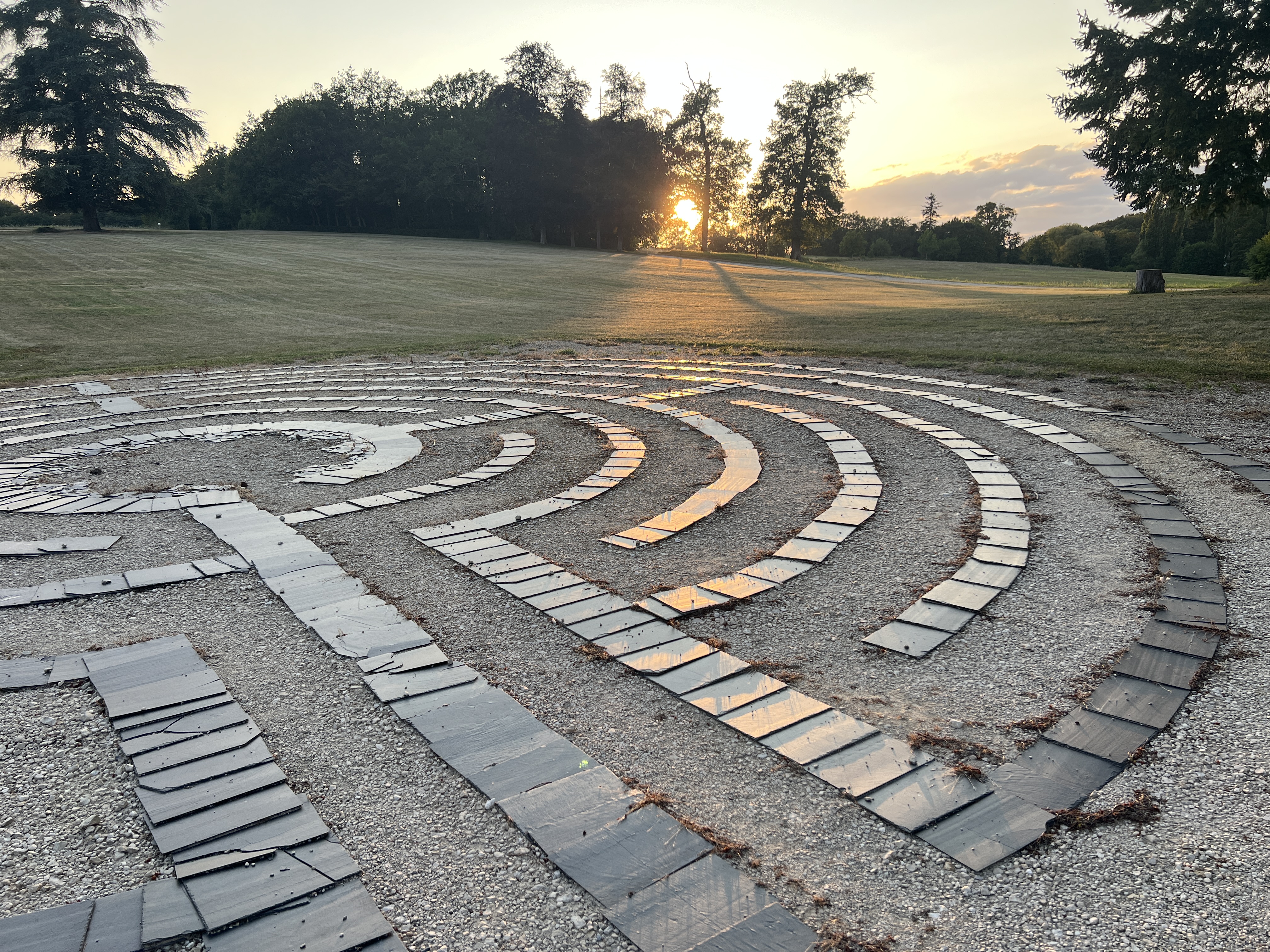
Labyrinth at Bonnevaux Centre for Peace (photo by Martin Malina, 21 July 2023, Marçay, France)

How could such a beginning
Ringed in water
Come to such an end
Fixed in fire?

(King, 2019)

When I recently read this poetic lament written by Canadian Indigenous historian and poet, Thomas King, I couldn’t help but immediately think about all the wildfires this summer.

Others are calling on us Canadians to get used to the “new reality” (Reed, 2025, August 11) regarding summertime wildfires. 2025 has been the second worst year for wildfires after the record-setting year in 2023.

The average number of hectares that burn over a 5-year period in Canada is around 4 million. This year alone, seven-and-a-half million hectares of land have burned due to wildfires, about 78% more than the 5-year average.

The warmer it gets the more fires we see. It is a stark manifestation of the climate crisis, with temperatures this past spring already two-and-a-half degrees Celsius above average. The hotter the climate the more the atmosphere sucks moisture out of the dead vegetation and the forest floor, creating ideal conditions for fires to start. The warmer temperatures increase the frequency of lightning that sparks the fires. Lightning is a leading cause of wildfires in remote regions of Canada’s north.

Indeed,

How could such a beginning
Ringed in water
Come to such an end
Fixed in fire?

(King, 2019)

How do you interpret this poem? Likely, we can go in many different directions with it. We could, like I initially did, take his poem literally and refer it to creation and the climate crisis.

We could also read it as a metaphor for faith, describing the journey of faith beginning in the waters of baptism and ending in the fiery passion of living in the Spirit?

Whichever way you go, poetic words are meant to call out from each of us – our own hearts and minds – a unique response. Scripture is meant that way, to elicit and evoke something from us.

Like last week’s Gospel, Jesus’ words in the opening verse of today’s reading from Luke leans into this approach: “I came to cast fire to the earth and how I wish it were already ablaze!” (Luke 12:49). Poetic. But is Jesus angry? Is he vengeful?

Recall, Jesus recently rebuked James and John for wanting retribution, wanting to bring down fire from heaven on unwelcoming Samaritans (Luke 9:54-55). Jesus means a different kind of fire. This is not the fire that incinerates. It’s not the fire of judgement raining down from heaven upon the heads of God’s (read, ‘our’) enemies. Let’s be careful about taking these poetic words literally.

Some bible scholars suggest Jesus is talking about the fire he takes upon himself. This is the “baptism by fire” (Lull, 2010, p. 361) that entails his own suffering, his own passion. God’s work on earth is Jesus’ own self-giving, his own sacrifice on the cross. “How I wish it were already ablaze,” Jesus says. How he wishes his purpose on earth was already accomplished. He was passionate.

So, where does that leave us? Jesus does not let his disciples, nor we, off the hook. In this season after Pentecost we continue to be reminded of the Holy Spirit’s work in our lives, in the church on earth. The fire the Spirit of God brings burns in the hearts and minds of followers of Jesus. “Were not our hearts burning within us?” confessed the disciples after seeing the resurrected Jesus (Luke 24:32). A spiritual awakening, a growth, a movement enflamed by the Spirit’s power continues to burn in the hearts of Jesus’ followers ever since.

So, if the fire in this Gospel refers to the passion of Jesus leading through the suffering of the cross and the empty tomb, the death and resurrection of Jesus introduce us to the paradox of faith. In other words, we cannot bypass the pain on the path to new life. Death before resurrection. Whatever good for which we pray, strive and seek only comes by way of hard, personal work. The good results from the struggle.

At the orientation meeting when I started the Master of Arts in Counselling Psychology over a year and a half ago, the Dean of the program told all of us newbies that, “to learn is to churn.” To churn, like hurricane Erin now does in the eastern Caribbean.

To learn is to churn. I didn’t want to believe him at first. But I can honestly now say that this learning journey, while rewarding and affirming in many ways, has also been a churning, so to speak.

Learning is something we say we are always doing. But the growth and positive change don’t come without the pain of loss. The ‘little deaths’, as Martin Luther liked to put it. This challenge can apply to everything from family relations to politics to community engagement and church work, from caring for ourselves and others to meeting our daily challenges. Solutions don’t come without some churning along the way.

To learn is to churn. On the one hand, churning is about movement. When we confront the ambiguity and nuance and complexity of life, we don’t just give up and stay stuck in this challenging awareness. Churning is about movement. We do something. Our behaviour changes.

At the same time, churning is about a movement that is not rushed nor hastily reactive. Churning turns things over, mixing it all, going deep. We don’t rush the turns of life. We spend time in, embrace, the change as hard as it is. Teilhard de Chardin said, “Above all, trust in the slow work of God” (DotMagis, 2025). Churning.

One highlight of the summer for me happened on the first day of summer, when members of three congregations in this community went for a walk from garden to garden to garden. We ended by walking the labyrinth on the floor in the parish hall at Julian of Norwich Anglican Church.

The labyrinth has a history in the Christian tradition. During the Middle Ages, when Christian pilgrimages to Jerusalem were disrupted by conflict, particularly during the Crusades, Christians developed labyrinths as a substitute for the physical journey to the Holy Land. 

These labyrinths, often called “Chemins de Jerusalem” (Paths of Jerusalem), provided a way for Christians to symbolically journey to Jerusalem through prayer and meditation, particularly on the Passion of Christ. The most famous of these labyrinths is in the Chartres Cathedral near Paris, France.

When I walked on the labyrinth at Julian of Norwich, praying and reflecting on the journey of life and faith, these words pierced my heart with renewed appreciation: “There is no wrong turn”. On the labyrinth, there is no wrong turn.

The labyrinth, after all, is not a maze. In a maze you may be tricked or mistaken in taking a wrong turn which leads to a dead end, right? But not so in a labyrinth. There is only the one path, leading to the centre. You just need to follow it.

And be mindful of the turns. Those turns take you around 360 degrees. If you are sprinting, you might overshoot and miss the turn. But by remaining faithful to the slow work, by staying on the path, that is all. You just need to take your time at each turn. On the labyrinth, there is no wrong turn. In a life of faith, there is no wrong turn.

These turns, changes of direction, in life, are not easy. But these turns provide the best learning opportunities in your life. And yes, to learn is to churn.

As I focus on my practicum over the next eight months, I will have an excellent opportunity to learn. It will also be an excellent opportunity for you, the congregation, to learn. To learn together in a new way.

Trust the path. On the way, there is no wrong turn. No decision you make is outside the purview of God’s grace, mercy and love. Because the path you are on, even with all the turns, takes you to the center of Jesus’ heart, into the fullness of Christ’s presence and love. This is the eternal journey that begins now, and in eternity never ends.

The promised glory at the end of the road requires us to take that road, and fully embrace ourselves on the path ahead, one step at a time.

Trust in the slow work of God. And be amazed.

References:

DotMagis (Ed.). (2025). Prayer of Teilhard de Chardin: Patient trust [Website]. Loyola Press. https://www.ignatianspirituality.com/prayer-of-theilhard-de-chardin/

King, T. (2019). 77 fragments of a familiar ruin: Poems. Harper Collins.

Lull, P. J. (2010). Luke 12:49-56: Pastoral perspective. In D. L. Bartlett & B. B. Taylor (Eds.), Feasting on the word: Preaching the revised common lectionary, year c volume 3 (pp. 359-362). Westminster John Knox Press.

Reed, B. (2025, August 11). Canada wildfire season already second worst on record as experts warn of ‘new reality’ [website]. The Guardian. https://www.theguardian.com/world/2025/aug/11/canada-wildfire-season
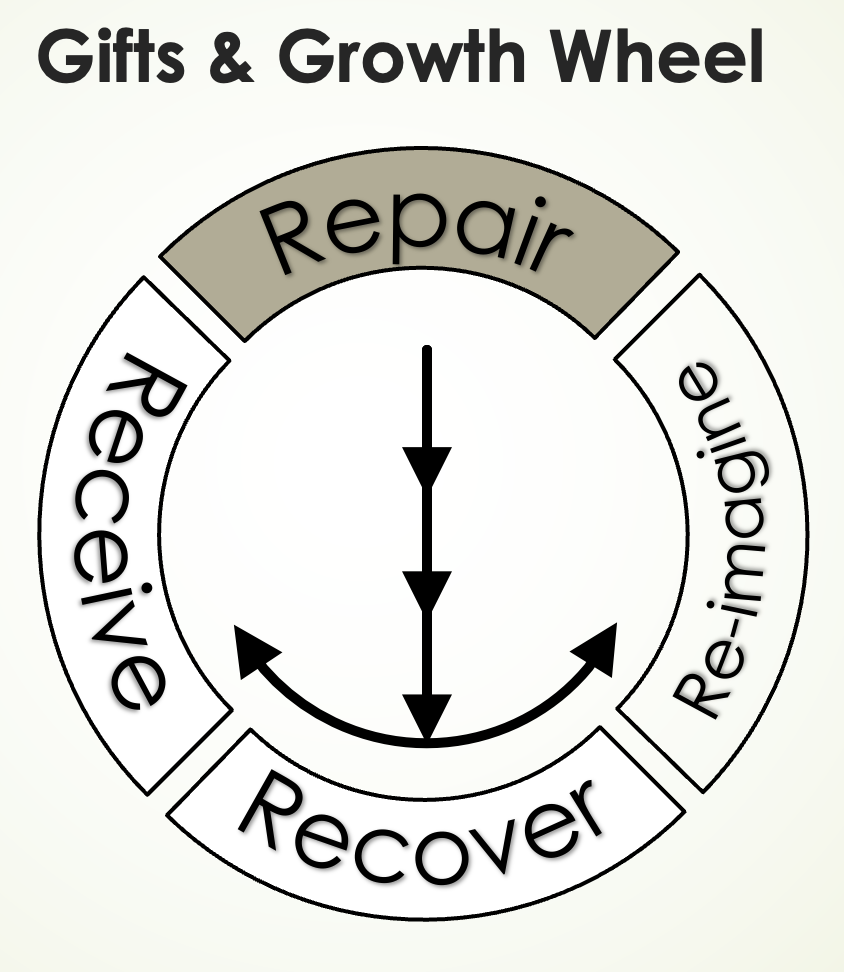
Gifts & Growth: Repair

A verse from Saint Paul captured my attention this week. He writes to the Romans: Do not be conformed to this age, but be transformed by the renewing of the mind, so that you may discern what is the will of God—what is good and acceptable and perfect (12:2).

Life in Christ, being a Christian, being faithful means renewing your mind. During this season of Lent, we are called in the liturgy to repent and return to the Lord.

Repentance means “an action or process” (Miriam-Webster Dictionary) of changing something. It is a changed action as much as a change of mind, toward what is good and right.

What stops you from living out the best version of yourself? Because God has entrusted you with gifts. I know many of you share your gifts with others and the church. There are many! And there are different kinds of gifts. But sometimes we hold back. Sometimes we feel we don’t have what it takes. So, what keeps you from celebrating those gifts and offering them in the community?

Thankfully, the Gospel of Luke emphasizes the persistence of God’s mercy and grace despite the stubborn obstacles that keep us from experiencing the joy of life in Christ. In today’s story from Luke 15 – the famous story of the Prodigal Son – it is God’s grace in the wake of estrangement, sin, and jealousy.

The focal point in the story is, of course, the youngest son who leaves home. The reader is invited to follow his story, his perspective. We are drawn to his journey. This is the person of interest.

It’s not that God doesn’t identify with the Father’s actions. It’s not that God doesn’t care for the older son, or any other character in the story. But God is particularly interested in the Prodigal Son.

Why? Is it because this person changes? The youngest son follows through on a different course of action when he realizes that things are not working out very well for him. So, when he hits rock bottom, he changes direction. That’s the gift, the grace upon which this story hinges.

It’s not to say, “Go and make mistakes!” It’s not to say, “Go, intentionally hit rock bottom in your life!” No. Rather, it is to say, “Don’t let your mistakes keep you from continuing to act, reaching out, trying to do good.” It is to say, “Don’t let fear keep you from taking risks, changing your tack, and trying something better.”

But beware! For those who value action—doing something—and want to do better to repair the problems in the world, we may be tempted to cheat and take a short cut.

copyright Martin Malina, 2025

Because to go to the thinker/Re-imaginers closest to you on the Wheel first, this might keep you trapped in justifying inaction, ironically. There’s always a reason, a rationale, not to do something, even good. We may over-think it.

Or, if you first go to the Receivers closest to you on the other side, you may trip into despair and isolation. In other words, you may just give up. It’s easy to get discouraged when your action, your work, your decisions take a downward turn.

No, for the action-oriented person to grow, they must first cross the floor and visit the Recover quadrant on the opposite side of the Wheel. To recover the heart, the feelings, the source of one’s identity. To recover the story of one’s life. To recover a sense of belonging to oneself, to others, to creation and to God. The heart-centred gifts of others will complement your own. You need them as much as they need you.

A concrete way to do this is to recover the lost traditions, rituals of one’s own faith and history. To find the anchor, again. And like a rubber band, to pull back in order to fly ahead with integrity and effectiveness.

But this means changing directions, changing one’s response to the world. What are some examples of right action?

Ask for help when you need it, seek forgiveness, embrace with open arms someone who has chosen a different path, embrace with open arms and accept the person who holds different values than you, take the initiative to reach out to others, to be with them and do good things together with them, care for creation with concrete acts of generosity and grace, vote in elections, commit to a spiritual discipline and practice of daily prayer, act and make different lifestyle choices, for the better. Etc. Etc.

In recent history, who are people you know who have experienced changes in their lives because of their faith? Who might first come to mind? In our church history it may be the likes of Martin Luther from the 16th century, and even Dietrich Bonhoeffer in the 20th century. But what about Martin Niemöller, who was a contemporary of Bonhoeffer’s? Have you heard of Martin Niemöller?

Martin Niemöller was a German Lutheran pastor. Most North Americans associate his name with the famous words inscribed on the wall of the United States Holocaust Memorial Museum in Washington:

First they came for the Communists
And I did not speak out
Because I was not a Communist
Then they came for the Socialists
And I did not speak out
Because I was not a Socialist
Then they came for the trade unionists
And I did not speak out
Because I was not a trade unionist
Then they came for the Jews
And I did not speak out
Because I was not a Jew
Then they came for me
And there was no one left
To speak out for me.

“Pastor Niemöller wasn’t just being poetic. That’s his life story. He was a German nationalist who, in the 1920s and early 1930s, supported Hitler and the Nazis. He hated Communism and socialism and workers — he believed that they had betrayed Germany in the aftermath of WWI. He worked against the Weimar Republic, thinking it to be politically weak and corrupt. Indeed, Niemöller voted for the Nazis, even in the 1933 elections which handed Germany over to Hitler.

“In short, Martin Niemöller not only did not speak out. He actively worked for a political movement to go after Communists, socialists, workers, and Jews … anyone whom he believed undermined the honor of the German nation.

“But Niemöller began to change his mind when Hitler interfered with church policies and applied racial tests to both clergy and laity, even insisting that German churches refrain from teaching or reading from the Old Testament.

“Niemöller’s resistance started when the Nazis applied their brutal and racist agenda to the church — Niemöller’s church, the community he most cared about, was vowed to serve, and led.” His changed action came about because he recovered the heart of his faith, his identity in the church, and the practices that made him Christian. And acted on it.

“Then, [Niemöller] realized that they were coming for him, too. It took him a while. It was a process. But he spoke out. He preached against Hitler and Nazism. He was one of the founders of the Confessing Church. He was detained several times between 1934 and 1937. Then, in 1937, he was arrested for treason and spent the next seven years in various prisons and concentration camps, including Dachau” (Butler Bass, 2025).

After recovering their authenticity, their true identity, action-oriented people can become Repairers. Being a Repairer as a spiritual gift is a greatly needed gift today. It is doing the right thing at the right time which will have positive effects even when those effects might not be immediately apparent. The church needs more Repairers today especially.

The last few weeks we have visited three of the four quadrants on the Gifts and Growth Wheel. Are you a Receiver – someone who reminds the rest of us of the faithfulness, the grace and the prevalence of God’s mercy? Or, are you a Re-imaginer – who thinks and reimagines a vision of God’s meaning and purpose in today’s world? Finally, are you a Repairer who will act righteously and guide others into active service in Christ’s name?

We have one more quadrant to visit next week. And no matter where you begin on this Wheel, we need everyone’s gifts to balance the wheel and help empower the church to faithfulness as we seek – like the Prodigal Son – to return to our home and be embraced by the Father at the end of all our toiling. Thanks be to God!

References:

Butler Bass, D. (2025, February 19). Forget Bonhoeffer. This is the Niemöller moment [Blog]. The Cottage/Substack. https://dianabutlerbass.substack.com/p/forget-bonhoeffer-this-is-the-niemoller?utm_campaign=email-half-post&r=66hlp&utm_source=substack&utm_medium=email

Miriam-Webster Dictionary. (2025). https://www.merriam-webster.com/dictionary/repentance

Prayer as Growth – Advent sermon series 1

In the movie, “Good Boys”, three young friends explore the meaning of friendship and growth. On the journey towards maturity, Max, Lucas, and Thor discover what it means to be in a healthy relationship that can change over time.

Everything is going fine until each boy begins to pursue individual goals. At the same time, they realize that what one of them wants to do is not necessarily what the others like to do. It looks like they are going their separate ways. And the friendship group appears to dissolve.

When Lucas sits down with his parents in tears, bemoaning the breakup of his friendships, his parents offer some sage advice. They recall an old pet Lucas used to have – a hermit crab. But, when Lucas was much younger he wasn’t told how exactly his hermit crab had left them. His parents, now, tell him the truth:

The hermit crab had to find a new shell, they say. And died on its way to the beach. They explain that a hermit crab eventually outgrows its shell. And must find another shell that is larger into which it can continue to grow. If it doesn’t find a larger shell, it will die one way or another.

Lucas makes the connection that he is growing, and may need to find a larger shell to grow into – a larger social group, new friends, other activities. Leaning on this truth, Lucas is freed from the self-blame for the recent troubles with Max and Thor. It is normal and healthy to go through these growing pains in relationship. As it turns out, the boys learn to find a new way of relating with one another – a way that respects each other’s unique talents and personalities.

Throughout his letter to the Romans, Paul describes a healthy relationship to God.[1]And as we grow in this relationship, we change. And the way we relate to God changes.

In this first part of the series of sermons in Advent on prayer, I would like to underscore this theme: Prayer as growth, in our relationship with God.

There are times in our lives, events and circumstances, that give us this sense that our whole person–our deepest desires, the core of who we are–is actually waking up. At first some experiences may not feel particularly enlivening. Ironically, it is often difficult, challenging times in life that cause this re-birthing within us.

Paul writes in his letter to the Romans: “Wake from sleep, now is the moment! Shed your clothes of darkness and ignorance and be clothed with Christ.”[2]This imperative is a common theme in Paul’s writings; to the Ephesians he writes: “Sleeper, awake! Rise from the dead!”[3]

And in our Gospel text today, Matthew records Jesus’ instruction to “Keep awake!” especially at the time when you are in the darkness of not knowing, or in grief, or loss or some kind of suffering. This is the time to wake up, for God is doing a new thing for you.[4]Do you not perceive it? It is time to get up. It is time to slough off the old and make room for the new. It is time “to live into the reality of the new age about to dawn.”[5]

We hear the call at this start of a new church year and the first Sunday in Advent. We hear this call to spiritual renewal as we seek to deepen our lives of faith and wait upon the coming of the Lord into our lives. The call to renewal starts with prayer.

I started by saying there are occasions in our lives that become opportunities—divine invitation, you could say—to try a different way of praying.  Like spokes on a large wagon wheel, there are different ways to pray—intercessory praying, devotional prayer, prayers with lots of words, prayers without using any words, imaginative prayers, body prayers, sacraments, song, music, art.

A variety of prayer forms give us ways of growing and deepening our relationship with God in Christ. Because at the centre of every wheel—even one with several spokes—is the hub, which is Christ. The ever-present, living Lord, moves with us and in us down the road of life.

As we grow older, for many of us, the only real question is: Why doesn’t  God answer my prayers? Because of this conundrum alone, many of us frequently just stop praying and hope for the best. Hopefully on our life’s path, when we meet others we listen to them and discover that no two of us have exactly the same spiritual journey.[6]So, why would we believe there is only one way to pray or only one way of understanding what happens in prayer?

We are each like the hermit crab, seeking to find a larger shell to grow into.

But how can we be encouraged to find a larger shell? How can we even believe that we are growing, that our broken lives so weak and stained by life’s hardships be the place wherein Christ makes his home and through which Jesus’ light shines? How is this even possible?

I heard this week the story of someone recently walking through the woods. Without yet any snow on the ground to brighten things here in Ottawa, the landscape is shrouded in browns and darkish colours. Blah. While walking the forest path, she stopped at large, oak tree which still held its leaves.

But the leaves weren’t full and vibrant with life as you would see in late Spring. They were curled at the edges, no longer pulsing with life-sustaining chlorophyll. Like crumpled, dried paper, these leaves hung there, lifeless and dead. Just waiting for the inevitable drop to the ground.

In that instant, the clouds high above suddenly broke. And streams of sunlight immediately penetrated the darkened woods and shone upon these listless leaves. In that moment of brilliance the leaves were clothed in the light. They were animated in the sunshine and restored to an incredible vision of renewed life. They absorbed and reflected the light. Their previously deadened state was transformed.

In the darkness of predawn, it is indeed hard to believe there is anything but the night. But arise, awake! The light is coming. And when the son comes as it does every morning, we are transformed and renewed in the light. And our lives reflect again God’s grace and love.

[1]Patrick J. Howell in David L. Bartlett & Barbara Brown Taylor, eds., Feasting on the Word: Preaching the Revised Common Lectionary Year A Volume 1(Kentucky: WJK Press, 2010) p.18.

[2]Romans 13:11-14; ibid., p.16.

[3]Ephesians 5:14.

[4]Matthew 24:42; Isaiah 43:19.

[5]Howell, ibid., p.14.

[6]Ray Leonardini, Finding God Within: Contemplative Prayer for Prisoners (New York: Lantern Books, 2018), p.1,41.

“¡Presente!”

Each of the four blessings is matched with a corresponding ‘woe’[1] First, Jesus says that blessed are they who are poor, who are hungry, who weep now and whom people hate. But, unlike Matthew’s version of the beatitudes[2], Luke doesn’t stop there. Luke doesn’t let us off easily.

Lest we become too enamoured with spiritualizing virtues or escape into some pie-in-the-sky notion of faith, Luke’s version of Jesus’ sermon only sets us up for being gobsmacked upside the head. In a stunning reversal to each blessing Jesus brings a ‘woe’—to those who are rich, who are full, who laugh now and about whom people speak well.

But wait—a secure financial future, a full stomach, a light heart, and a good reputation – aren’t these all values we want and seek? Aren’t these the things around which we structure our lives to obtain? Don’t these describe to a ‘t’ our five-year, ten-year and twenty-five-year goals?

A surface reading of this scripture can leave us picking sides. Am I on the ‘blessing’ side or the ‘woe’ side of the equation. Either / Or. Will we dare go deeper?

And, at the deeper currents of our awareness — when we are honest with ourselves — don’t we already know? Don’t we already know the truth of it—that, at best, wealth, a full stomach, a light heart and a good reputation are mixed blessings? They come at a great cost to health and relational well-being. They are temporary, fleeting. They can come and they can go.

Contrary to popular belief, rather than being evidence of God’s favour, prosperity can actually endanger our relationship with God, as was the case with the rich fool and Zacchaeus—both characters unique to Luke’s Gospel.[3]

What is common to both characters? Both came to Jesus rich men with full stomachs and their reputations intact. When they came to Jesus, both the rich fool and Zacchaeus were perfectly able to take care of themselves, to say the least.

The common trait they share as prosperous men of first century Palestine, is their self-sufficiency. This state is what separates them from God. And has them trapped. they are self-sufficient.

Elsewhere in Luke’s Gospel, we read that those who lay up treasures for themselves are not—and cannot be—rich toward God[4]because when we can take perfectly good care of ourselves, it is altogether too easy for us not to trust God. So, what jeopardizes the wealthy Christian’s relationship with God is the subtle temptation to think that we can go it alone and take care of ourselves.[5]

This underlying belief applies not only to our personal lives—and what we decide to do with our wealth, our investments, our properties our material blessing— but, also to the way we do church.

Will we be a community that lives only unto ourselves, or for the sake of others? Meeting the challenges of church today, how do we move forward? What decisions will we make with the resources we have? Will we abide by the code of self-sufficiency and go it alone? Or, will we seek out effective partners, neighbours and others on the journey of faith? Will we say God is only here inside thesewalls alone? Or, will we seek God’s work out there in the world?

What with all the competing values and programs for success beating down the doors of our hearts and minds, to follow the Christ of the cross is not easy. It’s not a technique or strategy that we can simply employ. In light of the beatitudes from Luke, the way of Christ cannot be an add-on. It cannot work that way, as another activity to add to the schedule of our already busy lives.

It comes to us as a complete package. It’s a call to transformation – a whole-life make-over. I understand the hesitation. Because life in the fast lane has its perks. Maybe we don’t want to give them up. Not easily, anyway. Seeking after self-sufficiency is too much of a lucrative deal for our egos.

Therefore the message of the Gospel can really be a downer! After all, how can we ever live faithfully when immersed in our world and its values?

But, perhaps, the message of All Saints provides an antidote to the despair and the grief. And give us hope for the journey. After all, the Gospel is not just about how to get into heaven after you die, but actually more about how to live in the kingdom of heaven on earth before you die. Not just the saints of heaven. But the saints on earth.

I want to close with a brief reflection on the meaning of a couple of words. First, ‘blessing’. “Blessed” is sometimes translated as “Happy”. I prefer the translation of the first word in the Psalms[6]which incidentally is also often translated to “Happy are they …”:

The Hebrew word here is ‘ashar, which means, literally, “to find the right road.” So, in offering the beatitudes, Jesus is saying: “You are on the right road when you are poor, when you hunger, when you weep, when you let go, when you don’t hold it all to yourself.” I prefer this translation because it implies a direction rather than a moral state. It acknowledges a journey of becoming. And any path of growth and transformation will include honest struggling and striving and letting go.

It is human to struggle with these things. On one hand, we do need to learn early in life how to take care of ourselves. Learning vital skills around self-care are important. Along the journey of maturity and growth, however, we must also learn how to balance this skill towards attention to others.

The second word is ‘presence’. This word doesn’t appear in the biblical texts for today, but it is implied in our ritual of All Saints. In Spanish, you hear the word said aloud: “¡Presente!”—which literally means “here” or “present”. There is a long tradition in Latin American movements for justice of invoking the memory of those who have lost their lives in the struggle.

At political gatherings their names were read out loud, one after another, not unlike we read the names of the saints earlier. After each name the crowd says together: “¡Presente!” as if to say: “You are not gone, you are here with us. You are not forgotten, and we continue the struggle in your name.”

It is human to struggle in the mission of God on earth. But we are not alone. Not only are the saints of heaven among us in spirit and in love, God is with us each step of the way. On the journey of life …

“Blessed are you who are poor – because you are not alone!”

“Blessed are you who hunger – because you are not alone!”

“Blessed are you who weep – because you are not alone!”

“Blessed are you who are despised – because you are not alone!”

“¡Presente!” “¡Presente!” “¡Presente!”


[1]Luke 6:20-31

[2]Matthew 5:1-12

[3]Luke 12:16-21; 19:1-10; E. Elizabeth Johnson in David L. Bartlett & Barbara Brown Taylor, eds., Feasting on the Word; Preaching the Revised Common Lectionary Year C Volume 4 (Kentucky: WJK Press, 2010), p.239-241.

[4]Luke 12:21

[5]E. Elizabeth Johnson, ibid., p.241

[6]Psalm 1:1

Give God a chance

A year ago last summer we bought a potted Hibiscus plant already in full, glorious bloom. The local nursery encouraged us to plant it right away and let it take root in our garden. When winter came, we snipped the stem down to a few inches above the ground.

Last Spring, the sprig showed no signs of life. At all. And it was late June already when I was tempted to pull up the seemingly lifeless root ball from the garden to make room for something else. Visiting the same nursery at the time I complained to them about the Hibiscus plant they sold to us, that obviously did not winter-well. To say the least.

“Don’t pull it up, yet!” they entreated me. “Wait a little longer, for it has been a late Spring. Give it a chance.”

At first, I didn’t believe them. But I left the dead thing alone trying not to think about my disappointment too much. Was I in for a surprise! In early July a tiny, green shoot pushed up the earth around the base. But then, not just one, but two, three and four shoots of new life erupted out of the ground. Seven weeks later, we were enjoying a multitude of magnificent blooms. The plant had more than doubled its growth from last year!

How critical it was for me to heed the gardener at the nursery when she told me “Don’t pull it up!” and “Wait a little longer” and “Give it a chance!”

“Then Jesus told them a parable about their need to pray always and not to lose heart”[1]

In Jesus’ story, the theme is ‘not giving up.’ Not giving up is what it looks like to pray always. Elsewhere in the bible, Paul, the writer to the early church, instructed the faithful “pray without ceasing”[2]. It’s about being persistent in waiting, in not reacting, in staying the course when it starts feeling like it’s no use any longer to keep going.

“If it seems to tarry, wait for it; it will surely come, it will not delay.”[3]

The prophet was waiting for a vision from God, a word that would give new life to those who were discouraged, defeated and ready to give up on God, on themselves and on the world.

For what do you wait? After what justice do you persist? What is it you seek after that seems elusive, just beyond your grasp? Whatever that is, the scriptures describe an inner quality of the heart that will not give up, that will wait for it, that is patient and true in enduring and persisting.

That sees the present moment as holding value in and of itself.

The goal, the destination, the vision – this may seem to tarry. Perhaps in those impatient moments it’s important again to look around at what is happening. Infant baptism, for one thing, is a visible sign of this challenge and truth.

For an infant does not express knowledge of God in the way we adults do. An infant cannot give us a rational accounting of their faith. They cannot, surely, deserve blessing by pointing to a long list of their good deeds and giving an impassioned testimony.

It confounds us sophisticated grown-ups crazy, as we are influenced so much by a success-mindset culture of instant gratification. The world we live in has little patience for this kind of long-view approach. We’d sooner just give up on someone or something for which we hope. When it seems we are in futility grasping at something not yet.

Here, we are asked to commit to quite the opposite. Infant baptism invites us all to dedicate ourselves to long journey. We are challenged to persist in our waiting for it, not to give up, to have faith and stay the course.

And, in the meantime, walk with the baptized as he grows over time into the person God has created him to be. The flowering will happen, yet quite beyond our claim to control it. The green shoots poking out of the ground are occasion to rejoice. Here is evidence enough for now, for this moment. Those tiny shoots hold the fullness of the gift of faith and life in him.

Dear family and friends of the baptized, and Faith community, I hope you stick with it. This journey of faith, together. Trust in the vision, the promise. And celebrate the wondrous gift of this moment.

IMG_3355


[1]Luke 18:1-8

[2]1 Thessalonians 5:17

[3]Habakkuk 2:3, the first reading from a couple of weeks ago, Pentecost 17C (RCL)

Humility

The gospel story for today is about humility. And exercising humility means letting go of our privilege in this time and place.

Privilege is a state of mind we presume to have, vis-à-vis others. The source of our privilege may come from the country in which we happen to be born, when in history we were born, to whom we were born. Privilege comes from being offspring and inheritors of settlers in this land who made an empire and found great financial wealth here. The list can go on.

In the economy of God’s grace, however, all that doesn’t matter. Gone is the pecking order. We all stand on the same level playing field. In the story where he advises his followers to take the last seat at a large table of a prominent Pharisee (Luke 14:1,7-14), Jesus denounces our egoistic striving to be first in line. As if the good that we experience in life depends on us, and is all up to us.

Which leads us back to humility. An image I hold of this humble stance in life is a prayerful pose: bowed slightly, hands open both receiving and giving.

Since the truth of the Gospel is so often expressed in parables — stories — here follows a story about the most privileged trees on the slopes of the Canadian Rocky and Coastal Mountains.

At least twice during our road trip through western Canada we came across swaths of mountainsides devasted either by the mountain pine beetle or forest fires. Even the most prevalent of trees in these areas – the western red cedar or lodgepole pine—were not immune from the infestation.


We learned, in the case of the pine beetle, that it takes about ten years for the cycle of renewal. Right now, in the early stages, all we saw from the vantage of trams high in the air were carpets of brown trees—the green of life and growth stripped, absent. Like matchsticks in the dirt, their needles deadened, lifeless. Didn’t look so good.

Our guides assured that this cycle was necessary for the forest to renew itself. The problem with the way the pine forest was establishing itself over decades was the growth was becoming too dense and thick, thereby choking out other life. Once the dead trees fall over from the pine beetle infestation, space is made for sunlight and rain to penetrate the forest floor once again, thereby inciting new growth.

IMG_8918

From the barren, lifeless landscape come first the purple, mountain mallow which blooms close to the ground. Then, notably, aspen grows and finally again pioneer species such as the lodgepole pine—the provincial tree of Alberta.

IMG_8926

These trees, some of them privileged, native species of the region, bow to the larger movements and cycles of life. They are part of something bigger than themselves that is happening in the eco-system. Needs larger than their own are being addressed. Each of those trees bow to a greater scheme. They, if they had consciences, realize their lives are given and meant for a greater good.

So, for us, imagine a humility that is not false but true. Not a humility that in a backhanded way seeks attention or self-aggrandizement. But a humility that honestly reveres the greater good in which we participate and which we serve.

It is like someone has quietly deposited a million dollars in your checking account. Imagine that! And now it is secretly yours. Yet you always know it was a gift. It is yours to use and enjoy and expand. But you cannot say you earned it or you deserved it. Everybody thinks it is your money and may or may not admire you for it; it doesn’t matter. You know better and cannot take the credit. You just live in gratitude and confidence. And you try to let the flow continue through you. You know that love can be repaid by love alone.[i]

You can say as followers of  Christ we need to get over ourselves at some point on this path. Now, getting over ourselves doesn’t mean doing harm or denying our humanity of which our ego striving is very much a part. It does mean we learn to hold all of who we are—including the not-so-good-parts—in the light of the bigger picture of God’s initial and primary grace and gifting to us. We are part of something much larger than we think.

In the economy of God’s grace, how then do we live? How does this awareness translate into real life?

We live our days, each moment, drawing from another source. God is primary; we are derivative. God is the source of all energy, power, wisdom and wealth. [ii]

We see ourselves an instrument of the gift we have.

We don’t, therefore, need to promote ourselves.

We don’t need to take first nor final responsibility for our goodness, our gift whatever it is.

We meet other people where they are at, not where we are at.

And when we experience setback in life, we need not worry too much about our failures. In truth, it is often in the very experience of failure, limitation and loss where we find the seeds of new life.

Indeed, our life is not our own. Yet at some deep level we know that it has been given to us as a sacred trust.

Our best is not our own; it is borrowed.

We know Someone takes us seriously; we feel deeply respected and grateful.

We can bow, in gratitude and respect, with hands open, to the gift.


[i]Richard Rohr, Adam’s Return; The Five Promises of Male Initiation (New York: The Crossword Publishing Company, 2016),  p.157-158.

[ii] Michael Dowd, “The Nested Body” in The Mendicant Volume 9 Number 3 (Centre for Action and Contemplation: Summer 2019), p.3.

The way the story is told

Look at the man whose community has judged as possessing a legion of demons. He has been pigeon-holed. Ostracized. Bullied. Looked down upon. Pitied. The man whom they looked upon, and said to themselves, ‘Thank God it’s not so bad with me.’ This is the kind of person who, it has been argued, we need. If only to make the rest of us feel better about ourselves.

Schadenfreude is the term we use to depict and distinguish those ‘less fortunate’ than us to justify our complaints and our more privileged status. So, we need ‘them’. And we need ‘us’. We need the distinction. To envision the opposite, to imagine some kind of union, to unearth the unholy distinctions between ‘them’ and ‘us’—well, that may be far too threatening to our fragile egos.

The way the story is told is not to focus on the man’s illness. Though, that’s what we like to talk about: the frothing at the mouth, the rattling of the chains which bound him, the pigs rushing dramatically to their watery deaths. The way the story is told, however, is not to fixate on whatever ails him, his sin, his problem. We say this is a healing story. But who else besides the man is invited to be healed?

Important though it is not to overlook the man’s problem, the way this story is told leads us to the climax of the telling—the last few sentences that describe the reaction of the man’s community, there across the Lake in Gentile territory.

When, at first, he is healed, and is shown to the people, how do they respond? You would think they would rejoice. You would think they would praise God. You would think they would marvel at the goodness, the promise, the hope, the delight of God in bringing transformation and healing to this man who once was lost in sickness and despair but now is saved. In Greek, the word for salvation is the same word for healing. This man we look upon, alongside the Gerasene community, is now restored, healed and given a new beginning in life. A second chance.

You would think those who witness this would rejoice in the promise and anticipation that this healing and transformation be offered to each of them also. Amen?!

The way the story is told, however, emphasizes the point not once at the end of the story, but twice: They were afraid, seized with a great fear.[1]They didn’t like what Jesus was doing. They had become too comfortable in their opinions, their prejudices, their categories, their pigeon-holing this man. And they didn’t like what Jesus was doing to upturn and completely reverse their world-view. They even had the gall to tell Jesus to leave. No more of this. Do you blame the healed man for wanting to get out of there, too, with Jesus?

This story shines an uncomfortable light not on the Gerasene Demoniac. The title of this story should rather be the community’s demoniac. The community’s sin. Their prejudice. And their incapacity to repent—to change their minds about the people they have normally pigeon-holed into convenient places of malice and schadenfreude, them and us.

The Gospel story opens with Jesus taking his disciples to the ‘opposite side’ of Galilee. To be faithful to Jesus, to follow Jesus, they have to leave their zones of comfort and familiarity to go to the Gerasene territory across the lake.  Every city, every community, every country, every culture, every church, has an ‘opposite side.’ And it’s to that ‘opposite side’ that we—Lutheran Christians in Canada today—are called to go.

The way the story is told, is that Jesus’ presence and power disrupts the social order of the way things are. Because, for one thing, to the people whose living depends on the pigs, their loss is catastrophic. The swineherds are understandably afraid.

From this standpoint, the way the story is told, the coming of the gospel of Jesus brings upheaval and sets in motion forces that will disrupt even economic and social arrangements. In other words, the good news will not seem good to everyone at first. Maybe, to us.

Especially to those who are comfortable, privileged and set in our ways. Indeed, for the community in Gerasene and for us, we might prefer the devil we know to the freedom we do not. We might take a false sense of security from the dysfunction, the prejudice, the self-righteousness we have learned to tolerate in ourselves, cope and live with, ignore and sluff off. And we might therefore fear what change—even change for health—may bring.

We fear freedom from what binds us:

Locked and bound in some prison of our doing—telling ourselves we are not good enough, that we can’t do it, that we don’t deserve the immeasurable love which God has for us.

Locked and bound in some prison of our doing—telling ourselves and each other that the poor, the newcomer to Canada, the Indigenous people of this land, our home on native land—deserve their plight as if we don’t have any responsibility to care for them. To tell ourselves we need not seek understanding from another’s point of view.

Locked and bound in some prison of our doing—maintaining beliefs, even religious ones, that serve only to belittle others from a different social, religious background than ours, others whose gender orientation is not ours, others who are impoverished financially. Maybe Paul’s words must ring true again today to our hearts that are divided and distressed over these issues: “There is no longer Jew or Greek, there is no longer slave or free, there is no longer male and female; for all of you are one in Christ Jesus.”[2]

What is the ‘opposite side’ of the lake, for you? Is it a troubled personal relationship? Is it a long-held assumption or belief? Is it something you’ve wondered about doing but had up until now been too afraid to try? Perhaps in this season after Pentecost, the Spirit of God is calling us to consider going there.

To discover anew that whether we succeed or fail, whether we accomplish our goals or not, whether we live or die, we are the Lord’s forever.[3]Healing and salvation will come to us, regardless of our pedigree. For, again in the words of Paul, “it is no longer I who live, but it is Christ who lives in me.”[4]The gospel doesn’t begin with us. It’s always about what God is doing in us.

As Richard Rohr writes, “It’s not what you do that makes you holy, it’s what you allow to be done to you that makes you holy.” (in today’s ‘daily meditation’, http://www.cac.org)

Grace does that. One doesn’t first become Christian, then go to church; One goes to church to become a Christian—and it will take a life time, and beyond. It’s not the destination, it’s the journey. As fourteenth-century Saint Catherine of Siena once said: “It’s heaven all the way to heaven, for Jesus is the way.”

Jesus invites us to join him on his journey to the opposite side. To grow and change. To reach further, deeper, into health and wholeness. To open ourselves to the unity we share with all people in Christ Jesus our Lord.

And that story will have a good ending.


[1]Luke 8:35,37, NRSV

[2]Galatians 3:28

[3]Romans 14:8

[4]Galatians 2:19-20

Kitchen vision

During Mika’s confirmation last weekend, I was grateful to reconnect with folks from her past and present, and hopefully future. At Mika’s confirmation party on the Saturday, we had just over thirty people in our house. It was raining, so all of them were, physically, in our house. It was crowded. Loud. Noisy.

You know I am an introvert. And they say that if you want to starve an introvert to death, put a stranger right in the middle of their kitchen. Far from being strangers, these were all friends and family. And yet, to have someone ‘in your space’ who is not normally there, was challenging for me. Add to that stress, organizing food for all these people and making sure everyone had somewhere to sit …

I remember first meeting Mika’s godparents in rural southern Ontario in my first parish. In century old houses, the kitchen can be the largest room. The kitchen is also where most people enter the house—not the front entrance facing the road. But ‘out back’ where friends, family and neighbours know to go in, right into the kitchen.

The kitchen in our first home there even had an Elmira wood stove in it. It was flanked by arm chairs and a small settee right beside the long counter and ample room for the kitchen table. Lots of people could fit in there!

Times have changed, indeed. Today, in average-sized homes there isn’t a whole lot of room to manoeuvre about. And for introverts such as myself, when I’m cooking or washing up the dishes, it’s a real struggle for me to share the space. I have to work at that.

I suspect I am not alone on this! We guard our spaces, covet our ground. We justify our beliefs and behaviour by appealing to social norms: Of course, everyone feels this way! Right? Let’s just say, having so many people crammed into ‘my space’ was a growth opportunity for me!

Jesus’ last prayer before his death and resurrection was for the disciples to be “one”—one in each other, one in Christ, one in God—bound together in the love of God.[1]The vision of God is an ever-expanding community brought together in love. The vision of God is that everyone can come to the table, everyone who is thirty, hungry, yearning for deeper connection with God and the world. The vision of God is that the dividing lines be erased—the lines that divide, exclude, deny, keep away.

The problem is, Jesus’ prayer and vision has come on hard times. We cannot deny it: the church has been fractured and divided more than anything—especially after the Reformation which brought some good things nonetheless. History in the last five hundred years has taught us, if nothing else, that fighting about who believes the right things about God can keep faithful people entangled with words about God rather than walking in the ways of God.

When followers of Christ draw lines in the sand, exclude and divide, when we quarrel and argue about dogmas and creeds and doctrines, the world will not witness the peace and love of God in us. So, the challenge of living faithfully is not only a call to private goodness or a superficial ‘everyone likes each other’.

It is a call to let our lives invite others to follow Jesus. Our lives ought not solely be preoccupied with right or wrong, guilty or not, in or out but whether or not our actions and behaviour contribute to the good of the world. Whether or not our actions contribute to a loving witness of what God’s vision is all about.

And we discover this path by experiencing the living presence of God in our lives. Not just talking about faith, but living it. And so, we are called to grow. And even when good growth happens, there will be growing pains as we stretch and flex our spiritual muscles.

There are two things ‘growing pains’ are not: First, when we are invited to do something differently, it is not an indictment against your history. It is not saying what happened in the past was all wrong. It is not dismissing the way you did things were bad.

When we are invited to do something new, something differently, let me suggest it is a challenge. A challenge to grow. Growth means change. When a plant or flower grows from its place in the ground, it changes. It’s ok to change our minds, as we grow. We are adults. We gain new life experiences. We learn new things, consider fresh perspectives. We have to integrate those experiences as we try new things.

Second, this discomfort is also not persecution. Please don’t confuse growing pains with ‘being persecuted’. We often hear that. When Christians, especially, are not interested in growth, some will conveniently use that interpretation: ‘We are being persecuted’.

When all along this discomfort is more likely about giving up privilege. It is giving up some of our privilege. Being comfortable at all costs—even the cost of avoiding difficult, vulnerable conversations, even at the cost of staying comfortable—is the very definition of privilege.

Growth will make us feel uncomfortable. But following Jesus is not about our degree of comfort. There is always a cost.

Dietrich Bonhoeffer, a German Lutheran theologian in the last century, spent the last year of his life in a Nazi prison. And he was executed by the Nazis just before the end of the Second World War.

But in those last days of his life he reflected deeply on the meaning of Christianity in the world and Christian discipleship. One of his great books was called, “The Cost of Discipleship.” And in it he warns us in the modern world to beware of what he called ‘cheap grace’. He wrote that cheap grace was the mortal enemy of our church. What we need in the church today is a costly grace, a grace that costs us something.

What is ‘cheap grace’? It is the kind of grace we give ourselves. It is the kind we get when we use the church to satisfy ourselves. It is grace without really following, without really being a disciple. It is the kind of grace reflected by the Christian who says, “I like to stay as I am.” “I’m ok” “Leave me alone.” “Don’t ask me to grow.” “I am happy where I am.”

To grow. To go deeper. To expand. To overcome the divisions that separate, isolate, exclude—within ourselves, with others and the world around us. The twelve apostles each gave their lives for their discipleship. Theirs was indeed a costly discipleship.[2]

The cross stands at the centre of this process of growth and change. We are called, and we are challenged to grow. And to grow means to give things up: attitudes, attachments, ways of seeing things, our resources, whatever keeps us the same. This is the way of the cross.

“Lay down your life if you want to find it,” Jesus said. “Leave yourself behind if you want to find your true self.”[3]

John’s visionary writing in the Book of Revelation concludes the bible. It ends with a prayer that the grace of the Lord Jesus be with “all”.[4]The original Greek does not add the words “the saints” which some English translations do. Indeed, the grace, love and mercy of God is meant for all people. Everyone.

The Spirit of God says, “Come!” to everyone:

And let everyone who hears say, ‘Come.’

And let everyone who is thirsty come.

Let anyone who wishes take the water of life as a gift …[5]

Divisions do not matter when people come to the table of good food aplenty. When people come forward to receive the gifts of God, differences do not really matter, do they? The bible’s climax is a marvelous image of countless people of all nationalities, ages, languages, sexes, classes—you name it!—drawing out water that is freely given as a gift to all.[6]

Differences do not matter in this climactic vision. What was of importance is the coming to the sacred waters, to the table. We come, to wash ourselves of prejudice and fear. We come to be challenged to grow. We come to receive grace. For everyone. Everyone is allowed in the kitchen. It’s not just mine, ours.

Come to the Table. It is for everyone.


[1]John 17:20-26; the Gospel for the 7thSunday of Easter, Year C in the Revised Common Lectionary.

[2]Laurence Freeman, “Christian Life in the Light of Christian Meditation: Discipleship” (Meditatio Talks Series 2019 A Jan-Mar), Discipleship 3, wccm.org/resources/audio/albums.

[3]Matthew 10:39; 16:25; Mark 8:35; Luke 9:24; 17:33; John 12:25

[4]Revelation 22:21

[5]Revelation 22:17

[6]Paul ‘Skip’ Johnson in Feasting in the Word Year C Volume 2 (Kentucky: WJK Press, 2009), p.534-538.

The Prodigal story: Three in One

Most of this sermon today is the work of the Rev. Monika Wiesner who first preached it. A lay member of our congregation, Sharon Wirth, then also preached Monika’s sermon at Faith Ottawa last year. A heart-felt ‘thank you’ to both for this contemplative and grace-filled approach to a popular parable of Jesus.

 Many will regard the turning point of the story as the call to repentance[1], when the rebellious, prodigal son comes to his senses in the sloppy mud of a pig pen.[2]And therefore, according to this interpretation, repentance must be preached and communicated to others who have or are falling away.

You will notice with me, however, that it is not because someone in town or the farmer on whose land he was working told him to repent. When the rebellious younger son comes to the end of his rope and realizes his folly, it’s not because someone guilted him, pressured him, preached him into repentance. The message of changing the Prodigal’s moral direction did not come from outside of him. But from within.

Repentance does not precede grace and mercy. Rather, the other way around: First and foremost, compassion and love changes lives. The experience of the younger son at the end of himself was an inner experience. His changed reality resulted from something that happened within himself. The state of his inner life shifted somehow.

Within himself, the younger brother heard the voice of self-love and acceptance. Not once. But twice in the story. First, in the pig pen he came to self-love within himself. Enough love to stop hurting himself. Then, later, from the father, this Love was reinforced.

Since we see the turning point of this story as primarily a movement of the inner life, imagine then, that this family of three actually lives together within each of us, within our souls.

Within our soul we first have a younger son or daughter that is severely wounded. We might call this our “wounded inner child”.  This is the part of our soul that experiences shame. It is the part of us that feels there is something intrinsically wrong with us.

Within our soul, we also have a critical older sibling. We might call this our superego or our “inner critic”. This is the part of us that actually triggers our shame, telling us where we’ve done wrong, wagging their finger at us in judgement whenever we step out of line.

Finally, there is also within our soul a compassionate parent, the compassionate parent that can heal our shame. We might call this our True Self. We Christians, knowing that God lives within each one of us, might call this our God-Self or even our Sacred Self.

It is the message of Jesus’ Priestly Prayer to his “Father” for his disciples: “As you are in me and I am in you, may they also be in us… I in them and you in me, that they may become completely one…”[3]And again, Jesus said to his followers, “I am the vine, you are the branches. Those who abide in me and I in them bear much fruit …”[4]

I invite you to imagine that this family lives within your own soul: the wounded child in you, your inner critic and your compassionate divine parent. All live within you.

In the rest of this sermon, heads up, I will intentionally switch to both male and female pronouns, so that each one of us may connect more personally with the experiences of these three different persons in the story.

How do these three persons relate within us?

When we are born, our soul and God are one. As an infant, we smile when we’re happy and we cry when we’re unhappy.

Then something happens to this unity within our souls. We experience events that we interpret as painful or as trauma. Our primary caregivers may be limited in their ability to parent or they may over-worked and overtired. And they hurt us.

Or maybe we simply need to leave the security of mommy and daddy for the first time and we discover that the world does not revolve around us. We experience hurt and rejection and intense anxiety and fear. Have you ever watched a young child who is being taken away from his/her mother? Do you ever wonder what is happening within that child’s psyche? These separation experiences may be necessary. But they are experienced as wounding.

What’s important for us to note is that these first experiences of woundedness follow us a lifetime. They might be called “holes within our souls”. We experience those first feelings of not being lovable or not being safe or not being of worth. Because our souls and God are one, this is where we feel our first disconnect from God.

Over the years, more holes are created. Our intense feelings of anxiety, powerlessness, depression, anger or jealousy or shame all have their roots in these holes. Whenever you feel these feelings, you are in touch with one of these holes in your soul.

So what do we do? We try to fill these holes by looking outside ourselves. As young children, we learned to please people by doing things that would make them happy and then we felt lovable and safe.  As we grew in years, we became the responsible one, the wise one, the funny one, or the caregiver. We became beautiful or educated or rich. We did whatever the outside world said would make us feel valued.

We did whatever was needed to fill those holes in our soul that were wounded and crying out in pain. We believed the outside world held the answers.

That is exactly what the younger brother did in this parable. He took his inheritance and he spent it on everything the world suggested would soothe his wounded soul. But in the end, nothing worked. One day, he simply came to the end of himself … and he was drowning in shame.

So the prodigal child remembers her home and her parents. However, her shame went so deep that she believed all love was gone from her life. Her parents would never take her back, so she decided she would do whatever it took to earn her place in the household. She needed to earn their love.

But to her amazement, the prodigal child found loving parents waiting for her. When they saw her, they were filled with compassion and ran out to her, put their arms around her and hugged and kissed her. The wounded child began to confess what a failure she was, no longer worthy to be called their child. But her parents would hear none of it.

Instead, this prodigal child found herself in a beautiful robe … with the family ring on her finger … and a huge “Welcome home” banner hanging over the dining room table. A celebration was being prepared in her honour.

This is the compassion for oneself … this is where all healing takes place. This is where we experience the compassionate God … because God and our soul are one.

But there is one other character in the story, namely the older critical brother, our inner critic. Our super-ego. This is the inner critic who can’t accept the “easy” homecoming of the wounded child.

This older sibling doesn’t believe in compassion, does not believe in grace. And so she becomes critical and angry and refuses to participate in the homecoming. She’s the one who says to the wounded inner child, “You don’t deserve this!”

This is the inner voice that holds us back from experiencing the compassion of God within and for ourselves. This is the inner voice that uses those feelings of shame to stop the healing of those holes in our soul. This is the older sibling who sits on the doorstep and sulks, refusing to go to the party.

Oftentimes, Christians confuse that critical inner voice as the voice of God. It is not! It is not. If anything, it is the voice of our primary caregivers at their worst.

One thing is for sure – when we decide to return home, to find healing for all those holes in our soul, our inner critic will become very active and tell us we don’t deserve compassion, acceptance or love and we don’t deserve the healing we so desperately want. The inner critic will pull out all the stops to keep us feeling shame. But just remember, if it isn’t the voice of compassion, it isn’t the voice of God.

And so the wounded child no longer needs to listen to the voice of the inner critic because our soul and God are one and God has already embraced us in love. We need only listen to the compassionate, holy and sacred that lives deep within each one of us. And that sacred God-Self is saying, “I’m preparing a banquet in your honour! Come to the party!”

In this parable do you hear the voice of God embracing you in love? Welcoming you home? Herein lies the nugget of truth that is at the root of all emotional or spiritual healing.

So let the party begin! We’ve all been invited!


[1]Meaning: metanoia –a change of mind.

[2]Luke 15:1-3,11b-32, the Gospel for the 4thSunday in Lent, Year C, Revised Common Lectionary (RCL)

[3]John 17:21,23 NRSV

[4]John 15:5

Pluck up!

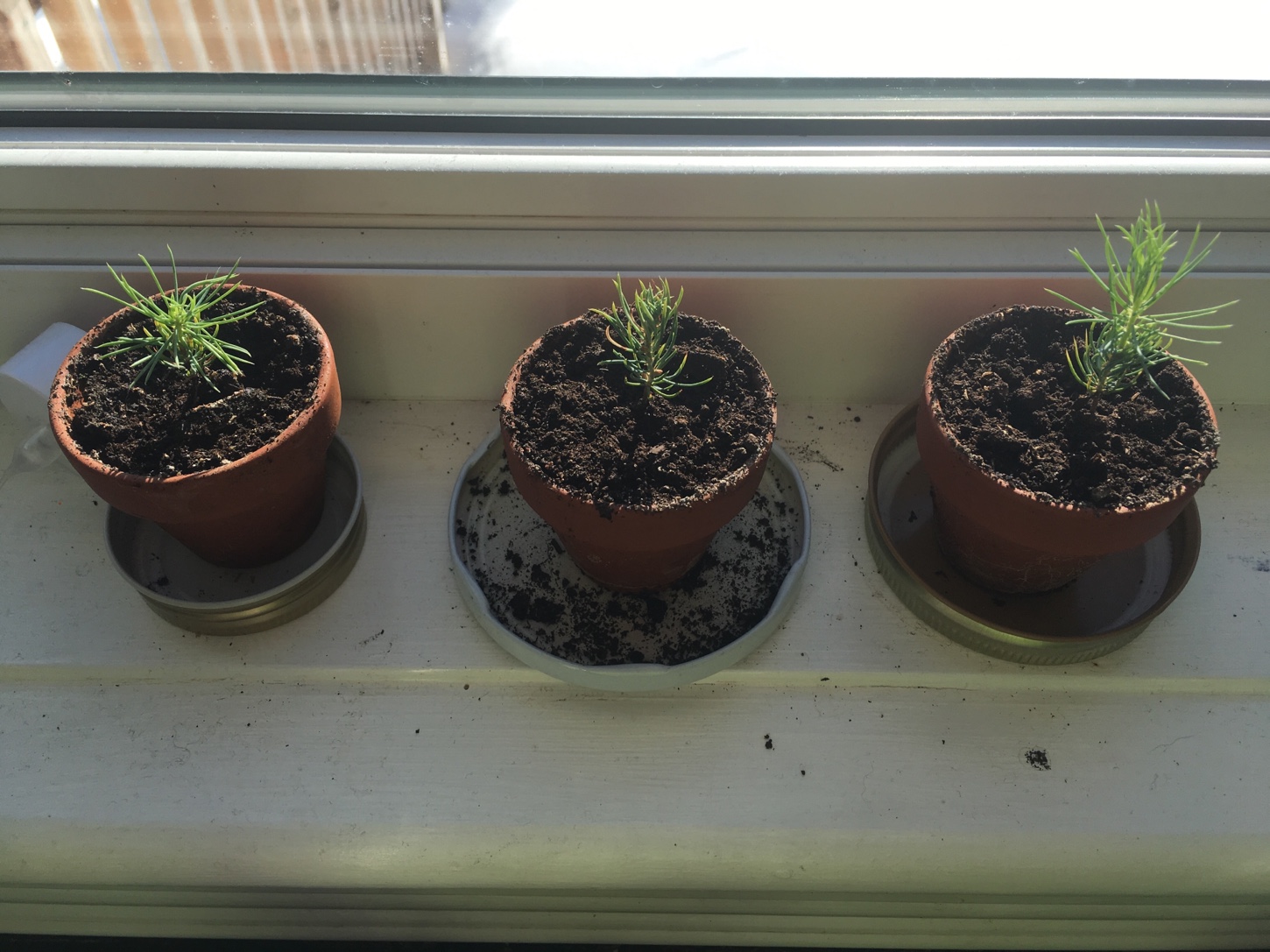
When our daughter received a pouch of seeds last Spring, we didn’t know initially what to do with them. They were Colorado Spruce Tree seeds. And we weren’t exactly planning on seeding a forest.

So we took a medium-sized flower pot and sprinkled the dozen-or-so seeds into the soil packed into the container which we left on the back deck outside. Let’s first see if the seeds in fact sprout, we thought. And go from there.

Three little buds popped through the top layer of soil a couple weeks later. One came up near the edge of the pot. But two of them came up in the centre, side-by-side. At first, I thought the two to be part of one sprig. But they weren’t.

At some point I would have to separate the two, distinct saplings. They were too close together. When to pull them up posed a bit of a challenge. If I waited too long, then the root systems would most certainly entwine and grow into one tree making it impossible to separate. If I plucked up the saplings too soon, I ran the risk of damaging the vulnerable shoots.

The task before me reminded me of the call of God to Jeremiah stated poetically: “to pluck up … and to plant.”[1]While Jeremiah’s plucking up and planting had to do with nations, social practice and religious faith, mine was more literal: As the tiny saplings were finding life and vitality to grow, I would first have to pluck them up from the soil before planting them into separate containers for the next stage of their growth.

And that plucking up would not be easy. It would hurt. It would put stress on the individual seedlings. I could very well be killing them in the transfer. Would they survive the ‘plucking up’?

Sometimes we don’t believe we can survive the ‘plucking up’ events of our lives. We don’t believe we have the strength to endure those difficult transitions in life, especially after experiencing loss, or when confronted with change or great disappointment and failure.

We object, like Jeremiah did—and Moses and Isaiah before him, to God’s call, finding all sorts of justifications: Can’t do that; I’m not qualified, I don’t have the skills, I don’t have the strength, I am too young or too old, I don’t have time. They make sense, common sense we might say. We find all sorts of excuses and even create a religion around all of that to keep us feeling good. Or at least not guilty. And stuck in a rut.

What is more, we make our faith into something that ought to make us comfortable. We ‘go to church’ expecting not the challenge to grow and change but instead to find the salve of warm fuzzies and emotional feel-goodies. We even believe Jesus was all about being ‘nice’. And if anyone is not nice, or challenges us, or doesn’t fit our mould—well, that’s not the way it’s supposed to be.

And yet, the biblical witness, if not our authentic lives of faith when we pay honest attention to them, suggest something entirely different:

  1. Jesus’ popularity suffers a severe blow after he says to his people in their synagogue that “today the scripture has been fulfilled in their hearing”.[2]What he means is that they—his people—would not be the vessels for the unfolding of God’s new narrative; outsiders would be. Stew on that. The audacity. They nearly succeed in throwing him off a cliff, they are so enraged.
  2. In the Jeremiah text, we read that God’s hand “touches” Jeremiah’s mouth. “I have put my words in your mouth,” God says.[3]Perhaps, at first, this sounds rather intimate, soft, gentle, nice.

But we need to be careful not to imagine it was a comforting touch. The same verb used here can also mean “strike” or “harm.” The one other biblical verse that uses this same verb to envision God’s hand touching is found in the prologue to the book of Job, where Satan challenges God to test Job’s faithfulness by taking away everything Job has.[4]There is nothing gentle about the wind that then “touches” the house where Job’s children are feasting, leaving every one of them dead beneath its roof.[5]

“When we picture the hand of God ‘touching’ Jeremiah’s mouth, we might do better to imagine a jolt or a shock. We would be justified in asking whether it hurt, whether it left a wound or scar, whether having God’s words in his mouth changed Jeremiah forever.”[6]

The message of Christ is the message of the cross. And then, resurrection. For our growth and life in Christ, we are called into places of disruption of our comfortable lives before anything new and life-giving happens. There’s no way around it, if we want to follow Jesus in this world.

It starts small, though. And that’s the grace and the hope. God does not call the qualified; God qualifies the called. The point of the Jeremiah story is that Jeremiah cannot depend on his own, developed capabilities and skill-set to justify his participation in God’s work. God called and equipped him even before he was born.

Every worldly role has purpose in Christ. No work is meaningless in God’s light. Martin Luther famously said about parenthood, when understood in Christian vocation: even changing dirty diapers is done for the glory of God! It is God’s invitation to us to invest God’s grace into whatever work God opens to us.[7]

All Jeremiah must do is trust God, and not make his decisions—yay or nay—based on fear. The most often repeated command in the bible—do you know it? “Fear not”. This does not mean we will never be afraid when we listen to and follow God. It means we do not lead our lives with fear in the driver’s seat. Instead, we find in the driver’s seat of our lives: Trust God. And hope in God. Fear can take a back seat, now.

I sat on the front porch with three separate, small pots for each of the seedlings. I did this in early November, believing they would do much better inside during their first winter.

My ‘plucking up’ was done swiftly, using the old adage of taking off a band-aid quickly is better than dragging it out. What surprised me the most in the process of ‘plucking up’ and then ‘planting’ again, was to see the roots.

Each of the tiny saplings had astoundingly long tap roots. One even had extended its main root all the way to the bottom of the original pot, and then some. More than tripling the length of the part of the sapling above ground, there was definitely more to the little sprout than what met the eye on the surface.

And so, there is much more to you and to me than what may first meet the eye—the eye of our self-regard. God calls us to break through the crust of the surface of our self-perception and to mine the depths of who we are, created uniquely each of us in God’s image. There’s so much good, there!

God is just waiting for you to uncover those depths, and then to bless and to empower who you are and what you do, into God’s holy purposes.

img_7991

[1]Jeremiah 1:10

[2]Luke 4:21-30

[3]Jeremiah 1:9

[4]Job 1:11, see Anathea Portier-Young in her commentary on Jeremiah 1:4-10 in workingpreacher.org

[5]Job 1:19

[6]Portier-Young, ibid.

[7]James Calvin Davis, in David L. Bartlett & Barbara Brown Taylor, eds., Feasting on the Word: Preaching the Revised Common Lectionary Year C Volume 1 (Kentucky: WJK Press, 2009) p.292