Impossible Questions: a sermon for Thanksgiving and Confirmation

In observing Jesus’ teaching style in this text (Matthew 6:24-34), indeed throughout the gospels, notice all the questions he asks.

Normally, you would think the student is the only one who asks questions of the teacher, not the other way around. Jesus, the Rabbi, or Teacher, asks questions to reinforce his point. In fact, Jesus is employing a technique he learned from the sages of Israel who came before him.

There are at least two kinds of questions employed by the wisdom writers of the Hebrew scriptures: The first, is the rhetorical type, the one with the obvious answer. The obvious answer is leading to either ‘yes’ or ‘no.’

For example, “Can one walk on hot coals without scorching one’s feet?” (Proverbs 6:28); “Does not wisdom call, and does not understanding raise her voice?” (Proverbs 8:1)? To answer these questions, you don’t need to study the night before.

Now, Jesus’ teachings include some rhetorical questions, such as: “Is there anyone among you who, if your child asks for bread, will give a stone?” (Matthew 7:9); “Is there anyone among you, who, if your child asks for a fish, will give a snake?” (Luke 11:11; Matthew 7:10); “Are grapes gathered from thorns, or figs from thistles?” (Matthew 7:16; Luke 6:44). No brainer, right? Either yes or no.

We have a large three-panelled window at the front of our house. Recently we placed my reading chair beside it so I can enjoy the natural lighting and look outside. Periodically a bird would hit one of the side panels with a loud ‘thump’ and we would jump each time a bird slammed into it, offering a prayer for the poor bird’s well-being.

One day we noticed a good-sized crack making its way from the top corner of the centre panel. And we called in the window-guy. As he was removing the large centre panel window, he asked for my help. It wasn’t easy getting it out of the frame. Even with the vinyl strips removed we needed to do a lot of jimmying to get that frame out.

“This panel was installed too tightly,” he mused. “That may be the cause of the problem. Windows need to have some give, some space to move. Otherwise when something hits it, it’ll break.”

Rhetorical questions are like that window that have no give. Today, rhetorical questions don’t get much traction in meaningful conversation let alone as an effective teaching method. Like the window too tightly installed, there’s no wiggle room. Laced with presumption, rhetorical questions are often used as cheap shots in a fight: “Do you think I was going to say anything in response to that stupid thing you did?” “Duh! Isn’t it obvious you should not have done that?”

Rhetorical questions are also not very helpful in dealing with crises. When someone struggles, asking them rhetorical questions presumes ‘they should know better.’ I remember sitting in a church assembly years ago when the bishop forbade the use of rhetorical questions in the debate we were having.

Given the trouble associated with this style of asking questions, you can breathe a sigh of relief because–maybe you’ve already noticed– rhetorical questioning isn’t the type of question used in today’s text. But, don’t breathe too easily just yet. Because Jesus’ distinctive voice comes through more clearly in his “impossible questions.”[1]

His impossible questions made him a subversive teacher who often undercut the comfortable assumptions of his audience. His teaching and use of questions were more in the style of Ecclesiastes and Job, rather than the sunnier outlook of Proverbs. Some examples of impossible questions we see in Ecclesiastes and Job:

“How can the wise die just like the fools?” (Eccl 2:16); “What do mortals get from all the toil and strain with which they toil under the sun?” (Eccl 2:22); “Where is the way of the dwelling of light, and where is the place of darkness?” (Job 38:19-20). Not so easy, these questions are, to answer. Even impossible, in light of reality for many people. Nothing neat and tidy about answers to these kinds of questions.

Impossible questions annoy and even anger people. Why? Because they make us scramble for answers and doubt our most basic assumptions. Who likes to do that? It’s easier to be fixed and unyielding with clear-cut proofs and rules. It’s easier to repel the questions with sure-fire answers. If we don’t yield or bend, however, we will crack under the pressure of our own doing and the challenges of life that come to us all.

  • “Can any of you by worrying add a single hour to your span of life?” (Matthew 6:27; Luke 9:25).
  • “What will it profit them to gain the whole world and forfeit their life?” (Matthew 16:26; Mark 8:36; Luke 9:25).
  • “Salt is good, but if salt has lost its taste, how can its saltiness be restored?” (Matthew 5:13; Mark 9:50; Luke 14:34).
  • “If you love those who love you what reward do you have?” (Matthew 5:46; Luke 6:32)

Indeed, Jesus uses sayings that conform to traditional wisdom like the beatitudes and proverbs. But he uses them not to resolve conflicts of life but to heighten them. He uses them not to preserve the status quo, but to push the hearer to questions one’s own values and assumptions.

Not a very popular technique. No wonder the authorities got nervous and eventually did away with Jesus.

Questions are indeed indicators that learning can happen. Of course, just because we ask questions, or questions are asked of us, doesn’t mean we will respond positively to them. Just because we ask questions to which are provided answers, rhetorical or otherwise, doesn’t mean we will take the next step forward, ourselves, with our growth, healing and transformation.

We will likely stumble out of the gate. And continue to stumble on the path of life. And sometimes get stuck in the mud. But just because we can’t fathom how to emerge from the shackles of our own humanity, our own failings, our own weaknesses, doesn’t mean all is lost. Doesn’t mean the journey is not worth taking.

Jesus stirs the pot. And continues to do so. But because he believes in us. Because Jesus believes in our growth, in our transformation. Because Jesus is anchored in his divine self, Jesus is free “to dive into a fully incarnate and diverse world—as it is. He can love this ordinary and broken world … and critique all false absolutes and idolatries at the same time.”[2]

Jesus nudges us and beckons us forward on the journey, refusing to abandon us when we get stuck. He goes ahead on the muddy path. In shine and shower, wind storm and in the calm stretches. And, on the way, can we learn to let go of the false absolutes and idolatries in our lives? Can we release our preoccupation with worry, for example, to hang on too tightly to the emotional securities of material wealth, which seems to be the message of the passage today? But I would extend this to worries about what awaits after  we let go of anything that we have held on too tightly in our lives?

Every time we worship and every time we say the Creed together, we are being confirmed in faith. We have a confirmation every Sunday! And the one being confirmed is YOU!

Yet, as I’ve tried to make clear to the confirmation classes year after year, just because you are saying ‘yes’ today, just because you are saying the words of affirmation of baptism printed on the sheet in your hands, just because you are standing up at the front of the church doesn’t mean:

  • You’ve got it all figured out
  • You have all the answers to all the questions of faith
  • You are finished on this journey of learning
  • You have nothing more to learn
  • You will now never again make any mistakes nor experience any hardship

You keep on keeping on, as they say, not because the church is perfect. Listen, if you haven’t figured that out yet let me emphasize again: the church is not perfect. The church will continue to be full of people who are far from perfect. You stay on the journey NOT because the church or its leaders are perfect and never make mistakes. Your faith and your participation in a life and journey of faith is not validated by the church to which you belong, but by the God who loves you and us despite all our failings.

If anything, what you are doing today is bearing witness to the need to keep on the journey. You are standing with the rest of us, calling for us to stay the course alongside you. By your witness today you are calling the rest of us not to stop asking questions. Not to stop doubting from time to time. Not to stop saying once in while, “Hey, wait a minute. I’m not sure I believe that. What’s that all about?” Not to stop looking up and asking for help from time to time. Not to give up, on the journey.

Your window of faith will last intact a lot longer when there continues to be ‘give’ around the frame of your beliefs.

Jesus suggests to us that knowing all the answers and not making mistakes is not the point of the faithful life. Rather, it is the imperfect yet faithful following on the journey that makes all the difference.

Despite all that is wrong, God is still there.

We stay on the path not because it is easy. But for those moments of grace. We do this for those moments of joy where we notice the pinpricks of light across the dark canvas of our world.

Where forgiveness melts cold hearts.

Where mercy triumphs over condemnation.

Where love embraces the weary traveller.

Thank you, God.


[1]Alyce Mckenzie, No Easy Answers: Reflections on Matthew 6:24-34 (patheos.com, February 21, 2011)

[2]Richard Rohr, Daily Meditation,3 October 2018 (www.cac.org/Meditations@cac.org)
A New Way to Pray: Tracking the Trajectory of the Reformation

What follows are the lecture notes for Week Three in the course I am giving at the Ottawa School of Theology and Spirituality (www.osts.ca) this Fall. Reformation Sunday is on the last Sunday in October, October 28, 2018. It is a time for Lutherans and all Christians to reflect on the legacy of Reformation, commemorate its contributions, and to pray for unity among all who try to follow in the Way of Christ Jesus today.

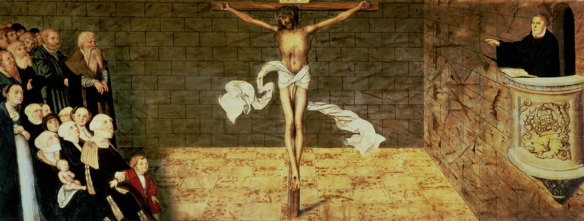
Lucas Cranach was a Renaissance painter and printmaker in woodcut and engraving. He was a friend of Martin Luther and his wife Katharine von Bora. In one of his paintings (1547) focusing on the Cross of Christ, Cranach depicts Martin Luther preaching to the congregation. I remember this particular painting vividly as it hung above the bookshelf in my house growing up.

image.png

It shows Martin Luther standing in a pulpit perched high on the wall of the chancel at the front of the medieval church. One of Martin Luther’s hands rests on the bible. And he points with his other hand to a cross with Jesus hanging bloodied bruised planted in the floor space between Luther and the crowd gathered in the church. Jesus hanging on the cross forms the center of this work of art.

Today this painting comprises one of the plates surrounding the altar in the Wittenberg church where Luther preached. As such, we often recognize and associate this painting with the ‘Reformation altar’.

Its prominence in Lutheran history suggests how poignantly this painting describes Luther’s theological bias: The Cross stands at the center. And Christ crucified informs everything in the church and even our reading of the bible.

Before we can embrace deeper understanding of Martin Luther’s theological claim that we find salvation by God’s grace—which finds us— through faith, we must first encounter the centrality of the Cross in Luther’s thinking and prayer.

In the seminary that I attended[1], we used the term, “Theology of the Cross”. Martin Luther first coined the phrase in his Heidelberg Disputation written in 1518. A theology of the cross is a way of understanding and imagining God. Fundamentally, in addressing God, we need to ask the questions: What is my image of God? Where is God primarily revealed? How is God best known?

Luther provided an answer: God was, and is, being revealed to us in all truth most clearly and unequivocally in suffering. In the vulnerability and pain of death on the cross, Jesus revealed—and continues to—the God who suffers alongside us wherever there is pain and suffering in the world. It is no wonder, then, that the longest sections in each of the four Gospels in the New Testament are dedicated to the various passion narratives[2]of Jesus.

Therefore, the Cross is theologically vital not just to Luther but to the Apostle Paul (the central figure of the Acts of the Apostles and some of the earliest Christian writings and Epistles) who central theme is: “God’s power is shown in human weakness.”[3]

The Theology of the Cross is contrasted to a Theology of Glory. Especially today among spiritually materialistic cultures in the West, what has been coined ‘a prosperity gospel’ has grown in popularity. This theology of glory presumes God validates faith, and is only validated by, success, measures of progress and triumphal conquering over any weakness or adversary.

A prosperity gospel fueled by unbridled optimism avoids places of defeat, failure, vulnerability and weakness as having anything to do with divine identity or purpose. A theology of glory undermines real people and a God who is known in the darkest times and places of life. It compromises and even derides a common humanity and the losses we all endure.

Prayer, as I have said, is the act of letting go. If prayer begins with God, and our address of God, we must presume before all else who this God is, and how this God is revealed—in scripture, in tradition and in our own experience.

One of the first creeds that circulated among the earliest Christians is from a hymn imbedded in Paul’s letter to the Philippians 2:5-11. The poetry first describes the descent of God. This is the primary movement of God, and of faith: downward. The Almighty chose to enter the lower and lowest regions of human birth, life and death. Only after this primary downward movement can the rising out of the depths happen.

Theologians over the centuries have used the term kenosis, from this text in Philippians, to capture the primary movement of faith. It starts with Christ’s self-emptying and letting go of God’s pure, divine nature. In God’s humility, Jesus compromised a perfect divinity in order to take on the fullness of a human existence.

Our God is a God who lets go, releases, self-empties what has become part of the God-self. This calls for a descent of the soul which in the words of St John of the Cross entails, indeed, a ‘dark night’ of the soul. Prayer is not easy, in so much as it may very well be simple.

Prayer, in the words of Laurence Freeman, “… always involves us in the paradoxes of growth, the cycle of losing so that we can find and then of having to let go of what we have found.”[4]

Prayer is a continual process of detaching and dislodging from places of comfort, stability and strength. Prayer is a deconstructive process. It is disruptive. In prayer we begin first to detach our self from all that we are attached to, all that has defined our identity and lives, all our constructs—mental and material—that constitute the construction and containment of our ego. All of this, in prayer, is placed on the precipice of loss.

All is not lost, however. Because in action and contemplation prayer’s aim and understanding is the prayer of God and for the sake of the God of the Cross. “Prayer calls the active person to a life of interiority and soul discovery … by detaching from all the fruits of action and doing everything purely for the love of God.”[5]In letting go, we discover our true self in God which includes and transcends all that we have been and are becoming.

By kenosis we resolve the Lutheran paradox. Some complain that the grace of God is cheap, such as Dietrich Bonhoeffer last century who sacrificed his life for a greater cause of justice in the Nazi regime. He wrote a book entitled, “The Cost of Discipleship”. Bonhoeffer argued that the theology of the cross ought not lead the Christian to rest on their laurels and not do anything. Just because we are saved by grace and since Christ lost everything for everyone once and for all doesn’t mean there isn’t a point doing anything. There is a cost of discipleship.

In prayer, we move into response because prayer is not for our sake. When we pray, it is not my prayer or our prayer. Praying is like walking along a path on the banks of a fast-flowing river and frequently stepping into the water. The current is strong. It is moving in one direction. We immerse ourselves into presence, the presence of Christ. We fall into the river of prayer that continues, the prayer of the living, resurrected Jesus, whose destination is union with God.

It is in Christ’s name we pray, and for the sake of our God who chose to be revealed in the humility and defeat of the Cross, in the most desperate human condition possible: death. We step maybe timidly yet faithfully into the water, fast flowing towards the great hope of new love and life in God. 

Questions for reflection and discussion:

  1. When you pray, after considering your image of God, what is God doing? What is God’s purpose—a purpose that is consistent with that image of God? Construct your prayer by strengthening the connection between image and function. If God is revealed in human suffering, where does that suffering lead? If God is compassionate, why? If God is patient, for what purpose? If God forgives and heals, to what end? Practice making this relationship between image and function as clear as possible before you make any petition to God. And write down some examples of the connection you make between image and function of God, to share with others next time (See copies of “Prayers of the Day” in Evangelical Lutheran Worship for good examples of how short prayers can be constructed).
  2. What is one non-negotiable spiritual practice and/or belief you would hold onto, if everything else had to be take away? (Ask yourself this, after visiting a place of worship other than your own)
  3. If time was short, what is most important to you in the end? Have you had this crucial conversation with those closest to you? If not, why not?

[1]Martin Luther University College (formerly, Waterloo Lutheran Seminary)

[2]The last several chapters of Matthew, Mark, Luke and John describe in detail the last days of Jesus leading to his arrest, torture and death on the cross. These passion narratives form nearly half the total lengths of the Gospels.

[3]1 Corinthians 1-2

[4]Laurence Freeman, Christian Meditation Newsletter, June 2005.

[5]Richard Rohr, Daily Meditation, 17 August 2018

Doers of positive change

If you’ve followed the Ottawa Senators’ Hockey Club over the last year you will have endured a roller coaster ride. From the high, you will have tasted the sweet drippings of a near-berth in the Stanley Cup Championship Series sixteenth months ago …

To the low, feeling the despairing collapse of the team, not just to being out of the playoffs but crashing all the way to second last place in the NHL standings by the end of this past season.

What happened?

In the last several months, the nightmare season was enflamed by revelations of all the off-ice drama that was happening:

  • Allegations of sexual abuse by then assistant manager Randy Lee;
  • The politicking of owner Eugene Melnick to shame/scare the fan base that he was either going to move the team away from Ottawa, and/or that the downtown arena project may not happen motivating concerned fans to initiate an #MelnykOut ad campaign across the city;
  • Star player Erik Karlsson’s wife applying for a peace bond (restraining order) against the girlfriend of another star player, Mike Hoffman, who allegedly used social media and other means to send discriminatory, abusive messages to the Karlssons even during the loss of their unborn son in March;
  • And the continuing speculation around and probable trade of Erik Karlsson in the final season of his current contract.

General Manager Pierre Dorion was right when he told the media last Spring that his locker room was “broken.” Inter-personal relationships, team chemistry – the essential ingredients in a winning team – were damaged maybe even beyond repair.

While ‘on paper’ the team had skilled players and was comprised of the same core from the year previous when they had that successful run to the Conference Final, something significant had changed for the worse. And this subtle yet very real aspect of failed team-work was at the root cause of the team’s on-ice collapse last season. It wasn’t that they weren’t good players; it was their unhealthy, damaging ways of relating with each other that was the problem.

Funny we are talking here in the church about a hockey team that many of us follow in Ottawa. And yet, we can, I think, attend in a similar way to most areas of our social, political, religious, family and personal lives. Are their areas in your work, your volunteer efforts in the church and in the community, in your personal health, in any aspect of your quality of life let’s say, that are lagging, that yearn for renewal, new life, positive change?

For some time, Ottawa Senator players have been saying that there needs to be a culture change in the locker room and among team relationships. Goaltender Craig Anderson said this week he is looking forward to the changed culture in the coming season but he is “too old for all the drama.”

Teammate and hometown defenseman Mark Borowiecki who is considered a leader in the group called out his goalie and others on the team by suggesting they need to do more than just say they need a culture change. Each player and the players themselves as a team, has to do the work of changing the culture. It wasn’t going to happen by itself. No divine intervention. No single-player trade, no matter how newsworthy, was going to change their culture. They, the players, had to take on the responsibility to work at it.

Be doers of the word. A theme in the scriptures assigned for this day. In the Book of James we get the message that while words are important, actions reveal the truth, authentic self and purpose of what we’re about (1:22) more than anything else. What we do with ourselves, with each other – our actions – are the best teacher and communicator of what is most important to our common life, our team, you could say – whether that team is the church, the family, a marriage, a community group, a political movement, or a sports team.

And this action is not only about our performance on the ice, so to speak. This work of doing is not merely about the mission, out there. It is not about whether we succeed or fail on the mission field in getting the job done – the work of ministry in the world. Perhaps our failure at getting that job done out there may at least in part relate to our failure to do anything on the inside of our personal and corporate lives. And lacking the awareness and the belief of positive change within.

It is no wonder Bishop Susan Johnson and the leadership of the Evangelical Lutheran Church in Canada (ELCIC) has identified being a “healthy church” as one of the four vision priorities, moving forward in community. Being a healthy church means, to “develop and promote a culture of mutual trust and accountability.”[1]

That is, we relate with one another and the world around us in ways that reflect genuine listening, respect, humility and patience. In short, we offer safe spaces for personal interaction and growth. We can’t achieve the other vision priorities of the church, such as compassionate justice, spirited discipleship or effective partnerships, unless we are first a healthy group of people relating to one another.

And no one will make this culture change in our relational lives unless we are doers of the word, unless we take action that promotes growth, faith and positive change in our common lives.

In the mid-point of Mark’s short Gospel, Jesus spends a lot of time around the Sea of Galilee. When I visited Israel during my seminary years, our bus ride was only a couple of hours from Jerusalem to the Sea of Galilee. In Jesus’ day, it meant walking at least six days. Word of Jesus had certainly spread, and his actions of healing and eating with sinners and picking grain on the Sabbath made the Pharisees – the keepers of the Law – extremely nervous. So much so, that the powers that be from Jerusalem invested the better part of a month checking up on Jesus’ ministry (7:1).

It is sometimes amazing the lengths people will go in order to keep things the way they have always been. A radio sports commentator mentioned after the Anderson and Borowiecki interviews that Mark Borowiecki was right: talk of culture change has been swirling around the same group of players for most of last season with little, actual change in their performance. It seems we haven’t really been taught how to work at bringing positive change, starting with us.

Change is frightening, to be sure. Institutions often seek to preserve the status quo. That was true in Jesus’ day. And it is true in congregations as much as in team locker rooms these days. Yet change, as we must surely know living in this time and place in history, is the norm, not an exception.

I was pleased to hear Pastor Mei Sum Lai, leading her last worship service at Resurrection Lutheran Church in Orleans[2]last Sunday, thank the congregation for allowing change to happen during her tenure there. I then reflected on all the changes that have happened here at Faith[3]in the last six years or so:

  • The bold decision to bring significant upgrades and modernization to the building and sanctuary;
  • The gutsy decision to worshipping for four months with our local Anglican parish while the sanctuary was off-limits in its renovation;
  • The move to weekly Communion;
  • The involvement of lay readers and worship assistants;
  • The completion of the work of the Evangelical Lutheran Women as a formal entity
  • The introduction of Christian Meditation as a weekly prayer group;
  • The evolution of bible study to a prayerful encounter with the Word;
  • The ongoing evolution of meals at the church in all its fits and starts – to name a few changes.

These changes, good or bad in your view, are nevertheless good practice for us. Making these changes are good exercise for us, for the positive changes that God is bringing about in our world and church. Because we won’t do it perfectly. We will make mistakes. We will even fail at times. But avoiding failure is not the point of Christian identity and mission. The point is, we are following Christ – or trying to – on a rocky and uncertain road in the post-modern world. Trying amidst the noise and chaos to discern and listen to Jesus’ voice.

What is at stake, is what we believe. What do we believe about change? I think this makes a huge difference in how that rocky road will go for us.

Despite the negative scrutiny and criticism heaped upon Jesus by the Pharisees, what does Jesus do in response? Does he cave into the pressure to play by the religious rules of the day? Does he try to please the authorities and adhere to the tradition for tradition’s sake? Does he shift into self-preservation mode and quietly step into the shadows as not to garner any more attention? What does he do?

Jesus keeps on healing. If you read on in chapter 7, he goes on from Lake Galilee southward on the road into the non-religious Gentile region first to heal the daughter of the Syrophoenician woman[4], and then he opens the ears of the deaf man in the Decapolis.[5]

In fact, I don’t know of anyone in the New Testament who doesn’t change after encountering Jesus, whether by a healing or in a shift of attitude and approach to life. The most dramatic example, probably, is Saul of Tarsus who on the road to Damascus encounters the living Lord and experiences a profound conversion.[6]

When you meet Jesus, your life changes for the better not because you don’t do anything about it. But because you’ve placed yourself, for better or worse, in a position to receive the grace, healing and change of God. Historian Diana Butler Bass writes, “For all the complexity of primitive Christianity, a startling idea runs through early records of faith: Christianity seems to have succeeded because it transformed the lives of people in a chaotic world.”[7]During this time, Christianity was primarily about how to live a better, more faithful life, here and now within the kingdom of God.

Team play is as much an inner game as it is an outer game. And the inner game takes work, not just words. This inner work is not easy to do.

Perhaps you might have a hard time believing positive change is possible in your own life. If so, is it because we refuse to see the positive changes happening in those around us – in the life of the church, in our own families and friendship groups? Because when we refuse to accept that others have changed, we strike the death knoll and close the doors of our own hearts to see the change there.

So perhaps a first step would be to regard others, especially those closest to us, as on a journey that is changing and growing them in ways beyond our control. And then wait for Jesus’ call on your own life to follow him, to encounter him, to meet him on the road of life. In most of the people who meet Jesus, they present their own need. They approach Jesus in their vulnerability. Where they are hurting.

Because whatever the case may be with your own heart, whether or not you believe change in your own life and in the life of others around you is possible, God waits for you. God is patient, ready and willing to heal. God believes in you.


[1]http://www.elcic.ca

[2]http://www.rlchurch.ca

[3]http://www.faithottawa.ca

[4]Mark 7:24-30

[5]Mark 7:31-37

[6]Acts 9:1-31

[7]Diana Butler Bass, “A People’s History of Christianity: The Other Side of the Story” (HarperOne, 2009), p.26.

Geometric power: The circle church

The architecture of church buildings, despite Christianity’s institutional decline in the Western world today, continues to draw our attention. For the most part, these are beautiful buildings, appealing to the eye whose symbols etched in paint, glass and images conveyed through colour and the play of light and shadow serve as magnets to the curious and searching among us all.

In one reading assigned for this Sunday from the prophet Amos, God’s judgement on Israel is measured by a plumb line.[1]Construction workers measured the stone blocks to make sure they were squared so the walls of the temple could be built straight up. It was used to make sure the construction of buildings was done properly. The plumb line image conveys the proverbial ‘standard’ to determine how righteous God’s people are. Needless to say, Israel fails miserably, time and time again.

It seems, for folks in the bible, there is always good and bad in the mix. God’s people will never, no matter how hard they try, be pure and perfect in their doing and being. From ancient days to this day, people of faith always miss the mark. Just read Paul.[2]Our vision is often clouded, and we cannot help but make mistakes on the journey.

The stories from the bible assigned for this day reveal characters mired in the shackles of their humanity, good and bad. David rejoices in bringing the ark of the covenant into the holy place of the temple in Jerusalem while others look on with hatred, despising him.[3]Of course, King David was no angel himself, committing murder and adultery while he was king.[4]

Herod Antipas, in the Gospel reading, respected the rogue John the Baptist and liked to hear him speak yet condemned him to a gruesome death in order to protect his own reputation.[5]Wherever you read in the bible, you cannot avoid the sinfulness of even the so-called heroes of the faith.

What we build to the glory of God, the fruits of our labours and expressions of our faith, will also reflect this good/bad reality. The Dean of the now re-named Martin Luther University College [formerly Waterloo Lutheran Seminary], Rev. Dr. Mark Harris, once told me, when he visited me at my former parish at Zion Lutheran Church in Pembroke, that no matter all the changes that happen in the church today — good and bad — architecture always wins out.

What does the architecture of a place of prayer, therefore, communicate? What truths do they reveal about what we value, what is important to the church? How does the architecture ‘win out’?

Recently, I’ve visited other congregations that are housed in beautiful, old church buildings. The first is Merrickville United Church where last month I did a pulpit exchange, you might remember. The second was two months ago when I visited Luther Place Memorial Church in Washington D.C., which hosted some seminars at the Festival of Homiletics.

What is similar about the floors in these churches, keeping in mind [hint!] our discussion of the plumb line? What would Amos say about their construction using his plumb line?

Why did the original construction include a sloped floor? Perhaps its architects wanted to create an easier sight-line for the person in the pew to see clearly the primary furniture of worship located in the chancel — the font, altar and pulpit. The font, where the first sacrament of baptism — of entering the family of God; the altar, where the sacrament of the meal invites us regularly for nourishment on the journey of faith; the pulpit from where we hear God’s word in scripture and voice.

That’s the good from the construction, that we are drawn and can see clearly what is central to our faith: Word and Sacrament. That we can come easily; we don’t have to work hard to earn our way to God. I don’t know how many times in worships services and lectures during my time in and visits to these spaces, we had to stop whatever was going on to wait for a rolling water bottle to make its easy yet loud, clattering roll down to the front.

So, the good: We can pool down into the arms of God’s grace. We are drawn to the love of God’s welcome and forgiveness. And we really don’t need to work hard to be there. We just need to ride the current flowing to God. It is gift. It is grace. It is free. Neither ought we place any barriers to God’s grace being accessible to all, to come forward. To let all, including ourselves, come to God. Amen? All are welcome!

You may have noticed, however, that King David brings the ark of the covenant “up” into the city. Indeed, this is the geography and architecture of the city of David built upon a hill.[6]And the holy of holies is not down below in the valley, but up high by the altar.

The people have to exert some physical energy to get to the place of God’s presence. Even David, in all his rejoicing in bringing the ark to Jerusalem, “danced before the Lord with all his might.”[7]He was working hard! He was putting his all – heart, soul and body – into the effort.

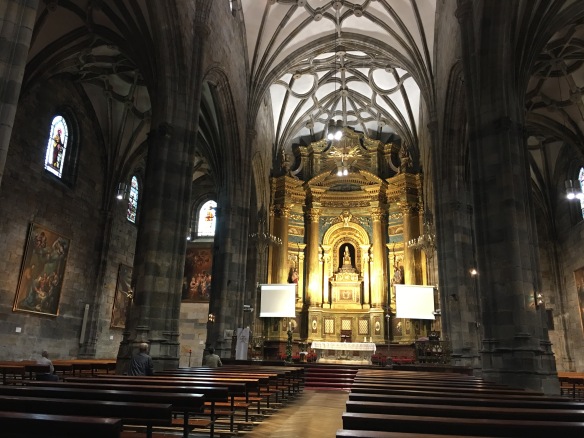
At the unplanned end to my Camino de Santiago pilgrimage last year, I sat in the large nave of the cathedral in Bilbao, Spain, reflecting on the disappointing turn of events. It is a spectacular fifteenth century build.

IMG_5352.jpg

As I looked around me in the silent, cavernous space, for a split second I experienced vertigo, not unlike you would in the old slanted room in the Ottawa Science Centre. Something was off.

Then I realized, I’d never before been in a church building whose floor was not sloped downward toward the altar, but upward!

IMG_5355.jpg

And what goes up must come down. The floor was slanting outward and downward toward the front doors and down into the city!

The story of David’s extravagant, energy-filled entrance up into the holy city didn’t finish at the holy of holies. Going up was completed by turning around at the apex to come back down. The story ends by David distributing food and gifts to not only his family and friends in the city, but “the whole multitude of Israel.”[8]Everyone is fed!

Worship and centering in God is followed by a necessary, gracious giving and going out into the world. I quote again the prophet Amos, where we started: “Let justice roll down like waters, and righteousness like an ever-flowing stream.”[9]

We don’t have slanted floors here. It’s more or less flat. Amos with his plumb line might be satisfied with the level of the floors. But what else could the architecture of our place of worship tell us about ourselves, our identity and God’s call for us?

IMG_6546

Could it be, sitting in room that is basically round that the obvious measure and geometric symbol is not the straight line, but the circle? And now, with larger windows surrounding us, windows which let more light in, also improve our imagination and connection with the world out there? Could it be, given the architecture of our faith here at Faith, we are now called not only to be drawn into the centre, the hub, of the circle who is Christ, but also be sent out in the centrifugal force of God’s Spirit?

In the last pages of the bible, the Book of Revelation, we read a vision of God’s magnificent future:

God’s future comes as an experience of God’s love, “flowing like a river from God’s throne, nourishing trees with leaves for the healing of the nations.”[10]This vision “pictures a world made whole, with people living in a beloved community, where no one is despised or forgotten, peace reigns, and the goodness of God’s creation is treasured and protected as a gift. Our faith is not a privatized expression of belief which keeps faith in Jesus contained in an individualized bubble and protects us from the world.

“Rather, we are on a spiritual journey in which we remain connected to the centre of the presence of God but whose love yearns to save and transform the world. We are called to be ‘in Christ’, which means we share – always imperfectly, and always in community with others – the call to be the embodiment of God’s love in the world.”[11]

In loving others by including them in the circle, we discover how much we are loved by God. We are the circle church. A porous, ever-expanding circle.


[1]Amos 7:7-9

[2]Romans 3:23; Romans 7:15-21

[3]2 Samuel 6:16

[4]2 Samuel 11

[5]Mark 6:14-29

[6]2 Samuel 6:12b

[7]2 Samuel 6:14

[8]2 Samuel 6:18-19

[9]Amos 5:24

[10]Revelation 22:1-2

[11]Richard Rohr’s Daily Meditation, Friday, July 13, 2018 (www.cac.org)

There’s a hole, PART 2: For a purpose

I am a hole in a flute / that the Christ’s breath moves through – / listen to this /music.            -Hafiz

If you comprehend it, it is not God. -St. Augustine

Unlike the pounding of the surf a stone’s toss away, the ponding on the nearby creek made the surface of its water look pristine. A narrow creek made its lazy, winding way down the escarpment from Highway 21 and aimed to run into Lake Huron after finally crossing the stretch of sand on the beach at Point Clarke.

One of our favourite pastimes on those lazy summer days was to play around the area where the creek and lake met. As children, my brother and I would build castles, dig trenches and re-direct the flow of the creek’s water.

For a real challenge, we would try to dam up the creek’s flow, which took some planning, and extra material like drift wood and larger stones to block any outflow attempts. Once we contained it, the creek turned slowly into a large pond, comfortably remaining – for the time being – behind its fortress sand walls.

I’ve already talked about how in God’s creation, it is meant to be that each of us has a hole in our heart (see “There’s a hole, PART 1: Meant to be”). Moreover, it is God’s good intention that this hole is there for a purpose.

Paul writes in his second letter to the Corinthian church a confession that in all his accomplishments for the expansion of the Gospel across the Mediterranean, he was given a thorn in his side.[1]The proverbial ‘hole’. It is not important, although many have tried, to figure out what this thorn actually was.

We don’t know. Maybe that’s the point. It’s not important that we know, only that this thorn was given him in order to keep him humble. The text says that the thorn was given Paul to keep him from being ‘elated’ – to keep his ego in check, perhaps because he tended toward being too full of himself, over confident in his own ability.

How does the ego get the better of yourself? What is your compulsion? What drives you to achieve some illusion of perfection in your life? So, you don’t need to trust what is beyond your life, what is ineffable, what cannot be fully understood that is the Great Mystery (a.k.a. God)?

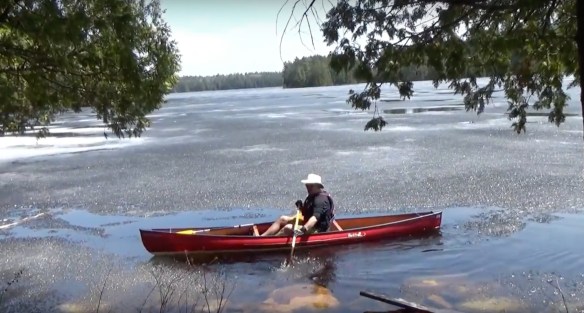
Let me show you an example of compulsion to achieve that which is beyond our capacity: On my fishing trip with colleagues last May to Algonquin Park, we tried everything to beat the ice on the lake. Despite the predominance of the ice-covered lake, we tried desperately to fight the odds against us catching some fish even to the point of risking our safety to break up the ice ourselves in our canoes.

Screen Shot 2018-07-07 at 2.29.00 PM

Yup, that’s me. And, yup, you guessed it: We caught no fish. The irony is that on the last day of our camp out, the wind and the sun did its job. When we woke that last day, we looked over a lake completely free of the ice.

IMG_6940.JPG

Was God sending us a message? Weren’t we the butt end of some divine humour?

The hole in our heart has a divine purpose: To keep us from being too sure of ourselves, over-confident in our ability and our capacity to have it all figured out. If we didn’t have this hole, might we put all our trust in our own autonomy, our independence, to lead our life without any need at all to trust anyone else let alone God.

Beyond Paul in the New Testament, the stories in the bible are about God lessening, even stopping, the compulsive drive of main characters, so the wind of God’s Spirit could draw them more gently and more effectively (Gideon and Moses in the Hebrew Scriptures are good examples).[2]

In the Gospel reading for today, Jesus instructs his disciples in going into the world to do God’s mission, “to take nothing for their journey … no bread, no bag, no money in their belts; but to wear sandals and not to put on two tunics.”[3]

God’s consolation is simple yet profound: “My grace is sufficient for you, for power is made perfect in weakness,” God tells Paul.[4]The making perfect here is not about getting rid of that vulnerability. Rather, whatever weakness we bear stays with us in order for us to complete our purpose as human beings. We are made complete in God’s love because of our hole, thorn, weakness – not without it.

In one of Martin Luther’s famous works entitled, “The Bondage of the Will”, he emphatically declared that we, as humans, can never work out our own salvation for ourselves. We will continually fail, even when, or especially when, we believe we are doing good in the world.

While some might find this realization depressing – and it would be helpful to know why that is, for yourself – perhaps the “bondage of the will” can be freeing. Because we don’t need to be driven to inaction because we are afraid of making a mistake. We don’t need to get stuck in the mud under the fear of imperfection. As Christians, we can be free to do good work in the world, imperfectly, knowing that what we do is for the benefit of others and not for ourselves.[5]

Author Brian McLaren in his recent book: “The Great Spiritual Migration”, describes this time in history as a transition in the church from “organized religion” to “organizing religion.”[6]

A Church in the flow of God’s Spirit pertains not only to wind and water over the earth, but also to spiritual movement. To purpose and mission. To going where we need to go as a people. To re-focus again on loving God, self and others as the primal energy of the church. To bring to life once again the old verse: “They will know we are Christians by our love …” … and not by our buildings, property, and concern for security, certainty and self-preservation.

Can we let go of these things for the sake of God’s mission, for the sake of the Gospel of life and love in Christ? As the prophet Amos so well put it, using the water imagery: “Let justice role down like waters, and righteousness like an ever-flowing stream … “[7]

By the time we had finally engineered the dam on the tiny creek aiming towards Lake Huron, the sun was setting and we had to go home. Inevitably, the next morning one of three things would have happened in our absence:

Either the creek would have found the weak spot in the sandy fortress wall we built, and escape through a tiny crack; or, increasing wind conditions over Lake Huron overnight would have created larger waves whose surf reached and destroyed the walls of our dam; or, someone would have been walking along the beach and, for the fun of it, just poked a tiny hole to watch as a slow trickle quickly turned into a strong, flowing stream.

In each case, a small hole was required in order for the creek to fulfill its mission and reach its destination – despite all the efforts of playful human beings to keep it contained.

After all, nothing was going to stop the flow. God’s Spirit and purpose will flow on because and through the holes in our lives.

[1]2 Corinthians 12:7-10

[2]Richard Rohr, “Dancing Standing Still; Healing the World from a Place of Prayer” (New Jersey: Paulist Press, 2014), p.18.

[3]Mark 6:8-9

[4]2 Corinthians 12:9

[5]Ross Murray, Senior Director, GLAAD Media Institute, LinkedIn July 2018.

[6]Brian McLaren, “The Great Spiritual Migration: How the World’s largest Religion is Seeking a Better Way to be Christian” (Massachusetts: Convergent Books, 2017)

[7]Amos 5:24

Canada is a neighbour

Happy Canada Day!

On this July 1stit is good to reflect on what makes Canada great. Let’s be positive! What is it about our society that stands out in a positive way – amid all that is not so good?

I would like to say that we are a country that aspires to a healthy neighbourliness. Being a good neighbour – whether striving for better relations with Indigenous people, whether relating to newcomers to Canada today, whether reaching out in kind to those who are different from me who live across the street – is our national identity.

Asserting this quality for Canadians, I believe, is not new. Being a good neighbour is not a recent trend in progressive society. Hearing preachers spout the virtues of neighbourliness reflects a deep seeded consciousness influenced by popular culture already in the last century.

It was in the 1950s when children fell in love with the Friendly Giant on TV in Canada. Some of you might recall watching actor Bob Homme on CBC TV from 1958 until 1985 being friendly to his puppet animal friends.

Then there was Mister Rogers’ Neighbourhood which first aired in 1968. Although an American show, did you know that Fred Rogers spent several years in Toronto in the early 1960s working with Ernie Coombs – Mr. Dressup – airing a prototype show called the same Misterogers?

Over his career, Fred Rogers was intentional about being more and more inclusive. He brought, for example, an African American person onto the show yet didn’t draw undue attention to it. This was a subtle yet poignant statement about neighbourliness when American white culture was anything but, towards people of colour.

To assert that these cultural icons were birthed in Canada would not be an overstatement. To be Canadian is to be a good neighbour. It is in our DNA. It is our calling, our witness to a world that wants to be anything but, especially these days.

Yet, it seems every generation of Canadians needs to learn anew how to be a good neighbour. We need to be continually reminded and encouraged to practice being a good neighbour because we tend to be a fearful lot. And fear keeps us from this holy calling.

Having faith doesn’t mean the absence of fear. Having faith means stepping into the fearful place. Having faith means action. It means “leaning into” the situation as we are.[1]

Our lay delegate from Faith Lutheran Church to the Eastern Synod Assembly in Toronto last week, admits being fearful taking the train for the first time. Julia is a seasoned, experienced OC-Transpo bus rider here in Ottawa. Despite the similarities in travel experience between the train and bus, she confesses taking the train across the province for the first time was an anxious affair.

What is more, we missed each other on the train ride to Toronto. Even though we were on the same train, we boarded at different locations – Julia, downtown; and me, at Fallowfield Station in Barrhaven. In fact, as it turns out, we were on the same car – but I never once caught sight of her.

Until on the last leg of the journey, when we were on the Union-Pearson Express train. My phone dinged. Julia texted me to confirm whether I knew where to catch the hotel shuttle to the convention centre where the Assembly was to take place.

Despite her fear of riding the train for the first time, and alone, Julia reached out to me. She was being a good neighbour by making sure I was ok. Her reaching out to me was helpful since, truth be told, I was not sure about where to catch the airport shuttle bus.

“Who is my neighbour?” Jesus asks before telling the story of the Good Samaritan.[2]“Liberated by God’s Grace … to be neighbour” was the theme of the Eastern Synod Assembly. Through thoughtful, provocative and compelling bible studies, song, and interactions with various peoples, the Assembly reflected and re-committed to become even better neighbours, as a church.

Interesting, in keeping all this in mind, that we encounter the nameless woman in the Gospel reading for today.[3]She approaches Jesus in the crowd, hidden, secretly. No wonder. She is powerless and outlawed in public spaces on account of her bleeding.

The main point of the story is not that she is miraculously healed. She could have remained hidden, quietly disappearing into the crowed after she is healed. That is the way she would have wanted it, likely.

The point is that Jesus calls her into a deeper relationship. She must come out of her private suffering. She must confront her fear, and make a deeper connection with herself, with others, and with Jesus.

“Who touched my clothes?” Jesus says out loud even though he knows the woman has already been healed when he felt the power drain out of him.[4]He, too, could have enabled the woman’s secretive behaviour, letting her go and moving on. He could have protected her in her fearful existence after she is cured.

Instead, Jesus calls for her to step up and be known. Demonstrating incredible courage, the woman responds to Jesus’ call and approaches him “in fear and trembling, fell down before him and told him the whole truth.”[5]

Jesus seeks out a relationship with her. It is of God to do this. God continues to call us into ever deeper relationship – with ourselves, with others and with God. The point of the Gospel is that we affirm our connectedness with others in healthy and compassionate co-existence. This is the path to truth.

Jesus’ ‘touch’ can heal us and the world. The touch of God’s grace can give us peace. We are shaped and made human in relationship with others. All our relationships – in church, in friendships, in marriage – are not just something extra added on to life for distraction and entertainment as if we would be complete human beings in individual isolation.[6]Relationships are not some added feature to our lives in order to get something, a means to some autonomous end.

Relationships are the fabric of life. Relationship – touch, if you will – makes us human and whole. Being neighbourly can heal us, make us better people. “Perfect love casts out fear,”[7]our scriptures say. Love can only be expressed in relationship.

The reason Julia was not afraid of riding the bus in Ottawa, was because she was practiced at it. She had done it many times. Even though the train is not that much different, she had never before taken the train. The difference is, some intentional, risk-taking exercise.

Later this week, members of Faith council will be volunteering for a couple of hours at the Mission downtown for homeless, impoverished men. We will get a tour of the facility and help give out some ice cream to those who are there. Practice, to move beyond fear to faithfulness, isolation into community, to where our neighbours are.

We need to practice being a good neighbour – to those who are vulnerable, to those who are powerless, to those who are stigmatized, to the homeless, the LGBTQIA+ community, to refugees and migrants. We have to lean in to the places of fear in our lives and to take some risks vis-à-vis people who are different from us. In doing so, we realize we are not alone, and we have meaning and purpose in our lives for the common good.

Canadians and Christians share something in common, to be sure. We are called to reach out. And be a good neighbour to the world. We are not left alone stuck in our fear. Because God continues to call us into the deeper waters of grace and love. God will never abandon us, despite our fear.

Let us approach boldly the seat of grace in Christ Jesus our Lord. Amen.

[1]Brother Luke Ditewig, “Brother, Give Us A Word” for June 28, 2018 (Society of Saint John the Evangelist) friends@ssje.org

[2]Luke 10:25-37

[3]Mark 5:21-43

[4]v.30

[5]v.33

[6]Michael L. Lindvall in David L. Bartlett and Barbara Brown Taylor, eds., “Feasting on the Word: Preaching the Revised Common Lectionary” Year B Volume 3 (Kentucky: WJK Press, 2009), p.192.

[7]1 John 4:18

Fresh air

I am glad to be back to breathe the air in the Ottawa Valley. That is why I live here, truth be told. Even before the plane landed at Ottawa airport last evening, I could feel it in the air.

IMG_7127

There’s nothing in the world like catching the sweet breeze blowing down over James Bay, through the budding pine and spruce trees of the Laurentian’s and over the pristine waters of the Ottawa River.

Not only was the hotel room where my brother and I stayed sealed off to the outside, the air in Washington DC was heavy, stale and full of particle contaminants that caused us some coughing, wheezing and rubbing our itching eyes. You don’t have to be an environmentalist to know the Potomac River basin is ….well, not the Ottawa River and Valley.

Ottawa and Washington DC are both the capital cities of their respective nations. Each reflects by its monuments, memorials and geography the character of the nation it represents. One of the purposes of nationalism, like the rivers that surround the two capital cities, is to separate one from the other. Indeed, the work of creating divisions continues in earnest to this day.

In fact, walls are being built not only in the United States, but all over the world as the USA Today front page reported a couple of days ago.[1]Protectionism and isolationism fueled by fear are on the rise.

IMG_7120

So, the voices of a different vision need to be heard, once again.

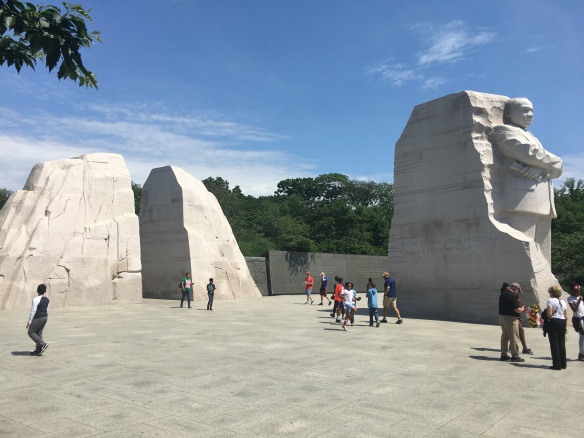
One of the most recently constructed memorials in Washington is on the shores of the Potomac River — the Martin Luther King Memorial.

IMG_6993

“No one is free,” said Martin Luther King, “until we are all free.” In other words:

What I want for myself can’t happen, until it can be so for everyone. If there is anyone who suffers in whatever way,

If there is anyone who is not free, in whatever way,

If there are people who are bound, captive to whatever vice, to whatever imprisonment of the soul or in prison because something they have done…

I am going to be healed of whatever ails me, only when I seek the healing of the other, the freeing of the other, the liberation of the other. The church holds up a different vision from that of the divisive, individualistic and exclusive nature of white nationalism in the world today.

You can see, I hope, why the consciousness of the church not only at Faith Lutheran, not only in Ottawa, or in the Eastern Synod or the Evangelical Lutheran Church in Canada, but in the United States of America and worldwide is moving to see not a division between things, not building walls between two perceived opposites, but building unity between them.

Not a division between politics and pastoral care,

Not a division between care for the soul and social justice,

Not a division between reaching out and reaching in,

Not a division between speaking out against injustice of whatever kind and speaking to the choir,

Not a division between contemplation and action.

Not an either-or, but a both-and.

Last week when Ken stood here and told you about the different ways we can support the financial health of the congregation, he introduced his well-delivered announcement by saying — “you’ve heard we in the church were never to talk about money, politics and sex (well, he didn’t actually say the last word, but I know you all were thinking it!).

And then a couple weeks before that, Mark stood here and told you about his upcoming trip to Ecuador to build homes in a community destroyed by an earthquake some years ago. And in his well-worded speech he said (I paraphrase): “In this mission trip the group he was going with was not doing mere charity, dollars sent to a far-off location, but directly helping them on the ground and making a real difference in the lives of those who suffer.” Check it out. He said it. I believe he has it all on a piece of paper.

I alone am not telling you all this. Your own members are. Your own church family is slowly but surely breaking down the walls that have divided, distanced and incubated our conversations in the church.

Limited our conversation. Limited our imagination. Limited the ways of God. NOT talking about these things, well, how has that worked out for the church in recent times?

NOT talking about the things that really matter in our daily life, NOT being open and honest, sharing the deepest secrets and burdens of our lives, NOT feeling safe in a community of faith to be who we humanly are, warts and all, imperfect, suffering, in need of God’s love. NOT being like that — how has that worked for the church? How has that worked for you?

It is not easy in the church (although everyone else in our real lives are talking about them!) to talk about money, politics and sex. It is not easy to talk about the real things that matter in this life. And so, the church for many decades has avoided having these conversations. Why? Because we were afraid? Because talking about sex, politics and money would put a mirror in front of us, exposing areas of our life that needed even a bit of God’s light shining upon it?

It’s not easy to talk about these things. I know. I feel it too. But I always thought that that’s what faith was supposed to be about — to confess, be honest, be real, and just do the work of God. How can we do the work of God when we can’t even be honest, and real, and confess ourselves to one another?

We can echo the prophet Isaiah’s complaint to the Lord: “Woe is me! I am lost, for I am a man of unclean lips …”[2]

But he doesn’t stop there. His confession is not just about himself. Faithfulness is not merely individualistic. We don’t come to church to make an individual contract with the Lord.

Isaiah continues in his confession: “Woe is me! I am lost, for I am a man of unclean lips, and I live among a people of unclean lips.”

Faithfulness drives towards the communal, the community, the well-being of the world. “No one is free, until we are all free.” Not just me, but we!

When we don’t include, welcome and affirm people who are different from us, we are a people of unclean lips.

When we refuse to include conversations about sexuality, money and political action, we are a people of unclean lips.

When we remain quiet in the face of injustice, we are a people of unclean lips.

In other words, this confession of Isaiah implies that he feels he should just ‘shut up and sit down.’ Not say anything. Because he is bad. And Israel is bad.

Maybe you feel this too. Not unlike Isaiah when confronted with a vision of God, you feel, deep down, the church is bad, and has nothing worthwhile to say in the public sphere. Millennials believe that. Just ask your children or your friend’s children. In the past, we church-going Canadians have conveniently said, “That sort of stuff is the government’s job.” We effectively, therefore, excuse ourselves from any social action in the name of Jesus. And continue the dividing.

Martin Luther King also said that in the church it’s alright to talk about the New Jerusalem (pointing to heaven, the afterlife), yes, but one day we also have to talk about the New York or the new Ottawa, the new community in the here and now.

What did Isaiah see in his vision?

Two details in this vision I want to focus on:

First, “the house was filled with smoke.”[3]

Here’s Isaiah who sees God in all God’s glory. How can I understand this vision by analyzing: Why the six wings folded over on various parts of the seraphim? What’s with that?

But the smoke fills the space. Usually, the image of smoke — like the cloud — in the bible is codeword for, “Can’t get this.” I can’t explain what’s going on in the presence of God. I can’t bring all the statistics, analysis, data and information the world can offer, to explain this rationally. But that’s ok. Because that’s not the point.

In 2018, in the wake of the internet revolution, did you know that more than 7 billion humans use the internet; and, that’s 7 and a half percent more, over 2016. Google now processes more than 40 thousand searches EVERY second. And remember, that’s only Google. Include all the other search engines out there, worldwide there are 5 billion searches EVERY day.[4]

We don’t need any more information! The church’s solutions are not found in accruing more data to solve our problems!

Because things happen in life that we can’t understand. The truth about God cannot be conveyed in data streams and pie charts and three point sermons.

Smoke in the house. Mystery. Might it be, that Isaiah and the bible is trying to say: We don’t need to understand everything. We don’t need to know how it makes sense for people of different races, colour, ethnic background, different social economic status, expressing a different sexuality, different ages, different abilities can form one, unified community. We don’t need to know how that can be.

Today is Trinity Sunday. I am not going to stand here and try to explain to you how three different persons can constitute one God. Because I don’t know. All I know is that those different persons are in a unified relationship. Relationship.

The third person, especially, confounds our Lutheran sensibilities. We’ve figured God the Creator. We’ve figured out God the Son, well, as much as we can. But the Holy Spirit throws a wrench into any rationalizations. A mystery, to be sure!

How does it all fit together? How can we analyze this even more? Shouldn’t we first have a detailed plan? Shouldn’t we try to draw a diagram?

We don’t need to know! All we have are the visions. The dreams. The imagination that describes in poetry and colourful words flashes and fragments of God’s kingdom and truth. We don’t need to know. We don’t need to reconcile all the contradictions. We don’t need to make sense of it. We don’t need to provide all the answers. We don’t need to put God in a box, nor explain God to anyone. God doesn’t need that from us.

Why?

Because even though Isaiah is a man of unclean lips (God doesn’t deny it!), even though God’s people have unclean lips, even though we are imperfect individuals in an imperfect church, that isn’t going to stop God. In Section Five of a recent Confession of Faith in a Time of Crisis called “Reclaiming Jesus” church leaders from across the United States wrote: “We support democracy, not because we believe in human perfection, but because we do not.”[5]

The realm of politics is imperfect. Who would think? Yet, our imperfection is the very reason politics happens. It is not something to avoid, it is something to embrace.

What does God do? Despite Isaiah’s complaints and resistance (just like all the rest of the people in the bible!) …

Despite us!

God reaches down from God’s throne and touches Isaiah’s lips with God’s holiness. God doesn’t steer uncomfortably away from the place of Isaiah’s greatest embarrassment, sin, weakness, brokenness, uncleanliness. God doesn’t avoid the uncomfortable places of our lives. God doesn’t even say anything to that uncleanliness.

God touches it. In the place of our greatest fear, shame, guilt, when we present ourselves in God’s almighty, mysterious presence, honestly and openly — not denying nor avoiding — we place ourselves in a position to be touched by God in the very place of our greatest weakness, to be healed, to be transformed, to be made new.

Even in the vision, the temple and the seraphim cannot contain the ‘bigness of God’. “The train of God’s robe filled the temple.”[6]The image is not meant to convey facts, figures, numbers, measurements, information.. Only our post-enlightenment, rational minds want to go there. But we can’t explain the vision of God. God’s kingdom doesn’t sit comfortably in our rationally justified common-sense policies.

God’s presence enfolds and goes to the edges and bunches up in the corner feeling like it needs to be stretched even beyond the walls of temple.

Whom shall I send? God asks.

Isaiah, transformed by God’s touch, can then say, “Here I am, send me.”[7]

Will we?

The Holy Spirit blows where it will. The wind does not stop at the border. The wind does not end at any walls we build to divide. The Holy Spirit brings fresh air into the stagnant, recycled, stuffy air of our temples. The Holy Spirit blows, fresh air at last, sending us into the world with God’s love, grace and power to change.

I don’t know how the fresh air of the Ottawa Valley is cleaner and sweeter than the air I breathed south of the border, really. But I don’t need to know how. I just know.

And give thanks.

[1]USA Today, May 24, 2018

[2]Isaiah 6:5

[3]Isaiah 6:4

[4]Bernard Marr, Forbes.com, May 21, 2018

[5]ReclaimingJesus.org

[6]Isaiah 6:1

[7]Isaiah 6:8

One part per billion

I’m going into the Algonquin Park region this coming week. As you can see outside the church, I’ve already strapped my canoe atop the car. I’m looking forward!

And when I’m paddling, I like to follow the river or lake banks. Of course, where I’m going, there are lots of little lakes and rivers, and therefore many riverbanks and rocky shorelines I will skirt (probably still breaking the ice!).

We live in a world where borders and boundaries are important. Whether these are borders between nations, continents, cities, regions, communities, families or individuals, they mark the line between separate and distinct realities. Without honouring certain boundaries, we can fail to distinguish who we are and lose a sense of our identity and purpose.

Last summer when I travelled through Spain and Portugal, I learned that he Portuguese-Spanish border is the oldest, unchanged national border on continental Europe. This surprised me because that border did not appear natural. Not unlike the border between Canada and the United States in North America, the Spanish-Portuguese border draws a counterintuitive line across the more natural flow of the continent’s geography.

For example, to see it from space, the North American continent flows more north-south: The mountains run north-south on the western half of the continent, the prairie and plains in the centre of the continent, and the Great Lakes basin spilling into both the Mississippi and St Lawrence River valleys in the eastern portion of the continent. The geography suggests more natural north-south lines.

Spain and Portugal share what looks like a giant square mass of land peaking in the northwest on what is called the Iberian Peninsula. The Atlantic Ocean hugs the northern and western edges of this square. And the Mediterranean laps up against the eastern edge and into the southern Straits of Gibraltar separating Africa from Europe.

Despite what looks like it should be a unified whole, this large land mass is divided between two nations with Portugal carving its small section on the south-western shoreline.

When the kids were toddlers — and sometimes even to this day — they often lingered on the thresholds of doorways separating outdoors from indoors. Standing or sitting on the threshold meant that the door remained open. Of course, we parents were concerned about them jamming their thumbs and fingers and toes. So, we would yell at them: “In our out! Make up your mind!”

Borderlands, as we know from German history (the Berlin Wall) and between North and South Korea, can be dangerous places. We call the space in the border “no man’s land.” At best, these thresholds are ambivalent to us; at worst, they leave us uncomfortable, unsettled, fearful. We feel we can’t rest in these places.

I learned recently about what is called the ‘riparian zone’ which is the border between land and water. The riparian zone can be the lake or riverbank that is a marsh, or a rocky or sandy, thin strip of land, a hardwood forest or stand of pine on the edge of the river.

This ‘in-between’ place of the riparian zone fulfills three, vital, ecological functions: First, the riparian zone functions as a natural filter, cleaning ground water as it flows into the larger watershed. It also protects the surrounding soil from accelerated erosion by slowing down wash effect of the river. In the process, riparian zones actually create new soil and provides for new habitats.

A NASA scientist called the river and its marshy edges the ‘sine qua non’ of life; that is, where water and land touch, these edges are necessary for life on earth.[1]

So, we agree that boundaries are important. Borders, whether political, relational or ecological are vital.

But we also say that the grace of God knows no boundaries. We say that God’s love crosses and surpasses all boundaries. Jesus says, “Abide in my love.”[2]Paul wrote that “nothing can separate us from the love of God.”[3]God’s love expands and grows and overcomes all obstacles.

How does this happen? How can we, on the one hand, honour the boundaries in our lives and, on the other hand, live into the boundary-busting, wall-breaking, division-crossing, far-reaching, limitless, boundless reality of God’s love? How can God’s love abide in us when we are separated from God and each other by sin?

We are human, after all.

Imagine you are at the ocean, and you’re standing in the ocean ankle-deep. It’s true, you are only ankle deep. But it’s also true you are in the ocean. It’s also true that if you keep going, it will get plenty deep soon enough. If not in the ocean you are standing in, certainly at the deepest point on earth — the Marianas Trench — because all oceans on earth are connected anyway.

What if the infinite depth of the ocean gives the totality of its depths to your ankle-deep degree of realization of it?[4]

During the Easter season, and because of the resurrection of Jesus, the church says God is everywhere. But then, we also say God is really in your soul. And God is really, really in the church. You have to go in the church to save your soul. And, in the church, God is really, really, really in the Holy Communion. And, then, God is really, really, really, really in heaven. And, here at Faith Lutheran in Ottawa, it’s like one part per billion!

But, Jesus is alive. Therefore, God is really, really, really, really, really, everywhere.

The truth is, when you’re connected to a little bit of it, you’re connected to the whole of it, the fullness of it.

Speaking of the Holy Communion, when we receive one grain, it belongs to the one bread; one grape, one cup. Many parts, one body. When you receive only one small part of the Communion, you receive the whole of Christ.

“Every piece of bread and sip of wine is precisely the same one: there is one bread, and that is Christ. We receive all of Christ in communion, not just a piece of him. If we break the loaf into a thousand pieces, there’s still only one Christ – and each of us receives all of him.”[5]

This logic extends on several levels. Our lives, for one, belong to God’s story. “We need to sense that all aspects of our history, of our experience, are part of the same story, even the bits that don’t make any sense or the meaningless parts …”[6]There is no part of us that does not, somehow, belong to the great story of God and God’s people. Every part of us — our history, our experiences — is valuable to God and to us, and to each other.

We are who we are. No part of us is wasted space, wasted DNA. No part of us is lost, no memory is gone. All parts of us and each one of us belong.


[1]Diana Butler Bass, “Grounded: Finding God in the World; A Spiritual Revolution” (New York: Harper One, 2015), p.68.

[2]John 15:9-17 speaks of the mutuality of divine love’s presence: We abide in Christ as he abides in us.

[3]Romans 8:38

[4]James Finley, Centre for Action and Contemplation, 28 April 2018 (audio, http://www.cac.org).

[5]Br. Mark Brown, Society of Saint John the Evangelist (SSJE), Brother, Give us a Word, 28 April 2018

[6]Laurence Freeman, Daily Wisdom (Word Community for Christian Meditation, Meditatio), 1 May 2018.

Value-added, Christians in the world

Love is not a gooey, “Come, kiss my boo-boo because I hurt myself.”

Love is not a warm-fuzzy blanket to wrap yourself when you’re feeling blue.

Love is not Valentine’s Day chocolates wrapped up in a big red bow.

That is, not love according to the Gospel of Jesus Christ.

Love can be many things. In our world, love has masqueraded in many forms. Do we even have the energy to reflect, talk and most importantly act in the love-sense of the Gospel?

The text from 1stJohn begins with an address to the “beloved”.[1]This is a better English translation than others that start with “Dear friends.” The word in the original Greek is agape. As the first readers and listeners to this word were, so we are addressed, the “beloved.”

This word appears several times in this text. Can you count them all?

And none of them mean what the world, and our compulsive, fearful selves might first imagine.

Agapeis a self-giving love. It is a love that reaches out for the good of the other, despite what the giver wants to do. “Not my will but thy will be done,” Jesus prays to his Father in heaven moments before he is arrested.[2]

I continue to be perplexed by Mother Theresa’s confession on her way to India as a young girl. From the start, when God’s call to go there was beginning to grow within her, I wonder if she really wanted to go.[3]If it were up to what she wanted alone, I don’t believe she would have sacrificed her whole life to the cause of the poor. And yet, we know of her incredible contribution to help the vulnerable and homeless on the streets of Calcutta over the decades that she lived there, served there, loved there.

And what a paradox it was. She discovered, in the giving, that she was being most fulfilled. It wasn’t a sacrifice in the sense of self-denial, self-hatred even, or repression. She was one of the most human of souls on this earth, say those who met her. She discovered that her greatest needs were met, in her self-giving.

In the Star Wars spin off TV series, “The Clone Wars”, a story is told of how Jedi younglings are trained in the Force in a ritual called “The Gathering”. In order to become full Jedi, they must build their own light sabers. Their light sabers are unique to the individual. Each one is built around a crystal which they have to retrieve on an inhospitable, cold planet.

A group of younglings is dispatched into an ice cave to harvest their crystal. In order to succeed, they must meet and overcome their deepest individual fear and greatest weakness: Fear of heights. Fear of monsters. Impatience. Being left behind. Their crystal becomes available to them once they endure this personal challenge, each to their own.

What is more, the clock is ticking. They must find their crystal and exit the cave in a few short hours before the entrance to it freezes over. Otherwise, they would have to wait a couple of weeks trapped inside without help until the next rotation of the sun would allow the ice entrance to melt open again.

It begins as an individual challenge. But it can only succeed as a group effort. Before sending the younglings into the cave, Jedi master Yoda gives them their final instructions: “Trust yourself and trust each other you must.”

For some, this is the biggest problem. Most of the younglings run into the cave and work together in smaller groups, at least in pairs. One helps the other, and vice versa.

But for Pedro, the young upstart, know-it-all youngling boy, he rushes in at breakneck speed and abandons the group immediately. He forges ahead giving the others the impression, again, that he doesn’t need anyone’s help.

Before you know it, he finds his crystal. Or so he thinks. He is the first one back outside the cave. But when Yoda inspects the crystal, it melts in his hand. It wasn’t a crystal he found on the tip of the cave’s stalactite, just some frozen water.

Pedro needs to go back in and do it all over again. But now, time is against him.
While he runs back through the main entrance of the cave, others are returning from their search. He is worried and anxious now that he won’t have enough time.

Feverishly sprinting down tunnels and turning corners Pedro doesn’t know what to do. Until he comes across one of his class mates, Ketuni, trapped behind a glass-like ice wall.

Ketuni had been rushing herself to get to the entrance after finding her crystal. She had followed what she thought was a short-cut from one of the larger caverns. Just as she was coming up the narrow passage leading to the main tunnel near the exit, she realized she was trapped. There was no way she had enough physical strength herself to break the translucent, ice wall. Neither did she have enough time to find another way around.

Ketuni is just about to give up, getting used to the idea of spending days alone in the cave when she notices Pedro rush by. Ketuni calls, “Help! Get me out! Help!”. Pedro faces her through the glass wall. “But I haven’t yet found my crystal. I can’t help you. I have to get going.” And so, preoccupied with his own agenda and needs, he darts off.

But seconds later, perhaps with a change of heart remembering Yoda’s initial instructions to work together, Pedro comes back to the trapped Ketuni. Still without a crystal himself, Pedro takes a sharp rock and breaks a hole through the glass wall big enough to let her out. “Thank you! I’ll help you find yours, now quick!” Ketuni says.

“No, No, you go. There isn’t enough time. Please, get yourself out!” Pedro cries. Reluctantly, yet realizing the truth of what he says, Ketuni runs to the exit. At that moment Pedro notices a crystal glimmering in the broken ice from the hole he made to help Ketuni escape. In his willing sacrifice for her sake, he finds what he is looking for himself. By the end of the story, of course, Pedro makes it out just in the nick of time.

One of the lessons learned from the story is the mutual blessing that comes from paying attention to the needs of the other as the way of discovering your own gift. Our little friend needed to learn the value of trust in working together.

Love, no matter how you define it, is relational. A healthy encounter is usually mutual. A basic definition of mutuality is: “What I want from you, I will first give to you.” If I want respect, I first need to give it. If I want your trust, I need to trust you. If I want you to listen to me, I first need to listen to you.

Mutuality is thus a rendition of the Golden Rule: Do unto others as you would have them do to you.[4]That is, love the other because that is what you seek from them. A primary and fundamental question in any loving relationship is: “How can I best love you?” This brings an interesting implication of living out our faith, in the world: Our deeper needs will be met when we meet the needs of others.

Giving and receiving. Like a vine that is connected to the source. Any part of that vine (the stem, the leaf, the sprig, the sprout) is at any given time both the receiver of nutrients and the giver. It is a conduit. There is constant motion. Stasis does not compute in this picture, this dynamic. Any part of that vine must know what it is like to be both receiver and giver, giver and receiver.

If you can’t trust another to give you help when you need it,

If you can’t receive the love of another, no strings attached,

Then, how can you give it?

Both receiving and giving. Mutuality is thus a hallmark of the agapelove strewn throughout the stories in the Bible.

And flowing in the life of the church today.

We are the beloved. And we are a conduit of that love to the world. Christians are called the world over to ‘add value’ to society. And that value and worth resides in each human being. William Sloan Coffin, in his reflection of love some decades ago, wrote, “God’s love does not seek out value, it creates value. It is not because we have value that we are loved. Because we are loved, we have value.”[5]

God does not love us after we prove somehow that we deserve it. God does not love us after we already prove our worth or value. God’s love in the world creates value in each of us and in those we meet whenever we share God’s love.

Whenever we receive love and give love, love is truly the energy that keeps the world going ‘round.


[1]1 John 4:7-21, NRSV

[2]Luke 22:42

[3]Greg Pennoyer, ed., “God For Us: Rediscovering the Meaning of Lent and Easter” (Massachusetts: Chalice Press, 2015), p.114-115.

[4]Matthew 7:12; Luke 6:31

[5]William Sloan Coffin, “The Courage of Love,” (New York: Harper & Row, 1982), p.11

God in Acts

In Mark Burnett’s recent visual adaptation of the entire Bible, some scenes from Jesus’ passion still stand out for me. Weeks have passed since the dramatic events of Holy Week and Easter. So, I ask you, to rewind the tape for just a minute. And recall with me when news of the upstart prophet from Galilee first came to ears of the high priest in Jerusalem:

The scene in the temple is dark, illuminated only by the flickering flame of candlelight sending fleeting shadows throughout the cavernous room. The religious leaders draped in their flowing robes shuffle about.

An anxious member of the religious elite makes his way to the high priest, catching his attention: “There are reports of a man performing miracles, and some five thousand followed him to Galilee.” At first, news about Jesus does not worry the high priest. He turns away without saying a word. But the messenger persists, pulling at the high priest’s shoulder. “He calls himself the Son of God!”

The high priest’s mouth stretches in a cold smile, “They all do.”

Then, the night before Jesus’ death, Pilate consoles his wife who is disturbed by news of Jesus’ arrest and trial. Pilate’s wife tries to convince Pilate to have nothing to do with Jesus and let him go.

But Pilate, feeling caught between a stone and a hard place, is playing a delicate political game in order to keep control. He says to his wife, trying to justify his own actions to have Jesus condemned to death: “Don’t worry, in a week this man will be forgotten.”

Both the high priest and Pilate, struggling for political control, convince themselves Jesus is a no one, or at best, a pretender. And will be forgotten, like all the rest of them.

We fast forward now, to life in Jerusalem after Jesus’ death and resurrection. Now, in the Book of Acts, the focus shifts to the disciples. A man who is disabled, sitting by the gate near the temple in Jerusalem, finds healing. Peter and John meet him on their way into the temple. “In the name of Jesus Christ”, Peter touches the man, and he is able to walk again.[1]

“By what power or by what name did you do this?” the religious leaders in Jerusalem ask Peter and John when they are arrested. The Sadducees, who were a powerful religious group in Jerusalem, did not believe in the resurrection of the dead.

Strike one, against Peter and John who did not stop preaching the resurrection of Jesus and all who believe.

It is said that five thousand people converted to Christianity after hearing and seeing what miracles and words Peter and John performed.[2]

Strike two, against them. Five thousand people is a huge threat to the religious establishment. And to social stability. Rome held Jerusalem’s religious leaders responsible for keeping the pax romana – Caesar’s idea of political control over each region in the vast Mediterranean empire. There was no way the Sanhedrin were going to allow Peter and John to continue their disruptive work.

So, they were arrested and brought before the religious council called the Sanhedrin. Did Peter and John know that a few weeks prior, Jesus stood in the same place before the religious leaders?

Strange, I find, that something obviously positive – the healing of a person – turns into something negative so easily where human nature is concerned. Questions of resurrection, the mercy of God and healing turn into a question of power: “By what power or by what name did you do this?”

It is also clear, as the author of Acts present, that the religious leaders were “jealously protective”[3]of their franchise on religion. They wanted the masses to be prayerful and faithful. But they wanted people to do so under the exclusive banner of the temple.

Yet, from the beginning, the Christian movement was an outbreak of the Holy Spirit, spreading like wildfire. It cannot be contained in any one, exclusive denomination, group or church claiming to be the only, right way. That is not the nature of the Christian movement, from day one to the present. Exclusivity is not the preferred style of Christian life.

“By what power or by what name did you do this?” Peter and John have an answer: There is no other name by which we all are healed. Jesus Christ stands for all.[4]For God shows no partiality, for there are people in every nation who are acceptable to God.[5]

There is no other name. Other gods will give up on you:

The god of war and violence will give up on you when you turn the other cheek.

The god of consumerism will give up on you when you give what you have to those in need.

The god of power and control will give up on you when you let go of any pretence of being in control of others, forcing them to be like you.

The god of competition and hatred will give up on you when you welcome, affirm and show mercy to those who are different from you and your kind.

All these false gods of the world will forget you. They will be forgotten. The high priest of Jerusalem and Pilate were right because there were so many claiming to be the Messiah who were just that: fakes. These are the false gods who will be forgotten.

But not Jesus. Even after his resurrection and ascension, Jesus will not be forgotten.

Peter and John may have had a couple of strikes against them standing as prisoners before the religious leaders in the temple’s portico. But they, and the Christian movement, would never strike out. God was about to blast a grand slam out of the park of history.

The God of resurrection and new life will continue to inspire, to push us forward, to pinch our consciences, even challenge us to move forward. There is no hiding from this God who will not give up on you and on us.

The God who created you, who loved you,

Who, even in your sin forgives you and shows you mercy,

The God who gives you a second chance, always,

The God who is your loving shepherd, compassionate friend,

This God will never, ever give up on you, nor forget you. Nor any lost, hurting person or creature in all of creation.

Whether it is Peter or John, or the voice of God speaking this through the church and in the world today …

There is no other name under heaven by whose power all can be saved.

Amen.

[1]Acts 3:1-10

[2]Acts 4:4

[3]Thomas C. Long cited in David L Bartlett & Barbara Brown Taylor, “Feasting on the Word: Preaching the Revised Common Lectionary” Year B Volume 2 (Kentucky: WJK Press, 2008) p.432

[4]Acts 4:10-12

[5]Acts 10:34