
Rules of the Gate

“I am the gate. Whoever enters by me will be saved, and will come in and go out, and find pasture” (John 10:9).

It would seem to me that the “gate” that is Jesus, ought to channel my thinking, my values and my directions in life.

Admittedly, there is a very strict etiquette to gates; a rule book that you must follow because not to do so may cost dearly, or lead to death, or destroy a family’s livelihood. What are the ‘rules of the gate’?

Well, the first that comes to my mind is, ‘shut the gate after you.’ It’s okay to open the gate to let yourself through but you must make sure it’s closed and fastened just the way you found it, once you’re the other side.

Other rules perhaps aren’t so obvious – if the gate’s held open, under no circumstances must you shut it, especially if you live on an farm with herds of cattle, sheep, horses, etc.. After all, the herd’s access to water is through that open gateway; if you close it disaster may follow: Animals may force themselves through hedges or fences onto a railway line or highway in their search for water with consequences too horrible to dwell on.

Rules also apply to climbing over the gate rather than opening it. Always climb near the hinges so that your weight doesn’t put a levered strain on those very hinges and potentially bend or even break them. The same applies to where you aim yourself if you’re going to vault the gate.

And if you’re tempted (and supple enough) to crawl under a gate – don’t – you’ll wear away the ground and encourage others to do the same until eventually animals will also do likewise. And, of course, always use the gate no matter how much extra effort it involves because to avoid it by scrambling over a wall, pushing through a hedge, or scaling a fence has potential for damage that animals will seek out and follow.

With gates there are rules. With gates there are principles of which to be aware. With gates come obligations that every person should follow. These are things to think on when Jesus calls himself the gate.

Whatever else the metaphor means, it’s clear that it’s about Jesus as the single entrance to the community of the faithful. We can only be part of this flock by going through this one gateway – and in that is our security and our protection. There is no other way in. Jesus is the very gate itself. The strength and clarity of that image is, I think, obvious.

But that isn’t the only thing this images means.

Jesus, the master of parables, uses metaphor in a rich and involving way that encourages his hearers to think long and hard about the images he uses. He requires of us that thinking because it makes us part of his people. We are involved in using his thoughts; musing on his meanings; and engaging with the pictures he himself has given us.

His story-telling style is one that asks effort on our part so that we can live within the images and symbols that he thought important. He speaks in a way that deliberately draws us closer to him. He makes us active participants in his telling, his living, of salvation. We are never just the audience.

An English lad got himself a summer job working on one of the Canadian Great Lakes – it was a real adventure for him. Of course on the application form he had to answer certain questions about his suitability for the job. When it came to the vital one about whether he was able to swim, he wrote: ‘Yes, I learnt the motions of swimming at my secondary school.’

Inevitably the day came when he fell off his employer’s motor boat. There followed wild splashing and shouting. He was clearly in trouble and had to be rescued. When on the lakeshore he had recovered from his ordeal he was asked about his answer on the form. ‘Yes,’ he said, I learnt the motions of swimming at school but I found them hard to put into practice.’ (Thank you to Christopher Burkett for many of the words and illustrations here come from his sermon, “Finding the Gate” in the online resource: Preacher Rhetorica, 2014)

And indeed they are! You can only learn swimming by swimming. Knowing the motions helps, but that’s no substitute for getting wet! It’s the difference between ‘knowing about’ and ‘knowing.’ This is why the Jesus method of teaching requires of us practice. He doesn’t tell us about living faithfully; instead he asks us to know faithful living from the inside. It’s not ‘You might compare my place in our community to something like a gate,’ but ‘I am the gate.’ It is as easy, but also as engagingly complex, as that. ‘Work out your living with me as the gate,’ says Jesus. Take this image and make it part of your living.

Don’t only know about the motions – like the lad and his swimming. Don’t dwell on the theory, as essential as that might be sometimes. But rather let the image, the symbol, the story become the lens through which you see your living of the faithful life. You can’t get faith ready to wear, off the peg. It’s not a system you can be drilled, or forced, or argued into. No, faith is an adventure of heart and mind where you write the script that utilizes the ideas, the images, the symbols that Jesus provides. Jesus, the master story-teller, gives us enough material for a lifetime and more.

A way through the gate is what is needed. Helping each other to a way through – to the way through, is our witness as people of faith. How do we do that?

When Bishop Michael Pryse (Eastern Synod, Evangelical Lutheran Church in Canada) met with the Christian Council of the (Ottawa) Capital Area last week, he addressed some good questions about what keeps us from actively pursuing and growing relationships with people of differing faiths from ours. Bishop Pryse said that what motivates him to engage people who are different from him is that doing so always “brings out the best Christian” in him.

Contrary to what we might first think — that hanging out with Catholics, Buddhists, Muslims, Baptists, United Church members or Anglicans could ‘water down’ our faith as Lutherans or Christians — engaging the diverse community of faith in truth enhances our loyalty to and conviction in our Lutheran-Christian identity. If anything we should seek out, not avoid, building relationships with those who are different from us, because it may very well encourage to “bring out the best Christian” in us.

The strategy, or rules of engagement, are threefold: First, be a friend. Second, make a friend. And then, bring a friend to Jesus. In that order! These gate rules are, essentially, about practising compassion, care and grace. That’s the best way to be a friend, then make a friend, then bring a friend to Jesus. NOT by trying to persuade the other they are wrong and we are right. That’s not how you be a friend — by trying to win one over against the stranger — to compete with them, to say, “My way is better than your way.” That’s not how you make a friend or keep a friend, is it?

You would expect me to say that the ways to go through the gate are the routes and rules of religion – faithfulness in prayer, in receiving communion, in working with the scriptures, in the giving of effort, time and cash to godly purposes. And that is certainly the case – these are tried and tested pathways. But the Jesus way of engaging us and the world in his saving life does more.

Remember, Jesus gave his disciples a new commandment: to “love another” (John 13:34; 15:12). Jesus preached in the Sermon on the Mount: “There is no other commandment greater than greatest of these” — to love God and love neighbour (Mark 12:31). Paul writes to the Galatians: “For the whole law is summed up in a single commandment, “You shall love your neighbour as yourself” (5:14).

The image of the gate asks of us effort, imagination and personal involvement. Jesus is the life. And we are to live in his way and dwell in his truth, that we may live his risen life. One of the things the resurrection of Christ means is that all the old criteria of judgement no longer apply – the ultimate criterion of death is no more.

We are to be a people who measure things not by the scarcity of death but by the abundant, resurrection life of Jesus. Let there be an end to cynicism and despair. We need each other to keep that measure bright and usable. Knowing each other; sustaining each other; bearing with each other; encouraging other; learning of each other; supporting each other – in joy as well as trouble.

Following these ‘rules of the gate’ will get us to pasture, through the valley of the shadow of death, and into the life, the light, and the love of Christ, eternal.

“There is a place we can find, a good place
like quiet meadows where flowers spread,
like green grasses by gentle streams;
a place where the heart feels nourished,
where the mind is hopeful, unhurried,
where the spirit is glad and at peace.
We’ll name this place fulfillment,
we’ll name it healing and thankfulness,
we’ll name this good place pasture
for there we seek to feed.

And there is a voice we can hear that calls us,
a gentle voice, melodious,
a voice like songbirds and laughter,
like a mother comforting her children,
like a shepherd calling his sheep.
We’ll name this voice acceptance,
we’ll name it mercy and forgiveness,
we’ll name it the voice of God’s love,
inviting us gently to feed.

It invites us to enter pasture
when we think we’re too hurting to listen,
too angry or grieving or fearful
to hear the voice that calls us to peace.

It invites us to enter pasture
when we’re sure we’re too busy to listen,
too burdened or worried or pressured
to hear the voice that calls us to peace.

It says: Come in and go out and find pasture.
It says: We are safe with the shepherd of all sheep.
It says: Meadows await us, in this moment.
It says: Rest in love. Where you are. Joyfully feed.”

“Pasture”, from Andrew King’s web blog, A Poetic Kind Of Place
On the way

For years now, amid the changing realities facing our lives in the church, I have found comfort and hope in a prayer — popular among Lutherans — from Evening Prayer in the old, ‘green book’ (The Lutheran Book of Worship). It goes goes like this:

Lord God, you have called your servants to ventures of which we cannot see the ending, by paths yet untrodden, through perils unknown. Give us faith to go out with good courage, not knowing where we go, but only that your hand is leading us and your love supporting us, through Christ our Lord. Amen.

It is a beloved prayer. The risen, living Jesus indeed goes with us.

But do we go “by paths as yet untrodden”? Yes, in the sense that each of us experiences the journey uniquely; and yes, we can’t know exactly how we will experience that journey. And yes, frankly, that’s how it sometimes feels — like we’re all alone on this journey.

I think in North America especially, the journey of life here carries with it a “frontier” mentality. We are, after all, pioneers — this is part of our history: clearing bush from the land, forging paths never trodden through the wilderness.

And more often than not we are blazing this new path on our own. It’s up to us. This vision, I believe, has captured our imagination and plays a large role in motivating our work and our identity in the church, even.

No wonder we fell so isolated and alone when things change in our lives. No wonder we are so afraid.

The first Christians in the time after Jesus rose from the dead were not called “Christian”. In fact, they were called “Followers of the Way” — the way of Jesus. It wasn’t until in Antioch years later that those who identified with the way of Jesus were labelled, “Christians” (Acts 11:26). Those first disciples — like Cleopas and his friend, that we read about in today’s Gospel (Luke 24:13-35) — were associated with a faith that was predominantly about a journey.

I like how the King James Version of this text concludes: “And they told what things were done in the way …” (v.35). The presence of Jesus is experienced together on the journey of life, following in the way of Jesus.

What if we re-claimed our original identity as “followers of the way”? What if we re-considered our image for this journey of faith we are on? What if this way was not so much about “blazing a new path, not so much a “pioneering/frontier” mentality where we create the path?

What if the journey we are on is more of a caravan route, where we follow where another has already trod?

A man dies and goes to heaven. Of course, St Peter meets him at the pearly gates.
St Peter says, “Here’s how it works. You need 100 points to make it into heaven. You tell me all the good things you’ve done, and I give you a certain number of points for each item, depending on how good it was. When you reach 100 points, you get in.”

“Okay,” the man said, “I was married to the same woman for 50 years and never cheated on her, even in my heart.”
“That’s wonderful,” says St Peter, “that’s worth three points!”

“Three points?” he says. “Well, I attended church all my life and supported its ministry with my tithe and service.”
“Terrific!” says St Peter, “that’s certainly worth a point.”

“One point?” Golly. How about this: I started a soup kitchen in my city and worked in a shelter for homeless veterans.”
“Fantastic, that’s good for two more points,” he says.

“TWO POINTS!!” the man cries. “At this rate the only way I get into heaven is by the grace of God!”

“Come on in!”

For a caravan journey to work, it is by the grace of God. It is a pathway through the wilderness, to be sure. As one plods along its winding route, we nevertheless follow the tracks of the carts and wagons and footprints etched on the roadway and left by others who have gone before us.

Jesus beckons us forward, to follow along the path he has made. Jesus is the main focus on the caravan route.

Let’s not forgot who joins the two disciples on the road to Emmaus. Let’s not forget who does most of the talking — the teaching — on the road. Let’s not forget who is the host at the evening meal, and who initiates for the disciples their recognizing the living Lord when Jesus breaks bread. It’s not about us. It’s about Jesus.

There are some characteristics of this caravan journey, of note; to summarize:

First it is not a journey undertaken alone. In fact, on the caravan route it is folly to travel alone. One would do well to travel together with others for mutual support, consolation and protection along the way.

The caravan route is not a journey of isolation, but of ever-expanding community. From these post-resurrection appearances of Jesus to his disciples, the church moves out into the world. From the disciples’ faith emerges a mission “to all nations” (Luke 24:47). It is not a caravan that goes in circles around Jerusalem; rather, the route winds itself around the world. The Greek word for church is “ekklesia” which literally translates — “a people called OUT”. Yes, the momentum of Christianity is centrifugal — the journey is an ever-expanding mission towards the places where Jesus will be.

When asked about his success, Wayne Gretzky once said, “I skate to where the puck is going, not to where it has been.” He explains why: Imagine the fast-paced ebb and flow of the hockey game; Gretzky says, “Skating toward where the puck IS will always guarantee your arrival at a place where the puck HAS BEEN” — and that’s no good.

By following the caravan route, it is possible to discover where the risen Jesus is going in our world and not just keep going back to the empty tomb. As a popular American preacher once wrote, “Vision is not about looking in tombs for a risen Jesus. It is about listening to where he says he is going to meet us and striking out for it.”

Second, the journey’s value does not depend on our doing all the right things. For the seven mile journey to Emmaus, the disciples didn’t even know it was Jesus walking with them. Whether we know it or not, whether we are aware of it or not, even in our sadness or fear, and even when all around us everything points to the contrary of what we believe “should be”, Jesus is with us and walking with us, and talking to us. Are we listening? Are we following?

All the disciples do is practice some basic hospitality and welcome this intriguing stranger into their home. It is our job only to trust in the presence of Jesus when we gather to hear the word of God, listen to it, and break the bread at Holy Communion — and leave the rest to God.

It is our job sometimes to pay attention to however our “hearts burn”, because just maybe, it is of God.

Here is a variation of a blessing you may have heard. It is also popular among Followers of the Way today, sometimes requested at wedding ceremonies when two people embark on the journey of married life:

“The Lord go before you, to show you the way. The Lord go beside you, to hold you and protect you. The Lord go behind you, to keep you safe from all harm. The Lord go beneath you, to catch you when you fall, and show you the way up. The Lord be within you, to comfort you when you’re sad. The Lord be above you to give you grace.”

Gospel morality

It was a cold afternoon in March. The windchill made it feel like -20’C. And I was worried. You see, I like to keep my feet warm. I dislike the feeling of cold feet. And too late I remembered that one of the realities of visiting a Mosque was taking off your shoes.

I would be in the Ottawa Mosque for several hours. And all I had donned on my feet last Sunday morning was a thin pair of black dress socks for morning worship. I tried to rationalize my way into a comfortable scenario: The annual meeting of the Multi-Faith Housing Initiative would likely be held in the basement of the Mosque — so perhaps the tradition of removing footware in a place of worship would not apply downstairs.

But sure enough as soon as I entered the building, the first thing to greet me was racks upon racks of shelving for shoes. No one was to pass that point — going upstairs or down — without taking off their shoes. As the doors came closed, a blast of chilling wind brushed against my pant leg, giving a frigid foretaste of what I was in for this afternoon.

Wearing my black suit with clerical collar and large pectoral cross hanging from my neck I made my way downstairs. Suddenly two young children dashed beside me on their way into the carpeted meeting room. They stopped, turned around and smiled largely.

Obviously familiar with their worship space surroundings, they proceeded to give me a brief, welcoming introduction to their home: Here are the washrooms; There is the kitchen; Those are the chairs for the meeting. I started to relax. And after a couple of hours, my feet were still warm on the deeply cushioned carpet. 

When we read these very long stories from the Gospel of John, it may be worthwhile to consider some details about the literary context. That is to say, let’s receive this text looking at the whole, larger perspective. For example, in the story of the healing of the blind man (John 9:1-41), only the first seven verses describe the actual healing miracle. The remaining thirty-four verses describe the debate that surrounded this man’s healing.

This leads me to wonder about what the Gospel writer, John, really wanted to emphasize. Perhaps the point of the Gospel is not so much on the miraculous and spectacular — which our culture of instant gratification would jump on. Perhaps there’s a deeper meaning here which can be easily overlooked by our obsessions with judgment, fear and need to explain everything.

First, as far as we are concerned, our connection and deepening relationship to God — which is a process of healing in and of itself — is a process. We see this progress in how the blind man grows step-by-step in his relationship to Jesus.

First, early on in the story, he addresses him, “the man called Jesus” (v.11). Then, he calls him, “a prophet” (v.17). And then, “a man of God” (v.33). Finally, at the end, the man healed by Jesus says to him, “Lord, I believe.” And he worshipped him (v.38). If anything, this Gospel story is not about explaining sin as much as it is about growing into a personal confession of God, in Jesus Christ. And this confession is not an immediate, conversion experience; it takes time. Our reconciliation with Jesus is a journey.

But, paradoxically, this journey is Christ-led; it is not our doing. We will notice that Jesus refuses to play the Pharisees’ game. The Pharisees are focused maintaining control over the religious enterprise — where they are the keepers of the law, the righteous. They maintain control by focusing on others’ sin, by issuing blame and judgment. And making it all about human works.

The Pharisees, and Jesus’ disciples who first ask the question, relate the man’s physical blindness to his sins, thus justifying his condition. The sins we commit are here understood as being the bad things we can somehow will ourselves to stop doing if we had a choice. This religious viewpoint basically implies that the quality of our faith depends fundamentally on our willpower.

Jesus has nothing to do with this. You can see why he was such a threat to the Pharisees. Because faith is not about us, in the end. It’s about God. I think that’s the meaning of Jesus’ statement that the man was born blind “so that God’s works might be revealed in him” (v.3). Our connection to God is primarily the result of God’s works, not ours. The purpose of our connection to God is to point to God, not ourselves.

The morality of the Gospel is fundamentally a question of how God relates to us, and how we are called to relate to one another. Gospel morality is not about whether or not we sin — because we do anyway no matter how hard we try not to. After all, the man didn’t choose to be blind; he couldn’t even take any personal responsibility for this condition.

Gospel morality is a question of how we respond to life’s challenges and events. Imagine dancing with a partner called, “Life Happens”: Do we ‘lead’ (like the disciple often did, and the Pharisees always did) with fear and/or judgment? Or, do we ‘lead’ with grace and thanksgiving?

How does God lead? The Gospel shows God’s favor towards us. The Gospel shows that “we did not choose Jesus; Jesus first chose us” (John 15:16). Jesus did not come “to condemn the world” but in order to save the world (John 3:17). Jesus, as God the Father, does not look on outward appearances (i.e. our frailty, our weakness, our sin), but on our heart (1 Samuel 16:7). God loved us, Saint Paul articulates, “while we were yet sinners” (Romans 5:6-8). God leads with grace, forgiveness, and love — despite all to the contrary in our lives.

The reality of our lives — and the truth of our lives — is not defined by what’s on the surface but by the constant presence, power and grace of God.

If there is a morality we speak of as Christians, it is a morality that trusts God above all when we lead with grace and thanksgiving. That is not to say there is no room for addressing cause for fear. But it is to claim that we will lead with grace.

Multi-Faith Housing Initiative is run by a diverse group of very capable, talented individuals from various faith communities. The executive committee led most of the meeting last Sunday — as you can imagine — typically clarifying detailed accounting, audit and administrative material. Women and men wore their business suits and looked officious, efficient and professional. Except for one thing.

What struck me as I watched them with their power-points, laptops and effective communication styles was they were all, to a person, in their stocking feet. That fact alone added a humbling effect to the gathering. It reminded me that despite all our differences — not denying them, but despite those differences — we were all standing on the same ground.

When Moses stood in the presence of God in the burning bush, God told him to take off his shoes, for he was standing on ‘holy ground’ (Exodus 3:5). Indeed we were all of us standing on holy ground united in our common purpose, humble before one another and God.

I was again reminded that although it may be easy to lead with judgment and fear in our diverse communities when uncertainty feels threatening, it is still better to lead with grace and thanksgiving — modelled to me by those young Muslim children who knew I wasn’t ‘one of them’ — but who nevertheless welcomed me with open arms.

“And whatever you do, in word and deed, do everything in the name of the Lord Jesus, giving thanks to God the Father through him” (Colossians 3:17).

The virus of perfectionism & the healing acme of God’s love

I remember at the conclusion of my qualifying exam as a seminarian seeking a call to serve as a pastor of a church, the lead examiner made only one suggestion.

Sitting before the bishop and an examining committee for over an hour –  hearing me answer questions about church doctrine, dealing with conflict, upholding the Gospel in a pluralistic society, defining God’s mission, etc. – I remember being taken aback with their summarizing statements at the end of it all:

They said, essentially: “From the sounds of it, Martin, you will have to work on one thing. And this may cause you problems down the road if you don’t navigate this issue well. So this is what you will have to practice, right from the start …

“The first time you lead worship one Sunday morning as a pastor of that congregation, when you notice the paraments on the altar are crooked, or not hanging in a symmetrically-perfect fashion, resist at all costs the urge to correct it.”

Here I was all concerned about issues of theological integrity, confessional adherence, denominational survival and biblical interpretation of controversial proportions – and what the leadership of the church was most concerned about was not what I believed so much, but how I, a future pastor, would exercise my leadership among the people of God.

At first, I was convinced they were missing the point. But the more I reflected on this and the more mileage I clocked over the years in pastoral leadership, I came to appreciate very much their advice. Perfectionism is like a virus, and can lead to many bad things not only in leadership but in the practice of faith:

Perfectionism is why I give up too quickly on many a handy-man project at home whenever it doesn’t work out the way I expect it to. Applied to a life of faith, perfectionism, I have discovered, leads only to discouragement, depression and a low self-esteem. Perfectionism, closely related to the need to please others, places undue pressure and unhealthy stress on our lives. Perfectionism makes religion out of following a bunch of rules. Perfectionism keeps us stuck in negative, self-depreciating cycles of thinking.

Have you, too, caught the perfectionism bug? Laurence Freeman, recipient of the Order of Canada a couple of years ago, said that his greatest success in life was to learn that his failures were more important than his successes (audio, “The Virus of Perfectionism”, http://www.meditatio.ca). I am certain his comments reflect the testimonies of many successful business people and those who are at the top of their fields who confess that the most important ingredient in achieving success is the long list of the failures that preceded it.

And then we confront a text like we read today (Matthew 5:48) when Jesus says: “Be perfect, as your Father in heaven is perfect.” What are we to make of that? Does God want us to be perfect, and avoid all possibility of failure, at all costs?

I think we have to be very careful in our understanding of this word, as we practice our faith, day to day. As I have struggled with perfectionism I have come to appreciate the flip-side of this coin:

It is born deep within the human soul to want things to be right, proper, good. We are, after all, created in God’s image. And part of this reflection manifested in each other is to seek God’s glory – which is beautiful, holy, perfect, right – full of dignity and yes, perfection.

So, we ought not repress nor deny this natural yearning within our very being. But what is the difference between acknowledging and celebrating this longing deep within us, and falling into the trap of perfectionism?

“Be perfect, as your Father in heaven is perfect.” I suspect we get hung up on the first part of that sentence all too often; but maybe it would do us well to start with the second half of that sentence.

How is God ‘perfect’? We know from the Gospel that should we want to understand God the Father, we need first to look at Jesus (John 14:7). So, what kind of perfectionism – if we can call it that – did Jesus demonstrate?

When folks ask me: “Why did Jesus have to die on the cross?” I approach the question of the atonement in this way: Is there a better way for God to demonstrate God’s absolute and steadfast love for us than by laying down his life for us (John 10:11) – by letting go and giving up that which is most precious to us all? If anything, Jesus’ death proves to us God’s unyielding, uncompromising and unconditional love for each one of us, in a way to which we could humanly relate.

And second, is there a better way for God to demonstrate absolute power over death and Satan for all time, than by God becoming completely vulnerable through Jesus to the consequences of that evil on earth – which was the unjust condemning of an innocent person to death?

Yes, Jesus could have walked away from Jerusalem. Yes, Jesus could have called down the forces of heaven to save him from the Cross and pound the devil to pulp before our very eyes. That might be a more satisfying approach. But that would have been playing the earthly game; that would have been playing by the rules of the forces of evil: force for force, might for might. Who comes out on top?

But Jesus chose to pull the rug out from under Satan’s legs. Jesus chose to limit his divine self (Philippians 2:5-11) in human form, and to suffer and die as a human completely vulnerable to an unjust evil. If anything, Jesus’ resurrection proves to us God’s absolute power for all time over death and the devil.

My favourite part of Mel Gibson’s film, “The Passion of the Christ”, is the last ten seconds of what feels like a very long movie: When Satan realizes, in agony, for the first time how he has been defeated. Now, that’s a perfect ending to a really graphic presentation of Jesus’ suffering and death.

That’s why Jesus died on the cross. To show us how perfect God is, in God’s love for us. We can’t do it perfectly; we will always miss the mark to some extent. But God is “perfect” love (1 John 4).

God’s love (hesed in Hebrew) is steadfast and unbounding, even to the point of complete vulnerability, letting go – for our sake and for all people. Jesus showed us the way of everlasting life for every human being of every time and every place. He said, “Love your enemies and pray for those who persecute you, so that you may be children of God; for he makes his sun rise on the evil and on the good, and sends rain on the righteous and on the unrighteous.” (Matthew 5:44-45)

The way of Jesus is the way to wholeness, completeness, in God’s eternal love, regardless of any and all human divisions within us and out there.

It’s not an easy way, to follow this perfect love. This way of Jesus doesn’t follow earthly rules of power plays, obsessive self-preservation and competitive perfectionism. Saint Paul prayed that God take away the thorn in his side (2 Corinthians 12:1-10). Presumably Paul asked for this so that he could be better at his job preaching the Gospel of Jesus. But God’s answer would nip Paul’s perfectionism in the bud. God’s answer was, ‘no.’

In fact, Paul’s weakness would be a far more effective way of showing God’s power. What would appear as ‘foolishness’ in the eyes of the world, would in truth be an effective witness to God’s power and God’s love, through Paul’s weakness.

God does not want us to be perfect. Because God does not want us to give up. God does not want us to give up on the journey of faith, no matter how difficult or how unpopular it may become at times. God just wants us to be faithful – to stay on the path, to doing what we can – not out of perfectionistic motivations but out of the heart of God’s love and power working through our imperfection.

And I think God wants us to be vulnerable to one another; that we are not afraid of showing and confessing our weaknesses, our shortcomings and our failures to one another. In the church, we don’t have to wear masks of perfectionism. We are, after all, broken people. That is the truth. But Jesus’ body, too, was broken, for the love of the world. And what is the church, but the Body of Christ?

We are vulnerable to each other, open to one another’s pain and one another’s truth, why? So we can find wholeness, healing, on our journey that begins now on earth and finds completion, perfection, in the world to come.

We are vulnerable to each other, open to one another’s pain and one another’s truth, why? So we can share the truth of God’s love to all people, effectively, genuinely and authentically.

Thank you, Jesus, for accepting us in your perfect love. Amen.

Because it all matters to God

Last weekend, my family visited the Biodome in Montreal. Situated right beside the Olympic Stadium, it used to house the cycling competitions during the 1976 Summer Olympics. But in recent years it was converted into four distinct and self-contained eco-systems from diverse regions in North and South America.

My favourite was the eco-system from South America, for its lush, tropical environment: humid, warm, pungent air; broad leaf palm trees; and, a host of diverse animals – crocodiles, capybaras and scarlet ibis birds.

Our nine-year-old daughter’s favourite animal is the turtle. She spent a lot of time gazing down onto the mossy ground of the rainforest where the yellow-spotted turtle made its home.

When the guide asked us if we had any questions, my daughter wondered where the baby turtles were. The guide said that it was getting more and more difficult for them to obtain babies since they were very vulnerable in that stage of life; indeed it seems that natural selection is making the turtle an extinct species.

Without their fully developed shell in which the adult turtle could retreat to hide and keep safe from predators, the infant turtles are getting far too susceptible to a premature death and more difficult to protect. Who knows? Maybe the turtle with its shelled existence is going the way of the dodo bird.

The religious people in Jesus’ day felt they were up against a formidable predator in the Roman occupation of Palestine. The Gospel of Matthew was written about the time when the Roman legions were laying siege to eventually destroy the temple in Jerusalem in 70 C.E. and fetter out any Zealots who violently opposed the occupation.

With their temple under attack, the anxious people of God were asking questions of identity and purpose: Who are we and what are we to do? How can it be that God’s holy city and temple are occupied territory? What does this say about God’s relationship with us? How does God want us to respond to this dark and murky reality of life?

This is the social and political context to which Jesus spoke, on the hillside near Capernaum overlooking the Sea of Galilee. This Gospel text (Matthew 5:13-20) forms part of the famous Sermon on the Mount in which Jesus outlined the values and purpose of the kingdom of God “that is near” (4:17).

It is a situation not completely unlike our own. When you consider the history of Christianity over the past two millennia, we find ourselves today in a similar, challenging circumstance: the institution of the church is diminished to the point of demise in many quarters. Christendom, once mighty, powerful and dominant in the western world, is relegated now in our society to the point of obscurity and irrelevance.

Many are asking those same questions: Who are we, and what are we to do? How can it be that God’s nation is “occupied” territory? How does God want us to respond to this dark and uncertain reality of life?

It is a natural instinct for many who, when under stress and pressure and the burden of fear, retreat under the shell – as a turtle does. One response to the perceived threat is to strengthen the walls between sacred and secular. Against the wiles of the crazy, dangerous world ‘out there’ we escape into our private and safe domains of home, property and religious purity. And build a fortress. But is this the right strategy? Or, does it spell, like the turtle, possible extinction?

Amidst the threats against the practice of faith in first century Palestine and twenty-first century Canada, Jesus preaches another way.

Amidst these threats, Jesus challenged Israel to be Israel, just as he challenges us to be ourselves in faith today. Jesus did not say, “You must become salt of the earth by pulling yourself up by your own bootstraps.” Jesus did not say, “You must one day down the road when everything is perfect in the world again, or when you can somehow make yourself worthy of it, become the light.”

Jesus announced, to remind them and us: “You ARE the salt of the earth.” “You ARE the light of the world, right now, right here, in the world as it is, in your life as it is now with all its uncertainty, and in all its darkness.” We don’t have to hide nor retreat behind fortress walls. The solution is in somehow activating saltiness and brightness within us.

So, how do we do that? If there were to be only one way of doing God’s will; if there were only one way of being a Christian – then I’m not sure Jesus would talk in parables and present metaphors and images like salt and light – images open to a multitude of functions and capabilities. Jesus would just spell it out in the letter of the law.

But no. Salt and Light. It’s as if he is saying: Given all the uses of salt, and the various applications of light – how do you fit in?

When Jesus uses the image of light, he makes the point not to hide it under a bushel, but make sure everyone can see it (Matthew 5:14-16). But if others are to see the light, in what conditions do we let it shine? At the noontime of a bright, sunny day?

We will have to shine it in the darkness. After all, people don’t notice a light – whether a flashlight or candle – in the brightness of day. But at night. When all is dark. When you can’t see everything clearly. When the way is uncertain. Where shadows lengthen.

That’s where we are to go. Into places of darkness, in the world and in our own lives: Where people suffer hunger, homelessness and rejection; Where we harbor unhealthy secrets within our souls. This may not seem very religious. This activity may not be easy or make us feel good. But it is where Jesus calls us “to follow him”.

Annie Dillard writes, “You do not have to sit outside in the dark. If, however, you want to look at the stars, you will find that darkness is necessary.” (p.43, Teaching a Stone to Talk: Expeditions and Encounters, New York: Harper, 1992)

Why do we go into the darkness of the world? Why should we take these risks, and expose even our own weaknesses and vulnerability?

Because this world matters to God. All of it. Not some utopic fantasy of what it could be without all the stains of human sin splattered all over the place. But this world in all its complexities, challenges, difficulties, problems.

Just like the weeds and the wheat – what did Jesus instruct his disciples in telling that parable? (Matthew 13:24-30) – To leave the wheat and weeds together, and God will take care of separating out the two when the time comes.

This world matters to God. Our human condition matters to God. Otherwise, Jesus would not have come the way he did:

  1. Jesus appeared in the dust of first century Palestine. Often throughout the Gospels, the writers take pains to indicate the time and place of the event they are recording. For example, the Gospel of Matthew opens with a detailed account, name for name, of the genealogy of Jesus (Matthew 1:1ff). The Word became flesh. God entered humanity, in a specific time and place in history. Jesus fully embodied both human and divine. The incarnation was, and is, not some abstract notion removed from life on earth. Jesus was born into this world.
  2. When Jesus died on the cross, the veil in the temple ripped in half (Matthew 27:51; Mark 15:38), symbolically abolishing the distinction between sacred and secular for all time. No longer would religious life be divided into neat categories that separated the faithful from real life, from engagement with the world as it is.
  3. In the ancient (Apostles’) creed of the church we say we believe in the “resurrection of the body”; by placing value on our own bodies in following Jesus we claim continuity between this world and the next. That means that laughing, grieving, crying, caring, walking, working, making love – doing all those things that are part of regular living in our own skin – these are all sacramental activities. These activities, Jesus preaches, are the building blocks of the kingdom of God.

The stuff of earth matters to God. And that’s why we reflect the light of Christ in the darkness of it.

By going the way of Jesus to reflect his light in a dark world, we discover a great grace: that we already have and are all that we need and God needs, to fulfill God’s purposes for us and for the world, in this time and in this place.

The wrong sign

When a road sign indicates something that you don’t expect is the case, it makes me wonder who is behind the seeming prank. What are they up to? What’s their point?

A couple of summers ago when we drove to Florida, a road sign caught my attention. It was hot when we passed through South Carolina and Georgia on the I-95 where many bridges line the route over various waterways and rivers. I can still remember the heat radiating off the hard-top on the interstate.

So you can understand why I did a double-take coming on to several of these bridges seeing a road sign that depicted a thermometer whose temperature hovered around freezing; above the thermometer was shown a car sliding out of control: “Bridge freezes first,” the sign warned.

Are you kidding me? Seriously? On the one hand, the image is true; as a Canadian surviving and driving on our highways during a rather hard winter, I know that when the temperature is below freezing, the highway can be very slippery. But in the southern U.S.? Perhaps last month that was the case there. But I have to confess a deep reservation that they would experience this danger on a regular basis even at this time of year. In fact, we could use some more of that signage up here in Canada.

One of my favourite Old Testament scholars, Walter Brueggemann, once joked in lecture that a metaphor, or a sign, is only good to a certain point. When you make an argument that is supported well by a metaphor, we say it’s a good metaphor. But when the limits of the metaphor become apparent, the one making the point uses the excuse, “Well, it’s just a metaphor.”

I wonder if that’s not the case with some of the metaphors, or images, we read in the bible. Let’s look at the image that describes Jesus as the “Lamb of God” (John 1:29-42) in our Gospel text today. There is something about that metaphor, that sign, that rings very true. But there is also something about that sign that just doesn’t make sense.

For example: A lamb in the temple rituals of the ancient Israelites was offered as a sacrifice to atone for the sins of the people. But if Jesus is now that lamb, why does a wrathful God have to be satisfied by the death of someone, let alone His only begotten son?

After all, God is Almighty. God can do anything. God is fundamentally loving and forgiving (1 John 4:7-21). If God needed to be satisfied by the death of Jesus to atone for our sins, why couldn’t God have simply exercised what Jesus instructed his disciples to forgive “70×7” (Matthew 18:22)? Why couldn’t God forgive, as many times as is necessary (i.e. infinitely), every person on earth in every place and time?

I read this week (pastordawn.wordpress.com) that the actual phrase, “Lamb of God” comes from the Jewish religious rites of Yom Kipper. It was during this festival celebrating the Day of Atonement that two unblemished lambs were brought to the temple to bear the sins of the people. But one was then set free into the wilderness.

The ritual around the Day of Atonement had at its central aim, to be united with God, to be reconciled with God. People were aware of and acknowledged their sin. That is what sin is – when we ‘miss the mark’ in faith. This confession was understood as a way towards that ultimate goal of reconciliation with God, a reconciliation that begins in our life on earth.

What happened to Jesus was an injustice. Jesus dying on the cross was a bad thing. He died wrongfully. Just like so many people today suffer injustice on a large scale – dying in wars, brutalized unjustly. God the Father was first to shed a tear when Jesus died; God is first to shed a tear when one of his followers – that’s us – suffers.

But as is often the case, God makes something out of nothing good. The willingness on the part of Jesus to give his whole self unto a wrongful death carries an important message to us. This is the good news, the Gospel: Jesus death and resurrection gives us permission to live life fully in our humanity. Jesus death and resurrection gives us permission to respond positively to Jesus’ invitation – as he made to Andrew and Simon – to “come and see” what God is all about, to embrace our walk on earth with others in faith. Jesus death and resurrection gives us permission even to embrace our own earthly death.

Because this life on earth matters. We are on the path to reconciliation with God that begins in this time and place. We are together on this faith journey to be united with God. Our lives are being transformed in the waters of baptism and in daily walk in faith. This is good news. As I said, one of the first disciples of Jesus identified in this text is Simon; already, early on in his discipleship, Jesus invites him into the transformed life, symbolized by changing his name from Simon to Cephas – the Rock, Peter.

As the liturgy of Holy Communion articulates it well: Jesus, “who on the Cross, opened to us the way of everlasting life” that is to say, to become fully united with God; to respond to that earthly journey towards union with God, a union that will one day be complete, beyond death.

The word “diabolical” comes from two Greek words meaning “to throw apart.” If something or someone is diabolical, that someone or something is dividing and separating that which could be united and at peace. The evil one tears the fabric of life apart. In contrast, the Spirit of God seeks to make one out of two; the Spirit comes to mend, soften and heal.

“Here is the Lamb of God who takes away the sin of the world!” cries the Baptist. How does Jesus ‘take away’ the sin of the world? The Son of God accomplishes this through forgiveness. Forgiveness is the M.O. of Jesus. Jesus gives his life for us, on the Cross. His sacrifice is an act of forgiveness. And, as such, unyielding love.

Richard Rohr points out that about two-thirds of Jesus’ teachings are about forgiveness; about a third of all the parables of Jesus, directly and indirectly, have to do with forgiveness (p.133-134, Everything Belongs). The growth and positive change that we experience in our lives because of following Jesus come about not because of a fear of punishment from a wrathful, legalistically-bound God who demands sacrifice in order to be satisfied. The growth and positive change in our lives happens through tears of confession and assurances of forgiveness more so than through threats and punishments.

That’s the powerful and most important meaning of the images of Lamb and Cross that we associate with Jesus: Forgiveness is God’s entry into powerlessness, humility. When we encounter the living Jesus in our own lives, we find someone not against us, but someone who is definitely for us!

The goal of faith is not separation, but union – union with God. We may call it getting to heaven, or being saved – however we describe it. But, ultimately discipleship is about bringing together, rather than dividing. True religion is about union. To live in conscious union, relationship, with God is what it means to “be saved”. To be restored, united, in Christ today is to be restored, united within the living Body of Christ, which is the Church. We are the hands and feet and eyes of Christ in the world today.

To exercise a ministry of reconciliation can only be done with great humility and grace. This was the dominant posture of Jesus’ work on earth: that he submitted himself to be baptized by John, that he knelt to wash the feet of his disciples, that he willingly made himself vulnerable in every human way possible, even unto death on a cross (Philippians 2).

Going into the World Junior Hockey Tournament or the Olympics, Canada is always one of the strong favourites. And given the high expectations, and with the entire nation looking on – there is, to say the least, a lot of pressure on the Canadians to win it all. I heard on the news that during the preliminary round of the World Juniors in 2010 in Buffalo, rather than making the mistake of being over-confident and arrogant, the coach then, Dave Cameron, taught his players to be humble in the face of all the attention and competition. Be humble. Interesting – especially in the highly competitive dog-eat-dog culture, we have the Canadian coach teaching his players the value and wisdom of humility.

In the church, and in the faithful living-out of the Gospel of Jesus Christ, however, it’s not some winning and some losing. It’s about doing both, winning and losing – doing both not apart and divided and competitive – but doing both together with grace and humility.

In humility, we can forgive and let go. In humility, we can see the other’s point of view. In humility we can see others as they are, created and loved in God’s image. In humility we can grow in faith in the ministry of reconciliation.

Let us pray that in all that we are and do, we seek to mend, to heal, and to unite that which has been divided in and among, and around us.

The visible signs of unity in the church can be today the most significant. Let’s watch for these signs.

When the gift seems strange

Because of the nature of my work, I cannot travel, like many Canadians do, to warmer climes during the holidays. I confess having fantasized celebrating Christmas Day or Easter morning in the tropics.

I imagine watching a sunrise over the liquid horizon, feeling the warm ocean breezes on my sun-bronzed skin and hearing the crackle of palm leaves above me. I squish my toes into the still-cool pristine sands beneath me and breathe in the salty air. I turn to those sharing the scene beside me, and say: “Merry Christmas”. And we burst into singing together, over the thunder of the crashing surf nearby, “Silent Night, Holy Night”.

I have to confess, I would like to experience this one day. I’m putting it on my bucket list. But I wonder: Will I then miss the typical experience of us northerners who are familiar with a winter setting for the celebration of these holy events? Will I feel I have missed something integral to the experience of a Christmas celebration without the frigid temperatures and snow-laden environs?

Those of you who have experienced a Christmas in a setting that is totally foreign to our typical Canadian winter climate, I’m interested in hearing from you. How did you feel? What did you think? Would you do it again?

As I reflect on our time-worn traditions, I confess how often I put so much emphasis on the ‘window dressing’ of the event, as if what makes the experience enjoyable for me depends on decisions I make or on how much I can control the circumstances. However, in all truth, achieving that ‘picture perfect’ Christmas depends in large part on forces beyond my control; for example, the weather. So, I am caught in-between pretending I can manage an ideal experience whose outcome is ultimately beyond my control.

The real question, therefore, is: How can I receive the gift of Christmas despite the circumstances of my life?

After the worship, we are holding our now annual ‘Epiphany potluck lunch’. Considering the origin of this church tradition, we are practising the spiritual discipline of receiving a gift, unexpectedly. Some of the first potluck meals in North America were held in 1843 at St Paul’s Church in Chicago, which served a large wave of German immigrants swelling Chicago. They held regular potlucks — communal meals where guests brought their own food (from a paper written by Daniel Sack on the social meaning of church socials).

But the original practice was in the spirit of spontaneity. The food was provided for an unexpected guest, but according to the ‘luck of the pot’. There was little or no control over what kinds of food people brought. Yet, attendees rejoiced in whatever they received, however mismatched or unbalanced the contents of meal ended up being. It was, after all, a gift.

In the Christmas story called “The Fussy Angel” which I read in worship on Christmas Eve, the angel assigned by God to look over the Christ child on the night of his birth was frustrated with the imperfect, out of control, events surrounding the Holy Birth.

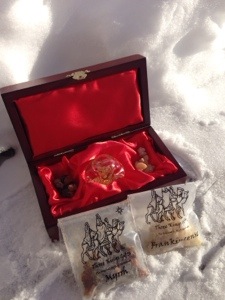
He chastised the Wise Men for their pricey and pretty yet wholly impractical and useless gifts. “If you were truly wise,” griped the angel, “you would have known that what we need is hot water and towels; goat’s milk and bread; twenty diapers and some soap to wash them with.” Not gold, frankincense and myrrh! (p.15-16, Mary Arnold, “The Fussy Angel”, Ignatius Press, 1995). Yet, the Christ child accepts these gifts, however impractical.

The gifts, of course, hold symbolic meaning: the gold – for a king; the spices – used in burial practices of the time.These gifts point to the identity and purpose of God made human in Jesus Christ, whose destination was the Cross and the empty tomb of Easter.

Admittedly, the whole story about astrologers bringing strange gifts to a child in a strange land sounds somewhat exotic, not real.  It is filled with strange incidents, strange gifts, and strangers encountering one another.

At the same time, there is meaning here. Should we but pause to consider the deeper, sometimes hidden, levels of our experience we may appreciate the gift anew, however strange.

The movie “The Best Exotic Marigold Hotel” (Fox Searchlight, 2012) tells of a group of seniors who head off to an inexpensive retirement home in exotic India. As unfamiliar and sometimes frustrating as the experience is, when one character asks why he likes it so much, he replies: “The lights, the colours, the vibrancy; the way people see life as a privilege, not as a right.”

Perhaps Epiphany can open our eyes as well to the holy revealed in what we may have previously thought of as strange, foreign, outside our experience.

Perhaps you have celebrated Christmas and New Year’s this year differently from ‘the norm’ — in a different setting, with different people, outside your comfort zone. Perhaps this Christmas was the first without a loved one. Or, perhaps your life circumstances are changing due to ill health. Admittedly, these are all situations to which, on the surface, we may react even reject outright if we had a choice.

But the Christ child teaches us something important: He didn’t reject those outlandish, impractical and useless gifts brought to him by, of all people, foreigners from the East. Instead, he welcomed them into their home with giggles, gurgles, and laughter.

And this grace, this gift of freedom, is infectious. It liberates us to receive and rejoice in the gifts of life, however small and strange they may at first appear.

20140103-110930.jpg

A ‘fussy’ Christmas?

I was stunned, as I am sure many were, to see photos last week of snow-covered Bethlehem. They say it was, for that Mediterranean region, the first such weather event in over a century.

And over the past century, biblical scholars have criticized Hallmark and other popular artists for depicting these snow covered fields around Bethlehem with sheep softly grazing; ‘they are not being historically or factually accurate’ we critically-minded people complained.

We were critical of such romanticized attempts to depict a ‘perfect’ Christmas from the Canadian perspective. Isn’t it true, though? In the weeks before Christmas, don’t we invest a great deal of time and energy trying to achieve that picture-perfect Christmas? How can you have Christmas without snow, after all?

We ramp up our expectations. Just like they do with movie trailers. Months before its theatre and weeks before its home release, we watch these 60 second teasers, which are designed to wet our appetite and raise our expectations to the awesomeness of the next super-hero, blockbuster flick.

Should we be surprised, then, when we are disappointed? Our expectations have been managed. Marketing gurus have effectively created an appetite, a need. The result: sadness. Many at Christmas feel an emptiness that their lives and families prevent them from having the sort of Christmas they believe they should have. If I don’t get that perfect gift, I’ll be depressed. Right?

Have we ever questioned why we have these expectations in the first place? From where have they come? Who is telling me, ‘It ought to be this way’?

If anything can capture and convey the true meaning of Christmas, a story will do just that. Listen, then, to the story of the ‘fussy angel’:

“When Jesus was born as a tiny baby, God wanted Him to have a special angel to guard Him. But it wasn’t St. Michael the great warrior archangel he chose; nor the mighty archangels Raphael and Gabriel.

No, it was the smallest angel in Heaven that caught God’s eye. ‘This one will do well,’ the Father said. Which proves that God works in strange and mysterious ways.

“But on that Christmas Eve when Christ was born, the little angel was not happy with what he found. ‘This will never do,’ he said, looking around the cold and drafty stable. ‘Get those smelly beasts away from my Master,’ he ordered, tugging on the donkey’s tail. ‘Who knows what diseases they carry and they’re breathing in his face!’ ‘Hush, little one,’ Joseph said. ‘Their breath is warm. They comfort him.’

“There was a cobweb on the manger. Mice peeped out from under the straw and, perched on a beam above where the baby lay, an old crow gazed downward. The little angel grabbed a straw broom and began some furious sweeping. ‘The King of Kings and they dump him in a barn full of animals,’ he muttered. ‘It’s terrible.’ He waved the broom at the crow but the bird ignored him.

“….At midnight the door of the stable burst open and a group of excited shepherds tumbled in. The shepherds fell on their knees, their leathery faces pointed in the direction of the manger. ‘Where’d you lot come from? You’re tracking snow inside. Keep the noise down. Can’t you see he’s sleeping?’ the angel warned.

“A young shepherd took a woolly lamb and laid it at the foot of the manger. ‘What good is a lamb? A sheepskin blanket would have been a better idea,’ said the angel. ‘Can you imagine how prickly it feels to sleep on a bed of hay?’ But Mary smiled at the shepherd boy and bent to pat the lamb.

“In the early hours of the morning they heard a camel snort and into the stable proceeded three wise men. They were richly dressed. Mary held the baby on her knee and as the kings approached, they laid at her feet gold, frankincense and myrrh.

“’That’s very pretty and quite useless,’ the angel observed. ‘If you were truly wise you would have known that what we need is hot water and towels; goat’s milk and bread; twenty diapers and some soap to wash them with.’ The kings turned their proud faces on the angel and were about to reply when the baby gurgled with delight and waved a royal fist in the air. Tempers cooled and everyone smiled … even the angel.

“Outside over the fields and houses of Bethlehem, angel choirs were singing in joyful chorus – ‘Silent night, holy night, all is calm, all is bright.’ The angel stepped outside. ‘The night’s not silent but it’s definitely bright,’ he said. ‘I’ve never seen so many stars. What was God thinking of? How can anyone sleep with all that light? We need curtains to shut it out.’

 “He found some sack cloth and pieces of straw and blocked the holes in the roof and walls of the stable. ‘Blow out your lanterns,’ he ordered the shepherds. ‘The baby needs some sleep.’ But even with holes blocked and lanterns dimmed, the stable was bathed in a golden glow. From the center of the manger a light shone that penetrated the darkness and it seemed this light would never be extinguished.

“By now the angel choirs were piling up ‘Glorias’ which shook the heavens with their strength and timbre. The angel strode outside again: ‘No, no, no! Brother [and sister] angels, have pity on him. He’s human now and needs to sleep. Turn the volume down!’

“But the heavenly choirs could not be silenced. Crescendo after crescendo rang out with such power and majesty that the people came out of their houses and gazed fearfully at the skies, wondering what was happening.

“Sure enough, inside the stable the baby had wakened and was back on his mother’s knee. The angel hung his head in shame. ‘It’s a mess,’ he groaned. ‘My poor master! What can I do?’

“Mary reached her hand toward the angel. ‘Come and see,’ she said. She drew back her veil and the angel looked at his tiny charge. And as he looked, his frustration melted. ‘Why everything is perfect,’ he thought. ‘It’s just the way He wants it to be. Smelly animals, prickly straw, silly gifts and loud music. The snow and the thin, sack blankets. It’s human and it pleases Him.’

“…. he was [then] struck by a surprising thought. This poor stable would one day be more famous than Buckingham Palace or the White House. In the hearts of the people everywhere the stable with its dirt floor and broken walls would be the most glorious palace of all ….” (Mary Arnold, The Fussy Angel, Ignatius Press, 1995).

Tonight, I welcome you to consider how you relate to the newborn Child of Bethlehem. Remember – God’s not looking for the perfect place to be nor the perfect person to do God’s will. God does not demand a perfect situation or people in order to fulfill God’s purpose and be present with God’s love.

Each of us is invited to come and kneel at the manger. I think Jesus and his ‘Abba’ Father in heaven would be happy – pleased – simply for us to come, to give what we are, and who we are, just as we are. What a gift – the greatest gift at Christmas, barring all expectations! – for Almighty God to receive us with such mercy, acceptance and grace. ‘Just the way we are’ is the best offering we can give to the tiny, newborn Jesus, who is our healing and our salvation. How can we resist such love?

Peace on earth, and in your heart, this Christmas.

.

Adventing the New

Christians observe Advent as a season in which we begin again. We start over. We begin a new church year. We return to the starting line, again.

The four weeks of Advent, leading to Christmas, also occurs at a time when everyone is getting ready to turn the page to a new calendar year. It is a time of drafting New Year resolutions, of wiping the slate clean, of starting some new discipline, of beginning again. These seasons are carried on the backs of hope and promise for something good, something better, and something new for our lives.

Although we feel the initiative rests with us to get the ball rolling on these good things, it’s a new beginning that doesn’t start with us, paradoxically. Our action to pray, to seek justice, to exercise, etc. is a response.

Liturgy acts this way. “The Lord be with you,” says the worship leader. And our response: “And also with you.” The prayer of Advent begins when another speaks a word to us. These scriptures upon which we reflect and those we hear read during worship are not ones worship leaders and preachers choose willy-nilly – our favorite, pocket bible verses.

No, in churches that follow a lectionary, these are assigned readings for the season. They were given to us. Advent prayer is essentially a prayer of response to something already there, already given. Our starting over and our returning to the Lord, happen because God is speaking a word to us.

Some fifteen years ago at the beginning of my parish ministry I remember visiting Mrs. Rose – I’ll call her. Mrs. Rose was well into her 90s when I began monthly visits to her home – she lived alone. She didn’t say much, not one for chit-chat, talking about the weather, no. She knew I came with the Eucharist, the Holy Communion.

So, we got right down to business. I would start the prayers – of confession, absolution, and consecration. And without even looking into the book for the words, she would join right in. This happened each time I visited her.

There were times I brought a prayer in her native language, German. I would start reading the 23rd Psalm in German, start praying the Lord’s Prayer in German, or sing a hymn she learned, and memorized, at her confirmation some 80 years ago. And each time I started into those readings and songs, she needed me only to begin – then she was able to join in and complete the prayer.

She represented for me a life lived in response to the new thing God does every day in our lives.

I sat by her deathbed in hospital some years later. Mrs Rose didn’t say anything anymore. And what she did say didn’t make a whole lot of sense, whenever family came to chat. But she was awake, aware of other people’s presence, listening carefully. And whenever I began those prayers she had learned by heart, especially the German ones, she launched into a near perfect recitation.

What word is God speaking to you this season? And are you willing to trust that word from God, in order to take the first, risky step towards the new thing God is doing? And live your life in response to the good, unexpected thing God is doing and saying?

Like Joseph (Matthew 1:18-25), who was willing to go against convention, and maintain his relationship with Mary — all from a dream he had from God.

John the Baptist’s day of reckoning

They say that even the most confident, bold and courageous people have soft hearts. Those of us who may instinctively flinch at John the Baptist’s energetic – even vitriolic – outburst against the Pharisees, and loyal deference to Jesus Christ in his speech from last week’s Gospel (Matthew 3:1-12); those of us who would question his insensitive, uncaring, and offensive style – we might pause today in light of this Gospel story about John the Baptist (Matthew 11:2-11).

For what we see here is a more nuanced, man of faith no longer ranting out of a dogmatic cut-and-dry confidence. But a soft, vulnerable heart. He is much more than an in-your-face, sock-it-to-them extremist and extrovert. Here we get a peek at his vulnerability and the depth of his soul. Maybe it’s because he knew he was close to his death.

At Nelson Mandela’s memorial service in South Africa last week, U.S. President Obama said that Mandela’s strength was “sharing with us [that is, the world] his doubts and fears.”

In prison, John the Baptist expresses his doubts as to whether the man he had rooted for all these years was truly the Messiah. Was his entire life calling to herald the coming Christ all for naught? Like the doubting Thomas would later, John the Baptist seriously questioned whether this Jesus who ate and hung out with sinners, Romans, and tax collectors was the man whom they all expected would save them from those very sinners. John the Baptist’s insecurity is telling, especially when placed in contrast with the early depiction of him crying out brashly in the wilderness.

How does Jesus respond to John’s expressions of doubt? With not only encouragement and affirmation. But Jesus also lifts John’s ministry up. Jesus doesn’t scold John for doubting. Jesus calls him “the greatest” person alive.

I hope John heard that good news. It is a path of hardship John the Baptist undertook, without question. It was a hard path of rejection, ridicule and suffering John endured being a prophet and preparing the way of the Lord. And yet, it is also a path tempered with grace. Because the grace of God came to John in prison; when he really couldn’t do anything to change his unfortunate circumstances – that’s when he received a word of blessing from the One for whom he had prepared the way.