Surrender, to be free indeed: a sermon for Reformation Sunday

I am grateful that by some coincidence the choir sang today a piece whose title was, “I surrender to Jesus”. And, indeed, the thread that runs through the whole song is the act of of surrendering. This theme might, on the surface, appear incongruent and disconnected with Reformation Sunday.

As a child, I remember Reformation Sundays in the Lutheran Church were indeed ‘celebrations.’ As if we were remembering and celebrating a victory on the battlefield of religious truth. Against our opponents in the religious marketplace.

When we retold the stories of Martin Luther who five hundred years ago stood up to communicate his theological emphasis — that we are saved by grace alone through faith alone in Christ alone according to scripture alone — the upshot was that those who didn’t believe this were lost, even despised. Worthy of our judgement. Illumination translated into pressure to conform, need to compete and become embroiled in violent conflict.

Indeed the history of the Reformation in the decades and centuries following Martin Luther’s assertions reflects violence. Wars, based more on political and economical divisions, were fought in the name of Protestant or Catholic truth. Blood was shed. Common folk lost their livelihoods even their lives in the upheavals of the so-called religious wars across Europe. Marching into battle to defend truth became the vision and basis for ‘celebrating’ the Reformation.

Martin Luther’s unfortunate anti-semitism whose words the Evangelical Lutheran Church in Canada repudiated became grounds for hatred against Jewish people to this day, such as in Pittsburgh yesterday. Indeed hatred and violence are as much a legacy of the Reformation as anything else.

Surrendering is indeed counterpoint to the flavour of victory. The cross always stands in contrast to the wiles of glory-seeking fanatics. It is not an easy path: Waving a white flag in the wind may feel like we are ‘giving up’ on who we are, or not caring anymore, or losing our identity. And, here, it doesn’t matter whether we surrender spiritually to Jesus or surrender to anyone on earth. It is the act of surrender that offends our sense of being. And scares us.

That is why, perhaps, we react to this notion that surrender is a good thing. And so, we keep fighting, defending, being all self-righteous. And violent against others, in word and deed. When all along, the truth of it and the real problem is: We find it difficult to admit that in some things we were, and are, wrong.

Martin Luther didn’t want to create a new church. If he knew today that his actions resulted not only in the proliferation of some 30,000 Christian denominations and a plethora of Protestant churches across the globe, but that there was even a church named after him—he would be rolling around in his grave. And yet we trust that despite Luther’s good intentions to merely reform the Roman Catholic Church of which he wanted to remain a member, what has happened is part of something much larger than Luther himself.

The truth is, when we take the risk to do what we are called to do, we fall into a larger reality, a larger good, that is beyond our control. Do we do good, or even pray, in order to control the outcome? Do we do good, and pray, so that what we want to happen will turn out? And if it doesn’t, there’s something wrong with the prayer, or God? Is the religious life about an escape plan from this world into heaven? Because following Jesus is not management-by-objective. We don’t pray and do good to get an insurance policy for heaven.

Rather, we do what we must do because we are stepping into the flow of a greater good in which we participate. We move into active response to God’s love and grace because whatever we do is not for our sake alone. When we do good and pray, for example, it is not my prayer or our prayer. Following Jesus is like walking along a path on the banks of a fast-flowing river and frequently stepping into the water.

The current is strong. It is moving in one direction. We immerse ourselves into presence, the presence of Christ. It enlivens us with refreshment and purpose. We fall into the river of prayer that continues, the prayer of the living, resurrected Jesus, whose destination is the ocean of complete, loving union with God.

We can also learn from the example of Jesus. In the Gospel text for Reformation Day (John 8:31-36) , those who oppose Jesus try to draw him into an argument. Jesus suggests they are not free. They are slaves to sin. His opponents reply by saying they are descendants of Abraham and therefore have never been slaves to anyone.

They are blind to their own inner captivity. They can’t see how enslaved they actually are. Indeed they are not free to grow, in Christ. Because they are right. And everyone else is wrong. They are their own worst enemy.

When Jesus hangs on the cross, and prays to God, “Into your hands I commend my spirit,” (Luke 23:46) he expresses a profound and deep surrender, a letting go, into the immeasurable vastness that is God. From his moment of ‘forsakenness’ (Mark 15:34) that we all must one day experience we learn that faith is not about belief at all. It is about trust and love.

This is a surrendering that does not compromise in any way who we are. Letting go is not ‘giving up’, as if we don’t care anymore about whatever it is we’ve been so inclined to manage and control.

Surrendering to God is releasing our managerial faculties. It is like forgiveness, when we let go of the resentment that keeps us trapped in wanting revenge and retribution. Surrendering to God is an expression of complete trust in that which is wonderfully greater than anything we can imagine let alone accomplish on our own.

Over twenty years ago, Carl Sagan’s book, Contact, was made into a movie. This is basically a story of aliens who send the makings of an interstellar vehicle to earth. Engineers and scientists figure out how to complete this egg-shaped pod that would transport one person through gateways and wormholes to other worlds in the universe.

It is during the inaugural flight that the character played by Jodie Foster discovers a solution to a serious problem. She discovers that what humans think is a sensible, reasonable thing to do actually is the problem.

You see, in this orb that would be Jodie Foster’s mode of travel, there was at first no chair, or anything to keep her in place. And how could someone travel at untold speeds to unimaginable, unknown places without some way to secure her body? Otherwise she could seriously hurt herself tumbling about inside.

So the engineers and scientists construct an elaborate chair which they fasten to the inside of the capsule.

As expected, during the initial flight, Jodie Foster’s character experiences an excruciating degree of turbulence and vibration, to the point where she might expire from the stress of it.

At the height of the extreme shaking, a pendant that had been around her neck comes loose. And floats in front of her eyes. Surprisingly it isn’t subjected to the violent turbulence. It isn’t moving at all. Just floating, suspended in space. It is still. Peaceful.

An idea comes to her in a flash. Without hesitating she unbuckles her chest strap, and releases her body from the chair. From that moment on, her body is finally free from being confined to the chair. She could then fully appreciate, enjoy and embrace the wonder of her interstellar experience.

She understands now that the aliens knew what they were doing in sending a chair-less vessel to earth. They had indeed done their homework before coming to make contact with humans. In unbinding herself, she discovers she can trust them, the experience, and the greater good of what was happening to her.

Had she fixated on remaining bound in the chair, she would not have been able to discover the wonders of the universe to its fullest. Worse, she could have died.

She had to let go. She had to surrender any notion of security to survive. She had to take the risk to unbind herself. She had to trust, and have faith, that in the letting go, she would find peace. And be free.

We don’t have to be right. Only faithful. That when we surrender to Jesus we express in our praying and in our work a trust that we, and the whole universe, are held in the loving embrace of God.

From the scrap heap of metal, we find two pieces. These pieces are ready to be disposed of. The bare bones. The raw material. Broken pieces. These pieces represent our broken, common humanity.

We can do something with these pieces, to be sure. These scraps of metal can be used to brace structures of our own doing—reinforce supporting walls, strengthen sides in a piece of furniture, cover holes and be painted over in appealing colours.

But when these scraps are left alone, God makes something out of nothing. From the ‘scrap’ consciousness. You see, it is no good when these pieces are already made into something by our own hands. But in our dissembled lives, when either the world only sees just scraps and/or we only see the broken dissembled pieces of our lives.

It is only when we let go and let be ‘just as we are’ that God does something with us through the cross. We then become part of the greater flow of love running forever towards God.

Pilgrims rising

Don was a husband and father who one day was commuting home after work in a bad thunder storm, when the car he was driving was struck by lightning. Don was okay, and he managed to get home. Sitting down with his teenaged children, he relayed to them his harrowing experience.

Expecting at least a small degree of sympathy from them, Don was perplexed when his eldest interrupted: “Quick, let’s go buy a lottery ticket because they say the chances of being struck by lightning are like the chances of winning the lottery.”

The disconnect we feel in how Jesus’ disciples often responded to him is not dissimilar. He tells them he must die a horrible death. And they respond by demanding seats of power, authority and glory beside Jesus. His disciples continually seem out of sync with their leader’s meaning.

The Gospel for today[1]must be read in the larger context of Mark’s writing here. In Mark, we see that this is the third time Jesus announces his death, the third time the disciples respond in perplexing ways, and the third time Jesus responds to them by giving them a commentary on true discipleship.[2]

By looking at the what comes immediately before this text, we also discover that the disciples who followed Jesus were afraid.[3]It’s fair to presume, then, their desire and request to secure positions of glory once Jesus took his rightful throne on earth and/or in heaven was born out of fear.

The connection between fear and striving for security is common in all of us, to this day.

We are afraid. We fear the changing realities which make new demands on our time, energy and resources in the church. We fear the outcome of our health concerns. We fear the effects of an uncertain future, in our nation, our world and in our personal lives. In the fear of the unknown, it is a natural knee-jerk to secure anything down. Do something, anything, to give yourself the illusion of control. An insurance policy.

Let’s give the disciples the benefit of the doubt, to suggest perhaps they were aware that Jesus’ path was going to lead to his arrest, torture and death. And they knew that likely they, too, would be caught in the crossfire. They were probably aware that Jesus was causing an uncomfortable stir among the powers that be, religiously and politically, in Jerusalem. They saw the writing-on-the-wall.

And in the midst of this fear, the Sons of Zebedee tried to insure some benefit for all the sacrifices they were already making and would likely continue to make. Perhaps if they didn’t understand something, it was they couldn’t yet grasp the depths of the sacrifices they would make as a community of faith.

What Jesus stands for is a different way altogether from the way of the world. The disciples are caught up in the power plays of the world. They have in mind a hierarchy, a pecking order, of who’s on top. There is this Machiavellian feel to the debate amongst themselves, as if relationships of power must only be a win/lose scenario, a zero-sum game where in order to get ahead some people have to be left behind.

The way of Jesus, in contrast, is the way of the Cross. Jesus exposes the false way of the world by surrendering to it and dying by it. The way of the cross exposes our folly and calls us to a deeper more inclusive way.

Martin Luther first coined the phrase in his Heidelberg Disputation written in 1518. He called it, “A theology of the cross.” It is a way of understanding and imagining God. That is, God was, and is, being revealed to us in all truth most clearly and unequivocally in suffering. In the vulnerability and pain of death on the cross, Jesus revealed—and continues to reveal—the God who suffers alongside us wherever there is pain and suffering in the world.

Luther thus criticized a “theology of glory” which presumes God validates faith, and is only validated by, success, measures of progress and triumphal conquering over any weakness or adversary. This theology dominates not only in our society, but sadly also in the church.

A theology of glory reflects an unbridled, Pollyanna optimism that avoids and resists places of defeat, failure, vulnerability and weakness as having anything to do with divine identity or purpose. A theology of glory undermines real people and a God who is known in the darkest times and places of life. It despises our common humanity and the losses we all endure.

The way of Jesus is for all people, not just for those who make it to the top. The way of Jesus is for all people, because we all have our crosses to bear. We can share in our common suffering. And grow together. It is therefore in community, the Body of Christ, the body ‘broken for all’ we say in the Communion, where Christ is revealed and where our true purpose is born.

#OttawaRising is the hashtag used, announced and displayed on Ottawa Senators Hockey club promotional material. The vision is of the team rising out of the ashes of disappointment from last season. That was the season from hell, when they finished second-to-last place in the league standings, suffered through a broken, conflicted locker room and as a result had to trade away star players.

But it is only standing in the ashes that you can claim the vision of ‘rising’ again. The Stanley Cup champion Washington Capitals wouldn’t declare resurrection as their identity, this season. It only makes sense to proclaim the resurrection in the midst of the defeat of the cross.

The Gospel abounds with a promise. The disciples may not hear it as such. But Jesus has great compassion on them. He does not rebuke them for being out of sync with him. He affirms that they will indeed drink the cup that he must drink and be baptized with the baptism that he must endure.

Jesus will continue to offer this promise and hope to us, that we will not always need to act and respond out of our fear. That what we do as a community does not need to be knee-jerk platitudes that only keep us stuck in cycles of fear, self-preservation and defensiveness. Jesus will continue to call us into deeper expressions of serving others and of paying attention to the needs of others not just our own.

If there was anything the disciples should have known with any amount of certainty, is that Jesus’ promise is secure and very sure. Because by being in last place, and losing it all, those first disciples would one day rise.

And so will we.

[1]Mark 10:35-45

[2]C. Clifton Black in David L. Bartlett & Barbara Brown Taylor, eds., Feasting on the Word: Preaching the Revised Common LectionaryYear B Volume 4 (Louisville Kentucky: WJK Press, 2009), p.189.

[3]Mark 10:32

Funeral sermon for an African-Canadian: Room for all

‘Do not let your hearts be troubled. Believe in God, believe also in me. In my Father’s house there are many dwelling-places. If it were not so, would I have told you that I go to prepare a place for you? And if I go and prepare a place for you, I will come again and will take you to myself, so that where I am, there you may be also. Peace I leave with you; my peace I give to you. I do not give to you as the world gives. Do not let your hearts be troubled, and do not let them be afraid. (John 14:1-3,27 NRSV)

The more I reflect on the gospel text you chose for reading this day, I have to conclude that Jesus has always been preparing room for your beloved, throughout his life.

The first room was in Ghana, his birthplace. Shortly after he was baptized in a Presbyterian church, and later attended the Missouri Synod Lutheran church there. You were married in 1971. Over the next several years you had four children and started to build your family life. A room you called home.

A political coup in Ghana in the 1980s created conflict between the nation’s lawyers and the self-acclaimed government. Lawyers defended the rule of law which threatened the legitimacy of the coup d’état. God was preparing another room for him and the family.

Fearing for his safety he fled to Nigeria where he stayed for five years while the rest of the family stayed in Ghana. You came to Canada in 1988 for six months, as participant of an exchange program between Carleton University and Ghana Institute of Management and Public Administration where you were a lecturer. Your husband visited you in Ottawa and decided to put in an application as a refugee in order to unite the family. It took five years, but in 1993, after 10 years of separation the family was finally together in Canada.

You received help from this congregation as they settled into their new life in Canada. People in this congregation, and other friends, gave you furniture and other means for getting used to living through cold, Canadian winters. Here was yet another room, on earth, that the Lord had prepared.

I recall some of this family history to underscore, broadly put, the importance of community in a Christian’s life. The story of immigration and supporting refugees escaping untold threat and terrors in their homelands is not unique to Theo and his family.

Standing on the side of refugees and migrants and immigrants—this is a central part of our identity not only as Canadians but as Christians and Lutherans. Our values are thus defined because we are a nation of immigrants, to be sure. And in God’s love for all humanity, we continue to this day to do what we can to support those newly arriving in Canada.

God sets the bar and calls us to follow—there’s room for everyone!

Through the turmoil and disruption of those decades late last century, your beloved had to believe, and nurture his faith. He had to trust that good would eventually prevail. He had to lean on God to get him through those lonely days separated by a vast geography from his loved ones. He had to depend on others—his own resources, the gifts and good-will of friends, and upon the grace and presence of God in his heart.

In the last six years that I have personally known him, especially as his cognitive and physical abilities declined, there was one thing that did not change each time I visited him: His face brightened, and his eyes looked like they were going to pop when I opened the bible and prayer book. He was fully attentive as I read familiar prayers and scriptures.

And for all that cannot be known and cannot be said about the mystery of the sacrament, he craved the sharing of the bread and cup in the Holy Communion. With few words spoken, he grasped for and received a tangible sign of the true presence of the living Lord Jesus.

Enough cannot be said about his expression of faith, especially the last years of his life. As he declined, he had to stop attending all the activities in which he loved to participate.

Except bible study. To the end, he would faithfully attend the regular bible study at the nursing home. If when I dropped by he was not in his room and I would ask a PSW or nurse where he might be, the answer was unanimous and consistent every time: In the chapel. Everyone knew that about him. And, more often than not he was there with his bible and prayer books open on his tray.

Even in this latter time of his life, his faith was expressed in community. It was room shared by all. And it was and is in a faith community where God prepares the soul for our final home in union with God. Just like when others supported him get to and settle in Canada as a refugee, decades ago—his faith was again validated by the loving presence of care-workers, church volunteers and staff in the nursing home. In faith, we are not an island unto ourselves. His life and faith demonstrated this in so many ways.

Jesus has indeed prepared an eternal dwelling place for your loved one. Today, he rejoices in the full presence of God where he now sees face-to-face. I believe his death on Thanksgiving is significant. It is a heavenly signal to us about what we need to do during times of loss and grief. At a time in Canada when we pause to give thanks for all the good in our lives, we therefore give God thanks and celebrate the gift of your beloved—a dear husband, father, brother and friend.

Thank you, God, for giving him to us and to the world, to know and to love. Amen.

The great un-doing

This past week I heard from someone how they overcame their addiction to smoking. A middle-aged man, he said he had been a smoker for many years until he started feeling the ill-effects of the habit. He had tried many gimmicks and treatments to quit, to no avail.

It wasn’t until he let go of his need to control the outcome of his efforts, that he succeeded. In other words, when he was able to tell himself: “I can’t do this on my own,” he finally found the capacity within himself to quit. He was able to stop smoking only when he accepted his own limitations, when he released the false notion that he was the master of his own destiny. Even to do something healthy, good.

He didn’t need to accomplish this on his own. What he wanted (to quit smoking), he needed to let go of. What he sought, he needed to release control over.

Whatever you want, you first need to let go of. Counter-intuitive, isn’t it? Usually when you want something, you go for it. And you don’t let up until you have it, eh?

So, what’s going on here?

What did the rich young man in the Gospel story want (Mark 10:17-31)? He wanted to prove that he was a righteous, good man. He wanted to show Jesus and others that he had fulfilled all the rules of his religion and therefore he was worth his religious beans. And who could compare?

The rich man approached Jesus thinking he had it in the bag. His question—”What must I do to inherit eternal life?” (Mark 10:17)—sounds disingenuous, inauthentic. In a manipulative, self-congratulatory way, he thus approached Jesus, even kneeling before him.

He had self-righteously fooled himself into believing he already knew the answer. The gospel writer doesn’t even assign the rich man a name, underscoring the fake, artificial nature of the man’s attitude.

But Jesus cuts through the crap, skims the fat off the top, and goes to the jugular! Indeed, “the word of God is living and active, sharper than any two-edged sword” (Hebrews 4:12). Jesus sees through the rich man’s pretense, and uncovers the real, authentic person beneath the surface. There he finds an enslaved heart, and brings to light the truth:

In order for the man to be liberated and set free, he has to surrender what owns him, what captivates and grips his soul: For him — it’s material possessions. For someone else, it might be different. But he has to learn, if he wants to grow, to let go and not hold on to those things that keep him stuck in false beliefs about himself, God, and the world around him.

What he wasn’t expecting, was an answer from Jesus that undid him. The one thing that he wanted to get—an unscrupulous, beyond reproach reputation as a religious superman—he would now have to let go of. He would have to let go of everything that made him, that put him in a position of power and wealth in his community and that gave him the grounds to boast.

He would now have to sell his reputation, literally, and become poor. And what do the poor have to show for their religious prowess? Wasn’t (and isn’t) being impoverished a sign of God’s dis-favour?[1]

All the texts assigned for today reflect the nature of relationship with God. Relationship with God is at the root of our spirituality, our church lives, our purpose in life and the meaning of our lives. Relationship. Relationship. Relationship.

And what the lectionary offerings are inviting us to consider today, is the nature of our relationship with God. They ask us to be honest, first, about who this God is we are supposed to relate to.

Let’s say, we want God. Well, detach from what we want. That is the key. Let go of our false conceptions about God. For example, an underlying assumption we will make about God is a transactional, mechanized God. Such assumptions were criticized by reformers like Martin Luther in the 16thcentury but also those before him like Meister Eckhart in the 14thcentury. This image they condemned, was God the “reward machine”.[2]It goes something like this:

God is the great rewarder-in-the-sky. And, if you put enough quarters in the slot, God will send down the candy-bar. In Martin Luther’s world, the criticism focused on the sale of indulgences—the more money you paid to the church, the more spiritual benefits you accrued.

These false beliefs about God then generated attitudes and actions that placed the onus all on us and our capacities and resources as individuals. That it was up to us to garner favour with God and so we would earn, and deserve, our salvation and even prosperity on earth.

I believe this is what is behind the rich, young man’s presumption and approach to Jesus. Certainly, he of all people deserves God’s favour.

And Jesus’ response is, essentially: If that’s what you want, you need to let go of it. And, it’s going to hurt before it gets better again.

Whether it’s a bad habit or false understanding of God or anything else that puts you in the driver’s seat of your life, God is looking you in the eye and challenges you to let go of that pretense. Whatever it is you want, first let go of it, and feel the pain of it. Detach yourself from your attachments if you truly want to be healed. It ain’t easy.

And the image is apt: Putting a camel through the eye of a needle is meant to communicate impossibility. And we say that in our own way every day. “Bah, I can’t change; people can’t change.” “We don’t change.” “People stay the same.” And so, we continue to get mired in unhealthy and self-destructive life-journeys. Transformation is inconceivable, we believe.

Maybe, before anything, our image of God needs transformation. If God is not a reward machine high in the sky, who and what is God all about?

It’s hard to believe with all the rain we’ve had in the past month that earlier this summer the lawns were brown, and the ground was bone dry. We’ve seen a lot of rain, lately. I’ve noticed local creeks are flowing again, and the grass on our yard is thicker and a dark, rich green.

I was reminded this week when I read that waterdrops in the atmosphere are created when water vapour condenses. That part I knew. But what popped out at me was the following sentence: water vapour condenses on tiny particles of dust. At the very centre of every raindrop is a particle.[3]

Our relationship with God is not between entities, to begin with. We don’t relate to being, a God among various God-beings out there in a religious marketplace.

We relate to God as the ground of our very being. Our connection to God already exists. Before we do, say, or think anything. Whether we know it or not. God is already connected to us, in our innermost being.

Saint Paul writes: “Do you not know that you are a temple of God and that the Spirit of God dwells in you?” (1 Cor 3:16); and, “I pray that, according to the riches of his glory, he may grant that you may be strengthened in your inner being with power through his Spirit, and that Christ may dwell in your hearts through faith, as you are being rooted and grounded in love (Eph 3:16-17).

We don’t add God to our lives, like filling a shopping cart in the grocery store. We don’t need to relate to a transactional God-the-rewarder-in-the-sky with our consumer mindset. The Reformation should have put that mechanistic view of our relationship with the Lord to rest. We still need the Reformation!

We don’t add God to our lives. We add our lives to God. Who is already there, at the very centre of our lives.

Imagine rain, falling. The raindrops have a way to go before reaching the ground. It may feel like a free-fall. Unnerving, dis-orienting, it is to let go of our deepest attachments. We experience like Jesus did a painful, momentary ‘forsaken-ness’ (Psalm 22:1). I wonder if the rich, young man had the courage to sell all he had to give it to the poor.

I would love to meet him, especially if had gone through with it. I have many questions to ask him. I suspect, however, that if he did it, if he did what Jesus called him to do — that in the letting go he opened his heart, confronted his greatest fear and experienced a free fall … right into the love of God at the very centre of his life. What a joyous surprise, to find the presence that will always be there, and has always been there!

It may seem impossible to do—this letting go—but in Christ all things are possible. And we discover in the journey: there really isn’t anything to lose that is of any enduring, lasting value.

[1]Today’s so-called ‘prosperity gospel’ implies that when you have it right with God, you will be blessed with material riches; the converse is true, too: according to the prosperity gospel, when you sin, God will withdraw blessing and you will be impoverished.

[2]Bernard McGinn, Praying with the Masters Today, Volume 2 (Meditatio Talks Series CD B, Track 5), 2018.

[3]Richard Rohr, “The God Particle” Daily Meditation 10 Oct 2018 (cac.org /Center for Action and Contemplation)

A New Way to Pray: Tracking the Trajectory of the Reformation

What follows are the lecture notes for Week Three in the course I am giving at the Ottawa School of Theology and Spirituality (www.osts.ca) this Fall. Reformation Sunday is on the last Sunday in October, October 28, 2018. It is a time for Lutherans and all Christians to reflect on the legacy of Reformation, commemorate its contributions, and to pray for unity among all who try to follow in the Way of Christ Jesus today.

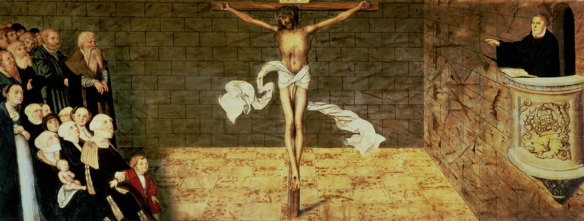
Lucas Cranach was a Renaissance painter and printmaker in woodcut and engraving. He was a friend of Martin Luther and his wife Katharine von Bora. In one of his paintings (1547) focusing on the Cross of Christ, Cranach depicts Martin Luther preaching to the congregation. I remember this particular painting vividly as it hung above the bookshelf in my house growing up.

image.png

It shows Martin Luther standing in a pulpit perched high on the wall of the chancel at the front of the medieval church. One of Martin Luther’s hands rests on the bible. And he points with his other hand to a cross with Jesus hanging bloodied bruised planted in the floor space between Luther and the crowd gathered in the church. Jesus hanging on the cross forms the center of this work of art.

Today this painting comprises one of the plates surrounding the altar in the Wittenberg church where Luther preached. As such, we often recognize and associate this painting with the ‘Reformation altar’.

Its prominence in Lutheran history suggests how poignantly this painting describes Luther’s theological bias: The Cross stands at the center. And Christ crucified informs everything in the church and even our reading of the bible.

Before we can embrace deeper understanding of Martin Luther’s theological claim that we find salvation by God’s grace—which finds us— through faith, we must first encounter the centrality of the Cross in Luther’s thinking and prayer.

In the seminary that I attended[1], we used the term, “Theology of the Cross”. Martin Luther first coined the phrase in his Heidelberg Disputation written in 1518. A theology of the cross is a way of understanding and imagining God. Fundamentally, in addressing God, we need to ask the questions: What is my image of God? Where is God primarily revealed? How is God best known?

Luther provided an answer: God was, and is, being revealed to us in all truth most clearly and unequivocally in suffering. In the vulnerability and pain of death on the cross, Jesus revealed—and continues to—the God who suffers alongside us wherever there is pain and suffering in the world. It is no wonder, then, that the longest sections in each of the four Gospels in the New Testament are dedicated to the various passion narratives[2]of Jesus.

Therefore, the Cross is theologically vital not just to Luther but to the Apostle Paul (the central figure of the Acts of the Apostles and some of the earliest Christian writings and Epistles) who central theme is: “God’s power is shown in human weakness.”[3]

The Theology of the Cross is contrasted to a Theology of Glory. Especially today among spiritually materialistic cultures in the West, what has been coined ‘a prosperity gospel’ has grown in popularity. This theology of glory presumes God validates faith, and is only validated by, success, measures of progress and triumphal conquering over any weakness or adversary.

A prosperity gospel fueled by unbridled optimism avoids places of defeat, failure, vulnerability and weakness as having anything to do with divine identity or purpose. A theology of glory undermines real people and a God who is known in the darkest times and places of life. It compromises and even derides a common humanity and the losses we all endure.

Prayer, as I have said, is the act of letting go. If prayer begins with God, and our address of God, we must presume before all else who this God is, and how this God is revealed—in scripture, in tradition and in our own experience.

One of the first creeds that circulated among the earliest Christians is from a hymn imbedded in Paul’s letter to the Philippians 2:5-11. The poetry first describes the descent of God. This is the primary movement of God, and of faith: downward. The Almighty chose to enter the lower and lowest regions of human birth, life and death. Only after this primary downward movement can the rising out of the depths happen.

Theologians over the centuries have used the term kenosis, from this text in Philippians, to capture the primary movement of faith. It starts with Christ’s self-emptying and letting go of God’s pure, divine nature. In God’s humility, Jesus compromised a perfect divinity in order to take on the fullness of a human existence.

Our God is a God who lets go, releases, self-empties what has become part of the God-self. This calls for a descent of the soul which in the words of St John of the Cross entails, indeed, a ‘dark night’ of the soul. Prayer is not easy, in so much as it may very well be simple.

Prayer, in the words of Laurence Freeman, “… always involves us in the paradoxes of growth, the cycle of losing so that we can find and then of having to let go of what we have found.”[4]

Prayer is a continual process of detaching and dislodging from places of comfort, stability and strength. Prayer is a deconstructive process. It is disruptive. In prayer we begin first to detach our self from all that we are attached to, all that has defined our identity and lives, all our constructs—mental and material—that constitute the construction and containment of our ego. All of this, in prayer, is placed on the precipice of loss.

All is not lost, however. Because in action and contemplation prayer’s aim and understanding is the prayer of God and for the sake of the God of the Cross. “Prayer calls the active person to a life of interiority and soul discovery … by detaching from all the fruits of action and doing everything purely for the love of God.”[5]In letting go, we discover our true self in God which includes and transcends all that we have been and are becoming.

By kenosis we resolve the Lutheran paradox. Some complain that the grace of God is cheap, such as Dietrich Bonhoeffer last century who sacrificed his life for a greater cause of justice in the Nazi regime. He wrote a book entitled, “The Cost of Discipleship”. Bonhoeffer argued that the theology of the cross ought not lead the Christian to rest on their laurels and not do anything. Just because we are saved by grace and since Christ lost everything for everyone once and for all doesn’t mean there isn’t a point doing anything. There is a cost of discipleship.

In prayer, we move into response because prayer is not for our sake. When we pray, it is not my prayer or our prayer. Praying is like walking along a path on the banks of a fast-flowing river and frequently stepping into the water. The current is strong. It is moving in one direction. We immerse ourselves into presence, the presence of Christ. We fall into the river of prayer that continues, the prayer of the living, resurrected Jesus, whose destination is union with God.

It is in Christ’s name we pray, and for the sake of our God who chose to be revealed in the humility and defeat of the Cross, in the most desperate human condition possible: death. We step maybe timidly yet faithfully into the water, fast flowing towards the great hope of new love and life in God. 

Questions for reflection and discussion:

  1. When you pray, after considering your image of God, what is God doing? What is God’s purpose—a purpose that is consistent with that image of God? Construct your prayer by strengthening the connection between image and function. If God is revealed in human suffering, where does that suffering lead? If God is compassionate, why? If God is patient, for what purpose? If God forgives and heals, to what end? Practice making this relationship between image and function as clear as possible before you make any petition to God. And write down some examples of the connection you make between image and function of God, to share with others next time (See copies of “Prayers of the Day” in Evangelical Lutheran Worship for good examples of how short prayers can be constructed).
  2. What is one non-negotiable spiritual practice and/or belief you would hold onto, if everything else had to be take away? (Ask yourself this, after visiting a place of worship other than your own)
  3. If time was short, what is most important to you in the end? Have you had this crucial conversation with those closest to you? If not, why not?

[1]Martin Luther University College (formerly, Waterloo Lutheran Seminary)

[2]The last several chapters of Matthew, Mark, Luke and John describe in detail the last days of Jesus leading to his arrest, torture and death on the cross. These passion narratives form nearly half the total lengths of the Gospels.

[3]1 Corinthians 1-2

[4]Laurence Freeman, Christian Meditation Newsletter, June 2005.

[5]Richard Rohr, Daily Meditation, 17 August 2018

Over mangoes

IMG_7760

Mercy Lawluvi’s first days in Canada were met by the famous ice storm. Arriving from Ghana a young woman in 1997, Mercy had never seen first-hand, touched nor felt snow, let alone freezing rain that made moving about a danger and terror for slipping and falling.

Mercy was alone. And she felt lonely, surrounded by the four walls of her apartment. She couldn’t even see her backyard garden bushes and trees buried and drooping under the heavy, thick accretions of ice.

Nevertheless she decided to slip-and-slide over to the nearby Loblaws. Surviving this first test of Canadian living, she made her way to the fresh produce section. Mercy was delighted to find some mangoes, her favorite fruit.

And as she was standing there, turning over a small reminder of her homeland, a woman came up to her looking for mangoes herself. “Hello,” she smiled. “The mangoes look good. What’s your name?” she asked.

“Mercy,” she responded.

“Where are you from?” the woman asked. “Ghana, in Africa. And these are my favorite fruit. I am so happy they are here.” And so, the two stood there for a long time chatting and exchanging mango recipes. Finally, the other woman asked, “What is your occupation?”

“I am a teacher.”

“I know the administrator of an ESL (English as a second language) school in Ottawa. Let me get the name of my friend to you. Maybe you see where that goes?”

“Thank you so much!”

Twenty-one years later, Mercy stands before us during the “Welcoming the Newcomer” session hosted by the Ottawa Lutheran Refugee Sponsorship Committee[1]this past Thursday, to tell us this story of her first welcome to Ottawa.

Because of the kindness shown by that nameless woman in Loblaws twenty-one years ago, whom she has never since met again, Mercy was able to find the emotional strength and resources to settle well and grow in her new country.

She said how much that simple encounter by the mango display made all the difference in the world to her, not only on that first day during the ice storm to help her through the loneliness and fear. But how important that encounter was for her development, networking and success-finding in her new home in Canada. Someone—a stranger to her— acknowledged her. And was genuinely interested in her.

Twenty-one years later she stands before us as the executive director of “Immigrant Women Services Ottawa”.[2]

And it all started by a caring, open-hearted person asking, “What is your name?”

Indeed, what is our name?  We have a family name sign in front of our house. In my first parish twenty-one years ago in the heart of farmland in southwestern Ontario, every house along the long and straight rural concession roads had one of these kinds of signs hanging or posted in the front yard.

IMG_7762

Fast forward to today, I believe we are the only house in Arnprior, maybe even the whole of Ottawa, who has one. Obviously, it’s not a thing.

I understand Millennials prefer their private, cocooned lifestyles. I understand that, fueled by fear, we are hyper-sensitive about things like identity-fraud and being targeted by criminals. So, if there’s anything we can do NOT to be publicly identified or exposed, the better.

I wonder, though, how much we have, because of this attitude, dampened, even snuffed out, any collective heart-filled reaching out. Because before newcomers, or anyone for that matter, can get to know us and trust us, we need to be available, visible, transparent, accessible to them. In other words we cannot hide from others, and then say that we are welcoming.

I read this week that the first step to building an ethical culture in churches, in business and in society in general, is to let people be who they are. Without needing to persuade, sell something, impose our opinion or argue a point. Without believing they first need to conform before I/we will give them any time. Without needing to protect, defend and uphold my or ‘our’ way of thinking, fearful that any such approach means a loss of integrity or personal safety.

Letting people be who they are, first. Means an open heart. Means, listening first. Means, asking questions first. Means, listening for points of similarity – mangoes. And, then, when trust begins to build, going from there.

“I will pour out my thoughts to you; I will make my words known to you,” Wisdom says.[3]I have the image of a couple of friends getting together at the end of a long day over drinks. And each takes turn pouring out their hearts to the other. Arms waving. Voices rising and falling with each impassioned response. Laughter. Silence. A mutual-inpouring!

I heard recently that each human being requires these two things to survive and thrive: unconditional love, and complete understanding. Both are met in this image from the Wisdom writings of the Bible. An intimacy that affords love and understanding to the partners involved in relationship.

Intimacy. God promises a deep and lasting connection within us. Despite our foibles, our missteps, our compulsions. God promises a deep connection within us despite our mistakes and failures.

Transparency, on the surface, goes only so far to the truth of who we are. You may see the name sign outside my home. You may see my license plate on the highway or city streets. This may be a good first step, I believe, to an honest transparency and invitation for conversation. But, that only goes so far.

When Jesus asks his disciples who they say he is, the question reveals more about the disciples than it does about Jesus. “Who do you say that I am?”[4]Jesus ask them, not because Jesus doesn’t know the answer himself but because the disciples are on a journey of growth with Jesus. These wayward disciples don’t often get it right on this journey. They miss the point of Jesus time and time again.

Jesus’ rebuke of Peter is consistent with how the disciples are portrayed by the Gospel writer.[5]And while Peter might I.D. Jesus correctly, while Peter can give Jesus his proper title and name—the Messiah—he still doesn’t understand what that name actually means in Jesus:

That this Messiah will suffer and die; that this Messiah will be rejected by the powerful, scorned by the knowledgeable, that this Messiah will be arrested a criminal, tortured and die a brutal death by capital punishment. And that this Messiah will rise again three days later. The disciples, Peter among them, do not really understand Jesus.

Just because we may know God’s name, doesn’t necessarily mean we know what is called of us under that name. Just because we can name Jesus and say the right words of faith doesn’t mean we get the follow-through right all the time. In another Gospel, Jesus says, “Not everyone who says to me, ‘Lord, Lord,’ will enter the kingdom of heaven, but only the one who does the will of my Father in heaven.”[6]

Because, ultimately, our titles and our names only give us an entry point into who we are. Words, titles and names cannot capture the totality of who we are. As James so pointedly writes, the words we say by our tongue will get us into trouble; “though small, [the tongue] stains the whole body.”[7]

Getting it right verbally isn’t what faith is about. It’s rather about experiencing God in our own lives and in relationship with others. Wisdom pours out her thoughts into us, not at us. God writes God’s law upon our hearts, deep within, despite our mistakes.[8]This faithful following of Jesus is not just a function of our brains.

Intimate relationship with God and with others in Christ is a matter for the heart. We know God and we know truth not by the words we say or the names with which we identify, but by a deeper knowing marked by deeds and experiences of faith, hope, trust and love.

When the heart is in a good place, we start simply, in small ways, to see the other, reach out to them with a smile and a question: “What is your name?”

And God replies, “Mercy.”

[1]olrs@bell.net

[2]http://www.immigrantwomenservices.com

[3]Proverbs 1:23 NRSV

[4]Mark 8:29

[5]Mark 6:51-52; Mark 8:21; Mark 9:32; Mark 10:23-32,38; Mark 16:13

[6]Matthew 7:21 NRSV

[7]James 3:1-12 NRSV

[8]Jeremiah 31:33

Doers of positive change

If you’ve followed the Ottawa Senators’ Hockey Club over the last year you will have endured a roller coaster ride. From the high, you will have tasted the sweet drippings of a near-berth in the Stanley Cup Championship Series sixteenth months ago …

To the low, feeling the despairing collapse of the team, not just to being out of the playoffs but crashing all the way to second last place in the NHL standings by the end of this past season.

What happened?

In the last several months, the nightmare season was enflamed by revelations of all the off-ice drama that was happening:

  • Allegations of sexual abuse by then assistant manager Randy Lee;
  • The politicking of owner Eugene Melnick to shame/scare the fan base that he was either going to move the team away from Ottawa, and/or that the downtown arena project may not happen motivating concerned fans to initiate an #MelnykOut ad campaign across the city;
  • Star player Erik Karlsson’s wife applying for a peace bond (restraining order) against the girlfriend of another star player, Mike Hoffman, who allegedly used social media and other means to send discriminatory, abusive messages to the Karlssons even during the loss of their unborn son in March;
  • And the continuing speculation around and probable trade of Erik Karlsson in the final season of his current contract.

General Manager Pierre Dorion was right when he told the media last Spring that his locker room was “broken.” Inter-personal relationships, team chemistry – the essential ingredients in a winning team – were damaged maybe even beyond repair.

While ‘on paper’ the team had skilled players and was comprised of the same core from the year previous when they had that successful run to the Conference Final, something significant had changed for the worse. And this subtle yet very real aspect of failed team-work was at the root cause of the team’s on-ice collapse last season. It wasn’t that they weren’t good players; it was their unhealthy, damaging ways of relating with each other that was the problem.

Funny we are talking here in the church about a hockey team that many of us follow in Ottawa. And yet, we can, I think, attend in a similar way to most areas of our social, political, religious, family and personal lives. Are their areas in your work, your volunteer efforts in the church and in the community, in your personal health, in any aspect of your quality of life let’s say, that are lagging, that yearn for renewal, new life, positive change?

For some time, Ottawa Senator players have been saying that there needs to be a culture change in the locker room and among team relationships. Goaltender Craig Anderson said this week he is looking forward to the changed culture in the coming season but he is “too old for all the drama.”

Teammate and hometown defenseman Mark Borowiecki who is considered a leader in the group called out his goalie and others on the team by suggesting they need to do more than just say they need a culture change. Each player and the players themselves as a team, has to do the work of changing the culture. It wasn’t going to happen by itself. No divine intervention. No single-player trade, no matter how newsworthy, was going to change their culture. They, the players, had to take on the responsibility to work at it.

Be doers of the word. A theme in the scriptures assigned for this day. In the Book of James we get the message that while words are important, actions reveal the truth, authentic self and purpose of what we’re about (1:22) more than anything else. What we do with ourselves, with each other – our actions – are the best teacher and communicator of what is most important to our common life, our team, you could say – whether that team is the church, the family, a marriage, a community group, a political movement, or a sports team.

And this action is not only about our performance on the ice, so to speak. This work of doing is not merely about the mission, out there. It is not about whether we succeed or fail on the mission field in getting the job done – the work of ministry in the world. Perhaps our failure at getting that job done out there may at least in part relate to our failure to do anything on the inside of our personal and corporate lives. And lacking the awareness and the belief of positive change within.

It is no wonder Bishop Susan Johnson and the leadership of the Evangelical Lutheran Church in Canada (ELCIC) has identified being a “healthy church” as one of the four vision priorities, moving forward in community. Being a healthy church means, to “develop and promote a culture of mutual trust and accountability.”[1]

That is, we relate with one another and the world around us in ways that reflect genuine listening, respect, humility and patience. In short, we offer safe spaces for personal interaction and growth. We can’t achieve the other vision priorities of the church, such as compassionate justice, spirited discipleship or effective partnerships, unless we are first a healthy group of people relating to one another.

And no one will make this culture change in our relational lives unless we are doers of the word, unless we take action that promotes growth, faith and positive change in our common lives.

In the mid-point of Mark’s short Gospel, Jesus spends a lot of time around the Sea of Galilee. When I visited Israel during my seminary years, our bus ride was only a couple of hours from Jerusalem to the Sea of Galilee. In Jesus’ day, it meant walking at least six days. Word of Jesus had certainly spread, and his actions of healing and eating with sinners and picking grain on the Sabbath made the Pharisees – the keepers of the Law – extremely nervous. So much so, that the powers that be from Jerusalem invested the better part of a month checking up on Jesus’ ministry (7:1).

It is sometimes amazing the lengths people will go in order to keep things the way they have always been. A radio sports commentator mentioned after the Anderson and Borowiecki interviews that Mark Borowiecki was right: talk of culture change has been swirling around the same group of players for most of last season with little, actual change in their performance. It seems we haven’t really been taught how to work at bringing positive change, starting with us.

Change is frightening, to be sure. Institutions often seek to preserve the status quo. That was true in Jesus’ day. And it is true in congregations as much as in team locker rooms these days. Yet change, as we must surely know living in this time and place in history, is the norm, not an exception.

I was pleased to hear Pastor Mei Sum Lai, leading her last worship service at Resurrection Lutheran Church in Orleans[2]last Sunday, thank the congregation for allowing change to happen during her tenure there. I then reflected on all the changes that have happened here at Faith[3]in the last six years or so:

  • The bold decision to bring significant upgrades and modernization to the building and sanctuary;
  • The gutsy decision to worshipping for four months with our local Anglican parish while the sanctuary was off-limits in its renovation;
  • The move to weekly Communion;
  • The involvement of lay readers and worship assistants;
  • The completion of the work of the Evangelical Lutheran Women as a formal entity
  • The introduction of Christian Meditation as a weekly prayer group;
  • The evolution of bible study to a prayerful encounter with the Word;
  • The ongoing evolution of meals at the church in all its fits and starts – to name a few changes.

These changes, good or bad in your view, are nevertheless good practice for us. Making these changes are good exercise for us, for the positive changes that God is bringing about in our world and church. Because we won’t do it perfectly. We will make mistakes. We will even fail at times. But avoiding failure is not the point of Christian identity and mission. The point is, we are following Christ – or trying to – on a rocky and uncertain road in the post-modern world. Trying amidst the noise and chaos to discern and listen to Jesus’ voice.

What is at stake, is what we believe. What do we believe about change? I think this makes a huge difference in how that rocky road will go for us.

Despite the negative scrutiny and criticism heaped upon Jesus by the Pharisees, what does Jesus do in response? Does he cave into the pressure to play by the religious rules of the day? Does he try to please the authorities and adhere to the tradition for tradition’s sake? Does he shift into self-preservation mode and quietly step into the shadows as not to garner any more attention? What does he do?

Jesus keeps on healing. If you read on in chapter 7, he goes on from Lake Galilee southward on the road into the non-religious Gentile region first to heal the daughter of the Syrophoenician woman[4], and then he opens the ears of the deaf man in the Decapolis.[5]

In fact, I don’t know of anyone in the New Testament who doesn’t change after encountering Jesus, whether by a healing or in a shift of attitude and approach to life. The most dramatic example, probably, is Saul of Tarsus who on the road to Damascus encounters the living Lord and experiences a profound conversion.[6]

When you meet Jesus, your life changes for the better not because you don’t do anything about it. But because you’ve placed yourself, for better or worse, in a position to receive the grace, healing and change of God. Historian Diana Butler Bass writes, “For all the complexity of primitive Christianity, a startling idea runs through early records of faith: Christianity seems to have succeeded because it transformed the lives of people in a chaotic world.”[7]During this time, Christianity was primarily about how to live a better, more faithful life, here and now within the kingdom of God.

Team play is as much an inner game as it is an outer game. And the inner game takes work, not just words. This inner work is not easy to do.

Perhaps you might have a hard time believing positive change is possible in your own life. If so, is it because we refuse to see the positive changes happening in those around us – in the life of the church, in our own families and friendship groups? Because when we refuse to accept that others have changed, we strike the death knoll and close the doors of our own hearts to see the change there.

So perhaps a first step would be to regard others, especially those closest to us, as on a journey that is changing and growing them in ways beyond our control. And then wait for Jesus’ call on your own life to follow him, to encounter him, to meet him on the road of life. In most of the people who meet Jesus, they present their own need. They approach Jesus in their vulnerability. Where they are hurting.

Because whatever the case may be with your own heart, whether or not you believe change in your own life and in the life of others around you is possible, God waits for you. God is patient, ready and willing to heal. God believes in you.


[1]http://www.elcic.ca

[2]http://www.rlchurch.ca

[3]http://www.faithottawa.ca

[4]Mark 7:24-30

[5]Mark 7:31-37

[6]Acts 9:1-31

[7]Diana Butler Bass, “A People’s History of Christianity: The Other Side of the Story” (HarperOne, 2009), p.26.

A spirituality of fierce landscapes

The Lord is king! Let the earth rejoice; let the many coastlands be glad! Clouds and thick darkness are all around him; righteousness and justice are the foundation of his throne. (Psalm 97:1-2)

Which is mountain? And which is cloud?

Sometimes it’s difficult to distinguish one from the other. When cooler air temperatures carried by strong wind collide with a warm land mass in wide open, exposed landscapes, what we see is not always clear. The lines between the two are not certain.

I am reminded of Moses meeting God in a could atop Mount Sinai in the wilderness. I imagine the dove dropping from the heavens and God’s voice booming at Jesus’ baptism. I sympathize with the disciples seeing Jesus change before their very eyes atop the Mount of Transfiguration. Biblical stories of God colliding and communicating with creation and humanity in a volatile mix of potent energies, some clashing and some joining in a mysterious dance of meaning and purpose.

And we’re not always sure what to make of it. Can we trust what we see? Is our perspective clouded? What is real?

Mountains convey a sense of certitude and stability, a rock and fortress we can count on and lean on. What are the rocks in our lives? Those things, beliefs and people that anchor us in the construct of our lives?

Clouds are ethereal. We cannot grasp the cloud. It is there and yet it isn’t. It is not solid. It is a vapour that we can see, yes, but that which we cannot contain. A cloud is free to form and reform, free to move, free to be and not to be. After all, it belongs in the sky. What are the clouds in our lives? Events, circumstances and situations that have arisen quite outside the realm of our control, good and bad?

Then, as we reflect on the journey of our lives, with all the twists, turns and unexpected happenings, which has more sway in the course of our lives? The mountain? Or, the cloud?

While the mountains of our lives give us a sense of security and well-being, comfort and confidence — all important in life — what role do the clouds play? The bible shows that God speaks through the cloud, even when our main characters find themselves on top of the mountains! Despite all the securities we afford in our lives, those things we strive for to make us feel in control, God clouds those places.

Not that God is against those things, per se. But that the only way God can get into our hearts and bring meaningful change is from the cloud. An anonymous fourteenth century spiritual writer called her work, “The Cloud of Unknowing”, to talk about a way of prayer in which God encounters us in the depths of our hearts.

It may feel, at times, like we don’t know much. It may feel, in these out-of-our-control experiences of life, that we don’t know anything. And we ask, “Why me?”, and “Why this?”

It is in the cloud of our unknowing, nevertheless, where our re-birth and renewal begins. It is here, in the cloud, where all we need to do is not turn around and go home. In the cloud of unknowing, we must not give up. It is called faith.

Faith, to know, that in the fiercest landscapes of our lives where everything seems uncertain, there is hope. We are held in a greater, larger purpose of which we cannot see the whole, big picture right now. We are held in a loving Mystery. And that’s ok.

Because the very reason we can ask the questions, struggle in the uncertainties and take the next, tentative, step on the path is because the sun gives the light for all this to be possible in the first place.

Geometric power: The circle church

The architecture of church buildings, despite Christianity’s institutional decline in the Western world today, continues to draw our attention. For the most part, these are beautiful buildings, appealing to the eye whose symbols etched in paint, glass and images conveyed through colour and the play of light and shadow serve as magnets to the curious and searching among us all.

In one reading assigned for this Sunday from the prophet Amos, God’s judgement on Israel is measured by a plumb line.[1]Construction workers measured the stone blocks to make sure they were squared so the walls of the temple could be built straight up. It was used to make sure the construction of buildings was done properly. The plumb line image conveys the proverbial ‘standard’ to determine how righteous God’s people are. Needless to say, Israel fails miserably, time and time again.

It seems, for folks in the bible, there is always good and bad in the mix. God’s people will never, no matter how hard they try, be pure and perfect in their doing and being. From ancient days to this day, people of faith always miss the mark. Just read Paul.[2]Our vision is often clouded, and we cannot help but make mistakes on the journey.

The stories from the bible assigned for this day reveal characters mired in the shackles of their humanity, good and bad. David rejoices in bringing the ark of the covenant into the holy place of the temple in Jerusalem while others look on with hatred, despising him.[3]Of course, King David was no angel himself, committing murder and adultery while he was king.[4]

Herod Antipas, in the Gospel reading, respected the rogue John the Baptist and liked to hear him speak yet condemned him to a gruesome death in order to protect his own reputation.[5]Wherever you read in the bible, you cannot avoid the sinfulness of even the so-called heroes of the faith.

What we build to the glory of God, the fruits of our labours and expressions of our faith, will also reflect this good/bad reality. The Dean of the now re-named Martin Luther University College [formerly Waterloo Lutheran Seminary], Rev. Dr. Mark Harris, once told me, when he visited me at my former parish at Zion Lutheran Church in Pembroke, that no matter all the changes that happen in the church today — good and bad — architecture always wins out.

What does the architecture of a place of prayer, therefore, communicate? What truths do they reveal about what we value, what is important to the church? How does the architecture ‘win out’?

Recently, I’ve visited other congregations that are housed in beautiful, old church buildings. The first is Merrickville United Church where last month I did a pulpit exchange, you might remember. The second was two months ago when I visited Luther Place Memorial Church in Washington D.C., which hosted some seminars at the Festival of Homiletics.

What is similar about the floors in these churches, keeping in mind [hint!] our discussion of the plumb line? What would Amos say about their construction using his plumb line?

Why did the original construction include a sloped floor? Perhaps its architects wanted to create an easier sight-line for the person in the pew to see clearly the primary furniture of worship located in the chancel — the font, altar and pulpit. The font, where the first sacrament of baptism — of entering the family of God; the altar, where the sacrament of the meal invites us regularly for nourishment on the journey of faith; the pulpit from where we hear God’s word in scripture and voice.

That’s the good from the construction, that we are drawn and can see clearly what is central to our faith: Word and Sacrament. That we can come easily; we don’t have to work hard to earn our way to God. I don’t know how many times in worships services and lectures during my time in and visits to these spaces, we had to stop whatever was going on to wait for a rolling water bottle to make its easy yet loud, clattering roll down to the front.

So, the good: We can pool down into the arms of God’s grace. We are drawn to the love of God’s welcome and forgiveness. And we really don’t need to work hard to be there. We just need to ride the current flowing to God. It is gift. It is grace. It is free. Neither ought we place any barriers to God’s grace being accessible to all, to come forward. To let all, including ourselves, come to God. Amen? All are welcome!

You may have noticed, however, that King David brings the ark of the covenant “up” into the city. Indeed, this is the geography and architecture of the city of David built upon a hill.[6]And the holy of holies is not down below in the valley, but up high by the altar.

The people have to exert some physical energy to get to the place of God’s presence. Even David, in all his rejoicing in bringing the ark to Jerusalem, “danced before the Lord with all his might.”[7]He was working hard! He was putting his all – heart, soul and body – into the effort.

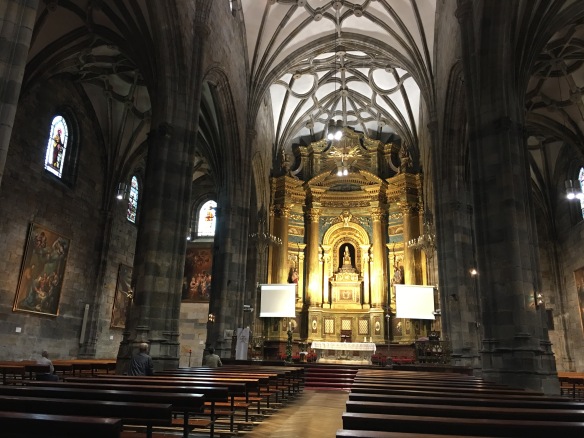
At the unplanned end to my Camino de Santiago pilgrimage last year, I sat in the large nave of the cathedral in Bilbao, Spain, reflecting on the disappointing turn of events. It is a spectacular fifteenth century build.

IMG_5352.jpg

As I looked around me in the silent, cavernous space, for a split second I experienced vertigo, not unlike you would in the old slanted room in the Ottawa Science Centre. Something was off.

Then I realized, I’d never before been in a church building whose floor was not sloped downward toward the altar, but upward!

IMG_5355.jpg

And what goes up must come down. The floor was slanting outward and downward toward the front doors and down into the city!

The story of David’s extravagant, energy-filled entrance up into the holy city didn’t finish at the holy of holies. Going up was completed by turning around at the apex to come back down. The story ends by David distributing food and gifts to not only his family and friends in the city, but “the whole multitude of Israel.”[8]Everyone is fed!

Worship and centering in God is followed by a necessary, gracious giving and going out into the world. I quote again the prophet Amos, where we started: “Let justice roll down like waters, and righteousness like an ever-flowing stream.”[9]

We don’t have slanted floors here. It’s more or less flat. Amos with his plumb line might be satisfied with the level of the floors. But what else could the architecture of our place of worship tell us about ourselves, our identity and God’s call for us?

IMG_6546

Could it be, sitting in room that is basically round that the obvious measure and geometric symbol is not the straight line, but the circle? And now, with larger windows surrounding us, windows which let more light in, also improve our imagination and connection with the world out there? Could it be, given the architecture of our faith here at Faith, we are now called not only to be drawn into the centre, the hub, of the circle who is Christ, but also be sent out in the centrifugal force of God’s Spirit?

In the last pages of the bible, the Book of Revelation, we read a vision of God’s magnificent future:

God’s future comes as an experience of God’s love, “flowing like a river from God’s throne, nourishing trees with leaves for the healing of the nations.”[10]This vision “pictures a world made whole, with people living in a beloved community, where no one is despised or forgotten, peace reigns, and the goodness of God’s creation is treasured and protected as a gift. Our faith is not a privatized expression of belief which keeps faith in Jesus contained in an individualized bubble and protects us from the world.

“Rather, we are on a spiritual journey in which we remain connected to the centre of the presence of God but whose love yearns to save and transform the world. We are called to be ‘in Christ’, which means we share – always imperfectly, and always in community with others – the call to be the embodiment of God’s love in the world.”[11]

In loving others by including them in the circle, we discover how much we are loved by God. We are the circle church. A porous, ever-expanding circle.


[1]Amos 7:7-9

[2]Romans 3:23; Romans 7:15-21

[3]2 Samuel 6:16

[4]2 Samuel 11

[5]Mark 6:14-29

[6]2 Samuel 6:12b

[7]2 Samuel 6:14

[8]2 Samuel 6:18-19

[9]Amos 5:24

[10]Revelation 22:1-2

[11]Richard Rohr’s Daily Meditation, Friday, July 13, 2018 (www.cac.org)

There’s a hole, PART 2: For a purpose

I am a hole in a flute / that the Christ’s breath moves through – / listen to this /music.            -Hafiz

If you comprehend it, it is not God. -St. Augustine

Unlike the pounding of the surf a stone’s toss away, the ponding on the nearby creek made the surface of its water look pristine. A narrow creek made its lazy, winding way down the escarpment from Highway 21 and aimed to run into Lake Huron after finally crossing the stretch of sand on the beach at Point Clarke.

One of our favourite pastimes on those lazy summer days was to play around the area where the creek and lake met. As children, my brother and I would build castles, dig trenches and re-direct the flow of the creek’s water.

For a real challenge, we would try to dam up the creek’s flow, which took some planning, and extra material like drift wood and larger stones to block any outflow attempts. Once we contained it, the creek turned slowly into a large pond, comfortably remaining – for the time being – behind its fortress sand walls.

I’ve already talked about how in God’s creation, it is meant to be that each of us has a hole in our heart (see “There’s a hole, PART 1: Meant to be”). Moreover, it is God’s good intention that this hole is there for a purpose.

Paul writes in his second letter to the Corinthian church a confession that in all his accomplishments for the expansion of the Gospel across the Mediterranean, he was given a thorn in his side.[1]The proverbial ‘hole’. It is not important, although many have tried, to figure out what this thorn actually was.

We don’t know. Maybe that’s the point. It’s not important that we know, only that this thorn was given him in order to keep him humble. The text says that the thorn was given Paul to keep him from being ‘elated’ – to keep his ego in check, perhaps because he tended toward being too full of himself, over confident in his own ability.

How does the ego get the better of yourself? What is your compulsion? What drives you to achieve some illusion of perfection in your life? So, you don’t need to trust what is beyond your life, what is ineffable, what cannot be fully understood that is the Great Mystery (a.k.a. God)?

Let me show you an example of compulsion to achieve that which is beyond our capacity: On my fishing trip with colleagues last May to Algonquin Park, we tried everything to beat the ice on the lake. Despite the predominance of the ice-covered lake, we tried desperately to fight the odds against us catching some fish even to the point of risking our safety to break up the ice ourselves in our canoes.

Screen Shot 2018-07-07 at 2.29.00 PM

Yup, that’s me. And, yup, you guessed it: We caught no fish. The irony is that on the last day of our camp out, the wind and the sun did its job. When we woke that last day, we looked over a lake completely free of the ice.

IMG_6940.JPG

Was God sending us a message? Weren’t we the butt end of some divine humour?

The hole in our heart has a divine purpose: To keep us from being too sure of ourselves, over-confident in our ability and our capacity to have it all figured out. If we didn’t have this hole, might we put all our trust in our own autonomy, our independence, to lead our life without any need at all to trust anyone else let alone God.

Beyond Paul in the New Testament, the stories in the bible are about God lessening, even stopping, the compulsive drive of main characters, so the wind of God’s Spirit could draw them more gently and more effectively (Gideon and Moses in the Hebrew Scriptures are good examples).[2]

In the Gospel reading for today, Jesus instructs his disciples in going into the world to do God’s mission, “to take nothing for their journey … no bread, no bag, no money in their belts; but to wear sandals and not to put on two tunics.”[3]

God’s consolation is simple yet profound: “My grace is sufficient for you, for power is made perfect in weakness,” God tells Paul.[4]The making perfect here is not about getting rid of that vulnerability. Rather, whatever weakness we bear stays with us in order for us to complete our purpose as human beings. We are made complete in God’s love because of our hole, thorn, weakness – not without it.

In one of Martin Luther’s famous works entitled, “The Bondage of the Will”, he emphatically declared that we, as humans, can never work out our own salvation for ourselves. We will continually fail, even when, or especially when, we believe we are doing good in the world.

While some might find this realization depressing – and it would be helpful to know why that is, for yourself – perhaps the “bondage of the will” can be freeing. Because we don’t need to be driven to inaction because we are afraid of making a mistake. We don’t need to get stuck in the mud under the fear of imperfection. As Christians, we can be free to do good work in the world, imperfectly, knowing that what we do is for the benefit of others and not for ourselves.[5]

Author Brian McLaren in his recent book: “The Great Spiritual Migration”, describes this time in history as a transition in the church from “organized religion” to “organizing religion.”[6]

A Church in the flow of God’s Spirit pertains not only to wind and water over the earth, but also to spiritual movement. To purpose and mission. To going where we need to go as a people. To re-focus again on loving God, self and others as the primal energy of the church. To bring to life once again the old verse: “They will know we are Christians by our love …” … and not by our buildings, property, and concern for security, certainty and self-preservation.

Can we let go of these things for the sake of God’s mission, for the sake of the Gospel of life and love in Christ? As the prophet Amos so well put it, using the water imagery: “Let justice role down like waters, and righteousness like an ever-flowing stream … “[7]

By the time we had finally engineered the dam on the tiny creek aiming towards Lake Huron, the sun was setting and we had to go home. Inevitably, the next morning one of three things would have happened in our absence:

Either the creek would have found the weak spot in the sandy fortress wall we built, and escape through a tiny crack; or, increasing wind conditions over Lake Huron overnight would have created larger waves whose surf reached and destroyed the walls of our dam; or, someone would have been walking along the beach and, for the fun of it, just poked a tiny hole to watch as a slow trickle quickly turned into a strong, flowing stream.

In each case, a small hole was required in order for the creek to fulfill its mission and reach its destination – despite all the efforts of playful human beings to keep it contained.

After all, nothing was going to stop the flow. God’s Spirit and purpose will flow on because and through the holes in our lives.

[1]2 Corinthians 12:7-10

[2]Richard Rohr, “Dancing Standing Still; Healing the World from a Place of Prayer” (New Jersey: Paulist Press, 2014), p.18.

[3]Mark 6:8-9

[4]2 Corinthians 12:9

[5]Ross Murray, Senior Director, GLAAD Media Institute, LinkedIn July 2018.

[6]Brian McLaren, “The Great Spiritual Migration: How the World’s largest Religion is Seeking a Better Way to be Christian” (Massachusetts: Convergent Books, 2017)

[7]Amos 5:24