Seeking kin-doms: a funeral sermon

Byron was born at the beginning of the Easter season in 1974, on Easter weekend in fact. Byron died on the last weekend of the Easter season in 2025. His life, from beginning to end was held and embraced in the life of the resurrected Jesus. 

At the beginning of the Easter season, the beginning of Byron’s life, it is about the promise fulfilled. After months of waiting and expecting, your baby is born. New life has arrived, upturning regular routines, upsetting comfortable sleep patterns and shocking the family into a new, delightful part of life.

But at the end of the Easter season, at this unbidden moment, when the one we’ve grown to love and know and see in the flesh, leaves us. This is the difficult time for the disciples of Jesus, who now that Jesus is resurrected will leave them. They will no longer see him in the flesh. What will they do without him? This crisis of faith hits them like a gut punch.

Byron’s sudden and unexpected loss hits us like a gut punch. And we may very well still be trying to get our breath back from the shock of it.

The Easter season frames Byron’s life both in the promise of life and in the loss of it. Every funeral service, arising from the pain of death, is an Easter service no matter what time of year.

Loss is part of life. In his lifetime, Byron’s favourite team, the Indianapolis Colts only one the Super Bowl once, in 2007 under Payten Manning’s quarterbacking. For all the years that Byron was faithful to his beloved team, he endured all those losses, year after year – except for that one.

Losses and death can dominate even in the season of Easter, except for that one Win. Hope and faith stay alive despite the losses. The hope of life still to come, against all the odds. The colour of Easter is white, the colour signifying life ongoing, life eternal.

Hockey and football, two of Byron’s passions, are seasonal sports. For the most part, they happen during a defined season of every year. But I think there is something deeper going on here.

Notice in both cases we are talking about team play, with others. Football, like hockey, is a team sport. In few other sports do the players need to connect intuitively with everyone else. The better a team connects that way, the greater chance they have to win. Football players will often talk about their team-mates as family.

Byron, at heart, valued kinship. He was dedicated to family and to the network of people that made up his life. He never missed a family gathering, at Christmas and at Easter. In fact, this past Easter weekend was the last time some of you saw Byron face-to-face.

When Jesus counselled his disciples, prepared them, for his departure, he promised them he would always be with them, in them, through the Holy Spirit. He promised them that they would not be alone, and that they would always have access to him in their hearts, and in the world (John 14).

How so?

“It is God’s pleasure,” Jesus says, “to give you the kingdom” (Luke 12:32). The phrase, “kingdom of God” is mentioned some eighty times in the New Testament. It is what Jesus says is the goal, purpose and aim of the Gospel – the good news. “Seek ye first the kingdom of God” (Matthew 6:33).

But kingdom doesn’t mean empire-building, evoking images of might-makes-right, power-seeking kings that we have witnessed throughout human history. To help us get the true gist of the word, biblical scholars are now suggesting the word kingdom should drop the ‘g’. In other words, wherever we see the word ‘kingdom’ in the New Testament what we should be reading is ‘kin-dom’ (Butler Bass, 2022).

The reign of Christ is really about our kinship with God, with creation, with one another and with ourselves. The reign of Christ is really about valuing relationships over things. For wherever your treasure is, there your heart is also. Whatever you value, your treasure, what is most important to you, your heart will follow suit.

Put another way, whatever you value, you pay more attention to. Whatever you pay attention to, you love.

Jesus says, “Seek ye first the kingdom of God” (Matthew 6:33). Which means, pay attention, draw your attention, to what is already in front of your eyes, to what you have in your relationships. There you will find love. And there, you will find Jesus.

Because it’s not that we don’t already have access to the kin(g)dom. It’s not that we don’t have it and we have to somehow acquire it, possess it. It’s God’s good pleasure to give us the kingdom. We already have it. It is God’s good pleasure to raise up before us the value of our relationships.

For Byron, despite the challenges he met, or maybe better yet through the challenges he faced he remained true to his values of supporting his children and valuing those relationships more than material things. He didn’t live to amass wealth and prestige. He didn’t live to accumulate material resources and build investment portfolios.

He lived for his family. It wasn’t a perfect kinship all round. Like for all of us, relationships aren’t easy. And sometimes we fail. Yet, in all his humility, simplicity, and yes even in his passion where he found his juice and motivation, underlying all of that was his commitment and dedication to his kin.

God will not stop expressing pleasure in giving us the kingdom, despite and perhaps more because of our tendency to slip up and fail. God takes pleasure in giving us the kin-dom, offering us relationships where love and grace abound.

Connecting to the life of Christ, we all live in relationship. May the kinship of God, as it did and does for Byron, surround us with grace and fill our lives with love, forever.

Reference:

Butler Bass, D. (2022). Freeing Jesus: Rediscovering Jesus as friend, teacher, savior, lord, way, and presence.Harper One.

Surprised by new life: a funeral sermon

Earla’s commitment to the altar guild attuned her to the seasons of the church year. The paraments and colours around the altar had to be changed when the seasons changed – from Christmas white to Epiphany green to Lenten purple to Easter white to Pentecost red, etc.

So, Earla would know we are now in Lent, and what that implied as far as the communion ware, flowers and colours that did or did not appear around the altar. She followed those rules, and advocated for them, faithfully.

And I broke a big one. Not intentionally. During a worship service I spilled half a bottle of communion wine on the new carpet in the chancel right after the renovations were completed 8 years ago. Earla, despite being a stickler for doing things right, showed me much compassion and grace. There wasn’t a hint of anger or frustration as she helped me clean up the mess behind the altar.

What strikes me in this season of Lent in which she spent her last days, are what the scriptures assigned to the church at this time reveal about God. Consistently the texts depict the disciples of Jesus and others gathered around a feast, a meal, at table. God’s message of love and grace in these texts are conveyed in, around and through eating and being at table for a meal:

The story of the fig tree (Luke 13:1-9) came to us the day after Earla died: Figs are mentioned a few times in the New Testament because figs were a staple food item in the Mediterranean – like potatoes are for us today. Then, last Sunday, the story of the Prodigal Son (Luke 15:1-3,11b-32) ends with the Father throwing a great feast with the fatted calf for the son that was lost but now was found.

And tomorrow in the Gospel (John 12:1-8) Jesus is anointed by Mary but not after we find the disciples gathered with Jesus’ friends Lazarus, Mary and Martha around a meal in their Bethany home. I hope you hear the reference to a meal in each of the first two verses from the Gospel:

1 Six days before the Passover Jesus came to Bethany, the home of Lazarus, whom he had raised from the dead. 2 There they gave a dinner for him. Martha served, and Lazarus was one of those at the table with him. 

Here these friends are gathered to eat together. But surprise! The Gospel emphasizes that Lazarus was there too. This is the Lazarus who died but whom Jesus raised from the dead (John 11). To show the reality of this new life, he is described as “one of those [eating] at the table.”

Lazarus is no ghost, no figment of whimsical imagination, no other-worldly vision flicking in and out of our line of sight. No. This is real flesh and blood, consuming and digesting the food everyone else is eating. God’s promise of new life comes by way of mealtime with friends and family.

Earla loved food. She loved her fish filets from McDonalds and hot fudge sundaes. She indulged in her bacon and processed foods. She was 95 years old! Eating was not only a personal pleasure but a reason to gather with others in the church. When she was able, I don’t think she missed a church potluck.

Like the Gospel which takes pains to convey the truth, the reality, of the resurrection – in this case, Lazarus – the promise of new life for us, new life in Christ, can encourage us on our life’s journey.

Because it isn’t over. Not for Earla. Not for us. Some things have certainly changed. Your grief bears witness to the fact that you will no longer relate to Earla in the ways that gave you much joy, that created wonderful memories and supported you in many different ways.

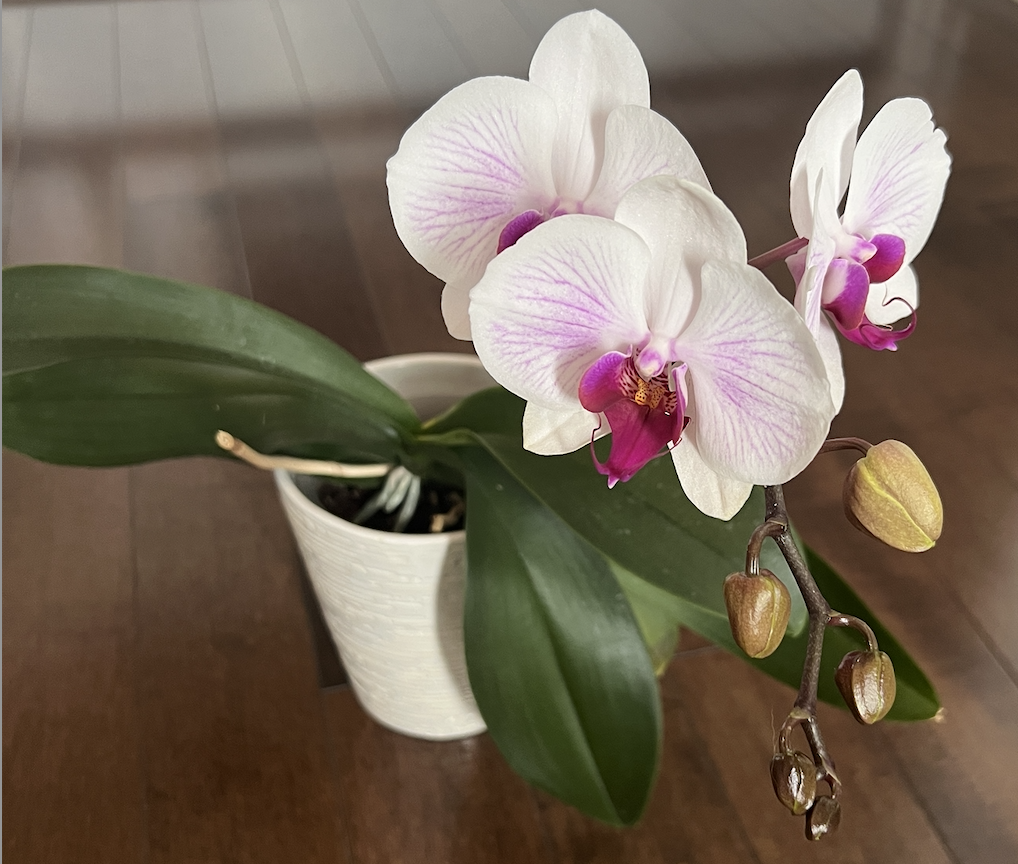
But while the relationship has now changed, it isn’t over. And there are abundant signs of this! Both the poinsettia given to Earla in hospital a year and a half ago, and the orchid plant that lay dormant for two years in Earla’s keep are reminders of the hope and promise of being surprised by the gift of new life.

After that first Christmas the poinsettia was all but destined for the compost pile. But it refused to wither and die. Contrary to anyone’s expectations, the leaves to this day have produced red leaves and remained healthy. It was one plant in Earla’s hospital room, on the windowsill, that drew our attention in amazement each time I visited.

And after two years of producing nothing, it was just this month that her tiny orchid plant decided to bring forth its majestic blooms. Who would have anticipated this?!

Their centre remains a violet/purply reminder of the journey of life on earth that will often include suffering and pain. But their frame dominates in Easter white – conveying the hopeful message of resurrection. And as you can see there are more buds to come! More surprises on the way!

Earla’s liturgical sensitivities are on display to this day as these plants from her continue to shout out that your beloved Earla sits today around the table. But now she sits at the banquet feast of heaven.

To welcome Earla at that heavenly feast, I am sure the heavenly hosts are serving it up in abundance: fish filets, bacon and hot fudge sundaes for everyone!

Love, in the book of life – a funeral sermon for losing someone you loved dearly

God’s love can’t be washed away (photo by Martin Malina, July 2018, Long Beach WS)

The ‘book of life’ is mentioned not only once in Revelation – this last book of the bible – but several times (3:5, 20:12, 20:15, 21:27), as well as in Philippians (4:3) and Exodus (32:32-33). The book of life is mentioned throughout the bible.

The book of life is an image that came to my mind after something you said to me recently that made me think about the length of the books we read.

Normally I don’t like reading big books with hundreds if not thousands of pages in it. I feel I don’t have time nor energy to plumb the depths and breadth of long books. I prefer short books, under a couple-hundred pages.

While a short book I can easily get a handle on, understand and keep track of all the characters, plot lines, and themes, there is one problem with short books. If it’s a good book, I don’t want it to end. When I reach the last page, I want more. So, it’s tough putting down a quick read that I really enjoyed.

Your beloved’s last words to you were, “I love you.” Indeed, you had a love story that ended too soon. In other words, the book was too short. And reading this love story, we all wanted more.

The thing about the book of life in the bible is that it is ongoing. People’s names are written in it. But it’s not closed, reserved only for the names of those who lived thousands of years ago. It is open, and names are continually added including, today, your loved one’s.

In the life of spirit, of faith, nothing ever ends. And while our flesh withers away on earth, our relations continue forever. While your relationship with your loved one changed at their death, it is not over. And therefore, your relationship with them is not lost. It has just changed. Their name, after all, is written in the book life, forever.

Your love story is not over. Another book in the series is being published. Part two. Because it is the book of life. Life and love never end.

Jesus said, “The hour has come for the Son of Man to be glorified. Very truly, I tell you, unless a grain of wheat falls into the earth and dies, the seed remains just a single grain; but if it dies, it bears much fruit.” (John 12:23-24)

Funeral sermon for an infant at Christmas

Let us pray. Heavenly God, you formed us in our mother’s womb and, in Jesus, welcomed children to come to you. Today we grieve the untimely end to a life that delighted you and us. Our hearts are torn, and we are burdened by our grief. Be with us as we walk this shadowed valley. Receive our tears. Hold space within us for hope’s return. Amen (All Creation Sings, 2020).

No words I can say will take the pain away. Our actions now must speak louder than any words. And what you are doing today, dear family, is showing up. And more than that you do an act of love, and an act of courage amidst this horrible loss. We are grieved, deeply saddened, our hearts are torn, as we prayed. Yet, you have given each other space and permission to feel what you must.

In this collective effort and in our humble actions today, we honour the life given to Leyla. We stake our ground, together today, and affirm that Leyla’s life made a difference in the world, and in the universe. Her life was a precious gift.

Recently I read (Coman, 2024) about a giant sycamore gap tree that enjoyed enormous popularity among visitors to Northumberland Park in England. This tree was used in many films. Because of its location it was a beautiful beacon and focal point in the park.

But in September 2023, the tree was felled in an act of vandalism. The outpouring of grief and anger was unprecedented, and a testament to the beauty and meaning it had offered many.

Was it over? Was this tree, that had offered such joy and beauty in the lives of many, no more?

In the following year seeds were harvested from the downed tree. Now, the seeds have grown to become saplings and are thriving. In a project called “Trees of Hope”, these tiny saplings from the felled tree are being given to people in prison, and many charities. In this way, the Sycamore Gap Tree will not only have its own offspring, but whose seeds are now being used for good.

When the tree came down, it wasn’t the end of it. It wasn’t over. And whatever is not over, is not lost. Never lost.

Dear family, you’ve experienced a seismic shift in your life these past weeks. The earth underneath you has opened up. And grief can sometimes feel like free-falling into the unknown abyss. It is true, life will never be the same again.

But when the ground shakes as in an earthquake, the trees shake. The pinecones fall to the ground. And the seeds within come out and are planted in the earth.

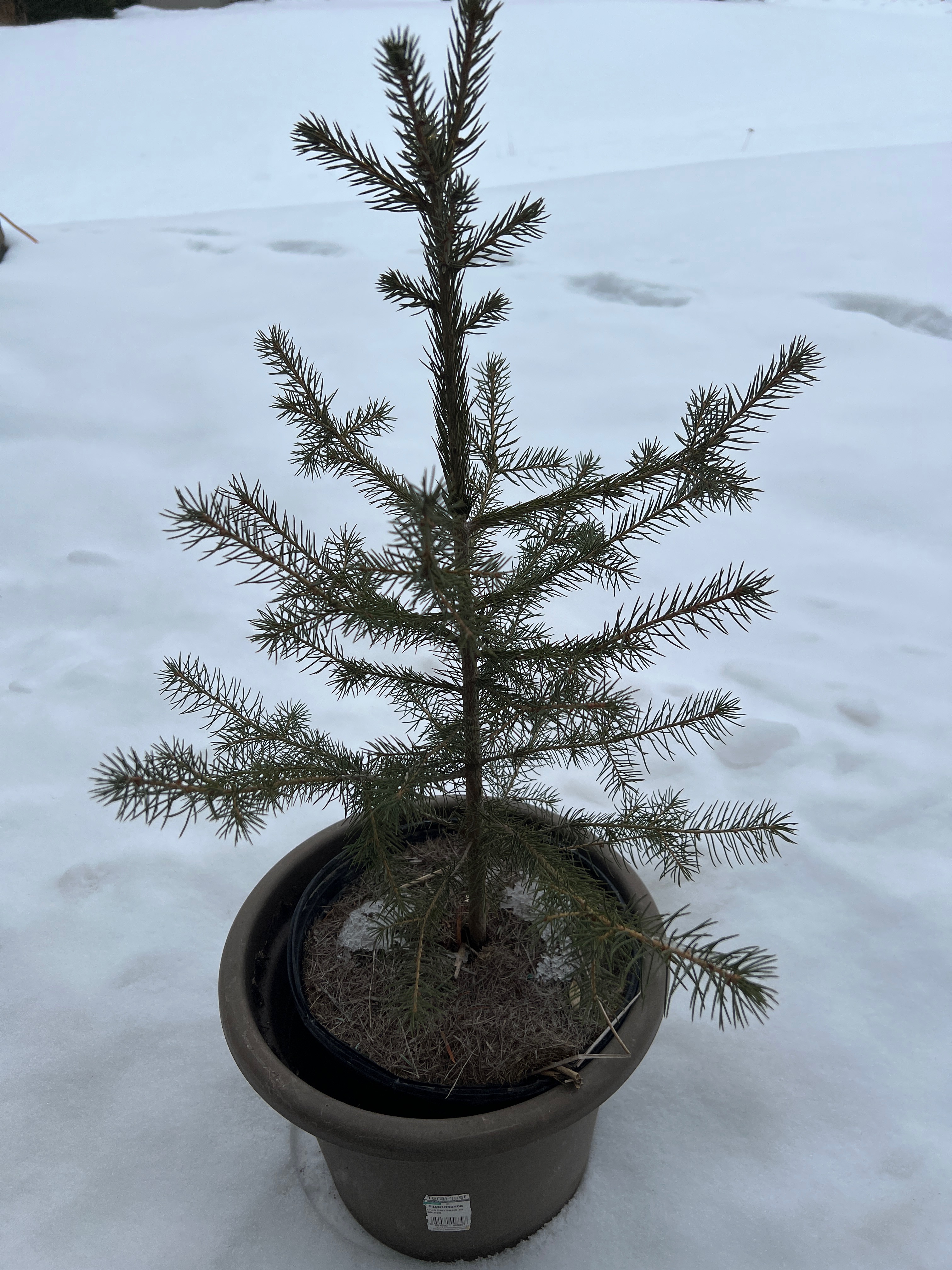
The Norway Spruce is common in Eastern Canada. One unique feature of this tree is its cones are the largest among all spruce varieties (Audubon, 2021). What does that mean? That means, lots and lots of seeds.

This sapling of Norway Spruce is now dormant for winter. It will need to be planted in the earth in the coming Spring. It needs lots of water, and it will grow. Perhaps during this wintertime, you can think of a place you’d like to plant it. In that simple act of planting a tree, there is this seed of hope that says maybe it’s not over; and because it’s not over, it’s not lost.

The cross of Christ, various legends have it, was made of varieties of wood ranging from dogwood to olive, to oak, to cypress. Whatever the blend or variety, the wood upon which Jesus died can be a sign and symbol of this close relationship between death and life. What dies finds a way to endure. What dies finds a way to live again. Our relationship with Leyla has changed, to be sure. But it isn’t over.

It is called the “tree of life”, both in the first book of the bible – Genesis (2:9) – and in the last book of the bible – Revelation (22:2). In the end, just as in the beginning, the tree of life promises that every ending marks a new beginning.

References:

All Creation Sings, Leaders Edition. (2020). Life passages and circumstances (p. 92) [adapted]. Augsburg Fortress.

Coman, S. (2024, December 9). Seeds of Hope: Day 8. Lutherans Connect. https://lcseedsofhope.blogspot.com/2024/12/day-8.html

National Audubon Society. (2021). Trees of North America. Knopf.

Love – the override button (a funeral sermon)

View over the Ottawa River at CFB Petawawa, August 2023 (photo by Martin Malina)

One thing Garfield loved to do was drive. When he still lived in Ottawa, he was determined to drive to bible study every Monday even in freezing rain. And as long as he was able, he drove.

In Petawawa, it was his precious cart that he scooted around in the neighbourhood off Laurentian Drive, sometimes pushing the limits of its speed. It’s as if he had a secret override button, that when he pressed it, it would give him just a bit more torque, a little more juice. I think he loved that.

We started the service today with a thanksgiving for baptism. Water.

At a wedding reception I attended last week, I sat beside someone who worked on cruise ships for almost twenty years. I asked him about what stood out in his memory, working on a boat sailing the world over.

He said what stuck out for him were those few times “Man overboard!” was called, those horrifying instances when it was believed someone had fallen into the water.

He told me about a time when a pop music group was celebrating New Years. Its lead singer was especially exuberant and tried to dance on the railing at the back of the ship. His body was never found.

The contrast struck my reflective cruise ship manager. On the one hand going on a cruise symbolizes vacation and fun and good times. Those “man overboard” occasions, on the other hand, were tragic events. How one extreme could exist so close alongside its opposite bewildered him. And me.

Indeed, being in the water can be dangerous business. On the one hand we dream and recite scripture about walking beside quiet and still waters (Psalm 23). Yet, sometimes those waters can get rough. Noah’s flood (Genesis) was not a dreamy Hallmark waterfall. More like the deadly flood waters that devastated Spanish towns in a few terrifying hours, a couple of weeks ago.

Getting into the water, we confront our fears. Getting into the water we become vulnerable. We know the dangers that lurk for humans who are not fish. We can even die, submerged under the water too long.

Waters, even baptismal waters, symbolize both peaceful religious experience as well as potential danger. Waters, even baptismal waters, take us out of our comfort zones as much as they bring comfort and joy.

We gave thanks for baptism at the beginning of this funeral service for Garfield. I want to tell you a baptism story from his life. For the longest time Garfield expressed his desire to renew and reaffirm his baptism. And when A put in the in ground pool at their home, Garfield spent a lot of time over the last couple of summers lounging in that pool.

And so, last July we all got into the pool. I could still see Garfield’s face. He wanted to do this, but I could see a bit of fear in his eyes. And before I could say anything, he had steeled his energy and dipped under. He had just pressed that secret override button.

This was a beautiful experience for me to witness. Garfield expressed his baptismal faith amidst the growing physical challenges he faced. Garfield’s baptismal faith was the marriage between water, will, and divine promise.

Later in the summer he went into the pool again. In those same waters he had an episode that triggered his recent hospitalization. Herein lies the paradox of faith, actually, between life and death. Two apparent extremes can co-exist on the same line at the same time. Both/And. Peaceful waters. Stormy waters. Same place.

In scripture we find many such paradoxes; In First John, between fear and love: “Love casts out fear” (1 John 4:18). When love casts out fear, it is not to eliminate it. It is to put it in its proper place. As long as we live on this earth, we will have fear. But love puts our fears in perspective, in the larger perspective. As Garfield did so often, we need to press the love-override button.

While I could already see some trepidation in Garfield’s eyes on the day he reaffirmed his baptism, what carried us through that experience was an overriding love.

He knew the love of God for him. He believed in the promise of God to be with him. Tears came to his eyes every time he spoke of God’s love for him. And, of course, by that I also mean the deep and committed love he felt from his so-called angels – P & A – who lived with him these last years and watched over his days.

When you enter their pool down steps into the water, you basically face the Ottawa River direction, and just over the trees in that direction are the Laurentian Hills. I like to think that even as Garfield descended into the waters, even as he faced both the joys of faith and the fears of being human, he was also literally facing the direction of the hills. No wonder one of his favourite verses from the bible is from Psalm 121: “I look to the hills from whence is my help to come?”

Love calls us to take the long view. I think that’s why Garfield often mentioned wanting to get in a helicopter to see Petawawa from above. Did he ever do that? (Well, he is doing it today!)

Because looking to the hills means lifting our gaze upward. It is the first thing we do when coming out of the waters. To open our mouths and gasp for air we have no choice but to look upwards, to the hills, to the horizon, to the heavens.

Indeed, we sail over the tempestuous sea of life. Our world is in storm mode – it may be on a personal level but also on national, and definitely global levels.

But Christ is on the ship with us. Jesus is in command – even when he seems to be asleep (Mark 4: 35-40). With the Psalmist we can declare, “He who keeps watch will neither slumber nor sleep” (Psalm 121:3).

Jesus watches us to protect us and keep us, no matter what storms we face, no matter how poor the prognosis is, no matter how uncertain the horizon looks, no matter how badly the waves threaten to wash us overboard. Jesus watches us because he loves us and sees us as we truly are. This is the baptismal promise.

Christ will stay on board with us until there are no more seas to sail. Jesus will guide our days and travel with us on the journey until we have climbed the mountain of our lives and reached its peak.

And then, the sky will be the limit. For Garfield, today, it is so.

Thanks be to God.

Glimmers of grace – a funeral sermon

This past summer, a friend of mine went overseas to participate in an archeological dig. From just the pictures she posted on Facebook I saw her donning a wide-brimmed sun hat and kneeling over carefully turned earth with trowel in hand. She was uncovering a mystery hidden from sight for thousands of years. 

I wonder what she uncovered – a fossil, a bone fragment, a sherd of pottery, a tool or utensil from a bygone age? Or, maybe, as I like to imagine, she was discovering a round, stone decal on which words or images were inscribed, carefully and meticulously sculpted. 

All these possibilities reveal a story, a narrative, of lives lived and cultures celebrated, lives and cultures far removed from our day and age.

Sometimes the truth of someone’s life is not easily accessible nor perceptible, at least from the surface. On the surface of things, we don’t get the complete picture. On top of that, no one can easily plumb the depths to uncover the totality and truth of one’s life buried deeply beneath the surface.

On the surface we conclude many things about what we see, good and bad. We may conclude it’s not worth digging beneath the surface. To uncover it all may be too much for us, even if we wanted to.

When God created Michael, God imprinted an aspect of the divine onto Michael life. Like a potter or sculptor, God fashioned Michael to reflect some unique manifestation of God’s self (Genesis 1:27).

Over the course of Michael’s life, the earth, the world, weighed down heavily on him – as it will onto all of us. Layer upon layer, year after year, the sediment collects and the dirt, sand, and roots which pack down over top the true manifestation of Michael’s life. 

How he positioned himself, responded to the weight of it all, had something to do with how deeply hidden his beauty and true self was hidden from us. Of course, other factors affected the course of his journey as well. But there is a deeper truth to behold in our contemplation of and thanksgiving today for Michael’s life.

Even when you who were closest to Michael struggled in loving him, God is like my archeology friend. God, on bended knee, is faithfully and persistently dedicated to uncovering the original work of God. There is a promise, after all, from scripture told by the prophet Isaiah: That God will never forget the work of God’s hands – “I have inscribed you,” God says, “on the palm of my hands” (49:15-16).

God has etched your being onto God’s own being. And so, God can never forget you, and will always remember each and every one of us no matter how deeply we are buried under the weight of the world.

And sometimes, as God continues to faithfully work at digging, uncovering, and chipping away the packed earth from our souls, we get a glimpse of what lies underneath. We catch a glimmer of grace.

Some of you witnessed moments, revelations, of what lay deep beneath the surface of Michael’s life just days before he died.

He hugged you. He told you he loved you. He held the words of the Lord’s Prayer close to his heart, and confessed this prayer warmed him when he was cold. Graciously, these revelations rose to the surface of his life for you to behold.

God will never stop, with each one of us, until life has gone full circle to the way it was in the beginning, so we can realize our true, unencumbered, unique self, beloved eternally by God. This is the promise of faith. 

Thanks be to God.

Heaven and earth – a funeral sermon

Strive first for the kingdom of heaven (Matthew 6:33)

Not long before she died, Bev shared with me a childhood memory: On her way to Sunday School with her brother, they ran across the yard and down the street. But alas! Dressed in her Sunday best, she tripped right into a puddle of mud, splattering her pretty dress. She didn’t end up going to Sunday School that morning, but the reason I think she remembered this incident was because of what happened next …. (I’ll tell you at the conclusion of the sermon!)

In her mind Bev strived for the higher ideal. In that sense, her vision was skyward, upward. Bev’s standard was golden. Her thinking, sharp. Her ideals cut to the chase. And there was no arguing.

Striving is about looking up. Almost every time Bev came to worship recently, she would take my arm at the door on the way out, and look me in the eye and say, “Psalm 121”. This is the Psalm she wanted read at her funeral, I think to represent her ideals. There’s this energy about looking up for help, far and away, to that high, transcendent point just beyond reach.

This section from the Psalms in which we find Psalm 121 is called the “psalms of ascent” reflecting the inspiration of the song writers singing their way up the path toward the city of Jerusalem. Coming up the path you couldn’t help but look up at the magnificent gates entering the city. “I look to the hills from where is my help to come? My help comes from the Lord who made heaven and earth…”

Heaven and earth. Heaven is for striving and looking up. Heavenward represents our deeply felt longings and aspirations not yet fulfilled. Striving for the goal, the destination, where upon the mountaintop in that beautiful imagery from the prophet, the Lord will make a feast for all, and death will be no more (Isaiah 25).

But the Psalmist doesn’t stop at heaven. “My help comes from the Lord who made heaven and earth.

The downside of only looking upward is that we will trip and fall when things get messy on the ground. Looking downward from time to time is part of the journey of faith, maybe a part we want to avoid, deny and skip over all together. But looking downward is the only way forward in faith.

When my family first moved into our newly constructed house over eleven years ago, it was at the time only roughed in for central vacuum. During coffee after worship one Sunday I happened to mention I was on the lookout for what kind of central vac system to install. And Beverley Milton was first up to give her advice. “Go with Kanata Vacuum, it’s just around the corner from my place, and they’re good,” was all she said. All she needed to say.

You see, when she first moved into her house over thirty years ago, she installed floor-to-floor carpeting. Fast forward to a couple of months ago: When the new owners bought her house, that very same carpet was in such good shape they did not need nor intend to replace it. Bev’s advice was golden. Every time I vacuum at home, especially in the last couple of months, I think of Bev and give thanks.

The last time I was in Bev’s house was in the Fall last year when family gathered around her dining room table – Leslie and Bev, Susan, Scott and Marilyn, Lauren and Colin – for a delightful meal and spirited discussion. But in order to eat, to receive the good gifts of the earth, what do have to do? Well, we need to look down, from time to time.

Lord, you have put all things under their feet (Psalm 8), the Psalmist also says.

While heaven is for striving and looking up, earth is for looking down and gathering in the gifts of the moment in real time. One of Bev’s favourite sayings was: Yesterday is history, tomorrow is mystery, today is a gift; that is why it is called the present. God is, after all, the maker of it all, of heaven and earth.

Your family gathered around that dining room every Sunday for decades. It’s a mealtime table memory I am sure you will cherish forever. Ever thankful, ever grateful, we look down to see where we are planted, where we find our place in this world. And being grateful, even if only in our memory, gives us peace, too.

That table sat on the carpet, don’t forget. Most of the time we don’t think about it, don’t notice where we are walking or sitting. We aren’t looking down at it but it’s there, holding us, grounding us, embracing us, literally. And when we do take the time to stop and look, we might notice the quality and durability of it. And give thanks.

It’s a matter of perspective, of course. I am captivated by a photo taken from a commercial airliner flying over Mount Everest, the tallest mountain in the world. From on high, the mountaintop does not look as daunting. From on high, everything is seen from a larger perspective.

from Astronomical Discoveries (@deAstronomical1) on X-Twitter

Today, Bev doesn’t need to strive in her mind anymore. Her perspective in communion with God holds it all, the big picture. She doesn’t need any more to toil on the ground reaching upward and yearning for some transcendent place far up and away. Now she can look down and smile at all the good gifts on earth each one of us can still enjoy. If we will but stop and take notice.

It’s appropriate we celebrate Bev’s life today, in the neighbourhood in which she spent many years as a child growing up, in “Little Germania”, I hear the New Edinburgh area was called. In this neighbourhood over 90 years later we gather to remember her life that started in this place where she went to Sunday School, played with friends and attended school. Close to the ground. It started here. She’s come full circle. But it doesn’t end here, for her and for us.

May God bless us on our journeys of striving, of yearning, of looking upward. May we also cherish those moments when we can look down and around, even if it’s sometimes messy and maybe not quite so perfect here, to see the gifts of the earth nourishing our souls every day.

By the way, that childhood memory didn’t end with her looking down at her spotted, mud-splattered Sunday dress. It ended with her turning around and running home straight into the loving arms and embrace of her mother, who told her, it was alright.

Amen.

He gave it all: a funeral sermon

Rolf Meier (1932-2023)

1 My God, my God, why have you forsaken me?
   Why are you so far from helping me, from the words of my groaning?
2 O my God, I cry by day, but you do not answer;
   and by night, but find no rest.

3 Yet you are holy,
   enthroned on the praises of Israel.
4 In you our ancestors trusted;
   they trusted, and you delivered them.
5 To you they cried, and were saved;
   in you they trusted, and were not put to shame …

29 To him, indeed, shall all who sleep in the earth bow down;
   before him shall bow all who go down to the dust,
   and I shall live for him.
30 Posterity will serve him;
   future generations will be told about the Lord,
31 and proclaim his deliverance to a people yet unborn,
   saying that he has done it.

Last week there was a resurrection, of a kind.

The famed “men’s breakfast” at Faith Lutheran Church resumed after the pandemic had shut it down. Nearly a dozen of us from the church gathered in the same place that had been the venue for the monthly breakfast for years. We even sat in the same part of the restaurant. I couldn’t help but think of some of the guys who used to attend who for whatever reason weren’t or couldn’t be there this time.

Rolf was one of them.

Eating is what we do as humans. Perhaps that is why Jesus in his resurrection appearance to his disciples made it a point to eat “broiled fish” (Luke 24:36-42) right in front of them. He wanted to show that his resurrection did not deny the value of our humanity as people of faith.

Embracing our humanity makes all the difference in understanding God’s love for us. God doesn’t love us because we are spiritual or have achieved enlightenment in some esoteric way. God loves us just as we are because God is good!

The glory of God, Saint Irenaeus of Lyons (135-202) wrote, is the living human. We don’t experience God or get closer to God by being more spiritual, but by being more human. God comes near to us when we accept and embrace all of who we are including our human frailty, imperfections as well as all the good things that emerge from our true humanity.

Whenever we gather for prayer and worship, we give it all to God. Not just the polished, nice parts. Not just the parts we want to show off and impress others with.

Someone told me a story about what Rolf did years ago, before I came to Faith Lutheran, on a Maundy Thursday during Holy Week. The focus of the service was the suffering of Christ. And it is tradition on Maundy Thursday to read Psalm 22 which Jesus cited from the cross before he died. The words spoken by Jesus are recorded in the Gospel: “My God, my God, why have you forsaken me?” (Mark 15:34)

But on that Maundy Thursday, for whatever reason, the person assigned to read Psalm 22 did not show up. The pastor at the time quickly looked for someone else to read it. At the last minute, Rolf, who was there as an usher, agreed.

But what really shocked someone there was how Rolf read it. At first, they wondered who it was. Because Rolf punched out the words in as loud a voice as he could muster: “My God! My God! Why have you forsaken me?” – with full dramatic effect.

Rolf gave it all. In that moment Rolf lived into the full range of his emotions, giving it all to God. And what Rolf showed in that moment, I believe, was an energy he did not often show to others, especially in the church.

You see, in the community Rolf preferred to work behind the scenes. He didn’t want to be the centre of attention. He probably only agreed to read Psalm 22 that night because on Maundy Thursday that Psalm is read from the back of the church while the altar is being stripped.

In responding to the call to read Psalm 22, Rolf perhaps had to step out of his comfort zone. But in doing so, he revealed his inner strength and truth. And conveyed the truth of the Gospel in so doing.

Jesus’ humanity was exposed on the cross, to be sure. Psalm 22 begins in lament. But it doesn’t end there. It continues into glory, as a celebration of trust and faith in the midst of agony and even death. “I shall live for him,” concludes the Psalmist. It is possible that a time of deepest abandonment can open within us feelings of peace, trust and even thanksgiving.

Rolf may not have been physically present with us at the breakfast last week. But every time the church gathers around food and drink, at the sacrament or whenever you, dear family and friends, gather for a regular meal in a restaurant or at home, we can celebrate Rolf’s life with us and around the eternal banquet feast of heaven. Thanks be to God.

Did the music end? A funeral sermon

Leslie loved good music. My wife Jessica and I bumped into Leslie and Bev at the NAC two years ago for a performance of The Messiah just before Christmas.

In the foyer before the concert began, we talked about what we liked about this famous oratory. One of the things I love about The Messiah, and baroque music in general, is the clear sense of timing, and how rhythm is employed to express various emotions and to move the story the music is telling forward.

Handel composed The Messiah in just three weeks, from August 22nd to September 14th in 1741. The timing on his brilliant composition is miraculous. How could any human being, even gifted as Handel was, complete such an epic work in just a few short weeks?

His accomplishment is an apt metaphor of the parable of the mustard seed from the Gospel today.[1] That tiny seed of a three-week period Handel needed to compose The Messiah grew exponentially to inspire the faith of countless subsequent generations and centuries.

Timing is the essence of music. Timing is the space between the notes, it is how quickly or how slowly the music is played, it is the length of the entire masterpiece. Reba McEntire wrote her song on the idea of a seven-minute time frame of meaning. Timing is critical to what God creates, and what we can do to measure the length and growth from a seed to a large tree where every bird eventually finds a home.

Leslie’s connection to worship, I sense, was grounded in the hymns we sang. Last year, we petitioned congregation members to submit their favourite hymns. And we would then include those chosen hymns in future worship services. In total, there were about sixty or so hymns the congregation submitted. Who do you think submitted by far the most, more than half of all the submissions?

Lutherans sing hymns; that’s an important part of Leslie’s Lutheran identity.

Luther’s Rose is a symbol of the Lutheran faith. Martin Luther designed each of the symbols on the Luther Rose to signify something important in Lutheran faith. Of course, Leslie loved flowers, gardening, and especially the rose. Roses were her favourite flower.

The heart is at the centre of Luther’s Rose. And the heart is associated with the love of God for us. Now the colour of the rose here is white. And white symbolizes eternal friendship and love.

In Luther’s rose the white rose petals which surround the heart also point to the realm of spirit and angels. So, the compassion of God has eternal implications. The love of Jesus points us along a journey towards the horizon, the ending of which we cannot yet see.

Along this journey of life, whether short or long, whether marked by quick, staccato notes or long, sweeping crescendos, we always hold the mustard seed in our hands and our hearts. No matter how far we are on this journey, despite the storms we encounter along the way, the smallest seed continues to hold the truth and promise of a vision of God’s eternal love, God’s never-ending compassion.

No matter what we do, or don’t do – that seed can’t get any smaller. But it can grow. In fact, it is the only thing it can do. It can only grow.

I pray Leslie’s witness of faith, during her life and to her dying moment, can encourage us not to give up on the journey. But to carry on as far as we will go. And, knowing that in the end, no matter what we have done or left undone, there is always room in the garden, at the table, in the tree—whatever metaphor works—there is a home for you and us all.

Most people love the Hallelujah Chorus in The Messiah—and I can understand why. It is beautiful. But my favourite piece is the last one—”Worthy is the Lamb, Amen.”

Jessica and I attended another concert of The Messiah several years ago at Dominion Chalmers United Church where the orchestra did something with that last piece that I had never heard before. You see, there are rest breaks in the music. Rests are beats where nothing is played—all instruments remain silent through however many rests they need to count before playing again.

Normally, just before the last series of “Amens” is sung, there is a rest, a pause, before the final crescendo is sung to the glorious climax of The Messiah.

But this time, the conductor held the rest for at least double its time. Initially, I wondered if they were finished. The music wasn’t playing at all, and we were left waiting for a long time. Was the music finished? Did the concert just end? Was it over?

But the conductor held his arms in the air during the long pause. And held them. And held them. The air was electric. The silence was charged with anticipation. We held our breaths.

Needless to say, the music wasn’t over. The extended length of silence only served to heighten the satisfying, climatic conclusion of the music.

Did the music end when Leslie died? There is definitely a long pause. It feels like the music ended and may, likely, for a long time to come. But music is about timing. And, my friends, the music is not over just because we can’t hear it right now.

The music of Leslie’s life will never end. It’s just being played in a different realm, and on a different frequency. And we will all tune in eventually. We will all find a place in that massive tree where every one of God’s creatures finds a home, for ever. To join in the never-ending song … “Amen!”


[1] Luke 13:18-19; read also Ecclesiastes 3

Turning the calendar – a funeral sermon for December times

It’s not the best time of year to have to bury a loved one. Christmas is already laden with so many emotions that to add another layer of fresh grief can be overwhelming.

It’s not the best time. But, then again, it’s never the right time, or a good time, to do this. Is it? Death always comes unbidden. Even as beloved GG lived under the threat of this day for many years now suffering as she did, her passing this last Sunday still jars us out of a sense of how we would live our lives.

It’s never a good time.

And yet, there are moments that remind us that there is meaning in some of it. Sometimes, there is a convergence in time and place that first surprises us. And then, if we let it, its message can sink deep into our hearts and actually give us hope.

I’ve already reminded the congregation of GG’s gift to the church years ago of our beautiful Advent Wreath. Year after year in the season of Advent—the four weeks leading up to Christmas—the large circular wreath is hauled up on guy wires and hung in place from the ceiling of the sanctuary. Its candles, shining over the congregation, have lighted our steady journey towards Christmas for many years.

Each Sunday before Christmas has a word associated with it, to help us on the journey. The four words are, in order: hope, peace, joy and love. These words describe the experience of living in faith and waiting for the coming of Jesus.

In a broader sense, the Advent calendars and wreaths with their intentional pacing and pausing on the way to Christmas build resilience in our spirit for living in these challenging and difficult times. Because to live well, we need hope, peace, joy and love in our lives.

This past Sunday is traditionally called “Gaudete” Sunday, from the Latin, “Rejoice”. On some wreaths, while the rest of the candles are all purple or blue the third candle, to signify joy, is coloured pink.

The third candle, the ‘Joy’ candle, on GG’s wreath was lighted during worship Sunday morning just moments after she died. Now, if that’s not a meaningful convergence in time and place, I don’t know what is.

Moreover, the month of the year—December—in which she died was also the month of the year she was born. And, December was the month when she first set foot in Canada after arriving from Germany a young woman full of life and ready to turn the calendar on a new year, a new beginning, and always ready for adventure.

The timing may not be the best for doing what we are doing today. But, in another sense, the timing couldn’t be better. Former Czech president and writer, Václav Havel, once gave a definition of hope that resonates with me. He wrote, “Hope is not the conviction that something will turn out well, but the certainty that something makes sense, regardless of how it turns out.”

So, it’s not about whether what happens turns out exactly the way we’ve envisioned it or want it to be. It’s not about my desires or preferred outcomes. That’s not hope. In this season and in these days before Christmas as the world watches and waits for something better, maybe we can lean on those moments of wonderful convergence, and trust that in the end, God’s timing is the best for us all.

From this point in time forward, the light will get brighter. The wreath will shed its full complement of light in the coming days, even as we still gather in darkness for Christmas Eve celebrations. But today we gather on the first day after the longest night of the year. From this point forward, the days will slowly but surely get longer and brighter.

That was GG’s hope and joy. And it is ours.

Amen.