
New Year’s Goals

It seems to me that so much “success” in our lives is based on setting goals. We set goals in our business ventures; we set goals for our personal self-care — exercise, diet and relationships; we set goals for acquiring the toys and things we want in life. Setting goals motivates us to act!

A person who does not have any goals, we believe, is a person without backbone, floating untethered through life, unprincipled, and usually lazy and poor. A person without any goals, we believe, is rudderless and not making the most of what life can offer. A person without any goals, we believe, are the very people who end up in therapy, counselling, or on the street. They just need to get their life back on track by setting some goals, we believe.

There are some traditions of this time of year that stand out for me. Making New Year’s resolutions is one of them. And I like to ponder what this means, because I need to get back on track with so many things — year after year! And since I do a lot of driving, I like what blogger Jeff Boss has to say about New Year’s resolutions:

“New Year’s resolutions are like traffic. As the driver, your focus is intent while trying to ‘get there;’ you see others pass you by; you get held up at a red light that slows down progress. Distractions such as the radio, crazy drivers, cellphones, preclude you from focusing on the one thing you should: the road ahead. In other words, New Year’s resolutions come and go, ebb and flow, only to be revisited the following year …

“It has been said that the only certainty in life is uncertainty; change is the one ‘thing’ we can all count on to always be there—and that guy Murphy always seems to be leading the charge.” (Jeff Boss, contributor, “4 Simple Goal-Setting Ideas for 2015”, Forbes http://buff.ly/1A6rx47)

As important as goal-setting is, we also have somehow to account for the unexpected, on-the-ground realities that come our way on the journey towards that goal.

What will we do when we encounter those who ‘pass us by’ on the road? What will we do when we have to ‘stop at a red light’? And, what will we do when we are distracted from our goals?

First, what do you do when you see others pass you by on the road of life and faith? Our culture is based on the value of competition — whether we’re talking about sibling rivalry, sports or our economy. Competition can be a motivator.

But it can also deflate one’s spirit, creativity and passion. Because competition can discourage you from focusing on the grace in your unique life, the gifts of your own life, family, job, and the blessing you are to others. You are beloved by God, created in the image of the Divine, endowed with a special gift to share with the world.

And it doesn’t matter that someone is passing you on the road; it doesn’t matter what other people are doing. It only matters what you are doing. How has our cultural obsession with competition and comparison stifled your growth and held you back?

Second, what do you do when you get held up at a red light that slows down progress? The red lights in our lives are usually those unfortunate events that are unexpected, stressful and require the loving support of others. No amount of goal setting can turn this around: a family member suddenly turns ill, you receive a discouraging diagnosis, a friend dies, tragedy strikes, the bottom falls out on your personal life, you lose your job. If you’ve set some lofty goals before any of this happens, you’re into a major reset on life. After all, “Life happens,” they say.

Finally, what do you do when you are distracted by the radio, crazy drivers, or your cellphone? These are issues we probably have the most control over, whether we like it or not, whether we take responsibility for them or not.

Most of the ‘distractions’ of life are self-imposed. We do it unto ourselves — lifestyle choices that are really counter-productive, habits that immediately gratify but are ultimately self-destructive. We enter here the realm of addictive behaviours that can de-rail any idealistic goals for self-improvement. So, they say, instead of watching that show, go for a walk; instead of staying up late on social media or surfing the net, get some sleep; instead of indulging in that second helping, pack away leftovers for lunch the next day.

This inner struggle can drive us over the curb and into the ditch! The passers-by, the red lights and the distractions on the road of life throughout the year often cause us to abandon those goals altogether.

I wonder what some of those first desert wanderers did to cope with the reality of the terrain over which they travelled. I wonder how the Magi (Matthew 2:1-12) following a star in the sky, coped with seeing others pass them by on the caravan routes whenever the star appeared to stop in the sky? I wonder how the Magi, following that star over what must have been a long period of time, dealt with the red lights of set backs that surely must have occurred on the trail? I wonder how the Magi kept their spirits up when the desert creatures, sand storms and bandits threatened their safety and resolve on the journey? I wonder what would have happened if they said, “Let’s just give this until January 11th, or December 21, or December 31 at midnight — and if that star hasn’t brought us to the Christ-child by then, let’s go home!”?

Perhaps the wisdom of the ancient story of the Epiphany has something to say to us about how we traverse the terrain of our lives today. As we set goals and resolve to do certain things in 2015, perhaps it would be wise to pay attention to how we travel over the long haul of our lives, and not just fixate on the specific goals themselves.

Will we pause regularly on the side of the road — not just at Christmas and Easter — to worship, pray and give thanks? Will we pause regularly on the side of the road — not just when times are good, but especially when they are bad — to reflect on the Word and the meaning of our faith in Jesus? Will we pause regularly on the side of the road — regardless of our ‘goals’ — to remember the One who walks with us, who is always by our side, who is ever faithful to us and steadfast in love for the whole world?

And thank God, that we always have a second chance to press the ‘reset button’ on our lives, reflect again, and start anew! Year after year! It is a miracle and grace that we even consider a fresh brand of New Year’s resolutions every January 1st. Despite the failures, we still go back to the drawing board every New Year.

In 2015, perhaps our goals need to be a little more open-ended and less prescriptive. The magi had a goal, to be sure: to follow the star to where the newborn king was born. But that goal could lead them anywhere! They didn’t presume it had to be Jerusalem. They didn’t presume it had to be in a palace. They didn’t presume it had to be in their own home country.

When the goals are set with this kind of openness, Murphy may still lead the charge, uncertainty can still be the only certain thing, and change be the only constant on the journey of life. But we still trust that God’s promises are true and that eventually our yearning and longings are resolved somewhere in God’s unconditional, and never-ending love.

Happy New Year!
Bane and Blessing

In the popular Brothers Grimm fairy tale, “Rapunzel”, that was in recent years adapted for the big screen in the movie “Tangled”, the main character, Rapunzel, has extremely long hair. This is her gift, it would appear.

But the evil witch has locked her in a room at the top of a tall tower without any entrance or exit except a window near the top. The witch and the prince climb up to the room where Rapunzel lives, by calling for Rapunzel to let down her long hair; they use her hair like a rope ladder.

But Rapunzel never uses her gift of long hair to free herself from her entrapment. While others recognized the gift she had, for better or for worse, why couldn’t she just cut off her own hair? Why could Rapunzel not use her gift, especially if it meant freedom? She had what she needed to be free!

Was it her strong emotional attachment to her hair that prevented her from living life truly, freely? If only she could let go and surrender that which was most precious to her….

In the famous Beatitudes, Jesus described the ‘blessedness’ of those in the kingdom of God. How can we understand this ‘blessing’? This Sermon on the Mount does not read like a self-help manual for the successful, in the twenty-first century. There is something counter-cultural going on here; something paradoxical, even radical.

It seems to suggest to me that to be followers of Christ we must also be able to see in ourselves what we see in others: the bane and the blessing, the good and bad, both/and. It is, on the one hand, to recognize the sinner in ourselves, and to forgive – let go, surrender – ourselves of that sin. And not let it rule us.

To recognize, embrace and confess the poverty of spirit within us.

To explore and acknowledge places of grief and loss in our own lives.

To practice humility with others, a stance that recognizes God as the “source of our life” (1 Cor 1:30).

To identify and name our own hungers, longings and thirst for righteousness.

To be merciful unto ourselves, to begin with.

To search after the purity of our own heart.

To share the gift of peace that is within us.

And to endure the persecution and suffering we all encounter in whatever form, for Christ’s sake.

It’s easy to point the finger, and see it in others, and preserve our own sense of self. It’s easy to do nothing and ‘wait’ for someone to come and save you from your problems (like Rapunzel), without noticing the resources you have yourself to do the right thing, even it means starting by confessing your own sin.

The Gospel of Jesus, while being simple is not easy. Therefore, we need not shy away from seeking after the ‘blessing’ of God upon our lives in our honest, simple, vulnerable selves. We need not hold back from coming to God in all our sinfulness, because God won’t hold back his love to us.

“Consider your own call …: not many of you were wise by human standards, not many were powerful, not many were of noble birth. But God chose what is foolish in the world to shame the wise; God chose what is weak in the world to shame the strong. God chose what is low and despised in the world, things that are not…” Paul writes (1 Cor 1:26-28).

Spiritual greats over the centuries have recognized this truth of God. St Augustine says, “In my deepest wound I see your glory and it dazzles me.” Julian of Norwich put it, “God sees the wounds, and sees them not as scars but as honors … God does not blame us for them.” Paul wrote elsewhere, defining God as one “who creates life out of death and calls into being what does not exist” (Romans 4:17).

On the cross, Jesus reconciled all these divisions in himself (Ephesians 2:10). It was, and is, the pattern of his life with us, as the Scriptures testify: Jesus himself was crucified between a good thief and a bad thief, hanging between heaven and earth, holding on to both his divinity and humanity, expelled as a problem for both religion and state.

His dying – his absolute letting go – upended any religious program that said, ‘You need to earn your worth and favour with God.’ Letting go is the nature of all true spirituality. Letting go is the nature of any genuine reconciliation. Letting go is the engine of meaningful and lasting transformation. And these are all, admittedly, a mystery – a paradox.

For Rapunzel, we cannot blame her for being attached to her hair; after all, it was a gift. Why would she want to cut it off – for any reason? Why would she want to give that up? It was such a deep part of her identity.

When we see Jesus on the cross, we see that our faith is about being ‘attached’ in love. Jesus instructs his followers in the Golden Rule to “love your neighbour as yourself” (Matthew 22:39, Mark 12:31, Luke 10:27).

But there’s a price, a cost, to pay for it. When you love someone, and act out of love for them, there is always the risk of pain and we will suffer for it. If we love, we give ourselves to feel the pain of the world. Love will simply lead us to the cross.

Sometimes the worst possible circumstances in our lives turn out to be the greatest gift – and vice versa. Because our greatest gift can be the source of our downfall; or, at very least, keep us from become the people God called us to be. Yet, it is in the collision and letting go of these opposites, where the blessing is realized.

Listen to the witness of a Catholic priest who visited the Philippines:

“I saw so many shining eyes in the Philippines, yet these are souls who have been eaten up and spit out by life. The Filipinos are a people with so little. I celebrated a Sunday Mass in a squatter’s camp. Shacks all around. Yet they were so excited that ‘Fodder’ was coming. The kids met me to lead me into the barrio. Out of these shacks came kids in perfectly clean clothes. I don’t know how the mothers kept them so clean. They were all dressed up for Sunday Mass. The boys all got their guitars, and it was the big event of the week. They have something we have lost.

“I felt like telling them, ‘You live in a dump by our standards, but do you know what you have? You’re not cynical like we are. You’re all smiling. Why should you be smiling? You don’t have any reason to smile. You live in a shack! It smells like garbage. But you have father and mother and clear, simple identity.’”

Then, this priest confesses: “I don’t know who trained them to do this, but you constantly feel your hand taken by the little Filipino children. They take your hand and put it to their head. They don’t ask you to bless them. They take it from you. It made me weep. For they have their souls yet! They have light, they have hope. The little children call you ‘Fodder, Fodder,’ and I think when they pull blessings out of you, blessings really come forth.

“They are ready for the blessing. They believe in the blessing, and you are not really sure if it was there until they saw it, expected it, and demanded it. These are the blessed of the earth,” he concludes.

These are ones who don’t need to be taught the faith. They live it. They live the mystery of life and death, blessing and loss. They’re okay with paradox, even if they can’t articulate it as such. They don’t need everything explained to them. They just love. And bless. And are blessed.

They, indeed, have the light of Christ. And they know it, deep down, in their souls.

Apart from the reference to Rapunzel and the film, Tangled, most of this reflection is adapted from Chapter 6, “Return to the Sacred” in Richard Rohr’s book, “Everything Belongs”

When the gift seems strange

Because of the nature of my work, I cannot travel, like many Canadians do, to warmer climes during the holidays. I confess having fantasized celebrating Christmas Day or Easter morning in the tropics.

I imagine watching a sunrise over the liquid horizon, feeling the warm ocean breezes on my sun-bronzed skin and hearing the crackle of palm leaves above me. I squish my toes into the still-cool pristine sands beneath me and breathe in the salty air. I turn to those sharing the scene beside me, and say: “Merry Christmas”. And we burst into singing together, over the thunder of the crashing surf nearby, “Silent Night, Holy Night”.

I have to confess, I would like to experience this one day. I’m putting it on my bucket list. But I wonder: Will I then miss the typical experience of us northerners who are familiar with a winter setting for the celebration of these holy events? Will I feel I have missed something integral to the experience of a Christmas celebration without the frigid temperatures and snow-laden environs?

Those of you who have experienced a Christmas in a setting that is totally foreign to our typical Canadian winter climate, I’m interested in hearing from you. How did you feel? What did you think? Would you do it again?

As I reflect on our time-worn traditions, I confess how often I put so much emphasis on the ‘window dressing’ of the event, as if what makes the experience enjoyable for me depends on decisions I make or on how much I can control the circumstances. However, in all truth, achieving that ‘picture perfect’ Christmas depends in large part on forces beyond my control; for example, the weather. So, I am caught in-between pretending I can manage an ideal experience whose outcome is ultimately beyond my control.

The real question, therefore, is: How can I receive the gift of Christmas despite the circumstances of my life?

After the worship, we are holding our now annual ‘Epiphany potluck lunch’. Considering the origin of this church tradition, we are practising the spiritual discipline of receiving a gift, unexpectedly. Some of the first potluck meals in North America were held in 1843 at St Paul’s Church in Chicago, which served a large wave of German immigrants swelling Chicago. They held regular potlucks — communal meals where guests brought their own food (from a paper written by Daniel Sack on the social meaning of church socials).

But the original practice was in the spirit of spontaneity. The food was provided for an unexpected guest, but according to the ‘luck of the pot’. There was little or no control over what kinds of food people brought. Yet, attendees rejoiced in whatever they received, however mismatched or unbalanced the contents of meal ended up being. It was, after all, a gift.

In the Christmas story called “The Fussy Angel” which I read in worship on Christmas Eve, the angel assigned by God to look over the Christ child on the night of his birth was frustrated with the imperfect, out of control, events surrounding the Holy Birth.

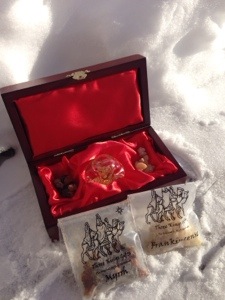
He chastised the Wise Men for their pricey and pretty yet wholly impractical and useless gifts. “If you were truly wise,” griped the angel, “you would have known that what we need is hot water and towels; goat’s milk and bread; twenty diapers and some soap to wash them with.” Not gold, frankincense and myrrh! (p.15-16, Mary Arnold, “The Fussy Angel”, Ignatius Press, 1995). Yet, the Christ child accepts these gifts, however impractical.

The gifts, of course, hold symbolic meaning: the gold – for a king; the spices – used in burial practices of the time.These gifts point to the identity and purpose of God made human in Jesus Christ, whose destination was the Cross and the empty tomb of Easter.

Admittedly, the whole story about astrologers bringing strange gifts to a child in a strange land sounds somewhat exotic, not real.  It is filled with strange incidents, strange gifts, and strangers encountering one another.

At the same time, there is meaning here. Should we but pause to consider the deeper, sometimes hidden, levels of our experience we may appreciate the gift anew, however strange.

The movie “The Best Exotic Marigold Hotel” (Fox Searchlight, 2012) tells of a group of seniors who head off to an inexpensive retirement home in exotic India. As unfamiliar and sometimes frustrating as the experience is, when one character asks why he likes it so much, he replies: “The lights, the colours, the vibrancy; the way people see life as a privilege, not as a right.”

Perhaps Epiphany can open our eyes as well to the holy revealed in what we may have previously thought of as strange, foreign, outside our experience.

Perhaps you have celebrated Christmas and New Year’s this year differently from ‘the norm’ — in a different setting, with different people, outside your comfort zone. Perhaps this Christmas was the first without a loved one. Or, perhaps your life circumstances are changing due to ill health. Admittedly, these are all situations to which, on the surface, we may react even reject outright if we had a choice.

But the Christ child teaches us something important: He didn’t reject those outlandish, impractical and useless gifts brought to him by, of all people, foreigners from the East. Instead, he welcomed them into their home with giggles, gurgles, and laughter.

And this grace, this gift of freedom, is infectious. It liberates us to receive and rejoice in the gifts of life, however small and strange they may at first appear.

20140103-110930.jpg

Revealing glory: a funeral sermon

Your keeping vigil with your mother over the past month occurred, primarily, during the season of Epiphany. The season of Epiphany in the church calendar is all about the revelation of Jesus. And the stories that we hear during this season — the baptism of Jesus, the miracle of water to wine, and the magi bringing priceless gifts to the baby Jesus — emphasize the glory of God in the coming of Jesus into the world.

Christians have responded to the revelation of God’s glory by affirming Jesus as the divine Son of God. The season finds its climax in the transfiguration of Jesus on the mountaintop alongside other biblical greats in Moses and Elijah. Here we witness as a foretaste of the coming glory of Easter the epitome of God’s shining glory in the blazing light of Jesus’ holy presence.

It may at first seem incongruous to talk about God’s glory on a day when we grieve the death of one beloved among us. It may at first even appear nonsense to focus on the brilliance, beauty, and blazing light of God’s presence in and around us during the darkest, coldest part of the year. As does wintertime, death may come to us as an example of God’s defeat, not God’s victory.

And yet, I do not hesitate in beginning this funeral sermon by mentioning God’s glory in Jesus. And not only because we still find ourselves in the season after Epiphany. It’s more because of whom we remember this day.

Because, for me, her life with us — even to the end — truly reflected God’s glory. In the sense that her presence conveyed dignity, respect, elegance. You told me how often she upheld values of proper etiquette and dress — especially in church! She wanted to look beautiful. God forbid you wore jeans to church!

Around New Year’s when she was very low I remember coming to the hospital to visit her. I had to wait outside in the hallway for a few minutes as a nurse attended to her. When I was finally called in to her room, I came in just as she was getting help from one of you putting her lipstick on! Even in her severely weakened, vulnerable, state, she still wanted to do what she could, to look beautiful. Glorious!

Epiphany is faith’s response to the dark, cold days of winter. Epiphany is faith’s response to the dark, difficult, painful times of our lives. Not that we deny, brush over, or try to hide that reality.

Only that we affirm, despite the loss and amidst the grief, the small nugget of hope — of beauty — within us all, as she did for herself. Your loved one was especially gifted at pointing out, recognizing and affirming that nugget in us — even when we couldn’t see it ourselves!

She truly had the gift of encouragement. And she used it! Several of you have recalled for me times when after leading a bible study or presenting music or words in worship, she would take the time to make a phone call or write a card to you afterwards. In those simple acts, she thanked you and pointed out the positive — even though you may have felt the opposite about the experience!

Earlier in her life, she exercised her gift of hospitality and invitation to newcomers to the community — inviting them over for supper or tea. Such grace goes a long way to affirm that gift of hope and faith in us so often and easily shrouded by life’s difficulties.

In doing so, your loved one was herself being transformed. Through the course of her life, in exercising her gifts of encouragement, hospitality, generosity and care, she was being transformed into the likeness of Christ’s glory. Indeed, I believe she once described to me her own life as a journey towards God.

There’s an old story (as told by Barbara Schmitz, p.35, “Changed From Glory Into Glory” in The Life of Christ and the Death of a Loved One, CSS Publishing, 1995) about a fellow who fell in love with a young woman. But he was sure that she would not be interested in him because he didn’t think he looked handsome. So with the help of a surgeon he had a special mask designed, a handsome mask that was then placed over his face. With this handsome new look, he easily won over the woman he loved and they were married.

But many years later, she discovered the trick and asked him to remove it. When he peeled off the mask, what was underneath, but a handsome face! For, after all those years, his natural face had slowly taken on the handsome contours of the mask. His face had been transformed into the likeness of the mask.

The Christian life, from baptism to death, is indeed a journey of being changed, transformed, into the likeness of Jesus Christ. And periodically, on this journey, in good times and even through difficult times, we pause to give thanks and celebrate the good, the blessing, the gift, that is there whether we always see it or not.

At this funeral service, we give thanks for the life of our loved one who now celebrates at the banquet feast of heaven. At this funeral service, we also share in a holy meal often called the Eucharist. Eucharist means “thanksgiving”. And in our thanksgiving to God for Jesus, we take one more step on that journey of being healed, being changed, being transformed, for the good.

May our lives, as did the one whom we remember today, reflect the glory of God.

In Christ Jesus, our Lord and Savior.

Who needs a deadline?

Whether it was averting a fiscal cliff south of the border, or imposing a contract in a labor dispute between Ontario teachers and government at the first of the New Year, or wondering if the Mayans were right about the winter solstice on December 21st, or salvaging an NHL season by first determining a drop-dead date in mid-January …

It seems that things only get done in our world if we have a deadline. Without one, could we make progress and agree on anything? I know some people, myself included, sometimes need a deadline to finish what we need to finish.

What does a deadline achieve? For one, it puts pressure on the situation to force a resolution. Without the weight of pressure and threat of complete breakdown of stability, some would argue that nothing would ever get accomplished.

On the other hand, especially when people are in conflict, some say that pressure of the deadline needs to be endured — getting over the hump, so to speak — in order for cooler heads to prevail and a more relaxed atmosphere in which to make the right decisions. Even if it means a complete breakdown of the system for a time being.

I’ve felt, over the last year has hung the shroud of the proverbial ‘deadline’. Will it come, or will it go? And what will it be like after?

Having a deadline means there must be, at the end of it, a winner and a loser. Deadlines amid conflict mean people will fight so that they will not end up the loser. Dead-line conveys precisely how the word is constructed: There’s a death, and lines are drawn.

Lines that communicate exclusion; that is, not everyone belongs in the winner’s circle, not everyone gets the glory. It presumes a Machiavellian world view where one person’s gain is another person’s loss.

And I wonder how many people are really satisfied at the end of such a process. Even the so-called winners. A pretty negative world-view, I would say.

There’s very little about this culture of the deadline that squares with the Christmas and Epiphany stories from the Bible.

After all, those magi weren’t on a deadline, where they? Think about it — they wandered far from home across a desert following a star. What would have happened if they said, “Let’s just give this until January 11th, or December 21, or December 31 at midnight — and if that star hasn’t stopped by then, let’s go home!”?

What motivated those travelers from the East?

Hope. Expectation. Anticipation. An openness without deadline, destination or schedule in mind. Why?

Because they knew that at the end of it there was going to be nothing but a victory for them. In meeting the Messiah, there was no way in heaven or on earth they or anyone else would lose.

Epiphany means that, even as a child, Jesus is for all people, not just the chosen few. Jesus is for the outsiders. Jesus comes to earth in order to draw people together — magi from the East, Syrians from the north, Egyptians from the south, Romans from the West. All compass points are covered by God’s loving welcome.

Throughout the Old Testament God uses foreigners, outsiders, and women — who are often the least expected and sometimes most unsavory characters to fulfill God’s will: Cyrus of Persia to free the Babylonian captives (Isaiah 45); Queen Esther, a woman, to save God’s people; Naaman the Syrian, favored by God, and his servant girl (2 Kings 5) — are just a few outstanding examples.

Jesus Christ is the very love of God incarnate. And that divine, creative love of God cannot be confined to ethnic or national identity. That love cannot be restricted to only one gender, or any group divided by ‘lines’ of a dispute. That love cannot be claimed only by the powerful, privileged or wealthy.

What the Epiphany stories illustrate is the expansive scope of God’s love. All people are invited and all are included to worship God, to kneel before Christ and to dine at the heavenly banquet.

God doesn’t need a deadline. The Psalmist today expresses this truth: “In his time, may the righteous flourish” (72:7). God’s time expands beyond our limited notions of time. “For my thoughts are not your thoughts, nor are your ways my ways, says the Lord” (Isaiah 55:8). “With the Lord one day is like a thousand years, and a thousand years are like one day” (2 Peter 3:8).

All that is to say, is that God will take all the time necessary to reach all of humanity. So that by the consummation of time, his love will embrace and imbue all of creation. That is the positive vision for the church: The light of Christ that has come into the world will shine for all to see and reflect.

Thanks be to God!