
Finding Love

When the Beatles sang, “All you need is love” back in the 1960s, this soft sentiment echoed the enthusiastic embrace by some people who wanted everyone simply to get along and overlook their differences. It was also during this turbulent time in history when others expressed a rejection of this dreamy emotion. The hard-liners suggested that we can’t solve the problems of the world without first acknowledging the base motives and evil intent of others expressing competing differences; the solution: a forceful, uncompromising response.

Depending on our personality and life experience, each one of us likely leans in one way or another. But neither vision of ‘love’ is what Jesus expresses in the Gospel for today (John 15:9-17), a text laden with talk of love.
Love, it goes without saying, is one of those words that is not easily defined. At least the biblical Greek distinguishes a few nuanced understandings of love ranging from a desiring love (eros) to a friendship love (philia) to a self-giving, outward-focused love for all people (agape). Consistently, in this Gospel text, it is the agape love that is prevalent. But Jesus weaves agape with friendship. And so Biblical scholars are correct to insist that these biblical definitions of love are not mutually-exclusive when they are used (David Cunningham, “Feasting on the Word” Year B Volume 2, WJK Press Kentucky 2008, p.498); there is overlap in meaning. So, we are back at the beginning, confronted with a powerful word which can mean so many things.
How do we understand what Jesus was getting at? How can we grasp, and better yet, experience, for our own lives the love of which Jesus demonstrates with his words and life?
Maybe we do need to look at more than just the word. We need to look at the setting, or context, in which those words are spoken. Because the words that we hear in one time and place can have an entirely different impact on us if we hear them in another time and place:
For example, ‘I hope you are well’ may seem like nothing more than a polite greeting in a casual conversation over the phone. But the phrase has a much more focused meaning if it is spoken by a friend visiting you in the hospital. They are the exact same words, but they carry a different resonance, a different intensity and inflection.
So, meaning shifts with the setting. That is an important principle to remember in the Gospel of John, for its words are always sounding in at least two different historical contexts: First, there is the immediate story line, the unfolding narrative of Jesus Christ and his ministry as recorded on the pages of the Bible. And second, there is the community that gave birth to – that wrote down the words of – the Gospel of John and the circumstances in which that community lived some three generations after Jesus’ earthly ministry.
Consider how the exact same words of Jesus would sound in these two different contexts. If, in the face of Jesus’ impending death we read, ‘No one has greater love than this, to lay down one’s life for one’s friends’ (15:13), then the verse leaps out to us as an interpretation of the sacrificial action Christ is about to suffer on the Cross.
But what happens if we read it in the context of the community of John at the end of the first century – when these words were first written down? During this time the community of Christians faced growing oppression from the Roman Empire and was experiencing serious conflict with the Jewish synagogue (9:22; 12:42; 16:2). The words seem no longer to refer only to Christ and his death, but to the sacrifice of members of the community.
I don’t believe we have to choose between one reading and the other. Instead, by identifying both readings we understand how the life of faith keeps expanding and deepening the meaning of Jesus’ words. It is a process that has kept the church vital generation after generation. And it continues in our own lives today. The Word is a living word whose meanings grow clearer as we hold the complexities of life in its light. (For this meaning-finding in context, I used Thomas Troeger’s wonderful formulation in “Feasting on the Word” ibid, p.497-501)
Love is not only a mushy, self-gratifying emotion that finds energy and drive in our dreamy states and compulsions. Love is also not merely a ‘tough’ love that is forceful, cleansing and ‘real’. Love is not only self-sacrifice. But neither is it self-denial and self-hatred. The meaning of love for each of us is more likely born in our own lives where we have to struggle and suffer through some external or internal conflict.
Another phrase from Jesus in this Gospel plants notions of love and joy firmly in the context of suffering. He says, “I have said these things to you so that my joy may be in you, and that your joy may be complete” (v.11). How can Christ speak of joy when he is about to be arrested and tortured to death? But also imagine how these words would have sounded to a community of believers at the end of the first century who themselves were grappling with rejection and persecution. Finally, what about us, the heirs of Jesus Christ and his disciples: How do these words redefine the meaning of joy as we move through strenuous times?
In the reality TV-show, “The Amazing Race” whose 26th season finale is soon approaching, a dozen teams are racing around the world. Couples challenge each other through each leg of the race, ultimately seeking the $1 million prize at the end. 
One couple in this season – Blair and Hayley — is particularly fascinating to watch. Because they have such friction. She is a nurse, and he is a doctor. You would think they have a lot in common and therefore could get along. But they are at each other’s throats all the time. Hayley nags and complains and is downright nasty to Blair. And Blair isn’t a pushover but for the most part is patient, non-anxious and keeps it together. You would also think, because they can’t communicate very well and have such acrimony between them, they would have long ago self-imploded and have been eliminated.
But, contrary to my expectations, they have found a way to make it work. They are still in the final four teams racing for the million. And, what is more, they won a recent leg of the race!
When Phil, the host of “Amazing Race”, greeted them on the ‘mat’ he shook his head in disbelief and inquired as to how they are finding success. Both of them admitted the challenges they face and how each of them drives the other crazy. But both of them said they respect each other and this tension is somehow motivating them forward. Phil responded: “You sound like true BFFs!” – Best Friends Forever.
To be honest, I have a hard time calling this ‘love’. But there is an aspect of ‘love’ here we often forget: A community needs to learn how to love one another despite the fact we will drive ourselves crazy from time to time. The early Christians, facing oppression and persecution from outside, needed to learn how to strengthen their bonds in-house, so to speak. But that doesn’t mean they couldn’t disagree. That doesn’t mean, they needed to force each other to repress their differences. That doesn’t mean they all had to be like-minded and ‘the same’. That doesn’t mean it has to be roses and champagne all the time.
Similarly for us. We can express our differences, fight (fairly!), respect each other. And still love one another. Especially when we focus on the reason we are together, the prize, the goal, what in truth unites us in Christ, we will find traction on our journey. There can be a beautiful loving that can happen in a diverse, sometimes chaotic, existence called the church. We won’t be all holding hands and singing ‘Kumbaya’ around the campfire all the time. Sometimes, our love will mean we have to make some tough choices, confront our differences and work through conflict. That’s love, too.
How do we find God’s love? Well, it’s a little bit of both/and. And sorry to say for those who want to have control – there is a little bit of letting go necessary. And, conversely, for those who tend to be passive, there is some work involved!
Photographer Ansel Adams would wait days and hours for the perfect circumstances and ideal light to take his iconic photos. He said, “Chance favours the prepared mind.” There is a method to the faithful walk. And it must go far beyond merely enforcing the will and doing it as if it all depended on our own sheer determination and timelines to make it happen. We have to remember, God is free and is not dependent on our actions. The reason Jesus says he no longer calls us slaves but friends (15:15) is this: A master was bound by convention and law to care for his slaves; but a friend’s love is freely given, and mutual. A friend will love and receive love, freely and without condition.
Could we learn to wait for and fully expect God’s grace and love to come freely as God will – in the flow of “living water”, “blowing wind”, “descending flames”, and “alighting doves” – all biblical descriptions of how God comes to us in love and truth? (see Richard Rohr, “Breathing Underwater”, Franciscan Media, Ohio 2011, chapter 6)
So, the waiting and the preparing the mind for God finding us in love, the softening of the heart, the deepening of expectation and desire, the ‘readiness’ to really let go of control, and the recognition that “I really do not want to let go” – these are all characteristics of the mature Christian. Because the actual willingness to change is the work of weeks, months, and years of “fear and trembling” (as Paul expresses in Philippians 2:12). 

Love is a process. Love is revealed in the transforming, changing person. It is found in the grit on the road of life with others. It is revealed in the commitment to stay the course, however difficult that course may be.

Grace and love will always favour the prepared mind, the heart willing to risk it all and nurturing the anticipation that there is a hopeful outcome. And, if you ask me, I believe the reason that Blair and Hayley in “The Amazing Race” are finding success? It’s because at least one of the partners at any given moment is showing a whole lot of undeserved grace and forgiveness to the other. No matter how that team finishes in the end, they will, I am sure, remember the love that in different ways each of them experienced in the other over the course of the race. Perhaps a little bit, at least, like true, best-friends-forever.
It’s ok to fall (4): It’s the only way

It’s only the second Sunday in Lent. Time seems to drag during this long, hard season. At least Advent — a similar season of preparation, repentance, and waiting — is only four weeks long; things seem to go faster in December.

The pace for Lent is perfect for Sarai and Abram. They are old — in their nineties, now in the twilight of their lives (Genesis 17). They are, likely, slower in moving about and more reflective than the young. They are, likely, more contemplative and more aware of the mistakes they have made and the wounds they have caused — all of which is appropriate for the Lenten journey (Craig Kocher, “Feasting on the Word” Year B Vol 2, Westminster/John Knox Press, Kentucky, 2008, p.50). I agree — although it’s hard to admit — sometimes we need a slower pace, and a place to listen and pray carefully, to confess our sin, as we turn toward God.

I tried something for the first time this past week which goes against the grain of my personality. When I go for my 45 minute walks, my route takes me along streets, roadways and eventually into a beautiful multi-acred forest called ‘the Grove’ whose trails lead to the Ottawa River. 

But I always carry my smart-phone with me. I have justified doing so for safety reasons. My hyper-vigilant personality loves this — no matter where I am on this planet I am only a text or phone call away! If there is a crisis or emergency, I can respond with efficiency and lightning speed to get help.

As I pondered leaving my phone at home, before going for my walk, I reflected on how dependent I have become on this device. Addicted, perhaps? I wondered what I would have done before the smart-phone era — not long ago, but long enough! If there was an emergency, I would have sought a neighbour’s help by knocking on their door; I would have paid more attention to my surroundings and where I might find help. I would have prepared better for my walk. I would have rested more in the moment, trusting more in the interrelated fabric of life around me.

So, here’s the good news. (But the structure of this sermon goes like this: There’s good news, then bad news, then really good news. Stay with me!) First good news, from this experience: I felt liberated. Leaving my phone behind wasn’t really that hard to do — and yet, it was a small step in a healthy direction, a simple sacrifice for evaluating my life-style and making concrete changes for the good. I will now practice more often ‘leaving my phone behind’, for its obvious benefits.

These are the ‘small’ steps we can make during Lent. Others give up chocolate, sweets, meat. Others still will ‘add’ something to their lifestyle — exercise, working out, volunteering more, coming to church more often, giving more money for some overseas mission, spending more time in prayer — all these good disciplines that are popular for Christians in Lent. And these are good!

During Lent, however, we are called also to contemplate the journey of Jesus to the cross — and the implications of that kind of sacrifice on our own lives. And so — and here’s the rub, the ‘bad’ news: Giving up chocolate or the cell phone is not ultimately what the Lenten journey is about. Jesus’ death on the cross was not making a ‘convenient’ sacrifice. Jesus’ death on the cross was not a little discipline that pinched but really didn’t change anything significant when Easter morning came around.

Jesus’ sacrifice goes to the jugular of our lives; it demands a costly cost; it means a radical change and giving up of something that is near and dear to us.

God calls Abram and Sarai to change their names. And it was a big deal in their day. In our times, names are often considered nothing more than labels. In our world, names are often chosen based on nostalgia, diction or popularity.

In the ancient world, however, names reflected the character and destiny of that person. To be called by your name, was a big deal. To change that identification was radical! Names were wrapped up in the core of one’s identity and purpose.

The name of God, above all, was untouchable — literally. The Jewish people withheld from spelling God’s name in scripture, from saying God’s name out-loud in worship. To call ‘on the name of the Lord’ was an act of profound devotion. To call ‘on the name of the Lord’ was a radical act of identifying with an un-nameable God.

And yet, in this text, even God is given a new name. For the first time, God is given the name “God Almighty” (Genesis 17:1). It is transliterated from the Hebrew, “El Shaddai” which might be translated, “God of the Mountains” (ibid., p.52).

So, here is my invitation to you today: Consider what profound and deep aspect of your life God is calling you to change. You may object, on the grounds of scriptural interpretation alone: “This text is not about us needing to change! God called Abram and Sarai to change their names. That was them. But not us!” 

Yes, we may think on occasions — even religious in nature — where we do still change our names — at weddings, some women will change their last names; and in Christian baptisms practised in some churches, babies take on their “Christian” name for the first time.

And yet, when we read this Old Testament text, and while we would do well to acknowledge its original context and meaning to the first people who received it, we are still asked today: What does it mean to us? How can this text become alive for us today?

And when we relate this text to the Gospel for today (Mark 8:31-38), where Jesus calls us to take up our cross and follow him, where Jesus challenges us to ‘lose’ our lives in order to ‘gain’ life — what does that mean? It’s not just about throwing a little more cash in the offering plate, or not indulging in sweets.

What may God be calling us to change, in our own lives? What may God be calling us, whispering into our hearts, to ‘lose’? Are we prepared to fall? Big time?

Jesus shows us that it’s okay to fall, because it’s the only way to go: The Cross. If anything, don’t skip opportunities in Lent to worship — during mid-week studies, Maundy Thursday, Good Friday, and the Easter Vigil. Why? Going to the Cross, through the Cross, is the only way for us to know and experience the joy and truth of resurrection. Being uncomfortable by facing our fear, anger and shame is the only way for us to know and experience the joy of life. If you yearn for true joy, satisfaction and rebirth in your life, being uncomfortable is the only way for you to be healed, to be redeemed and forgiven, to find your way in this world.

You can’t have Easter without Good Friday. We need to be prepared to ‘lose’ ourselves — to fall — in order to ‘find’ ourselves — to get up, again. In Christ. “El Shaddai”, God of the Mountains. Mountains define valleys. You can’t have mountains without valleys. Mountains encircle valleys — valleys of despair, valleys of impatience and sorrow, valleys of Lenten confession and discipline. Wherever you have a range of mountains, you will have valleys. But whenever you find yourself in a valley, don’t give up. Don’t get stuck in the valley. Don’t get comfortable there, either. Get up and keep on, because there’s a mountain just up ahead pointing our vision to the skies. 

And here comes the really good news (after the bad news, after the first good news): Abram is ninety-nine years old when ‘the big change’ happens. Ninety-nine! It’s never too late. Never too late for God to call us to change. Never too late for God to call us into ‘losing’ something that we have for a life-time believed to be important. Never too late for God to give us the strength we need to endure and follow-through on that change. Never too late for God to bless us with a wonderful gift of the new thing God is doing for us — whatever that may be.

God will never give up on us. God will wait a life-time, and then some! God is the God of Mountains. And mountains are steadfast and true. Mountains point upwards to the vastness and infinite beauty and glory of the sky and the stars. God pointed Moses’ vision upwards to see the Big Picture of God’s promises and God’s future.

Mountains will remind us, I pray, that God’s promises are sure. God’s covenant to us cannot be broken, even as we follow Jesus down this long, slow road. But, “whose destiny is our destiny: the cross, the grave, the skies” (ibid, p.54).

The Falling and the Rising

It is the first Sunday after Christmas. How do you navigate this ‘hangover’ time? Are you wandering now into the proverbial ‘deep valley’ after having experienced the ‘mountaintop’ of festive frivolity?

For some, the reality of the cost of gift giving has begun to sink in. Perhaps for you, your expectations were high coming into the season, only now to discover it was not what you thought it would be. For others still, the toys unwrapped on Christmas morn are already a tiresome bore, left on the shelf somewhere.

There is good reason to suggest that choristers ought to visit the nursing home with joyous carols, not before Christmas Day, but in the dog-days of late December and early January. It is this time that many of us may need a pick-me-up, more than ever. I am grateful some of you thought to organize a congregation meal together for Epiphany rather than when things are crazy in mid-December, when we are at the height of all expectation and activity.

We read in the Gospel text today, “Then Simeon blessed them and said to his mother Mary: “This child is destined for the falling and rising of many …” (Luke 2:34)

Notice the backward order of the words in the scripture — “falling and rising”. In the world, as it may be how we feel at this time of year, it’s ‘rise and fall’: The rise and fall of the Roman Empire, the rise and fall of the Third Reich, the rise and fall of a business tycoon, the rise and fall of a celebrity.

In Macleans magazine, they evaluate 2014 newsmakers in terms of “winners and losers” — and include the likes of famous Canadian radio host, Jian Ghomeshi, who “fell from grace”, we say, whose stardom rapidly disintegrated this Fall (Dec 8/15, Vol.127, Nos.48/49). This is the way we see the rhythm of history and what the world notices. First, one rises; then, once on top, the only way is the way down.

But with Jesus it’s the other way around. With Jesus, it’s fall and rise. “Unless a grain of wheat falls into the earth and dies, it remains just a single grain; but if it dies, it bears much fruit” (John 12:24). Anna fasts “night and day”, not ‘day and night’. Jesus did not fly directly up into heaven once danger flared. He suffered and died, and then was raised to glory. The movement is down, then up (Philippians 2:5-11). We fall, and from that lowest point, we rise.

You may just fall. But if you rise, it is because you have first fallen. Rising doesn’t come without falling.

If you have arisen, you would have done so rising from the ashes of defeat, failure, having come through some of the worst time of your life. If you have arisen, you would know what it means to be at ground zero. There is spiritual power and great wisdom in embracing your own vulnerability, your own limitation, your own shame, anger and fear.

There is inherent value in being open and honest about your pain — not denying it, not pretending it away, not hiding it, nor distracting ourselves from it. Because it is in facing our own ‘stuff’, even our own mortality, that we will experience the turn.

Simeon, the elder, can now be hospitable to his impending death after encountering the vulnerable, infant Jesus (Luke 2:22-40). There is no rising without first falling. Ironically, this is also the message of Easter. And this is how Christmas and Easter are indivisible: We can see it from the perspective of Mary …

Mary must have shuddered at Simeon’s words. Mysteriously he speaks of a “sword piercing her soul” (v.35). It is moving to think of Mary, feeling Jesus kick in her womb, hearing his first cry, nursing him, watching his first steps. After all, she will witness thirty years, which is telescoped into a single verse: “The child grew and became strong” (v.40). Jesus leaves home and marshals a following.

But wicked men turn against her son — who is pure, good, all love. Mary has to watch as Simeon’s prophecy is fulfilled. Her heart breaks as she sees the lifeblood she had given him drain out of his beautiful body on the Cross. The fall.

But then the rise, on Easter morn. Who, among all who witnessed Jesus risen from the dead, was more joyful to see him alive than his own mother? (thanks to James C. Howell, “Feasting on the Word” WJK Press, Kentucky, 2008, p.168, for his words and thoughts on ‘falling and rising’).

So, when we are at the bottom, how do we cope when “in the Fall”, and when we still await “the Rise”?

As I reflect about looking back over unhappy times in my own life, as I reflect on dashed expectations, disappointments and unfulfilled ‘wants’ — I wonder. I wonder if crying out for the Lord is a cry of despair, or a cry of hope? (thanks, Rev. Doug Reble, for this insight). For me, I have to confess: I would not give up on hope.

Because of Jesus. Mary and Joseph, in this part of the Christmas story, take Jesus to the temple in order to fulfill the letter of the Jewish law (Luke 2:22-24). Their diligence may raise questions for Christians who feel no obligation to the Old Testament’s laws. What is the purpose of the ‘sacrifice’ for their purification?

From a Christian faith perspective, we would say this child was in no need of any such purification. Jesus did not need to be purified. Karl Barth wonderfully wrote about Jesus’ baptism — which we shall read in a couple of weeks — that Jesus needed to be washed of sin; but not his sin, but our sin: “No one who came to the Jordan was as laden and afflicted as He” (cited in ibid., p.164).

No one ever came to the temple for purification as laden with sin — not his, but our sin. Jesus took it all on him. Jesus was purified, for our sake. Jesus takes it all on him — whatever burden we carry — so that we can have a new start, a fresh beginning. Therefore, we can hope.

In this coming new year, 2015, may you be blessed with hope. A hope which carries you through the weeks, months, or even years of “lonely exile” and into the peace, love, and joy promised in Jesus Christ. May your falling turn into a glorious rising, “soon and very soon”.

Forgive = Love

To forgive someone, is to love them. We cannot forgive someone who has hurt us, without first being able to love them. So, the question of how we can forgive is deeply connected to the question of the quality of, and our capacity to, love.

In the Gospel chosen for this Pentecost Sunday (John 20:19-23) Jesus meets the disciples to give them the holy breath — the Holy Spirit. His breathing on them gives them the authority to pronounce the forgiveness of sin.

But before he does this, he first says to them, “Peace be with you” — not once, but twice, in this short passage. The repetition of his greeting ought to make us pause, and reflect on what Jesus is doing here by repeating his opening statement to the disciples.

Let’s recall the story leading up to this passage: It is one of the first post-resurrection accounts of Jesus appearing to his disciples. The disciples are hiding behind locked doors, fearing arrest by the same people who had just executed their Lord on the cross. They had just heard an unbelievable account of an empty tomb, and were not sure what to make of it. Judas was gone from the group, and Peter was still reeling from guilt in having denied knowing Jesus.

Many of the twelve must have felt incredible guilt from having abandoned Jesus during his torture and death. And suddenly, now, Jesus comes into their midst through a locked door. Quite probably, their initial reaction would have been of fear — perhaps Jesus was coming back to exact retribution and punishment on his unfaithful, denying and fickle followers. “Where were you when I needed you?” “Shame on you!” you could imagine what the disciples may have expected Jesus to say.

Is this not how we often feel? Our first reaction to any notion of relationship with God is riddled with guilt and fear. Because we are so unfaithful, so weak. We make mistakes, over and over. We fail in our discipleship, and in our relationships. We are not committed and we often do all the wrong sorts of things. No wonder the church is in such a mess! So, if Jesus would appear walking through these very doors this morning, I suspect many of us might start shaking in our boots.

I had to giggle at something someone posted in their Facebook page: It was a picture of a gigantic jelly fish. And we see this jelly fish from underneath the water, looking sideways at this rather ugly, translucent being with long entrails dangling downward from its broad bobble top.

The caption underneath reads: “The fact that jellyfish have survived since the beginning of time, despite not having brains, is great news for stupid people.” Indeed, especially when it comes to following Jesus, we are all sometimes stupid!

Jesus demonstrates God’s true nature by what he has to repeat over and over to try to get through our thick heads. “Peace be with you!” “No, didn’t you hear me? “Peace be with you!” “I come not to condemn you for your sins, but to love you as my precious children.” Jesus demonstrates the love of God. He forgives his numb-skulled disciples because underlying Jesus’ whole approach to them, and us, is an unconditional and expansive love that is not shaken by our messing up all of the time.

That is why God forgives us our sins. And that is why and how we will forgive others as God has forgiven us. Love. Unconditional. When we can retract all our expectations and claims on another person, then we can truly love them. When we stop projecting our expectations and desires upon another person, especially if they have done something to hurt us, then we are able to love them, and therefore forgive them.

I read about a reporter who was covering the conflict in Sarajevo some twenty years ago. The reporter saw a little girl shot by a sniper. He rushed to a man who was holding the child, and helped them both into his car.

As the reporter raced to the hospital the man in the back seat said: “Hurry, my friend, my child is still alive.” A little later he said, “Hurry, my friend, my child is still breathing.” Still, later, he said, “Hurry, my friend, my child is still warm.” Finally, he said, “Hurry, hurry. Oh, God, my child is getting cold.”

When they got to the hospital, the little girl was dead. The man who had been holding the child then said to the reporter, “There lies a terrible task before me now. I must now go and tell her father that his child is dead. He will be heartbroken.”

The reporter was puzzled and responded, “I thought she was your child.” The man looked at him and said, “No. But aren’t they all our children?”

They are all our children. They are all God’s children. Christ sends us forth with the power of the Holy Spirit at Pentecost to love them all. We are our brothers’ and sisters’ keepers. Our capacity to love others — especially those different from us — will often determine our capacity to forgive. The people of the world are God’s loving creation, too. Our practice of showing compassion and care to all people reflects our capacity to love.

Can we do this? Can we bear faithful witness to God’s love and presence in our lives? Maybe not, if left to our own devices. But try we must. Fail, we often will. But don’t give up. Because Jesus will still come into our lives with an unconditional embrace of God’s love for you and for me. We have nothing to lose — certainly not God’s love.

And because of this great gift we have, Jesus will continue to say to us, “As the Father has sent me, so now, I send you.”

Come, Holy Spirit, come
Breathe into us the breath of new life,
Come with a mighty wind or on a soft breeze, and
Kindle our hearts on fire to go forth and fulfill your mission on earth.
Come, Holy Spirit, come.

Hope in the scars

For people who are approaching retirement, or anyone else who benefits from higher interest rates, these last seven years or so has been brutal. Even in the slow recovery since 2008, the Governor of the Bank of Canada has maintained the prime lending rate at historically low levels. In a recent interview with a small business owner who has been trying to retire for several years now, cynicism was beginning to creep into his voice.

Because he told a CBC reporter that while for the last couple of years those in power have been hinting at interest rates going up, they have remained level — and could even still go down further. When asked if he believed the promise of an interest rate hike, which would better his investments for retirement, he said: “I’ll believe it when I see it.”

Indeed, we use this popular cliche often, especially about someone who does not have a good track record: A neighbour who constantly behaves in ways contrary to his stated good intentions — “I’ll believe it when I see it”; a teenage son or daughter who says they will complete their chores at home before going out — “I’ll believe it when I see it”; a politician who promises local infrastructure investment — “I’ll believe it when I see it”.

It seems apparent that cynicism fits like a comfortable old slipper or jacket. We go there naturally. Even though expressing it really doesn’t help the situation, and keeps us stuck in negativity and despair. Hope appears a distant relative when cynicism lives next door.

The cynic depends entirely on proof. If anyone or anything does not prove the point in question, I will not believe it to be so — especially if the proposition is positive.

So, I think we can very easily relate to the disciples of Jesus. Thomas the twin, the ‘doubting’ Thomas (John 20:19-31), is likely for us folk living in the first decades of the 21st century the most relatable character in the New Testament.

Perhaps we can relate to the men who came to the tomb after Mary’s announcement that the tomb was empty (John 20:1-18). It seems they didn’t hear the message of the angel that the risen Christ was to meet them in Galilee, and NOT at the tomb (Matthew 28:1-10). Maybe they didn’t listen because they were fixated on finding ‘proof’ of Mary’s claim: Her words “seemed to them an idle tale, and they did not believe them” (Luke 24:11).

Of course, they were disappointed. The ones who come to the tomb for answers don’t see Jesus there; they don’t get any proof in the empty tomb. They just find more fuel for the flames of cynicism and despair.

It is into the darkness of this mood that Jesus appears to his disciples. And when Jesus comes to them, what he does first is show them his scars. Thomas doesn’t need need to believe in propositions of glory based on proof; he needs to hear Jesus say, “Touch my wounds — see here the evidence of the lowest point of my human life, the time in my life when I was defeated and overcome and when I had been beaten down and I was myself questioning, ‘why would God forsake me’.” (Rev. Pam Driesell, http://www.day1.org “Beyond Bunnies and Jelly Beans)

This is what his wounds point to — not his triumph but his tragedy, not his victory but a time when he was vilified, a time of pain and struggle.

And this perspective turns the tables on ‘proof’. Seeking proof in the religious life is a hand-tool of ‘religion’, not of faith in a God who decided to die on a cross in order to release God’s greatest power of love for all people.

Imagine for a moment how else this story could have gone. Jesus could have said, “Look, friends, it is I — completely healed. Nothing the Romans and religious leaders did to me has any lasting effect. I am perfect again.”

Instead, Jesus said, “Hey, I am scarred and wounded. But these wounds will not keep the power and life of God from flowing through me to you! And guess what! Just as God has sent me into the world, so I send you, not to cover up your scars, not to deny your wounds, but to show people that the same power that raised me from the dead is alive in you.”

Easter is not a promise that your retirement fund and your investments will be like “it used to be” in the ’80s and ’90s when 20% was expected. Easter is not a promise that the church will be like “it used to be” in the ’60s and ’70s when everyone went to church. Easter is not a promise that your family will be like “it used to be” when the children were young and the world was so sweet and innocent. Easter is not a promise that you will be cured from all your disease and that your pulse will continue beating on this earth forever.

Easter IS a promise that the power that gave you that pulse will never abandon you. Easter IS a promise that the power that raised Jesus from the dead can raise you from despair and cynicism. Easter IS a promise that the power that raised Jesus from the dead is still at work in the world doing a new thing in you, and in the church, and in the world. Easter IS the promise that nothing in your past, present or future has the ultimate power to define you.

Because you are defined by the light, the life and the love of God that flows through you and that flows through all creation, making all things new!

We don’t find Jesus in the ‘tomb’ of proof, because proof won’t satisfy our longing for life anyway. You don’t prove love, you embrace it. You don’t prove power, you experience it. You don’t prove life, you live it. You don’t prove new life, you receive it — and share it with the world.

The divinity of our risen Lord is linked, as it was during his life and ministry on earth, with his willingness to empty himself with his radical humility (Philippians 2:5-11), and with his ready willingness to identify with “the least of these” (Matt 25:40,45). When he reveals – not hides – his scars as the risen Lord, God continues to confound the wisdom of the world by the ‘foolishness’ of the Cross (1 Cor 1:25-28). To this day.

In her short story entitled, “Revelation”, Flannery O’Conner describes a vision of souls climbing upward into the starry field, and shouting “hallelujah!” Wonder turns to shock as she discovers that all the people she had considered inferior to herself — those wounded, scarred and beaten up by life — are leading the procession. And that reputable people like her are pulling up the rear.

Perhaps Thomas’ confession of tears is a coming-to-terms with that Christ-like identity and mission. Perhaps when Thomas finally believes and on his knees worships the risen Lord, he understands that he is now called by name to join the triumphant procession to honour the crucified and risen Christ. Thomas is, as we are all, invited to join Jesus on a heaven-bound journey that requires the humility to join the back of the line, to be vulnerable with our wounds, and to give up our conceited, self-centred, and cynical ways.

Let us pray: Life-giving God, may the power that raised Jesus from the dead fill us anew this Easter season, that we might boldly embody your love in all the world that you so love. Amen.

Easter: Reset on Life

Much of this reflection is adapted from the Rev. Pam Driesell’s excellent sermon, “Beyond Bunnies and Jelly Beans” (Easter A, April 24, 2011) found at day1.org. Thank you!

Easter is fun. And like Christmas, we say that these holidays are for the children.

Anticipation brightens our mood. Lilies and new clothes and family visits and Easter dinner preparations consume our attention.

But there’s a reason for the fun. So, I sympathize with the Mother who tried with very little success to convey to her four-year old daughter the meaning of Easter. It went something like this:

“Mommy, will the Easter bunny bring me purple jelly beans?”

“I am sure he will bring you jelly beans, love. But, remember, Easter isn’t about the bunny. It’s about Jesus.”

“But will they be purple?”

“Yes, honey, I am sure there will be some purple ones in there. Honey, the important thing about Easter isn’t the bunny. Easter is about how much Jesus loves you and me and the whole world.”

“Mommy, HOW MANY purple jelly beans will the Easter Bunny bring me?”

“Sweat heart, I think he will probably bring plenty of purple jellybeans. Do you know how much Jesus loves you?”

“Mommy ….”

“Yes, dear?”

“Will he bring me tootsie rolls, too?”

For a four-year old, Easter bunnies and purple jelly beans and tootsie rolls are just way more interesting than JESUS, and they are enough to make Easter fun. And fun is, for a four-year old, enough!

But my guess is that, unless you are four, you are also looking for something beyond candy-coated cliches added to the assortment of jellybeans we consume, purple or otherwise. We want to know something of what poor Mommy was trying to convey to her daughter.

Because Mom knows that her daughter won’t always be four, and sooner-AND-later all of us will encounter those changes in life that challenge us and often bring us to our knees. Life happens: In addition to all the joys and satisfaction and blessings of life, we encounter the dark night of heart-wrenching grief, devastating disappointment or smothering guilt. And when we do, we will need MORE than bunnies and jelly beans.

The story from the bible we read every year during Easter is the single most important reason we ever get together. It is the heartbeat of the Christian community. It is the hope to which we cling and the promise upon which we stand. It is the very essence of the Christian faith. It is much more than cliche.

Easter is about life. And what is more, Easter is about putting meaning in our lives once again. The message of the resurrection of Jesus is about new life, and starting over. Easter is about being given the permission to press the reset button on life. And this is a great and valuable gift.

How valuable?

Scientists have studied the mineral and chemical composition of the human body. The chemical and mineral composition of the human body breaks down as follows: 65% oxygen, 18% carbon, 10% hydrogen, 3% nitrogen, 1.5% calcium, 1% phosphorous, and less than 1% of potassium, sulphur, sodium, chlorine, magnesium, iron and iodine; oh, and there are trace quantities of fluorine, silicon, manganese, zinc, copper, aluminum and arsenic.

If we took all those parts and sold them on the common market, it would be worth about a dollar (Canadian). Now, our skin, I read, is our most valuable physical asset; it’s worth about $4. So, added all up, we’re worth just over $5!

But take a moment now to place your hand on your wrist or on your lower neck on either side of your windpipe; go ahead. Let’s all be quiet and still together for a moment.

What do you feel? You feel your pulse. You feel the mystery of biological life beating through your $5 worth of chemicals and minerals. And that mystery is worth much, much more.

Easter is about the power and meaning of life — the power and meaning and purpose that makes $5 worth of elements, priceless. The gift of life, and its meaning for each of us, individually, is priceless.

The Brazilian writer, Paulo Coelho, used the image of a sword to describe the gift given to him as a mark of graduation. After all, he was graduating from a magical order and the sword would befit such an accomplishment.

At the last moment, alas!, it was snatched from him, and he was ordered to go on the road. “Somewhere on this journey,” he conceded, “I will find my sword.” Because he felt strongly that he deserved such as prize, he was determined. However, all along the sometimes tiresome, sometimes dangerous and ever-adventurous journey, the sword proved elusive. He couldn’t find it.

He arrived at his destination disappointed and dejected. He thought himself a failure. And then, in a moment of inspiration, the doors were flung open and the purpose of his pilgrimage came to light: The very reason he was called upon this journey was to make him ask the question: “What am I going to us my sword for?” He realized in this moment of epiphany that a sword is pointless unless you have asked, and answered, that question.

That point of destination was no ending, but only a new beginning. He knew he had to return home to discover the meaning and purpose of his prize — to know how he would use this very special gift. (Charles Foster, The Sacred Journey, p.188)

As followers of Christ, we have been given the gift of resurrection. Jesus is alive, today. That is what we celebrate: Not only the joy of that first Easter morning over two thousand years ago. But to reflect and get ready for a re-start in our lives today, wherever we are.

Easter addresses that human longing to start over, but this time with renewed vigour for life. Saint Augustine called the restart a longing for God, the restlessness that only finds rest in God. Paul Tillich called it the ground or the power of being itself. Kierkegaard called it the leap of faith that quells anxiety. Easter is the Christian answer to the desire to live life ever abundantly, as Jesus willed for us (John 10:10).

This is not an easy accomplishment.

Mary came to the tomb thinking that death was the end for Jesus. She goes in the dark, presumably to prepare Jesus’ $5 worth of minerals and chemicals for burial. She is resigned to the finality of the journey — death. She is grieving. At first she does not even recognize new life when it is in front of her. But when the Risen Christ speaks her name (John 20:16) she knows.

The Lenten journey is symbolic of our journey of life: It isn’t always easy to trod the path that Jesus made to the Cross — the Cross of personal self-reflection, the Cross of confessing our sins and our ultimate dependence on God, the Cross which symbolizes a profound letting go of all that inhibits life in us and in the world. It isn’t always easy to look at the suffering and dying Jesus in our midst.

Maybe you can relate to Mary? (Or the disciples who when they first hear the news from Mary, “they don’t believe” — Luke 24:11). Maybe on this Easter 2014 you are resigned to the futility of life and the awful pain of death, the finality of death: perhaps the death of a beloved friend or family member, perhaps the death that pervades our culture, tragic deaths that come as a result of war, terrorism, violence, natural disasters the world over; perhaps the death of a business, friendship, even the church.

Maybe even one or more of these things has convinced you that not much makes sense in this life and although you are breathing, your heart is beating, but it is also breaking. There’s been so much sorrow and loss in your life that you showed up here today not looking for life but expecting to find more of the same … Easter bunnies and jelly beans … some candy-coated cliches that do not touch the real questions of your life or bring comfort to your deep grief.

As Jesus called Mary’s name, so the Risen Christ calls each one of us by our name. We are called by name to stand up and receive the gift of his new life. We are called by name to stand up, and press the reset button on our lives. We are called, each of us by name, to stand up and embrace the deep meaning of what this gift of new life means to us: to live abundantly in Christ whose life breathes and lives in us, now. And, then, we are called to share that new life in the world.

The living Jesus is always one step ahead of us, beckoning us to the future. The angel in the tomb instructs Mary to go ahead to Galilee where they will see Jesus (Matthew 28:7). And when Jesus suddenly appears to his disciples behind locked doors, he instructs them to share the news that Jesus will meet with all the disciples in Galilee (Matthew 28:10). New life in Christ is forward-looking; Jesus awaits us in God’s good future. There is hope in the possibilities of God’s future for us.

And that, my friends, is better news than bunnies and jellybeans. It is the reason for all our alleluias!

So, let us in this Eastertide, press the re-set button on life. The life of Jesus is our precious gift. A journey may come to an end, in a sense. The journey of Lent is behind us; it is done, for now. The darkness has cleared.

But it is the dawn of the day. A new journey begins.

It is time to begin, again.

Hallelujah! Christ is risen! Christ is risen indeed!

The healing power of memory

In suffering the pain of grief, memory can be a healing salve. Not only remembering stories of loved ones lost and recalling them at family gatherings. But when it comes to observing traditions and special occasions, such as Christmas or Easter. How do you navigate through a holiday without that special person? What do you do?

The first step is to recall in your mind’s eye the past; linger with these memories until you can feel the quiet, reassuring love and pleasure of those moments. Stay with each memory long enough to understand what about it is meaningful for you.

Then, let your memories guide you in making plans — let’s say, for this coming Easter holiday. The point is not to make an exact re-creation of the past. This is not about making a simulation of past experiences.

I heard about a man who, in middle age, purchased a Harley-Davidson to try to live in the myth of the youthful, unfettered individual who is free to go anywhere at any time. He felt unsatisfied, however, after his solitary road-trips. Something was missing.

After more reflection, what he was remembering on a deeper level was the positive experience in his youth of the friends he made in a bike shop where he worked a job one summer. The meaning of memory was found in the relationships more so than the motor-cycles. He didn’t sell the Harley-Davidson. But he did inquire about local riding groups of folks his age. His interest shifted to making friends.

Memories of past Christmases or Easters can transform each new celebration. For example, a memory of a family bike ride on an Easter Monday decades ago can lead to a family train trek through the Rockies. What’s important is not to re-create the past, but to transform it so it’s meaningful for the present. Not simulation, but translation.

During Lent we reflect on the question of healing, on our faith journeys. What I am discovering is as we hear the various stories of healing from members of our community, a wonderful theology of healing is emerging. And one important aspect of healing, is to consider the power of memory. Because of one, small experience of God’s grace in our past — should we be able to recall such an experience — can emerge strength and encouragement and guidance for dealing with a current challenge, suffering or crossroad in our lives.

But even if we are not able to remember any good in our past, the faith that gives us power today is not about our glory, but about God’s. In the Gospel for today, Jesus heals a man, blind from birth (John 9:1-41). Those who witness this healing miracle want an explanation for his condition: Is it his fault that he was blind, or his parents’ sin that caused him this disability. A biblically sound question, since the Torah suggests that the “iniquity of the parents is visited upon the children and the children’s children to the third and fourth generation” (Exodus 34:6-8).

Jesus avoids this kind of biblicism that seeks only to make technical arguments that focus only on our righteousness or lack thereof. Jesus turns our sites away from ourselves and onto God: The purpose of our lives, including our suffering, is to point to God, and God’s work. If we are to remember anything, it is to remember God’s mighty acts in relation to the people of God, including you and me. When the Psalmist delights in the past, his memory focuses on what God has done: “I remember the days of old, I think about all your deeds, I meditate on the works of your hands” (Psalm 143:5).

God’s vision is expansive and eternal, abounding in steadfast love. I wonder why the disciples weren’t that interested in the first part of that text from Exodus. Before talking about the iniquity imparted to the third and fourth generations, when the Lord spoke to Moses, he said first: “The Lord is a God merciful and gracious, slow to anger and abounding in steadfast love and faithfulness, keeping steadfast love for the thousandth generation” — which is a lot longer than four!

And as we know, generations ago the world was a lot different than what it is now. I was watching on Netflix a show that I remember watching avidly in the 1990s. One detail caught my attention, when the characters were talking to each other holding the old, large, clunky ear pieces connected by a spiral, rubber cord to a hand-dial phone. In one generation, so much has changed and people are doing things in different ways.

And yet, one thing remains: The steadfast love of God. Whatever we do in God’s mission, and however we do it, we can be assured that God is faithful to us, that God has unbounding love for us. After all, God doesn’t look on outward appearances; God looks at our heart. When David was chosen to be king of Israel, God wasn’t looking for the one who appeared to have all the desirable qualities; God wasn’t looking for the tallest, the strongest, the best-looking one to be their leader. God was looking at the heart of David (1 Samuel 16).

We can be courageous, then, and bold to reach out and be the hands and feet of Jesus in the world today. After all, it’s not, in the end about us. We find healing and wholeness for our lives in order to do, and by doing, the will of God. It is for His sake that we throw ourselves fully into life. It is for His sake that we are healed and restored.

The man who bought the Harley-Davidson was initially motivated by an individualistic worldview, that so often seeps into the life of the church. How often does our experience of worship, even, trend into being merely a disembedded, fragmented, personal experience in a crowd of strangers. As if worship was meant only for what you (individually) can get out of it for your own personal self-help agenda. No wonder many of us sometimes get frustrated with worship experience.

That is why a regular, weekly celebration of the Eucharist — the Holy Communion — is so vital to our life together. In this sacrament, we are re-membered as the Body of Christ. We remember what Jesus did and what God has done throughout salvation history; we recall these mighty acts of God, but not solely as a piece of history, a memorial. But as it impacts our lives today, in mission for others.

We come to the table, a diverse group of people. But we come as equals on a level-playing field deserving as one punishment for our sin but forgiven and showered with God’s mercy and grace — as one, by the self-less act of Jesus. We are empowered, through the broken body of Jesus, to be his broken body for the world, today. How that memory shapes us today may be different from decades ago. But memory continues to form us, and reform us. In our lives, the Gospel is translated for the world today.

Be thou, our vision, O God.

Thank you to Alan J. Roxburgh and M. Scott Boren in “Introducing the Missional Church: What it is, why it mattes, how to become one”, chapters 2-3

When the gift seems strange

Because of the nature of my work, I cannot travel, like many Canadians do, to warmer climes during the holidays. I confess having fantasized celebrating Christmas Day or Easter morning in the tropics.

I imagine watching a sunrise over the liquid horizon, feeling the warm ocean breezes on my sun-bronzed skin and hearing the crackle of palm leaves above me. I squish my toes into the still-cool pristine sands beneath me and breathe in the salty air. I turn to those sharing the scene beside me, and say: “Merry Christmas”. And we burst into singing together, over the thunder of the crashing surf nearby, “Silent Night, Holy Night”.

I have to confess, I would like to experience this one day. I’m putting it on my bucket list. But I wonder: Will I then miss the typical experience of us northerners who are familiar with a winter setting for the celebration of these holy events? Will I feel I have missed something integral to the experience of a Christmas celebration without the frigid temperatures and snow-laden environs?

Those of you who have experienced a Christmas in a setting that is totally foreign to our typical Canadian winter climate, I’m interested in hearing from you. How did you feel? What did you think? Would you do it again?

As I reflect on our time-worn traditions, I confess how often I put so much emphasis on the ‘window dressing’ of the event, as if what makes the experience enjoyable for me depends on decisions I make or on how much I can control the circumstances. However, in all truth, achieving that ‘picture perfect’ Christmas depends in large part on forces beyond my control; for example, the weather. So, I am caught in-between pretending I can manage an ideal experience whose outcome is ultimately beyond my control.

The real question, therefore, is: How can I receive the gift of Christmas despite the circumstances of my life?

After the worship, we are holding our now annual ‘Epiphany potluck lunch’. Considering the origin of this church tradition, we are practising the spiritual discipline of receiving a gift, unexpectedly. Some of the first potluck meals in North America were held in 1843 at St Paul’s Church in Chicago, which served a large wave of German immigrants swelling Chicago. They held regular potlucks — communal meals where guests brought their own food (from a paper written by Daniel Sack on the social meaning of church socials).

But the original practice was in the spirit of spontaneity. The food was provided for an unexpected guest, but according to the ‘luck of the pot’. There was little or no control over what kinds of food people brought. Yet, attendees rejoiced in whatever they received, however mismatched or unbalanced the contents of meal ended up being. It was, after all, a gift.

In the Christmas story called “The Fussy Angel” which I read in worship on Christmas Eve, the angel assigned by God to look over the Christ child on the night of his birth was frustrated with the imperfect, out of control, events surrounding the Holy Birth.

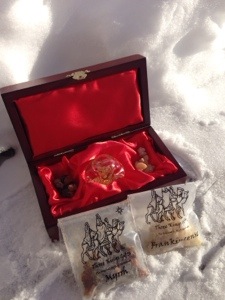
He chastised the Wise Men for their pricey and pretty yet wholly impractical and useless gifts. “If you were truly wise,” griped the angel, “you would have known that what we need is hot water and towels; goat’s milk and bread; twenty diapers and some soap to wash them with.” Not gold, frankincense and myrrh! (p.15-16, Mary Arnold, “The Fussy Angel”, Ignatius Press, 1995). Yet, the Christ child accepts these gifts, however impractical.

The gifts, of course, hold symbolic meaning: the gold – for a king; the spices – used in burial practices of the time.These gifts point to the identity and purpose of God made human in Jesus Christ, whose destination was the Cross and the empty tomb of Easter.

Admittedly, the whole story about astrologers bringing strange gifts to a child in a strange land sounds somewhat exotic, not real.  It is filled with strange incidents, strange gifts, and strangers encountering one another.

At the same time, there is meaning here. Should we but pause to consider the deeper, sometimes hidden, levels of our experience we may appreciate the gift anew, however strange.

The movie “The Best Exotic Marigold Hotel” (Fox Searchlight, 2012) tells of a group of seniors who head off to an inexpensive retirement home in exotic India. As unfamiliar and sometimes frustrating as the experience is, when one character asks why he likes it so much, he replies: “The lights, the colours, the vibrancy; the way people see life as a privilege, not as a right.”

Perhaps Epiphany can open our eyes as well to the holy revealed in what we may have previously thought of as strange, foreign, outside our experience.

Perhaps you have celebrated Christmas and New Year’s this year differently from ‘the norm’ — in a different setting, with different people, outside your comfort zone. Perhaps this Christmas was the first without a loved one. Or, perhaps your life circumstances are changing due to ill health. Admittedly, these are all situations to which, on the surface, we may react even reject outright if we had a choice.

But the Christ child teaches us something important: He didn’t reject those outlandish, impractical and useless gifts brought to him by, of all people, foreigners from the East. Instead, he welcomed them into their home with giggles, gurgles, and laughter.

And this grace, this gift of freedom, is infectious. It liberates us to receive and rejoice in the gifts of life, however small and strange they may at first appear.

20140103-110930.jpg

Impossible demands Incredible love

Mark Wahlberg is known for his acting prowess in films like “The Perfect Storm”, “Italian Job”, “The Fighter” and will star in next year’s “Transformers” sequel. He recently gave an interview with CNN’s Piers Morgan about the transformation in his life – from being a brawler and coke addict as a teenager to being a faithful Christian who now starts each day going into a church to pray.

Piers asks Mark Wahlberg, “What do you pray for?” He basically answers by saying he wants to be the best person he can be – responsible, a good neighbor, father, son, and servant to God.

On one level, I appreciate very much when popular, culture icons like Mark Wahlberg give public testimony to the Christian faith. His example gives a positive impression to the power of prayer, especially among younger people. “What do you pray for?” seems to strike a chord, since it is fashionable for skeptics who question God’s loving existence to point to unanswered prayer. Have they considered the very goal of prayer?

In the Gospel of John, one of the first words recorded out of the mouth of Jesus when he meets up with a couple of his disciples are: “What are you looking for?” (John 1:38). Apparently Jesus, too, recognizes the significance of, first off, identifying what it is we want, or expect, from God.

We may feel like the early disciples of Jesus did, then, when they asked Jesus: “Teach us to pray” (Luke 11:1). Jesus responds by instructing them to say what has become known as the “Our Father” or “The Lord’s Prayer” – the paramount prayer of Christianity.

So, what does Jesus tell us to ask for? In Luke’s version of the Lord’s Prayer (Luke 11:1-4), the first thing we ask for is “Thy Kingdom Come”. Perhaps this can give us a clue to the aim and nature of our Christian prayer.

In the interview, Mark Wahlberg says that he would rather give favours than receive favours. It is natural, is it not, to want to believe that our redemption and transformation will happen as a result of our good efforts? Even prayer becomes about telling God what we want and desire, about actualizing our dreams for a better world and life by our energy and efforts and eloquence.

There is much in this Gospel text to suggest that our growth and maturity rests with our initiative: “Ask, and it will be given to you; search, and you will find; knock, and the door will be opened to you. For everyone who asks receives, and for everyone who knocks, the door will be opened” (v.9-10). We resonate with those words, don’t we? They roll off our tongues easily enough! And we tell ourselves to buck up!

Yet, how many times have we given up on prayer because what we asked for so diligently hasn’t come to pass? We may have prayed and prayed and prayed for release from some kind of bondage or for someone else’s well being. And whatever it is continues to burden our lives. The issue remains unresolved.

This conundrum might be best described with forgiveness. In the Lord’s Prayer we ask God for forgiveness. But this forgiveness, it seems, is conditional upon our ability to forgive ‘everyone’ indebted to us! “Forgive us our sins as we forgive those who sin against us.”

That’s a tall order! Yikes! Have I forgiven – truly forgiven – others who have hurt me? And not only the one person that first comes to mind – but everyone who has ever hurt me? If not, will God forgive me?

Right after the Lord’s Prayer Jesus tells a rather weird story about going to a friend in the middle of the night to ask for three loaves of bread. Notwithstanding the awkward position in which you would be putting your friend in the middle of the night, why on earth wouldn’t you have something as basic as bread in your house at any given time?

Why would you be all out of bread in the first place? In a culture devoid of corner stores and open-all-night Seven-Elevens, you would think folks in Jesus’ day would plan ahead and have food stored up. Obviously a subtext of Jesus’ story here is the irresponsibility, laziness, short-sightedness, and sinfulness causing you to go to your friend in the first place.

How many times have I withheld grace or forgiveness from someone because I have felt they haven’t done their part enough to deserve my help?

On one hand I admire the person going shamelessly and boldly to the friend. It takes guts to interrupt someone, especially at night. Perhaps we can learn from this the trust and confidence you have in your friend to help you. Similar to the trust and confidence we are called upon to place in God.

Elsewhere in the New Testament the writer John expresses it this way: “I write the truth to you because you already know the truth” (1 John 2:21). We receive these words of Scripture and the word of God in Jesus Christ not because we don’t know it or don’t have it. We receive the words telling the truth of Jesus today because the truth and presence of Jesus already resides within us – at that deep level, in our hearts. The bible’s message is given to us to remind us, to help us re-member, what is already living within us.

And so with confidence, boldness, and shamelessness, we approach the “throne of grace” (Hebrews 4:13) with our pleas for help – even when those requests are misguided, selfish and born from our own weaknesses.

And this is the point, I believe, of the Gospel. Ultimately it is not about our efforts to make something of prayer and our relationship with God. Rather, it is about a God who will help us, no matter what. Jesus reminds us that God is always willing to offer us the help we need in order to live out the truth of Christ within us for the sake of the world which God so loved (John 3:16). Such is the incredible love of God even in the face of impossible demands.

While God receives all our prayers, however tainted with our ego compulsions, fears and neediness, the power of prayer resides in ‘thy kingdom come’ – which some ancient transcripts translated as “Your Holy Spirit come upon us and cleanse us.” Such a rendition is worth considering, because it is consistent with the last verse (13) of the text: “If you then, who are evil, know how to give good gifts to your children, how much more will the heavenly Father give the Holy Spirit to those who ask him!”

I wonder about the positive changes we desire for our lives. I wonder about how we shall pray for the good things we seek for ourselves, those we love, the church, and the world around us. What do you pray for? – the Holy Spirit? – the deep yearning for an experience of God’s love and grace and forgiveness? – that our lives be transformed according to love of God for us and for the world?

Will we pray for, and in, God’s will?

When we pray, “Thy kingdom come” are we willing to let ‘my kingdom’ go? (Richard Rohr).

What do you expect from God?

Good things! Good things, for the sake and love of the world, in Christ Jesus.

A mutual, loving relationship in the name of Jesus

“I made your name known to them, and I will make it known, so that the love with which you have loved me may be in them, and I in them.” (John 17:26)

Did you catch the Huffington Post article this week about the fastest growing baby names? ‘King’ and ‘Messiah’. Yes, ‘King’ and ‘Messiah’.

Expectations for our children must be growing!

While we may joke about what our names mean, the humour always reveals a glimmer of truth: Our names do reveal something of our essence. Our names are gateways into our character. People get to know us, first, by knowing our names.

My first name is Martin — I was born on Reformation Sunday (always the last Sunday in October), named after the church reformer of the 16th century, Martin Luther. And it so happens I am a Lutheran pastor!

My second name is Emanuel — which in the Hebrew language identifies God’s presence, meaning “God is with us”. In the Gospel of Matthew (1:23), Emanuel is ascribed to the coming Messiah. I like to think God is always with me.

My last name — Malina — as you may know reading this blog, means, from the Polish language, ‘raspberry’. I like to think raspberries convey sweetness.

Well, that pretty well sums it up! Now you know who I am!

What does your name signify about you? Inquiring can be both an amusing and insightful exercise.

In the Gospel reading (John 17:20-26) for this seventh Sunday after Easter, in the High Priestly Prayer, Jesus prays for the unity of his disciples present and future (that’s us!). There, we find a delightful play on words (in Greek) between ‘one’ (hen) and ‘in’ (en).

Indeed, to be one with another is to be in them. Jesus describes his intimate relationship with the Father this way. When I was a teenager in the 1980s, we used to talk like this to describe something or someone we liked — I’m in to that kind of music; or, I’m in to that person.

Our God is a relational God, to begin with. And, what is more, this relationship is characterized by affection and love. The word ‘love’ is mentioned five times in this short passage about divine and human unity.

The reciprocity of love described here necessitates some engagement on our part. We are called to respond. “In the name of Jesus”, we pray. “In the name of Jesus”, we involve ourselves in Christ’s mission on earth. “In the name of Jesus” we live, we breathe, we move and have our being. We are part of this dance with Jesus; we have a vital role to play in our relationship with God.

Because what Jesus teaches us is what is vital to any healthy relationship whether divine or human: mutuality. We speak here of a mutual relationship of love. Should Jesus live in us, which he promises to do, we engage in mutuality. That is, what you want most from this relationship with God — you first give.

If you want forgiveness, try forgiving others and yourself.

If you want love, give it to someone else.

If you want respect, show respect to God and to others.

And this concept of mutuality operates, really, in all healthy relationships — whether marriage, work, friendships, families, etc. At first, it may feel counterintuitive. Because what you want is something you may feel you lack. The paradox, however, lies in precisely the opposite: You will only receive what you think you don’t have, by giving it out to others.

But lest we get it into our heads that we must be like our ‘King’ or ‘Messiah’ — even if our names reflect such a designation! — stop, breathe, and let go of the pressure, demands and expectations of your perceived purpose in life!

The relationship of love begins when God calls us by name (Isaiah 43:1). When God says our name, we are blessed indeed. God’s voice naming us calls us back to ourselves. In the garden the morning of the resurrection, Mary mistakes Jesus for the gardener; it isn’t until Jesus speaks her name, “Mary”, when she is brought back to herself — and recognizes Jesus for who he is, the risen Son of God (John 20:16). The mutual relationship is born, and reborn, each time Jesus calls us by name.

Unlike what happens in a dance, the two partners involved in the covenant relationship with God are not entirely equal. We are not Jesus. And while in the Holy Spirit we can do great things for God and God’s mission, the first move comes from Jesus. He chose us (John 15:16). He called us by name to join in the dance. He makes the first move. Because when we slip and fall in the dance of life and love — which is bound to happen — Jesus is there to pick us right up again.

Because God loves us first.