Home is where you’re wanted

It’s Canada Day. It’s a day we celebrate our identity as Canadians and our beautiful home, in Canada.

They say the best part of travelling abroad is coming home. The first time that hit home for me was when in my late teens I visited southern Poland where my parents were born.

I recall being driven about the countryside there. And though there are gorgeous landscapes in the valleys and hills surrounding the Tatra mountains in the south, there were [and are, still] many coal mines in operation. We had a tour of one of these mines—its stark and dirty images still occupy my mind. There wasn’t a day being in Poland that I didn’t smell the pollution in the air.

Until I got off the homebound plane at Mirabel in the Laurentian hills between Ottawa and Montreal (when it was still an international airport during the 1980s.) Walking on the tarmac from the plane to the terminal, I felt the cool breeze coming down over the hills from the north, and breathed deeply the pristine air. And I recall being so thankful for living in a country where I could breathe that clean, natural air.

To this day when someone asks me why I love living in Canada, my immediate, visceral response is: “The air. I can breathe.”

We can all, I suppose, point to aspects of living in Canada for which we are grateful. Whatever we call home is so important to our sense of self. Indeed, our identity is formed out of however we define home. It’s usually some combination of family, relationships, personal history and place.

Often I hear the definition of home as ‘where you come from’. Where I come from includes relationships, family history, where my forbears settled and worked the land. This tie, this bond, can be very strong.

It’s ironic, maybe even disturbing, that we confront a gospel reading for this Sunday that challenges— to the core— our comfortable ideas of home. To those who first want to attend to family, Jesus says, “Let the dead bury their own dead.” Then, “No one who puts a hand to the plough and looks back is fit for the kingdom of God.”[1]In another Gospel, Jesus says, “Whoever loves father or mother more than me is not worthy of me; and whoever loves son or daughter more than me is not worthy of me.”[2]

He even warns those who want to follow him that they will have to do without. That the spiritual journey involves the way of material simplicity and letting go. It involves a poverty of sorts. “Foxes have holes, and birds of the air have nests; but the Son of Man has nowhere to lay his head.” Jesus was a transient. As a baby—Emanuel, Son of God—he was a refugee.

But while he didn’t boast of a physical home on earth, he certainly had what it took to be at home in himself and with God. He was grounded within himself, quite distinct from any external, material ties to land and hearth. Jesus turns to his disciples and beckons, “Take up your cross and follow me.”

A Jesus-identity stands in sharp contrast to everything we want to focus on in our celebration of Canada Day—material prosperity, security, affluence and strong, traditional bonds of family.

Jesus’ lifestyle describes what ancient and contemporary wisdom teachers have called a spirituality of subtraction.[3]This way is counterintuitive. Our human nature gravitates towards a spirituality of addition. That is, we normally say the solution to all problems is to do more, to add on, to do better, to achieve greater heights, to impress, to work harder, etc. Add. Accumulate. Get bigger, faster, better. More, more, more.

However, Jesus tells us that the less we do and the less that we desperately try to be someone, the closer we come to this kingdom of God. This state of being is where there is no longer any need to struggle to protect ourselves and to survive. “It’s the way of subtraction, where less is not just more, but everything.”[4]

Canada Day, while not a festival in the church calendar, gives us nonetheless opportunity to be thankful and celebrate God’s good gifts in all that we have and are. It is also an opportunity to  reflect on our identity and our home as Christians:

Where do we land, at the end of the day? If we are the ones on the positive side of history, what is the state of our own inner life, distinct from the externals and the material wealth? What are our go-to beliefs and unacknowledged assumptions? Who are we, really, when all else is stripped away? And who are we becoming? What do we need to let go of? What do we need to embrace, anew?

The way of subtraction is a way of recognizing, acknowledging, even embracing what the normal ebb and flow of life brings to us all. Not just yahooing when good things happen. But also not turning a blind eye, ignoring or denying the suffering, the losses, the fear and the anxieties that serve a very important purpose in life: Because they point to the way of our healing and transformation.

We can start, on Canada Day, by acknowledging that not everyone is happy today. Not everybody would have reason to celebrate Canada Day. And who are these people? Do we see them? Do we care?

When by some injustice some people are excluded. When some people feel judged or discriminated against by the majority. When history exposes problems with the way we settled this land, the way we did things in the past. When our people used unjust means to achieve goals that breached ethical lines.

On a personal level, we pay attention to those difficult transitions in life, those that cause great stress. When who we thought we were, when our long-held identity, when the home of our conditioned self doesn’t work or make sense anymore:

For example, when divorce or separation breaks down our idea of being someone who is happily married …

When growing up means no longer being a dependent son or daughter but someone who is a responsible, self-actualized and an independent adult…

When ageing means we can no longer derive purpose from our physical abilities; that is, how we see ourselves can no longer depend on being able to dothings …

For men especially, when we are not the breadwinners of the household, or don’t have grandchildren to brag about, or can’t point to a list of worldly accomplishments …

When having children is not a possibility, despite the dreams of youth …

When we no longer can have or do what we want …

In all these cases, and there are more, when who we are—who we thought we were—no longer works. Then, who are we?

“What we’re really being invited to give up [when Jesus talks like this] is not our car, our house, our laptop and our multiple hand-held devices (although it would be healthier to have a much lighter grip on all of those things). The possessions that we are really fiercely attached to are much less tangible: our ideas about who we are, beliefs deeply hidden even—especially—from ourselves, the self-sustaining narratives that we run for reassurance over and over again.”[5]

What would it look like in our lives when our priorities would shift? When we would regard all that we have and our relationships through the prism of faith? When all the material things we possess, when our long-held, cherished assumptions, our stalwart beliefs were seen through the perspective of faith?

What if Jesus were calling us to re-align our inner compass so that Monday through Saturday had just as much to do with faith as Sunday morning did?

When I breathe in the refreshing, clean air blowing from the north, I reflect on the nature of breath. Breath is gift. I take it in. I need it for life. I delight in it.

But I also have to let it go, for life. I need to breath out. I can’t continue to inhale unless I also exhale. Give it away. Return it to the world. The gift continues to become a gift for someone else, over and over again. I don’t possess it.

As Hildegard of Bingen wrote in the 12th century, “I am a feather on the breath of God.”

I recently read a wonderful definition of home. It wasn’t so much a definition stated with absolute resolve, more a suggestion to consider. What if home was not so much ‘where we’re from’ but more ‘where we are wanted.’[6]

In God’s realm on earth and in heaven, you are wanted. God wants you. In that mutual desiring, that is where our home is. And, what is more, God wants the stranger, the outsider, too. The other. God wants all of us. The span of God’s love covers this land and the whole world. “For God so loved the world …”[7]

Home is where we are wanted. When we are in communion with God, when we affirm our connection with the living Lord, when we can live out of the power of God’s Spirit in whom we move, live, breathe and have our being.


[1]Luke 9:51-62

[2]Matthew 10:37-38

[3]Meister Eckhart, Richard Rohr, Jim Green—to name a few.

[4]Jim Green, Giving Up Without Giving Up (London: Bloomsbury Continuum, 2019), p.67.

[5]Jim Green, p.68-69.

[6]Abraham Verghese, Cutting for Stone (Toronto: Random House, 2009)

[7]John 3:16
The way the story is told

Look at the man whose community has judged as possessing a legion of demons. He has been pigeon-holed. Ostracized. Bullied. Looked down upon. Pitied. The man whom they looked upon, and said to themselves, ‘Thank God it’s not so bad with me.’ This is the kind of person who, it has been argued, we need. If only to make the rest of us feel better about ourselves.

Schadenfreude is the term we use to depict and distinguish those ‘less fortunate’ than us to justify our complaints and our more privileged status. So, we need ‘them’. And we need ‘us’. We need the distinction. To envision the opposite, to imagine some kind of union, to unearth the unholy distinctions between ‘them’ and ‘us’—well, that may be far too threatening to our fragile egos.

The way the story is told is not to focus on the man’s illness. Though, that’s what we like to talk about: the frothing at the mouth, the rattling of the chains which bound him, the pigs rushing dramatically to their watery deaths. The way the story is told, however, is not to fixate on whatever ails him, his sin, his problem. We say this is a healing story. But who else besides the man is invited to be healed?

Important though it is not to overlook the man’s problem, the way this story is told leads us to the climax of the telling—the last few sentences that describe the reaction of the man’s community, there across the Lake in Gentile territory.

When, at first, he is healed, and is shown to the people, how do they respond? You would think they would rejoice. You would think they would praise God. You would think they would marvel at the goodness, the promise, the hope, the delight of God in bringing transformation and healing to this man who once was lost in sickness and despair but now is saved. In Greek, the word for salvation is the same word for healing. This man we look upon, alongside the Gerasene community, is now restored, healed and given a new beginning in life. A second chance.

You would think those who witness this would rejoice in the promise and anticipation that this healing and transformation be offered to each of them also. Amen?!

The way the story is told, however, emphasizes the point not once at the end of the story, but twice: They were afraid, seized with a great fear.[1]They didn’t like what Jesus was doing. They had become too comfortable in their opinions, their prejudices, their categories, their pigeon-holing this man. And they didn’t like what Jesus was doing to upturn and completely reverse their world-view. They even had the gall to tell Jesus to leave. No more of this. Do you blame the healed man for wanting to get out of there, too, with Jesus?

This story shines an uncomfortable light not on the Gerasene Demoniac. The title of this story should rather be the community’s demoniac. The community’s sin. Their prejudice. And their incapacity to repent—to change their minds about the people they have normally pigeon-holed into convenient places of malice and schadenfreude, them and us.

The Gospel story opens with Jesus taking his disciples to the ‘opposite side’ of Galilee. To be faithful to Jesus, to follow Jesus, they have to leave their zones of comfort and familiarity to go to the Gerasene territory across the lake.  Every city, every community, every country, every culture, every church, has an ‘opposite side.’ And it’s to that ‘opposite side’ that we—Lutheran Christians in Canada today—are called to go.

The way the story is told, is that Jesus’ presence and power disrupts the social order of the way things are. Because, for one thing, to the people whose living depends on the pigs, their loss is catastrophic. The swineherds are understandably afraid.

From this standpoint, the way the story is told, the coming of the gospel of Jesus brings upheaval and sets in motion forces that will disrupt even economic and social arrangements. In other words, the good news will not seem good to everyone at first. Maybe, to us.

Especially to those who are comfortable, privileged and set in our ways. Indeed, for the community in Gerasene and for us, we might prefer the devil we know to the freedom we do not. We might take a false sense of security from the dysfunction, the prejudice, the self-righteousness we have learned to tolerate in ourselves, cope and live with, ignore and sluff off. And we might therefore fear what change—even change for health—may bring.

We fear freedom from what binds us:

Locked and bound in some prison of our doing—telling ourselves we are not good enough, that we can’t do it, that we don’t deserve the immeasurable love which God has for us.

Locked and bound in some prison of our doing—telling ourselves and each other that the poor, the newcomer to Canada, the Indigenous people of this land, our home on native land—deserve their plight as if we don’t have any responsibility to care for them. To tell ourselves we need not seek understanding from another’s point of view.

Locked and bound in some prison of our doing—maintaining beliefs, even religious ones, that serve only to belittle others from a different social, religious background than ours, others whose gender orientation is not ours, others who are impoverished financially. Maybe Paul’s words must ring true again today to our hearts that are divided and distressed over these issues: “There is no longer Jew or Greek, there is no longer slave or free, there is no longer male and female; for all of you are one in Christ Jesus.”[2]

What is the ‘opposite side’ of the lake, for you? Is it a troubled personal relationship? Is it a long-held assumption or belief? Is it something you’ve wondered about doing but had up until now been too afraid to try? Perhaps in this season after Pentecost, the Spirit of God is calling us to consider going there.

To discover anew that whether we succeed or fail, whether we accomplish our goals or not, whether we live or die, we are the Lord’s forever.[3]Healing and salvation will come to us, regardless of our pedigree. For, again in the words of Paul, “it is no longer I who live, but it is Christ who lives in me.”[4]The gospel doesn’t begin with us. It’s always about what God is doing in us.

As Richard Rohr writes, “It’s not what you do that makes you holy, it’s what you allow to be done to you that makes you holy.” (in today’s ‘daily meditation’, http://www.cac.org)

Grace does that. One doesn’t first become Christian, then go to church; One goes to church to become a Christian—and it will take a life time, and beyond. It’s not the destination, it’s the journey. As fourteenth-century Saint Catherine of Siena once said: “It’s heaven all the way to heaven, for Jesus is the way.”

Jesus invites us to join him on his journey to the opposite side. To grow and change. To reach further, deeper, into health and wholeness. To open ourselves to the unity we share with all people in Christ Jesus our Lord.

And that story will have a good ending.


[1]Luke 8:35,37, NRSV

[2]Galatians 3:28

[3]Romans 14:8

[4]Galatians 2:19-20

From spiritual childhood to adulthood

It was in the 1980s and 1990s when the phrase “kids of all ages” came into vogue. When its usage skyrocketed. People attending circuses, entertainment and other public events would often hear the invitation and address to “kids of all ages!”

It was also during the 1980s and 90s when baby boomers became adults. And when these adults—like no adults before them but all who followed—started acting like children:

Half the buyers of comic books and tickets to superhero movies were adults. The majority of video game consoles, cartridges and discs at the end of the last century were bought by people in their 30s. Video games, originally sold to boys to pretend they were grown up action heroes were soon bought mainly by grown men who wanted to play like kids.[1]

This was the time when it became acceptable for adults to play video games and fantasy sports. This was the time when it became ok for the likes of me to dress like teens, to groom themselves and even get surgery to look thirty years younger. The “kids of all ages” phenomenon has had negative repercussions on men and women alike, especially around issues of self-esteem and body image.

Emotional immaturity, narcissism, co-dependency and not taking responsibility for one’s actions tend to be the psychological effects of the kids-of-all-ages era. And we live with these effects to this day.

You can understand, then, why some contemporary theologians have expressed concern over an uncritical and indiscriminate use of the term, “children of God”[2], which appears prominently in the short text from Romans today.[3]

It is popular in the church to identify with being “a child of God.” We gravitate to images of Jesus rocking children on his knee, telling his disciples that they are to become like children to enter the kingdom of God. At baptisms and confirmations, we remind the candidate and ourselves that each of us is a child of God.

We are held in the arms of God, close to the bosom of Jesus. Yes. Such comforting images can be helpful during times of trial and suffering, for sure. Yes. Our following Jesus and our endurance and resilience in the spiritual does not depend alone on cognitive, intellectual knowledge—usually the purview of adults—but on a simple childlike trust. Yes.

I also agree with Stuart Brown who, in his book, promoted the value of play. That, what might seem like a frivolous or even childish pursuit can be beneficial to our mental health. That, paradoxically, purpose-less, unproductive activity from time to time can make one enormously more productive and invigorated in other aspects of life.[4]These pursuits normally belong to children but are of benefit our whole life long. Yes.

At the same time, when Paul uses the term ‘children of God’ he associates our identity in Christ with anything but childish states of being. He talks about not being enslaved in fear. He talks about living with suffering. These are realities, not fantasies, born of a life lived and experienced and embraced with the good and the bad.

Being a child of God doesn’t give us license to behave childishly. Being a child of God doesn’t give us license to behave irresponsibly, shifting authority and blame for one’s actions to someone else.

Two aspects of being an adult in Christ I want to underscore. First, it is to pay attention to our own desires, not denying them. Paul writes that the Spirit of God speaks to our own spirit. “It is that very Spirit bearing witness with our spirit that we are children of God.” We have a human spirit. And God speaks through the deep desires and longings of our hearts. Unfortunately, whether we realize it or not, we use the identity of ‘child of God’ to deny our very human needs and desires. When we do so, are we not blocking God’s way of speaking to our hearts?

Saint Irenaeus, second century bishop of Lyons,  France, said that the ‘glory of God is a human being fully alive.’ God speaks through our very humanity. What gives us joy. What causes us pain. What is good and right. Our small ‘s’ spirit within us is the very thing God’s big ‘S’ Spirit connects with. The Psalmist paints an image of how God communicates with creation: “Deep calls to deep”.[5]We are part of, and participate in, the divine equation.

This divine relationship, from deep to deep, needs containment nonetheless. This is the second aspect of being an adult in Christ. Here, we turn to the words of Rev. Michael Curry, presiding bishop of the Episcopalian Church in America. You might remember his famous sermon he preached at the royal wedding just over a year ago. In it, he talks about fire—the primary symbol of Pentecost—harnessing the incredible power of love.

He said that the harnessing of fire was one of the great scientific and technological discoveries in all of human history.

‘Fire to a great extent made human civilization possible. Fire made it possible to cook food and to provide sanitary ways of eating which reduced the spread of disease in its time.

‘Fire made it possible to heat environments and thereby made human migration around the world a possibility, even into colder climates.Fire made it possible—there was no Bronze Age without fire, no Iron Age without fire, no Industrial Revolution without fire.

‘The advances of fire and technology are greatly dependent on the human ability and capacity to take fire and use it for human good.

‘Anybody get here in a car today? Fire—the controlled, harnessed fire—made that possible.Controlled fire in a plane gets us across this world. Fire makes it possible for us to text and tweet and email and Instagram and Facebook, and socially be dysfunctional with each other’ and act like children!

Fire makes all of that possible. Indeed, fire was one of the greatest discoveries in all of human history. And then Bishop Curry concluded that if humanity ever harnesses the energy of fire again, if humanity ever captures the energy of love—it will be the second time in history that we have discovered fire.

The passion, the spirit, the fire of love coming from within us needs to be contained. For it to have effect it must work within limits. The damage of forest fires and bombs we have witnessed both literally and figuratively throughout history and in our own lives. The passion, the spirit, and the fire of love needs containment. Then when its boundaries are respected, we can discover its true and divine power.

Poet and spiritual writer Anne Lamott says it best in describing the maturing Christian, as we grow from child to adult: “Grace meets us where we are but does not leave us where it found us.” In the implication there to ‘Grow up!’, we are challenged to continue to learn how to harness the energy, joy and passion of the Spirit within us, to use for the good of all.

The message of God’s love, the sending of the Spirit of God upon the church ever since that day long ago in Jerusalem, grows us into the adults that we are created and loved to be.


[1]Kurt Andersen, “Forever Young: Why Are Adults Acting Like Children?” The Saturday Evening Post (June 12, 2018).

[2]“As someone concerned with Christian moral practice, I lament the infantilizing of Christians as children, without the responsibilities of adult members of the household of God,” Jane Lancaster Patterson, Commentary on Romans 8:14-17 in www.workingpreacher.org

[3]Romans 8:14-17; a reading assigned for the Day of Pentecost, Year C, Revised Common Lectionary; in four short verses, Paul uses the term ‘children’ three times.

[4]Stuart M. Brown Jr. & Christopher Vaughan, Play: How It Shapes the Brain, Opens the Imagination, and Invigorates the Soul (New York: Avery Press, 2009), p.11

[5]Psalm 42:7

Kitchen vision

During Mika’s confirmation last weekend, I was grateful to reconnect with folks from her past and present, and hopefully future. At Mika’s confirmation party on the Saturday, we had just over thirty people in our house. It was raining, so all of them were, physically, in our house. It was crowded. Loud. Noisy.

You know I am an introvert. And they say that if you want to starve an introvert to death, put a stranger right in the middle of their kitchen. Far from being strangers, these were all friends and family. And yet, to have someone ‘in your space’ who is not normally there, was challenging for me. Add to that stress, organizing food for all these people and making sure everyone had somewhere to sit …

I remember first meeting Mika’s godparents in rural southern Ontario in my first parish. In century old houses, the kitchen can be the largest room. The kitchen is also where most people enter the house—not the front entrance facing the road. But ‘out back’ where friends, family and neighbours know to go in, right into the kitchen.

The kitchen in our first home there even had an Elmira wood stove in it. It was flanked by arm chairs and a small settee right beside the long counter and ample room for the kitchen table. Lots of people could fit in there!

Times have changed, indeed. Today, in average-sized homes there isn’t a whole lot of room to manoeuvre about. And for introverts such as myself, when I’m cooking or washing up the dishes, it’s a real struggle for me to share the space. I have to work at that.

I suspect I am not alone on this! We guard our spaces, covet our ground. We justify our beliefs and behaviour by appealing to social norms: Of course, everyone feels this way! Right? Let’s just say, having so many people crammed into ‘my space’ was a growth opportunity for me!

Jesus’ last prayer before his death and resurrection was for the disciples to be “one”—one in each other, one in Christ, one in God—bound together in the love of God.[1]The vision of God is an ever-expanding community brought together in love. The vision of God is that everyone can come to the table, everyone who is thirty, hungry, yearning for deeper connection with God and the world. The vision of God is that the dividing lines be erased—the lines that divide, exclude, deny, keep away.

The problem is, Jesus’ prayer and vision has come on hard times. We cannot deny it: the church has been fractured and divided more than anything—especially after the Reformation which brought some good things nonetheless. History in the last five hundred years has taught us, if nothing else, that fighting about who believes the right things about God can keep faithful people entangled with words about God rather than walking in the ways of God.

When followers of Christ draw lines in the sand, exclude and divide, when we quarrel and argue about dogmas and creeds and doctrines, the world will not witness the peace and love of God in us. So, the challenge of living faithfully is not only a call to private goodness or a superficial ‘everyone likes each other’.

It is a call to let our lives invite others to follow Jesus. Our lives ought not solely be preoccupied with right or wrong, guilty or not, in or out but whether or not our actions and behaviour contribute to the good of the world. Whether or not our actions contribute to a loving witness of what God’s vision is all about.

And we discover this path by experiencing the living presence of God in our lives. Not just talking about faith, but living it. And so, we are called to grow. And even when good growth happens, there will be growing pains as we stretch and flex our spiritual muscles.

There are two things ‘growing pains’ are not: First, when we are invited to do something differently, it is not an indictment against your history. It is not saying what happened in the past was all wrong. It is not dismissing the way you did things were bad.

When we are invited to do something new, something differently, let me suggest it is a challenge. A challenge to grow. Growth means change. When a plant or flower grows from its place in the ground, it changes. It’s ok to change our minds, as we grow. We are adults. We gain new life experiences. We learn new things, consider fresh perspectives. We have to integrate those experiences as we try new things.

Second, this discomfort is also not persecution. Please don’t confuse growing pains with ‘being persecuted’. We often hear that. When Christians, especially, are not interested in growth, some will conveniently use that interpretation: ‘We are being persecuted’.

When all along this discomfort is more likely about giving up privilege. It is giving up some of our privilege. Being comfortable at all costs—even the cost of avoiding difficult, vulnerable conversations, even at the cost of staying comfortable—is the very definition of privilege.

Growth will make us feel uncomfortable. But following Jesus is not about our degree of comfort. There is always a cost.

Dietrich Bonhoeffer, a German Lutheran theologian in the last century, spent the last year of his life in a Nazi prison. And he was executed by the Nazis just before the end of the Second World War.

But in those last days of his life he reflected deeply on the meaning of Christianity in the world and Christian discipleship. One of his great books was called, “The Cost of Discipleship.” And in it he warns us in the modern world to beware of what he called ‘cheap grace’. He wrote that cheap grace was the mortal enemy of our church. What we need in the church today is a costly grace, a grace that costs us something.

What is ‘cheap grace’? It is the kind of grace we give ourselves. It is the kind we get when we use the church to satisfy ourselves. It is grace without really following, without really being a disciple. It is the kind of grace reflected by the Christian who says, “I like to stay as I am.” “I’m ok” “Leave me alone.” “Don’t ask me to grow.” “I am happy where I am.”

To grow. To go deeper. To expand. To overcome the divisions that separate, isolate, exclude—within ourselves, with others and the world around us. The twelve apostles each gave their lives for their discipleship. Theirs was indeed a costly discipleship.[2]

The cross stands at the centre of this process of growth and change. We are called, and we are challenged to grow. And to grow means to give things up: attitudes, attachments, ways of seeing things, our resources, whatever keeps us the same. This is the way of the cross.

“Lay down your life if you want to find it,” Jesus said. “Leave yourself behind if you want to find your true self.”[3]

John’s visionary writing in the Book of Revelation concludes the bible. It ends with a prayer that the grace of the Lord Jesus be with “all”.[4]The original Greek does not add the words “the saints” which some English translations do. Indeed, the grace, love and mercy of God is meant for all people. Everyone.

The Spirit of God says, “Come!” to everyone:

And let everyone who hears say, ‘Come.’

And let everyone who is thirsty come.

Let anyone who wishes take the water of life as a gift …[5]

Divisions do not matter when people come to the table of good food aplenty. When people come forward to receive the gifts of God, differences do not really matter, do they? The bible’s climax is a marvelous image of countless people of all nationalities, ages, languages, sexes, classes—you name it!—drawing out water that is freely given as a gift to all.[6]

Differences do not matter in this climactic vision. What was of importance is the coming to the sacred waters, to the table. We come, to wash ourselves of prejudice and fear. We come to be challenged to grow. We come to receive grace. For everyone. Everyone is allowed in the kitchen. It’s not just mine, ours.

Come to the Table. It is for everyone.


[1]John 17:20-26; the Gospel for the 7thSunday of Easter, Year C in the Revised Common Lectionary.

[2]Laurence Freeman, “Christian Life in the Light of Christian Meditation: Discipleship” (Meditatio Talks Series 2019 A Jan-Mar), Discipleship 3, wccm.org/resources/audio/albums.

[3]Matthew 10:39; 16:25; Mark 8:35; Luke 9:24; 17:33; John 12:25

[4]Revelation 22:21

[5]Revelation 22:17

[6]Paul ‘Skip’ Johnson in Feasting in the Word Year C Volume 2 (Kentucky: WJK Press, 2009), p.534-538.

Resurrection in community

In the artwork of first centuries, for example, we see a striking difference between western and eastern portrayals of the resurrection of Christ. From western art we see pictures focusing almost exclusively on the risen Christ. Jesus emerges from the tomb alone as if to say, “Look at me! I made it!” Light glows from behind him. Whatever else there is in the painting, it is background material. Resurrection is primarily and exclusively about Jesus. And we declare “Jesus rose from the dead” as an individual.[3]

A good example is The Resurrection by Italian artist Andrea di Bonaiuto found in the Spanish Chapel, Florence, Italy.

Contrast this western artwork with the East. From eastern Christians, we see greater emphasis on the resurrection community. Resurrection is depicted more as a corporate event in the overcoming of death, evil and sin. Without denying the work of Christ in all of this, the implications are emphasized. So, it’s not so much about Jesus-the-individual conquering the grave as it is about all of creation rising from death to new life.

A good example is the painting outside the Church of St George in Romania.

The Eastern interpretation makes sense of challenging scriptures as one from the Gospel of Matthew; at the time of Jesus’ death and resurrection: The tombs also were opened, and many bodies of the saints who had fallen asleep were raised. After Jesus’ resurrection they came out of the tombs and entered the holy city and appeared to many.[4]  The life, death and resurrection of Jesus has implications for the whole people of God. Including us.

Both our tradition and the bible challenge our western bias. Instead of focusing only on the individual, we can learn how to be, and embrace being, in community.

Being and remaining in community is not easy. Relationships are messy. We would rather avoid having a crucial conversation.[2]We would rather not commit to a community because it’s easier to just leave when it gets tough. Especially when we can fall back to our individual, autonomous, private lives and independence. We would rather escape the boiling cauldron of community life.

We need to come clean with our natural bias towards individuality. That we value it. Really value it.

Let’s look briefly at today’s scripture. The story we read from Acts, chapter eleven, is actually a repeat of the same story in the previous chapter ten in Acts. The story line remains consistent: Peter has a vision from God and then meets three emissaries from Cornelius. And the message in both is the same:

Peter is called by God to expand his vision and mission of the Gospel to include Gentiles. Peter is challenged to overcome his stereotypes and distinctions between the Jews and Gentiles, and see God’s mission in more universal terms. No issue was more important to the early church than whether their newfound faith was intended only for Jews, or whether it was to include Gentiles while allowing them to remain Gentiles.[5]

The same story, told twice, in successive chapters. In fact, some of the words in chapter eleven are taken verbatim from chapter ten. Why did the author repeat the same story? Obviously this story was very important to the early church that it was re-told. Maybe a way to understand why, is to note what is different between the two. What’s the difference?

What changes in chapter eleven is the confrontation with ‘the apostles and the believers’ in Jerusalem.[6]Peter has been called before them, has heard their criticism, and now responds to it by telling them the story first conveyed in chapter ten. The difference is the context; and that context is Peter being called to task for his eating profane foods with those uncircumcised Gentiles.

We learn from the early church that believers were not reluctant to voice their differences. Peter did not escape. He didn’t go hide in the anonymity of a large shopping mall, airport or Caribbean vacation. He didn’t jump in his fishing boat and disappear on Lake Galilee.

Peter entered Jerusalem and squarely faced his critics. Too often, we try to be ‘nice’ at church. We try not to be confrontational. We try to sidestep controversy. We closet our differences. We paint smiles on our Sunday-morning faces. Even as we know deep down there may be an elephant in our collective room, and even as we suspect in our hearts irreconcilable issues. And, if we can’t handle this posturing, we leave. Get out of dodge. Back to being individuals in our private lives.

This text reminds us that controversy and difference needs to be voiced, not avoided. Conflict needs to be transformed, not ignored and swept under the rug. Living in Christ does not mean putting our heads in the sand. It means looking each other in the eye. It means accepting the other is unique, different from you.

What does this mean for us? First, when we say that we participate in the resurrection of Christ, we begin to see with fresh eyes the whole world not as risk or threat but as gift, invitation and trust. There’s what we call a ‘mutuality’ that informs our relationships—the way we relate with one another and especially those whom we may dislike or are fearful of.

In other words, mutuality can be described this way: what I see in you I see in me; what I see in me I see in you; seeing myself both in those I love and those I dislike.

Jean Vanier, the creator of the L’Arche Communities around the world, died a couple of weeks ago. He was the founder of homes for the disabled after he realized that all people, especially those with severe disabilities, have something important to offer to the world. In his writing entitled, “Ten Rules for life to become more human”, he said:

“The big thing about being human is to meet people. We need to meet people who are different and discover that the other person is beautiful.”[7]

To make this discovery for ourselves, especially in people we dislike, we need to practice paying attention for the gift in others.

The disciples are commanded by Jesus to love one another.[8]The life, death, resurrection and ascension of Jesus means the focus will shift to the community. The spotlight of faith is now not on some heavenly, other-worldly reality. It is on the Body of Christ. The focus now is not so much the individual, historic Jesus. Jesus now lives in the Body of Christ—the church, the community, wherever the Spirit of the living God blows in all creation, in every time and every place. This is the expansive vision of being a follower of Christ today, in real time.

When we share the Peace of God—a tradition in our preparation for receiving Communion—we can practice paying attention to the diverse ways in which we communicate that Peace of Christ and participate in vastness of Christ’s presence. We practice how it is to love. An analogy, you might say. Because we are all different.

And just because some may wish not to share the Peace in the same way as you do—shaking hands, or giving/receiving a hug—doesn’t mean they don’t want to participate.

Our intention comes from the heart. The desire to participate emerges from inside of us. I suggest the first thing we pay attention to is eye contact. When we turn to the person beside us look them in the eye. These eyes of ours are windows into the soul. They reveal this good intention in our heart to communicate the love and peace of Christ. This is when you can say, “the Peace of Christ be with you.”

The second thing is, pay attention to what you do with your hands. When you open them outward and upward you are giving a cue that you are open for a hug. Mind what the other is doing with their hands after making eye contact. Are they also opening their arms? If not, they are giving you a cue not to hug. What else can you do?

Your hands can come palms together in a prayerful pose—the namaste. While keeping eye contact and bringing your hands together over your heart, you may bow slightly, saying, “Peace be with you.” You can also give a fist-pump/shoulder-pump if you do not wish to shake hands. Obviously if both of you are reaching to each other in a motion to shake hands, your cues are mutual.

Two assumptions to review: First, please do not assume everyone will do it the same way as you. That’s Community 101 and it applies to lots of things. Pay attention to body language. There’s more to this liturgical act than saying the words. Second, just because you receive different cues from the other doesn’t mean they don’t wish to participate in conveying the love and peace of  Christ to you. We just have to work harder at discovering and respecting their way.

There are various ways we can communicate to another that we participate in the life-giving activity of God in the world that God so loved. And continues to love, through us.


[2]Patterson, Grenny, McMillan, Switzler, Crucial Conversations: Tools for Talking When the Stakes are High (Toronto: McGraw Hill, 2012), p.11-14

[3]Richard Rohr, Jesus’ Resurrection (Daily Meditations, www.cac.org), 21 April 2019.

[4]Matthew 27:52-53

[5]Stephen D. Jones in David L. Bartlett & Barbara Brown Taylor, eds. Feasting on the Word; Preaching the Revised Common Lectionary Year C Volume 2 (Louisville: WJK Press, 2009)  p.451-455.

[6]Acts 11:1-3

[7]Jean Vanier cited in Canada Lutheran Vol 34 No3 (April-May 2019), p.8

[8]John 13:31-35, the Gospel reading for Easter 5C, Revised Common Lectionary.

To see that we are seen

Because of the devastating flooding in the Ottawa region since Easter weekend, many conversations have turned toward the unprecedented levels of water in the Spring run-off. In 2017, we surpassed the 100-year levels. And just two short years later in 2019 we surpassed even 2017 levels. What’s going on?

When 16-year-old Greta Thunberg began demonstrating last year at the Swedish Parliament about climate change she rapidly gained worldwide attention. Among others, she inspired a whole generation of girls to be politically active.[1]

In Ottawa, the seat of the Canadian federal government, we are never short of political talk. We engage in daily debates over backyard fences, at the hockey rink and in coffee shops about the goings on in and around Parliament Hill.

We’ve heard the story before. This is not new, we say — the issues, the players, the opinions, the debates, the conflict. It’s par for the course.

Even as politics has taken a nasty turn in recent decades. It has become intensely personal. Conversations about politics now start with degrading remarks about the person and their character. Election campaigns have become platforms for disputing a candidate’s moral character. Scandals thrive on mudslinging and disparaging the ‘likeability’ factor of the major players. Never mind the views represented by these political players.

And you know we are sinking into a deeper moral hole when teenagers like Greta Thunberg are bullied by those who don’t share her political views—not with arguments about climate change but because she has autism. Neuro-typical people opposed to her politics have seized upon autistic traits Thunberg exhibits, “such as her ‘monotone voice’ and forthright manner, to liken her to a ‘cult member’ in an attempt to delegitimise her message.”[2]

Yet, we’ve heard the story before, we say. It gets replayed in different times and places by different characters and situations in history, no? Human beings will behave this way. In this day and age especially when information is shared immediately and globally.

It’s not a new story to us. We experience it on a daily basis. We can’t help ourselves. It’s either a joke. Or, we despair. And then we turn away.

For one thing, why can’t we distinguish the person from the issue? Maybe we don’t want to. Why do we so easily walk into the minefield of legitimizing the truth of something based on whether or not we like whomever represents the vision, the values, the policy, the idea? When the medium is the message?

We’ve heard this story before. It’s not new. People haven’t changed. We haven’t changed, we say.

When Jesus appears to his disciples after his resurrection, they don’t recognize him. Mary thinks she sees a gardener at the empty tomb.[3]The disciples at first don’t know it’s Jesus standing on the shoreline calling out to them.[4]Their vision is clouded, myopic.

We’ve heard this story before. I’m not the only one, I am sure, who has experienced not seeing someone while walking in a crowd. You know, you are in the mall going past so many people. Then I happen to be ‘looking’ at someone I know, but I don’t really see them. The only way I do is when they see me and call my name. And then I become aware that I am seen by them. That’s when it changes.

So, if that ever happens between you and me, you could always just say you thought I was my identical twin brother whom you don’t know!

The recognition happens when I see that I have been seen.[5]That’s when relationship starts. When you know you are seen by the other. When Mary, Peter, Thomas, John and all the other witnesses of the resurrection know that they are seen by the resurrected Jesus and recognized for who they are. Then they know and appreciate that they are part of the resurrection story, not distant from it but very much involved in the story we know.

The resurrection of Jesus means that not only have we heard this story before, not only armchair, arm-length critics of the story. But we are participants of it. Ourselves. We see that we have been seen.

We are Greta Thunberg. We are Doug Ford. We are Justin Trudeau. We are Jody Wilson-Raybould. We are Jane Philpott. We are all those people –whomever you first like to scrutinize, criticize, even demean and disparage. Because the person you first point a finger at is really about you, about your woundedness. When we judge another, we need to be aware that this judgement only exposes our own moral disparity. What we judge in the other reveals something in our shadow side, our weakness that we want to hide, suppress and deny for some reason. A part of ourselves that we have not been able to come to terms with and accept.

And yet, despite that dis-arming truth, the resurrected Jesus does not ignore us and walk by us in the crowd. Just as Jesus called out to Mary at the tomb and said her name, “Mary.” Just as Jesus called out to the disciples to let them know that they are seen and recognized by the loving, penetrating, all-knowing gaze of a gracious God – Jesus calls out to you and to me.

The resurrection story from the bible is not just a story we know, or think we know. The resurrection story is not really just a story about believing in the fact of the resurrection. It is believing that someone, starting with Jesus but not ending with Jesus, could be wounded and also resurrected at the same time.[6]

Resurrection is not merely about some perfected, other-worldly state that only few people achieve by their own strength or moral righteousness. That is the story the world believes. Resurrection is not some fanciful state of being, occupied only by Jesus, the Son of God. But because of Jesus’ resurrection, we all now can be seen for who we are. Like Christ we are all ‘little Christs’ (Martin Luther’s term) – wounded and resurrected at the same time. When we see that we are seen by loving eyes looking on us despite the woundedness therein. Despite the scars, the hurts, the ongoing struggles.

There is the hope.

“Put your finger here,” Jesus invites Thomas to touch the wound in his side on his resurrected body.[7]“Come and see,” Jesus invites the first disciples.[8]  “Come, and have breakfast,” Jesus invites his post-resurrected disciples for a meal he offers to them on the lakeshore. Jesus turns to us, in our ordinary, broken, common lives, and sees us. Whether or not we at first see him.

That’s the miracle of Easter — not just a resuscitated body, but that this resurrection body still bears the marks of woundedness at the same time and in the same place!

We are seen, and are invited to follow Jesus. As we are. We need not be intimidated nor held back by our imperfections. Those first disciples bore the woundedness of their own lives: tax collectors (not a good job), fishers (lowest class), even political agitators like Simon the Zealot.[9]These were people on the fringes of mainstream, privileged society. Not perfect by any stretch.

The miracle of the resurrection is not saying that life in Christ is perfect, or should be, or should be for some others. The miracle of the resurrection is saying that new life can be experienced right in the middle of all the dying, suffering, and pain of our own lives. Now, because of the resurrection, we don’t have to wait for ideal circumstances before we can really live. We, too, can discover the grace, the joy and the life of God in us, and in the world around us. Now. And no matter what.

In the coming week, try turning off your cell phone for an hour each day—you determine the time. If you don’t have a cell phone, unplug your landline or turn the ringer off each day for a certain amount of time. Practice not being available to the distractions and expectations of others. Practice this uncomfortable state of not being attached to the latest gossip, the latest market fluctuation, breaking news or a friend’s reaction. Practice not responding right away to a message or text or call.

And, in that discomfort, close your eyes and breath. And remember that God sees you. And that, in the silence and uncomfortable disconnection you are fundamentally and eternally connected.

Perhaps, in that moment, you can see that you are seen by the living Lord.


[1]‘The Greta effect? Meet the schoolgirl climate warriors’,  https://www.bbc.com/news/world-48114220

[2]https://www.theguardian.com/commentisfree/2019/apr/25/greta-thunberg-autism-spectrum-critics

[3]John 20:14-15

[4]John 21:4; forming part of the assigned Gospel text for the 3rdSunday of Easter, Year C, Revised Common Lectionary

[5]Laurence Freeman, “Discipleship” (Meditatio Talk Series 2019A, Jan-Mar), Track 1

[6]Richard Rohr, “Jesus’ Resurrection”, Daily Meditation 23 April 2019, http://www.cac.org

[7]John 20:27

[8]John 1:39

[9]Acts 1:13, Luke 6:15

Super-hero busted

With Marvel and DC the biggest box office attractions in recent years, the popular culture exposes our desires and fantasies. These super-heroes are really just projections of our own wants and longings. We put ourselves in these roles, vicariously living out the super-hero life.

What from the super-hero culture inform and influence our real lives, you ask? What does it mean to be a hero, living day-to-day?

Last week, we concluded our Lent book study about our medical culture. When the stakes are high and decisions have to be made about treatment of serious illness, what do we want? How do we respond? In the book aptly entitled, “Being Mortal”, author Atul Gawande writes:

“The pressure remains all in one direction, toward doing more, because the only mistake clinicians seem to fear is doing too little. Most have no appreciation that equally terrible mistakes are possible in the other direction—that doing too much could be no less devastating to a person’s life.”[1]

Being heroic means doing more, not less. More power. More strength. Super-human capacity. Fighting evil means counter punch for punch—just harder, faster. Solving problems means finding more resources, generating more capacity to meet the demands. Doing things better. This is the culture of heroism in our day. We want to be heroes.

Peter, one of Jesus’ disciples, is our biblical hero. We like him. We get him. He always wanted to be Jesus’ hero, protecting him from the suffering of which he spoke, jumping into the water not once but twice to be the first of the disciples to get to Jesus.[2]Jesus, at one point, even had to say to Peter: “Get behind me Satan” when Peter said he would not allow the suffering and death of Jesus.[3]

Even in the Passion narrative Peter is still delusional, believing he will follow Jesus, heroically, to the end. “Lord, I am ready to go with you to prison and to death!”[4]Peter is the consummate hero.

The part from the Passion narrative where he then ‘denies the Lord three times when the rooster crows’ is a turning point for him.[5]And for us.

In the Passion of our Lord, the Cross is the central image and destination. And against the Cross our truth is exposed, and we are caught in the headlights. Our true motivations are squared against the values of the kingdom of God to which Jesus bore witness in his last days and trial.

Normally, I have understood Peter’s denial of Jesus merely as self-preservation. He doesn’t want to expose his vulnerability in that situation. He doesn’t want to be considered a threat, and be arrested himself. He wants to conserve and protect himself. And so he is caught off-guard, and quickly denies his involvement with Jesus.

But what if we saw Peter’s words of denial more as a confession rather than self-seeking, self-preservation? Peter confesses, at the end of the road, that he does not ‘know’ the kingdom of which Jesus speaks. Peter confesses that he is not a true disciple of Jesus.

Even at this end, nevertheless, Jesus knows Peter better than he knows himself. “Today, you will deny me”. Hours later, Peter stares into the flames of the firepit in the courtyard of the high priest’s house, and warms his hands by the fire. Finally, Peter comes to himself in all honesty and vulnerability. “No, I don’t know him. No, I don’t know this Jesus. No, I don’t know what you’re talking about.”

He is finally telling the truth, in his ‘denial’. Facing this truth is hard, and that is why he goes out and weeps bitterly at the end. Peter’s ideal image of himself—a heroic disciple of the Lord, a super-hero Jesus freak—has come crashing down. He is not the hero he thought he was. He does not have the courage to follow in the way of Jesus to the cross.

When, in the solitude of our confession, we confront ourselves in all honesty—we find ourselves at ground zero, that turning point, that event-horizon towards transformation and healing. Because further down that path of hero worship we cannot go. And, we wonder, seriously question whether we have what it takes to let go, and follow Jesus to the cross of our lives.

It is unknown territory, on the bottom. We do not know it well, if at all. We shy away from it, understandably. We are uncomfortable, here. “In solitude, we encounter our own poverty, incompleteness and brokenness. We see how petty we can be; how possessive and judgmental; how angry, resentful, and mean-spirited; how self-centered in our thoughts and actions. No wonder we are tempted to flee solitude and to lose ourselves in busyness and distractions. It takes courage to plumb the depths of our soul.”[6]

Peter in the high priest’s courtyard finds his bottom in honest confession, not unlike the Prodigal Son wallowing in the mud of the pig pen when he has his moment of reckoning.

It takes courage to come close to Jesus near the Cross. It takes courage to let go of our heroism and our compulsion to do more, to do better. It takes courage to let go being incessantly active and working harder as a way of avoiding ‘plumbing the depths of our soul’.

Are you willing to give up being a hero for Jesus? Are you still a disciple when Jesus leads you this close to the cross?[7]

Perhaps another story from the Passion narratives of the Gospels usually assigned for Holy Week can be helpful. It’s the Gospel text from last week, actually, when Mary lavishly anoints Jesus’ feet.

How does Mary respond to the reality of human limitation and vulnerability? How does she respond to the ‘ground zero’ reality surrounding her and Jesus? Remember, Mary knows what is going on with Jesus. Anointing was reserved for coronations and burials. Jesus qualifies for both. And his end was nigh. How does she deal with that?

In Luke’s version of the anointing story, Jesus tells Mary: “Your sins are forgiven.”[8]Why were her sins forgiven after anointing Jesus’ feet with costly perfume?

Not only because of her great sorrow, nor because she remembered all her sins, nor even because of any contrition she might have felt for her human weakness. Why then?

Because she loved, and loved much.[9]So, instead of sorrowing over her sinfulness, she gave abundantly and without reservation of her affection and love for Jesus.

Confronting our truth, as scary as that is, is not license to wallow in passive, self-preoccupation. Rather, this degree of self-honesty and confession leads to extravagant acts of mercy and love towards another. At ground zero, we realize that our lives are not ours, but God’s. At ground zero, we realize that we live for something and someone much greater than our individual problems and shortcomings.

The description of what God does, relating to the suffering servant in Isaiah 50:4-9 is important:

The Lord God has given me the tongue of a teacher, that I may know how to sustain the weary with a word …

The Lord God has opened my ear …

The Lord God helps me …

The Lord God helps me.[10]

When truth-telling can lead to acts of profound love for the sake of ‘the weary’, the Lord God helps us.

When our actions, tarnished even by our humanity, focus on love for the vulnerable and weak, the Lord God helps us.

When our limitations are offered to God in acts of love for others, the Lord God helps us.

And we are still the Lord’s disciples. Even Peter, beyond his moment not of denial, but acceptance. Jesus pronounced him ‘the rock’ upon which God builds the church.

And, we know what lies beyond this momentary tribulation. We have Jesus to thank for that. This is the promise of our journeys, rough though they may be.

And, through it all, we are still the Lord’s disciples.


[1]Atul Gawande, Being Mortal: Medicine and What Matters at the End(Toronto: Penguin, 2017), p.220

[2]Matthew 14:28-31; John 21:7-19

[3]Matthew 16:23; Mark 8:33

[4]Luke 22:33

[5]Luke 22:24-34,54-62; John 18:15-27

[6]Br. David Vryhof
Society of Saint John the Evangelist, “Brother, Give us a Word” 8 April 2019


[7]M. Craig Barnes, The Pastor As Minor Poet: Texts and Subtexts in the Ministerial Life  (Michigan: Eerdmans, 2009),  p.79.

[8]Luke 7:44-48

[9]The Cloud of Unknowing, ed. Ira Progoff (Delta Books: 1957), 100-102.

[10]Isaiah 50:4-9 NRSV, reading assigned by the Revised Common Lectionary (RCL) for Passion Sunday.

You can tell a pilgrim …

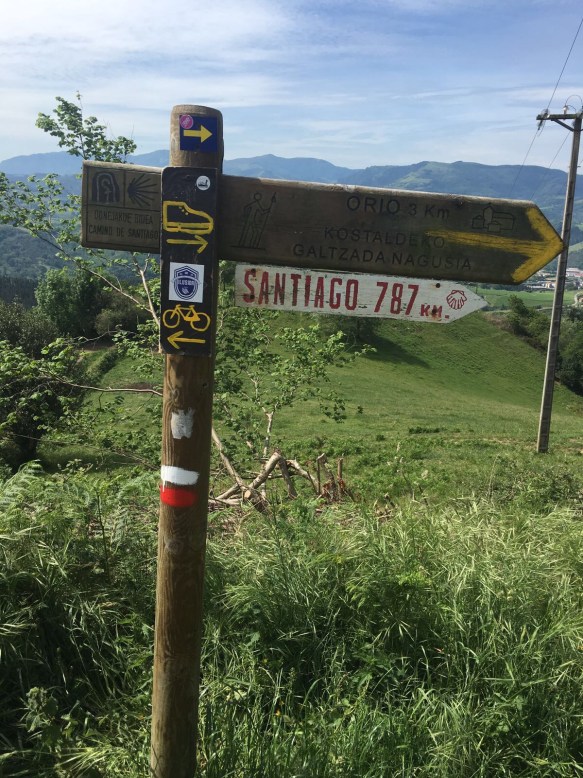
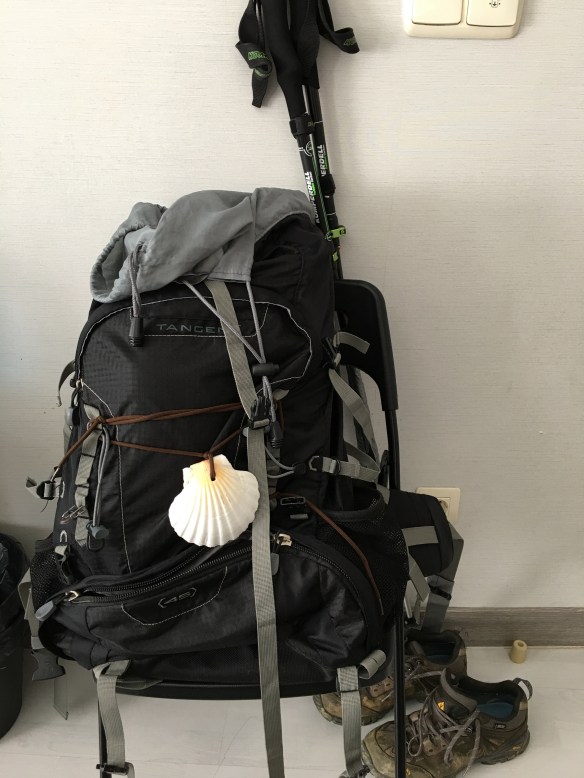
Before I took my first steps on the Camino de Santiago pilgrimage a couple of years ago, I first had to choose my shell—the symbol for St James the Apostle. Along the roadways and paths of the 800-kilometre trek across the Iberian Peninsula in northern Spain you can tell a pilgrim by the shell they have attached to their backpacks.

IMG_5341

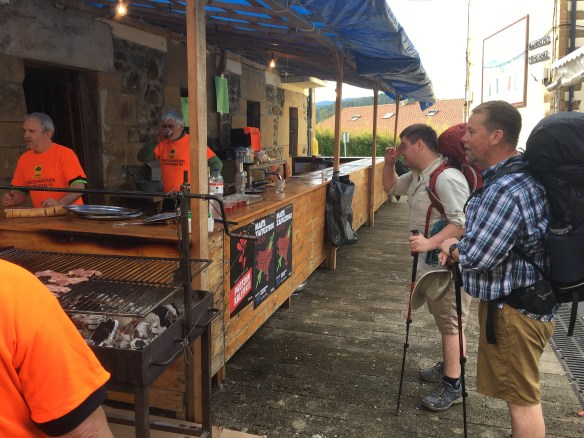
Wearing the shell attracted attention, often very positive. The group with whom I was walking came through a small suburb of the city of Guernica one Sunday morning. When we walked into the town square, we soon realized we were at the finish line of a marathon fundraiser for a local, special needs school.

There, some of the locals had set up large barbecues where they were grilling all sorts of meats for the marathon runners to enjoy after their race. We entered the square moments before the first runners crossed the finish line. But those preparing the barbecue called us over and without even asking our names or who we were offered us some of the delectable meats.

IMG_5308

When we expressed our gratitude, they asked us to say a prayer for them at the destination of our pilgrimage: the shrine in the city of Santiago, Spain—still some 700 kilometres away. I promised them I would.

IMG_5385

As you know, I didn’t make it to Santiago, falling ill to pneumonia and coming home early after only a couple of weeks on the trail. I remember struggling with my ‘failure’ to achieve my spiritual and physical goals. For one thing, I wasn’t able to offer a prayer in Santiago for those good people from Guernica who asked me to.

Was it worth it? Did my truncated pilgrimage do any good? Or, was the love and generosity those locals showed us and our receiving their gifts graciously, enough?

On Ash Wednesday, we begin a journey. And at the beginning of this journey, we are given a mark—not a shell, but the sign of the cross on our foreheads. It is a public act, a public ‘coming out’ if you will. By this mark the world will know we are Christians.

I hope you will wear your mark home tonight, wherever you go and whatever you still have to do—keep it visible. And see what happens. You might be invited into some meaningful, enriching conversations along the way. Some might even ask you to pray for them.

Go into the closet where no one can see you, instructs Jesus.[1]And pray to your Father in heaven who hears you, and will reward you for your faithful act. But even when we think our faith fails us? Or only for its visible success? Or only if we achieve our goals?

Arnold Lobel, author of his children’s book called The Frog and Toad Treasury describes the relationship of two friends and how they pass time together, explore the world together and support one another.

In one chapter, the action takes place in October. The leaves are falling. Frog decides to go to Toad’s house, secretly, and rake his leaves for him. “I will rake all the leaves that have fallen on his lawn. Toad will be surprised,” Frog says.

Now, his friend Toad has the same idea. Both manage to arrive at the home of the other unseen, ascertain that no one is home, rake the leaves, and return to their own houses unnoticed. On their respective ways home, however, a wind comes.

The wind blows and blows. The piles of leaves do too, so that the leaves are scattered everywhere. At the end of the day, neither Frog nor Toad realizes what the other has done, because both return home to leaves strewn across their yards. Both pledge to rake their own leaves the next day. Nevertheless, that night Frog and Toad are both happy when they each turned out the light and went to bed.[2]

What is more important: Our good intentions and motivation? Or, the outcome of our actions. Being authentic matters more than the results of our actions. The Gospel is not about the consequences, good or bad, of our good or bad intentions. The Gospel is not about achieving results and being rewarded for our good work, even with righteous motivation. In the end, the Gospel does not leave us stuck (and perplexed!) in self-centred piety, it points to what God is all about.

Normally when we hear the words of Jesus: “the kingdom of heaven is like …”[3]when someone does so and so, we think of the job we must do to enter that kingdom. And so, we imagine and want to be like that religious person, attending to ritual and prayer and acts of charity and justice our whole life long; the more we can do, the better.

Not that we don’t do anything or don’t keep trying. But we cannot ignore from these words of Jesus what Godis all about. I consider those scriptures about the kingdom of heaven as describing the character of God: A God who treasures each of us. And will stop at nothing to find us. And give up God’s very life on the cross—give up everything—in order to be with us and love us.

God is the one who sells all in order buy the field with the treasure buried in it. God is the merchant who sells everything in order to obtain the pearl of great value. Where God’s treasure is (God’s life, God’s mercy, God’s presence—in us), there God’s heart is also.

This is a fundamental message of Christianity. A message of One who comes into our life even in the messiness and despair of being human. Born a vulnerable baby to poor, teenage parents in a backwater town of Bethlehem. Living the life of a simple man from Nazareth, hanging out with fishers, tax collectors and prostitutes. Dying, even, the very humiliating death of a criminal, for all to see.

The message of Christianity is about a God who ‘sells it all’ in order to be with us, live in us and work in us, for the good.

God does all of this in order to know us, really know us. To love us. To grieve with us. To enjoy with us. To walk with us this often difficult journey that we undertake again this day.

And despite the difficult journey for which Lent is a metaphor, may the world in each step we take on the pilgrimage know we are Christians by our love.

And that’s enough.


[1]Matthew 6:1-6,16-21

[2]Cited in Lori Brandt Hale, David L. Bartlett & Barbara Brown Taylor, eds. Feasting on the Word: Preaching the Revised Common Lectionary Year C Vol 2 (Kentucky: WJK Press, 2009), p.23-24.

[3]from his later parables (or stories) describing the reign of God, specifically Matthew 13:44-45.

You are blessed

(We can better understand the beatitudes of Jesus[1] alongside the texts from the Hebrew scriptures assigned for today[2]. Read together in light of the imagery we find there, we begin to make sense of Jesus’ challenging words. Both the Psalmist and the Prophet paint the picture of a tree or shrub in a state of dryness, and in a state of blessedness, shall we say?)

6They shall be like a shrub in the desert, and shall not see when relief comes. They shall live in the parched places.[3]

Being in a “parched place” suggests the unfortunate state of our lives when misfortune and adversity come our way: when we fail at something, when we lose someone or something, or through circumstances beyond our control life hands us lemons.

But the problem is not so much that we are in the desert. It’s not the condition nor circumstance in which we find ourselves. When we are in a bad way, it’s not where we are.

When we are ‘dried out’, the problem is we don’t see the relief that comes our way. We have a vision problem:

We don’t perceive the grace, the gift, and the solutions that present themselves. We, for whatever reason, do not appreciate what we already have. We are blind to this grace.

The sight of which Jeremiah speaks is not merely physical, but of the heart—an attitude, an inner stance—that leans towards what is good within us and in the world around us. It is the intention of our minds and hearts to search for what is good, what is life-giving. And, we nurture this disposition despite what may appear to the contrary on the surface.

Of course, to search and yearn for something means there is something missing in our lives. It is to admit something is amiss. It is to be honest and open about our needs. The longing of the heart exposes our vulnerabilities. But also our hope.

7Blessed are those who trust in the Lord,
whose trust is the Lord.
8They shall be like a tree planted by water,
sending out its roots by the stream
.[4]

Our searching for what feels lost in our lives are like the roots of a tree that naturally expand, grow and spread out towards the source of life—in water, in light. It’s the search itself, the persistent, dedicated and committed journey towards the water that keeps the tree alive, even against the odds.

On the Washington State coast along the Pacific Ocean, you will find the famous Kalaloch Tree, otherwise known as the Tree of Life, or the Runaway Tree.Underneath the webbed roots of the Kalaloch Tree is the Tree Root Cave. Inside, a stream falls into the cave and flows out into the ocean.

69c053a6a3c63493189b8bdda3d7943d

(photo from pinterest.ca)

Many question how the tree continues to grow and the leaves continue to stay green. These questions have been asked so many times with no one really knowing how it keeps on going. So it became known to some as the Tree of Life. Because it continues to live by the stream and the ocean, even though where it finds itself is hardly the ideal spot for stability and longevity.

The Sitka Spruce tree, common along the lush, verdant Pacific coast under the constant influence of moist-laden trade winds, has lived a long time balanced precariously over these rocks. Even though it’s immediate circumstance is fragile, its roots are never far from the source of its very life.

There’s the story about a man searching for his keys under a street light. A friend comes by and asks, “What are you doing?” The response: “Looking for my keys.” The friend says, “Where did you drop them?” The man replies, “Around the corner but I’m looking here because the light is better.”[5]

It’s interesting that in order for the man to actually find his keys, he would eventually have to go around the corner into the dark to find them. But he starts under the light. He starts his search where the light is. Where his confidence rests. Where he can see. And he will go from there, on his journey.

Today, it is common for people to say, “I am blessed” when talking about good fortune. When expressing joy and thanksgiving about all the good in life, we say that “we are blessed.” And, on one level, it is true.

But when Jesus gives a list of characteristics describing those who are ‘blessed’, that’s hardly the case. We find it hard to attribute blessedness to the poor, to the downtrodden, to those who experience misfortune, bad luck, who are given life’s worst circumstances imaginable. We can’t easily make that connection when we associate blessedness with material prosperity, or excellent health, or good fortune.

In Jesus’ teaching, ‘blessedness’ is not absence of trouble. Blessedness, here, is not a reflection of good luck and prosperity. Blessedness, in Jesus’ sense, is not a result of peachy circumstances, fortune and material wealth in the way the word is used in common parlance today.

Rather, to be blessed is “to live through such opposition aware that the struggle is temporary”[6]and that in the end, God will stand by the faithful.

In Luke’s version of Jesus’ great sermon, Jesus stands not on the mountain (as is the case in Matthew 5-7), but on “a level place.” In the bible the word “level” often refers to places of disgrace, suffering, misery, hunger and mourning.[7]

Jesus does not ascend to some high place to give his teaching. Instead, he descends not only to where we stand, but he goes deeper. Jesus descends into the dark recesses of the most difficult, challenging corners of our hearts in order to teach, guide and lead us through. He comes down to that ‘level’.

To be blessed is to be that Kalaloch Tree on the precipice of destruction, and still yearn, search and reach for the water. To be blessed is to pursue the good despite all the bad that is evident all around you. To be blessed is to start that search wherever there is light, and go from there. To be blessed is to trust God to be there in the dark with you. To be blessed is to grow into God’s holy purposes despite adversity, setback and misfortune.

In short, to be blessed is to bear the scars of life proudly. It’s not the absence of difficulty, grief, pain, poverty and suffering that mark a Christian. It is following Christ in his way, despite the suffering that path brings. It is depending on God alone for life, because there is nothing else to rely on.

We thus journey on with hope, joy and trust, bearing witness to the goodness of God to sustain, to nourish and to grow us in the light of Christ.


[1]Luke 6:17-26

[2]Psalm 1; Jeremiah 17:5-10, according to the Revised Common Lectionary (RCL) for the Sixth Sunday after Epiphany, Year C

[3]Jeremiah 17:6 NRSV

[4]Jeremiah 17:7-8 NRSV

[5]Dr. Earl A. Grollman, “In Search of a Lost Faith”, Frontline (Winter 2019), p.4

[6]Ronald J. Allen, “Commentary on Luke 6:17-26” in http://www.workingpreacher.org

[7]Allen, ibid.

Even among the lost

I hear Simon’s despair, tainted with frustration and even anger, when he reacts to Jesus’ instruction to put the nets in deep water to catch the fish in Lake Galilee.[1]

“Master, we have worked all night long but have caught nothing.” He’s trying to make a point that there is no use to doing what Jesus asks of them. After all, they did all they could do. They employed all their resources, knowledge and effort into catching fish that night. But to no avail. Understandably frustrated, Simon scoffs at the futility of doing what Jesus asks. As if he knows better. There is not point to it all.

This is not the first time we hear Jesus say or do something that mystifies us. Earlier in this season after Epiphany, we witnessed Jesus being baptized. Jesus being baptized in the Jordan River often confounds our sensibility. Why does Jesus need to be baptized? Aren’t we the ones that need to be baptized? Not God!

So often we find salvation in what we do, and the meaning we attribute to what we do. In the church, we often do exactly what the crowds at the Jordan did: We come to worship, pray the printed confessions of sin, receive Communion and hope that these liturgical acts will wash away our sins. And make life right.

Then, we also have other programs for self-improvement, such as trying a new diet, cutting down on drinking and smoking, or finding someone who will love us just right. But these things are all futile for making real change in our lives, for making our lives right.

But Jesus walks into our lives just as he waded into the Jordan to be baptized by John. If Jesus was to walk into our lives today, he could just as well arrive at our job interviews, wedding receptions, or retirement parties. He could just as well stand in the long lines with us at the Tim Horton’s or sports venues. Jesus could just as well join us in all our driving around town to this and that – and the next futile thing we are trying to do in order to make life right.

Yes, I could feel the futility behind Simon’s statement—but we fished all night and caught nothing. Would Jesus step even into that despair?

When work seems futile. When other people frustrate us. When life seems pointless. When what we do appears to have little purpose, meaning or utility. When we fail. When despair sinks in.

Or, not far removed in the face of uncertainty, we clamber and clamor for the next shiny, new thing. We distract ourselves. We fall into mindless routine or stimulating addiction, to occupy our minds or numb them. And escape reality. Even just below the surface of seeming industry, there broils a fearsome anxiety.

Yes, I hear Simon’s despair. But I also see Jesus, right there.

What is Jesus up to here? Getting baptized. Going fishing with his friends. Going to weddings. Hanging out in the streets. What is Jesus up to here, living the life we all live?

For some reason, Jesus is taking on our lost condition. Jesus participates in our lives, doing what we do, engaging our routines, our work, our lifestyles. And, as we become more aware of Jesus closeness to us in our successes and our failures, we discover the Gospel truth: that salvation comes not because of our activity, our brains, our efforts. Salvation comes through a loving Savior who finds us and takes on our lost condition.

So maybe our job is not to explain the mystery, but simply to obey the seemingly pointless, futile instruction from Jesus. And act on it, as Simon did. “Yet, if you say so, I will let down the nets.”[2]

Visit the sick. Befriend the poor, the outcast, the refugee. Accompany the vulnerable, the weak, the dying.

After selling their large house where they called home for decades, Jack and Betty moved to a smaller two-bedroom apartment in town. Once settled in, they invited Craig, a church friend, to dinner in their new home. Craig was happy to oblige.

After all, on Sunday mornings they would sit together in worship. They didn’t say a lot. Betty might say something odd, but her countenance was so bright. Jack seemed always bothered by something, like he was scowling. But the couple was always together. And they liked each other.

Craig tells the story of his experience visiting Jack and Betty. He writes,

“Once I arrived at their apartment on the appointed evening, it didn’t take me long to realize that Betty had Alzheimer’s disease. It now seemed so obvious that I felt foolish for missing it earlier. Jack never let her out of his sight. It was then that I realized that he hadn’t been scowling for the last couple of years. He was just worried.

“Before I even had my coat off, Betty took me by the hand and led me to the painting above the sofa that depicted their stately old home. She became a bit more lucid as the stories of the old place tumbled out of her soul. I felt her squeeze my hand as she talked … [as if she were trying to say], ‘There is more to me than you see now.’ … Jack stood behind us and allowed his worry to ease a bit with a tender smile.

“Dinner was interesting. Betty couldn’t be allowed near the stove, and Jack wasn’t about to learn to cook. So he had asked their housekeeper to make them an extra-large omelet before she left that afternoon. When we were ready to eat, Jack put the egg dish in the microwave, then cut it into thirds and served it on Betty’s best china. For desert he brought out Klondike bars that we ate using the good silverware, which wasn’t easy. Several times during the meal, Betty got up and wandered around the apartment a bit. I was impressed by Jack’s ability to maintain our conversation, which was always of secondary importance to him, while always watching his wife.

“Throughout the evening I kept thinking that I needed to say something useful. After all … [isn’t that what we’re supposed to do with others?] But how profound could I be with Betty, whose mind was too clouded for conversation? What would I even say to Jack…? I could try, ‘Keep up the good work’ or ‘This must be really hard,’ but that would be so inane.

“After dinner, we left the old dining-room table and made our way back to the living room sofa, where I sat next to Betty. Jack took the chair across from us. I began to talk, trying to speak of …[relevant] things, but I wasn’t doing well. [As a Christian friend, from church] I knew that I was called there to be a blessing to them and … to witness to Christ’s presence among them. But how? I felt like a pilot circling above the clouds, looking for an opening to land. Soon Betty got up and wandered off again.

“When she returned, she stood behind the chair where Jack was seated and put her trembling hand on his shoulder. And as only old lovers know how to do, he reached up to take her hand as if it were the first and millionth time he had done it. I stopped talking as they both smiled at me.

“Well, there it was – the blessed presence of Christ. Then I knew that I wasn’t there to say a thing. My calling was to behold and be amazed. It was as if their mutual smile said, ‘Don’t you dare pity us. We are blessed.’ Beneath the gentle act of holding a trembling hand lies the mystery of … [love].

“In the end, this is as good as the calling to love can be. …There is just the holding of hands …”[3]

There is neither brow-wrinkled explanation nor fear-induced despair.

There is just the smile of God in the face of another.


[1]Luke 5:4-5

[2]Luke 5:5

[3]M. Craig Barnes, The Pastor As Minor Poet: Texts and Subtexts in the Ministerial Life (Grand Rapids: Eerdmans, 2009) p.97,103-105