
Rooted in the earth, rising to the sun

Recently I have been reading about people’s experiences on the Camino de Santiago — the eight hundred kilometre walking pilgrimage through northern Spain. This walk has become more and more popular among Christians of all stripes over the past couple of decades. It seems Christians around the globe are finding the pilgrimage a good place to work through personal issues, find focus in life again and seek re-connection with God, the world and themselves.

This past week I met with one such pilgrim from Ottawa who goes at least once a year to walk some part of the Camino; in fact he is leaving today for Barcelona. I sought his experienced advice for some practical considerations for the trek. His first rule of thumb: Pack only ten percent of your body weight. For me, that would mean no more that 20 pounds in my back pack — of all that I would need for the thirty to forty day hike. Twenty pounds is not a lot!

His second rule of thumb: What you wear on your back, put only one in your pack. That’s all. For example, if you are wearing a t-shirt, pack only one other t-shirt in your back-pack. If you are wearing a pair of shorts, pack only one other pair of shorts. And so on.

He laughed when he told me that about four days in — some one hundred kilometres into the journey — you find bins and bins full of personal items people left behind. These pilgrims had realized, thankfully sooner than later, that they were simply carrying too much — stuff they didn’t really need (extra shirts, pants, sweaters, books, jackets, bed mats, blankets, etc.). A final rule of thumb from my friend: If you do take something extra, then you need to have a good reason for it besides, “I might need it.”

This discipline reflects the quality of being able to let go. It can be described as a total self-surrendering, a giving up. The term “Kenosis” has been used among Christians throughout the ages to connote this sense of releasing that which we normally feel we need to hold onto tightly.

Fourteenth century German theologian Meister Eckhart said, “God is not found in the soul by adding anything, but by a process of subtraction.” (1) In our consumer culture, religion and spirituality have very often become a matter of addition: earning points with God, attaining enlightenment, producing moral behaviour. In the ‘prosperity gospel’ so popular in North America, we often hear the message that Jesus approves of you when your material and financial wealth increases; the more you have, the more in favour you are in God’s eyes.

Yet authentic, Christian faith is not about getting, attaining, achieving, performing or succeeding. The solution is not just “work harder” or “get more” of something. Our culture and economy, indeed, is based on more and more. Whereas true faith suggests: less is more. Martin Luther’s theology of Justification by Grace through Faith suggests the very same: We cannot by our own efforts achieve anything worthy of God.

So, stop trying. In fact, start doing the opposite: Let go of your pretence to manage your life according to the creed: Bigger and More is Better. Let go of a paralyzing negative body image. Let go of the inner talk that is putting yourself down, that tells you you are no good. Let go of attitudes of hatred against people who are different from you. Let go of those material aspirations that tease you into a false sense of security. Let go of being paralyzed by fear.

Instead, focus on what is essential. Appreciate that you already have enough, all that you need. When Jesus gives instruction in the Gospel text for today (Luke 14:25-33) he is travelling out on a public road, on his pilgrimage to the Cross. Remember, ever since Luke 9:51, he is already on the way to Jerusalem, his final destination. When Jesus is walking towards his death and resurrection in Jerusalem, he offers what sounds rather harsh to our ears. What is called-for here is a ‘single-mindedness’ that is needed when you travel with Jesus.

Discipleship is about being single-minded about the purpose, the goal and the mission of Jesus in the world. It is about prioritizing what is important to life in the public realm where culture, consumerism and a whole host of other distractions can keep us from this focus.

This single-mindedness demands that we think ahead, and anticipate the cost of our journey. Setting out on the road to follow Jesus requires at least a little forethought and reflection. This journey is not a light matter. Sit down and think about it a bit. Reflect.

There is not only the blessing of the assets promised, but there are the liabilities, too. Discipleship is not just one more hobby or extra-curricular activity to add to a well-rounded, prosperous life. It is not merely “a matter of pure passion and abandon” (2).

Followers of Jesus should count the cost, but also realize this is not just about counting the cost of a church building renovation or a church fund-raising project. The cost of discipleship, as Dietrich Bonhoeffer first coined the term, is about prioritizing our whole lives, not just our “church” or “Sunday morning” lives.

If someone told me a year ago that I would spend four days cut off from civilization, in the bush without cell-phone service, hauling all my food and everything I need to survive in a canoe that I would have to navigate through rapids and rocky, snake-infested portage routes — I would say they were dreaming … or talking about someone else.

Well, that’s precisely what I did last week, along the French River Provincial Park between North Bay and Sudbury. Fortunately I was not alone; I journeyed with a more experienced wilderness survivalist. 
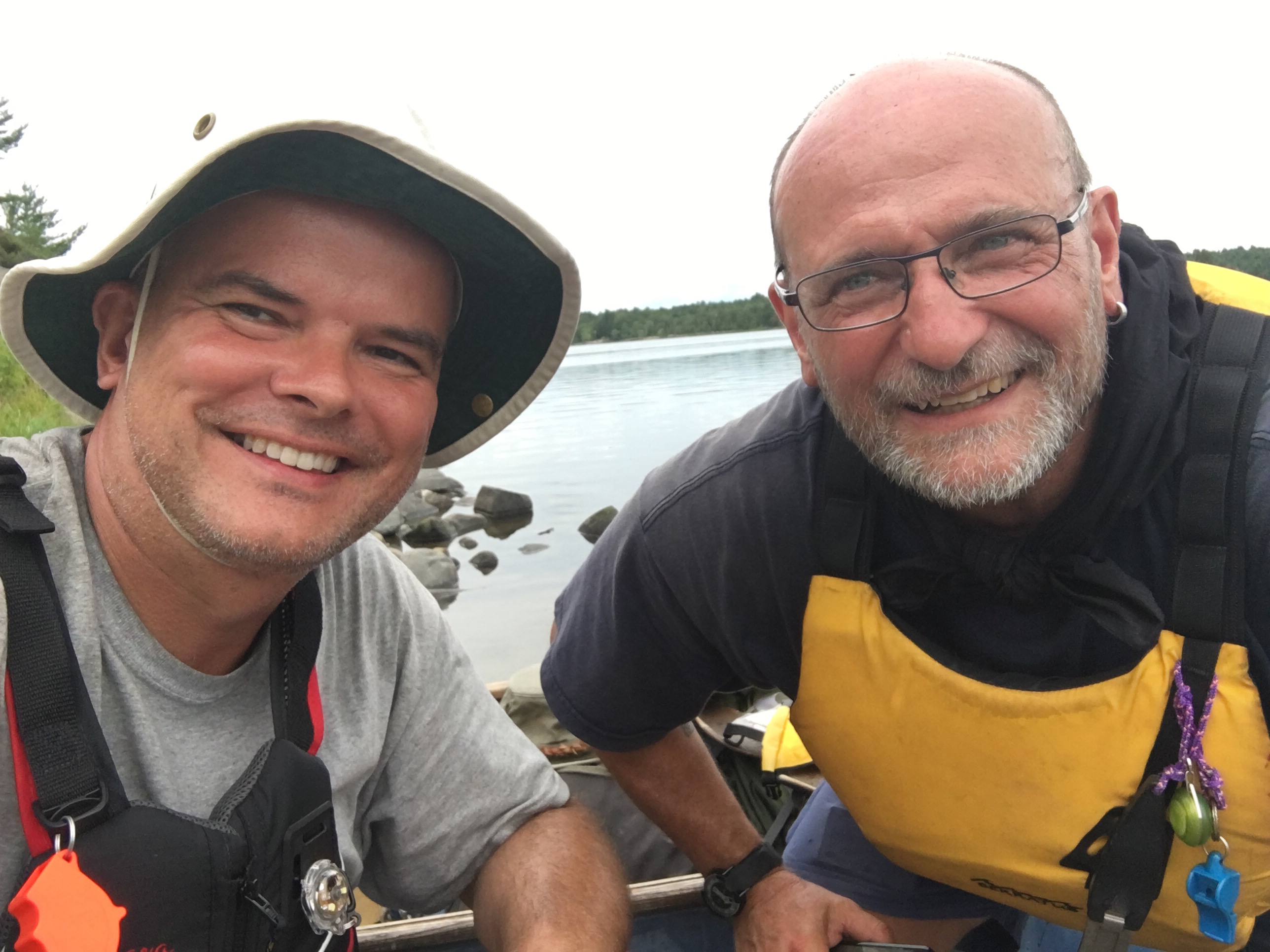
We ended up taking more than we needed. We could have packed less food, and less clothing. The exercise, nevertheless, was confident-building for me in realizing I really don’t need that much stuff.

Jesus says, “None of you can become my disciple if you do not give up all your possessions.”

To live life well, and faithfully, is to recognize one’s place in the world, and not to over-reach, over-extend, to be someone you are not — all on the basis of wanting more and more, bigger and better. To live faithfully, we are called to examine our dependencies, count the cost of it all, focus on what is important, and then make room in our lives for what is important by letting go.

A sojourn into the wilderness may indeed by the antidote to visions of self-aggrandizement embedded in the prosperity gospel message. Try doing without, for some time, what you may have taken for granted for too long. Try doing without what you always have believed you needed in order to live. Try Letting go. Releasing. Forgiving. 

This is not about doing away with personal boundaries. Letting go is not about condoning injustice or cruelty. Kenosis/letting go is not about being blind optimists, repressing or denying or not caring, or ‘giving up’ in frustration.

Forgiveness is a good example of letting go of the misery caused by holding on to the pain of resentment or holding a grudge. This kind of letting go brings a positivity that is based in honest struggle and prayer born out of compassion and love for self, the other, and God. The end result is a freedom and peace that cannot ever be realized through a program of simply working harder or getting more.

The German poet, Rainer Maria Rilke, wrote about the contrast between the law of gravity and the rising of the trees. He writes about the gift of letting go into a place of trust: Trusting that the gift in you is enough. So that you can rise up, rooted like trees: 

How surely gravity’s law,

strong as an ocean current,

takes hold of even the smallest thing

and pulls it toward the heart of the world.


Each thing —

each stone, blossom, child —

is held in place.

Only we, in our arrogance,

push out beyond what we each belong to

for some empty freedom.

If we surrendered

to earth’s intelligence

we could rise up rooted, like trees


Instead we entangle ourselves

in knots of our own making

and struggle, lonely and confused.

So, like children, we begin again

to learn from the things,

because they are in God’s heart;

they have never left God.

This is what the things can teach us:

to fall,

patiently to trust our heaviness.

Even a bird has to do that

before he can fly. (3)

In the poetry of scripture, the Psalmist describes beautifully the blessing we are, created in the image of God — so “wonderfully made” (Psalm 139:14). God would know intimately each part of our lives only if we were valuable to God and to the rest of creation. Otherwise, why would God care?

In other words, we are and have everything we need to enjoy and live to our fullest potential. We are beautiful. We don’t have to strive and strive to become someone we are not. We don’t have to ‘add’ anything to our lives to be well. In fact, when we have the courage to risk letting go, and “fall”, as Rilke poetically expresses, trusting in our “heaviness”, we will find a freedom and peace that will be the joy of all creation, and the glory of God.

We will live our lives at the same time rooted in the earth, and rising to the sun.

(1) Translated by J. Clark & J. Skinner, “Meister Eckhart: Selected Treatises & Sermons Translated from Latin and German with an Introduction and Notes”, Faber & Faber: 1958, p.194

(2) David Schnasa Jacobsen, Commentary on Luke 14:25-33 in “WorkingPreacher.org”, 2016

(3) Rainer Maria Rilke, “Rilke’s Book of Hours: Love Poems to God” translated by Anita Barrows and Joanna Macy, Riverhead Books: 1996, p.116-117; cited with permission in Richard Rohr’s Daily Meditation for August 28, 2016

No life insurance

It’s like the spirited game parents play with their young children.

I remember years ago when the kids were still in diapers tossing our little ones up into the air, and then catching them on their way down. What makes this game so delightful is to watch the expression on the face of the child. If you slow-motioned the activity and zoomed in on the facial reactions of the child at each stage of the ‘throw and catch’ game, you would see a contrast of emotions:

From the catch to the upward toss, a smile and squeal of joy; from the falling motion to moment of catch, a growing sense of alarm as the eyes widen in concern and fear begins to creep into the picture. But, then, again the catch. And the grin returns. And the game resumes.

Can you imagine being the widow in the Gospel story (Luke 7:11-17) who has just lost her only son? Having lost her husband is one thing. You think it cannot get any worse. Yet, as is often the case in life, it does. Now her son. She feels the sharp edge of grief once again. Perhaps more deeply for the child she gave birth to, and raised with all her mother’s love.

Not only a personal grief, but the prospect of living in extreme need. Being a widow in 1st century Palestine was usually a ticket to poverty and low social status. A woman’s economic worth was almost always tied up in the men of her household — her husband or eldest son. This was much more than personal, emotional grief. This was a complete life-style change, from top to bottom, in a heart beat.

After meeting Jesus, however, things change so rapidly. From a season of mourning and grief, to the astonishment and wonder of joy: Her son is no longer dead, but alive! No longer is she alone, vulnerable, a burden on society, worthless in the economy and social structures of the day. Now, she has her son back. She has family. And that means the world to her!

Although something has changed. This new thing is also scary. All who witnessed the miracle were filled with fear (v.16). What does this second chance at life mean? Things will be different now. No longer like the good old days.

The rapid and extreme change of emotions could make her feel like a yo-yo. Maybe life sometimes feels like that for you. From moments of exquisite satisfaction, pleasure and joy, to the dark caverns of grief, depression, loss, suffering, fear and pain. Life. Death. Life. Death. Life. Death. Life. 

In my first parish, which was in rural southern Ontario, burials were conducted (except during winter months) immediately following the funeral service in the cemetery right beside the church building. The recessional with casket proceeded to the grave side where the words of committal, prayers and scripture readings were offered. 

But then, the family stood by as the grave-diggers and funeral attendants lowered the casket, suspended up until that point on winches and ropes, down into the hole. In some cases, I had to assist by moving the casket into place as it slowly lowered. Once resting on the ground inside the hole, a family member used a spade to throw the first shovel-full of earth onto the casket — a symbol of the family participating in burying their loved one.

Today, especially in urban centres where funeral services are highly managed by market-driven professionals, most often the family leaves the grave-side before the casket is lowered and actually buried. I wonder about how the smallest of acts reflects our attitudes towards death and loss. 

Perhaps we can’t ‘go there’ emotionally so soon after losing a loved one and have to insulate ourselves in order to cope. The funeral rite therefore serves more as an anesthetic against the harsh reality of death and loss. I wonder: Does the experience and ritual of funerals only end up buffering the hard, emotional impact of loss?

Perhaps we are not used to ‘losing’, letting go, failing, surrendering, being powerless, vulnerable, at ground zero. We have little in life to practice this letting go before the final experience of losing a loved one. And perhaps healthy religion, as Richard Rohr claims, is about showing us what to do with our pain.

Is this too difficult an expectation of our faith? Because in making religion only about ‘feel good’ ‘warm fuzzies’ we might maintain our denial of life’s realities and only distract ourselves from truth. And that’s not what Christian faith is about — distracting us and keeping us from the rhythms of life, death, life, death, life.

Because in avoiding death, we also ironically, avoid life. And Jesus is about life. When we say this Gospel story is first and foremost about a miracle, we may be missing the point. It’s understandable that we do, because it is sensational. It captivates our imagination.

Focusing only on the miracle may just play into our fear and avoidance of death. As if to say Jesus performing this miracle was done for the boy’s sake. The enemy, death, was conquered! Therefore we can go on denying death. As if the boy will never eventually die an earthly death. As if to say Jesus performed this miracle solely to convince us to ‘believe’ in him — because no one else could do so (even though there were magicians/soothsayers and other miracle workers who performed incredible acts in Jesus’ day).

But the miracle, per se, is not the point of the story. Jesus raised the son from death not merely to show his divine power but to express his love and concern for the widow. He had compassion on her (v.13). And he couldn’t stand the thought that she would have to go it alone in a culture that marginalized the widow. Jesus brought the son back to restore a relationship, for living in the world.

God tosses us into the air. God throws us into the thick of life with all its challenges, disappointments, failures, weaknesses, joys, hurts, loves, pleasures and pain, satisfactions and accomplishments. God throws us into the air to experience fully this life we have been given. Life, death, life, death, life, death …

Then, to our happy amazement, God catches us again at just the right moment. God cares about what happens to us in our lives. God is interested in every minute detail and event in our lives — even those things we would rather cover up and hide in the darkest recesses of our hearts. God’s light exposes those secrets, even. We may feel vulnerable, challenged, unsettled for a time. And we may even wonder if we won’t just crash and burn on our way down.

Have faith in the One who’s tossing you. Because it’s part of life, for one thing. But most importantly, because God loves you and will quite unexpectedly be the One to catch you, at just the right moment.

The life-giving gap

Does a spring pour forth from the same opening both fresh and brackish water?” (James 3:11)

The writer, James, makes a case for integrity and authenticity in the Christian life. For us moderns, living in a day and age where how we look, our reputations, our social standings and our bank accounts seem to speak louder than anything else about who we truly are and what we truly want. Is our joy at living based on these ‘worldly’ values, when we are honest about it? 

It becomes particularly challenging for us Christians, whose value system is acutely counter-cultural. It becomes a real war, actually, to embrace the true source of our lives in a world of celebrity politicians and glory-seeking suburbanites. And I think, for the most part, we live a bifurcated existence. We say one thing — I believe in the God who asks us to bear our cross and follow him (Mark 8:34) — but so easily slip into a lifestyle that is really narcissistic, self-centred and selfish. The easy way.

It’s a rhetorical question. “Does a spring pour forth both fresh and brackish water?” In James’ mind, of course not. A spring will either bring forth, on balance, mostly fresh or mostly dirty water. The meter will lean one way or the other. 

Which way do you lean? In your work? In the way you invest? In how you spend your money? In how you spend your free time? With whom? In what and how you communicate?

In the Gospel for today (Mark 8:27-38), Jesus says some difficult, counter-cultural things about what kind of way Jesus — the Lord of Lords, the King of Kings, God incarnate, Almighty and Everlasting God — will travel the journey of life. And it is this God who beckons us to follow: in order “to undergo great suffering” (Mark 8:31). Really? That doesn’t sound right for a person claiming godly power!

In an upwardly mobile culture we are suddenly and shockingly presented with a downwardly mobile God. Naturally and understandably, through the lens of worldly value, we shudder. Peter rebukes Jesus. And it is in response to Peter’s communication that Jesus accuses Peter of being Satan.

The first lesson from Isaiah, the third chapter in the Epistle James and the Gospel reading for today are a call to discipline our speech — how we talk, and for what purpose. I would broaden this to say: How we communicate. The words we use. The body language we employ. They say that 70% of communication is non-verbal. I believe this truth is what prompted Francis of Assisi to say: “Preach the Gospel; Use words only when necessary!” It’s a cliche, but it’s true: Our actions speak louder than words.

We are called to pay attention not only to the words we use — important though they are, but our actions, our tone, our presence with another. We are called to pay attention to these details in assessing the quality of our relationships. Not to do so, to ignore and dismiss our attention to these aspects of relating, is evil. Not to hold ourselves accountable to what we say and how we say it to another is a satanic time-bomb waiting to happen.

The eighth commandment reads: Do not bear false witness against your neighbour (Exodus 20, Deuteronomy 5). This means, what we say about them. Of course, first we have to look around and ask: Who is our neighbour? On Meadowlands Drive West, in Nepean, Ottawa, and in Canada. Who are our neighbours today? Do we know their names? Who are they? And then, what do we say about them, to them?

In his explanation of all the Ten Commandments, Martin Luther makes clear these are not simply about ‘not-doing’ — not gossiping, not slandering — but even more important what positive behaviour we do for the sake of the neighbour. He writes that it is imperative that Christians should do all they can to protect the good name and social standing of their neighbours — and he lifts up particularly the “sins of the tongue” in this context. (Martin Luther, “The Large Catechism,” in the Book of Concord, ed. Robert Kolb & Timothy Wengert, Minneapolis: Fortress Press, 2000, p.420)

I can’t help here to think of the millions of refugees fleeing the violence in Syria. I can’t help here but think of the many ways Muslims are disparaged in the media in the West not only in the press, but also in those malicious forwarded emails that circulate “like a hydra with multiple heads: so pernicious and so difficult to stop” (Kristin Johnston Largen, “Inter-religious Learning and Teaching” Fortress Press, 2014, p.57).

James concedes to our human predicament. In the end, no matter how hard we try to do right by this, “no one can tame the tongue” (3:8). It’s as if the narrative of Scripture accepts the impossible capability of us, on our own, to get it all right all of the time. Even though Peter is in one moment ‘Satanic’ he is, in the next, the rock upon which the church will be built against whom “the gates of Hades will not prevail” (Matthew 16:18). Martin Luther’s well-known paradox can help us frame this apparent contradiction: We are simultaneously saints AND sinners (simul justus et pecator). 

This ‘word’ today may make us feel uncomfortable. It does, me. And, probably for good reason. Yet, there is good news. God speaks into this confused darkness of our lives. God speaks the Word of creation into this murky existence (Genesis 1). A Word of forgiveness, mercy and compassion. 

And the Word that God speaks sets up the endless harmonic of sounds in the world. And as we speak, and try to speak truthfully, perhaps what we are doing is far less hanging labels around the necks of the things of the world. And instead we try to find those divine harmonics and speak and act ‘in tune’ with that Word first spoken into silence and darkness.

The image I like of creation is that God first makes a great cave. And then breathes into it. Speaks into it. A Word. And from the cave the echoes come back. Differently pitched. Differently aimed. A world of Word. And we find our place in that world listening to those harmonics, trying to speak and act in tune with them. Not to speak and act from our will or our passion for control. But to speak because we want to join in what an earlier generation would have called the ‘music of the spheres’. (Rowan Williams, “The Spirit in the Desert” Meditatio Talk Series 2015 B Apr-June CD).

Those of us preachers and public speakers, especially need to think more about this. Paul says that the Body of Christ is made up of all parts, each important in their own right (1 Corinthians 12:12-27) — you are a hand, you a leg, you the eyes, you the foot. This morning, I am the mouth! And, like James, Paul also says that greater scrutiny and possible judgement will be brought upon those who speak (2 Peter 2:3;Colossians 2:20;1 Timothy 1:2-4). A timely word, perhaps, in a season of political campaign, mindless rhetoric and questionable election promises.

How do we speak in such a way that is authentic and true? Only by looking for the harmonics that that Word of God sets up. By refusing the mass pressures of culture. By becoming in our speaking as in our living a kind of invitation into the gracious harmonics of God’s world, into the resonances and echoes that are set up by that primordial utterance of God into the cave of creation.

Simone Weil used the concept of ‘hesitation’ to describe how to communicate in a healthy way For her, part of the essence of spiritual maturity was leaving the ‘life-giving gap’ between you, the act, and the other person (quoted in Rowan Williams, ibid.). Learning not so much to project straight away our ego compulsions into the other person; learning not so much to move right away into solving a problem on our own terms. But drawing away momentarily to listen for the sake of the other. And for the sake of the truth.

At the end of the day, we are called to check the compulsion to speak. And move back into a momentary stillness into which God’s draws us, and out of which God calls us to speak and to act with integrity and authenticity.

We would make James proud.

It’s ok to fall (5): God knows everything about us anyway

I don’t like being in the spotlight. Literally, too. I don’t mind being the centre of attention from time to time. But I must confess a high degree of self-consciousness, especially when I am supposed to be the sage on the stage.

I suspect many of you share my knee-jerk away from standing on a stage by myself feeling the heat of the light on my face, not being able to see anyone in the auditorium, and just knowing in the back of my brain that every little wrinkle, every little blemish, every little imperfection is exposed — fully. Are your hands sweating? Mine are, just thinking about it.

And that is why the Psalm for Lent — and often read on Ash Wednesday — is Psalm 51. “Create a clean heart in me O God and create a right spirit within me” (v.10) — we sing in our weekly offertory.  Before this petition, there is a quiet yet poignant confession, in verse 4: “Against you, you alone [O God], have I sinned and done what is evil in your sight.”

This, at first, may sound threatening and alarming. Yikes! God almighty has been offended by my sin! I. Am. Doomed! And there’s no hiding from God. Wow! We’re in for it, aren’t we? Never mind the friends, co-workers, family, spouse, people around me that I  have offended and hurt. They may not always easily forgive — but they’re not God! After all, “If you, O Lord, should mark iniquities, Lord who could stand!?” (Psalm 103:3)

Perhaps that is why we read in the Gospel for today (John 2:13-22) about Jesus snapping his whip and overturning tables in a righteous anger and prophetic impulse. This image of Jesus may leave us feeling a bit queasy. We may not like this image of Jesus. We may feel threatened by it. Uncomfortable, at very least. 

Why is Jesus angry? Jesus is angry for the injustice of the temple moneychangers taking up valuable room where the Gentiles are allowed to come and pray to God. And he is losing it, in the temple of all places! Entering the temple, Jesus discovers how deceiving appearances can be. While the place appears to fulfill its function, closer inspection reveals that the temple has forgotten its purpose.

I read this story at our mid-week bible study a couple of weeks ago, when we discussed the text of Jesus’ temptation in the wilderness. It is a re-telling of Dostoyevsky’s classic poem about the conversation between the Grand Inquisitor and Jesus:

“During the 16th century in Spain, at the very height of the Inquisition, Christ appeared unannounced in the streets of the city of Seville. As he went about caring for and healing the poor, the sick and the lame, the people began to recognize him and flock to him. An old Cardinal also recognized him …. and had him arrested!

That night in prison, Jesus had a visitor. The Grand Inquisitor entered his darkened cell and reprimanded Christ for appearing again and getting in the way of the Church’s work. ‘You are offered three tools to bring in your kingdom and rule the world. You were told to change stones into bread. Imagine the possibilities … bread for the hungry … people would have followed someone who fed them. But you refused! It was suggested that you throw yourself from the pinnacle of the temple and let God’s angels sweep you up before you came to harm. People would have been amazed. Everyone would have followed you. But you refused! And you were offered authority and power over all the kingdoms of the world. But you refused! In all this you wanted people to follow you out of love or not at all. And look where it got you.

‘Well, we have corrected your mistakes and we’re doing well. We cannot let you hinder what we are trying to do. And so, tomorrow, you will die.’

Jesus said nothing in reply. Rather, he looked into the eyes of the Grand Inquisitor for a long time and then walked over and kissed him. Oh how that kiss burned. The Grand Inquisitor stepped aside and let Christ escape into the night, saying to his back as he left, ‘Do not come back again.'”

We may squirm in our seats, now. 

This Gospel, I believe, pushes us to imagine Jesus entering our own sanctuaries, overturning our own cherished rationalizations and driving us out in the name of God. What kinds of ways of doing things have gotten us stuck in a rut — in our individual lives, and in the life of the church? It’s an important question to ask. Just because Jesus is ‘our’ saviour, doesn’t means “he is perpetually well-pleased with us knowing that he speaks for us, yes, and with us, but also to us and even, on occasion, against us.” (Paul C. Shupe, “Feasting on the Word” Year B Volume 2 David Bartlett/Barbara Brown Taylor, eds. WJK Press, Kentucky, 2008, p.96)

Well, there’s one thing we do I don’t believe Jesus could get upset about — at least, one activity of the church, one way of doing things. Know what that is? The potluck meal, of course! Everyone likes a potluck! Right?

You come, bringing your own dish to add to the table. But you come, also willing to try a little bit of everything, right? That’s what makes it fun! Doing this, doesn’t mean you will necessarily like each and every dish. Tasting a bit of other people’s gifts doesn’t mean you will run home and try to make what everybody else made. And, you certainly wouldn’t be rude to the people who brought dishes you weren’t too crazy about. At the potluck we practice being generous, adventurous, compromising, and kind to the other.

The potluck is an important symbol in the history and practice of being the church; I would say a guiding image on congregational life and how to work together. Because in the potluck experience, we practice being ‘other-centred’ rather than ‘self-centred’.

This practise reflects the ‘outward’ movement of church-orientation. It may start with a potlluck. It ought to end serving those who are hungry. The ancient word for church in Greek, ‘ekklesia’, literally means: ‘a people called out’. Called out to see what God is doing ‘out there’ in the world. Called out to act.

The movement is centrifugal. It certainly isn’t ‘convenient’. Sometimes we need to be ‘thrown out’ of our self-centred preoccupations with maintaining the institution of the church and the comfort of our lives, and out into the world where God is doing something. Where there are people in need.

The cleansing of the temple — though hard it feels sometimes to be judged, to be convicted of our sin, to be honest about our true motivations — this scene ends with the sinners being thrown ‘out’. Out, into the world, in order to get a fix on what God is doing. Out in the world, in order to find God, again. Out in the world, to get back on track with what Christian faith is really all about.

The story of the cleansing of the temple as John tells it points toward replacing the material ‘bricks-and-mortar’ temple with the temple of Jesus’ body. This is a theme that is picked up later again in the fourth chapter, when he tells the woman at the well that she will no longer worship God in any particular, physical location (John 4:20-23) but in “spirit and truth.” John is painting, here, a narrative foreshadowing Christ’s death and resurrection, and its embodiment in the Holy Communion which we celebrate every week.

Maybe it’s better that it is only against God that we have sinned. Because only God can fully restore us, heal us and love us despite knowing all the dirt in our lives. I think we know that human beings don’t have a good track record of forgiveness of others. Only God, in Christ, will continually offer to us his mercy and forgiveness, knowing full well how off-the-mark we are. And, for us to know that we can always return to the Lord our God, return to the table of the Lord time and time again — in all honesty, truth and humility, to a God who will not spurn us for our faithlessness and weaknesses.

We can fall on our knees, because nothing is hidden from God, and everything we need, God gives us — and then some. Thanks be to God!

Christmas: Jesus all grown-up in us

In the Monastery of the Holy Spirit in Conyers, Georgia, Mary — the God-bearer — is depicted in a magnificent rose window above the altar. What strikes me is the size of Mary’s womb. Mary sits in this glorious stained-glass circle with outstretched arms and a womb so large it contains Jesus standing as a grown man, with his arms open wide. (Trisha Lyons Senterfitt, “Feasting on the Word; Advent Companion”, WJK Press, Kentucky, 2014, p. 90)

Why the adult form of Jesus? After all, isn’t the Christmas story of Mary giving birth to the Son of Man about a baby Jesus? Was the artist of this stained glass window confusing metaphors?

Or, is there something more going on here worthy of our reflection?

After all, the historical Jesus was a man. But Christ was not his last name. “The Christ” includes the whole sweep of creation, and history joined with him, including you and me. We are members, each and every one of us, of the Body of Christ — this ‘mystical union’ we call it in our liturgy; Lutherans have sometimes called it the ‘invisible union’ of the church. Though we cannot claim to be the historical Jesus, obviously, we are, as Martin Luther described it, “little Christs”. We rightly believe in Jesus Christ — and both names — ‘Jesus’ and ‘Christ’ — are important. We, like Mary, are Christ-bearers.

The celebration of Christmas is not merely a reverie about a baby born in Bethlehem. We do the Gospel of Jesus no favour when we make Jesus, the eternal Christ, into a perpetual baby, a baby able to ask little or no adult response from us. That may have been the role of Advent — the season of preparing the way of the Lord, when we consider how to make room for the birth of Jesus in our lives. A baby image can be helpful, to start with: A sign of grace that results in a sweet feeling of love.

But, eventually, we have to grow up. A mature Christianity, today, receives the risen Christ in his fullness. In relationship with Jesus the Christ, there come expectations. God wants to relate to us in our adulthood — expecting a full, free, responsible, participatory (Philippians 3:10), cooperative (Romans 8:28) and mature (Ephesians 4:13) adult response from us. When we pray, “Come, Christ Jesus”, we are asking for our own full birth and transformation. God, in our growth, wants ultimately to have an adult relationship with us.

When we read in the Gospel today that we have the power to become “children of God” (John 1:12) we are not relinquishing any responsibility and mature engagement with our faith; being a ‘child of God’, a wonderful expression, simply indicates that God is God and I am not; being a ‘child of God’ describes a quality of trust towards God, a trust that despite any delusion on my part that I can somehow earn God’s favour. Because God still has faith in me. God will never give up on me.

But Christ has come! And it is the risen Christ in 2014, not the historical baby, of two thousand years ago! (Richard Rohr, “Preparing for Christmas” Franciscan Media, Cincinnati, 2008, p.8-9)

In our lives we have the capability already born within us to have room for our transformation. We are all ‘pregnant’ with the possibility of new life, becoming more than we are, growing up into the fullness promised to us in Christ. For God is with us and in us.

So, what does that path to our transformation look like?

In a modern painting of the manger scene by German artist Beate Heinen, Mary and Joseph hover over their newborn baby boy Jesus. There are no angels in the painting, neither ox and donkey nor any of the people, who in our imagination usually gather around the crib – shepherds and kings; just the three of them: Mary, Joseph and the child lying in a manger, which looks conspicuously like a coffin. The scene is set in a cold cavern like stable from which a winding path leads to a distant hill with three crosses. (Thank you to Rev. Thomas Mertz for this illustration)

In all the glory and celebration of the Advent and Christmas season this image sticks out like a sore thumb. As we celebrate the renewed life and hope for our world in Christ, the reminder to suffering and death creates a stumbling block. And it always has.

“How then is it written about the Son of Man, that he is to go through many sufferings and be treated with contempt?”(Mark 9:12) The words though spoken by Jesus reflect a nagging question on the minds and in the hearts of the disciples: “How can it be that our salvation comes through the suffering of God?” A few years later Paul wrote to the Corinthians that the message about the cross is foolishness (1 Corinthians 1).

You will notice that halfway between the manger and the hill in Beate Heinen’s painting there are three wanderers – a reminiscence of Jesus meeting two of his disciples on their way to Emmaus; still struggling and pondering the same questions, facing the foolishness of the cross.

As all believers they travel the road between the Good News of Christmas, the pain of Good Friday and the Glory of Easter. And it is not until they gather around a table, worshipping and united in the breaking of bread, that in the presence of God all starts to fall into place and their questions come to rest (Luke 24:13-35).

“The word made flesh” is the proclamation of the festive celebration of the Nativity of our Lord. The word made flesh! Meaning, that the Word — Jesus Christ — comes into our very ordinary humanity. But not the glory of humanity in all its splendour and might.

Rather, as the Christmas story reveals, Christ comes into the darkest night of our souls — in the outcast, rejected places. Christ comes into the impoverished places of our lives, and of humanity. As at least one theologian has put it (i.e. Gustavo Gutierrez), the Word made flesh should read: The Word made poor. That’s where Jesus is born and is at work. As Saint Paul put it, “For you know the generous act of our Lord Jesus Christ, that though he was rich, yet for your sakes he became poor, so that by his poverty you might become rich” (2 Corinthians 8:9).

As bread is broken around the Holy Communion, Christ comes into the broken places in us and into the world where healing is needed. The circle in the Georgia Monastery stained glass reminds me of the trajectory of my life — the promise of completion, wholeness, fulfillment is there, in Christ Jesus. I am continually being re-made, transformed; I am growing, in Christ Jesus. And so are you.

The rest of the world wants to finish Christmas this morning. But the true Christmas message that begins today does not allow us to keep stuck in our baby Christianity. But invites us to grow up — no matter how young we are — in a maturing faith, deepening commitment, and active Christian witness to the newborn King!

May we grow into a fuller, deeper celebration of Christmas in the days to come, as we ponder the mystery of God’s incarnation, God entering our humanity.

Dream-state

“Who are you?” the scrutinizing Levites ask John the Baptist (John 1:19-28). “Who is this man?” Because if John the Baptist is indeed preparing the way for the Messiah, he must be — according to tradition — the prophet Elijah.

There seems to be confusion in the ranks about his identity. If he is who he claims to be, then either their beliefs need to be changed, or else John the Baptist is a liar. ‘Who he is’, is a question of great importance.

I admire John the Baptist’s self-confidence. He does not seem to care who they think he is, much less their confusion. Note his rather curt responses to their questions: “I am not the Messiah”, “I am not”, “No” — He is not inclined to make kind, polite conversation. Neither does he care to make things better for them by clarifying.

And when he does say anything positive about his identity — he uses esoteric images from the ancient scripts: He is “a voice crying out in the wilderness”, meant to “make straight the way of the Lord” (Isaiah 40). This is not a clear, rational response to their very pointed questions that demand a ‘straight’ answer. What is apparent and important to John the Baptist, is that he knows who he is.

Who are you? Who are we? A glaring symptom of our confusion today, our disconnection from who we are, and our supreme fear and lack of confidence in our own identity — as people of God, as individuals and members of the Body of Christ — is the heaping layers of distraction with which we surround ourselves. Especially at this time of year!

It’s like we are walking around in a dream-state. Our dreaming disconnects us from who we truly are, and what is really important. On the first Sunday in Advent, we heard Jesus’ instruction to “Keep awake!” (Mark 13:37). On this third Sunday in Advent we sing the hymn: “Awake! Awake, and Greet the new Morn” (EvLW 242). It seems a prevalent theme in our Advent liturgy is to “wake up!”

Listen to the way Richard Rohr describes our way of life:

“It’s safe to say that there is confusion about what is needed for life and what is really important for life …. We have created a pseudo-happiness, largely based in having instead of being. We are so overstimulated that the ordinary no longer delights in us. [In our culture] … middle-class people have more comforts and securities than did kings and queens in the times when royalty flourished. We have become human doings more than human beings. And the word ‘rest’ as Jesus uses it [‘Come to me … to find rest for your souls’ (Matthew 11:28)] is largely foreign to us.”

What the Gospel says, is that simplicity “is the only place that happiness is ever to be found … Such a message is about as traditional, old-fashioned and conservative a gospel as we can possible preach, and it will always be true” (Richard Rohr, “Preparing for Christmas; Daily Meditations for Advent”, Franciscan Media, Cincinnati Ohio, 2008, p.27-28).

How do we wake up from this false, dream-state of distraction and over-stimulation? How do we wake up to our true selves? And how can we embrace a more simpler life of ‘being’?

These are the real questions I believe we need to be asking during Advent, and as we approach the Christmas season.

It’s not easy. It might take some discipline. Because we may be “Like people who have lived by the train tracks for years, we no longer hear the sound of the train. After years in church, we get used to the noise of Advent, to the message of the coming Christ, so much so that we no longer notice it. Or if we do, it has ceased to jolt us awake and has become instead a low, dull rumble …

Like the house hunter who noticed the train tracks on moving day, but later sleeps through the whistles and the engines that rush by, we can miss the thing in the season of Advent that might have been the most obvious and important at one time …” — the presence and love of Jesus coming into our lives again. (Lillian Daniel, “Feasting on the Word; Advent Companion”, WJK Press, Kentucky, 2014, p.66).

And this is God’s dream, coming to us. As Christians, we carry the mantle of God’s dreamers. This is our heritage — the dreams of the prophets and those who spoke God’s restorative vision to a people in exile, a people depressed, discouraged, downcast. And, who were given a vision — a dream — of a straight path through the wilderness of their lives.

To this day and age. If God could inspire Jacob in the desert with a dream of a ladder reaching down from heaven (Genesis 28:10-17), God can dream in us. If God could give guidance to Joseph wondering what to do with Mary (Matthew 1:18-25), then God can dream in us.

Twenty-five centuries after the psalmist expressed the words: “We were like those who dream…” (Psalm 126:1), Martin Luther King said, “I have a dream”. And with those words ignited a vision in the 20th century for justice towards an uncertain future. A generation later, (the first African-American) President Barak Obama, tantalized a nation, and the world, with his eloquent words of hope. Today, Malala Yousafzai inspires us to support education for women, in a dark and conflict-ridden world.

God’s dreams of a just and peaceful kingdom are born in the visions of the people of God, and in the heart of each child of God. In the end, it is not ‘my’ dream, maybe not even ‘our’ dream alone; it starts with God’s dream — when the wolf shall live with the lamb (Isaiah 11:6;65:25), and swords will be beaten into ploughshares (Isaiah 2:4).

The problem with dreaming is not the dream itself, necessarily, but whose dream it is. The problem with walking in a dream-state at this time of year, distracted by all the ueber- stimulation of our culture, is when it is our dream — my dream, alone, when I got caught up in my stuff so much that I don’t see the other; when I don’t see the other as God would.

Who are we? We are who we are meant to be when we bear witness in our very lives to the vision and dream of God. We are who we are created to be, when we let the light of God’s love that burns in our hearts, radiate out to a world shrouded in cold darkness.

And then, paraphrasing the famous words of Elliot Wolfson, God’s dream “dreams the dreamer as much as the dreamer dreams the dream.”

May God’s dream, dream in us.

The gift of the Beatitudes

There is the story about a little girl who was one day drawing a picture. She was so engrossed in her work that her mother asked, “What are you drawing?” “Oh, it’s a picture of God,” said the youngster. “A picture of God?” “Darling, no one knows what God looks like!” “No,” said the little girl, “but they will when I get through.”

Even though we know, deep down, that God cannot be put in a box of our own devising – our own imagination – we will still try. However imperfect our efforts may be at explaining God — and imperfect they often are! — we live, like the little girl, with the confidence and sometimes arrogance that says: We know it all! I am in control! And that’s good, to a point.

But then we grow up and life happens — we suffer, we mourn, things don’t go according to our plan — and we question God’s very own existence. Usually, our response is very individualistic. When we struggle with end-of-life realities, for example, I often hear questions about whether or not “I” am worthy for heaven. And people struggle, sometimes on their death beds, with their own, individual, deserving, as if their salvation hangs on their own merit and achievements, or lack thereof.

First, let me say that challenging events in our life need not be signs of God’s displeasure –presuming God is out to get us for our misdeeds. Rather, challenging events are invitations to go deeper into the truth of life and death. And therein we discover the wonder of God and God’s loving stance towards us.

The church has always understood our rising and dying in Christ as a collective experience, not an individualistic enterprise. All Saints Sunday which we acknowledge today emphasizes ALL the SaintS (plural) — not just one or two. Moreover, every Sunday when we celebrate the sacrament of the table, we connect with the “communion of saints in heaven and on earth”. We are part of the Body of Christ, members of something larger than us, individually.

In the reading from Revelation (7:9-17) we hear about “a great multitude that no one could count, from every nation, from all tribes and peoples and languages” (v.9). As members of the body of Christ we are primarily a people, not individuals that can be counted or measured. This truth is not meant to diminish our individuality but to encourage us in faith.

I pondered a photo recently taken of my godparents standing with my twin brother around the very font I was baptized in with him on November 30, 1969, about a month after my birth. Looking at the faces of my 5 sponsors now in their senior years, I was struck by how at my baptism — even though I couldn’t make those promises by myself at that time — the communion of saints held me in my faith and belief. Even though there are times in my life when my faith is weak, by myself, I can rest in the faith expressed by the larger faith community which holds me in prayer and membership. And this, to me, is of great comfort and encouragement.

Admittedly, it’s difficult for us to understand such a mystical and communal truth, in a highly individualistic culture bent on individual achievement and autonomy. But a life of faith in Christ Jesus invites us to consider reality and truth in a paradoxical way: That the poor are blessed, and so are the peacemakers, and those who mourn. In a world that lifts up those who achieve individual success and power by their own merit, the Beatitudes introduce a way of life that sees God in precisely the kinds of circumstances and communal expressions we would rather avoid, deny or at best tolerate.

Some have compared the 8 Beatitudes with which, in Matthew’s gospel (5:1-12) Jesus begins his teaching — what is called the Sermon on the Mount — with the 10 Commandments in the Old Testament.

This is an interesting comparison, on many levels. Someone mentioned in the lectionary study this past Monday how little airtime the Beatitudes get in our churches of late; much more emphasis is on the 10 Commandments. They remembered a time decades ago when the Beatitudes where enshrined on church bookmarks, wall-hangings, posters, cards in the narthex. They were all over the place. But no longer.

I wonder, is it because in recent times, especially, we have downplayed the subtle, albeit unpopular, aspects of the faithful life. Is it because we are uncomfortable with the humble truth of the Gospel of Jesus Christ — who gave up his whole life on the cross for the sake of all people? This is the essence of the Gospel which is captured in the Beatitudes, a way of life that faces the challenges of life head on and embraces those struggles as integral to, as the fodder of, the faithful life.

Conversely, the 10 Commandments are easier to comprehend, rationalistically, aren’t they? After all, here a bunch of rules to follow. And rules are easier to grasp than paradoxical sayings. Rules have cut and dry consequences. Rules are wrapped up in rewards and punishment. And we get that. We live in a culture that is driven by meritocracy.

Maybe it’s time we take another look at the Beatitudes. Because life happens. And when it does, we have some choice and a responsibility in the matter of how we will respond. We don’t have to search out suffering for suffering’s sake. The tough times come. And when they do, what will we do? How will we respond?

By saying, “We don’t deserve this? It shouldn’t happen to us?”

We can only go so far with the 10 Commandments — and the ‘Law” for that matter. Because while the Law provides a good order for living, no one individual can fulfill the demands of the law perfectly. The function of the law is to drive us to the throne of grace — to lead us, in the words of Martin Luther — “as beggars”, to God who is the starting and ending point of our lives.

One of Martin Luther’s greatest contributions to theological thinking is a paradox: he said that we are simultaneously saint AND sinner. Now, you can’t rationalistically explain that ‘both/and’ formulation — just like you cannot easily explain other sayings of Jesus; like, in order to find your life you need to lose it; or, just like you cannot explain that Jesus is both fully human and fully divine; or, just like you cannot easily explain the mystery of the real presence of Jesus we may experience with God in the Holy Communion. That is why the prayer of the day for All Saints Sunday emphasizes ‘the mystical union’ we share with the whole body of Christ on earth and in heaven. These are all precious paradoxes that describe — like the Beatitudes do — the fundamentals of our faith.

The gift of the Beatitudes — these fundamental teachings of Jesus — lies in their promise to us. What are the promises to those who courageously follow in the often messy, inexplicable, uncertainty of Jesus’ way of the Cross?

Ours is the kingdom of God, we will inherit the earth, we will be filled, we will receive mercy, we will see God, we will be called children of God, and our reward will be great in heaven.

Here is a wonderful, true description of faith that is full of promise, not condemnation; that is about hope in the midst of despair, not a fearful avoidance of reality; that is about affirmation and encouragement, not judgement and punishment; that is about blessing with an eye to new life.

Are we ‘divergent’?

Then Joseph could no longer control himself before all those who stood by him, and he cried out, “Send everyone away from me.” So no one stayed with him when Joseph made himself known to his brothers. And he wept so loudly that the Egyptians heard it, and the household of Pharaoh heard it. Joseph said to his brothers, “I am Joseph…” (Genesis 45:1-3a)

The Joseph story in Genesis paints an incredible picture of personal endurance through hardship, a journey which resolves into a final and satisfying conclusion. It is story-telling at its greatest. Those words of Joseph near the end of the book of Genesis, “I am Joseph”, mark a cathartic climax to his tumultuous life in Egypt. We can feel Joseph’s relief when he reveals his true identity to his brothers who had to this point no clue that he was indeed their long lost brother whom they had betrayed. These words signify the forgiveness and reconciliation that Joseph then expresses with his brothers and father, indeed with his extended Hebrew family and identity.

You see, since the time when his mischievous, jealous and evil-doing brothers sold Joseph into Egyptian slavery, Joseph was essentially a stranger in a foreign land: a Hebrew man of God living in the polytheistic religious culture in Egypt. What is remarkable, is that Joseph is able to use his gifts and street-wise talents to climb the ladder of success in this foreign culture, to the point of being appointed Pharaoh’s right-hand man during one of the greatest crisis facing the region at the time — a seven-year famine.

The main character, Tris, in the popular series of books by Veronica Roth entitled “Divergent”, struggles with her identity. It is no doubt to my mind why these books and movie are popular among young adults seeking to establish ‘who they are’ in this world. In this distopic vision of earth in the future, humanity is divided into five factions; each faction has a particular function in society: to advance knowledge, defence, care-giving, truth-telling and working the land. The goal of this culture is to keep people in only one of those factions throughout their lives. Of course, reality is not so cut-and-dried.

Young people are tested for their aptitude and then they need to make a choice, which faction they will join. Once that choice is made, they cannot change. Tris discovers she doesn’t fit the mold; she is ‘divergent’, meaning she has an aptitude — the gifts — to belong to more than one faction successfully. She becomes a threat to the leadership of the society who wants to stamp out all divergents and keep things in the society simple, clear-cut and easily controlled. Similar to Joseph, this, too, is the journey to discover and embrace one’s true identity.

But I believe it is a journey not just for young adults, but for all of us. Even in the church, as we week-by-week come here to re-connect with our religious identity. In next week’s Gospel reading (Matthew 16:13-20), Jesus himself asks his disciples, “Who do you say that I am?” The question of identity is crucial in our understanding not only of God but of ourselves in Christ Jesus, the Body of Christ. Who are we, as Christians and as Lutherans, in the world today some two thousand years after Jesus walked on this earth? And what is our purpose, our mission?

A while ago some of you expressed interest in exploring more our Lutheran history and identity — and how we communicate that identity in our Canadian context. I found a good summary of this from a retired professor from Waterloo Lutheran Seminary, who a few years ago gave a talk at Luther Hostel about Lutherans in Canada (“We’re from Away: The Lutheran Experience in Canada”, Robert Kelly, Luther Hostel 2011, pages 4-7).

Professor Robert Kelly asserts that Lutherans came here as immigrants who did not speak English. We came to Canada, essentially, as “Foreign Protestants”. This reality posed some challenges and reveals potential strengths in our identity.

Perhaps the most serious issue we face because of our history, Kelly writes, is how it has impacted our sense of mission. Most of our Lutheran churches began as groupings of people who shared an ethnicity and a language. Because our roots were in Germany and the Nordic countries our understanding of mission centred on making contact with immigrants from the old country who were already Lutheran. The British Government helped us with that in the 19th century by settling people of the same ethnicity and religion near each other. Our mission goal, then, was to get them into our congregations and keep them in the fold before some other group got them. Our mission was to make sure those who came as Lutherans remained Lutherans. We weren’t so interested in finding people who did not share our language and ethnicity. We were most certainly NOT a “church in mission for others.” Our mission was to care for ourselves and people like us.

Nevertheless, the fact that our ancestors came here as “foreign Protestants” who did not speak English is a strength we can build on. Kelly writes that “in a country that is defined by the diversity of its immigrants, we were one of the original groups that was neither French nor English. We have in our history an understanding of what it is like to come here and be perceived as different. In our historical experience is the possibility that we could relate to the present experience of immigrants from all over the world.”

Being “foreign Protestants” also put us a bit outside of the mainstream of society. This can be an advantage especially as the mainstream of society does not hold the values and beliefs of one of Martin Luther’s most enduring doctrines, “justification by grace through faith”.

That is, there is a tendency in the mainstream of our culture to blame the poor, the underprivileged, the minority, the unemployed or the victim for their situation. The roots of this negative attitude lie in the religious mainstream of British Protestantism: the idea that our prosperity in the world is a sign that we are the elect of God. It is this mainstream that promoted and still promotes the idea that we secure our place in the world through hard work and positive thinking. It is pretty much like the slogan at the heart of much of late Medieval theology: If you do your very best, God will not fail to reward you with grace.

Of course, Martin Luther had trouble with the basic idea that what makes us right with God is our work, our efforts to earn God’s favour. As Lutherans our history and theology has at its best opposed the mainstream approach. As Lutherans we say that our place in the world is not something we can earn, but is a gift of God’s unconditional promise in Christ. That is what the Lutheran Reformation was all about.

“Luther’s basic insight was that any scheme of salvation that is based in us and our ability to do our very best — whether that is defined as doing good works or believing the proper doctrines or hard work and positive thinking — is really no scheme of salvation at all. Rather it is a guarantee that our lives will either be wracked with anxiety or lived in the shallowness of self-righteousness. The ideology by which our society lives is precisely the ideology which Luther spent his adult life opposing” (Robert Kelly).

The Lutheran alternative in understanding the Gospel is that it is not about us and what we achieve, but about God and what God is doing. It’s about joining God’s activity wherever God is — which puts our preferences and comfortability at risk. The cross of Christ is the path of salvation, but it isn’t easy. The promise, of course, is that through the difficulties — like it was for Joseph — we do find our way.

Many Christians have stumbled at Jesus’ response to the Canaanite woman in the Gospel text for today (Matthew 15:21-28). It’s hard to make sense of first Jesus’ arrogant silence to the woman’s request; and then Jesus’ downright rudeness in essentially calling the woman a ‘dog’. This language is not what we expect of Jesus, it it? To be sure, we can explain the behaviour of Jesus in a way that we can easily grasp; for example the fact that Jesus talks at all to a Canaanite woman is a radical affirmation of her personhood (Dock Hollingsworth, “Feasting on the Word” Year A Volume 3, Bartlett/Taylor eds., John Knox Press New Westminster, 20011, p.361).

But perhaps the point of this Gospel text is simply to suggest to us the truth that Jesus and his Way does not always come through for us as we may expect. Jesus does not always conform to what we hope for. In other words, God is experienced in unexpected places and people. We cannot put God in a box.

We Lutherans have an important mission in Canada today. That mission is not, I believe, to find the lost Lutherans and bring them back to the orthodox fold. Rather, our mission — in the words of Robert Kelly — is “to be communities of people who speak the Gospel, the Good News of unconditional promise, clearly and who speak it to, for and with anyone who needs to hear it no matter where they come from or who they are.

Jesus does, in the end, grant the Canaanite woman her plea, as an example of Jesus’ radical inclusion of a Gentile. Here is another biblical appeal for the broad, unconditional reach of the Gospel of Jesus Christ.

“Our mission is to be communities of people who have heard the Good News of God’s promise in Christ and who live in the world as if that message is true. When we do that we have fulfilled the promise of our history” and our identity. We are being true, to who we really are.

Because it all matters to God

Last weekend, my family visited the Biodome in Montreal. Situated right beside the Olympic Stadium, it used to house the cycling competitions during the 1976 Summer Olympics. But in recent years it was converted into four distinct and self-contained eco-systems from diverse regions in North and South America.

My favourite was the eco-system from South America, for its lush, tropical environment: humid, warm, pungent air; broad leaf palm trees; and, a host of diverse animals – crocodiles, capybaras and scarlet ibis birds.

Our nine-year-old daughter’s favourite animal is the turtle. She spent a lot of time gazing down onto the mossy ground of the rainforest where the yellow-spotted turtle made its home.

When the guide asked us if we had any questions, my daughter wondered where the baby turtles were. The guide said that it was getting more and more difficult for them to obtain babies since they were very vulnerable in that stage of life; indeed it seems that natural selection is making the turtle an extinct species.

Without their fully developed shell in which the adult turtle could retreat to hide and keep safe from predators, the infant turtles are getting far too susceptible to a premature death and more difficult to protect. Who knows? Maybe the turtle with its shelled existence is going the way of the dodo bird.

The religious people in Jesus’ day felt they were up against a formidable predator in the Roman occupation of Palestine. The Gospel of Matthew was written about the time when the Roman legions were laying siege to eventually destroy the temple in Jerusalem in 70 C.E. and fetter out any Zealots who violently opposed the occupation.

With their temple under attack, the anxious people of God were asking questions of identity and purpose: Who are we and what are we to do? How can it be that God’s holy city and temple are occupied territory? What does this say about God’s relationship with us? How does God want us to respond to this dark and murky reality of life?

This is the social and political context to which Jesus spoke, on the hillside near Capernaum overlooking the Sea of Galilee. This Gospel text (Matthew 5:13-20) forms part of the famous Sermon on the Mount in which Jesus outlined the values and purpose of the kingdom of God “that is near” (4:17).

It is a situation not completely unlike our own. When you consider the history of Christianity over the past two millennia, we find ourselves today in a similar, challenging circumstance: the institution of the church is diminished to the point of demise in many quarters. Christendom, once mighty, powerful and dominant in the western world, is relegated now in our society to the point of obscurity and irrelevance.

Many are asking those same questions: Who are we, and what are we to do? How can it be that God’s nation is “occupied” territory? How does God want us to respond to this dark and uncertain reality of life?

It is a natural instinct for many who, when under stress and pressure and the burden of fear, retreat under the shell – as a turtle does. One response to the perceived threat is to strengthen the walls between sacred and secular. Against the wiles of the crazy, dangerous world ‘out there’ we escape into our private and safe domains of home, property and religious purity. And build a fortress. But is this the right strategy? Or, does it spell, like the turtle, possible extinction?

Amidst the threats against the practice of faith in first century Palestine and twenty-first century Canada, Jesus preaches another way.

Amidst these threats, Jesus challenged Israel to be Israel, just as he challenges us to be ourselves in faith today. Jesus did not say, “You must become salt of the earth by pulling yourself up by your own bootstraps.” Jesus did not say, “You must one day down the road when everything is perfect in the world again, or when you can somehow make yourself worthy of it, become the light.”

Jesus announced, to remind them and us: “You ARE the salt of the earth.” “You ARE the light of the world, right now, right here, in the world as it is, in your life as it is now with all its uncertainty, and in all its darkness.” We don’t have to hide nor retreat behind fortress walls. The solution is in somehow activating saltiness and brightness within us.

So, how do we do that? If there were to be only one way of doing God’s will; if there were only one way of being a Christian – then I’m not sure Jesus would talk in parables and present metaphors and images like salt and light – images open to a multitude of functions and capabilities. Jesus would just spell it out in the letter of the law.

But no. Salt and Light. It’s as if he is saying: Given all the uses of salt, and the various applications of light – how do you fit in?

When Jesus uses the image of light, he makes the point not to hide it under a bushel, but make sure everyone can see it (Matthew 5:14-16). But if others are to see the light, in what conditions do we let it shine? At the noontime of a bright, sunny day?

We will have to shine it in the darkness. After all, people don’t notice a light – whether a flashlight or candle – in the brightness of day. But at night. When all is dark. When you can’t see everything clearly. When the way is uncertain. Where shadows lengthen.

That’s where we are to go. Into places of darkness, in the world and in our own lives: Where people suffer hunger, homelessness and rejection; Where we harbor unhealthy secrets within our souls. This may not seem very religious. This activity may not be easy or make us feel good. But it is where Jesus calls us “to follow him”.

Annie Dillard writes, “You do not have to sit outside in the dark. If, however, you want to look at the stars, you will find that darkness is necessary.” (p.43, Teaching a Stone to Talk: Expeditions and Encounters, New York: Harper, 1992)

Why do we go into the darkness of the world? Why should we take these risks, and expose even our own weaknesses and vulnerability?

Because this world matters to God. All of it. Not some utopic fantasy of what it could be without all the stains of human sin splattered all over the place. But this world in all its complexities, challenges, difficulties, problems.

Just like the weeds and the wheat – what did Jesus instruct his disciples in telling that parable? (Matthew 13:24-30) – To leave the wheat and weeds together, and God will take care of separating out the two when the time comes.

This world matters to God. Our human condition matters to God. Otherwise, Jesus would not have come the way he did:

  1. Jesus appeared in the dust of first century Palestine. Often throughout the Gospels, the writers take pains to indicate the time and place of the event they are recording. For example, the Gospel of Matthew opens with a detailed account, name for name, of the genealogy of Jesus (Matthew 1:1ff). The Word became flesh. God entered humanity, in a specific time and place in history. Jesus fully embodied both human and divine. The incarnation was, and is, not some abstract notion removed from life on earth. Jesus was born into this world.
  2. When Jesus died on the cross, the veil in the temple ripped in half (Matthew 27:51; Mark 15:38), symbolically abolishing the distinction between sacred and secular for all time. No longer would religious life be divided into neat categories that separated the faithful from real life, from engagement with the world as it is.
  3. In the ancient (Apostles’) creed of the church we say we believe in the “resurrection of the body”; by placing value on our own bodies in following Jesus we claim continuity between this world and the next. That means that laughing, grieving, crying, caring, walking, working, making love – doing all those things that are part of regular living in our own skin – these are all sacramental activities. These activities, Jesus preaches, are the building blocks of the kingdom of God.

The stuff of earth matters to God. And that’s why we reflect the light of Christ in the darkness of it.

By going the way of Jesus to reflect his light in a dark world, we discover a great grace: that we already have and are all that we need and God needs, to fulfill God’s purposes for us and for the world, in this time and in this place.