Lift, and open the gates!

I reacted with sadness and sympathy looking at the photo of my friend’s dog whose entire face, chest and front legs were pierced with dozens — maybe even hundreds — of the sharp quills of a porcupine.
The photo was taken of the dog in the back of the car on the way to the vet, and she seemed stable enough — like the look of someone who knows they’ve been stung and know they just need to hold it together for a bit longer.

I felt sorry for that dog because it was simply being true to its nature — maybe motivated by a natural impulse to be friendly and play with another creature. Unfortunately, good intentions don’t always yield the desired results in relationships. Often, expressions of love and care are misunderstood. And the response can sting — just like this poor dog! I wonder if this dog will ever approach another porcupine again with such exuberance. 

On All Saints Sunday, Christians remember not only those who have gone before us who now taste and see the glory of God in eternity. We also reflect on the “communion of saints” on earth. And, like we did last Sunday during the celebration of the Reformation, we ask the good question: Who are we? Who are the saints? What qualifies a Christian for sainthood, beginning in this life?

Psalm 24 may suggest that no one living can belong to this glorious, virtuous group of people. Only those with clean hands and pure hearts who do not swear deceitfully (v.4) can qualify. A sharp tone of exclusivity rings throughout our tradition. Since I am not good enough, and will never be good enough, I have nothing good to offer. And so I will grovel in the dirt, turned in on myself and my sins.

Such negativity dominates our way of life. We don’t see abundance, we see scarcity. We don’t see forgiveness of sins as much as we love to talk about and dwell on our sinfulness. We don’t see the good, we see the bad. It’s a dangerous world out there, after all, and so we need to build closed, protective fortresses around us. And therefore, we get stuck in a self-centred, self-inhibiting style of life. Who am I to be able to offer anything of value? Let alone be counted among the saints?!

The bible’s poetry, today from the Psalms, offers insight into this problem. The Scriptures reveal a way of emphasizing what is important. Really important. We see this method most in the Hebrew scriptures — the Old Testament Psalms and prophets: Repetition.

Repetition of words and phrases underscores a sense of urgency or jubilation. In the Psalm for today — 24 — certain phrases are repeated. The context is a massive procession coming up the road to Jerusalem; God is returning to the temple being restored in the city of God. 

And as the people ascend to the walls, the cry goes out not once (v.7-10), but several times: “Lift up your heads, O gates! and be lifted up, O ancient doors! that the King of glory may come in.” (x2) The general image of ‘lifting up’, in fact appears almost half a dozen times in this short Psalm. What emphasis is being sought by the Psalmist, here?

The insistence of lifting up the gates mounts beyond the request to raise the gate just high enough, or the doors just wide enough, for the King of glory to enter and then to be slammed shut in the face of the others in the procession. Rather, the intent is for the gates to be raised so high above the walls that they will never need to be shut again. The intent is for the doors to be flung off their hinges, in order that the seekers and followers of the Lamb may follow him, redeemed and welcomed, into the courts of God. (1)

“The barriers to paradise, like the stone rolled away from the empty tomb in the garden, have been pushed aside to give us unfettered access to behold the smiling face of a gracious and accepting God, whose mercy, rather than our own merits, enables us to pass through the open door.”

We need to remember and appreciate who our King of glory is: A man, named Jesus, who encountered in his short life on earth all that we must endure and suffer. Our God is a God who became one of us in order to fully appreciate our own station in life. God understands our human weaknesses, suffers and endures with us on the road up to Jerusalem, and longs to welcome us into the divine presence. 

Ours is a God who bears the scars and wounds of crucifixion, even in his resurrected form. God is one who identifies with us seekers and wanderers who bear the scars of life, the woundedness of sin — and yet who long for something more: a deeper communion with God and the saintly procession going to Jerusalem together.

If we want to know God, we must know and accept ourselves; if we want to accept ourselves, we must know and accept God. Who are we? Well, perhaps we first need to ask: Who is God? Clean hands, a pure heart, a humble spirit, integrity and honesty — these are infinitely more difficult and subtle a list of characteristics suggested by this Psalm than the mandates against theft and adultery and the taking of another life (as in the Ten Commandments).

The qualifiers for sainthood are not a cut and dry check list easily accomplished like completing a shopping list. Rather, the qualifiers for sainthood are worked out in a life-long journey and sometimes seesaw struggle with the One who despite bearing the scars of suffering is the only One with clean hands and a pure heart.

Who are we? Well, then, Who is God? In Jesus, God is the One who welcomes us all into the holy city, whose cry goes out to lift up those gates — I mean, really lift up those gates — forever — in order to let in that whole procession of rag-tag, diverse, wounded, broken followers!

Knowing who we are, appreciating fully the grace and acceptance of us by a God who knows us, what do we have to lose? We can offer what little and what much we have to help others. We can use the gifts we have been given for the sake of the other, and with others, on this journey. We don’t have to be afraid. We can take the risk to reach out — not worried about the results but only convinced of the value of what we do.

Whether we have been stung by the quills of disappointment; whether we have been hurt by the failures of our lives; whether we have been weighted down by the pressures of performance in work and play; whether we endure the pain of physical, mental, emotional illness; whether we grieve through the losses of life — we are still on the way! And will always be!

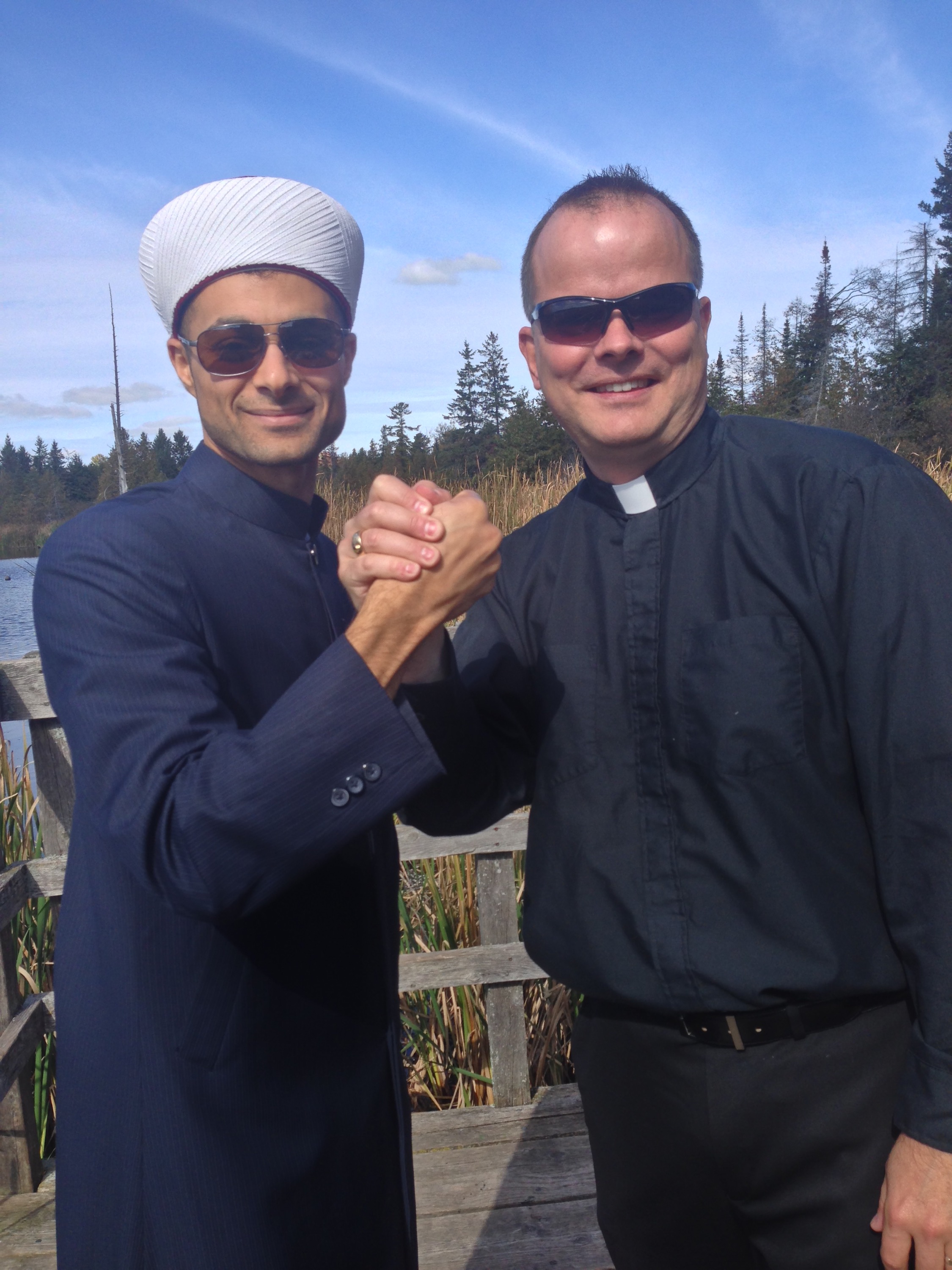
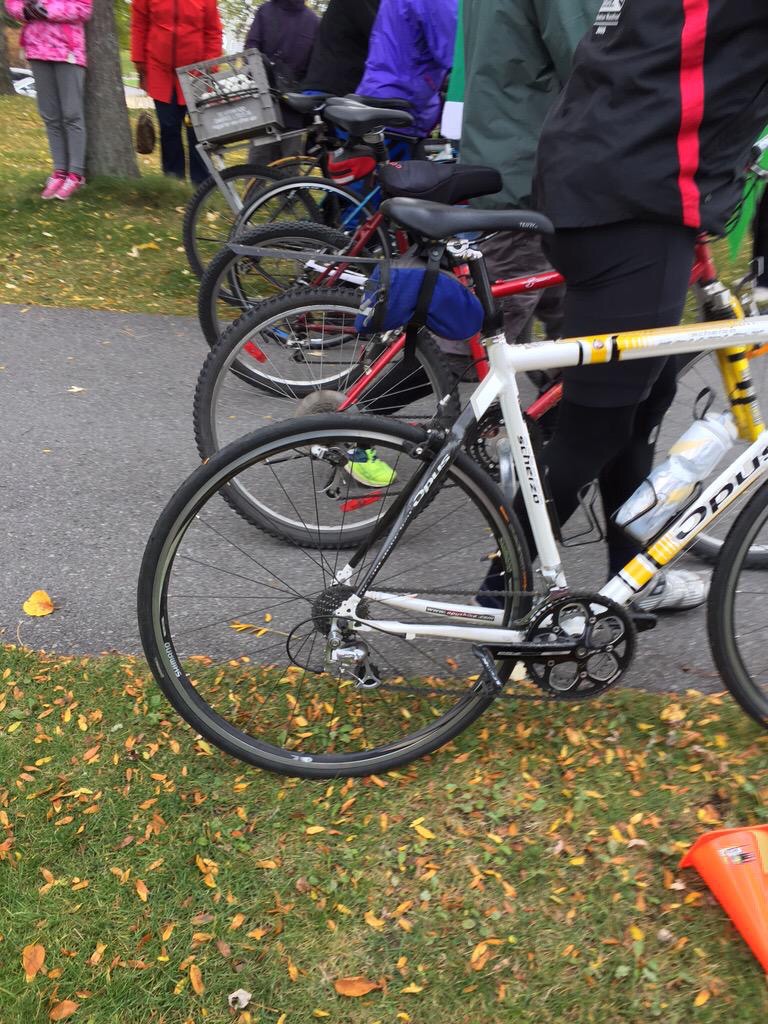
The highlight for me during the clerics cycling challenge (clericchallenge.com) was the finish line, when we all crossed together. This experience symbolized for me what the culture of Christian community ought to feel like and be like.

   
 We are part of a holy procession led by the King of Glory whose destination is sure. We have nothing to lose. If God’s grace is extended even to the generation of seekers (v.6), then we have nothing to lose. If what we are about is not a competition, then we have nothing to lose. If we don’t need to find fault in the other to prove our own self-worth, then we have nothing to lose. If it’s not about one-up-man-ship, then we can go for broke and not worry about it. If we don’t need to question who our Saviour is — who already accomplished for us our salvation — we don’t need to doubt our final destination. Then, why not share now what we have with others on this road?

All the saints on earth, despite the scars of life we bear, have gifts to share with other seekers on that journey. What gifts and blessings of God reflect in your life? In discerning this, remember: It’s not up to you alone! We don’t need to be perfect. We gain the gates not by our own merit or even hard work. Ours is the victory only because of the One for whose reason the gates are lifted in the first place.

Thanks be to God!
(1) — Michael Morgan in David L. Bartlett & Barbara Brown Taylor, eds. of “Feasting on the Word Year B, Volume 4” Fortress Press, 2009, p.228

You shall see the light

Jesus commanded that we shall love our neighbour as ourselves (Matthew 22:36-40). This commandment motivates me to participate this afternoon in the clerics’ cycling challenge (www.clericchallenge.com), initiated by Imam Mohamad Jebara.

  
Practically, then, what Jesus’ commandment means is that if you love someone, you want to know something about her or him. You want to know who she is, what he values, and how they orient their life. If you love someone, you take the time to talk to him, get to know her, and in so doing, you share yourself as well. 

  
Love shows itself in attention to another, in accepting another on their own terms — yes, and in a willingness to learn something new, to think about things in a new way, and to grow together in friendship and harmony. 

  
When I say Christians are called to love their Jewish or Muslim neighbours, for example, I mean we are called to develop relationships of mutual affection, understanding, and appreciation (Kristin Johnston Largen, “Interreligious Learning and Teaching” Fortress Press, 2014, p.59). Then, we love our neighbour as ourselves, thus fulfilling Jesus’ commandment.

  
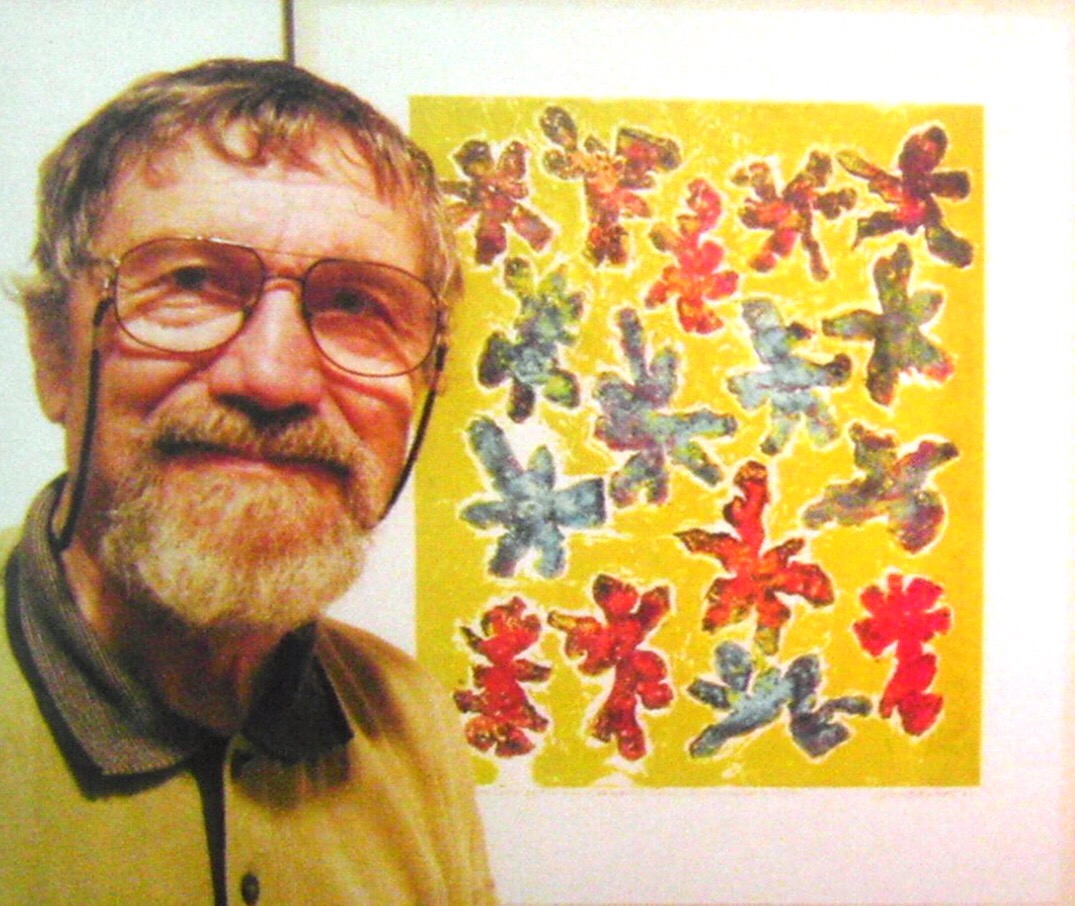
I had the pleasure of viewing some artwork this past week at the Rothwell Gallery on Montreal Road in Ottawa. The Gallery is presenting until October 24th the work of the late Leonard Gerbrandt (1942-2010) who travelled the world and created beautiful impressionistic watercolours and prints especially about the structures of various land and waterscapes. I was given a personal tour by Ute, his spouse, of the hundred pieces or so displayed in the gallery.

  
When we began the tour, she asked me to guess what colour appears and is prevalent in the vast majority of his art. With a twinkle in her eye, she confessed that this particular colour also happened to be his favourite. And so I went to work. At first, I suggested it was the earth tone greens, even maybe the rust, terracotta and orange/reds. No. No. And no.

As we reflected on one specific piece of art I marvelled how Leonard mixed the blues to distinguish sky and sea. Ute smiled, then said, it was blue indeed. I quickly travelled through the gallery looking anew at the paintings. And you know what? It was true! Now, I could see it — blue indeed found its way into almost all his paintings. Why didn’t I see that at first?

Blue, after all, is my favourite colour too (No political association, though!). And then I pondered further why I couldn’t see what had always been my favourite colour. Had I been distracted by the flashiness of other ‘colours’? Did I take ‘my colour’ for granted? What were ‘the blocks’ inside of me preventing me from seeing what was most important to me? Pride? Anger? Fear? Shame? Greed? Why couldn’t I appreciate fully the beauty that was staring me in the face, for me?

Of course, colours would not exist without the presence of light. In fact, it is how the light is represented in a work of art that brings out the textures and hues created by the paint brush. I also believe that art, like music, serves to reflect back to us an inner state — and that is why art and music can be so powerful conveyors of meaning and truth about ourselves and the world at any given moment in time.

The living Jesus is with us, and in our hearts through the Holy Spirit. The love of God propels the Spirit to move us in the the way of Jesus. And yet, we block our sight. We can’t see the light. What are those blocks that keep us from living out of our nature that is being renewed day by day? What keeps us from loving our neighbour? Is it fear of the unknown? Is it a shame that is deeply imbedded? Is it the fire of anger, the pain of regret, the poison of hatred, the paralysis of mistrust?

“Out of his anguish he shall see light” (Isaiah 53:11)

This phrase comes from a larger so-called suffering servant poem from the prophet Isaiah. Christians have read Jesus Christ into the role of the servant even though the text was originally heard among the people of Israel hundreds of years before Christ. The ‘servant’ could refer to the people as a whole suffering in Babylonian exile, or to a specific individual (i.e. Persian King Cyrus /Isaiah 45) who liberated the Israelites and led them home to Jerusalem.

This exegesis is important and we need to tread carefully in working with sacred texts that we share with our Jewish neighbours. We Christians know the sacrifice of Jesus on the Cross for our liberation, indeed for the whole world. Jesus fits the suffering servant-narrative from Isaiah. Let’s work with this.

The anguish Jesus experiences in his suffering and death reflects a God who is fundamentally relational. And God the Father, the Son and the Holy Spirit relates to us in our very own humanity. Thanks to Jesus who showed us the way not just in his divinity but especially in his very own humanity. ‘Anguish’ after all, is a human emotion grounded in love. That is, “to anguish over the loss of a loved one” (online dictionary definition).

Not only does Jesus know our suffering in a shared humanity, he feels for us because of God’s intense love for us. The author of Hebrews is therefore able to describe Jesus as the ultimate high priest, who “is able to deal gently with the ignorant and wayward, since he himself is subject to [this] weakness” (5:2). In short, Jesus helps us “see the light” because of God’s deep anguish-filled love for us. God grieves losing us to our sin, and will not stop short in going the distance — even sacrificing his own life — so that we too will see things as they truly are, in the brilliance of God.

In prayer, 14th century Christian mystic Julian of Norwich reflected the divine stance: “I am light and grace which is all blessed love.” May our words and deeds reflect the light of Christ to our neighbours, in all grace and love.


Slave to none, servant to all

Especially at the beginning of a new school year, the gospel story of little children sitting on the lap of Jesus warms my heart. This saccharine image speaks to Jesus’ welcoming the children as we would welcome them to church and the start of a new year of Sunday School programming. 
We tell ourselves, “So should we be towards the children, like Jesus was.” Or, “We should be like the children.” Here perhaps lies the genesis of any motivation and focus of children’s ministry in the church. This act of Jesus witnessed by the bible’s words becomes our authority for action.
Indeed, the Gospel text for this Sunday (Mark 9:30-37) is about God’s view on power and authority. How does authority work, in the kingdom of God? What does it look like?
And it is here, admittedly, we Lutherans get into trouble. We say that authority for a congregation in the Roman Catholic Church is the Pope. We also say that authority for a congregation in the Protestant tradition is the Bible. For Lutherans, it is a former pastor! 🙂
This Gospel story is more about Jesus’ stance vis-a-vis the powers-that-be in society. This is revolutionary and counter-cultural. He makes irrelevant the political-economic-cultural pecking order, as far as the kingdom of God is concerned. The root of the Greek words “servant” and “child”, spoken in the same breath, is virtually the same (pais/paidon); on the basis of vocabulary alone, those who first received this story were principally hearers and not readers. Mark’s Greek-speaking audience would have made the close connection between servant and child. Neither had any real social value.
Therefore, this story describes more a stance towards people in general, an attitude and approach for relating to those who do not have power, who are of particularly low social status. Contrary to what the economic and political powers espouse, Jesus assigns worth and importance to every person (Sharon Ringe in Feasting on the Word Year B Vol 4 eds. David Bartlett & Barbara Brown Taylor, WJK Press 2009, p.97).
This is no longer a sweet, warm-fuzzy message as much as it is a direct stab at our social hierarchy of values. And the disciples know it, deep down in their hearts. But they are afraid. In their silence, they betray their weakness and fault in not ‘getting’ Jesus nor willing to ‘go there’.
Jesus didn’t come to pander to power. He didn’t come to play the game. He didn’t come to compete in the smorgasbord of religions in the first century Palestine. He didn’t come to prove that he is right and everyone who doesn’t agree with him is wrong. 
He came to show that God loves everyone, including the lowly servants and children.
Jesus came to turn on its head the regular way of thinking about power. He lifted up children and servants as those who receive the grace and love of God, not just those deserving it because they happen to be higher up on the social pecking order. 
We know how Jesus’ earthly story goes. Jesus was a victim of his ministry of unconditional love, compassion and healing. And how did that go, for Jesus? The Cross. To say he was misunderstood is an understatement. Even his closest friends didn’t understand, or were too afraid, to face the truth of their hearts.
Perhaps we may take from this some measure of comfort, in tough times. For example, if you are ‘thrown under the bus’ by your closest friends, when you are misunderstood, when you are derided and put down for trying to do right, maybe you are indeed on the right track?
On the other hand, when you become puffed up in your righteous defence of the status quo of your life, when you engage in defensive, combative and competitive stances against those who differ — then, well, how is this the way of Jesus? It is not. It is a way, to be sure, heralded by the prevailing culture of human achievement, reputation-defending self-righteousness, one-up-man-ship and glory, yes. But far be it from being the Christian way.
We are asked by the Gospel message to examine our relationships with those in society with little economic or social value. How is our relationship with the physically disabled, the mentally ill, the refugees and newcomers to Canada, young people without direction, those who live on the streets, the poor, the Indigenous people of this land? 
I listened recently to how a graduating university student was deciding which job to take. Upon graduation he was offered a high-paying job from two different well-respected companies at the same time, one in Chicago and one in New York. The student sought advice from his pastor.
“Which job should I take?” he asked. “Both offer similar compensation. But I’m torn as to where I should go — Chicago or New York. Both have pros and cons. What do you think, pastor?”
The pastor hesitated, for a moment. Then he said, “It’s wonderful you have been given the privilege of a job offer. Many young people today don’t have one, let alone two. You are very fortunate.”
“Yeah, right,” the student responded. And quickly added: “But where should I go?”
“I really don’t know,” the pastor mused. “Does it matter?” It’s usually at this point in the session that people realize why pastoral counselling is free. 🙂
I think we tend to lose energy, even waste it, on these kinds of first-world problems. After all, the truth is there is no place we can go, no decision we can make that is out of the reach of God’s grace, love and healing (read Psalm 139). Where there is a fork in the road … take it! 
In most, if not all, of our dilemmas do we acknowledge that no matter what we decide, even for less-than-stellar motivations or for high and righteous ones, God will not abandon us? Because God’s grace will not come up short, ever.
In the end, the Gospel story of Jesus welcoming little children comes to us not a word about how we should act. It’s not primarily about us serving others. Rather, the Gospel is about Jesus serving us.
Jesus asks each of us: How can I serve you? Jesus reflects God’s favour towards us, and all people. Jesus will not do what we so regretfully and naturally fall into — a tit for tat food fight with whatever first-world problems we wrestle, about which we complain, and over which we fight for ‘the advantage’. That’s not what Jesus is about. 
At the same time, Jesus will not stop at our human divisions. If you are at the bottom of the ladder, Jesus will come to you. If you are at the top of the world, Jesus will come to you. Jesus will make the ladders of our lives irrelevant. These ladders of success, upward-mobility and power are nonsense in the kingdom of God. Jesus comes to us all, and asks us — “I will welcome you and serve you. What do you need today, in order to follow me?”

Seeing Jesus

Jesus says, “the person who sees me and believes will be raised up” (John 6:40).

If I polled the assembly gathered here this morning and asked you to raise your hand if you ‘believed in Jesus (or God)’, my guess is I would get a decent showing.

But if I asked you to put up your hand if you recently saw Jesus, I’m not sure I’d get the same kind of response. If you did raise your hand to that question I might look at you with some degree of skepticism. I might not take your statement at face value. I would want to ask you more questions.

Seeing Jesus sounds like a conversation for the mystics and contemplatives. If our faith is limited merely to a conversation about the historical, biblical Jesus, we will be challenged at this point of acknowledging the living, immanent Jesus who is also always more — an unfolding Presence in the course of all history.

Where do we see Jesus? This is an important question. How can we see the living, resurrected Lord in the world and in our lives today? How can we account for the presence of Jesus?

There is the problem of sight. Here, Jesus obviously is not talking about physical vision. Otherwise why would he even say, “the person who sees me …”? Of course the people to whom he originally spoke these words standing on the sandy, rocky ground in first-century Palestine saw him. Jesus is talking more about a perception of the heart, mind and soul — an internal dynamic.

If you follow any of my social media sites online, you might have noticed there recently some sunset photos over Lake Huron where my family vacationed over the past couple of weeks. Aside from the inspiring sunsets, this is not what I remember the water to look like:


Normally, as I recall from my childhood summers spent on these shores, Lake Huron is fairly active. More days than not you would see a lot of wave action, and white caps carving up the horizon and rolling in over the surf. You would feel the constant high winds buffeting the tree-lined shore.

For the fourteen days we lived by the shore last month, however, the Lake was mostly calm. The water was placid, where there would be no more than a ripple on the surface and a splash on the shore line. In fact I would be hard pressed to say there was more than two days of wave action that came close to my childhood recollections. Needless to say, the quiet, peaceful waters made for much stress-free sea-kayaking and swimming along the coast.


At sunset most evenings we sat around the fire pit a stone’s throw from the shore, enjoying the very soft breezes and the relatively flat surface of the water.

And, if you watched the water, once in awhile you would see a large white fish breach the surface and flap it’s broad tail. The slapping sound often caught my attention if I wasn’t looking at the exact spot on the water.

This sudden sound, amidst the relative quiet of the expansive scene of resting water, air and land before us, also caught the attention of the other members of my family (I would add, they were preoccupied by their hand held devices, swatting the bugs, and chatting incessantly with one another!).

“What was that?” they looked up.

“Oh, a fish, jumping out of the water,” I responded.

“Cool! Where? Where? I wanna see!”

“Well, you need to be watching the water. Keep scanning the water up and down the shore line close to the edge.”

“I don’t see anything!”, one says, scratching another mosquito bite.

“You need to keep watching the water. There,” I point over the water toward the island, “there was another one!”

“Where?”

“Were you watching the water?”

“Uh, no.”

And on and on it went. I had a restful holiday. No, I did. Really!

The problem is not so much an incapacity to see. It is first to confess how distracted we are as a people in a culture that is impatient, anxious, that does not want to slow down, that keeps us from seeing what is already there. Perhaps Jesus is there for us to see. And we, like the Pharisees with whom Jesus often sparred, are “blind” to this truth. Jesus gives us precisely what we need to live, fully (Matthew 23; John 10:10). Do we not see it?

Before the cross became the central symbol of Christianity, the sign of the fish identified the early Christian movement. In fact, the cross was for centuries rejected by Christian who naturally recoiled at the thought of having an instrument of torture and capital punishment the central symbol of the faith.

The fish was a symbol for Jesus Christ. Food. Like bread, fish gave faithful people ongoing strength, sustenance and nourishment for life. No wonder the miracle of multiplication of bread and fish became a popular Gospel story about Jesus feeding the multitude on a hillside in Galilee (Matthew 14, Mark 6, Luke 9, John 6).

The new logo of the Eastern Synod reflects this original, early Christian identification with fish:


In the sixth chapter of the Gospel of John especially, Jesus compares himself to bread — bread that sustains us and feeds us everything we need. Everything. Not more. Not less. In the Old Testament, it was manna that God provided to the people in their desert wanderings.

The desert was the place where the people had to learn to give up control, which is mostly what ‘making plans’ is all about. “Like us, the Hebrews weren’t initially too excited about all this vague mystery. The people didn’t just complain that they were out of food, they also began to romanticize about the good old days back in Egypt where they ate their fill of bread …

“God responded to the people’s anxiety about food in a very tangible way. He provided the daily blessing of bread from heaven called manna. It was a fine, flaky substance which appeared every morning. And it came with some instructions (Exodus 16:1-8). Every family had to gather their own. You couldn’t store it up or hoard it, or the worms would eat it. So you had to gather it every day, except on the sixth day of the week when you could gather an extra portion for the Sabbath. It wasn’t much — just enough to keep you going on the journey.

“All of these descriptions [like bread and fish] are wonderful metaphors for how God cares for us along the way in the desert journey: daily, tangibly, personally, and sufficiently, although never enough to remove our anxiety about tomorrow. We have to trust there will be more manna when we need it [emphasis mine].

“This is what Jesus had in mind in teaching us to pray, ‘Give us this day our daily bread’. To pray those words is as if to say, ‘No matter how hard I try to secure my life with money, exercise, relationships, or work, I know that only you can give it to me. And you will do it one day at a time.

“The best reason for seeing the manna as a blessing [of Jesus’ presence, I might add] comes from its name. The literal translation of manna is ‘What is it?’ This means that every morning the people would go out and gather the ‘What is it?’ The mothers would prepare it as creatively as they could, which was tough because there was no ‘What is it?’ -helper. The family would sit at the table to eat. The kids would ask, ‘What is it?’ The mother would sigh and say, ‘Yes.’ They’d bow their heads and pray, ‘Thank you God for What is it?'” (Craig Barnes, Insights from the Desert, “Nurtured in Mystery” Shadyside Presbyterian Church, 2010)

What if we lived out of gratitude for what God has already given us? What if we made decisions — even small ones, each and every day — based on trust in Jesus being there for us, just beneath the surface of our lives? They’re for the watching. They’re for the catching and gathering. Grace and Gift, available to us. Before we even lift a finger to eat.

Pentecost: A tangled mess

The tangled mess that is this long, electric cord takes me time whenever I cut the grass. I stand there pulling the ends through loops and ties, slowly unravelling the serpent-like wire until it stretches straight. Each time I cut the grass. Sometimes I am impatient and frustrated. But I do it time and time again. How can I resolve this problem of a tangled cord?
Sometimes our lives may feel tangled. In truth, our youth and those teenage years often may feel quite tangled, as you sort out sometimes messy contradictions and conflicts in your life — figuring out your sexuality, clarifying your vocation, discerning what you want to do “when you grow up”, finding your place in this world, and navigating the often bumpy road of relationships and friendships.
Dear confirmands, you are entering a most complicated, challenging and exciting period of your life. And through it all, your life may sometimes feel, frankly, a tangled mess. How to even begin un-tangling it?
Today, the colours in the church are passionate, powerful, fiery red, because it is Pentecost Sunday — the birthday of the church. It is the day we commemorate the coming of the Holy Spirit upon the disciples gathered in Jerusalem, in dramatic fashion I might add: Tongues of fire alighting upon peoples’ heads, and a sound like the “rush of a violent wind” crashing around them (Acts 2:2-3). Then, when the disciples address the diverse crowd in their native languages, Peter quotes from the prophet Joel describing what is happening in these “last days” — when God will show “signs on the earth below: blood, and fire, and smoky mist. The sun shall be turned to darkness and the moon to blood, before the coming of the Lord’s great and glorious day” (v.19-20). Indeed, we are seeing red!
Living amidst all this drama could feel kinda tangled, messy, chaotic. But, I thought being a Christian was supposed to be all neat and tidy, ordered and predictable, comfortable and nice. The coming of the Holy Spirit into our lives suggests something altogether different! Birthdays are supposed to recall who we are, our identity. How do we even begin un-tangling meaning and purpose of our existence as a church, from this crazy picture?
I purposely did not iron my red chasuble for today’s service to remind myself that following Jesus sometimes feels ‘dis-ordered’. And, I purposely left alone two small holes in this old, Pentecost garment to remind myself of something Saint Paul gets at in the second reading for Pentecost Sunday: “the Spirit helps us in our weakness”; and, that the whole creation, including you and me “groan inwardly while we wait for adoption, the redemption of our bodies. For in hope we were saved. Now hope that is seen is not hope. For who hopes for what is seen? But if we hope for what we do not see, we wait for it with patience” (Romans 8:22-27). 
What I often ‘see’ in my life are a lot of holes — many weaknesses. What I often see in other peoples’ lives are their weaknesses. What I often see is me trying so hard to keep my life untangled, compared to others. What I see is all my toiling and fretting and striving to make things right and straight. But, hope that is seen is not hope. If I pretend how good everything is — or ought to be — all of the time, that’s not hope. That’s just me toiling in vain pretending I will be saved by my own efforts.
You might have heard illustrations of some old cathedrals in Europe especially built with holes in the ceiling. They were built purposely so, in order to provide an ‘imperfect’ entry point for the Spirit of God to descend into the lives of the Body of Christ on earth — the church. The entry point of the Spirit of God is precisely through the imperfections, the tangled messes, of our lives — not through our vainglorious, self-righteous, pull-myself-up-by-the-bootstraps efforts. Remember, the Spirit of God helps us in our weaknesses. At ground zero. When on our knees we fall and confess, “I need help and I cannot do it on my own.”
We don’t find God by doing it right. God finds us by our doing it wrong. That’s not to say we ought to go out and try to sin. It is to say that when we find ourselves — as we all will — in moments of our greatest weakness, that’s when Grace happens, when we provide entry points through the ‘holes’ of our ego, our bravado, our pretences of ‘being right when everyone else is wrong’.
You would think that after fifteen years of home ownership and being the person who cuts the lawn in our household; and after ten years of cutting the lawn with an electric, corded, lawn-mower, I would have already figured this out and just purchased one of those roller-thingies for the cord. The strange thing is, I haven’t and after I am finished cutting, I still just crumple the cord and throw it into the garage on top of the mower.
Maybe that says something about the reality and truth of our lives. No matter how much we may grow, and mature — I would hope — over life, we are still stuck in some ways, and will still get into messes from time to time. Youth is just the beginning!
The scriptures for Pentecost are very clear that the disciples of Jesus did not ‘invoke’ the Spirit or earn God’s coming by saying and doing the right things. The Spirit came to them, freely, surprisingly and despite their weaknesses. And what is more, Saint Paul further specifies how that Spirit comes — when we do not know how to pray as we ought (v.26). Not a very impressive picture of humanity. And yet, God still has faith in us, and comes to us!
On the cross, as Jesus hung dying, he said, “It is accomplished” (John 19:30). The victory is won. In Jesus’ human suffering and death, he says this. Not on Easter Sunday, when we celebrate his resurrection. But the victory is won in the moment of God’s fullest identification with human humility, shame, vulnerability, weaknesses — at the moment of what signifies and is in reality our greatest defeat: death. There, “It is accomplished.”
Jesus, God, identifies with us in our tangled messes. In some ways — although this may not be comforting — being a teenager is the best time of our lives to know God, precisely because it is a time in our lives when we have permission to be most honest about the struggles of our identity and purpose in life. 
Even when you feel most distant from God. Even when you feel your faith is not ‘all there’, and you wonder if you have any faith in God at all. Even when you make a mistake, which you will. Being confirmed today is not a perfect ‘affirmation’ of baptism and faith you are making. And it never will!
These are the ‘holes’ so important that we acknowledge — not deny! — and we see as the entry points of the Spirit of the living God into our hearts. It is exactly at those moments of greatest vulnerability and honest weakness that Jesus walks closest to us: That was the purpose of the Cross, the accomplishment of the Cross. That in human suffering and entanglement, God’s grace and power abound. It is God who saves us. Not our work at being ‘good’ or ‘perfect’.
Traditionally during the liturgy of Pentecost, and specifically right after the reading of the Holy Gospel, the “Paschal” light is extinguished. You will recall that this candle was first lighted at the Great Vigil of Easter fifty days ago. And for each of the subsequent Sundays of Easter it has remained lighted — a sign of Christ’s living, resurrected and eternal presence.
Now it is extinguished. Would anyone suggest, why? Isn’t Jesus still alive? Where is he now? With the coming of the Holy Spirit into the church, and with Jesus ascended into heaven, the presence of God and Christ Jesus through the Holy Spirit alights in our own hearts. Through the ‘holes’ of our ego, in the imperfection of our lives, the flame of God’s Spirit washes over us in patience and in gentleness. The Spirit purifies and clarifies our hearts upon which God’s stamp still rests from our baptism. The Spirit encourages and reminds us of who we are and whose we are, forever, and no matter what.

It’s ok to fall (2): God is in control

Falling is a bad word if you are over the age of 70, because it can precipitate our dying. So our knee jerk is to take control! We are told not to fall. We avoid slippery, icy parking lots. We rig our homes to prevent falling — getting rid of area rugs, installing grip handles in the washrooms, renovating away any unnecessary steps. Ageing bears with it the mantra: “It’s NOT okay to fall!”

But we will at some point, anyway, whether we like to or not. And when we do, we pray for healing and mending of broken bones and tendons. We may come on our knees in submission and confession, asking God for help.

The story of the healing of Naaman (2 Kings 5:1-14) is normally read during the preceding season of Epiphany, when Ash Wednesday starts later in the calendar year. Because Lent starts earlier this year, it’s not in the lectionary. But this story is an excellent one upon which to reflect at the beginning Lent.

First, it is one of the most well-read stories of healing from the Hebrew Scriptures. And healing is a theme in these weeks leading up to Easter, when we take notice of our sin, weakness and brokenness, and pray for our restoration in Christ.

The journey of Lent is one where we follow Jesus on his journey to the Cross. And by recalling this holy story of Christ’s passion, suffering and death “for us”, we are invited to reflect on our life’s journey of suffering reflected in the hope of faith.

The story of our healing will thus follow the path that Jesus trod. It is our task, therefore, to pay attention to the nature of this path, and not to waver despite the temptations of the world around us to venture in another direction.

Because of the Cross of Jesus, I claim the theme of my sermons this Lent — “It’s okay to fall.” Why? Because God is in control. And this is one of those counter-cultural messages because our world tells us to take control so that we will not fall —

Tighten your grip. Strengthen your resolve. Become the master of your destiny. Show you are strong, even when you are not. All the politicians know this — never apologize or concede to your opponent, never give them the upper hand. In a national election year, we will notice this often, I am sure. The political leaders must show strength, power, control and righteousness.

The Gospel of Jesus, on the other hand, invites us to show weakness and vulnerability. For me to stand here and say, it’s okay to be vulnerable, show weakness; it’s okay to be honest about our stumbling in life; It’s vital for our soul to apologize when we have fallen and to seek forgiveness from the other —

This is revolutionary — totally counter-cultural! Totally going against the grain of our lives! How can we be okay with our ‘falling’? How can we even risk that?

When we camped a couple summers ago at Sandbanks Provincial Park on Lake Ontario, it was windy for the first couple of days. And the kite-flying enthusiasts were out on the beach in full force. Fortunately, we too had packed a kite.

And so there I was, with all the rigging, trying to keep the kite afloat high above us. I thought I had the knack of controlling the strings and handles — even controlling by my direction the flight, height and movement of the kite up or down, regardless of what the wind did — or so I thought.

Because ever so often, a micro-burst of air would come upon us unexpectedly — and only the most skilled (and lucky!) of us kite-fliers was able to anticipate and compensate for the burst of air that brought most of our kites diving into the sand. No matter what I did, the control was ultimately in the wind.

General Naaman was a command and control guy. He was the successful leader of the army of Syria (or Aram). He was used to issuing orders and getting results. People admired him for his strength, his resolve, his prowess on the battle field. He commanded the respect of not only his king but the kings of his enemies. He would be the poster boy for our culture when we imagine ‘strong leadership’.

Except for one thing. He suffered from a skin disease. It was his ‘thorn in the side’, as Saint Paul described one thing that brought him to his knees (2 Corinthians 12:6-10). General Naaman was hurting. And he tried everything to find healing. He used the resources of his country, accessed the healers, magicians of his nation and the powerful ones, all in order to rid him of his ailment.

Isn’t it true — relief from suffering becomes our sole desire, our fixation? When it comes to dealing with our suffering, control is exactly what we want. Like Naaman, we would like to control when and how this relief will come, expending all the resources at our disposal. And it wasn’t working. Nothing was. His command and control approach failed.

When we are really hurting, we will listen to anyone with a good suggestion, even those at the bottom of the food chain. In Naaman’s life, it’s the servant girl of his wife who first suggests the prophet Elisha, and the low rung servants who convince Naaman to listen to the prophet’s simplistic remedy to wash seven times in the Jordan River.

In his suffering and journey towards healing, Naaman is humbled. He concedes control to a process that is not normative for him. His world of protocols, kings, wealth, and well-known rivers is turned upside down. He has no option left at the end, in his journey, but to let go, and let God work through the prophets and the servants, and the dirty Jordan River.

We witness here, in the story of Naaman, falling can be redemptive. How letting go of control in those areas where we really do not have any control over anyway, is critical. How listening to the voice of God in unexpected places, and being obedient to that call even if it means doing something outside of the norm.

It’s okay to fall, because God is in control. This is the point of the passage, which shows us how in the end our ‘getting up’ is not because we know the best ‘rivers of healing’, have all sorts of money to buy it, or have connections with the people in power. We ‘get up’ not because we have engineered it somehow, not because we have employed our resources and worked hard to convince ourselves that we are the reasons the kite can fly.

We ‘get up’ solely and only because of God’s initiative to love us. We get up only because God, not us, is in control.

It’s okay to fall, and be humbled in our suffering. It’s okay to fall and admit our need. It’s okay to expose our vulnerability, our anger and doubt, and confess our sin. Because, in the end, the healing comes by the grace of God.

When Saint Paul prayed to be healed from his ‘thorn’, God assured him: “My grace is sufficient for you, for power is made perfect in weakness.” Naaman was not the only one in the history of faith in God that needed to hear and heed the words of the Psalmist (147:10-11):

“God’s delight is not in the strength of the horse,
nor his pleasure in the speed of a runner;
but the Lord takes pleasure in those …
who hope in his steadfast love.”

The Cross: Not only for us, but involves us

What Jesus did on the cross involves us.

One great temptation of being a Christian today is to delude ourselves into believing that the cross of Christ must be reserved exclusively to the annals of history. What Jesus did on the cross is a historical curiosity, we may think, which has little if nothing to do with our day-to-day lives. As a result, Christianity is basically a theoretical exchange of ideas, and whose energy and passion revolve around whose ideas are more persuasive.

One thing we need to continually challenge ourselves is in the practice of our faith, so that we are not only saying the right kinds of things but doing them as well. The Gospel text for today (Matthew 16:21-28) reminds us again that what Jesus did on the cross involves us today, in our experience of faith. When Jesus instructed his disciples to “take up their cross and follow me” he was displacing the cross for standing merely as an historical idea and fact, and placing the cross directly onto the lives, hearts, and experience of his followers at that time, and for all time to come — including us!

The theme of suffering percolates in the Gospel text. How do we Christians deal with suffering in our lives? In Martin Luther’s German translation of the Beatitudes of Jesus in the New Testament, he conveys the sense of: “Blessed are those who bear their suffering …” It is not a question of whether or not we suffer, or whether or not we can deny or avoid the challenging, difficult work that will come to us all in doing God’s work on earth. After all, Jesus himself said, “I am the resurrection and the life. Those who believe in me, even though they die, will live …” (John 11:25-26). All of us will die. All of us will suffer. Whether we are Christian or not. Life will bring that to each one of us in a unique way.

So, the question of faith is: HOW will we bear that suffering? How will we appreciate the experience of life’s failures, losses, pain, grief, death?
The second reading for today from Paul’s letter to the Romans (12:9-21) suggests a way forward through our suffering: “Let your love be genuine,” he writes. How we bear our suffering depends on the quality of love in our lives. How is love genuine?

It has something to do, I believe, with letting go of the need to control someone’s else experience of ourselves, our gifts, our hospitality; letting go of our need to impose on another what we think should be for them. This is most difficult to do. But it is true love when we love, unconditionally, with no strings attached.

In my travels over the summer, I’ve met people in Newfoundland on the east coast as well as in the urban jungle of California on the west coast. As I reflect on my encounters with various people on that journey, the most meaningful ones were almost always around a meal time in a B&B or coffee break at a conference. It was listening to our B&B hostess at breakfast near Gros Morne Park, talking with our servers at the Duke of Edinburgh pub in St John’s, chatting with American tourists at breakfast in L’Anse aux Meadows, or with students at the next table in a Thai restaurant in San Francisco — these are memories that come quickly to mind and leave a lasting impression. Around a meal, with others. And never an outcome that I could have planned, expected or managed if I were in control. My experience over a meal with others was totally a gift.

In this Meal we ritually share every week as a people of God, we become vulnerable to one another as equals before God. We bring all our “stuff” to the Communion railing — good and bad. It can be nerve-wracking to be pulled out of our comfortable pew, so to speak, and come forward and lay it bear before God and one another.

But it is here, in all our honesty and true humility, that we are made aware of Jesus’ faithfulness to us. Jesus is truly present around the table. Holy Communion is a regular reminder that Jesus is with us, especially in the disruptive events of our lives. And it is here that we receive the hope and promise that all will be well through the suffering of our lives.

What Jesus did on the cross, after all, does not only involve us, it was for us.

In all that we must bear, we are not alone. When the twin brothers from Quebec were eliminated last week from the Amazing Race Canada Reality TV show, I could relate to something said in the brief interview on the mat after hearing that they were “the last team to arrive.” The twin who had done poorly in one of the challenges and was the reason they had been eliminated said with tears in his eyes, “It’s amazing being a twin because even at the worst of times you are never alone.” Twins or no twins, as Christians we are never alone.

Because of what Jesus did on the cross, God now understands and relates to our suffering in an intimate way. God’s love is shown most powerfully in what Jesus did for us. Whenever we suffer and take up our own cross, Jesus suffers along side of us, bears with us, and endures with us — all for our sake.

Something Peter and the disciples seem to have missed in reacting to the way of the cross, is the promise of resurrection. They stumble at the “undergo great suffering” and being “killed” parts of Jesus’ speech. But did they hear: “…and on the third day be raised”? (Matthew 16:21)

The way with Jesus, that must go through the cross and suffering, leads to new life and fresh, new beginnings. The way with Jesus, that must go through the cross and endure suffering, is a way of great hope of a holy transformation of our lives that starts now and lasts through eternity.

Iceberg lessons

IMG_0028.JPG

She said she had driven all the way from Seattle. But it would be another four hour drive from where we were staying to the northernmost tip of Newfoundland. And she wondered whether it was worth it.

Her husband had planted the seed of doubt when she talked to him on the phone earlier that day. “All that way to stand on a mound of dirt, shiver in the brisk air, and look out onto a freezing patch of ice bobbing in the cold water?”

We were told that the last time Newfoundland had seen so many icebergs float into its myriad of bays and inlets was in 1912 — the year the Titanic sank after hitting one of these mammoth patches of ice.

Our itinerary on the Rock didn’t include a visit to Twillingsgate where over fifty icebergs, other tourists told us, crowded the bay there in early summer this year. But we were fairly positive, given the ideal conditions, that we might see some icebergs in the north near St Anthony and L’Anse aux Meadows, where we were headed anyway.

So despite the lack of enthusiasm from our travelling friend from Seattle, we set off up the highway. Four hours later we were rewarded with some incredible views of one of natures most extraordinary displays of beauty, power, size and transformation.

I suppose we could have chosen not to go — like the tourist from Seattle. Some folks, it seems, will not even want to consider the possibility of being transformed. But had we believed her justification for not going, we would have missed this golden opportunity for being enriched, yes, changed by seeing something new, something beautiful, in God’s creation.

Saint Paul uses this term only a couple of times in his letters to the early church. “Be transformed”, he urges the church (2 Corinthians 3:18; Romans 12:2). How are we transformed in Christ Jesus?

Seeing the icebergs taught me some Godly lessons about the journey of our lives, the journey of our transformation. So, what is the transformation that an iceberg undergoes?

First, it’s important to understand how the iceberg gets from point A to point B. The icebergs make their long journey following the North Atlantic Drift circulating the Baffin Basin from Greenland across to Baffin Island, down along the coast of Labrador and finally to Newfoundland. The icebergs we saw this summer were over a year in coming.

So, the first lesson of the iceberg is that whatever the transformation is, the change takes place over a long time. Enduring change in Christ is usually not sudden or immediate. The change addresses the deepest parts of our lives, even those parts wracked by sin — where our anger, our fear, our anxiety reside.

But because of its long-term nature, it’s easy to drop off and abandon the journey. We may feel it’s too hard and pointless a commitment since we see so little change in the short term. We can be discouraged, distracted, dismayed. We may choose, based on what we see in others around us, not to even bother. A.k.a. Seattle tourist.

But while inevitable that the ice will melt eventually and ‘die’ in whatever bay or cove it grounds upon, its purpose will be fulfilled in a unique way. The transformation is part of the bigger plan. In the end, it’s not about our choices; it’s not about us; as individuals we are not at the centre of our lives. It’s about God’s purpose, fulfilled in a unique and beautiful way through our individual selves. Each iceberg completes the journey in a way like no other, presenting unique shapes and sizes, landing on unique shorelines or melting out in the warmer currents of the open water.

The point is, however we change, we are still ourselves. In the transformation we undergo we don’t lose the best parts of ourselves. An iceberg still contains it’s basic elements of H2O. Just because the iceberg eventually dissolves it doesn’t lose the essence of its being. The iceberg’s transformation continues to incorporate its basic composition right to the end.

But — and here’s the rub — the change towards the good doesn’t occur without significant disruption.

One morning we walked down to the local coffee shop right on the rocky shoreline of Hay Cove, near L’Anse Aux Meadows, when we heard a booming ‘crack!’ Our heads turned immediately to the source of the thunderous clap: The iceberg nearest the shore had cracked in half. It had calved — shed part of its bulk and then slowly rolled over. We saw exposed to the air an icy wall that hadn’t likely seen the light of day for thousands if not millions of years. Remember over 80% of an iceberg lies underneath the surface of the water.

IMG_0029.JPG

The resurrection happens only because of the cross. There is no easy, short cut on the journey to being transformed in Christ, who modelled for us the pattern — the way — of dying and rising to new life. But this often difficult disruption seeks only to maintain balance and equilibrium; it is a redeemed disruption, so to speak. The iceberg in the water needed to shed part of its bulk so it could find a floating balance once again.

In the Gospel text for today (Matthew 16:13-20), Peter is redeemed. Jesus gives Peter the power and the grace to lead and be the ‘Rock’ upon which the church will be built. What an affirmation of Peter!

And yet, let us not forget the way Jesus had been with Peter over the years. This is the Peter who will deny knowing The Lord during his hour of greatest need (Matthew 26). This is the Peter who pretends to know all the answers when most often he gets it so wrong (Matthew 16).

Not only does Jesus show enduring faith in him, he lets Peter be Peter. Yes, at one point, Jesus even rebukes Peter (Matthew 16:23). But Jesus nevertheless lets him make his mistakes and do what he feels he needs to do, even though Jesus knows that Peter’s compulsion will more often than not get him into trouble.

Remember, it was Peter’s idea to come out of the boat and walk on the stormy water to Jesus (Matthew 14:28). He wanted to do it; this getting out of the boat and walking on the water was not Jesus’ idea. But Jesus let him do it anyway, even though it would get Peter into trouble. In other words, Jesus shows his love to Peter by accepting all of him — including his faults. This is the nature of God’s love — to love us ‘while we are yet sinners’ (Romans 5:8).

There is nothing symmetrically perfect with icebergs, as much as there is nothing morally perfect with anyone of us — despite the fact that we call ourselves Christians and say we follow Christ in the world today. We will, with time, break and crack. Bishop Michael Pryse attended the Canadian Lutheran-Anglican Youth Gathering in British Columbia last weekend, and he quoted the main speaker who said, “The church is like a glow-stick; it can’t shine until you break it!”

There is something true about this: That we can only fulfill our destiny — like icebergs do — when we accept the fact that we are broken, and will break, along the journey of life. When we come to terms with our brokenness, when we bear our suffering as our own, then the beauty of our lives can shine forth.

Denying our faults, pretending they are not there, or hiding them only leads to expecting those around us not to make any mistakes either. Well, that only leads to even more deception and lies. “Do not think of yourselves more highly than you ought,” Paul reminds us (Romans 12:3), appealing to a sense accepting and understanding our limitations.

Jesus saw the truth about Peter; that despite his brokenness, his pride and compulsion, the church needed someone like him. Jesus sees the truth about us, and values us, despite our faults.

We have to take the good with the bad, in ourselves and in each other. Then, in the honesty of the relationships in this place, the transformation of which Paul speaks takes place. In the sometimes cold and stormy waters of the baptism in which we began our journey, we continue in faith on the currents of God’s love. We can fulfill our mission only because of the faith God has in us.

Are we ‘divergent’?

Then Joseph could no longer control himself before all those who stood by him, and he cried out, “Send everyone away from me.” So no one stayed with him when Joseph made himself known to his brothers. And he wept so loudly that the Egyptians heard it, and the household of Pharaoh heard it. Joseph said to his brothers, “I am Joseph…” (Genesis 45:1-3a)

The Joseph story in Genesis paints an incredible picture of personal endurance through hardship, a journey which resolves into a final and satisfying conclusion. It is story-telling at its greatest. Those words of Joseph near the end of the book of Genesis, “I am Joseph”, mark a cathartic climax to his tumultuous life in Egypt. We can feel Joseph’s relief when he reveals his true identity to his brothers who had to this point no clue that he was indeed their long lost brother whom they had betrayed. These words signify the forgiveness and reconciliation that Joseph then expresses with his brothers and father, indeed with his extended Hebrew family and identity.

You see, since the time when his mischievous, jealous and evil-doing brothers sold Joseph into Egyptian slavery, Joseph was essentially a stranger in a foreign land: a Hebrew man of God living in the polytheistic religious culture in Egypt. What is remarkable, is that Joseph is able to use his gifts and street-wise talents to climb the ladder of success in this foreign culture, to the point of being appointed Pharaoh’s right-hand man during one of the greatest crisis facing the region at the time — a seven-year famine.

The main character, Tris, in the popular series of books by Veronica Roth entitled “Divergent”, struggles with her identity. It is no doubt to my mind why these books and movie are popular among young adults seeking to establish ‘who they are’ in this world. In this distopic vision of earth in the future, humanity is divided into five factions; each faction has a particular function in society: to advance knowledge, defence, care-giving, truth-telling and working the land. The goal of this culture is to keep people in only one of those factions throughout their lives. Of course, reality is not so cut-and-dried.

Young people are tested for their aptitude and then they need to make a choice, which faction they will join. Once that choice is made, they cannot change. Tris discovers she doesn’t fit the mold; she is ‘divergent’, meaning she has an aptitude — the gifts — to belong to more than one faction successfully. She becomes a threat to the leadership of the society who wants to stamp out all divergents and keep things in the society simple, clear-cut and easily controlled. Similar to Joseph, this, too, is the journey to discover and embrace one’s true identity.

But I believe it is a journey not just for young adults, but for all of us. Even in the church, as we week-by-week come here to re-connect with our religious identity. In next week’s Gospel reading (Matthew 16:13-20), Jesus himself asks his disciples, “Who do you say that I am?” The question of identity is crucial in our understanding not only of God but of ourselves in Christ Jesus, the Body of Christ. Who are we, as Christians and as Lutherans, in the world today some two thousand years after Jesus walked on this earth? And what is our purpose, our mission?

A while ago some of you expressed interest in exploring more our Lutheran history and identity — and how we communicate that identity in our Canadian context. I found a good summary of this from a retired professor from Waterloo Lutheran Seminary, who a few years ago gave a talk at Luther Hostel about Lutherans in Canada (“We’re from Away: The Lutheran Experience in Canada”, Robert Kelly, Luther Hostel 2011, pages 4-7).

Professor Robert Kelly asserts that Lutherans came here as immigrants who did not speak English. We came to Canada, essentially, as “Foreign Protestants”. This reality posed some challenges and reveals potential strengths in our identity.

Perhaps the most serious issue we face because of our history, Kelly writes, is how it has impacted our sense of mission. Most of our Lutheran churches began as groupings of people who shared an ethnicity and a language. Because our roots were in Germany and the Nordic countries our understanding of mission centred on making contact with immigrants from the old country who were already Lutheran. The British Government helped us with that in the 19th century by settling people of the same ethnicity and religion near each other. Our mission goal, then, was to get them into our congregations and keep them in the fold before some other group got them. Our mission was to make sure those who came as Lutherans remained Lutherans. We weren’t so interested in finding people who did not share our language and ethnicity. We were most certainly NOT a “church in mission for others.” Our mission was to care for ourselves and people like us.

Nevertheless, the fact that our ancestors came here as “foreign Protestants” who did not speak English is a strength we can build on. Kelly writes that “in a country that is defined by the diversity of its immigrants, we were one of the original groups that was neither French nor English. We have in our history an understanding of what it is like to come here and be perceived as different. In our historical experience is the possibility that we could relate to the present experience of immigrants from all over the world.”

Being “foreign Protestants” also put us a bit outside of the mainstream of society. This can be an advantage especially as the mainstream of society does not hold the values and beliefs of one of Martin Luther’s most enduring doctrines, “justification by grace through faith”.

That is, there is a tendency in the mainstream of our culture to blame the poor, the underprivileged, the minority, the unemployed or the victim for their situation. The roots of this negative attitude lie in the religious mainstream of British Protestantism: the idea that our prosperity in the world is a sign that we are the elect of God. It is this mainstream that promoted and still promotes the idea that we secure our place in the world through hard work and positive thinking. It is pretty much like the slogan at the heart of much of late Medieval theology: If you do your very best, God will not fail to reward you with grace.

Of course, Martin Luther had trouble with the basic idea that what makes us right with God is our work, our efforts to earn God’s favour. As Lutherans our history and theology has at its best opposed the mainstream approach. As Lutherans we say that our place in the world is not something we can earn, but is a gift of God’s unconditional promise in Christ. That is what the Lutheran Reformation was all about.

“Luther’s basic insight was that any scheme of salvation that is based in us and our ability to do our very best — whether that is defined as doing good works or believing the proper doctrines or hard work and positive thinking — is really no scheme of salvation at all. Rather it is a guarantee that our lives will either be wracked with anxiety or lived in the shallowness of self-righteousness. The ideology by which our society lives is precisely the ideology which Luther spent his adult life opposing” (Robert Kelly).

The Lutheran alternative in understanding the Gospel is that it is not about us and what we achieve, but about God and what God is doing. It’s about joining God’s activity wherever God is — which puts our preferences and comfortability at risk. The cross of Christ is the path of salvation, but it isn’t easy. The promise, of course, is that through the difficulties — like it was for Joseph — we do find our way.

Many Christians have stumbled at Jesus’ response to the Canaanite woman in the Gospel text for today (Matthew 15:21-28). It’s hard to make sense of first Jesus’ arrogant silence to the woman’s request; and then Jesus’ downright rudeness in essentially calling the woman a ‘dog’. This language is not what we expect of Jesus, it it? To be sure, we can explain the behaviour of Jesus in a way that we can easily grasp; for example the fact that Jesus talks at all to a Canaanite woman is a radical affirmation of her personhood (Dock Hollingsworth, “Feasting on the Word” Year A Volume 3, Bartlett/Taylor eds., John Knox Press New Westminster, 20011, p.361).

But perhaps the point of this Gospel text is simply to suggest to us the truth that Jesus and his Way does not always come through for us as we may expect. Jesus does not always conform to what we hope for. In other words, God is experienced in unexpected places and people. We cannot put God in a box.

We Lutherans have an important mission in Canada today. That mission is not, I believe, to find the lost Lutherans and bring them back to the orthodox fold. Rather, our mission — in the words of Robert Kelly — is “to be communities of people who speak the Gospel, the Good News of unconditional promise, clearly and who speak it to, for and with anyone who needs to hear it no matter where they come from or who they are.

Jesus does, in the end, grant the Canaanite woman her plea, as an example of Jesus’ radical inclusion of a Gentile. Here is another biblical appeal for the broad, unconditional reach of the Gospel of Jesus Christ.

“Our mission is to be communities of people who have heard the Good News of God’s promise in Christ and who live in the world as if that message is true. When we do that we have fulfilled the promise of our history” and our identity. We are being true, to who we really are.

Hope in the scars

For people who are approaching retirement, or anyone else who benefits from higher interest rates, these last seven years or so has been brutal. Even in the slow recovery since 2008, the Governor of the Bank of Canada has maintained the prime lending rate at historically low levels. In a recent interview with a small business owner who has been trying to retire for several years now, cynicism was beginning to creep into his voice.

Because he told a CBC reporter that while for the last couple of years those in power have been hinting at interest rates going up, they have remained level — and could even still go down further. When asked if he believed the promise of an interest rate hike, which would better his investments for retirement, he said: “I’ll believe it when I see it.”

Indeed, we use this popular cliche often, especially about someone who does not have a good track record: A neighbour who constantly behaves in ways contrary to his stated good intentions — “I’ll believe it when I see it”; a teenage son or daughter who says they will complete their chores at home before going out — “I’ll believe it when I see it”; a politician who promises local infrastructure investment — “I’ll believe it when I see it”.

It seems apparent that cynicism fits like a comfortable old slipper or jacket. We go there naturally. Even though expressing it really doesn’t help the situation, and keeps us stuck in negativity and despair. Hope appears a distant relative when cynicism lives next door.

The cynic depends entirely on proof. If anyone or anything does not prove the point in question, I will not believe it to be so — especially if the proposition is positive.

So, I think we can very easily relate to the disciples of Jesus. Thomas the twin, the ‘doubting’ Thomas (John 20:19-31), is likely for us folk living in the first decades of the 21st century the most relatable character in the New Testament.

Perhaps we can relate to the men who came to the tomb after Mary’s announcement that the tomb was empty (John 20:1-18). It seems they didn’t hear the message of the angel that the risen Christ was to meet them in Galilee, and NOT at the tomb (Matthew 28:1-10). Maybe they didn’t listen because they were fixated on finding ‘proof’ of Mary’s claim: Her words “seemed to them an idle tale, and they did not believe them” (Luke 24:11).

Of course, they were disappointed. The ones who come to the tomb for answers don’t see Jesus there; they don’t get any proof in the empty tomb. They just find more fuel for the flames of cynicism and despair.

It is into the darkness of this mood that Jesus appears to his disciples. And when Jesus comes to them, what he does first is show them his scars. Thomas doesn’t need need to believe in propositions of glory based on proof; he needs to hear Jesus say, “Touch my wounds — see here the evidence of the lowest point of my human life, the time in my life when I was defeated and overcome and when I had been beaten down and I was myself questioning, ‘why would God forsake me’.” (Rev. Pam Driesell, http://www.day1.org “Beyond Bunnies and Jelly Beans)

This is what his wounds point to — not his triumph but his tragedy, not his victory but a time when he was vilified, a time of pain and struggle.

And this perspective turns the tables on ‘proof’. Seeking proof in the religious life is a hand-tool of ‘religion’, not of faith in a God who decided to die on a cross in order to release God’s greatest power of love for all people.

Imagine for a moment how else this story could have gone. Jesus could have said, “Look, friends, it is I — completely healed. Nothing the Romans and religious leaders did to me has any lasting effect. I am perfect again.”

Instead, Jesus said, “Hey, I am scarred and wounded. But these wounds will not keep the power and life of God from flowing through me to you! And guess what! Just as God has sent me into the world, so I send you, not to cover up your scars, not to deny your wounds, but to show people that the same power that raised me from the dead is alive in you.”

Easter is not a promise that your retirement fund and your investments will be like “it used to be” in the ’80s and ’90s when 20% was expected. Easter is not a promise that the church will be like “it used to be” in the ’60s and ’70s when everyone went to church. Easter is not a promise that your family will be like “it used to be” when the children were young and the world was so sweet and innocent. Easter is not a promise that you will be cured from all your disease and that your pulse will continue beating on this earth forever.

Easter IS a promise that the power that gave you that pulse will never abandon you. Easter IS a promise that the power that raised Jesus from the dead can raise you from despair and cynicism. Easter IS a promise that the power that raised Jesus from the dead is still at work in the world doing a new thing in you, and in the church, and in the world. Easter IS the promise that nothing in your past, present or future has the ultimate power to define you.

Because you are defined by the light, the life and the love of God that flows through you and that flows through all creation, making all things new!

We don’t find Jesus in the ‘tomb’ of proof, because proof won’t satisfy our longing for life anyway. You don’t prove love, you embrace it. You don’t prove power, you experience it. You don’t prove life, you live it. You don’t prove new life, you receive it — and share it with the world.

The divinity of our risen Lord is linked, as it was during his life and ministry on earth, with his willingness to empty himself with his radical humility (Philippians 2:5-11), and with his ready willingness to identify with “the least of these” (Matt 25:40,45). When he reveals – not hides – his scars as the risen Lord, God continues to confound the wisdom of the world by the ‘foolishness’ of the Cross (1 Cor 1:25-28). To this day.

In her short story entitled, “Revelation”, Flannery O’Conner describes a vision of souls climbing upward into the starry field, and shouting “hallelujah!” Wonder turns to shock as she discovers that all the people she had considered inferior to herself — those wounded, scarred and beaten up by life — are leading the procession. And that reputable people like her are pulling up the rear.

Perhaps Thomas’ confession of tears is a coming-to-terms with that Christ-like identity and mission. Perhaps when Thomas finally believes and on his knees worships the risen Lord, he understands that he is now called by name to join the triumphant procession to honour the crucified and risen Christ. Thomas is, as we are all, invited to join Jesus on a heaven-bound journey that requires the humility to join the back of the line, to be vulnerable with our wounds, and to give up our conceited, self-centred, and cynical ways.

Let us pray: Life-giving God, may the power that raised Jesus from the dead fill us anew this Easter season, that we might boldly embody your love in all the world that you so love. Amen.