Advent video message
Reply

It seems to me that so much “success” in our lives is based on setting goals. We set goals in our business ventures; we set goals for our personal self-care — exercise, diet and relationships; we set goals for acquiring the toys and things we want in life. Setting goals motivates us to act!
A person who does not have any goals, we believe, is a person without backbone, floating untethered through life, unprincipled, and usually lazy and poor. A person without any goals, we believe, is rudderless and not making the most of what life can offer. A person without any goals, we believe, are the very people who end up in therapy, counselling, or on the street. They just need to get their life back on track by setting some goals, we believe.
There are some traditions of this time of year that stand out for me. Making New Year’s resolutions is one of them. And I like to ponder what this means, because I need to get back on track with so many things — year after year! And since I do a lot of driving, I like what blogger Jeff Boss has to say about New Year’s resolutions:
“New Year’s resolutions are like traffic. As the driver, your focus is intent while trying to ‘get there;’ you see others pass you by; you get held up at a red light that slows down progress. Distractions such as the radio, crazy drivers, cellphones, preclude you from focusing on the one thing you should: the road ahead. In other words, New Year’s resolutions come and go, ebb and flow, only to be revisited the following year …
“It has been said that the only certainty in life is uncertainty; change is the one ‘thing’ we can all count on to always be there—and that guy Murphy always seems to be leading the charge.” (Jeff Boss, contributor, “4 Simple Goal-Setting Ideas for 2015”, Forbes http://buff.ly/1A6rx47)
As important as goal-setting is, we also have somehow to account for the unexpected, on-the-ground realities that come our way on the journey towards that goal.
What will we do when we encounter those who ‘pass us by’ on the road? What will we do when we have to ‘stop at a red light’? And, what will we do when we are distracted from our goals?
First, what do you do when you see others pass you by on the road of life and faith? Our culture is based on the value of competition — whether we’re talking about sibling rivalry, sports or our economy. Competition can be a motivator.
But it can also deflate one’s spirit, creativity and passion. Because competition can discourage you from focusing on the grace in your unique life, the gifts of your own life, family, job, and the blessing you are to others. You are beloved by God, created in the image of the Divine, endowed with a special gift to share with the world.
And it doesn’t matter that someone is passing you on the road; it doesn’t matter what other people are doing. It only matters what you are doing. How has our cultural obsession with competition and comparison stifled your growth and held you back?
Second, what do you do when you get held up at a red light that slows down progress? The red lights in our lives are usually those unfortunate events that are unexpected, stressful and require the loving support of others. No amount of goal setting can turn this around: a family member suddenly turns ill, you receive a discouraging diagnosis, a friend dies, tragedy strikes, the bottom falls out on your personal life, you lose your job. If you’ve set some lofty goals before any of this happens, you’re into a major reset on life. After all, “Life happens,” they say.
Finally, what do you do when you are distracted by the radio, crazy drivers, or your cellphone? These are issues we probably have the most control over, whether we like it or not, whether we take responsibility for them or not.
Most of the ‘distractions’ of life are self-imposed. We do it unto ourselves — lifestyle choices that are really counter-productive, habits that immediately gratify but are ultimately self-destructive. We enter here the realm of addictive behaviours that can de-rail any idealistic goals for self-improvement. So, they say, instead of watching that show, go for a walk; instead of staying up late on social media or surfing the net, get some sleep; instead of indulging in that second helping, pack away leftovers for lunch the next day.
This inner struggle can drive us over the curb and into the ditch! The passers-by, the red lights and the distractions on the road of life throughout the year often cause us to abandon those goals altogether.
I wonder what some of those first desert wanderers did to cope with the reality of the terrain over which they travelled. I wonder how the Magi (Matthew 2:1-12) following a star in the sky, coped with seeing others pass them by on the caravan routes whenever the star appeared to stop in the sky? I wonder how the Magi, following that star over what must have been a long period of time, dealt with the red lights of set backs that surely must have occurred on the trail? I wonder how the Magi kept their spirits up when the desert creatures, sand storms and bandits threatened their safety and resolve on the journey? I wonder what would have happened if they said, “Let’s just give this until January 11th, or December 21, or December 31 at midnight — and if that star hasn’t brought us to the Christ-child by then, let’s go home!”?
Perhaps the wisdom of the ancient story of the Epiphany has something to say to us about how we traverse the terrain of our lives today. As we set goals and resolve to do certain things in 2015, perhaps it would be wise to pay attention to how we travel over the long haul of our lives, and not just fixate on the specific goals themselves.
Will we pause regularly on the side of the road — not just at Christmas and Easter — to worship, pray and give thanks? Will we pause regularly on the side of the road — not just when times are good, but especially when they are bad — to reflect on the Word and the meaning of our faith in Jesus? Will we pause regularly on the side of the road — regardless of our ‘goals’ — to remember the One who walks with us, who is always by our side, who is ever faithful to us and steadfast in love for the whole world?
And thank God, that we always have a second chance to press the ‘reset button’ on our lives, reflect again, and start anew! Year after year! It is a miracle and grace that we even consider a fresh brand of New Year’s resolutions every January 1st. Despite the failures, we still go back to the drawing board every New Year.
In 2015, perhaps our goals need to be a little more open-ended and less prescriptive. The magi had a goal, to be sure: to follow the star to where the newborn king was born. But that goal could lead them anywhere! They didn’t presume it had to be Jerusalem. They didn’t presume it had to be in a palace. They didn’t presume it had to be in their own home country.
When the goals are set with this kind of openness, Murphy may still lead the charge, uncertainty can still be the only certain thing, and change be the only constant on the journey of life. But we still trust that God’s promises are true and that eventually our yearning and longings are resolved somewhere in God’s unconditional, and never-ending love.
Happy New Year!
It is the first Sunday after Christmas. How do you navigate this ‘hangover’ time? Are you wandering now into the proverbial ‘deep valley’ after having experienced the ‘mountaintop’ of festive frivolity?
For some, the reality of the cost of gift giving has begun to sink in. Perhaps for you, your expectations were high coming into the season, only now to discover it was not what you thought it would be. For others still, the toys unwrapped on Christmas morn are already a tiresome bore, left on the shelf somewhere.
There is good reason to suggest that choristers ought to visit the nursing home with joyous carols, not before Christmas Day, but in the dog-days of late December and early January. It is this time that many of us may need a pick-me-up, more than ever. I am grateful some of you thought to organize a congregation meal together for Epiphany rather than when things are crazy in mid-December, when we are at the height of all expectation and activity.
We read in the Gospel text today, “Then Simeon blessed them and said to his mother Mary: “This child is destined for the falling and rising of many …” (Luke 2:34)
Notice the backward order of the words in the scripture — “falling and rising”. In the world, as it may be how we feel at this time of year, it’s ‘rise and fall’: The rise and fall of the Roman Empire, the rise and fall of the Third Reich, the rise and fall of a business tycoon, the rise and fall of a celebrity.
In Macleans magazine, they evaluate 2014 newsmakers in terms of “winners and losers” — and include the likes of famous Canadian radio host, Jian Ghomeshi, who “fell from grace”, we say, whose stardom rapidly disintegrated this Fall (Dec 8/15, Vol.127, Nos.48/49). This is the way we see the rhythm of history and what the world notices. First, one rises; then, once on top, the only way is the way down.
But with Jesus it’s the other way around. With Jesus, it’s fall and rise. “Unless a grain of wheat falls into the earth and dies, it remains just a single grain; but if it dies, it bears much fruit” (John 12:24). Anna fasts “night and day”, not ‘day and night’. Jesus did not fly directly up into heaven once danger flared. He suffered and died, and then was raised to glory. The movement is down, then up (Philippians 2:5-11). We fall, and from that lowest point, we rise.
You may just fall. But if you rise, it is because you have first fallen. Rising doesn’t come without falling.
If you have arisen, you would have done so rising from the ashes of defeat, failure, having come through some of the worst time of your life. If you have arisen, you would know what it means to be at ground zero. There is spiritual power and great wisdom in embracing your own vulnerability, your own limitation, your own shame, anger and fear.
There is inherent value in being open and honest about your pain — not denying it, not pretending it away, not hiding it, nor distracting ourselves from it. Because it is in facing our own ‘stuff’, even our own mortality, that we will experience the turn.
Simeon, the elder, can now be hospitable to his impending death after encountering the vulnerable, infant Jesus (Luke 2:22-40). There is no rising without first falling. Ironically, this is also the message of Easter. And this is how Christmas and Easter are indivisible: We can see it from the perspective of Mary …
Mary must have shuddered at Simeon’s words. Mysteriously he speaks of a “sword piercing her soul” (v.35). It is moving to think of Mary, feeling Jesus kick in her womb, hearing his first cry, nursing him, watching his first steps. After all, she will witness thirty years, which is telescoped into a single verse: “The child grew and became strong” (v.40). Jesus leaves home and marshals a following.
But wicked men turn against her son — who is pure, good, all love. Mary has to watch as Simeon’s prophecy is fulfilled. Her heart breaks as she sees the lifeblood she had given him drain out of his beautiful body on the Cross. The fall.
But then the rise, on Easter morn. Who, among all who witnessed Jesus risen from the dead, was more joyful to see him alive than his own mother? (thanks to James C. Howell, “Feasting on the Word” WJK Press, Kentucky, 2008, p.168, for his words and thoughts on ‘falling and rising’).
So, when we are at the bottom, how do we cope when “in the Fall”, and when we still await “the Rise”?
As I reflect about looking back over unhappy times in my own life, as I reflect on dashed expectations, disappointments and unfulfilled ‘wants’ — I wonder. I wonder if crying out for the Lord is a cry of despair, or a cry of hope? (thanks, Rev. Doug Reble, for this insight). For me, I have to confess: I would not give up on hope.
Because of Jesus. Mary and Joseph, in this part of the Christmas story, take Jesus to the temple in order to fulfill the letter of the Jewish law (Luke 2:22-24). Their diligence may raise questions for Christians who feel no obligation to the Old Testament’s laws. What is the purpose of the ‘sacrifice’ for their purification?
From a Christian faith perspective, we would say this child was in no need of any such purification. Jesus did not need to be purified. Karl Barth wonderfully wrote about Jesus’ baptism — which we shall read in a couple of weeks — that Jesus needed to be washed of sin; but not his sin, but our sin: “No one who came to the Jordan was as laden and afflicted as He” (cited in ibid., p.164).
No one ever came to the temple for purification as laden with sin — not his, but our sin. Jesus took it all on him. Jesus was purified, for our sake. Jesus takes it all on him — whatever burden we carry — so that we can have a new start, a fresh beginning. Therefore, we can hope.
In this coming new year, 2015, may you be blessed with hope. A hope which carries you through the weeks, months, or even years of “lonely exile” and into the peace, love, and joy promised in Jesus Christ. May your falling turn into a glorious rising, “soon and very soon”.
There is a rather obscure and tragic story from the bible not widely told. But it is part of the Christmas story (Matthew 2:16-18).
Herod was infuriated that the Magi had tricked him. Their agreement was that after paying homage to the newborn Messiah, the Magi would come back to Jerusalem and report to Herod where this new King was. Instead, they had gone home by a different route.
Enraged, the evil and paranoid dictator massacred all boys under 2 years of age in the Bethlehem area — just to be sure he would not have any competition from any Messiah, for years to come. Machiavellian in spirit, such brutality is reserved for the annals of history when humankind was barbaric and unenlightened, right? Surely, we have evolved to higher levels of sophistication. Or?
Last week alone, 132 schoolchildren and nine staff were massacred in a vicious attack by the Taliban in Peshawar, Pakistan. Then, in a Nigerian marketplace, some children were murdered by suicide bombers. All this tragedy, just in the past week.
The world today, never-mind first century Palestine, watches the anguish of grieving parents burying their children. And, in the words of Primate Fred Hiltz (Anglican Church of Canada), “we are left wondering how such evil intent to kill innocent children continues to stock the earth.”
The world, it would seem, has never been an easy place to bear and raise children. The dangers have threatened throughout the ages. Not only two thousand years ago, but to this day, we shake our heads and wonder: Why would anyone want to bring a child into the world today?
I think we could, then, sympathize with Mary’s initial response, after the angel Gabriel visits her with the astounding news that she will bear the Christ child. The Gospel text for today simply indicates that Mary was “perplexed” (Luke 1:29) by this encounter.
I think we can relate. What the angel proposes is both irrational and incredible. One would have to suspend belief — in at least two ways:
The angel’s message basically boils down to two instructions: First, “Do not be afraid!”
and then, “You will bear Christ!” Why? How so? “How can this be?”
“Do not be afraid!” “Fear not” — This message is actually repeated in the bible some 365 times (one for each day of the year). But this time is a dark time, and a dark place. How can we not be afraid!
At the same time, the Word instructs us to “fear the Lord”. Fear, in this sense, is humility before the Divine. Fear is respect before that which is indescribable, uncontainable, Mystery. “Fearing the Lord” is the beginning of wisdom (Proverbs 9:10). Those who fear the Lord, as Mary then sings, upon them mercy endures forever (Luke 1:50). In the end, fearing the Lord is about trusting in God above all else.
What kind of God do we worship? Look at Jesus: Our Lord is known for having taken children in his arms, blessing them and upholding their awe and wonder in the love and trust of those who care for them (Mark 10).
Sometimes I think we get things mixed up about God — that somehow God is like a dictator who keeps a checklist of who’s following the rules and who isn’t — and then punishing those who are deviant. God, in this view, is like some cosmic police-officer.
But if Jesus shows us who the Father is, then the picture is entirely different. “Jesus did not come to change God’s mind about humanity. Jesus came to change the mind of humanity about God” (twitter: @RichardRohrOFM). Jesus shows us that the God we worship is nothing like what we had come to expect in the likes of ruthless, dictators personified in power-obsessed Herod.
We don’t have to be afraid — afraid of God — because of who God is: “slow to anger, and abounding in steadfast love” (Psalm 103:8).
The second message may be even more perplexing: “You shall conceive in your womb a child … by the Holy Spirit … and he shall be Son of the Most High”! (Luke 1:31-35)
Scholars have long puzzled over the past tense on the lips of this soon-to-be pregnant woman. Mary, who before giving birth speaks of her offspring’s approaching mission as already accomplished — finished and done (i.e. “the Lord has scattered the proud; has brought down the powerful; has lifted up the lowly, has filled the hungry with good things”, etc.) She announces how the wrongs of her dark history have already been made right. (Luke 1:51-54).
The use of the past tense to announce a consummated future, is a statement of profound and deep faith. This grammatical curiosity from the Word of God suggests life-changing ramifications. Our challenge, I believe, is in the spirit of Mary’s faith, to cultivate the ability to see God’s promises as already having come to pass.
When we can express our faith from a trusting-in-God heart, how wonderfully this can change our whole outlook on life! Because we have to wait for it — something that, beyond our agency, will surely come to pass!
We are almost there. The liturgy in Advent forces us to wait for singing the joy of Christmas, unlike our culture that is already getting tired of Christmas when it hasn’t even happened yet. In church during Advent, we haven’t sung the Christmas carols for a reason.
Not only because Christmas doesn’t start until the 25th. But also because, as I’ve heard it said, Mary’s song must be the first Christmas song. Because it sets the right tone. It sets the tone of faithful praise and adoration. It brings truth and grace into sharp relief. It announces that the promises of God will come to pass:
For the lowly, the humble, those who respect the Lord. God will make things right for those who trust in God and God’s word.
How would you sing, this Christmas? How can you, now in your life, bring forth words, as well as a heart of thanksgiving, affirmation and hope? How has God been merciful in your life? Make a list, and check it more that twice!
My hunch is that even though life may indeed be difficult for you — whether burdened by grief, by sorrow, by depression, by financial ruin, by ill-health or a pending diagnosis, whatever — there are moments, even now, even barely perceptible, where you can point to a glimmer of grace, a memory of joy, and a hope that surpasses all understanding.
This is the song to carry you through the season. Because sleeping below our awareness of reality is the truth that God has already fulfilled his promises. And now, it’s simply a question of accessing the power of that truth, releasing it from your heart, for your life and for the benefit of a world shrouded in darkness.
Thanks be to God!
During Advent, the church has fasted. Not from food! Rather, we have refrained — tried to, at least, in our liturgies — from singing Christmas Carols. This was part of our preparation as we made room in our hearts by waiting and watching for the coming of Jesus.
But now, the wait is over! Christmas is a time for singing, a time for the carols. It is well to gorge on them now while they are plentiful, because it will be another year before we will sing them again.
Martin Luther, who loved Christmas, claimed that “music is a fair and glorious gift of God.” Music, he said, “makes people kinder, gentler, more staid and reasonable. The devil flees before the sound of music as much as before the Word of God” (from the foreword to the “Wittenburg Gesangbuch” (1524), Martin Luther’s hymnbook).
So, I would like you to ponder with me what is this ‘gift’ of Christmas so well expressed in the music of the season. I invite you to listen to lyrics from a couple of different popular, contemporary Christmas songs — that are normally not sung in church. But each of these songs have something to say to us about the gift of God at Christmas — the Gospel message about the Word made flesh in Jesus Christ.
Let’s see if you can identify them. Listen first to the words that we’ve probably heard in shopping malls since shortly after Halloween. It’s pretty easy to guess this one …
“You better watch out, you better not cry
You better not pout, I’m telling you why
Santa Claus is coming to town
He’s making a list, he’s checking it twice
Gonna find out who’s naughty or nice
Santa Claus is coming to town
He sees you when you’re sleeping
He knows when you’re awake
He knows if you’ve been bad or good
So be good for goodness sake
Oh, you better watch out, you better not cry
You better not pout, I’m telling you why
Santa Claus is coming to town, yeah
Santa Claus is coming
Santa Claus is coming to town!”
(Answer: Santa Claus is Coming to Town)
How does this popular song reflect (or not) the nature of God’s gift and grace at Christmas? And I’ll give you a hint: God is NOT Santa Claus. Yes, both Santa and Jesus are coming at Christmas to a town near you. But that’s where the similarity stops. Why?
Does God make a list? Does God check it twice? Does God try to figure out who’s naughty and nice, in order to determine who get’s the gift of Jesus’ love and presence?
If you look at all the characters in the New Testament, characters that meet Jesus, starting with Mary and Joseph, the shepherds, the tax collectors, those fishermen disciples, women, lepers, outcasts …. do they deserve the gift? If Santa was making a list of who’s been naughty or nice, we’d probably have to exclude everyone in the bible!
“They were people who were considered taboo, contagious, disabled, dangerous or excluded for all kinds of reasons” (Richard Rohr, “Preparing for Christmas” Franciscan Media, Cincinnati, 2008, p.56). They were poor, ordinary folk, whose sin, whose imperfection was visible, apparent. According to the message of Santa Claus is Coming to Town, they would have received a piece of coal in their stocking!
Santa is not God. The greatness of God’s gift is precisely because it is not conditional on our hard work to be ‘nice’. The greatest gift at Christmas is not something for which we must toil or earn by our hard work. But something that is given, that is already there, inside us!
Okay, time for the second song. Hear if you can recognize it by the lyrics; it tells a beautiful story …
“A poor orphan girl named Maria
Was walking to market one day
She stopped for a rest by the roadside
Where a bird with a broken wing lay
A few moments passed till she saw it
For it’s feathers were covered with sand
But soon clean and wrapped it was travelling
In the warmth of Maria’s small hand
She happily gave her last peso
On a cage made of rushes and twine
She fed it loose corn from the market
And watched it grow stronger with time
Now the Christmas Eve service was coming
And the church shone with tinsel and light
And all of the town folks brought presents
To lay by the manger that night
There were diamonds and incense
And perfumes
In packages fit for a king
But for one ragged bird in a small cage
Maria had nothing to bring
She waited till just before midnight
So no one would see her go in
And crying she knelt by the manger
For her gift was unworthy of Him
Then a voice spoke to her through the darkness
Maria, what brings you to me
If the bird in the cage is your offering
Open the door and let me see
Though she trembled, she did as He asked her
And out of the cage the bird flew
Soaring up into the rafters
On a wing that had healed good as new
Just then the midnight bells rang out
And the little bird started to sing
A song that no words could recapture
Whose beauty was fit for a king
Now Maria felt blessed just to listen
To that cascade of notes sweet and long
As her offerings was lifted to heaven
By the very first nightingale’s song.”
(Answer: Garth Brooks, “The Gift”)
The gift is an experience of grace, of something wonderful happening to us and in us and around us that is beyond our own efforts. All we need to do, is bring it forward, and offer what we have that is true to who we are — including our weaknesses, our limitations, our lowliness.
And God makes something beautiful out of our simple offering — the gift of our hearts, our minds, our hands. Like the healing of the bird, and its free song, it is a gift of pure love, a love that is shines unrelenting in the darkness and brokenness of our lives.
Last week at our children’s school concert, as is usual fair at these events, each class and grade goes on stage and presents a seasonal skit or song.
Near the end of the program, the audience was delighted to receive Ottawa singer-songwriter Craig Cardiff on stage with his guitar, surrounded by the grade 2-3 class. They danced and sang a simplified version of Craig’s popular song: “Love is Louder Than All the Noise”.
In the second verse, he writes:
“Was your messy heart chosen
or was it overlooked?
Are you the crazy in the corner,
writing it in your book?
A cynic with a cynic’s hook
waiting for the sky to fall?
Were you to be taken from me
by word by craft or by bomb
I would rage into an army
and bring you back with songs…
We said love is louder
than all this, all this noise.
Love is louder than all this noise.”
In the singing that we enjoy in this festive season, may our hearts, our minds and our hands sing loudest of the love of God. This greatest gift doesn’t come from our belief and ability to impress, nor from the resourcefulness of our own doing, nor from all the glitter and glamour.
The greatest gift of Christmas comes from a simple desire to love, and the openness of heart to be loved.
In some churches, the manger scenes during the Advent season are left intentionally incomplete: For example, as in our creche, the manger is empty; during the four weeks leading up to Christmas, the figurine of baby Jesus is not there. Until December 25th.
In one congregation that worships in a large, cathedral-type building, the magi start their journey at the beginning of Advent somewhere in the narthex (the entrance). Each successive Sunday in Advent, the magi move closer to the manger scene which is set up at the front near the altar.
And, each Sunday, the children of the congregation are charged with a treasure-hunt search for where the figurines of the magi have been placed that week — whether on a decorated window sill, or beside a poinsettia plant, or on the steps to the chancel, etc.
Not only do these traditions emphasize the important Advent themes of waiting and watching with expectation for the coming Christmas joy, we are reminded at this time of year that we are, all of us, indeed, on a journey towards the manger, towards a new encounter with Jesus.
I believe Grant’s love of hiking revealed his ability to see the Big Picture. You see, when you go on a hike, following a trail that spans hundreds of kilometres as Grant has done on occasion, you are not just meandering aimlessly. Oh, yes, the trail can take many twists, turns, ups and downs.
But part of the joy of long-distance hiking is understanding in your imagination where you are headed, where you began, and the relationship between the two. No matter where you are along that journey, you can see the Big Picture.
One of my favourite visual effects of modern cinema does this well: From the perspective of the TV/movie camera, a scene of someone or something that happens on the ground in one moment of time is suddenly zoomed out; we move backwards up into the sky — still focused on the ground, but quickly disappears through the clouds and then into outer space. And we can see the planet earth and the solar system. And we can understand how that particular event or person on earth relates to the cosmos!
To have this Big Picture vision is to see our present reality, on the ground, from the perspective of not only history (where you’ve been) but also from the perspective of the future (where you’re going). Grant was a Big Picture kind of guy. He enjoyed the long-distance hike.
The ancient caravan routes through the Holy Land, Judean desert I think informed the prophetic writings, many of which we read in the Bible. These caravan routes were the life-line of the economy, and framed the boundaries of social order.
When you followed a caravan route you were walking a path trodden by generations of people who came before you, and a path that was followed by many once you were gone. This is the experience of people who journey, in every time and place.
I like our Bishop’s repeated advice to pastors whenever we gather for clergy and leadership retreats: “Remember, we are one and all merely ‘interim’ pastors”. Even pastors who are tenured and may remain years, even decades, in one parish are still, only, ‘interim’. They are interim because there were pastors who preceded them in the congregations’s history, and hopefully there will be more pastors coming once they are gone.
The point is not a focus on the pastor so much as seeing that pastor in the context of the larger history and journey of a congregation. It’s to regard an individual from the perspective of the Big Picture.
I can see why Richard Rohr uses the term, Big Picture, to understand the Kingdom of God. Because even though we are in constant transition on the caravan route, both the memory of the past and the promise of the future impinge on the present moment. In the Big Picture, the twin pulls of historical and future vision reveal a “vibrant now” in which God’s kingdom is complete and dwelling among us (Gail Ricciuti, “Feasting on the Word; Advent Companion”, WJK Press, Kentucky, 2014, p.94).
Being in the present moment, while informed by the past and motivated by the future promise, requires that you keep both feet on the ground. Hiking is an activity that requires the hiker not merely to keep moving, but to keep focused on the ground, one step at a time. It’s a cliche, but it’s a good one: a journey of a thousand miles begins with the first step.
As such, the journey of faith is grounded in the moment. It is earthy, real. Your boots, feet and legs get dirty, scratched, bitten, sunburned. The Big Picture ultimately, for it to be effective, is anchored in the present, gritty, sometimes ugly circumstance of life.
Even when we experience death, loss, suffering and pain; this is part of the route when we have to go through the wilderness, the desert, and navigate the ‘dark night of the soul’ (St John of the Cross).
When I hiked part of the Bruce Trail near Tobermory on the Bruce Peninsula years ago, I remember first following the trail from the parking lot to a cliff- edge standing over a hundred feet above the crashing surf of Georgian Bay. It was a beautiful vista overlooking the bay, the sky, the water birds. The memory is vibrant: breathing in the marine smells, feeling the warm, morning sun. I relished the moment, standing still, taking it all in.
I didn’t want to turn my back on it, and continue on the hike. I wanted the moment to last forever. I felt that should I continue on the trail, I would never experience such a blissful moment again. It wasn’t easy to rip myself away. However, in the course of the day, there were many more such views I enjoyed along the trail.
The poet T.S. Elliott wrote: “The end is where we start from … or say that the end precedes the beginning” (ibid.). Grant met his ‘end’, we say, in dying. But that ending was just the start of something new. Our faith in God, the promise of salvation, Jesus’ resurrection, and by the guidance of the Holy Spirit — we are, each and everyone of us, including Grant — well equipped for the journey of life and death.
Because even though we might need to keep putting one foot forward and turn our back on the old, there is in each turn only something new waiting for us — a new perspective, something beautiful, something beyond our wildest dreams.
When we finish our walk on earth, the journey to Jesus merely takes on a whole new dimension. This Christmas, like the Magi who finally arrive at their destination to encounter the Christ child, Grant arrives home — his home with the Creator God and his Saviour Jesus. Now, he can experience life and union with God in a whole new, and deeper way.
One thing remains. The caravan is a journey undertaken with others, together. No one would even consider travelling the caravan routes through the desert alone. Jesus travelled with Grant throughout his life on earth, just as Jesus embraces Grant this day, with all the hosts of heaven.
Psalm 139:7-10
Where can I go from your spirit?
Or where can I flee from your presence?
If I ascend to heaven, you are there;
if I make my bed in Sheol, you are there.
If I take the wings of the morning
and settle at the farthest limits of the sea,
even there your hand shall lead me,
and your right hand shall hold me fast.
“Who are you?” the scrutinizing Levites ask John the Baptist (John 1:19-28). “Who is this man?” Because if John the Baptist is indeed preparing the way for the Messiah, he must be — according to tradition — the prophet Elijah.
There seems to be confusion in the ranks about his identity. If he is who he claims to be, then either their beliefs need to be changed, or else John the Baptist is a liar. ‘Who he is’, is a question of great importance.
I admire John the Baptist’s self-confidence. He does not seem to care who they think he is, much less their confusion. Note his rather curt responses to their questions: “I am not the Messiah”, “I am not”, “No” — He is not inclined to make kind, polite conversation. Neither does he care to make things better for them by clarifying.
And when he does say anything positive about his identity — he uses esoteric images from the ancient scripts: He is “a voice crying out in the wilderness”, meant to “make straight the way of the Lord” (Isaiah 40). This is not a clear, rational response to their very pointed questions that demand a ‘straight’ answer. What is apparent and important to John the Baptist, is that he knows who he is.
Who are you? Who are we? A glaring symptom of our confusion today, our disconnection from who we are, and our supreme fear and lack of confidence in our own identity — as people of God, as individuals and members of the Body of Christ — is the heaping layers of distraction with which we surround ourselves. Especially at this time of year!
It’s like we are walking around in a dream-state. Our dreaming disconnects us from who we truly are, and what is really important. On the first Sunday in Advent, we heard Jesus’ instruction to “Keep awake!” (Mark 13:37). On this third Sunday in Advent we sing the hymn: “Awake! Awake, and Greet the new Morn” (EvLW 242). It seems a prevalent theme in our Advent liturgy is to “wake up!”
Listen to the way Richard Rohr describes our way of life:
“It’s safe to say that there is confusion about what is needed for life and what is really important for life …. We have created a pseudo-happiness, largely based in having instead of being. We are so overstimulated that the ordinary no longer delights in us. [In our culture] … middle-class people have more comforts and securities than did kings and queens in the times when royalty flourished. We have become human doings more than human beings. And the word ‘rest’ as Jesus uses it [‘Come to me … to find rest for your souls’ (Matthew 11:28)] is largely foreign to us.”
What the Gospel says, is that simplicity “is the only place that happiness is ever to be found … Such a message is about as traditional, old-fashioned and conservative a gospel as we can possible preach, and it will always be true” (Richard Rohr, “Preparing for Christmas; Daily Meditations for Advent”, Franciscan Media, Cincinnati Ohio, 2008, p.27-28).
How do we wake up from this false, dream-state of distraction and over-stimulation? How do we wake up to our true selves? And how can we embrace a more simpler life of ‘being’?
These are the real questions I believe we need to be asking during Advent, and as we approach the Christmas season.
It’s not easy. It might take some discipline. Because we may be “Like people who have lived by the train tracks for years, we no longer hear the sound of the train. After years in church, we get used to the noise of Advent, to the message of the coming Christ, so much so that we no longer notice it. Or if we do, it has ceased to jolt us awake and has become instead a low, dull rumble …
Like the house hunter who noticed the train tracks on moving day, but later sleeps through the whistles and the engines that rush by, we can miss the thing in the season of Advent that might have been the most obvious and important at one time …” — the presence and love of Jesus coming into our lives again. (Lillian Daniel, “Feasting on the Word; Advent Companion”, WJK Press, Kentucky, 2014, p.66).
And this is God’s dream, coming to us. As Christians, we carry the mantle of God’s dreamers. This is our heritage — the dreams of the prophets and those who spoke God’s restorative vision to a people in exile, a people depressed, discouraged, downcast. And, who were given a vision — a dream — of a straight path through the wilderness of their lives.
To this day and age. If God could inspire Jacob in the desert with a dream of a ladder reaching down from heaven (Genesis 28:10-17), God can dream in us. If God could give guidance to Joseph wondering what to do with Mary (Matthew 1:18-25), then God can dream in us.
Twenty-five centuries after the psalmist expressed the words: “We were like those who dream…” (Psalm 126:1), Martin Luther King said, “I have a dream”. And with those words ignited a vision in the 20th century for justice towards an uncertain future. A generation later, (the first African-American) President Barak Obama, tantalized a nation, and the world, with his eloquent words of hope. Today, Malala Yousafzai inspires us to support education for women, in a dark and conflict-ridden world.
God’s dreams of a just and peaceful kingdom are born in the visions of the people of God, and in the heart of each child of God. In the end, it is not ‘my’ dream, maybe not even ‘our’ dream alone; it starts with God’s dream — when the wolf shall live with the lamb (Isaiah 11:6;65:25), and swords will be beaten into ploughshares (Isaiah 2:4).
The problem with dreaming is not the dream itself, necessarily, but whose dream it is. The problem with walking in a dream-state at this time of year, distracted by all the ueber- stimulation of our culture, is when it is our dream — my dream, alone, when I got caught up in my stuff so much that I don’t see the other; when I don’t see the other as God would.
Who are we? We are who we are meant to be when we bear witness in our very lives to the vision and dream of God. We are who we are created to be, when we let the light of God’s love that burns in our hearts, radiate out to a world shrouded in cold darkness.
And then, paraphrasing the famous words of Elliot Wolfson, God’s dream “dreams the dreamer as much as the dreamer dreams the dream.”
May God’s dream, dream in us.
In suffering the pain of grief, memory can be a healing salve. Not only remembering stories of loved ones lost and recalling them at family gatherings. But when it comes to observing traditions and special occasions, such as Christmas or Easter. How do you navigate through a holiday without that special person? What do you do?
The first step is to recall in your mind’s eye the past; linger with these memories until you can feel the quiet, reassuring love and pleasure of those moments. Stay with each memory long enough to understand what about it is meaningful for you.
Then, let your memories guide you in making plans — let’s say, for this coming Easter holiday. The point is not to make an exact re-creation of the past. This is not about making a simulation of past experiences.
I heard about a man who, in middle age, purchased a Harley-Davidson to try to live in the myth of the youthful, unfettered individual who is free to go anywhere at any time. He felt unsatisfied, however, after his solitary road-trips. Something was missing.
After more reflection, what he was remembering on a deeper level was the positive experience in his youth of the friends he made in a bike shop where he worked a job one summer. The meaning of memory was found in the relationships more so than the motor-cycles. He didn’t sell the Harley-Davidson. But he did inquire about local riding groups of folks his age. His interest shifted to making friends.
Memories of past Christmases or Easters can transform each new celebration. For example, a memory of a family bike ride on an Easter Monday decades ago can lead to a family train trek through the Rockies. What’s important is not to re-create the past, but to transform it so it’s meaningful for the present. Not simulation, but translation.
During Lent we reflect on the question of healing, on our faith journeys. What I am discovering is as we hear the various stories of healing from members of our community, a wonderful theology of healing is emerging. And one important aspect of healing, is to consider the power of memory. Because of one, small experience of God’s grace in our past — should we be able to recall such an experience — can emerge strength and encouragement and guidance for dealing with a current challenge, suffering or crossroad in our lives.
But even if we are not able to remember any good in our past, the faith that gives us power today is not about our glory, but about God’s. In the Gospel for today, Jesus heals a man, blind from birth (John 9:1-41). Those who witness this healing miracle want an explanation for his condition: Is it his fault that he was blind, or his parents’ sin that caused him this disability. A biblically sound question, since the Torah suggests that the “iniquity of the parents is visited upon the children and the children’s children to the third and fourth generation” (Exodus 34:6-8).
Jesus avoids this kind of biblicism that seeks only to make technical arguments that focus only on our righteousness or lack thereof. Jesus turns our sites away from ourselves and onto God: The purpose of our lives, including our suffering, is to point to God, and God’s work. If we are to remember anything, it is to remember God’s mighty acts in relation to the people of God, including you and me. When the Psalmist delights in the past, his memory focuses on what God has done: “I remember the days of old, I think about all your deeds, I meditate on the works of your hands” (Psalm 143:5).
God’s vision is expansive and eternal, abounding in steadfast love. I wonder why the disciples weren’t that interested in the first part of that text from Exodus. Before talking about the iniquity imparted to the third and fourth generations, when the Lord spoke to Moses, he said first: “The Lord is a God merciful and gracious, slow to anger and abounding in steadfast love and faithfulness, keeping steadfast love for the thousandth generation” — which is a lot longer than four!
And as we know, generations ago the world was a lot different than what it is now. I was watching on Netflix a show that I remember watching avidly in the 1990s. One detail caught my attention, when the characters were talking to each other holding the old, large, clunky ear pieces connected by a spiral, rubber cord to a hand-dial phone. In one generation, so much has changed and people are doing things in different ways.
And yet, one thing remains: The steadfast love of God. Whatever we do in God’s mission, and however we do it, we can be assured that God is faithful to us, that God has unbounding love for us. After all, God doesn’t look on outward appearances; God looks at our heart. When David was chosen to be king of Israel, God wasn’t looking for the one who appeared to have all the desirable qualities; God wasn’t looking for the tallest, the strongest, the best-looking one to be their leader. God was looking at the heart of David (1 Samuel 16).
We can be courageous, then, and bold to reach out and be the hands and feet of Jesus in the world today. After all, it’s not, in the end about us. We find healing and wholeness for our lives in order to do, and by doing, the will of God. It is for His sake that we throw ourselves fully into life. It is for His sake that we are healed and restored.
The man who bought the Harley-Davidson was initially motivated by an individualistic worldview, that so often seeps into the life of the church. How often does our experience of worship, even, trend into being merely a disembedded, fragmented, personal experience in a crowd of strangers. As if worship was meant only for what you (individually) can get out of it for your own personal self-help agenda. No wonder many of us sometimes get frustrated with worship experience.
That is why a regular, weekly celebration of the Eucharist — the Holy Communion — is so vital to our life together. In this sacrament, we are re-membered as the Body of Christ. We remember what Jesus did and what God has done throughout salvation history; we recall these mighty acts of God, but not solely as a piece of history, a memorial. But as it impacts our lives today, in mission for others.
We come to the table, a diverse group of people. But we come as equals on a level-playing field deserving as one punishment for our sin but forgiven and showered with God’s mercy and grace — as one, by the self-less act of Jesus. We are empowered, through the broken body of Jesus, to be his broken body for the world, today. How that memory shapes us today may be different from decades ago. But memory continues to form us, and reform us. In our lives, the Gospel is translated for the world today.
Be thou, our vision, O God.
Thank you to Alan J. Roxburgh and M. Scott Boren in “Introducing the Missional Church: What it is, why it mattes, how to become one”, chapters 2-3
Because of the nature of my work, I cannot travel, like many Canadians do, to warmer climes during the holidays. I confess having fantasized celebrating Christmas Day or Easter morning in the tropics.
I imagine watching a sunrise over the liquid horizon, feeling the warm ocean breezes on my sun-bronzed skin and hearing the crackle of palm leaves above me. I squish my toes into the still-cool pristine sands beneath me and breathe in the salty air. I turn to those sharing the scene beside me, and say: “Merry Christmas”. And we burst into singing together, over the thunder of the crashing surf nearby, “Silent Night, Holy Night”.
I have to confess, I would like to experience this one day. I’m putting it on my bucket list. But I wonder: Will I then miss the typical experience of us northerners who are familiar with a winter setting for the celebration of these holy events? Will I feel I have missed something integral to the experience of a Christmas celebration without the frigid temperatures and snow-laden environs?
Those of you who have experienced a Christmas in a setting that is totally foreign to our typical Canadian winter climate, I’m interested in hearing from you. How did you feel? What did you think? Would you do it again?
As I reflect on our time-worn traditions, I confess how often I put so much emphasis on the ‘window dressing’ of the event, as if what makes the experience enjoyable for me depends on decisions I make or on how much I can control the circumstances. However, in all truth, achieving that ‘picture perfect’ Christmas depends in large part on forces beyond my control; for example, the weather. So, I am caught in-between pretending I can manage an ideal experience whose outcome is ultimately beyond my control.
The real question, therefore, is: How can I receive the gift of Christmas despite the circumstances of my life?
After the worship, we are holding our now annual ‘Epiphany potluck lunch’. Considering the origin of this church tradition, we are practising the spiritual discipline of receiving a gift, unexpectedly. Some of the first potluck meals in North America were held in 1843 at St Paul’s Church in Chicago, which served a large wave of German immigrants swelling Chicago. They held regular potlucks — communal meals where guests brought their own food (from a paper written by Daniel Sack on the social meaning of church socials).
But the original practice was in the spirit of spontaneity. The food was provided for an unexpected guest, but according to the ‘luck of the pot’. There was little or no control over what kinds of food people brought. Yet, attendees rejoiced in whatever they received, however mismatched or unbalanced the contents of meal ended up being. It was, after all, a gift.
In the Christmas story called “The Fussy Angel” which I read in worship on Christmas Eve, the angel assigned by God to look over the Christ child on the night of his birth was frustrated with the imperfect, out of control, events surrounding the Holy Birth.
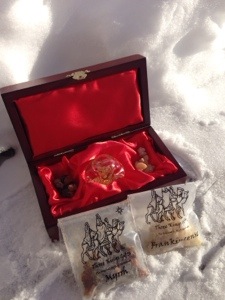
He chastised the Wise Men for their pricey and pretty yet wholly impractical and useless gifts. “If you were truly wise,” griped the angel, “you would have known that what we need is hot water and towels; goat’s milk and bread; twenty diapers and some soap to wash them with.” Not gold, frankincense and myrrh! (p.15-16, Mary Arnold, “The Fussy Angel”, Ignatius Press, 1995). Yet, the Christ child accepts these gifts, however impractical.
The gifts, of course, hold symbolic meaning: the gold – for a king; the spices – used in burial practices of the time.These gifts point to the identity and purpose of God made human in Jesus Christ, whose destination was the Cross and the empty tomb of Easter.
Admittedly, the whole story about astrologers bringing strange gifts to a child in a strange land sounds somewhat exotic, not real. It is filled with strange incidents, strange gifts, and strangers encountering one another.
At the same time, there is meaning here. Should we but pause to consider the deeper, sometimes hidden, levels of our experience we may appreciate the gift anew, however strange.
The movie “The Best Exotic Marigold Hotel” (Fox Searchlight, 2012) tells of a group of seniors who head off to an inexpensive retirement home in exotic India. As unfamiliar and sometimes frustrating as the experience is, when one character asks why he likes it so much, he replies: “The lights, the colours, the vibrancy; the way people see life as a privilege, not as a right.”
Perhaps Epiphany can open our eyes as well to the holy revealed in what we may have previously thought of as strange, foreign, outside our experience.
Perhaps you have celebrated Christmas and New Year’s this year differently from ‘the norm’ — in a different setting, with different people, outside your comfort zone. Perhaps this Christmas was the first without a loved one. Or, perhaps your life circumstances are changing due to ill health. Admittedly, these are all situations to which, on the surface, we may react even reject outright if we had a choice.
But the Christ child teaches us something important: He didn’t reject those outlandish, impractical and useless gifts brought to him by, of all people, foreigners from the East. Instead, he welcomed them into their home with giggles, gurgles, and laughter.
And this grace, this gift of freedom, is infectious. It liberates us to receive and rejoice in the gifts of life, however small and strange they may at first appear.
 Raspberryman