The change within

When seventeen-year-old Hannah said she was drug free, her parents were skeptical. Having participated in a rehab program and given all the support she could expect from friends and family, Hannah was able to declare that she was finding success in weaning herself off a destructive opioid dependence.

But her father was not convinced. When pressed, he simply confessed, “I don’t believe people can change. Once a drug addict, always a drug addict.”

Though fictional, Hannah and her parents’ situation poses a common predicament for many today. Not just of the real struggle with addiction. But also the struggle with belief: Do we change? And if so, how? And maybe more to the point: Do we recognize the change that happens in our lives? Do we want to?

There’s the story of the Zen Monk who was visiting Time’s Square in New York. And he wanted to buy a hotdog. The vendor asked him, “What would you like on your hotdog?”

The monk replied with a smile, “Make me one with everything.” So the vendor made the hotdog with ketchup, onions and lettuce and mustard and all these other nice things. And he gave it to the monk, and the monk gave the vendor a twenty-dollar bill.

And the vendor didn’t give him anything back. So the monk said, “What about my change?” And the vendor said, “The change is all within.”[1]

An underlying belief in Christianity is that people do change. The resurrection of Christ presents the ultimate pattern for life. We die. We live. We grow. We evolve. We are given new beginnings, to live again. Death. Resurrection. Life is dynamic, not static.

On this Transfiguration of our Lord Sunday, we encounter people who change. First and foremost, Jesus. He is bathed in uncreated light and to the onlookers his face radiates a changed appearance. His countenance is transformed before their very eyes. Here the gospel writers want to emphasize Jesus’ divine nature, his unique revelation as God’s own. The witnesses to this holy and amazing encounter receive the most wonderful gift of experiencing God’s greatness in Christ.[2]

At the same time, the transfigured Lord encounters us. In the scriptures for this Sunday we witness change in the characters of the bible, specifically Moses, Elijah and Paul.[3]They, and others in the bible, are not static beings, one-dimensional characters. We witness in them, rather, incredible change over the course of their lives and throughout history.

In other words, Jesus is not the only one who shows a divine-like appearance. Throughout scripture, there are others who experience within themselves a transfiguration.

Jesus is the first and foremost. But God’s divinity, though fully expressed in Jesus, is not confined to Jesus. God’s true presence is not limited to Jesus for Jesus’ sake alone. God’s fullness in all of creation is not locked in one specific time of history, two thousand years ago.

Martin Luther called it, the great, wonderful, holy “exchange”[4]. On the cross God experienced the fullness of our human sin in all its humiliating nakedness and vulnerability in order that all for whom Christ loved and died may eventually experience and grow into the fullness of divine life and union with God. This divine-human holy exchange is exemplified and mediated through Jesus.

We may balk at the notion that in our very lives, in each one of us, God is present in the living consciousness of Jesus. How can we be that good, eh? We are so used to imagining a separation there—that God is ‘out there’ reserved exclusively to doctrinal debate alone or in some other person upon whom we project all our hopes and dreams. But within me? In my heart? So that I can live differently, better, a changed person?

St. Paul, elsewhere in his first century writings expresses this truth from the start: In his letter to the Galatians, he says, “God revealed his Son in me”[5]. On the road to Damascus the living, post-resurrected Christ encountered Paul. Over one hundred times in all of his New Testament writings he writes this phrase: en Christo meaning ‘in Christ’. And to the Colossians, he confesses: “There is only Christ. He is everything and he is in everything.”[6]

The vendor’s response to the monk carries metaphoric weight. The change is within. A holy encounter with Jesus first changes us within. The change for the better can happen because God is in us. God works on our hearts. God is relentless. Sometimes it hurts. God is the refiner’s fire, creating and re-creating us from the inside-out.

So that, eventually, the light of Christ’s love may shine forth from our lives, and our union with God will be complete, in this world and the next.

Thanks be to God!

[1]Laurence Freeman, “Change is part of the Journey, like it or not”; talk 1 in Mount Oliveto Retreat, Maggiore Siena, Italy, June 18-25, 2016: Change (wccm.org, audio resources, album)

[2]Luke 9:28-43

[3]Exodus 34:29-35; 2 Corinthians 3:12—4:2

[4]“That is the mystery which is rich in divine grace to sinners: wherein by a wonderful exchange our sins are no longer ours but Christ’s and the righteousness of Christ not Christ’s but ours. He has emptied Himself of His righteousness that He might clothe us with it, and fill us with it.

And He has taken our evils upon Himself that He might deliver us from them… in the same manner as He grieved and suffered in our sins, and was confounded, in the same manner we rejoice and glory in His righteousness.”

–Martin Luther, Werke (Weimar, 1883), 5: 608.

[5]Chapter one, verse sixteen, as translated by the NIV and JB.

[6]Chapter three, verse 11. In the NRSV, the Greek is translated, “He is all and in all.”

Even among the lost

I hear Simon’s despair, tainted with frustration and even anger, when he reacts to Jesus’ instruction to put the nets in deep water to catch the fish in Lake Galilee.[1]

“Master, we have worked all night long but have caught nothing.” He’s trying to make a point that there is no use to doing what Jesus asks of them. After all, they did all they could do. They employed all their resources, knowledge and effort into catching fish that night. But to no avail. Understandably frustrated, Simon scoffs at the futility of doing what Jesus asks. As if he knows better. There is not point to it all.

This is not the first time we hear Jesus say or do something that mystifies us. Earlier in this season after Epiphany, we witnessed Jesus being baptized. Jesus being baptized in the Jordan River often confounds our sensibility. Why does Jesus need to be baptized? Aren’t we the ones that need to be baptized? Not God!

So often we find salvation in what we do, and the meaning we attribute to what we do. In the church, we often do exactly what the crowds at the Jordan did: We come to worship, pray the printed confessions of sin, receive Communion and hope that these liturgical acts will wash away our sins. And make life right.

Then, we also have other programs for self-improvement, such as trying a new diet, cutting down on drinking and smoking, or finding someone who will love us just right. But these things are all futile for making real change in our lives, for making our lives right.

But Jesus walks into our lives just as he waded into the Jordan to be baptized by John. If Jesus was to walk into our lives today, he could just as well arrive at our job interviews, wedding receptions, or retirement parties. He could just as well stand in the long lines with us at the Tim Horton’s or sports venues. Jesus could just as well join us in all our driving around town to this and that – and the next futile thing we are trying to do in order to make life right.

Yes, I could feel the futility behind Simon’s statement—but we fished all night and caught nothing. Would Jesus step even into that despair?

When work seems futile. When other people frustrate us. When life seems pointless. When what we do appears to have little purpose, meaning or utility. When we fail. When despair sinks in.

Or, not far removed in the face of uncertainty, we clamber and clamor for the next shiny, new thing. We distract ourselves. We fall into mindless routine or stimulating addiction, to occupy our minds or numb them. And escape reality. Even just below the surface of seeming industry, there broils a fearsome anxiety.

Yes, I hear Simon’s despair. But I also see Jesus, right there.

What is Jesus up to here? Getting baptized. Going fishing with his friends. Going to weddings. Hanging out in the streets. What is Jesus up to here, living the life we all live?

For some reason, Jesus is taking on our lost condition. Jesus participates in our lives, doing what we do, engaging our routines, our work, our lifestyles. And, as we become more aware of Jesus closeness to us in our successes and our failures, we discover the Gospel truth: that salvation comes not because of our activity, our brains, our efforts. Salvation comes through a loving Savior who finds us and takes on our lost condition.

So maybe our job is not to explain the mystery, but simply to obey the seemingly pointless, futile instruction from Jesus. And act on it, as Simon did. “Yet, if you say so, I will let down the nets.”[2]

Visit the sick. Befriend the poor, the outcast, the refugee. Accompany the vulnerable, the weak, the dying.

After selling their large house where they called home for decades, Jack and Betty moved to a smaller two-bedroom apartment in town. Once settled in, they invited Craig, a church friend, to dinner in their new home. Craig was happy to oblige.

After all, on Sunday mornings they would sit together in worship. They didn’t say a lot. Betty might say something odd, but her countenance was so bright. Jack seemed always bothered by something, like he was scowling. But the couple was always together. And they liked each other.

Craig tells the story of his experience visiting Jack and Betty. He writes,

“Once I arrived at their apartment on the appointed evening, it didn’t take me long to realize that Betty had Alzheimer’s disease. It now seemed so obvious that I felt foolish for missing it earlier. Jack never let her out of his sight. It was then that I realized that he hadn’t been scowling for the last couple of years. He was just worried.

“Before I even had my coat off, Betty took me by the hand and led me to the painting above the sofa that depicted their stately old home. She became a bit more lucid as the stories of the old place tumbled out of her soul. I felt her squeeze my hand as she talked … [as if she were trying to say], ‘There is more to me than you see now.’ … Jack stood behind us and allowed his worry to ease a bit with a tender smile.

“Dinner was interesting. Betty couldn’t be allowed near the stove, and Jack wasn’t about to learn to cook. So he had asked their housekeeper to make them an extra-large omelet before she left that afternoon. When we were ready to eat, Jack put the egg dish in the microwave, then cut it into thirds and served it on Betty’s best china. For desert he brought out Klondike bars that we ate using the good silverware, which wasn’t easy. Several times during the meal, Betty got up and wandered around the apartment a bit. I was impressed by Jack’s ability to maintain our conversation, which was always of secondary importance to him, while always watching his wife.

“Throughout the evening I kept thinking that I needed to say something useful. After all … [isn’t that what we’re supposed to do with others?] But how profound could I be with Betty, whose mind was too clouded for conversation? What would I even say to Jack…? I could try, ‘Keep up the good work’ or ‘This must be really hard,’ but that would be so inane.

“After dinner, we left the old dining-room table and made our way back to the living room sofa, where I sat next to Betty. Jack took the chair across from us. I began to talk, trying to speak of …[relevant] things, but I wasn’t doing well. [As a Christian friend, from church] I knew that I was called there to be a blessing to them and … to witness to Christ’s presence among them. But how? I felt like a pilot circling above the clouds, looking for an opening to land. Soon Betty got up and wandered off again.

“When she returned, she stood behind the chair where Jack was seated and put her trembling hand on his shoulder. And as only old lovers know how to do, he reached up to take her hand as if it were the first and millionth time he had done it. I stopped talking as they both smiled at me.

“Well, there it was – the blessed presence of Christ. Then I knew that I wasn’t there to say a thing. My calling was to behold and be amazed. It was as if their mutual smile said, ‘Don’t you dare pity us. We are blessed.’ Beneath the gentle act of holding a trembling hand lies the mystery of … [love].

“In the end, this is as good as the calling to love can be. …There is just the holding of hands …”[3]

There is neither brow-wrinkled explanation nor fear-induced despair.

There is just the smile of God in the face of another.


[1]Luke 5:4-5

[2]Luke 5:5

[3]M. Craig Barnes, The Pastor As Minor Poet: Texts and Subtexts in the Ministerial Life (Grand Rapids: Eerdmans, 2009) p.97,103-105

Pluck up!

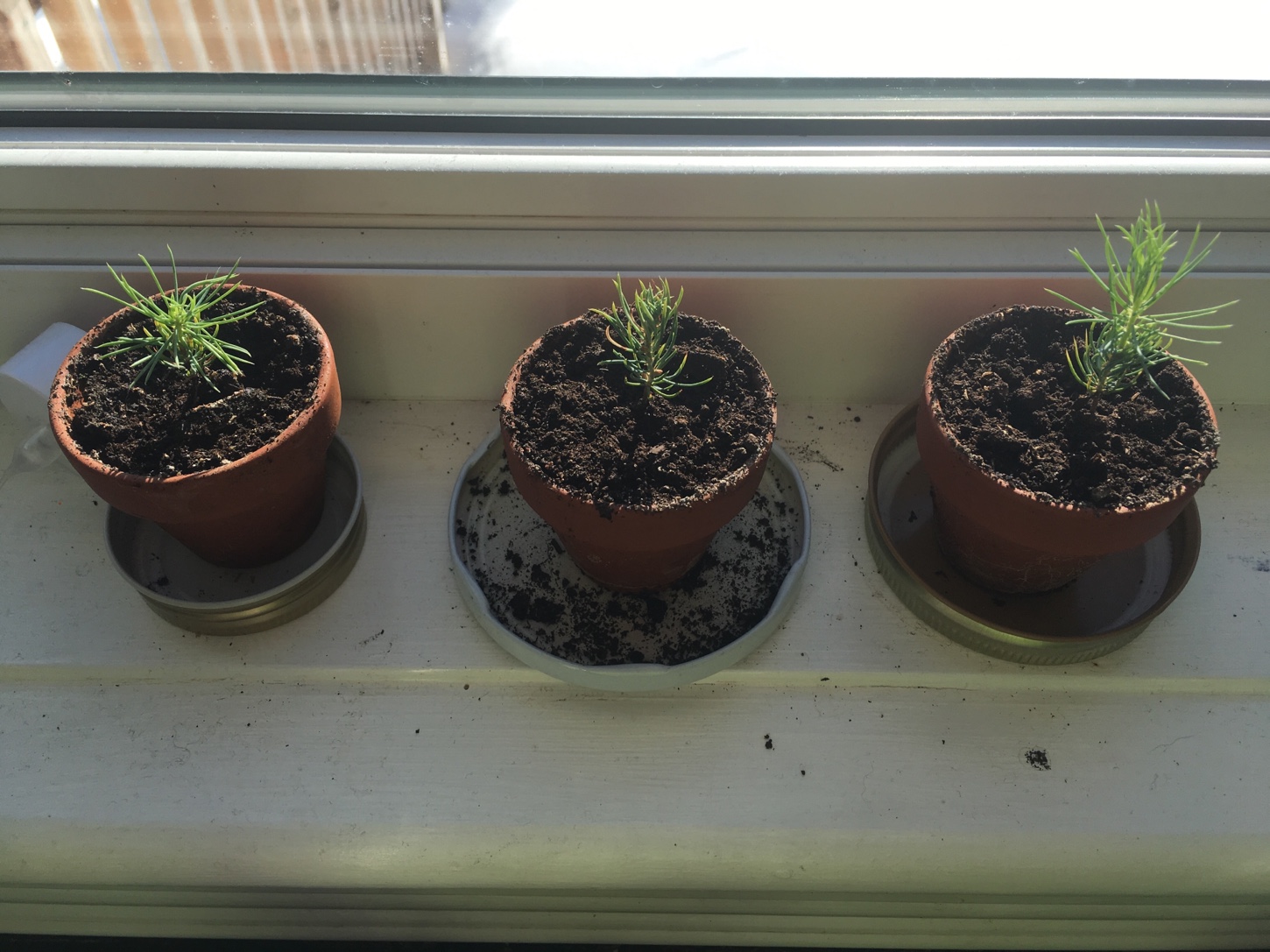
When our daughter received a pouch of seeds last Spring, we didn’t know initially what to do with them. They were Colorado Spruce Tree seeds. And we weren’t exactly planning on seeding a forest.

So we took a medium-sized flower pot and sprinkled the dozen-or-so seeds into the soil packed into the container which we left on the back deck outside. Let’s first see if the seeds in fact sprout, we thought. And go from there.

Three little buds popped through the top layer of soil a couple weeks later. One came up near the edge of the pot. But two of them came up in the centre, side-by-side. At first, I thought the two to be part of one sprig. But they weren’t.

At some point I would have to separate the two, distinct saplings. They were too close together. When to pull them up posed a bit of a challenge. If I waited too long, then the root systems would most certainly entwine and grow into one tree making it impossible to separate. If I plucked up the saplings too soon, I ran the risk of damaging the vulnerable shoots.

The task before me reminded me of the call of God to Jeremiah stated poetically: “to pluck up … and to plant.”[1]While Jeremiah’s plucking up and planting had to do with nations, social practice and religious faith, mine was more literal: As the tiny saplings were finding life and vitality to grow, I would first have to pluck them up from the soil before planting them into separate containers for the next stage of their growth.

And that plucking up would not be easy. It would hurt. It would put stress on the individual seedlings. I could very well be killing them in the transfer. Would they survive the ‘plucking up’?

Sometimes we don’t believe we can survive the ‘plucking up’ events of our lives. We don’t believe we have the strength to endure those difficult transitions in life, especially after experiencing loss, or when confronted with change or great disappointment and failure.

We object, like Jeremiah did—and Moses and Isaiah before him, to God’s call, finding all sorts of justifications: Can’t do that; I’m not qualified, I don’t have the skills, I don’t have the strength, I am too young or too old, I don’t have time. They make sense, common sense we might say. We find all sorts of excuses and even create a religion around all of that to keep us feeling good. Or at least not guilty. And stuck in a rut.

What is more, we make our faith into something that ought to make us comfortable. We ‘go to church’ expecting not the challenge to grow and change but instead to find the salve of warm fuzzies and emotional feel-goodies. We even believe Jesus was all about being ‘nice’. And if anyone is not nice, or challenges us, or doesn’t fit our mould—well, that’s not the way it’s supposed to be.

And yet, the biblical witness, if not our authentic lives of faith when we pay honest attention to them, suggest something entirely different:

  1. Jesus’ popularity suffers a severe blow after he says to his people in their synagogue that “today the scripture has been fulfilled in their hearing”.[2]What he means is that they—his people—would not be the vessels for the unfolding of God’s new narrative; outsiders would be. Stew on that. The audacity. They nearly succeed in throwing him off a cliff, they are so enraged.
  2. In the Jeremiah text, we read that God’s hand “touches” Jeremiah’s mouth. “I have put my words in your mouth,” God says.[3]Perhaps, at first, this sounds rather intimate, soft, gentle, nice.

But we need to be careful not to imagine it was a comforting touch. The same verb used here can also mean “strike” or “harm.” The one other biblical verse that uses this same verb to envision God’s hand touching is found in the prologue to the book of Job, where Satan challenges God to test Job’s faithfulness by taking away everything Job has.[4]There is nothing gentle about the wind that then “touches” the house where Job’s children are feasting, leaving every one of them dead beneath its roof.[5]

“When we picture the hand of God ‘touching’ Jeremiah’s mouth, we might do better to imagine a jolt or a shock. We would be justified in asking whether it hurt, whether it left a wound or scar, whether having God’s words in his mouth changed Jeremiah forever.”[6]

The message of Christ is the message of the cross. And then, resurrection. For our growth and life in Christ, we are called into places of disruption of our comfortable lives before anything new and life-giving happens. There’s no way around it, if we want to follow Jesus in this world.

It starts small, though. And that’s the grace and the hope. God does not call the qualified; God qualifies the called. The point of the Jeremiah story is that Jeremiah cannot depend on his own, developed capabilities and skill-set to justify his participation in God’s work. God called and equipped him even before he was born.

Every worldly role has purpose in Christ. No work is meaningless in God’s light. Martin Luther famously said about parenthood, when understood in Christian vocation: even changing dirty diapers is done for the glory of God! It is God’s invitation to us to invest God’s grace into whatever work God opens to us.[7]

All Jeremiah must do is trust God, and not make his decisions—yay or nay—based on fear. The most often repeated command in the bible—do you know it? “Fear not”. This does not mean we will never be afraid when we listen to and follow God. It means we do not lead our lives with fear in the driver’s seat. Instead, we find in the driver’s seat of our lives: Trust God. And hope in God. Fear can take a back seat, now.

I sat on the front porch with three separate, small pots for each of the seedlings. I did this in early November, believing they would do much better inside during their first winter.

My ‘plucking up’ was done swiftly, using the old adage of taking off a band-aid quickly is better than dragging it out. What surprised me the most in the process of ‘plucking up’ and then ‘planting’ again, was to see the roots.

Each of the tiny saplings had astoundingly long tap roots. One even had extended its main root all the way to the bottom of the original pot, and then some. More than tripling the length of the part of the sapling above ground, there was definitely more to the little sprout than what met the eye on the surface.

And so, there is much more to you and to me than what may first meet the eye—the eye of our self-regard. God calls us to break through the crust of the surface of our self-perception and to mine the depths of who we are, created uniquely each of us in God’s image. There’s so much good, there!

God is just waiting for you to uncover those depths, and then to bless and to empower who you are and what you do, into God’s holy purposes.

img_7991

[1]Jeremiah 1:10

[2]Luke 4:21-30

[3]Jeremiah 1:9

[4]Job 1:11, see Anathea Portier-Young in her commentary on Jeremiah 1:4-10 in workingpreacher.org

[5]Job 1:19

[6]Portier-Young, ibid.

[7]James Calvin Davis, in David L. Bartlett & Barbara Brown Taylor, eds., Feasting on the Word: Preaching the Revised Common Lectionary Year C Volume 1 (Kentucky: WJK Press, 2009) p.292

Lego truth

Playing with Lego was both fun and scary. As a kid, the first thing I did after opening the box was dumping all the pieces on the floor in front of me.

The reason I wanted to play with the Lego blocks was the picture on the front of the box—a Star Wars fighter, a fire hall, a dune buggy or helicopter. My motivation, initially, was to reproduce the image on the box that first captured my imagination, an image which appealed to me in some way.

In order to accomplish this task, what did I need?

After dumping all the pieces on the floor, I held the empty box in one hand and I stuck my free arm into the box searching for the multi-folded instruction manual.

This booklet was my lifeline. Or, so I felt, at the time. Before doing anything I would read and re-read the step-by-step instructions carefully, making sure I had all the pieces. I would even, after having read through the entire manual, organize the pieces on the floor into piles according to colour, and function. That way, I could accomplish my work in as efficient a manner as possible.

Once the project was done, I dissembled it and put the pieces back in the box. Some favourite models were re-constructed over and over again, over time. Depending on how complex the model was, I even learned to remember how to connect certain parts of the model without needing the instructions.

And, as it likely goes with all Lego, eventually over time pieces from various projects get dumped and mixed together in one big box.

I said, playing with Lego was also scary. If the instruction booklet went missing or was accidently thrown out or misplaced and I wanted to re-construct the original model, it rarely became exactly the way it was first designed: The fire hall became a garage. The dune buggy became a go-cart. The Star Wars fighter became a shuttle.

Scary, because starting from scratch without the instructions, I had to be somewhat creative. A risky venture, to say the least. What would I end up with? Would I like it? Would it work? How many times would I have to start over?

The central image in the Gospel reading today from Mark 13 is the temple in Jerusalem. It was a magnificent structure by first century standards. Finished by Herod a couple centuries before Jesus, the temple had signified the center of religious life in the region for a long time.

While the central image is the temple, perhaps the most captivating words are from Jesus who promises that not one stone will be left, one on the other.[1]In other words, this glorious building will be utterly destroyed. Understandably, not only are the temple authorities shocked, dismayed and offended by Jesus’ words, his very own disciples are alarmed. “Tell us, when will this happen? What will be the signs?” they drill Jesus with anxious questions.

Understandably, the vision of the temple’s complete demise causes anxiety and fear. After all, what will their faith look like? Where can they go to pray? What is their identity in faith, without the temple being there as it has been for the last couple hundred years–an anchor, a certainty, a visible, concrete reminder of their faith? Is it all for naught? Is it all lost, forever?

Scary. It’s like looking at a pile of Lego blocks on the floor wondering—what are these pieces supposed to do? What am I to do with them? The temptation to give up and do something else is huge.

In life, it sometimes feels like the instruction manual has gone missing. In life, it sometimes feels like what had worked in the past just doesn’t, cannot, work anymore. Like those tried-and-true patterns and go-to’s just don’t do the trick anymore quite like it used to. And that can be scary.

What are the ‘instruction manuals’ in our own lives that have given us our sense of security and certainty–a way of thinking that has informed our opinions; a mindset that we have never questioned? Or, have we looked at the bible like a legal text, a how-to playbook that you never question, or you dare not question? Is it a place, a building, a person?

What are those instruction manuals that seem to be slipping away into a pile of dis-ordered, chaotic pieces  in front of us?

Both in our personal lives, but also in the church, the prospect today of staring into the abyss of uncertainty and fear is very real. And here, we confront the important distinction between reality and truth.

On the one hand, there is the reality: In our personal lives, the reality usually presents itself as a problem—regarding health, relationships, work, politics—wherever a problem or challenge emerges.

In the church, the reality is becoming clearer: the dwindling numbers, the absence of youth and children in church life, the lack of financial resources, budget numbers spending more time in the red than in the black. These are the presenting realities about which everyone who cares has an opinion.

But, what is the truth underlying the reality? What are the issues underneath, that keep us stuck from embracing the presence of God still active in the world around us and in our lives—despite the problems? What truths do we need to unearth about ourselves, our feelings, our thinking, our behavior?

One truth we discovered in an asset-mapping exercise is we have so many resources we haven’t seen or thought about. We have so many resources we haven’t considered or recognized. What is the underlying asset buried in the problem? Do we see it? Do we want to?

What keeps us stuck, in moving forward with the gifts and talents and passions and capacity to do good? What keeps us from being creative with the ‘pieces’ of all that is possible right before our eyes?

When I took my First Aid Course a couple of years ago, an important part of the training was an initial conversation about our attitudes giving help to someone suffering an emergency — the broken leg, the heart attack. You could say, the reality was the presenting emergency. But the question posed for discussion got closer to the truth of why we are doing what we are doing. The question was:

What inhibits you, or what causes you to hesitate, in helping someone who is in obvious physical distress and need? In other words, what would keep you from engaging the situation before you?

The responses were common and what you might expect, ranging from: picking up germs, worried you will make matters worse, worried about legal implications should giving First Aid fail, or disrupting your busy day’s schedule. All of these inhibitions and issues are reasons not to give First Aid.

Fortunately, the training spends time dealing with each individual concern. Once these concerns are addressed, we are free to engage the situation in a helpful, responsible manner. We will still likely struggle with ourselves and our concerns, yet be assured that over time and with a lot of work all will be well.

During the first centuries when the stories we read in the New Testament took shape in the imagination of early Christians, it was a transition time for religious Jews. Following the destruction of the temple during the Roman Siege of Jerusalem in 70 C.E., the local synagogue became the gathering place. No longer did a temple provide the central focal point. Now the local synagogue became central to the identity of many Jewish people.

This transition lasted centuries. It didn’t happen overnight. Enduring change takes time and a whole lot of patient, committed endurance.

Whether it be personal matters that present a challenging reality for us, or whether it is in the church—the question we need to ask ourselves is: Without that proverbial set of instructions, what can we build? What can we build together using the pieces that we have? The possibilities are truly endless.

Because this is the new thing that God is building and creating in our lives. And it is good.


[1] Mark 13:1-8

Pilgrims rising

Don was a husband and father who one day was commuting home after work in a bad thunder storm, when the car he was driving was struck by lightning. Don was okay, and he managed to get home. Sitting down with his teenaged children, he relayed to them his harrowing experience.

Expecting at least a small degree of sympathy from them, Don was perplexed when his eldest interrupted: “Quick, let’s go buy a lottery ticket because they say the chances of being struck by lightning are like the chances of winning the lottery.”

The disconnect we feel in how Jesus’ disciples often responded to him is not dissimilar. He tells them he must die a horrible death. And they respond by demanding seats of power, authority and glory beside Jesus. His disciples continually seem out of sync with their leader’s meaning.

The Gospel for today[1]must be read in the larger context of Mark’s writing here. In Mark, we see that this is the third time Jesus announces his death, the third time the disciples respond in perplexing ways, and the third time Jesus responds to them by giving them a commentary on true discipleship.[2]

By looking at the what comes immediately before this text, we also discover that the disciples who followed Jesus were afraid.[3]It’s fair to presume, then, their desire and request to secure positions of glory once Jesus took his rightful throne on earth and/or in heaven was born out of fear.

The connection between fear and striving for security is common in all of us, to this day.

We are afraid. We fear the changing realities which make new demands on our time, energy and resources in the church. We fear the outcome of our health concerns. We fear the effects of an uncertain future, in our nation, our world and in our personal lives. In the fear of the unknown, it is a natural knee-jerk to secure anything down. Do something, anything, to give yourself the illusion of control. An insurance policy.

Let’s give the disciples the benefit of the doubt, to suggest perhaps they were aware that Jesus’ path was going to lead to his arrest, torture and death. And they knew that likely they, too, would be caught in the crossfire. They were probably aware that Jesus was causing an uncomfortable stir among the powers that be, religiously and politically, in Jerusalem. They saw the writing-on-the-wall.

And in the midst of this fear, the Sons of Zebedee tried to insure some benefit for all the sacrifices they were already making and would likely continue to make. Perhaps if they didn’t understand something, it was they couldn’t yet grasp the depths of the sacrifices they would make as a community of faith.

What Jesus stands for is a different way altogether from the way of the world. The disciples are caught up in the power plays of the world. They have in mind a hierarchy, a pecking order, of who’s on top. There is this Machiavellian feel to the debate amongst themselves, as if relationships of power must only be a win/lose scenario, a zero-sum game where in order to get ahead some people have to be left behind.

The way of Jesus, in contrast, is the way of the Cross. Jesus exposes the false way of the world by surrendering to it and dying by it. The way of the cross exposes our folly and calls us to a deeper more inclusive way.

Martin Luther first coined the phrase in his Heidelberg Disputation written in 1518. He called it, “A theology of the cross.” It is a way of understanding and imagining God. That is, God was, and is, being revealed to us in all truth most clearly and unequivocally in suffering. In the vulnerability and pain of death on the cross, Jesus revealed—and continues to reveal—the God who suffers alongside us wherever there is pain and suffering in the world.

Luther thus criticized a “theology of glory” which presumes God validates faith, and is only validated by, success, measures of progress and triumphal conquering over any weakness or adversary. This theology dominates not only in our society, but sadly also in the church.

A theology of glory reflects an unbridled, Pollyanna optimism that avoids and resists places of defeat, failure, vulnerability and weakness as having anything to do with divine identity or purpose. A theology of glory undermines real people and a God who is known in the darkest times and places of life. It despises our common humanity and the losses we all endure.

The way of Jesus is for all people, not just for those who make it to the top. The way of Jesus is for all people, because we all have our crosses to bear. We can share in our common suffering. And grow together. It is therefore in community, the Body of Christ, the body ‘broken for all’ we say in the Communion, where Christ is revealed and where our true purpose is born.

#OttawaRising is the hashtag used, announced and displayed on Ottawa Senators Hockey club promotional material. The vision is of the team rising out of the ashes of disappointment from last season. That was the season from hell, when they finished second-to-last place in the league standings, suffered through a broken, conflicted locker room and as a result had to trade away star players.

But it is only standing in the ashes that you can claim the vision of ‘rising’ again. The Stanley Cup champion Washington Capitals wouldn’t declare resurrection as their identity, this season. It only makes sense to proclaim the resurrection in the midst of the defeat of the cross.

The Gospel abounds with a promise. The disciples may not hear it as such. But Jesus has great compassion on them. He does not rebuke them for being out of sync with him. He affirms that they will indeed drink the cup that he must drink and be baptized with the baptism that he must endure.

Jesus will continue to offer this promise and hope to us, that we will not always need to act and respond out of our fear. That what we do as a community does not need to be knee-jerk platitudes that only keep us stuck in cycles of fear, self-preservation and defensiveness. Jesus will continue to call us into deeper expressions of serving others and of paying attention to the needs of others not just our own.

If there was anything the disciples should have known with any amount of certainty, is that Jesus’ promise is secure and very sure. Because by being in last place, and losing it all, those first disciples would one day rise.

And so will we.

[1]Mark 10:35-45

[2]C. Clifton Black in David L. Bartlett & Barbara Brown Taylor, eds., Feasting on the Word: Preaching the Revised Common LectionaryYear B Volume 4 (Louisville Kentucky: WJK Press, 2009), p.189.

[3]Mark 10:32

The great un-doing

This past week I heard from someone how they overcame their addiction to smoking. A middle-aged man, he said he had been a smoker for many years until he started feeling the ill-effects of the habit. He had tried many gimmicks and treatments to quit, to no avail.

It wasn’t until he let go of his need to control the outcome of his efforts, that he succeeded. In other words, when he was able to tell himself: “I can’t do this on my own,” he finally found the capacity within himself to quit. He was able to stop smoking only when he accepted his own limitations, when he released the false notion that he was the master of his own destiny. Even to do something healthy, good.

He didn’t need to accomplish this on his own. What he wanted (to quit smoking), he needed to let go of. What he sought, he needed to release control over.

Whatever you want, you first need to let go of. Counter-intuitive, isn’t it? Usually when you want something, you go for it. And you don’t let up until you have it, eh?

So, what’s going on here?

What did the rich young man in the Gospel story want (Mark 10:17-31)? He wanted to prove that he was a righteous, good man. He wanted to show Jesus and others that he had fulfilled all the rules of his religion and therefore he was worth his religious beans. And who could compare?

The rich man approached Jesus thinking he had it in the bag. His question—”What must I do to inherit eternal life?” (Mark 10:17)—sounds disingenuous, inauthentic. In a manipulative, self-congratulatory way, he thus approached Jesus, even kneeling before him.

He had self-righteously fooled himself into believing he already knew the answer. The gospel writer doesn’t even assign the rich man a name, underscoring the fake, artificial nature of the man’s attitude.

But Jesus cuts through the crap, skims the fat off the top, and goes to the jugular! Indeed, “the word of God is living and active, sharper than any two-edged sword” (Hebrews 4:12). Jesus sees through the rich man’s pretense, and uncovers the real, authentic person beneath the surface. There he finds an enslaved heart, and brings to light the truth:

In order for the man to be liberated and set free, he has to surrender what owns him, what captivates and grips his soul: For him — it’s material possessions. For someone else, it might be different. But he has to learn, if he wants to grow, to let go and not hold on to those things that keep him stuck in false beliefs about himself, God, and the world around him.

What he wasn’t expecting, was an answer from Jesus that undid him. The one thing that he wanted to get—an unscrupulous, beyond reproach reputation as a religious superman—he would now have to let go of. He would have to let go of everything that made him, that put him in a position of power and wealth in his community and that gave him the grounds to boast.

He would now have to sell his reputation, literally, and become poor. And what do the poor have to show for their religious prowess? Wasn’t (and isn’t) being impoverished a sign of God’s dis-favour?[1]

All the texts assigned for today reflect the nature of relationship with God. Relationship with God is at the root of our spirituality, our church lives, our purpose in life and the meaning of our lives. Relationship. Relationship. Relationship.

And what the lectionary offerings are inviting us to consider today, is the nature of our relationship with God. They ask us to be honest, first, about who this God is we are supposed to relate to.

Let’s say, we want God. Well, detach from what we want. That is the key. Let go of our false conceptions about God. For example, an underlying assumption we will make about God is a transactional, mechanized God. Such assumptions were criticized by reformers like Martin Luther in the 16thcentury but also those before him like Meister Eckhart in the 14thcentury. This image they condemned, was God the “reward machine”.[2]It goes something like this:

God is the great rewarder-in-the-sky. And, if you put enough quarters in the slot, God will send down the candy-bar. In Martin Luther’s world, the criticism focused on the sale of indulgences—the more money you paid to the church, the more spiritual benefits you accrued.

These false beliefs about God then generated attitudes and actions that placed the onus all on us and our capacities and resources as individuals. That it was up to us to garner favour with God and so we would earn, and deserve, our salvation and even prosperity on earth.

I believe this is what is behind the rich, young man’s presumption and approach to Jesus. Certainly, he of all people deserves God’s favour.

And Jesus’ response is, essentially: If that’s what you want, you need to let go of it. And, it’s going to hurt before it gets better again.

Whether it’s a bad habit or false understanding of God or anything else that puts you in the driver’s seat of your life, God is looking you in the eye and challenges you to let go of that pretense. Whatever it is you want, first let go of it, and feel the pain of it. Detach yourself from your attachments if you truly want to be healed. It ain’t easy.

And the image is apt: Putting a camel through the eye of a needle is meant to communicate impossibility. And we say that in our own way every day. “Bah, I can’t change; people can’t change.” “We don’t change.” “People stay the same.” And so, we continue to get mired in unhealthy and self-destructive life-journeys. Transformation is inconceivable, we believe.

Maybe, before anything, our image of God needs transformation. If God is not a reward machine high in the sky, who and what is God all about?

It’s hard to believe with all the rain we’ve had in the past month that earlier this summer the lawns were brown, and the ground was bone dry. We’ve seen a lot of rain, lately. I’ve noticed local creeks are flowing again, and the grass on our yard is thicker and a dark, rich green.

I was reminded this week when I read that waterdrops in the atmosphere are created when water vapour condenses. That part I knew. But what popped out at me was the following sentence: water vapour condenses on tiny particles of dust. At the very centre of every raindrop is a particle.[3]

Our relationship with God is not between entities, to begin with. We don’t relate to being, a God among various God-beings out there in a religious marketplace.

We relate to God as the ground of our very being. Our connection to God already exists. Before we do, say, or think anything. Whether we know it or not. God is already connected to us, in our innermost being.

Saint Paul writes: “Do you not know that you are a temple of God and that the Spirit of God dwells in you?” (1 Cor 3:16); and, “I pray that, according to the riches of his glory, he may grant that you may be strengthened in your inner being with power through his Spirit, and that Christ may dwell in your hearts through faith, as you are being rooted and grounded in love (Eph 3:16-17).

We don’t add God to our lives, like filling a shopping cart in the grocery store. We don’t need to relate to a transactional God-the-rewarder-in-the-sky with our consumer mindset. The Reformation should have put that mechanistic view of our relationship with the Lord to rest. We still need the Reformation!

We don’t add God to our lives. We add our lives to God. Who is already there, at the very centre of our lives.

Imagine rain, falling. The raindrops have a way to go before reaching the ground. It may feel like a free-fall. Unnerving, dis-orienting, it is to let go of our deepest attachments. We experience like Jesus did a painful, momentary ‘forsaken-ness’ (Psalm 22:1). I wonder if the rich, young man had the courage to sell all he had to give it to the poor.

I would love to meet him, especially if had gone through with it. I have many questions to ask him. I suspect, however, that if he did it, if he did what Jesus called him to do — that in the letting go he opened his heart, confronted his greatest fear and experienced a free fall … right into the love of God at the very centre of his life. What a joyous surprise, to find the presence that will always be there, and has always been there!

It may seem impossible to do—this letting go—but in Christ all things are possible. And we discover in the journey: there really isn’t anything to lose that is of any enduring, lasting value.

[1]Today’s so-called ‘prosperity gospel’ implies that when you have it right with God, you will be blessed with material riches; the converse is true, too: according to the prosperity gospel, when you sin, God will withdraw blessing and you will be impoverished.

[2]Bernard McGinn, Praying with the Masters Today, Volume 2 (Meditatio Talks Series CD B, Track 5), 2018.

[3]Richard Rohr, “The God Particle” Daily Meditation 10 Oct 2018 (cac.org /Center for Action and Contemplation)

The Meditation Journeys

This text represents a draft of a talk I gave at the Essential Teachings Weekend (ETW) for the Canadian Community for Christian Meditation (wccm-canada.ca) in Alexandria, Ontario (September 21-23, 2018). This was the third of three talks, entitled “Stages of the Journey” which complemented the first talk (“The Essential Teaching”), and the second talk (“History of the Tradition”).

STAGES OF THE JOURNEY

The notion of journey, or pilgrimage, originates in the very birth of Christianity. Christ-followers came to be known as “Christian” only after Christianity became the official religion of the empire in the fourth century C.E. But until then they were known as those who followed in the “Way”, implying a path, a road, a journey to be followed.[1]

The notion of motion is integral to those who try to follow Jesus to this day. In the last several decades the pilgrimage has become very popular, especially the Camino de Santiago which attracts hundreds of thousands of pilgrims every year. Many who walk the eight-hundred-kilometre journey across the Iberian Peninsula in northern Spain will attest that the journey is a metaphor for the passage of life or traversing some interior path.

Indeed, the exterior journey, such as the Camino, mirrors the internal journey where one explores the contours of the heart and the landscape of the soul. It is a journey that takes time and is fraught with danger. And, at some level, determination, dedication and faithfulness.

Speaking of Spain, it was perhaps the great Spanish mystics of the sixteenth century – Theresa of Avila and St John of the Cross – who first in their writings exemplified the interior and often difficult journeys of faith, such as in ‘The Dark Night of the Soul’. Recently, Richard Rohr describes it best when he asserts that it is through great suffering or great love by which we move along the path towards meaningful change and growth. Crises of faith and challenging circumstances of life are invitations to go deeper into the truth of self and the presence of God.

I want to describe these two journeys to you by using several metaphors—involving water, an hourglass, a wagon wheel and the Exodus story from the Bible describing the desert wanderings of a people. These symbols and images I hope will convey effectively the meaning of these journeys.

When we commit to meditation, we are undertaking what I would summarize as two journeys, operating on a couple of levels.

1.THE FIRST JOURNEY

The first is journey that happens during the time of the meditation.

The Ottawa river at Petawawa Point: the rough & the smooth

I used to live close to Petawawa Point in the Upper Ottawa Valley. Petawawa Point was a lovely spot on the Ottawa River which broadened out into a large lake dotted by several islands. And, I loved to kayak through and around these islands and waterways.

When I first put out onto the river at the beach I was immediately into the main channel lined by the green and red marker buoys, where all the motor boats would roar through. This was the turbulent section of my paddle. I often fought the waves created in the wake of speeding, noisy boats. This part demanded my determination, resolve, and good intention to get past the hurly-burly and through the narrow passage between a couple of islands.

Once through, the water opened up into an area of the river where the large, loud motor boats avoided – only the loons, hawks and sometimes eagles. Here was the more peaceful part of my paddling experience, one that I have treasured to this day.

Meditators have often mentioned to me—and I have experienced this too—that during the first fifteen to twenty minutes they are fighting themselves, their thoughts and distractions. And then something inexplicable happens, and they finally get into some kind of peaceful rhythm with their mantra in the last five minutes! Whether it takes you fifteen minutes, or only a couple of minutes into the meditation, it’s important to keep paddling even when things settle down in your brain.

You see, the temptation once I got through the busy channel into the peaceful expanse of the river was to stop paddling altogether and just float for a while. I would gaze at the birds flying, the clouds in the sky and the distant Laurentian Hills. It was beautiful!

In meditation, this is called the “pernicious peace”, where we just float in some kind of relaxed state our mind really doing nothing and it just feels good and we don’t want to do anything else. I soon realized however I wasn’t doing what I had set out to do. I came to the river to paddle, not to float. And as soon as I dipped my paddle again in the peaceful river, I found my stride, purpose and joy.

When we begin in our meditation, we usually immediately encounter the distractions of the mind. For example, I ruminate over what I am I having for supper, what groceries I need to pick up, what errands I need to run, how will I handle a problem at work or in my family, where am I going on my vacation, the main point of my upcoming sermon, etc.

How do we respond to these distractions? Do we simply float in some sleepy, dream-world, following the course of this stream-of-consciousness? Yes, sometimes we do fall asleep during meditation. It’s good to be relaxed. Yet, we also pay attention and are alert to the experience by remaining faithful to the paddle, so to speak, to the mantra. We focus the mind.

On the underwater rock: dealing with distractions

Another water image, from Thomas Keating, may help us.[2]It is the example of sitting on a large rock on the bottom of the river. Here, deep under the water you watch far above you the boats of various sizes and shapes float by and down the river. These boats represent all our thoughts and distractions. Often, the temptation of our mind is too great, and we push ourselves off the rock—it’s so easy! —and we swim to the surface.

Sometimes, we will even climb into the boats and sail on down the river in these thoughts. In other words, we will let our minds sink into thinking about it for some time in our meditation. Of course, when we do this, we are not saying our mantra, which is the discipline and faithfulness of sitting on that rock down below.

It’s important not to be harsh with yourself on this journey. Give permission for the boats to come by your mind in this river. Then, as you return to the word, you let these distractions keep floating on down the river. Let them go. Return to the place of deep silence, stillness, on the rock deep below.

Despite the incessant distractions of the mind that come to me during my meditation, I continue to ‘return to the Lord’ and my mantra. Someone once said that it is ok to ‘catch yourself’ in a distraction during meditation. In fact, the more often you catch yourself and gently return to the mantra, the better. Why? Because each time you return to the word, it’s one more time you are loving God. Each time I bring my concentration to the saying of the word, I am offering my love to Jesus. Each time I say the word, I am saying, “I love you” to Jesus.

The journey throughout the meditation period may appear simple. We sit quietly and in stillness for twenty minutes not doing anything except saying, interiorly, the mantra. But it is not easy. We confront in this journey the imprinting of our go-go culture and a hyper-active environment upon our egos. We encounter our very humanity in this journey —

A humanity which incessantly strives to accumulate more information and judge progress according to expectations. We already go into it expecting it gets easier over time. We expect benefits to accrue, like lower blood pressure and more patience. And when nothing like this happens after meditating for a few months or years, we give up. This is a spiritual capitalism.

We encounter our very humanity which also craves stimulation and distraction. Already in 1985, Neil Postman wrote a book indicting our culture with the provocative title: “Amusing ourselves to Death”. For most of our daily lives we choose to keep busy or entertain ourselves rather than sit still and face the truth of ourselves. No wonder we are bothered by distraction during meditation.

We encounter our very humanity which finds self-worth in active productivity. We do therefore we are – the mantra of our culture. The more we produce, the more we have to show for in our day, in our vocations, the better we are. So, it just doesn’t make sense from this perspective to be so unproductive by sitting still and doing nothing with ourselves, really. What’s to show for, after twenty minutes of idleness?

And so, we may also, at deeper levels, encounter anxiety, fear and/or anger – which represent our resistance to the journey of our meditation. These normal, human feelings, given now the freedom of space, time and a loosened ego, erupt to the point of a significant disruption.

When I first started on this journey in 2004, I was beset by anxiety, to the point where I felt that I might explode during the silence and the stillness, to the point where I felt I would run screaming from the meditation room. The waves in that channel from the wake of the speeding motor boats threatened to swamp and drown me! I remember how I resisted the letting go, by asking for example that I not sit in the circle but by the wall in a corner of the room. And then, by suggesting we should sit wherever we want to, not necessarily in a circle. Anything to assert my control, even over the meditation period.

Here, depending on the nature of the deep-seeded emotional pain, you may want to encourage those who find meditation times a time of suffering to seek help to deal with whatever is being uncovered—loosened—during meditation. Some have expressed concern that when we open up our inner lives in meditation, the devil/evil will come in. Laurence Freeman, to this question, said: “It is more likely the devil will come out! Negative feelings and the forces of the shadow will get released as repression is lifted. This is quite natural although it’s important to be prepared for the inner turbulence it can create at times.”[3]

This becomes a journey, then, of healing and transformation.

2. THE SECOND JOURNEY

This journey of healing, then, links us to the second journey operating at another yet concurrent level. The second journey we undertake when we meditate connects us with our whole life, indeed life’s journey.

Being a meditator is about slowly but surely learning how to meet life’s greatest moments with grace, acceptance, generosity, courage and faith. Meditating teaches us how to navigate a crisis of faith, a crisis in our relationships, in our work and in our health. It is about forming an attitude toward life in general. Meditating trains us to bea prayer rather than merely say prayers from time to time. This is contemplation: an inner attitude to all of life so that we are indeed praying always, or as Saint Paul puts it, to pray without ceasing.[4]

The dropping stone in water: deeper we go & letting it happen

James Finley talks about a dropping stone in the water, a journey characterized by a deeper simplicity, a deeper solitude and a deeper silence. He describes well this image of a descent.

“Imagine,” he writes, the stone is “falling … And the water in which the stone is falling is bottomless. So, it’s falling forever … And the water in which the stone is falling is falling along an underwater cliff. And there are little protrusions along this cliff and every so often, the stone lands on one of these protrusions; and pauses in its descent. And in the movements of the water, it rolls off and it continues on and on and on and on.

“Now imagine you are that stone; and imagine we’re all falling forever into God. And imagine you momentarily land on a little protrusion where you get to a place and where you say, ‘You know what? I think I’ll stop here and set up shop and get my bearings and settle in. After all, this is deep enough. That’s as far as I need and want to go. It’s comfortable here.’

“And then you fall in love, or your mother dies, or you have terminal cancer, or you’re utterly taken by the look in the eyes of one who suffers. And you are dislodged, by [a great love or great suffering], dislodged from the ability to live on your own terms and from the perception that the point you’ve come to is deep enough for you.

“And so, you continue on your descent, experiencing successive dislodging from anything less than the infinite union and infinite love which calls us deeper.”[5]

Meditating teaches us not to give up on this journey to a deeper contemplation. Some of the comments I have heard from parishioners who came only to one or two sessions of meditation. And then they declare as if for all time: “I don’t like it.” “It’s not for me.”

Meditation is emblematic of staying the course with what is important, of giving what is important a chance and committing to the path, the pilgrimage – even though we fall short time and time again. And as John Brierley mentions in his introduction to his popular guide for pilgrims, “We are not human beings on a spiritual journey, we are spiritual beings on a human journey.”[6]A very human journey. We will encounter and deal with all our inner and outer limitations on this journey. Sometimes we will need to stop because the human path challenges us in ways we must address. Sometimes the human path will keep us from embracing the fullness of the journey in what it offers.

The Exodus: a journey of transformation to liberation that never seems to end

The Exodus, from the bible, is a narrative of a desert wandering that takes a long time, much longer than you would think: If only the Israelites under Moses’ leadership walked a straight line from start to finish!

The journey, however, is much more than you think. After escaping the shackles, confines and suffering of slavery in Egypt, the Israelites are now a free people, or so you would think. Liberation as the goal is however a process that involves transformation. They are free to go to the Promised Land, yes. And yet, their journey in the desert, confronting the fierce landscape of their souls, is rife with resistance and conflict as they take a long and circuitous route towards their liberation.

They complain to Moses. They say they would rather return to the fleshpots of Egypt than eat the Manna from heaven given in the desert. They create distractions and build a golden calf. It’s not an easy journey for them, to get to the Promised Land. It’s not easy, to be free.

Yet, as what happens on the first journey (during a meditation period by returning to our mantra), we return to the Lord our God over and over on the journey of life. We learn over time to trust the journey and stay the course. By being committed to the journey of meditation, we cultivate the spiritual muscle of trust, despite the resistance and conflict we confront within us.

Trusting in God. Trusting in life. Trusting that the trajectory of our pilgrimage is heading in the right direction despite all the bumps in the road. As the small stone on the underwater ledge drops to a deeper level through every crisis and twist and turn of life, we learn to surrender and let go. Richard Rohr, I believe it was, said that all great spirituality is about letting go. Of course, trusting this process involves taking the risk as we ‘fall’ deeper into the mystery of life and God towards an unknown yet hopeful future.

Riverbank: dipping into something bigger

On this journey of life we remain faithful to the path, which winds its way on the banks of a great river. The river is moving. We stay connected to the river, regularly stepping into the waters to say our mantra. We step into the flow of the river. The current is strong. The River is the prayer that continues in our hearts that is Jesus’ prayer to Abba.[7]

When we so dip into the prayer of Christ, which is ongoing, we participate in the living consciousness of Jesus who continues to flow in the trinitarian dance of relationship with God. In meditation, we learn that life is not limited to myprayer or ourprayer. Dipping into the river is stepping into a larger field of consciousness. It is dipping into the very prayer of God in which we participate every time we meditate.

If this journey is not about us, we therefore look to relate to one another, especially those who suffer. We see in the other our common humanity and act in ways that are consistent with the grace that first holds us. In the end, meditation’s journeys lead us beyond ourselves, to others in love, and to God in love.

Meditation, therefore, is essentially a journey in community. It’s a pilgrimage we undertake with others and for others. It’s not a solitary journey. Thus, the importance, at least, of attending/being part of a weekly meditation group.

Contemplation, then, leads to action. The journey of life, like the journey through the time of meditation, embraces paradox. While on the surface seeming opposite and incompatible, contemplation and action are integrated into the whole. Both are essential on the Way.

In truth, following Jesus is embracing paradox. “In order to find your life you must lose it,” he says.[8]Later, Paul announces that strength is found in weakness and the weak have shamed the wise.[9]Of course, the major paradox of the faith centres on the Cross; God is defeated. And in that vulnerability and loss, Christ and Christ-followers discover new life and resurrection.[10]

To do well on the journey of contemplation, on the path of meditation and indeed life, is to accept the ambiguities, the ‘greys’ and the uncertainties of the Way. As any peregrino will tell you on the Camino de Santiago, there is no end to the daily surprises and challenges that meet the faithful pilgrim. If one’s mind is already made up about what to expect and how it should go, disappointment and premature abandonment of the journey is likely to follow.

To do well on the journey corresponds to the capacity you have to hold paradox in your heart. The solution finds itself more in the both/and of a challenge rather than an either/or. Perhaps the faithful pilgrim will have to compromise an initial expectation to walk every step of the way. And, in dealing with an unexpected injury, the pilgrim might need to take the train or bus for part of the journey. In other words, the dualistic mind is the enemy of the contemplative path.

On the spectrum between action and contemplation, where do you find yourself? If you want to become a better meditator and enrich your soul, then seek social justice. Become active in the cause of a better humanity and a better creation. Speaking to a group of social activists and community organizers, I would counsel the opposite: If you want to become a better justice-seeker and advocate, then dedicate more of your time to meditation. Both/And.

The hourglass: flow ever deeper

 The direction of the flow in an hourglass starts at the top in a basin that collects all, then moves downward into a narrowing, finally coming through into an expansive region flowing ever deeper and wider.

The top of the hourglass represents all that our mind grapples with – the squirrel brain. It represents all our efforts, desires and intentions – good and bad – of a furtive, compulsive ego to come to the expressed need for this practice. “I need some quiet in my life.” “I enjoy the silence shared with others.” “I need to slow down.” “I like being by myself.” Admittedly, many introverts are enticed by the prospect of meditation. Although these are the same people who realize, on the path, it is much more than stoking the flames of a rich imagination or escapist tendencies – all ego-driven.

On the path, then, meditation leads us deeper into the heart, at the narrows. This is the place of a pure heart, a singular, aligned heart-mind place—some have called it the still-point.

From this point, the journey then expands as we go deeper and farther into the broad, ever-expansive areas, towards the infinite depths involving others and participating actively with all creation.

The wagon wheel: towards the still point

Teachers of Christian Meditation, such as Laurence Freeman, have used the image of a wagon wheel to describe how different forms of prayer relate. These various ways of praying – body prayer, labyrinth walking, petitionary, sacramental, song, poetry, art – represent the spokes on the wheel. All of them attach to the centre.

At the centre of the wheel is the hub. And when the wheel is in motion, which it must be in order to fulfill its purpose and continue on the road, the one part of the wheel that remains still and sure is the hub. This is the place of meeting, convergence, the point, the centre: the Jesus consciousness. Always in motion yet always still. The still-point. Another paradox of prayer. Action and Contemplation.

If the hub is vibrating and not still while the wheel is in motion, then the wheel is out of balance and there is something wrong. The whole riggings may even fall apart if not attended to! For the wheel to function properly, the hub must remain still even as the wheel is rotating at high speeds.

It is here at the infinite center, time and time again, where our prayers lead. Like the labyrinth whose destination is the centre, it is on the path to this centre where we experience a taste and a foretaste of the feast to come, where we taste the freedom and joy of the Promised Land, a land flowing with milk and honey. Where we can be free.

Questions for reflection

  1. Which image presented here about the journey of meditation touches you immediately and speaks to you most effectively?
  2. On the spectrum between action and contemplation, in which direction do you naturally lean? What are some ways you can improve the balance in your life?


[1]Acts 18:25; 19:9; 19:23; 22:4; 24:22

[2]Cited by Cynthia Bourgeault, transcribed from the recording of a live retreat titled, An Introduction to Centering Prayer given in Auckland, New Zealand, in October 2009 (www.contemplative.org)

[3]Fr. Laurence Freeman, A Pearl of Great Price.

[4]1 Thessalonians 5:17

[5]  Adapted from James Finley, Intimacy: The Divine Ambush, disc 6 (Center for Action and Contemplation, 2013); cited in Richard Rohr, Daily Meditation, www.cac.org, April 27,2018

[6]John Brierley, A Pilgrim’s Guide to the Camino de Santiago(Camino Guides, 2017)

[7]In the Garden of Gethsemane on the night before his death, Jesus addressed God in prayer with this Aramaic word, meaning ‘Dad’.

[8]Matthew 10:39

[9]1 Corinthians 1-2

[10]All four Gospels – Matthew, Mark, Luke & John –  conclude with lengthy passion narratives.

Into the deep end

I’d like you to meet Harry Truman, at the end of his life.

This is not Harry Truman the 33rdpresident of the USA. This is Harry Truman, the eighty-three-year-old who, in March 1980, refused to budge from his home at the foot of Mount Saint Helens near Olympia, Washington State, where the volcano began to steam and rumble.

A former World War 1 pilot and Prohibition-era bootlegger, he’d owned his lodge on Spirit Lake for more than half a century. Five years earlier, he’d been widowed. So now it was just him and his sixteen cats on his fifty-four acres of property beneath the mountain.

Three years earlier, he’d fallen off the lodge roof shoveling snow and broken his leg. The doctor told him he was “a damn fool” to be working up there at his age.

“Damn it!” Truman shot back. “I’m eighty years old and at eighty, I have the right to make up my mind and do what I want to do.”

An eruption threatened, so the authorities told everyone living in the vicinity to clear out. But Truman wasn’t going anywhere. For more than two months, the volcano smoldered. Authorities extended the evacuation zone to ten miles around the mountain. Truman stubbornly remained.

He didn’t believe the scientists, with their uncertain and sometimes conflicting reports. He worried his lodge would be looted and vandalized, as another lodge on Spirit Lake was. And regardless, this home was his life.

“If this place is gonna go, I want to go with it,” he said. “’Cause if I lost it, it would kill me in a week anyway.” He attracted reporters with his straight-talking, curmudgeonly way, holding forth with a green John Deere cap on his head and a tall glass of bourbon and Coke in his hand. The local police thought about arresting him for his own good but decided not to, given his age and the bad publicity they’d have to endure. They offered to bring him out every chance they got.

He steadfastly refused. He told a friend, “If I die tomorrow, I’ve had a damn good life. I’ve done everything I could do, and I’ve done everything I ever wanted to do.”

The blast came at 8:40am on May 18, 1980, with the force of an atomic bomb. The entire lake disappeared under the massive lava flow, burying Truman and his cats and his home with it.

In the aftermath, he became an icon – the old man who had stayed in his house, taken his chances, and lived life on his own terms. The people of a nearby town constructed a memorial to him at the town’s entrance that still stands to this day, and there was a TV movie made based on the story.[1]

Opinions may be divided as to whether he did the right thing, by staying and dying so violently. Some herald his gritty resolve. Others shake their heads considering the effect of his decision on his loved ones, and the public resources expended on his behalf to inform and keep the community safe about the impending danger.

What would you have done?

4 Say to those who are of a fearful heart,
‘Be strong, do not fear!
Here is your God.
He will come with vengeance,
with terrible recompense.
He will come and save you.’

5 Then the eyes of the blind shall be opened,
and the ears of the deaf unstopped;
6 then the lame shall leap like a deer,
and the tongue of the speechless sing for joy.
For waters shall break forth in the wilderness,
and streams in the desert;
7 the burning sand shall become a pool,
and the thirsty ground springs of water;
the haunt of jackals shall become a swamp,
the grass shall become reeds and rushes.[2]

This poetry from the prophet reads, generally, in a comforting, encouraging and promising tone. However, the second half of verse 4 feels out of place. God “will come with vengeance, with terrible recompense” and then God “will come and save you.”

It sounds like salvation will come only after an horrible, terrifying experience. Perhaps, Harry Truman’s salvation came on the heels of being drowned in the burning lava flow.

This interpretation can lead, however, to dangerous conclusions. Such as the only way to something good is create and go through untold suffering: Such as the ends justify the means; That it is ok to do something hurtful, cruel, and violent if the result of that violence is pleasing; That salvation can only come through terrible suffering.

We know life happens. We don’t need to search out and fabricate all the pain that is a natural part of life. We don’t need to choose suffering. Great suffering comes in different forms quite apart from any conscious decision to bring it on.

The better question is not whether or not we must suffer, but how do we respond and live in the midst of our suffering. That is the question of faith.

No doubt, Harry Truman had experienced some significant losses in the years leading to the eruption of Mount Saint Helens. No doubt at age eighty-three, his physical capacities were failing. He had lost his spouse. He had broken his leg. He was coming up against his very sure limitations. And, likely, grieving in his own way the passing of his event-filled and active life.

One can only have compassion on him.

The words of Isaiah are spoken to “those who are of a fearful heart.”[3]Ultimately, the war of all that divides and challenges us is waged on the battlefield of our own hearts. Any external fight on our hands is really a fight happening in our own hearts. Do you fight against a circumstance beyond your control? Are you so terrified that you can’t even speak of it?

At the centre of that odd, out-of-place verse is a word I do not like much: “vengeance” (in Hebrew, naqam), because I struggle to link this promise with Gospel good-news.

And then I came across what Biblical scholar Hendrik Peels showed about this word, naqam, in the Bible. This word refers to a retribution by a legitimate authority. And especially in this text from Isaiah, the emphasis is a retribution that brings liberation to those who are oppressed, and freedom from a situation or need. Its meaning is closer to a restoration rather than to vengeance of any kind.[4]

We tend, naturally, first to react to our fears by targeting some outside source. We blame others, when all along we hold the source of our trouble in our own hearts by refusing to examine our attachments and address our own sense of loss and fear.

It’s not easy to learn how best to let go at the endings of our lives. Most of us, unfortunately, confront these deeper questions and challenges at the end of our lives when we face a critical crisis: our health fails and all that we have been attached to in life we lose, suddenly.

We can do ourselves a favour. But it takes exercise, and some pain during the course of our lives when we are not yet at this life-ending crisis time. Learning to die before we die is the point. When we meet with common challenges of life – a physical move, a changed relationship, a job loss, a surgery, a life-changing experience, daily challenges – we can practice how to die to what has been (in the past) and welcome the feeling of terror about the unknown future. We learn how to surrender to what cannot be controlled; or, find the courage to throw off the weight of internalized oppression. This is all serious heavy-lifting.[5]

Following Jesus provides a way through, so we don’t get stuck in despair or denial. The wisdom of the inspired Word of God has something to say about this journey of heavy-lifting:

It is to turn to our neighbor and help them on their journey. It is seeing with the mind’s eye and the heart’s passion that we share a common humanity with those who suffer, who are oppressed, who are vulnerable and needy. To look, and go, beyond ourselves. And not give up.

“Compassionate Justice” is therefore one of the four vision priorities of the Evangelical Lutheran Church in Canada (ELCIC).[6]Of course, making statements and standing up in the public sphere for the sake of the poor, the newcomer, the homeless, creation, the marginalized and weak can get us into trouble. Of course, we can spare ourselves a lot of trouble by shutting our eyes to the suffering.

But our closed eyes will also shut out God. The Word is spoken, indeed, to “those with fearful hearts”. To those who need to listen. And do something.

I’ve never met Harry Truman. I didn’t know him, personally. I didn’t know his family, his community, or his religious background.

But I wonder – what would have been in the last years of his life especially if someone he respected and trusted leant him an ear more than once-in-a-while.

What would it have been, if a friend offered to shovel the snow from the roof of his lodge.

What would it have been like, if family or friends showed him unconditional, loving attention despite his bravado and curmudgeonly behaviour.

I wonder if his ending could have somehow been less violent, less tragic.

Our hearts may be fearful. And yet hearts also race in expectation of something good. Something better. Hearts race in hope.

And hope never fails.

God of compassion and justice, bring justice to those who hunger for bread. And give a hunger for justice to those who have bread. Amen.


[1]Atul Gwande, “Being Mortal: Medicine and What Matters in the End” (Anchor Canada, 2017), p.66-67.

[2]Isaiah 35:4-7a, Revised Common Lectionary for Pentecost 16B

[3]Isaiah 35:4

[4]Hendrik G. L. Peels, The Meaning of the Root NQM and the Function of the NQM-Texts in the Context of Divine Revelation in the Old Testament (Leiden: Brill, 1995), 265-66.

[5]Brie Stoner, A Reflection: Into the Deep End in The Mendicant Volume 8 Number 3 (Center for Action and Contemplation, Summer 2018).

[6]http://www.elcic.ca

Doers of positive change

If you’ve followed the Ottawa Senators’ Hockey Club over the last year you will have endured a roller coaster ride. From the high, you will have tasted the sweet drippings of a near-berth in the Stanley Cup Championship Series sixteenth months ago …

To the low, feeling the despairing collapse of the team, not just to being out of the playoffs but crashing all the way to second last place in the NHL standings by the end of this past season.

What happened?

In the last several months, the nightmare season was enflamed by revelations of all the off-ice drama that was happening:

  • Allegations of sexual abuse by then assistant manager Randy Lee;
  • The politicking of owner Eugene Melnick to shame/scare the fan base that he was either going to move the team away from Ottawa, and/or that the downtown arena project may not happen motivating concerned fans to initiate an #MelnykOut ad campaign across the city;
  • Star player Erik Karlsson’s wife applying for a peace bond (restraining order) against the girlfriend of another star player, Mike Hoffman, who allegedly used social media and other means to send discriminatory, abusive messages to the Karlssons even during the loss of their unborn son in March;
  • And the continuing speculation around and probable trade of Erik Karlsson in the final season of his current contract.

General Manager Pierre Dorion was right when he told the media last Spring that his locker room was “broken.” Inter-personal relationships, team chemistry – the essential ingredients in a winning team – were damaged maybe even beyond repair.

While ‘on paper’ the team had skilled players and was comprised of the same core from the year previous when they had that successful run to the Conference Final, something significant had changed for the worse. And this subtle yet very real aspect of failed team-work was at the root cause of the team’s on-ice collapse last season. It wasn’t that they weren’t good players; it was their unhealthy, damaging ways of relating with each other that was the problem.

Funny we are talking here in the church about a hockey team that many of us follow in Ottawa. And yet, we can, I think, attend in a similar way to most areas of our social, political, religious, family and personal lives. Are their areas in your work, your volunteer efforts in the church and in the community, in your personal health, in any aspect of your quality of life let’s say, that are lagging, that yearn for renewal, new life, positive change?

For some time, Ottawa Senator players have been saying that there needs to be a culture change in the locker room and among team relationships. Goaltender Craig Anderson said this week he is looking forward to the changed culture in the coming season but he is “too old for all the drama.”

Teammate and hometown defenseman Mark Borowiecki who is considered a leader in the group called out his goalie and others on the team by suggesting they need to do more than just say they need a culture change. Each player and the players themselves as a team, has to do the work of changing the culture. It wasn’t going to happen by itself. No divine intervention. No single-player trade, no matter how newsworthy, was going to change their culture. They, the players, had to take on the responsibility to work at it.

Be doers of the word. A theme in the scriptures assigned for this day. In the Book of James we get the message that while words are important, actions reveal the truth, authentic self and purpose of what we’re about (1:22) more than anything else. What we do with ourselves, with each other – our actions – are the best teacher and communicator of what is most important to our common life, our team, you could say – whether that team is the church, the family, a marriage, a community group, a political movement, or a sports team.

And this action is not only about our performance on the ice, so to speak. This work of doing is not merely about the mission, out there. It is not about whether we succeed or fail on the mission field in getting the job done – the work of ministry in the world. Perhaps our failure at getting that job done out there may at least in part relate to our failure to do anything on the inside of our personal and corporate lives. And lacking the awareness and the belief of positive change within.

It is no wonder Bishop Susan Johnson and the leadership of the Evangelical Lutheran Church in Canada (ELCIC) has identified being a “healthy church” as one of the four vision priorities, moving forward in community. Being a healthy church means, to “develop and promote a culture of mutual trust and accountability.”[1]

That is, we relate with one another and the world around us in ways that reflect genuine listening, respect, humility and patience. In short, we offer safe spaces for personal interaction and growth. We can’t achieve the other vision priorities of the church, such as compassionate justice, spirited discipleship or effective partnerships, unless we are first a healthy group of people relating to one another.

And no one will make this culture change in our relational lives unless we are doers of the word, unless we take action that promotes growth, faith and positive change in our common lives.

In the mid-point of Mark’s short Gospel, Jesus spends a lot of time around the Sea of Galilee. When I visited Israel during my seminary years, our bus ride was only a couple of hours from Jerusalem to the Sea of Galilee. In Jesus’ day, it meant walking at least six days. Word of Jesus had certainly spread, and his actions of healing and eating with sinners and picking grain on the Sabbath made the Pharisees – the keepers of the Law – extremely nervous. So much so, that the powers that be from Jerusalem invested the better part of a month checking up on Jesus’ ministry (7:1).

It is sometimes amazing the lengths people will go in order to keep things the way they have always been. A radio sports commentator mentioned after the Anderson and Borowiecki interviews that Mark Borowiecki was right: talk of culture change has been swirling around the same group of players for most of last season with little, actual change in their performance. It seems we haven’t really been taught how to work at bringing positive change, starting with us.

Change is frightening, to be sure. Institutions often seek to preserve the status quo. That was true in Jesus’ day. And it is true in congregations as much as in team locker rooms these days. Yet change, as we must surely know living in this time and place in history, is the norm, not an exception.

I was pleased to hear Pastor Mei Sum Lai, leading her last worship service at Resurrection Lutheran Church in Orleans[2]last Sunday, thank the congregation for allowing change to happen during her tenure there. I then reflected on all the changes that have happened here at Faith[3]in the last six years or so:

  • The bold decision to bring significant upgrades and modernization to the building and sanctuary;
  • The gutsy decision to worshipping for four months with our local Anglican parish while the sanctuary was off-limits in its renovation;
  • The move to weekly Communion;
  • The involvement of lay readers and worship assistants;
  • The completion of the work of the Evangelical Lutheran Women as a formal entity
  • The introduction of Christian Meditation as a weekly prayer group;
  • The evolution of bible study to a prayerful encounter with the Word;
  • The ongoing evolution of meals at the church in all its fits and starts – to name a few changes.

These changes, good or bad in your view, are nevertheless good practice for us. Making these changes are good exercise for us, for the positive changes that God is bringing about in our world and church. Because we won’t do it perfectly. We will make mistakes. We will even fail at times. But avoiding failure is not the point of Christian identity and mission. The point is, we are following Christ – or trying to – on a rocky and uncertain road in the post-modern world. Trying amidst the noise and chaos to discern and listen to Jesus’ voice.

What is at stake, is what we believe. What do we believe about change? I think this makes a huge difference in how that rocky road will go for us.

Despite the negative scrutiny and criticism heaped upon Jesus by the Pharisees, what does Jesus do in response? Does he cave into the pressure to play by the religious rules of the day? Does he try to please the authorities and adhere to the tradition for tradition’s sake? Does he shift into self-preservation mode and quietly step into the shadows as not to garner any more attention? What does he do?

Jesus keeps on healing. If you read on in chapter 7, he goes on from Lake Galilee southward on the road into the non-religious Gentile region first to heal the daughter of the Syrophoenician woman[4], and then he opens the ears of the deaf man in the Decapolis.[5]

In fact, I don’t know of anyone in the New Testament who doesn’t change after encountering Jesus, whether by a healing or in a shift of attitude and approach to life. The most dramatic example, probably, is Saul of Tarsus who on the road to Damascus encounters the living Lord and experiences a profound conversion.[6]

When you meet Jesus, your life changes for the better not because you don’t do anything about it. But because you’ve placed yourself, for better or worse, in a position to receive the grace, healing and change of God. Historian Diana Butler Bass writes, “For all the complexity of primitive Christianity, a startling idea runs through early records of faith: Christianity seems to have succeeded because it transformed the lives of people in a chaotic world.”[7]During this time, Christianity was primarily about how to live a better, more faithful life, here and now within the kingdom of God.

Team play is as much an inner game as it is an outer game. And the inner game takes work, not just words. This inner work is not easy to do.

Perhaps you might have a hard time believing positive change is possible in your own life. If so, is it because we refuse to see the positive changes happening in those around us – in the life of the church, in our own families and friendship groups? Because when we refuse to accept that others have changed, we strike the death knoll and close the doors of our own hearts to see the change there.

So perhaps a first step would be to regard others, especially those closest to us, as on a journey that is changing and growing them in ways beyond our control. And then wait for Jesus’ call on your own life to follow him, to encounter him, to meet him on the road of life. In most of the people who meet Jesus, they present their own need. They approach Jesus in their vulnerability. Where they are hurting.

Because whatever the case may be with your own heart, whether or not you believe change in your own life and in the life of others around you is possible, God waits for you. God is patient, ready and willing to heal. God believes in you.


[1]http://www.elcic.ca

[2]http://www.rlchurch.ca

[3]http://www.faithottawa.ca

[4]Mark 7:24-30

[5]Mark 7:31-37

[6]Acts 9:1-31

[7]Diana Butler Bass, “A People’s History of Christianity: The Other Side of the Story” (HarperOne, 2009), p.26.

Fresh air

I am glad to be back to breathe the air in the Ottawa Valley. That is why I live here, truth be told. Even before the plane landed at Ottawa airport last evening, I could feel it in the air.

IMG_7127

There’s nothing in the world like catching the sweet breeze blowing down over James Bay, through the budding pine and spruce trees of the Laurentian’s and over the pristine waters of the Ottawa River.

Not only was the hotel room where my brother and I stayed sealed off to the outside, the air in Washington DC was heavy, stale and full of particle contaminants that caused us some coughing, wheezing and rubbing our itching eyes. You don’t have to be an environmentalist to know the Potomac River basin is ….well, not the Ottawa River and Valley.

Ottawa and Washington DC are both the capital cities of their respective nations. Each reflects by its monuments, memorials and geography the character of the nation it represents. One of the purposes of nationalism, like the rivers that surround the two capital cities, is to separate one from the other. Indeed, the work of creating divisions continues in earnest to this day.

In fact, walls are being built not only in the United States, but all over the world as the USA Today front page reported a couple of days ago.[1]Protectionism and isolationism fueled by fear are on the rise.

IMG_7120

So, the voices of a different vision need to be heard, once again.

One of the most recently constructed memorials in Washington is on the shores of the Potomac River — the Martin Luther King Memorial.

IMG_6993

“No one is free,” said Martin Luther King, “until we are all free.” In other words:

What I want for myself can’t happen, until it can be so for everyone. If there is anyone who suffers in whatever way,

If there is anyone who is not free, in whatever way,

If there are people who are bound, captive to whatever vice, to whatever imprisonment of the soul or in prison because something they have done…

I am going to be healed of whatever ails me, only when I seek the healing of the other, the freeing of the other, the liberation of the other. The church holds up a different vision from that of the divisive, individualistic and exclusive nature of white nationalism in the world today.

You can see, I hope, why the consciousness of the church not only at Faith Lutheran, not only in Ottawa, or in the Eastern Synod or the Evangelical Lutheran Church in Canada, but in the United States of America and worldwide is moving to see not a division between things, not building walls between two perceived opposites, but building unity between them.

Not a division between politics and pastoral care,

Not a division between care for the soul and social justice,

Not a division between reaching out and reaching in,

Not a division between speaking out against injustice of whatever kind and speaking to the choir,

Not a division between contemplation and action.

Not an either-or, but a both-and.

Last week when Ken stood here and told you about the different ways we can support the financial health of the congregation, he introduced his well-delivered announcement by saying — “you’ve heard we in the church were never to talk about money, politics and sex (well, he didn’t actually say the last word, but I know you all were thinking it!).

And then a couple weeks before that, Mark stood here and told you about his upcoming trip to Ecuador to build homes in a community destroyed by an earthquake some years ago. And in his well-worded speech he said (I paraphrase): “In this mission trip the group he was going with was not doing mere charity, dollars sent to a far-off location, but directly helping them on the ground and making a real difference in the lives of those who suffer.” Check it out. He said it. I believe he has it all on a piece of paper.

I alone am not telling you all this. Your own members are. Your own church family is slowly but surely breaking down the walls that have divided, distanced and incubated our conversations in the church.

Limited our conversation. Limited our imagination. Limited the ways of God. NOT talking about these things, well, how has that worked out for the church in recent times?

NOT talking about the things that really matter in our daily life, NOT being open and honest, sharing the deepest secrets and burdens of our lives, NOT feeling safe in a community of faith to be who we humanly are, warts and all, imperfect, suffering, in need of God’s love. NOT being like that — how has that worked for the church? How has that worked for you?

It is not easy in the church (although everyone else in our real lives are talking about them!) to talk about money, politics and sex. It is not easy to talk about the real things that matter in this life. And so, the church for many decades has avoided having these conversations. Why? Because we were afraid? Because talking about sex, politics and money would put a mirror in front of us, exposing areas of our life that needed even a bit of God’s light shining upon it?

It’s not easy to talk about these things. I know. I feel it too. But I always thought that that’s what faith was supposed to be about — to confess, be honest, be real, and just do the work of God. How can we do the work of God when we can’t even be honest, and real, and confess ourselves to one another?

We can echo the prophet Isaiah’s complaint to the Lord: “Woe is me! I am lost, for I am a man of unclean lips …”[2]

But he doesn’t stop there. His confession is not just about himself. Faithfulness is not merely individualistic. We don’t come to church to make an individual contract with the Lord.

Isaiah continues in his confession: “Woe is me! I am lost, for I am a man of unclean lips, and I live among a people of unclean lips.”

Faithfulness drives towards the communal, the community, the well-being of the world. “No one is free, until we are all free.” Not just me, but we!

When we don’t include, welcome and affirm people who are different from us, we are a people of unclean lips.

When we refuse to include conversations about sexuality, money and political action, we are a people of unclean lips.

When we remain quiet in the face of injustice, we are a people of unclean lips.

In other words, this confession of Isaiah implies that he feels he should just ‘shut up and sit down.’ Not say anything. Because he is bad. And Israel is bad.

Maybe you feel this too. Not unlike Isaiah when confronted with a vision of God, you feel, deep down, the church is bad, and has nothing worthwhile to say in the public sphere. Millennials believe that. Just ask your children or your friend’s children. In the past, we church-going Canadians have conveniently said, “That sort of stuff is the government’s job.” We effectively, therefore, excuse ourselves from any social action in the name of Jesus. And continue the dividing.

Martin Luther King also said that in the church it’s alright to talk about the New Jerusalem (pointing to heaven, the afterlife), yes, but one day we also have to talk about the New York or the new Ottawa, the new community in the here and now.

What did Isaiah see in his vision?

Two details in this vision I want to focus on:

First, “the house was filled with smoke.”[3]

Here’s Isaiah who sees God in all God’s glory. How can I understand this vision by analyzing: Why the six wings folded over on various parts of the seraphim? What’s with that?

But the smoke fills the space. Usually, the image of smoke — like the cloud — in the bible is codeword for, “Can’t get this.” I can’t explain what’s going on in the presence of God. I can’t bring all the statistics, analysis, data and information the world can offer, to explain this rationally. But that’s ok. Because that’s not the point.

In 2018, in the wake of the internet revolution, did you know that more than 7 billion humans use the internet; and, that’s 7 and a half percent more, over 2016. Google now processes more than 40 thousand searches EVERY second. And remember, that’s only Google. Include all the other search engines out there, worldwide there are 5 billion searches EVERY day.[4]

We don’t need any more information! The church’s solutions are not found in accruing more data to solve our problems!

Because things happen in life that we can’t understand. The truth about God cannot be conveyed in data streams and pie charts and three point sermons.

Smoke in the house. Mystery. Might it be, that Isaiah and the bible is trying to say: We don’t need to understand everything. We don’t need to know how it makes sense for people of different races, colour, ethnic background, different social economic status, expressing a different sexuality, different ages, different abilities can form one, unified community. We don’t need to know how that can be.

Today is Trinity Sunday. I am not going to stand here and try to explain to you how three different persons can constitute one God. Because I don’t know. All I know is that those different persons are in a unified relationship. Relationship.

The third person, especially, confounds our Lutheran sensibilities. We’ve figured God the Creator. We’ve figured out God the Son, well, as much as we can. But the Holy Spirit throws a wrench into any rationalizations. A mystery, to be sure!

How does it all fit together? How can we analyze this even more? Shouldn’t we first have a detailed plan? Shouldn’t we try to draw a diagram?

We don’t need to know! All we have are the visions. The dreams. The imagination that describes in poetry and colourful words flashes and fragments of God’s kingdom and truth. We don’t need to know. We don’t need to reconcile all the contradictions. We don’t need to make sense of it. We don’t need to provide all the answers. We don’t need to put God in a box, nor explain God to anyone. God doesn’t need that from us.

Why?

Because even though Isaiah is a man of unclean lips (God doesn’t deny it!), even though God’s people have unclean lips, even though we are imperfect individuals in an imperfect church, that isn’t going to stop God. In Section Five of a recent Confession of Faith in a Time of Crisis called “Reclaiming Jesus” church leaders from across the United States wrote: “We support democracy, not because we believe in human perfection, but because we do not.”[5]

The realm of politics is imperfect. Who would think? Yet, our imperfection is the very reason politics happens. It is not something to avoid, it is something to embrace.

What does God do? Despite Isaiah’s complaints and resistance (just like all the rest of the people in the bible!) …

Despite us!

God reaches down from God’s throne and touches Isaiah’s lips with God’s holiness. God doesn’t steer uncomfortably away from the place of Isaiah’s greatest embarrassment, sin, weakness, brokenness, uncleanliness. God doesn’t avoid the uncomfortable places of our lives. God doesn’t even say anything to that uncleanliness.

God touches it. In the place of our greatest fear, shame, guilt, when we present ourselves in God’s almighty, mysterious presence, honestly and openly — not denying nor avoiding — we place ourselves in a position to be touched by God in the very place of our greatest weakness, to be healed, to be transformed, to be made new.

Even in the vision, the temple and the seraphim cannot contain the ‘bigness of God’. “The train of God’s robe filled the temple.”[6]The image is not meant to convey facts, figures, numbers, measurements, information.. Only our post-enlightenment, rational minds want to go there. But we can’t explain the vision of God. God’s kingdom doesn’t sit comfortably in our rationally justified common-sense policies.

God’s presence enfolds and goes to the edges and bunches up in the corner feeling like it needs to be stretched even beyond the walls of temple.

Whom shall I send? God asks.

Isaiah, transformed by God’s touch, can then say, “Here I am, send me.”[7]

Will we?

The Holy Spirit blows where it will. The wind does not stop at the border. The wind does not end at any walls we build to divide. The Holy Spirit brings fresh air into the stagnant, recycled, stuffy air of our temples. The Holy Spirit blows, fresh air at last, sending us into the world with God’s love, grace and power to change.

I don’t know how the fresh air of the Ottawa Valley is cleaner and sweeter than the air I breathed south of the border, really. But I don’t need to know how. I just know.

And give thanks.

[1]USA Today, May 24, 2018

[2]Isaiah 6:5

[3]Isaiah 6:4

[4]Bernard Marr, Forbes.com, May 21, 2018

[5]ReclaimingJesus.org

[6]Isaiah 6:1

[7]Isaiah 6:8