‘One little word’

“Long ago your ancestors — Terah and his sons Abraham and Nahor — lived beyond the Euphrates and served other gods …. Now … choose this day whom you will serve, whether the gods your ancestors served in the region beyond the River or the gods of the Amorites in whose land you are living; but as for me and my household, we will serve the Lord.” (Joshua 24:2,15)

“Finally, be strong in the Lord and in the strength of his power. Put on the whole armour of God, so that you may be able to stand against the wiles of the devil. For our struggle is not against enemies of blood and flesh, but against the rulers, against the authorities, against the cosmic powers of this present darkness, against the spiritual forces of evil in the heavenly places … ” (Ephesians 6:10-12)

My mother told me the story of a dramatic stand made by Christians against Hitler on Easter Sunday 1942 in Norway: The Nazis had insisted that every Lutheran congregation praise God for Hitler’s rule over the Norwegians. The Lutheran Church considered this blasphemy, and refused. Every Norwegian Church closed that Easter Sunday morning. And instead they agreed to worship in the afternoon.

Later that day in one of the villages the people assembled in the market place. And because they were scared, they began singing what Lutherans have sung for over 400 years when they were afraid: “A Mighty Fortress is our God, a bulwark never failing …”

And they slowly began to walk to the steps of the village church — only to find the doors locked and guarded by a company of SS soldiers with submachine guns trained at them. When the Christians arrived at the front steps, having finished the first verse of Martin Luther’s famous hymn, an SS officer grabbed a woman holding a baby in her arms and said: “One more verse and she gets it first”, pointing the weapon at her head.

In the tense silence, the people, not knowing what to do, looked down at their feet.

And then, a single, soft, quivering voice began … 

“Though hordes of devils fill the land, all threatening to devour us, we tremble not, unmoved we stand, they cannot overpower us. Let this world’s tyrant rage … his might is doomed to fail. God’s judgement must prevail. One little word subdues him.”

It was the voice of the woman holding the baby. “One little word subdues him.” The soldiers were the ones in a moment of indecision who looked down at their boots. And then quietly they shuffled out of sight to let the worshippers enter the church.

One little word subdues him. Not a loud trumpet call. Not an explosion of spectacular proportions. Not an air strike obliterating the enemy. Not a bravado that denies human frailty and vulnerability. Not eloquent oration. Not a motivational speech rallying the crowd into a frenzy. One little word subdues him.

The themes of ‘standing up against evil’ and ‘taking a stand’ pervade the scriptures assigned for this Sunday. We must choose our god. We must stand up. Especially in the context of a multi-faith community. But how do we do this when all we want to do is stare down at our feet, immobilized with fear?

Because we are surrounded by diverse peoples. And that isn’t going to change. At least we can relate to the Ephesians. The Christians in Ephesus were probably taken to worship the emperor at the newly constructed temple of Domitian; Ephesus in the first century was also a thriving commercial city and the cultic centre of goddess Artemis. (Haruko Nawata  Ward, Feasting on the Word Year B Vol 3 Fortress Press, 2009, p.376). Christians were challenged to be confident in their faith amidst challenging times. Change some of the names, and it feels a bit like Canada in the 21st century!

And as simple as we sometimes may want to reduce the question of evil, the scriptures present a more subtle and systemic view of evil. In other words, evil is not just a little red man with a pitch fork sitting on your shoulder tempting you to do something bad. Evil is also, and more significantly, about forces beyond the immediately ‘individual’, into the realms of politics, world history, economics. 

More than against “flesh and blood” evil is also about certain patterns of thinking. Our attitudes and underlying beliefs and assumptions about people of other faiths and values.

Standing up against evil and taking a stand is just is as much to do with changing the way we think about ‘them’. Standing up against evil is about repudiating ways of thinking and unspoken assumptions that have only served to hurt and damage other people. Sometimes the way we think — the common sense assumptions of our culture — are downright evil and wrong. Let me give you an example:

This past summer at the national convention of the Evangelical Lutheran Church in Canada (ELCIC), the church voted to repudiate the “doctrine of discovery”. This doctrine is different from our normal understanding of a statement of faith. But it was a belief that resulted in untold damage to the aboriginal populations of North America. It was the reason aboriginal children were taken from their homes, families and communities to suffer — many of them — in the so-called Indian Residential Schools in the last century.

The doctrine of discovery was the underpinning belief that resulted in the first explorers labelling Aboriginal people as “beasts of the field and forest”, and prompted governments to justify “killing the Indian in the child.” The doctrine of discovery made the residential schools places where native children were not permitted to speak their own language, practice their own religion, nor attend with their own siblings or have any contact with their parents while they were at school. How evil is that!?

So what is this doctrine of discovery that the ELCIC repudiated? Basically, it was a system of belief based in the discovery of North America, as if nothing of inherent value existed here before ‘we’ arrived. When the explorers landed on the shores of Iceland and then Turtle Island (i.e. North America), the land appeared to be unoccupied in the ways of western Europe. The explorers therefore believed it was theirs to acquire and own. When the explorers encountered native bands, there was this immediate disconnected with their values and culture and relationship with the land, understandably. Still, the settlers felt superior in their relationship to the native culture, believing — “What we have is better for you.” And moving from that doctrine into practices and policies of assimilation and subjugation like the residential schools.

I can anticipate your objection: But what to make of the Great Commission in Matthew 28:19 — when Jesus instructs his disciples to “Go therefore and make disciples of all nations”? Isn’t this what we have been supposed to do? – make others, force others to be like us? Aren’t we supposed to impose our values on the world, using any means at our disposal? Another English translation of the word, disciples, changes the tone significantly. When we read, “Go therefore and make learners of all nations”, we can see our task as learning. Disciples are essentially ‘learners’. Learning involves challenging current patterns of thinking, and going out into the world to share our faith. (Kristin Johnston Largen, Interreligious Learning &  Teaching, Fortress Press, Minneapolis 2014, p.109)

When I visited Jerusalem years ago, I was surrounded by at least three different world religions day in and day out. Muslim minarets blared out regular calls to prayer; orthodox Jews bowed at the wailing wall. And I, with a small group of Christians found a little apartment in the old city to gather around bible, cup and bread, to pray  and sing together. Few other times in my life have I ever felt as confident and grateful for my Christian faith than in a context  where other faiths and cultures came and tried to live together, even clashed.

Sharing our faith is not about one-up-man-ship. Sharing our faith is not a competition. It is simply being confident to talk to others when appropriate about what is most important to you. And, giving the other the freedom to do likewise. I think we still need to work on that in the church because I think we still believe it’s about a competition. That we have to fight, even, if necessary, to defend God — or our ideas of God. Be the winner, not the loser, in a winner-takes-all kind of world. It was in Jerusalem when I first realized that if there was any evil in the world, it started in me and my selfish, materialistic, self-acquiring vision for life.

Paul’s armour-of-God metaphor, like all metaphors, has limits and can even be problematic. Such a text has been interpreted throughout two thousand years of church and world history often as justification for violence against others. It is challenging maybe even impossible for us today to engage this text without the lens of history and the development of society and human culture through the ages — particularly with respect to warfare.

And that is why, as Lutherans especially are taught to do, I would not want to interpret this text without placing it beside another text from Paul’s letters, in this case, to ‘let scripture interpret scripture’. Listen now to another clothing analogy, where Paul speaks of what we ‘put on’ in Christ:

“As God’s chosen ones, holy and beloved, clothe yourselves with compassion, kindness, humility, meekness, and patience. Bear with one another and, if anyone has a complaint against another, forgive each other; just as the Lord has forgiven you, so you also must forgive. Above all, clothe yourselves with love, which binds everything together in perfect harmony. And let the peace of Christ rule in your hearts to which indeed you were called in one body. And be thankful …. And whatever you do, in word and deed, do everything in the name of the Lord Jesus, giving thanks to God the Father through him.” (Colossians 3:12-15,17)

Indeed, in this light, the belt of truth is the Gospel. The helmut of salvation is God’s eternal promise of love for us. The breast-plate of righteousness is a heart of compassion. The boots are actions that bring peace and goodwill to the world. The shield of faith is trusting in God’s grace. The sword of the Spirit is proclaiming the word of forgiveness, mercy and love.

One little word subdues him. An act of humility, not military aggression nor forceful imposition.

One little word subdues him. A word of forgiveness rather than condemnation, racism and judgement.

One little word subdues him. Something unexpected, surprising and even looked down upon by the world’s winners — that changes history. One little word — not born of competition, comparison and control, but born of surrender, release and trust. One little word, “I love you”, changes everything.

One little word is Jesus. God becomes human. A baby. A prophet. A teacher. A lamb taken to slaughter. One little word is greater than anything the world lives by. One little word whispered in a storm. One little word sung softly into the barrel of a machine gun. One little word nudging gently our hearts, saying to you: I love you. I forgive you. You are free. You will forever more be a child of God.

Now, tell the nations of the world the same. And act like you believe it. Because it’s true. Thanks be to God.

Marriage: valuing difference

I am an identical twin. Whenever people see my brother and me together, usually the first reaction is to express how similar we look and act. People, it seems, naturally start with what appears to unite us and make us ‘the same’.

When two people celebrate a marriage, again what seems to be the focus is on what they must share in common, what makes them ‘one’. In various marriage traditions the unity of the couple is, obviously, presumed. In Christianity we read the scriptures about ‘two becoming one’; leave in order to cleave (Matthew 19:5; Ephesians 5:31).

We may therefore read into such a coming together a complete blending of the individuals, almost as if the two people in marriage must dissolve their separateness into one kind of amorphous blob. Somehow, it feels like individuality needs to be ‘erased’, we feel, in a proper marriage.

As a twin, I am continually intrigued by what challenges not only my twin relationship but other kinds of relationships as well: It is more difficult to consider our differences, what is dissimilar, between people as something to celebrate and lift up.

I am impressed by your differences that stand in sharp relief this weekend as you exchange wedding vows. Because, the very foundation of the way you are getting married is based on your differences. Not on something you share as the same.

Each of you come into the marriage union with a different and distinct set of religious beliefs. One is baptized Christian and the other is Hindu. In order to celebrate the marriage, you participated in a Hindu ceremony on Saturday, and then a Christian worship service on Sunday.

Using this experience as an important marker on your journey of life, I want to encourage you to continue celebrating the differences between you. Stand on your own two feet, albeit side by side. A healthy marriage will reflect two, distinct points of view. Don’t deny the individual journeys and identities of each person that brought you together in the first place, lest not those identities be diminished, ignored, suppressed or repressed in the course of your marriage. A healthy marriage will reflect an activity and character that results in two sets of feet moving in tension as in a dance, albeit in the same direction.

Kahlil Gibran, born in northern Lebanon, was an early twentieth century philosophical essayist, novelist, poet and artist whose 1923 book, “The Prophet”, is considered a classic in Arab literature. It is in this book that his poetry on marriage highlights the paradoxical nature of a true coming together, and a true unity of separate souls:

You were born together, and together you shall be forevermore.

You shall be together when the white wings of death scatter your days.

Ay, you shall be together even in the silent memory of God.

But let there be spaces in your togetherness,

And let the winds of the heavens dance between you.

Love one another, but make not a …[smothering] of love;

Let it rather be a moving sea between the shores of your souls.

Fill each other’s cup but drink not from one cup.

Give one another of your bread but eat not from the same loaf

Sing and dance together and be joyous, but let each one of you be alone,

Even as the strings of a lute are alone though they quiver with the same music.

Give your hearts, but not into each other’s keeping.

For only the hand of Life [God] can contain your hearts.

And stand together yet not too near together:

For the pillars of the temple stand apart, 

And the oak tree and the cypress grow not in each other’s shadow.[emphasis mine]

“Let their be spaces in our togetherness.”

What you are showing us is that we need not be afraid of what is different in the world today. We need not be afraid of what we don’t understand, just because it is a ‘mystery’. A mystery is not something we can’t understand; a mystery is infinitely understandable. Always unfolding. Always yielding and revealing new insights. Always inviting us to learn more, appreciate more, and love more. This is the true adventure and ongoing discovery of marriage and love.

You see, there is really only one reason, one motivation, one activity that gives charge, energy and purpose to your differentiated union. It is love. It is the passion and pure first love, born in the human heart, despite all the differences of our lives. Not denying them. Simply placing those differences in the perspective of love. The movement of love in your heart brings you into conversation and dialogue in the first place. And then, this love leads you both into deeper expressions of joy and intimacy.

Without needing to control the other, or force the other to change into our likeness. Love does not demand subservience. Love does not force another into submission. Love is not controlling of the other. Instead, love respects another who is different, seeks to understand the other. Love forgives the other and listens to them.

God is love. And that is why we are here today. As Lutheran pastor and teacher, Dr. Kristen Johnston Largen, writes, there is “inherent value in difference – even religious difference” (Interreligious Learning & Teaching, Fortress Press Minneapolis, 2014, p.79). Religious difference, in truth, is “part of God’s plan, rather than an obstacle to it.”

Love calls us out of our comfort zones, into the sometimes challenging and messy realities of being with another and participating in another’s field of life. On the one hand respecting one’s own integrity in doing so; at the same time, boldly entering another’s life. Marriage, in this way, is one of the best schools of love.

Raimon Panikkar, who was one of the most creative voices working in the area of interreligious dialogue encouraged people of different faiths to remember that “We belong together, even if our notions and codes are incompatible” (quoted in Largen, ibid., p.81). We belong together, in relationships of love. The scriptures you chose for your Christian wedding reflect this central tenet of Christianity (1 John 4:9-12, 1 Corinthians 13:4-13).

In the Christian faith, God is understood in a relationship. We call it, “The Holy Trinity” – three persons as one God. The truth of our lives is demonstrated most clearly in relation to one another. Because each of us has gifts and strengths to offer the other. In marriage, you individually have something the other needs, and the other can teach you a thing or two – I am sure! Each can learn from another, each from our own areas of strength.

For God bringing us together today.

For God bringing you both together in love.

Amidst the diversity, difference and distinctions of our common lives.
We give thanks. And praise be to God.

Amen.

Part B

I don’t have many bad memories from my youth. But recurring is one from exam time in highschool. This memory brings back desperate feelings of failure, despair, and shame. The exam was for a history or English course. And it was only a one-pager!

I recall sitting down in the large gymnasium at the start of the exam period looking down at the simple Part A question, and thinking to myself: ‘I got this one in the bag!’ Instead of writing my answer down on that page underneath the question, I wrote down about five pages on extra sheets I asked from the exam moderator. Usually, I took the entire allotted time to write my exams. I remember, however, with this one I finished much earlier.

After checking over my in-depth and complete answer, feeling satisfied and even smug with my work, I signed off on it and left the room with a hop in my step. I felt confident that I had performed to my usual high level of competency in a subject matter that I liked.

You might imagine the horror I felt shortly thereafter when I learned from others why it was that I happened to finish so early.

“Martin,” a friend asked me, “What did you write for the Part B question?”

“Part B?!!”

“Yeah, on the second page.” 

Alas! The one-pager was double-sided. I didn’t think to turn the question sheet over to do Part B. I had only completed the first half — Part A — of the exam. I didn’t finish the entire test. I. Was. Doomed.

In the Gospel for today (John 6:51-58), Jesus uses carnal language that borders on the cannabalistic. “Eat my flesh. Drink my blood.” What are we to make of this arresting, vivid, corporeal language?

Well, the Pharisees have an answer. But theirs is the usual mind-tripping, logical finagling. They take everything literally! “How can this man give us his flesh to eat?” they ask. This style of intellectual, rational mind-gaming is reminiscent of when earlier Jesus spoke of being born again — and again the Pharisee Nicodemus gets trapped in his head: “How can a man go back a second time into his mother’s womb and be born again?” (John 3:1-4).

The Gospel of John and especially this text (6:51-58) evokes images of ingesting, chewing, and gulping — and relates this to our relationship in Christ Jesus. Language like this pervades the Gospel, right from its inaugural, tone setting words: “The Word became flesh” (John 1:14).

The Word is not just a doctrine or idea. The Word is not just a mental picture that we frame with rational explanations, logical arguments and eloquent words about Jesus. That is only Part A.

There’s a Part B that needs to be completed in order to get at the fullness of truth of Jesus relating to us and the world God creates. When we talk of Christian theology and even Christian discipleship, we must go beyond saying: “Let’s follow Jesus” or merely have conversations about Jesus, or think about Jesus, or construct nice ideas about Jesus. 

We must learn to confess that Jesus not only wants our thoughts, Jesus wants all of me/us — every aspect of our lives including our bodies, our exercise, our diets, our play, our work, our relationships. Jesus wants more than our Sunday mornings. He wants Friday night and Wednesday morning as well. A local church had this message on their front-lawn sign last week: “Jesus doesn’t want weekend visits; he wants full custody.” 

Worship is only Part A. Part B is when we walk out that door when worship is over. If our prayers and songs and statements of faith during worship on Sunday morning — as glorious and uplifting and inspiring as they may be — do not translate into meaningful, concrete action consistent with our faith Monday through Saturday, then our worship is really, in the words of Saint Paul, “a noisy gong or clanging cymbal” (1 Corinthian 13:1). The Psalmist confesses to God: For you have no delight in sacrifice; if I were to give a burnt offering, you would not be pleased. The sacrifice acceptable to God is a broken spirit; a broken and contrite heart, O God, you will not despise. (Psalm 51:16-17)

“People often daydream, and even share their fantasies, about what they would do if they won the lottery. Still, most people choose to keep their money in their wallet. In response, lotteries south of the border run commercials reminding us, ‘You can’t win if you don’t play.’ In a sense, Jesus is saying something very similar: ‘Unless you eat the flesh of the Son of Man and drink his blood, you have no life in you’ (v.56). In these verses, Jesus demands more than intellectual assent, more than fantasies of eternal life. Jesus asks for high-stakes, all-in participation, here and now.” (Sundays and Seasons, Augsburg Fortress, 2014, p.261) Jesus wants all of me. Part A and Part B.

I still passed the course, both because I did well during the term on assignments and such; and, because I passed the exam with a 50% score. Even though I messed up and had my blinders on, even though I did not complete the expectations of the exam, I could count on the grace of the instructor.

You see, I did not get a perfect score on Part A. Close, but not perfect. I should have therefore failed the exam. But the instructor knew me. Knew me well. And she knew I deserved to pass the grade. Despite my mistake, I still got credit for the course.

Where there is suffering in the real world. Where there is blood spilled and bodies broken. Perhaps it did take the Christian movement some centuries to work through their natural repulsion against the unadorned cross — an instrument of torture and death — to finally embrace the Cross as the central symbol of our faith. Because there is an important point to it.

That is where Christ is, in our lives and in the world. And it is there that we must go to find Jesus in the faces of those bloodied by war, by displacement, by injustice and violence — in whatever kind. It is there that we must go to witness by our giving and our own brokeness the truth and hope of the Gospel. It is there that we must go. The life stronger than death that God gives to the world in Jesus Christ always comes to us “in the flesh” and blood sufferings of the present time. It is there we must turn the page, and go.

Part B.
Lord, you have searched me out; O Lord, you have known me. You know my sitting down and my rising up; you discern my thoughts from afar. You trace my journeys and my resting places, and are acquainted with all my ways. Indeed, there is not a word on my lips but, O Lord, know it altogether. You encompass me, behind and before, and lay your hand upon me. Such knowledge is too wonderful for me; it is so high that I cannot attain to it. Where can I go from your Spirit? Where can I flee from your presence? If I climb up to heaven, you are there; if I make the grave my bed, you are there also. If I take the wings of the morning and dwell in the uttermost parts of the sea, even there your hand will lead me and your right hand hold me fast. (Psalm 139:1-10)


Amen.

Seeing Jesus

Jesus says, “the person who sees me and believes will be raised up” (John 6:40).

If I polled the assembly gathered here this morning and asked you to raise your hand if you ‘believed in Jesus (or God)’, my guess is I would get a decent showing.

But if I asked you to put up your hand if you recently saw Jesus, I’m not sure I’d get the same kind of response. If you did raise your hand to that question I might look at you with some degree of skepticism. I might not take your statement at face value. I would want to ask you more questions.

Seeing Jesus sounds like a conversation for the mystics and contemplatives. If our faith is limited merely to a conversation about the historical, biblical Jesus, we will be challenged at this point of acknowledging the living, immanent Jesus who is also always more — an unfolding Presence in the course of all history.

Where do we see Jesus? This is an important question. How can we see the living, resurrected Lord in the world and in our lives today? How can we account for the presence of Jesus?

There is the problem of sight. Here, Jesus obviously is not talking about physical vision. Otherwise why would he even say, “the person who sees me …”? Of course the people to whom he originally spoke these words standing on the sandy, rocky ground in first-century Palestine saw him. Jesus is talking more about a perception of the heart, mind and soul — an internal dynamic.

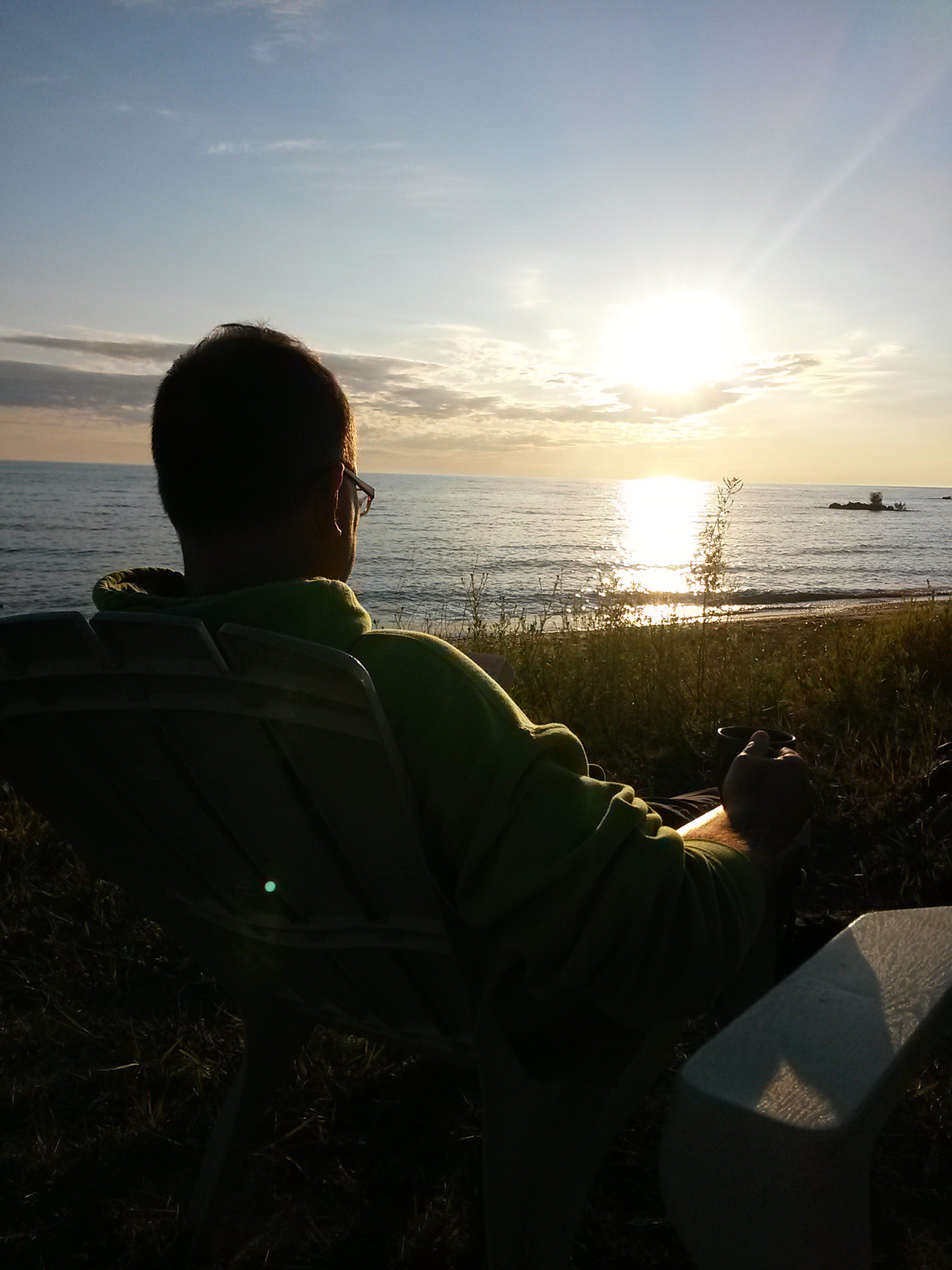
If you follow any of my social media sites online, you might have noticed there recently some sunset photos over Lake Huron where my family vacationed over the past couple of weeks. Aside from the inspiring sunsets, this is not what I remember the water to look like:


Normally, as I recall from my childhood summers spent on these shores, Lake Huron is fairly active. More days than not you would see a lot of wave action, and white caps carving up the horizon and rolling in over the surf. You would feel the constant high winds buffeting the tree-lined shore.

For the fourteen days we lived by the shore last month, however, the Lake was mostly calm. The water was placid, where there would be no more than a ripple on the surface and a splash on the shore line. In fact I would be hard pressed to say there was more than two days of wave action that came close to my childhood recollections. Needless to say, the quiet, peaceful waters made for much stress-free sea-kayaking and swimming along the coast.


At sunset most evenings we sat around the fire pit a stone’s throw from the shore, enjoying the very soft breezes and the relatively flat surface of the water.

And, if you watched the water, once in awhile you would see a large white fish breach the surface and flap it’s broad tail. The slapping sound often caught my attention if I wasn’t looking at the exact spot on the water.

This sudden sound, amidst the relative quiet of the expansive scene of resting water, air and land before us, also caught the attention of the other members of my family (I would add, they were preoccupied by their hand held devices, swatting the bugs, and chatting incessantly with one another!).

“What was that?” they looked up.

“Oh, a fish, jumping out of the water,” I responded.

“Cool! Where? Where? I wanna see!”

“Well, you need to be watching the water. Keep scanning the water up and down the shore line close to the edge.”

“I don’t see anything!”, one says, scratching another mosquito bite.

“You need to keep watching the water. There,” I point over the water toward the island, “there was another one!”

“Where?”

“Were you watching the water?”

“Uh, no.”

And on and on it went. I had a restful holiday. No, I did. Really!

The problem is not so much an incapacity to see. It is first to confess how distracted we are as a people in a culture that is impatient, anxious, that does not want to slow down, that keeps us from seeing what is already there. Perhaps Jesus is there for us to see. And we, like the Pharisees with whom Jesus often sparred, are “blind” to this truth. Jesus gives us precisely what we need to live, fully (Matthew 23; John 10:10). Do we not see it?

Before the cross became the central symbol of Christianity, the sign of the fish identified the early Christian movement. In fact, the cross was for centuries rejected by Christian who naturally recoiled at the thought of having an instrument of torture and capital punishment the central symbol of the faith.

The fish was a symbol for Jesus Christ. Food. Like bread, fish gave faithful people ongoing strength, sustenance and nourishment for life. No wonder the miracle of multiplication of bread and fish became a popular Gospel story about Jesus feeding the multitude on a hillside in Galilee (Matthew 14, Mark 6, Luke 9, John 6).

The new logo of the Eastern Synod reflects this original, early Christian identification with fish:


In the sixth chapter of the Gospel of John especially, Jesus compares himself to bread — bread that sustains us and feeds us everything we need. Everything. Not more. Not less. In the Old Testament, it was manna that God provided to the people in their desert wanderings.

The desert was the place where the people had to learn to give up control, which is mostly what ‘making plans’ is all about. “Like us, the Hebrews weren’t initially too excited about all this vague mystery. The people didn’t just complain that they were out of food, they also began to romanticize about the good old days back in Egypt where they ate their fill of bread …

“God responded to the people’s anxiety about food in a very tangible way. He provided the daily blessing of bread from heaven called manna. It was a fine, flaky substance which appeared every morning. And it came with some instructions (Exodus 16:1-8). Every family had to gather their own. You couldn’t store it up or hoard it, or the worms would eat it. So you had to gather it every day, except on the sixth day of the week when you could gather an extra portion for the Sabbath. It wasn’t much — just enough to keep you going on the journey.

“All of these descriptions [like bread and fish] are wonderful metaphors for how God cares for us along the way in the desert journey: daily, tangibly, personally, and sufficiently, although never enough to remove our anxiety about tomorrow. We have to trust there will be more manna when we need it [emphasis mine].

“This is what Jesus had in mind in teaching us to pray, ‘Give us this day our daily bread’. To pray those words is as if to say, ‘No matter how hard I try to secure my life with money, exercise, relationships, or work, I know that only you can give it to me. And you will do it one day at a time.

“The best reason for seeing the manna as a blessing [of Jesus’ presence, I might add] comes from its name. The literal translation of manna is ‘What is it?’ This means that every morning the people would go out and gather the ‘What is it?’ The mothers would prepare it as creatively as they could, which was tough because there was no ‘What is it?’ -helper. The family would sit at the table to eat. The kids would ask, ‘What is it?’ The mother would sigh and say, ‘Yes.’ They’d bow their heads and pray, ‘Thank you God for What is it?'” (Craig Barnes, Insights from the Desert, “Nurtured in Mystery” Shadyside Presbyterian Church, 2010)

What if we lived out of gratitude for what God has already given us? What if we made decisions — even small ones, each and every day — based on trust in Jesus being there for us, just beneath the surface of our lives? They’re for the watching. They’re for the catching and gathering. Grace and Gift, available to us. Before we even lift a finger to eat.

Believe in God’s possibilities

Somewhat striking to me in Gospel text is the sense of urgency surrounding these miraculous, healing stories from Jesus’ ministry (Mark 5:21-43). At least three times in this text, we hear the word ‘immediately’. A frenetic pace describes Jesus’ work here. It’s important, and it happens right away. There’s no time to lose. No sitting back. It’s time for action. It’s finally time to do something.
I suspect the reason this jumped out at me, is that summer can be a tempting, dangerous time for people like me who depend on routines and regular disciplines to keep our lives balanced. Because the temptation may be to skip the healthy practice — whether it be prayer, physical exercise, healthy eating, or attending to friends and family.
This text comes to us at the beginning of the traditionally long summer slow-down in our country. It may be wise to guard against what the Christian desert fathers and mothers called the sin of acedia, sloth, laziness, or my favourite word to describe the problem — inertia. The challenge during seasons of comfort and repose is to keep the important disciplines of exercising mind, body and spirit — to hold the sense of urgency around those important things in life.
Because to have faith is to hold fast, to trust in God’s possibilities. And the time to do that is now. Not some ideal day in the future, and not some day in the golden years of our past. But now. To have faith. To believe in God’s possibilities in your life. In our life, together.
While both Jairus’ dying 12-year-old daughter and the woman haemorrhaging for 12 long suffering years come from very different socio-economic and social circles, what they have in common is that their faith had made them well. (In the case of Jairus’ daughter, it wasn’t her faith, but that of her father). 
It doesn’t matter how old you are. It doesn’t matter whether you can even express your faith in words. It doesn’t matter whether you are poor and marginalized in society — like the woman in the text. It doesn’t matter if you are wealthy, comfortable and have status in society — like Jairus, the leader of the Jewish synagogue.
What is the healing in your life that you seek? Where can God touch the deepest need in your life? What is the discontent rocking your life now? Have you named it? Have you asked God for healing? God, we know, doesn’t cure every disease just because we ask for it. And yet, do you believe that God can do anything God wants, even bring healing? 
Last week after our two-day intensive training in Toronto, the Lutheran Ottawa Ministry Area Leadership Team was rushing to the airport to catch our flight back to Ottawa. We knew this usually half-full flight across the Province — a short 50 minute plane ride — is, these days, packed. The Women’s FIFA knock-out stage had games in Ottawa; and, the Pan-Am Games are soon beginning in Toronto. Our flight to Toronto the day before was also sold-out. 
And, with airlines normally over-booking, we heard of folks being delayed because they waited to get to the airport before getting their boarding passes. So, we were a little anxious, especially since someone on our Team had to get to work on returning to Ottawa.
I was fortunately able to get a seat, along with everyone else on the Team. As was the case with the flight to Toronto, I was assigned the middle of a three-seat row. Okay. I can put up with that for an hour. What I didn’t know was that the row I was in was the first one behind Business/First Class, which on each side of the centre isle has only two, larger seats across.
One thing on a short flight that I will enjoy doing is watching the real-time map on the screen in front of me — showing the variables of outside temperature, miles travelled, distance to destination, altitude and speed. On the screen you can watch the little icon of the plane travel slowly towards your destination. I enjoy watching that. Call me a nerd.
Because I don’t fly very often, I forgot that I probably had one of those video screens folded up and tucked away in my arm rest. But I didn’t think of that. I only reacted by feeling I got the short end of the stick. Ba-humbug! 
Both my row partners had screens on the back of the seats directly in front of thhem, but not me. 

Both of them fell asleep immediately upon take off. I concluded quickly they probably were not interested in using their screens. So I watched out of the corner of my eye until the guy on my right had his jaw hanging open and breathing heavily before I snuck my arm across to his screen to turn it on. But just as I was about to tap on “Map”, he twitched in his sleep and came half awake. I quickly withdrew, and waited until he again fell asleep before finally getting it turned on.

It dawned on me why I didn’t just ask him whether I could use his screen. I’m fairly confident he would probably have been okay with that, or at least reminded me of the screen I had in my arm rest. But I didn’t. I was bent on trying to sneak in my intention, or put off the actual engagement.
One aspect of the faith of Jairus and the woman, is that both in words and actions, they took the risk, made themselves vulnerable and even interrupted Jesus. They came out. They asked. Granted, they were desperate and at the end of their rope. Are you? Are we?
There are seasons in our lives when it may be difficult to believe in God’s possibilities for us. We get trapped in our heads. I know I do. We get stuck in our pain, and circle back over and over again trying to rationalize and self-justify not doing anything differently. We think too much about the hard realities facing us that we end up either rejecting our faith outright; or, we sit back in the lounge chair of summertime-like complacency. 
We may give up too quickly. We get discouraged so easily. We may even delude ourselves into thinking that “time will heal”. 
I suspect the biggest reason we hold back when opportunity for healing comes our way is because, as I did in the plane afraid to ask, I knew deep down in stepping out in faith to ask for something, my nicely constructed world however imperfect would have to change: Who knows? Maybe the fellow next to me would have wanted to talk with me, inquire what I did for a living and we would end up talking about God and faith and all his problems. It would require some work, then, right?
Asking for help and healing in prayer to God means things might get a bit messy, disruptive. Energy-draining. It’s a risk. Our asking for healing may very well shake us out of our comfortable way of doing things. God may very well be calling us into a sense of urgency as we go about ‘being Christian’. Do we even want that?
Do we believe in God’s possibilities? Do we hold the vision of God to heal, to restore and give new life, new beginnings to us, despite our present circumstances? Because opportunities will come our way. Will we seize the moment, as the woman did to interrupt Jesus? Carpe Diem! Will we want to acknowledge our dire, desperate circumstances giving rise to the courage to ask?
In the next year, our church will face an opportunity to begin a 5-, 10- or 15- year-long journey. An opportunity, I believe, will come across our bow to begin this journey in the next year. I mention this today, because it is the last time I’m preaching before my summer break. And I want to leave you with something to contemplate. I have a feeling we will, I hope over the next year, want to talk about this more.
When you go home today, I invite you to drive to the intersection of Woodroffe and Baseline. There is an open field there now, a strip of land between the transitway and Woodroffe, across the street from College Square. And as I speak, imagine the opportunity for Christian mission and ministry in this prime piece of land, the gateway to Nepean and very close to significant institutions of business, education, health care and culture at Centrepointe.
Then, imagine, what maintaining the status quo here will result in, some ten to fifteen years from now. If we just carry on business-as-usual and try to continue doing it on our own. We just need to tally the percentage of people in this room today over a certain age to answer that question rather decidedly. The trajectory is clear if we just ‘maintain’.
Then, again, imagine the possibility of healing that can come to the local Christian community overburdened and exhausted by a complacency and resignation to reality-as-is. Imagine the restoration, the new life, new beginning, and vigour of church ministry and mission in Jesus’ name that can happen when we share this work, as Lutherans, with other willing and effective partners in faith — other congregations — who are primed to do the same. Imagine what exciting work can be done together when we can combine our assets and resources — not ‘do it alone’ — and be a powerful, significant Christian voice and presence in West Ottawa. Imagine God’s possibilities! We’re not down and out; there’s a bright future! Together.
Jesus doesn’t ask Jairus, a Jewish synagogue leader, for proof of right belief. Faith is not saying the right doctrine or articulating a ‘correct’ denominational theology. Jesus doesn’t question the woman’s rather superstitious character of her faith before healing her. In fact the healing is virtually done before Jesus talks to her! Jesus doesn’t demand any rationally expressed pre-condition for granting his grace and healing power. To us, too.
In all truth, it’s his heart, his compassion, his unconditional love first and foremost that drives him to heal those who just have the courage to express an urgent, desperate desire for a new beginning, for health and wholeness. And take that first, small step in Jesus’ direction.

Imagine God’s possibilities!

Do we see the elephant?

You think when something happens frequently in a short period of time, perhaps I should pay attention to it? A sign? A reflection of something happening on a deeper level?
In the last couple of weeks I’ve attended a couple of administrative church meetings reviewing minutes taken at their annual meetings. One was the Christian Council of the Capital Area (CCCA) and the other was our very own monthly council meeting. And, in both cases, I sat around a large table while members studiously reviewed the draft minutes. In the silence, you could hear the crickets.
“Fine!” “Good job!” “Everything looks great!” “Thank you!” “Yup!” — the responses came rapid fire. And then — in both cases — someone caught it. “Ahh, it says at the top ‘Annual Meeting 2013’. Wrong year. Minor detail. Yet significant. It was worse at the CCCA where there were two different incorrect years on the front page highlighting different text!
I mention this not to slight our very capable secretaries, because it is the responsibility of the entire council to ensure the final copy is in order. But, I say this to emphasize how easy it is to see, but not to see. How very human it is — natural — to stare something straight in its face, and not have it register. 
In the Liquor Store the other day I was looking for Jessica’s favourite white wine from Chile. So I went to the South America section, where it always is. And I couldn’t find it! I stood there for an entire minute rubbing my chin and scanning the shelves. Finally I went to the desk somewhat frustrated. The attendant smiled and said, gently, “We have it.” I said, “No, you don’t.” He calmly led me to the exact same shelf where I stood staring at — I don’t know what. But there it was!
Psychologists might point to the need for us to be more ‘mindful’, in each and every moment of our lives. People of faith might consider how we are present to God’s presence always in our lives. There is often a disconnect, is there not, between my perception and reality? Some have called it ‘the elephant in the room’ that everyone feels is there but for whatever reason refuses to name it, address it.
The Gospel text for this last Sunday of Easter, is about Jesus’ prayer to God (John 17). It is, what liturgists call ‘intercessory prayer’ — that is the genre, or form, that this scripture takes. Prayer is the context. Jesus prays for his disciples, as they take over the mantel of responsibility for Jesus’ mission on earth, after Jesus ascends to heaven.
Since the time Jesus gave this ‘high priestly prayer’ over two thousand years ago, the church — the Body of Christ, the people of God — has continued to pray. I like that. Because no where that I can find in the Gospels does Jesus command his disciples to ‘worship’ him, to ‘praise’ him, to engage in the act of worship to which we contemporary Christians have come to narrowly define our Christian lives ‘on Sunday morning’. But Jesus does say, very often, ‘follow me’ and ‘pray’ and ‘do this in remembrance of me’ (referring to the Holy Communion), and ‘love your neighbour’.
What we are talking about here, is a lifestyle of following Jesus. And with this understanding, I believe, we can get a better handle on what Paul means when he says to “pray always” or “without ceasing” (1 Thessalonians 5:17). This phrase makes no sense if we see prayer merely as ‘asking God for things we want’ — how is it physically possible to do this? 
Prayer is not about trying to get God to change, according to our grocery list of desires and wants. Rather, when we pray what we are doing is asking God to change us. Prayer is about allowing God to change us. Always be open in your connection with God in Christ to being changed, transformed, grown in your own life into the image of God and the person God created you to be — regardless of what or for whom we are praying.
Problem is, some of us may be thinking: why would I want to change my life? There isn’t anything that needs changing. I am happy the way things are. Why would I want that? 

We may not able to be always ‘mindful’. But at least, could we not confess our sin in not hearing the voice of God calling us, not seeing and accepting the answer to prayer already right in front of our eyes?  I think it was Meister Eckhart who defined sin as simply refusing — by our actions and thoughts — to see ourselves as God sees us. What is the elephant in our room? What are we doing that is disconnected from what God is doing and what God sees in our lives?

We come to church with our pains, sufferings, hurts. But we also come to be Christ’s hands, heart and mind to those around us. We don’t come just to see ‘what’s in it for me?’ ‘What can I get out of this experience?’, like a consumer. We don’t come just to have my selfish needs, social or otherwise, met. Rather, we come to pay attention to those others who are hurting in any way.
What does God see? How are we paying attention to those in our midst with mental illness? Are we giving any time or effort of love to these people? How are we paying attention to those who come with marital or relational problems? Are we attending, with compassion, to this need at all? How are we paying attention to those who come, who are financially poor or new-comers to Canada, or students with all their complex needs? Talk about the elephant in the room when all we do when we come to church is notice the elephant poop in the corner and complain about that. Talk about the elephant in the room when all we do is talk about what colour paint we should apply to the walls of the room.
After eighteen years of pastoral ministry and leadership, one of the top-rated questions that has come my way, is: How do I know the voice of God? How do I know that it is God’s voice speaking? How is that in prayer, God communicates to us? How do we know it’s God and not just my ego?
I wonder whether it’s the elephant in the room syndrome that so much defines or characterizes church life today. Perhaps the answer is staring us in the face. And we just don’t want to see it. We don’t want to see it or confess it because we are afraid. And we are addicted. Addicted to a lifestyle that is all about consumption. Getting more. And more. And more. For me.
The Executive Director of the Mennonite Church in Canada, Rev. Dr. Willard Metzger, said during the “Justice Tour 2015” stop in Ottawa last week, that those of us who are older are addicted. And it is much harder for us in the second half of life to divest of our material addictions, compared to most young people today who will never earn the kind of pensions that, in general, retired folks today are enjoying; young people whose starting incomes will likely not increase to the same degree that was the case a generation or two ago; young people, more of whom will be working at full time jobs but barely making enough to enjoy the kinds of lifestyles most of us older people are enjoying today. Yes, we are addicted. And we don’t want to let go of this. And we don’t want to make sacrifices along these lines. Not easily, anyway.
National Bishop Susan Johnson (ELCIC) said at the same meeting that ‘the cries of the poor, this is the voice of God in our time. Are we listening?’
In v.18 of the Gospel text, Jesus’ prayed, “As you have sent me into the world, so I have sent them into the world.” While Jesus also says the disciples “do not belong to the world” (v.14), this does not mean escape from the world. While we affirm values and beliefs that do not correspond with the world’s values, we are not called to abandon the world, disengage nor hide from it, however bad it is. Because, Jesus prays that his disciples “may have Christ’s joy made complete in themselves/among themselves” (v.13). The joy that Christ gives is not found in escaping the world’s reality, but on the ground, in community engaging the world with all of its distorted powers, pressures and conflict.
God’s voice calls us into the world, not away from it. At the same time, God does answer our prayers, in a sense, because God already knows what we need (Matthew 6:7). And it’s a consistent answer, that we will read and hear about more in the coming season of Pentecost. God’s answer is the gift of the Holy Spirit (Luke 11:13). And the Holy Spirit is all about power. So, God’s answer to all our praying, is the power of God to do what is right, even if it means a sacrifice of part, or all, of our lifestyle and our privilege. God gives power more than answers (1) to change ourselves for the better, and for the sake of the world that God so loves (John 3:16).
May we be faithful in listening to God’s voice, and responding in the power of the Holy Spirit, God’s answer to prayer. We’ve prayed, in this morning’s service. Now, we are called to follow Jesus into our lives, away from this place.
(1) read especially chapter seven in Richard Rohr’s, “Breathing Under Water”

What is our purpose? -A little rant

I was privileged to meet Karen Hamilton this past week. She is the general secretary of the Canadian Council of Churches. She was in Ottawa giving some speeches and meeting with various church groups.

When I saw her she gave an address to the Christian Council of the Capital Area (CCCA) about ecumenism, inter-church relations and the problem of human trafficking in Canada these days.

She told some stories illustrating how churches, to a large degree, have lost sight of their purpose and meaning. Karen lives in Toronto, so she is well acquainted with municipal politics; and we all know, Toronto has had its fair share of vibrant, local politics in the past year.

She is friends with a local, Toronto councillor who has a background in theology but is well-entrenched in the secular world. With some frustration he told Karen recently that the single-most issue over which church groups petition Toronto city hall, repeatedly, is …. can you guess?

And let me just clarify — this is not an issue only espoused by one denomination, or one particular group of Christians. This is an issue that a broad spectrum of churches go to city hall over. Any more guesses?

Parking. And, presumably parking around their properties and buildings. Are you surprised? I was. Now, it’s not to say parking doesn’t deserve some attention. But for the secular world to have this dominant picture of what Christians spend so much of their time and galvanizing energy and petitioning politicians over … parking?

You’d think the church, if it were to venture into the public realm to make a stand and petition local government, would be more interested in issues other than parking. I agree with Karen Hamilton when she says the church does have an ‘optics’ problem. What kind of witness are we bearing in the world? Are we surprised that this institution for which we care is struggling?

After reading the Gospel text for the Third Sunday in Lent (John 2:13-22) I wonder how many tables at our annual /vestry meetings Jesus would overturn if he would walk into our places of worship and see what really motivates our “Christianity”?

It’s ok to fall (5): God knows everything about us anyway

I don’t like being in the spotlight. Literally, too. I don’t mind being the centre of attention from time to time. But I must confess a high degree of self-consciousness, especially when I am supposed to be the sage on the stage.

I suspect many of you share my knee-jerk away from standing on a stage by myself feeling the heat of the light on my face, not being able to see anyone in the auditorium, and just knowing in the back of my brain that every little wrinkle, every little blemish, every little imperfection is exposed — fully. Are your hands sweating? Mine are, just thinking about it.

And that is why the Psalm for Lent — and often read on Ash Wednesday — is Psalm 51. “Create a clean heart in me O God and create a right spirit within me” (v.10) — we sing in our weekly offertory.  Before this petition, there is a quiet yet poignant confession, in verse 4: “Against you, you alone [O God], have I sinned and done what is evil in your sight.”

This, at first, may sound threatening and alarming. Yikes! God almighty has been offended by my sin! I. Am. Doomed! And there’s no hiding from God. Wow! We’re in for it, aren’t we? Never mind the friends, co-workers, family, spouse, people around me that I  have offended and hurt. They may not always easily forgive — but they’re not God! After all, “If you, O Lord, should mark iniquities, Lord who could stand!?” (Psalm 103:3)

Perhaps that is why we read in the Gospel for today (John 2:13-22) about Jesus snapping his whip and overturning tables in a righteous anger and prophetic impulse. This image of Jesus may leave us feeling a bit queasy. We may not like this image of Jesus. We may feel threatened by it. Uncomfortable, at very least. 

Why is Jesus angry? Jesus is angry for the injustice of the temple moneychangers taking up valuable room where the Gentiles are allowed to come and pray to God. And he is losing it, in the temple of all places! Entering the temple, Jesus discovers how deceiving appearances can be. While the place appears to fulfill its function, closer inspection reveals that the temple has forgotten its purpose.

I read this story at our mid-week bible study a couple of weeks ago, when we discussed the text of Jesus’ temptation in the wilderness. It is a re-telling of Dostoyevsky’s classic poem about the conversation between the Grand Inquisitor and Jesus:

“During the 16th century in Spain, at the very height of the Inquisition, Christ appeared unannounced in the streets of the city of Seville. As he went about caring for and healing the poor, the sick and the lame, the people began to recognize him and flock to him. An old Cardinal also recognized him …. and had him arrested!

That night in prison, Jesus had a visitor. The Grand Inquisitor entered his darkened cell and reprimanded Christ for appearing again and getting in the way of the Church’s work. ‘You are offered three tools to bring in your kingdom and rule the world. You were told to change stones into bread. Imagine the possibilities … bread for the hungry … people would have followed someone who fed them. But you refused! It was suggested that you throw yourself from the pinnacle of the temple and let God’s angels sweep you up before you came to harm. People would have been amazed. Everyone would have followed you. But you refused! And you were offered authority and power over all the kingdoms of the world. But you refused! In all this you wanted people to follow you out of love or not at all. And look where it got you.

‘Well, we have corrected your mistakes and we’re doing well. We cannot let you hinder what we are trying to do. And so, tomorrow, you will die.’

Jesus said nothing in reply. Rather, he looked into the eyes of the Grand Inquisitor for a long time and then walked over and kissed him. Oh how that kiss burned. The Grand Inquisitor stepped aside and let Christ escape into the night, saying to his back as he left, ‘Do not come back again.'”

We may squirm in our seats, now. 

This Gospel, I believe, pushes us to imagine Jesus entering our own sanctuaries, overturning our own cherished rationalizations and driving us out in the name of God. What kinds of ways of doing things have gotten us stuck in a rut — in our individual lives, and in the life of the church? It’s an important question to ask. Just because Jesus is ‘our’ saviour, doesn’t means “he is perpetually well-pleased with us knowing that he speaks for us, yes, and with us, but also to us and even, on occasion, against us.” (Paul C. Shupe, “Feasting on the Word” Year B Volume 2 David Bartlett/Barbara Brown Taylor, eds. WJK Press, Kentucky, 2008, p.96)

Well, there’s one thing we do I don’t believe Jesus could get upset about — at least, one activity of the church, one way of doing things. Know what that is? The potluck meal, of course! Everyone likes a potluck! Right?

You come, bringing your own dish to add to the table. But you come, also willing to try a little bit of everything, right? That’s what makes it fun! Doing this, doesn’t mean you will necessarily like each and every dish. Tasting a bit of other people’s gifts doesn’t mean you will run home and try to make what everybody else made. And, you certainly wouldn’t be rude to the people who brought dishes you weren’t too crazy about. At the potluck we practice being generous, adventurous, compromising, and kind to the other.

The potluck is an important symbol in the history and practice of being the church; I would say a guiding image on congregational life and how to work together. Because in the potluck experience, we practice being ‘other-centred’ rather than ‘self-centred’.

This practise reflects the ‘outward’ movement of church-orientation. It may start with a potlluck. It ought to end serving those who are hungry. The ancient word for church in Greek, ‘ekklesia’, literally means: ‘a people called out’. Called out to see what God is doing ‘out there’ in the world. Called out to act.

The movement is centrifugal. It certainly isn’t ‘convenient’. Sometimes we need to be ‘thrown out’ of our self-centred preoccupations with maintaining the institution of the church and the comfort of our lives, and out into the world where God is doing something. Where there are people in need.

The cleansing of the temple — though hard it feels sometimes to be judged, to be convicted of our sin, to be honest about our true motivations — this scene ends with the sinners being thrown ‘out’. Out, into the world, in order to get a fix on what God is doing. Out in the world, in order to find God, again. Out in the world, to get back on track with what Christian faith is really all about.

The story of the cleansing of the temple as John tells it points toward replacing the material ‘bricks-and-mortar’ temple with the temple of Jesus’ body. This is a theme that is picked up later again in the fourth chapter, when he tells the woman at the well that she will no longer worship God in any particular, physical location (John 4:20-23) but in “spirit and truth.” John is painting, here, a narrative foreshadowing Christ’s death and resurrection, and its embodiment in the Holy Communion which we celebrate every week.

Maybe it’s better that it is only against God that we have sinned. Because only God can fully restore us, heal us and love us despite knowing all the dirt in our lives. I think we know that human beings don’t have a good track record of forgiveness of others. Only God, in Christ, will continually offer to us his mercy and forgiveness, knowing full well how off-the-mark we are. And, for us to know that we can always return to the Lord our God, return to the table of the Lord time and time again — in all honesty, truth and humility, to a God who will not spurn us for our faithlessness and weaknesses.

We can fall on our knees, because nothing is hidden from God, and everything we need, God gives us — and then some. Thanks be to God!

It’s ok to fall (4): It’s the only way

It’s only the second Sunday in Lent. Time seems to drag during this long, hard season. At least Advent — a similar season of preparation, repentance, and waiting — is only four weeks long; things seem to go faster in December.

The pace for Lent is perfect for Sarai and Abram. They are old — in their nineties, now in the twilight of their lives (Genesis 17). They are, likely, slower in moving about and more reflective than the young. They are, likely, more contemplative and more aware of the mistakes they have made and the wounds they have caused — all of which is appropriate for the Lenten journey (Craig Kocher, “Feasting on the Word” Year B Vol 2, Westminster/John Knox Press, Kentucky, 2008, p.50). I agree — although it’s hard to admit — sometimes we need a slower pace, and a place to listen and pray carefully, to confess our sin, as we turn toward God.

I tried something for the first time this past week which goes against the grain of my personality. When I go for my 45 minute walks, my route takes me along streets, roadways and eventually into a beautiful multi-acred forest called ‘the Grove’ whose trails lead to the Ottawa River. 

But I always carry my smart-phone with me. I have justified doing so for safety reasons. My hyper-vigilant personality loves this — no matter where I am on this planet I am only a text or phone call away! If there is a crisis or emergency, I can respond with efficiency and lightning speed to get help.

As I pondered leaving my phone at home, before going for my walk, I reflected on how dependent I have become on this device. Addicted, perhaps? I wondered what I would have done before the smart-phone era — not long ago, but long enough! If there was an emergency, I would have sought a neighbour’s help by knocking on their door; I would have paid more attention to my surroundings and where I might find help. I would have prepared better for my walk. I would have rested more in the moment, trusting more in the interrelated fabric of life around me.

So, here’s the good news. (But the structure of this sermon goes like this: There’s good news, then bad news, then really good news. Stay with me!) First good news, from this experience: I felt liberated. Leaving my phone behind wasn’t really that hard to do — and yet, it was a small step in a healthy direction, a simple sacrifice for evaluating my life-style and making concrete changes for the good. I will now practice more often ‘leaving my phone behind’, for its obvious benefits.

These are the ‘small’ steps we can make during Lent. Others give up chocolate, sweets, meat. Others still will ‘add’ something to their lifestyle — exercise, working out, volunteering more, coming to church more often, giving more money for some overseas mission, spending more time in prayer — all these good disciplines that are popular for Christians in Lent. And these are good!

During Lent, however, we are called also to contemplate the journey of Jesus to the cross — and the implications of that kind of sacrifice on our own lives. And so — and here’s the rub, the ‘bad’ news: Giving up chocolate or the cell phone is not ultimately what the Lenten journey is about. Jesus’ death on the cross was not making a ‘convenient’ sacrifice. Jesus’ death on the cross was not a little discipline that pinched but really didn’t change anything significant when Easter morning came around.

Jesus’ sacrifice goes to the jugular of our lives; it demands a costly cost; it means a radical change and giving up of something that is near and dear to us.

God calls Abram and Sarai to change their names. And it was a big deal in their day. In our times, names are often considered nothing more than labels. In our world, names are often chosen based on nostalgia, diction or popularity.

In the ancient world, however, names reflected the character and destiny of that person. To be called by your name, was a big deal. To change that identification was radical! Names were wrapped up in the core of one’s identity and purpose.

The name of God, above all, was untouchable — literally. The Jewish people withheld from spelling God’s name in scripture, from saying God’s name out-loud in worship. To call ‘on the name of the Lord’ was an act of profound devotion. To call ‘on the name of the Lord’ was a radical act of identifying with an un-nameable God.

And yet, in this text, even God is given a new name. For the first time, God is given the name “God Almighty” (Genesis 17:1). It is transliterated from the Hebrew, “El Shaddai” which might be translated, “God of the Mountains” (ibid., p.52).

So, here is my invitation to you today: Consider what profound and deep aspect of your life God is calling you to change. You may object, on the grounds of scriptural interpretation alone: “This text is not about us needing to change! God called Abram and Sarai to change their names. That was them. But not us!” 

Yes, we may think on occasions — even religious in nature — where we do still change our names — at weddings, some women will change their last names; and in Christian baptisms practised in some churches, babies take on their “Christian” name for the first time.

And yet, when we read this Old Testament text, and while we would do well to acknowledge its original context and meaning to the first people who received it, we are still asked today: What does it mean to us? How can this text become alive for us today?

And when we relate this text to the Gospel for today (Mark 8:31-38), where Jesus calls us to take up our cross and follow him, where Jesus challenges us to ‘lose’ our lives in order to ‘gain’ life — what does that mean? It’s not just about throwing a little more cash in the offering plate, or not indulging in sweets.

What may God be calling us to change, in our own lives? What may God be calling us, whispering into our hearts, to ‘lose’? Are we prepared to fall? Big time?

Jesus shows us that it’s okay to fall, because it’s the only way to go: The Cross. If anything, don’t skip opportunities in Lent to worship — during mid-week studies, Maundy Thursday, Good Friday, and the Easter Vigil. Why? Going to the Cross, through the Cross, is the only way for us to know and experience the joy and truth of resurrection. Being uncomfortable by facing our fear, anger and shame is the only way for us to know and experience the joy of life. If you yearn for true joy, satisfaction and rebirth in your life, being uncomfortable is the only way for you to be healed, to be redeemed and forgiven, to find your way in this world.

You can’t have Easter without Good Friday. We need to be prepared to ‘lose’ ourselves — to fall — in order to ‘find’ ourselves — to get up, again. In Christ. “El Shaddai”, God of the Mountains. Mountains define valleys. You can’t have mountains without valleys. Mountains encircle valleys — valleys of despair, valleys of impatience and sorrow, valleys of Lenten confession and discipline. Wherever you have a range of mountains, you will have valleys. But whenever you find yourself in a valley, don’t give up. Don’t get stuck in the valley. Don’t get comfortable there, either. Get up and keep on, because there’s a mountain just up ahead pointing our vision to the skies. 

And here comes the really good news (after the bad news, after the first good news): Abram is ninety-nine years old when ‘the big change’ happens. Ninety-nine! It’s never too late. Never too late for God to call us to change. Never too late for God to call us into ‘losing’ something that we have for a life-time believed to be important. Never too late for God to give us the strength we need to endure and follow-through on that change. Never too late for God to bless us with a wonderful gift of the new thing God is doing for us — whatever that may be.

God will never give up on us. God will wait a life-time, and then some! God is the God of Mountains. And mountains are steadfast and true. Mountains point upwards to the vastness and infinite beauty and glory of the sky and the stars. God pointed Moses’ vision upwards to see the Big Picture of God’s promises and God’s future.

Mountains will remind us, I pray, that God’s promises are sure. God’s covenant to us cannot be broken, even as we follow Jesus down this long, slow road. But, “whose destiny is our destiny: the cross, the grave, the skies” (ibid, p.54).

Step off the gas

It was -20c and the roadways were covered with snow and ice. And yet, I was feeling pretty proud of myself. Coming into the west-end near Stittsville, the Queensway/417 (the main expressway through the city of Ottawa) was empty. And it was mid-morning on a weekday!

I was powering it through! A little snowfall wasn’t going to impede me. I was going at my regular speed in the passing lane and was wondering why very few were venturing onto the highway. And then I saw a car had spun out, resting perpendicular to me at the side of the 417 in front of the Canadian Tire Centre. It had struck the guardrail. And a little further on I witnessed another car spinning out of control.

I decided to slow down, and tapped the brake. Surely my four-wheel drive will keep me in control. And then I felt the wheels begin to float underneath me. I stepped on the gas to try to get grip. But the fish-tailing was starting to feel like a swan dive! I was losing it!

You drivers out there, what would you do? Thankfully in that moment, I remembered what my drivers-ed teacher taught me thirty years ago: Step off the gas! I think we instinctively associate stepping on the gas with more control — in all circumstances; the more I give, the more I expend, the more I put myself out there — the better it’ll be.

But in this case, the solution was to let go and just keep the steering wheel pointed forward. And as soon as I let off the accelerator, the four wheels found purchase, and I was able to recover. It is a little bit counter-intuitive for us in our get’er done culture to divest ourselves of the belief that doing more about something will save us from whatever predicament we find ourselves in. Sometimes, in tough situations, we just have to let off the gas, a bit.

Isaiah writes to a people in exile. Some six hundred years before Jesus, the people of God were taken to a far away land, in Babylon, where for some generations they made it their home. They had to let go of things precious, people beloved, and a way of life they believed to be sacrosanct.

But Babylon was not home. Jerusalem was. And now, gone was their temple worship. Gone were the symbols, rituals and constant reminders of who they were and who the God of Abraham, Isaac and Jacob was. Gone was their culture, their social structures, their familiar communities.

And, in its place were foreign languages, foreign gods and strange customs. The Psalmist recalls the tragic sense of their exiled life, where they lamented, and mourned their loss: (Psalm 137:1-6)

By the rivers of Babylon—
there we sat down and there we wept
when we remembered Zion.
On the willows there
we hung up our harps.
For there our captors
asked us for songs,
and our tormentors asked for mirth, saying,
‘Sing us one of the songs of Zion!’
How could we sing the Lord’s song
in a foreign land?
If I forget you, O Jerusalem,
let my right hand wither!
Let my tongue cling to the roof of my mouth,
if I do not remember you,
if I do not set Jerusalem
above my highest joy.

To address this despair, Isaiah (40:21-31) offers some strategies for coping. First he holds in beautiful tension a paradox about God — two aspects of God over which theologians over the centuries have sparred: God is BOTH transcendent AND immanent. Not only is God up there “sitting above the circle of the earth (v.22), God also calls each part of creation “by name” (v.26).

Not only is God some far-away all powerful being, God is also personal, and calls to you by your name. God values what happens ‘on the ground’ in our ordinary lives. God’s love for us is revealed not only in the extraordinary, but especially in the ordinary lives of you and me. God cares.

Second, the prophet Isaiah encourages the people in exile not to forget their story, not to forget their history, not to forget what God had done for them in the past. Twice in this text the prophet asks the rhetorical questions: “Have you not heard? Have you not known? Has it not been told … ?” (v. 21&28). Of course they’ve heard! Of course they have been told! The problem is, they have forgotten.

A re-membering of their story — of God’s story with them — could strengthen their sense of identity, and bring forward to the present circumstances a hope that would see them through their loss. In other words, remembering for the future is an integral part of having faith in God.

Part of what it means to believe in God, is to believe in your story — and remember it! Remember what brought you to be where you are, today. Recall the most difficult times in your lives, and how God brought you through. Picture in your mind the people who where there, helping you cope and manage — friends, doctors, family, spouses, neighbours — people who came into your life at that lowest point and were like God’s angels to you.

Claim this story as your story of faith in a God who still makes good on God’s promises. The very fact that you are sitting in this room today is testimony enough to say: You survived! And not only did you survive — in many ways you thrived! And will so, again!

Not only do we remember who we are, we must remember who God is. God is in charge and whose thoughts and actions are way beyond our own capabilities (Isaiah 55:8-9). Therefore, our first job, especially when we are down-and-out, is to be patient. “Wait” is the direction from the prophet Isaiah. Just let off the gas a little bit. Saint Augustine wrote that ‘patience is the companion of wisdom’.

You might not need to do anything right now. What you really might need to do is nurture an inner life, an attitude, of watchful presence. Wait upon the Lord! — echoes throughout the poetry of the Hebrew scriptures (eg. from the Psalmist 27:16; 37) to a people yearning to renew their courage and trust. God is God; and we are not.

Waiting pays off for the people. King Cyrus of Persia (Isaiah 45) frees the exiles from Babylonian captivity — and the remnant of Israel finally returns to Jerusalem. Some 70 years they spent in captivity. Not all the people who left Jerusalem at the start of it saw the end of it. Many died in Babylon. But salvation is not individualistic. It is given to a people.

So, finally, Isaiah reminds us that just as it was for the Israelites in exile, our identity is in the larger collective. The narrative of our faith spans centuries. Our identity is corporate. As Christians, we call it “The Body of Christ” of which each of us is a member.

That means, even when we do not, individually, have a faith to stand up to the worst of the worst in life, even when our individual faith wanes from time to time, even when individually “I” have a hard time believing in God, “I” am not lost. There’s still a chance.

One of the downsides of an individualistic spiritual culture in which we live today, is to place unwarranted onus on ‘MY faith’ and ‘YOUR faith’ as the critical condition for ‘MY salvation’ or ‘YOUR salvation’. As if we are independent, autonomous beings. Many a death-bed confession — and this is common — involves anxiety about whether or not ‘my’ faith is strong enough, good enough. In those situations, especially, we need to be reminded that it is not ‘my’ faith or ‘your’ faith alone that will get you through this trial. It is the faith we share.

It is our faith together that helps us through the tough times. It’s not dependent on how good I am, or how strong my faith is. There is a people of God — “a cloud of witnesses” (Hebrews 12:1-2) — around me and you. There is a church, a community of faith — whose collective faith gets us through. This is the faith of our fathers and mothers, our predecessors, our forebears, the current saints in light, and the faith of those who will come after we are gone. I don’t think anyone would question that kind of faith. It is the collective, communion of saints in heaven and on earth praying for you, upholding you, during your personal exiles.

And, ultimately, it is the faithfulness of God that gets us through. Throughout the scriptures, salvation is described in this way: It is not we that have loved God, but that God has loved us (1 John 4:7-11). This is an integral, vital, part our story together. Let’s believe in it. And believe that God starts it all, and ends it all, for us.

For those who can’t stand doing nothing, who are frustrated by the notion of being patient and waiting, there may be something for you, in fact, to do: Practice. In all that you do, be mindful, aware and intentional in your prayer life. Because prayer is about letting go in time and space, and listening to God. Prayer is not about me, it’s about God.

I realize that part of what saved me on the highway this past week, was that I had practiced. I recall all those times that whenever I’m in an empty parking lot — even coming during the week into the church parking lot — I’ll have a little fun with it: I’ll spin around a bit — not recklessly doing donuts all over the place. But I’ll just get the car going enough to do a bit of fishtailing. I get the feel of it. So I know what I can do in a crisis.

Stepping off the gas in a spin out, works. And it takes a bit of practice.