
Cold sores and family

A highlight for me this summer was the family reunion at Wasaga Beach. We had been unable to attend this annual reunion the last few years, so it was a while since I had last connected with many people on my spouse’s side of the family. And as is consistent with my personality style, I was worried about making a good impression.

God has a funny way of challenging us where we need to be challenged. Because at about the time we decided to attend (which was a last minute thing on account of our recent move), I woke up with a big, festering cold sore on my lip.

Now, I had not had a cold sore for the last several years. It had also been a while since I knew what a cold sore was all about: irritating, itchy, never letting you forget it’s there (for a fleeting moment I wondered whether family reunions and cold sores had something in common!).

The cold sore has about a ten-day cycle, from initial growth to its drying, scabby end. I was to hit the high point of visible grossness the day of reunion. Everyone with whom I would have a conversation would have to be blind not to see the bulbess thing hanging from my lip. What would they say to me? (“Aahh, Martin, wipe your mouth man! Too much salsa for lunch?”) How would I respond? (“Awwh shucks, it’s nothing, really”) What would my extended in-law family think of the man their wonderful daughter had married?

As it turned out, God also has a funny way of reminding us of what is true, what is good, and what speaks of God’s love for us all. You see, my obsessive preoccupation with how I looked turned my conciousness away from others and the whole meaning of the event. Martin Luther defined sin as “being turned in on oneself”. I guess I was sinning: I was preoccupied with myself.

And yet, by the end of the day and contrary to my initial expectations, I felt accepted, loved and part of a family. No one drew attention to the cold sore; it was a non-issue. They were just happy to see me and my famly there! “It’s been too long!” That was the main thing: being together at the reunion. I felt like the Psalmist who expressed: “Even the sparrow finds a home, and the swallow a nest for herself where she may lay her young” (Psalm 84:3).

According to the Psalmist, it was the relatively insignificant, common, plain-looking, rather small sparrows who found a home among the rafters and ceiling crevaces in the tabernacle. It wasn’t the eagles, hawks, larger birds with colourful, attractive plumage.

What does this image suggest about who finds ‘home’ in God’s presence? The great? The mighty? The successful? The seemingly perfect? The beautiful?

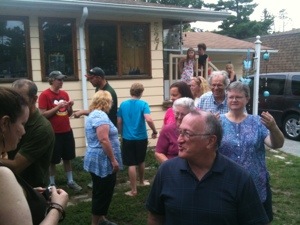
By the end of the reunion day, I had almost forgotten about my cold sore because I was more focused on this collection of diverse people who found there way to Wasaga Beach on a sunny, August day: There were some fifteen youth and children under the age of twenty in addition to some twenty adults and seniors. And this collection of people spanned the whole socio-political spectrum and North American continent …. You get the picture.

Immersed in this blessed diversity I forgot about myself, because it wasn’t about me to begin with. This reunion was bigger than the sum of its individual parts. There was something more going on here.

The basis of our unity was not the visible aspects of our togetherness, otherwise we would all look the same! The basis of our unity was something we shared on the inside that was manifested on the outside. And what is true on the inside of our lives gets expressed on the outside by way of attitude, by way of our beliefs, by way of the nature of how we relate to one another.

“As it is on the inside, so shall it be on the outside,” as Michael Harvey explains (@Unlockingthegrowth). While mortals look on the outside, the Lord looks upon the heart (1 Samuel 16:7).

Thy will be done on earth as it is in heaven. This notion from the Lord’s Prayer suggests that heaven (the invisible, interior reality) leads to a corresponding visible reality on earth. Like in the Holy Eucharist, Baptism — any Sacrament — an inner truth reflected exteriorly, in water, bread, cup, meal.

Over the past month we have heard scriptures from the sixth chapter of the Gospel of John reflect on Jesus as the “bread of life”. We conclude today this teaching of Jesus from the synagogue in Capernaum. And the disciples, it is reported, had difficulty with it (John 6:56-69).

Admitedly, I think for us, too, it is much easier to deal with external, material reality: we can touch, taste, manage, something on the outside of us. It is easier to make judgement on a crooked picture frame hanging on your wall; but to reflect on why that particular picture is there in the first place and who painted it, for example, takes much more work that often, quite frankly, we’re not up for.

To approach the inner realm of our lives can be dumbfounding, intimidating, overwhelming a prospect. And so we avoid this work and get ourselves immersed in unreflected, unexamined action and busyness. Because that’s easier.

Yet Jesus emphasizes the truth of the inner life giving reason and substance to the outer life. In his words, “It is the spirit that gives life; [without the spirit] the flesh is useless.” (John 6:63). The beginning points of all meaningful and effective action are prayer, contemplation, reflection, engagement with our inner lives in relationship with God and others. The spirit gives life.

And this is how to understand that more famous text from Ephesians 6 about putting on the armour of God. We put on the belt of truth, the breastplate of righteousness, the shoes proclaiming the gospel of peace, the shield of faith and helmet of salvation and sword of the spirit, NOT in an aggressive, confrontational, external stance against enemies of the flesh. “For our struggle is not against enemies of blood and flesh, but … against the spiritual forces of evil in the heavenly places” (Ephesians 6:12). Again, the beginning point of faith is in the internal, invisible reality of our lives.

That is not to say that sometimes when we don’t feel inside any stirrings of the spirit, we ought not do anything. Sometimes the reverse is true: we need to engage in right action despite our feelings or what might or might not be going on interiorily; our external action, then, may affect positively what is going on inside us. After all, Jesus doesn’t exclude one or the other: “The words that I have spoken to you are spirit AND life” — internal AND external are both vital, to hold in balance. Not either/or, but both/and.

As I said, the exterior reality that reflects the inner truth is that of attitude, and the quality of our relationships. And, more to the point, this attitude is pointed to the quality of our relationships with those whom we invite to church and those to whom we are strangers and happen to cross the threshold of our church.

These people, too, are part of God’s creation, loved and cherished. Every person on the planet can claim the passage from the Psalms: “I am fearfully and wonderfully made” (Psalm 139:14). And therefore they are among us for a divine purpose.

More Christians are raising concern about equating the church with ‘family’ – presuming the analogy refers to a traditional father-mother-children unit. For being exclusively defined as such, I agree with their objections. Because the family of God is so much more.

It is not our job to judge their status in the family. It is our job to invite them. To be an invitational church. That family reunion at Wasaga Beach happened because an invitation to come went out. I am grateful for that invitation.

Because we are a church that belongs to Jesus Christ, there is a place for you and everyone else here. “You did not choose me,” Jesus says, “But I chose you …” (John 15:16).

Christ’s invitation is about joining in God’s mission. And this mission is not just the purvue of the rich, the famous, the successful, the educated, those who have unblemished bodies, those who have been a part of the church forever — but to all, including you and me. Because God made us, “wonderfully”, from the inside out.
20120825-115542.jpg

Failure = Success

When we think of David, we think: shepherd, poet, giant-killer, king, and ancestor of Jesus – in short, one of the greatest characters in the Bible.

But alongside that list stands another: betrayer, liar, adulterer, and murderer. The Bible makes no effort to hide David’s failures. The first text from the Scriptures today (2 Samuel 11) highlights one of David’s greatest sins: his adultery with Uriah’s wife, Bathsheba.

And this sin doesn’t stand alone in his life. In order to have Bathsheba, David not only breaks the sixth commandment, but the fifth one as well – he arranges for Uriah’s murder. One thing leads to the next.

Like David, we are sinners and we live in the web of sin. Our sins are not isolated, autonomous items, knick-knacks lined up on the shelf; and when we want, we can simply remove one without really having an effect on anything else. When we say we are sinful, we confess the pervasive depth and breadth of sin in our lives. The doctrine of original sin implies that brokenness and imperfection seep into and is woven into the very fabric of all creation. You can’t escape it.

Which may lead us to despair over our seeming palliative moral situation as human beings. We are bound to fail. What hope is there?

One of the outstanding effects of our cynicism and despair is our loss of resiliency. We give up all too easily. This trait becomes a hallmark of a people who are fearful and shameful of failure, of making mistakes. We may try something new, take a bit of risk, and if it doesn’t work the first time – we say, “That isn’t for me” and walk away.

Loss of resiliency comes from our fear of failure. The phrase “airbrushed out” is used to describe photos where a model’s imperfections have been removed, or where their attributes have been enhanced. But airbrushing, as Michael Harvey points out (Unlocking the Growth, p.118) also happens in church circles.

Doesn’t the church have a tendency today to airbrush out any imperfections? I doubt if church authorities today would commission the writing of David’s Psalms. There is too much honesty there: “Why have you forsaken me?” “Why have you let my enemies surround me?”

But what if we chose to look at our failures and imperfections as an aid to hearing God’s voice, to the transformation of not only ourselves but of the world around us?

Norman Vincent Peale used to say: “When God wants to send you a gift He wraps it up in a problem. The bigger the gift that God wants to send you, the bigger the problem He wraps it in.” Problems are a sign of life and activity. But we get concerned with the wrapping rather than the gift, don’t we?

The wise would say: There is no failure in falling down; the failure is only in not getting back up again. So don’t waste a good failure, because imperfect practice makes perfect, and failure precedes success. David, while he sinned greatly, he moved on from his mistakes: confessed his imperfections and accepted the suffering they brought.

Thomas Edison said, “If I find 10,000 ways something won’t work, I haven’t failed. I am not discouraged, because every wrong attempt discarded is another step forward.” Often one of the best ways to hear God’s voice is in the midst of failure, if only we stop berating ourselves to listen for it.

How do we do this?

First: Practice persistence. If I came home from a long trip late some stormy night to a fridge that was empty of the one thing I desperately wanted to eat, what would I do?

I could just go to bed and forget about it. Give up.

Or, I could put on my boots and raincoat and walk down to the corner store. But alas, they’re sold out of what I want; I could just go home and forget about it. Give up.

Or, I could drive farther across town to a late night drugstore. But alas, they don’t carry the thing I want; I could just go home and forget about it. Give up.

Or, I could drive to a specialty food store where I am sure they would carry my product. But alas, when I arrive there I discover they have closed for the day; I could just go home and forget about it. Give up.

Or, I could drive downtown to an all-night super-big grocery store where I finally find that one, precious item.

Persistence. Learning to unlock failure as a necessary way to grow is a bit like playing a video game. There is always another level, another lock to break down and then yet another level to reach. And if you don’t take down the locks one by one, well, you never reach the top.

Christ Jesus saw the rich young ruler walk away, saw many disciples turn back after a particularly hard teaching, saw Judas betray him, and the other eleven disciples temporarily desert him in the Garden of Gethsemane. Jesus himself had to face disappointment and ultimate failure – from a human perspective – in his defeat on the Cross.

Yet Jesus remained true to his divine call. Jesus stayed on the path set before him. No failure too deep nor cross too heavy would stop him. Praise be to our Lord, who showed us the way!

In the striving and persistence, there is yet another very important distinction to make: between doing the right thing, and the results. The results of our best-laid plans and intentions are in God’s hands. When we fret and fume and obsess about the results, we are often disappointed and we lose resiliency and give up, afraid to try anything, take any risk.

It was Saint Paul who wrote: “I planted the seed, Apollos watered it, but God gave the growth” (1 Corinthians 3:6). Our job is to do what we need to do – let God worry about the results.

Our gut response to failure is often: just follow/enforce the law. (As if doing that will make all things right again). The purpose of the law, in Lutheran theology, however, is to drive us to our knees at the throne of grace. The purpose of the law, which stands out in Martin Luther’s theology, is to make us realize that we cannot accomplish by our own strength and effort the perfection of the law. This confession and realization draws us to Christ and his work.

Failures are like leftovers. Leftovers are food that may even be discarded. Leftovers are food that was not initially desired nor needed by those for whom it was prepared. Leftovers have a second-rate, imperfect quality about them. In the Scriptures, sometimes leftovers are like the crumbs spilled on the floor for the dogs to eat (Matthew 15:27) In Matthew’s version of the feeding miracle, the ‘leftovers’ are identified as “broken pieces” (Matthew 14:20).

Whatever you take the miracle of the feeding of the multitudes to mean, one thing the text from John 6 makes explicit: Jesus causes everyone’s hunger to be satisfied and twelve baskets of leftovers are collected. Why emphasize these leftovers? A great miracle has just occurred, the only one told by all four Gospels – Matthew, Mark, Luke and John – and our attention is drawn to leftovers? Kind of odd, no?

Perhaps the Gospel writer indicates by this the character of the new community of believers where “leftovers” – both food and people – are neither insignificant nor abandoned. Who are the ‘leftover’ people in our society? Those at the margins? Anyone who is not afraid to show and be honest about their imperfections, their failures?

When we accept the “leftovers” in our own lives – whatever failures and imperfections – we are in the best position to accept Jesus.

During the storm on the sea when they notice Jesus walking on the water, the disciples take Jesus in – receive him – into the boat. The Gospeler John often uses the verb “to receive” (lambanein) in terms of believing that Jesus is the Son of God (see 1:12-13;3:27-36;5:43;7:39;12:48;13:20,etc.). For John, such trust and reception on the dark and wind-tossed seas of their failures is followed immediately by calm and joy. Jesus distributes the food to all; Jesus is the source of peace.

You see, the thing about David, is that he trusted and believed in God as one who would forgive him, who would satisfy the hunger of his heart, who was the source of all things good. I believe it is because of this trust that God referred to David as one “after his own heart” (Acts 13:22).

We know how leftovers can sometimes taste the best; our failures can be the key to our growth, to positive action. God speaks through our failure. Accepting this, confessing it, and then doing what we are able, in trust and openness of heart, receiving Jesus as the one who accomplishes the good deeds in us and through us – this is the character of faith.

How is God Faithful? – in Covenant

We are a Covenant people! — So announced the theme of the biennial Eastern Synod Assembly last week in Waterloo. What does it mean to be in a Covenant relationship with God? Certainly this word is not in common usage today. Perhaps ‘promise’ comes close.

Yet Covenant conveys more. First and foremost, to be in a Covenant relationship with God is to trust that God worries about the results. God brings it home. God’s action is the punctuation mark at the end of all our sentences. God finishes.

And we do not. That’s important.

Nevertheless, to assert God’s side of the bargain, what is presumed is our action as well. There’s no point in having punctuation marks at the end of sentences that aren’t written. And so to be in a Covenant relationship with God is to take the risk of faith, not knowing what the consequences may be. Without this element of faith we bring judgement upon ourselves in living and believing in “cheap grace.”

Indeed what we often need to start with — and that is why we being most acts of worship with confession — is seeking forgiveness for blocking God and locking ourselves in false ways of being church. How do we block God and lock ourselves in patterns of unfaithfulness? A worthy question worth exploring: How do we block God and lock ourselves in ways that keep us stuck?

Have you considered that being Christian is not just about going to church on Sunday? Have you considered that being Christian has just as much to do with what we do in our free time? — being Christian has just as much to do with Monday to Saturday as it does with Sunday? — being Christian has just as much to do with what we spend our money on? — being Christian has just as much to do with how we vote? — being Christian has just as much to do with how we relate with our spouse, our children, our extended family, our neighbours, our community? — being Christian has just as much to do with our behaviour as it does with the words we speak? “Preach the Gospel; use words, if necessary,” instructed Saint Francis.

Many of us, myself included, grew up in the church with the idea that faith was a private affair; and, therefore there were three topics good, pious Christians would never discuss openly, especially in the church. You know those three topics, right? — sex, religion, politics.

In looking recently over our annual Canada Revenue Agency charitable report that all churches are bound by law to complete and submit annually, I was surprised to find a question among a hundred other questions: The question was: “Did the charity carry on any political activities during the fiscal period?” The little note above the question clarified that churches indeed can be involved in politics, as long as that political activity is non-partisan and limited in extent.

I was also struck by the meaning of the Old Testament story optioned for this Sunday, from the book and prophet, Samuel. In this story, the Holy Ark of the Covenant — there’s that word again! — is brought triumphantly into Jerusalem. We read about that procession of King David dancing as the Ark is brought into Jerusalem and placed at the center of that great city. It is an image of uninhibited, unabashed glory, of joy and celebration (2 Samuel 6:1-5,12b-19).

Now, just for a moment, reflect with me on the meaning of this: The Ark of the Covenant in ancient Israel was at the time the most powerful and central image of Israel’s faith. And Jerusalem was (like Ottawa is for Canadians) the center of political power in the nation — the capital city.

And what does David do? He brings the two together: religion AND politics. And, perhaps more significantly, he does it not begrudgingly nor fearfully, but joyously!

At the Synod Assembly last week in Waterloo, we passed several motions that you could deem “political” in nature. Let me briefly review a few of these: a motion in support of non-violent solutions in pursuing justice in the world and in situations of conflict; a motion to call upon the government to re-instate full health care coverage to refugee claimants; motions to address affordable housing, poverty, racism and environmental action. These motions can be viewed on the Synod website; hard copies are also available from your delegates.

Faith is not exclusively ‘private’. It is ‘public’. It’s not just about me and Jesus; but about me and the world that God so loved. It’s more than just me. And as soon as we translate our faith into the public realm, it gets political. We have the biblical witness to this marriage between faith and politics:

When the seven perscuted churches in west Asia on the Aegian Sea coast (in present day Turkey) of the Book of Revelation are pressed to swear allegiance to Emperor Nero they are brought before the courts; and the encouragement of scripture is heard: Do not worry about what to say when called upon to testify to your faith in Christ as Lord. “For what you are to say will be given to you; for it is not you who speak, but the Spirit of your Father speaking through you” (Matthew 10:19).

The beheading of John the Baptist, from our Gospel text for today (Mark 6:14-29), provides a gruesome image of what sometimes may happen when religion and politics meet in the same room.

And perhaps the most poignant image from the New Testament — the Cross — was a political symbol and practical means of Roman capital punishment. It’s like the electric chair or lethal injection would be for us today. For several centuries after Christ early Christians shied away from using the cross as a central symbol; you can’t find images of crosses anywhere in the archeological record of those first centuries. In fact, the fish was the first central symbol of Christianity. Did the early church find the cross too brutal — too political — an image? I wonder.

I know I need to confess my own fear of bringing my faith to bear on the public world around us. I know I need to confess my own fear of blocking what God wants to do and locking myself because of my fear of rejection, my fear of failure, my fear of sticking out my neck.

One of the speakers at last week’s Synod (I’ll want to talk more about Michael Harvey in the near future) said that fear is the socially acceptable sin of the church today. It is a sin of omission. This is the sin we need to confess. I don’t think it’s coincidence that the biblical injunction: “Do not be afraid/Do not fear/Fear not!” appears some 365 times throughout the bible. We need to hear that; I need to hear that, each day of the year.

Because on the other side of fear is the vision, the abundant life. On the other side of fear is new life. The thing we fear is actually God’s call on our lives. We need to accept and confess our fear. We need to go there.

And when we do, God finishes. God is faithful. God remains true and steadfast to the Covenant relationship. Because God loves us and wants us to love God and those around us. God wants to be in relationship with us, even though we so often miss the mark.

Listen to Paul’s words we often recite: “Who will separate us from the love of Christ? Will hardship, or distress, or persecution, or famine, or nakedness, or peril, or sword? [notice the political words here]. No, in all these things we are conquerors through him who loved us. For I am convinced that neither death, nor life, nor angels, nor rulers, nor things present, nor things to come, nor powers, nor height, nor depth, nor anything else in all creation, will be able to separate us from the love of God in Christ Jesus our Lord” (Romans 8:35-39).

Jesus goes there. Jesus has crossed the boundary between private and public, religion and politics. Jesus enters all aspects of our life together. There is no place Jesus does not go. Even to those places we fear most. Jesus goes there — into our hurt, pain, suffering, persecution, illness. It is not our job to be successful; it is our job only to be faithful, and do it. We are called only to follow, to follow in the way. And then “Jesus will bring to completion the good work begun in you” (Philippians 1:6).

Thanks be to God! Amen.