Doers of positive change

If you’ve followed the Ottawa Senators’ Hockey Club over the last year you will have endured a roller coaster ride. From the high, you will have tasted the sweet drippings of a near-berth in the Stanley Cup Championship Series sixteenth months ago …

To the low, feeling the despairing collapse of the team, not just to being out of the playoffs but crashing all the way to second last place in the NHL standings by the end of this past season.

What happened?

In the last several months, the nightmare season was enflamed by revelations of all the off-ice drama that was happening:

  • Allegations of sexual abuse by then assistant manager Randy Lee;
  • The politicking of owner Eugene Melnick to shame/scare the fan base that he was either going to move the team away from Ottawa, and/or that the downtown arena project may not happen motivating concerned fans to initiate an #MelnykOut ad campaign across the city;
  • Star player Erik Karlsson’s wife applying for a peace bond (restraining order) against the girlfriend of another star player, Mike Hoffman, who allegedly used social media and other means to send discriminatory, abusive messages to the Karlssons even during the loss of their unborn son in March;
  • And the continuing speculation around and probable trade of Erik Karlsson in the final season of his current contract.

General Manager Pierre Dorion was right when he told the media last Spring that his locker room was “broken.” Inter-personal relationships, team chemistry – the essential ingredients in a winning team – were damaged maybe even beyond repair.

While ‘on paper’ the team had skilled players and was comprised of the same core from the year previous when they had that successful run to the Conference Final, something significant had changed for the worse. And this subtle yet very real aspect of failed team-work was at the root cause of the team’s on-ice collapse last season. It wasn’t that they weren’t good players; it was their unhealthy, damaging ways of relating with each other that was the problem.

Funny we are talking here in the church about a hockey team that many of us follow in Ottawa. And yet, we can, I think, attend in a similar way to most areas of our social, political, religious, family and personal lives. Are their areas in your work, your volunteer efforts in the church and in the community, in your personal health, in any aspect of your quality of life let’s say, that are lagging, that yearn for renewal, new life, positive change?

For some time, Ottawa Senator players have been saying that there needs to be a culture change in the locker room and among team relationships. Goaltender Craig Anderson said this week he is looking forward to the changed culture in the coming season but he is “too old for all the drama.”

Teammate and hometown defenseman Mark Borowiecki who is considered a leader in the group called out his goalie and others on the team by suggesting they need to do more than just say they need a culture change. Each player and the players themselves as a team, has to do the work of changing the culture. It wasn’t going to happen by itself. No divine intervention. No single-player trade, no matter how newsworthy, was going to change their culture. They, the players, had to take on the responsibility to work at it.

Be doers of the word. A theme in the scriptures assigned for this day. In the Book of James we get the message that while words are important, actions reveal the truth, authentic self and purpose of what we’re about (1:22) more than anything else. What we do with ourselves, with each other – our actions – are the best teacher and communicator of what is most important to our common life, our team, you could say – whether that team is the church, the family, a marriage, a community group, a political movement, or a sports team.

And this action is not only about our performance on the ice, so to speak. This work of doing is not merely about the mission, out there. It is not about whether we succeed or fail on the mission field in getting the job done – the work of ministry in the world. Perhaps our failure at getting that job done out there may at least in part relate to our failure to do anything on the inside of our personal and corporate lives. And lacking the awareness and the belief of positive change within.

It is no wonder Bishop Susan Johnson and the leadership of the Evangelical Lutheran Church in Canada (ELCIC) has identified being a “healthy church” as one of the four vision priorities, moving forward in community. Being a healthy church means, to “develop and promote a culture of mutual trust and accountability.”[1]

That is, we relate with one another and the world around us in ways that reflect genuine listening, respect, humility and patience. In short, we offer safe spaces for personal interaction and growth. We can’t achieve the other vision priorities of the church, such as compassionate justice, spirited discipleship or effective partnerships, unless we are first a healthy group of people relating to one another.

And no one will make this culture change in our relational lives unless we are doers of the word, unless we take action that promotes growth, faith and positive change in our common lives.

In the mid-point of Mark’s short Gospel, Jesus spends a lot of time around the Sea of Galilee. When I visited Israel during my seminary years, our bus ride was only a couple of hours from Jerusalem to the Sea of Galilee. In Jesus’ day, it meant walking at least six days. Word of Jesus had certainly spread, and his actions of healing and eating with sinners and picking grain on the Sabbath made the Pharisees – the keepers of the Law – extremely nervous. So much so, that the powers that be from Jerusalem invested the better part of a month checking up on Jesus’ ministry (7:1).

It is sometimes amazing the lengths people will go in order to keep things the way they have always been. A radio sports commentator mentioned after the Anderson and Borowiecki interviews that Mark Borowiecki was right: talk of culture change has been swirling around the same group of players for most of last season with little, actual change in their performance. It seems we haven’t really been taught how to work at bringing positive change, starting with us.

Change is frightening, to be sure. Institutions often seek to preserve the status quo. That was true in Jesus’ day. And it is true in congregations as much as in team locker rooms these days. Yet change, as we must surely know living in this time and place in history, is the norm, not an exception.

I was pleased to hear Pastor Mei Sum Lai, leading her last worship service at Resurrection Lutheran Church in Orleans[2]last Sunday, thank the congregation for allowing change to happen during her tenure there. I then reflected on all the changes that have happened here at Faith[3]in the last six years or so:

  • The bold decision to bring significant upgrades and modernization to the building and sanctuary;
  • The gutsy decision to worshipping for four months with our local Anglican parish while the sanctuary was off-limits in its renovation;
  • The move to weekly Communion;
  • The involvement of lay readers and worship assistants;
  • The completion of the work of the Evangelical Lutheran Women as a formal entity
  • The introduction of Christian Meditation as a weekly prayer group;
  • The evolution of bible study to a prayerful encounter with the Word;
  • The ongoing evolution of meals at the church in all its fits and starts – to name a few changes.

These changes, good or bad in your view, are nevertheless good practice for us. Making these changes are good exercise for us, for the positive changes that God is bringing about in our world and church. Because we won’t do it perfectly. We will make mistakes. We will even fail at times. But avoiding failure is not the point of Christian identity and mission. The point is, we are following Christ – or trying to – on a rocky and uncertain road in the post-modern world. Trying amidst the noise and chaos to discern and listen to Jesus’ voice.

What is at stake, is what we believe. What do we believe about change? I think this makes a huge difference in how that rocky road will go for us.

Despite the negative scrutiny and criticism heaped upon Jesus by the Pharisees, what does Jesus do in response? Does he cave into the pressure to play by the religious rules of the day? Does he try to please the authorities and adhere to the tradition for tradition’s sake? Does he shift into self-preservation mode and quietly step into the shadows as not to garner any more attention? What does he do?

Jesus keeps on healing. If you read on in chapter 7, he goes on from Lake Galilee southward on the road into the non-religious Gentile region first to heal the daughter of the Syrophoenician woman[4], and then he opens the ears of the deaf man in the Decapolis.[5]

In fact, I don’t know of anyone in the New Testament who doesn’t change after encountering Jesus, whether by a healing or in a shift of attitude and approach to life. The most dramatic example, probably, is Saul of Tarsus who on the road to Damascus encounters the living Lord and experiences a profound conversion.[6]

When you meet Jesus, your life changes for the better not because you don’t do anything about it. But because you’ve placed yourself, for better or worse, in a position to receive the grace, healing and change of God. Historian Diana Butler Bass writes, “For all the complexity of primitive Christianity, a startling idea runs through early records of faith: Christianity seems to have succeeded because it transformed the lives of people in a chaotic world.”[7]During this time, Christianity was primarily about how to live a better, more faithful life, here and now within the kingdom of God.

Team play is as much an inner game as it is an outer game. And the inner game takes work, not just words. This inner work is not easy to do.

Perhaps you might have a hard time believing positive change is possible in your own life. If so, is it because we refuse to see the positive changes happening in those around us – in the life of the church, in our own families and friendship groups? Because when we refuse to accept that others have changed, we strike the death knoll and close the doors of our own hearts to see the change there.

So perhaps a first step would be to regard others, especially those closest to us, as on a journey that is changing and growing them in ways beyond our control. And then wait for Jesus’ call on your own life to follow him, to encounter him, to meet him on the road of life. In most of the people who meet Jesus, they present their own need. They approach Jesus in their vulnerability. Where they are hurting.

Because whatever the case may be with your own heart, whether or not you believe change in your own life and in the life of others around you is possible, God waits for you. God is patient, ready and willing to heal. God believes in you.


[1]http://www.elcic.ca

[2]http://www.rlchurch.ca

[3]http://www.faithottawa.ca

[4]Mark 7:24-30

[5]Mark 7:31-37

[6]Acts 9:1-31

[7]Diana Butler Bass, “A People’s History of Christianity: The Other Side of the Story” (HarperOne, 2009), p.26.


A meaningful religion

I like how Richard Rohr distinguishes between religion and spirituality. In his short, concise and excellent book “Dancing Standing Still” in which he relates prayer to justice, he writes that religion is for folks who fear hell, while spirituality is for those who have gone (or, are going) through hell.

Religion is for those who fear hell …. whether that be some notion of eternal damnation, financial ruin, making moral mistakes, earthly tragedy and accident … you name it. Basically, religion placates, and enables, fearful living. As if we can somehow avoid all of the above on the journey of life.

Spirituality, on the other hand, is for those who have gone, or are going through, hell. People who have experienced profound suffering — physically, mentally, socially and even religiously. Spirituality is for those who are aware of their own poverty, who have failed time and time again, who know their sin, who struggle honestly in the truth of their brokenness — materially and internally.

Just read the story from Luke 18:9-14 for a good biblical example showing the contrast between the two stances and their implications.

Where today do you find yourself are on the spectrum between religion on the one hand, and spirituality on the other? What do you like most about your religious, or spiritual, practice? What does it do for you?

How can religion (any religion) become more attentive to a growing number of people who are seeking a more meaningful spirituality despite their particular religious background?

A spirituality of fierce landscapes

The Lord is king! Let the earth rejoice; let the many coastlands be glad! Clouds and thick darkness are all around him; righteousness and justice are the foundation of his throne. (Psalm 97:1-2)

Which is mountain? And which is cloud?

Sometimes it’s difficult to distinguish one from the other. When cooler air temperatures carried by strong wind collide with a warm land mass in wide open, exposed landscapes, what we see is not always clear. The lines between the two are not certain.

I am reminded of Moses meeting God in a could atop Mount Sinai in the wilderness. I imagine the dove dropping from the heavens and God’s voice booming at Jesus’ baptism. I sympathize with the disciples seeing Jesus change before their very eyes atop the Mount of Transfiguration. Biblical stories of God colliding and communicating with creation and humanity in a volatile mix of potent energies, some clashing and some joining in a mysterious dance of meaning and purpose.

And we’re not always sure what to make of it. Can we trust what we see? Is our perspective clouded? What is real?

Mountains convey a sense of certitude and stability, a rock and fortress we can count on and lean on. What are the rocks in our lives? Those things, beliefs and people that anchor us in the construct of our lives?

Clouds are ethereal. We cannot grasp the cloud. It is there and yet it isn’t. It is not solid. It is a vapour that we can see, yes, but that which we cannot contain. A cloud is free to form and reform, free to move, free to be and not to be. After all, it belongs in the sky. What are the clouds in our lives? Events, circumstances and situations that have arisen quite outside the realm of our control, good and bad?

Then, as we reflect on the journey of our lives, with all the twists, turns and unexpected happenings, which has more sway in the course of our lives? The mountain? Or, the cloud?

While the mountains of our lives give us a sense of security and well-being, comfort and confidence — all important in life — what role do the clouds play? The bible shows that God speaks through the cloud, even when our main characters find themselves on top of the mountains! Despite all the securities we afford in our lives, those things we strive for to make us feel in control, God clouds those places.

Not that God is against those things, per se. But that the only way God can get into our hearts and bring meaningful change is from the cloud. An anonymous fourteenth century spiritual writer called her work, “The Cloud of Unknowing”, to talk about a way of prayer in which God encounters us in the depths of our hearts.

It may feel, at times, like we don’t know much. It may feel, in these out-of-our-control experiences of life, that we don’t know anything. And we ask, “Why me?”, and “Why this?”

It is in the cloud of our unknowing, nevertheless, where our re-birth and renewal begins. It is here, in the cloud, where all we need to do is not turn around and go home. In the cloud of unknowing, we must not give up. It is called faith.

Faith, to know, that in the fiercest landscapes of our lives where everything seems uncertain, there is hope. We are held in a greater, larger purpose of which we cannot see the whole, big picture right now. We are held in a loving Mystery. And that’s ok.

Because the very reason we can ask the questions, struggle in the uncertainties and take the next, tentative, step on the path is because the sun gives the light for all this to be possible in the first place.

Geometric power: The circle church

The architecture of church buildings, despite Christianity’s institutional decline in the Western world today, continues to draw our attention. For the most part, these are beautiful buildings, appealing to the eye whose symbols etched in paint, glass and images conveyed through colour and the play of light and shadow serve as magnets to the curious and searching among us all.

In one reading assigned for this Sunday from the prophet Amos, God’s judgement on Israel is measured by a plumb line.[1]Construction workers measured the stone blocks to make sure they were squared so the walls of the temple could be built straight up. It was used to make sure the construction of buildings was done properly. The plumb line image conveys the proverbial ‘standard’ to determine how righteous God’s people are. Needless to say, Israel fails miserably, time and time again.

It seems, for folks in the bible, there is always good and bad in the mix. God’s people will never, no matter how hard they try, be pure and perfect in their doing and being. From ancient days to this day, people of faith always miss the mark. Just read Paul.[2]Our vision is often clouded, and we cannot help but make mistakes on the journey.

The stories from the bible assigned for this day reveal characters mired in the shackles of their humanity, good and bad. David rejoices in bringing the ark of the covenant into the holy place of the temple in Jerusalem while others look on with hatred, despising him.[3]Of course, King David was no angel himself, committing murder and adultery while he was king.[4]

Herod Antipas, in the Gospel reading, respected the rogue John the Baptist and liked to hear him speak yet condemned him to a gruesome death in order to protect his own reputation.[5]Wherever you read in the bible, you cannot avoid the sinfulness of even the so-called heroes of the faith.

What we build to the glory of God, the fruits of our labours and expressions of our faith, will also reflect this good/bad reality. The Dean of the now re-named Martin Luther University College [formerly Waterloo Lutheran Seminary], Rev. Dr. Mark Harris, once told me, when he visited me at my former parish at Zion Lutheran Church in Pembroke, that no matter all the changes that happen in the church today — good and bad — architecture always wins out.

What does the architecture of a place of prayer, therefore, communicate? What truths do they reveal about what we value, what is important to the church? How does the architecture ‘win out’?

Recently, I’ve visited other congregations that are housed in beautiful, old church buildings. The first is Merrickville United Church where last month I did a pulpit exchange, you might remember. The second was two months ago when I visited Luther Place Memorial Church in Washington D.C., which hosted some seminars at the Festival of Homiletics.

What is similar about the floors in these churches, keeping in mind [hint!] our discussion of the plumb line? What would Amos say about their construction using his plumb line?

Why did the original construction include a sloped floor? Perhaps its architects wanted to create an easier sight-line for the person in the pew to see clearly the primary furniture of worship located in the chancel — the font, altar and pulpit. The font, where the first sacrament of baptism — of entering the family of God; the altar, where the sacrament of the meal invites us regularly for nourishment on the journey of faith; the pulpit from where we hear God’s word in scripture and voice.

That’s the good from the construction, that we are drawn and can see clearly what is central to our faith: Word and Sacrament. That we can come easily; we don’t have to work hard to earn our way to God. I don’t know how many times in worships services and lectures during my time in and visits to these spaces, we had to stop whatever was going on to wait for a rolling water bottle to make its easy yet loud, clattering roll down to the front.

So, the good: We can pool down into the arms of God’s grace. We are drawn to the love of God’s welcome and forgiveness. And we really don’t need to work hard to be there. We just need to ride the current flowing to God. It is gift. It is grace. It is free. Neither ought we place any barriers to God’s grace being accessible to all, to come forward. To let all, including ourselves, come to God. Amen? All are welcome!

You may have noticed, however, that King David brings the ark of the covenant “up” into the city. Indeed, this is the geography and architecture of the city of David built upon a hill.[6]And the holy of holies is not down below in the valley, but up high by the altar.

The people have to exert some physical energy to get to the place of God’s presence. Even David, in all his rejoicing in bringing the ark to Jerusalem, “danced before the Lord with all his might.”[7]He was working hard! He was putting his all – heart, soul and body – into the effort.

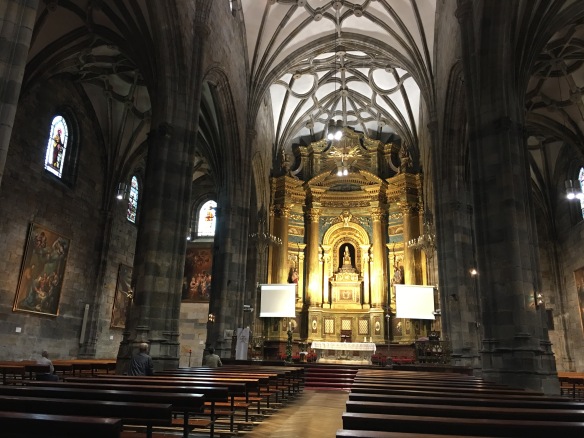
At the unplanned end to my Camino de Santiago pilgrimage last year, I sat in the large nave of the cathedral in Bilbao, Spain, reflecting on the disappointing turn of events. It is a spectacular fifteenth century build.

IMG_5352.jpg

As I looked around me in the silent, cavernous space, for a split second I experienced vertigo, not unlike you would in the old slanted room in the Ottawa Science Centre. Something was off.

Then I realized, I’d never before been in a church building whose floor was not sloped downward toward the altar, but upward!

IMG_5355.jpg

And what goes up must come down. The floor was slanting outward and downward toward the front doors and down into the city!

The story of David’s extravagant, energy-filled entrance up into the holy city didn’t finish at the holy of holies. Going up was completed by turning around at the apex to come back down. The story ends by David distributing food and gifts to not only his family and friends in the city, but “the whole multitude of Israel.”[8]Everyone is fed!

Worship and centering in God is followed by a necessary, gracious giving and going out into the world. I quote again the prophet Amos, where we started: “Let justice roll down like waters, and righteousness like an ever-flowing stream.”[9]

We don’t have slanted floors here. It’s more or less flat. Amos with his plumb line might be satisfied with the level of the floors. But what else could the architecture of our place of worship tell us about ourselves, our identity and God’s call for us?

IMG_6546

Could it be, sitting in room that is basically round that the obvious measure and geometric symbol is not the straight line, but the circle? And now, with larger windows surrounding us, windows which let more light in, also improve our imagination and connection with the world out there? Could it be, given the architecture of our faith here at Faith, we are now called not only to be drawn into the centre, the hub, of the circle who is Christ, but also be sent out in the centrifugal force of God’s Spirit?

In the last pages of the bible, the Book of Revelation, we read a vision of God’s magnificent future:

God’s future comes as an experience of God’s love, “flowing like a river from God’s throne, nourishing trees with leaves for the healing of the nations.”[10]This vision “pictures a world made whole, with people living in a beloved community, where no one is despised or forgotten, peace reigns, and the goodness of God’s creation is treasured and protected as a gift. Our faith is not a privatized expression of belief which keeps faith in Jesus contained in an individualized bubble and protects us from the world.

“Rather, we are on a spiritual journey in which we remain connected to the centre of the presence of God but whose love yearns to save and transform the world. We are called to be ‘in Christ’, which means we share – always imperfectly, and always in community with others – the call to be the embodiment of God’s love in the world.”[11]

In loving others by including them in the circle, we discover how much we are loved by God. We are the circle church. A porous, ever-expanding circle.


[1]Amos 7:7-9

[2]Romans 3:23; Romans 7:15-21

[3]2 Samuel 6:16

[4]2 Samuel 11

[5]Mark 6:14-29

[6]2 Samuel 6:12b

[7]2 Samuel 6:14

[8]2 Samuel 6:18-19

[9]Amos 5:24

[10]Revelation 22:1-2

[11]Richard Rohr’s Daily Meditation, Friday, July 13, 2018 (www.cac.org)

There’s a hole, PART 2: For a purpose

I am a hole in a flute / that the Christ’s breath moves through – / listen to this /music.            -Hafiz

If you comprehend it, it is not God. -St. Augustine

Unlike the pounding of the surf a stone’s toss away, the ponding on the nearby creek made the surface of its water look pristine. A narrow creek made its lazy, winding way down the escarpment from Highway 21 and aimed to run into Lake Huron after finally crossing the stretch of sand on the beach at Point Clarke.

One of our favourite pastimes on those lazy summer days was to play around the area where the creek and lake met. As children, my brother and I would build castles, dig trenches and re-direct the flow of the creek’s water.

For a real challenge, we would try to dam up the creek’s flow, which took some planning, and extra material like drift wood and larger stones to block any outflow attempts. Once we contained it, the creek turned slowly into a large pond, comfortably remaining – for the time being – behind its fortress sand walls.

I’ve already talked about how in God’s creation, it is meant to be that each of us has a hole in our heart (see “There’s a hole, PART 1: Meant to be”). Moreover, it is God’s good intention that this hole is there for a purpose.

Paul writes in his second letter to the Corinthian church a confession that in all his accomplishments for the expansion of the Gospel across the Mediterranean, he was given a thorn in his side.[1]The proverbial ‘hole’. It is not important, although many have tried, to figure out what this thorn actually was.

We don’t know. Maybe that’s the point. It’s not important that we know, only that this thorn was given him in order to keep him humble. The text says that the thorn was given Paul to keep him from being ‘elated’ – to keep his ego in check, perhaps because he tended toward being too full of himself, over confident in his own ability.

How does the ego get the better of yourself? What is your compulsion? What drives you to achieve some illusion of perfection in your life? So, you don’t need to trust what is beyond your life, what is ineffable, what cannot be fully understood that is the Great Mystery (a.k.a. God)?

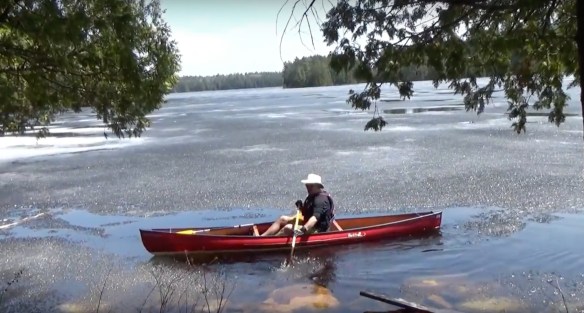
Let me show you an example of compulsion to achieve that which is beyond our capacity: On my fishing trip with colleagues last May to Algonquin Park, we tried everything to beat the ice on the lake. Despite the predominance of the ice-covered lake, we tried desperately to fight the odds against us catching some fish even to the point of risking our safety to break up the ice ourselves in our canoes.

Screen Shot 2018-07-07 at 2.29.00 PM

Yup, that’s me. And, yup, you guessed it: We caught no fish. The irony is that on the last day of our camp out, the wind and the sun did its job. When we woke that last day, we looked over a lake completely free of the ice.

IMG_6940.JPG

Was God sending us a message? Weren’t we the butt end of some divine humour?

The hole in our heart has a divine purpose: To keep us from being too sure of ourselves, over-confident in our ability and our capacity to have it all figured out. If we didn’t have this hole, might we put all our trust in our own autonomy, our independence, to lead our life without any need at all to trust anyone else let alone God.

Beyond Paul in the New Testament, the stories in the bible are about God lessening, even stopping, the compulsive drive of main characters, so the wind of God’s Spirit could draw them more gently and more effectively (Gideon and Moses in the Hebrew Scriptures are good examples).[2]

In the Gospel reading for today, Jesus instructs his disciples in going into the world to do God’s mission, “to take nothing for their journey … no bread, no bag, no money in their belts; but to wear sandals and not to put on two tunics.”[3]

God’s consolation is simple yet profound: “My grace is sufficient for you, for power is made perfect in weakness,” God tells Paul.[4]The making perfect here is not about getting rid of that vulnerability. Rather, whatever weakness we bear stays with us in order for us to complete our purpose as human beings. We are made complete in God’s love because of our hole, thorn, weakness – not without it.

In one of Martin Luther’s famous works entitled, “The Bondage of the Will”, he emphatically declared that we, as humans, can never work out our own salvation for ourselves. We will continually fail, even when, or especially when, we believe we are doing good in the world.

While some might find this realization depressing – and it would be helpful to know why that is, for yourself – perhaps the “bondage of the will” can be freeing. Because we don’t need to be driven to inaction because we are afraid of making a mistake. We don’t need to get stuck in the mud under the fear of imperfection. As Christians, we can be free to do good work in the world, imperfectly, knowing that what we do is for the benefit of others and not for ourselves.[5]

Author Brian McLaren in his recent book: “The Great Spiritual Migration”, describes this time in history as a transition in the church from “organized religion” to “organizing religion.”[6]

A Church in the flow of God’s Spirit pertains not only to wind and water over the earth, but also to spiritual movement. To purpose and mission. To going where we need to go as a people. To re-focus again on loving God, self and others as the primal energy of the church. To bring to life once again the old verse: “They will know we are Christians by our love …” … and not by our buildings, property, and concern for security, certainty and self-preservation.

Can we let go of these things for the sake of God’s mission, for the sake of the Gospel of life and love in Christ? As the prophet Amos so well put it, using the water imagery: “Let justice role down like waters, and righteousness like an ever-flowing stream … “[7]

By the time we had finally engineered the dam on the tiny creek aiming towards Lake Huron, the sun was setting and we had to go home. Inevitably, the next morning one of three things would have happened in our absence:

Either the creek would have found the weak spot in the sandy fortress wall we built, and escape through a tiny crack; or, increasing wind conditions over Lake Huron overnight would have created larger waves whose surf reached and destroyed the walls of our dam; or, someone would have been walking along the beach and, for the fun of it, just poked a tiny hole to watch as a slow trickle quickly turned into a strong, flowing stream.

In each case, a small hole was required in order for the creek to fulfill its mission and reach its destination – despite all the efforts of playful human beings to keep it contained.

After all, nothing was going to stop the flow. God’s Spirit and purpose will flow on because and through the holes in our lives.

[1]2 Corinthians 12:7-10

[2]Richard Rohr, “Dancing Standing Still; Healing the World from a Place of Prayer” (New Jersey: Paulist Press, 2014), p.18.

[3]Mark 6:8-9

[4]2 Corinthians 12:9

[5]Ross Murray, Senior Director, GLAAD Media Institute, LinkedIn July 2018.

[6]Brian McLaren, “The Great Spiritual Migration: How the World’s largest Religion is Seeking a Better Way to be Christian” (Massachusetts: Convergent Books, 2017)

[7]Amos 5:24

A wedding sermon: To expand and include

In a moment, we will share candlelight in this circle of friends and family. Sharing the light is a symbol of the meaning of marriage. Just as one candle shines its light in the darkness and with other candles expands the field of vision, so the nature of the rose bud is to open and expand into the world. Each of you receives a rose from the bridal couple.

Like the rose bud, the human soul defines itself in the same way. The soul’s nature and purpose is to expand and include, by offering a courageous ‘yes’ to life.[1]The soul, in all human goodness, always says ‘yes’. Wherever and whenever ‘no’ must be said, it will follow the initial ‘yes’. ‘No’ never leads in a life of faith, and love. ‘No’ will find clarity and effectiveness only after the gracious lead of ‘yes’ – to any and all of life’s circumstances and situations, marriage included.

The primary words in a wedding service, traditionally and effectively, are spoken by the bride to the groom, and the groom to the bride: “I do.” In other words, “Yes! I will.” You cannot come to a wedding service without the energy of the “yes” defining this very moment. Thanks be to God!

In the time I have journeyed with the bridal couple in preparation for this day, I have witnessed in them a celebration of who they are as a couple. I have witnessed an emerging and resilient joy at their union. And the gift within them.

Each of us has a gift inherent and living within us. I invite you to participate now in a brief guided meditation to experience and touch that gift within your life. You may close your eyes or focus on the rose in front of you:

‘Imagine, for a moment, a rose bud. At first, the rosebud is closed and enveloped by its green sepals. Now, imagine that the sepals start to open, turn back, and reveal the petals inside – tender, delicate, still closed.

‘Now, the petals themselves slowly begin to open. [Such is the process of growth in us.] As you imagine the petals slowly begin to open, perhaps you can become aware of a blossoming also occurring in the depths of your being. You may feel that something in you is opening and coming to light.

‘As you keep visualizing the rose, you feel that its rhythm is your rhythm, its opening is your opening. You keep watching the rose as it opens up to the light and the air, as it reveals itself in all its beauty. You smell its perfume and absorb it into your being.

‘Now gaze into the very center of the rose, where its life is most intense. Let an image emerge from there. This image will represent what is most beautiful, most meaningful, most creative that wants to come to light in your life right now. It can be an image of absolutely anything. Just let it emerge spontaneously, without forcing or thinking.

‘Now stay with this image form some time and absorb its quality. The image may have a message for you – a verbal or a non-verbal message. Be receptive to it.’[2]This is the gift of the rose for you today, on this joyous occasion of the your union.

There is something beautiful emerging out of this expanding and inclusive circle. From the union of two, comes the growth of an emerging new family, including more and more people, an expansion born out of the ‘yes’ of love, life, and light.

In your opening notes about the service, dear couple, you quoted from the bible a verse from Proverbs (17:17). “A friend loves at all times.” The verse goes on to say that these relationships bear together not just the good times but the challenges of life, too. Despite the dissonance inherent in all relationships, someone stands by you. This, too, is an important image for the journey of marriage.

When I bought the same Sony receiver that you have in your home, I connected them to some old Sony tower speakers that I’ve used for years. You’d think that the same brand would create a perfect compatibility. But, I neglected to consider what connected these two parts. To connect the speakers to the receiver, I used the same, old speaker wires whose ends were frayed to put it mildly.

As a result, whenever the receiver is plugged into the electricity, I can hear this faint but persistent humming sound. For some reason, the wires inhibit a perfect compatibility between speaker and receiver. For a perfectionist such as myself, it drives me crazy. Needless to say, I’m on the hunt for some new wire that will, hopefully, more adequately convey and balance the connective energy between speaker and receiver.

In other words, the connection will not always be perfect. In truth, conflict is part of healthy life. “A life without conflicts is by necessity only half a life,” I read recently. “A certain degree of stress is good and necessary; and shows you inside of the true Mystery”[3]of all relationships, even good ones.

The healthiest of relationships will carry some subtle dissonances. But, when the marriage focuses intentionally on its fundamental purpose and nature to ‘make music’ – staying with the analogy – then the grace of God is experienced in all beauty and wonder and goodness. Because when I crank that receiver, the whole neighbourhood can hear what I’m playing! And it’s a sweet, clear sound.

When light does what it is meant to be – despite the darkness all around …

When the rose bud does what it is designed to do – expand and include …

When the human soul, before anything else, says, “Yes!” to love and life …

When, in the midst of the hard realities of life, the music of love and gentleness and compassion sound to all the world around …

Then, we know that we do and are, what we were meant for.  Then, your marriage communicates to yourselves and to those around all that is good in this life we are given.

[1]Richard Rohr, “Dancing Standing Still: Healing the World from a Place of Prayer” (New Jersey: Paulist Press, 2014), p.23-24.

[2]Jacqueline Syrup Bergan and Marie Schwan, CSJ, “Love, A Guide for Prayer” (Maryland: The Word Among Us Press, 2004), p.78-79.

[3]Richard Rohr, ibid., p.19.

Canada is a neighbour

Happy Canada Day!

On this July 1stit is good to reflect on what makes Canada great. Let’s be positive! What is it about our society that stands out in a positive way – amid all that is not so good?

I would like to say that we are a country that aspires to a healthy neighbourliness. Being a good neighbour – whether striving for better relations with Indigenous people, whether relating to newcomers to Canada today, whether reaching out in kind to those who are different from me who live across the street – is our national identity.

Asserting this quality for Canadians, I believe, is not new. Being a good neighbour is not a recent trend in progressive society. Hearing preachers spout the virtues of neighbourliness reflects a deep seeded consciousness influenced by popular culture already in the last century.

It was in the 1950s when children fell in love with the Friendly Giant on TV in Canada. Some of you might recall watching actor Bob Homme on CBC TV from 1958 until 1985 being friendly to his puppet animal friends.

Then there was Mister Rogers’ Neighbourhood which first aired in 1968. Although an American show, did you know that Fred Rogers spent several years in Toronto in the early 1960s working with Ernie Coombs – Mr. Dressup – airing a prototype show called the same Misterogers?

Over his career, Fred Rogers was intentional about being more and more inclusive. He brought, for example, an African American person onto the show yet didn’t draw undue attention to it. This was a subtle yet poignant statement about neighbourliness when American white culture was anything but, towards people of colour.

To assert that these cultural icons were birthed in Canada would not be an overstatement. To be Canadian is to be a good neighbour. It is in our DNA. It is our calling, our witness to a world that wants to be anything but, especially these days.

Yet, it seems every generation of Canadians needs to learn anew how to be a good neighbour. We need to be continually reminded and encouraged to practice being a good neighbour because we tend to be a fearful lot. And fear keeps us from this holy calling.

Having faith doesn’t mean the absence of fear. Having faith means stepping into the fearful place. Having faith means action. It means “leaning into” the situation as we are.[1]

Our lay delegate from Faith Lutheran Church to the Eastern Synod Assembly in Toronto last week, admits being fearful taking the train for the first time. Julia is a seasoned, experienced OC-Transpo bus rider here in Ottawa. Despite the similarities in travel experience between the train and bus, she confesses taking the train across the province for the first time was an anxious affair.

What is more, we missed each other on the train ride to Toronto. Even though we were on the same train, we boarded at different locations – Julia, downtown; and me, at Fallowfield Station in Barrhaven. In fact, as it turns out, we were on the same car – but I never once caught sight of her.

Until on the last leg of the journey, when we were on the Union-Pearson Express train. My phone dinged. Julia texted me to confirm whether I knew where to catch the hotel shuttle to the convention centre where the Assembly was to take place.

Despite her fear of riding the train for the first time, and alone, Julia reached out to me. She was being a good neighbour by making sure I was ok. Her reaching out to me was helpful since, truth be told, I was not sure about where to catch the airport shuttle bus.

“Who is my neighbour?” Jesus asks before telling the story of the Good Samaritan.[2]“Liberated by God’s Grace … to be neighbour” was the theme of the Eastern Synod Assembly. Through thoughtful, provocative and compelling bible studies, song, and interactions with various peoples, the Assembly reflected and re-committed to become even better neighbours, as a church.

Interesting, in keeping all this in mind, that we encounter the nameless woman in the Gospel reading for today.[3]She approaches Jesus in the crowd, hidden, secretly. No wonder. She is powerless and outlawed in public spaces on account of her bleeding.

The main point of the story is not that she is miraculously healed. She could have remained hidden, quietly disappearing into the crowed after she is healed. That is the way she would have wanted it, likely.

The point is that Jesus calls her into a deeper relationship. She must come out of her private suffering. She must confront her fear, and make a deeper connection with herself, with others, and with Jesus.

“Who touched my clothes?” Jesus says out loud even though he knows the woman has already been healed when he felt the power drain out of him.[4]He, too, could have enabled the woman’s secretive behaviour, letting her go and moving on. He could have protected her in her fearful existence after she is cured.

Instead, Jesus calls for her to step up and be known. Demonstrating incredible courage, the woman responds to Jesus’ call and approaches him “in fear and trembling, fell down before him and told him the whole truth.”[5]

Jesus seeks out a relationship with her. It is of God to do this. God continues to call us into ever deeper relationship – with ourselves, with others and with God. The point of the Gospel is that we affirm our connectedness with others in healthy and compassionate co-existence. This is the path to truth.

Jesus’ ‘touch’ can heal us and the world. The touch of God’s grace can give us peace. We are shaped and made human in relationship with others. All our relationships – in church, in friendships, in marriage – are not just something extra added on to life for distraction and entertainment as if we would be complete human beings in individual isolation.[6]Relationships are not some added feature to our lives in order to get something, a means to some autonomous end.

Relationships are the fabric of life. Relationship – touch, if you will – makes us human and whole. Being neighbourly can heal us, make us better people. “Perfect love casts out fear,”[7]our scriptures say. Love can only be expressed in relationship.

The reason Julia was not afraid of riding the bus in Ottawa, was because she was practiced at it. She had done it many times. Even though the train is not that much different, she had never before taken the train. The difference is, some intentional, risk-taking exercise.

Later this week, members of Faith council will be volunteering for a couple of hours at the Mission downtown for homeless, impoverished men. We will get a tour of the facility and help give out some ice cream to those who are there. Practice, to move beyond fear to faithfulness, isolation into community, to where our neighbours are.

We need to practice being a good neighbour – to those who are vulnerable, to those who are powerless, to those who are stigmatized, to the homeless, the LGBTQIA+ community, to refugees and migrants. We have to lean in to the places of fear in our lives and to take some risks vis-à-vis people who are different from us. In doing so, we realize we are not alone, and we have meaning and purpose in our lives for the common good.

Canadians and Christians share something in common, to be sure. We are called to reach out. And be a good neighbour to the world. We are not left alone stuck in our fear. Because God continues to call us into the deeper waters of grace and love. God will never abandon us, despite our fear.

Let us approach boldly the seat of grace in Christ Jesus our Lord. Amen.

[1]Brother Luke Ditewig, “Brother, Give Us A Word” for June 28, 2018 (Society of Saint John the Evangelist) friends@ssje.org

[2]Luke 10:25-37

[3]Mark 5:21-43

[4]v.30

[5]v.33

[6]Michael L. Lindvall in David L. Bartlett and Barbara Brown Taylor, eds., “Feasting on the Word: Preaching the Revised Common Lectionary” Year B Volume 3 (Kentucky: WJK Press, 2009), p.192.

[7]1 John 4:18

Conversations – Children’s Ministry

In recent years and with increasing awareness, it’s evident that a fresh, creative approach to children’s ministry is needed. We stand, really, at a crossroads with how we do this work. An opportunity stands before us. And an important question is: Will we embrace it?

What is this opportunity, you ask?

As part of the process of growing our ministry at Faith, the leadership of the church — comprising of members of the council as well as members at large of the congregation — we felt one important step in discernment was to bring the questions to the whole assembly on a Sunday morning.

There isn’t likely a better way introducing this conversation to the congregation than by having a baptism.

First, scheduling this baptism had been a bit of journey itself. Originally we were aiming for a July date. But in the last ten days, the opportunity in the family’s lives to be together this weekend came up. And so, here we are, on the Sunday we had planned for the better part of a month to bring the children’s ministry issue up for conversation. It’s a wonderful convergence that happened beyond anyone’s planning.

Then, there is the meaning of the baptism itself. What does this occasion mean to you — as parents, sponsors, cousins and church community of Elise? It can mean belonging. It can mean togetherness in faith. It can mean life. New life. New beginnings. It can mean the start of a life-long journey of continual growth, learning and expanding the soul in God’s love.

I hope you can with me begin to see some connecting points with the question I asked at the top — about the opportunity we have at this moment in the history of Faith to embrace something new, something fresh in our growth as a community of faith. Let me further prime the pump!

In the relatively short Gospel of Mark, the phrase, “Kingdom of God’, is mentioned at least fourteen times. Clearly, Jesus’ message and ministry on earth is about communicating in word and deed what this reign of God means — to the original listeners in their world, and to us in our day and age.

We come up against some challenges in reading the Gospel for today (Mark 4:26-34). That is, challenges to our way of thinking. Jesus, quite clearly in the story of the growing seed, makes it a point to emphasize the farmer has very little to do with making the seed grow. He “would sleep … and the seed would sprout and grow … [and] he does not know how. The earth produces of itself …” (v.27-28). This is how the kingdom of God operates.

As products of the Enlightenment and Scientific Eras where we demand proof, evidence and rational methods prior to justifying any kind of belief and action — this imagery and story-telling which by the way is how Jesus communicated probably drives us nuts.

But a baby cannot speak for herself what she believes. A baby cannot stand up and confess by memory the Apostles’ Creed (I’m not sure most of us who have likely said a few times in the course of our lives can!). A baby cannot make rational choices nor communicate them effectively. We can’t prove that she can demonstrate in a any clear, indisputable way that she has faith. That she deserves the gift.

A baby is dependent, vulnerable, and relies on others to make this baptism happen. It is truly a community event, not an individualistic enterprise. It does ‘take a village’ in the kingdom of God.

Could that be a sign that the kingdom of God is here? When those values and qualities described in the above couple of paragraphs characterize a situation or a decision? (Yes!) (And Yes!)

A friend who lives in Cantley near the Gatineau Park north of Ottawa told me that his municipality recently replaced aged and diseased trees along the roadway in front of his house. After cutting down several trees, the municipality gave him a few oak tree seedlings to plant in their place.

What surprised him the most after receiving these tiny seedlings, was the actual size of the whole tree that he held in his hand. The part above the ground that would remain visible was only a mere few inches. But the part that would be buried under the ground, the part that wasn’t seen, was the root system. Especially the tap root — the main one — was at least double the length of what was seen above ground.

Now we are also getting at the nature and definition of faith, “for we walk by faith, not by sight” writes Saint Paul (2 Corinthians 5:7). Often, the truth of the matter lies beyond what is visible, what we can calculate, measure and determine rationally.

That doesn’t mean we don’t have a job to do. We will water and nurture growth. We will make the space available, and put whatever resources we have to helping the growth along.

The stories Jesus told ask us not to close our imagination and creative juices, ever. Because there is a dynamic, vital power at work beyond our comprehension and grasp, always. Indeed, our imagination must be stirred by these stories as we seek to connect our individual and historical stories within the larger story of God’s movement in our lives and in the life of the world. (See Nibs Stroupe in David L. Bartlett & Barbara Brown Taylor, eds. “Feasting on the Word: Preaching the Revised Common Lectionary” Year B Vol 3, Kentucky: WJK Press, 2009, p.143)

This moment in the life of Faith Lutheran Church is ours to embrace and be bold in the creative process. It’s our job to do this. It’s not outlined in a neat and tidy manual. The answers are not clear-cut. And that’s ok.

Remember, “Jesus and the Gospel writers were not lacking in verbal skills. Had they wished to define the Kingdom of God in specific terms, they were capable of doing so. They chose not to. What the Kingdom of God is to be, has been left to us. It has been left to us to envision, to dream, to imagine and to build.” (Br. Mark Brown, Society of Saint John the Evangelist, “Brother Give us a Word” 12 June 2018).

Children’s Ministry by, with and for the church — as with infant baptism — is about small things. At least, about the beginning of a journey that starts out small. Yet, these stories of Jesus describing the kingdom of God are about small things, like seeds, that eventually yield great outcomes.

Out of the most insignificant beginnings, “God creates a mighty wind that will blow throughout the entire world. In these stories, Jesus invites seekers in every age and every place to consider joining in this kind of life-long journey” whose ending is anything but small. (Nibs Stroupe, ibid. p.145). Let it be so! Amen.

Children’s Ministry Review – Faith Lutheran Church

The Church Council has considered the reality that dedicating resources to maintain the current Sunday School program is no longer feasible nor sustainable.

Over the last several years there has been a noticeable trend in decreasing Sunday morning attendance that does not justify nor attract volunteers to lead a ministry for children in that traditional model.

Here follow some observations about the learning process for younger generation Christians today, that learning is more:

1. Intergenerational – it happens when young and older Christians mix to share their faith and work together in service-projects and initiatives in the community

2. In-the-home – it happens effectively in the church only when there is, however small, some faith-based discipline, activity or conversation in the household/home of that child/youth

3. Spanning-a-whole-life – it happens effectively in the church when a whole-life approach is adopted for Christian learning. Milestones such as Confirmation are markers along journey of faith that continues into adulthood and beyond

4. Worship-integration – Each worship service, rich in ritual, liturgy, symbol, art and sacrament are valuable occasions and opportunities for ongoing Christian learning

5. Inter-denominational – Because of the growing reality of multi-faith marriages, families are more open to seeking children’s ministries from other churches and faith groups, not just their own parish where they hold membership

These observations reflect the changing realities, socially, and for the church as we respond in ministry. Our response needs to respect and adjust to these changing realities.

These challenges may be summarized by the following questions for the church to consider:

1. At this time, does Faith Lutheran consider itself a children’s Christian education center, as a reflection of our unique character and mission? If not, what about the couples and families who do come with their children to worship? To which congregations can we refer them /partner with for a viable children’s learning ministry?

2. If we do, what is the focus, scope and intent of the program?

3. Who is the intended ‘audience’? Only those who have been baptized here in the last few years (e.g., cradle roll)? Or, is there a more public ‘interface’, providing a service to the wider community?

4. What resources (skills, passionate volunteer leaders, property space, budget lines) do we have already, and are we willing to make available for this purpose?

5. In what specific way(s) can you support a children’s ministry led by Faith Lutheran Church at this time in your life? Please check all that apply:

_____ organize and lead a traditional cradle-roll for all that have recently been baptized at Faith;

_____ organize and lead children’s programming on a Sunday morning;

_____ organize and lead children’s programming on a weekday afternoon/evening;

_____ pray regularly for the children and youth who attend Faith;

_____ increase your financial donations to the church in order to support a viable program; ministry starting in the Fall.

Please make time this week to reflect on these questions. Submit any written notes you provide, into the offering plate on Sunday, June 17, 2018, email your comments about Children’s Ministry to pastormartin@faithottawa.ca, or submit to the church office by June 29.

We will make time in the service on the 17th to honour and celebrate the Sunday School ministry in our history at Faith, recall favourite memories together about Sunday School at Faith, and address some of the questions above. Thank you for your time and input.

There’s a hole, PART 1: Meant to be

The Lord God took the man and put him in the garden of Eden to till it and keep it. And the Lord God commanded the man, “You may freely eat of every tree of the garden; but of the tree of the knowledge of good and evil you shall not eat, for in the day that you eat of it you shall die” Genesis 2:15-17).

“There is a hole inside you. It’s been there a long time. Longer than you even knew. But chances are great these days this hole reappears on almost a daily basis, reminding you that something is missing in your life.”

It shouldn’t come as a surprise, really, to say that there is lots that’s wrong with the world. We don’t have to look far and wide to notice the brokenness in our lives, the violence in creation and in relationships of all kinds.

Christians have pointed to the creation stories in Genesis — in the Bible — to locate the beginnings of all that has gone wrong in this world. “The Fall” we have called it.

But all the doctrine-making explanations do not take away the problem.

All that’s not right, all this reminds each of us that something is missing in our lives. Like a hole right at the bottom of your heart.

One of the first camp songs I learned was one that’s called: “There’s a hole in the bottom of the sea.” Right off the bat, that image suggests permanence, because a hole at the bottom of the sea has likely been there a very long time.

But the song goes on in repetitive fashion: “There’s a log in the hole … there’s a log … there’s a bump … there’s a frog … there’s a wart … there’s a fly … there’s a flea — all in the hole in the bottom of the sea.”

So even though that hole is an integral and permanent part of the landscape, it’s fun to imagine that hole filled! From a young age we learn that having a hole is not good. It’s better to have it filled, somehow. What is the hole in the bottom of your heart? What is missing in your life?

“It may involve a relationship. It may involve a yearning for intimacy in the relationships you have. Maybe it’s an issue related to health, a problem that has become chronic. Maybe it’s a loved one who died and left a huge hole in your heart.

“Maybe the thing that’s missing has to do with being fulfilled in your life’s work, or vocation, or job. Or, maybe the hole has to do with a dream that has been just out of reach.

“If we had time and courage, we would turn to each other and share what is the hole in our lives. And we would have to listen, because all the holes are different; they’re not quite the same.

“The only thing that is the same, is that everybody is missing something.

“As Christians, we would pray about it. So we claim such verses as: ‘Ask and you will receive, seek and you will find, knock and the door will be open unto you’ (Matthew 7:7, Luke 11:9). Over the years, there has been plenty asking, seeking and knocking … and still this thing that is missing persists.

“Oh, we learn eventually to cope with it. Our favourite coping mechanism is to rush back to work and get busy enough to not have to think about it. Others prefer to distract themselves through entertainment. Some of us come to church precisely in search of spiritual distraction from the hole that remains in our hearts.

“But at the end of the day, when you are too tired to remain distracted, when you are trying to get to sleep, the pain of this hole returns. Maybe the pain is so great you well up with tears, and you can’t sleep. You think about all the choices you’ve made in your life and you wish you could do it all over again.

“There is nothing that will keep us up at night like fear. We try to talk ourselves out of anxiety with rational reasons why we shouldn’t be afraid. But as soon as we figure out why what we fear wont happen, we find three more ways it will happen. If only I had ….

“Some will say that God does not desire this for us. That God doesn’t desire us to live with any holes in our lives at all. That God wants us to be complete, whole.

“I’m not sure about that, actually.

“The opening of the bible is very important for us. It gives a short glimpse into what God had in mind for us. It’s only two pages in my bible. That’s all we get, in terms of what God had in mind from the very beginning. The entire rest of the bible is … the recovery plan.

“We cherish these first two pages. They’re critical to us. In these brief glimpses into what God had in mind for us we’re told we were created by God — which means we are creatures, not the creator — we were placed into a garden. And we were told that we could freely eat of almost every fruit of this garden. (Genesis 1-3)

“Because it was given to us by God. Even in taking the fruit we are partaking in doxology — we are saying, “Thank you” to God because it was given to us. We didn’t create the fruit, God created the fruit. We receive it. We receive all of this out of the bounty of God’s goodness to us. So, it’s not just thanksgiving for the knowledge of God, it is thanksgiving for being in this spectacular garden, to being able to work in it, be stewards of it and receive its fruit.

Almost all the fruit. But there was one tree whose fruit was forbidden. Fruit that was not given to us by God. And to desire this fruit is to desire it for its own end. Not as a means for saying thanks to God because God chose not to give us this fruit.

“Do you remember where that tree was planted in the garden? Right slap dab in the middle. The exact same place it is planted in your life. Right in the middle of your life. This meant, as the narrative goes, every day Adam and Eve had to walk past this thing that they did not have. A reminder that something was missing in the garden of their lives. Just as there is in ours. That it wasn’t all for the taking. And, that they were not supposed to have it.

“Keep in mind, this is God’s idea of paradise. This is not a result of the ‘Fall’. This is the garden God created for you and called “good”. God said, “It’s all for you except for this one thing right in the middle that you’re never going to have.” Now, this drives us nuts. Just like it did Adam and Eve. We think about this thing we don’t have every day. This hole that just keeps returning. We obsess over it. We want it. Other people have. Why can’t I?

“There can be 999 spectacular trees in our garden. But where do we pitch our tent? Right underneath this one thing we don’t have. We obsess over it. We yearn for it. We think about it constantly. Let the rest of the garden go to weed, but what am I going to do about this one thing I don’t have?

“As the narrative goes, it is in reaching further than we were meant to reach that we then lose the garden. On the way out, we discover that it actually was a pretty good garden. Only now it is paradise lost.

“There is nothing and no one that can do as much damage to your life as you can yourself. When we reach for more than we were created to have.”

The real miracle, however, is that despite all the pain and suffering and confusion, there is good in the world.

Now, hear this: there is good in our lives. There is good within us. There is good within you. And good that can come out of you in word and deed.

But that good only happens, that good is there only when we trust God. When we put our trust in that which is beyond us — in the power, grace and strength that is God and God’s alone. God created everything.

When we put our trust in God …

Not in our abilities to do the good because there is always something missing in our lives.

We put our trust in God. For we can also claim these verses from the bible, the words of Jesus who said, “Pick up your cross, and follow me” (Mark 8:34-35). Jesus, the God we follow, never promised to plug up that hole in our hearts.

We do have a choice. We can choose gratitude over despair. We can be thankful despite all that is wrong in the world. Despite all that is wrong in our lives. We may have pitched our tent underneath that one tree. But we can also build an altar there, an altar of thanksgiving right beside that hole in the bottom of our heart.

“Because the garden, you know, it’s pretty good. It’s not perfect. Something is missing. But we can choose gratitude, because it’s pretty good.”

Thank you, to Craig Barnes whose sermon is given, in quotations, from the Festival of Homiletics in Denver Colorado (Minneapolis: Luther Seminary Peach Media CD, 2015)

Mistaken identity

This morning I preach at Merrickville (Ontario) United Church, as part of a pulpit exchange. Today Merrickville United Church celebrates its annual Anniversary Sunday.

Thank you for welcoming me to speak at your anniversary Sunday celebration. Anniversaries are about celebrating who we are. These are occasions for affirming our identity. So, let me introduce myself to you so that you may have some idea and experience of who I am.

Questions of identity are important to me. I have an identical twin brother who is also a Lutheran pastor. What is more, my brother and I are twin sons of parents who are both also (retired) Lutheran pastors in the same Evangelical Lutheran Church in Canada. Challenges around mistaken identity have followed me all my life! Which Malina are we talking about?! That is why who I am and how different I am from my rather homogenous nuclear family is an important part of my personal journey.

Another level of mistaken identity in my life revolves around the church to which I belong. Your pastor told you, I suspect, that you were going to have a preacher from the “Evangelical Lutheran Church” visit you today. I wonder how many of you thought you would be getting a shellacking from a hard-core conservative, fundamentalist preacher. The word that likely derailed you was ‘evangelical’.

Over a month ago after Billy Graham Sr. died, the local Ottawa CBC morning radio host called me to say they wanted to have an ‘evangelical’ represent the views of Billy Graham in a live discussion panel the next day. The reason she called me was that the name of the parish I am pastor of is called “Faith Evangelical Lutheran Church.” She assumed that the same word meant the same thing. I had to steer her in another direction.

Because for Lutherans, we use the word evangelical from its German roots, ‘evangelische’. The meaning here, is ‘Good News!’. Unfortunately, in North America the word evangelical has been coopted by conservative fundamentalism. You can breathe more easily now!

Indeed, it is the focus of the word Good News (Gospel) that can summarize the purpose of Lutheran preaching, in a nutshell. We are all about proclaiming what is good news to the world today. Lutherans traditionally use the concept of ‘law’ as a counterpoint to understand better where we fall short, and why we yearn and seek God’s grace, forgiveness and love.

In the Gospel reading for today, from Mark, Jesus breaks the law in order to eat (Mark 2:23-3:6). He and his disciples are poor wanderers. They pick grain from the field on the sabbath. Two things Jesus says in this text worth noting: First, “the sabbath was made for humankind” — and not the other way around. In other words, the sabbath law and all law serves us. “Is it lawful to do good or do harm on the sabbath?” Jesus asks. He says that even the law is subject to God’s grace and the common good.

We do our thing as Christians not primarily to serve the tradition and keep all the laws and conform to precepts and rules. No. We do our thing as Christians primarily to follow in the way of Christ which is a way of love, grace, and doing the right thing — despite what the law says.

I love the name of your church: United. And I love that you are undergoing a renovation of your gathering space in your building here. It may be disruptive and stressful — all meaningful transformation is. But it tells me a lot about who you are. Let me attempt an affirmation of sorts.

You are a church ‘on the move’. You are transforming your space in order to make it a more inclusive, accessible building. Moreover, you are making this transformation and renewal to make it a more flexible, multi-purpose space. So different groups, musical, theatrical, social, community groups can use it. You are creating a welcoming and affirming space. This is wonderful! By increasing the possibility of diverse interaction you are, paradoxically, building unity among people!

German reformed theologian Juergen Moltmann wrote that “Christian fellowship — which means liberating fellowship — no longer means just sitting down beside the people I agree with. It means sitting beside the people I don’t agree with — and staying there.” (@moltmannjuergen)

As the inclusive, expansive vision of God’s unity shines before us, we become not a community of like-minded, conformists. Rather, precisely in celebrating and affirming our diversity, we deepen our unity. That is what the church on the move is all about!

Early twentieth century French philosopher, Teilhard de Chardin, expressed how people grow in unity by becoming more ourselves. By embracing our uniqueness as individuals and communities, by differentiating, we discover our unity. Contrary to what may be our initial impulse — that unity is experienced only if we become what someone else wants us to be, or others become like us — the opposite is true. Not by becoming the same — that is not loving — but in the freedom of our being different, we find unity in love.

The word religion from Latin, ‘religio’, literally means, re-binding together. “Bind us together, Lord,” is a favourite song in the Lutheran church. Unity is found by recognizing our differences, appreciating them, and choosing to love anyway, which is the form of love most often used in the New Testament (agape).

The church moving forward is the beacon of Christ’s light. “Let light shine out of darkness” (2 Corinthians 4:6), Paul writes in the Epistle reading for today (Pentecost 2B, RCL). The church is not the brake lights on a car, but the headlights. Shining a vision forward, an ever-expanding, inclusive, affirming vision for all people. Because light pays little heed to the lines we draw in the sand. Divine light and love recognize in each person and each relationship a unique reflection of Creator God.

In Christ, then, there is no need for mistaken identity no matter how similar or how different we may be.