There’s a hole, PART 2: For a purpose

I am a hole in a flute / that the Christ’s breath moves through – / listen to this /music.            -Hafiz

If you comprehend it, it is not God. -St. Augustine

Unlike the pounding of the surf a stone’s toss away, the ponding on the nearby creek made the surface of its water look pristine. A narrow creek made its lazy, winding way down the escarpment from Highway 21 and aimed to run into Lake Huron after finally crossing the stretch of sand on the beach at Point Clarke.

One of our favourite pastimes on those lazy summer days was to play around the area where the creek and lake met. As children, my brother and I would build castles, dig trenches and re-direct the flow of the creek’s water.

For a real challenge, we would try to dam up the creek’s flow, which took some planning, and extra material like drift wood and larger stones to block any outflow attempts. Once we contained it, the creek turned slowly into a large pond, comfortably remaining – for the time being – behind its fortress sand walls.

I’ve already talked about how in God’s creation, it is meant to be that each of us has a hole in our heart (see “There’s a hole, PART 1: Meant to be”). Moreover, it is God’s good intention that this hole is there for a purpose.

Paul writes in his second letter to the Corinthian church a confession that in all his accomplishments for the expansion of the Gospel across the Mediterranean, he was given a thorn in his side.[1]The proverbial ‘hole’. It is not important, although many have tried, to figure out what this thorn actually was.

We don’t know. Maybe that’s the point. It’s not important that we know, only that this thorn was given him in order to keep him humble. The text says that the thorn was given Paul to keep him from being ‘elated’ – to keep his ego in check, perhaps because he tended toward being too full of himself, over confident in his own ability.

How does the ego get the better of yourself? What is your compulsion? What drives you to achieve some illusion of perfection in your life? So, you don’t need to trust what is beyond your life, what is ineffable, what cannot be fully understood that is the Great Mystery (a.k.a. God)?

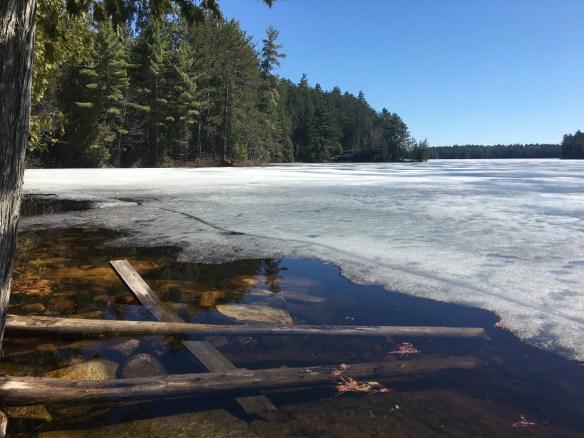
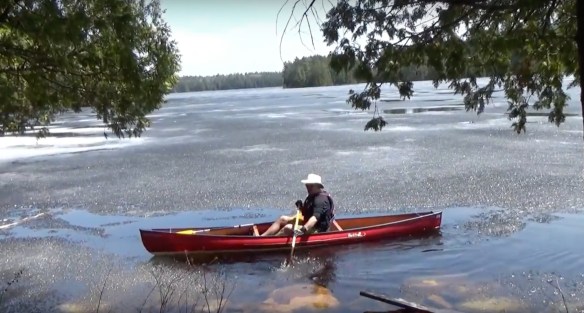
Let me show you an example of compulsion to achieve that which is beyond our capacity: On my fishing trip with colleagues last May to Algonquin Park, we tried everything to beat the ice on the lake. Despite the predominance of the ice-covered lake, we tried desperately to fight the odds against us catching some fish even to the point of risking our safety to break up the ice ourselves in our canoes.
Screen Shot 2018-07-07 at 2.29.00 PM

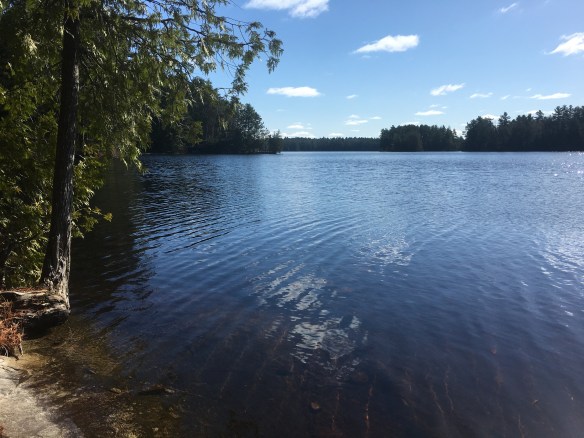
Yup, that’s me. And, yup, you guessed it: We caught no fish. The irony is that on the last day of our camp out, the wind and the sun did its job. When we woke that last day, we looked over a lake completely free of the ice.
IMG_6940.JPG

Was God sending us a message? Weren’t we the butt end of some divine humour?

The hole in our heart has a divine purpose: To keep us from being too sure of ourselves, over-confident in our ability and our capacity to have it all figured out. If we didn’t have this hole, might we put all our trust in our own autonomy, our independence, to lead our life without any need at all to trust anyone else let alone God.

Beyond Paul in the New Testament, the stories in the bible are about God lessening, even stopping, the compulsive drive of main characters, so the wind of God’s Spirit could draw them more gently and more effectively (Gideon and Moses in the Hebrew Scriptures are good examples).[2]

In the Gospel reading for today, Jesus instructs his disciples in going into the world to do God’s mission, “to take nothing for their journey … no bread, no bag, no money in their belts; but to wear sandals and not to put on two tunics.”[3]

God’s consolation is simple yet profound: “My grace is sufficient for you, for power is made perfect in weakness,” God tells Paul.[4]The making perfect here is not about getting rid of that vulnerability. Rather, whatever weakness we bear stays with us in order for us to complete our purpose as human beings. We are made complete in God’s love because of our hole, thorn, weakness – not without it.

In one of Martin Luther’s famous works entitled, “The Bondage of the Will”, he emphatically declared that we, as humans, can never work out our own salvation for ourselves. We will continually fail, even when, or especially when, we believe we are doing good in the world.

While some might find this realization depressing – and it would be helpful to know why that is, for yourself – perhaps the “bondage of the will” can be freeing. Because we don’t need to be driven to inaction because we are afraid of making a mistake. We don’t need to get stuck in the mud under the fear of imperfection. As Christians, we can be free to do good work in the world, imperfectly, knowing that what we do is for the benefit of others and not for ourselves.[5]

Author Brian McLaren in his recent book: “The Great Spiritual Migration”, describes this time in history as a transition in the church from “organized religion” to “organizing religion.”[6]

A Church in the flow of God’s Spirit pertains not only to wind and water over the earth, but also to spiritual movement. To purpose and mission. To going where we need to go as a people. To re-focus again on loving God, self and others as the primal energy of the church. To bring to life once again the old verse: “They will know we are Christians by our love …” … and not by our buildings, property, and concern for security, certainty and self-preservation.

Can we let go of these things for the sake of God’s mission, for the sake of the Gospel of life and love in Christ? As the prophet Amos so well put it, using the water imagery: “Let justice role down like waters, and righteousness like an ever-flowing stream … “[7]

By the time we had finally engineered the dam on the tiny creek aiming towards Lake Huron, the sun was setting and we had to go home. Inevitably, the next morning one of three things would have happened in our absence:

Either the creek would have found the weak spot in the sandy fortress wall we built, and escape through a tiny crack; or, increasing wind conditions over Lake Huron overnight would have created larger waves whose surf reached and destroyed the walls of our dam; or, someone would have been walking along the beach and, for the fun of it, just poked a tiny hole to watch as a slow trickle quickly turned into a strong, flowing stream.

In each case, a small hole was required in order for the creek to fulfill its mission and reach its destination – despite all the efforts of playful human beings to keep it contained.

After all, nothing was going to stop the flow. God’s Spirit and purpose will flow on because and through the holes in our lives.

[1]2 Corinthians 12:7-10

[2]Richard Rohr, “Dancing Standing Still; Healing the World from a Place of Prayer” (New Jersey: Paulist Press, 2014), p.18.

[3]Mark 6:8-9

[4]2 Corinthians 12:9

[5]Ross Murray, Senior Director, GLAAD Media Institute, LinkedIn July 2018.

[6]Brian McLaren, “The Great Spiritual Migration: How the World’s largest Religion is Seeking a Better Way to be Christian” (Massachusetts: Convergent Books, 2017)

[7]Amos 5:24

A wedding sermon: To expand and include

In a moment, we will share candlelight in this circle of friends and family. Sharing the light is a symbol of the meaning of marriage. Just as one candle shines its light in the darkness and with other candles expands the field of vision, so the nature of the rose bud is to open and expand into the world. Each of you receives a rose from the bridal couple.

Like the rose bud, the human soul defines itself in the same way. The soul’s nature and purpose is to expand and include, by offering a courageous ‘yes’ to life.[1]The soul, in all human goodness, always says ‘yes’. Wherever and whenever ‘no’ must be said, it will follow the initial ‘yes’. ‘No’ never leads in a life of faith, and love. ‘No’ will find clarity and effectiveness only after the gracious lead of ‘yes’ – to any and all of life’s circumstances and situations, marriage included.

The primary words in a wedding service, traditionally and effectively, are spoken by the bride to the groom, and the groom to the bride: “I do.” In other words, “Yes! I will.” You cannot come to a wedding service without the energy of the “yes” defining this very moment. Thanks be to God!

In the time I have journeyed with the bridal couple in preparation for this day, I have witnessed in them a celebration of who they are as a couple. I have witnessed an emerging and resilient joy at their union. And the gift within them.

Each of us has a gift inherent and living within us. I invite you to participate now in a brief guided meditation to experience and touch that gift within your life. You may close your eyes or focus on the rose in front of you:

‘Imagine, for a moment, a rose bud. At first, the rosebud is closed and enveloped by its green sepals. Now, imagine that the sepals start to open, turn back, and reveal the petals inside – tender, delicate, still closed.

‘Now, the petals themselves slowly begin to open. [Such is the process of growth in us.] As you imagine the petals slowly begin to open, perhaps you can become aware of a blossoming also occurring in the depths of your being. You may feel that something in you is opening and coming to light.

‘As you keep visualizing the rose, you feel that its rhythm is your rhythm, its opening is your opening. You keep watching the rose as it opens up to the light and the air, as it reveals itself in all its beauty. You smell its perfume and absorb it into your being.

‘Now gaze into the very center of the rose, where its life is most intense. Let an image emerge from there. This image will represent what is most beautiful, most meaningful, most creative that wants to come to light in your life right now. It can be an image of absolutely anything. Just let it emerge spontaneously, without forcing or thinking.

‘Now stay with this image form some time and absorb its quality. The image may have a message for you – a verbal or a non-verbal message. Be receptive to it.’[2]This is the gift of the rose for you today, on this joyous occasion of the your union.

There is something beautiful emerging out of this expanding and inclusive circle. From the union of two, comes the growth of an emerging new family, including more and more people, an expansion born out of the ‘yes’ of love, life, and light.

In your opening notes about the service, dear couple, you quoted from the bible a verse from Proverbs (17:17). “A friend loves at all times.” The verse goes on to say that these relationships bear together not just the good times but the challenges of life, too. Despite the dissonance inherent in all relationships, someone stands by you. This, too, is an important image for the journey of marriage.

When I bought the same Sony receiver that you have in your home, I connected them to some old Sony tower speakers that I’ve used for years. You’d think that the same brand would create a perfect compatibility. But, I neglected to consider what connected these two parts. To connect the speakers to the receiver, I used the same, old speaker wires whose ends were frayed to put it mildly.

As a result, whenever the receiver is plugged into the electricity, I can hear this faint but persistent humming sound. For some reason, the wires inhibit a perfect compatibility between speaker and receiver. For a perfectionist such as myself, it drives me crazy. Needless to say, I’m on the hunt for some new wire that will, hopefully, more adequately convey and balance the connective energy between speaker and receiver.

In other words, the connection will not always be perfect. In truth, conflict is part of healthy life. “A life without conflicts is by necessity only half a life,” I read recently. “A certain degree of stress is good and necessary; and shows you inside of the true Mystery”[3]of all relationships, even good ones.

The healthiest of relationships will carry some subtle dissonances. But, when the marriage focuses intentionally on its fundamental purpose and nature to ‘make music’ – staying with the analogy – then the grace of God is experienced in all beauty and wonder and goodness. Because when I crank that receiver, the whole neighbourhood can hear what I’m playing! And it’s a sweet, clear sound.

When light does what it is meant to be – despite the darkness all around …

When the rose bud does what it is designed to do – expand and include …

When the human soul, before anything else, says, “Yes!” to love and life …

When, in the midst of the hard realities of life, the music of love and gentleness and compassion sound to all the world around …

Then, we know that we do and are, what we were meant for.  Then, your marriage communicates to yourselves and to those around all that is good in this life we are given.

[1]Richard Rohr, “Dancing Standing Still: Healing the World from a Place of Prayer” (New Jersey: Paulist Press, 2014), p.23-24.

[2]Jacqueline Syrup Bergan and Marie Schwan, CSJ, “Love, A Guide for Prayer” (Maryland: The Word Among Us Press, 2004), p.78-79.

[3]Richard Rohr, ibid., p.19.

Canada is a neighbour

Happy Canada Day!

On this July 1stit is good to reflect on what makes Canada great. Let’s be positive! What is it about our society that stands out in a positive way – amid all that is not so good?

I would like to say that we are a country that aspires to a healthy neighbourliness. Being a good neighbour – whether striving for better relations with Indigenous people, whether relating to newcomers to Canada today, whether reaching out in kind to those who are different from me who live across the street – is our national identity.

Asserting this quality for Canadians, I believe, is not new. Being a good neighbour is not a recent trend in progressive society. Hearing preachers spout the virtues of neighbourliness reflects a deep seeded consciousness influenced by popular culture already in the last century.

It was in the 1950s when children fell in love with the Friendly Giant on TV in Canada. Some of you might recall watching actor Bob Homme on CBC TV from 1958 until 1985 being friendly to his puppet animal friends.

Then there was Mister Rogers’ Neighbourhood which first aired in 1968. Although an American show, did you know that Fred Rogers spent several years in Toronto in the early 1960s working with Ernie Coombs – Mr. Dressup – airing a prototype show called the same Misterogers?

Over his career, Fred Rogers was intentional about being more and more inclusive. He brought, for example, an African American person onto the show yet didn’t draw undue attention to it. This was a subtle yet poignant statement about neighbourliness when American white culture was anything but, towards people of colour.

To assert that these cultural icons were birthed in Canada would not be an overstatement. To be Canadian is to be a good neighbour. It is in our DNA. It is our calling, our witness to a world that wants to be anything but, especially these days.

Yet, it seems every generation of Canadians needs to learn anew how to be a good neighbour. We need to be continually reminded and encouraged to practice being a good neighbour because we tend to be a fearful lot. And fear keeps us from this holy calling.

Having faith doesn’t mean the absence of fear. Having faith means stepping into the fearful place. Having faith means action. It means “leaning into” the situation as we are.[1]

Our lay delegate from Faith Lutheran Church to the Eastern Synod Assembly in Toronto last week, admits being fearful taking the train for the first time. Julia is a seasoned, experienced OC-Transpo bus rider here in Ottawa. Despite the similarities in travel experience between the train and bus, she confesses taking the train across the province for the first time was an anxious affair.

What is more, we missed each other on the train ride to Toronto. Even though we were on the same train, we boarded at different locations – Julia, downtown; and me, at Fallowfield Station in Barrhaven. In fact, as it turns out, we were on the same car – but I never once caught sight of her.

Until on the last leg of the journey, when we were on the Union-Pearson Express train. My phone dinged. Julia texted me to confirm whether I knew where to catch the hotel shuttle to the convention centre where the Assembly was to take place.

Despite her fear of riding the train for the first time, and alone, Julia reached out to me. She was being a good neighbour by making sure I was ok. Her reaching out to me was helpful since, truth be told, I was not sure about where to catch the airport shuttle bus.

“Who is my neighbour?” Jesus asks before telling the story of the Good Samaritan.[2]“Liberated by God’s Grace … to be neighbour” was the theme of the Eastern Synod Assembly. Through thoughtful, provocative and compelling bible studies, song, and interactions with various peoples, the Assembly reflected and re-committed to become even better neighbours, as a church.

Interesting, in keeping all this in mind, that we encounter the nameless woman in the Gospel reading for today.[3]She approaches Jesus in the crowd, hidden, secretly. No wonder. She is powerless and outlawed in public spaces on account of her bleeding.

The main point of the story is not that she is miraculously healed. She could have remained hidden, quietly disappearing into the crowed after she is healed. That is the way she would have wanted it, likely.

The point is that Jesus calls her into a deeper relationship. She must come out of her private suffering. She must confront her fear, and make a deeper connection with herself, with others, and with Jesus.

“Who touched my clothes?” Jesus says out loud even though he knows the woman has already been healed when he felt the power drain out of him.[4]He, too, could have enabled the woman’s secretive behaviour, letting her go and moving on. He could have protected her in her fearful existence after she is cured.

Instead, Jesus calls for her to step up and be known. Demonstrating incredible courage, the woman responds to Jesus’ call and approaches him “in fear and trembling, fell down before him and told him the whole truth.”[5]

Jesus seeks out a relationship with her. It is of God to do this. God continues to call us into ever deeper relationship – with ourselves, with others and with God. The point of the Gospel is that we affirm our connectedness with others in healthy and compassionate co-existence. This is the path to truth.

Jesus’ ‘touch’ can heal us and the world. The touch of God’s grace can give us peace. We are shaped and made human in relationship with others. All our relationships – in church, in friendships, in marriage – are not just something extra added on to life for distraction and entertainment as if we would be complete human beings in individual isolation.[6]Relationships are not some added feature to our lives in order to get something, a means to some autonomous end.

Relationships are the fabric of life. Relationship – touch, if you will – makes us human and whole. Being neighbourly can heal us, make us better people. “Perfect love casts out fear,”[7]our scriptures say. Love can only be expressed in relationship.

The reason Julia was not afraid of riding the bus in Ottawa, was because she was practiced at it. She had done it many times. Even though the train is not that much different, she had never before taken the train. The difference is, some intentional, risk-taking exercise.

Later this week, members of Faith council will be volunteering for a couple of hours at the Mission downtown for homeless, impoverished men. We will get a tour of the facility and help give out some ice cream to those who are there. Practice, to move beyond fear to faithfulness, isolation into community, to where our neighbours are.

We need to practice being a good neighbour – to those who are vulnerable, to those who are powerless, to those who are stigmatized, to the homeless, the LGBTQIA+ community, to refugees and migrants. We have to lean in to the places of fear in our lives and to take some risks vis-à-vis people who are different from us. In doing so, we realize we are not alone, and we have meaning and purpose in our lives for the common good.

Canadians and Christians share something in common, to be sure. We are called to reach out. And be a good neighbour to the world. We are not left alone stuck in our fear. Because God continues to call us into the deeper waters of grace and love. God will never abandon us, despite our fear.

Let us approach boldly the seat of grace in Christ Jesus our Lord. Amen.

[1]Brother Luke Ditewig, “Brother, Give Us A Word” for June 28, 2018 (Society of Saint John the Evangelist) friends@ssje.org

[2]Luke 10:25-37

[3]Mark 5:21-43

[4]v.30

[5]v.33

[6]Michael L. Lindvall in David L. Bartlett and Barbara Brown Taylor, eds., “Feasting on the Word: Preaching the Revised Common Lectionary” Year B Volume 3 (Kentucky: WJK Press, 2009), p.192.

[7]1 John 4:18

Conversations – Children’s Ministry

In recent years and with increasing awareness, it’s evident that a fresh, creative approach to children’s ministry is needed. We stand, really, at a crossroads with how we do this work. An opportunity stands before us. And an important question is: Will we embrace it?

What is this opportunity, you ask?

As part of the process of growing our ministry at Faith, the leadership of the church — comprising of members of the council as well as members at large of the congregation — we felt one important step in discernment was to bring the questions to the whole assembly on a Sunday morning.

There isn’t likely a better way introducing this conversation to the congregation than by having a baptism.

First, scheduling this baptism had been a bit of journey itself. Originally we were aiming for a July date. But in the last ten days, the opportunity in the family’s lives to be together this weekend came up. And so, here we are, on the Sunday we had planned for the better part of a month to bring the children’s ministry issue up for conversation. It’s a wonderful convergence that happened beyond anyone’s planning.

Then, there is the meaning of the baptism itself. What does this occasion mean to you — as parents, sponsors, cousins and church community of Elise? It can mean belonging. It can mean togetherness in faith. It can mean life. New life. New beginnings. It can mean the start of a life-long journey of continual growth, learning and expanding the soul in God’s love.

I hope you can with me begin to see some connecting points with the question I asked at the top — about the opportunity we have at this moment in the history of Faith to embrace something new, something fresh in our growth as a community of faith. Let me further prime the pump!

In the relatively short Gospel of Mark, the phrase, “Kingdom of God’, is mentioned at least fourteen times. Clearly, Jesus’ message and ministry on earth is about communicating in word and deed what this reign of God means — to the original listeners in their world, and to us in our day and age.

We come up against some challenges in reading the Gospel for today (Mark 4:26-34). That is, challenges to our way of thinking. Jesus, quite clearly in the story of the growing seed, makes it a point to emphasize the farmer has very little to do with making the seed grow. He “would sleep … and the seed would sprout and grow … [and] he does not know how. The earth produces of itself …” (v.27-28). This is how the kingdom of God operates.

As products of the Enlightenment and Scientific Eras where we demand proof, evidence and rational methods prior to justifying any kind of belief and action — this imagery and story-telling which by the way is how Jesus communicated probably drives us nuts.

But a baby cannot speak for herself what she believes. A baby cannot stand up and confess by memory the Apostles’ Creed (I’m not sure most of us who have likely said a few times in the course of our lives can!). A baby cannot make rational choices nor communicate them effectively. We can’t prove that she can demonstrate in a any clear, indisputable way that she has faith. That she deserves the gift.

A baby is dependent, vulnerable, and relies on others to make this baptism happen. It is truly a community event, not an individualistic enterprise. It does ‘take a village’ in the kingdom of God.

Could that be a sign that the kingdom of God is here? When those values and qualities described in the above couple of paragraphs characterize a situation or a decision? (Yes!) (And Yes!)

A friend who lives in Cantley near the Gatineau Park north of Ottawa told me that his municipality recently replaced aged and diseased trees along the roadway in front of his house. After cutting down several trees, the municipality gave him a few oak tree seedlings to plant in their place.

What surprised him the most after receiving these tiny seedlings, was the actual size of the whole tree that he held in his hand. The part above the ground that would remain visible was only a mere few inches. But the part that would be buried under the ground, the part that wasn’t seen, was the root system. Especially the tap root — the main one — was at least double the length of what was seen above ground.

Now we are also getting at the nature and definition of faith, “for we walk by faith, not by sight” writes Saint Paul (2 Corinthians 5:7). Often, the truth of the matter lies beyond what is visible, what we can calculate, measure and determine rationally.

That doesn’t mean we don’t have a job to do. We will water and nurture growth. We will make the space available, and put whatever resources we have to helping the growth along.

The stories Jesus told ask us not to close our imagination and creative juices, ever. Because there is a dynamic, vital power at work beyond our comprehension and grasp, always. Indeed, our imagination must be stirred by these stories as we seek to connect our individual and historical stories within the larger story of God’s movement in our lives and in the life of the world. (See Nibs Stroupe in David L. Bartlett & Barbara Brown Taylor, eds. “Feasting on the Word: Preaching the Revised Common Lectionary” Year B Vol 3, Kentucky: WJK Press, 2009, p.143)

This moment in the life of Faith Lutheran Church is ours to embrace and be bold in the creative process. It’s our job to do this. It’s not outlined in a neat and tidy manual. The answers are not clear-cut. And that’s ok.

Remember, “Jesus and the Gospel writers were not lacking in verbal skills. Had they wished to define the Kingdom of God in specific terms, they were capable of doing so. They chose not to. What the Kingdom of God is to be, has been left to us. It has been left to us to envision, to dream, to imagine and to build.” (Br. Mark Brown, Society of Saint John the Evangelist, “Brother Give us a Word” 12 June 2018).

Children’s Ministry by, with and for the church — as with infant baptism — is about small things. At least, about the beginning of a journey that starts out small. Yet, these stories of Jesus describing the kingdom of God are about small things, like seeds, that eventually yield great outcomes.

Out of the most insignificant beginnings, “God creates a mighty wind that will blow throughout the entire world. In these stories, Jesus invites seekers in every age and every place to consider joining in this kind of life-long journey” whose ending is anything but small. (Nibs Stroupe, ibid. p.145). Let it be so! Amen.

Children’s Ministry Review – Faith Lutheran Church

The Church Council has considered the reality that dedicating resources to maintain the current Sunday School program is no longer feasible nor sustainable.

Over the last several years there has been a noticeable trend in decreasing Sunday morning attendance that does not justify nor attract volunteers to lead a ministry for children in that traditional model.

Here follow some observations about the learning process for younger generation Christians today, that learning is more:

1. Intergenerational – it happens when young and older Christians mix to share their faith and work together in service-projects and initiatives in the community

2. In-the-home – it happens effectively in the church only when there is, however small, some faith-based discipline, activity or conversation in the household/home of that child/youth

3. Spanning-a-whole-life – it happens effectively in the church when a whole-life approach is adopted for Christian learning. Milestones such as Confirmation are markers along journey of faith that continues into adulthood and beyond

4. Worship-integration – Each worship service, rich in ritual, liturgy, symbol, art and sacrament are valuable occasions and opportunities for ongoing Christian learning

5. Inter-denominational – Because of the growing reality of multi-faith marriages, families are more open to seeking children’s ministries from other churches and faith groups, not just their own parish where they hold membership

These observations reflect the changing realities, socially, and for the church as we respond in ministry. Our response needs to respect and adjust to these changing realities.

These challenges may be summarized by the following questions for the church to consider:

1. At this time, does Faith Lutheran consider itself a children’s Christian education center, as a reflection of our unique character and mission? If not, what about the couples and families who do come with their children to worship? To which congregations can we refer them /partner with for a viable children’s learning ministry?

2. If we do, what is the focus, scope and intent of the program?

3. Who is the intended ‘audience’? Only those who have been baptized here in the last few years (e.g., cradle roll)? Or, is there a more public ‘interface’, providing a service to the wider community?

4. What resources (skills, passionate volunteer leaders, property space, budget lines) do we have already, and are we willing to make available for this purpose?

5. In what specific way(s) can you support a children’s ministry led by Faith Lutheran Church at this time in your life? Please check all that apply:

_____ organize and lead a traditional cradle-roll for all that have recently been baptized at Faith;

_____ organize and lead children’s programming on a Sunday morning;

_____ organize and lead children’s programming on a weekday afternoon/evening;

_____ pray regularly for the children and youth who attend Faith;

_____ increase your financial donations to the church in order to support a viable program; ministry starting in the Fall.

Please make time this week to reflect on these questions. Submit any written notes you provide, into the offering plate on Sunday, June 17, 2018, email your comments about Children’s Ministry to pastormartin@faithottawa.ca, or submit to the church office by June 29.

We will make time in the service on the 17th to honour and celebrate the Sunday School ministry in our history at Faith, recall favourite memories together about Sunday School at Faith, and address some of the questions above. Thank you for your time and input.

There’s a hole, PART 1: Meant to be

The Lord God took the man and put him in the garden of Eden to till it and keep it. And the Lord God commanded the man, “You may freely eat of every tree of the garden; but of the tree of the knowledge of good and evil you shall not eat, for in the day that you eat of it you shall die” Genesis 2:15-17).

“There is a hole inside you. It’s been there a long time. Longer than you even knew. But chances are great these days this hole reappears on almost a daily basis, reminding you that something is missing in your life.”

It shouldn’t come as a surprise, really, to say that there is lots that’s wrong with the world. We don’t have to look far and wide to notice the brokenness in our lives, the violence in creation and in relationships of all kinds.

Christians have pointed to the creation stories in Genesis — in the Bible — to locate the beginnings of all that has gone wrong in this world. “The Fall” we have called it.

But all the doctrine-making explanations do not take away the problem.

All that’s not right, all this reminds each of us that something is missing in our lives. Like a hole right at the bottom of your heart.

One of the first camp songs I learned was one that’s called: “There’s a hole in the bottom of the sea.” Right off the bat, that image suggests permanence, because a hole at the bottom of the sea has likely been there a very long time.

But the song goes on in repetitive fashion: “There’s a log in the hole … there’s a log … there’s a bump … there’s a frog … there’s a wart … there’s a fly … there’s a flea — all in the hole in the bottom of the sea.”

So even though that hole is an integral and permanent part of the landscape, it’s fun to imagine that hole filled! From a young age we learn that having a hole is not good. It’s better to have it filled, somehow. What is the hole in the bottom of your heart? What is missing in your life?

“It may involve a relationship. It may involve a yearning for intimacy in the relationships you have. Maybe it’s an issue related to health, a problem that has become chronic. Maybe it’s a loved one who died and left a huge hole in your heart.

“Maybe the thing that’s missing has to do with being fulfilled in your life’s work, or vocation, or job. Or, maybe the hole has to do with a dream that has been just out of reach.

“If we had time and courage, we would turn to each other and share what is the hole in our lives. And we would have to listen, because all the holes are different; they’re not quite the same.

“The only thing that is the same, is that everybody is missing something.

“As Christians, we would pray about it. So we claim such verses as: ‘Ask and you will receive, seek and you will find, knock and the door will be open unto you’ (Matthew 7:7, Luke 11:9). Over the years, there has been plenty asking, seeking and knocking … and still this thing that is missing persists.

“Oh, we learn eventually to cope with it. Our favourite coping mechanism is to rush back to work and get busy enough to not have to think about it. Others prefer to distract themselves through entertainment. Some of us come to church precisely in search of spiritual distraction from the hole that remains in our hearts.

“But at the end of the day, when you are too tired to remain distracted, when you are trying to get to sleep, the pain of this hole returns. Maybe the pain is so great you well up with tears, and you can’t sleep. You think about all the choices you’ve made in your life and you wish you could do it all over again.

“There is nothing that will keep us up at night like fear. We try to talk ourselves out of anxiety with rational reasons why we shouldn’t be afraid. But as soon as we figure out why what we fear wont happen, we find three more ways it will happen. If only I had ….

“Some will say that God does not desire this for us. That God doesn’t desire us to live with any holes in our lives at all. That God wants us to be complete, whole.

“I’m not sure about that, actually.

“The opening of the bible is very important for us. It gives a short glimpse into what God had in mind for us. It’s only two pages in my bible. That’s all we get, in terms of what God had in mind from the very beginning. The entire rest of the bible is … the recovery plan.

“We cherish these first two pages. They’re critical to us. In these brief glimpses into what God had in mind for us we’re told we were created by God — which means we are creatures, not the creator — we were placed into a garden. And we were told that we could freely eat of almost every fruit of this garden. (Genesis 1-3)

“Because it was given to us by God. Even in taking the fruit we are partaking in doxology — we are saying, “Thank you” to God because it was given to us. We didn’t create the fruit, God created the fruit. We receive it. We receive all of this out of the bounty of God’s goodness to us. So, it’s not just thanksgiving for the knowledge of God, it is thanksgiving for being in this spectacular garden, to being able to work in it, be stewards of it and receive its fruit.

Almost all the fruit. But there was one tree whose fruit was forbidden. Fruit that was not given to us by God. And to desire this fruit is to desire it for its own end. Not as a means for saying thanks to God because God chose not to give us this fruit.

“Do you remember where that tree was planted in the garden? Right slap dab in the middle. The exact same place it is planted in your life. Right in the middle of your life. This meant, as the narrative goes, every day Adam and Eve had to walk past this thing that they did not have. A reminder that something was missing in the garden of their lives. Just as there is in ours. That it wasn’t all for the taking. And, that they were not supposed to have it.

“Keep in mind, this is God’s idea of paradise. This is not a result of the ‘Fall’. This is the garden God created for you and called “good”. God said, “It’s all for you except for this one thing right in the middle that you’re never going to have.” Now, this drives us nuts. Just like it did Adam and Eve. We think about this thing we don’t have every day. This hole that just keeps returning. We obsess over it. We want it. Other people have. Why can’t I?

“There can be 999 spectacular trees in our garden. But where do we pitch our tent? Right underneath this one thing we don’t have. We obsess over it. We yearn for it. We think about it constantly. Let the rest of the garden go to weed, but what am I going to do about this one thing I don’t have?

“As the narrative goes, it is in reaching further than we were meant to reach that we then lose the garden. On the way out, we discover that it actually was a pretty good garden. Only now it is paradise lost.

“There is nothing and no one that can do as much damage to your life as you can yourself. When we reach for more than we were created to have.”

The real miracle, however, is that despite all the pain and suffering and confusion, there is good in the world.

Now, hear this: there is good in our lives. There is good within us. There is good within you. And good that can come out of you in word and deed.

But that good only happens, that good is there only when we trust God. When we put our trust in that which is beyond us — in the power, grace and strength that is God and God’s alone. God created everything.

When we put our trust in God …

Not in our abilities to do the good because there is always something missing in our lives.

We put our trust in God. For we can also claim these verses from the bible, the words of Jesus who said, “Pick up your cross, and follow me” (Mark 8:34-35). Jesus, the God we follow, never promised to plug up that hole in our hearts.

We do have a choice. We can choose gratitude over despair. We can be thankful despite all that is wrong in the world. Despite all that is wrong in our lives. We may have pitched our tent underneath that one tree. But we can also build an altar there, an altar of thanksgiving right beside that hole in the bottom of our heart.

“Because the garden, you know, it’s pretty good. It’s not perfect. Something is missing. But we can choose gratitude, because it’s pretty good.”

Thank you, to Craig Barnes whose sermon is given, in quotations, from the Festival of Homiletics in Denver Colorado (Minneapolis: Luther Seminary Peach Media CD, 2015)

Mistaken identity

This morning I preach at Merrickville (Ontario) United Church, as part of a pulpit exchange. Today Merrickville United Church celebrates its annual Anniversary Sunday.

Thank you for welcoming me to speak at your anniversary Sunday celebration. Anniversaries are about celebrating who we are. These are occasions for affirming our identity. So, let me introduce myself to you so that you may have some idea and experience of who I am.

Questions of identity are important to me. I have an identical twin brother who is also a Lutheran pastor. What is more, my brother and I are twin sons of parents who are both also (retired) Lutheran pastors in the same Evangelical Lutheran Church in Canada. Challenges around mistaken identity have followed me all my life! Which Malina are we talking about?! That is why who I am and how different I am from my rather homogenous nuclear family is an important part of my personal journey.

Another level of mistaken identity in my life revolves around the church to which I belong. Your pastor told you, I suspect, that you were going to have a preacher from the “Evangelical Lutheran Church” visit you today. I wonder how many of you thought you would be getting a shellacking from a hard-core conservative, fundamentalist preacher. The word that likely derailed you was ‘evangelical’.

Over a month ago after Billy Graham Sr. died, the local Ottawa CBC morning radio host called me to say they wanted to have an ‘evangelical’ represent the views of Billy Graham in a live discussion panel the next day. The reason she called me was that the name of the parish I am pastor of is called “Faith Evangelical Lutheran Church.” She assumed that the same word meant the same thing. I had to steer her in another direction.

Because for Lutherans, we use the word evangelical from its German roots, ‘evangelische’. The meaning here, is ‘Good News!’. Unfortunately, in North America the word evangelical has been coopted by conservative fundamentalism. You can breathe more easily now!

Indeed, it is the focus of the word Good News (Gospel) that can summarize the purpose of Lutheran preaching, in a nutshell. We are all about proclaiming what is good news to the world today. Lutherans traditionally use the concept of ‘law’ as a counterpoint to understand better where we fall short, and why we yearn and seek God’s grace, forgiveness and love.

In the Gospel reading for today, from Mark, Jesus breaks the law in order to eat (Mark 2:23-3:6). He and his disciples are poor wanderers. They pick grain from the field on the sabbath. Two things Jesus says in this text worth noting: First, “the sabbath was made for humankind” — and not the other way around. In other words, the sabbath law and all law serves us. “Is it lawful to do good or do harm on the sabbath?” Jesus asks. He says that even the law is subject to God’s grace and the common good.

We do our thing as Christians not primarily to serve the tradition and keep all the laws and conform to precepts and rules. No. We do our thing as Christians primarily to follow in the way of Christ which is a way of love, grace, and doing the right thing — despite what the law says.

I love the name of your church: United. And I love that you are undergoing a renovation of your gathering space in your building here. It may be disruptive and stressful — all meaningful transformation is. But it tells me a lot about who you are. Let me attempt an affirmation of sorts.

You are a church ‘on the move’. You are transforming your space in order to make it a more inclusive, accessible building. Moreover, you are making this transformation and renewal to make it a more flexible, multi-purpose space. So different groups, musical, theatrical, social, community groups can use it. You are creating a welcoming and affirming space. This is wonderful! By increasing the possibility of diverse interaction you are, paradoxically, building unity among people!

German reformed theologian Juergen Moltmann wrote that “Christian fellowship — which means liberating fellowship — no longer means just sitting down beside the people I agree with. It means sitting beside the people I don’t agree with — and staying there.” (@moltmannjuergen)

As the inclusive, expansive vision of God’s unity shines before us, we become not a community of like-minded, conformists. Rather, precisely in celebrating and affirming our diversity, we deepen our unity. That is what the church on the move is all about!

Early twentieth century French philosopher, Teilhard de Chardin, expressed how people grow in unity by becoming more ourselves. By embracing our uniqueness as individuals and communities, by differentiating, we discover our unity. Contrary to what may be our initial impulse — that unity is experienced only if we become what someone else wants us to be, or others become like us — the opposite is true. Not by becoming the same — that is not loving — but in the freedom of our being different, we find unity in love.

The word religion from Latin, ‘religio’, literally means, re-binding together. “Bind us together, Lord,” is a favourite song in the Lutheran church. Unity is found by recognizing our differences, appreciating them, and choosing to love anyway, which is the form of love most often used in the New Testament (agape).

The church moving forward is the beacon of Christ’s light. “Let light shine out of darkness” (2 Corinthians 4:6), Paul writes in the Epistle reading for today (Pentecost 2B, RCL). The church is not the brake lights on a car, but the headlights. Shining a vision forward, an ever-expanding, inclusive, affirming vision for all people. Because light pays little heed to the lines we draw in the sand. Divine light and love recognize in each person and each relationship a unique reflection of Creator God.

In Christ, then, there is no need for mistaken identity no matter how similar or how different we may be.

Fresh air

I am glad to be back to breathe the air in the Ottawa Valley. That is why I live here, truth be told. Even before the plane landed at Ottawa airport last evening, I could feel it in the air.

IMG_7127

There’s nothing in the world like catching the sweet breeze blowing down over James Bay, through the budding pine and spruce trees of the Laurentian’s and over the pristine waters of the Ottawa River.

Not only was the hotel room where my brother and I stayed sealed off to the outside, the air in Washington DC was heavy, stale and full of particle contaminants that caused us some coughing, wheezing and rubbing our itching eyes. You don’t have to be an environmentalist to know the Potomac River basin is ….well, not the Ottawa River and Valley.

Ottawa and Washington DC are both the capital cities of their respective nations. Each reflects by its monuments, memorials and geography the character of the nation it represents. One of the purposes of nationalism, like the rivers that surround the two capital cities, is to separate one from the other. Indeed, the work of creating divisions continues in earnest to this day.

In fact, walls are being built not only in the United States, but all over the world as the USA Today front page reported a couple of days ago.[1]Protectionism and isolationism fueled by fear are on the rise.

IMG_7120

So, the voices of a different vision need to be heard, once again.

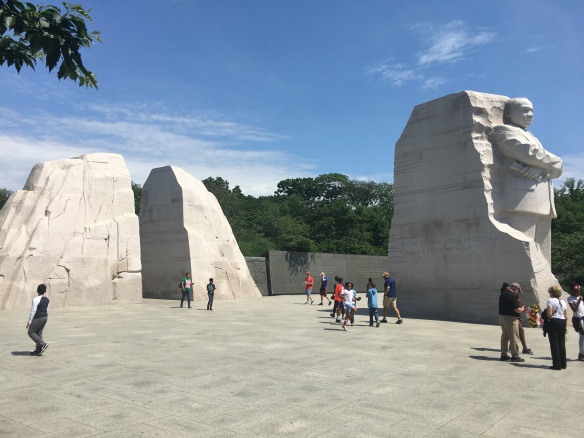
One of the most recently constructed memorials in Washington is on the shores of the Potomac River — the Martin Luther King Memorial.

IMG_6993

“No one is free,” said Martin Luther King, “until we are all free.” In other words:

What I want for myself can’t happen, until it can be so for everyone. If there is anyone who suffers in whatever way,

If there is anyone who is not free, in whatever way,

If there are people who are bound, captive to whatever vice, to whatever imprisonment of the soul or in prison because something they have done…

I am going to be healed of whatever ails me, only when I seek the healing of the other, the freeing of the other, the liberation of the other. The church holds up a different vision from that of the divisive, individualistic and exclusive nature of white nationalism in the world today.

You can see, I hope, why the consciousness of the church not only at Faith Lutheran, not only in Ottawa, or in the Eastern Synod or the Evangelical Lutheran Church in Canada, but in the United States of America and worldwide is moving to see not a division between things, not building walls between two perceived opposites, but building unity between them.

Not a division between politics and pastoral care,

Not a division between care for the soul and social justice,

Not a division between reaching out and reaching in,

Not a division between speaking out against injustice of whatever kind and speaking to the choir,

Not a division between contemplation and action.

Not an either-or, but a both-and.

Last week when Ken stood here and told you about the different ways we can support the financial health of the congregation, he introduced his well-delivered announcement by saying — “you’ve heard we in the church were never to talk about money, politics and sex (well, he didn’t actually say the last word, but I know you all were thinking it!).

And then a couple weeks before that, Mark stood here and told you about his upcoming trip to Ecuador to build homes in a community destroyed by an earthquake some years ago. And in his well-worded speech he said (I paraphrase): “In this mission trip the group he was going with was not doing mere charity, dollars sent to a far-off location, but directly helping them on the ground and making a real difference in the lives of those who suffer.” Check it out. He said it. I believe he has it all on a piece of paper.

I alone am not telling you all this. Your own members are. Your own church family is slowly but surely breaking down the walls that have divided, distanced and incubated our conversations in the church.

Limited our conversation. Limited our imagination. Limited the ways of God. NOT talking about these things, well, how has that worked out for the church in recent times?

NOT talking about the things that really matter in our daily life, NOT being open and honest, sharing the deepest secrets and burdens of our lives, NOT feeling safe in a community of faith to be who we humanly are, warts and all, imperfect, suffering, in need of God’s love. NOT being like that — how has that worked for the church? How has that worked for you?

It is not easy in the church (although everyone else in our real lives are talking about them!) to talk about money, politics and sex. It is not easy to talk about the real things that matter in this life. And so, the church for many decades has avoided having these conversations. Why? Because we were afraid? Because talking about sex, politics and money would put a mirror in front of us, exposing areas of our life that needed even a bit of God’s light shining upon it?

It’s not easy to talk about these things. I know. I feel it too. But I always thought that that’s what faith was supposed to be about — to confess, be honest, be real, and just do the work of God. How can we do the work of God when we can’t even be honest, and real, and confess ourselves to one another?

We can echo the prophet Isaiah’s complaint to the Lord: “Woe is me! I am lost, for I am a man of unclean lips …”[2]

But he doesn’t stop there. His confession is not just about himself. Faithfulness is not merely individualistic. We don’t come to church to make an individual contract with the Lord.

Isaiah continues in his confession: “Woe is me! I am lost, for I am a man of unclean lips, and I live among a people of unclean lips.”

Faithfulness drives towards the communal, the community, the well-being of the world. “No one is free, until we are all free.” Not just me, but we!

When we don’t include, welcome and affirm people who are different from us, we are a people of unclean lips.

When we refuse to include conversations about sexuality, money and political action, we are a people of unclean lips.

When we remain quiet in the face of injustice, we are a people of unclean lips.

In other words, this confession of Isaiah implies that he feels he should just ‘shut up and sit down.’ Not say anything. Because he is bad. And Israel is bad.

Maybe you feel this too. Not unlike Isaiah when confronted with a vision of God, you feel, deep down, the church is bad, and has nothing worthwhile to say in the public sphere. Millennials believe that. Just ask your children or your friend’s children. In the past, we church-going Canadians have conveniently said, “That sort of stuff is the government’s job.” We effectively, therefore, excuse ourselves from any social action in the name of Jesus. And continue the dividing.

Martin Luther King also said that in the church it’s alright to talk about the New Jerusalem (pointing to heaven, the afterlife), yes, but one day we also have to talk about the New York or the new Ottawa, the new community in the here and now.

What did Isaiah see in his vision?

Two details in this vision I want to focus on:

First, “the house was filled with smoke.”[3]

Here’s Isaiah who sees God in all God’s glory. How can I understand this vision by analyzing: Why the six wings folded over on various parts of the seraphim? What’s with that?

But the smoke fills the space. Usually, the image of smoke — like the cloud — in the bible is codeword for, “Can’t get this.” I can’t explain what’s going on in the presence of God. I can’t bring all the statistics, analysis, data and information the world can offer, to explain this rationally. But that’s ok. Because that’s not the point.

In 2018, in the wake of the internet revolution, did you know that more than 7 billion humans use the internet; and, that’s 7 and a half percent more, over 2016. Google now processes more than 40 thousand searches EVERY second. And remember, that’s only Google. Include all the other search engines out there, worldwide there are 5 billion searches EVERY day.[4]

We don’t need any more information! The church’s solutions are not found in accruing more data to solve our problems!

Because things happen in life that we can’t understand. The truth about God cannot be conveyed in data streams and pie charts and three point sermons.

Smoke in the house. Mystery. Might it be, that Isaiah and the bible is trying to say: We don’t need to understand everything. We don’t need to know how it makes sense for people of different races, colour, ethnic background, different social economic status, expressing a different sexuality, different ages, different abilities can form one, unified community. We don’t need to know how that can be.

Today is Trinity Sunday. I am not going to stand here and try to explain to you how three different persons can constitute one God. Because I don’t know. All I know is that those different persons are in a unified relationship. Relationship.

The third person, especially, confounds our Lutheran sensibilities. We’ve figured God the Creator. We’ve figured out God the Son, well, as much as we can. But the Holy Spirit throws a wrench into any rationalizations. A mystery, to be sure!

How does it all fit together? How can we analyze this even more? Shouldn’t we first have a detailed plan? Shouldn’t we try to draw a diagram?

We don’t need to know! All we have are the visions. The dreams. The imagination that describes in poetry and colourful words flashes and fragments of God’s kingdom and truth. We don’t need to know. We don’t need to reconcile all the contradictions. We don’t need to make sense of it. We don’t need to provide all the answers. We don’t need to put God in a box, nor explain God to anyone. God doesn’t need that from us.

Why?

Because even though Isaiah is a man of unclean lips (God doesn’t deny it!), even though God’s people have unclean lips, even though we are imperfect individuals in an imperfect church, that isn’t going to stop God. In Section Five of a recent Confession of Faith in a Time of Crisis called “Reclaiming Jesus” church leaders from across the United States wrote: “We support democracy, not because we believe in human perfection, but because we do not.”[5]

The realm of politics is imperfect. Who would think? Yet, our imperfection is the very reason politics happens. It is not something to avoid, it is something to embrace.

What does God do? Despite Isaiah’s complaints and resistance (just like all the rest of the people in the bible!) …

Despite us!

God reaches down from God’s throne and touches Isaiah’s lips with God’s holiness. God doesn’t steer uncomfortably away from the place of Isaiah’s greatest embarrassment, sin, weakness, brokenness, uncleanliness. God doesn’t avoid the uncomfortable places of our lives. God doesn’t even say anything to that uncleanliness.

God touches it. In the place of our greatest fear, shame, guilt, when we present ourselves in God’s almighty, mysterious presence, honestly and openly — not denying nor avoiding — we place ourselves in a position to be touched by God in the very place of our greatest weakness, to be healed, to be transformed, to be made new.

Even in the vision, the temple and the seraphim cannot contain the ‘bigness of God’. “The train of God’s robe filled the temple.”[6]The image is not meant to convey facts, figures, numbers, measurements, information.. Only our post-enlightenment, rational minds want to go there. But we can’t explain the vision of God. God’s kingdom doesn’t sit comfortably in our rationally justified common-sense policies.

God’s presence enfolds and goes to the edges and bunches up in the corner feeling like it needs to be stretched even beyond the walls of temple.

Whom shall I send? God asks.

Isaiah, transformed by God’s touch, can then say, “Here I am, send me.”[7]

Will we?

The Holy Spirit blows where it will. The wind does not stop at the border. The wind does not end at any walls we build to divide. The Holy Spirit brings fresh air into the stagnant, recycled, stuffy air of our temples. The Holy Spirit blows, fresh air at last, sending us into the world with God’s love, grace and power to change.

I don’t know how the fresh air of the Ottawa Valley is cleaner and sweeter than the air I breathed south of the border, really. But I don’t need to know how. I just know.

And give thanks.

[1]USA Today, May 24, 2018

[2]Isaiah 6:5

[3]Isaiah 6:4

[4]Bernard Marr, Forbes.com, May 21, 2018

[5]ReclaimingJesus.org

[6]Isaiah 6:1

[7]Isaiah 6:8

Dare we imagine

For my friend’s wedding over twenty years ago, I was asked to play Pachelbel’s Canon in D on my violin for the processional. We were to rehearse on the Friday evening. As I was running late, I drove over 120 km/hour on the Queensway from the west end all the way to Orleans. When I ran into the church, violin case in toe, the bride was waiting. I had made it just in time to set up and start the procession.

The notes lifted off the strings and the bridal party started down the aisle. But I was getting strange looks from them when all of a sudden the bride waved her hands and said: “Could we start over? Martin, did you tune your instrument?”

At that moment I actually heard the music I was playing – completely off key, sharp by at least three tones. “Ah, no,” I mumbled, even though the problem wasn’t that I hadn’t tuned my instrument. The problem was in my head.

You see, when I sat down to play, my mind was still travelling 120 km/h on the Queensway. My body may have been resting at that moment when I played the first note. But everything inside of me was still going. And going fast. No wonder I was playing sharp.

I learned from that experience, that before I play my guitar or violin, or sing any song, I must pause. I stop. And in my mind, before playing the first note, I hear what I want to play and how I want to play it. I need to imagine it first, before doing anything.

The truth is, you cannot even do something until you first have an image of it inside you. Albert Einstein, early 20th century inventor and scientist, once said, “I am enough of an artist to draw freely upon my imagination. Imagination is more important than knowledge …”[1]

Late 20thcentury author, surgeon, and inventor — Leonard Shlain – made the case that images come before our capacity to verbalize or name what we see.[2]We have to see it in our mind’s eye, first. Our imagination dictates our reality to a large extent.

Attending the Festival of Homiletics in Washington D.C. this week is a real treat, as I have had a little time in the busy schedule hopefully to visit the National Gallery of Art.

There, until mid-summer is an exhibition of paintings about Francis of Assisi. Francis of Assisi from the 13thcentury is an important figure in Christian history. He is, of course, known for his spirituality about nature and all of creation. Francis is also credited for putting Christmas on the annual Christian calendar. Christmas is the celebration of God’s incarnation into humanity.

I was impressed to learn that “Francis of Assisi has the longest, single entry in the bibliography in the Library of Congress, also in Washington D.C. He is the most written-about human being in history. Every day there is another biography, monograph, that they enter into their files, from another language, another culture, even other religions.

When the Pope some years ago wanted to gather leaders of all the world religions to have a respectful, inter-faith dialogue, the only city in the world that they could agree to meet in was Assisi, Italy. Because the memory of this man doesn’t carry much negative baggage at all. “[3]He was one of those rare human beings whose humility and stance towards others garnered respect and love. Truly, a saint.

In one popular painting of him, he is standing with arms open and the birds flocking around him. But instead of looking up – which you might expect – he is looking down at the earth.

In the season of Pentecost we are entering now, we read from Book of Acts that the Spirit of God “came from heaven” upon those gathered in Jerusalem.[4]The Spirit of God came down upon the earth. The Spirit of God descended to the place where humans were gathered.

Often we assume that to be spiritual, or to be holy, we have to gaze upwards towards heaven – somewhere away from the here and the now. We may therefore over emphasize our destination in the heavenly realms while paying little heed to the earthly journey.

In the optioned first reading for today[5], we encounter a dramatic vision of what happens in the valley of dry bones.[6]The prophet Ezekiel conveys to us a message using fantastic imagery, not unlike later apocalyptic visions from Daniel and the Book of Revelation in the Bible. I hope our imaginations are stirred by this reading, where skeletal human remains join together and begin to walk again.

Christians have traditionally understood this vision primarily to point to the resurrection of the dead, in light of Christ’s resurrection. This rising, then, would happen at the end of time, after our physical death.

Such an interpretation does not do full justice to the text, whose context is the community of exiles in Babylon, some six centuries before Christ. These exiles – the people of God – felt dead, like the dry bones. They had lost everything when Babylon conquered Jerusalem – their temple, their homes, their land.

The prophet Ezekiel with the exiles, conveys the word of God to the hopeless. The vision of new life in the dry bones is a promise of new life for the exiles. They are given hope, in a hopeless world.

Holy people in art are often depicted looking up to God. While this is certainly an appropriate stance to have in life, let us not miss the point of the Pentecost message, which is not fundamentally heavenward. The primary movement and message of Pentecost is downward. To the ground. God’s Holy Spirit blows upon the earth, in the earth, and in humanity.

God’s Spirit comes to us, wherever we are in life on earth. To whatever circumstance of our lives. Whether we are imprisoned in the exile of our own making or constrained by forces beyond our control. It is into the ordinary, the mundane even sordid realities of life to which God now comes.

Our lives on earth matter to God. How we live and what we do with what we have matters to God. How we live and what we don’t have matters to God. How we live with others matters to God.

While in the passing season of Easter our gaze may have looked upward to the glory of Jesus, our gaze and focus during Pentecost levels out upon the earth. We now watch for the presence of God among us. We go where the Spirit blows to do God’s will and mission.

We pause to imagine, like African American slaves did centuries ago on this continent, that ‘dem bones’ will rise again out of captivity. Dem bones will sing a new song. Dem bones will embrace freedom in the loving grace of God.

Dare we imagine.

[1]Cited in Leonard Shlain, “Art and Physics: Parallel Visions in Space, Time, and Light” (New York: HarperCollins, 2007)

[2]Richard Rohr, “Daily Meditation” 14 May 2018 (Center for Action and Contemplation), http://www.cac.org

[3]Richard Rohr, “The Art of Letting Go: Living the Wisdom of Saint Francis”, Session One/CD1 (Boulder Colorado: Sounds True, 2010)

[4]Acts 2:2 NRSV

[5]Day of Pentecost, Year B, Revised Common Lectionary

[6]Ezekiel 37:1-14

Ascension action

As you saw last Sunday, I had my canoe strapped atop my car. I was eager to put paddle in water and explore the waterways around Papineau Lake near the northern border of Algonquin Park, just south of Mattawa.

From Highway 17 at Mattawa, we turned south on a dirt road. The land there still thawing from winter’s grip, the snow-melting runoff left deep potholes and troughs across the narrow roadway. For about fifteen kilometres we traversed the rough and bumpy access road, thankful for the four-wheel drive.

Finally arriving at the end of the road at the shores of Papineau Lake, we still had to portage our gear about half a kilometer through the thick bush to the cabin. I thought to put the canoe in at the water in order to paddle my gear along the shore line and save the heavy climb carrying everything on my back along the trail.

But when I looked out over the lake, this is what I saw all over its surface: Ice.

IMG_6939

Despite the 20-degree Celsius air temperature by midweek, the persistent ice continued to lock out any hope of paddling into the lake. Until the fourth day of our camp-out, the ice prevented us from going to the deepest parts of the lake to fish for the coveted Lake Trout for dinner. We were limited to shoreline casts where a narrow band of water teased us into never-ending hope for a catch.

IMG_6935IMG_6931

After a windy and rainy day late into our stay, we awoke at long last to this glorious sight:

The ice was completely gone. Night and day. Needless to say, I was out on the water in my canoe, crisscrossing the lake and exploring new shorelines. The loons were back. The lake had awakened once more.

In these last few days, the church has recognized the Ascension of our Lord. Some forty days after Easter each year the church recalls when Jesus, after appearing to his disciples following his resurrection, ascends to heaven.[1]

Jesus, here, leaves them for good, so to speak. It is no wonder why the scripture texts in these last few weeks have gone back to parts of the farewell discourses from John’s Gospel, also appointed for reading before Christ’s death.[2]There’s a point to it.

Jesus prepares his disciples for his leave-taking, never easy – a second time, now. Both before his death, and now before his Ascension, Jesus needs to remind and console them – and us – that we are not left alone.

Despite his going away, Christ will come to them no longer in physical form but in the Holy Spirit. God is present now to us in each other– the community, through the power of the Holy Spirit.

Why did Jesus leave them? You might wonder: Why should Jesus have ascended to heaven and leave it all in his disciples’ hands? We don’t need to go far into Christian history to see the imperfection (to put it mildly) of Christians throughout the ages.

Jesus was alive and among them. Why couldn’t he just have stuck around – forever? Things would certainly have turned out better, no? Could you imagine how encouraging it would be for his disciples then and now to have Jesus appear from time to time albeit in his resurrected form to guide us, talk to us, lead us, comfort us, in physical form?

All the while the ice remained in the lake, we were confined to the shoreline. We could still fish, to be sure. But the real good catches were waiting for us out in the middle of the lake. For us to do so, we had to get out on the lake ourselves. The ice had to go, first.

If the Ascension didn’t happen, would the disciples ever really believe Jesus’ promise – or have to believe Jesus’ promise – that God lives in them through the Holy Spirit? Would the disciples ever do what Christ commanded them – to go “to the ends of the earth” to be Christ’s witnesses?[3]

If Jesus remained with them, wouldn’t they be tempted to look only to Jesus standing out in the middle of lake – even if there was ice covering it –  and not trust themselves enough to get ‘out there’ to do the job? Wouldn’t they become overly dependent on Jesus for everything and not embrace the gift within them?

“You are my witnesses, even to the ends of the earth,” Jesus says. We need to hear that first word in the sentence: You. Jesus speaks to each one of us here. Each one of us are Christ’s witnesses, now that Jesus is no longer present to us in bodily form.

And, that means, we have to follow through not only with words, but with deeds. When the ice melts, we are called to get ourselves out there into the middle of the lake and start fishing, with the gifts we have.

Over forty years ago, my father flew low over Algonquin Park in a single-prop plane. I was just a baby, and my mother was worried. You see, my father, the pastor of a church in Maynooth, was the passenger squeezed tightly into the small cabin of this plane. It was the pilot’s first solo flight.

The pilot was a member of his parish. Bill, we will call him. For years leading up to this event, my dad counselled Bill who struggled with many personal problems to say the least. Nothing was going right for this guy. At one point in their conversations, my dad asked Bill: “If there was anything you wanted to do, what is it you dream of doing?” Good, pastoral question, no?

Without much hesitation, Bill said he had always wanted to fly a plane. So, my dad encouraged him to get his pilot’s license. Which he did in short order. Again, good pastoral guidance. You’d think my dad’s job was done. Pastor School 101, check.

But when it came time for Bill to fly solo, he naturally asked his own wife to go with him the first time. She flatly refused, which worried my dad a bit. What was it about Bill that she couldn’t trust going into a plane with her husband flying it?

So, Bill came to my father. “Pastor,” he said, “you have been with me through it all. You said words that helped me in my despair. You listened to me when things weren’t going well. You helped me discover my passion. You encouraged me to get my pilot’s license. Now, I’d like you to go with me into the air, for my first solo flight. Would you please come?”

You could imagine why my mother was so worried. With two little baby boys to care for, she feared Bill would crash the plane and she would be left to parent us alone.

But dad went. He might have been justified in finding some excuse not to go with Bill. I think in his wisdom my dad knew, though, that his words had to be followed by actions.

I think in his wisdom, my dad knew that to be a witness to the gospel, it wasn’t merely about believing the right things and saying the right things. It had to be followed up by walking the talk. And this action involved some risk, to be sure, and a whole lot of trust.

May this Ascension Sunday remind us all that the God gives us the gifts we need to take the risk to get out there onto the lake and do the job that is ours, together in and through one another, blessed by God, and empowered by the Holy Spirit.

[1]Luke 24: 44-53

[2]John 17:6-19 (Easter 7B), John 15:9-17 (Easter 6B), John 15:1-8 (Easter 5B) – These texts, part of the ‘farewell discourse’ of Jesus in John’s Gospel, are intended to prepare, encourage and empower his disciples prior to Jesus’ departure. The context of the farewell discourse is Holy Week, especially during the Passover Meal on the night of his betrayal and arrest.

[3]Acts 1:8

One part per billion

I’m going into the Algonquin Park region this coming week. As you can see outside the church, I’ve already strapped my canoe atop the car. I’m looking forward!

And when I’m paddling, I like to follow the river or lake banks. Of course, where I’m going, there are lots of little lakes and rivers, and therefore many riverbanks and rocky shorelines I will skirt (probably still breaking the ice!).

We live in a world where borders and boundaries are important. Whether these are borders between nations, continents, cities, regions, communities, families or individuals, they mark the line between separate and distinct realities. Without honouring certain boundaries, we can fail to distinguish who we are and lose a sense of our identity and purpose.

Last summer when I travelled through Spain and Portugal, I learned that he Portuguese-Spanish border is the oldest, unchanged national border on continental Europe. This surprised me because that border did not appear natural. Not unlike the border between Canada and the United States in North America, the Spanish-Portuguese border draws a counterintuitive line across the more natural flow of the continent’s geography.

For example, to see it from space, the North American continent flows more north-south: The mountains run north-south on the western half of the continent, the prairie and plains in the centre of the continent, and the Great Lakes basin spilling into both the Mississippi and St Lawrence River valleys in the eastern portion of the continent. The geography suggests more natural north-south lines.

Spain and Portugal share what looks like a giant square mass of land peaking in the northwest on what is called the Iberian Peninsula. The Atlantic Ocean hugs the northern and western edges of this square. And the Mediterranean laps up against the eastern edge and into the southern Straits of Gibraltar separating Africa from Europe.

Despite what looks like it should be a unified whole, this large land mass is divided between two nations with Portugal carving its small section on the south-western shoreline.

When the kids were toddlers — and sometimes even to this day — they often lingered on the thresholds of doorways separating outdoors from indoors. Standing or sitting on the threshold meant that the door remained open. Of course, we parents were concerned about them jamming their thumbs and fingers and toes. So, we would yell at them: “In our out! Make up your mind!”

Borderlands, as we know from German history (the Berlin Wall) and between North and South Korea, can be dangerous places. We call the space in the border “no man’s land.” At best, these thresholds are ambivalent to us; at worst, they leave us uncomfortable, unsettled, fearful. We feel we can’t rest in these places.

I learned recently about what is called the ‘riparian zone’ which is the border between land and water. The riparian zone can be the lake or riverbank that is a marsh, or a rocky or sandy, thin strip of land, a hardwood forest or stand of pine on the edge of the river.

This ‘in-between’ place of the riparian zone fulfills three, vital, ecological functions: First, the riparian zone functions as a natural filter, cleaning ground water as it flows into the larger watershed. It also protects the surrounding soil from accelerated erosion by slowing down wash effect of the river. In the process, riparian zones actually create new soil and provides for new habitats.

A NASA scientist called the river and its marshy edges the ‘sine qua non’ of life; that is, where water and land touch, these edges are necessary for life on earth.[1]

So, we agree that boundaries are important. Borders, whether political, relational or ecological are vital.

But we also say that the grace of God knows no boundaries. We say that God’s love crosses and surpasses all boundaries. Jesus says, “Abide in my love.”[2]Paul wrote that “nothing can separate us from the love of God.”[3]God’s love expands and grows and overcomes all obstacles.

How does this happen? How can we, on the one hand, honour the boundaries in our lives and, on the other hand, live into the boundary-busting, wall-breaking, division-crossing, far-reaching, limitless, boundless reality of God’s love? How can God’s love abide in us when we are separated from God and each other by sin?

We are human, after all.

Imagine you are at the ocean, and you’re standing in the ocean ankle-deep. It’s true, you are only ankle deep. But it’s also true you are in the ocean. It’s also true that if you keep going, it will get plenty deep soon enough. If not in the ocean you are standing in, certainly at the deepest point on earth — the Marianas Trench — because all oceans on earth are connected anyway.

What if the infinite depth of the ocean gives the totality of its depths to your ankle-deep degree of realization of it?[4]

During the Easter season, and because of the resurrection of Jesus, the church says God is everywhere. But then, we also say God is really in your soul. And God is really, really in the church. You have to go in the church to save your soul. And, in the church, God is really, really, really in the Holy Communion. And, then, God is really, really, really, really in heaven. And, here at Faith Lutheran in Ottawa, it’s like one part per billion!

But, Jesus is alive. Therefore, God is really, really, really, really, really, everywhere.

The truth is, when you’re connected to a little bit of it, you’re connected to the whole of it, the fullness of it.

Speaking of the Holy Communion, when we receive one grain, it belongs to the one bread; one grape, one cup. Many parts, one body. When you receive only one small part of the Communion, you receive the whole of Christ.

“Every piece of bread and sip of wine is precisely the same one: there is one bread, and that is Christ. We receive all of Christ in communion, not just a piece of him. If we break the loaf into a thousand pieces, there’s still only one Christ – and each of us receives all of him.”[5]

This logic extends on several levels. Our lives, for one, belong to God’s story. “We need to sense that all aspects of our history, of our experience, are part of the same story, even the bits that don’t make any sense or the meaningless parts …”[6]There is no part of us that does not, somehow, belong to the great story of God and God’s people. Every part of us — our history, our experiences — is valuable to God and to us, and to each other.

We are who we are. No part of us is wasted space, wasted DNA. No part of us is lost, no memory is gone. All parts of us and each one of us belong.


[1]Diana Butler Bass, “Grounded: Finding God in the World; A Spiritual Revolution” (New York: Harper One, 2015), p.68.

[2]John 15:9-17 speaks of the mutuality of divine love’s presence: We abide in Christ as he abides in us.

[3]Romans 8:38

[4]James Finley, Centre for Action and Contemplation, 28 April 2018 (audio, http://www.cac.org).

[5]Br. Mark Brown, Society of Saint John the Evangelist (SSJE), Brother, Give us a Word, 28 April 2018

[6]Laurence Freeman, Daily Wisdom (Word Community for Christian Meditation, Meditatio), 1 May 2018.