Unknown's avatar

About raspberryman

I am a pastor in the Evangelical Lutheran Church in Canada, serving a parish in Ottawa Ontario. I am a husband, father, and admirer of the Ottawa Valley. I enjoy beaches, sunsets and waterways. I like to write, reflect theologically and meditate in the Christian tradition.

The power of the pause

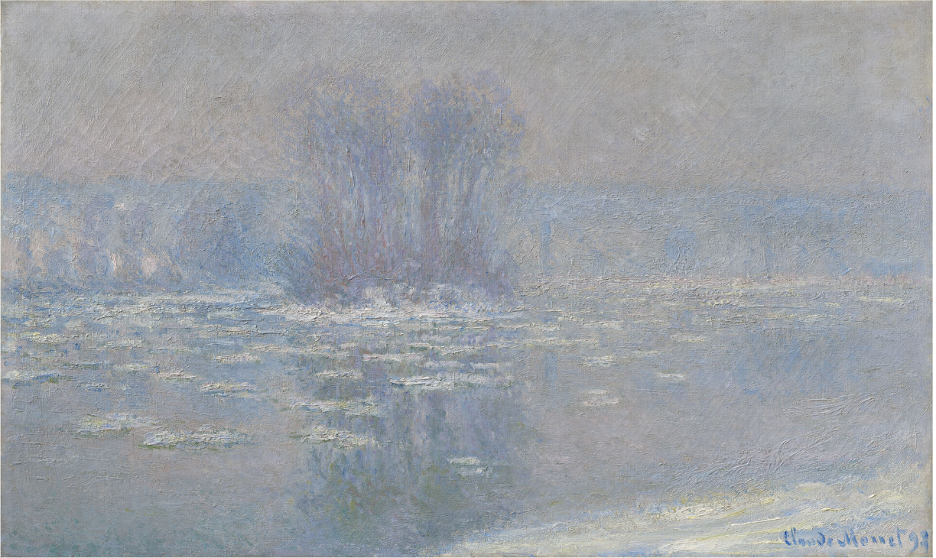
photo by Martin Malina, October 10, 2025 (Ottawa River at Arnprior)

It’s my job to change the calendars hanging in various locations on the walls of our house. There are a few. And I’ve notice that when I flip the calendar to the next month, I feel this grumpy eagerness to get on with it, to the next month, with a kind of dismissive good-riddance attitude towards the passing month. Like I’m on a treadmill that’s hard work and I’m glad that the month is over and we can just move on.

When I catch myself changing the calendar and feeling this ‘let’s-just-get-on-with-the-next-month’, I know there is something off within me.

So, I decided to try changing my approach. I promised myself that when I turn the calendars next time, rather than happily/grumpily dismiss the previous month I would pause and bring more of a thankful, reflectiveness to that ritual. I will intentionally bring to mind, if not anything specific that happened, a general attitude of thanksgiving for having made it despite everything that’s happened good and bad, through another month in 2025.

What this exercise — this intention — does for me, I think, is slow me down a bit to stay in that changing moment, that ritual of transition, with more positiveness and a restful, gracious heart. This change-over becomes, in short, a prayer.

Advent underscores this pivotal place for me. To stay in the pause before getting on to the next thing. This journey of change – from one thing to the next – is worthwhile because it is a better way to live.

But it’s not easy to be ok in the in-between time of waiting. It’s not easy to practise the virtues of patience, of watching, of observing, of trusting what is promised.

This hustle culture we live in puts a whole lot of pressure on us to perform perfectly, and to ramp up our activity and consumption. How can we journey on without losing our minds, our faith, our well-being? How can we experience the power of the pause which Advent invites us to experience?

Before I went on my camino in northern Spain years ago, other pilgrims who had completed the 800-kilometre hike advised me to be scrupulous about how much weight I would haul on my back. They suggested I rip out and discard the pages of the novel or guidebook I was carrying with me after I was done reading them. Just to get the weight down with each passing step on the way.

At first, I thought this was crazy. I would just make sure I didn’t pack too much from the start. The thought of needing to shed backpack weight as I went along seemed absurd to me.

Needless to say, once I started the hike, I soon learned the wisdom of this advice, to make my journey a whole lot more manageable and easier. It’s during the journey, not arriving at the destination, where the most important lessons of life are learned.

And what are we to learn during this Advent journey, this year, as we pause together between what was and what is to come?

When the ancient Israelites took their circuitous route through the desert wilderness en route to the Promised Land, they navigated hunger and thirst, desert heat, and attacking armies. And while they met up with all these challenges on the way, they carried the holy ark containing the tablets — the ten commandments — Moses had received on the mountain inscribed by the hand of God.

“But those tablets were actually the second set that Moses received.” I read recently that “right beside them in the ark sat the broken shards of the first set, which Moses had smashed in his rage when he witnessed the people dancing mindlessly around the golden calf” (Brous, 2024, pp. 98-99). Both sets. The tablets and the broken tablets – both holy – rested together in the ark.

That’s a significant amount of extra weight, wouldn’t you say, to carry on a long journey?! Not very efficient packing for the long, desert journey! Why wouldn’t they have just taken the new, second set and discarded the broken pieces from the first set? Why would they have intentionally doubled their load to carry? You may think this is mere biblical trivia. But there’s nothing trivial about this.

The desert figures prominently in the readings for Advent. It’s in the desert where the prophets of God do their work. Isaiah preaches a future vision free of suffering (Isaiah 35:1-10). John the Baptist foretells the coming of the Messiah (Matthew 11:2-11). These proclamations all come from within the desert.

Biblically, the desert is the place of transition and transformation. The desert, for the ancient people of faith, was the way home – first the way out of slavery in Egypt to the Promised Land, then, centuries later, the way out of Babylonian exile back home to Jerusalem. In the Christmas story, the Holy Family also travelled through the desert from Egypt back home to Nazareth after the threat of Herod’s reign had passed. Through the desert. Back home.

That first journey through the desert out of Egypt was, by the way, a journey that could have taken the Israelites just 11 days on foot – the direct way to the Jordan River. You wonder if they couldn’t have been more efficient in their travel plans, especially because of all the hardship they met in the desert.

But instead, it took them 40 years. A journey that, at the time, could have taken just 11 days, took them 40 years. So, two conclusions we cannot ignore: First, the theme of journeying is vitally important to a life of faith.  And second, what we carry on that journey includes even the broken pieces of our lives!

Seasons of transition, these difficult times of change and challenge, from one place or situation to the next, these in between times need our attention. They give us permission and call us to explore the power of the pause in our lives individually and as a church. These times and places have something to tell us and call us to change our direction.

Maybe, to start, one lesson here is that in times of change, the broken pieces we carry have just as much value to us and our faith as do the more polished, perfected, certain and secure aspects of our lives.

In the Gospel today from Matthew 11, Jesus rebukes those who expected the word of God to come by means of “soft, plush robes in royal palaces” (v.8). The word of God comes by means of the desert, the wilderness, by the raw, rough and even harsh words of a less-than-polished, trouble-making John the Baptist.

Author Cole Arthur Riley writes, “There is no greater exhaustion than a charade of spirituality” (Riley, 2022, p. 186). The charade is maintained when celebrating Christmas ignores the wisdom of Advent preceding it.

Advent does not permit us to rush headlong into soft lights and mistletoe, cheery or sentimental Christmas music. Advent calls us into that pivotal space where we slow things down to find the “sacred fusion of sorrow and celebration” (Brous, 2024, p. 99). In so doing, we discover a way home to what God is preparing for us.

The pain cannot be hidden away, even at this time of year. The sorrowing world, the grief we bear, these changing times with all the suffering we encounter. Advent calls us not to dismiss and discard these realities. Rather to hold them all in the light. Even as we sing, Joy to the World.

The Gospel brings good news, yes. But it never minimizes the realness of our pain. “Rejoice with trembling” (Psalm 2:11, English Standard Version) the Psalmist instructs. Even when we’re rejoicing, we should tremble a little. In other words, be careful “not to … disconnect from [our] humanity that lives and dies, loves and loses, suffers and sometimes finds solace” (Brous, 2024, p. 102).

So maybe Advent is the simple invitation to try. Try to stay in the moment of in-between a little longer. In that in-between, try to embrace both the joy and the suffering. And maybe, in the desert, you too will witness the power of the pause as you discover God’s promise delivered, in and around you.

In a webinar a couple of weeks ago called “Conversations Across the Church” hosted by newly elected national ELCIC bishop, Larry Kochendorfer, he concluded by praying his favourite prayer from the ELW. It’s on page 76, the last one on that page, for those who would like to look it up later. Let us pray:

O God, where hearts are fearful and constricted, grant courage and hope. Where anxiety is infectious and widening, grant peace and reassurance. Where impossibilities close every door and window, grant imagination and resistance. Where distrust twists our thinking, grant healing and illumination. Where spirits are daunted and weakened, grant soaring wings and strengthened dreams. All these things we ask in the name of Jesus Christ, our Savior and Lord. Amen. (ELCA, 2006).

References:

Brous, S. (2024). The amen effect: Ancient wisdom to mend our broken hearts and world. Avery.

Evangelical Lutheran Church in America. (2006). Evangelical lutheran worship: Pew edition. Augsburg Fortress.

Riley, C. A. (2022). This here flesh: Spirituality, liberation, and the stories that make us. Convergent Books.

Even if

See, the day is coming, burning like an oven, when all the arrogant and all evildoers will be stubble; the day that comes shall burn them up, says the Lord of hosts, so that it will leave them neither root nor branch. But for you who revere my name the sun of righteousness shall rise, with healing in its wings (Malachi 4:1-2a).

Jesus says, “When you hear of wars and insurrections, do not be terrified, for these things must take place first, but the end will not follow immediately” (Luke 21:9).

These scriptures can make us feel afraid. We can come away from our bible reading today fearful, scared. Our already heightened sense of foreboding for all the bad things that are happening in the world today is not calmed down by these readings. In fact, these scriptures may serve only to fuel and fan the flames of our terror.

I read recently an interesting fact about our brains. When facing a threat, our brain registers three levels of response in succession. The first response – the first brain mechanism that fires when we are confronted by any threat – is not fight or flight. Whenever we feel threatened, the first level activated by the nervous system, is also not freeze and dissociation. Fight or flight, freeze and numbing, are respectively the second and third responses of the nervous system.

No, the very first brain mechanism that fires when we are threatened, the very first level activated by the brain to the nervous system, is social engagement (Van der Kolk, 2014, p. 82). It is reaching out to others. When we don’t get that, when we miss that first level of reaching out to get the help we need from another person, then the brain trips the second and third activations.

When we read the apocalyptic texts – the end-of-times, doom-and-gloom ones like for today – it makes sense to view these scriptures as messages to a traumatized community of faith that must remain together through their trials.

The follow up question for us, is how can we as people of faith meet the many increasing challenges in our lives in an increasingly hostile and divisive world. What do we do first?

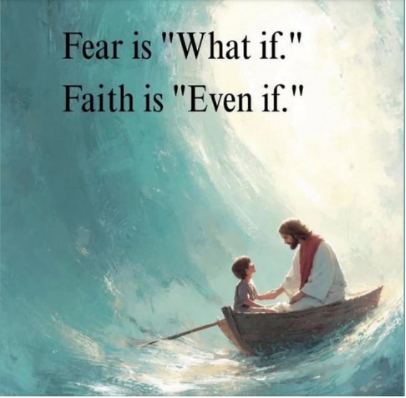
I came across a picture of Jesus sitting in a tiny rowboat with a child. The boat is in the ocean. And coming straight toward them is a towering wave at least ten stories high and just about to crash over them. Jesus and the child are facing each other with a caring, trusting and loving disposition. They’re holding hands.

The caption reads: Fear is: “What if …” Faith is, “Even if ….”  “What if” thinking only stokes the catastrophic thinking and anxiety plaguing so many of us today. What if I get sick? What if I make a mistake? What if I miss my opportunity? What if I lose a relationship I cherish? What if I lose my job? What if, What if, What if? “What if” thinking is based in fear and usually creates unhealthy stress and reinforces unhelpful behaviour.

On the other hand, people of faith will practice saying, “Even if”. After all, Jesus says these terrible things “must take place first” (Luke 21:9). It’s not even a question of whether or not, really. Eventually all of us must confront our greatest fears.

So, even if that proverbial wave crashes down over the tiny boat submerging its occupants in the turmoil and crushing weight of water, Jesus goes down with us. Jesus is not afraid to encounter with us our worst fears. Jesus is not afraid to be with us through it all, even dying, because he’s gone through it himself. Our worst-case scenario, he’s been there done that.

So even when the worst thing happens, you will not be alone. Even if you lose everything, you will not be abandoned. Even if your limitations grow and you can no longer function the way you used to, you still have purpose, and you still are loved.

The cross of Christ can enable us to live despite all that challenges us, all the difficulties we face. We gaze on the cross because the story is not over at the foot of the cross.

Our hope is sustained because we are not alone. Being in community creates a larger context for our lives, a meaning beyond our individual fate. We face the proverbial music together.

And I think that’s the point of these scriptures. They are addressed not to individuals, but to communities whose suffering is held together. Recall, that the early followers of Jesus in those first centuries were persecuted and run underground, literally. To survive, those groups of individuals needed to stick together. Given the harsh reality facing people of faith at the time, these texts served as propaganda for their time – a kind of pep talk, motivational piece – aiming to provide solidarity for communities under duress.

I read recently that when the traditional creeds – the Apostles and Nicene – were developed and composed between the 2nd and 4th centuries, that the phrase – “communion of saints” – was the last phrase added to the Creed. The last phrase, why is that? Is it because it took a while for those early Christians to realize how important it was to be in community when facing a personal and collective crisis – of faith, of health, of personal safety? (Rohr, 2025).

In one another’s care, when we make space and hold space for each other’s suffering, that’s where we encounter the living presence of Jesus in our midst. That’s where Christ is present.

I came across a beautiful description of an ancient pilgrimage ritual, “when hundreds of thousands of people would ascent to the Temple Mount in Jerusalem, the focal point of Jewish religious and political life in the ancient world.

“The crowd would enter the Courtyard in a mass of humanity, turning to the right and circling – counterclockwise – around the enormous complex, exiting close to where they had entered.

“But someone suffering … the grieving, the lonely, the sick – someone to whom something awful had happened – that person would walk through the same entrance and circle in the opposite direction. Just as we do when we’re hurting: every step, against the current. And every person who passed the brokenhearted would stop and ask: “What happened to you?” “I lost my mother,” the bereaved would answer. “I miss her so much.” Or perhaps, “My husband left.” Or, “I found a lump.” “Our son is sick.” “I just feel so lost.”

“Two thousand years ago, the Rabbis constructed a system of ritual engagement built on a profound psychological insight: when you’re suffering … you show up. You root your suffering in the context of care … You don’t pretend that you’re okay. You’re not okay … the whole world moves seamlessly in one direction and you in another. And even still, you trust that you won’t be marginalized, mocked, misunderstood. In this place, you will be held, even at the ragged edge of life.

“And those who walked from right to left – each one of them – would look into the eyes of the ill, the bereft, and the bereaved. “May God comfort you,” they would say, one by one. “May you be wrapped in the embrace of this community.” “What’s your story? Why does your heart ache?” And after the grief-stricken person answers, you would respond, “I see you, you are not alone.” (Brous, 2024, pp. 3-5).

Our instinct, in facing a threat or some kind of suffering, is to fight, or to retreat, to avoid, to isolate, to hide from others and give up. The tradition of faith, the good parts, are all about resisting those urges and activating what our brain structures are already, naturally wired for.

So, when you meet tough times, if anything, show up. What does showing-up look like for you? It may be faithfully watching the online, weekly services of worship. It may be coming in person to church services every week, once a month, seasonally, or whenever you are able. It may mean asking a friend to drive you to church. However it looks like for you, enter into the spaces and places where people of faith gather. Enter into those places and spaces even if it means swimming against the current.

And if you are not suffering when you go to worship, open your hearts and ears to receive and to validate the stories of those who are. And you will be giving them a great gift.

The gift of Christ’s presence.

References:

Brous, S. (2024). The amen effect: Ancient wisdom to mend our broken hearts and world. Avery.

Rohr, R. (2025). The tears of things: Prophetic wisdom for an age of outrage. Convergent.

Van der Kolk, B. A. (2014). The body keeps the score: Brain, mind, and body in the healing of trauma. Penguin.

Reception and release

“Increase our faith!” the disciples ask Jesus (Luke 17:5). Perhaps they in so doing expose their underlying belief that they are not good enough at practising their faith. “Increase our faith!” is their prayer.

And perhaps yours, too.

What does it mean, to have more faith? What does that look like?

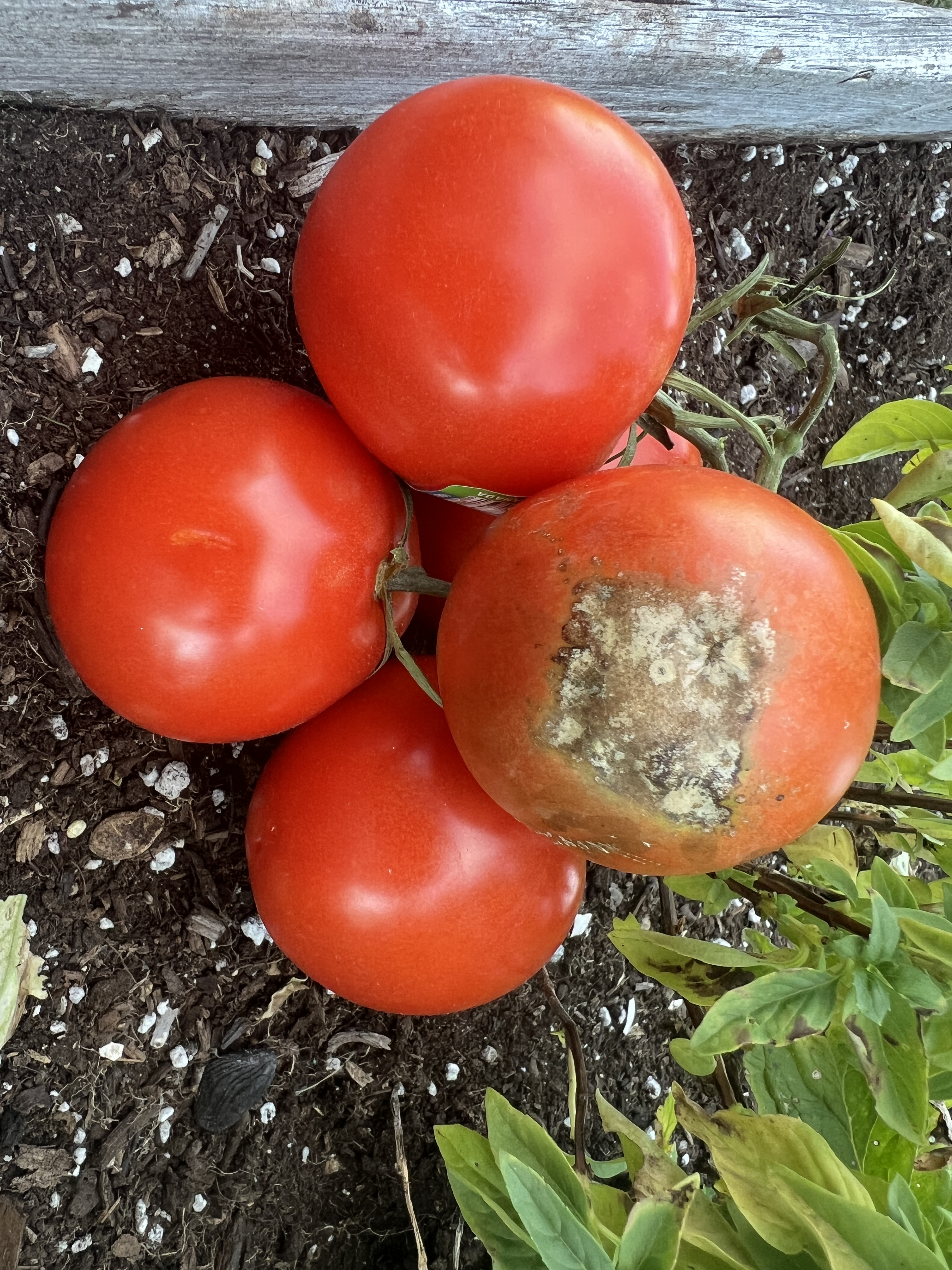
When my beef tomato plant yielded hundreds of blooms early in the summer my hopes soared. But as the blooms turned into tiny green golf-balls, then turned yellow and grew finally into the large, red ripened tomatoes, the vast majority of them had a problem.

Even in the premature, un-ripened stage all of them with very few exceptions showed signs of rot, starting from the bottom up. Many of these rotten tomatoes didn’t even have a bottom. It looked like someone had sliced off the bottom half which was flat and blackened.

At a critical stage early in the plant’s development, the tomato plant did not get what it needed. When I looked up this problem, the experts suggested this plant did not receive the requisite amount of calcium. The soil, in other words, did not provide this plant with the needed nutrients mediated by regular watering.

But it was not just about what was missing, but when. As soon as I noticed the first tiny green tomato with the rot back in July, and did my research, I started watering the plant, even soaking the ground, every evening. But it was too late. I’d missed that critical stage in its development. Early on in its growth, that is when the watering and soil treatment should have happened.

“Increase our faith!” The disciples asked Jesus to strengthen what they probably perceived to be their weak faith. They had just heard Jesus’ difficult teaching on the need to forgive others who have hurt them (Luke 17:1-4). They likely felt unable to do this and concluded that they didn’t have enough faith. They may even have gotten down on themselves. Not having enough faith translated into being a bad person.

Jesus responds with a parable to temper their expectations. To sum it up, I can hear Jesus ask them a rhetorical question: “Who do you think you are, God?”

As far as gardening goes, I felt like a failure.

A couple of things I need to remember regarding my disappointing tomato plant experience: First, we did get a few, really good, juicy-sweet tomatoes from it. It wasn’t a total loss.

Second, I might do well to recall my part in its growth. And this ties in with the act of blessing, which we have engaged in this morning. Because when we give a blessing, how are the blessing’s gifts realized? After all, the blessing’s benefits must be received in order for the blessing to be fulfilled. It’s not just the giving but the receiving as well.

The action of blessing our pets is a good exercise of faith for us today, because, of course, we have little way of verifying scientifically that our blessing confers anything of value on our pet. They can’t even say, “Thank you, I feel better already.” But we still do it, faithfully if imperfectly. And that is the important piece.

Is it not the same relating with human beings? In our stuffed-up pride, we may like to believe that our caring and our words and our blessing actions must have a positive effect on those whom we bless when we can see and verify it by their changed behaviour, or whatever. The value of our prayers, our service, our words become contingent on a verifiable result. And when we don’t have that result immediately, we may lose faith in ourselves and in God.

My gardening failure, taken as a metaphor to failing at all my righteous attempts to do good, doesn’t mean I’m weak in my faith or not praying hard enough. When you experience failure, it doesn’t mean your faith is deficient.

The paradox is that for anything great to happen, for any wondrous change to occur for the better, we first must accept ourselves as we are, with all our limits and weaknesses. Whenever we avoid, mask, pretend and think more and expect more from us than what is, we often run into trouble and bring about the opposite of what we seek.

After the first week of training and orientation at my practicum site last month, I felt I had a tentative and yet untested grip on all the policies, procedures and digital charting protocols. I was just beginning to understand how things operated in the office, receiving referrals from the doctors and using the proper charting process, never mind the actual practice of counselling clients.

There are, including me, four psychotherapists in our department. On one day in the second week, it so happened that the other three were not in the office. For the whole day, I was it, the only therapist on site.

I wondered, at first, why I had been left all by myself. There were still things I wasn’t sure about. But I managed through all the hiccups and logistics that challenged me that day. I figured out solutions, if only temporary. As the day wore on, I found more confidence in myself and found an unexpected pride in occupying that space and role for the day.

Later I reflected how important that experience was for me not to lean on the crutch of more experienced professionals at my beck and call to help me. I appreciated the faith my colleagues had in me to leave me alone in their office and on their computers. It was, in truth, an important part of my learning.

They had faith in me! God has faith in me, and God has faith in you!

The prayer to God, “Increase our faith” is learning to trust the faith that God already has in us especially when things are stressful, tense and not going our way – when we’re not on our game, when we are suffering, grieving, losing.

Let me repeat: Increasing our faith looks more like the practice of receiving and trusting in the faith of God in us, when we are not at our best.

This Gospel is about God validating the faith already in us, never mind how strong or weak it is. The real question is – Do we trust the incredible faithfulness God has in us? Do we trust God’s faithfulness in us,

enough faith to let us make our own mistakes,

enough faith to let us make our own decisions with the resources we already have,

enough faith to let us meet those tough days without giving up,

enough faith to let us use what we already have for good,

enough faith to meet our seemingly insurmountable challenges with courage,

enough faith to trust we are never out of the reach of God’s love, mercy, grace and forgiveness.

Our new national bishop of the Evangelical Lutheran Church in Canada (ELCIC), the Rev. Bishop Larry Kochendorfer, said recently: “We do not fully know the future, but we have what we need. We have bread and wine, we have the scriptures, we have each other … Jesus comes alongside. Love is at our side.”

The blessing we receive from God is God’s faith in us. The blessing is the gift of accepting that God believes in us because God loves us. And this is the blessing we give to others.

When we bless others, we have faith in them, in their abilities to meet their own challenges with the resources, and the God-given capacities they have, to grow and flourish.

“Increase our faith, Lord. Help us lean on the faith you have in your creation. Help us trust you have given us enough of what we need to live by your grace and love.”

Amen.

Heaven’s perspective

I surprised myself by how much more reading I’m getting done than I had expected. I suppose I underestimated how many audio books I would be listening to while driving up to Pembroke several times a week for my counselling practicum.

But this book I read the old-fashioned way – paper copy in hand (but not while driving, let me assure you!).

In his book entitled, “The Plover” (a plover is a shorebird), the late Brian Doyle authors a fictional tale about the seafaring travels of Declan and his crew aboard the boat called, you guessed it, the Plover.

One of his crew members is a seagull – yes, a seagull – who accompanies the Plover across the Pacific Ocean. Through storm and gale, calm and quiet, the gull is a faithful companion who, unbeknownst to the crew, tries to communicate to them. Sitting on the deck, or flying 9 feet above the stern, the gull makes remarks about their idiosyncrasies, dangers ahead, and islands that exist just beyond the horizon they cannot yet see (Doyle, 2014, pp. 188-190).

This communication from the seagull only the reader understands. However, Declan and his mates, for the most part, only hear what we normally hear from seagulls – a whole lot of squawking.

There is another character in the story who reflects a little bit of the gull’s perspective, a visionary or prophet you might say, who is not understood. He is referred to simply as the “minister” – a political one.

Before joining the crew, he was violently kicked out of his island home, for proposing an unacceptable vision for his Pacific nation. The minister was rejected because he described a reality he believed in, but for most people it seemed unrealistic. For one thing, he envisioned people actually getting along.

This political vision was largely a dream. It existed over the horizon of human experience. The minister’s vision was the way of non-violence, care and empathy. It was a way of the future just around the proverbial bend of human history. This minister spoke of making the impossible possible (Doyle, 2014, pp. 185-187). It was a vision in which people separated by culture, politics and religion could be caring and compassionate to one another.

In the Gospel reading today, we the reader observe the story of the rich man from the perspective of heaven (Luke 16:19-31). We see the big picture of his life, and his life after death.

The rich man’s life is marked by privilege and wealth. His life on earth was the gold standard. His life is what everyone aspired to, what everybody wanted.

Contrast that with his life after death. His life after death comes as a surprise to him, and perhaps to us as well. Why would someone as great and successful and privileged as the rich man end up in hell? This Gospel flies in the face of a belief which rewards the prosperous. It is a belief in which you must earn your worth, where the value of your personal worth is equal to how much money you have. I’m describing the world’s values.

The perspective of heaven, in contrast, announces that while the rich man may have reached the top of the ladder according to the world’s values, he had been, in the end, climbing the wrong ladder.

But the crux of this story is what lies in-between. Between these two realities that only the perspective of heaven can see lies a great chasm. In the story, Abraham tells the condemned man that this chasm “has been fixed, so that those who might want to pass from here to you cannot do so, and no one can cross from there” back (Luke 16:26). No one can breach this chasm, this divide. The realm of the afterlife, and the realm on earth are divided. And no crossing over is possible.

We can wrap us this sermon here and say that nothing is impossible with Christ. Christ makes all things possible, against all odds. By miraculous, supernatural means, even. To justify our claim, many of us Christians quote that famous verse from Paul’s letter to the Philippians: “I can do all things in Christ who strengthens me” (4:13). True.

But the promise of God does not refer to success in every personal endeavour. All things being possible is not a mission statement for doing the impossible according to what I want – my individual desires or longings, or even what the world values.

Rather, all things possible in Christ means all things are possible on earth according to the perspective of heaven, according to God’s vision, God’s future, God’s desire. All things are possible pursuing the righteousness of God, the mission of God.

This may be a great challenge for us.

We may not be in a position now to be able to believe that human beings can relate to one another with empathy, with compassion, with grace and love. You may not believe now that it is possible for people in your life to change for the better, for all wars to cease, for the lion to lie down with the lamb (Isaiah 11:6), for combatants to lay down the sword, for anger to be transformed into a desire for justice.

But maybe it doesn’t matter whether you can believe this claim right now. Maybe all that matters now is that the idea lies within you, that the word of grace resides in you like a seed waiting to sprout.

Why?

Because this bible story from Luke is not over, on different levels. First, we don’t know whether the rich man’s brothers changed for the better or not. That story is yet to be written.

Same with us. The story of your life is not over. The story of my life. There is a reason the rich man remains nameless in this story. Unlike the poor man Lazarus who is identified by name, the rich man does not have a name. Could the story-teller Luke be inserting his listeners and readers into this rich man character’s role? That rich man is us.

But don’t despair. As I said, it’s not over.

The story of Lazarus and the rich man is not over from the perspective of Christ’s resurrection. In the story, Abraham speaks “as if” someone rises from the dead (Luke 16:31). But someone later did! Jesus overcame the chasm separating this life from the next. Jesus overcame death and grave and opened to all people the way of everlasting life. The story is still being written!

This past summer I’ve also watched more movies than I usually do. In the film, “The Gorge” (Apple Original Films, 2025), Cold War soldiers have kept watch over a mysterious and deep canyon since the end of the Second World War. The bottom of this gorge is shrouded in mist.

Decades after decades highly trained soldiers took turns alone at the watch towers on either side, but no one ever spoke nor communicated in any way with their counterpart. The two soldiers whom we meet in this film, from opposites sides of an impossible divide, finally do cross over, literally and figuratively. And what finally breached the divide was love. It’s a love story.

In a pivotal scene the deadly creatures climbed up from the bottom of the gorge and began to attack one of the outposts at the top. The soldier from the other side fired a grappling hook, so he could zip-line across to help defend the other from their common foe. He was motivated by self-giving love which put him at great, personal risk.

Jesus’ resurrection means that eternity starts now. The bridge over the chasm separating this life from the next is already built. God’s love for us breaches this deep and wide chasm that separates us from God and from one another. We who journey in the way of Christ always have a chance to grow, to change, to be transformed into the likeness of Jesus. Because the God of love is a God of second chances.

Even though we may stumble from time to time doing the right thing, even though we, like the rich man, fail to see the need of Lazarus at our gate time and time again (Malina, 2016), we don’t stop trying. Because Jesus’ resurrection lives on in us.

The chasm can be breached, with Love as our guide. That is our hope.

References:

Derrickson, S. (Director). (2025). The gorge [Film]. Apple Original Films.

Doyle, B. (2014). The Plover. Picador.

Malina, M. (2016). Mirage gates [Blog]. WordPress. https://raspberryman.ca/2016/09/23/mirage-gates/

You have a place at the table

Online Services at Faith Lutheran Church, Ottawa (www.faithottawa.ca)

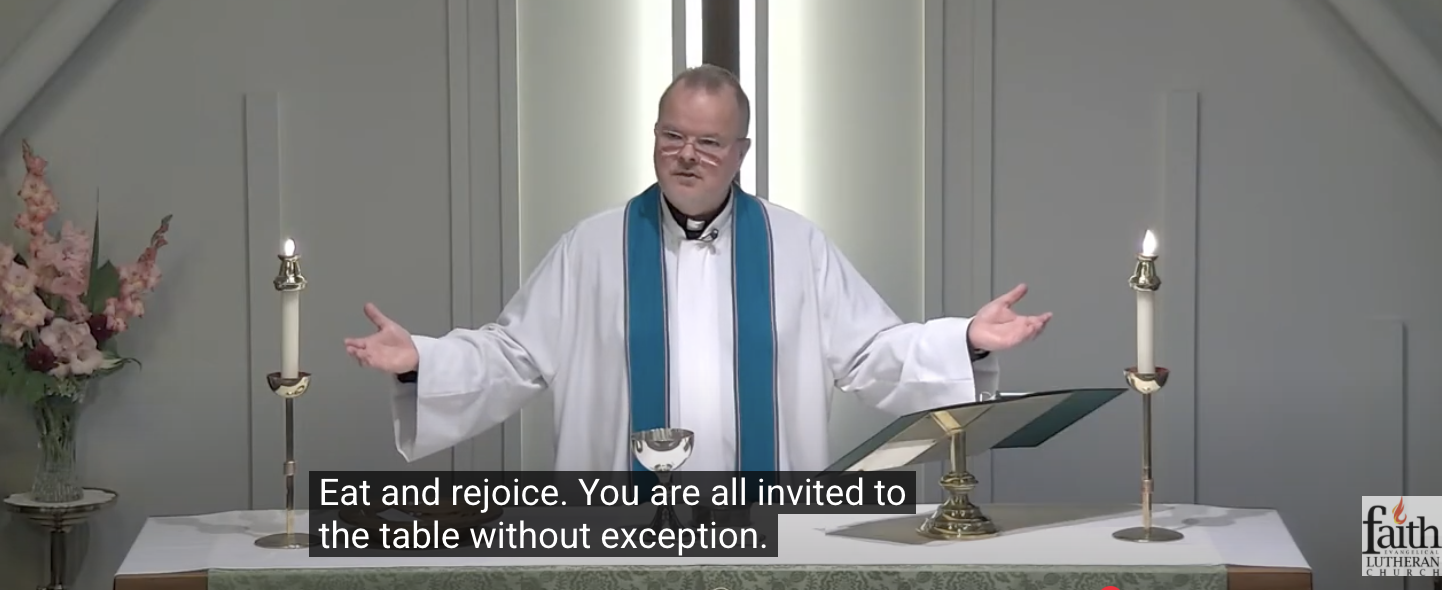
In my last sermon before the start of my practicum, I want to focus on and underscore the central action of the church to be welcoming and affirming of all people, without exception. I want to thank the congregational council for giving their blessing and support for the adventure on which we now embark over the next 8 months, which will see me take a significant step back from working in the church as I complete the practical part of my Master of Arts in Counselling Psychology program. I also want to thank the congregation, in advance, for giving Pastor Rosalie an ideal and excellent opportunity to practise her skills and development as a Lutheran pastor in the Canadian context. You are giving her this opportunity to exercise leadership as you pursue together God’s mission in this world, to invite all people to partake of God’s grace and love, without exception. Thanks be to God. ~ Pastor Martin

Do you have a place at the table? Do you feel there’s room for you around the table of the Lord? Is there a place for you, here, in the church?

On the last day of school at the end of June, every year like clockwork, we look forward to receiving an invitation to attend the annual Ida Street BBQ in Arnprior.

For years, neighbours at the end of our street host a gathering around food and drink. The street is barricaded off to vehicle traffic. And we are given the opportunity to meet each other, mix and mingle at the start of the summer holidays.

A diverse group of people from all walks of life, identities, backgrounds and life experiences gather around food.

In the Gospel of Luke, Jesus is especially preoccupied by eating (Saddler Jr., 2010). There are, in Luke, more references to eating, banquets, tables, and reclining at tables than in any of the other Gospels (Karris, 1985).

It is sitting or reclining around the table where Jesus teaches (22:24-30; 11:37-41) and encounters those who are marginalized (7:39). The table is the focal point in some of his parables (16:21; 14:15-24), as in today’s banquet feast parable (14:7-14).

That the table is the centre piece in Jesus’ teaching and fellowship should not escape our notice. There’s something important about eating together that sets the stage for healing and for restoring broken relationships. Jesus will not only meet us when we come together over food and fellowship but has something to teach us at the table of the Lord.

One of my earliest memories about church was Communion Sundays. I remember picking up on the holiness of the moment happening at the front.

But it wasn’t holy because of the kind of bread, or wafer offered or the wine. It was something about just the simple experience of going to the front with others. I would kneel or stand shoulder to shoulder on the same level as everyone else around the altar.

We were, all of us around the communion rail, in this holy action together in all our diversity. Part of God’s family.

And it wasn’t just an individual thing. There was no table of honour, for some. It wasn’t the privileged people who got to go first to receive communion, or anything like that. It was table after table of the mix of people who ever happened to be in line at the time our table was called.

That was the good memory. What I also remember that slightly annoyed me, quite frankly, were all the words. My Dad, the pastor, would read the longest Eucharistic prayer in the book! And while I appreciated the beautiful language and theological import of the words spoken before Communion, I grew astonishingly restless. “Just get on with it! Let’s go to the front!” was what my heart cried out.

Church is about doing, as much as it is about thinking and feeling.

My recent studies about what brings psychological healing made me appreciate what we do in faith, week after week, coming to the table of the Lord. What we do brings spiritual and psychological healing.

‘Talk therapy’ is popular these days. Many of the cognitive treatments rely on a whole of verbiage, to the extent that we’ve come to believe resolution only comes by coherently and accurately telling yourself and another what you think and what you feel. Religion isn’t the only place we encounter a whole lot of words. But words alone don’t save us.

We may be saved ‘by the Word’ – meaning the “Word became flesh” (John 1:14) in Jesus. But we are not saved by words alone – arguments, disputations, constitutions, belief statements. When Jesus says, “we are not saved by bread alone” (Matthew 4:4) he means we are not saved by material possessions or even spiritual materialism.

Dietrich Bonhoeffer was convinced himself, and wrote, that “the church is constituted not by religious formulae, by dogma, but by the practical doing of what is commanded [by Jesus]” (Barnhill, 2005, p. 253).

What brings healing is more than just books, talk therapy or words alone. Because, to Jesus, socially constructed, mentally devised distinctions that divide people do not define a person’s value, a person’s worth.

What defines a person’s value, dignity and worth is God’s invitation. God’s invitation, in Christ Jesus, to sit at the same table as everyone else. Gone are the ‘places of honour’. Gone is a ranking system, a pecking order, based on meritocracy and those who ‘deserve it’, reserved only and exclusively for those who have achieved ‘great things’. God’s invitation is not only for those who have it all, those who are perfect.

You don’t have to prove yourself worthy. Communion isn’t only for those whose lives are just right. You don’t receive Communion only when you are somehow rid of all your impurities and can show the best of yourself.

Because the truth of the Gospel, the good news in Christ Jesus, is that even if you lose everything (or I should say when you lose everything because eventually, we all will) – financial security, wealth, prestige, physical strength, your reputation, your social standing, those you love – when you lose it all, you still have a place at the table.

That’s why Holy Communion is offered to those in hospital beds and care homes, to the dying, to the poor, the marginalized, the suffering.

No matter what station of life, whether you are climbing the ladder and amassing your portfolio and finding the better jobs with higher income scales, you have a place at the table. In the prime of life in great health and are living the dream, you have a place at the table.

And, when things are failing, when you are descending the ladder, you have a place at the table. Even if you are staring into the abyss, unknowing and uncertain about a scary future. Even if your health is failing, resources are dwindling, and you are alone in your struggles. You have a place at the table.

There is always a place at the Lord’s table for you. God invites you, more than once a year. How about every time the church gathers to worship? You are all welcome, without exception!

References:

Barnhill, C. (Ed.). (2005). A year with Dietrich Bonhoeffer: Daily meditations from his letters, writings, and sermons. Harper One.

Karris, R. J. (1985). Luke: Artist and theologian: Luke’s passion account as literature. Paulist Press.

Saddler Jr., R. S. (2010). Luke 14:1, 7-14: Exegetical perspective. In D. L. Bartlett & B. B. Taylor (Eds.), Feasting on the word: Preaching the revised common lectionary, year c volume 4 (pp. 21-25). Westminster John Knox Press.

Wildfires and the journey of faith

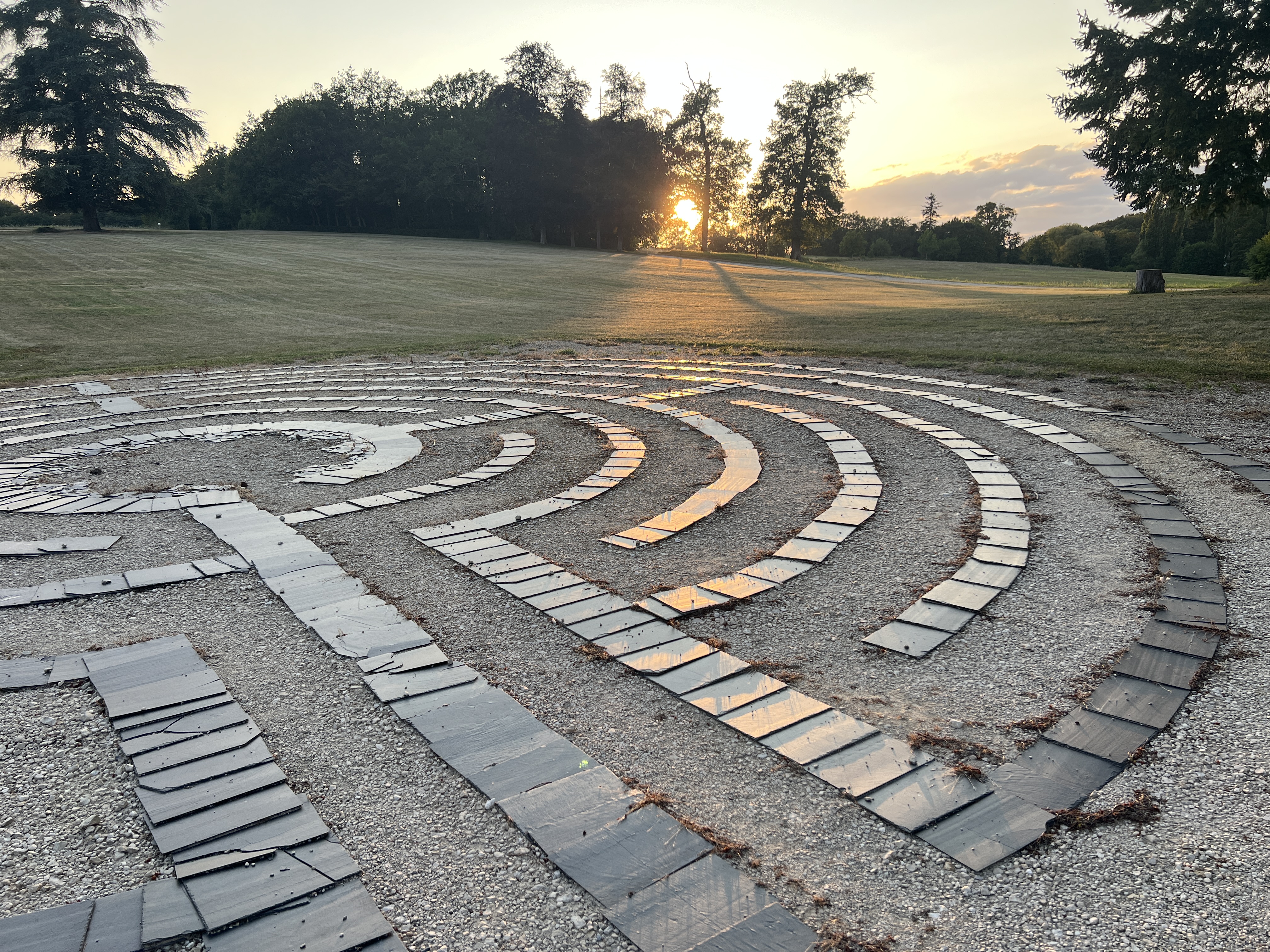
Labyrinth at Bonnevaux Centre for Peace (photo by Martin Malina, 21 July 2023, Marçay, France)

How could such a beginning
Ringed in water
Come to such an end
Fixed in fire?

(King, 2019)

When I recently read this poetic lament written by Canadian Indigenous historian and poet, Thomas King, I couldn’t help but immediately think about all the wildfires this summer.

Others are calling on us Canadians to get used to the “new reality” (Reed, 2025, August 11) regarding summertime wildfires. 2025 has been the second worst year for wildfires after the record-setting year in 2023.

The average number of hectares that burn over a 5-year period in Canada is around 4 million. This year alone, seven-and-a-half million hectares of land have burned due to wildfires, about 78% more than the 5-year average.

The warmer it gets the more fires we see. It is a stark manifestation of the climate crisis, with temperatures this past spring already two-and-a-half degrees Celsius above average. The hotter the climate the more the atmosphere sucks moisture out of the dead vegetation and the forest floor, creating ideal conditions for fires to start. The warmer temperatures increase the frequency of lightning that sparks the fires. Lightning is a leading cause of wildfires in remote regions of Canada’s north.

Indeed,

How could such a beginning
Ringed in water
Come to such an end
Fixed in fire?

(King, 2019)

How do you interpret this poem? Likely, we can go in many different directions with it. We could, like I initially did, take his poem literally and refer it to creation and the climate crisis.

We could also read it as a metaphor for faith, describing the journey of faith beginning in the waters of baptism and ending in the fiery passion of living in the Spirit?

Whichever way you go, poetic words are meant to call out from each of us – our own hearts and minds – a unique response. Scripture is meant that way, to elicit and evoke something from us.

Like last week’s Gospel, Jesus’ words in the opening verse of today’s reading from Luke leans into this approach: “I came to cast fire to the earth and how I wish it were already ablaze!” (Luke 12:49). Poetic. But is Jesus angry? Is he vengeful?

Recall, Jesus recently rebuked James and John for wanting retribution, wanting to bring down fire from heaven on unwelcoming Samaritans (Luke 9:54-55). Jesus means a different kind of fire. This is not the fire that incinerates. It’s not the fire of judgement raining down from heaven upon the heads of God’s (read, ‘our’) enemies. Let’s be careful about taking these poetic words literally.

Some bible scholars suggest Jesus is talking about the fire he takes upon himself. This is the “baptism by fire” (Lull, 2010, p. 361) that entails his own suffering, his own passion. God’s work on earth is Jesus’ own self-giving, his own sacrifice on the cross. “How I wish it were already ablaze,” Jesus says. How he wishes his purpose on earth was already accomplished. He was passionate.

So, where does that leave us? Jesus does not let his disciples, nor we, off the hook. In this season after Pentecost we continue to be reminded of the Holy Spirit’s work in our lives, in the church on earth. The fire the Spirit of God brings burns in the hearts and minds of followers of Jesus. “Were not our hearts burning within us?” confessed the disciples after seeing the resurrected Jesus (Luke 24:32). A spiritual awakening, a growth, a movement enflamed by the Spirit’s power continues to burn in the hearts of Jesus’ followers ever since.

So, if the fire in this Gospel refers to the passion of Jesus leading through the suffering of the cross and the empty tomb, the death and resurrection of Jesus introduce us to the paradox of faith. In other words, we cannot bypass the pain on the path to new life. Death before resurrection. Whatever good for which we pray, strive and seek only comes by way of hard, personal work. The good results from the struggle.

At the orientation meeting when I started the Master of Arts in Counselling Psychology over a year and a half ago, the Dean of the program told all of us newbies that, “to learn is to churn.” To churn, like hurricane Erin now does in the eastern Caribbean.

To learn is to churn. I didn’t want to believe him at first. But I can honestly now say that this learning journey, while rewarding and affirming in many ways, has also been a churning, so to speak.

Learning is something we say we are always doing. But the growth and positive change don’t come without the pain of loss. The ‘little deaths’, as Martin Luther liked to put it. This challenge can apply to everything from family relations to politics to community engagement and church work, from caring for ourselves and others to meeting our daily challenges. Solutions don’t come without some churning along the way.

To learn is to churn. On the one hand, churning is about movement. When we confront the ambiguity and nuance and complexity of life, we don’t just give up and stay stuck in this challenging awareness. Churning is about movement. We do something. Our behaviour changes.

At the same time, churning is about a movement that is not rushed nor hastily reactive. Churning turns things over, mixing it all, going deep. We don’t rush the turns of life. We spend time in, embrace, the change as hard as it is. Teilhard de Chardin said, “Above all, trust in the slow work of God” (DotMagis, 2025). Churning.

One highlight of the summer for me happened on the first day of summer, when members of three congregations in this community went for a walk from garden to garden to garden. We ended by walking the labyrinth on the floor in the parish hall at Julian of Norwich Anglican Church.

The labyrinth has a history in the Christian tradition. During the Middle Ages, when Christian pilgrimages to Jerusalem were disrupted by conflict, particularly during the Crusades, Christians developed labyrinths as a substitute for the physical journey to the Holy Land. 

These labyrinths, often called “Chemins de Jerusalem” (Paths of Jerusalem), provided a way for Christians to symbolically journey to Jerusalem through prayer and meditation, particularly on the Passion of Christ. The most famous of these labyrinths is in the Chartres Cathedral near Paris, France.

When I walked on the labyrinth at Julian of Norwich, praying and reflecting on the journey of life and faith, these words pierced my heart with renewed appreciation: “There is no wrong turn”. On the labyrinth, there is no wrong turn.

The labyrinth, after all, is not a maze. In a maze you may be tricked or mistaken in taking a wrong turn which leads to a dead end, right? But not so in a labyrinth. There is only the one path, leading to the centre. You just need to follow it.

And be mindful of the turns. Those turns take you around 360 degrees. If you are sprinting, you might overshoot and miss the turn. But by remaining faithful to the slow work, by staying on the path, that is all. You just need to take your time at each turn. On the labyrinth, there is no wrong turn. In a life of faith, there is no wrong turn.

These turns, changes of direction, in life, are not easy. But these turns provide the best learning opportunities in your life. And yes, to learn is to churn.

As I focus on my practicum over the next eight months, I will have an excellent opportunity to learn. It will also be an excellent opportunity for you, the congregation, to learn. To learn together in a new way.

Trust the path. On the way, there is no wrong turn. No decision you make is outside the purview of God’s grace, mercy and love. Because the path you are on, even with all the turns, takes you to the center of Jesus’ heart, into the fullness of Christ’s presence and love. This is the eternal journey that begins now, and in eternity never ends.

The promised glory at the end of the road requires us to take that road, and fully embrace ourselves on the path ahead, one step at a time.

Trust in the slow work of God. And be amazed.

References:

DotMagis (Ed.). (2025). Prayer of Teilhard de Chardin: Patient trust [Website]. Loyola Press. https://www.ignatianspirituality.com/prayer-of-theilhard-de-chardin/

King, T. (2019). 77 fragments of a familiar ruin: Poems. Harper Collins.

Lull, P. J. (2010). Luke 12:49-56: Pastoral perspective. In D. L. Bartlett & B. B. Taylor (Eds.), Feasting on the word: Preaching the revised common lectionary, year c volume 3 (pp. 359-362). Westminster John Knox Press.

Reed, B. (2025, August 11). Canada wildfire season already second worst on record as experts warn of ‘new reality’ [website]. The Guardian. https://www.theguardian.com/world/2025/aug/11/canada-wildfire-season

On the lookout

The Sentry (photo by Martin Malina)

In the Star Wars movies, occasionally we come across the sentry in the tower. You know, the guy wearing the long helmet standing in a narrow pod high up in the trees?

The sentries in Star Wars play a vital role in the Rebel Alliance’s defense strategy, acting as a first line of warning against the evil Imperial forces. They use hand-held scanners to check transponder codes and get eyes-on weapons status of incoming ships.

But I have a problem with that image.

With all the high tech involved in Star Wars, including hyper-speed travelling spaceships, light sabres and tractor beams, you’d think that the radar and other digital visual systems should be enough to identify incoming threats from afar. Why do you need someone standing atop the trees outside? It seems a bit odd, given the science fiction genre of the story. After all, wouldn’t it be too late if enemy fighters came zooming in from outer space at high speed when the sentry first identifies them?

The argument is that the sentry’s position is hard to spot nestled among the trees, presuming the location of the Rebel Alliance’s base remains a secret. Good point.

I realized I needed to go beyond what was an initial, critical reaction or response. I needed to engage in a dialogue with someone else, which I did on a discussion website.

There is also something odd I find in this Gospel text for today (Luke 12:32-40). The general theme of the parable is about what we value, and about being alert. The logic fails a bit in this last part. For me, the parable ends by floating a bit off the ground of reality, like one of those hovercrafts in Star Wars.

It’s like captain obvious. Everyone needs sleep. Therefore, it’s impossible to prevent theft. Obviously if the house owner knew when the thieves would arrive, he would stay up and wait for them. Is Jesus setting us up for failure? Surely he’s not saying we need to stop sleeping or never rest.

The friction in my mind made me move. I dug a little bit into the way Jesus taught. Maybe Jesus set up the story in this way in order to evoke a reaction, a response, so that the reader or listener participates in the meaning-making exercise?

We have to remember Jesus’ role as a teacher in his Jewish lineage. To understand Jesus as a teacher is to remember that even those with great authority teach within a long line of communal interpretation (Bass, 2021).

When Jesus preached, he didn’t give sermons from behind lecterns and pulpits. He engaged his listeners so that together, in their dialogue, they would create the message (Nabhan, 2021). He would evoke from the listener the relevant meaning for them.

So, if you are like me, maybe we have to start with our initial reactions or responses to the parable, then engage each other and God in prayer to uncover, discover and appreciate God’s message to us today. In this way we encounter a living text, reflecting that we are the living body of Christ today in this world.

So, with this understanding of our union in Christ, let’s start with the themes of being prepared, of staying alert, of paying attention; and, of where our treasure is, what are our values.

Let’s contrast the world’s values with the way of Christ – the kingdom of God. We live in that tension all the time.

Are “being on high alert” and being “asleep at the switch” our only alternatives? Like I said, I don’t know anyone in the history of humanity who never slept or rested. So, maybe it isn’t either/or. A better question to ask, then, is how we pay attention.

Imagine a dial whose needle leans one way or another.

So, what would being alert look like according to the ways of the world? Being on high alert may push the needle towards the ‘control and certainty’ side of the dial. Being on high alert means being fixated on something clearly and unequivocally defined. As the sentry in the tower does, we look for a specific threat and what that clearly, unquestionably looks like: An Imperial ship – the bad guys, or an X-wing – the good guys. We are on the lookout, especially for the bad guys.

Over time, we develop a way of looking – a perception – that imposes our deliberate will, and projects our unconscious fears, on whatever we encounter. We begin to believe that the world is a dangerous place, and we proceed to view anything we meet as threatening and dangerous.

In the end, perhaps the house owner is asleep at the switch when the thief arrives precisely because he has been looking for that thief for so long and so hard (Schlafer, 2010).

On the other hand, what does staying alert and awake look like according to the values of the kingdom of God? Rather than ‘certainty and control’, the needle leans towards the other side of the dial, towards ‘anticipation’. Our watchful waiting cultivates a kind of peripheral vision.

We’re not so much on the lookout for something specific. Leaning towards ‘anticipation’ means we develop a sixth sense, an awareness of what is good.

And so, we can sit loose with what we are naturally disposed or conditioned to see as the enemy. Because thieves come in all manner of shapes, sizes, forms and means. Saint Paul wrote, “the devil comes disguised as an angel of light” (2 Corinthians 11:14). On the other hand, the good will sometimes come to us not in ways we expect. In short, we cannot predict the future no matter how prepared we are.

This kind of vision translates into a different way of growing in faith. We may consider counter-intuitive ways of dealing with problems and challenges in our life. We curate a more creative approach. For example, in taking a break, we encounter a breakthrough. Fresh insight comes not when we are looking (for something specific), but rather when we are not looking (for something specific). Counter-intuitive.

I think it starts when we are honest with our sacred stories, the sacred scriptures. It starts when we pay attention to the reaction we have when we read something that doesn’t initially make sense. We honour that. But then we need to stick with it so we can go deeper and discover sources of wisdom we never expected. It’s best not to do this alone, but with one another.

Perhaps we too will be surprised by the answers God gives us when we can let go of our preconditioned responses, can loosen our grip of control, and can practice trust in the midst of the world’s uncertainty. Just because we live in uncertain times does not mean we are far from God’s graces.

We can notice the beauty in moments that would otherwise rush us by. We can see the good where in haste we would dismiss. Our developing sense of awareness notices the glimmers of love and goodwill from strangers, neighbours and everyone in between.

Perhaps this Gospel today reminds us that it’s ok to stop. It’s not just ok, it’s vitally important that we do take breaks, that we rest, that we slow down and loosen our grip on things. It can be scary to let go.

But on the other side is a newfound joy, purpose and a life that is worth living because God’s grace, love and mercy are bigger than anything we can ever ask for or imagine.

Let’s be the lookout. Because there is always something good to find out there.

References:

Bass, D. B. (2021). Freeing Jesus: Rediscovering Jesus as friend, teacher, savior, lord, way, and presence. HarperOne.

Nabhan, G. P. (2021). Jesus for farmers and fishers: Justice for all those marginalized by our food system. Broadleaf.

Schlafer, D. J. (2010). Luke 12:32-40 Homiletical perspective. In D. L. Bartlett & B. B. Taylor, Feasting on the word: Preaching the revised common lectionary, year c volume 3 (pp. 335-339). Westminster John Knox Press.

A fish story: Because we don’t know

photo by Martin Malina (July 21, 2025, Big Rideau Lake)

The picture here is a photo taken last month on the Big Rideau Lake. This carp weighed in about 45 pounds. Paul Francis has been fishing on that lake for the last 70 years and he says it’s the biggest fish that he’s ever seen come out of the Big Rideau.

Thanks to his 17-year-old nephew Jack who heroically pulled this injured fish out of the lake.

There is much about this fish’s story we don’t know. How was it injured? What happened? Assuming it got into the lock at the south end of the lake, from where did it come? We will never know its complete history, its story.

The fish symbol is a prominent symbol in Christianity with roots in the early church. The symbol comes from a Greek word (Ichthys) that translates to “fish,” but also functions as an acronym for “Jesus Christ, Son of God, Savior” in Greek (Ἰησοῦς Χριστός, Θεοῦ Υἱός, Σωτήρ). 

The symbol’s use is believed to have originated in the 2nd century, becoming popular by the late 2nd and 3rd centuries, especially during a time of Roman persecution of Christians.

Why the fish as a symbol for Jesus? Perhaps because he called fishermen to be his first disciples? Perhaps because he multiplied the loaves and fish in the feeding of the five thousand? Perhaps because in one post-resurrection account, Jesus fed fish to his disciples for breakfast on the beach?

The important thing here is to understand the symbol of the fish was associated with the name of Jesus.

When I read again Paul’s Epistle to the Colossians this past week, I found it odd that in the entire letter, the name of Jesus is mentioned seven times (1:1; 1:3; 1:4; 2:6; 3:17; 4:11; 4:12) but in five of those seven times the name Jesus is paired with “Christ”. Only twice in this Epistle does the name of Jesus stand alone.

Contrast this with the number of times the word “Christ” appears all by itself in Colossians: Some twenty-four times. What is Paul up to here? At very least, it may explain why a few centuries after Jesus died and rose again, our religion was known as “Christian”, not “Jesu-sian” (Shaia, 2021). Scripture calls our attention to distinguish between the meaning of Jesus, and the meaning of Christ. They’re not quite the same.

We read in the first chapter of the Gospel of John: “In the beginning was the Word, and the Word was with God, and the Word was God” (John 1:1). John speaks of a reality existing in a time before Jesus walked on the earth. John uses the term “Word”, “Logos” in Greek, to express the same eternal reality that Paul means when he intentionally uses just the word Christ, or the Christ.

But, that “Word” also “became flesh” (John 1:14). Martin Luther, the 16th century reformer understood “the Word” to be Jesus. So, the eternal reality is Christ. And, the particular, historical reality is Jesus. The same, but not the same.

Why do New Testament writers Paul and John make this distinction? Perhaps we who identify as Christian may be encouraged in our faith to not just focus on the biographical details of a brief human history in ancient Palestine that can never be completely known.

For example, there is nothing the Gospels mentioned about Jesus’ youth, from about age 12 until he appears near the beginning of his ministry at age 30. As one scholar puts it, “there will never be enough bones or papyrus or analytical wisdom” to fill those gaps in the history, and meet our needs today (Shaia, 2021, p. 209).

So, why did Jesus come? Two thousand years ago in the Middle East, Jesus came so that we, today, might enter into the greater truth of the Christ – the truth that encompasses the reality of all things in the universe for all time. Again, using Saint Paul’s language in the Epistle today: “Christ is all and in all!” (Colossians 3:11). For all time and in every place.

God, in Christ, is just as much in the daily, common, ordinary, material concerns of our lives as Christ is present in our praying, singing and humble service to the world. In Christ, there is no separation between Sunday, and Monday-through-Saturday. In Christ, there is no separation between sacred and secular. All of it matters. All of it belongs. All of our reality concerns God.

That is why we read stories in the Gospel about barns, possessions, money and wealth (e.g. Luke 12:13-21). How we are with our possessions has a lot to do with how we are with our faith in Christ.

The distinction Paul makes is really pastoral. The wisdom of our Christian forebears, the writers of scripture and the truth of the Word, is that Jesus the Christ is with us today. Christ is present and has something to say to us.

Christ is with us, in us, around us, connecting it all, now and forever. If this is the presence that we come to know today, then we don’t need to fear tomorrow.

And that is why we don’t live unto ourselves alone. That is why we can’t ignore the cries of the world. That is why as Christians, today’s problems in the world matter in a life of faith. It is a truth for today. It is the hope for tomorrow.

With this perspective, we can catch ourselves when we interpret scripture with our ego in the driver’s seat, which places us at the centre of it all, which makes eternity dependent on us and what we do or don’t do.

Which is nonsense, precisely because we don’t know everything. We are not God. We don’t have the whole and complete picture.

We need to read this passage from Colossians the same way we read German. In German, before reading a whole sentence written in the past tense, or containing a subordinate clause, you need to first go to the last word in the sentence or clause, which is usually the verb. Once you get that, then you can make sense of all the rest of the words that precede it. Where you start your thinking makes all the difference in how you interpret.

It’s the last verse in this scripture from Colossians that informs our interpretation of what comes before. Notice in verse 10 of Colossians 3 the passive construction of how we are renewed in Christ. So, it’s because we are renewed that we can do all the good things implied in this passage: We can tell the truth, we can engage others with calmness, gentleness, peace and respect.

It’s because “Christ is all and in all” (v. 11) that we are generous and live with moral integrity and in unity with others who are not like us. The gift of Christ in us and through the Holy Spirit generates compassionate behaviour and a loving orientation to life and community. It all matters. Everyone belongs. God’s love is for all.

And it starts with God’s gift of Christ present with us, in us. Out of this eternal reality and perspective flows a grace-filled way of life today.

Reference:

Shaia, J. A. (2021). Heart and mind: The four-gospel journey for radical transformation (3rd ed.). Quadratos.

Telling our story

National Bishop Susan Johnson (ELCIC) listens to words of gratitude for her 18 years of service as national bishop (July 12, 2025, Winnipeg, http://www.elcic.ca)

The Mary-and-Martha Gospel story (Luke 10:38-42) reminds me of what sometimes happens when family and/or friends gather around a table on a holiday or to celebrate some special occasion. Over the meal, each person has a different take on the subject matter at hand. Everyone has their own opinion.

After years of regularly encountering this Gospel in the lectionary, and preaching countless sermons on it, I have concluded that there are at least three characters sitting around our table today. These three characters represent my own evolution of understanding this Gospel story. They are the Literalist, the Rebel, and the Peacemaker.

The Literalist is the first to speak. The Literalist reads this Gospel and concludes that Mary is the person that we all should model: the one who is quiet and listens to Jesus and doesn’t worry at all about the practical aspects of hosting Jesus and his entourage. While the mundane activities need to be done, we are called instead to aspire to the true, higher, spiritual gifts.

The Rebel, as you might guess, jumps right in. The Rebel resists the Literalist’s interpretation and declares their objection. They see it in the opposite way. Martha is the true hero, and Jesus is unfair in admonishing her. After all, the practical aspects of hosting a party are vital in healthy relationships and community building, not to mention how dominant cultures have tended to diminish and marginalize women who traditionally did these more active, practical things.

Finally, the Peacemaker quietly interjects. The Peacemaker will argue that both roles, or postures, are important to balance in any community or within any individual. Jesus isn’t taking sides in this debate. Rather, he directs his comments to the way Martha goes about her task, “worried and distracted by many things” (Luke 10:41). Whether we are active all the time and busy in our service to God, or praying in silence and resting in stillness and holy presence, distraction is the real culprit.

If you were invited to this table, and you came, where would you sit? And with whom? The Literalist? The Rebel? The Peacemaker? Or … is there yet another voice that needs to be heard?

In the farewell tribute and celebration of outgoing national bishop Susan Johnson at the national convention of the ELCIC last week, a speaker and close friend of Susan’s, Willard Metzger from the Mennonite Church and current director of the Citizens for Public Justice (CPJ) talked about the strengths in Bishop Johnson’s ministry (www.elcic.ca).

He spoke about how Bishop Susan knows who she is. She is strong in her personal identity. In other words, she has an abiding love of self despite all the challenges she had faced, both personally and professionally, in her 18 years as bishop.

Willard went on to say that our love for God is affirmed when we love ourselves. Why? Because God created each of us. Each individual is created out of the love of God. It is fundamentally crucial as Christians to continually work at loving ourselves because God created you, made you, fashioned you in God’s image. We would then compassionately correct any messages we might tell ourselves, or the world might tell us, to the contrary.

Here’s another voice, another way of interpreting the Gospel. What shall we call this character? The Lover? It’s not about whether it’s better to be active and serving, attending to others and being hospitable in practical ways. Neither is it better to be contemplative, and reflective and sitting at Jesus’ feet. It’s not either/or.

It was that Mary knew who she was, was strong in her own identity, and loved herself enough to know that she just needed to do the one thing she was about and be who she was, at that point in time. The “better part” that she had chosen was that she chose to be herself without trying to be someone and do something she was not. She didn’t need to please someone else or fulfill their expectation of her. Jesus said it: Who she was and what she was about could not, “will not be taken away from her” (Luke 10:42).

This year, the national church has embarked on a restructuring process. During the convention the facilitators of the restructuring process engaged convention delegates, visitors and staff in an activity which I would like to practice here today, with you.

To begin with, the activity had us pair off. So before doing anything, turn to one person sitting beside or close to you and introduce yourself to them. It’s best to break the ice before diving in to do this exercise. If you are watching online with another person, you can do this with them at home.

The aim is to tell a story, together. I’ll start you off by saying, “Once upon a time ….” Then one of you will start telling your story by saying just one word. Then the other person will respond, but with just one word. And back and forth you go, taking turns but with just one word at a time.

Before you begin we need a general theme that will govern all our stories. So, what country or place in the world would you like to visit? …. What activity would you like to do there? ….

Ok, the story you will create together with your partner will be in this place and revolve around this activity. But remember, you say just one word when it’s your turn. I’ll give you a couple of minutes to do this, ok? Ready? “Once upon a time …” Go!

Time’s up! What was one challenge you may have encountered in the exercise? You may have had an idea about where the story should go. But then your partner would say a word that totally threw you off. They, obviously, can’t read your mind. And they might very well rather take the story in a different direction.

For the exercise to be productive, both partners need to get past themselves, listen carefully, and join together in telling a story that emerges from both, without preconception. You are co-creating in the moment. And hopefully having some fun along the way.

The exercise taught me that there is a difference between my story, and a story. There’s a difference between my story, and our story. And it’s not that my story is bad, or lacking, or not good enough. Refer to my earlier point about loving ourselves.

Each of us is beloved and has value and worth and beauty. You and I need to know who we are as individuals. We need to rejoice and celebrate in our particular, unique gifts that each person brings.

At the same time, we need to share and engage each other in relationship, and work together, respecting each other’s gifts. We co-create a new story, an emerging story. This can be exciting, and scary at the same time.

However your close relationships are organized, however community happens for you, despite and maybe because of our differences, the family still gathers around the table, as we will at the Holy Meal shortly. We reach out to make meaningful connections.

And perhaps this is the grace. Even though the people sitting around the proverbial table may be very different in their outlooks and interpretations and politics, we still gather and hear each other out. We practice being in community. And God continues to love each one of us, and the church.

Let us rejoice and give thanks in the story that God tells through us.

Thanks be to God!

The harvest is plentiful

photo from http://www.elcic.ca (July 2025)

I started by searching for coastal scenes, and ocean waves crashing on pristine beaches. Over time, as I would scroll through these short reels, the images became more extreme, and I saw larger waves sometimes amplified with AI – surfers riding thirty-foot giant whitecaps crashing off the coast of Portugal. Then, boats capsizing in North Atlantic storms. Then, tsunamis plowing through Asian sea-side villages. And, just the last day, it was a beach scene, to be sure. But the folks on the beach witnessed a volcano violently erupt not far from their Pacific Ocean-side setting.

What happened to the serene, coastal, picturesque scenes at sunset?

Unfortunately, a quirk of human behaviour is that on average we will stare at something negative and outrageous for a lot longer than we will stare at something positive and calm (Hari, 2022). We call it negativity bias.

Our attention is captivated more by the gruesome details of an airplane crash than someone handing out flowers on a street corner, even though flowers are better for you to look at than mangled bodies. Social media knows this and capitalizes on it, because the business plan is to get your attention on screen for as long as possible, which increases the chance you will buy something.

These social media algorithms capitalize on our negativity bias at best, radicalization at worst.

A major study found that for every word of moral outrage you add to your social media feed, your retweet/share rate will go up 20 percent. Specifically, the words that will increase your share rate most are “attack,” “bad” and “blame”. In YouTube, for example, words such as “hates”, “obliterates”, “slams”, “destroys” will get picked up more frequently. If you fill your Facebook posts with indignant disagreement, you’ll double your likes and shares. So, the social media algorithms will prioritize outraging you and angering you. “If it’s more enraging, it’s more engaging” (Hari, 2022, p. 131).

Should we be surprised, then, that when we read the bible, our negativity bias is already disproportionately stoked. What do we pick up first? What words or phrases do our eyes or ears dwell on? Which parts of scripture do we focus on?

He said to them, “The harvest is plentiful, but the laborers are few; therefore ask the Lord of the harvest to send out laborers into his harvest” (Luke 10:2).

I caught myself lingering on, “The labourers are few.” We often kneejerk into seeing the negative, don’t we? And then from that negativity bias we believe that there is something wrong with us. “I am not good enough when I’m not labouring in God’s harvest,” we self-talk. “What’s wrong with me?”

The problem, we conclude, are individual flaws whose only solution requires individual tweaks. We are individually broken, and the solution is bucking up and doing the right thing. Each of us have to do this, individually.

Of course, each one of us can indeed do our part and improve our self-control and discipline. But that alone isn’t going to solve the problem. It’s like trying to run up a downward-moving escalator.

Sure, there are always the exceptions, individuals who will heroically sprint to the top. But the vast majority of us will never make it, even though we may be giving it all we’ve got. There are larger forces at work, mostly against us.

Regarding our screen addiction, the problem about saying we need individually to be more disciplined is that there are a thousand engineers on the other side of your screen working against you.

Yes, we should take out our phones and turn off our notifications. Yes, we need to figure out our individual triggers and get help. But the human family is up against an environment designed to invade and raid our focus and which, to put it kindly, is negatively affecting our social and political culture.

“The answer is individuals making better choices” is the cruel optimism the dominant culture dishes out. Cruel, because, in the end, it doesn’t change anything. We are still getting more distracted, and our brains are being adversely affected despite all the effort we dedicate to individual self-improvement.

It’s easy to despair. It’s easy to shrug our shoulders and conclude that there is nothing we can do about it. And complain about how bad the world is getting, how everything is just falling apart. And give up. And continue doom scrolling.

“So let us not grow weary in doing what is right, for we will reap at harvest time, if we do not give up” (Galatians 6:9).

Let us persist in doing what is right. What does that look like? Doing the right thing?

“There’s the old metaphor that … villagers are at the river one day, and they notice a dead body come floating down the river. So they do the right thing. They take it out and they give it an appropriate burial. The next day two bodies come down the river and they do the appropriate thing and they bury the bodies. This goes on for a while, and finally they start to wonder – I wonder where these bodies are coming down the river [from], and if we should do something to stop that? So they go up the river to find out” (Hari, 2022, pp. 236-237).

The Gospel is not pouring pink on reality. It’s not pretending everything is fine when it is not. It’s not a cruel optimism the world dishes out, full of distraction and pretence. Nor is the Gospel about a doom and gloom, giving-up kind of despair for the world. Instead, the Gospel is about an authentic optimism.

That is where together, as a community, we build a solution that deals with underlying, systemic problems. That is where the church bands together to do the hard work, to go upriver.

In a few days, the ELCIC national convention will meet in Winnipeg. Among important tasks such as electing a new national bishop and vice chair, we will be celebrating the 50th anniversary of the ordination of women. We will commemorate some of the first women, such as Pamela McGee who was the first in 1976, to be ordained in the ELCIC (Riachi, 2025).

The mid-1970s witnessed a huge change in our church, and in society. Think about how it was for women in the 1960s, in contrast. In 1962, for example, there were no women in the British cabinet, the U.S. cabinet or the Swiss government at all (Hari, 2022). In Canada, the statistics are only slightly better. For example, Grace MacInnis was the only woman elected to Parliament in the 1968 general election. What changed?

The advances made happened not because individuals self-improved and overcame their personal, private hangups. The advances made happened because of an intentional, organized community doing the right thing for a better world.

The church took scripture seriously, such as Paul’s words to the Galatians we have heard in the last few weeks: “There is no longer male and female, for all of you are one in Christ Jesus” (Galatians 3:28). And “For the whole law is summed up in a single commandment, ‘You shall love your neighbour as yourself’” (Galatians 5:14).

While we may celebrate 50 years of ordaining women in the ELCIC this year, so much sexism and misogyny remain, women still face huge barriers, and many of the advances that have been made continue to be under threat today. The work must continue.

Making a wrong right happen by a people working together to advocate and put pressure on the powers that be. The advances are made by a people who refuse to capitulate to the despair that nothing can be done about it. They don’t “grow weary”, as Paul’s words to us today encourage.

Why?

Because the harvest is plentiful. Because grace abounds. Yes, the world is a complicated and dangerous place. Yes, we face challenges to our wellbeing and health, every day.

But there’s another story in town. God’s presence fills the earth with beauty, light, life and love. There’s no stopping the goodness of God for all people. God’s persistence, God’s perseverance, God’s faithfulness never ends for all people. God doesn’t ever give up on us. God grants us what we need when we need it. And God’s gifts overflow.

The harvest is plentiful! That’s the truth. Thanks be to God.

References:

Hari, J. (2022). Stolen focus: Why you can’t pay attention – and how to think deeply again. Random House.

Riachi, M. (2025, June). Rejoicing in hope: A preview to the ELCIC national convention. Canada Lutheran, 40(4), 10-14.