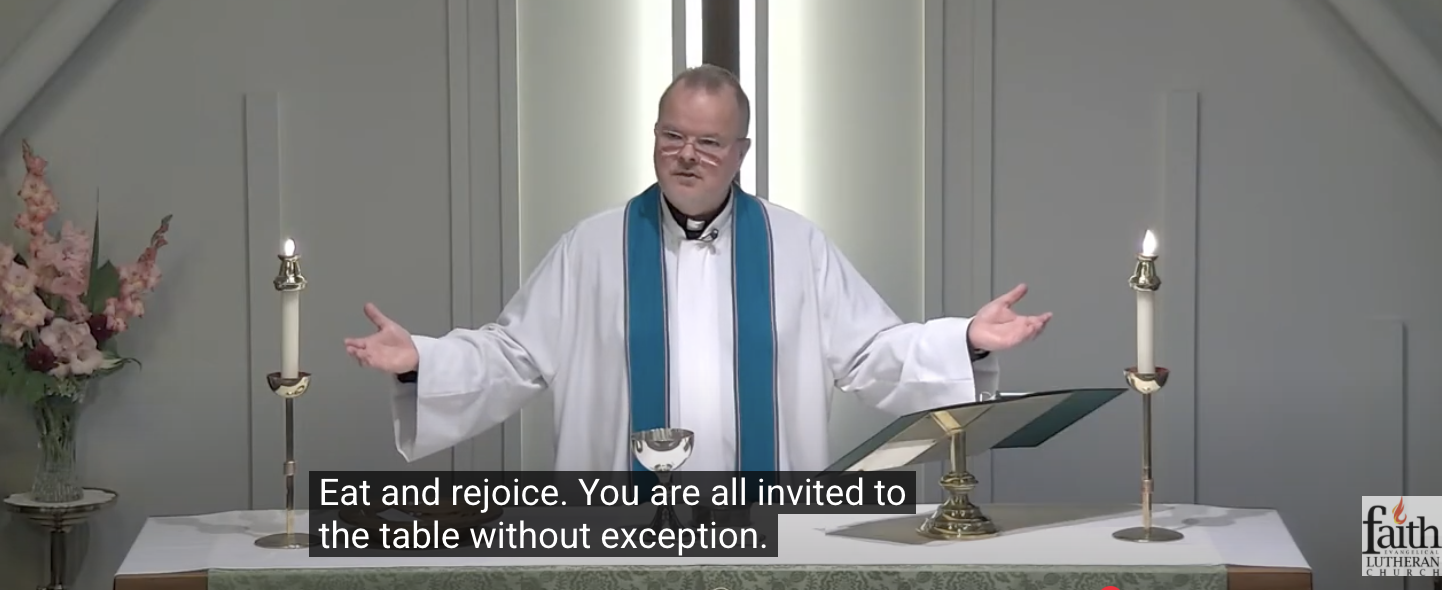
You have a place at the table

Online Services at Faith Lutheran Church, Ottawa (www.faithottawa.ca)

In my last sermon before the start of my practicum, I want to focus on and underscore the central action of the church to be welcoming and affirming of all people, without exception. I want to thank the congregational council for giving their blessing and support for the adventure on which we now embark over the next 8 months, which will see me take a significant step back from working in the church as I complete the practical part of my Master of Arts in Counselling Psychology program. I also want to thank the congregation, in advance, for giving Pastor Rosalie an ideal and excellent opportunity to practise her skills and development as a Lutheran pastor in the Canadian context. You are giving her this opportunity to exercise leadership as you pursue together God’s mission in this world, to invite all people to partake of God’s grace and love, without exception. Thanks be to God. ~ Pastor Martin

Do you have a place at the table? Do you feel there’s room for you around the table of the Lord? Is there a place for you, here, in the church?

On the last day of school at the end of June, every year like clockwork, we look forward to receiving an invitation to attend the annual Ida Street BBQ in Arnprior.

For years, neighbours at the end of our street host a gathering around food and drink. The street is barricaded off to vehicle traffic. And we are given the opportunity to meet each other, mix and mingle at the start of the summer holidays.

A diverse group of people from all walks of life, identities, backgrounds and life experiences gather around food.

In the Gospel of Luke, Jesus is especially preoccupied by eating (Saddler Jr., 2010). There are, in Luke, more references to eating, banquets, tables, and reclining at tables than in any of the other Gospels (Karris, 1985).

It is sitting or reclining around the table where Jesus teaches (22:24-30; 11:37-41) and encounters those who are marginalized (7:39). The table is the focal point in some of his parables (16:21; 14:15-24), as in today’s banquet feast parable (14:7-14).

That the table is the centre piece in Jesus’ teaching and fellowship should not escape our notice. There’s something important about eating together that sets the stage for healing and for restoring broken relationships. Jesus will not only meet us when we come together over food and fellowship but has something to teach us at the table of the Lord.

One of my earliest memories about church was Communion Sundays. I remember picking up on the holiness of the moment happening at the front.

But it wasn’t holy because of the kind of bread, or wafer offered or the wine. It was something about just the simple experience of going to the front with others. I would kneel or stand shoulder to shoulder on the same level as everyone else around the altar.

We were, all of us around the communion rail, in this holy action together in all our diversity. Part of God’s family.

And it wasn’t just an individual thing. There was no table of honour, for some. It wasn’t the privileged people who got to go first to receive communion, or anything like that. It was table after table of the mix of people who ever happened to be in line at the time our table was called.

That was the good memory. What I also remember that slightly annoyed me, quite frankly, were all the words. My Dad, the pastor, would read the longest Eucharistic prayer in the book! And while I appreciated the beautiful language and theological import of the words spoken before Communion, I grew astonishingly restless. “Just get on with it! Let’s go to the front!” was what my heart cried out.

Church is about doing, as much as it is about thinking and feeling.

My recent studies about what brings psychological healing made me appreciate what we do in faith, week after week, coming to the table of the Lord. What we do brings spiritual and psychological healing.

‘Talk therapy’ is popular these days. Many of the cognitive treatments rely on a whole of verbiage, to the extent that we’ve come to believe resolution only comes by coherently and accurately telling yourself and another what you think and what you feel. Religion isn’t the only place we encounter a whole lot of words. But words alone don’t save us.

We may be saved ‘by the Word’ – meaning the “Word became flesh” (John 1:14) in Jesus. But we are not saved by words alone – arguments, disputations, constitutions, belief statements. When Jesus says, “we are not saved by bread alone” (Matthew 4:4) he means we are not saved by material possessions or even spiritual materialism.

Dietrich Bonhoeffer was convinced himself, and wrote, that “the church is constituted not by religious formulae, by dogma, but by the practical doing of what is commanded [by Jesus]” (Barnhill, 2005, p. 253).

What brings healing is more than just books, talk therapy or words alone. Because, to Jesus, socially constructed, mentally devised distinctions that divide people do not define a person’s value, a person’s worth.

What defines a person’s value, dignity and worth is God’s invitation. God’s invitation, in Christ Jesus, to sit at the same table as everyone else. Gone are the ‘places of honour’. Gone is a ranking system, a pecking order, based on meritocracy and those who ‘deserve it’, reserved only and exclusively for those who have achieved ‘great things’. God’s invitation is not only for those who have it all, those who are perfect.

You don’t have to prove yourself worthy. Communion isn’t only for those whose lives are just right. You don’t receive Communion only when you are somehow rid of all your impurities and can show the best of yourself.

Because the truth of the Gospel, the good news in Christ Jesus, is that even if you lose everything (or I should say when you lose everything because eventually, we all will) – financial security, wealth, prestige, physical strength, your reputation, your social standing, those you love – when you lose it all, you still have a place at the table.

That’s why Holy Communion is offered to those in hospital beds and care homes, to the dying, to the poor, the marginalized, the suffering.

No matter what station of life, whether you are climbing the ladder and amassing your portfolio and finding the better jobs with higher income scales, you have a place at the table. In the prime of life in great health and are living the dream, you have a place at the table.

And, when things are failing, when you are descending the ladder, you have a place at the table. Even if you are staring into the abyss, unknowing and uncertain about a scary future. Even if your health is failing, resources are dwindling, and you are alone in your struggles. You have a place at the table.

There is always a place at the Lord’s table for you. God invites you, more than once a year. How about every time the church gathers to worship? You are all welcome, without exception!

References:

Barnhill, C. (Ed.). (2005). A year with Dietrich Bonhoeffer: Daily meditations from his letters, writings, and sermons. Harper One.

Karris, R. J. (1985). Luke: Artist and theologian: Luke’s passion account as literature. Paulist Press.

Saddler Jr., R. S. (2010). Luke 14:1, 7-14: Exegetical perspective. In D. L. Bartlett & B. B. Taylor (Eds.), Feasting on the word: Preaching the revised common lectionary, year c volume 4 (pp. 21-25). Westminster John Knox Press.

Wildfires and the journey of faith

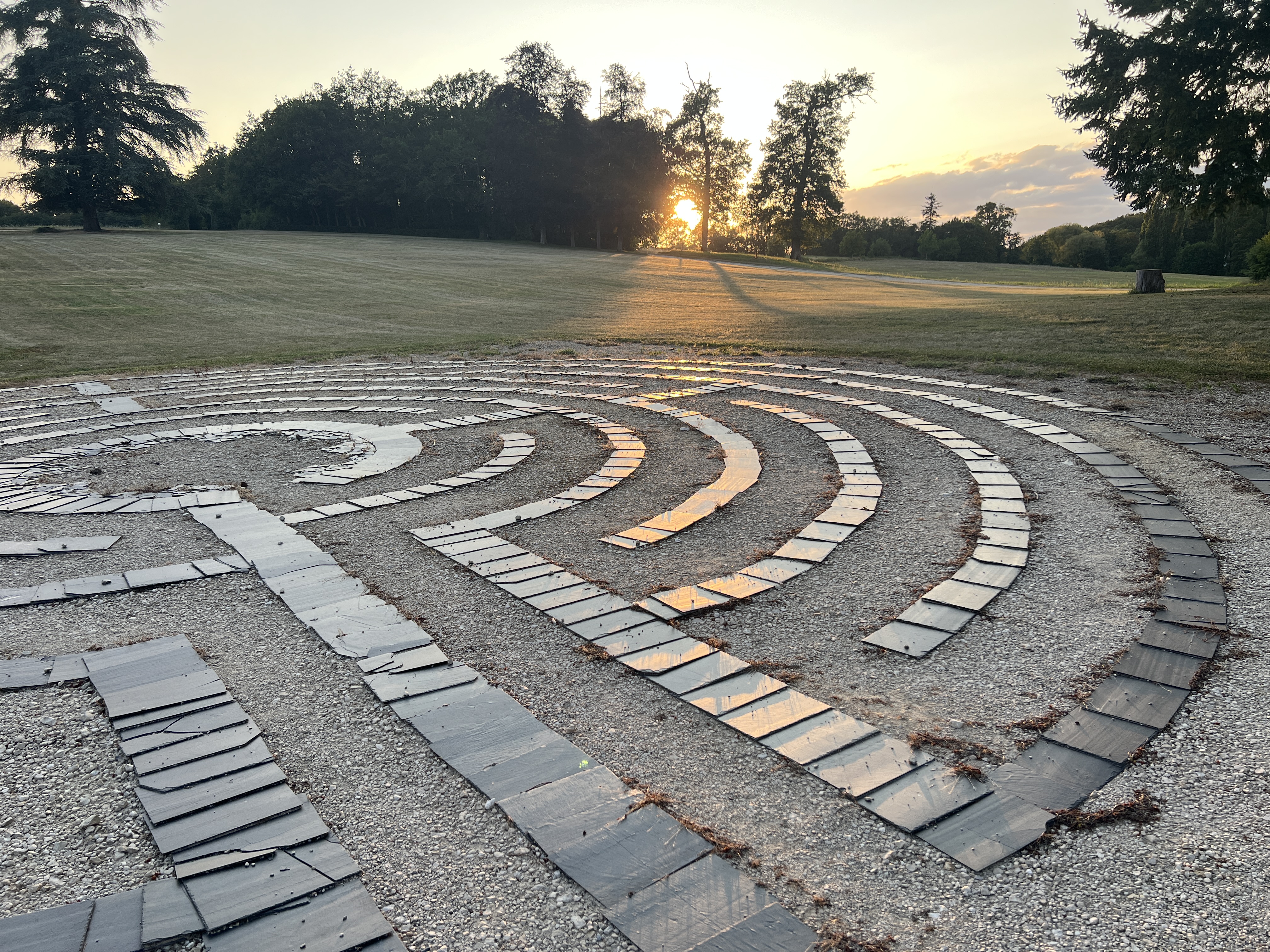
Labyrinth at Bonnevaux Centre for Peace (photo by Martin Malina, 21 July 2023, Marçay, France)

How could such a beginning
Ringed in water
Come to such an end
Fixed in fire?

(King, 2019)

When I recently read this poetic lament written by Canadian Indigenous historian and poet, Thomas King, I couldn’t help but immediately think about all the wildfires this summer.

Others are calling on us Canadians to get used to the “new reality” (Reed, 2025, August 11) regarding summertime wildfires. 2025 has been the second worst year for wildfires after the record-setting year in 2023.

The average number of hectares that burn over a 5-year period in Canada is around 4 million. This year alone, seven-and-a-half million hectares of land have burned due to wildfires, about 78% more than the 5-year average.

The warmer it gets the more fires we see. It is a stark manifestation of the climate crisis, with temperatures this past spring already two-and-a-half degrees Celsius above average. The hotter the climate the more the atmosphere sucks moisture out of the dead vegetation and the forest floor, creating ideal conditions for fires to start. The warmer temperatures increase the frequency of lightning that sparks the fires. Lightning is a leading cause of wildfires in remote regions of Canada’s north.

Indeed,

How could such a beginning
Ringed in water
Come to such an end
Fixed in fire?

(King, 2019)

How do you interpret this poem? Likely, we can go in many different directions with it. We could, like I initially did, take his poem literally and refer it to creation and the climate crisis.

We could also read it as a metaphor for faith, describing the journey of faith beginning in the waters of baptism and ending in the fiery passion of living in the Spirit?

Whichever way you go, poetic words are meant to call out from each of us – our own hearts and minds – a unique response. Scripture is meant that way, to elicit and evoke something from us.

Like last week’s Gospel, Jesus’ words in the opening verse of today’s reading from Luke leans into this approach: “I came to cast fire to the earth and how I wish it were already ablaze!” (Luke 12:49). Poetic. But is Jesus angry? Is he vengeful?

Recall, Jesus recently rebuked James and John for wanting retribution, wanting to bring down fire from heaven on unwelcoming Samaritans (Luke 9:54-55). Jesus means a different kind of fire. This is not the fire that incinerates. It’s not the fire of judgement raining down from heaven upon the heads of God’s (read, ‘our’) enemies. Let’s be careful about taking these poetic words literally.

Some bible scholars suggest Jesus is talking about the fire he takes upon himself. This is the “baptism by fire” (Lull, 2010, p. 361) that entails his own suffering, his own passion. God’s work on earth is Jesus’ own self-giving, his own sacrifice on the cross. “How I wish it were already ablaze,” Jesus says. How he wishes his purpose on earth was already accomplished. He was passionate.

So, where does that leave us? Jesus does not let his disciples, nor we, off the hook. In this season after Pentecost we continue to be reminded of the Holy Spirit’s work in our lives, in the church on earth. The fire the Spirit of God brings burns in the hearts and minds of followers of Jesus. “Were not our hearts burning within us?” confessed the disciples after seeing the resurrected Jesus (Luke 24:32). A spiritual awakening, a growth, a movement enflamed by the Spirit’s power continues to burn in the hearts of Jesus’ followers ever since.

So, if the fire in this Gospel refers to the passion of Jesus leading through the suffering of the cross and the empty tomb, the death and resurrection of Jesus introduce us to the paradox of faith. In other words, we cannot bypass the pain on the path to new life. Death before resurrection. Whatever good for which we pray, strive and seek only comes by way of hard, personal work. The good results from the struggle.

At the orientation meeting when I started the Master of Arts in Counselling Psychology over a year and a half ago, the Dean of the program told all of us newbies that, “to learn is to churn.” To churn, like hurricane Erin now does in the eastern Caribbean.

To learn is to churn. I didn’t want to believe him at first. But I can honestly now say that this learning journey, while rewarding and affirming in many ways, has also been a churning, so to speak.

Learning is something we say we are always doing. But the growth and positive change don’t come without the pain of loss. The ‘little deaths’, as Martin Luther liked to put it. This challenge can apply to everything from family relations to politics to community engagement and church work, from caring for ourselves and others to meeting our daily challenges. Solutions don’t come without some churning along the way.

To learn is to churn. On the one hand, churning is about movement. When we confront the ambiguity and nuance and complexity of life, we don’t just give up and stay stuck in this challenging awareness. Churning is about movement. We do something. Our behaviour changes.

At the same time, churning is about a movement that is not rushed nor hastily reactive. Churning turns things over, mixing it all, going deep. We don’t rush the turns of life. We spend time in, embrace, the change as hard as it is. Teilhard de Chardin said, “Above all, trust in the slow work of God” (DotMagis, 2025). Churning.

One highlight of the summer for me happened on the first day of summer, when members of three congregations in this community went for a walk from garden to garden to garden. We ended by walking the labyrinth on the floor in the parish hall at Julian of Norwich Anglican Church.

The labyrinth has a history in the Christian tradition. During the Middle Ages, when Christian pilgrimages to Jerusalem were disrupted by conflict, particularly during the Crusades, Christians developed labyrinths as a substitute for the physical journey to the Holy Land. 

These labyrinths, often called “Chemins de Jerusalem” (Paths of Jerusalem), provided a way for Christians to symbolically journey to Jerusalem through prayer and meditation, particularly on the Passion of Christ. The most famous of these labyrinths is in the Chartres Cathedral near Paris, France.

When I walked on the labyrinth at Julian of Norwich, praying and reflecting on the journey of life and faith, these words pierced my heart with renewed appreciation: “There is no wrong turn”. On the labyrinth, there is no wrong turn.

The labyrinth, after all, is not a maze. In a maze you may be tricked or mistaken in taking a wrong turn which leads to a dead end, right? But not so in a labyrinth. There is only the one path, leading to the centre. You just need to follow it.

And be mindful of the turns. Those turns take you around 360 degrees. If you are sprinting, you might overshoot and miss the turn. But by remaining faithful to the slow work, by staying on the path, that is all. You just need to take your time at each turn. On the labyrinth, there is no wrong turn. In a life of faith, there is no wrong turn.

These turns, changes of direction, in life, are not easy. But these turns provide the best learning opportunities in your life. And yes, to learn is to churn.

As I focus on my practicum over the next eight months, I will have an excellent opportunity to learn. It will also be an excellent opportunity for you, the congregation, to learn. To learn together in a new way.

Trust the path. On the way, there is no wrong turn. No decision you make is outside the purview of God’s grace, mercy and love. Because the path you are on, even with all the turns, takes you to the center of Jesus’ heart, into the fullness of Christ’s presence and love. This is the eternal journey that begins now, and in eternity never ends.

The promised glory at the end of the road requires us to take that road, and fully embrace ourselves on the path ahead, one step at a time.

Trust in the slow work of God. And be amazed.

References:

DotMagis (Ed.). (2025). Prayer of Teilhard de Chardin: Patient trust [Website]. Loyola Press. https://www.ignatianspirituality.com/prayer-of-theilhard-de-chardin/

King, T. (2019). 77 fragments of a familiar ruin: Poems. Harper Collins.

Lull, P. J. (2010). Luke 12:49-56: Pastoral perspective. In D. L. Bartlett & B. B. Taylor (Eds.), Feasting on the word: Preaching the revised common lectionary, year c volume 3 (pp. 359-362). Westminster John Knox Press.

Reed, B. (2025, August 11). Canada wildfire season already second worst on record as experts warn of ‘new reality’ [website]. The Guardian. https://www.theguardian.com/world/2025/aug/11/canada-wildfire-season

On the lookout

The Sentry (photo by Martin Malina)

In the Star Wars movies, occasionally we come across the sentry in the tower. You know, the guy wearing the long helmet standing in a narrow pod high up in the trees?

The sentries in Star Wars play a vital role in the Rebel Alliance’s defense strategy, acting as a first line of warning against the evil Imperial forces. They use hand-held scanners to check transponder codes and get eyes-on weapons status of incoming ships.

But I have a problem with that image.

With all the high tech involved in Star Wars, including hyper-speed travelling spaceships, light sabres and tractor beams, you’d think that the radar and other digital visual systems should be enough to identify incoming threats from afar. Why do you need someone standing atop the trees outside? It seems a bit odd, given the science fiction genre of the story. After all, wouldn’t it be too late if enemy fighters came zooming in from outer space at high speed when the sentry first identifies them?

The argument is that the sentry’s position is hard to spot nestled among the trees, presuming the location of the Rebel Alliance’s base remains a secret. Good point.

I realized I needed to go beyond what was an initial, critical reaction or response. I needed to engage in a dialogue with someone else, which I did on a discussion website.

There is also something odd I find in this Gospel text for today (Luke 12:32-40). The general theme of the parable is about what we value, and about being alert. The logic fails a bit in this last part. For me, the parable ends by floating a bit off the ground of reality, like one of those hovercrafts in Star Wars.

It’s like captain obvious. Everyone needs sleep. Therefore, it’s impossible to prevent theft. Obviously if the house owner knew when the thieves would arrive, he would stay up and wait for them. Is Jesus setting us up for failure? Surely he’s not saying we need to stop sleeping or never rest.

The friction in my mind made me move. I dug a little bit into the way Jesus taught. Maybe Jesus set up the story in this way in order to evoke a reaction, a response, so that the reader or listener participates in the meaning-making exercise?

We have to remember Jesus’ role as a teacher in his Jewish lineage. To understand Jesus as a teacher is to remember that even those with great authority teach within a long line of communal interpretation (Bass, 2021).

When Jesus preached, he didn’t give sermons from behind lecterns and pulpits. He engaged his listeners so that together, in their dialogue, they would create the message (Nabhan, 2021). He would evoke from the listener the relevant meaning for them.

So, if you are like me, maybe we have to start with our initial reactions or responses to the parable, then engage each other and God in prayer to uncover, discover and appreciate God’s message to us today. In this way we encounter a living text, reflecting that we are the living body of Christ today in this world.

So, with this understanding of our union in Christ, let’s start with the themes of being prepared, of staying alert, of paying attention; and, of where our treasure is, what are our values.

Let’s contrast the world’s values with the way of Christ – the kingdom of God. We live in that tension all the time.

Are “being on high alert” and being “asleep at the switch” our only alternatives? Like I said, I don’t know anyone in the history of humanity who never slept or rested. So, maybe it isn’t either/or. A better question to ask, then, is how we pay attention.

Imagine a dial whose needle leans one way or another.

So, what would being alert look like according to the ways of the world? Being on high alert may push the needle towards the ‘control and certainty’ side of the dial. Being on high alert means being fixated on something clearly and unequivocally defined. As the sentry in the tower does, we look for a specific threat and what that clearly, unquestionably looks like: An Imperial ship – the bad guys, or an X-wing – the good guys. We are on the lookout, especially for the bad guys.

Over time, we develop a way of looking – a perception – that imposes our deliberate will, and projects our unconscious fears, on whatever we encounter. We begin to believe that the world is a dangerous place, and we proceed to view anything we meet as threatening and dangerous.

In the end, perhaps the house owner is asleep at the switch when the thief arrives precisely because he has been looking for that thief for so long and so hard (Schlafer, 2010).

On the other hand, what does staying alert and awake look like according to the values of the kingdom of God? Rather than ‘certainty and control’, the needle leans towards the other side of the dial, towards ‘anticipation’. Our watchful waiting cultivates a kind of peripheral vision.

We’re not so much on the lookout for something specific. Leaning towards ‘anticipation’ means we develop a sixth sense, an awareness of what is good.

And so, we can sit loose with what we are naturally disposed or conditioned to see as the enemy. Because thieves come in all manner of shapes, sizes, forms and means. Saint Paul wrote, “the devil comes disguised as an angel of light” (2 Corinthians 11:14). On the other hand, the good will sometimes come to us not in ways we expect. In short, we cannot predict the future no matter how prepared we are.

This kind of vision translates into a different way of growing in faith. We may consider counter-intuitive ways of dealing with problems and challenges in our life. We curate a more creative approach. For example, in taking a break, we encounter a breakthrough. Fresh insight comes not when we are looking (for something specific), but rather when we are not looking (for something specific). Counter-intuitive.

I think it starts when we are honest with our sacred stories, the sacred scriptures. It starts when we pay attention to the reaction we have when we read something that doesn’t initially make sense. We honour that. But then we need to stick with it so we can go deeper and discover sources of wisdom we never expected. It’s best not to do this alone, but with one another.

Perhaps we too will be surprised by the answers God gives us when we can let go of our preconditioned responses, can loosen our grip of control, and can practice trust in the midst of the world’s uncertainty. Just because we live in uncertain times does not mean we are far from God’s graces.

We can notice the beauty in moments that would otherwise rush us by. We can see the good where in haste we would dismiss. Our developing sense of awareness notices the glimmers of love and goodwill from strangers, neighbours and everyone in between.

Perhaps this Gospel today reminds us that it’s ok to stop. It’s not just ok, it’s vitally important that we do take breaks, that we rest, that we slow down and loosen our grip on things. It can be scary to let go.

But on the other side is a newfound joy, purpose and a life that is worth living because God’s grace, love and mercy are bigger than anything we can ever ask for or imagine.

Let’s be the lookout. Because there is always something good to find out there.

References:

Bass, D. B. (2021). Freeing Jesus: Rediscovering Jesus as friend, teacher, savior, lord, way, and presence. HarperOne.

Nabhan, G. P. (2021). Jesus for farmers and fishers: Justice for all those marginalized by our food system. Broadleaf.

Schlafer, D. J. (2010). Luke 12:32-40 Homiletical perspective. In D. L. Bartlett & B. B. Taylor, Feasting on the word: Preaching the revised common lectionary, year c volume 3 (pp. 335-339). Westminster John Knox Press.

A fish story: Because we don’t know

photo by Martin Malina (July 21, 2025, Big Rideau Lake)

The picture here is a photo taken last month on the Big Rideau Lake. This carp weighed in about 45 pounds. Paul Francis has been fishing on that lake for the last 70 years and he says it’s the biggest fish that he’s ever seen come out of the Big Rideau.

Thanks to his 17-year-old nephew Jack who heroically pulled this injured fish out of the lake.

There is much about this fish’s story we don’t know. How was it injured? What happened? Assuming it got into the lock at the south end of the lake, from where did it come? We will never know its complete history, its story.

The fish symbol is a prominent symbol in Christianity with roots in the early church. The symbol comes from a Greek word (Ichthys) that translates to “fish,” but also functions as an acronym for “Jesus Christ, Son of God, Savior” in Greek (Ἰησοῦς Χριστός, Θεοῦ Υἱός, Σωτήρ). 

The symbol’s use is believed to have originated in the 2nd century, becoming popular by the late 2nd and 3rd centuries, especially during a time of Roman persecution of Christians.

Why the fish as a symbol for Jesus? Perhaps because he called fishermen to be his first disciples? Perhaps because he multiplied the loaves and fish in the feeding of the five thousand? Perhaps because in one post-resurrection account, Jesus fed fish to his disciples for breakfast on the beach?

The important thing here is to understand the symbol of the fish was associated with the name of Jesus.

When I read again Paul’s Epistle to the Colossians this past week, I found it odd that in the entire letter, the name of Jesus is mentioned seven times (1:1; 1:3; 1:4; 2:6; 3:17; 4:11; 4:12) but in five of those seven times the name Jesus is paired with “Christ”. Only twice in this Epistle does the name of Jesus stand alone.

Contrast this with the number of times the word “Christ” appears all by itself in Colossians: Some twenty-four times. What is Paul up to here? At very least, it may explain why a few centuries after Jesus died and rose again, our religion was known as “Christian”, not “Jesu-sian” (Shaia, 2021). Scripture calls our attention to distinguish between the meaning of Jesus, and the meaning of Christ. They’re not quite the same.

We read in the first chapter of the Gospel of John: “In the beginning was the Word, and the Word was with God, and the Word was God” (John 1:1). John speaks of a reality existing in a time before Jesus walked on the earth. John uses the term “Word”, “Logos” in Greek, to express the same eternal reality that Paul means when he intentionally uses just the word Christ, or the Christ.

But, that “Word” also “became flesh” (John 1:14). Martin Luther, the 16th century reformer understood “the Word” to be Jesus. So, the eternal reality is Christ. And, the particular, historical reality is Jesus. The same, but not the same.

Why do New Testament writers Paul and John make this distinction? Perhaps we who identify as Christian may be encouraged in our faith to not just focus on the biographical details of a brief human history in ancient Palestine that can never be completely known.

For example, there is nothing the Gospels mentioned about Jesus’ youth, from about age 12 until he appears near the beginning of his ministry at age 30. As one scholar puts it, “there will never be enough bones or papyrus or analytical wisdom” to fill those gaps in the history, and meet our needs today (Shaia, 2021, p. 209).

So, why did Jesus come? Two thousand years ago in the Middle East, Jesus came so that we, today, might enter into the greater truth of the Christ – the truth that encompasses the reality of all things in the universe for all time. Again, using Saint Paul’s language in the Epistle today: “Christ is all and in all!” (Colossians 3:11). For all time and in every place.

God, in Christ, is just as much in the daily, common, ordinary, material concerns of our lives as Christ is present in our praying, singing and humble service to the world. In Christ, there is no separation between Sunday, and Monday-through-Saturday. In Christ, there is no separation between sacred and secular. All of it matters. All of it belongs. All of our reality concerns God.

That is why we read stories in the Gospel about barns, possessions, money and wealth (e.g. Luke 12:13-21). How we are with our possessions has a lot to do with how we are with our faith in Christ.

The distinction Paul makes is really pastoral. The wisdom of our Christian forebears, the writers of scripture and the truth of the Word, is that Jesus the Christ is with us today. Christ is present and has something to say to us.

Christ is with us, in us, around us, connecting it all, now and forever. If this is the presence that we come to know today, then we don’t need to fear tomorrow.

And that is why we don’t live unto ourselves alone. That is why we can’t ignore the cries of the world. That is why as Christians, today’s problems in the world matter in a life of faith. It is a truth for today. It is the hope for tomorrow.

With this perspective, we can catch ourselves when we interpret scripture with our ego in the driver’s seat, which places us at the centre of it all, which makes eternity dependent on us and what we do or don’t do.

Which is nonsense, precisely because we don’t know everything. We are not God. We don’t have the whole and complete picture.

We need to read this passage from Colossians the same way we read German. In German, before reading a whole sentence written in the past tense, or containing a subordinate clause, you need to first go to the last word in the sentence or clause, which is usually the verb. Once you get that, then you can make sense of all the rest of the words that precede it. Where you start your thinking makes all the difference in how you interpret.

It’s the last verse in this scripture from Colossians that informs our interpretation of what comes before. Notice in verse 10 of Colossians 3 the passive construction of how we are renewed in Christ. So, it’s because we are renewed that we can do all the good things implied in this passage: We can tell the truth, we can engage others with calmness, gentleness, peace and respect.

It’s because “Christ is all and in all” (v. 11) that we are generous and live with moral integrity and in unity with others who are not like us. The gift of Christ in us and through the Holy Spirit generates compassionate behaviour and a loving orientation to life and community. It all matters. Everyone belongs. God’s love is for all.

And it starts with God’s gift of Christ present with us, in us. Out of this eternal reality and perspective flows a grace-filled way of life today.

Reference:

Shaia, J. A. (2021). Heart and mind: The four-gospel journey for radical transformation (3rd ed.). Quadratos.