
Can you catch it?

When I was younger I enjoyed playing catch using a softball or baseball. My catch partner and I would stand at a distance from each other, and we would toss, whip, lob, sidearm, underhand, windmill or basically throw the ball in various combinations of the above.

That simple, and for me rather therapeutic, repetitive motion – back-and-forth—impressed upon me the truth that whether the ball is successfully caught doesn’t just depend on the catcher. Whether the ball is successfully caught depends to a large degree how accurately the ball is thrown. Assuming you want your ball partner to catch the ball!

You need to throw the ball in such a way to match the catcher’s ability, attention in the moment, stance and glove position. The one throwing the ball needs to pay attention to and know the catcher. Throwing and catching the ball is a relationship in which both parties have to do their part for the exercise to work.

Which then reminds me of a popular saying in the church I have heard over the years: That faith is not taught as much as it is caught. The ball of faith, if it is to be successfully passed on, needs to be thrown in a way that the catcher can catch it. Because every individual is unique and has different abilities, personality, and capacity, the gift of faith—if it is to stick and not be dropped—needs to come at them in a way they can handle it.

No one size fits all. The ball of faith has wings to fly in a manner in which each of us can perceive it, appreciate it, and let it enter into our life. On our part, to throw the ball of faith, we need to reach people through their point of view, not our own. In other words, we need a relationship with them to seek to understand their tendency, their perspective, and then speak their language (Rubin, 2017).

One of the most significant scientific facts in existence is something we cannot directly see, touch, taste, or even smell. But we can feel it on our skin. Planet Earth is wrapped in 5,600 million million tons of air, and most of the time most of the air is moving (Mahany, 2023, p. 93). While wind is elusive, hard to define, one thing it is for sure: Wind is impossible to ignore.

photo by Martin Malina (Long Beach WA, July 21, 2017)

The winds have been particularly noticeable of late. They have been strong enough to send us the smoke caused by wildfires in Western Canada. Over the past few years, we have witnessed the effects of powerful windstorms here in Ottawa – toppling ancient trees, downing lines, throwing damaging debris.

A couple of weeks ago, a Chinese paraglider was caught in a powerful updraft sending him some nine kilometres straight upward until he was piercing the edge of the atmosphere with air temperatures near -40 degrees Celsius. Most para-gliders caught in this unfortunate circumstance don’t survive. Miraculously, he did (TWN, 2025).

Indeed, wind is elusive, dangerous. We cannot contain it, control it, nor even predict its behaviour. No wonder for people of faith the world over and since the beginning of time have made the wind, air, breath synonymous with the divine (Mahany, 2023).

There is movement in the scriptures assigned for this season after the resurrection of Jesus leading into this Pentecost Sunday. There is movement with the Spirit. The Spirit descends on the disciples gathering in Jerusalem with “the sound like the rush of a violent wind” (Acts 2:1-21). Elsewhere in the bible, Jesus breathes the Spirit into the disciples (John 20:22). God’s breath moves over creation (Genesis 1:2). “Even the winds and waves obey” the the disciples notice after Jesus stills the storm on Lake Galilee (Matthew 8:27).

The question of faith confronting the disciples after Easter was, what happens now when Jesus, the founder of the community, is no longer around? Is the community left on its own, with no access to Jesus’ presence or transformative power (Bay, 2010)? Has the wind, the breath of God, stopped blowing?

Has Jesus dropped the ball? Have the disciples? The disciples, essentially, are anticipating their grief at losing access – physical access – to their loved one in Jesus. And they don’t know what to do without him.

The question of faith is how to live amidst the perceived absence. Pentecost answers the question of grief. Because one important aspect of healing is that we are no longer defined by our losses. While the pain of grief stays with us our whole life long, who we are now is not defined by what happened then. Not because we’ve forgotten. Healing is not forgetting.

But we are now defined by what the connection to our lost loved one means to us today, now. They live in us. They live in some way in the world today. Who we are and who they are, are no longer defined by what caused our painful grieving in the first place. Instead, we are defined today by those around us who hold us, accept us, and give us encouragement on the way.

“Show us the Father,” demands Philip (John 14:8). Jesus rebukes Philip. Philip wants to see, touch, taste, control, contain, put a lock on his apprehension of faith. No, no, Jesus says to Philip and to you and to me. You know God already. You don’t need to put God in a box in order to believe. God is already with you, in you. “You know [God],” Jesus responds, “because God abides with you, and God will be in you” (John 14:17).

God is already with you, in you. The life of Jesus, through the coming Spirit of God, lives in you, through you, around you! So, act like it!

We take a breath some 20-30 thousand times a day. Yet, are we aware when we even just take one? If you do anything on this Pentecost Sunday that is spiritual and life giving, just breathe with awareness that you do. Breathe in God’s love, God’s presence. Breathe out – return the gift of God’s life and love into the world by your loving actions for your neighbour.

Jesus throws the ball of faith towards us. And it’s not that we have to catch it one way. We don’t need to be afraid of dropping it. When we are aware of the presence of Jesus, when we face him and lift our hands to catch the ball, Jesus throws it at us in a way we can receive it. Because Jesus knows us. Jesus is in a relationship of love with us. God created us. And the Spirit lifts the ball and carries it into our hearts so that we can catch it.

Thanks be to God.

References:

Bay, E. C. (2010). Pastoral perspective: John 14:8-27. In D. L. Bartlett & B. B. Taylor (Eds.). Feasting on the Word: Preaching the Revised Common Lectionary Year C, Volume 3 (pp. 20-24). Westminster John Knox Press.

Mahany, B. (2023). The book of nature: The astonishing beauty of God’s first sacred text. Broadleaf Books.

Rubin, G. (2017). The four tendencies: The indispensable personality profiles that reveal how to make your life better (and other people’s lives better, too). Harmony Books.

The Weather Network (2025). Paraglider sucked nearly 9 km up into the frigid atmosphere [Video]. Newsflare/Reuters. https://www.theweathernetwork.com/en/video/Ke6uK9sn?playlist=JRE9lq9q

There’s a hole, PART 2: For a purpose

I am a hole in a flute / that the Christ’s breath moves through – / listen to this /music.            -Hafiz

If you comprehend it, it is not God. -St. Augustine

Unlike the pounding of the surf a stone’s toss away, the ponding on the nearby creek made the surface of its water look pristine. A narrow creek made its lazy, winding way down the escarpment from Highway 21 and aimed to run into Lake Huron after finally crossing the stretch of sand on the beach at Point Clarke.

One of our favourite pastimes on those lazy summer days was to play around the area where the creek and lake met. As children, my brother and I would build castles, dig trenches and re-direct the flow of the creek’s water.

For a real challenge, we would try to dam up the creek’s flow, which took some planning, and extra material like drift wood and larger stones to block any outflow attempts. Once we contained it, the creek turned slowly into a large pond, comfortably remaining – for the time being – behind its fortress sand walls.

I’ve already talked about how in God’s creation, it is meant to be that each of us has a hole in our heart (see “There’s a hole, PART 1: Meant to be”). Moreover, it is God’s good intention that this hole is there for a purpose.

Paul writes in his second letter to the Corinthian church a confession that in all his accomplishments for the expansion of the Gospel across the Mediterranean, he was given a thorn in his side.[1]The proverbial ‘hole’. It is not important, although many have tried, to figure out what this thorn actually was.

We don’t know. Maybe that’s the point. It’s not important that we know, only that this thorn was given him in order to keep him humble. The text says that the thorn was given Paul to keep him from being ‘elated’ – to keep his ego in check, perhaps because he tended toward being too full of himself, over confident in his own ability.

How does the ego get the better of yourself? What is your compulsion? What drives you to achieve some illusion of perfection in your life? So, you don’t need to trust what is beyond your life, what is ineffable, what cannot be fully understood that is the Great Mystery (a.k.a. God)?

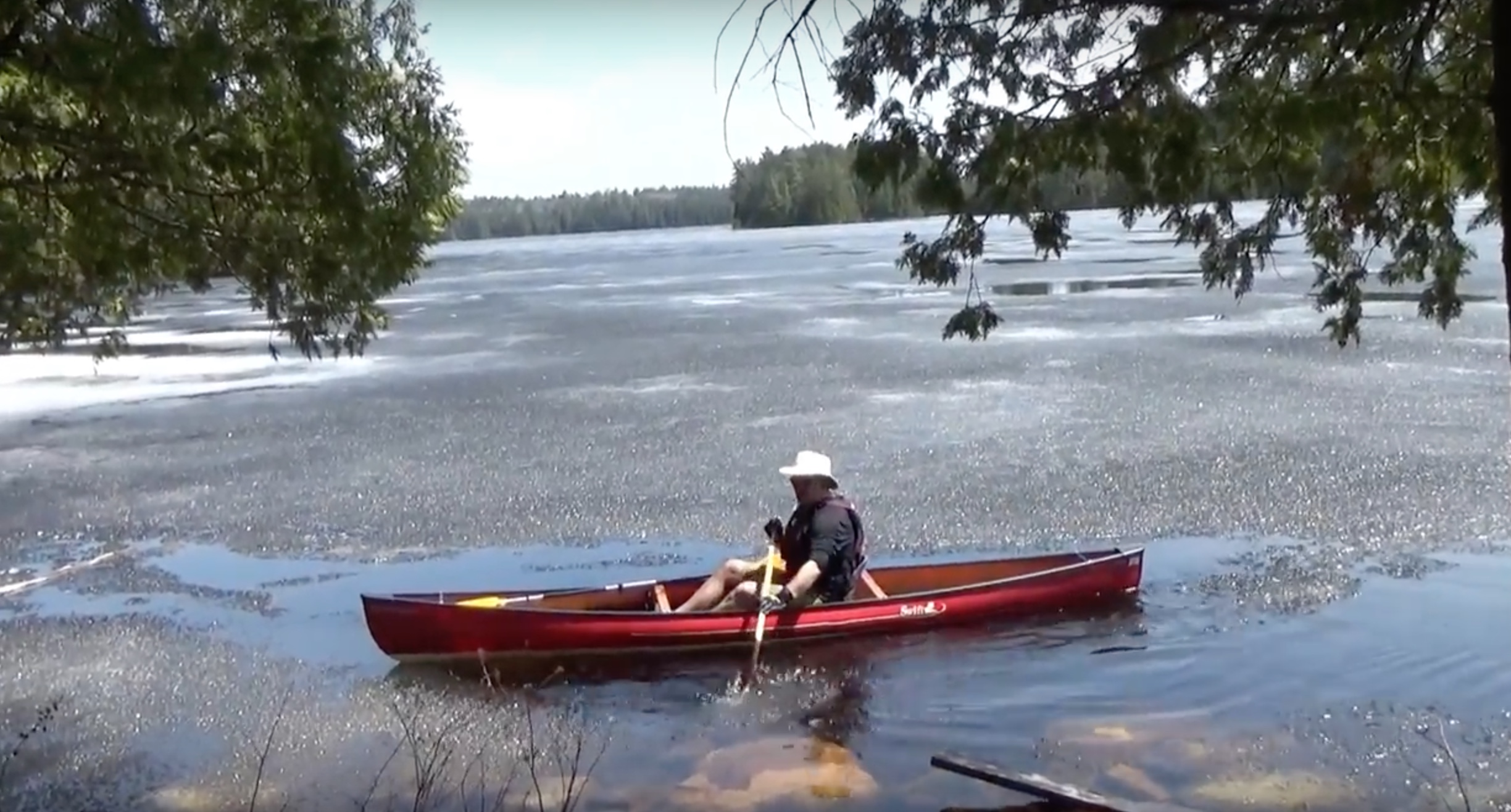
Let me show you an example of compulsion to achieve that which is beyond our capacity: On my fishing trip with colleagues last May to Algonquin Park, we tried everything to beat the ice on the lake. Despite the predominance of the ice-covered lake, we tried desperately to fight the odds against us catching some fish even to the point of risking our safety to break up the ice ourselves in our canoes.

Screen Shot 2018-07-07 at 2.29.00 PM

Yup, that’s me. And, yup, you guessed it: We caught no fish. The irony is that on the last day of our camp out, the wind and the sun did its job. When we woke that last day, we looked over a lake completely free of the ice.

IMG_6940.JPG

Was God sending us a message? Weren’t we the butt end of some divine humour?

The hole in our heart has a divine purpose: To keep us from being too sure of ourselves, over-confident in our ability and our capacity to have it all figured out. If we didn’t have this hole, might we put all our trust in our own autonomy, our independence, to lead our life without any need at all to trust anyone else let alone God.

Beyond Paul in the New Testament, the stories in the bible are about God lessening, even stopping, the compulsive drive of main characters, so the wind of God’s Spirit could draw them more gently and more effectively (Gideon and Moses in the Hebrew Scriptures are good examples).[2]

In the Gospel reading for today, Jesus instructs his disciples in going into the world to do God’s mission, “to take nothing for their journey … no bread, no bag, no money in their belts; but to wear sandals and not to put on two tunics.”[3]

God’s consolation is simple yet profound: “My grace is sufficient for you, for power is made perfect in weakness,” God tells Paul.[4]The making perfect here is not about getting rid of that vulnerability. Rather, whatever weakness we bear stays with us in order for us to complete our purpose as human beings. We are made complete in God’s love because of our hole, thorn, weakness – not without it.

In one of Martin Luther’s famous works entitled, “The Bondage of the Will”, he emphatically declared that we, as humans, can never work out our own salvation for ourselves. We will continually fail, even when, or especially when, we believe we are doing good in the world.

While some might find this realization depressing – and it would be helpful to know why that is, for yourself – perhaps the “bondage of the will” can be freeing. Because we don’t need to be driven to inaction because we are afraid of making a mistake. We don’t need to get stuck in the mud under the fear of imperfection. As Christians, we can be free to do good work in the world, imperfectly, knowing that what we do is for the benefit of others and not for ourselves.[5]

Author Brian McLaren in his recent book: “The Great Spiritual Migration”, describes this time in history as a transition in the church from “organized religion” to “organizing religion.”[6]

A Church in the flow of God’s Spirit pertains not only to wind and water over the earth, but also to spiritual movement. To purpose and mission. To going where we need to go as a people. To re-focus again on loving God, self and others as the primal energy of the church. To bring to life once again the old verse: “They will know we are Christians by our love …” … and not by our buildings, property, and concern for security, certainty and self-preservation.

Can we let go of these things for the sake of God’s mission, for the sake of the Gospel of life and love in Christ? As the prophet Amos so well put it, using the water imagery: “Let justice role down like waters, and righteousness like an ever-flowing stream … “[7]

By the time we had finally engineered the dam on the tiny creek aiming towards Lake Huron, the sun was setting and we had to go home. Inevitably, the next morning one of three things would have happened in our absence:

Either the creek would have found the weak spot in the sandy fortress wall we built, and escape through a tiny crack; or, increasing wind conditions over Lake Huron overnight would have created larger waves whose surf reached and destroyed the walls of our dam; or, someone would have been walking along the beach and, for the fun of it, just poked a tiny hole to watch as a slow trickle quickly turned into a strong, flowing stream.

In each case, a small hole was required in order for the creek to fulfill its mission and reach its destination – despite all the efforts of playful human beings to keep it contained.

After all, nothing was going to stop the flow. God’s Spirit and purpose will flow on because and through the holes in our lives.

[1]2 Corinthians 12:7-10

[2]Richard Rohr, “Dancing Standing Still; Healing the World from a Place of Prayer” (New Jersey: Paulist Press, 2014), p.18.

[3]Mark 6:8-9

[4]2 Corinthians 12:9

[5]Ross Murray, Senior Director, GLAAD Media Institute, LinkedIn July 2018.

[6]Brian McLaren, “The Great Spiritual Migration: How the World’s largest Religion is Seeking a Better Way to be Christian” (Massachusetts: Convergent Books, 2017)

[7]Amos 5:24

Turning into the wind

We were just down the street from Pearson International Airport in Toronto. Late in the evening after the first day’s sessions at the Synod Assembly last week, I walked along Dixon Road which goes right to the airport. 

At one point on a bridge you can stand directly underneath the path and roar of landing planes. You look west in the direction of the landing, and you see the long runway lighted brilliantly for the descending jets touching down. You look in the opposite direction towards the east, and you can see a long line of planes taking their turn in the landing rotation, the dots of their lights extending in a straight line far into the distant sky.

It was a windy day, the gusts reaching over 50 km/h from the south. What impressed me was how each plane’s nose was turned slightly to the left, towards the south, as they made their final approach. The planes were coming in on a straight line, yes, but turned towards the wind in order to keep their landing true. At the last second before touching down, the jet would straighten out.

Wind, like currents in the water, is a significant if not main factor in affecting the flight or sail of the airborne or water craft. In order to land safely and soundly, the planes had to face the challenging issue head on. In the words of Paul in his letter to the Galatians, the problem must be “detected” (Galatians 6:1) and exposed. 

You will get nowhere in a plane or boat unless you ‘dance with the devil’ so to speak. Unless you look your problem square on, face it and name it, and change your position accordingly. If the landing planes insisted on keeping their plane aligned straight on their approach, they would not have made their landing on the runway, but somewhere to the north of it!

Our guest at the Synod Assembly, Bishop Munib Younan (president of the Lutheran World Federation) spoke of Lutheranism. He warned us, that in these Reformation Anniversary years, we do not celebrate ourselves. We do not pretend that God couldn’t have done anything good without us. We are not the perfect church, but always reforming.

Being Lutheran, he said, is a call to humility, not a spirit of triumphalism. We dare not make an idol out of Martin Luther or his legacy in us.

Paul strongly exhorts the Galatian church to proceed with one another in humility and gentleness, not lording it over others who are ‘sinners’. Because we ourselves are no better. We must learn to face our own demons. This is what is meant by his words: “All must test their own work … for all must carry their own loads (v.4-5).” We dare not point fingers without first acknowledging our own stuff.

This is then, how we bear one another’s burdens. Amidst the conflict wreaking havoc in the early church in Galatia, Paul encourages the people to persist in not losing heart, to have courage and not give up.

As the Gospel text for today describes (Luke 10:1-11), the work of the church doing God’s mission in the world will result in friction and struggle. You cannot follow Christ and not encounter conflict and adversity in your life. 

The famous Psalm 23 so often associated with bringing comfort and evoking peaceful, calming images includes this disturbing verse: “You prepare a table before me in the presence of mine enemies” (Psalm 23:5). It feels like this verse doesn’t belong beside still waters and green pastures along paths of righteousness. But it does belong! It means that God gives us the gift of grace in the presence of all that challenges us, all our demons internal and external, everything that we may not like in our lives — not apart from it.

Paul concludes his letter to the Galatians by focusing our attention on the cross of Christ (6:12,14) — the symbol of death and suffering of a God who goes the distance to love us. This is the only reality about which to “boast”. Why?

There is a treasure in the midst of the suffering. We may not see it right away. Yet, our struggle does yield something good, something meaningful, something liberating. Yes, we are liberated by God’s grace. 

Liberated however not by ‘nicey-nicey, goody-goody’ — a phrase our Bishop Michael Pryse used at Synod to describe an approach to church life that just keeps us stuck. Liberated not pretending to live a charmed life. Not by everything working out perfectly. But liberated through what may be a terrible suffering, a loss, the very pain that would otherwise destroy a person altogether. There is a treasure therein.

That is why we boast of the cross, and nothing else. How can God be found in the painful letting go that marks the various stages of life? How can we even sense or feel God’s presence in the midst of a grief too heavy to bear? How can we move on through the turbulence of change and transformation?

In his short book, “Rules for a Knight”, actor-writer Ethan Hawke recounts the last words of instruction by a renowned knight, Thomas, to his children:

“There is a memory that won’t let me go,” Thomas begins. “Last summer all you children were playing by the ocean. We were with your mother and her sister’s family, do you remember? The weather was sublime, streaks of sun and a deep blue sky. You four and all your cousins were building castles with the warm, muddy sand. Each of you kept your castle separate, announcing, ‘This one is mine!’ ‘That’s yours!’ ‘Stay away from mine!’

“When all the castles were finished, your cousin Wallace playfully stepped on Cven’s. Lemuel, you flew into a protective rage. You were only looking out for your sister, I know. Mary-Rose, you thought Lemuel was over-reacting, and you threw him to the ground. Next, everyone was fighting, throwing sand, howling with tears, and pushing one another. Young Wally had to be taken home, sobbing in your aunt’s arms.

“When he was gone, you all went back to playing with your castles for a little while but quickly moved on to swimming. It grew cloudy, and soon it was time for us to begin the journey home. No one cared at all about their castle anymore. Idamay, you stamped on yours. Cven, you toppled yours with both hands. We all went home. And the gentle rain washed all the castles back into the surf.

“Please be kind to one another,” Thomas concludes. (1)

What are the castles in your life? Things or issues that in five to ten years won’t really matter anymore? Things for which you might lay your life down now in heated, compulsive reaction, but really won’t endure — material possessions, opinions that merely shore up a vulnerable ego, beliefs that have outlasted their use? A spirit of judgement and condescension towards people who do not experience life like you do? A reputation to defend at all costs? etc. etc. What are your castles in the sand?

“My friends,” writes Saint Paul, “if anyone is detected in a transgression, you who have received the Spirit should restore such a one in a spirit of gentleness.” Around the same time Philo of Alexandria wrote: “Be kind: Everyone you meet is fighting a hard battle.”

Turning into the wind may be a basic operation for landing a plane. When I face the wind and continue paddling or cycling into it, tears will come to my uncovered eyes. There are tears that come in the face of God’s Spirit, a Spirt that will blow down castles built in the sand.

This wind also has the power, like the Spirit of God, to build endurance, strengthen my inner life and take me where I need to go. If I stay with it, often more rapidly than I would on my own!

May God’s wind blow surely and true in your life this summer. May you receive grace in turning to the wind.

(1) – Ethan Hawke, “Rules for a Knight”, Alfred A Knopf, New York, 2015, p.148-149