
The cost of energy

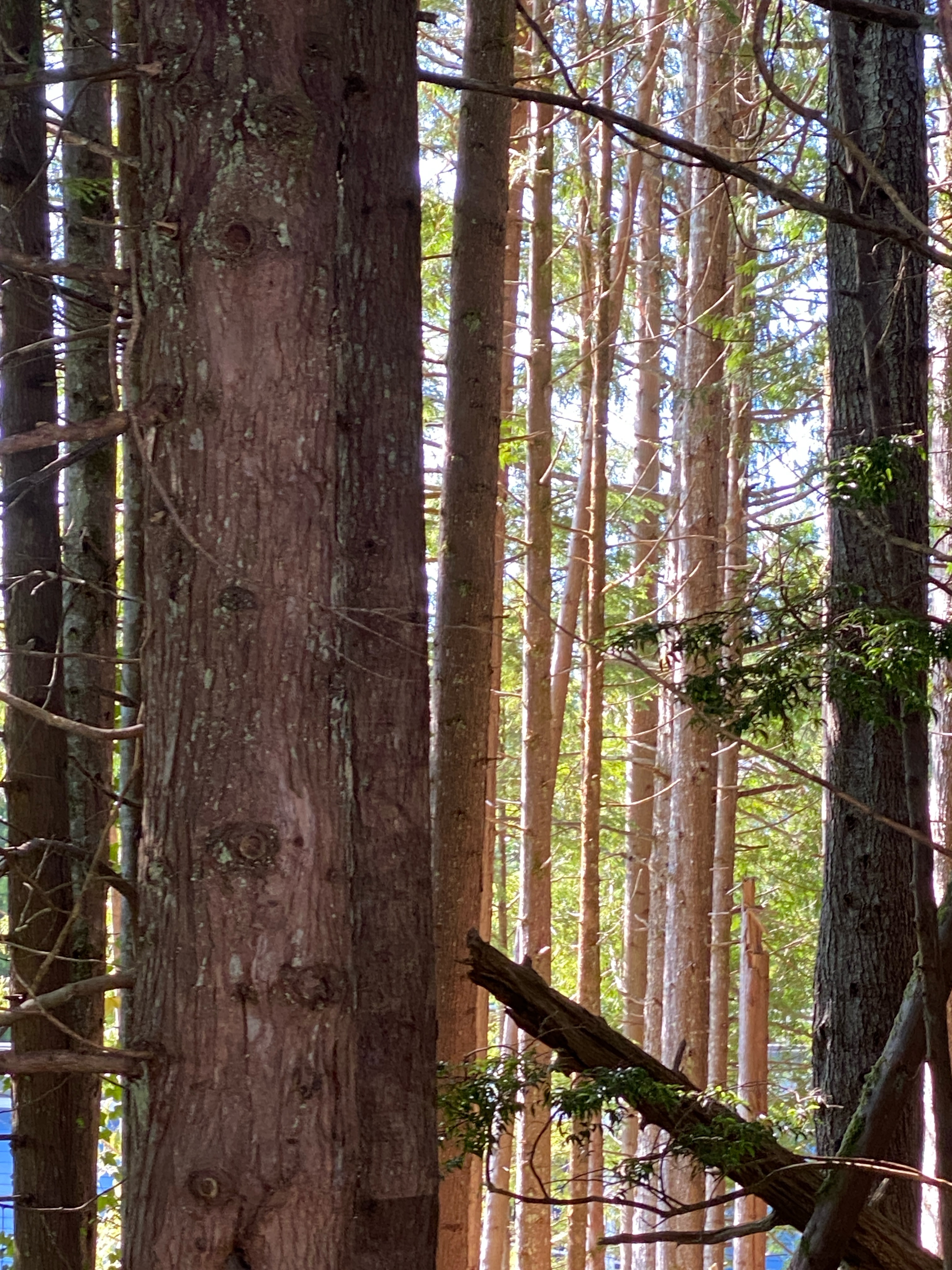
photo by Martin Malina (July 15, 2024) in Tofino, British Columbia

This year is the 80th anniversary of the death of Dietrich Bonhoeffer. After spending two years in prison, he was executed on April 9, 1945, just days before the end of the 2nd World War, for playing a key role in opposing the Nazis under Hitler.

Bonhoeffer’s life and death bear witness to the Cross. During this coming Holy Week we focus on the passion of Christ. And Bonhoeffer, like few other Lutherans in the last century, bears witness to the truth that we must first endure the cost of following Jesus to the Cross before celebrating the resurrection joy.

Bonhoeffer writes in A Testament to Freedom: “… if we would have a share in [the] glory and radiance [of Christ’s resurrection], we must first be conformed to the image of the Suffering Servant who was obedient to the death of the cross. If we would bear the image of his glory, we must first bear the image of his shame” (Barnhill, 2005, p. 107).

In other words, it costs something to be Christian in Canada. What is that cost? Perhaps the cost is our privilege, for the sake of one who is marginalized. Or maybe our pride, for the sake of respecting and dignifying another. Or our energy, for the sake of doing the right thing in the right moment. Our comfort, for the sake of exposing a harsh truth. It costs, to follow Christ.

One take away from our Sunday reflections throughout Lent about spiritual gifts and growth in faith, is that in order to develop our gifts so they can be a blessing for others, we need to cross to the other side – literally and symbolically. It’s easy to slip sideways on the pretense of growth. But for real growth to happen, we need to get out of our comfort zone and try something we’d sooner not.

The message of faith, nevertheless, is that the cost is worth it. Whatever it takes. Because the resurrection promise motivates us, inspires us, encourages us, and supports us. Because there is always grace, love, forgiveness. We believe in a God of second chances. We believe in a God who will never forsake us even in our moment of greatest need. Bonhoeffer hung on to that truth. It empowered him.

During Holy Week, we celebrate the persistence of God’s mercy despite stubborn obstacles. A major source of those obstacles resides in ourselves. Despite the self-incrimination of the convicted criminal hanging beside Jesus, Jesus’ final words to him, and the last words Jesus speaks to another human before he dies, is a word of mercy and promise (Luke 23:43): “Today you will be with me in paradise.”

God’s grace and mercy is our fuel for living. We need it. Because we will never get it right. We will miss the mark. We will stumble. But God does not give up on us. Despite all our mistakes, missteps, failures and self-doubt, God continues to nudge us forward through all the discomfort, risk-taking and vulnerability that we experience in being faithful servants of Christ. God’s grace and mercy is our energy source.

And that is why the Eucharist, the Holy Communion, is central to our Holy Week pilgrimage. It is at the table, the holy meal which we celebrate today and later this week on Maundy Thursday, when we affirm our deep and enduring connection with the living Lord Jesus.

And this connection is not just figurative or symbolic. But real, as well. This real connection gives us strength to carry on.

In 2019 a study published in Smithsonian revealed that some seeds discovered in Eastern France dated to Roman times, including the time not long after Jesus lived, in the 2nd century. It was discovered that these seeds had the same DNA as some types of contemporary wine grapes (Coman, 2024 December 10). 

In other words, some wines we drink today contain grapes with the same DNA as grapes in Jesus’ day when “on the night before he died” he took a cup and blessed it for his disciples to drink. This connection is real.

The cross, which now becomes our focal point in the days ahead, was made of wood and therefore is often referred to as ‘the tree’. In these last days we make our final leg of the Lenten pilgrimage where we will stop at the foot of the tree on Good Friday.

There is a Roman era tradition, in which to honour a special tree, wine was poured on their roots. It is no wonder then that in some legends the tree of crucifixion was a rowan tree whose berries look like droplets of blood (Mahany, 2023, pp. 45-47). The very fuel, energy source, is Christ’s blood shed for us.

We are connected, in a real sense, to Christ’s life source. We are connected through earthly elements that nourish, sustain and empower us to live and follow Jesus right to the very end. In following Christ’s mission on earth, we have what it takes.

Thanks be to God.

References:

Barnhill, C. (Ed.). (2005). A year with Dietrich Bonhoeffer: Daily meditations from his letters, writings, and sermons. Harper One.

Coman, S. (2024, December 10). Seeds of hope. Lutherans Connect. https://lcseedsofhope.blogspot.com/2024/12/day-9.html

Mahany, B. (2023). The book of nature: The astonishing beauty of God’s first sacred text. Broadleaf Books.

You are blessed

(We can better understand the beatitudes of Jesus[1] alongside the texts from the Hebrew scriptures assigned for today[2]. Read together in light of the imagery we find there, we begin to make sense of Jesus’ challenging words. Both the Psalmist and the Prophet paint the picture of a tree or shrub in a state of dryness, and in a state of blessedness, shall we say?)

6They shall be like a shrub in the desert, and shall not see when relief comes. They shall live in the parched places.[3]

Being in a “parched place” suggests the unfortunate state of our lives when misfortune and adversity come our way: when we fail at something, when we lose someone or something, or through circumstances beyond our control life hands us lemons.

But the problem is not so much that we are in the desert. It’s not the condition nor circumstance in which we find ourselves. When we are in a bad way, it’s not where we are.

When we are ‘dried out’, the problem is we don’t see the relief that comes our way. We have a vision problem:

We don’t perceive the grace, the gift, and the solutions that present themselves. We, for whatever reason, do not appreciate what we already have. We are blind to this grace.

The sight of which Jeremiah speaks is not merely physical, but of the heart—an attitude, an inner stance—that leans towards what is good within us and in the world around us. It is the intention of our minds and hearts to search for what is good, what is life-giving. And, we nurture this disposition despite what may appear to the contrary on the surface.

Of course, to search and yearn for something means there is something missing in our lives. It is to admit something is amiss. It is to be honest and open about our needs. The longing of the heart exposes our vulnerabilities. But also our hope.

7Blessed are those who trust in the Lord,
whose trust is the Lord.
8They shall be like a tree planted by water,
sending out its roots by the stream
.[4]

Our searching for what feels lost in our lives are like the roots of a tree that naturally expand, grow and spread out towards the source of life—in water, in light. It’s the search itself, the persistent, dedicated and committed journey towards the water that keeps the tree alive, even against the odds.

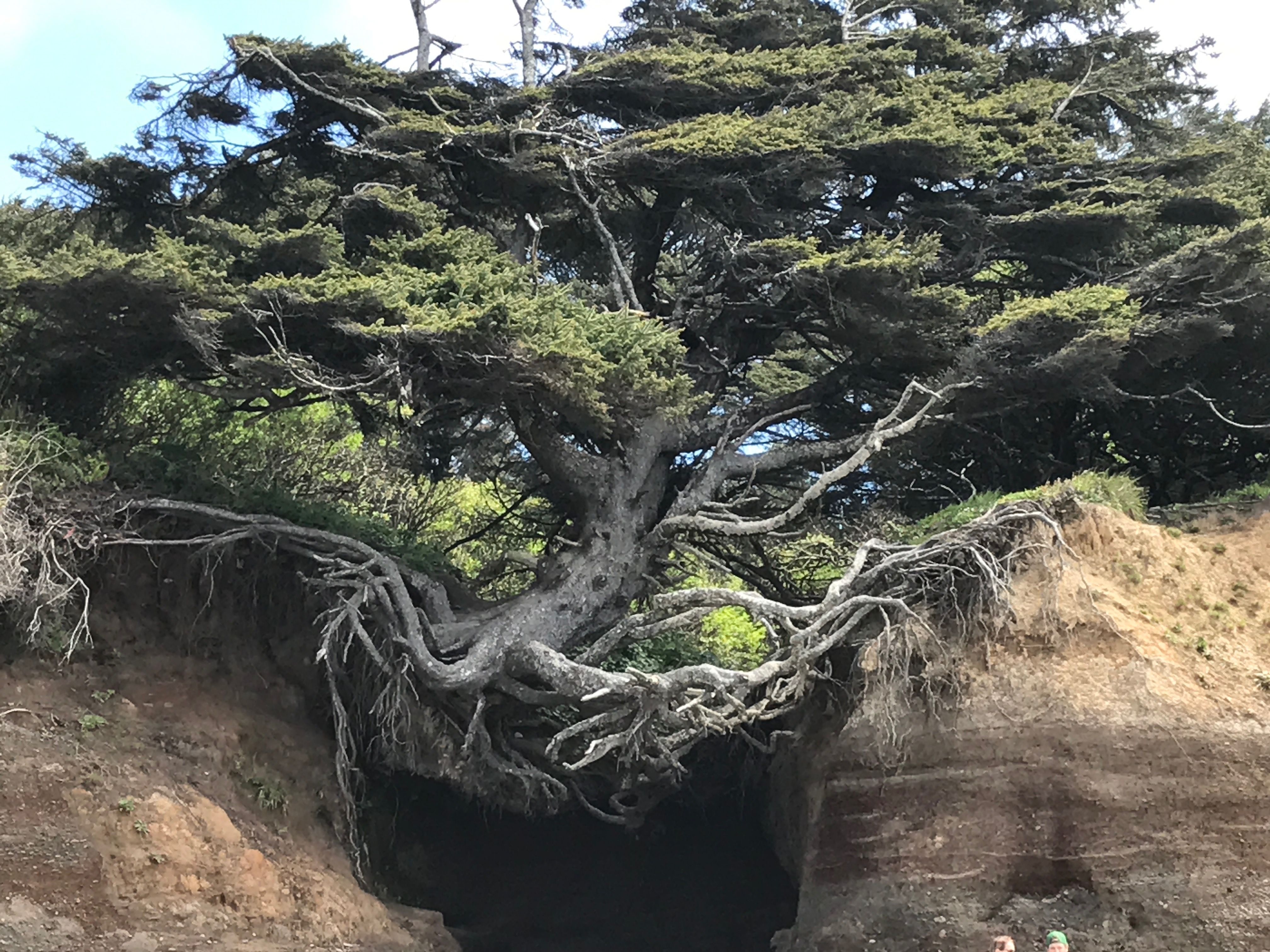
On the Washington State coast along the Pacific Ocean, you will find the famous Kalaloch Tree, otherwise known as the Tree of Life, or the Runaway Tree.Underneath the webbed roots of the Kalaloch Tree is the Tree Root Cave. Inside, a stream falls into the cave and flows out into the ocean.

69c053a6a3c63493189b8bdda3d7943d

(photo from pinterest.ca)

Many question how the tree continues to grow and the leaves continue to stay green. These questions have been asked so many times with no one really knowing how it keeps on going. So it became known to some as the Tree of Life. Because it continues to live by the stream and the ocean, even though where it finds itself is hardly the ideal spot for stability and longevity.

The Sitka Spruce tree, common along the lush, verdant Pacific coast under the constant influence of moist-laden trade winds, has lived a long time balanced precariously over these rocks. Even though it’s immediate circumstance is fragile, its roots are never far from the source of its very life.

There’s the story about a man searching for his keys under a street light. A friend comes by and asks, “What are you doing?” The response: “Looking for my keys.” The friend says, “Where did you drop them?” The man replies, “Around the corner but I’m looking here because the light is better.”[5]

It’s interesting that in order for the man to actually find his keys, he would eventually have to go around the corner into the dark to find them. But he starts under the light. He starts his search where the light is. Where his confidence rests. Where he can see. And he will go from there, on his journey.

Today, it is common for people to say, “I am blessed” when talking about good fortune. When expressing joy and thanksgiving about all the good in life, we say that “we are blessed.” And, on one level, it is true.

But when Jesus gives a list of characteristics describing those who are ‘blessed’, that’s hardly the case. We find it hard to attribute blessedness to the poor, to the downtrodden, to those who experience misfortune, bad luck, who are given life’s worst circumstances imaginable. We can’t easily make that connection when we associate blessedness with material prosperity, or excellent health, or good fortune.

In Jesus’ teaching, ‘blessedness’ is not absence of trouble. Blessedness, here, is not a reflection of good luck and prosperity. Blessedness, in Jesus’ sense, is not a result of peachy circumstances, fortune and material wealth in the way the word is used in common parlance today.

Rather, to be blessed is “to live through such opposition aware that the struggle is temporary”[6]and that in the end, God will stand by the faithful.

In Luke’s version of Jesus’ great sermon, Jesus stands not on the mountain (as is the case in Matthew 5-7), but on “a level place.” In the bible the word “level” often refers to places of disgrace, suffering, misery, hunger and mourning.[7]

Jesus does not ascend to some high place to give his teaching. Instead, he descends not only to where we stand, but he goes deeper. Jesus descends into the dark recesses of the most difficult, challenging corners of our hearts in order to teach, guide and lead us through. He comes down to that ‘level’.

To be blessed is to be that Kalaloch Tree on the precipice of destruction, and still yearn, search and reach for the water. To be blessed is to pursue the good despite all the bad that is evident all around you. To be blessed is to start that search wherever there is light, and go from there. To be blessed is to trust God to be there in the dark with you. To be blessed is to grow into God’s holy purposes despite adversity, setback and misfortune.

In short, to be blessed is to bear the scars of life proudly. It’s not the absence of difficulty, grief, pain, poverty and suffering that mark a Christian. It is following Christ in his way, despite the suffering that path brings. It is depending on God alone for life, because there is nothing else to rely on.

We thus journey on with hope, joy and trust, bearing witness to the goodness of God to sustain, to nourish and to grow us in the light of Christ.


[1]Luke 6:17-26

[2]Psalm 1; Jeremiah 17:5-10, according to the Revised Common Lectionary (RCL) for the Sixth Sunday after Epiphany, Year C

[3]Jeremiah 17:6 NRSV

[4]Jeremiah 17:7-8 NRSV

[5]Dr. Earl A. Grollman, “In Search of a Lost Faith”, Frontline (Winter 2019), p.4

[6]Ronald J. Allen, “Commentary on Luke 6:17-26” in http://www.workingpreacher.org

[7]Allen, ibid.

Marriage: Read the fine print!


Standing outdoors in this beautiful location to celebrate your marriage naturally brings me to the first story of creation in the Bible (Genesis 1). God created Adam and Eve to love one another. Their home was truly an outdoor Paradise.
And when we imagine a Paradise, it is perfect, isn’t it? True, God intended creation to be good. Just read the number of times each act of creation is punctuated by: “It is good…. It is good” ….. It is good!”
It is true, God gives what we need in marriage, too. God gave Adam and Eve each other and the Garden of Paradise, where so many good things surrounded them. There was a bounty of fruit and trees all around them. They could have their fill!
But not of all the fruit! There was that one tree at the centre of the Garden whose fruit they were forbidden to eat. Well, we know how the story goes from there. “Adam and Eve were the first people to not read the Apple terms and conditions.” — those of you have these iPhones might appreciate the metaphor about first-world issues of responsible reading of all the fine print before clicking on ‘update’. Who has time for that?!
I think sometimes when we celebrate marriage we might forget that damn tree right at the centre of our Garden of Paradise which is supposed to be perfect, right? We may therefore be disappointed because we get caught up in the idealism and feelings of love at the expense of the reality and sometimes pain of human interaction. They say that marriage is made in heaven, but so is thunder and lightning!
I say this to you today not to discourage you both. Quite the opposite. Getting married is an act of great courage, especially these days. We need more people to do courageous things. And when we can accept the truth of our limitations as individuals and couples, we can navigate the adventure of married life with enduring commitment, forgiveness and mutual understanding much better.
And God certainly understands the challenge for us, I believe. Having that forbidden tree — whatever limitation, personal issue or suffering it may represent for you — having that forbidden tree in Paradise was, after all, God’s idea of ‘perfection’. Even before Adam and Eve sinned, God’s creation included imperfection, if you will. Or as Saint Paul, the author of that familiar passage of love we heard today described elsewhere in his letter to the Corinthians “the thorn in his flesh” (2 Corinthians 12:6-9) — something imperfect, incomplete and unsatisfied with which he had to live.

Don’t forget to read the fine print in life and love! Because it isn’t always peaches and cream. At the same time, as we stand in this beautiful outdoor setting today, I want to remind you both that God does give you all that you need — and more! In the gift of each other and this assembly of loved ones gathered with you today, in the gift of being able to work as you do in the great outdoors caring for the environment, in the gift of health, in the gift of the material blessings of your life — may you be, day by day, encouraged in your gratitude for all the good things you are and have.

The Lord spoke to Saint Paul, “My grace is sufficient for you, for my power is made perfect in weakness” (2 Cor 12:9)