Closer to the light

Card crafting by Jasmine Hawley; Image from ‘Creative Stamping Magazine’ (Issue 147, p. 16, 2025)

As the days lengthen and the sun shines higher in the sky, so much more is exposed to the light, and for longer. The journey of the seasons can reflect our own personal, spiritual journeys with God. And one truth becomes clearer at this glorious time of year:

The closer we get to the sun, to the light source, the more of our shadow we see. We get closer to God, or God gets closer to us. And one of the first experiences of this nearing, is exposure to what we’ve wanted to hide, what has embarrassed us, what we’ve kept hidden from view. Nearer my God to Thee, and more of myself I and others see.

It’s like two opposite movements in tension. On the one hand, towards the bright glorious presence of God. And, on the other, towards the revelation of our own truth good and bad.

This can discourage us, and we might rather turn away from getting closer to the light.

Another natural reaction is to blame others. At every level of human interaction – from geo-political affairs to national debates, to community groups, families and inter-personally – it’s easier to locate the source of the problem outside us. It’s much, much harder, to admit the problem at home, in us.

Russian writer Aleksandr Solzhenitsyn put it beautifully: “If only there were evil people somewhere insidiously committing evil deeds, and it were necessary only to separate them from the rest of us and destroy them.

“But the line dividing good and evil cuts through the heart of every human being. And who is willing to destroy a piece of [their] own heart?” (Solzhenitsyn, 1974, p. 168). Jesus himself says that good and evil come from within us, from the heart (Mark 7:20-23; Matthew 12:34; Luke 6:43-45).

So, what does this mean? First, as Solzhenitsyn implies, it is impossible to purge that evil side of us. Jesus in the parable of the weeds, implies the same. “Don’t pull up the weeds because you might uproot the good wheat as well. Let the weeds and the wheat grow together …” (Matthew 13:24-30).

And, in truth, there is more to this than mere tolerating it, or putting up with the less-than-perfect ideal. Because, in truth, therein lies a key, working with both sides in your life, a key to growing and becoming stronger.

Holy is this tension between good and bad within us, not to be spurned. So, spiritual wisdom from the ages has taught: “Pray in the moments light and darkness touch” (Mahany, 2023, p. 125). Pray in the moments when the nearness of God’s light exposes the tender vulnerabilities in you.

The problem, really, are the untruths we believe – the ideals fuelled by perfectionist, purist expectations. When we set up those expectations, it is our vision we seek, rather than God’s. The problem starts when we dream up a vision of the church, for example, as an ideal we have to realize, rather than a reality created by God.

Because when it doesn’t go our way, when reality bursts our bubble, we think we are a failure. When our idealized image is shattered, we see the church falling to pieces. And then we blame others in the church, then we blame God, we blame culture, and finally we blame ourselves (Barnhill, 2005).

But Jesus doesn’t ask us to conform to some perfect ideal. When Jesus says, “Be perfect as your Father in heaven is perfect” (Matthew 5:48) he is not talking about someone who has magically become faultless by their own efforts. Our belonging in Christ is not a race we have to run or some competition to see who conforms to Christ faster or better. Our unity in Christ is not about uniformity based on some ideal to be striven after.

As Bonhoeffer claims, “the church doesn’t need brilliant personalities but faithful servants of Jesus and of one another. It does not lack the former, but the latter” (Barnhill, 2005, p. 140).

Instead, the Gospel is about Jesus who seeks to be formed in us (Galatians 4:19). What we have trouble believing is, what may appear weak and insignificant to us – the long shadow appearing the closer we get to the light – what may appear weak and vulnerable and shameful to us, may be useful to God. May even be great and glorious to God.

How so?

Every year towards the end of the season of Easter, we receive this prayer of Christ from John 17. This morning, we heard again the words of Jesus praying that his followers for all time “may be one” (John 17:20-26). The passage concludes with Jesus’ statement about how the world will know God. They will know God by the love in them and for each other.

When Jesus says, “Be perfect as your Father in heaven is perfect” he is talking about the Father’s love. Love others as your God loves you. What binds us together in unity, how we become one in Christ in the end, is the forgiveness of sins we all receive from God. Why what appears weak in us may be great to God, is that our perceived failures open the door to being aware we are loved despite our failure. We are forgiven.

And not just me. But everyone else I want to blame for the ills of church and society and the world we live in. Our forgiveness for what appears to be a long and scary shadow behind us as we near the light of Christ’s presence is what unites us in Christian community. And that reality, that truth, is great!

We don’t need to strive for perfection, or some ideal vision of what it ought to be like. We only need to receive one another, our leaders, our volunteers, our families in the way Christ also receives us – bathed in the light of God’s loving forgiveness, always and forever.

This forgiveness releases us to be who we are, including all our limitations and failures. God’s forgiveness releases us to take the next step, and follow where Christ leads.

Indeed, they will know we are Christians by our love.

References:

Barnhill, C. (Ed.). (2005). A year with Dietrich Bonhoeffer: Daily meditations from his letters, writings, and sermons. Harper One.

Mahany, B. (2023). The book of nature: The astonishing beauty of God’s first sacred text. Broadleaf Books.

Solzhenitsyn, A. I. (1974). The gulag archipelago, 1918–1956: An experiment in literary investigation (Vols. 1-2). Harper and Row.
Healing for everyone

Each and every one of them in the crowd wanted to be healed (John 5:1-9). That’s why they were there, surrounding the pool. Jesus asks the man a rhetorical question, “Do you want to be made well?” Because based on how the man responds, what Jesus may really have been asking was, “If so, why haven’t you already been into the pool?”

Everyone seeks healing, and that’s why they are there. The question really gets at the barriers to our healing, everyone’s healing.

The story ends well, for the man. In this Gospel, Jesus leads the man to new life. How does he get there? The text reads like all Jesus did was snap his fingers and the story is over. But let’s break it down.

To set him on the path to new life, Jesus provides the necessary support that man needed but never got from anyone else, for 38 long years.

Recall, for context, many more people than usual were in Jerusalem for the festival and passed by the pool on their way to the temple to offer a sacrifice.

This is how Sue Monk Kidd describes the scene at a healing pool in her creative telling of the Gospel. This scene is told from the perspective of someone close to Jesus:

“We crossed the valley with the little lamb on Jesus’ shoulders and entered Jerusalem through the Fountain Gate near the Pool […]. We planned to cleanse ourselves there before entering the Temple, but we found the pool glutted with people. A score of cripples lay on the terraces waiting for some sympathetic soul to lower them into the water.

“’We can purify ourselves at one of the mikvahs near the Temple,’ I said, feeling repulsed by all the infirmities and foul bodies.

“Ignoring me, Jesus thrust the lamb into my arms. He lifted a paralytic boy from his litter; his legs were twisted like tree roots.

“’What are you doing?’ I said, trailing after him.

“’Only what I’d want if I were the boy,’ he replied, carrying him down into the water. I clutched the squirming lamb and watched as Jesus kept the child afloat while he splashed and bathed.

Naturally, his deed set off shouts and pleas from the other cripples, and I knew we would be here a while. [Jesus] bore every one of them into the pool” (Kidd, 2020, pp. 169-170). This is Jesus. This is the beloved character of Jesus.

During the Easter season, we celebrate the resurrection of Jesus. And we see how it is in Jesus’ nature and purpose, exampled by this Gospel text, to lead us to life, beginning in this life. The one you have now, however imperfect, broken, hurting, sinful. Jesus beckons us to new life.

But the path to new life isn’t a solo journey. We understand that everyone is not the same. But that means everyone has different needs. And so, everyone needs everyone else to do their part to help. Interdependence. As the body of Christ in the world today, the church is about following together in Jesus’ way by helping each other.

Jesus models how it’s done in a simple yet vivid way: He acts to remove the barriers that keep others from their path to growth, healing, and new life. Jesus levels the playing field, so everyone at least has an opportunity, like everyone else, to grow and be renewed.

Doing this is not easy and it means taking a risk. Jesus healed the man on the Sabbath. He broke convention and the rules for the sake of the wellbeing of another. Jesus got in trouble with the law for his acts of compassion and healing.

There’s a meme that’s gone around my social media page. It’s an animated picture of the front of a church during a snowstorm. There’s a crowd of people waiting to climb the steps to get into the building. But they are waiting for the lone caretaker to shovel off the pile of snow making entrance impassable for anyone. Amid the crowd is one person in a wheelchair.

The caretaker, before attacking the snow blocking the stairs, begins his work by shovelling the long, switchback ramp leading up to the main doors.

The crowd complains – “Hey, do the stairs first. There’s more of us!”

The caretaker responds – “If I shovel the ramp first, then all of us can enter right away.”

Jesus leads us into new life by removing the barriers. It’s a new life given to us all, not just those in the majority.

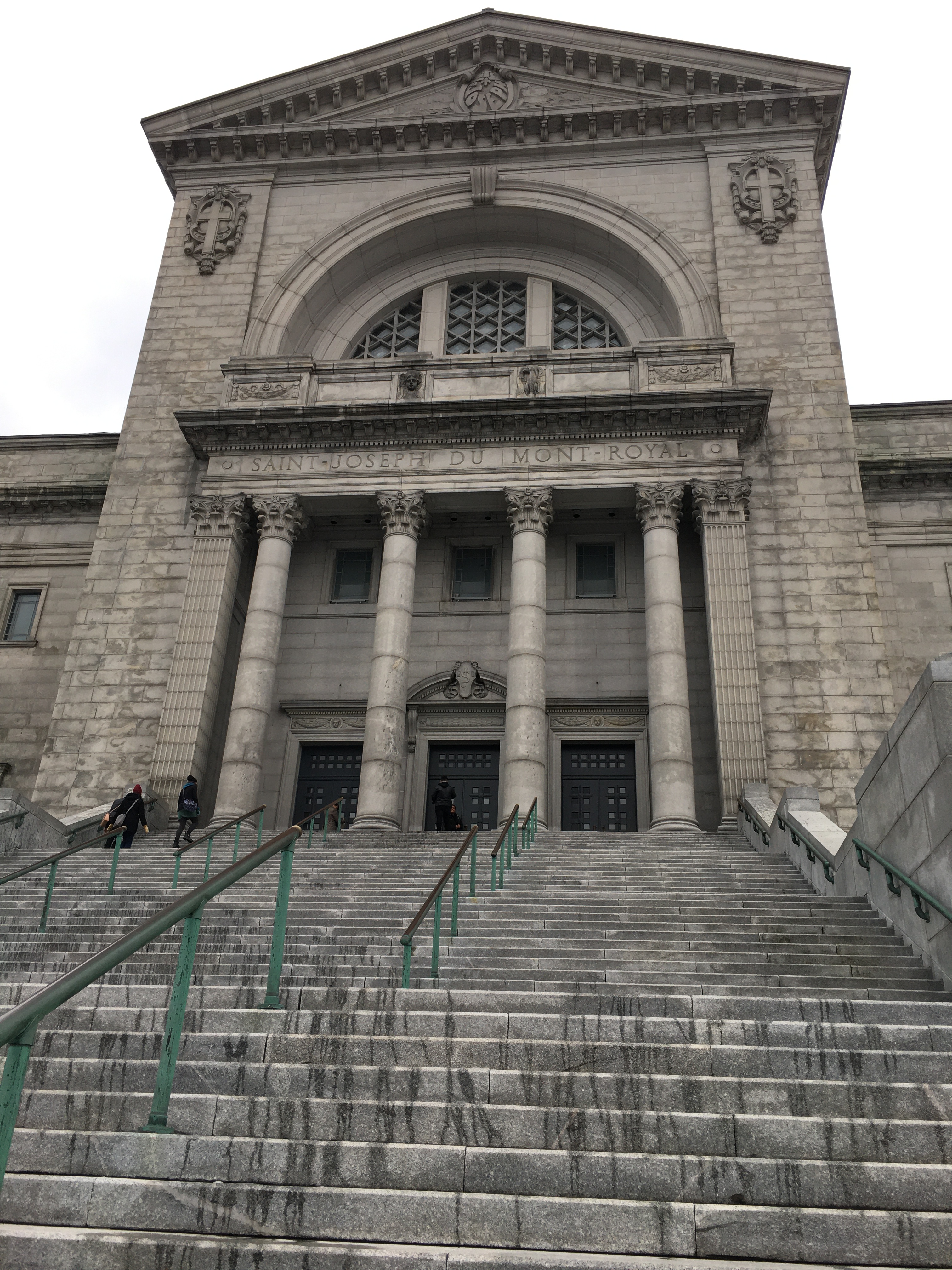
Climbing the stairs at St Joseph’s Oratory in Montreal (Nov 2019, photo by Martin Malina)

Dietrich Bonhoeffer said we don’t find truth and freedom by focusing exclusively on our own needs and wants. We find God’s truth and freedom by focusing our attention on another’s needs and wants. In doing that, we free ourselves from whatever blocks us on the journey to new life.

He says it best. Bonhoeffer writes in one of his sermons: “God’s truth alone allows me to see others. It directs my attention, bent in on myself, to what is beyond and shows me the other person. And, as it does this, I experience the love and grace of God … God’s truth is God’s love, and God’s love frees us from ourselves to be free for others” (Barnhill, 2005, p. 151).

There’s a beautiful Taizé song we are chanting before meditation these Easter weeks. It announces and celebrates the living Lord who leads us all into life.

Bless the Lord my soul, and bless God’s holy name. Bless the Lord my soul, who leads me into life. (Berthier, 1981).

What are the barriers you face? What are the barriers others face? And how does God invite you to help level the playing field so that all may come to know new life?

References:

Barnhill, C. (Ed.). (2005). A year with Dietrich Bonhoeffer: Daily meditations from his letters, writings, and sermons. Harper One.

Berthier, J. (1981). Bless the Lord, my soul [Taizé Community]. Les Presses de Taizé, France.

Kidd, S. M. (2020). The book of longings. Penguin.

Nearer, my God

Jesus says, “My sheep hear my voice” (John 10:27). He doesn’t say, “My sheep see me.” In this Gospel, belief is equated with hearing and listening, not seeing.

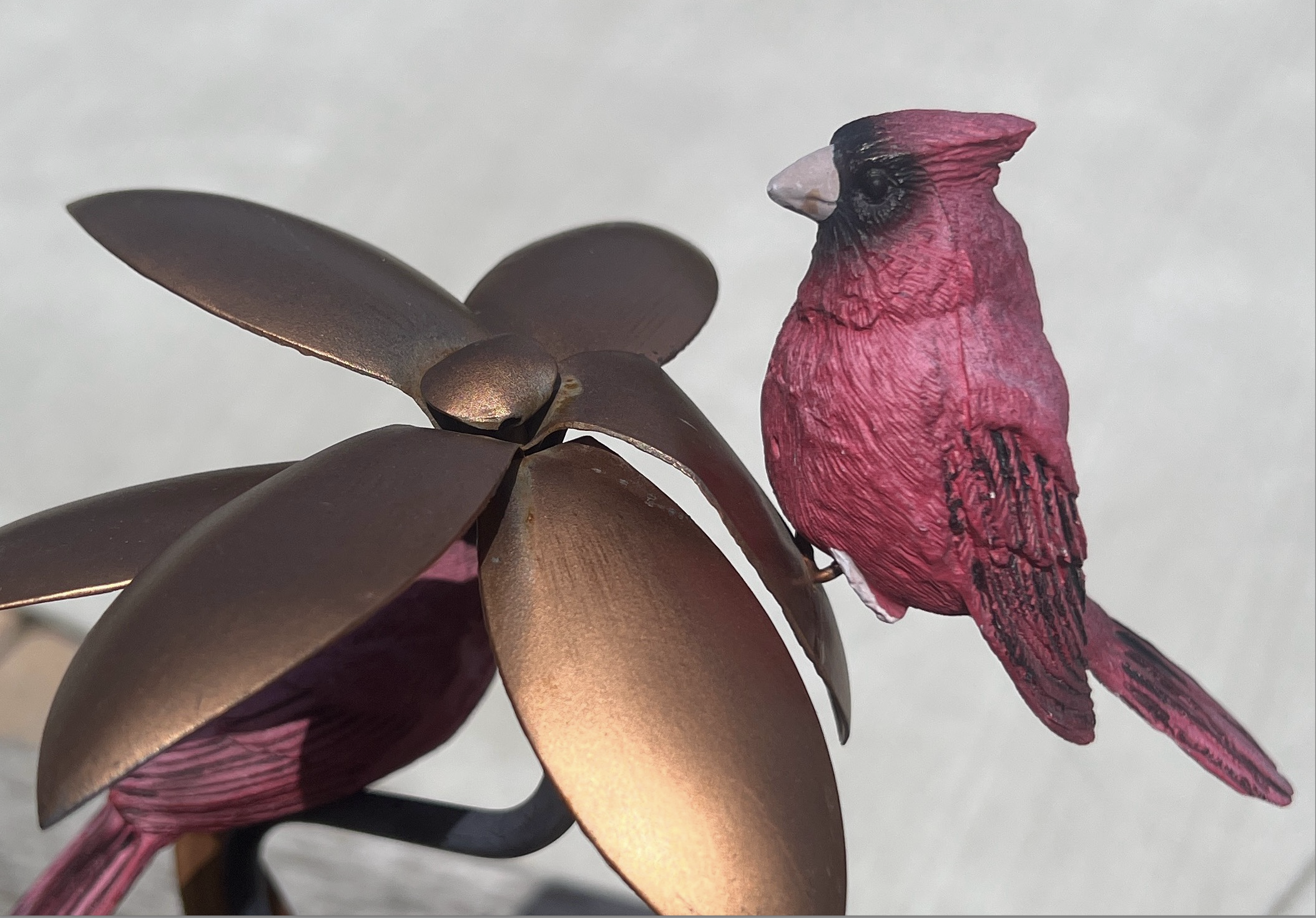
At this time of year, the birds are finally returning to our feeder. And when I go for my walks around the neighbourhood I know where the cardinals live – in a stand of old growth trees near the Algonquin Trail in Arnprior. Almost every time I walk through there, I first hear the cardinal’s distinct song.

photo by Martin Malina (Aug 6, 2023)

The point is, I know the cardinal is there. I will scan the trees, fence lines and roof tops from whence the song comes. Rarely will I first observe the bird nestled deep in the foliage, despite its catchy red coat. But because I can’t see the bird doesn’t mean it’s not true, doesn’t mean it’s not there. I know it is nearby. I believe, not because I have seen it with my own eyes but because I hear it close by.

When I was in public school, at Halloween teachers handed to us students those orange UNICEF boxes. We strung those boxes around our necks and carried them with us trick-or-treating. Some of you may remember those boxes. So, when we went to each house for candy, neighbours would also have the option of dropping some coin into those iconic boxes. All the proceeds were then donated to the United Nations Children’s Fund, originally labelled the United Nations International Children’s Emergency Fund (https://www.unicef.ca/en).

I value that experience of learning. I learned that what I did for myself was not enough to be a good human being. I also had to do something for other children, especially those who were suffering hunger and persecution in faraway lands. Just because I couldn’t see these children with my own eyes, just because these were not my personal friends, didn’t mean I wasn’t called by God’s voice to do something to care for them in their suffering, their hunger, their pain.

Today it’s unfortunately fashionable to openly admit that if some situation that others suffer doesn’t impact me directly, I don’t care and I don’t want anything to do with it. We shy away from taking on the responsibility, collectively, to teach by example younger generations the vital importance of working together to care for those who are not our own, so to speak. If the problem is far away, far removed from my or our reality, then forget it.

My wife Jessica talks about a cherished memory of family friends whose parents created a home environment in Ottawa where neighbourhood kids felt comfortable dropping by at any time of day or night. Not only did those parents care for their own children with fierce love, but their home also became grand central for all the kids in the neighbourhood to hang out and even eat meals together.

Jessica has often remarked how influential that early childhood experience was in forming the desires of her own heart in wanting to be open to others and engage those outside the family with caring acts of compassion, generosity and respect. In response to a need.

God’s voice, God’s call – the root of the word vocation – doesn’t come from far away. God doesn’t come to us from some celestial, otherworldly heaven removed from our day to day. God’s presence is near to us, in fact born in the nitty-gritty of our lives. The call is to live out from our Christian values of compassion and love.

Jesus assures his disciples of two things in the Gospel text for today. First, that he and God “are one” (John 10:30). So, if Jesus will never allow anything or anyone to snatch us away from his care and protection for eternity, neither does God. For Jesus and God are one. In other words, we are never, ever out of the scope, the field of belonging to God’s loving care and attention. Ever.

The second assurance flows from the first. God and Jesus are not only faithful and loyal to us – as a shepherd is to their flock of sheep, using a biblical metaphor. God’s loyalty and faithfulness means that God perseveres. God does not give up. Even if for just one out of the hundred in the flock (Luke 15:1-7). No matter how awful and terrible the human circumstances can get for anyone. No matter how lost one can get. God keeps at it, keeps loving us, finding us, embracing us, forgiving us, protecting us.

That ‘snatch’ verb repeats twice in the conclusion of this Gospel’s short eight verses (in verses 27 and 28). That should draw our attention to the persevering God we worship. Nothing will snatch us away from God’s perseverance.

Dietrich Bonhoeffer translated the word perseverance to mean, literally: “remaining underneath, not throwing off the load, but bearing it” (Barnhill, 2005, p. 72). Bearing it.

How do we recognize God’s voice, today? God’s voice emerges from human suffering and loss.

Bearing the load. God bears the human load. The cross of Jesus indicates the kind of God we worship. We worship a suffering God who knows our pain, our hunger. We worship a God who is revealed to us most poignantly in the lives of those who persevere in their suffering. Bearing the load.

From the UNICEF website (https://www.unicef.ca/en/blog/seven-inspirational-stories-about-mothers-around-world), I read about a brave Mom, named Neveen Barakat, who kept her family strong in the midst of war. Neveen’s husband died in a blast that hit a UN-run school in Gaza. The blast wounded three of her children and left Neveen with a permanent disability. A photo from the webpage cited above shows Neveen comforting her six-year-old daughter, Rosol.

The mothering love of Neveen is bearing a huge load. And that is why we must care with the mothering love God reveals to us in Jesus. Because while God’s revelation comes to us daily in our human suffering and pain, God’s grace calls us to care for others in the way of Christ who bears their suffering, too.

We can care for others close and far because God is never far away. God doesn’t care from a distance. God will hear our voice when we call out, just as we know and listen to the voice of our loving God who will never give up on us. Even if it’s just a whisper under our breath, God is near and hears us. God is close and will help us persevere.

References:

Barnhill, C. (Ed.). (2005). A year with Dietrich Bonhoeffer: Daily meditations from his letters, writings, and sermons. Harper One.

UNICEF. (2025). Seven inspirational stories about mothers around the world [website]. https://www.unicef.ca/en/blog/seven-inspirational-stories-about-mothers-around-world.

Flowing far towards thanksgiving

The Niagara River at the Falls, photo by Martin Malina (May 2022)

When confronted with obstacles, challenges and frustrations, what is our natural impulse? What do you do? I, for one, react by trying to do it all by myself. Go it alone. Problem is, as challenges mount and obstacles grow larger and there doesn’t seem any end in sight to all that is wrong in the world today, that strategy – going it alone – is less and less effective to say the least.

It takes a river, and some massive Falls to suggest another way.

Last week I began what is turning out to be, for me, a season of long-distance trips over the next few weeks and months. It started with a church meeting in Niagara Falls – the farthest distance from home that I have been in over three years.

“Then the angel showed me the river of the water of life, bright as crystal, flowing from the throne of God …”[1] The vision of God presented to us from John’s revelation in the last book of the bible is not always consistent with our human tendency to react against the obstacles we face. While God’s vision is of wholeness and union, we tend to go the opposite direction. We would rather divide and conquer.

We are motivated by so many conflicting and competing impulses and desires. Left alone to our own devices, we don’t get very far. And, usually, we will make a mess of things. And yet, if we seek and are honest about our desire to be healed from whatever ails us, we must come to terms with our natural impulse to go-it-alone.

The man lying by the pool called Beth-zatha had been ill for thirty-eight years. He had tried everything, it seems, to find healing for himself. “Sir, I have no one to put me into the pool when the water is stirred up; and while I am making my way, someone else steps down ahead of me,” he complains to Jesus. [2] Left to his own devices, relying on his own resources, he had gotten nowhere.

Why Jesus had chosen him, and none other, of the many invalids that populated the pool side, is another question that confounds our fierce independence. Perhaps there was a reason, a mission, a purpose for the man whom Jesus heals in this Gospel text. 

“Let your way be known upon earth, your saving health among all nations.” In the Psalm for today, the phrases “all the nations” and “the peoples” and “all the ends of the earth” appear no less than nine times in seven short verses.[3]

Health and healing are for the nations, for the purpose of the well-being of all people. As I stood at Niagara Falls, in the corner of the pedestrian mall close to the ledge overlooking the thundering waters, I saw down the gorge dividing Canada and the United States. And the text from Revelation popped into my mind: “On either side of the river is the tree of life … for the healing of the nations.”[4]

Rainbow Bridge over the Dividing Line, photo by Martin Malina (May 2022)

The tree of life “on either side of the river”. What do you make of that? The tree of life shows up in the garden of Eden, mentioned very early in the first book of the bible.[5] But by the end of the bible, in the last book and the last chapter for that matter, there are now at least two, it appears.[6]

On either side. Not one side or the other. Not we’re right, they’re wrong. Not someone wins and someone loses. Not just for me and my kin. Not God is on our side, never yours. Not me-first, then you.

The vision of God is: On either side. On both sides of the question. On both sides of the dividing line. It seems that it takes a whole bible and a whole lot of stories about the topsy-turvy relationship between God and God’s people for it to finally get worked out. God is on all sides, by the end of it all. Good news!

So, what did the healed man do? What was his purpose? After Jesus told him to “stand up, take your mat and walk”, where did he go? Did God have a purpose for him, besides inciting a growing conflict between Jesus and the religious leaders because he healed on the sabbath?

A few verses later, we read that afterwards “Jesus found him in the temple.”[7] We may wonder why, after thirty-eight years of illness would someone to go to the temple after being made well. There could be many possible reasons. But a good guess is that his heart was bursting with thanksgiving. And he wanted, first and foremost, to praise God for the gift of grace. 

Another clue may be why Jesus himself came up to Jerusalem in the first place, just before going to the pool. There was a “festival of the Jews”.[8]  Some suggest that this festival was Tabernacles, or Booths.[9]

This festival was Israel’s Thanksgiving. The Feast of Tabernacles was a reminder of when God delivered Israel, through Moses, out of slavery in Egypt and their time in the desert. The Israelites lived in tabernacles or booths on their 40-year journey to the Promised Land. To celebrate this festival was to give thanks to God for all the blessings the people have received throughout their history.

The people. All the nations. To the ends of the earth. Thanksgiving opens our hearts. Thanksgiving expands our hearts.

Wherever this Gospel text leads us in our contemplation of new life in Christ during this Easter season, one thing, I think, is clear: The man who was healed couldn’t go it alone. He couldn’t do it by himself. He needed someone else to help him. 

Whatever we would say about this time in our lives—the confusion, the uncertainties, and ambiguity of post-pandemic reset, the longing for healing and wholeness so many of us seek at different levels—individually, socially, mentally, physically, spiritually, financially—one thing is sure: We can’t do it on our own. We can’t pretend that we don’t need any help. 

Wherever Jesus is found in his post-resurrection appearances, it is always with others, healing others, inspiring others, helping others, challenging others, comforting others. Where two or three are gathered in his name, Jesus is there with them.[10]

May the waters of our baptism lead us down the river, embracing both sides of the divide, to the healing of all. And it all starts by reaching out to, and receiving help from, another, who comes to us. 

Thanks be to God!


[1] Revelation 22:1

[2] John 5:1-9

[3] Psalm 67

[4] Revelation 22:2

[5] Genesis 2:9

[6] The Greek has “tree,” which is used in a collective sense of trees on both sides of the river.

[7] John 5:14

[8] John 5:1

[9] 1 Kings 8:2; Nehemiah 8:14. Tabernacles is the only Jewish festival that is commonly called simply “the festival”. Other holidays in the Gospel of John are always referred to by their particular names – “the festival of Dedication” (John 10:22) and “the festival of the Passover” (John 13:1)

[10] Matthew 18:20

audio for “Flowing far towards Thanksgiving” by Martin Malina

Parting words to love

audio for ‘Parting words to love’ by Martin Malina
Flight of love, photo by Jessica Hawley Malina April 2022

Parting words leave a lasting impression.

The story is told of the words that were exchanged when the Spanish Priest,  Saint John of the Cross, died in the 14th century. At his death, the monastery that he went to, he deliberately chose one of the superiors who didn’t like him. On his deathbed, he said to the superior, “So whatever I did to contribute to the conflict between us, I want to apologize.” That’s how he died. And it was said that the superior came out crying. It changed his life.[1]

Sometimes what stays with us about a loved one who died is their last word spoken to us. Sometimes those words are instructions (“Take care of so-and-so”). Sometimes those words are a simple expression of love (“I love you”). Sometimes they are spoken to give assurance (“I am at peace”). Sometimes those parting words give us clarity and direction for the rest of our earthly lives.

Jesus gave his disciples parting words just before he died. These words  echo through the canyon of time to us hearing them read today. “I give you one commandment … that you love one another”. [2]

Now, on the surface this commandment sounds kind of soft. It doesn’t come cut and dry like all those “shoulds” and especially “should nots” in the over 600 laws and commandments we find in the bible. 

The commandment to love is often used as a summary statement for the two tables of the Ten Commandments. But it’s so hard to respond to this command stated so simply. We may receive it like a slider in baseball: The pitch appears first to be coming fast, straight across the plate–a simple pitch to hit hard, maybe a homerun! But at the last minute breaks down and away from the plate–a most difficult pitch to hit. Which often results in a strikeout! We really need to practice and work hard at it.

In the Easter season we reflect on what it means to be alive in the new life of Jesus. And this Gospel text gives focused expression to that life. In other words, being alive in Christ is realized in a loving relationship. After all, Jesus is love, as God is love.[3]

And the Gospel is full of images and descriptions of Jesus’ love in action. To illustrate this, another Gospel text echoes down the canyon of time from just before the Lenten season began, just before Jesus’ journey to the Cross. 

Jesus describes himself as a hen: “How often have I desired to gather your children together as a hen gathers her brood under her wings…” Jesus says as he laments over Jerusalem.[4]

Sometimes I think we would rather Jesus be the fox, as he described Herod, in that same text from Luke. Herod was the supreme ruler of the first century Roman Empire. “Go, tell that fox Herod”, Jesus instructs the Pharisees. Herod, the fox, was the one with all the cards to play, the one aggressive, defensive and wily.  But, no, in contrast to Herod, Jesus is mother hen.

First and foremost, being a follower of Christ means being gathered under wing, nurtured and held in a loving embrace. The fox may still have his way. The fox may still be a predator upon the mother hen and her chicks.

But in acts of violence and aggression the fox will never know love the way the mother hen will give it. In this image it is clear: Being with Jesus in times of danger is not about removing the danger. Being with Jesus in times of danger is about giving and receiving love in a relationship.

Love is an action word. Love is concrete behaviour in every moment we are given that communicates mercy, grace, forgiveness, faithfulness. And Jesus did love. He went to the public places, the city streets and gates. He healed the sick, brought sight to the blind, raised the dead. Jesus spent time with those who were overlooked and despised. He loved those who were marginalized in a culture dominated by violence, aggression and retribution.[5]

Many of those around Jesus wanted a Messiah to liberate them from the Romans and restore a religious kingdom. The religious leaders who scrutinized, criticized and argued with Jesus yearned for a Messiah who would give them what they wanted.[6] Many, indeed, wanted Jesus to be the fox. No, Jesus said to Pilate just before he was crucified. That’s not what Jesus’ kingdom is like, at all![7]

Do the echoes of Jesus’ parting words fall into silence? Will his parting instructions actually make a difference in a world today just as violent as in the first century? Do the echoes down the canyon of time translate to something more than mere platitude?

An image from the prophet Isaiah describes that day when justice is restored. This is the day when indeed the fox and hen will not be predator and prey. Rather, God’s vision is one in which “the wolf shall dwell with the lamb, and the leopard shall lie down with the young goat, and the calf and the lion and the fattened calf together; and a little child shall lead them …”[8]

They say people who have difficulty loving others are those who can’t, don’t or won’t receive love themselves. Receiving love is part of our relationship with God. A fundamental part. 

Receiving gifts. Receiving care and grace. Receiving support when it is offered. Without making conditions on the gift or somehow making it into an “I owe you” kind of transaction. Receiving love can be the most difficult act of faith. In truth, we will often reject a gift when it is offered. This is probably our greatest downfall. We strike out.

And so in this Easter season may we lean towards, receive and depend upon the life and love of Jesus. The commandment to love may sound childish. We won’t find this ‘law’ anywhere written in public discourse, debated in our legislative assemblies, printed in constitutions or legalized. 

Yet when we practice it, we participate in the coming kingdom of God. When little acts of grace, or big acts of grace, are given and received freely, in our lives, we are letting “a child lead us”–the babe born in Bethlehem and the One who refuses to stop loving us. Thanks be to God!


[1] James Finley in Richard Rohr, “Transformed by the Dark Night; Week 19 Luminous Darkness, Deepening Love” in Daily Meditations (www.cac.org, 13 May 2022).

[2] John 13:31-35

[3] 1 John 4:8,16

[4] Luke 13:31-32, 34

[5] Luke 6:27-36

[6] John 10:22-30

[7] John 18:36

[8] Isaiah 11:6 NRSV

Not lightyears away but light today

audio of ‘Not lightyears away but light today’ by Martin Malina
Brilliant light, photo by Martin Malina 2019

There are several images of Jesus we find in the Gospel of John. These are metaphors, or mental images, we have to describe Jesus. Examples are: the good shepherd, the gate or door, the vine, the way, truth and the life. Jesus is all of these, and more.

The purpose of all these images we find is to invite us to encounter Jesus in a new light. These metaphors are not just given to us to satisfy our intellectual curiosity about God, to consider in some detached, theoretical manner. But to invite us into a new way of experiencing Jesus, to live in Christ.

Easter is about the resurrection of Jesus. Easter is about life. In the Gospel text today, Jesus tells those who scrutinize him, that he has come to give people eternal life.[1] Earlier in this same chapter of John’s gospel, Jesus says he has come to give us life “abundantly”.[2]

Having life in Christ is not just about “heaven lightyears away”[3]. More to the point of Jesus’ death and resurrection on earth, being alive in Christ springs from our life here and now. It springs from “making something of what we experience and receiving what experience makes of us.”[4]

It’s an onging, divine, conversation. It’s full engagement with, not denial of, what is alive in us and the world around us. In such a space we take what is given us in each moment and respond to it, in love. And in our response, we allow ourselves to depend on something greater than ourselves.

Where does the light shine, today? Where the shadows lengthen under the ongoing war in Ukraine, where our health falters and our losses mount, where we find our vision clouded in the ambiguous, post-pandemic reset, when we can’t see very well, literally and figuratively ….

Where does the light shine? When we don’t know the way, when the lights go out and our lives feel like we are groping around on the floor to get our bearings, does the light shine somewhere at all? Will it ever again?

Jesus goes to the temple during the Festival of Dedication.[5] The Gospel writer John mentions this detail not without intention, I believe. 

The Festival of Dedication refers to the Festival of Hannukah. It is the festival of lights. It is an annual Jewish rededication of the temple in memory of the miracle of lights. The miracle happened when the eternal flame in the temple burned for eight days on one day’s amount of oil. This miracle occurred in the 2nd century B.C.E. during the Maccabbean revolt against the Greek desecration of the temple. The Festival of lights.

Christians believe Jesus is the light of the world.[6] In this Easter season, the gift of greater light, longer in the day, is making a positive impact on my mind and my mood. 

The man who invented the light bulb, Thomas Edison, comes to mind. And when you think about what his invention gave to us, it is astounding. His gift of light means that when in places where the natural light from the sun cannot illuminate, we can still shine a light. 

When Thomas Edison was a boy, one day he came home from school and gave his mom a letter.

Quietly he said to his mother: “My teacher gave me this letter to give only to you, and for your eyes only.”

She scanned down the letter and her eyes filled with tears. Then she began from the beginning, reading the words, boldly, outloud: “Your son is a genius. This school is too small for him. Please teach him yourself.”

Many years later, after the death of his mother, Edison was sorting some family documents and came across a folded piece of paper. It was the letter from his old teacher that his Mom had kept. But when Edison read it, he was shocked. It had actually read:

“Your son is mentally challenged. We cannot accommodate him anymore in our school.” Edison wept, and then wrote in his journal: “Thomas A. Edison was a mentally disabled child. But through one, courageous, heroic mother he became the greatest genius of the century.”[7]

This story is about a mother’s faith in her child. When someone has faith in us, look what’s possible. We are all children of the same God. And Christ, in his love for us, is faithful no matter what.

When the shadows lengthen it’s hard to believe in anything let alone Jesus. The good news despite it all is that Jesus believes in us. And will remain faithful to us in love, forever. Let Jesus be our guide, over these coming days, and beyond. Let Jesus be our guide, so we can rise again, and again, in the new light of Christ. Amen.


[1] John 10:28

[2] John 10:10

[3] “Gather Us In”, Evangelical Lutheran Worship (Minneapolis: Augsburg Fortress, 2006) Hymn #532, verse 4

[4] Brian McLaren, “Seeking Aliveness”, in Richard Rohr, Daily Meditations (www.cac.org, 25 November 2021).

[5] John 10:22

[6] John 1:3-5,9

[7] Adapted and translated from Jürgen Werth, Neukirchener Kalendar, April 15, 2022.

Outside

Alive Again, photo by Martin Malina (June 2021)
audio for ‘Outside’ by Martin Malina

In the hymn of the day we will sing shortly, the last verse pops out for me: “Not in the dark of buildings confining, not in some heaven light years away – here in this place the new light is shining, now is the kingdom, and now is the day.”[1]

If ever there was an Easter message of hope for me, it is in those words of a hymn, entitled, “Gather Us In”, that we have known and sung for years. “Not in the dark of buildings confining …”

One thing many of us did, in our families, at home and as the church during the pandemic, was spend more time outside. It was a safe place to be with others. 

Camping sites were booked months in advance. Algonquin Park became a suburb of the big cities for two summers in a row. It was impossible to find a free site anywhere if you were planning last minute. Our backdecks and front yards, church yards and local parklands became popular places. 

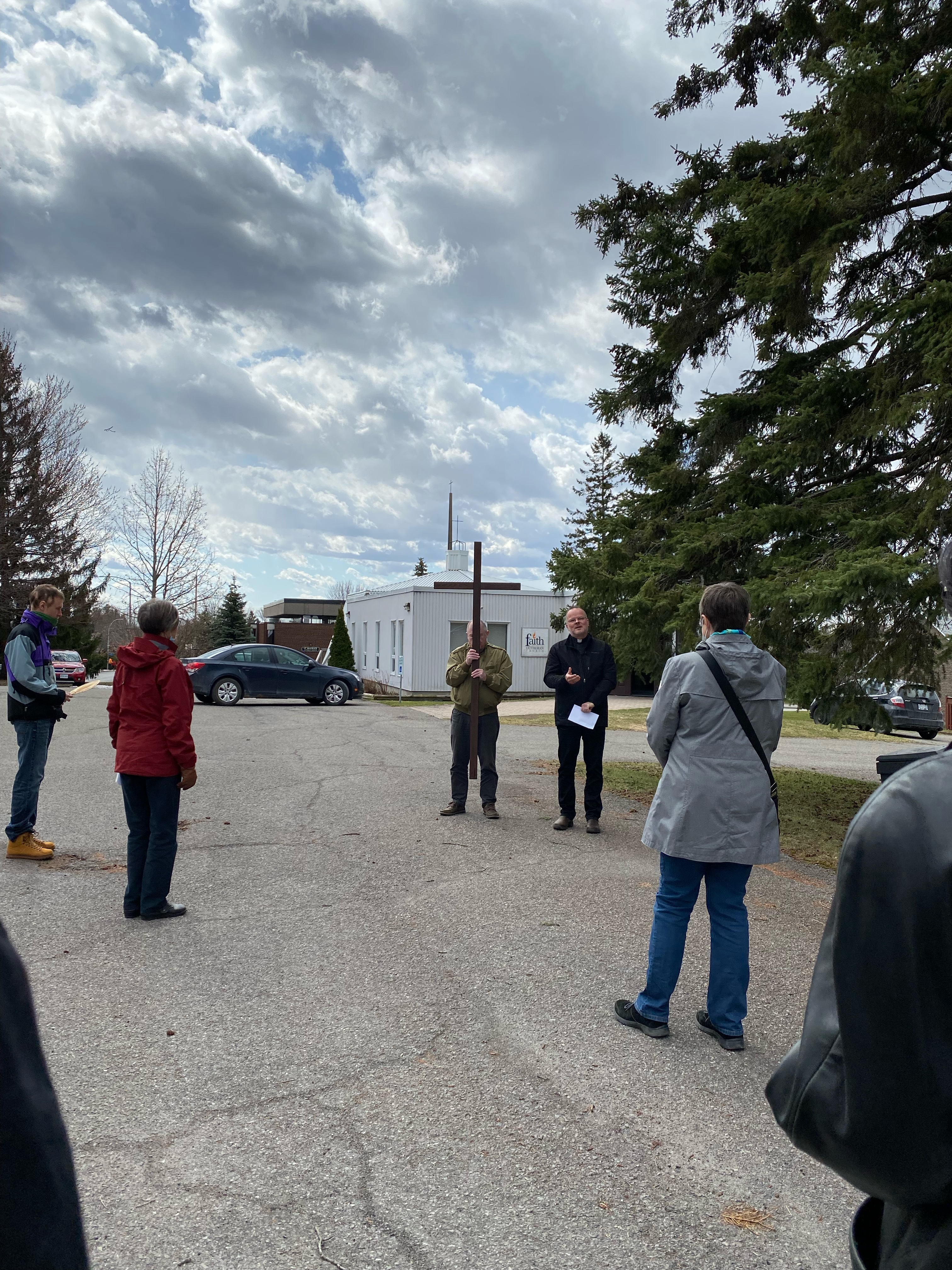
I appreciated and enjoyed very much our Good Friday pilgrimage around these church grounds. It is definitely an asset we have—this beautiful, large, treed lot in this location where our congregation gathers every week. I have renewed my appreciation for this place by walking on the grounds outside lately. The garden project on the west side, as it continues to develop and grow with each passing year, is a wonderful stewardship we offer to others of the gifts we have been given. 

Good Friday pilgrimage (photo by Jessica Hawley Malina, April 2022)

Being outside revives the soul, grounds us literally and renews our purpose in faith. It’s a visceral reminder of our bodily connection with a reality much larger than us. Being in nature pulls us out of our self preoccupations.

I suspect we’ve always known the outdoors was a good place for spiritual connection, health and growth. But like so much with the pandemic, this awareness of things taken for granted, of pre-existing realities exposed, was forced upon us unbidden. As grace will often come.

Watching Canadian commercials on TV advertising everything from airlines to beer, to cars—so much of our identity as Canadians is formed outside. So much of how we see ourselves is about engaging the wilderness, even against the harsh realities it poses for us. It’s part of our DNA to go there anyway, despite the wind, the rain and the snow.

We cannot deny our deep connection with the outdoors. At some level we are drawn, if we are able, to go outside—to garden, to ski, to play, to swim, to paddle, to hike, to walk, to rest, to breathe, to listen, to observe.

In the post-resurrection appearances of Jesus to his disciples, the prominent locations of these encounters are outside: In the garden outside the tomb with Mary, on the road to Emmaus, on the mountain in Galilee just before Jesus’ ascension, and in today’s Gospel by the water:

Jesus showed himself again to the disciples by the Sea of Tiberias; and he showed himself in this way.[2] The living Lord met his disciples not in buildings confining, but outside in the wilderness.

The word wilderness is mentioned some 300 times in the bible.[3]

The Hebrew word, midbar, usually translated as ‘wilderness’, means “speaking”. Ba-midbar, translated as ‘the wilderness’ means “the organ which speaks.” And, in the Hebrew and English lexicon, the definition of midbar is: 1. Mouth, the organ of speech; 2. Wilderness. [4]

Rather than simply a harsh backdrop for the biblical story, the wilderness is the place that speaks. When we often portray the setting for many of scripture’s greatest stories as merely a background to the unfolding human drama—such as the site of forty years of Israel’s wandering, or Jesus temptation in the desert, or at his baptism in Jordan River, or on the mount of transfiguration—we miss the point that the wilderness itself is the place that speaks. Wilderness is the place from which and through which God speaks to us.[5]

Not just the location themselves, but the relationships that happen in those settings. Another repeating feature of the post-resurrection narrative is that at first, when being outside, the disciples don’t recognize Jesus: By the water— Just after daybreak, Jesus stood on the beach; but the disciples did not know that it was Jesus.[6] In the garden outside the empty tomb, Mary first mistook Jesus to be the gardener: She turned around and saw Jesus standing there, but she did not know that it was Jesus.[7]And travelling along the road to Emmaus: While they were talking and discussing, Jesus himself came near and went with them, but their eyes were kept from recognizing him.[8]

Maybe Jesus’ changed appearance in his post-resurrection body fooled these disciples. But I wonder if they simply didn’t expect to see Jesus there.

The way I remember faces and names is to make the connection with the place—the setting, the location—we had a meaningful encounter. And I will often ask about or mention that, when reuniting with someone I hadn’t seen in a long time. “Remember when were attending that event in such-and-such-a-place and talked about that issue …” Or, “Did we meet at Lutherlyn that one summer during children’s camp?” Etc.

And if I’m not expecting to meet someone somewhere specific, if I’m not expecting them to be there, then I will likely not recognize them if they, in fact, are there. I would be surprised. I wonder if the disciples really didn’t expect to meet up with Jesus in these outdoor locations. Therefore, they were surprised when they did.

“Not in the dark of buildings confining.”

The potent meaning of Jesus’ resurrection is that no more is God confined to the physical or mental boxes we devise, into which we conveniently put God. The potency of the resurrection, the revolutionary upshot, is that Jesus is everywhere, especially outside! “Look on the other side!” Jesus advises the forlorn disciples who have caught nothing all night long from their fishing boat. “Put your nets on the other side of the boat!”[9]

In Christian traditions, the church has often been described as a boat. So, “look on the other side!” Look on the other side of these walls to find what you are looking for. Because, now, there is no place on earth, that God won’t be present. And from where God will be calling us to go! Will we recognize Jesus there?

This is good news. Because we can be freed from our expectations, the veils clouding our vision that keep us stuck in our thinking that God can only be found in one place, under certain conditions, and only inside. Good news, that God still has something new to say to us.

And the gift of the pandemic, if I can say that, is that it forced us outside, to reconsider God amongst all that lives. The fish. The animals. The birds. The trees. The water ways. The snow. The sky. And beyond. Because the wilderness has something divine to say to us. Notice how your senses come alive when you go outside next time. What do your eyes, ears, nose, mouth, and skin each reveal to you about how God is alive in the world around you?

Let’s be surprised at where Jesus shows up. And rejoice!

Thanks be to God.


[1] “Gather Us In” #532, Evangelical Lutheran Worship (Minneapolis: Augsburg Fortress, 2006).

[2] John 21:1 NRSV

[3] Victoria Loorz, Church of the Wild: How Nature Invites us into the Sacred (Minneapolis: Broadleaf Books, 2021), p.54

[4] Brown-Driver-Briggs Hebrew and English Lexicon (Snowballpublishing, 2011)

[5] Victoria Loorz, ibid., p.61

[6] John 21:4

[7] John 20:14-15

[8] Luke 24:15-16

[9] John 21:6

Too good to be true?

audio for “Too good to be true?” by Martin Malina
Martin Malina April 2022

Thomas will not believe, cannot believe, even the words of his friends. Thomas will not believe, cannot believe, even with Jesus standing right in front of him. Not until conditions he has laid down are met.

I suspect we like Thomas. He’s becoming a favourite biblical character. I think we can relate, especially these days, to Thomas’ state of mind. From a place of profound grief at his loss he becomes skeptical, and not sure to trust everything that he is told especially if it sounds ‘too good to be true’.

How are we, like Thomas, strengthened in our faith, especially in difficult times, to trust and believe in the presence of the living Jesus with us? 

It’s as if Jesus is saying that “Even when you can’t see me, I am with you always. Even if you are not certain in any given moment, doesn’t mean I am not there. You don’t need to clearly see me in order to have faith.” Because, as he tells Thomas, “Blessed are those who have not seen me, and yet have come to believe.”[1]

So, the problem is our perception. Jesus is hidden from us only by our perception.

For example: When was the last time you looked at or considered the eyes of a bird? Did you know that the colour of the eyes of the cormorant bird is emerald? And the eye of the eagle is amber. The eye of the grebe is ruby. The eye of the ibis is saphire. Four gemstones mirror the minds of birds, birds who mediate between heaven and earth. In these beautiful birds, have you ever even thought about looking at their eyes?

We miss the eyes of the birds, focusing only on the feathers, their eye-catching plumage. What are we looking for? And where have we failed to look?[2]

Well, for one thing, we look for facts. The Easter celebration often gets clouded by debates about about the facts: Did Jesus actually rise from the dead? Was it factually a bodily resurrection? Beyond the shadow of any doubt? Underlying this line of questioning is a strong desire for certainty. Many Christians will demand certainty in declaring positive and unequivical answers to questions about facts, in order to validate any kind of faith in the resurrection of Jesus.

What this line of thinking fails to see is that it’s not only about what we see. More importantly, it is how we see it. Where we look.

The way our brain processes what and how we see leads medical scientists today to conclude that certainty is related to narrowness of vision; that is, the more certain we become of something, the less we see. What we clearly see, where the narrow focused beam of our attention is concentrated, also means in that moment of clarity and concentration, our vision is narrowed.[3]

If we want to see more—the broad perspective, to scan the horizon for example—and hold everything in our line of sight, we need to use our brain differently. We use our brain not just for what we focus on. But also in order to hold-it-all-together, which means accepting the mystery, accepting our complicated lives that in truth are filled with contradiction, inconsistency and uncertainty. Life 101. This is a gift and a function we need more of in this ambiguous, post pandemic time.

The debate really should be between Certainty versus Compassion. Because in any given moment in time, we cannot do both, fully.[4] We cannot be at the same time absolutely certain, and fully compassionate. We are not wired in our bodies to do both at the same time.

Because our striving for certainty is often driven by fear, fear of the unknown. This function comes from our survival instinct—either flight, fight or freeze. So, we either demand certainty born out of our fear response to life. Or, we can function out of a calm, compassionate, trusting and loving center within ourselves. 

Saint Paul writes in that famous text from his letter to the Corinthians that if we fail in love, we fail in all other things.[5] In this Easter season, we celebrate God’s triumph over death. We affirm that death has not the final word on our lives. And in that famous book of the bible about love—the Song of Songs—we read that “Love is stronger than death”.[6]

The fear function of our brains will lead to death if not tempered by the love function of our brains, which leads to life.

We are like Thomas in so many ways. Thomas needed to be certain. He was afraid of being wrong. And in response to that natural, human tendency, Jesus chooses compassion.  When Jesus meets Thomas, in person, in the flesh, Thomas doesn’t need to actually touch Jesus wounded hands and side, now. He doesn’t need to. Paradoxically, Thomas so confidently then expresses his faith in that felt sense of Jesus’ love in his presence. Because Jesus starts with compassion. 

God does not hold back and wait until we get things right. Until we are certain before doing anything. Jesus did not first demand Thomas to improve his frame of mind before coming to him, in love and acceptance. 

Rather, God loves us where we are and as we are. Divine love finds us. Divine love has handed itself over to us to do what we please.

The scripture doesn’t say too much if anything at all about what happened to Thomas after this encounter. We know more about Thomas’ mission and death from other historical sources and tradition. But the Gospel itself is quiet in the mention of Thomas after this encounter with Jesus, I believe for a purpose.

We are left to finish this story, in our own lives, in our own ‘seeing’, in what and how we see Jesus in the world today, and in the faithful confession of what it is we seek. May God’s love inspire us to join the ongoing conversation with the living Lord in our midst today.

Choose to start with compassion. This is good. Very good. And true.


[1] John 20:29

[2] Terry Tempest Williams, cited in Daily Prayer for All Seasons (New York: Church Publishing, 2014), p.44

[3] Iain McGilchrist, The Master and His Emissary: The Divided Brain and the Making of the Western World (London: Yale University Press, 2019), p.83

[4] “Physiologically it is impossible to be rooted in both drives at once.” Alane Daugherty, From Mindfulness to Heartfulness: A Journey of Transformation Through the Science of Embodiment (Illinois: Balboa Press, 2014), p.13.

[5] 1 Corinthians 13

[6] Song of Songs 8:6