
Practising baptism

audio for ‘Practising Baptism’ by Martin Malina

We cannot possess hope without practicing it – Amanda Gorman

I look downcast at my guitar sitting in the corner of my home office. Over the winter I picked it up daily, plucking on its strings and practising some Christmas carols adapted for classical guitar.

But since February I haven’t picked it up once. Not once. And you know what? It is true: If you don’t use it you lose it. If the strings on my guitar aren’t exercised daily—pulled and stretched by regular use—they will actually deteriorate and snap under the tension of the steel-wound strings. I’ve already lost my D-string.

So in raising up the benefit of practice, I want to give Aidan a gift at his baptism today. I know his father is a big fan of the Buffalo Bills NFL team. So I’m guessing this might be a hit, and encouragement to start early. Here is, I suspect, not Aidan’s first football. But he can add it to his collection.

Aidan will have to start early in his life practising to catch and throw and run with the football. Starting early will give him the best chance to become really good in this sport over time. And Dad can help, at the beginning anyway.

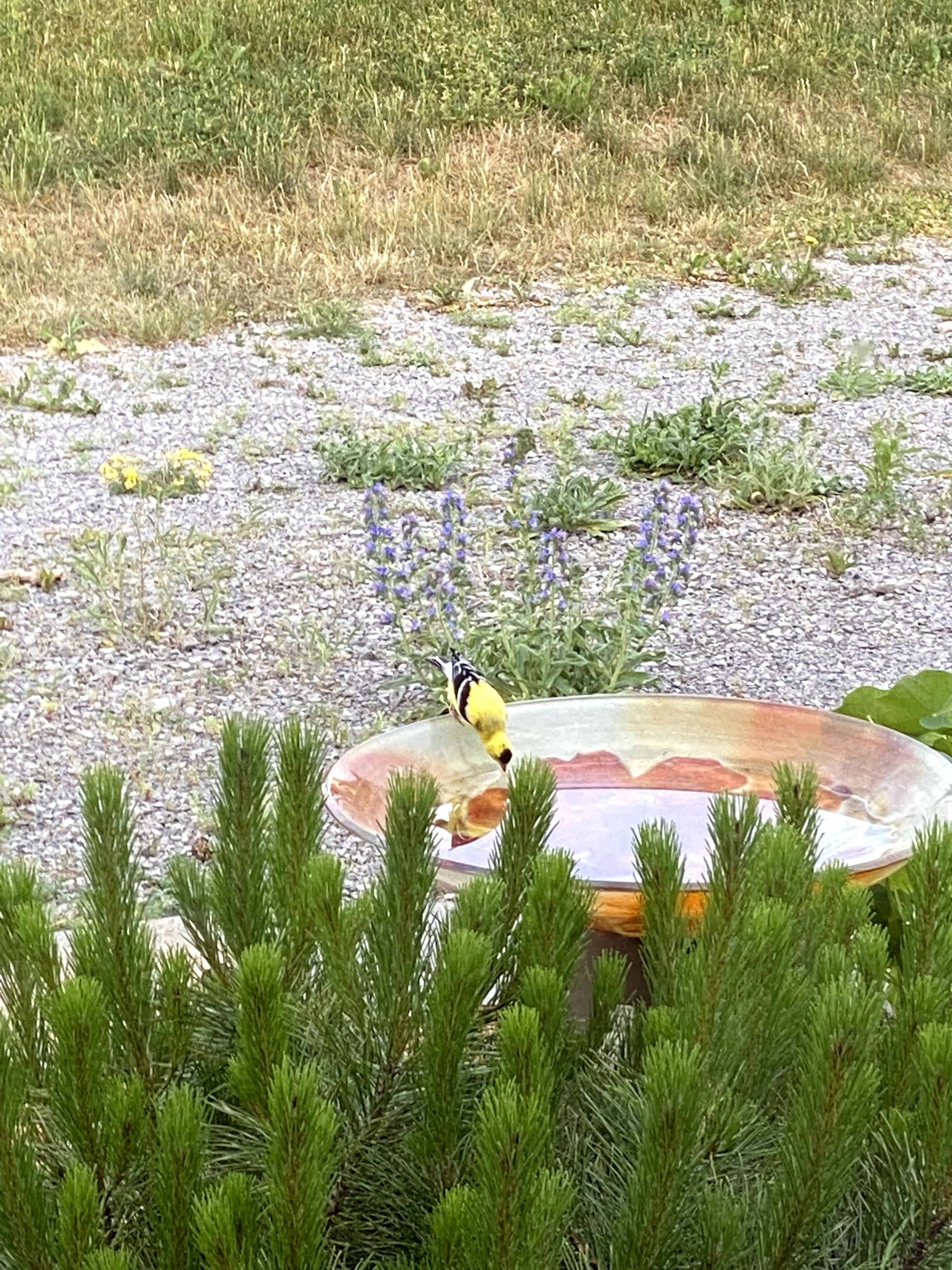
Practising requires discipline. It doesn’t just happen. I read the story of John who was visiting a friend one day. And they were sitting on the porch at the friend’s house one afternoon. John’s friend complained that there were never any birds in her yard. 

During the hour that they talked, John saw and named half a dozen birds. The friend was astonished, declaring how much she wanted to see and hear them too. “No”, John replied with blunt honesty, “you only want to want to see and hear them. You must have the bird in your heart before you can find it in the bush.” The friend was charmed by the idea of attending to birds, but didn’t have the will to give herself to its practice.[1]

I can think of two good reasons why we baptize infants, you may be wondering. The first reason is a belief I’ve held on to most of my life: The baptism of infants demonstrates God’s unconditional grace and love. This grace is the foundation of faith. For Lutherans especially, reflecting Martin Luther—the great 16th century reformer—who preached that we are ‘justified’ (i.e. made right) before God ‘by grace alone’.

In other words, there is nothing we can do to earn God’s favour—not all the good works we do, not all the services we attend, not all the people we help in God’s name. We don’t do what we do in order to check the boxes to get God’s attention: “Hey God, look how good I am!”

Babies cannot prove their worth. They can’t even speak for themselves at the font. They depend on others’ care, protection and presence to support them in faith at this moment. It’s not to suggest babies don’t have the capacity for faith—I believe they do. They just can’t express it in ways we adults recognize. But it is to say that they encounter God at this time in their lives pretty helpless on their own.

And that’s how we all relate to God—relying on God’s good will and faithfulness to us no matter our age, our intelligence, our competence. Jesus said, “Unless you turn and become like children, you will never enter the kingdom of heaven.”[2]

But recently another good reason, maybe more simple, has emerged for me as to why we baptize infants:

If living in this world didn’t mean anything significant for our faith, if being a Christian was only valuable in so far as the prize at the end of life, if it were all about the destination and not the journey—then why would we baptize infants? Why wouldn’t we wait until later in life to be baptized?

No, the practice of infant baptism holds immense value for living in faith during our lives on earth. Infant baptism exclaims that the journey does matter, not just the destination. The beginning of faith coincides with the beginning of life-on-earth. Baptism launches us not just with heaven in mind, but more significantly, baptism suggests a way of life for now.

In the Gospel for today Jesus gives practical instructions to the seventy disciples.[3] He gives the disciples a blueprint for ‘how to’ relate to people and presents a lifestyle consistent with following Jesus in the world. I am not suggesting a literal application for every time and every place; we always need context to determine those things. 

But the point is: This life, and how we live it, matters. And how we learn to live the faith of Jesus in our lives is born out of a life time of practising our baptism. Martin Luther suggested that every morning before starting your day when you wash your face: Remember your baptism! 

How we pray. When we pray. How we serve our neighbour. Working together in a community of faith to make a positive difference in the world. Caring for others in need. These are all things that grow us in Christ Jesus. This is our practice. We need to practice! 

“Practice when it is easy and it will be there for you when it is hard,” said a wise teacher.[4] But if you haven’t practiced when it was easy in life for you, then it likely won’t be helpful for you and others when life gets hard. That’s why it is important to start early, and when you are young, to develop your spiritual practice and discipline. Try new things. Grow in your faith.

There will be times in our lives when practising, like with my guitar, will be put on the proverbial back shelf. But the guitar is always there, always reminding me that I can pick it any time again and start over. In faith, we are always starting over with each new day. By the grace of God we are, as people of faith, always beginning again.

We begin again not trying to earn favour with God and secure our place in heaven. That’s not why we practice. We practice our faith to reflect the love of God for all of creation, for all people. Because that’s how God approaches us. With grace, with forgiveness, with compassion. In baptism we are given the Spirit of God. God promises to be with us always, and empower us along the way, to practice.


[1] Cited in Belden C. Lane, Chapter Two in “Beginning to Listen” Kindle edition, The Great Conversation: Nature and the Care of the Soul (New York: Oxford University Press, 2019)

[2] Matthew 18:3

[3] Luke 10:1-11

[4] Russ Hudson, “The Role of Anger in Spiritual Work,” Oneing Vol.6, no.1, Anger (Center for Action and Contemplation, Spring 2018): p.70-71.

Changes in our lives

Finding God (photo by Martin Malina June 2020)
audio for sermon ‘Changes in our lives’ by Martin Malina

During the early months of the COVID pandemic the confirmation class was meeting weekly online. In our tradition, confirmation is a two-year program for 13 to 14 year-olds—in that age range. By the time I started meeting the confirmands again in person it had been about two years of connecting online.

I remember the time a young confirmand walked through the doors of the church to attend the first in person class in over two years. My eyes were level at a certain height on the door frame, as I expected him to be as tall as I had remembered him two years ago. Was I shocked when he came through the door, I had to elevate my sight a good foot-and-a-half, it seemed. He had grown so much like a weed in the time I hadn’t seen him!

I marvelled once again at how much people change. But not just physically. And not just youth. There are various dimensions of our lives—mental, social, emotional, psychological, spiritual—that also change over time.

Hasidic Jews tell the story of a rabbi’s son who began leaving the synagogue during morning prayers to wander in the woods. The boy loved being alone in the forest. His father was concerned—not simply because the boy neglected his prayers, but because the woods were wild and dangerous in the mountains where they lived. One day he asked his son, “Why do you go out there alone in the forest? I notice you’ve been doing it a lot lately.”

The boy replied, “I go into the woods to find God.”

“Ah, that’s wonderful,” replied his dad. “I’m glad you are searching for God. But you know you don’t have to go anywhere special to find the Holy One, Blessed Be His Name. God is the same everywhere!”

“Yes,” answered the boy, “but I’m not.”

God might be the same everywhere, but the boy knew there was something different about him out in the wilds. Perhaps, stripped of things familiar, he was more vulnerable, more open and receptive?[1]

We receive two texts again this day—again from 1 Kings and from the Gospel of Luke. And we meet various characters, who are challenged in a similar way, I find.[2]

The challenge that Elisha—in the 1 Kings text—and the nameless people on the road with Jesus—in the Gospel text—the challenge they faced was to acknowledge the change happening within them. Indeed, from the Gospel text they were called to follow Jesus in a new direction or to listen to Jesus in a new way. Their hearts were pulling them to grow and mature and try something new.

In this Gospel text, we often first react to Jesus’ saying that “No one who puts a hand to the plow and looks back is fit for the kingdom of God.”[3] We often get stuck in the past. The nameless person wants to go back and say goodbye to their family. They offer their obedience, but only on that condition. The question we are left with at the end is, ‘Will they follow?’

At the same time I don’t believe Jesus means that we should ignore our history, deny our attachments, shrug off our relationships, reject the past. There’s enough throughout scripture to suggest otherwise: The fourth commandment to love and honour your parents, the Wisdom writings that admonish the people to care for their elderly, and the Epistles of St Paul who preaches love for parents.[4]

No, this isn’t about the past. But neither is it about the future. “No one who puts their hand to the plow …” Jesus says. He doesn’t talk about looking forward. He doesn’t talk about how to make straight rows. Just put your hand to the plow, what is right before you now. What grounds you in the present moment, right here.

Neither the past nor the future are the central issues in this Gospel. The problem is right now. What Jesus and Elijah both address to the nameless person and Elisha respectively is their unawareness that they are, and have been, changing. That they have changed, themselves.

Sometimes when we take a break from our spiritual disciplines, when we’ve been away from habits and practices that have in the past fed us and enriched us, it’s hard to go back. But the reason it is hard to go back—back to church, back to a prayer discipline, back to any kind of exercise that some part of us says is good—the reason it is difficult is because we resist, refuse or deny that we have changed in the meantime. Who you are when you come back to it is different.[5]

And perhaps it is time for a different direction or more importantly a new way of responding, of being, in relationship with ourselves, with others, in creation and with God:

A different place and a different time of day to pray.

A different way of relating with others in the church and serving others—listening more, accepting more, risking more.

A different way of understanding scripture and a new image to hold of God so we can trust more deeply.

We only have to look around us, in nature, as the boy did going into the forest to find God. We only have to look around us in the wild, and especially at this time of year, to see the life growing all around us. It is a law of nature to change. Nothing remains static; nothing in creation stays the same, if it has life. The same is true for us, living in this reality, this world that God created and God so loved.

God is. God was. And God will be forevermore. And everywhere. Despite where we go to find God, God is already there. Despite how we are changed by the invitation of divine love and life to follow, God is already with us. Jesus goes before us into an uncertain and unknown future. God’s ever-presence can hold us and accompanies us into the changes of our lives. Always has.


[1] Cited in Beldon C. Lane. The Great Conversation: Nature and the Care of the Soul (New York: Oxford University Press, 2019) p.2

[2] 1 Kings 19:15-16,19-21; Luke 9:51-62

[3] Luke 9:62

[4] Deuteronomy 5:16; Exodus 20:12; Proverbs 20:20; 23:22; Ephesians 6:1-24; 1 Timothy 5:8

[5] Ram Dass, Polishing the Mirror: How to Live from your Spiritual Heart (Boulder Colorado: Sounds True Inc., 2014), p.146

When the dialogue fails, the conversation continues

The sky is alive tonight, in the silence (photo by Martin Malina, May 2022)
audio for ‘When the dialogue fails, the conversation continues’ by Martin Malina

One of the joys I find in reading the bible is noticing the common, connecting points or themes in two or more texts. For today, the 2nd Sunday after Pentecost, according to the Revised Common Lectionary, the Gospel is from Luke 8; and, an alternate option for the Hebrew scripture is from 1 Kings 19.

What is similar in these seemingly disparate readings? In both, the primary character experiences a divine encounter. From 1 Kings, Elijah the prophet experiences God in the sound of sheer silence. In the Gospel, the man from the region of the Gerasenes is healed by Jesus. And, both Elijah and the healed man are called to go back to the place they had earlier—and for different and justifiable reasons—left.[1] 

In the Gospel text the man inflicted with demons had been shunned by his community. Because of his illness, he remained locked in chains, living in the caves on the outskirts of town. He was not only an outsider, he was despised, rejected and feared. 

After his healing, I can understand why he wants to travel on with Jesus. A better option, for sure. I can understand why he wants to get out of dodge and begin life over far away from the place associated with his rejection and hate on him. I can understand his desire to stay away from the source of conflict, uncertainty, risk, even danger for him. 

It would be hard to imagine going back. Going back to a community and family that had disowned him, and treated him like a second class citizen, banishing him to the fringes. Even though after Jesus cures him he is better as an individual, his relationship with others in his home country remains at best uncertain. At worst, poisoned beyond repair. 

But Jesus throws him a knuckle ball: No. “’Return to your home, and declare how much God has done for you.’ So he went …”[2]

The healed man was going back to a different situation for him. It wasn’t going to be like it used to be. He was a changed man, for one thing. And his relationships with family and friends were going to be very different.

The same with Elijah. He was called to go back to the “wilderness around Damascus”[3], where he would be exposed, and continue to live under the threat of assassination. This was the place where Elijah would have to continue doing God’s work—in the wilderness, a place of danger, and personal risk. God was calling him to go back to appoint a new leader for the people. He was going back to an entirely different situation than before.

Coming back to church will be different. Not like it used to be. Anyone who has come back will testify to this. Yet, the most important and rewarding thing is renewing our relationships. Somehow, we feel it, that we enter a deeper stage in our relationship. It’s not that we can’t grow in our relationships online. It’s not that Zoom meetings don’t have a purpose. 

But once in a while, and at some point, God may be calling us—not to escape risks, potential danger; not to avoid contact at all costs, retreat into our comfort and safety zones, for all time. God may be calling us to come back to reconnect with and grow current relationships, and make new ones.

What can we do to affirm our bond in Christ and deepen our relationships with one another, even in averse conditions and when things are different?

As part of my continuing education leave over the past week I attended and took leadership in a conference of the World Community for Christian Meditation. I am the Canadian national coordinator of this worldwide community.

The national coordinators of Ukraine and Russia have been for some years meeting online to meditate, during which participants pray in silence together. No words. No speeches. Just a heartfelt recognition of Christ’s living presence among them, unifying them in the silence.

Nevertheless, as with any social group meeting online or in person, when you gather people ask, normally, how everyone is doing – just a little chit-chat – before the prayer time. It’s an important part of any group including meditation groups. 

However, the Ukrainian coordinators expressed disappointment and concern that in the last couple of months when the Eastern European groups met online to meditate, the Russian meditators didn’t even ask how the Ukrainians were doing. Perhaps, they thought, they shouldn’t or couldn’t say anything that might be construed to the authorities as sympathy for Ukraine. So maybe they were afraid.

Something was lost. The dialogue had failed. Those relationships were on the brink. The Ukrainians felt hurt that their meditation cohorts wouldn’t even ask how they were doing.

If their communion was based solely on what was said, or the words that needed to be said, or grandiose ideological speeches about right and wrong, it would very well feel like a great chasm, a great divide separated them, their relationships irreconcilable.

When the dialogue fails, what is left? Where is God? Is it worth it? is there any point to go on? The way the story is told, Elijah expected God to be found in the noise. But God was found in the sound of sheer silence.[4] In the silence, God is found. A holy silence. And that is where the healing begins, the breach can be restored. And unity is reestablished in Christ.

And I wonder how that would be accomplished. Words might need to be part of the conversation at some point, obviously. But the conversation might also need a whole lot of silence in between.

So how would silence accomplish this, practically? Paul Tillich, the great Lutheran theologian of the 20th century wrote that “The first duty of love is to listen.”[5]

What does Elijah’s obedience teach us about how we have conversations? When the dialogue fails, the conversation can still continue. By listening. Even in a momentary pause, we communicate by listening. Listening is not the easy first-option in relating with others. We would rather speak first, make sure we are heard, and our opinions shouted from the roof tops. But this is not the only, and certainly not the most effective, way of maintaining and growing relationships.

In the silence God is. In the silence, God listens to us. But sometimes we have to stop talking. We have to quiet our busy minds. We have to nurture the gifts of stillness and simplicity in our lives. And listen.

The Ukrainian and Russian meditators are on two opposite sides of a huge divide. It appears all hope is lost. The war goes on. More people die. The chasm grows deeper and wider with each passing day. 

And yet, despite the failure of words and actions, to say the least, the Ukrainian and Russian meditators continue to pray together in unity, in the silence. In the meditation room, virtually, they will still gather to pray. In their faithfulness to return regularly to be with one another they acknowledge in the silence the living Christ who continues to pray for them. They practice love by listening to God and each other in the silence. 

And in the silence, God listens to their hearts. In the silence the presence of Jesus through the power of the Holy Spirit unifies them. And gives them all hope, for the future.

In case you haven’t heard yet, the doors to the church are unlocked. The doors are open. A few of us gather on Sunday mornings in this lovely sanctuary, to pray, to sing, and celebrate Christ’s presence. And you are welcomed to join us in person. Come. Come back, to reconnect. And maybe we can all start over, first by just listening to each other.


[1] 1 Kings 19:1-15; Luke 8:26-39

[2] Luke 8:39

[3] 1 Kings 19:15

[4] 1 Kings 19:12

[5] Paul Tillich. Love, Power, and Justice (New York: Oxford University Press, 1954), p.84.