God waits, for us

Towards the sun, through the flame (photo by Martin Malina, October 2024)

Despite condemnation of these acts by public leaders (Alhmidi, 2024), temples, synagogues, mosques and churches in Canada are burning.

A House of Commons report published in September catalogued a chart of statistics showing, by a breakdown of provinces and territories, how between 2010 and 2022 the number of police-reported cases of arson causing significant damage to religious institutions steadily increased from 13 incidents annually to 74.

These stats reflect not only damage to material property but acts of violence against people on site (Government of Canada, 2024 September 16).

Religion has become a target for people’s pain. A church near Eganville (Ottawa Valley) covered their building with tin late last century to protect it in the wake of suspicious fires that destroyed the Lutheran and Catholic church buildings in town at the time. They call it “the tin church”.

Visions of burning churches capture our imaginations. These visions stir up fear and despair. And one of the first things we want to do is to circle the wagons. What is the world coming to?

The Gospel for today (Mark 13:1-8) was first heard in the Jewish-Roman war of 66-70 C.E. Ultimately, in this war the temple in Jerusalem was demolished never to be rebuilt. It didn’t look good for the people of faith in the day, as the outward signs of their religion were torn down and burned.

It feels like ‘the end’ whenever the beloved symbols, forms, and outward appearances of our lives at best change, at worst are destroyed, especially in dramatic fashion and/or through violent conflict.

We feel like we are in the midnight hours of a life when we suddenly lose what we have cherished and become attached to over time. It is a trauma from which many do not recover. Some people struggle under the weighty pain of regret regarding past behaviours. Many today face incredible and what can often feel like and may actually be insurmountable obstacles.

We shake our heads in disbelief. How can the goodness of God prevail in the midst of this harsh reality? Is faith just a pipe dream? Is the kingdom of God merely some illusion to distract ourselves in one of many ways we amuse ourselves to escape from this reality? We look to the Black Friday deals.

There is word, a phrase and an image of Jesus the writer to the Hebrews uses that caught my attention. In verse 12 (Hebrews 10), “When Christ had offered for all time a single sacrifice for sins, he sat down at the right hand of God, and since then he has been waiting …”

The writer of Hebrews bears witness to God’s great acts in Jesus of overcoming death and the grave and rising to new life. And then the writer of Hebrews pictures Jesus as sitting down and waiting. You can almost hear a pin drop. There is Jesus dusting off his hands with an attitude of mission-accomplished and slumping into an easy chair with a satisfied grin (Wallace, 2009).

Is this a picture of Christ the first hearers of scripture needed to hear as their temple burned? Isn’t Jesus supposed to rescue people in trouble? Swoop down and pull us out of the hellfire? Doesn’t he care? We get a rather passive image of Jesus sitting, waiting, and doing nothing. We don’t want this Jesus – a God who waits!

Facing the craziness of this world today, trying to cope with all our losses, we want a strong man who will make things right and make us great again!

Hebrews (chapter 10) cites a beloved passage from Jeremiah (31:33-34) where the prophet announces God’s vision of writing God’s covenant, God’s promise, on our hearts and minds (Hebrews 10:16).

What is implied is that the life of faith is not a matter of living under external measures. Our minds, our hearts – that’s where God goes. The life of faith is not validated by blind compliance to the outside demands of the law. The life of faith, rather, is Spirit-driven and a Spirit-given ability to live into the new covenant (Fahey, 2009). In other words, people of faith are called to live a new life, a changed life, from the inside out.

The early church had to hear again the gracious word of God. That is the purpose of this letter to the Hebrews. In facing their losses, they needed to hear again the Gospel promise that God will be faithful (Hebrews 5:12). God has faith in us. God believes in us, trusts us to do our part, to make our move. To be loving. To see in the hearts of everyone we meet the face of God, to be gracious and compassionate, and generous.

This is not a cockeyed optimism. It is not a life based on emotional reactions to outward circumstances. Rather, it is a life practised in hope and trust.

Jesus waits for us to take responsibility for our actions – past and present. Jesus waits for us to forgive ourselves, show compassion to ourselves, as God has already forgiven us and first loved us. We cannot have outward renewal unless and until we experience for ourselves inner renewal and change.

We may not see the victory of God in Christ with the naked eye. But we can hear it again with the naked ear (Long, 2009). The message here is that if you want to know the truth, pay attention not to the evil you see out there, but to the Gospel you hear and receive in here.

We do not rely on external circumstances or outward legalities or protocols to validate our faith nor to justify our actions. Instead, we find, in and through God’s grace, a pathway through devastation and suffering to freedom and salvation.

The time of loss and change signifies an ending to be sure. It is also a new beginning for people of deep faith. To have new life, all things must grow and change. It is no accident that the final words of today’s Gospel are: “This is but the beginning of the birth pangs” (Mark 13:8).

The midnight hour feels heavy buried deep in the shadows. The nighttime of our lives hides all things true from view. But dawn is just a few hours away. In the concluding words of Hebrews 10 (25): “Encourage one another, and all the more as you see the Day approaching.”

We need to make the move, towards the light. Because the sun will rise. The son is coming. And that is the surest promise of faith.

References:

Alhmidi, M. (2024, October 15). Video of Trudeau remarks edited to remove his condemnation of church fires. The Canadian Press. https://www.thecanadianpressnews.ca/fact_checking/video-of-trudeau-remarks-edited-to-remove-his-condemnation-of-church-fires/article_d82061e0-4cf5-55c7-83f0-f586a1016a1a.html

Fahey, J. E. (2009). Hebrews 10:11-14 (15-18), 19-25; Theological perspective. In D. Bartlett & B. Brown Taylor (Eds.), Preaching the revised common lectionary; Feasting on the word; Year B, volume 4 (pp. 302-307). WJK Press.


Government of Canada. (2024, September 16). Inquiry of ministry Q-2825. House of Commons. Retrieved on 14 November 2024 from https://smartcdn.gprod.postmedia.digital/nationalpost/wp-content/uploads/2024/11/Q-2825-Order.pdf

Long, T. G. (2009). Hebrews 10:11-14 (15-18), 19-25; Exegetical perspective. In D. Bartlett & B. Brown Taylor (Eds.), Preaching the revised common lectionary; Feasting on the word; Year B, volume 4 (pp. 302-307). WJK Press.
Wallace, P. M. (2009). Hebrews 10:11-14 (15-18), 19-25; Homiletical perspective. In D. Bartlett & B. Brown Taylor (Eds.), Preaching the revised common lectionary; Feasting on the word; Year B, volume 4 (pp. 302-307). WJK Press.

Jesus’ eye is on the sparrow

photo by Martin Malina (Aug 26, 2024)

Many of us who love to read fiction, or watch movies, do so not only to find out whodunnit. We continue reading because we expect that a happy or at least satisfyingly good and appropriate ending awaits.

What is more, some hardened book lovers will toil through a dry and thick middle part of a book just to get to the ending trusting it will be well worth the work. Some people in this room today whom I know – not mentioning any names – will even have the audacity to cheat. They will peak ahead to the last page to determine whether or not it is worth their time and energy to plow through those sometimes-boring middle sections of the book.

The lectionary readings for this Sunday deserve a careful reading and re-reading. And you will note that the story of the widow at Zarephath feeding Elijah ends in abundance and promise fulfilled (1 Kings 17:8-16). The lecture in Hebrews about Jesus’ sacrifice for our sins ends in the promise of salvation for those who wait for God. That text ends by explicitly stating that when Jesus comes again it’s not to deal with sin, but to save people (Hebrews 9:24-28).

Judgement and sin are not the end of the story. Mercy, grace, salvation and promise-fulfilled are.

When we read this sacred text thousands of years after it was first written, what do we hear? What do we say? What do we believe about what’s important in our faith?

Last month, the father of liberation theology, Gustavo Gutiérrez, died at age 96. Once considered a revolutionary, his notion of God’s preferential option for the poor, his idea of empathy and advocacy for the poor, have influenced the social teaching of the church over the last century (Friskics-Warren, 2024 October 24).

According to Lutheran theology God is revealed most clearly in the suffering and death of Jesus. The cross therefore becomes the central metaphor for how God comes to us, and in what circumstances of life. God is revealed most profoundly not in glory, not in victory, not in riches, not in greatness, nor in prosperity.

But, rather, in conditions that are the exact opposite. Hence, the missional stance that suggests the voices of the poor, those on the margins, those who don’t have it all, in fact guide the church.

The cross shows us the way of Christ in the world and in the church. It is a humble way, a way of honesty. A way of being vulnerable. A way of asking for and receiving help and love from others. In receiving love we know who we truly are. At very least, we say God is revealed in all things, even in the tragic and sad.

In grief work, we say that sad is not bad (Morris, 2018). Sad may clue us, in fact, to the way forward in faith. What we initially ignore, dismiss, discard, pity, even despise in others and in ourselves may clue us, invite us into the truth of faith.

I think the woman gave her two cents worth, literally, because she trusted God. Hers was the faith in trusting that ultimately what awaited her at the end of her life was not judgement and sin. At the end, for her, was the embrace of a loving God for eternity. What has she to lose?

From his great sermon on the mount, we learn something important about Jesus verified in this Gospel today. Jesus’ eye is on the sparrow, on the littlest bird (Matthew 10:29). Therefore, we know that he watches, not to judge, not to put pressure on us to perform righteously, not to goad us to make a good example for others, not to make us great. No.

Jesus watches to protect us. To love us. To hold us through thick and thin.

The end of our story, your story, is good. Trust that life which God gives, reigns! Trust that love, which is still expressed from time to time in the world, reigns, in the end. Trust that God will not forsake you, that God will not forsake the little ones, that God will give voice in our weakness, that God will rise in the voices of the poor, in their example to us.

Will we listen? Will we watch where Christ looks?

Reference:

Friskics-Warren, B. (2024, October 24). Gustavo Gutiérrez, father of liberation theology, dies at 96. The New York Times. https://www.nytimes.com/2024/10/23/world/americas/gustavo-gutierrez-dead.html?unlocked_article_code=1.W04.MM2s.LBybnrYFAjNp&smid=em-share

Morris, S. (2018). Overcoming grief (2nd ed.). Robinson.

Holding space for another

Jesus came not to be served but to serve (Mark 10:45). A relationship, any relationship, based on serving another affects the power dynamic. Changing the relationship from “What is in it for me?” to “What is in it for us”?

There is a term called “holding space for people” (Plett, 2015). Have you heard of it? Holding space for another basically means offering unconditional support and letting go of judgement and control. Holding space for another means we are willing to come alongside another person in whatever journey they are on without judging them or making them feel inadequate, without trying to fix them or trying to impact the outcome. Holding space.

Jesus holds space for James and John. Jesus lets James and John, the sons of Zebedee, take the lead. Jesus does not take the command-and-control role of an army general and pander to their desire to simply do what they are told. And so, he asks of them: “What is it you want me to do for you?” (Mark 10:36). Holding space.

James and John take a huge risk, one that Jesus invites them to take. James and John become vulnerable to Jesus. Jesus wants them to be honest. And they are.

And when we take the risk of holding space for another, when we take the risk of being honest and vulnerable sometimes the answer to our questioning and its consequences do not make us feel good and may even create more problems, as it did for James and John. Now the other disciples are upset with them. So, Jesus takes a great risk with them. And with us.

Why does Jesus act this way? He is, after all, the Son of Man. Why, of all people, does he come to serve?

Because Jesus has faith in them. And Jesus has faith in us. Jesus perceives something far beneath the surface of our ego thrashing about that is holy and good.

The question is, will we accept Jesus’ answers to our questions? Will we accept the sometimes-difficult journey of growth and maturity, which includes making mistakes? And, will we trust Jesus who has more faith in us than we do in ourselves?

One thing Jesus will not do: Jesus will not pander to our childish cravings for immediate gratification. Jesus will not pander to our childish compulsions to be told. Rather, Jesus waits for us to take the risk, to declare what we want, to be open and honest and vulnerable with our deepest desires and secrets of the heart, to be willing to take that difficult first step on our journey of transformation to new life in Christ.

When you came in this morning, did you notice the two-story stone house on the corner just beside the parking lot to the church? This house used to belong to Faith Lutheran Church. It was the parsonage, where among other purposes, pastors and their families lived since the 1960s till 2004 when the church sold it to its current owners Anya and Mihailo. Last April, their house was designated a City of Ottawa Heritage Building.

Northern Lights over 43 Meadowlands (photo by Anya Mihailovic, October 2024)

Anya recently told me the story of the last pastor who lived in the parsonage with his family, Pastor Bill Riekert. Shortly before he died, he visited Anya and Mihailo after they had renovated most of the house.

When Pastor Riekert stood at the base of the staircase in their main room and looked up, he paused and surveyed all the original woodwork. And he said in awe: “Was all this here the whole time!?”

You see, until Anya and Mihailo renovated, what covered the floors, the walls and staircase railings was a whole lot of wall-to-wall carpet and paint. The paint and carpets covered up what lay underneath. He couldn’t believe the beauty of the original structure and woodwork of the floors, walls and staircase that had lain there hidden underneath since the house was built over a hundred years ago.

In the book of Hebrews, we read that “Every High Priest chosen from among mortals is put in charge of things pertaining to God on their behalf” (Hebrews 5:1). But, the writer goes on to say, “one does not presume to take this honour, but takes it only when called by God” (5:4). When we hold space for another, and indeed with God, we do not presume to be in charge. We do not presume to know it all, and what is best for the other as if we are the one to judge ultimately these questions.

Instead, we listen for God. We listen to each other. And in all humility we trust this: That someone else sees in you what you may not see in yourself. We trust that someone else can hone-in on something we have neglected to appreciate buried deep within us, even for a very long time, covered up by the trappings of ego. We trust that whatever needs to be uncovered and exposed—good and bad—is held in loving embrace by God in Jesus Christ who gave his life for us. Jesus holds space for us, to be who we are, openly and honestly, so we can hold space for another.

And Jesus waits. Waits for us to commit to this journey of growth which is long, sometimes tiresome, often difficult but will ultimately lead to new life and indescribable joy. That is the promise of faith in Jesus.

References:

Plett, H. (2015, March 11). What it means to ‘hold space’ for people, plus eight tips on how to do it well. Heather Plett. https://heatherplett.com/2015/03/hold-space/

Building relationship

Meeting a horse (photo by Martin Malina 7 Aug 2022 Long Beach WA)

Because I don’t have a pet, I learn by the witness of others who do. And I recently read someone, named KC, reflect on their first experience of getting a pet. When KC was seven, her mom took her to the animal shelter and told her she could pick out a cat.

She walked straight to the back of the rows of cages and found the rattiest little cat you’ve ever seen in your life. Her tail had been severed after she was hit by a car and her rear was oozing from fresh wounds and ointments. Without even looking at the other cats KC announced to her mother that she wanted that one. KC took her home and cared for that cat.

KC got to know her, and she became her friend. But not because this cat appeared worthy. But simply because KC decided to care for her (Davis, 2022, p. 84).

Maybe you wonder like me, how can KC want to care for such a mangy creature? Yet, something about her story reminded me of God. How God is with us.

In order for Adam not to be alone, God created animals in addition to a human partner (Genesis 2:18-24). Creation communicates the message that none of us were meant to be alone. We were created for relationship – including non-human creatures.  Saint Francis of Assisi understood that. And that is why, near the feast day of Saint Francis (Time and Date, 1995-2024), we make time today to reflect on and honour all our relationships, and especially today with the non-human world.

The story of KC choosing her pet suggests nevertheless that getting know one another means, likely, a life-long work of seeing beyond the surface of things. Getting to know another is about going deeper.

Let’s have some fun with that. I have an exercise I invite you to do with me now. It’s a mind game that involves speculation. I will give you a series of clues – they are objects, items – and then I’ll ask you to offer a series of guesses as to what they ultimately represent, what they ultimately are about (Sperry & Sperry, 2020, p. 39). Ok? Ready?

The first two objects you are given are an iPod and a phone charger. What is their link, or commonality? What do these items ultimately represent? … (Electronic devices?)

But then, you are given a book of crossword puzzles. Now, finding a common link with the first two objects is a bit more challenging, isn’t it? What do you think all three objects ultimately represent? … (Things that entertain and pass the time?)

Next, you receive a map and a bottle of water. Now the task has become much more difficult. Any guesses? What do all five objects represent? … (Inanimate objects?)

Then, these two clues are given: two parents and three children. Now, what do all these items represent? Perhaps a concept that links all these items together is a family trip? Wait, though. We need to verify our tentative guess.

Ten other clues are given next, including snacks, sunglasses, and hand wipes. Each of these subsequent clues adds to the common meaning of all these items suggesting you are correct, indeed.

We are talking here not about electronic devices, ultimately. We are not talking ultimately about things that pass the time, nor are we ultimately talking about inanimate objects. Ultimately, we are talking about a family trip.

Taken together, all these items are necessary to get the true picture of what is actually happening. It’s not that our earlier guesses were false per se. But those conclusions were based on a small sample size of objects. We would be in error to announce too soon what it’s all about. We need to dig deeper in order to unveil the truth, to truly know someone.

So, how do we start?

Why do so many adore their pets? I am told dogs and some cats, too, will often approach their human counterparts with unconditional positive regard. They approach relationship with an openness sadly not often matched in human relationships.

We all need unconditional positive regard from each other. That’s what draws anyone to join any groups and social gatherings. Because they are received first and foremost with an unconditional positive regard from those they meet there. Curiosity. Acceptance. Love.

No wonder Jesus’ closing, summary statement from today’s Gospel is the challenge to receive the love of God as a child (Mark 10:13-16). Without our adult ways getting in the way. Without our adult ways of first scrutinizing a situation or person, without first judging them. They say the longest leap in the world is to jump to a conclusion.

How do we train our minds and hearts to suspend our usual launch into pre-conceived, critical, judgemental interpretations?

Father Ed, the priest who helped Bill Wilson start up Alcoholics Anonymous over a century ago said, “Sometimes Heaven is just a new pair of glasses” (Lamott, 2017).

There is so much more to a person than just the first thing you notice during a brief encounter. Looking upon the heart calls for patience and a willingness in all humility to learn more, ask more, about that person. It’s about relationships that go far beneath the surface. And developing those relationships.

When God guided Samuel to choose the next King of Israel, the Lord said to Samuel: “Do not look on his appearance or on the height of his stature, because I have rejected him; for the Lord does not see as mortals see; they look on the outward appearance, but the Lord looks on the heart” (1 Samuel 16:7).

Alongside the challenge in this word, we can also be comforted knowing that what lies on the surface of our lives need not define us. For example, our challenging circumstances need not define us. What first we notice there, on the surface, is real and requires loving care and attention, to be sure.

At the same time, the Lord looks upon and loves what is on our hearts, what is true there, what is good there. And maybe, what mortals cannot initially nor easily perceive. Except, perhaps, some of our dear animal friends.

Let’s put on that new pair of glasses. And let us pray our vision expands to perceive the dignity God sees in everyone. Because there is something beautiful in everything, everyone, every creature God created.

References:

Davis, K. C. (2022). How to keep house while drowning: A gentle approach to cleaning and organising. Penguin.

Lamott, A. (2017). Hallelujah anyway: Rediscovering mercy. Riverhead.

Sperry, L., & Sperry, J. (2020). Case conceptualization (2nd ed.) Taylor & Francis.

Time and Date. (1995-2024). Feast of St Francis of Assisi 2024 in Canada [website]. https://www.timeanddate.com/holidays/canada/st-francis-assisi-feast

In a beginning

Fitzsimmons Creek, Whistler B.C. (photo by Martin Malina, July 18, 2024)

About an hour and a half ago, at 8:44am (EST) today (September 22, 2024), summer gave way to autumn. We are now officially in the Fall season. Today, I am reminded of the cycle of seasons again. Round and round we go. Our lives, indeed, go through cycles.

But we will often couch these repetitive cycles in negative terms. For example, we talk of cycles of violence, cycles of poverty, cycles of addiction, and so on. When do we talk about history repeating itself when it has to do with something positive and good? And depending on your mood today, and which seasons are your favourite in the year, even the autumnal equinox can represent a negative turn.

In observing this season of creation, the church focuses our attention on the basic building blocks of life on this planet – wind, water, light, earth. And the creation stories in the first book of the bible describe how it all began. And begins again.

I add the present form of the verb because two key words from the Hebrew language in the first chapter of Genesis not only provide guideposts in our understanding of cycles of time repeating themselves, but overwhelmingly support a positive viewpoint. The biblical creation stories, while also introducing the concept of sin, offer a resoundingly hopeful message.

The bible begins with those auspicious words: “In the beginning, God created …” (Genesis 1:1). A recent Lutherans Connect (LC) devotion points out that in Hebrew, there is no “the” (LC, 2024). It is, technically, ‘in a beginning’.

While the Genesis story says everything was created in six days in an unspecified moment in time, the grammatical nuance of ‘a beginning’ suggests that God continues to create something new in every time and place. In a beginning.

In fact, some scholars understand that there is no definitive beginning because creation has been happening already for a very long time (LC, 2024). The cycle of creation has gone on longer than we thought.

Based on evidence in the rock formations, for example, on the East Coast of Scotland at Siccar Point, scientists have concluded the earth is approximately 4.5 billion years old (LC, 2024).

This claim is not at odds with the bible if we pay attention to the grammar. Creation happens, happened, and continues to happen. Creation happens at every new beginning. In a beginning.

And what is more, every creative act of God is a cycle that repeats for good, literally. When God creates, the first chapter of Genesis reveals a litany of goods (Genesis 1: 4,10,12,18,21,25,31): “It was good … It was good …. It was good.” In short, God calls all that God has made, “good”.

But in the Hebrew word ‘tov’, ‘good’ is not just a static affirmation. Rather, ‘tov’ means a deeper sense of becoming well, closer to the meaning of ‘shalom’ in Hebrew – peace and well-being. God saw that all creation, including the human, was becoming well and evolving over time (LC, 2024). ‘Good’ from the Hebrew ‘tov’ evokes this sense of movement, of growth and transformation for the better.

Whenever there is a new beginning in life, God is creating for the good. The continuing acts of God’s creation happen at points of starting over. And this is a good thing, part of an evolving creation.

Our faith, we say, begins at baptism. And Ariel’s baptism today at Faith Lutheran Church in Ottawa is a sign for us all that God seeks to start afresh with us. At these beginning points in time, what we really affirm is an ongoing, unending relationship God has with us. Baptism conveys in water and word God’s grace starting over and re-newing our lives.

As we celebrate birthdays – Ariel did yesterday and her mother will on Saturday; as we celebrate anniversaries – Pastor Diane celebrates her 30th year of ordination this month; as we welcome new members at this new stage on their faith journeys; as we pray for Pastor Bavani and Jasmine who begin a new chapter of their lives later this week travelling back home to India; as we baptize Ariel today …. We affirm that life and relationships of love continue refreshed in new ways by God’s grace.

None of the above are a one-time, one-and-done deal. Each of these events are gateways through which we pass and commit to a life-long journey of endings which always signify new beginnings of goodness. I came across a bit of wisdom in my social media recently about grieving the losses of our lives. It is sage advice to those who walk alongside those who grieve:

“When supporting someone who is grieving, understand that you’re not trying to help them get back on track. You’re coming alongside them as they chart a new course.”

Ariel’s immediate family is together today, surrounding her with love at her baptism. We acknowledge the profound and challenging journey over the past few years that eventually brought them to this place at this point in time. We acknowledge all they endured and lost, migrating to Canada and away from difficult circumstances.

We also acknowledge and celebrate that God continues to open doors. God continues to create in this land new beginnings for you. We affirm the waters of baptism that give Ariel and us all the grace and promise of life renewed, and hope sprung again.

Thanks be to God, for a new beginning.

Reference:

Lutherans Connect. (2024, September 5 & 11). On the threshold. Centre for Spirituality and Media at Martin Luther University College. https://lconthethreshold.blogspot.com

With wave and wind

As many of you know, I love to paddle in my kayak and/or canoe, mostly recreationally and on flat water. If there is any one factor, in my experience, that affects how I enjoy the paddle, it is wind speed. In fact, normally I would avoid getting out on the water if wind speeds are gusting over 20 km/h.

This past Spring and Summer I have not been able to get out as often as I usually do. My extra course work has kept me busy during any free time I have.

So, during the latter part of my vacation at the end of August when there was correspondingly a break between semesters, I took full advantage and resolved to get out in my kayak as often as possible.

I was hoping for calm winds and sunny skies, of course.

But when Jessica and I arrived at our riverside camp site on the first day of our camping trip, it was sunny but, oh, it was gusting something fierce. I looked out over the bay in the Ottawa River and noticed the slightly cresting whitecaps. Borderline. But, it was my first opportunity to get out on the water all summer long. How could I not?

With hat strapped securely on my head and uncertainty and fear swirling in my gut, I launched my kayak into the choppy waters and headlong into the stiff breeze. Prayers for safety and confession of fear accompanied me on my way into the water. But I was also curious to test my abilities that had lay dormant for a year.

Wind and Spirit are the same word in both Hebrew – the language of the Old/First Testament – and Greek – the original language of the New Testament (Lutherans Connect, 2024). So, what went through my mind as I tumbled into my tiny vessel was that there surely must be something I can learn from being vulnerable to the wind. What could the wind teach me about the Spirit of God?

There are other places in the world where the winds blow constantly and at fierce velocities. Slope Point, on the southernmost tip of New Zealand, is a rocky shoreline made almost inhabitable by high-powered winds, having soared some 3200 kms across the Antarctic Ocean uninterrupted (Lutherans Connect, 2024). The winds are so strong it is possible to become almost airborne when you lean into it and jump.

The wind, of course, can be dangerous for its unpredictability, uncontrollability and its destructive potential. That, too, went through my mind as I struggled to keep my kayak upright and moving in tandem with wave and wind. I wisely decided not to push it and cross the river to the other side that first time out. Rather, I stayed in the relative safety of the bay. I was getting the hang of it by focusing on my paddling and keeping an even and steady stroke going.

In the Gospel reading today (Mark 8:27-38), we witness an identity crisis that those who follow Jesus appear to be having. They can’t seem to understand who Jesus is. At best, they skirt around the edges of truth and express different perceptions: Some say John the Baptist, some say Elijah, others, one of the prophets. Who is this Jesus? Peter says, the Messiah.

However, Peter has become accustomed to thinking the Messiah as a wonder-worker with the power to banish every difficulty and suffering (Shaia, 2021). Peter has come to expect Jesus to be a miracle-working Messiah.

In contrast, Jesus’ response is firm in describing God who embraces the path of great trial, conflict and loss. Disciples of Jesus will, consequently, not minimize, evade or divert from the hard realities of life. Jesus tells Peter, in other words, that if he is only looking for a “super-parental divine rescuer” (Shaia, 2021, p. 158), then he has not yet understood the nature of his faith.

God is certainly capable of rescuing us. But God will not always rescue us. Because God has faith in us. God gave us resources and gifts to use and employ. God allows us to use our abilities and capacities including our supports and others for help so we will mature and grow in faith.

Peter is just one example from the bible. There are many others. Read the stories of David from the books of Samuel in the First Testament. David had been chosen as a child already. Yet God did not intervene every time in his life to keep him from making mistakes or taking the occasional wrong turn. God did not rescue him, because God wanted him to mature.

Part of the maturity process, apart from learning from past mistakes, is realizing with joy and thanksgiving the resources, capacities and gifts we have that may have gone unrecognized when the proverbial waters of our lives were once calm and still.

Up until my kayak experience that windy day on the Ottawa River, I had never had a wave actually wash over the deck of my kayak and into the cockpit. I had assumed that if that ever happened, I would be in serious trouble, at risk of capsizing and swamping the boat.

I was wrong.

On that day a large wave struck the side of my boat. While the surge of river water soaked my pants, my little craft stayed true when I just kept my arms moving and paddling through it – left, right, left, right ….

From the shores of Driftwood Provincial Park on the Ottawa River
August 21, 2024 (photo by Jessica Hawley Malina)

Then I thought of the design of my craft, built near Algonquin Park for these very waters – a stable, wide hull with a skeg, like a rudder, which I could deploy in deeper waters to keep my tracking straight when current and wind assailed me. I had my life jacket on. It was all good! And I was having a blast! I had underestimated my capacities and resources.

Following Jesus is as if we were in a tiny boat on a menacing sea in a great storm. The storm overwhelms our senses. Emotionally we feel completely directionless. What shall we do?

We have only two helpful choices: We can perform the one simple task we have – we can row: left, right, left, right … keep going. And not give up.

And we can pray. Our prayer is first one of surrender. We surrender our previous evasion, avoidance, assumptions and denial tactics when we realize they are not particularly helpful nor relevant in the present circumstances.

Our prayer is then one of trust with full awareness and acceptance of the path ahead. We trust that the journey is long and full. To believe the journey is long and full, I mean that amidst the storms we all face there will be a time when the waters will be still again, and the breeze soft and calm.

A few days later, I indeed experienced the glory, peace and brightness of a paddle in the river when the water was as still as glass. I stayed out for hours. And I thanked God.

References:

Lutherans Connect. (2024, September 9). On the threshold. Centre for Spirituality and Media at Martin Luther University College. https://lconthethreshold.blogspot.com

Shaia, A. J. (2021). Heart and mind: The four-gospel journey for radical transformation (3rd ed). Quadratos.

Belonging, unconditionally

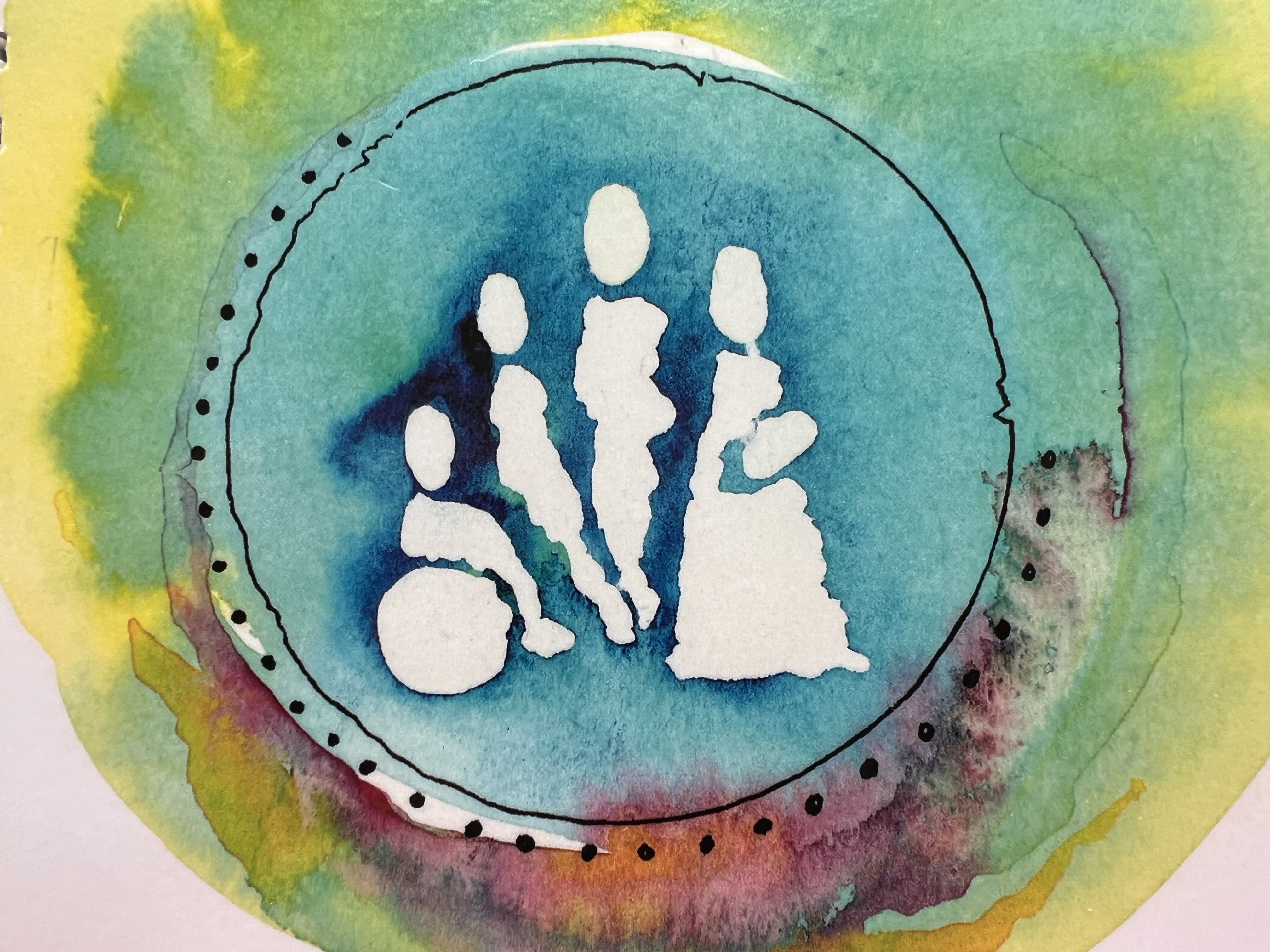
Artwork by Wendy Newbery on the front cover of Laura MacGregor & Allen Jorgenson “Beyond Saints and Superheroes: Supporting Parents Raising Children with Disabilities”
(published by Mad and Crip Theology Press, 2023)

The stories of healing in the Gospels show Jesus in action – doing what he has been called by God to do. But compared to the other Gospels in the New Testament – Matthew, Luke and John – the narrative that Mark writes to describe Jesus’ activity goes along at a hurried clip. Mark’s story-telling style sails along quickly.

In today’s reading from Mark (Mark 7:24-37) we witness two healings which are told one after the other in Mark’s compressed and concise manner:

First, a young girl is healed, the daughter of the Syrophoenician woman – a Gentile. Then, giving us time only to take a quick breath, Mark tells of a deaf man being healed – a man from the Gentile region of the Decapolis near the Sea of Galilee. Jesus, it feels, is on pace for logging in another eighty-hour work week.

But lest we get side-tracked by Mark’s style or distracted by our fascination of and fixation on the miraculous in these accounts, notice today the pains Mark takes to convey the details of identifying who these people are that Jesus heals. Mark had to be intentional in noting their identity, otherwise he would not have tolerated such excessive verbiage in his brief, succinct script. He wanted to emphasize an important aspect of God’s mission in Christ Jesus.

But it’s not the individual names of the woman’s daughter and the deaf man that Mark shares. It’s where they are from. That’s the point. Mark wants the followers of Jesus to get very clear on the social group, the cultural identifier to which these individuals belong.

Belong. Belonging.

The new school year brings to focus how we belong. After emerging from a summer break marked by individual endeavours and pursuits, summer jobs, private family gatherings, vacations and trips, going to school brings everyone together. Going to school highlights our collective being and our socialization. For many of us, it was schooling that first introduced us to the notions of belonging or not belonging.

It is our experience in school where we learn the criteria, said or unsaid, for what it means to feel part of a community. Do we measure up? Are we good enough? Do we pass the grade, socially and academically? Is our voice heard? Where do we fit, jocks or nerds, science geeks or social rebels, artists or conformists?

How do we belong? Unfortunately, school can create not just positive but also negative experiences about how we belong.

Deacon Michelle Collins in the ELCIC writes that it is possible to belong based on personal initiative, worth, performance, joining a group through membership or application (Collins, 2024). This is the way of the world, isn’t it?

But belonging, according to the Gospel, goes in another direction. Collins (2024) writes that belonging, according to the Gospel, happens because someone is chosen to belong. Belonging is initiated by the chooser and is not contingent on the merit or initiative of the chosen. Belonging, first and foremost, is a gift. Belonging is a particular kind of gift.

Jesus showed no favouritism in his healing ministry. In the second reading from James (2:1-10), Christians are instructed – using the very words from the Gospel, to love others as you love yourself – to show no favouritism. And, James is particular about how we do good works according to the Gospel.

Because Jesus showed no partiality in loving people. Wherever he travelled throughout Palestine, he engaged people in life-giving ways. Jesus shared God’s love to everyone he encountered, even those deemed outsiders or non-deserving. Jesus, by his actions, demonstrated that everyone belongs to God’s community. Without exception.

God chooses you and not because you’ve done well to prove yourself worthy according to our human criteria, conditions, biases, perceptions, achievements or values. God chooses us; therefore, we belong.

Dr. Temple Grandin was born with autism. She didn’t speak until age 4. Her neurodiversity may have been considered a handicap, a negative. As a result of this kind of negative thinking by others, she may have experienced being excluded, marginalized, not belonging.

But her talents and abilities were recognized and supported, thankfully. She is credited for inventing a special livestock restraint system. Her design aimed to calm the cattle down before slaughter, thus making the whole process more humane. Today, Temple Grandin teaches at Colorado State University and makes meaningful contributions to society (Grandin, 2024).

The purpose of the Gospel is to remind all who read and hear it that they are chosen unconditionally by God. Because we belong to God, our relationship with the world is reoriented. We have been changed by being chosen. The reality of unconditional belonging releases us from seeking to belong based on performance or merit. We don’t have to win anyone’s approval because we are already God’s beloved. And we can accept others without condition because they, too, are God’s beloved. Their voice, too, needs to be heard.

Thanks be to God!

References:

Collins, M. (2024, August 26). Belonging as gift. Eternity For Today, www.eft.elcic.ca

Grandin, T (2024). Temple Grandin is the 2024 lifetime achievement award winner. RDC Design Group, www.templegrandin.com

Grace changes us

Imagine you and a friend standing on one side of a tall brick wall. Your friend peers through a tiny, narrow hole and is able to see what’s on the other side. Your friend notices water cascading down like the way water streams off a roof in a downpour.

“It’s raining,” your friend declares with conviction while looking through his very narrow hole.

“Is it really?” you ask, “Is that the truth?” There’s a ladder leaning against the wall nearby, so you climb up to look over the wall. And what you see paints another picture.

A water pipeline runs along the side of a building and has ruptured just in front of, and slightly above, the tiny hole your friend was peering through. Alas, it isn’t raining after all. But you can understand why your friend thought it was.

It’s now up to you to help your friend understand the truth for themself. Will your friend be willing to change their mind and consider another point of view? Will you help them climb the ladder to see for themself? What will you do if your friend continues to insist and persist in believing it is raining on the other side of the wall?

Now, switch roles. Now, you are the one peering through the hole. You are convinced it is raining. What do you say and what do you do when your friend says otherwise?

I’ve just used a metaphor. What is a metaphor? In the context of faith talk, it is something we encounter in our daily lives that lifts up a meaning for us in relation to the story of faith we receive from the Gospel, the bible and what we have learned in the church. We encounter during the course of daily life people, events, experiences and we observe in nature something that reminds us of the faith story.

Using metaphors in faith talk is appropriate. Jesus taught using parables, talking about mustard seeds, fig trees, lost coins and sheep. Abraham and Joseph dreamt. God told Abraham his descendants would number the stars in the sky. In the Gospel today from John 6, Jesus talks about flesh and bread and blood. Of course, we can’t take any of these metaphors literally. They are images that embody meaning for each of us. Metaphors offer us a way to discover fresh perspectives and new learning to renew our faith. So, here is another metaphor ….

Kingdom of the Planet of the Apes (2024) is a post-apocalyptic film, the fourth movie in the Planet of the Apes franchise. All four movies revolve around the character named Caesar, who is an ape.

Early in the days after a virus wiped out most of humanity, Caesar was instrumental in leading the movement to help apes and humans coexist in peace, living together, sharing the land they inhabited.

Of the humans that survived the virus, most had lost the ability to speak and think intelligently. There were exceptions. One of the main characters in this film, May, is able to speak and is very smart.

The virus had another, unexpected effect: It gave apes the ability to speak, matching an intelligence comparable to what humans once had. Apes are now high functioning communicators.

In this latest film it is Caesar’s legacy which is at stake among the apes who now dominate the world. This movie begins with a dramatic scene of the ape clans burning Caesar’s lifeless body on the funeral pyre. Caesar is now dead. And how will his legacy be preserved?

Proximus Caesar is the tyrannical king of the Coastal Ape Colony, a rogue clan of apes that claim to follow the ways and teachings of the late Caesar. Proximus Caesar is the bad guy, who justifies his lust for power by calling on Caesar’s name and words to rally his troops to dominate all other apes and species on the planet. He twists and distorts Caesar’s words, interpreting Caesar in a way that is not true to Caesar and what Caesar originally stood for and valued.

Our main character, a young ape called Noah is on a journey to find his own clan which was attacked and enslaved by Proximus Caesar. On his way he encounters an old ape who was learned in the ways of Caesar and his time. His older friend maintains an interpretation of Caesar that is truer, and insists Noah keep Caesar’s memory in its rightful place.

Eventually both Noah and May are captured by Proximus. An important scene in the movie has Proximus invite his special human guest and Noah to a table for a feast. A private audience with Proximus Caesar appears on the surface a privilege and an honour. That’s the pretence.

But this meal has another sinister purpose, not fundamentally to show hospitality and generosity but to elicit vital information Proximus needs in order to secure the power he craves.

Here is not a table of grace, of communion. Here is not a table celebrating the bond of friendships crossing the boundaries of race and species. Are their tables like this in your life where the pretence of love is overshadowed by unholy intentions?

It seems both our main characters, Noah the ape and May the human girl, are caught in between divided loyalties despite the friendship growing between them. The conflict is heightened around that meal scene, as Proximus tries to drive a wedge of mistrust between them. Proximus entices Noah to be more suspicious of May’s intentions.

Proximus is not altogether wrong, as May relentlessly pursues her secret mission to retrieve a small computer from a fortified facility along the coast into which Proximus tries to gain entrance. May had earlier deceived Noah, pretending she like most other humans couldn’t speak. In the end, she confesses this to Noah and pleads forgiveness. But the damage has been done, and Noah never fully trusts her.

Jesus invites his disciples to another kind of table — the table of wisdom, of communion, of divine love. Jesus tells his disciples that he is the bread in which we find our true sustenance (John 6:55-56) to live out God’s legacy, which is the Gospel of God’s unconditional grace and love in Jesus’ name.

But so many voices compete in the religious landscape. Whose voice is truer? How can we tell? How is Christianity being interpreted?

Right up until almost the end of the movie, we are left wondering if May and Noah, humans and apes, will ever be able to live together in trust and peace. It doesn’t look good by the end of the movie.

Until the very last sequence of scenes. Because the last scenes depict both May and Noah looking up.

Earlier in the movie, Noah had discovered an observatory with a huge telescope still operational aimed at the night sky. After liberating his clan from Proximus’ enslavement, Noah brings his clan back to the telescope. The last scene shows Noah’s face and eyes open wide as he looks up and into the expanse of the heavens above with curiosity, and wonder.

Then we switch to May who is also looking up. But she, now, far away from Noah, is looking at the giant satellite dishes. The computer she found was able to activate them so her tiny group of humans could communicate with other humans around the planet. May is looking up into what is now beyond her capability and efforts thus far. Her mission is over. May is looking up at the forces beyond her control now.

Both May and Noah leave us hopeful at the end. Both, separated by divisions still rife, turn their gaze upward and beyond who and where they are. Their open eyes and looks of wonder leave us hopeful that something bigger than either of them will guide them into a better tomorrow.

Whether or not we are aware, despite all our good intentions and efforts, and in the midst of all that separates Christians, Jews and Muslims, God is there. The Kingdom of the Planet of the Apes is a metaphor for how it is among creatures who share this earth, how we often don’t get along and sometimes get along. But there is always hope and a way forward when all of us look up towards what is bigger and larger than each one of us.

I started with a metaphor which involved a ladder. There’s a famous ladder in the bible as well. I love the scene at the end of Jacob’s encounter with God through the night (Genesis 28, 32). He has dreamed of a ladder reaching to heaven, and he has also struggled while he slept. When Jacob finally awakes and changes his thinking at the dawn of a new day, he discovers who has been with him all along. He says to God, “You were here all the time, and I never knew it!” (Genesis 28:16).

That’s grace.

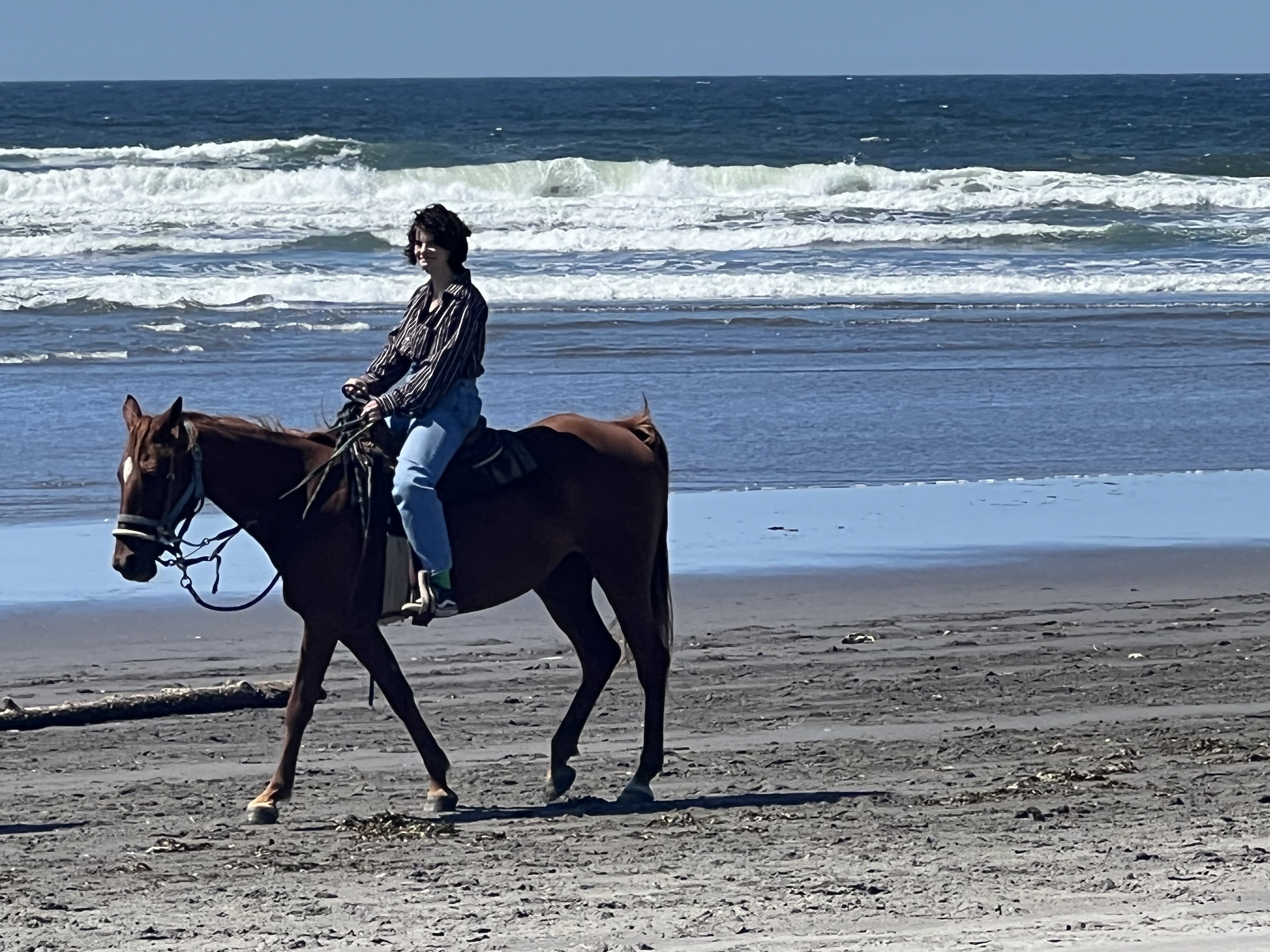
Walking on Long Beach, Tofino (photo by Jessica Hawley Malina July 12, 2024)

Can you believe it?

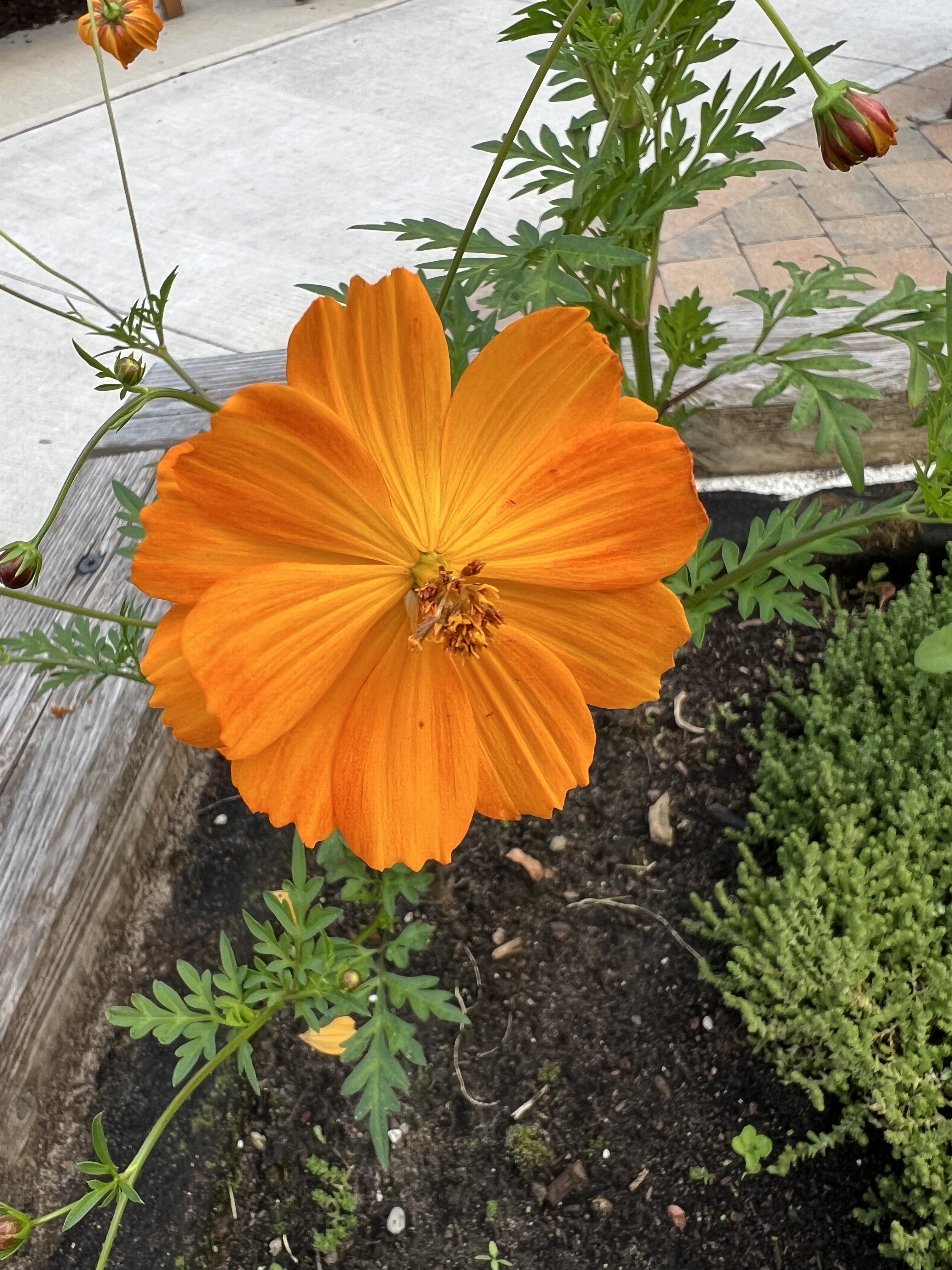
Around Mother’s Day, this past Spring, Jessica gifted my mom a small sleeve of cosmos seeds. Mom then planted them in the community garden in the backyard of her retirement residence.

Residents there take great pride in the flower garden that each year yields a spectacle of colour and shows off their gardening skills.

Before leaving for our West Coast vacation last month, my mom was delighted to report that the first flowering buds were appearing on her cosmos plants.

Two and a half weeks later, when I returned to observe the progress of the cosmos, I had to blink and pinch myself. Was I looking in the right place in the sprawling garden? Because those cosmos flowers were not where I thought they had been.

My mom then told me the drama that had ensued at the retirement home in the time I was away. Someone in the building had ripped out her cosmos. And they were found discarded in the garden shed atop the compost heap. After my mom reported what happened to the front desk, to staff and her friends there, everyone at the home soon knew of the offence. But no one came forward. Who dun it?

As the Sherlock Holmes investigation went into high gear, my mom’s friends quickly retrieved the limp stems from the garden shed, put them in a bucket of water, and a few days later replanted them in another spot in the garden, and soaked the ground with water.

Hoping against hope, they nevertheless warned my mom the ripped out flowers probably didn’t have a chance as it had been over 24 hours they had lain in the hot shed.

One evening the following week, a resident a few doors down from my mom’s room quietly took. my mom aside after dinner and whispered into her ear that she had seen something from her fifth floor balcony the day of the incident.

The culprit was identified, someone who when gently confronted confessed they thought the cosmos looked too much like a weed; and, besides, it didn’t fit in the otherwise manicured looking part of the garden where the flowers had been originally planted. The deed was quickly forgiven, as miracle of miracles, the transplanted cosmos flowers not only lived but thrived in their new location. What drama! What a miracle!

Despite a mistaken floral identity, despite misguided intentions and conflicting visions for the garden, despite the almost certain prognosis of death for the ripped-out cosmos, grace happened.

The Gospel for today from John (6:35,41-51) presents a far more troubling reality for Christians. This troubling reality is a stain and a blemish on Christian history since the time of Jesus. The Gospel writer John specifically mentions “the Jews” (John 6: 41) as complaining and debating against Jesus. Here we glimpse into what John does a few times in his Gospel: portraying Jews, as a whole, rejecting Jesus.

Perhaps this portrayal was understandable from John’s perspective, if it was a response to the persecution of his community by Jewish neighbours in the latter part of the 1st century (Oldenburg, 2024) when this Gospel was first written.

But in the centuries since, it has been Christians who have persecuted their Jewish neighbours, in both subtle and violent ways, and often using John’s gospel as an excuse. Particularly after the Holocaust in the last century, today’s reading, like Good Friday’s, cannot be proclaimed without acknowledging how this gospel has been used to justify not only hate crimes against Jews but by extrapolation any race, culture or religion distinct from ours including Arabs, Muslims and Palestinians.

Retribution is a blight on humanity. From disputes in the garden to geo-political conflict, it seems humanity is destined, if anything, to continue the senseless escalations of a tit-for-tat mentality. Can it ever end? Like the ripped-out cosmos, reconciliation and peace really appear hopeless, causes destined to die on the growing pile of dashed dreams and unattainable aspirations.

I sympathize with the prophet Elijah’s impulse to just escape and hide. Jezebel threatens and warns violent retribution against Elijah. In a way you could say Jezebel’s intent is justifiable after Elijah himself killed the prophets of Baal (1 Kings 18-19). Elijah therefore gets out of dodge, feeling defeated, vulnerable and depressed. He will give up and disappear into the wilderness. What was the point of his prophetic role anyway if he was just going to be killed at the hand of the enemy?

At his lowest point, ready to die under the broom tree, Elijah experiences grace by the miraculous appearance of life-sustaining bread. Even though he was mistaken to leave his followers and run away from his prophetic duties, Elijah is looked after. Even though he was mistaken, Elijah is nevertheless sustained. Even though his thinking on the matter was flawed, it doesn’t stop God.

God has not given up on him. God’s love and favour are not dependent upon Elijah’s morality, wisdom, or consistency, but upon God’s reliability. God’s grace is not dependent on how many mistakes we make, whether or not we make the right decisions all of the time. Judgement is not God’s first response.

God is faithful. And the life God has given to creation will therefore ultimately find a way. The angels attended to Elijah on his escape path in the wilderness. Just like the angels attended to Jesus when he was tempted in the wilderness (Mark 1:12-14). We are never completely separated from God’s gracious, loving presence no matter how deep and far our wilderness wanderings, no matter how deep and far our grief, our depression, our never-satisfied longings.

We all get stuck in killer cycles – be it retribution, anger, fear, despair, anxiety. God will not be phased by any of it. When Elijah is fed and makes his forty-day journey to the holy Mount Horeb, God meets him there and says, “Why are you here?” (1 Kings 19:8).

Get up and get going! God will be with you and give you what you need for the journey ahead. And God will continue being ever-faithful, ever-gracious, ever-loving.

Reference:

Oldenburg, M. W. (2024). Crafting the sermon; Looking at sunday, august 11 lectionary 19, year B 12th sunday after pentecost. Sundays and Seasons. Augsburg Fortress. https://www.sundaysandseasons.com

Into the night

Sunset over Clayoquot Sound, Tofino BC, July 12, 2024 (photo by Martin Malina)

I find it bemusing that the crowd in this week’s Gospel reading (John 6:24-35) is still asking for signs. How many do they need? In the first verse of John 6 from last week’s Gospel, “they saw the signs that [Jesus] was doing for the sick.” And then, after the Feeding of the Five Thousand, the Gospel concludes by validating the faith of the crowd: “When the people saw the sign that he had done, they began to say, ‘This is indeed the prophet who is to come into the world’” (v. 14).

The crowd’s appetite for signs, for proof, is insatiable. It’s like we are never satisfied. Nothing is ever good enough. There is always something wrong that needs improvement. You hear this from, ironically, players on winning sports teams never mind losing ones, when they say: “We can always get better.” Yes, but, what do they expect? That they can play a perfect game? Really?

The religious craving for signs feels a little bit like what is defined today as “spiritual materialism”. Spiritual materialism feeds off ‘signs’. It just leaves us wanting for more but with the expectation that we have to earn it by our accomplishments, and by possessing greater truth for ourselves. It’s tied in with the world’s values and that prosperity gospel notion – a way of doing religion in which we are never permitted to be content with imperfection. We can therefore never allow ourselves to be at peace.

If something I perceive is wrong I need to figure it out. I need to be better and work harder. Fix it. I must hone my skills of discernment, so that in the end I can own or discard the proposition based on my own interpretation thereof never mind what someone else thinks. On this path, everything I perceive is bad must be purged and eliminated. I therefore live in a constant state of vigilance, unrest, and discontentment.

You ask: Do we not want a deeper communion with God? And, can we not learn to tell the difference between right and wrong, good and bad? Absolutely, we can.

But Jesus suggests a way of life that does not deny the two are inextricably entwined. The weeds and wheat must grow together (Matthew 13:34-40), according to a teaching of Jesus. If we are going to grow in faith, we need to learn to live with and accept both realities.

Jesus talked about the mustard seed, which is both good and bad. Pliny the Elder, a contemporary of Jesus, wrote that the mustard seed was medicinal, so it did have some value. But Pliny the Elder advised against planting it because it tended to take over the entire garden. It was a weed that could not be stopped (Rohr, 2024).

Sometimes what we need is found only by embracing those difficult times in our lives as doorways to experiencing God in a whole new and wonderful way.

Because what we need is not validated by proof. What we need is not immediately perceived by observation alone. Let me give you an example. Today, many of us observe all that is not well in the world. And, there is definitely evidence that will support that proposition. These days are like nighttime when the world is blanketed by shadow and ash.

Ironically it is only at nighttime when we can see the stars shine brightly. When we look up at night our spirits rise to the brilliance of the pinpricks of light against the night sky. Ironically it only when we engage, accept and not avoid nor deny our doubts, our pain and the difficulties of life, that we discover a grace of God, a gift or a help coming from a place we never expected.

People of faith through the centuries have used this metaphor of the nighttime for how they still kept faith through their suffering. How did they do that? Did they know something we don’t? Or are they aware of a reality that exists beyond evidence of what we observe on the surface?

You see, those very stars that shone so brightly for us during the nighttime, are they gone during the daytime? Have they magically disappeared? Well, no. Those same stars are shining just as brightly in the daytime. We just don’t see them. But they are still there.

The brighter our surroundings, the more difficult it is to see the stars. And yet, during the daytime of our lives, those are the good times we say. During the day when our sun/star is shining brightly everything is going accordingly, to plan. During the day when our sun/star shines, all is well, and everything is just so.

We cherish those memories of the way things were – so right, so beautiful – in the past. When we could see it all. And everything was as it should be forever more. And so, as I said, we grieve today, that it will never be the same again.

It is significant that Jesus provides a way forward, albeit somewhat cryptically, in his response to the crowd seeking a sign. He says, in today’s Gospel, “… you are looking for me, not because you saw signs, but because you ate your fill of the loaves” (v. 26).

In other words, you connect with God not because you ‘see signs’ but because you experience something that moves you to act. Manna has a purpose. You connect with God not because you’ve figured it out beforehand in your head, but because you receive God’s grace in the wilderness of your life to move on and do what needs doing.

Remember, when all you had was the simple manna that nevertheless sustained you through that difficult time (Exodus 16:2-4, 9-15). It was during the tough times that God’s presence was made manifest, that God was made real to you in the breaking of the bread. And so it is, today.

At the beginning of my vacation Jessica and I attended a Christian Meditation retreat whose theme was “From anxiety to peace”. Our theme speakers reflected on anxiety not as something to deny or try to get rid of on the journey of faith. Healing doesn’t come by denying the reality of what is, including all our thoughts, feelings and behaviours good and bad.

Rather, we were challenged to consider anxiety as the invitation towards peace, the doorway through which we discover deeper understanding and clarity of thought, teaching us to be ok. The wilderness night times offer a way to experience hope by accepting and seeing with the mind’s eye the small wonders of God’s love made real to us. And therefore we don’t need to let fear be our guide.

What are the stars shining in the night for you? The little things that you might miss in the daytime? Those things we easily take for granted? People and situations we overlook in all our hurry?

God, give us peace. God, give us courage.

Reference:

Rohr, R. (2024, July 30). A gracious weed: The reign of God. Daily Meditations, Center for Action and Contemplation. https://cac.org/daily-meditations/a-gracious-weed/