
In the Gospel last week Jesus healed someone with an unclean Spirit.[1] This week, Jesus heals again, not only Simon’s mother-in-law but many others with all kinds of different problems.[2] What does it mean that Jesus heals us?
The language has changed in two thousand years. What healing was to people in the first century was expressed in language that has evolved over time. Today, the language we use to describe health, wholeness and healing assumes medical advances and understandings of how our bodies and brains work—something the authors of the letters, books, poetry and sermons of the bible didn’t yet know about.
It’s not to say there is no truth in the words of scriptures. It is to confess, however, that the means of conveying that truth—the language—has changed. Because our perspective has deepened. We have learned more, over time.
Listen to these predictions made almost a century ago, about computers. In 1949, a Popular Mechanics writer predicted, “Computers in the future may weigh more than one and a half tons.” And an IBM executive in 1943 observed, “I think there is a world market for maybe five computers.”[3] Despite their erroneous predictions, computers have since the 1940s changed in size, weight, speed, memory capacity, and market value. And they are an integral part of how we must effectively engage with others and the world today.
Technology is like language. Language is a tool. And while fulfilling an important purpose, tools change with changing needs.
Today, it’s Artificial Intelligence (AI). Maybe one thing we can learn from the mistakes the IBM executive and Popular Mechanics magazine made in the 40s is not to be too certain about our predictions about AI. You never know.
There are, nevertheless, some insightful comments made by those who work closely with AI development. They point to how the technology affects people and what we value. The development of AI presents a desperate need for compassionate, loving human interaction in this world, called “soft skills”.
Although technical skills will always help someone develop an expertise, the research suggests that in the age of AI, ethics skills are more valuable than ever.[4] People who develop and work with AI need to become ethicists to preserve authenticity and trust. Interpersonal communication is another in-demand skill in this field; that is, the ability to build real relationships.
So, what does this have to do with healing? Let’s look again at the Gospel. Jesus heals. That’s what Jesus does: he seeks the healing of all people. The emphasis in this text is on healing for the sake of a good and better life-on-earth, for us and for all people. Jesus came so that we might have “life abundantly”[5] because “God so loved the world.”[6]
God so loved the world, at the time when those words were first written two thousand years ago. But God so loved the world, in the 1940s. And, God so loved the world, today, in 2024.
Jesus’ healing today has to do with reconciling people within community, overcoming barriers and whatever separates people. Healing has to do with strengthening relationship and building community.
And, to this end, God has given us the tools we need. Much of our medicine today derives from plant-life, in other words, from God’s good creation. Our healing from God is found in the gifts God has already given to us in our natural environment.
Listen to this definition of medicine from an Indigenous writer: “Medicine is in every tree, plant, rock, animal, and person. It is in the light, the soil, the water, and the wind. Medicine is something that happened ten years ago that still makes you smile when you think about it. Medicine is that old friend who calls you up out of the blue because he or she was thinking about you. There is medicine in watching a small child play. Medicine is the reassuring smile of an elder. There is medicine in every event, memory, place, person and movement. There is even medicine in empty space if you know how to use it. And there can be powerful medicine in painful or hurtful experiences as well.”[7]
Let’s remember Jesus’ healing didn’t prevent people from dying eventually from something. Healing is not some magical cure for your problems. Healing is not the total eradication of disease from life on earth.
When Jesus healed he showed us, gave us a picture, of love-in-action, healing that happened in community, not in private. Notice the healing was always in the presence of another. That’s how we know these healings happened! There was always somebody around – if not in the crowded synagogue, in a crowded house and in the streets and byways.
Healing is what happens when there is loving connection with oneself, between oneself and others, between oneself and the natural world, between oneself and the Divine. There is balance in all those parts that make us who we are.
And God loves it all. God wants us to know and feel that love. Jesus couldn’t wait to get on to the next town and village to share the message of and demonstrate God’s love-in-action!
Today is Global Mission Sunday in the ELCIC. In Bishop Johnson’s sermon for today,[8] she reflects on our relationship with the Evangelical Lutheran Church in Jordan and the Holy Land (ELCJHL). In the midst of all their troubles, especially war, they continue to live in hope and faith.
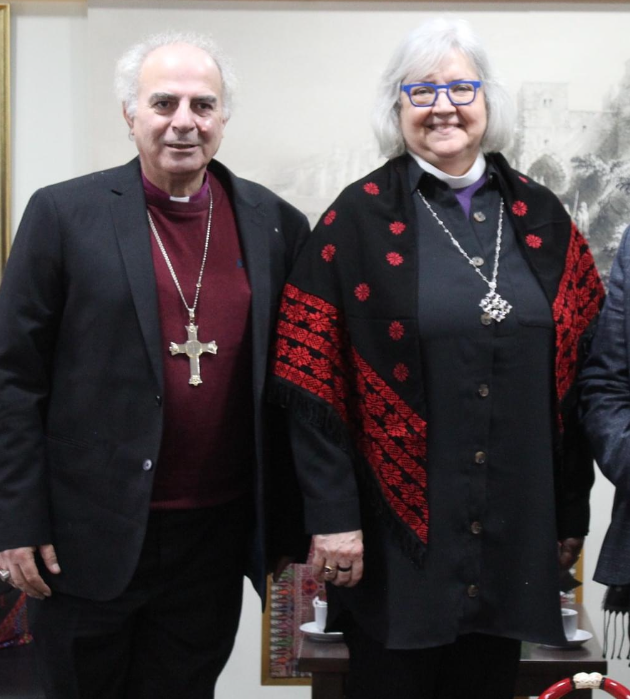
Bishop Susan was actually in the Holy Lands last month, and talked with Bishop Ibrahim Azar about the very toned-down Christmas they had just experienced. She asked him how it had gone and he said to her how hard it was. “But,” Bishop Azar said, “Christ was born again in our hearts.” Christ was born again in our hearts.
If the ELCJHL can be faithful and continue ministry in their extremely difficult circumstances— keeping congregations and schools open and serving those in need, what about us?
Here’s a prediction that cannot be denied: We can certainly continue with faith and hope in the midst of the challenges we face!
Thanks be to the God, who continues to heal in Christ’s name, we pray. Amen.
[1] Mark 1:21-28
[2] Mark 1:29-39
[3] Ed Bowen. (2024, January 18). Hold Fast to the Truth. Eternity for Today.
[4] Peter Cardon. (2024, January 23). The Future of Work: New study finds AI makes employers value soft skills more. Fast Company. https://www.fastcompany.com/91012874/new-study-finds-ai-makes-employers-value-soft-skills-more
[5] John 10:10
[6] John 3:16
[7] Garrett, M. T., Garrett, J. T., & Brotherton, D. (2001). Inner circle/outer circle: A group technique based on Native American healing circles. Journal for Specialists in Group Work, 26(1), 17-30.
[8] Click here for Global Mission Sunday resources (ELCIC, February 4, 2024).



 Raspberryman